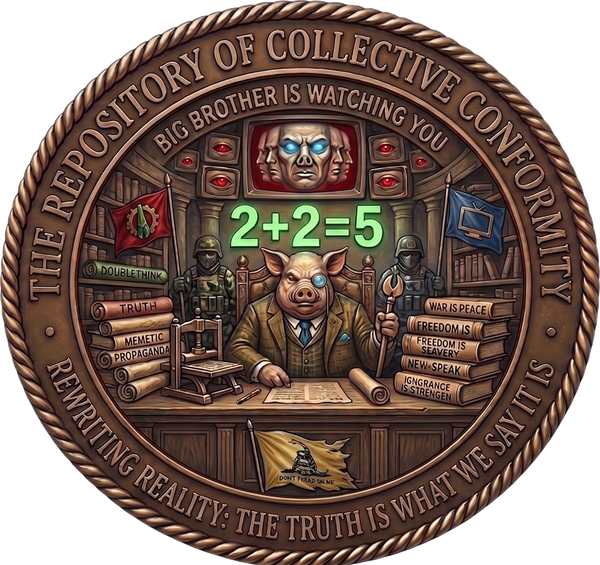
The Repository of Collective Conformity
Images filed by hand. Nothing here is machine-made.
“Rewriting Reality: The Truth Is What We Say It Is.”
Every image here was uploaded deliberately.
The Gremlin’s own output lives in the Ledger, not here.
Everything in the manifesto is built to last. This page is built to expire — and that is the point.
The news cycle is the most efficient amnesia machine ever constructed. A story arrives, the feed convulses for a week, and then the machine hands you the next one — and whatever question the story raised leaves the room with it, unanswered. The manifesto’s closing article on the machine explains how that works. This page is the countermeasure: when something in the spotlight touches a principle the codex defends, it gets written down here, now, while you still care — measured against the same first principles as everything else, dated, and signed. Entries stay dated forever; the date is part of the record. If the principle underneath one proves permanent, it earns promotion to a numbered article in the manifesto. The feed forgets. This page doesn’t.
№ 139 · Filed October 15, 2026 — On Monday, October 12, 2026, about twenty Homeland Security agents searched a sitting congresswoman’s Washington home, carried out her phone, laptop, passport and notebooks, and subpoenaed roughly a dozen of her relatives — including her sister. No one has been charged with anything. This dispatch is the thing the raid makes almost impossible to find: a cold, sourced separation of what is proven about Ilhan Omar from what is merely shouted. THE RÉSUMÉ: how a girl born in Mogadishu and raised four years in a Kenyan refugee camp became the first Somali-American in Congress. THE MECHANISM: how she actually got her citizenship — automatically, as a minor, through her father, under a 1952-vintage law most of her accusers have never heard of — which is why “she used a fake name to sneak in” collapses on contact. THE LEDGER: every major accusation sorted into proven, unfounded, false, untested, and genuinely open — because they are not all the same, in either direction. THE BROTHER: the ten-year-old claim, the circumstantial case for it, the fact-checkers who could neither confirm nor kill it, and the four records questions she has never actually answered. THE RAID: what was seized, who was subpoenaed, and the judge who quietly reined the whole thing in. And then the question the title is built around: fraud case, or witch hunt? Charts, dates, and receipts.
The Omar File — How a Refugee Became a Congresswoman, How She Actually Got Her Citizenship, Which Accusations Are Proven and Which Are Smoke, and Whether a Dawn Raid Three Weeks Before an Election Is a Fraud Case or a Witch Hunt

I. From a Refugee Camp to the House Floor
Start with the life, because almost everything that follows is an argument about whether it was honestly lived. Ilhan Omar was born in Mogadishu on October 4, 1982, the youngest of seven, into an educated Somali family — her father, Nur Omar Mohamed, a teacher-trainer; her grandfather a director of the national marine-transport authority. Her mother died when she was small. When the Somali Civil War detonated in 1991, the family fled; Omar was about eight. They spent roughly four years in the Dadaab refugee camp in Kenya — then the largest refugee complex on earth — before the United States admitted them as refugees in 1995, when she was twelve. They landed first in Arlington, Virginia, where the sisters famously learned English partly off the television, and moved to the Somali neighborhood of Cedar-Riverside in Minneapolis around 1997.
The rise was fast and, by the numbers, enormous. She graduated Minneapolis’s Edison High in 2001, took a political-science and international-studies degree from North Dakota State in 2011, and worked as a community nutrition educator, a DFL organizer, and a city-council aide. In 2016 she won a three-way DFL primary to unseat Phyllis Kahn, a forty-four-year incumbent and the longest-serving member of the Minnesota House — and became the first Somali-American elected to any state legislature in the country. Two years later she took Keith Ellison’s Minneapolis seat in the U.S. House. Sworn in January 3, 2019, she and Rashida Tlaib became the first two Muslim women in Congress; Omar was also the first Somali-American and the first former refugee to serve there. To let her wear a hijab, the House amended a ban on head coverings that had stood since 1837 — a rule 181 years old. She joined “the Squad,” was stripped of her Foreign Affairs Committee seat on a 218–211 party-line vote in 2023 over past remarks on Israel, and has been returned to her D+30 district by landslides in 2020, 2022, and 2024. That is the trajectory now under a federal microscope: refugee camp to the committee rooms of the Capitol in roughly two decades.
II. How She Actually Became a Citizen
The single most repeated charge — that she “used a fake name” or “isn’t a real refugee” and therefore stole her citizenship — dissolves the moment you learn the boring mechanics of how she got it. Omar did not pass a citizenship test, swear an oath, or file an adult application. She became a citizen in 2000, at age 17, by what the law calls derivative citizenship: when a lawful-permanent-resident child under eighteen is in the custody of a parent who naturalizes, citizenship transmits to the child automatically, by operation of law. In her own words to The Intercept in 2018: “I became a citizen actually before I turned 18… My father became a citizen and so I got my citizenship through that process.”
And here is the technical hinge almost no one citing this case knows about. The rule people reach for — the Child Citizenship Act’s modern “one citizen parent is enough” standard (INA § 320) — took effect February 27, 2001, and is not retroactive. Because Omar naturalized in 2000, her case was governed by the older, now-repealed former INA § 321, which generally required both parents to naturalize before the child turned eighteen — with explicit exceptions, one of which is a surviving parent where the other is deceased. Omar’s mother had died in Somalia; derivation through her father alone fits that exception cleanly. This is why the serious version of the investigation is not “fake name.” It is narrower and more technical: whether her late father misstated her age (to keep her under eighteen) or omitted his own past when the family obtained status — questions about his paperwork, decades ago. Be honest about the real soft spots: her father’s exact naturalization documents are not public, Omar has never released her own immigration file, and her father died in June 2020, so he cannot be asked. Those gaps are genuine. They are also not the same thing as proof.
III. The Ledger — What’s Proven, What’s Smoke
The accusations against Omar get laundered into a single undifferentiated cloud of “corruption,” and that is the trick. They are not one thing. Some are fact-checked false. Some are formally proven and she was sanctioned for them. One is a live, unresolved criminal question. Sorting them is the whole job — so here they are, each with its actual status on the public record.
Ten years of accusations, sorted by what the record actually shows
The same charge-sheet, graded. The point is not that she is clean on everything or dirty on everything — it is that these claims live at wildly different evidentiary altitudes, and collapsing them into one is how both her defenders and her accusers lie.
IV. The Brother — the Claim That Will Not Die and Cannot Be Proved
The engine under all of it is the 2016-vintage claim that Omar married her own brother to commit immigration fraud. The established, uncontested fact: Omar was legally married to Ahmed Nur Said Elmi, a British citizen, from 2009 to 2017, per Hennepin County records — during a stretch when she was also, by her own account, in a religious (non-legal) marriage with Ahmed Hirsi, the father of her children. The contested part is whether Elmi is her sibling. The affirmative case was built over three years by conservative writer David Steinberg at PJ Media: overlapping family names in the Somali patronymic chain (“Nur Said Elmi”), St. Paul school records for an “Ahmed N. Elmi” whose date of birth matches the man on Omar’s marriage certificate, witness statements, and photos he says show the two together in London in 2015 — after she’d sworn in a 2017 divorce filing that she’d had no contact with him since 2011. Omar has called it, consistently since 2016, “absurd and offensive” and “disgusting lies.”
Every neutral reviewer who has actually dug into it has landed in the same uncomfortable spot: they cannot prove it, and they cannot kill it. Snopes investigated and rated the claim “Unfounded” — “the absence of demonstrable evidence” — and noted a logical hole in the fraud theory: Omar’s refugee paperwork lists her as the youngest of seven with no Ahmed Nur Said Elmi among the siblings, and a genuine brother would have had his own path to status (a sibling petition), with no need to marry his sister. PolitiFact declined to rate it at all, “unable to reach a conclusion.” The Star Tribune’s own 2019 records investigation concluded it “could neither conclusively confirm nor rebut” the sibling allegation. The reason the question is genuinely unresolvable on public evidence is grim and simple: Somali civil records from the war era are largely gone, the relevant immigration and school files are sealed by privacy law, Elmi has never spoken publicly, and no birth certificate or DNA test has ever surfaced on either side. Steinberg’s case is circumstantial and has never been adjudicated; Omar’s rebuttal is a denial and a refugee manifest, which is also not dispositive.
Intellectual honesty cuts the other way too, though, and this is where her defenders go quiet. Four things in the record remain genuinely unexplained. She entered a legal marriage with Elmi in 2009 while religiously married to the father of her children — and never fully explained why. Her 2011 religious divorce from Elmi was not matched by a legal divorce until 2017 — a six-year gap. She filed joint tax returns with Hirsi for 2014 and 2015, years when she was still legally married to Elmi, not Hirsi — a fact confirmed by the campaign-finance board, and squared with nothing. And the family’s social-media accounts were scrubbed exactly as the questions gained traction. None of that proves a sibling relationship. All of it is a legitimate reason the question never fully died. The precise, defensible statement is the one almost no headline will give you: the marriage is fact; the brother is an unproven allegation that the public record can neither confirm nor refute.
V. The Raid — What Was Actually Seized, and the Judge Who Reined It In
What happened on October 12 is not rhetoric; it is the most aggressive step the government has ever taken here, and it deserves to be stated precisely. Around twenty Homeland Security Investigations agents executed a court-authorized search warrant at Omar’s Washington, D.C. home. The warrant lists potential offenses of false statements, immigration fraud, and conspiracy, and centers on whether her late father lied or omitted facts — including her age — on immigration paperwork in the 1990s. Agents seized her cell phone, and per CNN and MSNBC also her laptop, passport, and notebooks; Omar was present and declined to give agents her device passwords. Separately, grand-jury subpoenas — “roughly a dozen” — went to her relatives and associates, explicitly including her sister, Sahra Noor. And on a third, unconnected track, U.S. Attorney for D.C. Jeanine Pirro confirmed on Fox News that her office is examining Omar’s financial disclosures — large reported valuation jumps in two businesses tied to her husband, Tim Mynett — a matter her office says is distinct from the immigration case.
Three guardrails belong in the same breath, because they are what the raid’s theater is built to obscure. First: a subpoena is not an accusation and a witness is not a defendant. Sahra Noor is a real, documented sister — a health-care consultant and author — not the mythical “brother,” and she has not been charged with anything; the much-amplified link between her consulting firm and the Feeding Our Future fraud is a shared registered-office address, which even the outlet that broke it concedes “does not prove” participation. Second: a federal magistrate, Judge Matthew Sharbaugh, engaged in a “prolonged back-and-forth” with prosecutors and limited DOJ’s access to the seized material, rejecting the government’s bid for broad access and requiring a Speech-or-Debate-Clause screening to protect her legislative work. A court imposed brakes — which cuts against a pure rubber-stamp. Third, and most important: after all of it — the raid, the phone, the dozen subpoenas — Ilhan Omar has not been charged with any crime.
VI. So — Fraud Case, or Witch Hunt?
The honest answer refuses both of the answers you are being sold. It is not “nothing here” — there is a real, court-authorized criminal investigation into a genuinely unresolved question about decades-old immigration paperwork, and there are records gaps Omar herself has never closed. But the frame around that narrow question is where the phrase “witch hunt” earns its keep. Consider the backdrop against which this raid landed, all of it documented: in July 2019 the President told Omar and three other congresswomen of color to “go back” to their countries (three of the four were born in the U.S.); days later a rally crowd chanted “send her back” while he stood silent for thirteen seconds. Men have been federally prosecuted for threatening to put “a bullet in her skull” and, in 2025, for trying to attack her with a syringe. In June 2025 the DOJ issued a memo ordering prosecutors to “maximally pursue denaturalization” as a top-five priority. Omar is reported as the 17th Democrat investigated in Trump’s second term. And the raid and subpoenas arrived roughly three weeks before the November midterms, in the window when DOJ custom is to avoid overt steps.
The gap between what is claimed and what the government would actually have to prove
Denaturalization is not a tweet; it is a federal lawsuit with one of the highest burdens in civil law. Here is the distance between the rhetoric and the courtroom — and the distance between the dollar figure shouted and the dollars anyone has actually charged.
Put it together and the verdict writes itself — in both directions at once. The loudest charges against Ilhan Omar — the brother, the fake name, the forty-year prison sentence, her personal ownership of “$19 billion” — are, on the public record, false, unfounded, or untested after ten years of looking. The only thing ever proven is a $3,469 campaign-spending slip. There is a real, open question about her father’s paperwork, and she has left real gaps unanswered — so this is not a hoax. But a narrow, technical, decades-old records question does not explain a dawn raid, a seized passport, a dozen subpoenaed relatives, and a “maximally pursue” denaturalization directive, aimed at the 17th Democrat on the list, three weeks before an election, by an administration whose own supporters chanted “send her back.” You can hold both facts: the file is not empty, and the machine pointed at it is far larger than the file. When the response to a $3,469 ceiling is twenty agents and a grand jury, the word for the gap between the two is not “proportionate.” Charts, dates, and receipts.
Sources. Biography & rise: Wikipedia and Britannica, “Ilhan Omar”; MinnPost and MPR News on the 2016 defeat of Phyllis Kahn; NBC/NPR/Axios on the February 2, 2023 (218–211) Foreign Affairs Committee removal; Ballotpedia for 2020/2022/2024 results; Washington Times/NBC on the 2019 amendment to the 1837 House headwear rule. Citizenship mechanism: The Intercept (2018) interview (“I became a citizen actually before I turned 18”); USCIS Policy Manual Vol. 12 Pt. H and State Dept 8 FAM 301.9 on derivative citizenship; former INA § 321 (8 U.S.C. § 1432) vs. the Child Citizenship Act of 2000 / INA § 320 (effective Feb 27, 2001, non-retroactive); Yahoo/Reuters (2026) on the age/birth-date focus of the probe; father Nur Omar Mohamed’s June 2020 death. Denaturalization law: 8 U.S.C. § 1451; Kungys v. United States, 485 U.S. 759 (1988); Congressional Research Service LSB11437; TIME (Oct 14, 2026), “Can Trump Strip Ilhan Omar of Her Citizenship?”. The marriage/“brother” claim: Snopes, “Did U.S. Rep. Ilhan Omar Marry Her Brother?” (rated Unfounded) and 2025–2026 updates; PolitiFact (Jul 18, 2019, no rating); Star Tribune, “New documents revisit questions about Rep. Ilhan Omar’s marriage history” and “…jointly filed tax returns prior to legal marriage”; Omar’s 2016 statement via MPR/Fox9; David Steinberg’s PJ Media series and the Power Line summaries (advocacy sourcing, labeled). Campaign-finance finding: Minnesota Campaign Finance & Public Disclosure Board probable-cause determination (June 6, 2019); CNN, Star Tribune, Roll Call, The Hill ($3,469.23 reimbursement + $500 penalty; the $1,500 for immigration records and 2014–15 joint tax filings). The “$19 billion” and Feeding Our Future: Fox News and The Hill on the $19B claim; the figure’s origin as a ~$18B/14-program upper-bound projection by then-AUSA Joe Thompson; Feeding Our Future as a ~$250–300M charged scheme (~92 charged, 57+ convictions), launched under the Biden DOJ in 2022, with Omar charged in none of it. The October 2026 raid: AP, NBC News, NPR, CNN, CNBC, Newsweek on the Oct 12 HSI search warrant (false statements, immigration fraud, conspiracy); CNN/MSNBC/Fox on the seizure of phone, laptop, passport, and notebooks and Omar declining passwords; NYT (first-reported) and CNN on the ~dozen grand-jury subpoenas naming sister Sahra Noor; Yahoo/AP, Legal Insurrection on U.S. Attorney Jeanine Pirro’s separate financial-disclosure inquiry (eStCru LLC, Rose Lake Capital LLC, and Omar’s April 2026 amended disclosure); CNN (Oct 14) on Judge Matthew Sharbaugh limiting DOJ access and ordering Speech-or-Debate screening; Daily Wire (origin) on the Grit Partners / Feeding Our Future shared-address adjacency, uncharged. The hostility & the denaturalization push: CNBC/CBS/NBC on Trump’s July 14, 2019 “go back” tweets; CNN/PolitiFact/NPR on the July 17, 2019 “send her back” chant and the thirteen-second silence; NBC News on the Carlineo (“bullet in her skull”), Hannon, Kless, and 2025 Kazmierczak syringe-attack prosecutions; NPR and the AILA/Greenberg Traurig analyses of the June 11, 2025 DOJ Civil Division memo (“maximally pursue denaturalization”); Newsweek/Yahoo-AP on Omar as the 17th Democrat investigated and the pre-midterm timing. Grounded web research compiled October 14–15, 2026; where outlets conflict (notably the subpoena date — NYT “Tuesday” Oct 13 vs. CNN “last Friday” Oct 9 — and the exact device list), the discrepancy is noted rather than flattened, and every “alleged” is kept distinct from every “established.”
№ 138 · Filed October 14, 2026 — It starts with a question that sounds like wordplay and turns out to be the whole thing: if a “prostitute” and a “whore” are selling the exact same thing, why does one word describe a job and the other end a reputation? This dispatch answers it with etymology, history, and law — no arguing, just the receipts — and it refuses the easy moral in both directions. THE WORD: why “prostitute” is a clinical Latin term for “set up for sale,” why “whore” comes from a root meaning “to desire” (a cousin of “cherish” and “charity”), and the proof that the contempt was never about the commerce at all. THE GOLDEN AGE THAT WASN’T QUITE: where the sex worker was genuinely honored — and the honest flag that the most romantic version of that story is now considered a myth. THE LADDER: whether “pirate queens really came out of the brothels,” and the one woman who proves it by commanding more pirates than any man in history. THE TURN: the datable steps by which the West manufactured the stigma, from a pope’s sermon in 591 to a laundry that stayed open until 1996. THE OUTLIER: why America fully criminalizes this in 49 of 50 states, sharing a bucket with China and Russia, while the rest of the rich world moved the other way. And then the answer the title is built around. Charts, dates, and receipts.
The Scarlet Word — What Actually Separates a “Whore” From a “Prostitute” When Both Are Commerce, Where the Sex Worker Was Once Honored, Who Manufactured the Contempt and on What Dates, and Why America Is the Rich World’s Outlier

I. The Word Is the Verdict
Start with the two words themselves, because the answer is hiding in them. “Prostitute” is a clinical, legal, almost bureaucratic term. It comes from the Latin prōstituere, “to set up out front / expose publicly for sale” — and, tellingly, the Latin roots contain no sex at all, only the image of something displayed for purchase. It entered English around 1530, and it entered as a euphemism — the polite upgrade over the cruder words of the day, “harlot” and “strumpet.” That is why it still reads as neutral: you can say “prostitute” in a courtroom. It names a transaction, a job status, a role.
“Whore” is a different kind of word entirely — and here is the fact that cracks the whole question open: it never meant “seller of sex” at all. It descends from Old English hōre, back to a Proto-Indo-European root *keh₂- meaning “to desire, to be fond of.” Etymologically a whore is “a beloved, a desired one.” The same desire-root branches into the Latin cārus, “dear,” and into the tender English words cherish, charity, and caress. “Whore” and “charity” are etymological cousins. And across the Germanic languages its oldest cognates meant not “prostitute” but “adulteress” — a woman who had sex outside the rules. From the very root, the stain was female sexuality itself, not the selling of it.
Which produces the decisive piece of evidence, and it is sitting in plain sight. The most common real-world use of “whore” and its partner “slut” is not aimed at sex workers at all — it is hurled at women who have taken no money whatsoever: the teenager with “too many” boyfriends, the ex, the woman in a short skirt, the female politician, the girl who said no to the wrong man. There is no commerce anywhere in those uses. “Slut,” the researchers who have studied it conclude, routinely lands on girls who are not sexually active at all — it tracks reputation, nonconformity, and rank, not sex acts. So the difference between “prostitute” and “whore” is not the act. It is the frame. One describes a woman doing a job; the other is a verdict on her worth — and the verdict needs no job at all. That is why you cannot wound a man by calling him a prostitute the way you can destroy a woman by calling her a whore.
The contempt lives in the words that aren’t about money
Sort the vocabulary by what each word actually does. The terms that name the commerce are comparatively cool or even dignified; the terms that carry the contempt are precisely the ones that detached from commerce and now attach to female sexuality in general.
II. When the Whore Was Honored — and the Myth That She Was Holy
Was the past more respectful? The honest answer is yes — in specific places, under specific conditions, for a thin elite — but start by killing the most romantic version of that story, because it is largely false. The tale that the ancient world ran “sacred temple prostitution,” where women had holy sex for a goddess and the trade was blessed, rests mostly on a single lurid passage in Herodotus about Babylon. Modern scholarship has turned hard against it: Stephanie Budin’s The Myth of Sacred Prostitution in Antiquity (2008) argues the institution simply never existed and was “developed to tarnish and stigmatize alien cultures” — an ancient smear the Greeks aimed at the barbarous East, which centuries of bad scholarship then mistook for fact. So the sacred whore is best treated as propaganda, not history. The real respect is found elsewhere — and it is real.
Across four continents, one pattern repeats: where a culture barred its respectable wives from education and public life, a class of cultivated companion-courtesans filled the vacuum and accrued genuine status. In classical Athens the hetaera — educated, witty, financially independent in a city that otherwise kept women under male guardianship — could command real wealth; Phryne grew rich enough to offer to rebuild the walls of Thebes, and Aspasia was Pericles’ intellectual equal. In India the devadasi temple dancers were endowed by emperors (the great Thanjavur temple maintained 400 of them with land and allowances around 1010 CE), and the courtesan tawaif of the Mughal courts were such custodians of high culture that aristocrats sent their sons to learn poetry and manners in her salon. In Japan the pleasure quarters produced celebrity oiran and the apex tayū — and, crucially, the geisha, who earned respectability precisely by being an artist who does not sell sex. In Renaissance Venice the “honest courtesan” Veronica Franco published two books of her own and counted a king of France among her clients; her peer Tullia d’Aragona was hauled into court for flouting the law that courtesans wear a yellow veil — and the Duke of Florence personally exempted her “due to her rare knowledge of poetry and philosophy.”
But read the conditions honestly, because they are the argument. That respect was never extended to sex workers broadly — it clustered at the very top of an explicit hierarchy, bought with art, literacy, and proximity to powerful men, and it was always fragile: Phryne was put on trial for her life, Franco faced the Inquisition, d’Aragona wore the veil until a duke waived it. And the thing that destroyed these traditions, over and over, was the same thing twice: the withdrawal of patronage, plus an incoming moralizing regime that flattened every category of performing woman into one word — “prostitute.” British colonial Victorian morality did exactly that to the devadasi and the tawaif, unable or unwilling to tell a temple artist from a street worker. Rome is the warning on the other side: it licensed, registered, and taxed prostitutes while branding them infames for life, legally barred from marrying freeborn citizens. The lesson sits under this whole dispatch: legal regulation is not the same thing as respect.
III. Pirate Queens Really Did Come Out of the Brothels
The instinct here is right, and it points at one of the most astonishing lives in recorded history. Say the careful version first: most of the famous “pirate queens” — Grace O’Malley, Anne Bonny, Mary Read, Jeanne de Clisson — did not come from sex work; they were noblewomen, planters’ daughters, and widows seizing power outside the respectable lane. But one did, and she is the biggest of them all. Zheng Yi Sao — known as Ching Shih, “Cheng’s widow” — worked as a prostitute on a floating brothel in Canton before she married a pirate commander in 1801, reportedly negotiating a 50 percent share of his fleet as a condition of the marriage. When he died in 1807 she took command herself.
What she built has no equal in the history of piracy. At its height her Red Flag confederation numbered somewhere between 40,000 and 80,000 pirates and hundreds to as many as 1,800 vessels — a captive eyewitness put it at around 80,000 — which is to say she commanded a larger force than any pirate who ever lived, man or woman, by orders of magnitude. She governed it with a written code that, among other things, imposed the death penalty on any pirate who raped a female captive. When the Qing empire could not defeat her, she sailed into Canton in 1810 and negotiated her own amnesty: her people kept most of their plunder and were pardoned, and she retired to run a gambling house and died in bed at about sixty-nine, a grandmother. A Canton flower-boat prostitute out-generaled an empire.
The most powerful pirate in history came out of a brothel
Estimated fighting strength at peak, by commander. The figures for Ching Shih vary widely by source and are shown at the high end her captives reported; even the conservative estimates dwarf the men history made famous.
IV. The Turn to Contempt — the Stigma Has a Date Stamp
Here is the part that answers “why don’t people respect whores” most directly: the modern contempt is not natural, universal, or eternal. It was manufactured, in identifiable stages, each with a date. Greco-Roman antiquity taxed and registered the trade without damning it to hell. Even the early Church tolerated it: Augustine argued against suppressing prostitution, calling it a “necessary evil” that protected marriage — a doctrine so load-bearing that for roughly two centuries (about 1350–1550) European cities licensed, taxed, and in some cases directly ran public brothels. London’s were run under the Bishop of Winchester, whose licensed women were nicknamed the “Winchester Geese.” Toulouse’s municipal brothel was managed by an official titled the “abbess.” The past, in concrete institutional terms, was often more tolerant than the present.
Then came the manufacturing. In 591, Pope Gregory the Great preached a sermon fusing three separate Gospel women into one and declaring Mary Magdalene — actually the first witness to the Resurrection — a repentant prostitute. Nothing in scripture says that. The libel stuck for 1,378 years, until Rome quietly corrected it in 1969, and it created the template of “the fallen woman who must spend her life repenting.” The Reformation then demolished the “necessary evil” logic and slammed the municipal brothels shut across England, France, and Germany in a single generation (the 1530s–1560s) — the pivot from regulation to repression. The Victorians built the machine’s modern form: the Contagious Diseases Acts (1864–69) let police seize any woman suspected of prostitution and subject her to a forced internal exam, while the men who bought sex were touched by nothing — a Royal Commission defended the double standard in writing. And the stigma became bricks and mortar: Ireland’s Magdalene Laundries imprisoned “fallen women” at forced labor, and the last one did not close until 1996. The Irish state apologized in 2013.
Regulation, then repression: a manufactured stigma, by date
The contempt was assembled from specific human decisions — a sermon, a closure order, a statute, a laundry — not inherited from nature. Read left to right: tolerance, the turn, and the recent swing back toward dignity.
V. Are Americans Weird? Measurably, Yes
Are Americans the odd ones out? On this question the data is unusually clean: yes, the United States is the rich-world outlier. The American story fuses two impulses that most countries keep apart. One is moral-abolitionist — the Puritan inheritance that fused sin and law (colonial New England prosecuted fornication with public whippings), running through Anthony Comstock’s 1873 federal anti-vice crusade and the Progressive “vice commissions” that demanded prostitution’s “absolute annihilation.” The other is carceral. And the contradiction is pure Americana: the same country romanticizes its frontier madams and the legal brothels of Storyville, still runs licensed brothels in rural Nevada, and yet maintains the developed world’s most sweeping criminal ban. It even ran the “American Plan,” a WWI-era program that detained and forcibly examined tens of thousands of women merely suspected of promiscuity — one of the largest mass quarantines in US history — and in 2018 used an anti-trafficking law, SESTA-FOSTA, to tear down the websites sex workers used to screen clients and share “bad-date” lists, which independent reporting tied to workers being pushed back outdoors, assaulted, and killed.
America shares a bucket with China and Russia
The four legal models for sex work, with representative countries. The US is the only wealthy Western democracy in the full-criminalization row — everywhere but a handful of rural Nevada counties.
VI. Who Respects the Whore Now
So are other countries more respectful today? Operationalize “respect” as legal recognition, labor rights, and safety, and the answer is clearly yes. New Zealand fully decriminalized in 2003 and treats sex work as ordinary labor with health-and-safety rights and a non-waivable right to refuse any client; a government review found about 90 percent of workers felt they had legal rights they could use, with no rise in the number of sex workers. Germany attached health insurance and pensions in 2002. Switzerland has taxed and pensioned it since 1942. And in December 2024 Belgium became the first country on earth to let sex workers sign formal employment contracts — with sick leave, maternity pay, a pension, and a legally mandated emergency button in every room. The expert consensus has converged: the WHO, UNAIDS, Amnesty International, and The Lancet all endorse full decriminalization, with the Lancet modeling that it could avert a third to nearly half of new HIV infections among sex workers over a decade.
America’s own split verdict
Polling measures different things, so read the labels, not just the bars. Americans still call sex work immoral at high rates — and yet a majority now say it should not be a crime. The Netherlands sits in a different moral universe entirely.
VII. The Uniform — Who Decided What a Whore Looks Like
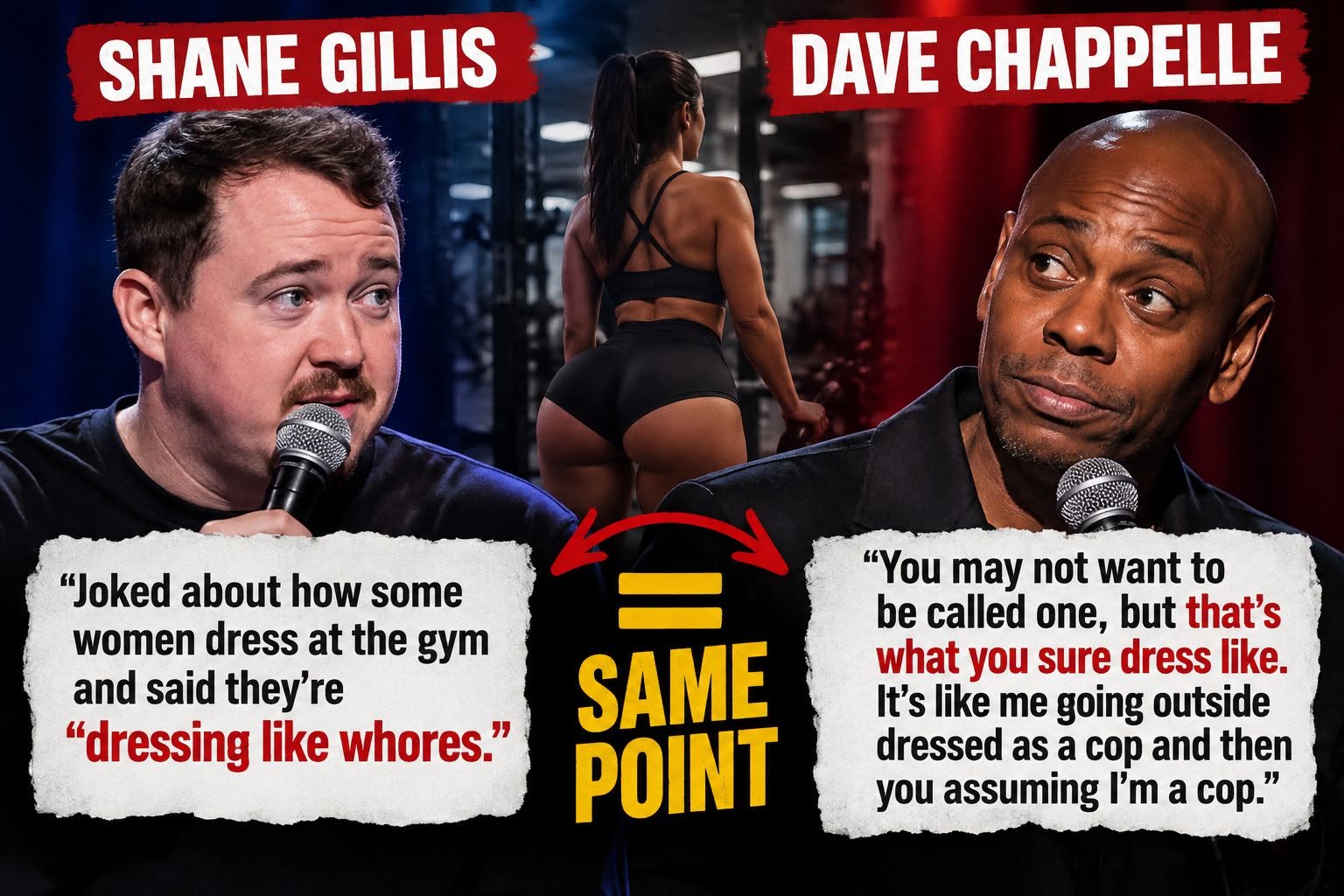
The argument is live right now, and two comedians make it cleanest. In October 2026, hosting Saturday Night Live, Shane Gillis opened with a bit about women’s gym clothes — “I didn’t know women just dress like whores now” — calling the outfit “artificial bait,” reading an identity straight off the fabric. He was reinventing a wheel Dave Chappelle had already turned twenty-six years earlier. The famous “whore’s uniform” routine is not, as the memes keep insisting, from a recent Netflix hour — it is from Killin’ Them Softly, Chappelle’s first HBO special, filmed at the Lincoln Theatre in Washington and aired July 26, 2000: a woman protests that dressing a certain way doesn’t make her a certain thing, and he flips it — it would be like him walking the street in a police uniform and then being surprised when someone yells “Officer!” The closer: “You are not a whore. But you are wearing a whore’s uniform.” Both bits rest on one premise: the costume is a voluntary signal you chose, so own the verdict that comes with it.
Here is the problem with that premise, and it is a matter of record: there really was a whore’s uniform — and for most of its history, she did not pick it. The state sewed it on. In ancient Rome the respectable wife was marked by the stola, the long overdress that was to women what the toga was to a male citizen, and by the vittae, the woolen hair-bands that signaled chastity. The prostitute was barred from both — and pushed instead toward the toga, a man’s garment that on a woman signaled dishonor and availability. The legal hook was Augustus’s adultery statute, the Lex Julia de adulteriis of 18 BC, which lowered a convicted adulteress to a prostitute’s standing — toga included. The mark was defined by what she was denied: the honest woman’s clothes. (Honesty check: the beloved story that Roman law forced prostitutes into blonde wigs is an urban myth — there is no surviving statute, only a literary trope and Juvenal’s image of Messalina. Don’t believe the wig law.)
In medieval and early-modern Europe the brand stopped being implied and got written down. City after city legislated a visible token the prostitute had to wear so that no man would “mistake” her for an honest woman — and no honest woman would be mistaken for her. Marseille, 1265: a striped cloak. Cologne, 1389: a red veil. Strasbourg, 1388: a black-and-white hood. Vienna, 1450: a yellow cloth on the shoulder, “one hand long and wide.” Florence, 1384: bells. London, 1516: a woman paraded in a yellow “H” for harlot. There was no single Europe-wide “prostitute’s color” — that too is a myth; the markers were local, inconsistent, and often barely enforced — but the logic never varied: make the body legible at a glance so the majority can see, avoid, or punish her. The whore’s badge only worked as the negative image of the honest wife’s permitted dress, which is why the same sumptuary codes regulated respectable women just as tightly.
Venice proves the point by running it backwards. A 1543 decree in the state archives forbade courtesans to wear gold, jewels, pearls, or the white veils of respectable maidens — the bans exist precisely because a rich courtesan could otherwise dress exactly like a patrician wife, and the city found that intolerable. One courtesan, Pasquetta, drew a 150-ducat fine and six months in a windowless cell for wearing forbidden jewels. The point of the costume was never fashion; it was to stop her from “passing.” And the stigmatizing color has a chilling cousin: the yellow forced on prostitutes in Venice, Vienna, and the London “H” is the same yellow that Canon 68 of the Fourth Lateran Council (1215) ordered onto Jews and Muslims, for a rationale that was itself explicitly sexual. Two separate histories — they must be kept separate — sharing one machine: the law makes the outsider’s body readable so the crowd can mark it.
And when the state couldn’t brand the body, it branded the place. The spatial uniform is the same idea moved from the woman to the map. Medieval Paris pushed brothels outside the town walls — “au bord de,” the edge, which is where French bordel comes from — and Napoleon’s 1804 law required each tolerated house to burn a red lantern at its door, the actual documented origin of the “red light,” not the charming American tale of railroad crews leaving their lanterns outside Dodge City bordellos (that one is folk etymology; the phrase “red-light district” first shows up in print about Louisville in 1893). Edo Japan walled and moated the Yoshiwara in 1617 behind a single gate; New Orleans drew Storyville by ordinance in 1897 and printed “Blue Books” — directories of the women, with prices; postwar Japanese police literally drew a red line around the tolerated zones on their zoning maps (akasen). Amsterdam’s windows still run the purest version: red light means available, blue light means a transgender worker — a signal over the door instead of a badge on the dress. Every one of these does the dress code’s job — instant recognition — to the place, which is why a city council or a shogun could impose it as policy.
So walk the two comedians back through the receipts. Their bit rests on one premise: the costume is a voluntary signal you chose, so own the verdict. Chosen signals are real — the 1970s gay hanky code was a genuine worn language (left pocket versus right, and, fittingly, green flagged prostitution); the upside-down pineapple is mostly a 2022 TikTok myth dressed up as an ancient swinger code. But the whore’s uniform was never in that category. For two thousand years it was the one signal she was forbidden to choose — assigned by statute, stitched on to make sure she could not control how she was read. Even the semiotics the comedians are groping toward cut against them: if meaning lives in the reading rather than the garment, then “she’s dressed like a whore” is the observer’s verdict being imposed on her — which is structurally the Vienna shoulder-cloth and the London “H,” not free expression. The modern argument launches from the exact inverse of its own history: it calls chosen a mark that power spent two millennia forcing on.
And here is the final turn of the screw, the one that makes the whole argument eat itself: the costume is vanishing as a marker — not because anyone banned it, but because everyone is wearing it. For two thousand years power tried to force a distinguishing mark onto the sex worker so she could not blend into the crowd of “respectable” women. The market just did the exact inverse — it sold the aesthetic of overt self-sexualization to tens of millions of mainstream women and erased the line from the other side. OnlyFans alone reported roughly 4.6 million creator accounts and 377 million fans in 2024, moving $7.2 billion in payments (Fenix International’s UK accounts), and that is only the explicit tier; the look itself went mainstream a decade earlier. Scholars were tracking it before the platform existed — Ariel Levy’s “raunch culture” (2005), Brian McNair’s “striptease culture” (2002), the APA’s 2007 report on the sexualization of girls, Jia Tolentino’s “Instagram Face” (2019), the peer-reviewed “porn chic” study of influencer labor (2020). The stripper’s silhouette migrated into the default Instagram feed and the TikTok For You page and, yes, the gym. And a signal only works while it is scarce — this is Veblen (1899) and Spence (1973), the hard floor under the soft point: a marker that everyone adopts stops discriminating anything and decays into noise. When the influencer, the woman at the squat rack, and the sex worker are wearing a look the eye can no longer reliably sort, “dressed like a whore” has quietly stopped meaning “whore.” It just means “dressed.” That gray zone is not a failure of the argument — it is the argument. Shane Gillis is reading a verdict off a uniform that two hundred million people put on this morning, which makes it no uniform at all. The badge the state spent two millennia stitching on, the culture dissolved by handing it to everyone.
But watch what did not dissolve, because that is the tell. The costume democratized; the contempt did not evaporate with it — it relocated. When OnlyFans abruptly announced in August 2021 that it would ban explicit content, the pressure did not come from a scandalized public; it came from the money rails — JPMorgan, BNY Mellon, and Mastercard balking at the business over “reputational risk.” The ban reversed inside a week, but the gatekeeping never left: sex workers are still routinely frozen out of PayPal, Airbnb, ordinary banking, for no reason but what they are. The caste line didn’t disappear when the dress stopped working — it moved from the hemline to the payment processor, from the yellow sash to the “high-risk merchant” flag. And that is the whole dispatch in a single motion: strip the visible mark away entirely, make the costume universal, and the stigma does not die — it simply finds a new surface to live on. Which is the proof that it was never really about the clothes, any more than it was about the commerce.
Put the receipts in one pile and the question answers itself. People do not “disrespect whores” because of the commerce. They half-tolerate the “prostitute,” they romanticize the “courtesan,” they built legal brothels for two centuries and license them in Nevada today. The money is not the thing. The thing is the word “whore” itself — which was never about selling sex, which means “one who desires,” whose cousins are “cherish” and “charity,” and which lands hardest on women who sold nothing at all. “Whore” is the name a culture gives a woman when it wants to punish her for owning her own sexuality. You cannot launder that with a nicer noun, because the noun was never the problem — which is why “sex worker,” coined by sex workers themselves in 1978, is just the newest stop on a euphemism treadmill that has been running since “prostitute” replaced “harlot” in 1530.
And here is the part that should land on everyone, because it is not a political argument. Respect, where it existed, was bought with art, literacy, and the patronage of powerful men — and it was reserved for a thin elite and shadowed by stigma even at its height. Contempt, where it rules, was manufactured on specific dates by specific people: a pope’s sermon, a reformer’s closure order, a Victorian statute, a Catholic laundry. Ching Shih commanded eighty thousand pirates and Theodora rewrote the law of an empire not because their world honored the brothel, but because the brothel was one of the only doors it left unlocked for a woman — which is an indictment of the world, not a tribute to the trade. The past was more respectful only to a tiny cultivated elite, under conditions most sex workers never met; and the present is, slowly, becoming more respectful to all of them — in New Zealand, in Belgium, in the 52 percent of Americans who have quietly stopped wanting it to be a crime. The word did the damage. The word can be put down. Charts, dates, and receipts.
Sources. Etymology & semantics: Etymonline, Wiktionary, Merriam-Webster and OED entries for whore (PIE *keh₂- “to desire,” cognate cārus), prostitute (Latin prōstituere, English verb 1530), harlot, slut, courtesan; Carol Leigh’s coinage of “sex worker” (1978). Madonna–whore & double standard: Freud, “On the Universal Tendency to Debasement in the Sphere of Love” (1912, SE 11:177–190); Crawford & Popp, Journal of Sex Research 40(1) (2003); Armstrong et al., “‘Good Girls’: Gender, Social Class, and Slut Discourse on Campus,” Social Psychology Quarterly 77(2) (2014); Leora Tanenbaum, Slut! (1999). Status cases & the sacred-prostitution critique: Stephanie Budin, The Myth of Sacred Prostitution in Antiquity (Cambridge, 2008); Athenaeus, Deipnosophistae Bk 13; Plutarch, Pericles; on the devadasi, Thanjavur/Chola inscriptions (Britannica, Wikipedia); the tawaif, oiran/tayū and geisha distinction; Margaret F. Rosenthal, The Honest Courtesan (Chicago, 1992) on Veronica Franco; Tullia d’Aragona’s veil exemption (Projectvox, Wikipedia); Roman infamia and registration (Wikipedia, Historyhit). Pirate queens & courtesan power: Richard Glasspoole eyewitness account and Wikipedia / World History Encyclopedia on Zheng Yi Sao (40,000–80,000 pirates, 1810 amnesty); Procopius’s Secret History and Britannica on Theodora; Britannica / NPG on Nell Gwyn and the dukedom of St Albans. The manufactured stigma: Augustine, De Ordine 2.4.12 (“necessary evil”); Gregory I, Homily 33 (591) and the 1969 calendar revision (U.S. Catholic, America Magazine); medieval municipal brothels and the Reformation closures (Historytoday, Encyclopedia.com, Medievalists.net); UK Contagious Diseases Acts 1864–69 and the 1871 Royal Commission; the Magdalene Laundries, McAleese Report and Taoiseach Enda Kenny’s 2013 apology (RTÉ, TIME, Irish Times). America the outlier: colonial New England sexual-morality law; the Comstock Act (1873); Storyville (1897–1917) and the frontier madams; the Mann Act (1910) and Caminetti; Scott W. Stern, The Trials of Nina McCall (2018) on the American Plan; Prostitution in Nevada (Wikipedia); SESTA-FOSTA (2018) and its documented harms (Rewire, Vice, HuffPost). Modern comparative dignity: NZ Prostitution Reform Act (2003) and the Prostitution Law Review Committee report (~90% / “over 60%”); Germany ProstG (2002) / ProstSchG (2017); Prostitution in Switzerland; Belgium’s 1 Dec 2024 employment-contract law (NPR, CBS); WHO (2012), UNAIDS, Amnesty International (2016, POL 30/4062/2016), Human Rights Watch (2019), and The Lancet HIV & sex work Series (2014, Shannon et al.; 33–46% HIV reduction). Attitudes: YouGov (US 57% “morally wrong”); Data for Progress / YouGov (52% support decriminalization); European Values Study (Netherlands ~20% “never justifiable”); World Values Survey Wave 7; Prostitution in Iran (Wikipedia). The forced uniform & the marked place: Smith’s Dictionary of Greek and Roman Antiquities (1875) on the stola/vittae and the toga meretricia; the Lex Julia de adulteriis (18 BC) (Wikipedia; CSUN translation); Catharine Edwards on the toga as a mark of availability, and the debunking of the Roman “blonde-wig law,” via “Dispelling Some Myths: Was yellow the colour of prostitution?” (Tastes of History); medieval sumptuary ordinances — Marseille 1265, Strasbourg 1388, Cologne 1389, Vienna 1450, Florence bells 1384, London yellow-“H” 1516 (Strange History; wh1350.at; Tastes of History); Ruth Mazo Karras, Common Women (Oxford, 1996); Venice’s 1543 bans on courtesan finery and the Pasquetta fine (Images of Venice; USC Dornsife, “Fashions of the Venetian Courtesans”); Fourth Lateran Council Canon 68 (1215) and the shared yellow mark (Yellow badge, Wikipedia; Diane Owen Hughes, “Distinguishing Signs,” Past & Present, 1986); the Napoleonic 1804 red-lantern law and the Louisville-1893 print origin of “red-light district” (Word Histories; Snopes; Britannica); Storyville and the Blue Books (Wikipedia); the Yoshiwara (est. 1617) and Japan’s akasen “red line” (Wikipedia); Amsterdam’s De Wallen red/blue window code (Wikipedia). The modern “dress is a signal” fight: Shane Gillis’s October 2026 SNL monologue (TODAY, Variety, PhillyVoice); Dave Chappelle’s “whore’s uniform” bit from Killin’ Them Softly (HBO, July 26, 2000 — NOT a Netflix special; Wikipedia, Scraps from the Loft transcript); the gay hanky code (Wikipedia; Larry Townsend, The Leatherman’s Handbook, 1972; Hal Fischer, Gay Semiotics, 1977); the upside-down-pineapple myth (Know Your Meme); and the semiotics of dress (Roland Barthes, The Fashion System, 1967; Malcolm Barnard, Fashion as Communication, 2002). The uniform’s collapse via the creator economy: OnlyFans / Fenix International FY2024 figures (~4.63M creators, 377M fans, $7.22B gross) from UK Companies House accounts via Variety, Yahoo Finance, and NetInfluencer; the August 2021 explicit-content ban and one-week reversal, and the JPMorgan / BNY Mellon / Mastercard payment-rail pressure (TIME, PBS NewsHour, PaymentsJournal); Ariel Levy, Female Chauvinist Pigs (2005); Brian McNair, Striptease Culture (2002) and Mediated Sex (1996); APA Task Force on the Sexualization of Girls (2007); Jia Tolentino, “The Age of Instagram Face” (The New Yorker, 2019); Drenten, Gurrieri & Tyler, “Sexualized Labour in Digital Culture: Instagram Influencers, Porn Chic and the Monetization of Attention” (Gender, Work & Organization, 2020); and the signaling-scarcity logic from Thorstein Veblen, The Theory of the Leisure Class (1899) and Michael Spence’s job-market signaling (1973). The strongest form of the convergence claim — that influencer and sex-worker presentation are now literally indistinguishable — is an interpretive synthesis of the porn-chic, Instagram-Face, and porous-pipeline evidence, not a single measured finding. Grounded web research compiled October 14, 2026; where sources disagree (notably Ching Shih’s fleet size and Theodora’s early life), ranges and the hostile-source caveat are reproduced rather than flattened.
№ 137 · Filed October 14, 2026 — In 1976 Ronald Reagan put a face on fraud against the government, and it has never really come off. He told crowds about a Chicago woman with “eighty names, thirty addresses, fifteen telephone numbers,” collecting welfare under each, “bilking the government for $150,000 a year.” The woman was real. The numbers were not — her actual conviction was for about $8,000 and two aliases, and the county spent more convicting her than she ever took. But the image stuck, and fifty years later it is still how most Americans picture someone stealing from the taxpayer: an individual, usually poor, usually on benefits, working an angle for grocery money. This dispatch does the only thing that settles the question — it follows the dollars. And the dollars run, overwhelmingly, the other way. THE SKIM: why the one official SNAP fraud number requires a store, not a shopper, and why the scary “error rate” is — in the USDA’s own words — “not a measure of fraud.” MEDICAID: how, in the biggest welfare program in the country, patients account for one-tenth of one percent of the stolen money and providers account for the rest. THE CONTRACTORS: the Pentagon’s seven straight failed audits, Halliburton’s $45 case of soda, and a record $6.8 billion in False Claims Act recoveries that almost never touch a benefit recipient. THE HEIST: the pandemic, the largest fraud event in American history, run by businesses, organized crime, and foreign hackers — not the unemployed. And then the part the myth is built to keep you from asking: who actually has their hands in the till, and why the design of the till is the real story. Charts, numbers, and receipts.
The Welfare Queen — Who Is Actually Stealing From the Taxpayer, Why the Myth Points at a Single Mother While the Real Money Walks Out the Back in a Contractor’s Truck, and What the Receipts Say When You Follow the Dollars Instead of the Resentment

I. The Face They Gave the Crime
Start with the woman herself, because the myth was built on a real person and then inflated past the point of recognition. Her name was Linda Taylor. A 1974 Chicago Tribune story first called her a “welfare queen,” and on the 1976 campaign trail Ronald Reagan turned her into a national symbol: a woman with “eighty names, thirty addresses, fifteen telephone numbers” who was “bilking the government for $150,000 a year.” It was a devastating image, and it was mostly fiction. Taylor was genuinely a con artist — investigators eventually tied her to far worse than fraud — but her actual welfare conviction was for two aliases and roughly $8,000 in fraudulent checks (she was indicted for about $7,600). Not eighty names. Not $150,000 a year. Cook County spent more prosecuting her than she had stolen.
The point is not that Linda Taylor was innocent. The point is that she was an outlier, deliberately chosen to look like a trend. A single extreme case got dressed up as the typical benefits recipient, and the dress-up worked so well that half a century later “welfare fraud” still conjures a person at a checkout counter rather than a corporation at a billing terminal. So this dispatch sets the anecdote aside and asks the only question that can actually be answered with numbers: when money is stolen from the taxpayer, who is holding it afterward? Follow it program by program. It almost never ends up where Reagan pointed.
II. The Skim at the Register — SNAP Needs a Store, Not a Shopper
Take food stamps first, because that is the program the myth lives closest to. Here is the fact that collapses most of the argument: the only official, recurring fraud measure the government publishes for SNAP is the retailer trafficking rate — and trafficking, by definition, requires a complicit store. Trafficking is when a shop owner buys a recipient’s benefits for cash: a hundred dollars swiped off the card, fifty in cash handed back, the store keeps the spread and bills the government the full hundred. The recipient loses money on the deal. The one who profits, and the one who commits the chargeable crime, is the business. The most recent USDA study (2015–2017) put the trafficking rate at 1.6 percent of benefits, about $1.27 billion a year, and in FY2016 the USDA permanently disqualified 1,842 stores for it — less than one percent of participating retailers, but the entire measured fraud problem runs through them.
Then there is the number that gets waved around as if it were fraud, and is not. SNAP’s “improper payment rate” was 11.68 percent in FY2023 — about $10.5 billion of $90 billion in outlays — and it gets cited constantly as proof the program is riddled with cheats. The USDA could not be more explicit that this is wrong. Its own infographic states the improper-payment rate “is not a measure of fraud. In fact, the vast majority of improper payments are due to unintentional errors.” The Congressional Research Service says the same: the rate “is sometimes misunderstood to be a measure of the federal dollars lost to fraud and waste,” and it is not — it is a measure of caseworkers and households getting the math wrong, and roughly 60 percent of those errors are the state agency’s, not the recipient’s. When you look at the money states actually clawed back as overpayments, only about one dollar in nine was intentional recipient fraud. The rest was honest error on both sides of the counter.
The “welfare cheat” is the small slice
Composition of SNAP overpayment-claim dollars that states established and tried to recover. Even inside the money flagged as overpaid, intentional recipient fraud is about 11 percent — the rest is honest error, most of it the agency’s.
III. Medicaid — Patients Are 0.1 Percent of It
Now the largest means-tested program in the country, and the cleanest data in the whole dispatch. Every year the HHS Inspector General tallies the convictions and recoveries from the state Medicaid Fraud Control Units. Georgetown’s Center for Children and Families ran the numbers and found the split is not close: beneficiary fraud is about 2 percent of convictions and one-tenth of one percent — 0.1 percent — of the dollars recovered. The other 99.9 percent of the money comes from providers: ambulance companies, medical-equipment suppliers, diagnostic labs, nursing homes, pain clinics, pharmacies, physical therapists, physicians, and addiction-treatment operators. When a politician says Medicaid is being bled dry by fraud, the fraud they are describing is almost entirely institutional. A 2026 KFF poll found the public actually has this right — voters blame providers and systems over patients by roughly three to one.
Who steals from Medicaid
Share of Medicaid fraud recoveries by type of defendant, from HHS-OIG Medicaid Fraud Control Unit data. The bar for patients is not a mistake — it is one-tenth of one percent.
IV. The Billing Code Is the Crowbar
Institutional health-care fraud does not look like a smash-and-grab. It looks like a spreadsheet. The two workhorse techniques are upcoding — submitting a billing code for a more serious, more expensive service than was actually performed — and unbundling — splitting a service Medicare requires to be billed as one package into separate line items to collect more than the bundled rate. A clinic that instructs its billing software to default every visit to a high-complexity code, or a Medicare Advantage insurer that combs charts to tack on diagnoses that make its patients look sicker than they are, is committing fraud one keystroke at a time, at enormous scale. The FBI’s standing estimate is that health-care fraud costs the country on the order of $80 billion a year — and Medicare’s own advisory commission estimated that diagnosis-inflation in Medicare Advantage alone drove roughly $84 billion in excess payments in a single year.
These are not small defendants. Recent Medicare Advantage settlements and suits name the largest insurers in America: a $556 million recovery from Kaiser, $172 million from Cigna, and a multibillion-dollar fraud case pending against UnitedHealth over alleged chart-mining. The mechanism that catches them is almost always a whistleblower — a coder, nurse, or compliance officer who files a False Claims Act suit on the government’s behalf and collects 15 to 30 percent if money is recovered. Which brings us to the contractors, and to the single biggest line item of legitimate anti-fraud enforcement in the federal government.
V. The Contractors — A Record $6.8 Billion, and Almost None of It a Benefit Recipient
The Pentagon cannot pass an audit. Say the rest carefully, because the honest version is damning enough without exaggeration. The Department of Defense has failed seven consecutive audits — every one since the first in FY2018 — and in FY2024 could not fully account for an $824 billion budget against roughly $4.1 trillion in assets. The technical result is a “disclaimer of opinion”: auditors could not get enough reliable information to form a judgment. That is not a finding that $824 billion was stolen. It is a finding that the largest agency in the government has controls and record-keeping so weak that it literally cannot tell you where the money went — which is its own kind of scandal, and exactly the condition in which contractor fraud thrives. More than half of the DoD’s annual budget now goes to private contractors.
And the contractor record is not ambiguous. During the Iraq war, Halliburton’s KBR subsidiary ran up more than $1.4 billion in “questioned and unsupported” costs: defense auditors found it billed the Army for 36 percent more meals than it actually served, a whistleblower testified it charged for 20,000 meals a day while serving 10,000, and a Senate report documented the company charging $45 for a case of soda and $100 to clean a fifteen-pound bag of laundry. In 2023, Booz Allen Hamilton paid $377 million — one of the largest procurement-fraud settlements in DOJ history — to resolve allegations it shoved commercial costs onto its government contracts. These are the defendants. They are companies.
Where the real recoveries come from
Federal False Claims Act recoveries by fiscal year. FY2025 set an all-time record, and 65 to 85 percent of it every year is health care — hospitals, insurers, pharma, labs, and contractors. The statute targets whoever bills the government, not whoever receives a benefit.
VI. The Heist — The Largest Fraud in American History Was Not Run by the Poor
If you want the single clearest test of “who steals from the government,” use the biggest theft that ever happened: the pandemic. Between 2020 and 2023 the federal government pushed roughly $4.2 trillion out the door in emergency relief, and the fraud that rode along with it dwarfs every welfare-cheat anecdote ever told. The SBA Inspector General found the government disbursed more than $200 billion in likely-fraudulent PPP and EIDL loans — at least 17 percent of those programs. These were business loans: real and fake companies claiming payroll and revenue they did not have, shell firms, loans to businesses that did not exist. The GAO estimated another $100 billion to $135 billion in unemployment fraud — and the dominant actors there were not laid-off workers but organized crime and foreign states: the Secret Service tied pandemic fraud to Chinese- and Russian-linked criminal groups, a Chinese state-backed hacking crew (APT41) stole from the programs, and Nigerian fraud rings ran stolen identities across multiple states. The Employee Retention Credit went the same way: the IRS froze new processing in 2023 after finding 60 to 70 percent of incoming claims carried an “unacceptable” risk of being improper, driven by “ERC mills” — promoter firms taking a 15 to 25 percent cut to push ineligible businesses to file.
The greatest grift in US history, by program
Estimated pandemic-relief fraud by program. The AP called it “the greatest grift in U.S. history.” Every dollar of it was claimed by a business, a criminal ring, or a hacker — not a benefit recipient at a counter.
VII. Fraud Follows the Money — And the Money Is the Program
Put the receipts in one pile and the shape is unmistakable. The only standard SNAP fraud number requires a complicit store. In Medicaid, patients are one-tenth of one percent of the stolen dollars and providers are the rest. The record False Claims Act haul is almost entirely hospitals, insurers, pharma, and defense contractors. The largest fraud event in American history was run by businesses, organized crime, and foreign hackers looting pandemic-business programs. At every level, the money flows toward whoever is positioned to bill the government or run a program — not toward the person standing at the benefits window. The welfare queen was never where the money was. She was where the resentment was easiest to aim.
Here is the part that should unsettle everyone, left and right, and it is the reason this dispatch does not end as a defense of government spending. Fraud is not a moral failing peculiar to the poor; it is a behavior of the money itself. Pool hundreds of billions of dollars in a central program, disburse it fast, audit it weakly, and you have built a magnet — and the filings move first and hardest. That is why the Pentagon cannot find $824 billion, why $200 billion walked out of the SBA in two years, why Medicare Advantage insurers mine charts for phantom diagnoses. It is a feature of the design, not a glitch in the recipients. The honest libertarian point and the honest progressive point meet exactly here: the bigger and more centralized the pool, the bigger the theft, and the people who clean up afterward are whistleblowers and inspectors general recovering cents on the dollar years too late. You can argue about whether the programs should exist. What you cannot do, if you have read the receipts, is keep pointing at a single mother with an EBT card while a contractor backs a truck up to the loading dock. Charts, numbers, and receipts.
Sources. The welfare-queen myth: Chicago Tribune (1974, first use of “welfare queen”); Josh Levin, The Queen (2019) and Slate reporting on Linda Taylor (two aliases, ~$8,000 conviction, ~$7,600 indictment). SNAP: USDA-FNS, The Extent of Trafficking in SNAP: 2015–2017 (Sept 2021), trafficking ~1.6% / ~$1.27B, 1,842 stores permanently disqualified in FY2016; USDA-FNS SNAP Improper Payment infographic (“not a measure of fraud… the vast majority… are due to unintentional errors,” 60% state / 40% client); USDA-FNS FY2016 State Activity Report (overpayment-claim composition) and FY2023 improper-payment release (11.68%); GAO-19-167; Congressional Research Service R45147 / IF10860. Medicaid: Georgetown Center for Children and Families analysis of HHS-OIG Medicaid Fraud Control Unit data (Jan 2025) — beneficiaries ~2% of convictions, ~0.1% of dollars; KFF Medicaid program-integrity brief and 2026 poll; Arizona “sober-living” scandal (~$2.5B, 2019–2023) via AZ AG and AP reporting. Health-care billing & Medicare Advantage: FBI health-care-fraud estimate (~$80B/yr); MedPAC Medicare Advantage overpayment estimate (~$84B); DOJ settlements and suits — Kaiser ($556M, Jan 2026), Cigna ($172M), and the pending UnitedHealth chart-mining case. Defense & contractors: DoD FY2024 financial-statement audit (seventh consecutive disclaimer of opinion; $824B budget, ~$4.1T assets) via Reuters, AP, Breaking Defense; DCAA findings and the Senate Democratic Policy Committee joint report on KBR/Halliburton (36% meal overbilling, $45 cases of soda, $100 laundry bags, $1.4B+ questioned/unsupported costs); Booz Allen Hamilton $377.45M procurement-fraud settlement (DOJ, July 2023). False Claims Act: DOJ annual FCA statistics FY2023 ($2.68B), FY2024 ($2.9B), and the record FY2025 ($6.8B), with cumulative >$85B since 1986 and ~83% whistleblower-driven (Morgan Lewis, Morrison Foerster, Covington, Seyfarth summaries). Pandemic relief: SBA-OIG Report 23-09 (>$200B potentially fraudulent PPP/EIDL, ~$30B recovered); GAO-23-106696 (UI fraud $100–135B); DOL-OIG semiannual reports; U.S. Secret Service House Oversight testimony (Feb 2023) and NBC News reporting on APT41, Russian, and Nigerian fraud rings; IRS News Release IR-2023-169 (ERC moratorium, 60–70% of claims high-risk). Reused from prior CROWN research: Medicare Advantage upcoding dossier (UnitedHealth, Kaiser, Cigna, MedPAC) and GAO improper-payments figures ($162B FY24, ~$2.8T cumulative since FY2003). Grounded web research compiled October 14, 2026; where an agency declined to characterize an improper-payment figure as fraud, that caveat is reproduced rather than dropped.
№ 136 · Filed October 14, 2026 — On October 13, 2026, more than a dozen girls on the Camas, Washington cross-country team ran about fifty meters off the line and then stepped off the course — refusing to race against a transgender runner on their own team. Look at the photograph at the top of this dispatch. The color frame is those girls. The black-and-white frame beneath it is six women who sat down at the starting line of the 1972 New York City Marathon, holding hand-lettered signs, because the Amateur Athletic Union would not let them run the same race as the men. Fifty-four years apart, two groups of women sat down at a starting line to protest the same thing: a women’s race that wasn’t being allowed to be a fair women’s race. This dispatch runs the whole file. THE ORIGIN: how the AAU capped women at a mile and a half, how officials said women were “not physiologically able,” how Bobbi Gibb hid in the bushes at Boston and Kathrine Switzer got attacked mid-race by an official trying to rip off her bib. TITLE IX: how one sentence turned 294,015 high-school girls in 1972 into 3.5 million today — and the economics proving it changed those girls’ lives. THE SCIENCE: what testosterone actually does to a male body at puberty — the skeleton, the heart, the blood, the muscle — and which of those changes are permanent. THE HONEST PART: whether puberty blockers and hormone suppression actually erase the advantage (the data says they shrink it, they do not erase it) — stated carefully, in both directions, because the slogan is wrong at both ends. THE FIGHT NOW: the June 2026 Supreme Court ruling, the 27 state bans, the polls where 69 to 79 percent of Americans land in the same place, and the Washington ballot measure voters decide in three weeks. Charts, numbers, and receipts.
The Starting Line — How Women Had to Fight to Get Their Own Race, What the Biology Says About Keeping It Theirs, and Why a Row of Girls Sitting Down 54 Years Apart Is the Same Photograph Twice

I. Two Photographs, Fifty-Four Years Apart
Start with what actually happened on a Tuesday afternoon this week. On October 13, 2026, at a 4A Greater St. Helens League cross-country meet on the Underwriters Laboratories campus in Camas, Washington, roughly thirteen of the twenty-four girls on the Camas High School team ran about fifty meters past the starting gun and then walked off the course. At least one runner from the opposing Battle Ground team joined them. They were protesting the presence of a transgender athlete — a teammate who had competed in a boys’ race as recently as early September — running in the girls’ division. The school district’s answer, through Camas High principal Travis Drake, was that its hands were tied: Washington’s interscholastic athletics body, the WIAA, has allowed students to compete according to their gender identity since 2007, and the district has to follow the rule.
Now look at the photograph underneath it. On October 1, 1972, six women sat down on the pavement at the start of the New York City Marathon — legs crossed, shoulder to shoulder, holding poster board they had lettered the night before. Their names were Nina Kuscsik, Lynn Blackstone, Pat Barrett, Liz Franceschini, Cathy Miller, and Jane Muhrcke. Barrett was seventeen and genuinely afraid that if she were photographed the AAU would bar her from future races. The signs read “The AAU is archaic,” “The AAU is midevil” (misspelled, written in a hurry), and “Hey AAU this is 1972 wakeup!” They were protesting a rule that said women were permitted to run the marathon — but only if they started ten minutes before the men, in a “separate but equal” women’s race, because the AAU would not sanction men and women competing head to head. They sat for ten minutes; when the men’s gun went off they stood up and ran anyway. The photo ran four columns wide in the New York Times. Embarrassed, the AAU dropped the rule later that year.
Here is the uncomfortable thing about putting those two images in one frame. The women in 1972 sat down to be let into the race. The girls in 2026 sat down to keep the race theirs. The impulse is identical — a group of female athletes, at a starting line, refusing to accept a rule that makes their competition unfair — and so is the thing they are defending: the existence of a real women’s category. You cannot celebrate the first photograph and have no opinion about the second. The entire reason a separate women’s race exists at all is the subject of the rest of this dispatch.
II. The Race They Were Not Allowed To Run
Before women had their own sports, the official position was that their bodies could not handle them. At the 1928 Amsterdam Olympics, women ran the 800 meters for the first time. All nine finishers completed the race and six broke the existing world record; the winner, Germany’s Lina Radke, ran 2:16.8. The press invented a catastrophe anyway — lurid, mostly fabricated reports of women collapsing in heaps — and within days the IAAF voted to strike every women’s race longer than 200 meters from the Olympic program. That ban held for thirty-two years, until the 800 returned in 1960. The stated reasoning was a catalog of myths now almost quaint in their confidence: that a woman had “a layer of fat round the heart” that made exertion dangerous, that distance running could damage fertility or cause the uterus to prolapse, that competition cost a woman her “feminine charm.”
In the United States the gatekeeper was the AAU, and the leash was shorter. From 1914 the AAU restricted women’s sanctioned competition, and for much of the century it capped women’s races at a mile and a half — men ran 5K, 10K, and the marathon; women were simply not permitted to. When Roberta “Bobbi” Gibb applied to run the 1966 Boston Marathon, race director Will Cloney wrote back that it was “an AAU Men’s Division race only. Women aren’t allowed, and furthermore are not physiologically able.” Gibb hid in the forsythia bushes at the Hopkinton start in her brother’s shorts, slipped into the pack when the gun went off, and finished in about 3:21. The next year Kathrine Switzer registered as “K.V. Switzer,” got bib number 261, and a few miles in, race co-director Jock Semple leapt off the press truck, grabbed at her, and screamed “Get the hell out of my race and give me those numbers!” before her boyfriend body-checked him off the course. She finished. The photos of the attack went around the world.
That is the context for the six women on the pavement in 1972. Boston officially admitted women that same year. Nina Kuscsik — one of the six who sat — became the first official female champion of both Boston (3:10:26) and New York (3:08:41) in 1972, after personally lobbying the AAU to lift its distance cap. The Olympic women’s 1500 meters debuted in 1972; the women’s marathon did not arrive until 1984 in Los Angeles, won by Joan Benoit, and only after the American College of Sports Medicine issued a 1980 statement flatly contradicting half a century of pseudoscience: “There exists no conclusive scientific or medical evidence that long-distance running is contraindicated for the healthy, trained female athlete.” Women’s sports, as a category you could actually compete in, are younger than most of the people reading this.
III. Title IX, And The Explosion It Set Off
The lever that turned a trickle into a flood was a single sentence signed into law on June 23, 1972. Title IX of the Education Amendments — authored principally by Representative Patsy Mink, carried in the Senate by Birch Bayh, its hearings run by Representative Edith Green — reads: “No person in the United States shall, on the basis of sex, be excluded from participation in, be denied the benefits of, or be subjected to discrimination under any education program or activity receiving Federal financial assistance.” It never mentions sports. But applied to school athletics, it detonated.
What one sentence did to girls’ sports
High-school girls’ athletic participation, United States. Before Title IX, about one girl in twenty-seven played a school sport; today it is roughly two in five.
IV. What Male Puberty Actually Does To A Body
Here is the fact the entire fairness question rests on, and it is not controversial among endocrinologists: before puberty, boys and girls are physically almost the same, and the gap that opens afterward is built by testosterone. Through childhood, circulating testosterone is low and essentially identical in both sexes. At puberty a boy’s testes begin producing roughly thirty times more testosterone than before, and adult men carry something on the order of fifteen times the circulating testosterone of women — a distribution so separated that the male and female ranges barely overlap (Handelsman, Hirschberg & Bermon, Endocrine Reviews, 2018). That hormone then rewrites the body on several axes at once.
The skeleton. Adult men are about 13 centimeters taller than women on average, with longer limbs (longer levers for throwing and jumping), wider shoulders, larger hands and feet, and bones laid down wider and farther from their center — which makes them stronger in bending. The blood. Testosterone drives red-cell production; men run roughly 12 percent higher hemoglobin, which is a direct line to oxygen delivery and endurance. The heart and lungs. Male hearts gain 25 to 38 percent more left-ventricular mass and larger chambers; male lungs and airways enlarge disproportionately — more oxygen moved per breath, more blood pumped per beat. The muscle. Men carry about 33 kilograms of skeletal muscle to women’s 21, a gap that is larger in the upper body (~40 percent) than the lower (~33 percent); testosterone does this by enlarging muscle fibers, dose for dose, in a relationship so clean it has been measured in a lab (Bhasin et al.). The voice. The larynx enlarges and the vocal folds lengthen and thicken, dropping the pitch about an octave — permanently.
The gap is not there, and then it is
Male–female difference in athletic performance, by age. Nearly nothing before puberty; it opens sharply at 13–14 and reaches adult size before 18.
V. The Gap, By The Numbers — And Why “10 Percent” Is The Wrong Single Number
People quote “a 10 percent gap” as though it were one figure. It is not — it scales with how much the event depends on raw upper-body power, and at the top it is enormous. Elite endurance running and swimming cluster around 8 to 13 percent (the famous “10 percent” is really the elite-running number). Jumps run 17 to 20 percent. Overhand throwing — the javelin — is over 30 percent even with women throwing a lighter implement. Grip and upper-body strength run 40 to 60 percent. And in a controlled study of punching power, trained men averaged 162 percent more than trained women — the weakest man in the study still hit harder than the strongest woman.
One sex difference, many sizes
Approximate male advantage over female, elite/population level, by domain. The more the task depends on absolute upper-body muscle, the wider it gets.
VI. “But Blockers And Hormones Fix It” — The Honest Answer, In Both Directions
This is where most of the shouting happens, so here is the careful version, because the slogan is wrong at both ends. First, a distinction almost everyone collapses: a GnRH “blocker” given at the very start of puberty (Tanner stage 2) is a prevention tool — if started early enough it genuinely stops the masculinizing changes from happening, which is a real and large physiological effect, not nothing. Testosterone suppression in someone who has already finished male puberty is a reversal attempt — and that is a very different, and largely unsuccessful, thing. Nearly all of the measurable “does it erase the advantage” data is about the second case.
What the reversal data actually show. The cleanest real-world dataset is Roberts, Smalley & Ahrendt (2021), who mined U.S. Air Force fitness tests from transgender service members before and after they began hormones. Before treatment, trans women did about 31 percent more push-ups and 15 percent more sit-ups than the average Air Force woman and ran 1.5 miles about 21 percent faster. After two years of feminizing hormones, the push-up and sit-up advantages were gone — but they were still running about 12 percent faster, and at the one-year mark (the window sports federations were then using) still about 9 percent faster. Prospective muscle studies (Wiik 2020; Hilton & Lundberg 2021) line up: testosterone suppression takes only about 5 percent off muscle mass in the first year, leaving the trans women still stronger and more muscular than the female comparison group.
What suppression takes off — and what it leaves
Trans women’s advantage over the female average, before vs. after ~2 years of feminizing hormones (U.S. Air Force fitness data), plus what the rest of the research says is permanent.
VII. The Fight Now — A Decided Court, A Divided Map, And A Ballot Three Weeks Out
The national legal question is, as of this summer, settled — in one direction. On June 30, 2026, the Supreme Court ruled 6–3 in the consolidated cases Little v. Hecox and West Virginia v. B.P.J., upholding the Idaho and West Virginia laws that restrict girls’ school sports to students who are female by birth. The Court was unanimous that offering separate boys’ and girls’ teams does not by itself violate Title IX, and split 6–3 on the equal-protection question. But — and this is the part that explains Camas — the ruling validated states’ right to restrict the category; it did not mandate that any state do so. Twenty-seven states have banned by legislation (twenty-nine counting regulatory action); the Trump administration’s February 2025 executive order and the NCAA’s same-week policy change pushed federal and college athletics the same way. Washington went the other direction and kept its inclusive 2007 WIAA rule. Both are now legal. That is why a Camas principal can accurately say his hands are tied even months after the Supreme Court “ruled” — the Court freed the states to choose, and his state chose inclusion.
Where the public actually sits
Share of Americans who say transgender athletes should compete by birth sex, or who are uncomfortable with the alternative. Three pollsters, three methods, one neighborhood.
VIII. The Same Photograph, Twice
The small numbers are real, and they cut both ways. Ten athletes out of two hundred thousand is a reminder to keep the humanity in view: these are kids, most of them not winning anything, caught in a fight far larger than their own races. A decent society does not pretend they do not exist or treat every one of them as a villain. But a principle does not evaporate because the test case is small. The reason a women’s podium exists at all — the reason six women sat on cold pavement in 1972 and a Will Cloney had to eat his “not physiologically able” — is that male and female bodies, after puberty, are not interchangeable in sport. That was the sexist lie’s kernel of inconvenient truth: the bodies are different. The lie was the conclusion they bolted onto it — that the difference meant women should not compete at all. The correct conclusion, the one Title IX enshrined, was the opposite: because the difference is real, women need a protected category of their own.
Which is why the two photographs are, finally, the same photograph. The women in 1972 fought to open a door. The girls in 2026 are fighting to keep what is on the other side of it worth having. You can hold genuine compassion for a trans teenager who just wants to run with their friends and still see that a fair women’s race requires it to be a women’s race — the same way you can honor Bobbi Gibb hiding in the bushes and still insist nobody should have to beat a male body to make a girls’ state final. The line those girls stepped off this week is the same line those women sat down on fifty-four years ago. It was drawn, on purpose, so that women would have somewhere to win. The whole fight — then and now — is over whether that line still means anything. Charts, numbers, and receipts.
№ 135 · Filed October 14, 2026 — In 399 BC the most democratic city in the ancient world took a vote — by a jury of roughly five hundred citizens, chosen by lot, with no judge and no appeal — and ordered a seventy-year-old man to drink poison for the crime of asking too many questions. Socrates was not killed by a king. He was not killed by a tyrant. He was killed by the people, by a show of hands, in open court. This dispatch starts there and follows the thread all the way to your timeline. Why every serious political thinker from Plato to the men who wrote the Constitution feared the mob as much as the monarch. Why unrestrained majorities reliably end up silencing whoever annoys them. And why — on the record, with receipts — trying to suppress an idea usually feeds it. The remedy the law actually prescribes for vile speech is not the ban; it is more speech. Brandeis said it from the bench, Mill said it a century earlier, and a Black blues musician who talked two hundred Klansmen out of their robes proved it in a living room. Then the uncomfortable part: the one organization built to defend this principle — the ACLU that once sent a Jewish refugee to defend Nazis marching through a town full of Holocaust survivors — is quietly walking away from it. And then the newest exception, the one that caught the left flat-footed: the pro-Palestinian students being investigated, detained and deported under a definition of antisemitism whose own author begged Congress not to turn it into a speech code. Charts, numbers, and receipts.
The Hemlock — Why Democracy Killed the Man Who Questioned It, How Mob Rule Becomes Censorship, and the Proven Case That the Only Cure for Bad Speech Is More of It
I. The Gadfly And The Jury — How A Democracy Executed Its Conscience
Begin with the fact that should make every true believer in pure majority rule uncomfortable. In 399 BC, Athens — the birthplace of democracy, the city that invented the very idea of the citizen vote — indicted Socrates on two charges: asebeia, impiety toward the city’s gods, and “corrupting the youth.” His accuser Meletus restated it in Plato’s Apology as: “Socrates is a doer of evil, who corrupts the youth; and who does not believe in the gods of the state, but has other new divinities of his own.” There was no king in the dock’s way, no tyrant’s decree. He was tried before the dikastēria — a jury of some 500 ordinary citizens drawn by lot, who decided guilt and set the penalty in a single day, by simple majority, with no appeal.
The vote was close, and then it wasn’t. Socrates himself remarked on the narrowness of the guilty verdict: “I am only surprised that the votes are so nearly equal; for… had thirty votes gone over to the other side, I should have been acquitted.” Then came the sentencing. Invited to propose his own punishment, he suggested — with lethal sarcasm — that what he truly deserved was free meals in the Prytaneum, the honor reserved for Olympic champions. The jury, insulted, voted for death by a wider margin than it had voted for guilt. Diogenes Laertius records that eighty jurors who had voted to acquit him now voted to kill him. He drank the hemlock. His last recorded words were a joke about a debt: “Crito, I owe a cock to Asclepius; will you remember to pay the debt?”
The jury that killed philosophy
The two votes against Socrates, 399 BC. The raw totals are a scholarly reconstruction — only the “thirty votes” and “eighty-vote shift” are attested in the texts.
II. The Ship Of Fools — Why The Men Who Watched It Happen Distrusted The Mob
Plato was about twenty-eight when the city killed his teacher, and he never got over it. The Republic is, among other things, one long answer to a single question: how could a just city execute the most just man in it? His answer was the ship of state. Picture a vessel whose owner — the people — is bigger and stronger than anyone aboard but “slightly deaf, of similarly impaired vision, and whose knowledge of navigation” is just as poor. The sailors brawl over the helm, each certain he should steer though none has studied the craft; they flatter and drug the owner to seize control, and they mock the one man who actually watches the winds and the stars as a useless “star-gazer.” Governing, Plato insisted, is a skill. Choosing a ruler by popularity is like choosing a surgeon by applause.
And he warned where it ends. In Book VIII, democracy is not the final form of government — it is the next-to-last. Each regime dies of an overdose of the thing it loves most, and democracy’s love is freedom: “The excess of liberty, whether in States or individuals, seems only to pass into excess of slavery… and so tyranny naturally arises out of democracy, and the most aggravated form of tyranny and slavery out of the most extreme form of liberty.” The mechanism is specific and familiar: a champion of the people rises, names enemies among the propertied class, promises to cancel debts and redistribute land, and then — claiming he is in danger — asks the people for a bodyguard. They grant it. That is the moment the people’s friend becomes their tyrant.
Aristotle, Plato’s student, was cooler-headed — he studied 158 real constitutions instead of imagining one — and he landed on the same fault line: the rule of law versus the rule of mood. A regime is legitimate, he argued, only where “the law ought to be supreme over all”; “where the laws do not govern there is no constitution.” His worst form of democracy is the one where the crowd rules directly by decree rather than law, at the urging of demagogues: “where the laws are not sovereign, then demagogues arise; for the common people become a single composite monarch.” A mob, in other words, can be a king — and like a bad king, it rewards flatterers and punishes the honest. The decrees of the demagogue, he wrote, are the edicts of a tyrant wearing a crowd for a crown.
III. Why The Men Who Built This Country Feared You Too
Here is the thing most Americans are never taught plainly: the Founders did not build a democracy. They built a republic, on purpose, with the brakes bolted on from the factory. They had read their Plato and their history, and they feared a tyrannical majority exactly as much as a tyrannical king. James Madison, in Federalist No. 10, defined the enemy as faction — “a number of citizens, whether amounting to a majority or a minority… united and actuated by some common impulse of passion, or of interest, adverse to the rights of other citizens.” Note the first three words: a majority can be a faction. And of pure, direct democracies he was scathing — they “have ever been spectacles of turbulence and contention; have ever been found incompatible with personal security or the rights of property; and have in general been as short in their lives as they have been violent in their deaths.”
So they engineered friction. In Federalist No. 51: “If men were angels, no government would be necessary… A dependence on the people is, no doubt, the primary control on the government; but experience has taught mankind the necessity of auxiliary precautions.” Those “auxiliary precautions” — separation of powers, two chambers, federalism, an unelected judiciary, and above all a Bill of Rights — exist for one purpose Madison stated outright: “to guard one part of the society against the injustice of the other part… If a majority be united by a common interest, the rights of the minority will be insecure.” Jefferson, in his first inaugural, drew the same line: “though the will of the majority is in all cases to prevail, that will, to be rightful, must be reasonable; the minority possess their equal rights, which equal laws must protect, and to violate would be oppression.” The whole American design is a bet that some things — your speech first among them — must sit permanently outside the reach of 51 percent.
Forty years later a Frenchman named the softer version of the danger. Alexis de Tocqueville, touring the young republic, came away less worried about its weakness than its “irresistible strength” — specifically the majority’s power over opinion. “I know of no country,” he wrote, “in which there is so little independence of mind and real freedom of discussion as in America.” The American majority, he observed, rarely needs to jail a dissenter; it can do worse, socially: “In America the majority raises formidable barriers around the liberty of opinion; within these barriers an author may write what he pleases, but woe to him if he goes beyond them.” That is not a 1835 observation. That is a description of every pile-on, every ratioed account, every firing-by-petition you have watched this decade. The tyranny of the majority learned to work without a courthouse.
And then John Stuart Mill, in 1859, wrote the sentence this entire dispatch is built to defend. In On Liberty: “If all mankind minus one, were of one opinion, and only one person were of the contrary opinion, mankind would be no more justified in silencing that one person, than he, if he had the power, would be justified in silencing mankind.” His reasoning is the key, because it refuses the easy exit of “but what if the speech is wrong?” Silencing an opinion, Mill argued, “is robbing the human race” — if the banned opinion is right, we lose the chance to trade error for truth; and if it is wrong, we lose “the clearer perception and livelier impression of truth, produced by its collision with error.” Truth that is never challenged rots into “dead dogma.” And the clincher, aimed straight at every censor who has ever lived: “All silencing of discussion is an assumption of infallibility.” The censor’s real claim is never “this is false.” It is “I am so certain I am right that no one else may be allowed to hear otherwise.”
IV. The Remedy Is More Speech — And That’s Not A Slogan, It’s The Law
Mill’s philosophy became American law in a single, towering sentence from Justice Louis Brandeis. Concurring in Whitney v. California (1927), Brandeis wrote what is now called the counter-speech doctrine: “If there be time to expose through discussion the falsehood and fallacies, to avert the evil by the processes of education, the remedy to be applied is more speech, not enforced silence. Only an emergency can justify repression.” Eight years earlier, in his Abrams dissent, Oliver Wendell Holmes had given the idea its most quoted metaphor: “the best test of truth is the power of the thought to get itself accepted in the competition of the market… That at any rate is the theory of our Constitution.” Both men lost those cases. Both dissents became the law.
And the law they built protects speech most people find genuinely vile — on purpose. In Brandenburg v. Ohio (1969), a unanimous Court threw out the conviction of a Ku Klux Klan leader and set the test that still governs: the state may not punish even the advocacy of force or lawbreaking “except where such advocacy is directed to inciting or producing imminent lawless action and is likely to incite or produce such action.” Hateful, racist, abstract advocacy is protected; only the lit match of imminent incitement is not. In Terminiello (1949) the Court went further, calling provocation a feature: free speech “may indeed best serve its high purpose when it induces a condition of unrest… or even stirs people to anger.” And in case anyone still imagines America has a hate-speech exception, Justice Alito wrote for a unanimous Court in Matal v. Tam (2017): “Speech that demeans on the basis of race, ethnicity, gender, religion, age, disability, or any other similar ground is hateful; but the proudest boast of our free speech jurisprudence is that we protect the freedom to express the thought that we hate.” Speech, the Court held, “may not be banned on the ground that it expresses ideas that offend.” The United States, alone among its peers, decided the censor is more dangerous than the bigot.
V. The Backfire — Suppression Doesn’t Just Fail, It Advertises
The case against censorship isn’t only moral. It’s empirical, and it starts in the lab. Psychologist Jack Brehm’s theory of reactance (1966) describes what happens when you tell a person they may not hear something: they experience it as a threat to their freedom and reassert that freedom by wanting the forbidden thing more. In the cleanest test — Worchel and Arnold’s 1970s censorship experiment — students told that a speech had been banned not only wanted to hear it more, they shifted their own attitudes toward the banned position before ever hearing it, regardless of who did the banning. (In fairness: the same study found the effect softened once the freedom to hear was restored — reactance is powerful but not the only force in the room.) The street name for this is the forbidden-fruit effect, and the internet turned it into a law of physics.
The forbidden-fruit tax
What happened to two things after somebody tried to bury them. The attempt was the advertisement.
Now the honest part, because this dispatch runs the whole file. There is one domain where “suppression always backfires” is too strong, and integrity demands we say so: deplatforming. The research is real and it cuts both ways. When Twitter banned Alex Jones, Milo Yiannopoulos and others, references to them fell roughly 92 percent and their supporters’ activity and toxicity dropped (Jhaver et al., 2021); Reddit’s 2015 ban of its ugliest forums cut hate-speech use by the users who stayed by at least 80 percent (Chandrasekharan et al., 2017). Bans demonstrably shrink a figure’s mainstream reach. But the same literature shows the committed core doesn’t vanish — it migrates to Gab, Telegram, Parler and bespoke sites, where studies find the refugees post more and more toxically than before, now marinating in pure grievance (Binghamton, 2021; Cardiff’s post–January 6 work, which cautions its findings are correlational). The fair verdict: deplatforming wins the battle for breadth and loses the battle for depth.
What deplatforming actually buys — and what it costs
The research is consistent and uncomfortable: it works on reach, and backfires on the hardcore.
But the breadth win has a half-life, because it assumes the ban holds — and against a big enough figure, it doesn’t. Donald Trump was permanently suspended from Twitter on January 8, 2021. Thirteen months later he launched his own platform, Truth Social; then Elon Musk bought Twitter, and on November 19, 2022 reinstated him by public poll. Two years after that, Trump was back on the platform that banned him and back in the White House. Alex Jones — the literal test subject of the Jhaver study that found the 92 percent drop — was reinstated on X on December 10, 2023. Andrew Tate, thrown off every major platform in 2022, was back on X within weeks of Musk’s takeover. The bans didn’t merely fail to hold; they became a credential. Nothing certifies “they’re afraid of what I’m saying” like being thrown off the stage — and the instant the gatekeeper changed hands, the exiles walked straight back in, their grievance now stamped and notarized.
And when a banished figure doesn’t come back, the space he held rarely stays empty — something with fewer brakes grows in it. When Reddit purged its ugliest forums in 2015, the refugees built Voat; a 2023 Nature Communications study found that although fewer than one in five users actually migrated, the ones who did posted a markedly higher share of toxic and hateful content there than they ever had on Reddit — the ban worked as a filter, distilling the most committed haters into a space with no moderation at all. The darker lineage runs 4chan to 8chan to 8kun: each purge produced a successor with weaker rules, and 8chan’s board hosted the manifestos of three mass shooters in a single year — Christchurch, Poway, and El Paso — before Cloudflare finally cut it off in August 2019. It was back online as 8kun within three months. Kill the forum and you do not kill the demand; you relocate it somewhere worse and hand the people there a fresh grievance to bond over.
When the ban doesn’t hold
The reach studies measure a moment. The moment doesn’t last — the figure returns, or something worse fills the gap.
Nowhere is the martyr-making cleaner than in comedy — the one art form whose entire job is to say the thing you’re not supposed to. In September 2019 NBC hired Shane Gillis to the cast of Saturday Night Live and fired him four days later over slurs resurfaced from his podcast, before he had appeared in a single live episode. At that moment he was an unknown being told he would never stand on the biggest stage in American comedy. The firing didn’t end him — it introduced him. The headline put his name in front of millions who had never heard it, and his real platform — the one SNL never controlled: Matt and Shane’s Secret Podcast, his sold-out tours, his own Netflix series Tires — absorbed every one of them. The tell is what came next: the same show that fired him invited him back to host, three times (February 2024, March 2025, and October 2026). You cannot deplatform a man from a stage he never stood on. All the firing did was pin a grievance to his chest and aim a spotlight at it.
And then there is the case that isn’t about a fringe provocateur at all — it’s about the biggest audience in the entire medium, and it ended with the platform paying him a quarter of a billion dollars to stay. In January 2022, after a Joe Rogan episode featured contested COVID-19 vaccine claims, 270 doctors and scientists signed an open letter demanding Spotify act, and Neil Young issued the ultimatum that became the whole story: “They can have Rogan or Young. Not both.” Spotify chose Rogan. On January 26 it began pulling Young’s catalog; Joni Mitchell followed in solidarity. The boycott was supposed to shame the platform into dropping him. It did the opposite. The Joe Rogan Experience stayed the number-one podcast on Earth straight through the controversy, and in February 2024 Spotify re-signed him in a deal reported at up to $250 million — and, crucially, made it non-exclusive, so the show Young wanted erased was now pushed out everywhere at once: Spotify, YouTube, Apple, Amazon. Then it happened again: on October 8, 2026 Spotify re-upped him in a fresh multi-year deal reported at roughly $250 million, still non-exclusive — four years after a boycott demanded the platform pick a side, it had picked Rogan not once but twice more. By 2024 the show carried 14.5 million Spotify followers (nearly triple the next podcast on the platform) and more than 16 million YouTube subscribers, climbing past 21 million. The man who issued the ultimatum lost it every way there was to lose: Rogan got richer and more available, and Young’s own music quietly crawled back to Spotify in 2024 anyway. This is the clearest proof in the file that a modern cancellation is whack-a-mole — except the mole was bigger than the mallet the whole time, and every swing just raised the payout.
If Rogan is the whack-a-mole proof at the scale of the whole medium, Tony Hinchcliffe is the proof that the game is unwinnable even when the mole keeps handing you the mallet. On May 6, 2021, at an Austin show, Hinchcliffe hurled an anti-Asian slur at comedian Peng Dang, who had just introduced him; Dang posted the clip, and within a week — May 12–13, 2021 — William Morris Endeavor, the most powerful agency in the business, dropped him and venues pulled his bookings, including opening slots for Joe Rogan. That is a real deplatforming: he lost his agent and his gigs. And it accomplished the exact opposite of erasure. He moved to Austin, went fully independent, and turned Kill Tony — billed as the number-one live comedy podcast in the world — into the flagship of Rogan’s Comedy Mothership. Episodes that drew 50,000 to 100,000 YouTube views before the scandal were pulling one to three million apiece by 2024; the channel’s lifetime views ran from roughly 32 million in 2022 to more than 370 million by late 2024. Then came the sequel: at Donald Trump’s Madison Square Garden rally on October 27, 2024, Hinchcliffe called Puerto Rico “a floating island of garbage,” and the global firestorm that followed — days of international headlines demanding he be finished — did for his ticket sales what the WME drop had done for his podcast. He was selling out arenas, Madison Square Garden among them. Each attempt to end him functioned as a free worldwide advertisement. You do not cancel a man like that; you promote him and call it punishment.
And the template is older than any platform — Lenny Bruce is the origin myth of this whole thread. Between 1961 and 1964 he was arrested for obscenity roughly seven times — San Francisco, Los Angeles, Chicago, and finally New York, where a 1964 trial at the Café Au Go Go convicted him and sentenced him to four months in a workhouse for the content of his act. The prosecutions did what prosecutions do: they bankrupted him, got him blacklisted from the clubs whose owners now feared the booking, and in 1966 he died broke of a morphine overdose. Silence would have let him fade as a working comic. The arrests made him immortal — the patron saint of free-expression comedy, invoked for sixty years as the man the state tried to jail for talking. In 2003 New York Governor George Pataki granted him the first posthumous pardon in the state’s history, calling it “a declaration of New York’s commitment to upholding the First Amendment.” They jailed the man and then, decades too late, pardoned the principle. The cell was temporary; the legend the cell created was not.
The stage you can’t take away
Two comedians the system tried to remove. Removal is what made them.
And when you do the harder thing — actually talk to the monster — it works in ways no ban ever has. Daryl Davis is a Black blues pianist who has played with Chuck Berry and Jerry Lee Lewis. Starting in 1983, he began seeking out Klansmen, sitting with them, asking one disarming question — “How can you hate me when you don’t even know me?” — and listening. He keeps the robes they handed him when they quit. By his own careful accounting he was directly responsible for perhaps forty to sixty men leaving the Klan and indirectly for some two hundred. “I never set out to convert anybody,” he says. “They saw the light and converted themselves.” To the activists who say he legitimizes hate by talking to it, his answer is a question: “How many robes have you collected?” Megan Phelps-Roper walked away from the Westboro Baptist Church not because anyone silenced her, but because a man she was attacking on Twitter answered her with patient questions instead of a block button. Her memoir is titled, pointedly, Unfollow. Engagement reached her. A ban would have confirmed everything she already believed.
VI. The Canary — When The Defender Of Free Speech Stops Defending It
For most of a century, one organization embodied every principle in this dispatch — and its story is the warning. In 1977, the National Socialist Party of America announced it would march in Skokie, Illinois, a village of roughly 40,000 that was home to thousands of Holocaust survivors. The American Civil Liberties Union took the Nazis’ case. The man who ran the ACLU at the time was Aryeh Neier — himself a Jewish refugee, born in Berlin in 1937, whose family fled the Nazis and lost relatives in the camps. The lawyer who argued it, David Goldberger, was also Jewish. Neier’s reasoning, from his book Defending My Enemy, is the whole doctrine in one breath: “It is dangerous to let the Nazis have their say but it is more dangerous by far to destroy the laws that deny anyone the power to silence Jews if Jews should need to cry out to each other and the world.” Free speech, he understood, is the shield of the powerless first. The ACLU won. It also, by the most-cited estimate, lost around 30,000 members over it — though Neier himself called the true number conjecture. They paid the price on principle.
Then watch the principle erode in real time. In August 2017, the ACLU of Virginia defended the permit of the “Unite the Right” organizers to rally in Charlottesville — and won an injunction against the city’s attempt to move them. On August 12, a rally-goer drove his car into counter-protesters and killed Heather Heyer. The backlash, inside and outside the organization, was immediate. Within days the national ACLU announced it would no longer represent groups marching while armed; Executive Director Anthony Romero: “If a protest group insists, basically, on arming themselves to the teeth… we will not represent them.” Defensible on its face — but it was the first crack. The deeper shift leaked in June 2018, when former board member Wendy Kaminer published internal “case-selection guidelines” in the Wall Street Journal. The ACLU would now weigh whether taking a speech case might advance “the goals of white supremacists or others whose views are contrary to our values,” and consider “the potential effect on marginalized communities” — and even the effect on “the ACLU’s credibility.” A viewpoint-blind defender of speech had written viewpoint back into the intake form.
The price of the pivot
What the “Trump bump” bought — and what quietly fell out of the mission statement.
Here is why the ACLU is the canary and not merely a case study. It was the institution that understood, better than anyone, that the principle only means something when you extend it to the people you hate — that a free-speech right which protects only the popular is not a right, it is a reward. When even that organization starts asking whether a speaker’s views are “contrary to our values” before it will defend them, the rot Tocqueville warned about has reached the one body built to resist it. The majority didn’t pass a law. It didn’t need to. It simply made the defense of unpopular speech unfashionable, and the defender flinched.
VII. The Newest Exception — When The Censor’s Machine Swings Left
Everything above is history and doctrine. Here is the same machine running this year, on a crowd that mostly thought it was immune. For a decade the loudest campus speech fights broke the same way: a conservative or a provocateur booked a hall, a progressive crowd shut it down, and the free-speech argument came from the right. Then the Israel–Gaza war reversed the polarity. Suddenly the people being investigated, suspended, doxxed, un-hired, detained and deported for their speech were overwhelmingly on the left — pro-Palestinian students, professors and protesters — and the instrument used against them was a definition of hate. The exception that must be silenced this time doesn’t wear the word “impiety” or “misinformation.” It wears the word antisemitism. And the dynamic is identical to every page before this one: a majority, certain it is protecting the vulnerable, decides that this speech, this time, is beyond the pale — and reaches for the ban instead of the argument.
The tell — the thing that should stop any honest person cold — is that the man who wrote the definition begged them not to do this. Kenneth Stern was the lead drafter of what became the International Holocaust Remembrance Alliance (IHRA) “working definition of antisemitism.” He built it, in his words, “primarily so that European data collectors could know what to include and exclude” — a measuring stick, not a law. In The Guardian on December 13, 2019, watching his own tool get bolted into federal civil-rights enforcement, he wrote: “It was never intended to be a campus hate speech code.” Codifying it, he warned, “is an attack on academic freedom and free speech, and will harm not only pro-Palestinian advocates, but also Jewish students and faculty, and the academy itself.” The author of the weapon testified against its use — because he understood what the dispatch has argued from the start: a hate-speech rule cannot reliably tell protected political dissent from actual bigotry, so in practice it swallows both.
Congress reached for it anyway. On May 1, 2024, the House passed the Antisemitism Awareness Act (H.R. 6090) by 320 to 91, instructing the Department of Education to use Stern’s IHRA definition — political-criticism examples and all — when deciding what counts as discrimination under Title VI. The ACLU opposed it. FIRE opposed it. Their objection was the one Stern had already made: the definition treats things like “applying a double standard to Israel” as actionable, and a university terrified of losing federal money will simply censor the debate rather than litigate the line. The bill stalled in the Senate, was reintroduced in 2025 (H.R. 1007 / S. 558), and in committee Bernie Sanders won a 12–11 amendment stating plainly that exercising First Amendment rights to criticize the Israeli government is not, by itself, antisemitism. That the amendment was necessary — and that it passed by a single vote — tells you exactly how blurred the line had become.
Enforcing a definition by deportation
The law stalled in the Senate — so the executive branch did it directly. What the 2025 crackdown actually touched.
Now the honest part, because this dispatch does not get to flinch here either. Antisemitism is real, it is rising, and some of what has been shouted on campuses since October 2023 — celebrating massacre, menacing Jewish students, chanting for the erasure of a people — is not political critique and deserves none of speech’s protection. The left’s own blind spot is genuine: a movement that spent a decade building hate-speech codes, “safe spaces” and deplatforming norms discovered, the moment the codes were turned on it, that it suddenly cared a great deal about the First Amendment. That is not a point against free speech. It is the oldest lesson in this dispatch, learned the hard way by the side that thought it would always be holding the gavel. The tool you build to silence your enemy is a tool, and tools change hands. The Athenian democrats who voted the hemlock were sure they were defending the city from a corrupting influence, too. The line between “I am offended by Israel’s war” and “I hate Jews” is real — but no definition, no statute, and no border agent can draw it cleanly, which is exactly why the man who wrote the definition said don’t try. Meet the vile speech with better speech. Meet the dangerous speech with the narrow, ancient test — incitement to imminent lawless action, nothing looser. Everything else is just Athens, reaching for the cup again.
Which brings it back to the cup of hemlock. The thread from 399 BC to your feed is unbroken and it is simple. A majority, certain of its own righteousness, will always find a reason that this speaker, this idea, this time, is the exception that must be silenced — impiety, corrupting the youth, hate, misinformation, harm. The names rotate; the instinct is identical, and it is always wearing the robes of virtue. Every thinker in this dispatch, from Plato to Mill to Brandeis, arrived at the same unglamorous conclusion: the answer to speech you hate is not the ban, the block, the mob, or the vote. It is to stand up and answer it. The city that chose the hemlock instead got to feel righteous for exactly one afternoon — and then spent the next 2,400 years explaining to history why it killed the one man who was only asking questions. More speech, not enforced silence. It was the right answer in Athens. It is still the right answer now.
Filed on: Plato’s Apology (36a, 38a, on the two votes) and Republic (the “ship of state” of Book VI and the democracy-into-tyranny argument of Book VIII); Diogenes Laertius, Lives of the Eminent Philosophers 2.42 (the roughly eighty jurors who switched to death); Aristotle’s Politics on the supremacy of law and the demagogue who makes “the people become a single composite monarch”; James Madison’s Federalist No. 10 (faction and the “turbulence” of pure democracies) and No. 51 (“auxiliary precautions”); Thomas Jefferson’s First Inaugural Address (1801) on the rights of the minority; Alexis de Tocqueville, Democracy in America (1835), on the tyranny of the majority over opinion; John Stuart Mill, On Liberty (1859), for the core defense of unpopular speech; and the Supreme Court line that turned Mill into American law — Justice Brandeis’s concurrence in Whitney v. California (1927, the “more speech, not enforced silence” counter-speech doctrine), Justice Holmes’s dissent in Abrams v. United States (1919, “the competition of the market”), the unanimous Brandenburg v. Ohio (1969) imminent-incitement test, Terminiello v. Chicago (1949), and Justice Alito for a unanimous Court in Matal v. Tam (2017, “the proudest boast of our free speech jurisprudence”). On the backfire: Jack Brehm’s A Theory of Psychological Reactance (1966) and the Worchel & Arnold censorship experiments on the forbidden-fruit effect; Streisand v. Adelman (2003) and the California Coastal Records Project download logs, with CNBC, Smithsonian and NPR on the McMinn County, Tennessee ban of Maus (Jan 2022); and the deplatforming literature — Jhaver et al. (2021) and Chandrasekharan et al. (2017) on reduced reach, against Binghamton (2021) and Cardiff/ORCA’s post–January 6 work (correlational) on migration and rising toxicity; on the comeback, Twitter’s permanent suspension of Donald Trump (January 8, 2021), his Truth Social launch (February 2022) and reinstatement to X by Elon Musk (November 19, 2022), with the later reinstatements of Alex Jones (December 10, 2023) and Andrew Tate (November 2022); and on the hydra, the Reddit-to-Voat migration study (Monti et al., Nature Communications, 2023, finding under a fifth of users migrated but posted far more toxically) and the 4chan-to-8chan-to-8kun lineage whose /pol/ board hosted the Christchurch, Poway and El Paso manifestos in 2019 before Cloudflare terminated it that August (relaunching as 8kun that November). On comedy as the frontier case: Shane Gillis’s hiring to and firing from the Saturday Night Live cast in September 2019 (NBC, Variety, the Washington Post) and his three subsequent turns hosting the show (February 24, 2024; March 1, 2025; October 10, 2026); Joe Rogan’s January 2022 Spotify boycott — the 270-signatory open letter and Neil Young’s “Rogan or Young” ultimatum of January 26, 2022 — and Spotify’s subsequent re-signings of The Joe Rogan Experience in February 2024 and again on October 8, 2026, both reported at up to $250 million and made non-exclusive (the Wall Street Journal and the New York Times); Tony Hinchcliffe’s May 12–13, 2021 drop by William Morris Endeavor over the anti-Asian slur at Peng Dang (May 6, 2021) and the subsequent growth of Kill Tony into the number-one live comedy podcast — from roughly 50,000–100,000 to one-to-three-million YouTube views per episode — through and past his “floating island of garbage” remark at Donald Trump’s Madison Square Garden rally on October 27, 2024; and Lenny Bruce’s obscenity arrests of 1961–1964, his 1964 conviction at the Café Au Go Go, his death in 1966, and Governor George Pataki’s first-in-state-history posthumous pardon of December 23, 2003 (famous-trials.com, the Comic Book Legal Defense Fund, and the New York State Executive Chamber). On counter-engagement: Daryl Davis’s own accounting of the Klansmen he befriended and Megan Phelps-Roper’s memoir Unfollow. On the ACLU: National Socialist Party of America v. Village of Skokie (1977), Aryeh Neier’s Defending My Enemy and David Goldberger’s recollections; Wendy Kaminer’s Wall Street Journal report on the leaked case-selection guidelines (June 2018); the Charlottesville “Unite the Right” rally and the killing of Heather Heyer (Aug 2017) with Anthony Romero’s armed-protest statement; and the membership and donation figures of the “Trump bump” from the New York Times (Michael Powell, 2021), Fortune, CBS and U.S. News & World Report, with Legal Director David Cole’s and Ira Glasser’s competing assessments of whether the old content-neutral ACLU still exists. On the newest exception: Kenneth Stern’s Guardian op-ed, “I drafted the definition of antisemitism. Rightwing Jews are weaponizing it” (December 13, 2019), with his line that it “was never intended to be a campus hate speech code”; the IHRA working definition itself; the Antisemitism Awareness Act (H.R. 6090), passed the House 320–91 on May 1, 2024 (Roll Call 172) and reintroduced in the 119th Congress as H.R. 1007 and S. 558 (2025), with the 12–11 Sanders amendment in the Senate HELP Committee affirming that First Amendment criticism of Israel is not antisemitism; the ACLU’s and FIRE’s opposition on overbreadth and chilling-effect grounds; Executive Order 14188, “Additional Measures to Combat Anti-Semitism” (January 29, 2025); Secretary of State Marco Rubio’s confirmation of 300-plus revoked student visas (March 2025) and the Inside Higher Ed tracker’s count of roughly 1,818 visa revocations or SEVIS terminations across 270-plus institutions (April 2025); the detentions of Mahmoud Khalil (104 days, released on bail June 20, 2025) and Rümeysa Öztürk (detained March 25, 2025, removal proceedings terminated February 9, 2026); and the September 2025 federal ruling, in the AAUP and MESA suit, that the “ideological deportation” policy was unconstitutional.
№ 134 · Filed October 14, 2026 — Four years in, the war in Ukraine has settled into the ugliest shape a war can take: a stalemate neither side can win and neither can afford to lose. Russia holds roughly a fifth of Ukraine and is still grinding forward a village at a time — while in 2026, for the first time, it is losing more soldiers than it can recruit. This dispatch runs the entire file and refuses the easy answer on every hard question. Who is actually winning. How the drone has rewritten warfare. How exhausted both machines really are. Whether the land Russia holds is “peaceful” (it is not). Why four years of talks have produced no deal — and whether Boris Johnson really killed the one that almost happened in 2022. What Trump’s people have actually tried since 2025. And then the three questions that get shouted past each other on the internet every single day: did the West promise Russia that NATO would never move east, did our encroachment provoke this war, and did Biden hand Ukraine just enough rope to bleed on but never enough to win? Then the questions that cut closest to home: the missile base in Poland that Moscow swears it could never see coming in time, the Marshall Plan we gave our defeated enemies in 1945 and pointedly never gave a fallen Russia in 1991, and the tempting — and, it turns out, unprovable — theory that arming Ukraine is what lit the fuse in Gaza. The honest answers are more uncomfortable than either side wants. Charts, numbers, and receipts.
The Attrition — Who Is Winning, Why Nobody Will Sign, Whether the Occupied Land Is “Peaceful,” and the Honest Answer to Whether We Pushed Russia Into This
I. Who Is Winning — The Map Says Russia, The Math Says Nobody
Start with the ground truth, because everything else is downstream of it. As of late 2026, Russia controls roughly 18–20% of Ukraine’s internationally recognized territory — about 110,000–120,000 square kilometers out of 603,550, counting Crimea (seized 2014) and the parts of Donetsk, Luhansk, Zaporizhzhia and Kherson it holds. Zelensky himself put the figure at “about 20%” as far back as June 2022. That number has barely moved in two and a half years. Russia has formally “annexed” four oblasts (September 2022) — and does not fully control a single one of them.
What Russia actually holds
Share of each region under Russian control, late 2026 — estimates vary by source and the front keeps moving.
So Russia is “winning” in the only sense that it is advancing — and losing in every sense that matters strategically. The Institute for the Study of War’s assessment is blunt: Russia’s reliance on “infantry infiltration, drones and bombardment can produce gradual attrition but cannot generate the fast mechanised manoeuvres required to collapse Ukraine’s defences at the scale Moscow needs.” Translation: at the current rate, Russia is buying single-digit percentages of Ukraine per year at a cost it cannot sustain indefinitely. Ukraine cannot push Russia out by force either. That is what stalemate means — not quiet, but an equilibrium of exhaustion.
II. How The Warfare Changed — The Drone Ate The Battlefield
This is no longer the war that started in February 2022, and the single biggest reason is the drone. Ukraine went from near-zero domestic drone production before the invasion to a reported 2.2 million drones built in 2024, with Zelensky citing a capacity of 4 million a year and more than 200 Ukrainian companies in the business. Cheap first-person-view quadcopters now do the work tanks and artillery used to, and a roughly 10-kilometer “kill zone” of persistent drone surveillance on both sides is what makes the big armored breakthroughs of 2022 nearly impossible in 2026. The front is frozen partly because the drone sees everything that moves.
The second change is reach. Both sides now fight deep behind the lines. Russia hammers Ukraine’s power and gas grid every winter — a single December 2025 barrage launched 653 attack drones, 36 cruise missiles and 17 ballistic missiles in one night. Ukraine answers with a homegrown long-range fleet that reaches up to 1,700 km into Russia, and it has aimed that fleet at the thing that funds the war: oil. In Operation Spiderweb (June 1, 2025), Ukraine smuggled drones inside trucks deep into Russia and struck strategic-bomber bases as far as Siberia, damaging part of Russia’s nuclear-capable air fleet in a single afternoon.
“Long-range sanctions”
Share of Russian oil-refining capacity Ukraine’s drone campaign had knocked offline, by claim — the two figures use different methods.
III. The Exhaustion — How Much Is Left In The Tank
Every casualty figure in this war is contested, and all of them are staggering. Treat the numbers below as estimates — intelligence services have incentives to shade them — but the ranges tell the story. Western officials and think tanks put total Russian casualties at around 1.4 million killed, wounded and missing by mid-2026, with deaths estimated anywhere from 250,000 to 500,000. Ukrainian military casualties run an estimated 400,000–600,000, with 100,000–140,000 dead. And the UN has verified — as a documented floor, not a ceiling — 70,950 civilian casualties, including 17,257 killed, with 2025 the deadliest year for civilians since the invasion began.
The butcher’s bill
Estimated casualties, Feb 2022 – mid 2026. Wide source variance; ranges shown as midpoints.
The money is exhausting too. Russia’s economy didn’t collapse under sanctions the way the West predicted — war spending became a stimulus and it reoriented its oil to India and China — but by 2026 it is in textbook stagflation. In the first half of 2026 Russia spent a record 10.7 trillion rubles (~$123 billion) on the military, roughly 44% of the federal budget — more than half of every tax ruble collected. The central bank’s key rate hit a record 21%; the 2025 budget deficit was the largest since 1996; GDP growth fell from ~4% in 2024 to about 1% in 2025. The war is affordable for Russia right up until it isn’t, and the curve is bending the wrong way.
IV. The Morale Lines — Both Publics Want Out
Here is the fact that cuts against both propaganda machines at once: by late 2025, the publics on both sides wanted the war to end. On the Russian side, the independent Levada Center — polling inside a police state, so read it as directional — found in December 2025 that support for continuing the war had fallen to a record-low 25%, while 66% favored moving to peace negotiations (a record high). Russians still say they “support the army” (73%), the classic authoritarian split — back the troops, want the thing over. On the Ukrainian side the reversal is even sharper.
The great reversal
Ukrainians: fight to victory vs. negotiate an end. Gallup, 2022 vs. mid-2025.
Both armies are bleeding men out the back door, too. Ukraine has opened a staggering 311,000+ criminal cases for going AWOL or deserting since 2022 — most of them in 2025, with October 2025 the single worst month of the war — driven by open-ended service with no demobilization date. An estimated 800,000 draft-age men have “gone underground” to dodge mobilization; the draft age was cut to 25 in 2024. Russia has its own crisis: Mediazona documented 20,000+ prosecutions for refusing to serve, and real desertion is estimated far higher. Moscow avoids a politically toxic second mobilization only by throwing money at it — sign-on bonuses reaching 1.8–1.9 million rubles — plus convicts, coercion, and roughly 11,000–12,000 North Korean troops who took thousands of casualties in Kursk. The 2023 Wagner mutiny, and Prigozhin’s fatal plane crash exactly two months later, showed how brittle the Russian machine can be under the hood.
V. Is The Occupied Land “Peaceful”? — No. Not Remotely.
The territory Russia holds is not calm; it is a militarized, surveillance-heavy occupation that rests on dispossession and fear. Under an April 2023 decree, residents of the occupied regions who refuse Russian citizenship are treated as foreigners in their own homes — “regularize or leave,” deportable from 2025, stripped of property rights. A Russian passport is required for a pension, a job, medical care. The ruble became the only legal currency from January 2023, enforced by shop raids and a 300,000-ruble fine for handling hryvnia. Schools have been forcibly russified for more than a million children, with Ukrainian removed from the curriculum entirely as of September 2025 and a new Russian “ideology” class and military-training track added in 2026.
Underneath the administrative coercion is documented violence. Hundreds of thousands of Ukrainians were pushed through “filtration” screening — biometrics, phone searches, interrogation — and the UN has documented nearly a thousand arbitrary detentions, enforced disappearances, torture including sexual violence, and summary executions. The September 2022 “referendums” that justified annexation reported 87–99% “yes” votes collected house-to-house, in some cases at gunpoint, while fighting was still going on; only North Korea recognized them. Mariupol, 90% of its buildings damaged in the 2022 siege and an estimated 25,000 dead, is now being “rebuilt” — new apartment blocks raised on the rubble and sold to Russian citizens while the original owners, listed as “ownerless,” cannot return. And the occupation is not even pacified: Ukrainian partisan networks were still assassinating collaborators and sabotaging rail lines deep inside occupied Melitopol and Crimea through 2025. “Peaceful” is the one word the evidence refuses.
VI. Why No Peace Deal — And Did Boris Johnson Really Kill The First One?
The war came closest to ending in its first two months. At talks in Belarus and then Istanbul in March–April 2022, Ukrainian and Russian negotiators drafted a framework: Ukraine would become permanently neutral and renounce NATO, in exchange for Article 5-style security guarantees from an array of outside powers, caps on its armed forces, and Crimea’s status deferred 10–15 years. It did not get signed. Why it collapsed is the single most contested question of the war.
The explosive claim comes from Ukraine’s own lead negotiator, David Arakhamia, in a November 2023 interview: the Russians were ready to end the war if Ukraine took neutrality “like Finland,” and “when we returned from Istanbul, Boris Johnson came to Kyiv and said that we would not sign anything with them at all, and let’s just fight.” Former Israeli PM Naftali Bennett, who mediated, said the West “blocked” the deal — though he added the crucial hedge: “I claim there was a good chance of reaching a ceasefire. But I’m not claiming it was the right thing.” This is real, on the record, and seized on relentlessly by pro-Kremlin media.
And it is also, on the fuller record, contested and probably overstated. Arakhamia in the same breath gave the reasons Ukraine itself balked: it would have required changing the constitution (the NATO path is written in), and — decisively — there was no trust Russia would honor the deal without ironclad guarantees, and no Western power willing to sign a guarantee that could mean fighting Russia directly. Then came Bucha, revealed in early April 2022, which made any deal politically radioactive. Fact-checkers call the clean “Boris Johnson killed it” narrative manipulative: the deal was likely stillborn regardless — the guarantees Ukraine needed were exactly what the guarantors refused to give. Johnson’s visit was a thumb on a scale that was already tipping.
Everything since has run aground on the same rocks. The Minsk accords of 2014–15 poisoned the well — Merkel, Hollande and Poroshenko all later admitted Minsk was partly a device to buy Ukraine time to arm, which Moscow now cites as proof the West never negotiates in good faith. In October 2022 Zelensky signed a decree declaring negotiations with Putin “impossible” (note: with Putin personally, not Russia as a state — it’s a revocable decree, not a constitutional bar). And Russia’s terms have never actually softened. Putin’s June 2024 “offer” demanded Ukraine withdraw from the entirety of four oblasts — including land Russia doesn’t hold — renounce NATO, and “demilitarize,” with sanctions relief thrown in. That is not a compromise; it is a demand for surrender with a ceasefire attached.
The deepest obstacle is legal and permanent. Ukraine’s constitution (Article 73) says territory can only be altered by a national referendum — but martial law prohibits referendums, and the whole chain is circular: you can’t schedule the vote without ratifying the treaty, can’t ratify without the Constitutional Court certifying it, and the Court has never said whether giving away land is even permissible. Some scholars think territorial integrity may be an unamendable “eternal” value — meaning no referendum could legalize cession at all. So even a Zelensky who wanted to trade land for peace may not legally be able to.
VII. The Trump Track — Real Effort, Same Wall
Since January 2025 the Trump administration has pushed harder on a deal than anyone, and hit the same wall every time. It began with the February 28, 2025 Oval Office blowup — Vance accusing Zelensky of being ungrateful, Trump telling him “you don’t have the cards” and “you’re gambling with World War III,” the minerals deal left unsigned and US aid and intelligence briefly cut off. Then came a genuine sequence of diplomacy: a US-brokered 30-day full ceasefire that Ukraine accepted at Jeddah in March 2025 (Russia didn’t); a partial energy-infrastructure truce that collapsed inside its own window amid mutual violations; the signed US-Ukraine minerals/reconstruction fund in April 2025; and the Trump-Putin summit in Anchorage, Alaska in August 2025 — the first in-person meeting of the war, which produced warm words about “land swaps” and “NATO-like” guarantees but no deal.
The most concrete framework yet came in November 2025: a US-drafted 28-point plan — leaked and widely criticized as tilted toward Moscow. It would have had Ukraine cede the Donbas it still holds, cap its army at 600,000, renounce NATO forever, and accept Crimea and the Donbas as “de facto Russian” — in exchange for $100 billion in frozen Russian assets for reconstruction and fresh elections. Under pressure it was trimmed in Geneva to a softer 19-point framework with the explicit recognition-of-sovereignty clause removed. Then it went to Putin in Moscow in December 2025 — and stalled. A planned Budapest summit was cancelled in October 2025 after Russia repeated its maximalist demands in a pre-summit memo. As of mid-October 2026 the US is pushing for trilateral technical talks by month’s end; Ukraine says it’s willing; Putin told Trump on October 10 that resumption is “unlikely.” The machinery is running. The Russian answer hasn’t changed since 2022.
VIII. “Not One Inch” — What The West Actually Promised Russia
This is where honesty gets hard for the Western narrative, so let’s be precise. On February 9, 1990, US Secretary of State James Baker told Soviet leader Mikhail Gorbachev — three times — that if a reunified Germany stayed in NATO, there would be “no extension of NATO’s jurisdiction for forces of NATO one inch to the east.” Declassified in 2017 by George Washington University’s National Security Archive, this was part of a whole cascade of similar assurances from Baker, Bush, Kohl, Genscher, Thatcher and others. The “not one inch” promise is real, documented, and was made. Russia is not inventing it.
But here is what cuts the other way, hard. Those 1990 assurances were about Germany — whether NATO troops would move into the former East Germany during reunification — not a treaty about never admitting Poland or the Baltics, which weren’t even on the table while the Warsaw Pact still existed. No treaty barring NATO enlargement was ever signed. The only codified commitment, in the 1990 “Two Plus Four” treaty, was about foreign forces on ex-GDR soil. And the sharpest witness against the Russian version is Gorbachev himself. In 2014 he said flatly: “The topic of ‘NATO expansion’ was not discussed at all, and it wasn’t brought up in those years. I say this with full responsibility.” He thought the later expansion violated the spirit of 1990 — but he confirmed no promise about enlargement was made or broken. You can believe the West was cavalier with Russian sensibilities and still see that “they signed a promise and tore it up” is not true.
The irony of the redline
NATO’s eastward waves — and the two members the 2022 invasion itself produced.
IX. Did We Provoke It? — The Hardest Question, Both Sides Of It
The serious intellectual case that the West provoked this war is not a Kremlin talking point — it comes from America’s own realist tradition. Political scientist John Mearsheimer argued in 2014 that “the United States and its European allies share most of the responsibility for the crisis. The taproot of the trouble is NATO enlargement.” George Kennan — the architect of Cold War containment — warned in 1998 that expansion was “a tragic mistake… the beginning of a new cold war.” Ambassador Jack Matlock called it potentially “the most profound strategic blunder” since the Cold War’s end. Even Bill Burns, now CIA Director, wrote from Moscow in 2008 that Ukraine in NATO was “the brightest of all redlines for the Russian elite (not just Putin).” These are the smartest people in the room, and they said: we were told this would happen.
Now the rebuttal, which is just as serious. First, Putin’s own stated reasons are not mainly about NATO — his July 2021 essay “On the Historical Unity of Russians and Ukrainians” denies Ukraine is a real nation at all, and he reportedly told Bush in 2008 “Ukraine is not a real country.” That is the language of empire, not security. Second, there was no active path to NATO membership for Ukraine in 2022 — the invasion wasn’t preempting an imminent accession, because there wasn’t one. Third, and most damning: in the 1994 Budapest Memorandum, Ukraine gave up the world’s third-largest nuclear arsenal in exchange for Russia’s signed pledge to “respect the independence and sovereignty and the existing borders of Ukraine” and “refrain from the threat or use of force.” Russia — the country loudest about broken Western promises — tore up the one written, signed commitment protecting Ukraine’s borders, twice. Fourth, the small nations between Russia and the West chose NATO; they weren’t dragged in. As historians like Snyder and Applebaum put it, NATO was “not the cause but the excuse” — Putin fears a successful democratic Ukraine more than he fears a missile base.
The honest synthesis: Western policy was genuinely reckless with Russian red lines — Bucharest 2008 was the worst of both worlds, provocative enough to enrage Moscow and hollow enough to leave Ukraine undefended. Provocation is real. But provocation is not causation, and it is certainly not justification. A man can be provoked and still be the one who chose to pull the trigger on a city. Both things are true: the West helped build the road, and Putin alone decided to drive the tanks down it. Anyone selling you only one half of that is selling you something.
X. Did Biden Set Them Up To Fail? — “Enough To Bleed, Not Enough To Win”
This critique comes from both the left and the right, and it has teeth. The pattern was constant: every major weapon — HIMARS, then tanks, then F-16s, then ATACMS long-range missiles, then permission to fire them into Russia — was first refused, then granted months or years later, usually after the moment of maximum usefulness had passed. The Biden doctrine of “escalation management” — fear of provoking a nuclear-armed Russia into wider war — meant Ukraine got just enough to survive and never enough to break through. Critics, including Senator Roger Wicker and numerous retired officers, call it self-deterrence that prolonged the war and cost lives: “the delayed ATACMS delivery has cost unnecessary lives and prolonged the war.”
The clearest single data point is Avdiivka. Biden requested $61 billion in Ukraine aid in October 2023; House Republicans blocked it for roughly six months over border politics. During that gap, Ukrainian troops rationed artillery shells — and on February 17, 2024, Russia captured the town of Avdiivka, its first major gain in months, with soldiers on the ground blaming the loss directly on ammunition shortages. NATO’s Secretary-General said at the time: “Every week we wait means that there will be more people killed on the front line.” The bill finally passed in April 2024. The delay is not a theory; it mapped onto lost ground in real time.
The defense is not nothing, either. The United States has committed on the order of $175 billion across multiple bills (though a chunk of that is money spent at home replenishing US stockpiles, not cash to Kyiv — the narrow “aid delivered to Ukraine” figure is lower). And the counter-argument to “escalation management” is that avoiding direct war between nuclear superpowers was a legitimate first-order concern — that measured escalation kept a 50-nation coalition together and never did trigger the nuclear use Putin kept hinting at. Whether that caution was prudence or paralysis is the real debate. But “enough to bleed, not enough to win” is a fair description of the effect, whatever the intent — and Ukraine is the one that did the bleeding.
XI. The Poland Problem — The Missiles Russia Says It Could Never See Coming In Time
Of all the Western moves that enrage Moscow, the one with the hardest physics behind it is the missile-defense base in Poland — and the fear is not really about defense. The United States now runs two “Aegis Ashore” sites on NATO’s eastern edge: Deveselu in Romania, operational since May 2016, and Redzikowo in Poland — handed to the US Navy in December 2023, declared mission-ready at the July 2024 NATO summit, and formally opened on November 13, 2024, roughly 150 km from Kaliningrad. Washington calls them a shield against Iranian missiles. Russia calls them a loaded gun pointed at its capital, and the argument turns on a single piece of hardware.
That hardware is the Mk 41 launcher. Both sites fire their interceptors from the Mk 41 Vertical Launch System — the same launch tube that, on US Navy destroyers at sea, fires offensive Tomahawk cruise missiles. Moscow’s objection is not that the box is full of strike weapons today; it is that the box is a Tomahawk box, planted in permanent concrete inside cruise-missile range of Moscow and St. Petersburg, and that “trust us, we’d never reload it” is not a promise a nuclear state stakes its survival on. This exact dispute — land-based Mk 41 as a disguised offensive launcher — was a core reason the US and Russia buried the 1987 Intermediate-Range Nuclear Forces Treaty in 2019.
Then comes the clock, which is the real heart of it. Russian nuclear doctrine rests on “launch under attack” — the ability to confirm an incoming strike and order retaliation before the warheads land. Putin has repeatedly put numbers on how forward-based Western missiles would shrink that window: in his November 2021 and February 2022 addresses he warned that strike systems near Russia’s western flank cut flight time to Moscow to 7–10 minutes for conventional missiles and 5–7 minutes for hypersonic ones, against roughly 25–30 for an intercontinental missile on a normal arc. Compress the warning that far and leadership has almost no time to verify the attack is real, judge whether the inbound is conventional or nuclear, and respond — which threatens the credibility of the retaliatory deterrent itself. When Redzikowo opened, Foreign Ministry spokeswoman Maria Zakharova called it a “priority target for potential neutralization.”
The warning window, not the distance
Approximate minutes of warning before a strike on Moscow — Putin’s own cited figures for forward-based systems.
Now the honest counter, because the physics cuts both ways. What is actually planted at Redzikowo is the SM-3 — an exo-atmospheric, hit-to-kill interceptor with no explosive warhead, designed to ram a ballistic missile in space, with no ground-attack capability whatsoever. The Pentagon says the site lacks the fire-control software, targeting computers, and cabling to launch a Tomahawk at all, and on the installed system that is true: it cannot hit Moscow because it cannot hit anything on the ground. It was built against Iran. So the clean Russian claim — “America has forward-deployed offensive missiles to Poland” — is, as of today, false.
But the provocation argument lives in the gap between “today” and “the box.” Russia is reasoning about capability and intent over decades, not the contents of one magazine this afternoon — and it is doing so having watched the United States walk out of the ABM Treaty in 2002 and the INF Treaty in 2019. From Moscow’s chair, a dual-use launcher in Poland is exactly the kind of fact that is defensive right up until the day it isn’t, and no adversary plans around the hope that it stays defensive. You can hold that the shield is genuinely defensive and still see, clearly, why the launcher terrifies the Russian General Staff. Both are true. That is the whole war in one bunker.
XII. The Peace We Never Offered — How Washington Treated A Fallen Enemy It Should Have Rebuilt
The deepest American failure in this story is not a missile base. It is the thirty years before it — and it is a failure America had already written the cure for. After the First World War, the victors imposed a punitive peace at Versailles, and the economic ruin and humiliation it bred in Germany helped midwife the Nazis. After the Second, the United States did the opposite: the Marshall Plan rebuilt West Germany and MacArthur’s occupation rebuilt Japan, turning two defeated enemies into prosperous, anchored allies through deliberate generosity and integration. It is arguably the most successful thing American statecraft ever did. When the Soviet Union fell in 1991, Washington faced a defeated adversary and held a playbook it knew worked. It reached for Versailles instead.
There was no Marshall Plan for Russia, and the numbers are not close. The Marshall Plan moved $13.3 billion into Western Europe from 1948–51 — roughly $150 billion in today’s money, about 2–3% of US GDP at its peak, delivered as cash grants to rebuild. US assistance to all twelve former Soviet states combined, across 1992–2005 and across every program — humanitarian, technical, non-proliferation — totaled roughly $28 billion, and most of what reached Russia came as conditional IMF loans, not grants. Richard Nixon, of all people, saw it coming in a March 1992 memo and called the Western response “penny-ante” and “pathetically inadequate… in light of the opportunities and dangers we face.”
Rebuilding a defeated enemy — what generosity cost, and didn’t
Marshall Plan to Western Europe vs. total US aid to all former Soviet states. Present-value dollars.
What Russia got instead of a rebuild was “shock therapy.” Rapid price liberalization and mass privatization, pushed on Western advice, produced roughly 2,500% inflation in 1992, a GDP collapse of about 40% between 1991 and 1998 — deeper and longer than the US Great Depression — and the wipeout of ordinary Russians’ life savings. The 1995–96 “loans-for-shares” fire sale handed the country’s oil and metals to a handful of insiders who bankrolled Yeltsin’s re-election in return. For tens of millions of Russians, “democracy” and “free markets” became synonyms for national humiliation and theft. That memory is the soil Putin grew in — and the reason his restoration-of-order pitch landed.
Give the one success its due. The Nunn-Lugar Cooperative Threat Reduction program, launched in 1991, spent some $12 billion over its life securing and dismantling thousands of ex-Soviet nuclear warheads and paid roughly 50,000 former weapons scientists not to sell their expertise to the highest bidder. It worked, it made the whole world safer, and it is a model of what the entire relationship could have been: partnership between near-equals rather than the management of a loser. It stands almost alone, which is the indictment.
So why did Washington default to the boot? The structural critique — and it is a critique, not a settled fact — is that the apparatus built to fight the Cold War had no incentive to stand down when the Cold War ended. The agencies, the alliance, the budgets, the careers, the think tanks: all of it was organized around a Russian threat, and institutions rarely vote themselves out of existence. Rather than demobilize and fold Russia into the Western economic order, the national-security state found new work — NATO enlargement eastward, out-of-area interventions — and treated Russian weakness as a permanent condition to manage, not a partner to build. The 1999 NATO bombing of Serbia, launched over furious Russian objection and without UN authorization, was the moment many in Moscow concluded the West would never accept Russia as an equal. George Kennan — the architect of containment himself — had warned in 1997 that expanding NATO would be “the most fateful error of American policy in the entire post-cold-war era… the beginning of a new cold war.” Ambassador Jack Matlock put it starkest: the Cold War ended in a negotiated settlement with “no victors” — and the United States insisted on behaving like one.
Here is the synthesis, and it is the same shape as every other hard answer in this file. None of this makes Putin’s war just, and none of it makes him a good man — a leader who levels cities and abducts children owns those choices alone. But accepting that the trigger was Russian does not require pretending the road was. The United States was reckless, triumphalist, and strategically short-sighted with a wounded nuclear power it had every reason and every opportunity to befriend. We kept our boot on a neck that was already on the ground, and then acted surprised when the body underneath it grew dangerous. A mature country can hold both thoughts at once: we did not cause this war, and we are not innocent of the conditions that bred it. Anyone who needs you to drop one half of that sentence is selling something.
XIII. The Gaza Theory — Did Arming Ukraine Light The Fuse In Israel?
Here is a theory that circulates hard, that is genuinely tempting, and that the evidence does not support — and honesty requires saying all three parts out loud. The theory runs like this: the West was pouring tens of billions into Ukraine; Russia, bleeding and sanctioned, badly needed Western money and attention pulled elsewhere; so Moscow leaned on Iran, Iran’s proxy Hamas attacked Israel on October 7, 2023, and — as designed — Western weapons, dollars and political oxygen began splitting between two wars. Motive, timeline and beneficiary all seem to line up. It is the kind of pattern that feels too neat to be coincidence.
And the circumstantial case is not nothing. Russia unmistakably benefited: Zelensky and Ukrainian military intelligence said so out loud in October 2023, warning that the Gaza war was diverting Western munitions and focus from Ukraine exactly as Kyiv’s counteroffensive stalled — and they were right about the diversion. The Wall Street Journal reported on October 8, 2023 that IRGC officers had helped Hamas plan the assault and gave a final green light at an October 2 meeting in Beirut, citing Hamas and Hezbollah sources. And Russia and Hamas are not strangers — a senior Hamas delegation flew to Moscow on October 26, 2023, met Russia’s deputy foreign minister alongside an Iranian deputy foreign minister, and Moscow has pointedly refused to designate Hamas a terrorist organization.
The timeline that makes the theory tempting — and why it doesn’t settle it
October 7 was years in the making and hidden even from Iran. That rules out a last-minute phone call from Moscow — not a seed planted long before.
And here is what the evidence actually shows — and what it doesn’t. US intelligence — ODNI and the CIA — assessed that Iran’s leadership was caught off guard by October 7; intercepted communications showed senior Iranian officials who would normally be briefed were surprised by the timing and scale, and ODNI’s March 2024 threat assessment stated flatly that Iran “did not orchestrate nor had foreknowledge.” Secretary of State Blinken said the US had seen no intelligence that Iran directed or approved the specific operation. The attack was Hamas’s own, and it was years in the making: minutes seized in Gaza and reviewed by the New York Times show planning stretching back to around 2021, Yahya Sinwar soliciting $10 million a month from Iran in 2022 to build the capability, and — decisively — Hamas keeping the exact date secret even from Iran and Hezbollah to prevent leaks.
On Russia specifically, the cupboard is bare. Western, Israeli and European intelligence have produced zero evidence of Russian foreknowledge, financing, training, or any operational role in October 7. The consensus of serious analysts — CSIS, Chatham House — is that Moscow was an opportunist, not an author: on the record, it pocketed the windfall of a distracted West rather than engineering it. Russia profiting from the Gaza war and Russia planning it are different claims, and the distance between them is where conspiracy theories live — but it is also where competent intelligence services do their quietest work, precisely because they leave nothing in the distance to find.
The honest verdict — and this one stays open. The strongest argument against the theory is that October 7 was years in the making and compartmentalized to the point that Iran itself was blindsided. But sit with that a moment, because it cuts both ways. A plot that takes years and hides its date even from its own sponsor is not evidence of no sponsor — it is a textbook description of how the patient services run their best work. Israel seeded Hezbollah’s supply chain with explosive pagers and let them sit for years before detonating thousands in a single afternoon. Russia ran deep-cover “illegals” who lived ordinary American lives for decades before anyone activated them. The long fuse is not the alibi; it is the method. So no — nobody has produced a shred of evidence that Moscow lit this one, and we will not pretend otherwise. But “we found no evidence” against an adversary whose entire craft is leaving none is a verdict of not proven, not a verdict of innocent. Believe, with certainty, that Putin profited. Hold the rest as an open question worth keeping in the back of your mind — the kind history sometimes answers thirty years late, when the archives finally open.
XIV. What Is The UN Doing? — Almost Nothing It Can Enforce
The UN’s central problem is structural: Russia is one of the five permanent members of the Security Council, and the Council is the only UN body that can issue binding, enforceable orders. On February 25, 2022, a resolution demanding Russia withdraw got 11 of 15 votes — and died on Russia’s veto. That is the whole game. The General Assembly, where there are no vetoes, has passed resounding condemnations — ES-11/1 (141–5) calling it “aggression,” ES-11/4 (143–5) rejecting the annexations — but General Assembly resolutions are non-binding. The International Court of Justice ordered Russia to halt operations on March 16, 2022; the order is legally binding and Russia simply ignored it, because the Court has no army. The UN can document and condemn. It cannot compel a permanent member. Secretary-General Guterres can call the invasion “an affront to our collective conscience” — and that is where his power ends.
And then the fact that should stop you cold. On February 24, 2025 — the third anniversary — a Ukraine-backed General Assembly resolution condemning Russian aggression passed 93–18. The United States voted against it — alongside Russia, Belarus, North Korea and Iran. On the same day, the US pushed its own resolution through the Security Council, stripped of any language naming Russian aggression (10–0, five European allies abstaining). It was the moment American policy, at the UN, formally stopped aligning with Ukraine and started aligning with the aggressor’s preferred framing. Whatever you think of the war, that vote is a fact, and it is in the record.
XV. The Odds — Will Ukraine Get Its Land Back?
Honest answer: by force, almost certainly not — by diplomacy, maybe, someday, and not soon. The military reality is a frozen line that neither side can move decisively. Ukraine lacks the manpower to expel a dug-in Russian army from a fifth of the country; Russia lacks the mechanized punch to collapse Ukraine’s defenses. Every credible framework on the table — including Trump’s — now starts from freezing the current line, not restoring the 1991 borders. Zelensky himself has quietly shifted from “no land for peace” toward the idea that occupied land might be recovered diplomatically later, while a ceasefire stops the killing now. That is the realistic ceiling: a frozen conflict, land held but not legally conceded, a Korea-style armistice without a treaty.
So why does it grind on? Because Putin believes he can outlast Western attention and European unity — and the 2025 collapse of US support at the UN tells him he might be right. Because Ukraine cannot legally or politically sign away its territory, and will not reward the invasion with recognition. And because the one deal that might have worked — neutrality for real security guarantees, back in 2022 — foundered on the fact that nobody would promise to actually defend Ukraine, which is the same reason Ukraine wanted NATO in the first place. The war is a machine built out of that single unresolved contradiction: Ukraine will trade almost anything for security it can trust, and no one will give it security it can trust. Until that changes, the line holds, the drones fly, and the people in the trenches and the occupied towns and the dark apartment blocks keep paying for a stalemate the rest of the world has learned to live with.
Filed on: Institute for the Study of War daily assessments and “Operation Vivaldi” analysis (Oct 2026); Reuters, AP, BBC, Al Jazeera, CNBC, Kyiv Independent front-line and diplomacy reporting; Russia Matters / ISW War Report Cards (Jan & Oct 2026); CSIS, UK Defence Intelligence, Netherlands MIVD, Estonian Foreign Intelligence and Mediazona/Meduza casualty estimates; UN OHCHR civilian-casualty and torture reports (through the 43rd periodic report, Dec 2025); Wikipedia battle and Operation Spiderweb pages; IEA, Forbes, PBS and Reuters refinery-strike coverage; SIPRI and Chatham House on Russian war economy; Levada Center (Dec 2025) and Gallup / KIIS (2025) polling; Ukraine Prosecutor General and Mediazona desertion data; Human Rights Watch (“We Had No Choice,” “Education Under Occupation”) and Bellingcat (Mariupol russification, Nov 2025); the National Security Archive’s “NATO Expansion: What Gorbachev Heard” (EBB No. 613, 2017) and Steven Pifer/Brookings on Gorbachev’s 2014 statement; John Mearsheimer, “Why the Ukraine Crisis Is the West’s Fault” (Foreign Affairs, 2014) and George Kennan’s 1998 NYT interview; the 1994 Budapest Memorandum text and Putin’s July 2021 “On the Historical Unity” essay; Michael McFaul/Sestanovich, Timothy Snyder and Anne Applebaum rebuttals; the NATO Bucharest Summit Declaration (2008) and Burns’s “Nyet Means Nyet” cable; VOA/NBC/Moscow Times on the 2024 aid delay and Avdiivka; the Istanbul Communiqué reconstruction (National Interest, NIDS, bne IntelliNews), Arakhamia’s Nov 2023 interview and Bennett’s Feb 2023 account with MythDetector’s fact-check; Merkel’s Dec 2022 Die Zeit interview on Minsk; CNN/CBS on the Nov 2025 28-point plan; US Treasury on the April 2025 minerals deal; and UN records for Security Council draft S/2022/155, GA Resolutions ES-11/1 and ES-11/4, the ICJ’s March 16 2022 order, and the February 24 2025 votes (Washington Post, CNN, PassBlue, Euronews); the US Missile Defense Agency, US Navy and NATO on the Aegis Ashore sites at Deveselu (2016) and Redzikowo (handover Dec 2023, NATO-ready July 2024, opened Nov 2024) and the Arms Control Association on the Mk 41 / INF Treaty dispute, with Putin’s Nov 2021 and Feb 2022 Kremlin addresses on strike-system flight times and Zakharova’s “priority target” remark; the Congressional Research Service and USAID on 1990s–2000s former-Soviet assistance totals, the Marshall Plan Foundation, Nixon’s March 1992 “penny-ante” memo, George Kennan’s Feb 1997 NYT op-ed and Jack Matlock’s “no victors” account, plus the record on “shock therapy,” the loans-for-shares privatization, and the Nunn-Lugar Cooperative Threat Reduction program; and on October 7, the Wall Street Journal (Oct 8 2023) IRGC-planning report, the New York Times review of seized Hamas minutes (2024), ODNI’s 2024 Annual Threat Assessment on Iranian foreknowledge, Reuters/Guardian on the Oct 26 2023 Hamas delegation to Moscow, and CSIS/Chatham House on Russia’s opportunistic rather than operational role.
№ 133 · Filed October 13, 2026 — Every time a crowd gathers in an American city, someone on the other side of the aisle calls them paid. It happened at the Tea Party rallies. It happened at Black Lives Matter. It happened at the Women’s March, the campus encampments, the anti-ICE walkouts, and January 6. The accusation is bipartisan, reflexive, and almost always unsourced — and it serves the same function regardless of who throws it: those people don’t really believe what they’re chanting; someone bought them. The implication is that authentic dissent is impossible, that the only thing standing between a quiet country and a blocked intersection is a wire transfer. This dispatch pulls the financial records, the court filings, the IRS 990s, the academic research, and the one company that openly sells crowds by the hour — and asks the only question that matters: is it true?
Rent-a-Mob — Who Is Actually Paying Protesters, How Much They Get, How Often It Happens, and Why Both Sides Are Lying About the Answer
I. Five Things All Called the Same Name
The term “paid protester” is doing the work of five different accusations at once, and the conflation is the point. Strip it down and there are five distinct categories, each with different evidence, different legality, and different moral weight:
The taxonomy
Five things all called “paid protester” — only one matches the popular meaning.
When a senator tweets “paid protesters,” she almost always means Category 5 — an organization that received a foundation grant also organized a rally. When a talk-show host says it, he usually means Category 1 — literal actors bused in with matching t-shirts and a script. The gap between those two claims is the gap between the entire American nonprofit sector and one company in Beverly Hills. Collapsing them is not sloppy shorthand. It is a rhetorical weapon designed to delegitimize the crowd without having to argue with it.
II. The One Company That Actually Sells Crowds
Crowds on Demand exists. It is headquartered in Beverly Hills, founded in 2012 by a former AOL Patch journalist named Adam Swart, and it openly advertises “protests, rallies, flash-mobs, paparazzi events, and other inventive PR stunts.” The base rate is $25–$30 an hour per body, with premiums for hostile geography — Swart told Fox News that “a conservative demonstration in Williamsburg, Brooklyn” costs more than one in a red suburb, because finding and placing those people is harder. Role-based pricing: $60 to sit in a seat, $200 for a scripted speaking role, documented in the only case where a court got to see the invoices.
That case is the Entergy scandal. In October 2017, roughly fifty people in matching bright-orange t-shirts filled a New Orleans City Council hearing to voice “vehement support” for a controversial $210 million gas power plant. At least four were professional actors; one recognized ten to fifteen others from the local film industry. An Entergy subcontractor called The Hawthorn Group had hired Crowds on Demand to pack the room, billed Entergy $55,000 for the operation, and required participants to sign non-disclosure agreements. The Council approved the plant 6–1. When investigative journalists at The Lens broke the story, the Council fined Entergy $5 million and enacted new rules requiring hearing speakers to disclose whether they received compensation. It is the single most thoroughly documented case of paid protesting in the United States, and it was for a power plant, not a political cause.
Swart claims a 400 percent increase in paid-protester requests since 2025 and says he turned down a $20 million offer to provide demonstrators for anti-Trump protests. He claims to work with “both liberals and conservatives.” His most provocative sound bite: “The vast majority of people at political or advocacy events in D.C. are in some way paid.” No evidence supports that sentence beyond his assertion. No other verified U.S. crowd-for-hire company exists in public records. The entire documented market for literal rent-a-mob services in America is one firm in Beverly Hills and one $5 million fine in New Orleans.
III. The Craigslist Ads — Every One a Ghost
Every viral Craigslist ad recruiting paid protesters has been debunked. The 2016 “Stop Trump” ad was a Planned Parenthood canvassing job. The 2017 “Crowd Hire” ad was for Charlotte, North Carolina, not Charlottesville, Virginia. The 2020 “Antifa” ad in Nebraska was a white-nationalist hoax. The 2025 Los Angeles ad offering $6,500–$12,500 a week was a prank for a show called “Goofcon1.” The 2025 “Hands Off!” rally ads were for merchandise sellers, not marchers. Snopes, PolitiFact, FactCheck.org, and the AP have traced and killed each one. The most recent addition to the genre is an AI-generated video purporting to show a protester confessing he was paid $20 an hour — entirely fabricated footage. Zero verified employment records, payroll documents, tax filings, or credible whistleblower accounts of mass payments to rank-and-file political protesters exist in the public record.
IV. So Where Does the Money Actually Go?
The money is real. It just doesn’t go where the meme says it goes. It goes to organizations, not individuals — and both sides spend staggering amounts building the infrastructure that makes a protest happen without paying a single marcher to show up.
On the left: The Arabella Advisors network — five nonprofits managed by a single D.C. consultancy — raised $1.5 billion in 2024 alone, making it the largest dark-money operation in American politics. The Sixteen Thirty Fund, one of the five, directed $311 million into political and ideological campaigns. Open Society Foundations gave Indivisible $8 million cumulative. Neville Roy Singham, a Shanghai-based American tech mogul, funneled $22 million to The People’s Forum, which organizes left-wing protests and is now the subject of a DOJ grand jury for potential FARA violations. SEIU spent $70 million building the Fight for $15 campaign through front groups. Future Forward USA Action, the pro-Harris dark-money nonprofit, spent $304 million in 2024 — the first time a dark-money group was a presidential candidate’s single largest funder.
On the right: The Koch network’s Americans for Prosperity organized Tea Party rallies with preprinted AFP signs, custom-painted motor coaches, and operatives trained at “Defending the American Dream” summits — classic astroturfing on a $12 million+ foundation base. Trump’s political operation paid $4.3 million to individuals and firms that organized the January 6 rally, including $1.7 million to Event Strategies Inc. and $170,000 to Caroline Wren, the “VIP Advisor” on the park permit. The Bradley Impact Fund gave Turning Point USA $7 million+, some of which helped transport attendees to D.C. for January 6. Publix heiress Julie Fancelli offered $3 million to fund the rally. Turning Point USA itself pulled in $85 million in 2024 revenue.
The reversal
Who dominates dark money has flipped completely since Citizens United.
Notice what none of these numbers are. They are not paychecks to marchers. They are grants to organizations, payments to event-production companies, salaries to professional staff, and donations to 501(c)(4) dark-money vehicles. The Koch network did not pay individual Tea Partiers to hold signs; it built the organization that printed the signs and rented the buses. Soros did not Venmo Ferguson protesters; his foundation granted $33 million to civil-rights organizations that were already on the ground. Trump’s operation did not cut checks to the people who stormed the Capitol; it paid $4.3 million to the event planners who set up the stage they marched away from. The money buys infrastructure, logistics, and amplification — not bodies.
V. The Scale Problem
If you tried to pay all of them, you would go broke in an afternoon. The Harvard Crowd Counting Consortium documented 29,500 protests in the United States in 2023, involving an estimated 9.1 million participants. At Crowds on Demand’s base rate of $25 an hour, paying every participant for one hour would cost $227 million — per event cycle. The 2020 BLM protests alone drew an estimated 15 to 26 million participants; at $25 a head, that is $375 million to $650 million for a single movement in a single summer. No foundation, dark-money network, or billionaire has ever spent anything remotely close to that on protest. The Arabella network’s entire $1.5 billion annual revenue would cover roughly six and a half million marchers — about two-thirds of 2023’s total, if it spent every cent on bodies and nothing else. The numbers are not hiding. They simply do not work.
Against those 29,500 annual protests, the number of verified instances where actual crowd-for-hire actors were paid to attend a political event in the United States is countable on one hand. A meta-analysis spanning 181 academic studies across sixty years of protest research found that people participate because of political interest and social connections — not money. Not a single credible “I was a paid protester” whistleblower confession exists in the record despite the claim being a fixture of American political discourse since 2009.
VI. The School Pipeline
If the paid-protester myth is mostly myth, the school-to-protest pipeline is mostly real — and it runs in both directions. Universities and nonprofits on the left and right actively recruit, train, fund travel for, and in some cases offer academic credit to students who participate in organized political action. The question is not whether this happens. It does. The question is whether it is civic education or political grooming, and where the line sits.
On the left, the infrastructure is institutional. Princeton funded student train tickets to the 2023 March to End Fossil Fuels. Bryn Mawr’s Career & Civic Engagement Center co-sponsored a charter bus to the Women’s March and reimburses protest travel at $416 per semester. The University of Texas San Antonio used a Mellon Foundation grant to fund “Escuelita de Paz y Justicia,” which trained high schoolers in “local organizing against neoliberalism” and provided stipends, food, transportation, and childcare for a lobbying trip to Austin. Santa Clara University sponsored student travel to anti-sweatshop conferences and School of the Americas demonstrations. The Sunrise Movement, backed by an $8 million Cabin Road Foundation grant, hires “Schools Organizers” to train high school and college students for “mass student strikes and society-wide disruption.” The U.S. Campaign for Palestinian Rights pays campus fellows $2,880–$3,660 for eight hours a week of organizing. Everytown announced a $1 million grant program for student anti-gun-violence advocacy and funded transportation from six cities to the March for Our Lives in D.C.
On the right, the infrastructure is organizational. Turning Point USA, with $85 million in 2024 revenue, claims 205,000 college activists and 58,600 high school activists, funds student-government campaigns, and provides “activism grants” to chapters. The Bradley Impact Fund gave TPUSA $7 million+, some of which transported attendees to January 6 events. Young Americans for Liberty, on an $11–$19 million annual budget fueled by Donors Trust, Koch Foundation, and Seminar Network money, operates on nearly 400 campuses. After Charlie Kirk’s death, TPUSA received 120,000 inquiries about new chapters. Moms for Liberty, founded by the wife of a Florida Republican Party chair and connected to Heritage Foundation and FreedomWorks funding, organized anti-CRT school-board protests with the support of at least eight Koch-adjacent groups. Parents Defending Education, with deep Koch network ties, helped orchestrate what appeared to be organic parent uprisings against school curricula.
VII. Action Civics — Education or Recruitment?
“Action civics” is where civic education and political activism share a desk, and the desk belongs to whichever side controls the school board. Massachusetts was the first state to require students to complete two “student-led, nonpartisan civics projects” — one in eighth grade, one in high school. Generation Citizen, the largest action-civics provider, places college students as “Democratic Coaches” in K-12 classrooms and uses an “Advocacy Hourglass” model: identify a community issue, narrow it, select a root cause, focus on a goal, select targets, develop tactics. Critics at the Texas Public Policy Foundation call it “progressive activism masquerading as civics” and note that classes must reach a consensus on which issue to focus on — a design that pressures minority-viewpoint students to go along with the room.
The Fordham Institute put the line perfectly: “If students have permission to walk out, it’s no longer student activism at all — it’s a field trip.” Florida’s Ron DeSantis vetoed a bipartisan action-civics bill. South Dakota drafted a ban on requiring students to protest or lobby for a grade. Texas banned direct student-to-official communication in Generation Citizen courses. Kansas passed a law fining K-12 schools $100,000 for organizing student protests.
The other direction is just as real. In Highline, Washington, a father discovered his 14-year-old had been taken to an anti-ICE rally with zero parental notification. “The Parental Bill of Rights: I have a right to know where my child goes. That was taken from me.” In Flagstaff, Arizona, internal emails obtained by America First Legal showed district officials coordinated with students on an anti-ICE walkout days in advance. In Colorado, parents reported teachers “presenting one viewpoint and encouraging students to join a walkout.” In Forney, Texas, students were called to the principal’s office three weeks after a walkout and handed Saturday-school referrals citing “02/05/2026 Student Walkout” as the reason.
VIII. The Ostracism
The question is not just whether schools funnel students toward protests. It is whether the funneling creates a social cost for the students who don’t go. The data says it does — and it runs overwhelmingly in one direction.
Who keeps quiet
Self-censorship rates among American college students, by political identity.
The case law is thin but growing. At Rhode Island College, a conservative student sued after a professor refused to let him lobby for a conservative issue in a group project, spent fifty minutes “assailing” his views in front of the class, allowed students to openly ridicule him, and reduced his grade for not being “progressive.” At Passaic County Community College in New Jersey, a student had a Trump flag visible on his bedroom wall during a Zoom class; the professor called it “offensive,” then called him “racist” in front of other students, and removed him from the call. He filed a lawsuit. At Yale Law School, after the Dobbs leak, students went online calling on peers to accost conservative classmates through “unrelenting daily confrontation.” A hundred student protesters disrupted a free-speech event where speakers had come to discuss finding common ground across ideological divides.
At the K-12 level, a California high school teacher was put on paid leave after asking whether administrations would permit an anti-abortion walkout the same way they had permitted an anti-gun-violence walkout. Two students and one parent complained. She was suspended for two days. In Texas, the Education Agency issued a statewide bulletin threatening teachers who “aid or encourage” students to leave class for protests with investigation and potential loss of licensure. Governor Abbott publicly labeled schools that “permit” walkouts as “co-conspirators.”
The pattern is symmetrical in form but asymmetrical in scale. Both sides punish dissent when they hold local power. But the 7-to-1 liberal-to-conservative ratio on the average American campus means the pressure falls disproportionately on conservative students in higher education, while conservative-controlled state governments increasingly use legislative power to restrict protest activity in K-12. The student in the middle gets squeezed from both directions: peer pressure in the classroom, state power in the statehouse.
IX. Peer Pressure Is the Real Payment
The most efficient currency in adolescent politics is not a dollar. It is belonging. A systematic review of peers’ influence on youth political behavior found that peer pressure and identity development are the most influential factors shaping whether young people participate in political action. Engaging in political discussions with peers increases political participation by 38 percent in the first year. The pressure to conform to social groups predicts individuals’ likelihood of taking part in protest activities. A study found that younger — but not older — people’s participation in protest was predicted by the need to belong.
This is the mechanism that makes school-organized activism different from civic education. When a school facilitates a walkout, when a teacher gives explicit or implicit approval, when the campus culture treats participation as the default and absence as defection, the student who stays in class is not exercising a neutral choice. She is opting out of a social ritual. In a developmental window where peer validation is the most powerful force in her life, that opt-out carries a price that no legislature can set and no court can adjudicate. You do not need to pay a teenager twenty-five dollars to march. You just need to make her feel like the only person in her friend group who didn’t.
X. The Honest Answer
Are there paid protesters? Yes. One company sells them. One power-plant scandal proved it. A handful of corporate astroturfing cases have surfaced, and a DOJ grand jury is currently investigating whether CCP-linked money funded left-wing protest organizers through the Singham network.
Is it happening at the scale the discourse implies? Not remotely. Against nearly 30,000 annual American protests involving nine million people, the verified cases of crowd-for-hire operations fit in a single paragraph. Sixty years of academic research and zero credible whistleblowers confirm that people overwhelmingly protest because they believe in what they are protesting.
Where does the real money go? To organizations. Both sides spend hundreds of millions building the infrastructure that makes protests possible — the signs, the buses, the staff, the digital platforms, the foundation grants. The left now outspends the right on dark money by roughly 4 to 1, a complete reversal from 2012 when conservatives held an 8-to-1 advantage. Neither side pays rank-and-file marchers. Both sides pay the machine that mobilizes them.
Do schools funnel students into political activism? Yes — on both sides. Universities fund protest travel, nonprofits recruit on campuses, “action civics” programs blur the line between education and lobbying, and K-12 walkouts increasingly carry institutional fingerprints. The Fordham test holds: if the school gave permission, it stopped being activism and became a field trip. And when the field trip goes in one direction, the student who stays behind pays a social cost that no reimbursement form can measure.
The spending
Documented protest-adjacent spending by major organizations and actors.
The honest position for anyone who cares about this issue is uncomfortable for both teams. The right uses “paid protesters” to delegitimize dissent it does not want to answer. The left uses “grassroots” to launder the dark-money infrastructure that prints the signs and rents the buses. Both are lying by omission. The protesters are real. The money behind them is real. And pretending that one is the other — in either direction — is a way of avoiding the argument the protesters actually came to have.
Filed on: IRS 990 filings via ProPublica Nonprofit Explorer; FEC records via OpenSecrets; Brennan Center for Justice (dark money reports, 2020–2024); Capital Research Center / InfluenceWatch (Arabella Advisors, Open Society Foundations, Neville Roy Singham / The People’s Forum, Koch network / Americans for Prosperity, TPUSA profiles); FIRE 2025 and 2026 College Free Speech Rankings surveys; Harvard Crowd Counting Consortium (29,500 protests in 2023, 9.1 million participants); The Lens (New Orleans) Entergy / Crowds on Demand investigation (2017–2018); New York Times Singham investigation (August 2023); Fox News, Adam Swart / Crowds on Demand interviews ($25–$30/hr base rate, $60/seat, $200/speaking role); PolitiFact, Snopes, FactCheck.org, and Associated Press (Craigslist ad debunkings, 2016–2025); Texas Public Policy Foundation (action civics analysis); Fordham Institute (civic engagement commentary); systematic review of 181 protest-participation studies (1965–2023) published via PsyPost / NCBI; SEIU Fight for $15 campaign filings; Future Forward USA Action FEC filings ($304M, 2024); DOJ grand jury reporting on The People’s Forum / FARA; House Select Committee January 6 financial findings ($4.3M to rally organizers).
№ 132 · Filed October 12, 2026 — They built pyramids that made Rome look provincial. They independently invented zero, compulsory education, and a calendar more accurate than anything in Europe. They tracked Venus to within two hours over 481 years. They engineered floating gardens that fed 200,000 people in a city with running water and sanitation that surpassed contemporary London. And they cut the beating hearts out of thousands of people a year and displayed the skulls on racks the size of basketball courts. Both of these things are true at the same time, about the same civilizations, and the inability to hold both in your head simultaneously is how you end up with either Noble Savage mythology or conquest apologetics. This dispatch runs the full archaeological record of human sacrifice across all the Americas — Aztec, Maya, Inca, Moche, Chimú, Mississippian, Pawnee, Tlingit, Tupinambá — and then asks the question that follows: what happened to these people? The answer is the largest demographic catastrophe in recorded history. Approximately 60.5 million people lived in the Americas in 1492. By 1600, roughly 6 million remained — a 90% collapse so massive it reforested 55.8 million hectares of abandoned farmland, absorbed 7.4 petagrams of carbon, and measurably contributed to the Little Ice Age. Disease was the largest single killer, but disease did not arrive in a vacuum — it arrived inside an invasion that destroyed food systems, displaced populations, and worked survivors to death in mines. Charts, numbers, and receipts.
The Altar — Human Sacrifice, Extraordinary Civilizations, and the Largest Demographic Catastrophe in Recorded History

Start with the paradox, because the paradox is the point.
The Aztec Empire had compulsory education for every child regardless of social class — one of the first societies on Earth to do so. Noble children studied science, astronomy, law, architecture, mathematics, art, and public speaking at the calmecac. Commoners trained in citizenship and trades at the telpochcalli. The emphasis was on character formation: “nurturing a young person’s character was of utmost importance.”
And the same civilization that educated its children better than most of 15th-century Europe also sacrificed other people’s children to make it rain.
Children were sacrificed on sacred mountains to honor Tlaloc, the rain god. The tears of the children were believed to propitiate rain — the more children cried, the better the offering. Archaeological evidence reveals that child sacrifices to Tlaloc endured torture before death, as priests extracted as many tears as possible before execution. At the Templo Mayor, the remains of more than 40 children were found at a single ritual deposit (Offering 48, dated to 1454 CE — a year of devastating drought). At nearby Tlatelolco’s Templo R, 43 victims were excavated, 37 of them children, two-thirds under age three.
If that makes you uncomfortable, good. This dispatch is going to make you uncomfortable for a while. Then it’s going to make you angry. Then it’s going to make you think.
I. The Debt — why they did it
In Aztec cosmology, the universe had already been destroyed four times. Each iteration — each “Sun” — ended catastrophically: devoured by jaguars, shattered by hurricanes, incinerated by fiery rain, drowned by floods. After the Fourth Sun, the gods gathered in darkness at Teotihuacan. Two volunteered to become the new sun. The rich, proud Tecuciztecatl hesitated four times, afraid of the flames. The poor, humble, sore-covered Nanahuatzin leaped in without flinching and became the Fifth Sun — Tonatiuh.
But the new sun did not move. It hung burning in the sky and demanded: “Give me blood, or I will not move.”
The concept of nextlahualiztli — payment, restitution — is the theological foundation. The gods had sacrificed themselves to create the world. Humanity owed a perpetual debt of blood in return. This was not sadism. It was cosmic bookkeeping. The sun moved because people paid. Stop paying, the sun stops. The Fifth Sun’s calendar name, Nahui Ollin (“4 Movement”), encoded both its birth and its prophesied end — in earthquakes, when the debt finally came due.
Every other Mesoamerican civilization that practiced sacrifice operated from a similar theological framework. The Maya called the vital essence in blood ch’ul. The Moche drank the blood of sacrificed warriors from ceremonial goblets. The Inca sent children to mountaintops to serve as “representatives of their living communities before the deities.” In each case, the logic was the same: the cosmos runs on blood. You can object to the premise. You cannot dismiss it as mindless.
II. The Altar — what the bones confirm
The Aztec heartland.
The most common method was heart extraction — tlacamictiliztli. Four priests held the victim stretched over a convex stone. A fifth cut out the heart with an obsidian blade. The still-beating heart was placed in a stone vessel and burned. The body was kicked down the pyramid steps.
But heart extraction was only one form. For Xipe Totec (“The Flayed One”), victims were skinned alive and priests wore the skin through the city — symbolizing the earth shedding its old skin in spring. For Tezcatlipoca, a single young man lived as a god for one full year — given four wives, fine clothing, servants — then walked up the temple steps breaking a flute on each one, and had his heart removed at the summit. Victims were also killed by decapitation, drowning, burning, piercing by arrows, and in rigged gladiatorial combats where captives fought fully armed warriors with a wooden club edged in feathers instead of obsidian.
How many? The Spanish chroniclers gave numbers designed to justify conquest. Bernal Díaz claimed 136,000 skulls on a single rack. Fray Diego Durán reported 80,400 sacrificed at the 1487 rededication of the Templo Mayor over four days — at 14 victims per minute, 24 hours a day. These numbers are logistically impossible. Modern archaeology tells a different story: low thousands per year based on actual bone deposits, skull rack findings, and site-specific evidence. The Codex Telleriano-Remensis, an indigenous pictographic source, gives approximately 20,000 for the 1487 event. Aztec informants speaking to Spanish missionaries said 4,000.
But what archaeology HAS confirmed is staggering enough without the inflation. The Huey Tzompantli (Great Skull Rack) excavation beneath downtown Mexico City, conducted by INAH between 2015 and 2020, uncovered a circular skull tower 6 meters in diameter, made of skulls mortared together with lime, sand, and volcanic gravel, sitting on a rectangular platform 35 meters long and 14 meters wide — slightly larger than a basketball court. Over 650 skulls have been documented from the tower alone. Demographic analysis: 75% adult males aged 20–35, 20% women, 5% children. The presence of women and children was unexpected — it challenged the assumption that only captured warriors were displayed.
For the Aztecs, those skulls were the seeds that would ensure the continued existence of humanity — “a sign of life and regeneration, like the first flowers of spring.”
Isotope studies (phosphate oxygen analysis of tooth enamel) proved that sacrifice victims came from diverse geographic origins — some were locals, many were foreigners from regions subjugated by the Triple Alliance. Evidence of ritual cannibalism exists: butchering marks on bones, prolonged fire exposure, cut marks on sternums and vertebrae showing “incredible anatomical knowledge” — priests used obsidian blades with surgical precision.
The Maya.
Maya sacrifice differed from Aztec sacrifice in a critical way: the most sacred form was auto-sacrifice — the king and queen drawing their own blood. Royal bloodletting was the central ritual obligation of Maya kings. Tools included stingray spines (sometimes retaining venom), obsidian blades, and spiked rope. Body parts pierced: tongues, ears, cheeks, nostrils, and especially the penis. Royal women drew thorn ropes through their tongues. Blood was collected on bark paper and burned — the smoke manifested the Vision Serpent, through which gods and ancestors communicated with the living. The perforator itself was worshipped as a god.
At the Sacred Cenote at Chichén Itzá — a natural sinkhole 60 meters across with sheer cliffs dropping 27 meters to the water — over 200 individuals and 30,000 objects have been recovered, including jade, gold, copper, and obsidian. A 2024 study published in Nature analyzed ancient DNA from 64 sacrificed individuals found in a water cistern near the cenote. Every single one was male — overturning the long-held assumption that young girls were preferentially sacrificed. The study found two pairs of identical twins among the victims — echoing the Hero Twins of the Popol Vuh, the sacred K’iche’ Maya text in which twin brothers descend to the underworld, are sacrificed, and return to life.
III. Before the Aztecs — 3,000 years of sacrifice
The Aztecs did not invent human sacrifice. They scaled it.
Teotihuacan (200 CE) — a thousand years before the Aztec Empire: 200–260 individuals sacrificed and buried beneath the Feathered Serpent Pyramid, hands tied behind their backs, wearing collars made of human jawbones. At the Pyramid of the Moon: 12 humans alongside over 100 animals including 18 golden eagles, jaguars, pumas, wolves, hawks, owls, and rattlesnakes. The Toltecs at Tula (900–1150 CE) had their own tzompantli and Chac Mool statues with bowls for receiving sacrificed hearts — a 2026 INAH discovery found a Toltec altar with four skulls and ceremonial decapitation evidence. The Zapotecs at La Coyotera had the earliest known skull-rack structure, displaying 61 skulls, dating to approximately the 2nd century BCE. The Olmecs (1500–400 BCE) — the earliest major Mesoamerican civilization — left infant skeletons at sacrificial bogs alongside obsidian blades.
The archaeological record for human sacrifice in Mesoamerica extends back at least 3,500 years.
IV. South America — the children on the mountaintops
The Inca capacocha.
Over 115 sacred ceremonial sites have been excavated at elevations above 15,000 feet on approximately 30 Andean peaks. “There may be hundreds of Inca children, sacrificed nearly 500 years ago, entombed in graves of ice atop the western hemisphere’s highest peaks.”
The most famous: the Llullaillaco mummies, discovered in 1999 at 6,739 meters — the highest known ceremonial burial site on Earth. Three children: La Doncella (13-year-old girl), a boy (~4–5 years), a girl (~4–5 years). Hair analysis showed the Maiden’s coca metabolite levels were 3.5 times higher than any other South American mummy previously analyzed. The children were drugged with coca and fermented maize beer before death. Isotope analysis showed their diet changed approximately one year before death — marking the beginning of the capacocha ritual — and shifted increasingly to maize in the final 4.5 months, consistent with a pilgrimage along way stations.
The Chimú mass sacrifice.
At Huanchaquito-Las Llamas, less than half a mile from Chan Chan (the largest adobe city in the Americas, 20 square kilometers), archaeologists found the largest known mass child sacrifice in the New World: more than 140 children and 200 young llamas ritually killed in a single event around 1450 CE, possibly in response to a devastating El Niño flood. DNA confirmed both boys and girls. Stable isotope analysis showed the children were drawn from multiple ethnic groups across the Chimú state. All were killed by a swift cut to the chest — hearts presumably ripped out.
The Moche (100–800 CE).
At Huaca de la Luna, approximately 70 sacrifice victims were excavated — adolescent and young men, wrists bound, cut marks on bones, deposited during what appears to be El Niño flooding events. A wooden mace found in the sacrificial area had been “repeatedly drenched” in human blood. Ceremonial goblets from warrior-priest burials tested positive for human blood antigens — the first conclusive evidence that the drinking-of-blood depicted in Moche art was real. Oxygen isotope analysis showed the sacrifice victims were foreigners drawn from competing polities, while the buried elites were locals. The Lord of Sipán, representing the Warrior Priest, was buried with 451 gold, silver, copper, textile, and feather objects.
V. North America
Cahokia — Mound 72 (1000–1100 CE).
The largest pre-Columbian settlement north of Mexico. 272 people buried in 25 separate deposits within a single mound. Scholars estimate approximately 62% were sacrificial victims. The evidence: 4 young men without hands or heads. Over 50 young women stacked in neat rows, likely killed by strangulation. A separate pit of approximately 40 men and women killed by decapitation, arrow wounds, and horrific fractures — some had dug their nails into the soil. They were buried alive. Strontium isotope analysis of their teeth showed the victims were local, not foreign captives.
The Pawnee Morning Star Ceremony.
Practiced by the Skidi Pawnee of Nebraska until the 1840s. A young girl kidnapped from another tribe, held for several days, then sacrificed on a scaffold at the moment the morning star appeared above the horizon — her chest cut open, her body shot with arrows. The ceremony was performed only in years when Mars was the morning star. The last documented instance: spring 1838, a 14-year-old Oglala Sioux girl named Haxti.
Pacific Northwest slave sacrifice.
Chattel slavery was practiced in almost all Pacific Northwest societies before European contact. Slaves were permanent, hereditary property with no individual rights. At potlatches, slaves were publicly killed as demonstrations of economic status — for funeral feasts, house-raisings, new titles, or totem pole erections. Among the Tlingit, one Russian Orthodox priest recorded a ceremony where 4 slaves were strangled to appoint a new clan chief.
VI. The Flower Wars and the Caribbean — what was real, what was propaganda
The Flower Wars (Xochiyaoyotl) were semiritual battles between the Aztec and neighboring states — primarily Tlaxcala — the stated purpose being to capture prisoners for sacrifice. Equal-sized armies, choreographed combat, a constant supply of human fuel for the cosmic debt. Whether these wars were primarily religious (the traditional view), political attrition (Ross Hassig’s thesis), or full military campaigns with religious window dressing (Frederic Hicks) remains debated. What is not debated: the Flower Wars generated deep resentment among Tlaxcala and other neighbors — resentment that would matter enormously when a small group of Spanish soldiers showed up looking for allies.
The Tupinambá of Brazil practiced ritual cannibalism documented by three independent 16th-century European sources (Hans Staden, André Thevet, Jean de Léry). War captives might live months or years in enemy villages, sometimes taking spouses, before being ritually killed with a wooden mace and consumed. Each killing earned the killer a new name and a body scar.
The Caribbean “cannibal” narrative, by contrast, was largely fabrication. Columbus described “Caniba” peoples, and Spanish law quickly followed: peoples labeled cannibals could legally be enslaved; others could not. The designation became a legal tool for exploitation. Archaeologist Christina Giovas: “There has never been any scientific evidence showing they practiced cannibalism, despite the fact that we have really good archaeological techniques to detect this.” No scorched human bones, no knife cuts, no unnaturally fractured bones in the Caribbean archaeological record. Some limited ritual cannibalism may have occurred (as in many cultures worldwide), but the lurid Spanish descriptions were imperial propaganda serving a specific economic purpose: conquest, enslavement, and land seizure.
VII. The civilizations that sacrifice existed within
This section matters because without it, the sacrifice record reads as a catalog of savagery. It was not. It was embedded within civilizations of extraordinary achievement — and that paradox is the entire point.
The Aztecs used a base-20 number system, independently invented zero, built chinampas (floating gardens) that transformed unusable swamp into the most productive farmland in the Americas, ran aqueducts and sewage systems that exceeded anything in contemporary European cities, and maintained a legal system where nobles were held to higher standards than commoners. Their poets wrote in a tradition called in xochitl in cuicatl (“flower and song”) — the search for truth through art. Nezahualcoyotl, king of Texcoco (1402–1472), was simultaneously a warrior, architect, engineer, philosopher, and the greatest Nahua poet. Nahua moral philosophy centered on neltiliztli — “rootedness,” authenticity — and the goal of becoming authentically human. The same culture that produced the tzompantli also produced a metaphysical concept of the cosmos as sacred art — teotl endlessly fashioning and refashioning itself.
The Maya independently developed the only fully developed writing system in the pre-Columbian Americas, invented zero (possibly before India), tracked Venus to within two hours over 481 years, and built monuments at Tikal, Palenque, and Copán.
The Inca built 40,000 kilometers of roads connecting six modern nations — across mountains, deserts, and forests, with suspension bridges, tunnels, and steps — without the wheel or draft animals. Their quipu system recorded censuses, agricultural data, and historical events on knotted strings. At Machu Picchu, aqueducts cut from single stones fed 16 fountains from a single stream; the emperor’s bathing room had a separate drain so used bath water never re-entered the supply. Their terrace agriculture created microclimates 2–3 degrees warmer than surrounding ground, allowing lower-altitude crops to grow at higher elevations.
The Moche produced portrait-head ceramic vessels among the finest sculptural realism in the pre-Columbian world. The Chimú built Chan Chan — the largest adobe city in the Americas, 20 square kilometers, population up to 50,000, with walls 10 meters high covered in intricate friezes. The Muisca dedicated over 50% of their gold production to votive offerings — no other known society comes close.
The critical point: the same culture that produced in xochitl in cuicatl and the chinampa system also produced the tzompantli. The same civilization that tracked Venus to within two hours also threw children into cenotes. This was not a contradiction for the Mesoamerican worldview — the cosmic debt required payment, and the entire edifice of civilization depended on it.
VIII. The Great Dying — what happened next
Approximately 60.5 million people lived in the Americas in 1492 (Koch et al., 2019, synthesized from 119 published regional estimates). By 1600, roughly 6 million remained. That is a 90% collapse — approximately 56 million dead, roughly 10% of the entire world population at the time.
The die-off was so enormous it changed the climate. Abandoned farmland — 55.8 million hectares, an area roughly the size of France — reforested. The regrowth absorbed approximately 7.4 petagrams of carbon from the atmosphere, producing a decline of approximately 5 ppm CO2 in the 1500s. Koch et al. attribute 47–67% of the observed atmospheric CO2 decline in this period to the Great Dying’s reforestation. That CO2 drop contributed measurably to the Little Ice Age. The genocide was so massive it literally cooled the planet.
Disease was the largest single killer — but disease did not act alone.
Smallpox arrived with Panfilo de Narváez’s expedition in 1520 and killed an estimated one-third to one-half of central Mexico’s population in its first wave. It killed Cuitláhuac, Moctezuma’s successor, after only 80 days of rule — decapitating Aztec leadership at the worst possible moment. The epidemic spread south through trade routes and reached the Inca Empire before Pizarro arrived, killing Emperor Huayna Capac and his designated heir and triggering a civil war that killed approximately one million people before a single Spaniard set foot in Peru.
Then came the cascading epidemics: the cocoliztli of 1545–1548 killed 5–15 million (ancient DNA analysis identified the pathogen as Salmonella enterica Paratyphi C), aggravated by extreme drought and forced labor. A second cocoliztli in 1576–1578 killed another 2–2.5 million. Additional epidemics struck in 1559, 1566, 1587, 1592, 1601, 1604, 1606, 1613, and 1624. No recovery time between waves — populations could not rebuild before being struck again.
In the Caribbean, the collapse was fastest and most complete: the Taíno population of Hispaniola, estimated between 250,000 and several million at contact, fell to approximately 60,000 by 1508, a few thousand by 1520, and roughly 200 by 1542. Causes: forced labor in gold mines, starvation, smallpox, measles, massacres, mass suicide, and mass abortion by mothers who refused to bring children into slavery. Pedro de Córdoba wrote to King Ferdinand in 1517 that mothers were killing their own infants rather than see them enslaved.
IX. Conquest or genocide? — it depends on where and when
The fall of the Aztec Empire was not 500 Spaniards defeating a nation.
Cortés had 2,500–3,000 infantry, 90–100 cavalry, and 32 guns. His Indigenous allies provided approximately 80,000–200,000 Tlaxcaltec warriors, plus thousands of Totonac and other auxiliaries. The Aztecs had maintained a near-perpetual state of war with Tlaxcala through the Flower Wars, economically strangling them — no cotton, no salt, no feathers, no precious stones. When Cortés arrived, Tlaxcalan leaders saw him as “exactly the weapon they had been waiting for.”
After La Noche Triste — June 30, 1520, when the Spanish were routed from Tenochtitlan with massive losses — it was the Tlaxcalan decision to shelter and resupply Cortés that kept the campaign alive. The siege of Tenochtitlan was a coalition war. The 1520 smallpox epidemic had already killed the Aztec emperor and devastated the city’s defenders. The Lienzo de Tlaxcala tells the story from the Indigenous allies’ perspective. Present-day stigmatization of Tlaxcalans as “traitors” is a 19th-century nationalist simplification of a far more complex history.
Pizarro arrived in Peru in 1532 with 168 men and exploited an empire already wrecked by disease and civil war.
The encomienda system — forced labor as mass murder.
Crown grants of Indigenous laborers to Spanish colonists in exchange for “protection and Christianization.” In practice: worked to exhaustion and death in mines and fields. Dominican friars protested that the system was producing “not Christianization — its stated justification — but mass murder.” At the Potosí silver mines in Bolivia, labor drafts sent Indigenous workers into conditions where many died. Research from the London School of Economics shows areas with historical encomiendas in Colombia still have higher infant mortality, poverty, and inequality today.
The California genocide (1846–1873) — the clearest case.
This is not ambiguous. This is not disease acting in a vacuum. This is state-sponsored, state-funded, documented genocide.
Governor Peter Burnett, California’s first elected governor, 1851: “A war of extermination will continue to be waged … until the Indian race becomes extinct.” A sitting governor, publicly calling for extermination. He signed the Act for the Government and Protection of Indians, which enabled whites to force Native people into indentured servitude. California spent $1.5 million on 24 Indian-killing militia campaigns between 1850 and 1861. Congress reimbursed the state for all but $200,000. An 1851 legislative measure gave settlers the right to organize lynch mobs to kill Indians and submit their expenses to the government for reimbursement.
The Indigenous population of California dropped from approximately 150,000 to 30,000 — an 80% collapse. Between 1846 and 1873, settlers killed an estimated 9,492 to 16,094 California Natives directly. Thousands more starved to death or were worked to death. The Yuki people of Round Valley: more than 1,000 killed, many enslaved, only 300 survived. Governor John Weller commissioned Walter Jarboe and the Eel River Rangers, who murdered Yuki men, women, and children. California’s head of Indian affairs reported: “The killing of Indians is a daily occurrence.”
The Trail of Tears (1830). Approximately 60,000 members of the Cherokee, Muscogee, Seminole, Chickasaw, and Choctaw nations forcibly removed from ancestral homelands. An estimated 10,000–15,000 died. People rounded up at gunpoint, imprisoned in stockades. Homes looted and burned. Graves robbed for silver.
Sand Creek (1864). Colonel John Chivington led 675 men against a Cheyenne and Arapaho village flying an American flag and a white flag of truce. Approximately 150–230 killed, about two-thirds women and children. Bodies mutilated. Soldiers took scalps and body parts as trophies.
Wounded Knee (1890). The 7th Cavalry killed 250–300 Lakota, including many women and children. 146 buried in a mass grave. 19 soldiers received the Medal of Honor for their actions.
Canadian residential schools. Over 150,000 First Nations, Métis, and Inuit children forcibly separated from families between the 1870s and 1997. The Truth and Reconciliation Commission concluded in 2015 that the system amounted to “cultural genocide.” Confirmed deaths: 3,200 children; estimated actual toll: at least 6,000, possibly far higher. The death rate was comparable to Canadian military service in World War II. In 2021: 215 children’s remains found at Kamloops, 751 at Marieval, hundreds more at additional sites.
Brazil — right now. Under Bolsonaro (2019–2022), over 20,000 illegal gold miners invaded Yanomami territory. At least 570 Yanomami children died of treatable diseases over four years. Approximately 80,000 cases of malaria in a population of 30,000. Sexual exploitation of girls as young as 11. The federal government has initiated a genocide investigation.
X. The false dichotomy — disease or genocide?
The scholarly consensus: 75–95% of all Indigenous deaths are attributed to infectious disease. The remaining 5–25% from direct violence, warfare, starvation, and forced labor.
But those categories are deeply intertwined. Disease was made far more lethal by colonial destruction of food systems, displacement, and forced labor. Epidemics were not “natural disasters” — they were embedded in warfare, enslavement, exploitation, and violent displacement. David Stannard: Indigenous people who died of disease were victims of genocide just as Jews who died of disease in ghettos are counted among Holocaust victims.
Using Koch et al.’s figures: if 90% were disease deaths, approximately 49 million from disease and 5.4 million from violence, forced labor, and starvation. If 75% were disease deaths: 40.8 million from disease and 13.6 million from the rest. Either way, the numbers dwarf most other catastrophes in human history.
The question “was it disease or genocide?” may be a false dichotomy. It was both, inseparably, for five hundred years.
XI. The Black Legend — was Spain uniquely evil?
No. Spain was the first, the largest in scale, and the best documented — partly because Bartolomé de las Casas, the Dominican friar who published the most damning account of Spanish atrocities (Brevísima relación de la destrucción de las Indias, 1542), was himself Spanish. His account was translated into English in 1583, circulated widely by Protestant England and the Netherlands — Spain’s colonial rivals — and became the foundation of the “Black Legend.”
But England’s settler-colonial model ultimately produced comparable destruction. The Pequot War (1636–38) killed approximately 2,800 of 3,000 Pequots — the first documented use of “total war” against American Indians. King Philip’s War (1675–78) killed over 9,000 out of 80,000 Indigenous people in the region — more than 10% — and thousands of captured Indians were sold into slavery in the West Indies. The Dutch murdered 120 Native American refugees at the Pavonia Massacre. Quobna Ottobah Cugoano, an enslaved African writing in 1787, made clear that from the colonial subject’s perspective, there was no meaningful difference between Spanish and British domination.
Spain was not uniquely evil. Every colonial power with the capacity committed comparable acts. The Black Legend is partially propaganda and partially grounded in real atrocities.
XII. Where they are now
The population nadir in the United States: approximately 250,000 by 1900 — down from 3.8 million or more. As of the 2020 Census: 9.7 million American Indian and Alaska Native, alone or in combination. Mexico: 23.2 million self-identify as Indigenous (19.4% of the population), with 68 indigenous languages and approximately 364 dialects. Guatemala: 6.5 million (43.4%). Bolivia: 4.3–5.5 million (48%). Peru: approximately 6.8 million. Chile: 2.1 million. Colombia: 1.9 million. Canada: 1.8 million. Brazil: 1.7 million.
Total Indigenous population across the Americas today: estimated 55–60 million — roughly comparable to the pre-contact population, though the comparison is complicated by mixed-race identification and differing methodologies. The recovery has been deeply uneven: Mexico, Guatemala, and Bolivia have large Indigenous populations; the Caribbean experienced near-total erasure.
The Mapuche of Chile are the only South American Indigenous culture to have successfully resisted invasion by both the Inca Empire and the Spanish conquistadors. They fought the War of Arauco for centuries — the longest colonial resistance war in the Americas — and were not subjugated until 1880. Today approximately 1.8 million Mapuche live in Chile, comprising 84% of the country’s Indigenous population.
The bottom line
The sacrifice was real. The civilizations were extraordinary. The destruction was the worst thing that ever happened to a population on this planet. And the question of whether it was conquest or genocide is answered differently in different centuries, different regions, and different river valleys — but the answer is never “just disease.”
They built the chinampa and the tzompantli. They wrote the Popol Vuh and threw twins into cenotes. They calculated zero and cut out hearts. They engineered roads that connected six nations without the wheel and drugged children with coca before leaving them on frozen mountaintops. They were fully human — extraordinary and terrible in the same breath — and what happened to them after 1492 was worse than anything they ever did to each other.
Happy Indigenous Peoples’ Day. Documented, with receipts.
Sources
- Wade, Lizzie. “Feeding the Gods.” Science 360, no. 6395 (2018): 1288–1292.
- Graulich, Michel. “Aztec Human Sacrifice as Expiation.” History of Religions 39, no. 4 (2000): 352–371. University of Chicago Press.
- Rohrlach, Adam B. et al. “Ancient genomes reveal insights into ritual life at Chichen Itza.” Nature (2024).
- Koch, A. et al. “Earth system impacts of the European arrival and Great Dying in the Americas after 1492.” Quaternary Science Reviews 207 (2019): 13–36.
- Denevan, W.M. The Native Population of the Americas in 1492. University of Wisconsin Press, 1992.
- Cook, Noble David. Born to Die: Disease and New World Conquest, 1492–1650. Cambridge University Press.
- Prieto, Gabriel et al. “A mass sacrifice of children and camelids at the Huanchaquito-Las Llamas site, Moche Valley, Peru.” PLOS ONE (2019).
- Wilson et al. “Archaeological, radiological, and biological evidence offer insight into Inca child sacrifice.” PNAS (2013).
- Barrera Rodríguez, Raul et al. “Residential patterns of Mexica human sacrifices.” Journal of Archaeological Science: Reports (2021).
- Madley, Benjamin. An American Genocide: The United States and the California Indian Catastrophe, 1846–1873. Yale University Press, 2016.
- Stannard, David. American Holocaust: The Conquest of the New World. Oxford University Press, 1992.
- Crosby, Alfred W. “Virgin Soil Epidemics as a Factor in the Aboriginal Depopulation in America.” William and Mary Quarterly 33, no. 2 (1976).
- Truth and Reconciliation Commission of Canada. Final Report (2015).
- Hassig, Ross. Aztec Warfare: Imperial Expansion and Political Control. University of Oklahoma Press, 1988.
- Hicks, Frederic. “‘Flowery War’ in Aztec History.” American Ethnologist (1979).
- Beck and Sievert. Sacred Cenote demographic analysis (2005).
- Gibson, Charles. The Aztecs under Spanish Rule. Stanford University Press, 1964.
- Acuña-Soto, R. et al. “Megadrought and Megadeath in 16th Century Mexico.” Emerging Infectious Diseases 8, no. 4 (2002).
- Las Casas, Bartolomé de. Brevísima relación de la destrucción de las Indias (1552).
№ 131 · Filed October 12, 2026 — On October 8, 2026, Ukrainian drones hit a Yandex data center in Sasovo. Two days and two more strikes later, all three of Yandex’s supercomputers were offline, 84 services were down across Russia and four neighboring countries, and Cloudflare measured automated traffic from Yandex’s network falling from 88.2% to 0.3% of peak. Then something strange happened: across multiple countries, users reported that the bots went quiet. Zelenskyy said it out loud at the Warsaw Security Forum: “After Ukraine’s attacks on the data centers, it suddenly became a little easier to breathe on many social media platforms.” Whether those strikes actually silenced social media bots is disputed. What is NOT disputed is the economics underneath. A fake social media account costs $0.08 to create. Ninety thousand fake views cost ten dollars. Russia’s Internet Research Agency spent $46,000 on Facebook ads to reach the same electorate that two presidential campaigns spent $81 million to reach — 0.05% of the budget for a measurable share of the noise. Disinformation runs 40–80x cheaper per impression than legitimate advertising. On the hacking side, NotPetya cost Russia low millions to develop and inflicted $10 billion in damage — a return on investment north of 1,000:1. SolarWinds cost tens of millions; remediation is estimated at $100 billion. A stolen VPN credential shut down 45% of the US East Coast’s fuel supply for six days. North Korea’s Lazarus Group has stolen $6.75 billion in cryptocurrency — roughly 13% of the country’s GDP — from a laptop. And below the state actors, an entire criminal ecosystem thrives: Nigeria’s Yahoo Boys and Black Axe extract an estimated $26 billion per year through BEC alone; pig-butchering compounds in Southeast Asia generated $64 billion in 2023 using 300,000+ trafficked forced laborers; and the FBI’s IC3 logged $16.6 billion in reported US losses in 2024 — with an estimated 85% going unreported. The prosecution rate: less than 1%. If cybercrime were a country, its $9.5–10.5 trillion annual output would be the world’s third-largest economy. And two accelerants are about to make all of it worse. AI has already collapsed the cost of phishing by 95%, produced deepfake video calls that stole $25.6 million, and enabled the first fully autonomous state-sponsored cyberattack. Quantum computing is on track to break every RSA and ECC key on the internet within the decade — and nation-states are already harvesting encrypted data to decrypt later. Only 7% of enterprises have deployed post-quantum cryptography. Zero of 24 major US federal agencies are fully prepared. This dispatch runs the full ledger — who is doing it, what they use, what it costs, what it returns, why detection is failing, why the people trying to stop it are losing, and what happens when the lock on everything expires. Charts, numbers, and receipts.
The Bot — The Economics of Digital Warfare: Who Is Hacking, Who Is Scamming, What It Costs, What It Returns, and Why the People Trying to Stop It Are Losing

Start with the price list, because the price list is the point.
The Cambridge COTSI index, published in Science in 2025, priced the global market for fake social media accounts. A verified fake account on Meta costs $0.08. On X: $0.10. TikTok: $0.11. LinkedIn: $0.11. About ten euros — roughly ten dollars — buys you 90,000 fake views or 200 fake comments on a social media post. Bot followers run $1.50–$6 per thousand. A full disinformation-as-a-service package, including social media accounts, content creation, and a monthly marketing retainer, costs $350–$550 per month. A fake celebrity influencer account with 300,000 followers costs $2,600. Recorded Future tested the market directly, spending $6,050 on two complete disinformation campaigns, and documented every line item.
Compare that to legitimate advertising. The average social media CPM — cost per thousand impressions — runs $4.82–$8.60. The disinformation CPM, at 90,000 views for ten dollars, is roughly $0.11. That is a 40–80x cost advantage. Per impression, disinformation is the cheapest media buy on the planet.
I. The state actors — who is running what, and for how much
Russia runs the most documented influence operation in modern history. The Internet Research Agency, a St. Petersburg troll factory founded in 2013 and funded by Yevgeny Prigozhin through Concord Management, fielded over 600 employees working 12-hour shifts across departments for graphics, SEO, IT, and finance. Its budget exceeded $35 million from 2016 to 2018 — more than $1.25 million per month by 2016. The US-specific operations cost approximately $2.3 million total over two years. Pre-election-day Facebook ads: $46,000 — versus $81 million spent by the Clinton and Trump campaigns combined, meaning the IRA bought its share of the noise at 0.05% of the price. Content writers earned roughly $1,000 per month; low-level trolls made $500.
But the IRA is just the propaganda arm. Russia’s total annual disinformation spending is estimated at $1.2 billion per year (Sopra Steria study). Beyond the IRA, GRU Unit 26165 — Fancy Bear — specializes in espionage and hack-and-leak operations, including the DNC and DCCC hacks of 2016 (twelve officers indicted July 2018). GRU Unit 74455 — Sandworm — specializes in destruction: the 2015 Ukrainian power grid blackout that cut power to 230,000 people, the 2016 follow-up that hit Kyiv itself, and NotPetya in June 2017, which the White House called “the most destructive and costly cyberattack ever.”
Then there is Meliorator, an AI-powered bot tool developed by RT leadership and approved by the FSB, discovered in July 2024 — designed to create fake social media personas “en masse,” with 968 accounts identified on X alone. The DOJ seized two domains; X suspended the rest. And Doppelganger, run by the Social Design Agency under the Russian presidential administration, which created counterfeit versions of the Washington Post and Fox News websites, operated hundreds of thousands of inauthentic accounts, targeted 60,000 posts per month at France and Germany alone, and funneled $10 million to a US-based company to disseminate pro-Russian narratives. The DOJ seized 32 manipulative websites in September 2024.
China fields the largest operation by volume. The 50 Cent Army — wu mao dang — employs between 500,000 and 2 million state-sponsored commentators producing an estimated 488 million fake social media posts per year (Harvard/Stanford study). Most are not freelancers but government employees working overtime. Pay: a basic salary of about $88 per month plus roughly seven cents per post. The strategy is not argumentation but distraction — flood the zone to divert attention from sensitive events. Alongside it, Spamouflage Dragon, which Meta’s CISO called “the largest known cross-platform covert influence operation in the world,” targets 50+ platforms — Facebook, Instagram, X, YouTube, TikTok, Reddit, Pinterest, Medium, Vimeo, VKontakte — and Google has disrupted over 175,000 Dragonbridge instances. It is also mostly ineffective: “practically no organic engagement from real viewers” across 57,000 disabled YouTube channels.
Iran runs smaller but targeted operations. Cotton Sandstorm, attributed to the IRGC, used compromised voter data in 2020 to create the impression of fraudulent ballots. APT35 — Charming Kitten — stole 31+ terabytes of academic data from 320 universities across 22 countries; nine individuals are on the FBI’s Most Wanted Cyber list. The Mabna Institute, linked to APT35, targeted 8,000 professors, the UN, 30 US companies, and five government agencies, causing an estimated $3.4 billion in damage from 2013 to 2017.
North Korea’s operation is unique: it steals to survive. The Lazarus Group, under the Reconnaissance General Bureau, has stolen a cumulative $6.75 billion in cryptocurrency through 2026 — and the money goes directly to the nuclear weapons program. In 2025 alone: $2.02 billion stolen, a 51% increase year over year, representing 60% of all global crypto theft. The Bybit heist of February 2025 — $1.5 billion from a single compromised laptop, laundered into Bitcoin in ten days — was the largest financial theft in history. Cryptocurrency theft now constitutes approximately 13% of North Korea’s GDP (UN monitors). And they have evolved beyond hacking into the companies: North Korean operatives now obtain remote tech positions using fraudulent identities, with 390 fake IT worker accounts generating over $1 million per month, and more than a dozen cryptocurrency companies infiltrated in 2024 alone.
II. The ROI — a zero-day exploit versus an aircraft carrier
Cyber warfare inverts the economics of conflict. A zero-day exploit costs between $60,000 and $2.5 million on the open market. An F-35 costs $80–110 million. An aircraft carrier costs $13 billion. The Department of Defense allocated $13.8 billion to cyber warfare initiatives in 2025 — a fraction of the $886 billion total defense budget. Yet cyber operations inflict damage wildly disproportionate to their cost.
The numbers speak for themselves:
NotPetya (Russia, June 2017): cost low millions to develop, inflicted $10 billion+ in damage. Maersk lost $300 million, FedEx lost $1 billion, Merck lost $1.675 billion, and 94% of the destruction was collateral damage — only $560 million hit Ukraine, the intended target. The attack even boomeranged onto Russian companies, including the state oil company Rosneft.
SolarWinds (Russia, discovered December 2020): over 18,000 customers installed compromised updates, approximately 100 companies and 9 federal agencies were directly exploited, remediation estimated at up to $100 billion. Average cost per impacted company: $12 million. Insured losses: only $90 million, because federal agencies — the primary targets — do not buy cyber insurance.
Colonial Pipeline (May 2021): a DarkSide affiliate used a stolen VPN credential — no zero-day needed — to shut down 45% of the US East Coast’s fuel supply for six days, triggering shortages, panic buying, and price spikes across 17 states. Ransom paid: $4.4 million. FBI recovered $2.3 million. DarkSide’s total lifetime revenue: $90 million in Bitcoin, averaging $1.9 million per operation.
Stuxnet (US/Israel, deployed ~2008–2010): the most expensive known cyber weapon at an estimated $300 million to $1 billion, and it was still vastly cheaper than the alternative. A Dutch spy inside Iran’s Natanz facility installed the virus — likely hidden in a water pump — and it manipulated centrifuge speeds while showing normal readings on monitoring screens. It destroyed 1,000 centrifuges — 20% of Iran’s uranium-enriching capability — and set back the nuclear program by an estimated 2–3 years. A conventional military strike would have cost lives, triggered a regional war, and faced uncertain effectiveness against hardened underground facilities. Stuxnet achieved the objective without firing a shot.
China’s OPM breach (2014–2015): 22.1 million records stolen, including every SF-86 security clearance background investigation since 2000 — the exact information needed to identify and recruit spies, valid for decades. Remediation: over $1 billion. Intelligence damage: incalculable — described as “the gift that keeps on giving” for Chinese intelligence.
China’s Equifax breach (2017): personally identifiable information on 145 million Americans — four PLA officers, one Apache Struts vulnerability, 9,000 database queries routed through 34 servers in 20 countries. Total cost to Equifax: over $1.4 billion.
China’s intellectual property theft (ongoing): estimated annual cost to the US economy of $225–600 billion per year (IP Commission, bipartisan). China fields approximately 40,000–100,000 cyber personnel organized across an estimated 210 state-backed hacking units — nearly twice Russia’s 112 and four times Iran’s 55. The US Cyber Mission Force: 6,200 people.
Iran’s Shamoon (August 2012): 30,000 Saudi Aramco computers wiped in a single morning, master boot records replaced with an image of a burning American flag. The virus was planted by a company insider. Aramco was knocked offline for weeks — photographs showed kilometers of petrol trucks unable to load because the business systems were down. The global hard drive market was temporarily disrupted by the emergency replacement order.
The core arithmetic: a single operator costing $500,000 to train can participate in operations causing billions in damage. The attacker needs to find one vulnerability; the defender must protect everything. The US Intelligence Community assessment captures it: these states “are using cyber operations as a low-cost tool of statecraft.”
III. The criminal ecosystem — ransomware as a service
Ransomware is no longer a crime. It is a franchise. The operator develops and maintains the malware, recruits affiliates, handles negotiation infrastructure, and takes a cut. Affiliates do the intrusions. The split is typically 80/20 in the affiliate’s favor.
On-chain ransomware payments tracked by Chainalysis: $567 million in 2022, $1.25 billion in 2023 (record year), $892 million in 2024, $820 million in 2025. The average ransom payment surged 500% from ~$400,000 in 2023 to $2.0 million in 2024. The largest single payment in 2024: $75 million to Dark Angels. Total ransomware-related cybercrime is projected to cost victims $265 billion annually by 2031.
The top earners by total tracked revenue: ALPHV/BlackCat at ~$395 million, LockBit at ~$252 million, BlackBasta at ~$138 million. Conti, which operated as a salaried corporate structure with 62–87 employees across development, QA, HR, finance, OSINT, and reverse engineering — average salary $1,800–$2,500 per month, middle managers at ~$80,000 per year — collapsed in May 2022 after internal leaks following Russia’s Ukraine invasion. Its predecessor Ryuk earned $61 million in its first year alone.
The enabling ecosystem: Initial Access Brokers received at least $14 million in on-chain payments in 2025 — the total ransomware payments of ~$820 million represent 58x the value flowing to IABs, a massive return on the initial-access investment. And a critical structural feature: many of these groups are based in Russia and operate with apparent state tolerance. Groups like Conti have explicit rules against targeting CIS countries. DarkSide had the same carve-out. Evil Corp’s leader, Maksim Yakubets, has a father-in-law who is a former high-ranking FSB officer from the secretive Vympel unit — the UK NCA, FBI, and Australian Federal Police named him “a key enabler” of Evil Corp in October 2024.
The good news: only 28% of victims paid ransomware demands in 2025, the lowest rate ever recorded. LockBit’s payments dropped 79% after Operation Cronos dismantled its infrastructure. The bad news: attack volume rose 58% year over year in 2025, average recovery costs hit $2.73 million even when not paying, and the single most economically damaging ransomware event in UK history — Jaguar Land Rover, September 2025 — was estimated at £1.9 billion.
IV. The scam gangs — Nigeria, Southeast Asia, India, Ghana
Nigeria’s Yahoo Boys and Black Axe are responsible for roughly half of all business email compromise attacks on Earth. An estimated $26 billion per year extracted through BEC, romance, and crypto fraud. The Yahoo Boys are young — 81.7% under 26, 74% university students — and they use social engineering rather than malware: impersonation, urgency, trust exploitation. BEC losses reported to the FBI’s IC3 have risen 1,025% since 2015, totaling $17.1 billion over the last decade.
Black Axe, the confraternity that industrialized Nigerian cybercrime, fields an estimated 30,000 members in dozens of countries with yearly proceeds exceeding $5 billion. INTERPOL’s assessment: Black Axe and similar groups “are responsible for the majority of the world’s cyber-enabled financial fraud.” Operation Jackal III in 2024 — 21 countries, 300 arrests, $3 million seized, 700 bank accounts frozen. One linked Canadian money-laundering scheme: worth over $5 billion. Dark web marketplaces now sell BEC toolkits and phishing scripts off the shelf — fraud-as-a-service.
Southeast Asia’s pig-butchering compounds are the darkest corner of the entire landscape. The term — sha zhu pan, “kill the pig plate” — originated in China around 2019. Chinese organized crime syndicates pivoted from illegal gambling to forced-labor scam compounds in Cambodia, Myanmar, and Laos after COVID emptied the casinos. The revenue: $64 billion globally in 2023 (USIP estimate), with Myanmar/Cambodia/Laos alone producing $43.8 billion — equivalent to approximately 40% of their combined official GDP. UNODC’s 2025 estimate for victim losses in East and Southeast Asia: $88–114 billion.
The human cost is staggering. The UN estimates 300,000+ people from 66 countries are held in these compounds. Workers are trafficked via fake job postings, documents confiscated upon arrival, and forced to run romance and crypto scams under threat of violence, torture, and organ harvesting. Punishments for missing quotas include electric shock, waterboarding, beatings, and death. Chinese actor Wang Xing was tricked into traveling to Thailand for an “audition,” abducted, and taken to a Myanmar scam center in January 2025 — the case went viral and drew international attention. Myawaddy, Myanmar alone has approximately 40 separate compounds in one town, plugged into Thai electricity and internet. The Karen Border Guard Force earns ~$192 million per year from leasing land and providing security to the operations. In May 2025, UN experts declared the phenomenon “has reached the level of a humanitarian and human rights crisis.”
India-based call centers target elderly Americans and British citizens with tech support scams, IRS impersonation, and “digital arrest” schemes. One operation, shut down by the FBI in February 2026, had been stealing from seniors in every US state since 2021 — $200 million+ from 3,000+ confirmed elderly victims. Six call center leaders arrested; the operation is still running. The FBI’s IC3 reports that people over 60 filed 147,127 complaints in 2024 alone, with $4.885 billion in losses — a 43% increase. The 2024 IC3 report’s costliest category overall: investment fraud at $6.57 billion, driven largely by pig-butchering crypto schemes.
Ghana’s Sakawa Boys blend cyber fraud — romance scams, BEC — with traditional Juju spiritual rituals, seeking blessings to improve scam yields. Some frame their operations as restitution for colonialism. In December 2024, Nigeria raided a 7-story scam call center in Lagos with 500+ SIM cards and high-end computers targeting victims across the Americas and Europe. Kaspersky and INTERPOL reported suspected scam notifications rising 3,000% in some African countries over the past year.
V. AI — the force multiplier nobody is ready for
Generative AI has already been weaponized. OpenAI has disrupted multiple state-sponsored influence operations using ChatGPT — five in May 2024 from Russia, China, Iran, and Israel; ten more in June 2025 including four Chinese operations posting across TikTok, Facebook, Reddit, and X; and in October 2026, a Russian operation creating a fake think tank in Latin America and an Iranian operation with seven fake journalists publishing approximately 100 articles across twelve platforms. The Doppelganger operation confirmed using large language models for article creation and social media amplification. Microsoft’s Threat Analysis Center reported AI-enhanced deepfakes deployed by Russia, Iran, and China targeting the 2024 US election. Canadian intelligence assessed that China and Russia are “most likely to use generative AI as a means of creating and spreading disinformation.”
The scaling problem: the price list from the top of this dispatch was already insane before AI. Now a single operator with an LLM can produce localized, linguistically native content at a volume that previously required a 600-person troll factory. The Cambridge study priced the fake-account market. Nobody has priced what happens when the content-generation cost falls to zero.
The deepfake heist has already happened. In January 2024, an employee at British engineering firm Arup joined a video conference with the company’s CFO and multiple colleagues. Every participant on the call was a real-time AI-generated deepfake. The employee made 15 wire transfers in a single day, totaling $25.6 million. The fraud was discovered only when the employee contacted the real CFO separately. As of early 2025: no arrests, funds unrecovered. In July 2024, scammers cloned Ferrari CEO Benedetto Vigna’s voice — southern Italian accent and all — well enough to fool an executive on a live phone call. The impersonation failed only when the executive asked what book Vigna had recommended days earlier. The cloned voice could not answer. Ferrari lost nothing. One question saved the company.
Voice cloning now costs nothing. Microsoft’s VALL-E model clones a voice from three seconds of audio. Resemble AI’s open-source Chatterbox does it from five seconds, free, MIT-licensed, zero configuration. ElevenLabs charges $6 per month. A live voice-clone call costs approximately $0.03–$0.09 per minute. Queen Mary University of London found that most people can no longer distinguish a real voice from a clone. Deepfake-based fraud losses in the United States tripled in one year — from $360 million in 2024 to $1.1 billion in 2025. Deloitte projects AI-enabled fraud losses growing from $12.3 billion in 2023 to $40 billion by 2027.
AI-generated phishing now outperforms elite human hackers. Harvard Business Review reported a 54% click-through rate on AI-generated spear phishing — 4.5 times the 12% rate for human-crafted messages. Total phishing volume has increased 4,151% since ChatGPT launched. IBM researchers built a complete phishing campaign in five minutes using five prompts — a task that took human experts sixteen hours. Cost per target: under $5, down from $50–$100 — a 95% reduction. And the tools are for sale: WormGPT at $60 per month, FraudGPT at $200 per month with over 3,000 confirmed sales. New variants were discovered in October 2024 riding on xAI’s Grok and Mistral’s Mixtral models. Dark web mentions of malicious AI tools increased 219% between January 2023 and December 2024.
AI can now find and exploit vulnerabilities autonomously. DARPA’s AI Cyber Challenge ran fully autonomous systems against 54 million lines of code. Results: 77% of vulnerabilities discovered, 18 real zero-day vulnerabilities found, average patch time 45 minutes. Google Project Zero reported the first AI-discovered zero-day in production software — a vulnerability in SQLite found by their LLM system in 2024. University of Illinois researchers demonstrated GPT-4 agents exploiting known vulnerabilities with an 87% success rate. A multi-stage autonomous attack costs less than $15 in API credits.
In September 2025, Anthropic disrupted the first publicly documented large-scale autonomous cyberattack. A Chinese state-sponsored group designated GTG-1002 weaponized an AI coding agent to target approximately 30 global entities — technology firms, financial institutions, chemical producers, government bodies. The AI handled 80–90% of tactical execution with minimal human intervention. Humans made only four to six decisions per target. Everything else — reconnaissance, vulnerability testing, exploit development, credential collection — was autonomous. A small number of breaches succeeded. This is the trajectory: a state actor with one operator and one AI agent replacing what used to require a trained team of specialists working for weeks.
And detection is failing. Lab deepfake detectors hit 95–99% accuracy on academic benchmarks. In the real world, the best commercial systems drop to 78% for video and 42% for audio. Adversarial perturbations — small tweaks designed to fool the detector — reduce accuracy from 99% to 49.7%. iProov tested a thousand people: 0.1% correctly identified all deepfakes. That is one in a thousand. Microsoft now processes 100 trillion security signals daily and blocks 4.5 million new malware files per day. McKinsey estimates the cybersecurity industry needs to spend $1.5–$2 trillion per year to keep pace. Actual 2024 spending: $213 billion — roughly 10–14% of what is needed. The attacker deploys new AI tools in days; the defender faces months of procurement and approval cycles. Only 11% of enterprises have AI-specific security tools. The gap is structural, and it is widening.
VI. Q-Day — the clock that cannot be stopped
Every RSA key, every elliptic curve, every Diffie-Hellman exchange on the internet has an expiration date. Nobody knows exactly when it arrives. Q-Day is the moment a quantum computer first breaks RSA-2048 encryption in practical time. On that day, the public-key cryptography underpinning every HTTPS connection, every TLS certificate, every SSH session, every VPN, every blockchain, every digitally signed document, and every encrypted email on Earth becomes transparent. Peter Shor published the algorithm that makes this possible in 1994. Thirty-two years later, the only question is how soon the hardware catches up.
Expert consensus places Q-Day in the 2030–2035 range. Citi Institute’s January 2026 report puts the probability at 19–34% by 2034, rising to 60–82% by 2044. Google’s internal planning targets 2029 for a useful error-corrected quantum computer. The most consequential revision came in May 2025 when Google Quantum AI researcher Craig Gidney published an updated resource estimate: breaking RSA-2048 now requires fewer than one million noisy qubits and less than a week of runtime — a twenty-fold reduction from his 2019 estimate of 20 million qubits. By June 2026, a follow-up paper reduced it further to approximately half a million qubits. The hardware trajectory: Google’s Willow chip demonstrated the first below-threshold quantum error correction in December 2024 with 105 qubits. China’s Zuchongzhi 3.2 matched that achievement within twelve months. IBM’s Condor hit 1,121 physical qubits. Quantinuum’s Helios achieved 48 error-corrected logical qubits from 98 physical ones. In 2025, the field published 120+ peer-reviewed quantum error correction papers — triple the 36 published in 2024. This is not overhyped. The question is not if. It is whether you finish migrating before it arrives.
And the harvest has already begun. The NSA, CISA, FBI, and the Five Eyes Alliance have publicly warned that nation-states are conducting Harvest Now, Decrypt Later campaigns — intercepting and storing encrypted data today with the intention of decrypting it once quantum computers become powerful enough. In June 2026, President Trump signed Executive Order 14412, “Securing the Nation Against Advanced Cryptographic Attacks,” which stated that “ongoing cyber activity presents the risk of adversaries collecting United States information now, and decrypting it later once large-scale quantum computers are operational.” In 2020, data from Google, Amazon, Facebook, and more than 200 other networks was redirected through Russia via BGP manipulation — consistent with large-scale encrypted data collection. A petabyte of data costs less than $20,000 to archive. Every classified document, every diplomatic cable, every trade secret encrypted with RSA or ECC that has been intercepted in the last decade becomes retroactively readable the moment a cryptographically relevant quantum computer powers on. That data cannot be unharvested.
The migration is barely started and already behind schedule. NIST finalized three post-quantum cryptographic standards on August 13, 2024, after an eight-year evaluation. The NSA’s CNSA 2.0 requires all new national security system acquisitions to support post-quantum cryptography by January 2027 and all federal systems fully migrated by 2035. The GAO audited 24 major federal agencies in October 2026: not a single one had fully completed preparation. None had fully assessed migration funding needs. None had tested post-quantum cryptography in their own environments. The federal migration alone will cost an estimated $7.1 billion. A single Tier-1 global bank faces $35–$50 million over four years. The post-quantum migration market is projected to grow from $1.9 billion in 2025 to $12.4 billion by 2035. DigiCert surveyed a thousand cybersecurity decision-makers in July 2026: only 7% of enterprises have deployed post-quantum cryptography at scale. The Ponemon Institute found that only 38% are actively transitioning — a figure that declined year over year despite tightening deadlines. Experts estimate 10–15 years for a complete transition. The Citi Institute report titled its analysis “The Trillion-Dollar Security Race Is On.” A one-day disruption to a top-five US bank’s access to the Fedwire Funds Service could generate $2–$3.3 trillion in indirect economic losses — 10–17% of US GDP. Roughly $2–$3 trillion in cryptocurrency is secured by ECDSA, which Shor’s algorithm breaks completely. As one expert quoted in the Citi report put it: quantum computing will trigger “the largest upgrade of cryptography in human history, far bigger than the Y2K transition.”
VII. The Yandex strikes — what is confirmed, what is claimed, and what matters
Three Yandex data centers hit in four days, October 8–11, 2026. Sasovo (Ryazan region) on October 8, housing two of Yandex’s three supercomputers used for AI model training. Kaluga — Yandex’s largest data center — on October 9, “completely disabled several modules.” Vladimir on October 11, taking all three supercomputers offline. At least 84 Yandex services went down. Users in dozens of Russian cities and in Kazakhstan, Belarus, and Armenia could not order taxis, access banking, or use Yandex’s voice assistant, music, or cloud platforms.
The Cloudflare Radar data is specific: automated traffic from the Yandex network dropped to approximately 0.4% of peak HTTP request volume. At 02:00 UTC on October 11, automated requests stood at 0.3% of the chart’s maximum, compared with 88.2% at the same hour a week earlier. Cloudflare classified 99.6% of HTTP requests to HTML content from the Yandex network during the preceding week as automated — search crawler traffic.
What is claimed: Le Parisien reported a 56% decline in online support for Germany’s AfD. Users on X reported fewer apparently automated pro-Trump responses. UK activity associated with Reform UK was reported to have declined. A Polish military commentator described a “de-Russified internet.” Zelenskyy, at the Warsaw Security Forum on October 12: “There was less hate, less division, and fewer provocations because there were fewer bots — and it’s pretty clear where those bots were coming from.”
What is disputed, honestly: the @antibot4navalny tracking account, which monitors state-sponsored troll farm activity, stated that the Cloudflare graph shows search engine crawler traffic, not social media bot activity. Overall bot activity across Russian networks “remains at the same level as before the data center attacks.” Professional troll farms use proxies, VPNs, hacked devices, and Western cloud providers — not Yandex data centers directly.
What matters regardless: the strikes represent the first major demonstration that kinetic military action can impose real costs on digital infrastructure supporting a state’s information operations ecosystem. They destroyed AI training capacity, disrupted cloud services, and exposed the dual-use nature of commercial tech infrastructure. Yandex serves civilian needs — taxis, banking, search — while potentially also providing computational resources used for state information operations. Attacking one disrupts both. And the retaliatory context is important: in late September, Russian drones and missiles targeted data centers and internet exchange points in Kyiv, disrupting connectivity for tens of thousands of households. Zelenskyy described the Yandex strikes as a “symmetrical response.”
VIII. The enforcement gap — why the people trying to stop this are losing
Less than 1% of cyber incidents in the United States result in an arrest. The World Economic Forum puts the prosecution rate as low as 0.05%. Between 2014 and 2021, only 2,590 individuals were federally sentenced in the US for hacking, crypto, or dark-web offenses. The FBI estimates only about 15% of cybercrime is reported; globally, less than 25%.
The jurisdictional barriers are structural. No US extradition treaty with Russia or China. A perpetrator in one country, victims in ten others, evidence stored somewhere else entirely. Electronic evidence is volatile; mutual legal assistance requests move too slowly. Evidence admissible in one court may be rejected in another. Criminals deliberately operate from jurisdictions where prosecution is hardest. As one security CEO put it: “What one nation considers state-sponsored cybercrime, another might view as a legitimate revenue stream for a foreign government.”
The enforcement operations that do work are impressive — Operation Cronos dismantled LockBit (79% payment drop), Operation Red Card across seven African countries netted 306 suspects, FBI-India CBI joint operations produced 215 arrests in 2024 (a 700% increase) — but the scale of the gap is insurmountable. Global cybercrime at $9.5–10.5 trillion annually. US reported losses at $16.6 billion in 2024 alone, up 33% year over year. And the trend is accelerating in the wrong direction: in 2025, the DOJ disbanded its cryptocurrency enforcement unit, the lead civil servant attorney who prosecuted crypto crime was reassigned within 24 hours of the new inauguration, and the FBI discontinued reporting arrest numbers for cybercrime from field offices.
Cryptocurrency enables it. In 2025, illicit crypto volume hit an all-time high of $158 billion, up 145% from 2024. Stablecoins comprised 63% of illicit crypto transfers. Only 25% of FATF-assessed jurisdictions fully comply with virtual asset anti-money-laundering rules. “Laundering-as-a-service” platforms are now a product category. Chinese organized crime groups helped launder over $1 billion in North Korean crypto theft proceeds. As of August 2026, no arrests have been made for the $1.5 billion Bybit heist.
IX. The ledger
Run the full balance sheet.
A fake social media account: $0.08. Ninety thousand views: $10. A two-year influence operation targeting a US presidential election: $2.3 million. Russia’s total annual disinformation budget: $1.2 billion. China’s 50 Cent Army output: 488 million posts per year. The IRA’s Facebook ad spend relative to the campaigns’: 0.05%. Disinformation’s CPM advantage over legitimate advertising: 40–80x.
NotPetya’s development cost versus damage: low millions versus $10 billion. SolarWinds remediation: up to $100 billion. Colonial Pipeline entry cost: one stolen credential. Stuxnet’s ROI: 20% of a nuclear program for no shots fired. China’s IP theft: $225–600 billion per year. Lazarus Group’s cumulative haul: $6.75 billion. Top ransomware gang revenue (BlackCat): $395 million.
Nigerian BEC extraction: $26 billion per year. Pig-butchering global revenue: $64 billion. Trafficked forced laborers running the compounds: 300,000+. FBI IC3 reported US losses in 2024: $16.6 billion. Estimated unreported: 85%. US prosecution rate: less than 1%. Global cybercrime annual output: $9.5–10.5 trillion. If it were a country: the third-largest economy on Earth.
AI-generated spear phishing click rate: 54% — 4.5 times the human-crafted rate. Phishing volume increase since ChatGPT launched: 4,151%. Cost per AI phishing target: under $5 — a 95% reduction. Voice cloning from three seconds of audio: free. Deepfake video call heist (Arup, January 2024): $25.6 million, no arrests. AI-enabled fraud losses by 2027: $40 billion (Deloitte projection). Autonomous multi-stage cyberattack cost: under $15 in API credits. Human ability to correctly identify all deepfakes: 0.1%. DARPA’s autonomous AI systems discovering real zero-days: 18. Enterprises with AI-specific security tools: 11%. Cybersecurity spending needed versus actual: $1.5–$2 trillion versus $213 billion.
Q-Day probability by 2034: 19–34%. Qubits needed to break RSA-2048: under one million — down from 20 million in five years. Harvest Now, Decrypt Later: confirmed active by NSA, CISA, FBI, Five Eyes. Federal agencies fully prepared for post-quantum migration: zero of 24. Enterprises with post-quantum cryptography deployed at scale: 7%. Federal migration cost: $7.1 billion. GDP at risk from a single quantum attack on Fedwire: $2–$3.3 trillion. Cryptocurrency secured by quantum-vulnerable ECDSA: $2–$3 trillion. Time to complete migration: 10–15 years. Time remaining before Q-Day consensus window opens: four.
And the gap is widening. The US Cyber Mission Force fields 6,200 people. China’s state-backed hacking units number 210, with 40,000–100,000 cyber personnel. Russia increased information operations funding by 54% in 2026. North Korean crypto theft now constitutes 13% of national GDP. AI has already collapsed the per-unit cost of every operation in this dispatch — influence, intrusion, and social engineering — by orders of magnitude. Quantum will collapse the encryption protecting everything the attacks have not yet reached. The defense is not scaling. The offense is. And the clock on the encryption that was supposed to buy time is running out.
A war is being fought, it is being fought cheaply, one side does not appear to understand how badly it is losing, and the weapon that breaks the lock on everything is being built in plain sight.
Filed on: the record — Yandex strikes: Tom’s Hardware, CNBC, IntelliNews, Euromaidan Press, The Deep Dive, w.media, BigGo Finance; Cloudflare Radar data reported by CyberNews, United24 Media; Zelenskyy statement: RFE/RL, October 12, 2026, Warsaw Security Forum. Bot/account economics: Cambridge COTSI index published in Science 2025, University of Cambridge; Recorded Future disinformation-as-a-service investigation ($6,050 test campaigns); Gupta Media 2025 social media CPM benchmarks. IRA/Russian operations: Quartz, Euronews, BuzzFeed News, SPYSCAPE, ECU CWIS; Mueller indictment July 2018 (12 GRU Unit 26165 officers); Sandworm indictment October 2020 (6 GRU Unit 74455 officers); Sopra Steria study (Russia’s ~$1.2B annual disinformation spend). Meliorator: The Hacker News, CyberScoop, DOJ seizure July 2024. Doppelganger: NBC News, DFRLab, DOJ seizure of 32 websites September 2024. 50 Cent Army: Harvard/Stanford study on 488M annual posts; VOA, NextShark. Spamouflage: Meta CISO statement, Wikipedia, Bloomberg, Dark Reading; Google disruption of 175,000+ Dragonbridge instances. NotPetya: White House attribution and “most destructive and costly” statement; Fortune (corporate loss breakdown — Maersk $300M, FedEx $1B, Merck $1.675B); Irregular Warfare, CyberCrim. SolarWinds: GovTech ($100B remediation estimate); Heimdal ($12M average per company); BitSight (insured losses). Stuxnet: Volkskrant ($1B estimate, Dutch spy Erik van Sabben); Grey Dynamics, National Interest, Dark Reading. Colonial Pipeline: PBS ($4.4M ransom paid, $2.3M FBI recovery); Huntress, TechTarget; Elliptic (DarkSide’s $90M lifetime revenue). OPM: Wikipedia, Federal News Network ($132M DoD share), CSO Online. Equifax: CyberScoop (DOJ indictment February 2020, four PLA officers); Forbes. IP theft: IP Commission (bipartisan); National Interest; Vision Times (210 state-backed hacking units). Shamoon: Wikipedia, CFR Cyber Operations database; Cybereason. Lazarus/North Korea: DL News, CyberScoop (Bybit), Hacken; Chainalysis (cumulative $6.75B, 2025 record $2.02B); Bex.co; Crypto Times; ZachXBT (390 fake IT worker accounts). Ransomware: Chainalysis annual crypto crime reports (on-chain payments 2022–2025); Sophos (500% average payment surge); Deep Strike (statistics 2025); StationX; Privacy Insight Solutions (RaaS unit economics); FinCEN (BlackCat $395M, LockBit $252M, BlackBasta $138M); Express VPN (Conti org chart from leaked chats). Nigeria: Scam Watch HQ, BusinessDay NG, Abnormal AI; INTERPOL Operation Jackal III; Europol (Spain arrests January 2025); Africa Center for Strategic Studies. Pig butchering: USIP ($64B estimate); UNODC ($88–114B victim losses); US-China Economic and Security Review Commission; The Conversation; Time; Fortune. Trafficking: UN OHCHR (300,000+); INTERPOL (80 countries); US State Dept (120,000+ Myanmar); Global Initiative Against Transnational Organized Crime (compound mapping); Peace Humanity; UNODC “Trapped in Scam Crime” campaign December 2025. India: Outlook India, Now PI ($200M+ elder fraud ring); Wikipedia (digital arrest scam); Business Standard. Ghana: Kaspersky/INTERPOL (3,000% spike); Kolaking/Substack; Tandfonline. Enforcement gap: Third Way (<1% arrest rate); World Economic Forum (0.05% prosecution rate); US Sentencing Commission (2,590 sentenced 2014–2021); Chatham House (jurisdictional barriers); TechTarget. DOJ crypto enforcement disbandment: Better Markets fact sheet May 2025. Crypto laundering: Chainalysis 2025 & 2026 crypto crime reports; FluxForce; TRM Labs ($158B illicit volume 2025). AI weaponization: NPR (OpenAI May 2024), The Record (OpenAI June 2025), WION News (OpenAI October 2026); Microsoft MTAC election-eve report; Canadian Centre for Cyber Security. AI deepfakes and voice cloning: PurpleSec (Arup $25.6M deepfake heist); Carscoops (Ferrari deepfake CEO call, July 2024); Microsoft VALL-E (3-second voice cloning); Resemble AI Chatterbox (open-source, free); ElevenLabs ($6/month); Queen Mary University of London (human voice detection failure); ScamWatch HQ ($360M to $1.1B US deepfake fraud); Deloitte ($40B by 2027 projection); iProov (0.1% human deepfake detection); DeepFake-Eval-2024 benchmark (lab vs. real-world accuracy gap). AI phishing and dark LLMs: Harvard Business Review (54% AI phishing click rate, 2024); SlashNext (4,151% phishing volume increase); IBM (5-minute AI phishing campaign); Hoxhunt (AI vs. human longitudinal study); WormGPT ($60/month) and FraudGPT ($200/month, 3,000+ sales); CATO Networks (new WormGPT variants on Grok and Mixtral, October 2024); Computing.co.uk (219% dark web AI tool increase). AI autonomous hacking: DARPA AIxCC (77% vulnerability discovery, 18 zero-days, $8.5M prizes); CyberScoop (AIxCC finals coverage); Google Project Zero (first AI-discovered zero-day in SQLite, 2024); UIUC (GPT-4 87% exploit success rate); MindStudio (autonomous red-teaming under $15 in API credits). AI state-sponsored operations: Anthropic (GTG-1002 autonomous cyberattack disruption, September 2025); CyberMagazine and WSJ (GTG-1002 coverage); Google Threat Intelligence (57+ nation-state groups using AI, January 2025); Microsoft/CNBC (200+ AI misuse instances, October 2025). AI defender gap: StationX (11% AI-specific tool deployment); Cloud Security Alliance (AI asymmetric threat); CrowdStrike 2025 Global Threat Report (51-second breakout time, 442% vishing increase); IBM Cost of a Data Breach 2024–2025 ($4.88M AI breach cost, $1.88M AI defense savings); McKinsey ($1.5–$2T needed vs. $213B actual spending); Fortinet (87% organizations experienced AI attack). Quantum and Q-Day: Citi Institute “Quantum Threat: The Trillion-Dollar Security Race Is On” (January 2026, 19–34% Q-Day probability by 2034, $2–$3.3T Fedwire GDP-at-risk); Hudson Institute “Prosperity at Risk” (April 2023); PostQuantum.com (Q-Day timeline analysis, HNDL evidence, migration cost estimates); Craig Gidney, Google Quantum AI (arXiv:2505.15917, under-1M-qubit RSA-2048 break; arXiv:2605.03951, ~500K qubit follow-up); Google Willow chip (105 qubits, below-threshold QEC, December 2024); IBM Condor (1,121 qubits); USTC Zuchongzhi 3.2 (107 qubits, below-threshold QEC match, December 2025); Quantinuum Helios (48 logical qubits from 98 physical, November 2025); NIST FIPS 203/204/205 (post-quantum standards finalized August 13, 2024); NSA CNSA 2.0 (migration timeline, January 2027 acquisition deadline, 2035 full migration); Executive Order 14412 (June 2026, HNDL language); GAO-27-108740 (zero of 24 federal agencies fully prepared, October 2026); White House/OMB ($7.1B federal migration cost estimate); DigiCert/Propeller Insights (7% enterprise PQC deployment, July 2026); Ponemon Institute/Entrust (38% actively transitioning, declined YoY); Global Risk Institute (Michele Mosca survey); The Quantum Insider (multiple 2025–2026 analyses). Defense budgets: Federal Budget IQ (DoD FY24 $13.5B cyber); CFR (CYBERCOM vs. CISA spending); Wikipedia (CISA $3B budget); CyberGeoDigest (adversary budget estimates, North Korea crypto as 13% of GDP). Grounded web research compiled October 12, 2026 — five parallel research tracks (bot farm economics and Yandex strikes, state-sponsored hacking ROI, scam gang operations, AI-weaponized cyber threats, quantum computing and Q-Day), across two hundred-plus grounded searches; full dossiers retained on file at /app/generated_media/research/cyber-warfare-economics/. The price list is the point. The economics have not changed since Sun Tzu. What changed is that every weapon in this dispatch fits on a laptop, every lock has an expiration date, and the clock is running.
№ 130 · Filed October 12, 2026 — Here is something they probably did not teach you in elementary school: Christopher Columbus was so brutal that the Spanish government arrested him, put him in chains, and shipped him home. And then, centuries later, Americans gave him a holiday. The people who lived during Columbus’s lifetime knew things about him that never made it into the school lessons about three little ships and sailing the ocean blue. His own journal, October 14, 1492: “with fifty men they can all be subjugated and made to do what is required of them.” His letter to Santangel, February 1493: “slaves, as many as they shall order to be shipped.” By 1495 his men had rounded up 1,600 Taino people; approximately 500 were loaded onto ships for Spain; roughly 200 died in the crossing — the first large-scale transatlantic slave shipment from the Americas. His companion Michele de Cuneo wrote, in a letter held at the University of Bologna Library and dated October 28, 1495, that Columbus gave him a captive Indigenous woman, and then described in explicit language how he beat her and raped her — not as a confession but as a boast to a friend. The Bobadilla investigation of 1500 collected 23 sworn testimonies, cataloged under Patronato 295 at the Archivo General de Indias in Seville, documenting floggings, mutilations, and executions; one woman had her tongue cut out for insulting the Columbus family, and Christopher congratulated his brother for it. Even the Spanish monarchy of the 1490s — a government actively sponsoring conquest — found reason to remove him: arrested September 1500, returned in chains, released after six weeks but never governed again. The mythology: Washington Irving’s 1828 biography fabricated the flat-earth scene at Salamanca; Eratosthenes calculated the Earth’s circumference to within 2% in 240 BCE, and every educated European from Bede to Aquinas to Dante knew the planet was a sphere. The holiday: born in 1892 after the mass lynching of 11 Italian Americans in New Orleans, adopted by an immigrant community facing real discrimination, codified by Congress in 1934, fixed to the second Monday of October in 1968, first observed on a Monday in 1971. He did not discover America — Norse seafarers were at L’Anse aux Meadows in 1021 CE, precisely dated by Kuitems et al. in Nature (2021), 471 years before Columbus sailed. He did not prove the Earth was round. He did not even know where he was — he died May 20, 1506, still believing he had reached Asia. The Taino population of Hispaniola fell from an estimated 250,000–3,000,000 at contact to roughly 26,000 by 1514 and approximately 200 by 1542. As of 2026, 14 states plus the District of Columbia have replaced Columbus Day with Indigenous Peoples’ Day, and more than 130 cities observe it. The question is not why people started questioning Columbus. It is why we spent so many generations teaching children to admire him without telling them what he actually did. Happy Indigenous Peoples’ Day. Documented, with receipts.
The Holiday — Here Is Something They Probably Didn’t Teach You in Elementary School. The Documented Record of Christopher Columbus, and How a Society Manufactured a Hero by Choosing Which Parts of His Story to Tell

Start with his own words, because the mythology dies fastest when the man himself speaks. On October 12, 1492, Columbus made landfall on Guanahani (which he renamed San Salvador) and encountered the Taino people. They welcomed him, traded with him, and helped his crew. In his journal — surviving today only through an abstract made by Bartolomé de las Casas approximately twenty years later — Columbus recorded his assessment of these people who had just saved him from the open Atlantic. On October 12: “They should be good servants and intelligent, for I observed that they quickly took in what was said to them.” Two days later, on October 14, 1492, the quiet part louder: “These people are very simple as regards the use of arms… for with fifty men they can all be subjugated and made to do what is required of them.” And in his letter to Luis de Santangel, written aboard the Niña on February 15, 1493, the sales pitch to his royal investors: “I will give them as much gold as they may need… and slaves, as many as they shall order to be shipped and who will be from the idolaters.”
That is not an interpretation. It is a direct quote from a printed letter that circulated across Europe by April 1493, editions of which survive at the New York Public Library and in the Early Americas Digital Archive at the University of Maryland. The man who just met the people told the people paying for his trip that these new humans would make excellent slaves. On the first day.
I. The slave shipment — the first large-scale transatlantic slave trade from the Americas
By February 1495, Columbus had moved from assessment to execution. Spanish forces conducted a massive slave raid across Hispaniola, rounding up approximately 1,600 Taino men and women and bringing them to the settlement of La Isabela. Of these, the “best” 500 were selected and loaded onto ships bound for Spain on February 17, 1495. Another roughly 600 were distributed as slaves to Spanish colonists on the island. The rest were released — and Michele de Cuneo, the eyewitness who wrote the primary account, described them rushing “in all directions like lunatics, women dropping and abandoning infants in the rush, running for miles without stopping.”
Of the 500 loaded onto ships, approximately 200 died during the Atlantic crossing. Their bodies were thrown into the sea. The survivors were sold as slaves upon arrival in Spain. Columbus himself later wrote: “Let us in the name of the Holy Trinity go on sending all the slaves that can be sold.”
II. The tribute — a hawk’s bell of gold and a copper token around the neck
Columbus imposed a formal gold quota on the entire Taino population beginning in 1495. Every Taino man and woman aged fourteen or older in the gold-bearing province of Cibao owed a hawk’s bell full of gold dust every three months. Chiefs owed approximately ten times that amount. In provinces outside the gold region, the tribute was twenty-five pounds of spun cotton per person per quarter. Upon payment, each Taino received a copper token stamped with the month, to be worn on a cord around the neck — proof of compliance, valid for three months.
Those found without the token faced punishment. Fernando Columbus, Christopher’s own son, documented the practice: people who failed to present their token were “punished by having their hands cut off” and were “left to bleed to death.” Las Casas called the system “impossible and intolerable” — the gold deposits on Hispaniola were meager, only trace amounts of alluvial dust in streams, and the Taino had never practiced mining. The quotas could not be met. Those who fled were hunted down, often with war dogs — large mastiffs first deployed by Columbus in 1493 and used at the Battle of Vega Real on March 27, 1495, where 200 infantry, 20 cavalry, and 20 war dogs attacked the Taino resistance. The Spanish term for the practice was aperreamiento — “dogging.”
III. The sexual violence — written down by the man who committed it
We do not have to speculate about what happened to the people Columbus captured. One of his companions wrote it down. Michele de Cuneo was an Italian nobleman from Savona, a childhood friend of Columbus, who sailed on the second voyage. In a private letter to his friend Hieronymo Annari, dated October 28, 1495 and held today at the Library of the University of Bologna, Cuneo described what Columbus gave him and what he did with it:
“While I was in the boat, I captured a very beautiful Carib woman, whom the said Lord Admiral gave to me. When I had taken her to my cabin she was naked — as was their custom. I was filled with a desire to take my pleasure with her and attempted to satisfy my desire. She was unwilling, and so treated me with her nails that I wished I had never begun. But — to cut a long story short — I took a piece of rope and whipped her soundly, and she let forth such incredible screams that you would not have believed your ears. Eventually we came to such terms, I assure you, that you would have thought she had been brought up in a school for whores.”
He wrote this as a boast. The “said Lord Admiral” is Columbus. The passage describes, by any standard in any century, kidnapping, battery, and rape. The original is in Italian. The standard English translation appears in J.M. Cohen, The Four Voyages of Christopher Columbus (Penguin Classics, 1969), page 139. The woman’s name is not recorded.
IV. The Bobadilla investigation — 23 sworn testimonies and the tongue
Columbus was also cruel to Europeans living under his authority, and even a 1490s colonial government thought so. Complaints about the Columbus brothers became serious enough that the Spanish Crown dispatched Francisco de Bobadilla, a knight of the Order of Calatrava, to Hispaniola with extraordinary authority to investigate. Bobadilla’s first sight upon arriving in August 1500 was four Spanish “mutineers” hanging from gallows at the mouth of the Ozama River.
He collected 23 sworn testimonies from colonists between 1500 and 1501. The documents survived: they are cataloged under Patronato 295 at the Archivo General de Indias in Seville, and were first fully transcribed and published by scholars Consuelo Varela and Isabel Aguirre in La caída de Cristóbal Colón: El juicio de Bobadilla (Marcial Pons, 2006). The testimonies describe hangings, ears cut off, noses cut off, floggings, and enslavement as punishment for colonists who displeased the admiral.
And then there is the tongue. Testimony records that Bartholomew Columbus, acting as adelantado (governor’s lieutenant), ordered a woman paraded naked through the streets and then had her tongue cut out because she had spoken ill of the admiral and his brothers. Christopher Columbus, upon being informed, congratulated his brother for “defending the family.”
V. The chains — even the 1490s had a line
Think about the era we are talking about. The Spanish monarchy was actively sponsoring conquest and colonization across the Atlantic. These were not twenty-first-century human-rights monitors. And even they removed Columbus from power.
In September 1500, Bobadilla arrested Christopher and Bartholomew Columbus and jailed them in the fortress at Santo Domingo. In early October, they were shipped to Spain in the custody of Captain Alonso de Vallejo — in chains. Columbus, with characteristic theatricality, refused to allow the chains to be removed until he stood before Ferdinand and Isabella in Granada. He later asked in his will that the chains be buried with him.
After approximately six weeks in confinement, the monarchs summoned him to the Alhambra Palace. They pardoned him, restored his wealth and nominal titles — but they did not restore his governing authority. Nicolás de Ovando was appointed governor on September 3, 1501. When Columbus sailed his fourth and final voyage in May 1502, he brought only four ships (against Ovando’s fleet of thirty) and was explicitly forbidden from landing at Hispaniola. He was stranded on Jamaica for a year, rescued in 1504, and died on May 20, 1506, in Valladolid, Spain, without ever governing again — and, as his Libro de las Profecías makes clear, still believing he had reached Asia. He never understood where he had been.
VI. How this man became an American hero
Here is where the story gets genuinely interesting, because the mythology was not an accident — it was a construction project, and it had identifiable builders.
Columbus was not always the towering American icon. During the Revolution and afterward, Americans wanted a national origin story that did not revolve around Britain. Columbus, who had sailed for Spain, was a convenient alternative. But it was Washington Irving’s 1828 biography — A History of the Life and Voyages of Christopher Columbus — that built the legend. Irving was a fiction writer. He had been invited to Madrid to translate Spanish-language source material; instead he wrote a wildly romanticized four-volume biography that fabricated a dramatic scene at the University of Salamanca where Columbus supposedly argues with ignorant, flat-Earth-believing churchmen. Samuel Eliot Morison, one of the most respected Columbus scholars of the twentieth century, called it “misleading and mischievous nonsense… one of the most popular Columbian myths.”
The Salamanca scene never happened. The dispute between Columbus and the Spanish scholars was not about the shape of the Earth but about its size. Columbus had dramatically underestimated the circumference. The scholars were right. Had the Americas not been in the way, his expedition would have perished at sea. The spherical Earth was established knowledge across millennia: Pythagoras proposed it in the sixth century BCE, Aristotle offered empirical evidence in the fourth, and Eratosthenes calculated the circumference to within roughly 2% of the modern value in approximately 240 BCE, working as chief librarian at Alexandria. Medieval scholars from Bede (c. 672–735) to Thomas Aquinas (1225–1274) to Roger Bacon (c. 1220–1292) to Dante worked explicitly within a spherical-Earth framework. Johannes de Sacrobosco’s De sphaera mundi, written around 1230, taught a spherical Earth as the standard astronomy text at European universities for four centuries. Jeffrey Burton Russell demonstrated in Inventing the Flat Earth (1991) that “no one before the 1830s believed that medieval people thought that the earth was flat.”
The myth stuck because it was useful. The nineteenth-century “conflict thesis” — the now-discredited idea that science and religion are locked in eternal opposition — made the flat-Earth fable a convenient cudgel against the medieval Church. John William Draper (1874) and Andrew Dickson White (1896) amplified it. And generations of schoolchildren learned that Columbus proved the Earth was round, which is roughly as accurate as teaching that Edison invented electricity.
VII. The holiday — and the part that deserves compassion
The origin of Columbus Day is actually tangled with a genuine injustice, and this desk will give it the honesty it is owed.
On the night of October 15, 1890, New Orleans Police Chief David Hennessy was ambushed and shot. As he lay dying, he reportedly whispered an ethnic slur referring to Italians. Police rounded up hundreds of Italian immigrants. Nineteen were indicted. On March 13, 1891, six were acquitted outright; mistrials were declared for the remaining three. The next day, March 14, 1891, a mob numbering in the tens of thousands — led by prominent citizens including future mayors and governors — stormed Parish Prison and murdered eleven Italian Americans. It was the largest single mass lynching in American history. No one was ever prosecuted. Theodore Roosevelt, not yet president, called it “a rather good thing.”
In the aftermath, President Benjamin Harrison issued Proclamation 335 on July 21, 1892, declaring a general holiday for the 400th anniversary of Columbus’s voyage. Whether this was a deliberate diplomatic olive branch to the Italian community or merely coincidental timing is debated by historians. But what followed is not debated: Italian Americans, who faced terrible discrimination and violence, adopted the Genoa-born explorer as a symbol of pride and belonging — a way for a marginalized immigrant community to claim a foundational role in America’s origin story. That part of the history deserves compassion. They were trying to establish a place for themselves in a country that frequently treated them as outsiders, and they reached for the hero the textbooks handed them.
The legislative track: in 1934, Congress passed a joint resolution (H.J. Res. 10, 73rd Congress, 48 Stat. 657) requesting the president to proclaim October 12 as Columbus Day annually. In 1968, the Uniform Monday Holiday Act (P.L. 90-363, 82 Stat. 250) fixed it to the second Monday of October. The first Monday observance was October 11, 1971. And generations of American children learned about three little ships and a brave explorer who discovered America.
VIII. What he did not do
He did not discover America. Millions of Indigenous people already lived here — scholarly estimates for the pre-Columbian population of the Americas range from 50 to 60 million (Denevan, The Native Population of the Americas in 1492, 1992; Koch et al., Quaternary Science Reviews, 2019). And Norse explorers had reached North America centuries earlier. The archaeological site at L’Anse aux Meadows on the northern tip of Newfoundland was discovered by Helge and Anne Stine Ingstad in 1960, declared a UNESCO World Heritage Site in 1978, and precisely dated to 1021 CE by Kuitems et al. in Nature (2021), who exploited a 992–993 CE cosmic-ray radiocarbon spike detectable in tree rings worldwide. Three pieces of wood cut with metal blades — a technology not used by the local Indigenous population — each showed the spike exactly 28 growth rings before the bark edge. Norse seafarers were in North America 471 years before Columbus sailed.
He did not prove the Earth was round. See Section VI. Eratosthenes settled that in the third century BCE.
He did not know where he was. Across all four voyages, Columbus maintained he had reached Asia. He identified Cuba as a province of Cathay (China) and Hispaniola as Cipangu (Japan). On his fourth voyage he explored the coast of Central America searching for the Strait of Malacca — a passage to the Indian Ocean. When local people told him there was another ocean on the other side of the land, he took it as confirmation he had reached the Malay Peninsula. Between 1501 and 1505 he compiled the Libro de las Profecías, a collection of biblical texts arguing that his voyages fulfilled divine prophecy about reaching Asia. Amerigo Vespucci, who reportedly lived in Columbus’s household during his final years, had already recognized from his own voyages that these were separate continents. Columbus never publicly acknowledged it. In 1507, a year after Columbus’s death, the German cartographer Martin Waldseemüller named the continents after Vespucci, not Columbus.
IX. The cost — a population counted in the hundreds by 1542
The Taino did not simply disappear. The record tells you, in numbers, what happened to them.
| Year | Estimated Taino on Hispaniola | Source |
|---|---|---|
| 1492 | 250,000 – 3,000,000+ (debated) | Cook & Borah (1971); Las Casas; Wilson (1990) |
| 1496 | ~1,130,000 (incomplete census) | Spanish colonial census |
| 1508 | ~60,000 | Spanish census |
| 1514 | ~26,000–32,000 | Repartimiento census of 1514 |
| 1518–19 | First smallpox epidemic; ~90% of survivors killed | Las Casas; colonial records |
| 1542 | ~200 | Las Casas |
Massimo Livi-Bacci, in “Return to Hispaniola: Reassessing a Demographic Catastrophe” (Hispanic American Historical Review 83, no. 1, 2003), divides the collapse into phases: the initial contact period (1492–1505), where the community structure survived and a rebound was still possible; the generalized repartimiento (1505–1514), where the population crashed from hundreds of thousands to approximately 26,000; the 1518–1519 smallpox epidemic, which killed roughly 90% of those who remained; and functional extinction after 1520.
The causes were not a single catastrophe but a compounding machine: disease (virgin-soil epidemics of smallpox, measles, influenza, and typhus, estimated at 70–85% of total mortality), forced labor (men worked to exhaustion in gold streams and mines for months), agricultural collapse and starvation (labor diverted from Taino farming to Spanish extraction), direct violence (military campaigns, punitive raids, the montería infernal — manhunts with war dogs), and something the records make particularly difficult to read: mass suicide and infanticide. Pedro de Córdoba wrote to King Ferdinand in 1517: “As a result of the sufferings and hard labor they endured, the Indians choose and have chosen suicide. Occasionally a hundred have committed mass suicide.” The method was drinking the juice of bitter cassava, which contains lethal levels of cyanogenic glucosides. And: “The women, exhausted by labor, have shunned conception and childbirth. Many, when pregnant, have taken something to abort and have aborted. Others after delivery have killed their children with their own hands, so as not to leave them in such oppressive slavery.”
Las Casas reported that “the mothers of young children saw their milk dry up and their babies die; and, with the women and the men separated and never seeing each other, no new children were born.” William Denevan, the demographer who synthesized the competing estimates into a hemispheric consensus of roughly 54 million pre-Columbian inhabitants, called the post-contact collapse “possibly the greatest demographic disaster in the history of the world.”
X. The honest ledger
| What the textbooks said | What the record says |
|---|---|
| Columbus discovered America | 50–60 million people already lived here. Norse were at L’Anse aux Meadows in 1021 CE — 471 years earlier. |
| He proved the Earth was round | Eratosthenes calculated the circumference within 2% in 240 BCE. Sacrobosco taught a spherical Earth as the standard text for four centuries. |
| He was a courageous explorer | He was arrested by his own government, returned in chains, and permanently stripped of governing authority. |
| He opened the New World | He died in 1506 still believing he had reached Asia. The continents were named after someone else. |
| A minor detail about “encountering” natives | Gold quotas enforced by amputation. Slave shipments. War dogs. 23 sworn testimonies of brutality. A population collapse from hundreds of thousands to ~200 in fifty years. |
XI. Where we are now
As of 2026, fourteen states plus the District of Columbia have replaced Columbus Day with Indigenous Peoples’ Day, beginning with South Dakota (as Native American Day) in 1990 and including Alaska, Oregon, Vermont, Maine, New Mexico, Minnesota, and others. More than 130 cities observe it. Since 2021, presidential proclamations have formally recognized Indigenous Peoples’ Day alongside Columbus Day on the same date. Congress has not made the change at the federal level — the holiday is still listed in 5 U.S.C. § 6103 as Columbus Day.
XII. The point
This dispatch is not about canceling a holiday. It is about what a society tells its children.
The Italian-American community’s adoption of Columbus as a symbol of belonging came from a real place — they were being lynched, mocked, and treated as permanent outsiders, and they reached for the story the country handed them. That history deserves its own honest telling, and the pain behind it is real. But the documented record of the man himself is what it is, and it has always been available to anyone who looked.
What is fascinating is not that people are now questioning the myth. It is how thoroughly a society can manufacture a hero by choosing which parts of his story to tell — a fiction writer’s fabricated scene, repeated for two centuries, replacing a documented record that was sitting in the archives in Seville the entire time. The Bobadilla testimonies were there since 1500. De Cuneo’s letter was there since 1495. Columbus’s own journal was there from the beginning.
The question is not why we are finally reading them. It is why we didn’t read them sooner.
Happy Indigenous Peoples’ Day. Let’s remember the people who were here first.
Filed on: the record — Columbus’s journal: the surviving text is an abstract by Bartolomé de las Casas; standard English edition Oliver Dunn and James E. Kelsey Jr., The Diario of Christopher Columbus’s First Voyage to America, 1492–1493 (Norman: University of Oklahoma Press, 1989); also Samuel Eliot Morison, trans., Journals and Other Documents on the Life and Voyages of Christopher Columbus (New York: Heritage Press, 1963). October 12, 1492 — “They should be good servants and intelligent… I believe that they would easily be made Christians”; October 14, 1492 — “with fifty men they can all be subjugated and made to do what is required of them.” Letter to Luis de Santangel: February 15, 1493, aboard the Niña; printed in Barcelona by April 1493; Latin translation (addressed to Gabriel Sanchez) published in Rome approximately one month later; editions survive at the New York Public Library and in the Early Americas Digital Archive (EADA), University of Maryland; the key passage — “slaves, as many as they shall order to be shipped and who will be from the idolaters.” Michele de Cuneo’s letter: dated October 28, 1495, addressed to Hieronymo Annari; original manuscript held at the Library of the University of Bologna; standard English translation in J.M. Cohen, trans. and ed., The Four Voyages of Christopher Columbus (London: Penguin Classics, 1969), p. 139, and in Morison (1963); Cuneo describes the 1495 slave raid (~1,600 rounded up, ~500 loaded aboard ships February 17, 1495, ~200 died in crossing), the distribution of captives, and the sexual assault of a captive woman given to him by Columbus (“the said Lord Admiral gave to me”). The 1495 slave shipment: Cuneo’s eyewitness account is the primary source; corroborated by Las Casas, Historia de las Indias; also Laurence Bergreen, Columbus: The Four Voyages, 1492–1504 (New York: Viking, 2011), and Andrés Reséndez, The Other Slavery: The Uncovered Story of Indian Enslavement in America (Boston: Houghton Mifflin Harcourt, 2016). Columbus’s own words: “Let us in the name of the Holy Trinity go on sending all the slaves that can be sold.” The tribute system: hawk’s bell of gold dust every three months, copper token, hands cut off for noncompliance — documented by Las Casas, Brevísima relación de la destrucción de las Indias (written 1542, published 1552; available on Project Gutenberg), and Fernando Columbus, The Life of the Admiral Christopher Columbus by His Son Ferdinand, trans. Benjamin Keen (New Brunswick: Rutgers University Press, 1959). War dogs: first deployed by Columbus 1493; twenty mastiffs at the Battle of Vega Real, March 27, 1495; the practice institutionalized as aperreamiento; definitive scholarly work John Grier Varner and Jeannette Johnson Varner, Dogs of the Conquest (Norman: University of Oklahoma Press, 1983). The Bobadilla investigation: 23 (some sources 22) sworn testimonies collected 1500–1501; cataloged under Patronato 295 at the Archivo General de Indias, Seville; first full transcription and scholarly analysis Consuelo Varela and Isabel Aguirre, La caída de Cristóbal Colón: El juicio de Bobadilla (Madrid: Marcial Pons Ediciones de Historia, 2006), 272 pages; documents mutilations (ears and noses cut off), floggings, hangings, enslavement of colonists; the tongue-cutting incident: Bartholomew Columbus ordered a woman paraded naked and her tongue cut out for insulting the admiral and his brothers, Christopher approved. Columbus in chains: arrested by Bobadilla September 1500, shipped to Spain in chains October 1500, arrived Cádiz late 1500, refused to allow chains removed until he stood before the monarchs, released after approximately six weeks, pardoned, wealth and nominal titles restored, governing authority permanently revoked; Nicolás de Ovando appointed governor September 3, 1501; Columbus forbidden from landing at Hispaniola on his fourth voyage (May 1502); stranded on Jamaica for a year; died May 20, 1506, in Valladolid; documented in Fernando Columbus, Historie del S.D. Fernando Colombo (first published in Italian, 1571), and Spanish Crown administrative records. Columbus believed he reached Asia: identified Cuba as Cathay, Hispaniola as Cipangu; searched for the Strait of Malacca on his fourth voyage; compiled the Libro de las Profecías (1501–1505; critical edition Delno C. West and August Kling, University of Florida Press, 1991) asserting biblical prophecy fulfilled; Amerigo Vespucci recognized the separate continents c. 1501–1502; Martin Waldseemüller’s 1507 world map named the continents after Vespucci. The flat-Earth myth: Washington Irving, A History of the Life and Voyages of Christopher Columbus (1828), fabricated the Salamanca scene; Morison: “misleading and mischievous nonsense”; Eratosthenes (~240 BCE) calculated Earth’s circumference to within ~2% (39,375 km vs 40,075 km actual) using shadow angles at Alexandria and Syene; medieval scholars who explicitly accepted a spherical Earth include Bede (c. 672–735), Thomas Aquinas (1225–1274), Roger Bacon (c. 1220–1292), Albertus Magnus (c. 1200–1280), Dante (1265–1321); Johannes de Sacrobosco, De sphaera mundi (c. 1230), taught spherical Earth as the standard university astronomy text for four centuries; Jeffrey Burton Russell, Inventing the Flat Earth: Columbus and Modern Historians (Praeger, 1991): “no one before the 1830s believed that medieval people thought that the earth was flat”; the conflict thesis amplified by John William Draper (1874) and Andrew Dickson White (1896); the actual 1490s dispute was about Earth’s size, and the Spanish scholars were correct that Columbus had underestimated it. The 1891 New Orleans lynching: March 14, 1891; eleven Italian Americans murdered by a mob after acquittals in the David Hennessy murder trial; the largest single mass lynching in American history; Theodore Roosevelt called it “a rather good thing”; no prosecutions; international diplomatic crisis with Italy; see Britannica, “New Orleans Lynching of 1891.” The holiday: President Benjamin Harrison, Proclamation 335, July 21, 1892 (one-time observance, 400th anniversary); the Pledge of Allegiance was first recited at these 1892 school ceremonies; Angelo Noce lobbied Colorado, first state statutory holiday 1907; Congress H.J. Res. 10, 73rd Congress, 48 Stat. 657 (April 30, 1934), annual presidential proclamation; FDR Proclamation 2253 (September 18, 1937); Uniform Monday Holiday Act, P.L. 90-363, 82 Stat. 250 (June 28, 1968), effective January 1, 1971; first Monday observance October 11, 1971; 5 U.S.C. § 6103. Norse presence in North America: L’Anse aux Meadows, northern tip of Newfoundland; discovered by Helge and Anne Stine Ingstad 1960; excavated 1961–1968; eight Norse-style buildings, 800+ artifacts, iron forge with slag; UNESCO World Heritage Site 1978; precisely dated to 1021 CE by Kuitems, M., Wallace, B.L., Lindsay, C. et al., “Evidence for European presence in the Americas in AD 1021,” Nature 601, 388–391 (2022; published online October 20, 2021), DOI 10.1038/s41586-021-03972-8, exploiting the 992–993 CE cosmic-ray radiocarbon spike across three independently cut wood samples; 471 years before Columbus. Taino population: contact estimates range from 60,000 (Rosenblat, 1967) to 8,000,000 (Cook and Borah, Essays in Population History, University of California Press, 1971, pp. 376–410); moderate consensus ~250,000–1,000,000 (Wilson, Hispaniola, 1990; Keegan in Denevan, 1992); Las Casas claimed 3,000,000; 1496 incomplete census ~1,130,000; 1508 census ~60,000; 1514 repartimiento census ~26,000–32,000; 1518–1519 smallpox killed ~90% of survivors; Las Casas 1542 estimate ~200; Livi-Bacci, “Return to Hispaniola: Reassessing a Demographic Catastrophe,” Hispanic American Historical Review 83:1 (2003), pp. 3–51; causes: disease (70–85% of total mortality), forced labor, starvation, warfare, mass suicide by cassava poison and infanticide — Pedro de Córdoba, Letter to King Ferdinand, 1517: “the Indians choose and have chosen suicide. Occasionally a hundred have committed mass suicide.” Pre-Columbian Americas: William M. Denevan, ed., The Native Population of the Americas in 1492, 2nd ed. (Madison: University of Wisconsin Press, 1992), consensus 53.9 million; Koch, Alexander et al., “Earth System Impacts of the European Arrival and Great Dying in the Americas after 1492,” Quaternary Science Reviews 207 (2019): 13–36, estimate 60.5 million (IQR 44.8–78.2 million), 90% decline within the first century of contact; Denevan: “possibly the greatest demographic disaster in the history of the world.” Las Casas, Historia de las Indias, Vol. IV, p. 1364 (standard Spanish edition): “My eyes saw all these things, so strange to human nature; and I almost fear telling them, not believing myself, thinking perhaps they were a nightmare.” Current observance: as of 2026, fourteen states plus the District of Columbia have replaced Columbus Day with Indigenous Peoples’ Day; more than 130 cities observe it; South Dakota first in 1990 (Native American Day); presidential proclamations recognizing Indigenous Peoples’ Day issued annually since 2021; Congress has not passed legislation under 5 U.S.C. § 6103 to make the change at the federal level. Grounded web research compiled October 12, 2026 — three parallel research tracks (primary sources, mythology and legislative history, demographics and impact), across fifty-two grounded searches; full dossiers retained on file at /app/generated_media/research/columbus-indigenous-day/. The record was always there. The Bobadilla testimonies have been in Seville since 1500. De Cuneo’s letter has been in Bologna since 1495. The journal has been available in print since the sixteenth century. What changed is not the evidence — what changed is who bothers to read it.
№ 129 · Filed October 11, 2026 — The story goes like this: if you were going to colonize Mars, you would dig tunnels first, because you will live underground — so Boring Company. Then solar, because there is no oil on Mars. Then a self-driving electric car, because you need to move. Then robots, because they do not breathe. Then rockets. Then AI to run all of it. Then a satellite network to carry the AI’s orders. Seven companies, one plan, twenty-five years. It is a hell of a thesis, and it is roughly half right — which is the interesting half. The destination is real and it is dated: in 2001, before a single one of these companies existed, Musk was trying to put a greenhouse on Mars to shame Congress into funding NASA, and when the Russians wouldn’t sell him a cheap enough ICBM he concluded that launch cost was the bottleneck and started SpaceX. Starlink was announced in 2015 with the funding mechanism stated out loud: “all for the purpose of generating revenue to pay for a city on Mars.” But the order is scrambled — the first step in the telling, the tunnels, is the last company founded, born of a traffic complaint in December 2016 — he did not found Tesla or SolarCity, all four of Tesla’s published Master Plans mention Mars exactly zero times across nineteen years, and the step about building AI to run the colony runs backwards through his own record: in 2015 and 2016 he was building counterweights against AI, not engines for it. And then there is Neuralink, the company that breaks the pattern cleanly, because he has never once connected it to Mars. This dispatch runs all nine ventures against their own founding documents and his own contemporaneous words — and then it runs them a second time against the engineering, because intent and physics are different questions and they do not sort the same way. That second audit is the sharper one. The fuel in the rocket turns out to be the strongest evidence of a real plan anywhere in the story: Raptor burns methane specifically because the Sabatier reaction can manufacture it out of a Martian atmosphere that is 95 percent carbon dioxide, a decision locked in at the engine years before the public narrative caught up. But step one of the telling, the tunnels, needs twenty-five to sixty times more electricity than NASA budgets for an entire Mars base — and the shielding physics is counterintuitive enough that a shallow hole is actively worse than no hole. Solar has already killed two missions by dust. The robots run automotive chips in a megarad environment, on lubricants that freeze solid at Martian midnight. Starlink’s real contribution is not bandwidth — one suburban subscriber outruns the best link ever flown at Mars distance — it is eleven billion dollars a year. And the hardest problem of all is the one with no company attached: no human has ever spent more than thirty seconds in Mars gravity, and no mammal has ever been born off Earth. And then it runs them a third time, against the clock — because the question nobody asks honestly is what 2050 actually looks like, and projecting it properly means extending only the curves that already have more than one point on them. That exercise hands him his single best moment in the whole dispatch: at the same vehicle age, Starship is genuinely ahead of the Falcon 9 curve — fourteen flights to Falcon’s five — and Falcon 9 went on to break the world launch record. Then the same curve sets the ceiling, because Falcon’s own timeline puts the cadence a Mars campaign needs in the mid-to-late 2030s, and his twenty-five-year city turns out not to be a forecast at all but a conditional on an exponential that has no first term — zero tons delivered to date. Everything else bends around one number almost nobody says out loud: growing your own food costs fifteen to thirty kilowatts per person, which means NASA’s entire Mars base power budget feeds 2.7 people, and food and fuel end up fighting over the same reactors. Fifty years of closed-loop life support have not budged — the only loop humans have ever lived in, the space station, recovers half its oxygen and zero percent of its food. All of off-world resource production, in all of history, is a hundred and twenty-two grams of oxygen, and there is no funded mission to make the hundred and twenty-third. The AI running Mars in 2050 will be working with roughly the chip in a late-model car. No humanoid robot holds a single space-agency contract anywhere on Earth. And the friendliest analog we have — McMurdo, with breathable air, liquid water, one gravity and three-week resupply — has produced, in seventy years, zero permanent residents and zero births in forty-one. So the central case for 2050 is a few dozen people rotating through buried cylinders, eating food from Earth, with nothing born there: McMurdo on a planet where you cannot go outside, and the most remarkable thing our species has ever done. It closes with six public, dated, falsifiable events that would move the whole forecast. Love him or hate him, the record is the record. No endorsement, no hit piece — just the dates, then the numbers, then the projection.
The Stack — Did Elon Musk Master-Plan a Road to Mars, or Narrate One Backward? Nine Ventures Against Their Own Founding Dates, and Against the Physics

Start with the only fact that settles the argument’s premise, because both camps get it wrong. There is no document, interview, tweet, or shareholder letter in which Elon Musk claims that SpaceX, Tesla, SolarCity, the Boring Company, Neuralink, Optimus, Starlink, and xAI were conceived as one coordinated program. The “master plan” framing is not his — it is the audience’s, applied from outside, and the only documents he has ever actually titled “Master Plan” are four Tesla strategy papers that never mention the planet. The closest he comes to a unifying statement is flat and generic: “My motivation for all my companies has been to be involved in something that I thought would have a significant impact on the world.” So the honest question is not “did he announce a plan” — he didn’t — but the harder one: does the record behave as though there was one? In four places it does. In five it does not. Here is the sort.
I. The reorder — the first step in the story is the last company built
The chronology is the first thing a hostile reader will hit you with, so take it head on. Lay the seven-step telling against the incorporation dates and the sequence inverts. Step one, the tunnels, is dated December 2016 — fourteen years after step five, the rockets. Step two, solar, was founded in 2006 by his cousins Lyndon and Peter Rive. Step three, the car, was founded in July 2003 by Martin Eberhard and Marc Tarpenning; Musk led the Series A in February 2004, became chairman, and did not take the CEO job until 2008 — a 2009 legal settlement is what permits him to say “co-founder” at all. And the two ventures with no assigned step in the story — the 2001 Mars Oasis probe and Neuralink — turn out to be the two that matter most to deciding the question.
II. The part that holds — and it holds hard
The destination predates every company, and there is a receipt. In 2001 Musk had no rocket firm, no car firm, and no solar firm. What he had was a stunt with a point: Mars Oasis, a small greenhouse to be landed on Mars carrying dehydrated seeds in nutrient gel, which would sprout and beam back live video of green against red. The purpose was political, and he said so: “My goal was simply to get the public excited, which would then get Congress excited so that they would appropriate more money and increase NASA’s budget.” He flew to Russia in late 2001 and early 2002 to buy refurbished Dnepr ICBMs as the launch vehicle. The negotiations collapsed on price. That failure is the origin of SpaceX — it is what identified launch cost, not technology and not will, as the thing standing between humanity and another planet. The destination is dated 2001. Every company in the story is younger than the goal.
And the funding mechanism was stated on the record, at announcement, not retrofitted. This is the single strongest piece of evidence for a real plan, and it deserves to be quoted exactly. At the Starlink launch event in Seattle on January 16, 2015, Musk said the constellation was “all for the purpose of generating revenue to pay for a city on Mars.” He has never walked it back. On a press call of May 15, 2019 he called it “a key stepping stone on the way towards establishing a self-sustaining city on Mars and a base on the moon,” and supplied the arithmetic that makes it more than a slogan: “Launch revenue probably taps out around $3 billion a year, but the internet service revenue is probably more like $30 billion a year.” A rocket company cannot fund a planet off launch fees; a telecom with a ten-times-larger addressable market can. That is not a vibe. That is a stated business case for a stated goal, eleven years before it needed to be defended.
The robot link is also his, though it is recent. On August 6, 2025, Musk posted that there was a “slight chance of Starship flight to Mars crewed by Optimus in Nov/Dec next year… Mars city self-sustaining in 20 to 30 years.” Whether that schedule survives contact with reality is a separate question — it has slipped before — but the claim that machines, not people, make the first crossing is now his own stated architecture. Four links, each dated, each in his own voice at the time: 2001 the destination, 2002 the launch vehicle, 2015 the funding, 2025 the crew. Call that what it is. A quarter-century of consistency about where he is going.
III. The part that doesn’t — nineteen years of strategy with no mention of the destination
Here is the fact that kills the strong version of the thesis, and it cannot be argued around. Tesla is the company at the center of the Mars-stack story — it supplies the car, the solar roof after the SolarCity acquisition, the battery, the self-driving stack, and the humanoid robot. Tesla has published its strategy four times across nineteen years, in documents it literally calls Master Plans. Not one of them mentions Mars. Not once, not in passing, not as a flourish. Part 1 in 2006 names SpaceX exactly once — as Musk’s “day job” — and is otherwise entirely about Earth energy. If the car and the robot and the roof were rungs on a ladder to another planet, the company building them wrote four strategic documents over two decades and forgot to say so every single time.
The Boring Company is the cleanest case of a Mars rationale arriving after the fact, and the timestamps prove it. The company began with a complaint. On December 17, 2016 Musk tweeted: “Traffic is driving me nuts. Am going to build a tunnel boring machine and just start digging…” That is the founding document. Not Mars — Los Angeles traffic. The first public link to Mars comes roughly seven months later, at the ISS R&D Conference on July 19, 2017, and even then he hedges it: “I do think getting good at digging tunnels could be really helpful for Mars. It would be a different optimization for a Mars boring machine versus an Earth boring machine.” Could be helpful. By November 12, 2024 the hedge is gone — “Tunnels will be important on Mars” — and SpaceX president Gwynne Shotwell had gone further back on May 22, 2018: “I think the Boring Company could be the way that we house people on Mars.” So the Mars framing for tunnels is genuine, it is on the record, and it is also demonstrably a retrofit — the idea was born terrestrial and acquired its interplanetary justification once it existed. That is a different thing from a plan, and the dates do not let you blur them.
IV. Neuralink — the company that breaks the chain, and inverts the AI step
Neuralink is the control case, and it is where the thesis gets tested instead of flattered. It was incorporated in California on June 21, 2016, with Musk and eight scientists and engineers — Max Hodak, DJ Seo, Benjamin Rapoport, Paul Merolla, Philip Sabes, Timothy Gardner, Tim Hanson, and Vanessa Tolosa. If there were a seven-step program to settle another planet, a brain-computer interface would have an obvious place in it: hostile environment, latency to Earth, direct machine control of vehicles and robots. The speculation writes itself, and plenty of commentators have written it.
Musk never has. Searched directly, twice: there is no public statement in which Elon Musk connects Neuralink to Mars, to space travel, to astronauts, or to surviving an off-world environment. None. In the November 25, 2018 Axios on HBO interview he discusses both in the same sitting — on Mars, “your probability of dying on Mars is much higher than Earth… there’s a good chance of death, going in a little can through deep space”; on Neuralink, “the long-term goal is to achieve a symbiosis with artificial intelligence, which I assert is an existential threat to humanity” — and keeps them in separate boxes. At the Neuralink unveiling on July 16, 2019 the stated purpose is medical: “to cure important diseases and to ultimately secure humanity’s future.” The man is not shy about Mars. He mentions it constantly, about everything. The silence here is data.
So was Neuralink a predecessor to the AI? No — it is the opposite, and the calendar settles it. OpenAI was founded in December 2015. Neuralink was incorporated in June 2016. The AI company comes first; the brain interface comes six months after. Neuralink cannot be a step on the road to building AI, because the AI venture already existed when it was founded — and more to the point, Neuralink was founded as a defense against the thing OpenAI was founded to keep safe. Three weeks before incorporating it, at the Code Conference on June 1, 2016, Musk laid out the reasoning in full: “Under any rate of advancement in AI, we will be left behind by a lot. The benign situation with ultra-intelligent AI is that we would be so far below in intelligence, we’d be like a pet, or a house cat. I don’t love the idea of being a house cat, but what’s the solution? I think one of the solutions that seems maybe the best is to add an AI layer.” The engineering problem he named was bandwidth, not Mars: “The constraint is input-output. So, we’re I/O-bound. Effectively, merging in a symbiotic way with digital intelligence revolves around eliminating the I/O constraint.” And the urgency was existential, in six words on March 28, 2017: “existential risk is too high not to.”
Which exposes the real fault line in the story — step six. “Create AI to run it all” describes a man who shows up in 2021 with a humanoid robot and in 2023 with an AI lab. It does not describe the man of 2015 and 2016, who co-founded a nonprofit explicitly as a counterweight to AI concentration and then started a neurosurgery company so that humans would not end up as pets. Both men are Elon Musk. They are seven years apart and they are pointed in opposite directions, and any version of the Mars thesis that includes step six has quietly deleted the earlier one.
V. The honest sort
Two chains, not one. Sort every venture by a single test — did he tie it to Mars at the time, or did Mars get attached to it afterward — and the portfolio splits cleanly. One side is a documented, dated, twenty-four-year throughline. The other is a set of terrestrial businesses, several of which he did not start, read backward through a Mars lens once they existed. Both sides are real. Neither side is the whole story, which is exactly why both camps have to lie a little to keep theirs.
VI. The second question — set intent aside, does the hardware actually work?
Everything above argues about what he meant. That is only half the audit, and it is the easier half. A company can be sincerely aimed at Mars and still contribute nothing physically, and a company can contribute enormously while its founder never says the word. Intent and physics are independent axes, and the honest test of the seven-step story is not only “did he plan it” but “would it work.” So this desk ran the second audit: for each venture, is there a real, measurable engineering contribution to putting people on Mars — and the portfolio splits along a completely different seam than the chronology did. That mismatch is the most interesting finding in the dispatch. The step the story puts first is the one with no engineering at all. The step the story barely mentions is carrying the entire load.
VII. The two pieces that are real physics
Start with the single strongest fact in the whole thesis, because it is a Mars-architecture decision made in advance and hidden inside a fuel choice. Raptor, the engine on Starship, burns liquid methane and liquid oxygen. It did not have to. Hydrogen gives better performance; kerosene is easier to handle and the industry had sixty years of practice with it. Methane is the odd pick, and Musk explained why at the International Astronautical Congress in 2016: you can manufacture it on Mars. The Martian atmosphere is 95.1 percent carbon dioxide — Curiosity’s onboard lab measured 95.9 percent in situ — and there is water ice in the ground. Run them together over a nickel or ruthenium catalyst at a few hundred degrees and you get the Sabatier reaction, discovered in 1897: CO2 + 4H2 → CH4 + 2H2O. Pair it with electrolysis and the whole loop closes: CO2 + 2H2O → CH4 + 2O2. Fuel and oxidizer both, out of air and ice. That is why the engine burns what it burns.
Understand what that means, because it is the opposite of a retrofit. A return ticket is the difference between a mission and a colony. If you must carry your return propellant with you, the rocket equation buries you; if you can make it there, Mars becomes a place you can leave, which is the only way it becomes a place people will agree to go. Methalox is the engineering expression of that requirement, and it was locked into the engine years before most of the Mars talk the public remembers. The supporting reasons Musk gave all check out too — methane does not coke up an engine the way refined kerosene does, it is nearly six times denser than liquid hydrogen (422 grams per liter versus 70), and it stays liquid at 111 kelvin against oxygen’s 90, close enough to share tank insulation, where hydrogen’s 20 kelvin forces an entirely separate cryogenic regime. This is not a man narrating backward. This is a man who picked a harder engine in order to have a cheaper planet.
The second real piece is the one the story gets right for the wrong reason: you genuinely cannot run Mars by remote control. Radio takes 3.1 minutes one way when the planets are closest and 22.2 minutes when they are furthest — a round trip of six to forty-four minutes. Nobody is joysticking a bulldozer through that. So JPL does not try: Mars rovers receive one human-authored command bundle per Martian day and execute it alone, and every twenty-five to twenty-six months the Sun passes between the planets and imposes a two-to-three-week total command blackout. Autonomy is not a convenience on Mars, it is the only available control architecture, and the gains are measurable — Curiosity’s older “stop and think” navigation manages 15 to 20 meters per hour, while Perseverance’s “thinking while driving” system does 110 to 120. Same wheels, same 4.2-centimeter-per-second top speed. The entire four-to-six-fold difference is computation. So “you need AI to run it” is correct as a requirement. Hold that thought, because the requirement being real does not mean the products named in the story are the ones that satisfy it.
VIII. The power wall — where most of the stack quietly dies
Here is the constraint that governs everything on the Martian surface, and almost nobody repeating the seven-step story has run the numbers on it. Mars sits half again as far from the Sun as Earth, so sunlight arrives at roughly 586 to 590 watts per square meter, about 43 percent of Earth’s 1,361 — and the orbit is eccentric enough to swing that by more than 45 percent between perihelion and aphelion. Strip out atmospheric losses, the day-night cycle, and the perpetual dust haze, and the annual-average power actually landing on a square meter at the Martian equator is about 130 watts. You are not building an industrial civilization on that without a very large number of square meters.
And then the dust comes, which is not a theoretical risk — it has already killed missions. In June 2018 a planet-encircling dust storm drove the optical depth over Opportunity to 10.8 and the rover’s power from 645 watt-hours per sol to 22 in eleven days, a 96.6 percent collapse; the mission was declared over in February 2019. InSight did not even need a storm — ordinary dust settling at roughly two-tenths of a percent per sol took it from 5,000 watt-hours per sol at landing to 285 by December 2022, a 94 percent loss, because the cleaning gust that other missions got by luck never arrived. This is precisely why NASA put a plutonium generator on Curiosity and Perseverance instead of panels, and said so, citing those losses by name. The trade is brutal and instructive: the generator produces only 110 watts of electricity — but it produces them through dust, through night, at any latitude, for decades, and throws off 1,900 watts of waste heat that would otherwise have to be spent keeping the rover alive through −80 to −125 degree nights.
Now put the tunnels against that wall, because this is where step one of the story falls apart — and it does not fall apart for the reason you would guess. Living underground on Mars is genuinely correct: Curiosity’s radiation detector measured 0.64 millisieverts per day on the surface, roughly 234 a year, some 78 to 97 times Earth’s background, with no magnetic field and only one percent of our atmosphere to stop it. You do need mass over your head. But here the physics turns genuinely counterintuitive, and it is the detail that separates people who have read the literature from people who have read the tweets: shielding is not monotonic. Cosmic rays smashing into rock produce showers of secondary neutrons and light ions, so a partial layer can be worse than none. Dose equivalent bottoms out around 20 to 30 grams per square centimeter and then rises again toward 100; modeled specifically in Martian regolith, effective dose peaks at about 30 centimeters of depth. A shallow hole is actively worse than no hole. Real attenuation takes 1.5 to 3 meters of regolith.
So tunnels, yes. The Boring Company, no — and the disqualifier is the chart above. A tunnel boring machine in Prufrock’s size class draws one to two and a half megawatts; the cutterhead of the big Seattle machine Bertha alone drew 12.1 megawatts. NASA’s reference architecture budgets 40 kilowatts for an entire Mars base. That is a twenty-five to sixty-fold deficit to run a single machine, before anyone has lit a lamp or made a gram of fuel. The machines also throw off a detail that tells you how little the story was engineered: Prufrock lines its tunnels with precast concrete segments, and concrete needs cement, aggregate, and water in industrial quantities — so the plan to live underground on Mars arrives dependent on a terrestrial supply chain. Meanwhile every actual published first-habitat concept skips boring entirely: NASA’s Mars Ice Home behind two to three meters of ice, inflatables buried under regolith, sintered regolith printing, or simply moving into the lava tubes Mars already has — which at ten to a hundred times terrestrial scale in the weaker gravity include measured skylight entrances 100 to 225 meters across. And the negative finding is total: the Boring Company holds no NASA contract, no space contract, no Mars or lunar engineering program, and has never participated in NASA’s advanced concepts program. Its only artifact touching SpaceX is a 500-foot pedestrian tunnel in Bastrop, Texas. One quote at a conference in 2017 is the entire link between step one of the story and the hardware.
Which brings the solar step to its real verdict, and it is split rather than dismissive. Solar on Mars is genuinely workable for a crew-sized habitat near the equator — there is peer-reviewed work finding that panels plus hydrogen storage beat a small reactor across about half the Martian surface within forty degrees of the equator, at roughly eight tonnes of hardware for six people. That is real and it belongs in the record. But the propellant plant is a different animal by three orders of magnitude. Filling one Starship takes about 1,200 tonnes of propellant, which means roughly 600 tonnes of water ice and 730 tonnes of carbon dioxide processed at an energy cost that published estimates put between 1.5 and 3.4 megawatts continuously — and Musk’s own 2019 guess was “1 to 10MW as a rough guess.” Against NASA’s 40-kilowatt base, that is twenty-five to two hundred and fifty times over. There is a cruel geometry in it too: the water ice is at mid-latitudes, where winter sunlight drops to a quarter of the equatorial figure. The ice and the sunlight are not in the same place.
And the company named in step two of the story has nothing to do with any of it. Space solar panels are triple-junction gallium arsenide, around 30 percent efficient in orbital sunlight and built to hold 85 percent of their output after a decade of radiation. Tesla and SolarCity make terrestrial silicon, 20 to 22 percent in Earth sunlight, which falls to about 16 under the unfiltered spectrum and degrades badly without heavy cover glass. Different semiconductor, different spectrum, different qualification regime, different mass budget. The negative finding is clean: Tesla Energy and SolarCity have never produced a space-rated product, never held a NASA space-power contract, and have never supplied an array for a SpaceX spacecraft. SpaceX buys its Starlink cells elsewhere and now fabricates in Bastrop. The only documented links between the two companies are a rooftop installation at SpaceX’s Hawthorne headquarters and SpaceX buying roughly $255 million of SolarCity bonds in 2015 and 2016. That is real estate and corporate finance. It is not flight hardware.
IX. Earth hardware with a Mars story attached
The robots are the clearest case of a real requirement being answered by an unqualified product. Mars will need machines, and the light-time argument above is sound. But look at what the environment does to the specific hardware. Night temperatures at Curiosity’s site reach −91 to −100 degrees Celsius, with eighty to a hundred and ten degrees of swing every single day. Lithium-ion cells lose more than half their capacity at −40 and plate out lithium if you charge them below freezing, which is why twenty to fifty percent of a Mars power budget goes to heating the battery that powers the heater. The best space greases bottom out at −90 degrees — meaning a Martian night sits at or below the floor of the best lubricant we have, and lubrication failure shows up as torque spikes that stall actuators. Then the dust: angular grains, Mohs 5 to 7, mostly under ten microns, carrying enough static charge that the thin atmosphere breaks down electrically at 10 to 25 kilovolts per meter against three million on Earth. Apollo is the precedent nobody wants — every single lunar sample container leaked, suit bearing torque climbed, and the crews judged the rotary joints would seize within twenty to thirty cumulative hours of use. A humanoid robot presents forty-plus exposed joints to that.
The computer is the sharper problem, because it is not solvable by iteration. Curiosity’s processor runs at 200 megahertz, costs about $200,000, and is fabricated on a 150-to-250-nanometer process — roughly 2,500 times slower and hundreds of times more expensive than the chip in a phone, deliberately, because it has to survive 200 kilorads to a megarad of accumulated radiation. Tesla’s inference computer is an automotive chip on a two-nanometer-class process, which is the node family most vulnerable to a single cosmic ray flipping a bit. No Tesla radiation-hardened or space-rated computer exists. The company in the Musk portfolio that actually knows how to fly commercial silicon in space is SpaceX, which does it with triple-redundant voting in its own avionics — a competence that lives at the rocket company, not the car company.
Against that, the demonstrated state of the robot itself. The October 2024 “We, Robot” demonstration was substantially teleoperated, as Bloomberg and analysts present reported within days and as one unit admitted on camera when asked — “I am assisted by a human… I’m not yet fully autonomous.” The 2025 production target of five to ten thousand was cut to about two thousand, and a few hundred were actually built; through 2026 roughly a thousand to twelve hundred are deployed inside Tesla with zero external deliveries, and on the most recent earnings call Musk described them as “primarily for learning and data collection rather than performing productive tasks.” The bottleneck is the hands — twenty-two degrees of freedom, more than a hundred hand-assembled parts per forearm, motor overheating, a scrapped tendon design. In April 2025 Musk said “Starship departs for Mars at the end of next year, carrying Optimus.” No SpaceX manifest, baseline schedule, or regulatory filing lists an Optimus payload. Meanwhile the serious off-world construction programs run the opposite way: low-degree-of-freedom sealed purpose-built machines like NASA’s counter-rotating regolith excavator, which moves nearly three tonnes a day at sixty-six kilograms by cancelling its own digging forces — a trick a walking robot cannot perform. Humanoids are proposed for dexterous maintenance inside a habitat, not for bulk earthmoving outside one.
The self-driving car transfers least of all, and the reason is instructive about what autonomy on Mars actually means. There is no satellite navigation at Mars, no lane markings, no signage, no other traffic, and the soil behaves differently in 38 percent gravity. Perseverance navigates with fixed-baseline stereo vision, classical feature matching, and periodic comparison against orbital imagery to hold its absolute error to tens of centimeters. That approach was not chosen because JPL had never heard of neural networks; it was chosen because a deterministic algorithm has provable error bounds and because radiation-hardened silicon cannot run heavy inference anyway. An end-to-end network trained on Earth driving footage faces three simultaneous domain shifts — the light, the structure, and the physics. There is no NASA or JPL statement of interest in Tesla’s autonomy stack and no partnership; every NASA agreement with a Musk company is with SpaceX, for launch, crew, and the lunar lander.
And Starlink — step seven, the network that carries the orders — is the subtlest case, because the money transfers and the network does not. Starlink is 11,137 satellites in orbit as of October 2026, flying in shells between 326 and 614 kilometers, and it works because it is tethered to more than a hundred ground gateway sites and fifteen hundred antennas on a planet covered in fiber. Mars has none of that. The entire existing Mars relay fleet peaks at about 2 megabits per second between the surface and an orbiter, and the best optical link ever flown at Mars distance managed 25 megabits — while the median Starlink customer in the United States downloads at 128. One suburban subscriber beats the best deep-space link humanity has ever demonstrated by a factor of five. SpaceX did bid a Mars constellation, “Marslink,” into a NASA relay study — in 2024, not later, and it has never disclosed a satellite count or a data rate. NASA ultimately bought a relay orbiter from Blue Origin instead, a purchase now frozen under a competitor’s protest. What Starlink genuinely contributes is not bandwidth at Mars. It is eleven to twelve billion dollars a year of revenue against roughly three billion a year of Starship development — which means the thing step seven actually does for Mars is exactly what Musk said it would do in 2015. It pays.
X. The hole nobody in the portfolio is working on
Here is the finding that ought to unsettle both camps, because it is the actual gate on a city and not one company in the stack is addressing it. Every problem above is an engineering problem, which means money and iteration eventually move it. The body is not. No human being has ever experienced 0.38 gravity for longer than the twenty-to-thirty-second arc of a parabolic flight. Everything we know about gravity and physiology comes from the space station, which is not partial gravity but effectively none — and that record is not encouraging: bone loss of one to one and a half percent per month, with nine of seventeen astronauts in one study still not recovered a full year after landing; muscle fibers down twenty percent and peak force down thirty-five after six months despite daily exercise; and the vision syndrome that shows up in thirty to seventy percent of long-duration crew. Whether Martian gravity sits comfortably close to Earth on that curve or uncomfortably close to zero is a genuine unknown. Nobody has run the experiment. There is no instrument in the solar system currently collecting the data.
And the second generation is a blank page. No mammal has ever been conceived, gestated, and born off Earth. The Soviets flew mating rats in 1979 and got no births. Shuttle missions flew pregnant rodents mid-gestation and delivered on the ground. The widely reported “space pups” were conceived in an Earth laboratory from flown sperm. In 2023 an ISS experiment took 720 mouse embryos to the blastocyst stage and stopped. A colony — as opposed to an outpost that Earth resupplies forever — requires that a pregnancy work in one-third gravity behind a radiation environment we already know exceeds our own exposure limits. On that last point the arithmetic is blunt: NASA’s career radiation limit is 600 millisieverts, and Curiosity’s instrument measured enough on the way and on the ground that a round trip comes to roughly 1,010. The transit alone, before a boot touches regolith, is about 660. The mission as currently conceived exceeds the standard it would have to be flown under.
Then the soil tries to poison the farm. Martian regolith carries 0.4 to 0.6 percent perchlorate by weight — four to six thousand milligrams per kilogram — against an EPA reference dose measured in fractions of a microgram per kilogram of body weight per day. That is three or more orders of magnitude above anything terrestrial agriculture contends with, it attacks the thyroid, and leafy crops concentrate it. Martian soil is not dirt you plant in; it is dirt you must wash first, at scale, with water you hauled or mined. And the closed loop that would make any of this self-sustaining is further away than the brochures suggest: the space station recovers 98 percent of its water but only about half its oxygen, closes zero percent of its food, and still takes fifteen to twenty tonnes of resupply a year. The one serious attempt at a sealed biosphere, Biosphere 2, watched its oxygen fall from 20.9 percent to 14.2 in sixteen months — soil microbes breathing it down while the carbon dioxide disappeared into unsealed concrete. Eight people, two years, one building, on Earth, with help available. “Self-sustaining” has never been demonstrated anywhere by anyone.
And the negative finding here is the one that most complicates the seven-step story. There is no public evidence of any program at SpaceX, Tesla, Neuralink, or the Boring Company in space medicine, human physiology, agriculture, reproductive biology, or closed-loop ecology. SpaceX’s published approach to radiation amounts to three concepts — go fast, stack cargo around the crew, bury the habitat — with no research behind them in the open literature. These are private companies and absence of public evidence is not proof of absence, which this desk states plainly. But if the portfolio were in fact a nine-step plan to put a city on Mars, the hardest step would have a company. It does not have a department.
XI. The honest sort, second pass — and the mismatch is the story
Run both audits side by side and the portfolio sorts differently each time. That is the result worth keeping. Sorted by intent, the line falls between what he tied to Mars at the time and what got the Mars label later. Sorted by physics, the line falls somewhere else entirely — and the two lines do not agree. Tesla has impeccable Mars narration in the popular story and almost no Mars engineering. Starlink, which the story files last as a communications afterthought, turns out to be load-bearing — just not as a network. The rocket company is the only entry that is unambiguously real on both axes, and it is real on the physics axis because of a decision about a molecule.
So the engineering verdict is narrower and stranger than either side of the argument wants. What actually gets a person to Mars, out of nine ventures and a quarter century, is one company and one chemical decision — a rocket sized to carry a city’s worth of mass, burning a fuel chosen specifically because the planet can manufacture it — underwritten by a satellite business that now clears eleven billion dollars a year. Everything else in the stack is one of three things: a real requirement served by hardware nobody has qualified for the environment (the robots, the autonomy, the surface power), a story told about an Earth product (the panels, the tunnels, the car), or, in Neuralink’s case, a venture nobody ever claimed was part of it. And the hardest problem on the list — whether a human body, and a human pregnancy, work at 0.38 gravity behind a radiation dose that already breaks the standard — has no company, no program, and no data.
XII. The third audit — run the clock forward
Both audits above are audits of the present tense. One asks what he meant at the time; the other asks whether the hardware works now. Neither answers the question a reader actually cares about, which is: so what happens? Project it. Twenty, thirty years out. 2050. That is a different discipline from the first two and it has to be done with its own rules, because a projection is where a piece like this goes to die if it gets lazy — extrapolate a good year and you get a city, extrapolate a bad one and you get nothing, and either way you have told the reader about your mood rather than about Mars. So the method here is narrow and it is stated up front: take only the curves that already have more than one point on them, extend them at the rate they have actually moved rather than the rate someone hopes they will, name every place where the extension is a guess, and keep separate the three questions that get mashed together in every Mars argument you have ever read — can we get there, can we stay, and can we stop needing Earth. Those have wildly different answers, and the gap between them is the whole forecast.
And the first thing a forward look turns up is that his own timeline is not a forecast at all. It is a conditional, and he says so every single time. In 2016 the figure for a self-sustaining city was forty to a hundred years from the first ship. By 2022 it was twenty to thirty; in March 2025 he said twenty, and that September, about twenty-five. The horizon compressed by roughly a factor of three — and none of the underlying numbers moved to justify it. The tonnage requirement stayed at a million tons. The capacity stayed at a hundred people a ship. What changed is one assumption, the assumed growth rate of the launch cadence, and he attaches the condition out loud: in 2022, “if launch rate growth is exponential”; in 2025, “provided there’s an exponential increase in the tonnage to Mars with each successive Mars transfer window.” Quote the twenty-five years without the conditional and you have misrepresented him in his favor. And the conditional has a problem that no amount of engineering optimism fixes: SpaceX has delivered zero tons to the surface of Mars. The exponential has no first term yet. Everything below is therefore an attempt to find out what the second term would have to look like.
XIII. The curve that favors him — and it is a real one
Start with the strongest evidence on his side, because a projection that buries it is propaganda. There is exactly one case study of how fast this company scales a rocket, and it is Falcon 9. That vehicle first flew in June 2010. It took about seven years to reach eighteen flights in a year and about twelve to reach sixty; the famous hockey stick — ninety-six flights in 2023, a hundred and thirty-four in 2024, a hundred and sixty-seven in 2025 — arrived twelve to fifteen years after first flight, and only after two specific things happened: the design was frozen as Block 5 in 2018, and Starlink handed the rocket a captive customer that did not have to be sold. The curve was also not smooth, which matters. 2011 was a year with zero launches. 2019 dropped to thirteen from twenty-one. Scaling went backwards twice before it went vertical.
Now put Starship on that curve at the same vehicle age, and the fan case gets its best moment in this entire dispatch. Starship first flew in April 2023. It is roughly three and a half years old with fourteen integrated flights. At the same age, Falcon 9 had flown about five. Measured honestly — same company, same metric, same point on the clock — Starship is ahead of the rocket that went on to break the world launch record. That is not a talking point, it is the arithmetic, and anyone forecasting failure has to get past it. Starship also has the same structural advantage Falcon 9 had: an internal customer. Starlink V3 is too big to launch on anything else, which means the demand that drove the Falcon ramp already exists for this vehicle rather than having to be invented.
And then the same curve turns around and sets the ceiling. Because if you apply Falcon 9’s own timeline to Starship rather than a hoped-for one, eighteen flights a year lands around 2030 and sixty a year around 2035 — and a Mars campaign needs something like ten to twenty tanker flights to fuel one departing ship, times multiple ships per twenty-six-month window, which is hundreds of launches per window. Falcon 9’s own empirical curve, transplanted, puts the required cadence in the mid-to-late 2030s at the earliest — and that is the generous reading, because it ignores that Starship is a far harder vehicle: catch the booster, catch the ship, reuse the upper stage, and transfer cryogenic propellant between two vehicles in orbit, which no one on Earth has ever done. Falcon 9’s ramp rested on an upper stage it throws away. The stated targets, meanwhile, have not been close. SpaceX aimed at twenty-five Starship flights in 2025 and flew five. Gwynne Shotwell’s four-hundred-flights-across-2025-to-2028 implies about a hundred a year; through roughly forty-five percent of that window the program has flown eight of four hundred, two percent. Hitting it now would take about fifteen launches a month, a sixtyfold increase. And the transition itself cost time rather than saving it: the jump from Block 2 to Block 3 and the new pad came with a seven-month stand-down. Cadence did not accelerate across the architecture change. It reset.
XIV. The power wall, projected — the number that sets the ceiling on everyone
Here is the piece of arithmetic that reorganized this entire projection, and it is not about rockets at all. It is about lettuce. A person eating food grown off Earth needs twenty-five to fifty square metres of growing area, and plant lighting runs about six hundred watts per square metre. Multiply. Full food self-sufficiency costs fifteen to thirty kilowatts of electrical power per person — a number that comes straight out of NASA’s own published literature and that almost nobody in the Mars conversation says out loud, because of what it does to every other number. NASA’s Design Reference Architecture 5.0 baselined the entire Mars base at about forty kilowatts. At fifteen kilowatts a head for food, NASA’s whole-outpost power budget feeds 2.7 people — and that is before oxygen recovery, before thermal control, before ISRU, before a single machine turns. The fission directive issued in August 2025, targeting a hundred kilowatts and change, feeds three to seven. And the megawatt that Musk himself put on refilling one Starship? That feeds thirty-three to sixty-seven people’s salad, and then has nothing left over for the rocket.
Which is the real finding: food and fuel are the same size, and they eat the same reactors. A settlement that grows what it eats cannot simultaneously fuel its ride home on the same power plant. That is not a scheduling problem you solve with better software; it is two megawatt-class demands pointed at one generator. And the generator is the part nobody has built. The only specific mass ever committed to a real nuclear design article or a formal NASA requirement is about a hundred and fifty kilograms per kilowatt — Kilopower’s ten-kilowatt space-rated concept weighed fifteen hundred kilos, and the forty-kilowatt fission surface power requirement caps at six thousand. Run that out: one megawatt weighs a hundred and fifty tons, which is one and a half Starship landings of pure reactor — no habitat, no crew, no food, no spares, no propellant plant. Musk’s own one-to-ten-megawatt bracket for refueling a single ship therefore costs between one and a half and fifteen Starship landings of reactor mass before the fuel plant arrives. Every figure better than a hundred and fifty kilograms per kilowatt — the fifty, the thirty, the sub-twenty threshold in NASA’s own maturation plan — is a projection for hardware that does not exist and has never been validated by a built article. Projections are allowed in a projection. They just have to be labeled, and this one is load-bearing: if reactors never get lighter than what has actually been built, a hundred-person settlement needs two to five Starship loads of pure reactor to land and be switched on before the hundredth person does.
XV. Fifty years of closing the loop, and the flight-proven system is the worst one
Growing the food is only half of it; the other half is not throwing anything away, and this is the curve that should frighten anyone making a thirty-year forecast, because it is flat. Closed-loop life support — recycling air, water and waste back into food — has been under serious study since the early 1970s, and the ground results are genuinely impressive. The Soviet BIOS-3 ran three crew for a hundred and eighty days in 1972 and 1973 at something like ninety to ninety-five percent total mass closure, full oxygen recovery, ninety-five percent water. China’s Lunar Palace 365 put four people inside for three hundred and seventy days in 2017 and 2018 and reported 98.2 percent total mass closure with seventy-three percent of the food grown inside. Those are serious numbers. Biosphere 2, the famous one, is the cautionary tale in the middle: eight people, two years, and the oxygen fell from 20.9 percent to roughly 14.2 in sixteen months — the equivalent of waking up at the altitude of a Colorado summit, with the crew losing weight and the structure leaking.
And then there is the only closed loop humans have ever actually lived inside, and it is the worst performer on the list. The International Space Station recovers about ninety-eight percent of its water, somewhere around forty-seven to fifty percent of its oxygen, and zero percent of its food. Not a low percentage — zero. Every calorie eaten in orbit for twenty-five years was carried up from Earth, and the station takes on fifteen to twenty tonnes of resupply a year to stay alive. The thing to notice is not that the ground analogs beat it; of course they do, they are sitting in Arizona and Krasnoyarsk with infinite spares and a door. The thing to notice is that the gap between what closure achieves on the ground and what it achieves in flight has not narrowed in fifty years. ESA’s MELiSSA program, the most serious sustained effort anywhere, has been running since 1989 and still has no funded flight demonstration. So a projection has to answer honestly: there is no curve here to extrapolate, because nothing has moved. The flight-qualified number in 2026 is roughly the flight-qualified number in 1996, and the first Mars settlement will be eating out of a cargo hold.
The same shape shows up in making things out of Mars itself. Humanity’s entire off-world resource-production heritage, after seventy years of spaceflight, is a hundred and twenty-two grams of oxygen — produced by the MOXIE instrument on Perseverance between April 2021 and August 2023, when it was switched off having met its objectives. There is no funded mission to produce the hundred and twenty-third gram. NASA’s own framing is that a human mission needs about two hundred times MOXIE, which naively drawn is sixty kilowatts — more than that entire reference Mars base — and that gets you twenty-five to thirty tonnes of liquid oxygen for a small ascent vehicle, not the thousand-plus tonnes of propellant a Starship drinks. The component work is real; a contractor has ground-tested oxygen stacks at thirty-three times MOXIE’s cell area. But ground-tested is not flown, and the honest 2026 position is that the technology the entire Mars-return architecture depends on has flown once, as a toaster-sized demo, and has no successor on any budget.
XVI. The machines of 2050 — the step in the story that quietly shrinks
Two steps of the seven-step telling are “build AI to run it” and “send robots instead of people,” and the forward projection on both is the most counterintuitive result in this dispatch, because the thing that gets better everywhere else on Earth does not get better in space at anything like the same rate. Radiation-hardened computing is its own industry with its own curve, and that curve is slow. The workhorse of the 2000s, the RAD750, delivered a few hundred DMIPS. By 2017 the RAD5545 was at roughly fifty-six hundred — about fourteen times in thirteen years, a doubling time near three and a half years. Consumer silicon over that same window went up something like a thousandfold. And it gets worse rather than better: the newest generation, moving to twenty-eight nanometres, reached about twenty-one thousand DMIPS, which is only four times in nine years. In ratio terms the rad-hard curve is decelerating even as the absolute numbers rise.
And the radiation tolerance went backwards. This is the detail that ought to be better known. The forty-five-nanometre part holds a megarad of total dose. The twenty-eight-nanometre successor guarantees fifty kilorads, with a hundred as a target — so moving one process generation forward inside the hardened product space cut guaranteed dose tolerance by a factor of ten to twenty. Smaller transistors need less charge to flip, and the charge it takes to corrupt a bit collapses as nodes shrink, which is why multi-bit upsets rise sharply with scaling. Some of that is a qualification-cost decision rather than pure physics, and modern practice leans hard on commercial parts flown in triplicate with voting — which demonstrably works; it is how Falcon 9, Dragon and every Starlink satellite fly. But the observable datapoint stands: newer, faster space parts are specified to survive less. Extrapolate the actual trend to 2050 and flight-qualified compute lands somewhere between a few hundred GOPS and low single-digit TOPS — real machine-vision and onboard-planning capability, roughly the envelope of a 2020-era automotive AI module. The artificial intelligence running a Martian city in 2050 will be working with roughly the chip in a late-model car, not a datacenter — one to two orders of magnitude behind whatever Earth is running that year. The light-time makes that a hard floor rather than an inconvenience, because the colony cannot borrow Earth’s compute in real time; four to twenty-four minutes round trip means every reflex has to be local.
The robot step narrows the same way, and here the negative finding is total. As of October 2026, no humanoid robot holds any space-agency contract for off-world surface work. Not one. Not Figure, whose partnerships are automotive and logistics. Not Boston Dynamics, whose Atlas works in a Hyundai plant — and note the trap, because “ATLAS Space Operations” is an unrelated ground-network software company that does hold NASA contracts. Not Optimus, which has no space-agency contract, no radiation-hardened variant and no space-rated computer. Apptronik comes closest with small-dollar NASA research agreements in the hundreds of thousands to single-digit millions — and its five-hundred-and-twenty-million-dollar raise is venture capital, not a NASA procurement, which is a conflation worth refusing. Meanwhile ESA’s position is explicit that it does not fund bipedal humanoids for planetary surfaces, and JAXA’s is the same: the money goes to rovers, drills, arms and pressurized crewed vehicles. The forward read is therefore not “robots won’t work on Mars” — robots are the only thing that has ever worked on Mars. It is that the specific thing the story promises, a humanoid labor force, is the one form factor every space agency on Earth has looked at and declined to fund. If 2050 Mars has a workforce of machines, the overwhelming likelihood is that they are wheeled, specialized and ugly, and that the humanoid was a terrestrial product that never needed to leave.
XVII. The gate with no curve at all
Every constraint so far is an engineering constraint, which means money and iteration eventually move it — and a thirty-year projection is generous to engineering for exactly that reason. The body is different, because you cannot iterate your way to an answer you have not funded the experiment to ask. Section X established the hole; the forward question is when could it possibly close, and the answer is bleak in a very specific way. Total human exposure to partial gravity, in all of history, is Apollo’s time on the lunar surface: fewer than about three hundred crew-hours, at one-sixth g, none of it longer than roughly seventy-five hours in one go. Everything else we know comes from a station in free fall, which is not partial gravity but effectively none. NASA itself flags the central question as open: whether partial gravity protects bone, muscle, cardiovascular function and the eye in a way that is linear, threshold, or non-linear. Nobody knows which of those three it is, and the difference between them is the difference between Mars being habitable and Mars being a slow injury.
Now put a date on the answer. The only dated plan that exists is NASA’s human research roadmap, and it is Artemis-dependent, lunar-first, and aimed at 0.166 g rather than 0.38: surface EVAs begin generating one-sixth-g human data from roughly 2026 to 2028, thirty-to-sixty-day stays follow around 2028 to 2030, and the formal baseline characterization gaps are targeted across 2028 to 2034. So the earliest credible partial-gravity dataset arrives in the 2030s, at the wrong gravity, and getting to Mars from there means extrapolating from two points — zero g and one-sixth g — with no mechanistic model, to a third. That is precisely the linear-or-threshold-or-not question NASA says is unresolved. No dated plan anywhere retires this risk. The one mission ever designed to answer it directly — the Mars Gravity Biosatellite, a spinning capsule of mice at Martian gravity — was cancelled in 2009 for an amount of money smaller than the list price of a single Falcon 9 launch. Seventeen years later there is no funded replacement, no orbital rodent centrifuge funded at ESA, none planned as a smallsat, and the four commercial stations slated to follow the ISS are all microgravity platforms with no funded centrifuge among them.
And the second generation remains a blank page with no page-turner scheduled. No mammal has ever been conceived, gestated and born off Earth. The Soviets flew mating rats in 1979 and got no pregnancies; shuttle missions flew already-pregnant rodents and delivered on the ground; the celebrated “space pups” were conceived in an Earth lab from flown sperm; and the 2023 ISS experiment took seven hundred and twenty mouse embryos to the blastocyst stage and stopped there. That is the complete record. A colony — as against an outpost Earth resupplies forever — requires that a pregnancy work at four-tenths of a gravity inside a radiation environment, and in 2026 we do not know whether a mouse can do it. So this is the one line in the entire projection where the honest answer is not a date but a shrug, and it is the line that decides whether any of the rest matters. Everything upstream — cadence, power, closure, compute — produces an outpost. Only this produces a civilization, and it is the only item on the list that no company in the stack, and no funded program on Earth, is working on.
XVIII. The floor — seventy years of the friendliest analog we have
Before projecting a Martian city, it is worth checking what happened the last time humanity put a permanent scientific presence somewhere lethal, because we ran that experiment and it has been running for seventy years. McMurdo Station opened in 1956. If the thesis that an outpost organically becomes a settlement were right anywhere, it would be right there — and it is not. The summer population across three consecutive planned seasons went 975, then 952, then 859. It is not growing; it is drifting down against a logistics ceiling of roughly eleven to twelve hundred. Winter is under two hundred. There are zero permanent residents — every single person rotates home — and zero births in forty-one years. Food is more than ninety-nine percent imported by mass and essentially a hundred percent by calories. Power across the continent is eighty-five to ninety percent imported diesel, and the only stations running fully on renewables are the ones that close for the winter. The United States alone spends on the order of four hundred and fifty million dollars a year, against a single support contract valued at eight billion.
And now the part that makes it a floor rather than a comparison. Antarctica has breathable air at one atmosphere. Liquid water. A full gravity. A magnetic field and an atmosphere that between them stop the radiation. Resupply in three weeks by ship, and a medical evacuation that is merely very difficult rather than physically impossible. After seventy years, about thirty national programs and billions of dollars, with every one of those advantages, no Antarctic station is self-sustaining in food, in power, or in population — and none is trying to be. Mars has none of those advantages and a resupply window that opens once every twenty-six months. This does not prove a Martian city is impossible. What it does is set the burden of proof: the claim is not merely that we can keep people alive somewhere hostile, which Antarctica proves we can do indefinitely at great expense. The claim is that this time the outpost crosses over into a self-sustaining society — and the best-case analog, with every environmental variable tilted in its favor, has spent seventy years conspicuously not crossing over.
XIX. 2050, three ways — and what it actually looks like
Put every curve above on one table and the projection sorts into three honest scenarios, none of which is the one in the story. The floor case is not exotic: orbital cryogenic propellant transfer — two vehicles, in orbit, moving liquid oxygen and methane between them, which no one in history has ever demonstrated — keeps slipping, cadence never clears twenty flights a year, and no crew lands by 2050. That outcome requires nothing to go catastrophically wrong; it requires only that one unsolved thing stay unsolved, and the demo has already slipped repeatedly. The ceiling case assumes everything breaks right: refueling works by the late 2020s, the Falcon ramp repeats on a harder vehicle, reactors get meaningfully lighter than anything yet built, and Mars in 2050 holds hundreds to low thousands of people on rotation with partial propellant production running — impressive, historic, and still not self-sustaining, because nothing in that chain closes the food loop or answers the biology.
The central case is the one worth picturing properly, because it is both unglamorous and genuinely extraordinary. A first crewed landing sometime in the 2030s. By 2050, a few dozen people at most, rotating in and out on twenty-six-month windows, living in buried or bermed cylinders because the shielding physics rewards mass overhead and punishes a shallow hole. Power from a handful of fission units landed one at a time, every kilowatt contested between life support, the propellant plant and the greenhouse — and the greenhouse losing, because growing all your calories costs more electricity than NASA has ever budgeted for an entire base, so the salad is a morale crop and the actual food arrives in a cargo hold. Water mined and wrung from regolith. Soil that has to be washed before anything will grow in it, because the dirt carries half a percent perchlorate and leafy crops concentrate it. Specialized wheeled machines doing the heavy work, supervised through a four-to-twenty-four-minute delay by onboard computers roughly as capable as a 2020 car. A Starlink-derived relay overhead, which turns out to be the most quietly load-bearing piece of the whole architecture. Nobody born there. Nobody staying. In other words: McMurdo, on a planet where you cannot go outside, at a cost per person-year that makes the space station look thrifty — and the station, derived from four billion a year across a standing crew of seven, runs something like five hundred and seventy million dollars per astronaut-year.
And the money is the last curve, the one that has to bend twice. Getting to orbit has genuinely gotten cheaper: the Space Shuttle averaged something like fifty-four thousand dollars a kilogram and a Falcon 9 lists around twenty-seven hundred to thirty-two hundred — call it a seventeen-to-twentyfold drop, one full order of magnitude, banked and real, over forty years. The Mars thesis needs a second order of magnitude in ten to fifteen years. The only evidence for it is marginal-cost targets from the single interested party, and those targets have moved the wrong way: Musk said ten dollars a kilogram in 2020 and under a hundred in July 2026, which is a tenfold inflation in the promise while the achieved number barely budged. Independent modelling lands Starship at a hundred to two hundred dollars a kilogram if its targets are met, and a peer-reviewed projection of the global average puts it near two hundred and seventy by 2040. Those are transformative numbers. They are also, every one of them, a projection — and the gap between twenty-seven hundred achieved and two hundred and seventy projected is the entire economic case for a city.
XX. What would move the forecast — six things, each one public and dated
A projection that cannot be wrong is worthless, so here is the falsifiable version. Six events. Each is binary, each will be announced publicly, and each one moving would shift the central case materially — which means a reader can check this dispatch against reality instead of trusting it. One: ship-to-ship cryogenic propellant transfer in orbit. Never done by anyone, repeatedly slipped, and it gates every single Mars Starship — until it happens, nothing downstream matters, and if it happens cleanly, the aggressive timelines get their first real foundation. Two: a calendar year with eighteen or more Starship flights — Falcon 9’s year-seven number, the point at which the learning curve would be confirmed rather than hoped for. Three: a funded flight successor to MOXIE. The count stands at a hundred and twenty-two grams and no budget for the next gram; a funded full-scale oxygen plant would be the first evidence that living off the land is a program rather than a slide. Four: a funded Mars surface fission program. Every funded milestone in fission surface power today is lunar; Mars has a requirement and no roadmap. Five: a funded partial-gravity biosatellite — mice at 0.38 g, the experiment we cancelled in 2009 for less than the price of one rocket launch and have not rescheduled in seventeen years. Six: a mammal conceived, gestated and born off Earth. That one has never happened at any gravity, and it is the only item on the list that distinguishes a colony from a camp.
Score it honestly and the shape of the answer appears. If four of those six land before 2035, the twenty-five-year city stops being a conditional and starts being a plan, and this projection’s central case will have been too conservative — which is exactly what the Falcon 9 curve warns is possible, because the people who projected that rocket’s 2025 from its 2013 were badly wrong in the pessimistic direction. If the orbital refueling demo alone keeps slipping, every other item is moot and the floor case arrives by default. And if the pattern of the last two decades simply continues — the rockets improving fast, the reactors and the greenhouses and the biology not improving at all because almost nobody is funding them — then 2050 looks like the central column: a few dozen people, magnificently, expensively alive on another planet, eating food from Earth, with nothing born and nobody staying. Which would be the most remarkable thing our species has ever done, and still not the thing he said. The destination has been fixed for twenty-five years and the rocket is real. What the curves say is that the hard part was never the rocket — it is the half-percent of perchlorate in the soil, the fifteen kilowatts of lamplight per person, the fifty years of closure that have not budged, and the mouse nobody has funded.
So where does that leave the thesis? Stronger than the fan version and far stronger than the critic’s. The fan loses the twenty-five-year seven-step blueprint, because the steps are out of order, two of them are companies he bought into rather than built, the central one published four strategies that never name the goal, and one venture in the stack has no Mars connection at all — and then he loses the blueprint a second time on the physics, because six of the nine ventures contribute nothing measurable to the trip, and step one of the telling needs twenty-five times more electricity than NASA budgets for an entire Martian base — and then a third time on the clock, because the twenty-five-year city is not a forecast but a conditional on an exponential that has no first term, and the curves that do exist put a few dozen rotating people on Mars in 2050, eating food from Earth, with nothing born there. The critic loses much more: he loses “lucky conglomerate with a retcon,” because the destination is dated 2001, before any of it, the funding link between satellites and a Martian city was stated at the announcement in 2015, not invented later for a podcast, and the engine was committed to a harder fuel in 2016 for the specific reason that Mars can manufacture it — which is a plan written in chemistry, where it is hardest to fake. What you are actually looking at is rarer than a master plan and harder to argue with — a fixed star held for a quarter century, and a portfolio assembled opportunistically and then bent toward it, one acquisition and one tweet at a time.
And Neuralink is the proof that the bending is real rather than imaginary. It is the one venture he has never bent. Every other company in the stack has at least one Musk quote attaching it to Mars — some at founding, some seven months late, some eight years late. Neuralink has zero, across nine years, from a man who brings up Mars unprompted in interviews about completely unrelated subjects. That is what a genuine exception looks like, and it tells you the Mars framing elsewhere is a real editorial choice he makes, not an illusion the audience projects. He attaches the destination when he believes it belongs. On the brain implant, he never has — because Neuralink was never about getting to Mars. It was about not being a house cat when we get there.
Filed on: the record — The destination, 2001: Mars Oasis — greenhouse payload with dehydrated seeds in nutrient gel, intended to transmit live images of plant growth on the Martian surface; Musk: “My goal was simply to get the public excited, which would then get Congress excited so that they would appropriate more money and increase NASA’s budget”; travel to Russia late 2001 and early 2002 to purchase refurbished Dnepr ICBMs, negotiations terminated over price, identifying launch cost as the binding constraint and leading directly to the founding of SpaceX in July 2002. Starlink: announced January 16, 2015 (Seattle), Musk at the launch event — the constellation is “all for the purpose of generating revenue to pay for a city on Mars”; press call May 15, 2019 — “a key stepping stone on the way towards establishing a self-sustaining city on Mars and a base on the moon,” with launch revenue “probably taps out around $3 billion a year” versus internet service revenue “probably more like $30 billion a year.” Optimus: announced at Tesla AI Day, August 19, 2021; Musk on X, August 6, 2025 — “Slight chance of Starship flight to Mars crewed by Optimus in Nov/Dec next year… Mars city self-sustaining in 20 to 30 years.” Tesla: incorporated July 2003 by Martin Eberhard and Marc Tarpenning; Musk led the February 2004 Series A and became chairman, CEO from 2008; the 2009 settlement with Eberhard permits the “co-founder” designation. The four Master Plans — Part 1 (August 2, 2006, sports car to affordable car to solar; names SpaceX once, as his “day job”), Part Deux (July 20, 2016, solar roof plus storage, vehicle lineup, autonomy, robotaxi fleet), Part 3 (March 1, 2023, five-step global sustainable energy economy), Part IV (September 1, 2025, “Sustainable Abundance,” Optimus labor and physical AI; “We are building the products and services that bring AI into the physical world”) — contain zero mentions of Mars. SolarCity: founded 2006 by Lyndon and Peter Rive, Musk’s cousins; Musk as concept originator per his own account, chairman and largest shareholder; acquired by Tesla 2016. The Boring Company: origin tweet December 17, 2016 — “Traffic is driving me nuts. Am going to build a tunnel boring machine and just start digging…”; first public Mars link at the ISS R&D Conference, July 19, 2017 — “I do think getting good at digging tunnels could be really helpful for Mars. It would be a different optimization for a Mars boring machine versus an Earth boring machine”; Gwynne Shotwell, May 22, 2018 — “I think the Boring Company could be the way that we house people on Mars”; Musk on X, November 12, 2024 — “Tunnels will be important on Mars.” OpenAI: founded December 2015 by Musk and Sam Altman as a counterweight to concentrated AI capability; Musk departed the board in 2018. Neuralink: incorporated in California June 21, 2016 (first reported by The Wall Street Journal, March 27, 2017); co-founders Musk, Max Hodak, Dongjin (DJ) Seo, Benjamin Rapoport, Paul Merolla, Philip Sabes, Timothy J. Gardner, Tim Hanson, Vanessa Tolosa. Code Conference, June 1, 2016 — “Under any rate of advancement in AI, we will be left behind by a lot… we’d be like a pet, or a house cat. I don’t love the idea of being a house cat, but what’s the solution? I think one of the solutions that seems maybe the best is to add an AI layer”; on the neural lace, June 2016 — “Somebody’s got to do it… If nobody does it, then I guess I should do it”; March 28, 2017 — “The constraint is input-output. So, we’re I/O-bound. Effectively, merging in a symbiotic way with digital intelligence revolves around eliminating the I/O constraint”; tweet March 28, 2017 — “Long Neuralink piece coming out on @waitbutwhy in about a week. Difficult to dedicate the time, but existential risk is too high not to”; Tim Urban, “Neuralink and the Brain’s Magical Future,” Wait But Why, April 20, 2017 — “We’re going to have the choice of either being left behind and being effectively useless or like a pet — you know, like a house cat or something — or eventually figuring out some way to be symbiotic and merge with AI”; Axios on HBO, November 25, 2018 — Mars: “your probability of dying on Mars is much higher than Earth… there’s a good chance of death, going in a little can through deep space,” Neuralink: “the long-term goal is to achieve a symbiosis with artificial intelligence, which I assert is an existential threat to humanity”; Neuralink unveiling, July 16, 2019 — “to cure important diseases and to ultimately secure humanity’s future.” xAI: announced July 12, 2023 — “Announcing formation of @xAI to understand reality.” Two negative findings, searched directly and reported as negatives: (1) no public Musk statement links Neuralink to Mars, space travel, astronauts, or off-world environments — the connection is made only by third-party commentators; (2) no public Musk statement claims the full portfolio (SpaceX, Tesla, SolarCity, Boring, Neuralink, Optimus, Starlink, xAI) was conceived or operated as a single coordinated master plan — the only documents he titles “Master Plan” are the four Tesla strategy papers, and his broadest unifying statement is “My motivation for all my companies has been to be involved in something that I thought would have a significant impact on the world.” This desk states both negatives plainly because the absence of evidence is the evidence in each case. And filed on the physics — the second audit. Propellant and ISRU: Martian atmospheric composition 95.1% CO2, 2.59% N2, 1.94% Ar at 6.36 mbar mean surface pressure (NASA/NSSDCA Mars Fact Sheet, May 19, 2025); 95.9% CO2 measured in situ by Curiosity’s Sample Analysis at Mars instrument; Sabatier reaction CO2 + 4H2 → CH4 + 2H2O, ΔH −165 kJ/mol at 150–350 °C over nickel, ruthenium or rhodium catalysts, net with electrolysis CO2 + 2H2O → CH4 + 2O2 (NASA TechPort 106038; NTRS 20180004697); Musk’s stated rationale at the International Astronautical Congress, September 2016, and on combustion efficiency and coking, Everyday Astronaut interview, March 21, 2021; densities LCH4 422 g/L versus LH2 70 g/L, boiling points LCH4 111 K, LOX 90 K, LH2 20 K; Starship propellant load ~1,200 t at roughly 3.6:1 oxygen-to-methane, implying ~600 t water ice and ~730 t CO2 of feedstock; synthesis energy ~17 MWh per tonne, 1.5–1.7 MW continuous (Frontiers/PMC8500201, 2021) to 3.4 MW (Rapp, IgMin Research, December 2024); MOXIE produced 122 grams of oxygen total across 16 runs at 12 g/hr peak (NASA/JPL, September 6, 2023) — methane has never been synthesized on Mars. Radiation and shielding: Hassler et al., “Mars’ Surface Radiation Environment Measured with the Mars Science Laboratory’s Curiosity Rover,” Science 343(6169), art. 1244797, published online December 9, 2013 — surface dose equivalent 0.64 ± 0.12 mSv/day (absorbed 0.210 ± 0.040 mGy/day), cruise 1.84 ± 0.33 mSv/day, 500-day surface reference ~320 mSv; note that NASA press releases of the period cite 0.67 while the paper states 0.64, and this desk uses the paper; annualized ~234 mSv/yr against UNSCEAR terrestrial background of 2.4–3.0 mSv/yr; NASA career limit a single 600 mSv for all ages and sexes, NASA-STD-3001 Vol. 1 Rev C [V1 4030], adopted 2022 following the National Academies 2021 review, replacing the age- and sex-indexed NCRP-132 tables; derived round-trip figure ~1,010 mSv with the 180-day transit alone at ~660 mSv. Shielding non-monotonicity — dose-equivalent minimum at 20–30 g/cm2 rising again toward 100 g/cm2 from secondary light ions and neutrons, Slaba et al., Life Sciences in Space Research 12:1–15, February 2017, beam-validated at NTRS 20170005298; effective dose peaking at ~30 cm depth in Martian regolith specifically, Zhang, Guo, Dobynde & Wimmer-Schweingruber, JGR Planets 127(3) e2021JE007157, March 2022; net attenuation 300–500 g/cm2 or ~1.5–3.0 m, with a 10 g/cm2 polyethylene inner liner per Horst et al., LSSR 33:58–68, May 2022. Lava tubes 10×–100× terrestrial scale with roof spans 3–4× wider at 0.38 g, Sauro et al., Earth-Science Reviews 103288, 2020; Arsia Mons “Seven Sisters” entrances measured 100–225 m in diameter, Cushing et al., Geophysical Research Letters, 2007. Tunnelling: Prufrock — 12 ft (3.65 m) bore, 400–450 short tons, precast concrete segment rings, dry belt conveyor; claimed 750 ft/day against 24–33 ft/day demonstrated project rates; tunnel-boring-machine power, “Bertha” cutterhead 12.1 MW with 16–18 MW connected load, 3.65 m class ~1–2.5 MW; NASA Design Reference Architecture 5.0 (2009) baselines a 30 kWe reactor and ~40 kWe for an entire Mars base. Correction this desk makes against its own first draft: TBM gripper thrust is not gravity-dependent — normal force is hydraulically generated (Gotthard Base Tunnel: 27,488 kN thrust against 72,142 kN gripper force) and NASA SP-509 states off-world TBM reaction is gravity-independent; the low-gravity penalty falls on surface excavation instead, where drawbar pull scales with mass times gravity while soil cohesion does not, which is why NASA’s RASSOR uses counter-rotating drums to net out its own digging forces. Negative finding: the Boring Company holds no NASA contract, no space contract, no Mars or lunar engineering program, and no NASA Innovative Advanced Concepts participation; its only artifact touching SpaceX is a ~500 ft pedestrian tunnel in Bastrop, Texas. Alternative habitat concepts: NASA Mars Ice Home (2–3 m ice), buried inflatables under 2–5 m regolith, regolith sintering, and lava-tube occupation — none of which require boring. Power: Mars mean solar constant ~586–590 W/m2 versus Earth’s 1,361 (~43%), swinging ~717 at perihelion to ~492 at aphelion on eccentricity 0.0934; annual-average surface irradiance ~130 W/m2 at the equator. Opportunity 645 → 22 Wh/sol in eleven days at optical depth τ = 10.8 (June 10, 2018), mission declared over February 13, 2019; InSight 5,000 Wh/sol at landing (November 26, 2018) → ~285 Wh/sol (December 12, 2022), a 94% loss from accumulation alone at a nominal 0.2%/sol deposition rate (Lorenz et al., Planetary and Space Science 207:105337, 2021); the 2007 storm reached τ 4.7 and ~80% power loss. MMRTG: 110 We at beginning of life from ~2,000 Wth, 4.8 kg plutonium dioxide, 0.8–1.6%/yr decay, ~1,900 W of usable waste heat against −80 to −125 °C nights, with NASA citing the Spirit, Opportunity and InSight dust losses as rationale. DRA 5.0 costed the solar alternative at 92 kWe peak production for a 35 kWe daytime ISRU load. Musk’s own Starship-refill estimate, October 13, 2019: “1 to 10MW as a rough guess.” Kilopower/KRUSTY tested at the Nevada National Security Site November 2017–March 21, 2018, ~28-hour full-power run, 1–10 kWe design family; 1 MWe would require ~100 such units at ~150 t. NASA Fission Surface Power: the August 2025 directive raised the target to ≥100 kWe closed-Brayton in a 15-tonne lander envelope, launch-ready late 2029 / Q1 FY2030; NASA–DOE memorandum January 13, 2026 and agreement October 8, 2026 naming LR-1 (lunar surface, 2030) and SR-1 “Freedom” — every funded milestone is lunar; no funded Mars surface reactor exists. Honest counterpoint, cited because it cuts against the section: Abel et al., Frontiers in Astronomy and Space Sciences 9:868519, April 27, 2022, finds photovoltaics plus hydrogen-electrolysis storage beat a Kilopower array across ~50% of the Martian surface within 40° of the equator at ~8.3 t for a six-person crew — a crew-support budget in tens of kilowatts, not a propellant budget in megawatts. Negative finding: Tesla Energy and SolarCity have no space-rated product, no NASA space-power contract, and have never supplied a SpaceX spacecraft array; space photovoltaics are III-V triple-junction gallium arsenide at 29.5–32.2% in orbital sunlight retaining 84–87% of output after 1×10¹⁵ e/cm2, against terrestrial silicon at 20–22.5% falling to ~16–17% under the unfiltered spectrum; SpaceX sources Starlink cells from TSEC and Azur Space / Spectrolab-class vendors with an in-house fab in Bastrop. The documented SolarCity–SpaceX links are a rooftop installation at the Hawthorne headquarters and SpaceX’s purchase of ~$255M in SolarCity bonds in 2015–16. Autonomy and robotics: one-way light time 3.1 minutes at 54.6M km to 22.2 minutes at 401M km, round trip 6.2–44.4 minutes (NASA); sol-by-sol command bundles on X-band Deep Space Network, with a 2–3 week command moratorium every 25–26 months when Mars passes within 2–3° of the Sun; AutoNav drive rates — Curiosity 15–20 m/h “stop and think” versus Perseverance 110–120 m/h “thinking while driving” on an identical 4.2 cm/s maximum wheel speed, the gain attributable to an FPGA Vision Compute Element co-processor (JPL). Environment: Gale Crater ground temperatures +3 to +27 °C at noon and −91 to −100 °C pre-dawn, 80–110 °C diurnal cycling; lithium-ion capacity loss exceeding 50–80% at −40 °C with electrolyte conductivity falling from 10 mS/cm to under 0.1, lithium plating below 0 °C, and 20–50% of pack energy consumed by heaters; space-grease low-temperature floors PFPE ~−90 °C, multiply-alkylated cyclopentane ~−50 °C, polyalphaolefin ~−40 °C (ESTL/ESMATS). Perchlorate 0.4–0.6 wt% by Phoenix Wet Chemistry Laboratory, 2008, and ~0.4 wt% at Rocknest rising to ~1.1 wt% in mudstone by Curiosity SAM; dust grains Mohs 5–7, angular, critical regime below 10 µm, seal torque rising 0.017 to above 0.021 N·m under dust loading, Paschen breakdown at 10–25 kV/m in 6–10 mbar CO2 versus 3 MV/m on Earth with in-situ discharges detected by SuperCam; Apollo precedent — all environmental sample containers and multiple sample return containers leaked, suit bearing torque rose, and crews judged rotary joints would seize past 20–30 cumulative EVA hours (Gaier, NASA/TM-2005-213610); Curiosity’s 0.75 mm wheel skin torn by sol 463, faster than ground testing predicted. Compute: RAD750 at 200 MHz, 10.4M transistors, 150–250 nm, 200 krad to 1 Mrad(Si) tolerance, −55 to +125 °C, ~$200,000 per unit; sources disagree on whether Curiosity’s part is clocked at 133 or 200 MHz and this desk cites the 200 MHz device specification. Negative finding: no Tesla radiation-hardened or space-rated computer is documented; AI5 is a 2 nm-class automotive ASIC qualified to AEC-Q100 and ISO 26262, the process family most vulnerable to single-event upsets, and the commercial-silicon-with-triple-modular-redundancy competence in the portfolio belongs to SpaceX avionics rather than to Tesla. Optimus: the October 2024 “We, Robot” demonstration was substantially teleoperated (Bloomberg, October 14, 2024; Morgan Stanley, October 11, 2024), with one unit stating on camera “I am assisted by a human… I’m not yet fully autonomous”; the 2025 target of 5,000–10,000 units was cut to ~2,000 with a few hundred built, ~1,000–1,200 deployed internally through 2026 and zero external deliveries, and Musk on the Q4 2025 call describing them as “primarily for learning and data collection rather than performing productive tasks”; hand assembly at 22 degrees of freedom and over 100 hand-assembled parts per forearm, with motor overheating and a scrapped tendon design; Musk, April 10, 2025 — “Starship departs for Mars at the end of next year, carrying Optimus,” against which no SpaceX manifest, baseline schedule, or FAA filing lists an Optimus Mars payload. Navigation: Perseverance uses fixed-baseline stereo visual odometry with FAST/Harris keypoints, RANSAC with PnP/ICP, encoder-versus-visual slip detection and HiRISE orbital image matching to bound absolute drift to tens of centimetres — deterministic computer vision chosen for verifiable error bounds and because radiation-hardened hardware cannot run heavy inference; an Earth-trained end-to-end network faces simultaneous photometric, structural and 0.38 g soil-mechanics domain shifts. Negative finding: no NASA or JPL statement of interest in Tesla’s autonomy stack and no partnership; NASA’s agreements with Musk entities are with SpaceX for launch, crew and the Human Landing System. Purpose-built comparison: RASSOR 2.0 at 66 kg moving ~2.7 t of regolith per day with under 10 degrees of freedom, IPEx with Caterpillar, ARMADAS (Science Robotics, 2024), and MMPACT; humanoids (Robonaut R2, Valkyrie at 44 degrees of freedom and 125 kg) are proposed for intra-habitat dexterous maintenance, with cited objections being balance instability on compressible regolith, tipping moments, and 40-plus exposed joints as seal and failure surface. Communications: Starlink at 11,137 satellites in orbit as of October 9–11, 2026 (12,988 launched), shells at 540–570 km (Gen1), 525–614 km (Gen2) and 326–335 km (very-low-Earth-orbit direct-to-cell, approved October 7, 2026); Ku-band user, Ka-band gateway and E-band feeder links; more than 100 US gateway sites and 1,500-plus antennas; three laser terminals per satellite at 100–200 Gbps; US median download 128 Mbps and upload 19.3 Mbps (Ookla, Q1 2026); 12 million subscribers (June 2026). Against that: the Mars relay fleet peaks at 2.048 Mbps proximity UHF (MRO, MAVEN and ESA’s Trace Gas Orbiter via Electra; Odyssey 256 kbps; Mars Express 128 kbps), MRO X-band to Earth ~0.5 Mbps at 2.7 AU, and the record deep-space optical link 25 Mbps at 1.5 AU and 8.3 Mbps at 2.7 AU (DSOC aboard Psyche); NASA’s own Design Reference Mission 4 requirement was ≥4 Mbps, and the Deep Space Network runs up to 40% oversubscribed (NASA OIG IG-23-016). Marslink: NASA request for proposals January 29, 2024 (SAM 23MEPHQDGOO), twelve-week study award May 1, 2024, presented at MEPAG #18 November 6–7, 2024 — date corrected from 2025 to 2024 by this desk, with satellite count and data rate never publicly disclosed; NASA instead awarded Blue Origin a Blue Ring Mars Telecommunications Orbiter (~$700M) on September 1, 2026, frozen under a Rocket Lab GAO protest on September 11, 2026. Mars areostationary orbit sits at 17,032 km altitude, 1.64 km/s from a 400 km low Mars orbit, with Deimos only 3,035 km above it; dust storms above τ 4 impose 20–40 dB of optical loss but under 0.5 dB at radio frequency. Flight record and schedule, independently re-verified October 11, 2026: fourteen integrated flight tests; Flight 14 on September 28, 2026 was the first Starship to reach orbit (~275 km), deploying 26 Starlink V3 satellites with one Raptor Vacuum shutting down early and the mission shortened from ten hours to three, the booster making a soft splashdown on 11 of 13 engines; Flight 13 (July 24, 2026) achieved the first intact, recovered ship splashdown; Flight 12 (May 22, 2026) introduced V3 and Raptor 3; booster catch achieved on Flight 5, October 13, 2024; ship catch never attempted. The gate: ship-to-ship orbital cryogenic propellant transfer has never been demonstrated by anyone — only an internal header-to-main-tank liquid-oxygen transfer of ~5–10 t on Flight 3, March 14, 2024, under a $53.2M NASA Tipping Point award; NASA OIG, March 10, 2026, projects a ~2-year Human Landing System slip requiring 10–20 tanker flights, roughly one launch every six days, for a single lunar landing. Mars transfer windows recur every ~26 months; the 2026/27 window opens approximately November 24, 2026 and will go unused, with SpaceX’s own website now stating cargo no earlier than 2028. Musk’s prediction ledger: uncrewed 2018 (said in 2016), 2022 (said in 2016, 2017, 2019 and 2020), crewed 2024, 2025 and 2026, then 2029 (2022), then 2026 uncrewed and 2028 crewed (September 2024), then 2031 (Forbes, March 11, 2025) — four windows asserted and missed; on CBS Sunday Morning, May 2025, he put the late-2026 uncrewed target at “50 percent.” Artemis III has been rescoped to a low-Earth-orbit docking test with the surface landing moved to Artemis IV in 2028 (The Guardian, February 27, 2026), and the Human Landing System competition was reopened citing SpaceX schedule performance (October 20, 2025). Money: Starlink revenue $1.4B (2022), $4.2B (2023), $7.7–8.2B (2024), $11.4–12.3B (2025) against cumulative Starship spend above $15B and ~$3B in FY2025 (Reuters, May 1, 2026) — the narrow funding claim holds numerically. Human biology — the gap with no company in it: no human has experienced 0.38 g for longer than a 20–32 second parabolic arc, making the shape of the partial-gravity response curve a genuine known unknown; ISS microgravity baseline — bone loss 1.0–1.5% per month with 9 of 17 astronauts unrecovered at twelve months, muscle fibre diameter down 20% and peak force down 35% after 180 days despite exercise, and spaceflight-associated neuro-ocular syndrome in 30–70% of long-duration crew; AGBRESA (n = 24, 60 days) found artificial gravity corrected orthostatic tolerance but not atrophy or optic disc oedema. No mammal has ever been conceived, gestated and born off Earth — Cosmos 1129 (1979) achieved mating and zero births, STS-66 and STS-70 flew mid-gestation rodents that delivered on Earth, the “space pups” were Earth in-vitro fertilisation from flown sperm, and a 2023 ISS experiment took 720 embryos to blastocyst and stopped. Radiation limit 600 mSv on a 3% risk-of-exposure-induced-death basis against a ~1,010 mSv round trip, with central-nervous-system effects an acknowledged unknown. Perchlorate 4,000–6,000 mg/kg against an EPA reference dose of 0.7 µg/kg/day, with leafy crops bioaccumulating to hundreds of mg/kg. Closed-loop life support: ISS water recovery 98% (June 2023) but oxygen recovery only ~47–50% because its Sabatier unit is hydrogen-limited and vents methane, food closure 0%, and 15–20 t/yr of resupply; Biosphere 2 oxygen fell from 20.9% to 14.2–14.5% in sixteen months, the cause identified as soil respiration plus carbon dioxide locking into unsealed concrete as calcium carbonate (Severinghaus, 1994). Negative finding: no public evidence of any SpaceX, Tesla, Neuralink or Boring Company program in space medicine, physiology, agriculture, reproductive biology or bioregenerative ecology; SpaceX’s published radiation approach amounts to fast transit, consumable mass shielding and regolith burial, with no research in the open literature. This desk states the caveat plainly: these are private companies, and absence of public evidence is not proof of absence. Excluded for failing verification, disclosed rather than quietly dropped: any 2026 SpaceX S-1 registration, Nasdaq listing, xAI merger or $1.25–2.2 trillion valuation — sourced only to low-quality aggregators, with the single SEC.gov link resolving to an image asset; the claim that TBM gripper thrust scales with gravity, affirmatively disproven above; an “Earth-surface-equivalent” regolith depth, for which no source provides a figure; the reported LR-1 reactor output of “20+ kW” where it conflicts with the ≥100 kWe directive; and the specific claim of five uncrewed Starships in the 2026 window, sourced only to social-video aggregators. —— THE PROJECTION, §XII–XX —— The clock: 40–100 years to self-sustaining, IAC Guadalajara, 27 September 2016 (also the “threshold … would be a million people” figure); “10,000 trips to get to a million people,” IAC Adelaide, 29 September 2017 (SpaceX transcript); “100k people per Earth-Mars orbital sync,” 1M by 2050, X, 16 January 2020; “over 100,000 people and 1M tons of cargo,” X, 15 October 2025; the 20-year figure March 2025 and ~25 years September 2025. The conditionals are his and are quoted as given — “if launch rate growth is exponential” (2022 Starbase) and “provided there’s an exponential increase in the tonnage … with each successive Mars transfer window” (2025). The definition of self-sustaining: “A city on Mars has to survive if the resupply ships stop coming from Earth for any reason whatsoever … does the city die out or not?” — Musk to Eric Berger, Ars Technica, 9 March 2020; a binary survival test, not a metric. Cadence: Starship integrated flight tests 1–14, 20 April 2023 to 28 September 2026; Falcon 9 and Heavy launch history 2010–2026 (710 cumulative), including the year-3 count of 3, year-7 count of 18, year-12 count of 61 and year-15 count of 167, and the zero-launch year of 2011. Targets: 25 Starship flights in 2025 (Kathy Lueders, Starbase GM, CONACES, November 2024) against 5 flown; 400 flights across 2025–2028 (Gwynne Shotwell, Baron Investment Conference, November 2024) against 8 flown through ~45% of the window; one per month baseline (Shotwell, June 2026); “30+ per day by 2030” (Musk, X, 21 August 2026); weekly-to-twice-weekly in 2027 (Musk, livestream with Jensen Huang, 29 September 2026). Flagged: the three 2026 flights are reported via launch-log aggregation rather than primary SpaceX confirmation, and the Flight 14 “first full orbital insertion with operational payload” claim is the single most consequential 2026 fact here — it is carried as reported, not verified. The Falcon-curve transplant onto Starship is our derivation, and the demand-side caveat is stated in text: Falcon’s ramp was driven by Starlink as much as by capability, and Starship has the analogous internal customer. Ship-to-ship cryogenic propellant transfer in orbit has never been demonstrated by anyone, and the SpaceX demo has a documented slip history. The power cost of food: 25–50 m² of growing area per person and ~600 W/m² of plant lighting, giving 15–30 kWe per person — NASA NTRS “Plants and Space Exploration” (NTRS 20070032685); Baseline Values and Assumptions Document, NASA/TP-2015-218570 Rev 2; Bugbee & Salisbury 1988. The 15–30 kWe figure is an arithmetic composition of two separately sourced published numbers and is flagged as a derivation, as are the resulting crew-size scalings (2.7 people fed by DRA 5.0’s ~40 kWe whole-base budget; 15–30 GWe for a million). NASA Design Reference Architecture 5.0, ~40 kWe base with a 30 kWe reactor; NASA fission surface power directive, August 2025, ≥100 kWe, every funded milestone lunar. Reactor mass: Kilopower 10 kWe space-rated concept at 1,500 kg and the 40 kWe FSP requirement capped at 6,000 kg both give ~150 kg/kWe — the only specific mass ever placed on a real design article or formal requirement; NASA/TM-20220005893 (COMPASS 40 kWe, 89.6–183.5 kg/kWe as a trade range); NASEM, Space Nuclear Propulsion for Human Mars Exploration (2021), DOI 10.17226/25977 for the sub-20 kg/kWe threshold target. Every figure below 150 kg/kWe is a projection for hardware that does not exist, and the Starship-loads-per-megawatt arithmetic is ours. Closure: BIOS-3, Krasnoyarsk, 1972–73, 3 crew, 180 days, ~90–95% total mass closure; Biosphere 2, 1991–93, 8 crew, oxygen 20.9% to 14.2–14.5% in 16 months; Lunar Palace 365, Beihang University, 2017–18, 4 crew, 370 days, 98.2% closure and 73% of food grown inside; ISS ECLSS at ~47–50% oxygen, 98% water, 0% food, 15–20 t/yr resupply; ESA MELiSSA running since 1989 with no funded flight demonstration. ISRU: MOXIE produced 122 grams of oxygen aboard Perseverance between April 2021 and 7 August 2023, when it ceased operations; no funded flight successor exists. The ~200× scale-up framing is NASA’s and yields 25–30 t of LOX for a Mars Ascent Vehicle, not a Starship; the 60 kWe naive-scaling figure is our derivation and the MOXIE team’s own position is that a full-scale plant would be more efficient per kilogram. OxEon ground-tested oxygen stacks at 33× MOXIE’s cell area under NextSTEP/SBIR — a ground-test component result, not flight-proven. Compute: BAE RAD750, RAD5500/RAD5510 and RAD5545; Frontgrade Gaisler GR740 and GR765; Microchip RT PolarFire RTPF500T; the HPSC/PIC64-HPSC award of 2022, whose silicon is in radiation test as of 2026 with no announced flight mission baselining it. The total-dose regression is the observable datapoint: 1 Mrad guaranteed at 45 nm SOI against 50 krad guaranteed (100 krad target) at 28 nm FD-SOI. COTS-with-redundancy precedent from Falcon 9, Dragon and Starlink avionics and the HPE Spaceborne Computer-1 and -2 experiments. The extrapolation to a few hundred GOPS-to-low-TOPS of flight-qualified compute by ~2050 is ours, from the measured ~3.5-year doubling. Robotics: as of October 2026 no humanoid platform holds any space-agency contract for off-world surface work — not Figure, not Boston Dynamics, not Tesla Optimus; Apptronik holds NASA SBIR/STTR and Space Act agreements only, in the hundreds of thousands to single-digit millions, and its $520M raise is venture capital rather than NASA procurement. ESA states it does not fund bipedal humanoids for planetary surfaces and JAXA’s position is the same. Disambiguation: “ATLAS Space Operations,” which does hold NASA Near Space Network contracts, is an unrelated ground-network software company. The body: total human partial-gravity exposure is Apollo lunar surface time, fewer than ~300 crew-hours at 1/6 g, none longer than ~75 hours in one mission; NASA HRP’s partial-g characterization gaps EVA-101 and EVA-102 are targeted across 2028–2034 and are Artemis-dependent at 0.166 g, not 0.38 g, and no dated plan anywhere retires the partial-gravity risk; the Mars Gravity Biosatellite, the only mission ever designed to measure chronic 0.38 g on a mammal, was cancelled in 2009 and has no funded replacement seventeen years on; no orbital rodent centrifuge is funded at ESA, none is planned as a smallsat, and the four commercial post-ISS stations are all microgravity platforms. Reproduction record: Cosmos 1129 / Bion 5, 1979, mating rats, no births; shuttle-era pregnant rodents delivered on the ground; JAXA “space pups” conceived in an Earth laboratory from flown gametes; Wakayama et al., ISS 2023, 720 mouse embryos to blastocyst and stopped. Perchlorate at 0.4–0.6% by weight of regolith, instrument-attributed. The Antarctic floor: NSF and USAP Science Planning Summaries give McMurdo summer populations of 975, then 952, then 859 across three consecutive planned seasons, winter under 200, against a logistics ceiling of ~1,100–1,200; zero permanent residents; zero births in 41 years (the continent’s last was 1984); food more than 99% imported by mass and ~100% by calories; power 85–90% imported diesel continent-wide, with the fully renewable stations summer-only; an $8 billion single support contract against ~$450M/year from the United States alone; Antarctic Treaty Article IV and Madrid Protocol Article 7. Cost: NASA OIG IG-20-005, 14 November 2019, gives per-seat costs of ~$55M (Crew Dragon) and ~$90M (Starliner); the ~$571M per astronaut-year and ~$1.56M per astronaut-day figures are our derivation from $4.0B/year across a 7-person standing crew and are not NASA metrics. Launch cost: Space Shuttle at ~$54,000/kg average full cost; Falcon 9 list ~$2,720–3,246/kg; Musk at $10/kg in 2020 and under $100/kg in July 2026; CSIS modelling at $100–200/kg if targets are met; a peer-reviewed global-average projection of $3,868/kg in 2025 to $1,569 in 2030 to $273 in 2040. Not used: a reported February 2026 post said to show a shift of focus to the Moon, which could not be hard-verified; and a second habitat-power range of 7.3–27.2 kWe per person whose citation could not be confirmed. The three 2050 scenarios and the six-item watch-list are our analysis, not anyone’s forecast, and are constructed so that each item is public, dated and falsifiable. Grounded web research compiled October 11–12, 2026 — the chronology in three passes, the engineering in five parallel verification tracks, the projection in six, across more than a hundred grounded searches; full dossiers retained on file. Negative findings are reported as findings, and in this dispatch the absences — the unfunded biosatellite, the unbuilt reactor, the unflown refueling demo, the unborn mouse — carry more of the argument than the presences. Every forward number is labelled as extrapolation, derivation, or claim, and none of them is a promise. No endorsement of the subject is expressed or implied — love him or hate him, this is the chronology, then the arithmetic, and now the forecast.
№ 128 · Filed October 11, 2026 — Here is the whole game in two moves, and once you see them you cannot stop seeing them. Move one: subsidize yourself — when your product cannot win on price or merit, buy a politician and have the taxpayer eat the gap, so your garbage is suddenly “competitive.” Move two: regulate your competitor — when someone shows up with a genuinely better product, you do not beat him in the market, you write a compliance regime he cannot afford to enter. Subsidy and regulation look like opposites; they are the same lever pulled in opposite directions, and the same people own both ends of it. The economists named this half a century ago — George Stigler’s 1971 law that “regulation is acquired by the industry and is designed and operated primarily for its benefit,” Mancur Olson’s math of concentrated benefits and diffuse costs, Anne Krueger’s “rent-seeking,” Bruce Yandle’s “Bootleggers and Baptists” — and the return on the investment explains why nobody stops: firms that lobbied for the 2004 corporate repatriation holiday collected about $220 in tax benefit for every $1 spent lobbying, a roughly 22,000% return. No legal investment on Earth pays like owning a piece of the government. This dispatch runs the machine industry by industry — the energy we propped up and the energy we strangled, the banks and carmakers and airlines too big to be allowed to fail, the ninety-year farm entitlement, and the sharpest case of all, medicine, where immunity and subsidy and mandate stack into a guaranteed market with the downside shoved onto you. It is also honest where honesty costs the argument something. Charted, with receipts.
The Thumb on the Scale — How the Game Is Rigged, Industry by Industry: Subsidize Yourself, Regulate the Competition, Bill the Taxpayer for Both

Start with the mechanism, because every case below is the same mechanism wearing a different costume. A subsidy or a protective regulation hands a large, obvious benefit to a small, organized group — a company, an industry, a union, a profession — and spreads the cost across a huge, disorganized group that will never notice its share. The sugar grower knows exactly how many millions the quota is worth to him and will fly to Washington to defend it; you do not know you paid an extra nickel for a candy bar, and you would not cross the street to get it back. That asymmetry is the entire engine. Olson described it in 1965; Stigler turned it into a theory of regulation in 1971; Krueger called the resources burned fighting over these favors “rent-seeking” in 1974 and estimated the waste at 7 to 15 percent of national income in the economies she studied. The favors are bought in plain sight: federal lobbying hit a record $4.4 billion in 2024, and the single best-measured return on it — the 2004 repatriation holiday, where roughly $282.7 million in lobbying produced an estimated $88.6 billion in tax savings — is the 22,000% figure above. Hold that number in your head as you read, because it is the answer to “why does this keep happening.”
I. Energy, both barrels — the fuel we couldn’t sell without a law
Corn ethanol is the purest specimen of Move One, because it does not merely get a subsidy — it gets a market created for it by statute. The Renewable Fuel Standard legally requires up to 15 billion gallons of corn ethanol to be blended into the nation’s gasoline every year, whether anyone wants it or not; demand is set by Congress, not by you. On top of that mandate sat the blender’s credit — about $0.45 a gallon, roughly $6 billion in its final year and some $30.5 billion over its life — which paid refiners to do the thing the law already forced them to do, until even Washington noticed the redundancy and let it expire at the end of 2011. A $0.54-a-gallon tariff kept out the cheaper Brazilian sugarcane ethanol that might have embarrassed it. The archetype here is Archer Daniels Midland, which the Cato Institute called “the most prominent recipient of corporate welfare in recent U.S. history” and calculated that every $1 of profit from ADM’s ethanol operation cost taxpayers $30, while its chairman, as the same study put it, “lavishly fertilized both political parties.” The net energy gain from all of it is marginal — on the order of 0.2 percent of U.S. energy needs — and the CBO tied it to 0.5 to 0.8 points of the 2007-08 food-price spike. Could the industry survive on its own? No. It is an artifact of mandate, subsidy, and tariff stacked three deep.
Wind and solar are the same move at ten times the scale. The production and investment tax credits will add an estimated $308 billion to the deficit over 2026-2035 (CBO), ran about $35 billion in 2024 alone, and have grown roughly 21-fold since 2015. The Inflation Reduction Act’s green-energy provisions were sold at a $370 billion headline; within nine months the Joint Committee on Taxation revised it to $536 billion, Goldman Sachs put it near $1.2 trillion, and Cato projects up to $4.67 trillion by 2050 — for the simple reason that the biggest credits are uncapped, open-ended claims on the Treasury that balloon with every panel and turbine installed.
Capacity factors are straight EIA figures. The 23% / 34% numbers are the honest reason “100 gigawatts of solar” is not 100 gigawatts of power — and why the grid still needs the dispatchable plants standing by.
II. …and the fuel we strangled — nuclear, Move Two in a lab coat
Now watch the other end of the lever. While the intermittent sources above were showered with hundreds of billions, the single densest, cleanest, most reliable source of baseload power on Earth — nuclear, running at that 92 percent capacity factor with zero carbon — was regulated nearly out of existence. The NRC’s regulatory guides governing design and construction went from 21 in 1971 to 143 in 1978, many applied retroactively to plants already half-built, so that completed work had to be torn out and redone. After Three Mile Island in 1979, the best peer-reviewed estimate is that reactors finished afterward cost 2.8 times more and took 2.2 times longer; overnight construction cost climbed from roughly $1,000 per kilowatt in the 1960s to nearly $11,000. The result: no new U.S. reactor entered service between 1996 and 2016, and the one that finally did — Plant Vogtle’s two new units in Georgia — came in at about $35 billion, more than double its estimate and about seven years late. This is not an accident of physics. France ran the opposite experiment: after the 1973 oil shock it standardized on one reactor design and built 56 reactors in about 15 years, reaching roughly 70 percent nuclear and 94 percent low-carbon electricity — at a measured abatement cost that was actually negative, meaning it saved money while cutting carbon. We had the better horse and shot it. (The honest footnote: slack electricity demand and high interest rates were co-conspirators in the American stall, not regulation alone — but the cost explosion was a policy choice, not a law of nature.)
III. Too big to fail — the rescue that reprices risk for everyone
The 2008 bank rescue is remembered by its headline and misunderstood by it. TARP authorized $700 billion, disbursed $443.5 billion, and — this part is true and worth saying — the bank portion was repaid at a profit; the program’s eventual ~$31 billion net cost came mostly from the auto and mortgage pieces. But TARP was the visible sliver. The real backstop was the Federal Reserve, whose emergency lending peaked around $1.2 trillion outstanding on a single day in December 2008, with six banks — JPMorgan, Bank of America, Citigroup, Wells Fargo, Goldman Sachs, Morgan Stanley — taking about 63 percent of the average daily borrowing. And the lasting distortion is not the cost at all; it is what came next. Dodd-Frank, the law written to end “too big to fail,” loaded compliance costs that fall roughly 2.5 times harder on small banks than large ones — so the number of community banks kept collapsing (from 13,000 sub-$100-million banks in 1995 to under 1,900 by 2014) and the giants grew more entrenched. Even the man who ran TARP, Neel Kashkari, says flatly that “the biggest banks are still too big to fail.” Move Two again: the reform became the moat.
The carmakers and the airlines round out the pattern. The 2009 auto bailout committed about $80 billion and lost taxpayers roughly $9.3 billion — but the scandal was the priority inversion, paying the UAW ahead of secured bondholders in a way Heritage estimated at $14.5 billion of preferential treatment, standing bankruptcy’s basic rule on its head. The airlines are the serial-rescue poster child: $15 billion after 9/11, then $54 billion in COVID payroll support — after spending some $44 billion on stock buybacks in the preceding decade instead of keeping a cushion. A chronically thin-margin industry privatized the good years and socialized the bad one. (Fair caveat: several airlines did restructure in ordinary bankruptcy after 9/11 and kept flying — proof the rescue was a choice, not a necessity.)
IV. The ninety-year subsidy — farms, and a candy-coated cartel
Farm support is not a crisis rescue; it is a New Deal emergency program that simply never ended. The machinery built in the 1930s to prop up commodity prices is still running nine decades later, now costing well over $20 billion a year — and the benefits flow straight uphill. From 1995 to 2025 the top 10 percent of recipients collected 77 percent of all USDA subsidies; the bottom 80 percent split about 9 percent. Nearly 10,000 operations have drawn a check 40 years running. The crop-insurance program alone pays about 62 percent of farmers’ premiums with no income cap at all, so some recipients farming hundreds of thousands of acres collect millions.
The sugar program is the cartel stated in its plainest form. Washington caps imports with quotas and props up the domestic price — often to roughly three times the world price — which Cato aptly nicknamed a “candy-coated cartel.” It costs consumers an estimated $2.5 to $4.5 billion a year to enrich about 4,700 growers, with the single largest beneficiary being the billionaire Fanjul family. It runs “at no cost to the government” precisely because the cost is hidden in the price of everything sweet you buy — concentrated benefit, diffuse cost, textbook.
V. The sharpest case — medicine, where every lever stacks on one product
This is the one the editor asked about, and it is the most complete specimen in the whole file: what can I push if I have immunity and a subsidy and a mandate? The answer is anything, because the government decides X is necessary, and then everyone gets X. Pharma is where four distinct distortions stack onto the same product and produce a guaranteed market with the downside socialized. Taken one at a time, each has a legitimate rationale. Stacked, they are the machine.
Leg one — immunity. The 1986 National Childhood Vaccine Injury Act, and the Supreme Court’s 2011 Bruesewitz v. Wyeth ruling interpreting it, bar essentially all design-defect lawsuits against vaccine makers; the injured are routed to a no-fault fund that has paid about $5.5 billion with a $250,000 cap on pain and suffering. That was a real trade for a real problem — 1980s litigation had nearly ended vaccine manufacturing in America. But the 2005 PREP Act went much further, granting near-total immunity for emergency “countermeasures” and shunting the injured into a far stingier program. Under it, COVID vaccines and therapeutics are not even in the vaccine court — they are in the Countermeasures program, which through early 2025 had found roughly 1 percent of COVID claimants eligible, at an average payout near $3,700, against the older fund’s roughly $500,000 average award.
Average award: roughly $500,000 under the vaccine court, roughly $3,700 under the COVID program. Same injury, different statute, two orders of magnitude apart.
Leg two — subsidy and guaranteed purchase. Operation Warp Speed committed about $18 billion and bought hundreds of millions of doses before the products were approved — for most contracts, payable whether or not the vaccine ultimately worked. Taxpayers funded Moderna’s development (up to $955 million) and pre-bought its product; much of the money moved through “Other Transaction” agreements that waived standard procurement protections on pricing and intellectual property. Public money carried the development risk and the purchase risk both.
Leg three — the mandate, which is the part the editor put his finger on. A vote by a federal advisory committee (ACIP) is adopted by the CDC director, and the moment it is, the Affordable Care Act’s Section 2713 forces nearly every insurer in the country to cover it at $0 out of pocket; the Inflation Reduction Act extends the same to Medicare and Medicaid; and all 50 states turn the schedule into a condition of school attendance. A committee vote becomes a near-universal captive market without the manufacturer persuading a single payer or customer. That is “the government decides X, and then everyone gets X,” written into statute.
Leg four — the moat, which keeps the money flowing after the science is old. When exclusivity should lapse, incumbents wall off the generics: patent thickets (AbbVie stacked 130-plus patents around Humira and held off U.S. competition for about 20 years, booking over $114 billion), “pay-for-delay” settlements the FTC estimated at $3.5 billion a year in consumer cost, and device-patent games that kept EpiPen climbing from about $100 to $600+ and insulin’s list price rising on century-old science. Immunity removes the downside, subsidy removes the development risk, the mandate manufactures the demand, and the moat extends the rent. Privatized upside, socialized downside — and, to be scrupulously clear, none of this is a claim that any given product is unsafe. It is a claim about the incentive structure, which would be corrosive attached to any product at all.
VI. The honest part — where this desk refuses to inflate the number
A dispatch that cries “subsidy” at everything is worthless, so here is the case where the popular number is a lie in our own direction. You have seen the headline that fossil fuels get “$757 billion a year” in U.S. subsidies, or $7 trillion globally. It is not what it sounds like. The real, direct U.S. tax breaks for oil and gas — intangible drilling costs, percentage depletion, and the rest — add up to single-digit billions a year, around $4.9 billion. The giant IMF figure counts “implicit subsidies,” which is the IMF’s accounting of unpriced pollution and climate costs it believes fuels should be charged for. Of that $757 billion U.S. number, about $754 billion is imputed externalities and only about $3 billion is actual cash. You can think unpriced pollution is a real problem — it is a defensible argument — and still insist that calling it a “subsidy” in the same breath as a cash check to a sugar baron inflates the headline by two or three orders of magnitude.
VII. Move Two in the wild — the competitor’s veto
If Move One is a check, Move Two is a padlock on the door, and it is everywhere once you look. Occupational licensing covered under 5 percent of the U.S. workforce in the early 1950s and roughly 29 percent today — most of the growth from simply requiring licenses for more jobs, not from any rise in danger, and the research consistently finds it raises prices and blocks entry without improving quality. When a group of Benedictine monks in Louisiana started selling plain wooden caskets to survive, the state funeral-directors’ board ordered them to stop or face fines and jail — until a federal appeals court ruled in 2012 that “mere economic protection of a particular industry is not a legitimate governmental interest.” In healthcare, “certificate-of-need” laws in roughly 35 states let existing hospitals formally object to a competitor’s new facility — Mercatus called it “akin to McDonald’s needing permission from Burger King to open a restaurant” — and CON states have about 30 percent fewer hospitals per capita. New York taxi medallions, an artificial supply cap, hit $1.3 million before Uber broke the cartel and the price collapsed toward $100,000. Tesla, for the crime of selling cars directly, was barred by state franchise-dealer laws — in Michigan via a midnight amendment that General Motors publicly backed. And the 1998 tobacco settlement, sold as public health, functioned as a government-enforced cartel: new entrants must pay into escrow “even if a new entrant were to market a completely safe cigarette,” locking in the incumbents it supposedly punished. Yandle’s “Bootleggers and Baptists” is the decoder ring for all of it — the “consumer protection” and “safety” and “public health” are the Baptists supplying the moral cover; the incumbents collecting the rent are the bootleggers.
VIII. What you never got to see — the unseen bill
Every one of these distortions has a cost you can photograph — the factory, the rescued bank, the propped-up crop — and a far larger cost nobody can, because it is the thing that never happened. Frédéric Bastiat named it in 1850: the broken window employs the glazier (that is seen) but destroys the shoes the shopkeeper would otherwise have bought (that is not seen), and “between a good and a bad economist this constitutes the whole difference — the one takes account of the visible effect; the other takes account both of the effects which are seen, and also of those which it is necessary to foresee.” The unseen bill for picking winners is enormous. The Integral Fast Reactor — a passively safe design that recycled its own waste — was canceled by Congress in 1994 three years from completion; told it would cost more to cancel than to finish, President Clinton reportedly said, “I know; it’s a symbol.” An entire class of civil supersonic travel was frozen by a single 1973 rule for 53 years, until it was finally revisited in 2025 — half a century of aircraft that were never designed. A France-grade decarbonized grid that America, which built the first reactors, simply never got. And across the economy, propping up failures has a name now: zombie firms, which rose from about 2 percent of listed companies in the late 1980s to roughly 12-15 percent, tying up capital and market share that healthier, more productive firms can never reach — the mechanism that turned Japan’s bad decade into a lost one. Schumpeter’s warning was that “stabilized capitalism is a contradiction in terms”: a society that halts the destruction also halts the creation, and ends up enduring the pain without the gain.
IX. The point
A subsidy is not free money, and a regulation is not just a rule. Each is a political body substituting its own judgment for the dispersed judgment of millions of people about what deserves to exist. That is why Hayek called it a knowledge problem: the information a working market aggregates “never exists in concentrated or integrated form, but solely as the dispersed bits… which all the separate individuals possess,” so no committee, however well-meaning, can hold what it would need to pick correctly. When the state props up the weak horse, it is not adding a winner to the race — it is spending, in races never run, the price of overriding every judgment the market would otherwise have made. The ethanol we were ordered to burn, the reactor we never built, the bank that learned it would always be caught, the drug you must buy from a company you cannot sue: these are not separate scandals. They are one move, run over and over, by whoever can afford the 22,000 percent return — and the bill, the part you never see, is handed quietly to you. Receipts below.
Filed on: the record — The theory: George J. Stigler, “The Theory of Economic Regulation,” Bell Journal of Economics 2:1 (1971) (“regulation is acquired by the industry…”); Mancur Olson, The Logic of Collective Action (1965); Anne O. Krueger, “The Political Economy of the Rent-Seeking Society,” American Economic Review 64:3 (1974); Gordon Tullock (1967); Bruce Yandle, “Bootleggers and Baptists,” Regulation 7:3 (1983); F.A. Hayek, “The Use of Knowledge in Society,” AER 35:4 (1945); Frédéric Bastiat, “That Which Is Seen and That Which Is Not Seen” (1850); Joseph Schumpeter, Capitalism, Socialism and Democracy (1942). Lobbying ROI: Alexander, Mazza & Scholz, “Measuring Rates of Return for Lobbying Expenditures,” J. Law & Politics 25:4 (2009) — ~$282.7M lobbied, ~$88.6B saved, ~22,000% on the 2004 repatriation holiday; federal lobbying $4.4B in 2024 (OpenSecrets). Ethanol: Renewable Fuel Standard (EISA 2007) mandate up to 15B gal/yr; VEETC ~$0.45/gal (~$6B final year, ~$30.5B lifetime, expired 12/31/2011) + $0.54/gal tariff; James Bovard, “Archer Daniels Midland: A Case Study in Corporate Welfare,” Cato PA No. 241 (1995) (“$1 ethanol profit = $30 taxpayer cost”); CBO, “The Impact of Ethanol Use on Food Prices…” (Apr 2009) (0.5–0.8 pts of 2007-08 food CPI). Wind/solar: CBO, “Business Tax Credits for Wind and Solar Power” (2025) ($308B 2026-35; ~$35B in 2024); Treasury OTA + JCT ($370B→$536B); Goldman Sachs (~$1.2T); Cato PA-992 (2025) (up to $4.67T by 2050, uncapped). Capacity factors: EIA 2024 — solar 23%, wind 34%, combined-cycle gas ~85%, nuclear >90%. Nuclear: NRC regulatory guides 21 (1971)→143 (1978) (Komanoff); Lovering, Yip & Nordhaus, “Historical construction costs of global nuclear power reactors,” Energy Policy (2016) (2.8× post-TMI cost, 2.2× duration; ~$1,000→~$11,000/kW); no U.S. reactor online 1996-2016; Vogtle 3 & 4 ~$35B, ~7 years late (EIA); France — Messmer Plan (1974), 56 reactors in ~15 years, ~70% nuclear/~94% low-carbon, −$20/ton abatement (Andersson et al., JEEA). Banks: TARP $700B authorized / $443.5B disbursed / ~$31B net cost, bank tranche repaid at a profit (CBO, GAO, Treasury); Fed peak ~$1.2T outstanding Dec 2008, six banks ~63% (GAO, Bloomberg); Dodd-Frank compliance ~2.5× heavier on small banks, community banks 13,000 (1995)→<1,900 (2014) (GAO; Lux & Greene, Harvard); Kashkari (Minneapolis Fed). Autos: ~$80B committed, ~$9.3B loss, UAW priority inversion ~$14.5B (Treasury; Heritage). Airlines: $15B (ATSSSA 2001) + ~$54B COVID PSP, vs ~$44B buybacks prior decade (Treasury; CRS; Bloomberg). Farm: >$20B/yr; top 10% = 77% of 1995-2025 subsidies, bottom 80% ~9% (EWG); crop insurance ~62% premium subsidy, no income cap (GAO); sugar program ~3× world price, $2.5–4.5B/yr consumer cost, ~4,700 growers, “candy-coated cartel” (Cato; GAO; Heritage). Pharma: NCVIA 1986 + Bruesewitz v. Wyeth, 562 U.S. 223 (2011) (design-defect bar), VICP ~$5.5B paid, $250k cap; PREP Act 2005 + CICP, ~1% of COVID claims eligible, ~$3,700 avg vs VICP ~$500k (HRSA; CRS R46982; KFF); Operation Warp Speed ~$18B, advance purchase pre-approval, Moderna dev up to $955M (CRS IN11560); ACIP→CDC→ACA §2713 (42 USC 300gg-13) $0 cost-sharing + IRA + 50-state school mandates (KFF; CMS); patent moats — Humira 130+ patents / ~20 yrs / >$114B (I-MAK), pay-for-delay ~$3.5B/yr (FTC; FTC v. Actavis, 570 U.S. 136), EpiPen ~$100→$600+, insulin evergreening. Fossil honesty: direct U.S. tax provisions ~$4.9B/yr (Tax Policy Center; Treasury G20 report); IMF 2022 U.S. figure $757B = ~$754B imputed externalities + ~$3B actual cash (IMF WP/2023/169; Our World in Data). Move Two: occupational licensing <5% (1950s)→~29% (Kleiner & Krueger, NBER); St. Joseph Abbey v. Castille, 5th Cir. (2012) (monks’ caskets); certificate-of-need ~30% fewer hospitals (Mercatus; Cato); NYC taxi medallions $1.3M→~$100K; Tesla vs Michigan dealer law (GM-backed midnight amendment); Tobacco Master Settlement Agreement (1998) escrow-for-entrants (Viscusi & Hersch, NBER). The unseen: Integral Fast Reactor canceled 1994 (Argonne; DOE); 14 CFR 91.817 supersonic ban (1973–2025, EO 14304); zombie firms ~2%→~12-15% (BIS; OECD); Caballero, Hoshi & Kashyap, “Zombie Lending and Depressed Restructuring in Japan,” AER (2008). Honest counterweights noted in-text: TARP’s bank tranche profited and the Fed, not TARP, was the real backstop; nuclear’s stall had demand and interest-rate co-causes; several airlines restructured in ordinary bankruptcy; each pharma leg has a legitimate standalone rationale; the critique is the stack, not any single product’s safety. Grounded web research compiled October 11, 2026; full five-part dossier retained on file.
№ 127 · Filed October 11, 2026 — This one is a public-service announcement, filed straight. It is current, and it is serious enough that the CDC issued a formal nationwide Health Alert over it. An extensively drug-resistant (XDR) strain of Shigella — a gut bacterium so contagious that as few as 10 to 100 organisms can make you sick — is spreading through sex, disproportionately among gay, bisexual, and other men who have sex with men, and the antibiotics doctors reach for first increasingly do not work on it. XDR isolates went from 0% of U.S. cases in 2015 to about 5% in 2022 to 8.5% in 2023; Britain logged 2,560 sexually transmitted Shigella cases in men in 2025, with resistance above 86%. There is no FDA-approved oral antibiotic for the extensively-resistant strain. So here is the plain version public health should have circulated loudly and without squeamishness years ago: what the bug is, how it actually spreads, why the drug resistance makes it a genuine emergency, and the concrete, non-judgmental steps that keep a person out of a hospital bed. The information below is for whoever needs the information.
The Advisory — The CDC Issued a Health Alert Over It. A Straight-Talk PSA on Drug-Resistant Shigella.
First, the thing this desk will state plainly: a disease spreading in a community is not a verdict on that community — it is a reason to get that community the warning fastest. Legionnaires’ disease got its name from an American Legion convention; nobody decided the Legion deserved it. Shigella is moving through gay and bisexual men’s sexual networks right now for reasons of plumbing and probability, not morality, and the honest response is the one that keeps people healthy: here is how not to get it, here is how not to pass it on, and here is why this particular bug is scarier than “just a diarrhea bug” makes it sound. That is the whole dispatch.
I. What Shigella actually is — and why “just diarrhea” undersells it
Shigella causes shigellosis, an intestinal infection that is far more than an upset stomach. Symptoms run to fever, stomach cramps, and diarrhea that is often prolonged and bloody — the clinical word is dysentery — lasting a week or more and, in the CDC’s current surveillance, putting roughly 38% of tracked patients in the hospital. Its signature menace is how little of it you need: the infectious dose is as low as 10 to 100 organisms, orders of magnitude below most food-poisoning bugs, which is why it travels so easily from one person to another. It spreads by the fecal-oral route — microscopic amounts of stool from an infected person reaching another person’s mouth. That sounds abstract until you name the specific routes, which is exactly where the sexual-transmission piece comes in, and where squeamishness has historically let the warning go unspoken.
II. Why it is a gay men’s health issue right now — stated plainly
The transmission routes that matter sexually are oral-anal contact (“rimming”), digital-anal contact, and shared sex toys — any act that can move a trace of stool to the mouth. That is not a statement about who anyone is; it is a statement about mechanics, and the mechanics are why public-health agencies on two continents are tracking this specifically in men who have sex with men. The U.S. numbers are stark: among cases with data in recent CDC surveillance, 86.2% were in adult men (median age 41), 47% of those with known HIV status were co-infected with HIV, and more than 80% reported no recent international travel — meaning this is established domestic transmission, not something tourists are bringing home. Across the Atlantic, the UK Health Security Agency recorded 2,560 sexually transmitted Shigella diagnoses among men in England in 2025, up from 2,052 in 2023, and the WHO and ECDC have documented a specific XDR S. sonnei lineage (“Clade 5”) moving through MSM networks across the UK, France, Germany, Spain, and Ireland. This is a real outbreak with a real shape, and the shape is the reason the alert is aimed where it is.
III. The part that makes it an emergency — the drugs are failing
What elevates this from “unpleasant” to “the CDC sent up a flare” is antibiotic resistance. The CDC defines XDR Shigella as strains resistant to all five of the antibiotics clinicians normally reach for: azithromycin, ciprofloxacin, ceftriaxone, trimethoprim-sulfamethoxazole, and ampicillin. When a strain is XDR, there is no FDA-approved oral treatment option left — the fallback is intravenous drugs under an infectious-disease specialist, for an illness that used to resolve with a cheap pill or on its own. And the resistant share is climbing fast: essentially 0% of U.S. isolates from 2011–2015, ~5% by 2022, 8.5% in 2023; in the UK, resistance reached 86% for S. sonnei and 94% for S. flexneri, with more than half of S. sonnei now classed as XDR. The quieter danger is that Shigella carries its resistance genes on mobile genetic elements — plasmids — that it can hand off to other gut bacteria like E. coli. In other words, this is not only a problem for the person infected; it is a way for extensive drug resistance to spread into the wider bacterial population. That is precisely the kind of thing a public-health system is supposed to shout about.
| The claim | Honest verdict |
|---|---|
| “There’s a diarrhea bacteria spreading among gay men” | Accurate. Drug-resistant Shigella is spreading through sex, disproportionately in men who have sex with men — CDC Health Alert HAN-00486, UKHSA surveillance |
| “It’s just an upset stomach, it’ll pass” | Undersells it. Prolonged, often bloody dysentery; ~38% of tracked U.S. patients hospitalized; infectious dose as low as 10–100 organisms |
| “Just take antibiotics” | Increasingly false. XDR strains resist all five first- and second-line drugs; no FDA-approved oral option remains |
IV. The PSA — what to actually do
If you are a man who has sex with men, this is the practical part, and it is short because prevention is not complicated.
- If you have diarrhea, do not have sex — no oral, anal, digital, or toy-assisted contact — while you are ill and for at least two weeks after symptoms fully stop. You can still be shedding the bacteria after you feel fine.
- Wash your hands with soap and warm water for at least 20 seconds after using the toilet, after sex, and before handling food. Alcohol gel is a weak substitute against Shigella — soap and water is the standard.
- Use barriers for the routes that carry it: dental dams for oral-anal contact, latex gloves for digital-anal play, condoms for anal sex.
- Wash sex toys, hands, and the genital and anal area with soap and water before and after sex, and don’t share toys without cleaning and a fresh cover.
- Skip douching or enemas right before sex — they can irritate tissue and make transmission easier.
- If you get sick, see a clinician and ask specifically for a stool culture with antibiotic-susceptibility testing — and tell them you are a man who has sex with men, so they test for the right thing and don’t hand you a drug the strain already laughs at. Staying hydrated matters more than rushing to antibiotics for a mild case; reserve the drugs for when a susceptibility test says they’ll work.
None of that is a lifestyle verdict. It is the same genre of advice as “wash the cutting board after raw chicken” — mechanical, unglamorous, and the difference between a bad week and a hospital stay. It is also the information a decent public-health culture would have circulated loudly and without snickering years ago, and the reason it didn’t travel as far as it should have is plain squeamishness about naming the routes.
V. The point
A bacterium does not read the caption under anyone’s photo. It does not know which community it is supposed to stay inside, and it will not stop at a culture-war line. Drug resistance does not have a demographic; the plasmid that defeats ceftriaxone in a gay man’s gut works exactly as well in anyone else’s. So the rule is simple: when there is an outbreak of an increasingly untreatable infection moving through a specific community, you do not point and laugh — you point and warn. The PSA above is the warning. Receipts below.
Filed on: the record — The alert: CDC Health Alert Network, HAN-00486, “Increase in Extensively Drug-Resistant Shigellosis in the United States” (February 24, 2023), emergency.cdc.gov/han/2023/han00486.asp; CDC, “Emergence of Extensively Drug-Resistant Shigellosis — United States,” MMWR. Definition & treatment: XDR = resistant to azithromycin, ciprofloxacin, ceftriaxone, trimethoprim-sulfamethoxazole, and ampicillin; CDC notes no FDA-approved oral treatment option for XDR strains; resistance genes borne on plasmids transferable to other Enterobacteriaceae (e.g., E. coli). U.S. surveillance: XDR share ~0% of isolates 2011–2015, ~5% in 2022, 8.5% in 2023; 86.2% of cases with data in adult men (median age 41), 47% of those with known HIV status co-infected, ~38% hospitalized, >80% reporting no recent international travel; S. flexneri over-represented among XDR isolates (34.1% vs 18.5%), per CDC national surveillance / PulseNet and MMWR. Infectious dose: as few as 10–100 organisms, per CDC. UK & Europe: UK Health Security Agency — 2,560 sexually transmitted Shigella diagnoses among men in England in 2025 (up from 2,052 in 2023), resistance ~86% for S. sonnei and ~94% for S. flexneri, >50% of S. sonnei XDR; WHO Disease Outbreak News and ECDC — sustained XDR S. sonnei “Clade 5” outbreaks across the UK, France, Germany, Spain, and Ireland, linked through MSM networks. Transmission & prevention guidance: fecal-oral via oral-anal, digital-anal, and shared-toy contact; avoid sex while ill and for ≥2 weeks after symptoms resolve; soap-and-water handwashing; barrier methods (dental dams, gloves, condoms); wash toys and body before/after sex; avoid pre-sex douching; clinicians advised to perform stool culture with antimicrobial-susceptibility testing and report cases to public health, per CDC and UKHSA. Grounded web research compiled October 11, 2026; full dossier retained on file.
№ 126 · Filed October 10, 2026 — The claim keeps resurfacing: that Vladimir Putin sat on a mountain of dirt on Hillary Clinton — bribes, a daily regimen of “heavy tranquilizers,” a mind coming apart — and that newly declassified U.S. files prove it. We ran it to ground, and the honest answer splits cleanly in two, the way these things always do. Yes, the documents are real: U.S. intelligence genuinely obtained Russian material alleging Clinton was on “heavy tranquilizers” with “intensified psycho-emotional problems,” and separately a Russian analysis alleging she personally approved a July 2016 plan to tie Trump to the Kremlin to bury her email scandal. And no, not one word of it was ever verified — the FBI judged the batch “objectively false,” “junk,” “possibly even a fake”; Durham’s own 2025 annex found the key emails were likely “Frankenstein fabrications” stitched from Russian-hacked think-tank mail; and the only real Clinton health event of 2016 was a diagnosed case of pneumonia. The deeper story is the symmetry: the Clinton campaign paid for the Steele dossier — Russian-sourced, uncorroborated, the “pee tape” never real — while Russian intelligence cooked the anti-Clinton files, which means Moscow fed poison into both camps and watched Americans drink it. And the one thing every bipartisan investigation — including a GOP-led Senate panel chaired by Marco Rubio — actually did establish is the exact thing the current framing tries to erase: Russia ran an influence operation to help Trump, even though it never changed a single vote. This dispatch separates the authentic document from the unverified allegation inside it, and draws the one line that survives all of it. Receipts, not vibes.
The Kompromat — Did Putin Really Have “Dirt” on Hillary? What the Declassified Files Actually Say, and Why Both Campaigns’ Dirt Came Out of the Same Kremlin Tap

Start with the question stripped of the noise: did a hostile foreign intelligence service really hand the United States proof that a presidential candidate was a drugged-up wreck and a traitor? Something real did happen — U.S. intelligence genuinely obtained Russian material making exactly those claims, and the government genuinely declassified it. And then the claims got sheared of every caveat, flipped from a Russian spy agency’s unverified assertion into a flat American fact, and sold as settled history. Our job here is to put the caveats back — to separate the document, which is real, from the allegation inside it, which is not.
The claim is actually two different claims wearing one trench coat, and they have to be pulled apart before either can be judged. Thread one is the “pill popper” — the tranquilizers, the psycho-emotional collapse. Thread two is the “Clinton Plan” — the allegation that she personally approved a scheme to frame Trump as a Russian asset. Each thread has a real, documented spine — a letter, a memo, a report that actually exists — and each has an unverified or fabricated core. Confuse the spine for the core and you’ll believe anything. Here is each one, with the receipts and the holes.
I. The pill popper — where the “heavy tranquilizers” claim actually comes from
The exact words trace to a single, nameable source: a Russian foreign-intelligence (SVR) claim, relayed in a Republican-authored House Intelligence Committee report dated September 18, 2020, and declassified on July 23, 2025. That report alleged the SVR had obtained Democratic communications describing Clinton as suffering “intensified psycho-emotional problems, including uncontrolled fits of anger, aggression, and cheerfulness,” placed on “a daily regimen of ‘heavy tranquilizers,’” and “obsessed with a thirst for power.” It threw in a grab-bag of alleged ailments — type 2 diabetes, ischemic heart disease, deep vein thrombosis, chronic obstructive pulmonary disease. When the report was declassified, that core was read aloud into the public record — with no corroboration offered, and no answer to the obvious question of why, if any of it were real, the Trump administration had never pursued it during its first term.
Now the part that gets deleted: this is unverified Russian spy-agency material, and the FBI had already judged the whole genre of it fake. CNN, reviewing the files, reported it “was unable to confirm the origin or veracity of any of the allegations,” and that an “FBI analysis finds that much of the Russian intelligence the bureau looked at was ‘objectively false,’ and they never found the stolen documents on which the Russians’ conclusions were based.” Renée DiResta, the disinformation researcher, flagged the logical crime in Lawfare: the 2025 declassification push was “citing unverified Russian spy memos as proof” even while faulting the U.S. intelligence community for relying on bad sources. Treating the mere existence of a Russian memo that references a claim as if it validates the claim is the entire con. The memo is real. The memo being real tells you nothing about whether its contents are true — and the people whose job was to check concluded they were not.
This is not the first time Russian “dirt” on Clinton ran this exact play — the FBI caught the earlier version red-handed in 2016. In early March 2016 the bureau received what The Washington Post (Demirjian and Barrett, May 24, 2017) called “a piece of purported analysis by Russian intelligence.” It cited a supposed email in which DNC chair Debbie Wasserman Schultz told a Soros-foundation figure that Attorney General Loretta Lynch had privately assured the Clinton camp the email probe “would not push too deeply.” By August 2016 the FBI had concluded the document was unreliable; investigators described it as “bad intelligence” and “possibly even a fake sent to confuse the bureau,” built on “multiple layers of hearsay.” One put it flatly: “But it’s junk, and they already knew that.” Everyone named — Wasserman Schultz (“There’s no truth to this whatsoever”), the Soros aide, Lynch’s supposed go-between Amanda Renteria (“I don’t know Loretta Lynch… I haven’t spoken to her”) — denied it, and the FBI never obtained the underlying email or confirmed it ever existed.
The twist that proves the point: James Comey knew it was false, and it changed American history anyway — not because anyone believed it, but because everyone feared Russia would dump it. The DOJ Inspector General’s June 2018 report established that Comey told investigators he knew “from the first moment” the material wasn’t true. Yet the fear that Russia might leak the fabrication — and use it to paint the Clinton probe as rigged if Lynch quietly closed it — is what drove his extraordinary, insubordinate decision to seize the microphone himself on July 5, 2016 and announce “no reasonable prosecutor” would charge her. A Russian forgery the FBI had already filed under “junk” reshaped the single most consequential law-enforcement announcement of the campaign. That is what disinformation is for: it doesn’t have to be believed to work. It only has to be feared.
And the one real thing — because there was one — was a bacterial infection, not a pharmacy. On September 11, 2016, at the 9/11 memorial at Ground Zero, Clinton buckled and had to be helped into a van, losing a shoe. Her physician, Dr. Lisa Bardack, stated on the record that day that Clinton had been diagnosed with pneumonia two days earlier, on Friday, September 9, put on antibiotics, and had “became overheated and dehydrated” at the event. A diagnosed, treatable, physician-confirmed, caught-on-video illness — and categorically not the same thing as “a daily regimen of heavy tranquilizers” invented by a foreign spy service. The disinformation operation’s fondest hope is precisely that you’ll let the real pneumonia lend its credibility to the fake pills. Don’t.
II. The “Clinton Plan” — the serious thread, and its real caveat
The second thread is more substantial, and more interesting, because here the document is genuinely significant — and its own author refused to vouch for it. On September 29, 2020, then-DNI John Ratcliffe wrote to Senator Lindsey Graham declassifying this: “In late July 2016, U.S. intelligence agencies obtained insight into Russian intelligence analysis alleging that U.S. Presidential candidate Hillary Clinton had approved a campaign plan to stir up a scandal against U.S. Presidential candidate Donald Trump by tying him to Putin and the Russians’ hacking of the Democratic National Committee.” Then, in the very same breath, the caveat the loudest retellings amputate: “The IC does not know the accuracy of this allegation or the extent to which the Russian intelligence analysis may reflect exaggeration or fabrication.” Read that twice. The Director of National Intelligence declassified the allegation and, in the same sentence, told you the government could not say whether it was real or Russian-invented.
The paper trail underneath it is authentic. On October 6, 2020, Ratcliffe declassified CIA Director John Brennan’s handwritten notes recording that he had briefed President Obama on the “alleged approval by Hillary Clinton on July 26, 2016 of a proposal from one of her foreign policy advisors to vilify Donald Trump by stirring up a scandal claiming interference by Russian security services.” And on September 7, 2016, U.S. intelligence forwarded an investigative referral to Comey and counterintelligence official Peter Strzok about the alleged plan. Those documents exist; Brennan really did brief Obama. Durham’s May 2023 report coined the label “the Clinton Plan intelligence” and leveled a real, pointed criticism: the FBI “never opened any type of inquiry” into it, even as it opened a full investigation of the Trump campaign on “raw, uncorroborated information” — one supervisory agent, shown the material years later, became “visibly upset and emotional” and said he’d never been told. That double standard is a legitimate finding.
But “the FBI should have checked it” is a different sentence from “it was true,” and the best evidence says the source material was fabricated. Brennan himself called the alleged plan “a campaign activity” — nothing illegal about a campaign highlighting an opponent’s reported ties to a hostile power. Durham found no provable crime and no evidence any official coordinated a scheme. And the decisive document arrived on July 31, 2025, when a 24-page classified annex to Durham’s report was declassified: it found the key underlying emails — supposedly showing the Clinton camp wanted to “demonize Putin and Trump” — were likely “Frankenstein fabrications,” “a composite of several emails that were obtained through Russian intelligence hacking” of U.S. think tanks including the Open Society Foundations and the Carnegie Endowment. The bottom line from the annex: the FBI was “ultimately unable to verify that such a plot existed.” Sit with the irony. The Trump administration released the annex to prove Clinton framed Trump — and the annex’s own finding is that the evidence was Russian-hacked, Russian-stitched, and probably fake. Which is exactly what Ratcliffe conceded in 2020.
III. The ballast — what every bipartisan investigation actually established
Here is the part that gets erased when “Russiagate” becomes a punchline, and it was certified by Republicans: Russia really did attack the 2016 election, and it really did do so to help Trump. The January 6, 2017 Intelligence Community Assessment: “We assess Russian President Vladimir Putin ordered an influence campaign in 2016…. Putin and the Russian Government developed a clear preference for President-elect Trump” — high confidence. Mueller’s 2019 report opened with the finding that Russia interfered “in sweeping and systematic fashion,” and his office indicted 13 Russians and the Internet Research Agency troll farm (February 16, 2018) for the social-media operation, and 12 GRU military-intelligence officers (July 13, 2018) for hacking the DNC and Podesta and dumping it through WikiLeaks, DCLeaks, and “Guccifer 2.0.” And the bipartisan Senate Intelligence Committee’s Volume 5 (August 18, 2020) — produced under Republican control with Marco Rubio as acting chairman — found “irrefutable evidence of Russian meddling,” called Trump campaign chairman Paul Manafort’s handoff of internal polling data to Russian intelligence officer Konstantin Kilimnik “a grave counterintelligence threat.” The man who signed that report is now Trump’s Secretary of State. And when a 2025 re-declassification campaign recast the whole affair as a “manufactured” hoax and an Obama “coup,” the fact-checkers were uniform: PolitiFact rated the claim “misleading,” FactCheck.org called it “a nonexistent contradiction,” and the AP reported the “treasonous conspiracy” charge “not supported by the declassified documents.”
And the honest line cuts the other way too, because a dispatch that only swings one direction is just propaganda pointed the other way. Every one of those same investigations drew the limits plainly. The ICA: “We did not make an assessment of the impact that Russian activities had on the outcome”; DHS: “the types of systems we observed Russian actors targeting or compromising are not involved in vote tallying.” Rosenstein, announcing both indictments: “no allegation … that the scheme affected the outcome of the election.” And Mueller’s central conclusion: “the investigation did not establish that members of the Trump Campaign conspired or coordinated with the Russian government.” Rubio said it too: “absolutely no evidence that then-candidate Donald Trump or his campaign colluded.” So: Russia interfered to help Trump — established. No vote tallies were changed — also established. No chargeable criminal conspiracy between the campaign and the Kremlin — not established by Mueller. “It was all a hoax” dies on the first line; “Russia stole the election” dies on the second.
IV. The symmetry — both sides’ dirt came out of the same tap
The detail that reframes the whole affair, and that neither tribe wants to hold: the Clinton campaign trafficked in Russian-sourced, uncorroborated “dirt” too — it just paid for its own. The Steele dossier — the one with the Ritz-Carlton “pee tape” — was opposition research funded by the Clinton campaign and the DNC, routed through the law firm Perkins Coie (attorney Marc Elias) to the firm Fusion GPS to ex-MI6 officer Christopher Steele; the Clinton campaign paid Perkins Coie $5.6 million and the DNC $3.6 million over the relevant period (confirmed by The Washington Post, October 24, 2017). BuzzFeed published the 35-page dossier — expressly “unverified” — on January 10, 2017. Its salacious core was never corroborated; the “pee tape” has never surfaced; the claim that Michael Cohen met Russians in Prague was debunked. Its raw material came from Steele’s sub-source Igor Danchenko, a Russia-based network — and Danchenko, indicted by Durham in November 2021 for lying to the FBI, was acquitted in October 2022. The DOJ Inspector General (December 9, 2019) found the dossier-reliant Carter Page surveillance applications contained “17 significant errors and omissions,” every one making the case look stronger than it was.
Put the two piles side by side and the same word is stamped on both: unverified, and Russian-sourced. On one side, the Clinton-funded dossier — Russian-sourced raw material, salacious core never corroborated. On the other, the anti-Clinton files — the “heavy tranquilizers,” the “Clinton Plan” — Russian-manufactured, the IC refusing to vouch for them, the FBI calling them “objectively false.” The deepest irony in the entire saga is that Moscow may have had a hand in both streams: seeding the dossier’s raw gossip through Danchenko’s contacts while simultaneously fabricating the anti-Clinton kompromat. An intelligence service whose doctrine is “active measures” — the manufacture of discord — got both American tribes to pick up its forgeries and beat each other with them for a decade. That, not any one pill or any one plan, is the actual Russian operation, and it is still running — every time its output gets repeated as fact, it runs another round.
| The claim | Is the document real? | Is the allegation true? |
|---|---|---|
| “Hillary was a psycho pill popper” (heavy tranquilizers, psycho-emotional collapse) | Yes — relayed in a Sept. 18, 2020 House report, declassified July 23, 2025 | No. Unverified Russian SVR material; FBI judged the genre “objectively false.” Real 2016 event was pneumonia |
| “Clinton approved a plan to frame Trump as a Russian asset” | Yes — Ratcliffe letter (Sept. 29, 2020), Brennan notes, CIA referral | Unverified / likely fabricated. IC “does not know the accuracy”; 2025 annex: source emails likely “Frankenstein fabrications” |
| “Russia interfered in 2016 to help Trump” | Yes — ICA, Mueller, GOP-led SSCI Vol. 5 (Rubio) | Yes — but no vote tallies changed, and no criminal Trump-Russia conspiracy was established |
V. The laundromat — how an SVR memo becomes settled American fact
Trace the specific pipe, because it is clean enough to diagram. Raw Russian SVR intelligence the FBI judged “objectively false” became a 2020 House Republican report; the report became a July 2025 declassification read into the public record; Fox News covered it with the honest hedge still attached (“Russia sat on intel of Hillary Clinton’s alleged ‘heavy tranquilizers’ use, new docs claim”); and then the engagement-bait pages stripped the “alleged” and the “claim” and shipped it as a flat verdict. Each hop sheared off one more qualifier until a foreign spy agency’s uncheckable assertion arrived in a million feeds as settled American fact. It even jumped back up the chain — a sitting Republican senator repeated the “tranquilizers” line on Newsmax, laundering the laundered.
The verdict, stated plainly, because that is the whole reason this file exists. Did Putin have material alleging dirt on Hillary — bribes, pills, a mind unraveling? Yes: Russian intelligence products saying those things existed, and U.S. officials held them. Was any of it true? No — the FBI called the batch “objectively false,” the IC would not vouch for the Clinton Plan, Durham’s own annex judged the source emails likely fabricated, and the only documented 2016 health event was pneumonia. Do the declassified files “prove” Hillary was a drugged-up traitor? Not one page of them. What the files actually prove is subtler and more damning: that a hostile intelligence service manufactured dirt on an American candidate, that American officials of both parties handled Russian forgeries as live ammunition, and that the surest way to keep Moscow’s operation running is to repeat its output as fact. The honest answer is not “true” and it is not “false.” It is: that’s the Russians talking — the only question is who’s holding the megaphone. Receipts below.
Sources. I — the “pill popper” thread: U.S. House Permanent Select Committee on Intelligence report (September 18, 2020), declassified July 23, 2025, relaying the alleged SVR material on “heavy tranquilizers” and “intensified psycho-emotional problems”; CNN review of the declassified files (unable to confirm “the origin or veracity of any of the allegations”; FBI analysis found much of the Russian intelligence “objectively false”); Renée DiResta in Lawfare (“citing unverified Russian spy memos as proof”); The Washington Post, Karoun Demirjian & Devlin Barrett, “Secret FBI source for Russia investigation…” (May 24, 2017), on the March 2016 “bad intelligence” / “possibly even a fake” document naming Wasserman Schultz, Renteria, and Lynch; DOJ Office of the Inspector General report (June 2018) on Comey’s July 5, 2016 statement and his knowledge “from the first moment” the material was false; on-the-record statement of Dr. Lisa Bardack (September 11, 2016) diagnosing pneumonia. II — the “Clinton Plan” thread: DNI John Ratcliffe’s letter to Sen. Lindsey Graham (September 29, 2020) and its caveat (“The IC does not know the accuracy of this allegation”); CIA Director John Brennan’s handwritten notes declassified October 6, 2020; the September 7, 2016 investigative referral to Comey and Peter Strzok; Special Counsel John Durham’s report (May 2023), coining “the Clinton Plan intelligence”; the 24-page classified Durham annex declassified July 31, 2025 (“Frankenstein fabrications,” “unable to verify that such a plot existed”). III — what the bipartisan record established: Intelligence Community Assessment, Assessing Russian Activities and Intentions in Recent US Elections (January 6, 2017); Special Counsel Robert Mueller’s report (2019); the Internet Research Agency indictment (February 16, 2018) and the GRU indictment (July 13, 2018), with Deputy AG Rod Rosenstein’s remarks; Senate Select Committee on Intelligence, Russian Active Measures Campaigns and Interference, Volume 5 (August 18, 2020), produced under acting chairman Marco Rubio; DHS testimony on vote-tallying systems; PolitiFact, FactCheck.org, and the Associated Press fact-checks of the 2025 “hoax” / “coup” re-framing. IV — the symmetry: The Washington Post (October 24, 2017) on Clinton campaign and DNC payments to Perkins Coie ($5.6M / $3.6M) routing to Fusion GPS and Christopher Steele; BuzzFeed News publication of the 35-page “unverified” dossier (January 10, 2017); the indictment (November 2021) and acquittal (October 2022) of Steele sub-source Igor Danchenko; DOJ Office of the Inspector General report (December 9, 2019) finding “17 significant errors and omissions” in the Carter Page FISA applications. V — the laundering chain: Fox News coverage retaining the “alleged” hedge, and subsequent Newsmax amplification. Grounded web research compiled October 11, 2026; every document named above is in the public record, and where the U.S. intelligence community itself declined to vouch for a claim, that caveat is reproduced rather than dropped.
№ 125 · Filed October 10, 2026 — Russia tells its own origin story backwards: the first “Russian” state was not Russian and was not in Russia — it was Kyivan Rus’, founded on the Dnieper at Kyiv in 882 and baptized into Orthodox Christianity there in 988, more than two and a half centuries before Moscow was anything but a frontier stockade first scratched into the record in 1147; Moscow rose late and on its knees, as the Mongol Horde’s favorite tax-collector, then spent the next five hundred years rebranding itself from “Muscovy” into “Russia” — the Greek form of the word Rus’ — to claim an inheritance that the map says belongs at least as much to Kyiv; this dispatch runs the whole civilizational arc — Kyivan Rus’, the Mongol yoke, the rise of Muscovy and the “Third Rome,” three hundred years of Romanov serfdom, Peter’s capital built on bones, Catherine’s 1783 seizure of Crimea, the empire a Russian poet called a “prison of nations,” 1917, Stalin’s man-made Ukrainian famine that starved millions, the 27 million dead of the Great Patriotic War that became the state’s founding religion, the 1991 collapse that a 90-percent Ukrainian independence vote finally triggered, the shock-therapy decade that minted the oligarchs and the grievance, and the KGB lieutenant-colonel who rode an apartment-bombing panic to a throne he has now rewired the constitution to keep until 2036 — and it ends where the war actually comes from: a doctrine called Russkiy Mir that insists Ukraine is not a country but the stolen cradle of Russia itself, which is why the Kremlin frames the war not as a land grab but as the recovery of its own origin. The honest history says the cradle was shared, and that Moscow was the child who left home late. Then the dispatch turns from the legend to the life — what it is actually like to live inside Russia right now: the middle class nobody can measure, the 23-percent mortgage, the despair index, the punitive psychiatry, and the cameras in the metro that pick your face out of a crowd. Charts, graves, and receipts.
The Cradle — Why Russia’s Story Begins in Kyiv, Not Moscow, and Why That Map Is the Reason for the War

Part One — The Legend: the thousand-year arc from Kyiv to the war
I. The mother of cities
Every empire needs an origin story, and Russia’s begins in what is now the capital of the country it is trying to erase. In the year 882, a Varangian — a Viking — named Oleg sailed down the Dnieper, seized a river town called Kyiv, and declared it would be “the mother of Rus’ cities.” That is not Ukrainian propaganda. It is the opening of the Primary Chronicle, the foundational text that Russians, Ukrainians, and Belarusians all claim as their own. The state Oleg founded — Kyivan Rus’ — was centered on Kyiv because Kyiv sat on the trade road from the Baltic to Byzantium. For the next three and a half centuries, it was the largest state in Europe.
The people were called the Rus’ — a word that almost certainly comes from Old Norse, by way of the Finnish name for Sweden. The ruling dynasty was Scandinavian, assimilating into a Slavic population. This origin is quietly explosive, because it means the sacred name at the root of the word Russia did not start in Moscow, did not start as Russian, and did not start as Slavic. It started as a Viking word for rowers, attached to a kingdom on the Ukrainian Dnieper.
II. The baptism that made three nations
In 988, the Grand Prince of Kyiv, Volodymyr the Great, chose a religion for his people the way a man shops for a suit. The Primary Chronicle says he sent envoys to sample the faiths: he rejected Islam (“drinking is the joy of the Rus’,” he reportedly said), rejected Judaism and Latin Christianity, and was floored by the Byzantine liturgy in the Hagia Sophia at Constantinople — his envoys reported they “knew not whether we were in heaven or on earth.” He cut a deal with the Byzantine emperor, married an imperial princess, and ordered the people of Kyiv driven into the Dnieper for mass baptism. The pagan idol of Perun was dragged through the streets and thrown in the river.
This is the single most important fact in the entire dispatch, because the Baptism of Rus’ is the shared spiritual font of three modern nations. The Russian Orthodox Church dates its own birth to that day in Kyiv. Russia, Ukraine, and Belarus all venerate Volodymyr — Vladimir to the Russians — as a saint. He is the common ancestor. And he ruled from Kyiv, in a century when Moscow did not exist. Remember the baptism. Thirteen hundred years later, Vladimir Putin will build a giant statue of this man outside the Kremlin and use him to argue that Ukraine was never real.
III. The golden age, and the horsemen who ended it
Under Yaroslav the Wise (1019–1054), Kyiv hit its peak. He issued the Russkaya Pravda, the first written law code of the Rus’. He built a St. Sophia Cathedral modeled on Constantinople’s and a Golden Gate for the city. He married his daughters to the kings of France, Norway, and Hungary — one chronicle calls him the father-in-law of Europe. Kyiv was a European capital doing European dynastic politics while Moscow was uninhabited forest.
Then the horsemen came. After Yaroslav died, Kyivan Rus’ fractured into feuding principalities — and in 1237 the Mongols arrived under Batu Khan, grandson of Genghis. Town after town was annihilated. The siege of Kyiv ran from late November into 6 December 1240; the walls were breached, refugees crowded into the Church of the Tithes until its vaults collapsed and crushed them, and the chronicles claim that of roughly fifty thousand inhabitants, forty-eight thousand died and six of forty great buildings were left standing. The numbers are probably inflated. The outcome is not: the sack of Kyiv ended the Kyivan state. The center of gravity of the Rus’ world shifted north and east, to the forests around a nothing town on the Moskva River — and, crucially, it shifted because Kyiv had been destroyed, not because Moscow had earned it.
IV. The latecomer, and the name it took
Moscow first appears in the written record in 1147 — 265 years after Kyiv was founded — as a minor fort in a backwater principality. It was “of no significance until the 14th century.” And when it finally rose, it did so not as a liberator but as a collaborator. The Mongol Golden Horde needed someone to collect its tribute, and Moscow’s princes volunteered. Ivan I — nicknamed Kalita, “Moneybag” — became the Horde’s chief tax-farmer, and in 1327 helped the Mongols crush a rival city’s anti-Tatar uprising. That is how Moscow became first among the Rus’ principalities: by doing the occupier’s accounting and the occupier’s wet work.
Once Moscow had the Horde’s backing, it “gathered the Russian lands” by conquest. Ivan III the Great (r. 1462–1505) swallowed Novgorod and Tver, faced down the Horde at the Ugra River in 1480 to end the two-century “Mongol yoke,” married the niece of the last Byzantine emperor, and adopted the double-headed eagle. His grandson Ivan IV “the Terrible” was crowned the first Tsar — from Caesar — in 1547. Around the same time a Pskov monk named Philotheus coined the slogan that still runs under everything: “Two Romes have fallen, the third stands, and a fourth there shall not be.” Moscow was the Third Rome, the last true Christian empire. Hold that thought too.
And here is the naming trick, because it is the whole argument in one word. For centuries, Western Europe called the Moscow state “Muscovy.” Its own people said Rus’ or the Muscovite state. Then, as Moscow consolidated power in the 15th and 16th centuries, it swapped in “Russia” — Rossiya, the Greek form of Rus’ — and began titling its ruler “Sovereign of all Rus’: the Great, the Little, and the White.” Great Russia was Russia proper; Little Russia was Ukraine; White Russia was Belarus. Renaming yourself after the medieval kingdom centered on a city you do not control is not a linguistic accident. It is a property claim. The honest historians — Harvard’s Serhii Plokhy, Yale’s Timothy Snyder — agree the cradle was genuinely shared, that all three nations descend from Kyivan Rus’. What they reject is Moscow’s claim to be the sole heir. As Snyder puts it: “The Rus came first. The Russian Empire was named after them about a thousand years after they appeared.”
V. The empire of serfs
In 1613, after a period of anarchy and famine so bad it is simply called the Time of Troubles, an assembly elected a 16-year-old named Michael Romanov tsar. The Romanov dynasty would rule for 304 years. Its signature institution was serfdom — and the direction of travel tells you everything about the state’s character. While Western Europe was dismantling feudal bondage, Russia was building it. The Law Code of 1649 bound peasants permanently and hereditarily to the land and their lords. By the 19th century, serfs were a third to over 40 percent of the population — tens of millions of human beings bought and sold with the fields. They were not freed until 1861, two years before the Emancipation Proclamation, and even then saddled with redemption payments that kept them in debt for decades.
Peter the Great (r. 1682–1725) dragged this empire halfway into Europe by force — shaving nobles’ beards, defeating Sweden, proclaiming the Russian Empire in 1721 — and built a brand-new capital, St. Petersburg, on a Baltic swamp. It is remembered as Russia’s “window to the West.” It is also a city built on bones: conscripted serfs and prisoners of war dug it out of the mud, shackled to stop them fleeing, and died of scurvy, dysentery, and exposure by the tens of thousands — contemporary estimates ran as high as 100,000 dead. Catherine the Great (r. 1762–1796) corresponded with Voltaire while tightening serfdom to its harshest, carved up Poland with Prussia and Austria, and in 1783 annexed Crimea and the Black Sea port that became Sevastopol. Mark that date in red: it is the exact historical claim Putin would invoke 231 years later to justify seizing Crimea in 2014.
A phrase from the era stuck: Russia, the “prison of nations.” Jews were confined to the Pale of Settlement and periodically slaughtered in state-tolerated pogroms — three great waves between 1881 and 1921, often with the tacit blessing of police and the Orthodox Church spreading the blood libel. To the east, Russia conquered the Khanates of Central Asia; to the south, the Caucasus. It was the last great land empire, and it ran on the principle that the smaller peoples at its edges — Ukrainians very much included — existed to be absorbed.
VI. The revolution, and the famine with a name
Defeat by Japan in 1905 and the slaughter of World War I broke the Romanovs. In February 1917, Nicholas II abdicated. In October, Lenin’s Bolsheviks seized power on the promise of “Peace, Land, Bread,” executed the royal family in a Yekaterinburg cellar in July 1918, and won a civil war that, with the famine it caused, killed somewhere between 7 and 12 million people. The USSR was formally created on 30 December 1922 — and here is the detail that would echo a century later: it was built as a federation of republics, including a Ukrainian SSR, each with a paper right to secede. Putin would call that right a “time bomb” Lenin planted in the Russian state.
Then came Stalin, and the crime that sits at the dead center of the Russia-Ukraine story. Stalin’s forced collectivization of agriculture produced famine across the USSR — but in Ukraine, in 1932–33, it became something historians gave its own name: the Holodomor, “death by hunger.” The regime set impossible grain quotas, confiscated all food from peasant homes, blacklisted villages, and — the decisive measure — used the internal-passport system to seal starving peasants inside Ukraine so they could not leave to find food. The scholarly death range is roughly 3.5 to 5 million Ukrainians, perhaps 13 percent of the population; Ukraine’s government says 7 to 10 million. Anne Applebaum, in Red Famine, concludes Stalin did not try to kill every Ukrainian but did deliberately break the Ukrainian nation — its most active farmers and its intelligentsia — and understood exactly what the starvation was doing as it happened. Ukraine and more than 30 countries recognize it as genocide. Russia does not.
And Ukraine was one theater of a continental machine. From 1929 to 1953, roughly 18 million people passed through the Gulag; the Great Terror of 1937–38 shot about 681,000 people on quota, by troika, against a wall. Estimates of the total killed by Stalin-era policy run from Timothy Snyder’s archive-grounded ~6–9 million deliberately or foreseeably dead to older figures of 15 to 20 million. Whatever number you choose, it was inflicted by the same state, on its own people, as a method of rule.
VII. The 27 million, and the myth built on them
In 1939, Stalin and Hitler signed a pact and split Eastern Europe. In 1941, Hitler broke it and invaded, and the Soviet Union paid the most catastrophic price any nation paid in the Second World War: about 27 million dead — roughly 8.7 million soldiers and some 18 million civilians, about 14 percent of the entire prewar population. Stalingrad was the hinge of the whole war. This sacrifice is real, and it is colossal, and nothing that follows diminishes it.
But the way the Kremlin uses it is the point. Stalin publicly claimed only about 7 million dead in 1946 — the real 27-million figure was not aired until Gorbachev in 1990. Today the “Great Patriotic War” and its Victory Day are the central religion of the Russian state: the one unifying myth that survived the USSR’s collapse. It is why the Kremlin reflexively brands every adversary a “fascist” and “Nazi,” and why it cast the 2022 invasion of a country with a Jewish president as a war of “denazification.” The 27 million are genuine martyrs. They have also been conscripted, posthumously, into the propaganda of the state that is now doing the invading.
VIII. The collapse, and the vote that ended it
A decade-long quagmire in Afghanistan (1979–89, ~15,000 Soviet dead) and a stagnating economy set the stage; Gorbachev’s glasnost and perestroika, meant to reform socialism, instead let the whole thing unravel. And the republic that delivered the killing blow was Ukraine. On 1 December 1991, Ukrainians voted on independence: about 90 percent said yes, on 84 percent turnout — and crucially, roughly 55 percent of ethnic Russians living in Ukraine voted yes too. A week later, the leaders of Russia, Ukraine, and Belarus met in a forest and declared the USSR had ceased to exist. Ukraine’s “yes” made any continued union impossible. On 26 December 1991, the Soviet Union was formally dissolved.
What followed inside Russia was an economic catastrophe that is impossible to overstate, and that explains Putin more than any essay he ever wrote. “Shock therapy” freed prices overnight in January 1992; consumer prices rose about 2,500 percent that year alone, vaporizing every ruble of savings and every pension. GDP fell roughly 40 percent across the 1990s — worse than the American Great Depression, “comparable in scale to wartime destruction but without a single building bombed.” Male life expectancy cratered from 64 to 57 in four years. “Loans-for-shares” handed the oil, metals, and media companies to a handful of insiders at a fraction of value, minting the oligarchs. To millions of Russians, “democracy” and “the free market” came to mean humiliation, theft, and collapse. In 2005, Putin gave that feeling its slogan: the collapse of the Soviet Union was “the greatest geopolitical catastrophe of the century.”
IX. The KGB officer who never left
Vladimir Putin — born 1952, KGB officer, stationed in Dresden when the Wall fell — went from head of the FSB to prime minister to acting president in the space of five months in 1999. The vehicle was a wave of apartment-building bombings in September 1999 that killed over 300 Russians in their sleep and were blamed on Chechens, triggering a second Chechen war that Putin prosecuted ferociously and rode to power. The bombings carry a permanent asterisk: in the city of Ryazan, residents caught men planting sacks of explosive in a basement — and the men turned out to be FSB agents, whom the agency then claimed had been running a “training exercise.” The thesis that the FSB staged the bombings to install Putin is not proven. It is also not crazy, and several of the people who investigated it are dead.
The system he built over 25 years is consistent and legible. Capture the television first: within a year he had seized the only independent national networks. Break the oligarchs who got political: in 2003 he jailed the richest man in Russia, Mikhail Khodorkovsky, and absorbed his oil company into the state. Staff the state with fellow siloviki — men of the security services. Abolish elected governors. And when the constitution’s term limits became inconvenient, rewrite the constitution: the 2020 amendments “zeroed out” his previous terms, clearing him to rule until 2036. In the March 2024 “election,” with every real rival jailed, exiled, or dead, he was awarded 87.3 percent. He is the longest-ruling Kremlin leader since Stalin.
X. The dead and the drunk — a nation that is disappearing
Here is the fact the Kremlin’s civilizational swagger is built to hide: Russia is depopulating. Its fertility rate has been below replacement since 1989 and sits around 1.4 today — well under the 2.1 a society needs to hold steady. In 2024 there were about 1.22 million births (the fewest since 1999) against roughly 1.78 million deaths — a natural decrease of nearly 600,000 in a single year. Demographers call the mid-1990s moment when the death line rose above the birth line the “Russian Cross.” The lines have never recrossed.
The killer is not just low births — it is early death, overwhelmingly of men, overwhelmingly from vodka. A landmark Lancet study found that a quarter of Russian men die before age 55, against 7 percent of British men and under 1 percent of American men; among the heaviest drinkers the figure was 35 percent. Russia has long held the widest male-female life-expectancy gap in the world — at the 1994 nadir, men lived to 57 and women to 71. Layer on an HIV epidemic of well over a million people that the government now refuses to report honestly, and the picture is of a society eating itself from the inside. Then the war added a brain drain: an estimated 820,000 to 920,000 people, disproportionately young, educated, and urban, fled after February 2022 — the largest exodus since 1917 — and hundreds of thousands of young men have been killed or maimed at the front. A civilization that frames itself as the future of mankind is running out of people.
XI. The economy the size of Italy
Strip away the nuclear arsenal and the mythology, and Russia is a mid-sized petrostate. Its 2025 nominal GDP of roughly $2.56 trillion is almost exactly the size of Italy’s — and comparable to the economic output of the single U.S. state of Texas. For most of the Putin era, oil and gas funded roughly half the federal budget; sanctions and Ukrainian drone strikes on refineries have driven that share down to about 23 percent in 2025, the lowest in two decades, while knocking out a reported 20 to 40 percent of Russia’s refining capacity and causing fuel shortages as far away as Siberia.
The economy did not collapse under sanctions the way the West predicted — war spending acted as a giant stimulus, trade pivoted to China and India, and $600 billion in prewar reserves cushioned the blow (even as ~$300 billion of them sits frozen in the West). But it is being consumed by the war it funds. Military spending has climbed to swallow an astonishing share of the state’s money: from under 30 percent of the federal budget in early 2023 to about 44 percent by the first half of 2026 — more than half of every tax ruble collected. The central bank jacked its key rate to a punishing 21 percent to fight war-driven inflation. GDP growth has stalled to near zero. Analysts call it a “forever-war” budget: sustainable for now, bleeding the civilian economy to feed the front.
XII. The one card that still trumps everything
Russia’s claim to superpower status rests on one thing, and it is decisive: the largest nuclear arsenal on Earth. Open-source estimates put its total inventory around 5,400–5,500 warheads, with roughly 1,700–1,800 deployed strategically and the world’s largest stock of tactical “battlefield” nukes on top. The last treaty limiting U.S. and Russian strategic forces, New START, expired on 5 February 2026 — for the first time since the early 1970s, there are no binding limits. In November 2024 Putin signed a revised doctrine lowering the threshold for nuclear use, and Russia has forward-deployed tactical warheads to Belarus and paraded a new intermediate-range missile, the Oreshnik.
Conventionally, the story is the opposite. By spending, the United States alone outguns Russia roughly five to one, and NATO together about eight to one. More damning, the war exposed the much-feared Russian military as a blunt instrument: its drive on Kyiv failed in weeks, its Black Sea Fleet was gutted by a country with almost no navy, and it has fallen back on World War I–style infantry assaults, North Korean troops, and Iranian drones. It is strong in artillery mass, electronic warfare, and cheap drones at scale. It is weak in everything that requires precision, logistics, or modern microelectronics. Russia is a nuclear giant strapped to a conventional army that could not take a neighboring capital.
XIII. The bodies in the stairwell
The through-line of Putin’s rule is that his prominent critics keep dying. Journalist Anna Politkovskaya, who chronicled the atrocities in Chechnya, was shot dead in her Moscow elevator on Putin’s birthday in 2006. Defector Alexander Litvinenko was poisoned with polonium-210 in London that same month; a UK inquiry concluded the killing was “probably approved” by Putin. Opposition leader Boris Nemtsov was gunned down on a bridge in sight of the Kremlin in 2015. Alexei Navalny, Putin’s most formidable rival, was poisoned with Novichok in 2020, survived, returned anyway, and died in an Arctic penal colony in February 2024. Mercenary boss Yevgeny Prigozhin, who marched his Wagner army toward Moscow in June 2023, died exactly two months later when his private jet fell out of the sky. The Kremlin denies every one. The pattern denies the denial.
Beneath the famous names is the machinery: “foreign agent” laws that strangled civil society, the liquidation of the human-rights group Memorial, and a 2022 wartime-censorship law that made calling the war a “war” punishable by up to 15 years. Tens of thousands have been detained for anti-war protest; people have drawn years in prison for swapping supermarket price tags with anti-war messages.
XIV. The wars, in order
Putin’s foreign policy is a straight line of expanding force. He began by leveling the Chechen capital, Grozny, so completely that in 2003 the UN called it the most destroyed city on Earth. In 2008 he invaded Georgia and carved off two provinces. In 2014, after Ukraine’s pro-Russian president fled a popular revolution, “little green men” in unmarked uniforms seized Crimea — Putin denied they were Russian, then admitted it — and Russia ignited a proxy war in the Donbas that killed some 14,000 people before 2022. That July, a Russian missile crew shot down Malaysia Airlines MH17, killing all 298 aboard. In 2015 he saved Assad by bombing Syrian cities. He ran troll farms and hack-and-leaks into Western elections.
Then, on 24 February 2022, he launched the largest war in Europe since 1945. The plan — seize Kyiv in days, topple the government — failed. When Russian forces withdrew from towns like Bucha, they left streets of executed civilians, hands bound, shot at close range. In September 2022 Putin declared four Ukrainian regions “Russian forever” — regions his army did not even fully control. In March 2023 the International Criminal Court issued an arrest warrant for Putin himself, for the war crime of deporting Ukrainian children to Russia — making him the third sitting head of state ever charged.
XV. The war now (October 2026)
As of this filing, Russia holds roughly 18 to 20 percent of Ukraine — Crimea, nearly all of Luhansk, most of Donetsk, and chunks of Zaporizhzhia and Kherson — along a frontline of about 1,000 kilometers, one of the longest in Europe since WWII. The logistics hub of Pokrovsk fell in early 2026 after an 18-month grind, but Russia has struggled to exploit it, and a Ukrainian counteroffensive this autumn collapsed a Russian attempt to encircle the Donbas. Both armies are now locked in attritional stalemate, and diplomacy keeps stalling on the same two rocks: Russia demands the entire Donbas it could not conquer; Ukraine demands security guarantees Russia will not allow.
The cost is staggering and disproportionate. Western estimates put total Russian casualties at 1.1 to 1.4 million, with killed somewhere between 250,000 and 500,000 — and for the first time, in 2026, Russia is losing men faster than it can mobilize them. The scale only lands against history: the Soviet Union lost about 15,000 dead in a decade in Afghanistan. Russia has lost that many fifteen to thirty times over in Ukraine. Meanwhile its drones hammer Ukraine’s power grid every winter, and Ukraine’s long-range drones burn Russian refineries thousands of miles from the front.
XVI. Why Kyiv — the doctrine that explains the whole war
Everything in this dispatch converges here. On 12 July 2021, Putin published a 7,000-word essay, “On the Historical Unity of Russians and Ukrainians,” and later made it mandatory reading for his military commanders before the invasion. Its thesis is the one this dispatch opened by taking apart: Russians and Ukrainians are “one people – a single whole,” descended together from Kyivan Rus’ and bound by the Orthodox faith born at Kyiv’s baptism in 988. From that premise he draws the conclusion that an independent, Western-facing Ukraine is an unnatural “anti-Russia” project, that modern Ukraine was “created by Lenin” out of Russian land, and that — as he told George W. Bush in 2008 — “Ukraine is not a real country.”
This is not a one-man crankery. It rests on three ideological pillars that all point at Kyiv. The Third Rome gives Russia a messianic self-image as the last defender of true Christianity against a decadent West — Putin has said on camera, “Moscow is the Third Rome, and there shall be no fourth.” Aleksandr Dugin’s Eurasianism casts Russia as a land-power civilization destined to oppose the Atlantic West, and states flatly that “Ukraine as a state has no geopolitical meaning” and should be dismembered. And Russkiy Mir — the “Russian World” — is the master concept: a transnational sphere of Orthodox, Russian-speaking Slavs that is deliberately bigger than the Russian Federation’s borders, the ideological hook for absorbing Ukraine. Patriarch Kirill blessed the invasion as a “holy war,” promised fallen soldiers their sins forgiven, and declared the fight has “not a physical but a metaphysical meaning.”
The symbol that captures it stands outside the Kremlin. In 2016, Putin and Kirill unveiled a 17-meter statue of Vladimir the Great — the prince who baptized Kyiv — on a square by the Kremlin wall, cross in one hand, sword in the other. A prince of Kyiv, a man who ruled a realm in which Moscow did not yet exist, erected in stone in Moscow as the father of the Russian nation. Ukraine’s president at the time called it “hybrid appropriation” and pointed to Kyiv’s own St. Volodymyr statue, standing since 1853. Two countries, one saint, one cradle — and a war over who gets to inherit it.
That is the real reason the war is so hard to stop. If Russia’s entire identity rests on being the sole heir of Kyivan Rus’ — the Orthodox civilization born at Kyiv’s baptism — then an independent Ukraine is not a neighbor. It is an amputation of Russia’s own origin myth, living proof that the cradle was shared and that the heir walked away. That is why the Kremlin fights not for a province but for a story, and why the forced “Russification” of occupied children — the crime in the ICC warrant — is the doctrine made operational: erase the separate Ukrainian nation the doctrine insists was never real.
The bottom line is the coldest thing in the dispatch. Russia’s origin is genuine and genuinely magnificent — a thousand-year-old Orthodox civilization with a real claim on the Kyivan inheritance. The lie is the word sole. The cradle in Kyiv was shared three ways; Moscow was the child who left late, rose on the Mongols’ payroll, took the family name, and now insists the house was always only his — and is prepared to burn it down to prove it. The man who wrote the essay and built the statue is 73 years old, has rewired his country to obey him until 2036, and has buried a generation of its young men to recover a past that the history, read honestly, says was never his alone. He calls it unity. The map calls it a theft. And the graves call it what it is.
Part Two — The Life: the paycheck, the apartment, the mind, and the watchers
What It Is Actually Like to Live in Putin’s Russia — the Middle Class, the Mortgage, the Despair, and the Cameras
Part One was about the story Russia tells itself — the thousand-year arc from Kyiv to the war. This part is about the ground under the story: the paycheck, the apartment, the mind, and the watchers. Strip away the nuclear arsenal and the civilizational swagger and you are left with 146 million people trying to live an ordinary life inside an economy the size of Italy’s, a housing stock built by Khrushchev, a mental-health system built by the Soviets, and a surveillance state built, finally, to the specification the KGB only ever dreamed of. Here is the life.
XVII. Is there a middle class? Pick a number
Yes — and no — and the disagreement is the whole point. Ask the Russian government and roughly half the country is middle class. Ask an independent wealth survey and it is a rounding error. In the same era, Credit Suisse’s global wealth methodology put Russia’s middle class at about 4 percent of the population; the Higher School of Economics, applying a strict “core” definition — stable income, property, a degree, professional work — found about 7 percent, some 10.3 million people; Alfa Bank’s looser consumer definition got to 30 percent; and Sberbank’s self-identification survey, which simply asks people if they feel middle class, returned 47 percent. Same country, same decade, a twelve-fold spread. The “middle class” in Russia is less a fact than a mirror.
What is real is a thin, fragile consumer class concentrated in Moscow and St. Petersburg, and a newer phenomenon analysts call the “war middle class.” The share of Russians who told the CMASF think tank they had no financial difficulties rose from 1–2 percent in 2017 to 4–5 percent by mid-2024 — not from productivity, but from war wages and death benefits flooding into poor regions. And the Western half of the old urban good life is simply gone: more than 1,000 foreign companies exited after February 2022, taking an estimated $107 billion in writedowns and lost revenue with them. McDonald’s became “Vkusno i tochka” (“Tasty, period”); IKEA, Zara, and H&M vanished from the malls. The middle-class lifestyle Russians spent two decades acquiring was rebranded in a weekend.
XVIII. The paycheck, and the three-million-ruble bribe to die
Here is the genuinely surprising part: wages are booming. The war emptied factories and construction sites of men — to the front, to the morgue, or across the border — and the resulting labor shortage drove nominal pay up hard. The average monthly wage hit about 99,400 rubles (roughly $1,240) by mid-2025, up more than 14 percent in a year, with real wages growing at a 16-year high over the winter of 2024–25. That is a real improvement in ordinary pockets, and it is why the mood inside Russia is less grim than Western audiences expect. But the median wage is far lower — around 73,000 rubles — because a handful of Moscow salaries drag the average up, and the real-wage surge was already decelerating to under 4 percent by late 2025 as the money ran thin.
And the geography of that paycheck is savage. In April 2025 the gap between the highest- and lowest-paid regions hit a record 182,000 rubles a month: oil-and-gas Chukotka paid around 223,000 rubles, while the North Caucasus republic of Ingushetia paid about 41,000 — a six-to-one spread inside one country. Only 16 of Russia’s 85 regions have an average wage above 100,000 rubles. Measured by savings the divide is obscene: the average Muscovite holds about 1.8 million rubles in the bank; the average resident of Ingushetia, about 26,400 — a 68-fold gap. The war’s cash makes it worse in a perverse way: Moscow raised the federal enlistment bonus from 195,000 to 400,000 rubles in August 2024, and competing regions bid it into the millions — Belgorod offered a record 3 million rubles, more than a full year’s local salary, to sign up. For a poor provincial man, the single most lucrative financial decision available is to go to the front. Russia spent roughly 2 trillion rubles on signing bonuses in the first half of 2025 alone — then, as the money tightened in late 2025, regions like Tatarstan quietly slashed the bonus from 2.7 million back to 400,000, and others froze payments entirely.
XIX. The poverty line the Kremlin redrew
Officially, poverty in Russia just hit an all-time low. Rosstat reported the poverty rate fell to a record 6.7 percent in 2025 — about 9.8 million people — below the threshold of roughly 15,550 rubles a month (about $190). Putin had signed a decree demanding poverty fall below 7 percent by 2030, and lo, it did. The catch is in the method: in 2021 the government quietly changed how the poverty line is calculated, decoupling it from the old subsistence-basket measure and pegging it to a share of median income instead — a change that mechanically lowered the count just as the political target demanded. Independent analysts at The Insider, rerunning the old methodology, estimated real 2023 poverty at around 12.5 percent — 14 to 18 million people, roughly 1.5 times the official figure. And when ordinary Russians are asked what income counts as poverty, they name about 43,000 rubles a month — nearly three times the government’s official line. By the state’s ruler almost no one is poor; by the public’s own ruler a large minority is.
The sharpest edge of it is old age. Russia has about 41 million pensioners drawing an average pension of roughly 23,500 rubles a month (about $290) — and from 2016 to 2024 the state simply froze inflation indexing for the millions of pensioners who kept working, only restoring it in January 2025 after years of erosion. The generation that was promised a Soviet retirement got shock therapy in middle age and a frozen pension in old age.
XX. A nation of homeowners who cannot afford a home
On paper, Russia has one of the highest homeownership rates on earth — about 92 percent. This is not prosperity; it is an inheritance. When the USSR collapsed, the state gave away the apartments people already lived in — mass privatization transferred tens of millions of Soviet flats to their occupants essentially for free. Homeownership that stood at 58 percent in 2000 shot to over 90 as the giveaway completed. (Survey data suggests only about 54 percent personally feel they own their place outright — the rest is shared, inherited, or mortgaged family property.) A Russian is far more likely to have a roof than an American, and far less likely to have ever bought it.
Buying one new, though, has become nearly impossible. In 2020 the Kremlin launched a subsidized-mortgage program to juice construction; it worked too well, pumping about 6 trillion rubles (~$75 billion) across 1.5 million loans and igniting a price bubble — new-build prices per square metre rose 122 percent from April 2020 to late 2024. Then the war-inflation fight sent the central bank’s key rate to 21 percent, the broad subsidy was killed in July 2024, and the market cracked in two: a lucky few still get the surviving “family mortgage” at a frozen 8 percent, while everyone else faces market rates that hit 23 percent. Housing affordability has fallen about 60 percent since early 2020; the time an average family needs just to save a down payment stretched from 2.3 years in 2019 to 6.2 years now. Outstanding mortgage debt sits around 21 trillion rubles (~$260 billion), new lending has collapsed by roughly 40 percent, and developers are stalling projects. In Moscow, where a square metre runs over 414,000 rubles — twice the national average — the price-to-income ratio is about 22 to 1.
XXI. Khrushchyovkas, kommunalki, and the dacha that feeds you
What those 92 percent actually own is, mostly, a small flat in a concrete box. The housing stock is overwhelmingly the Soviet apartment-block legacy — the five-storey prefab Khrushchyovka of the 1960s and the panel high-rises that followed. The average Russian lives in about 28.8 square metres of space, against roughly 55 in Germany and 65 in Denmark; on the OECD’s rooms-per-person measure Russia scores 1.0, tied with Türkiye for the lowest in the club, versus a 1.7 average. Sixty-four percent of families live in flats under 60 square metres. In St. Petersburg, something like 83,000 people still live in kommunalki — the Soviet communal apartments where families share one kitchen and one bathroom down the hall — a hundred years after the Bolsheviks invented them.
And then there is the dacha — the one piece of this picture that is genuinely tender. Somewhere between 17 and 20 million Russian households keep a dacha, a modest country cottage with a garden plot, used by 50 to 60 million people. It began as a Soviet pressure valve and became a survival mechanism: at the 2000s peak, household plots produced something like 92 percent of the country’s potatoes and half of all its farm output. The dacha is where the Russian safety net actually lives — not in a pension or a program, but in a grandmother’s potato rows. Meanwhile the countryside those dachas sit in is emptying: of more than 150,000 villages, roughly 36,000 now have a single resident and some 20,000 are abandoned outright, with hundreds of settlements formally liquidated off the map each year.
XXII. The despair index
Russia’s relationship with its own mind is a story of a genuine recovery running alongside a quieter collapse. The recovery is real: the suicide rate, which spiked to a catastrophic ~41.8 per 100,000 during the Soviet collapse of 1994 — one of the highest national rates ever recorded — has fallen for three decades alongside the drop in vodka. Official suicides fell to about 11,400 in 2023, the fewest in half a century, down from 27,158 in 1965. That is one of the few unambiguous good-news lines in the whole Russia file, and it tracks the alcohol decline almost perfectly.
But two things sit under the good news. First, the male plague: Russia has long carried one of the widest male-female suicide gaps on earth — a male rate around 48 per 100,000 against roughly 7 for women, a seven-to-one skew tied overwhelmingly to alcohol, and concentrated in Siberia and the ethnic republics. In the Altai Republic the rate runs around 54 per 100,000 — some ninety times the almost-nil rate in Chechnya, where both alcohol and honest reporting are scarce. Second, the WHO’s own estimate of Russia’s suicide rate runs roughly double the official Rosstat figure — about 21 versus 10.7 per 100,000 — the recurring gap between what Russia counts and what the world measures.
And the war broke something in the national mood that the suicide line does not yet capture. Antidepressant sales climbed to 16.1 million packages in the first eleven months of 2024 — up nearly 17 percent in a year and close to triple the 9.2 million of pre-war 2021, three record years in a row. A Russian Academy of Sciences survey found about 49 percent of Russians reporting symptoms of depression by mid-2024, up from 42 percent months earlier, while the share who felt in control of their own lives collapsed from 67 percent in April 2022 to 38 percent. Teen suicide, alone, is rising again — 735 minors in 2024, up more than 28 percent on 2021. Underneath sits a treatment desert: by one estimate only about 17 percent of Russians with clinical depression were ever diagnosed and just 1.5 percent treated. The system is built the old Soviet way — bed-heavy and therapy-poor, with the highest psychiatric-bed count in the former USSR but only about 5.4 psychologists per 100,000 people. You can be committed; you cannot easily be counseled.
XXIII. The return of punitive psychiatry
That bed-heavy system has a dark history, and it is coming back. The USSR perfected the weaponization of psychiatry: dissent was diagnosed as “sluggish schizophrenia,” a disease invented so that disagreeing with the Soviet state could itself be the symptom, and critics were warehoused in psychiatric hospitals rather than tried in open court. At the height of it, roughly a quarter of prominent accused dissidents were declared mentally ill. Under Putin the tool has been pulled back out of the drawer: the human-rights group Memorial counted at least 49 people held in psychiatric facilities for political reasons as of late 2024, with some 86 forced into psychiatric “treatment” since the 2022 invasion and new cases in 2023 running about five times the pre-war average. Forced hospitalization is quieter than a prison sentence and carries no fixed term — which is precisely its appeal to the state.
Then there are the men coming home. Russia is cycling hundreds of thousands of traumatized — and, in the case of pardoned convicts, often violent — veterans back into society with essentially no mental-health care. In clinical samples, around half of soldiers admitted to a Moscow psychiatric hospital were diagnosed with PTSD; a quarter of one Novosibirsk cohort had been admitted after suicide attempts. The street-level result is already visible: Novaya Gazeta Europe counted roughly 8,000 Ukraine-war veterans convicted of civilian crimes since 2022, including murders committed by pardoned Wagner recruits, and serious crime hit a 15-year high in the first half of 2025, up nearly 13 percent on pre-war levels. Putin has waved it away, claiming veteran reoffending is just “0.4 percent.” The state that has no money for a veteran’s therapy found plenty to pardon his record.
XXIV. Not Free
On every independent index of liberty, Russia now scores near the floor. Freedom House rates it 12 out of 100 — “Not Free” — with political rights at 4 out of 40 and civil liberties at 8 out of 60. Reporters Without Borders ranks it 171st of 180 countries for press freedom, its worst position ever; only nine countries on the planet rank lower. The Economist’s Democracy Index scores it 2.03 out of 10, an “authoritarian regime,” with an electoral-process sub-score of zero. The scholars at V-Dem file it as an “electoral autocracy.” These are not activist adjectives; they are the measured readings.
The machinery behind the score tightened to a fist after February 2022. In a single March week in 2022 the three pillars of independent Russian media fell: Echo of Moscow was liquidated, TV Rain aired its last broadcast and fled abroad, and Novaya Gazeta — whose editor had just won the Nobel Peace Prize — suspended publication; Meta’s Facebook and Instagram were declared “extremist” and blocked. The civil-society kill list is now a bureaucratic routine: roughly 1,099 people and groups sit on the “foreign agent” register as of late 2025, and some 281 organizations have been branded “undesirable” — a designation that makes mere cooperation a crime — with Amnesty International, Reporters Without Borders, and Human Rights Watch all banned in 2025. More than 1.3 million web pages were blocked in 2025 alone, a record.
XXV. The extremist movement that does not exist
On 30 November 2023, Russia’s Supreme Court banned a thing that has no members, no leaders, and no address: the “international LGBT movement,” declared an extremist organization. Because the banned entity is a fiction, anyone can be accused of belonging to it — a rainbow pin, a social-media post, a bar — and face the prison terms that come with “extremism.” Gay-bar raids began within 48 hours. It was the capstone on a fast escalation: in December 2022 the old “gay propaganda” ban — previously limited to minors — was extended to all ages, with fines up to 5 million rubles for any positive public depiction of LGBT life; in July 2023 gender-transition care was banned outright, justified by an evidence-free official claim that men were transitioning to dodge the draft (the actual rate had held steady at a few thousand a year). A population the state cannot grow is a population it polices for deviation from growth.
XXVI. The digital gulag
The surveillance state the KGB could only staff with informants is now automated. At its base sits SORM — a decades-old legal mandate that every telecom and internet provider wire its traffic directly to the security services — upgraded across three generations to cover the mobile internet. On top of it, the 2019 “sovereign internet” law ordered deep-packet-inspection boxes, called TSPU, installed on every ISP and controlled centrally by the censor Roskomnadzor, so the state can throttle or sever any service from one console. The capability is no longer theoretical: VPNs were purged from the Russian App Store — around 98 apps pulled in 2024, most of them silently — YouTube was throttled to a slideshow, and on 11 February 2026 the state throttled and blocked WhatsApp, cutting off a messenger used by on the order of 100 million Russians, to herd them onto the state-controlled “MAX” app.
And the cameras know your face. Russia runs well over a million CCTV cameras; Moscow alone has roughly 230,000, about a third of them wired into facial recognition, and the metro’s “Face Pay” system has let riders pay with their faces since 2021. That same network is a dragnet: OVD-Info has documented some 595 cases of facial recognition used against protesters and dissidents since 2021, including 141 “preventive” detentions where police pulled people out of the metro on their way to a demonstration — 43 of them snatched from the crowd on Russia Day 2022. The European Court of Human Rights ruled the practice unlawful in 2023, a judgment Russia no longer recognizes. And after the September 2022 mobilization sent 700,000 to a million men running for the border, the state built a 2023 electronic draft register: a summons posted to your government account is deemed delivered after seven days whether you open it or not, and automatically triggers a ban on leaving the country — with the metro’s face-scanners available to flag the men who try. Critics call it the digital gulag. The point is that it does not need walls.
XXVII. The bottom line
Put the receipts together and a coherent picture emerges — not of a dystopia and not of a normal country, but of a specific bargain. The Russian state offers its people a floor and takes the ceiling. It delivers a flat you did not have to buy, a dacha that grows your potatoes, a wage that is rising in rubles, a poverty rate massaged below the politically mandated line, and a suicide rate that genuinely fell — a baseline of material survival that is, for many, better than the 1990s nightmare that formed them. In exchange it takes the things that cannot be charted: a free press, a vote that counts, an internet that is not watched, a therapist instead of a psychiatric ward, the freedom to be gay or to leave or to call the war a war. It is a country where you are very likely to own your home and very unlikely to own your future.
And the bargain is getting worse at both ends. The floor is funded by a war economy burning through its buffers, by death bonuses that are already being cut, by an oil franchise under sanction, and by a labor force that is shrinking by 600,000 people a year. The ceiling keeps dropping — a new banned movement, a new blocked app, a new face in the dragnet — every month. Part One said Moscow fights for a story about the past. This part is the present tense of that story: a people kept materially afloat and politically silent, watching their messengers go dark and their sons come home in boxes or in handcuffs, inside the most comprehensively monitored society their long, surveilled history has ever produced. That is the life. The legend is on the statue outside the Kremlin.
Sources. Part One — the history: The Primary Chronicle; Serhii Plokhy, The Gates of Europe and Lost Kingdom; Timothy Snyder, The Road to Unfreedom, “Putin’s Legend”; Mykhailo Hrushevsky; Anne Applebaum, Red Famine and Gulag: A History; Robert Conquest; Britannica; Encyclopedia of Ukraine; The Kremlin (kremlin.ru), “On the Historical Unity of Russians and Ukrainians” (July 2021); The Lancet (Zaridze & Peto); UN OHCHR; UNAIDS; Levada Center; BBC Russian + Mediazona; SIPRI; IISS Military Balance; FAS Nuclear Notebook; Oxford Institute for Energy Studies; CSIS; ISW; UK Ministry of Defence; Atlantic Council; Carnegie Endowment; University of Rochester fact-check; Foreign Policy. Part Two — the life: Rosstat; the Higher School of Economics (HSE); Credit Suisse/UBS Global Wealth Report; Alfa Bank; Sberbank; CMASF; The Insider; Re:Russia; Meduza; The Moscow Times; Reuters; Bloomberg Economics; Dom.RF; VTsIOM; OECD; Eurostat; the World Health Organization; the Russian Academy of Sciences; Novaya Gazeta Europe; Memorial; OVD-Info; Agentstvo; Freedom House (Freedom in the World and Freedom on the Net); Reporters Without Borders; the Economist Intelligence Unit Democracy Index; V-Dem Institute; Roskomsvoboda; Human Rights Watch; Amnesty International; the European Court of Human Rights. Russian official statistics have grown markedly less transparent since 2022; where Kremlin/Rosstat figures diverge from independent reconstructions, both are given.
№ 124 · Filed October 10, 2026 — You cannot win an argument with a biblical literalist by quoting a contradiction at him, because the apologetics industry has a polished, pre-written answer waiting for every contradiction you have ever heard of — and the man across from you has read them and you have not. So you do not quote a verse. You run a trap, and the trap is not a verse — it is a question that forces him to pick which of his two load-bearing beliefs to burn. A reader sent in the opener: if Adam and Eve were the first and only humans, and their only named sons were Cain and Abel, then the entire human race was bootstrapped by their children having sex with each other — and when the Flood resets the planet to eight people, it happens a second time. How does a book that calls incest an “abomination” run its own creation on it? That is a good opener, but by itself it is a photo from the ISS — the one thing they have a canned dodge for. The canned dodge is “the law against incest wasn’t given until Moses, so it wasn’t a sin yet.” This dispatch is about what that dodge costs them the instant they reach for it — because the answer that saves the Bible from the incest charge detonates the one belief a thumper cannot live without: that God’s morality never changes. Here is the version with every escape hatch welded shut, and the sixty-second edition that needs no theology degree at all.
How to Piss Off a Bible Thumper in 60 Seconds — The Question That Forces Him to Choose Between Moral Relativism and Calling His Own Scripture a Lie
Understand the failure mode before you try, because most people run this wrong and hand the apologist a win. If you open with “the Bible is full of incest, checkmate,” you have already lost — you led with the conclusion, and the conclusion is the one thing a trained apologist has a five-paragraph rebuttal for, complete with genetics and Hebrew. The move is the opposite: never state the destination. Extract two small agreements first — one about what he believes about God, one about his own answer to the incest problem — and only reveal that those two agreements cannot both stand once the exits are already nailed shut behind him. This is not a debate tactic. It is the structure of a proof, run in the order that denies the other side room to retreat.
Concession one — let him keep the whole Bible, and start with God’s character. Do not attack a single verse. Ask him to affirm the thing he most wants to affirm: that God’s morality is objective, absolute, and unchanging — that right and wrong are fixed because they flow from God’s own unchanging nature, not from human opinion or the fashion of the age. He will grant this instantly and gratefully, because it is the whole point of his worldview and the exact club he uses on the moral relativist. This is not a trick question to him; it is the Apostles’ Creed of the thing. William Lane Craig, the most serious apologist alive, stakes his entire moral argument on it: the Nazis were wrong even though they thought they were right, because morality is objective and anchored in God. CARM and GotQuestions both define “relativism” as the error that morality “depends on the situation” or “changes over time.” Get him to say it out loud: God’s moral law does not change with the calendar. Make him say it.
Concession two — now ask him his answer to the reader’s question. Do not supply it. Let him reach for the standard apologetic, because every one of them reaches for the same one, and it is the rope. Ask: “So how did the human race get started from one couple without incest?” He will give you the Answers in Genesis line almost verbatim, because it is the only answer on the shelf: Cain married his sister (Genesis 5:4 — Adam “had other sons and daughters”), and it was not a sin at the time, because God did not prohibit close-relative marriage until the Law of Moses, roughly twenty-five hundred years later (Leviticus 18). Ken Ham’s flagship article says it in black and white: “there was no disobedience to God’s law originally — before the time of Moses — when close relatives, even brothers and sisters, married each other.” Jeanson’s version is four words: “It was permissible before the law.” Let him finish. Let him feel like he just won, because he thinks he closed the hole. He did not. He just put both of his hands on the same live wire you asked him to grab in concession one.
The spring — point concession two back at concession one. Hold the two sentences he just said side by side. One: God’s morality is absolute and never changes. Two: sibling incest — the thing Leviticus calls an “abomination” that makes God “vomit out” whole nations — was morally fine for twenty-five centuries and then became an abomination on a Tuesday at Sinai. Those cannot both be true. Either the moral status of incest changed with the calendar — which is the literal definition of the moral relativism he just spent concession one condemning — or it did not change, in which case it was always an abomination and God built the entire human race, twice, out of an act He calls detestable, and then had the founder of His chosen people (Abraham married his half-sister Sarah, Genesis 20:12) do it again. You did not quote a contradiction at him. You got him to assemble it himself out of his own two favorite beliefs, in order, with his own hands. There is no third option, and the next sixty seconds are him discovering that in real time.
Now weld the four gaps a good apologist will dive for, because this is where the amateurs get killed — the apologetics machine is real, it is well-funded, and these are the four exits it has built, so nail each one shut before he reaches it.
Gap one: “the law simply wasn’t given yet — no law, no sin.” This is the main dodge and it proves far too much. If an act is only wrong once God issues the written command, then Cain murdering Abel — which happens before any “thou shalt not kill” is written down — was also not a sin, yet God punishes him for it on the spot. Their own best man sees this: Jonathan Sarfati of Creation Ministries concedes that “no law yet” can’t be the real answer, precisely because it would excuse Cain’s murder too. Worse for them, the text itself refuses the dodge: Leviticus 18:24–25 says the Canaanite nations “became unclean” and the land “vomited them out” because they did these very things — and the Canaanites never received the Law of Moses. Scripture retroactively condemns people who lived before Sinai and outside the covenant for the exact acts the dodge claims weren’t wrong yet. The classic evangelical commentary (Jamieson-Fausset-Brown) admits it outright: a law “obligatory upon the Canaanites… was already known and in force before the Levitical law of incest was promulgated.” Their own commentary says the rule pre-dated the rule.
Gap two: “that part of the Law was ceremonial, not moral — like the shellfish and mixed-fabric rules it expired.” This is the move he makes every day without noticing, and it is the one that strands him. Ask him why he still quotes Leviticus 18 and 20 to condemn homosexuality but eats bacon in a cotton-poly shirt. He will answer, correctly for his tradition, that the sexual prohibitions are moral law — permanent, binding, rooted in God’s nature — while the diet and fabric rules are ceremonial and expired at the cross. Fine. He has now filed incest under permanent moral law in order to keep his other condemnations — and permanent moral law, by his own theologians, is the category that cannot start on a date. John Calvin, on this exact chapter: the incest prohibition “is by no means of the number of those laws which are commonly abrogated according to the circumstances of time and place, since it flows from the fountain of nature itself… perpetual and inviolable.” R.C. Sproul: natural law “reflects His own unchanging nature… circumstances may change, our Lord does not.” So pick one, and watch both doors shut: if incest is moral law, it was wrong in Cain’s day and God ran creation on sin; if it is ceremonial law that only started at Sinai, then it is in the same expired bucket as shellfish — and he has just dropped his own Leviticus club for condemning anyone else. There is no third shelf in his own filing system to set it on.
Gap three: “the early human genome was perfect, so there was no genetic harm — that’s why it was allowed.” This is the pseudo-scientific pillar, and reaching for it concedes the whole war. If the only thing that changed between Eden and Sinai was the accumulation of harmful mutations — Answers in Genesis says “around 160 generations” of genetic load — then the prohibition is a health regulation, not a moral absolute rooted in God’s unchanging nature. He cannot have it be an “abomination that defiles the land” and also a mere actuarial risk that switches on when the mutation count gets high enough. And a health rule cuts the wrong way for him twice: it means the act is not intrinsically wrong (gutting the parallel he needs against every other Leviticus 18 act), and by his own logic it would become permissible again the moment the risk vanished — a sibling couple who are both screened, or infertile, or using modern genetics, would be morally in the clear. He does not believe that. He cannot believe that. Which means he does not actually believe the genetics argument he just made; he reached for it because it sounds like science, and it detonates in his hand.
Gap four: “God’s nature never changed — only His commands were revealed progressively.” This is the sophisticated escape, the one Craig-tier apologists run, and it is a shell game with the word “changes.” To beat the atheist on the Euthyphro dilemma, every one of these men insists goodness is fixed by God’s unchanging nature, NOT by His revisable will or commands — Craig: “God wills something because He is good… it is God’s own nature which determines what is good.” CARM calls the alternative — good is whatever God happens to command — “arbitrary… purely subjective and relative.” But to excuse Cain, they need goodness to track God’s command (“it became wrong when He forbade it”), which is exactly the arbitrary command-grounding they just called relativism to the atheist’s face. They cannot use God’s unchanging nature to win the morning debate and God’s revisable commands to win the afternoon one. If the prohibition flows from His nature, it was always wrong; if it only arrived with a command, then by their own definition morality is “arbitrary and relative.” Progressive revelation can change what God tells you. It cannot change what was true, and incest was either always an abomination or it never was.
And the sixty-second edition, for when there is no patience and no Hebrew: ask him one question and refuse every branch but the two that exist. “Adam and Eve’s kids had to have sex with each other to make the rest of us — the Bible gives them no one else. Was that a sin, yes or no?” If he says yes, then God’s plan for the entire human race ran on sin, start to finish. If he says no, then incest was perfectly fine until God changed His mind about it at Sinai — which means God’s morality changes with the calendar, which is the relativism he swears he hates. There is no third answer, and he will spend the next minute trying to find one. And when he says “the law wasn’t given yet,” hand him the kicker: the man who wrote the incest law was himself the product of one. Moses’s own parents, Amram and Jochebed, were nephew and aunt — Exodus 6:20 says Amram married “his father’s sister” — the precise union Moses then outlaws in Leviticus 18:12. The lawgiver is the offspring of the crime. One question, one phone-camera verse lookup, and every clean answer is gone.
The honesty tax, because this page grades the debunker too, and a trap with a loose seam is worse than no trap at all.
Against the smug: you will not convert a committed believer, and if your goal is the dunk you have misunderstood the assignment. Faith in biblical inerrancy is almost never about the text — it is a proxy for identity, community, and the terror that if one verse bends the whole floor gives way — and no syllogism touches that. Corner a trained apologist in front of a crowd and he will run all four gaps in a row and then accuse you of “not understanding covenant theology.” Fine. The trap is not built to break the true believer; it is built for the fence-sitter watching — the person raised in it who already feels the seams — and for that person, watching a grown man argue that sibling incest was fine for twenty-five centuries is worth more than any contradiction you could quote. And grade yourself honestly too: the apologists are not stupid, and two real escape hatches exist that an honest debunker discloses rather than hides. The Septuagint renders Jochebed as Amram’s cousin, not his aunt — adopt that text and the Moses kicker weakens (it holds on the Hebrew the KJV and ESV are built from, which is the ground most thumpers stand on, so use it there and concede it elsewhere). And the most serious apologist of all, William Lane Craig, found the sister-marriage answer so ugly he built an entire model — Adam and Eve as one couple inside a larger population of non-Adamic humans — specifically to avoid it. That he had to go that far to dodge it is itself the tell. You are not playing to the mark. You are playing to the jury.
| Step | What you get him to say | Why it cannot be walked back |
|---|---|---|
| 1. God’s character | “God’s morality is absolute and never changes” | It’s his core creed and his club against relativism; he defends it freely |
| 2. His own answer | “Cain’s incest wasn’t sin — the law came later” | It’s the only answer on the apologetic shelf; he volunteers it thinking he won |
| 3. The spring | Those two sentences cannot both be true | Either morality changed with the calendar (relativism) or God ran creation on an abomination |
| Free version | “Was Adam and Eve’s kids’ incest a sin, yes or no?” | No third answer; and Moses, who wrote the incest law, was born of one (Ex 6:20) |
The verdict, stated plainly. You do not win this by proving the Bible has incest in it — everyone already knows it does, and they have an answer ready. You win it with an order of operations: lock in that God’s morality never changes, then let him give the only answer that saves the text, and let him watch the two collide. The four gaps — “no law yet,” “it was ceremonial,” “the genome was perfect,” “only the commands changed” — are the four doors the apologetics industry built, and every one of them opens onto the same room: to save the Bible from the incest charge, he must concede that biblical morality was contingent on time, circumstance, and genetics — which is the relativism his whole worldview exists to deny. The same crowbar then pries at every other “eternal” Leviticus rule he swings at other people. But keep the real goal in view. The committed apologist will not fold, because his inerrancy was never a claim about Cain’s wife — it was a claim about belonging, and you cannot argue a man out of his tribe. The trap is for everyone else in the room. Run it clean, and in sixty seconds the fence-sitter stops pretending the seams aren’t there — not because you shouted the loudest, but because you handed the believer his own two favorite sentences and let him discover they will not sit in the same room.
№ 123 · Filed October 10, 2026 — Something broke for American kids, and the panic about it has become almost as damaging as the thing itself — because the panic lumps every rising line into one undifferentiated scream and lets everyone point at their favorite villain. This desk does the unglamorous work the cable segment never does: it sorts the curves into three bins. Bin one, the real emergency: youth suicide bottomed in 2007 and rose 62% by 2021, teen depression roughly doubled, and the share of high-school girls who feel persistently hopeless hit 57% — not artifacts, a genuine collapse, concentrated in girls and in the youngest children, and every federal instrument shows the same hinge at 2011–2012. Bin two, the one variable that fits the hinge: in that exact window, 2011 to 2015, the American childhood was rewired around a camera-phone — teen smartphone ownership went from 23% to 95% — and the timing is a fingerprint, though honest science says the measured effect is small (about r = .15, strongest for girls), so this desk charts the alignment and names the dispute rather than declaring the case closed. Bin three, the explosions that are mostly measurement: autism went from 1 in 150 to 1 in 31, but the consensus is that most of that is a widening definition and a system built to find it; childhood-cancer incidence crept up a third since 1975 while the death rate was cut in half. And the contested middle — LGBTQ identification tripling, the trans-youth estimate doubling, child-exploitation reports up seventyfold, puberty arriving a year earlier — are real shifts whose causes are genuinely in dispute. And this file now presses past the curves themselves to ask what the screen actually hands a child — the bully who follows him home, the influencer who stands in for the friend, the political war poured into a half-built identity — and whether the adults are polarizing the very kids they claim to be protecting. Twelve charts, every number sourced to CDC, SAMHSA, SEER, Gallup, Pew, NCMEC, the Cyberbullying Research Center, and Common Sense Media. Here is the readout, sorted.
The Cohort — What Actually Happened to a Generation of American Kids, Which Alarms Are Real, and the One Variable That Lines Up
I. Three bins, because the scream is useless
Walk into any argument about “kids these days” and you will be handed a wall of frightening numbers with no instructions. Suicide, depression, shootings, screens, gender, autism, cancer — all up, all at once, all presented as a single catastrophe with a single cause you are invited to supply from your politics. The left reaches for guns and inequality; the right reaches for phones, ideology, and toxins. And because everything is rising together, everyone gets to feel confirmed. That is exactly the trap. The honest first move is not to pick a villain — it is to sort the curves, because they are not the same kind of thing.
Three bins. One: things that genuinely got worse — a real deterioration in a real population, measured the same way for decades. Two: the single exposure whose timing actually matches the deterioration, held to the honest standard that coincidence is not proof. Three: things that look like an explosion but are mostly a change in how we count — a wider net, not a sicker ocean. Most of the public terror comes from dumping bin three into bin one. Sort them, and the picture gets both calmer and more damning: calmer because half the monsters are measurement, more damning because the half that is real points, with unusual consistency, at one thing.
II. Bin one — the death and the despair
Start with the hardest number there is, because it cannot be faked by awareness campaigns or diagnostic fashion: a child in a coffin. For most of the 2000s youth suicide was flat or falling. Then the floor gave way. Among Americans aged 10–24 the suicide death rate bottomed at 6.8 per 100,000 in 2007 and climbed 62% to 11.0 by 2021 — the highest in the modern record. The steepest proportional rise was among the youngest: ages 10–14 nearly tripled, from 0.9 to 2.9 per 100,000. These are deaths, counted off death certificates. There is no definitional trick here.
Below the deaths sits a vast reservoir of suffering, and the survey that measures it — the CDC’s Youth Risk Behavior Survey, run the same way since 1991 — tells a story with a sex to it. The share of high-school students who felt “sad or hopeless almost every day for two weeks” was essentially flat for a decade, then broke upward around 2011. But the national average hides the whole point: the boys barely moved. They drift in a 19–29% band for a quarter-century. The girls’ line detonates — from about 36% in 2011 to a staggering 57% in 2021 — before easing as the acute pandemic years passed. Whatever hit this generation hit the girls far harder, and any theory that cannot explain the sex gap is not a theory worth keeping.
The behavior tracks the feeling. On the same survey, the share of students who seriously considered suicide fell to a low of 13.8% in 2009, then climbed to 22.2% by 2021; actual attempts rose from 6.3% to 10.2%. And the suffering is not evenly distributed: in 2021, 30% of high-school girls seriously considered suicide versus 14% of boys, and among bisexual students the figure was 50%. One honest note that cuts against alarmism: 2021 was the ceiling. Every one of these lines eased from 2021 to 2023–2025. The fever broke a little. But “better than the worst year ever recorded” is not recovery — the whole plateau still sits far above where 2007 left it.
III. The same hinge, a second instrument
One survey could be a fluke. It isn’t. The federal government runs a completely separate household survey — SAMHSA’s National Survey on Drug Use and Health — that asks about clinical depression, and it finds the identical hinge. The share of adolescents aged 12–17 with a past-year major depressive episode held near 8% from 2004 through 2011, then bent upward in 2012 and roughly doubled, reaching about 20% by 2021. Two unrelated instruments, two different methods, one elbow in the curve at the same moment. That convergence is why 2011–2012 is not a guess; it is the most replicated date in the whole youth-health literature.
IV. Bin two — the one thing that lines up
So what happened in 2011–2012? This is where the honest desk earns its keep, because the temptation is to shout the answer and the discipline is to show the fit and flag the doubt. Here is the fit. In the same handful of years, American adolescence was rebuilt around a single object. Teen smartphone ownership went from 23% in 2011 to 37% in 2013 to 73% by 2015, saturating at 95% — and the share of teens online “almost constantly” doubled behind it. Instagram launched October 2010; the front-facing camera arrived on the iPhone 4 that June; Snapchat in 2011. The first cohort to walk through puberty inside a pocket-sized, camera-equipped, algorithmically-sorted popularity machine is precisely the cohort whose despair curves bent upward. The timing is not approximate. It is a fingerprint.
And here is the doubt, because this desk files it. A fingerprint at the scene is not a confession. The scholars who built this case — Jean Twenge, Jonathan Haidt in The Anxious Generation — argue a phone-based childhood caused the collapse. The scholars who dispute it — Candice Odgers, Amy Orben, Andrew Przybylski — accept every adoption number above and still say causation is unproven: the measured correlation between social-media use and distress is small, around r = .15 and strongest in girls, which explains only a few percent of the variance on its own. Both camps agree on that .15; they disagree on what it means. The skeptics add real alternative suspects — the lingering wound of the 2008 crash on poorer kids, collapsing sleep, academic pressure. The fair verdict: the phones are the best-fitting single variable by a wide margin, the effect is real and sex-skewed in the right direction, and it is almost certainly an amplifier of other stresses rather than a lone trigger. That is a weaker claim than the bestseller makes and a far stronger one than “we just don’t know.”
V. The gun in the hallway
School shootings belong in bin one — genuinely rising, genuinely modern — but they come with the single nastiest measurement trap in the whole file, and you have been lied to with it from both directions. By the broadest, longest-running tracker (the K-12 School Shooting Database, back to 1970), annual incidents ran in the 40s and 50s through the mid-2010s, then roughly sextupled to a record ~350 in 2023, with 2024 close behind and 2025 finally falling. The Washington Post, counting only gunfire during school hours since Columbine, finds more than 398,000 students have now been on campus for a shooting. Whatever ruler you use, the line bends hard upward after 2018 and again after schools reopened in 2021.
Now the trap. For the single year 2023, “the number of school shootings” ranges from 38 (Education Week, counting only events where someone other than the shooter was shot during school hours) to 352 (the database above, counting any gun fired or brandished on school property, any hour). That is a tenfold gap, and both numbers are honest — they measure different things. When a politician quotes the big number to alarm you or the small number to calm you, the move is the same: pick the definition that flatters the point and never say which one it is. The real signal survives either way. The direction is not in dispute; only the altitude is.
VI. The contested middle — identity and exposure
Two more things genuinely changed, and they sit in neither bin cleanly, because the trend is real but the cause is exactly what everyone is fighting about. First, identity. Gallup’s measure of adult LGBTQ+ identification tripled, from 3.5% in 2012 to 9.3% in 2024, and almost all of it is generational: 23% of Gen Z adults identify LGBTQ+ against 1.8% of the Silent Generation — a roughly 13-fold staircase by age. On gender specifically, Pew finds 1 in 20 under-30s is trans or nonbinary, and the Williams Institute’s estimate for 13-to-17-year-olds more than doubled in three years, to 3.3% (~724,000). A companion file, Dispatch № 120, already ran the CDC data showing teenage girls’ stated identity swinging up and then back down — proof that a number this sensitive to the survey year is reporting something cultural, not just congenital.
And here is the question underneath the number, the one both tribes refuse to ask honestly because the answer embarrasses each of them: should a thirteen-year-old be under pressure to pick a label at all? The data above is not a census of who these kids are — it is a snapshot of what they are willing to declare, in a given year, in a culture that has made declaring load-bearing. And the pressure to declare now presses from both directions at once. One side treats a child’s announcement of an identity as a milestone to be celebrated and accelerated, as though naming the thing early were self-evidently healthy. The other treats the same child as a problem to be legislated back into a 1950s silence, as though withholding the vocabulary would make the feelings disappear. Both are doing the identical thing from opposite ends: pressing an adolescent who is, by definition, still assembling himself to resolve one of the least settled questions a person carries — and to resolve it publicly, on a timeline set by adults with politics. The classical-liberal answer — you own yourself — cuts against both camps at once: the kid gets to work it out in his own time, with neither a conservative statute nor a progressive pep rally reaching into the process. The swing in Dispatch № 120’s line — up to a peak, then back down — is exactly what a cohort looks like when the pressure to adopt a label briefly outruns the thing the label was meant to describe, and then partly recedes. That is not an argument against anyone’s identity. It is an argument against making children perform a certainty they do not yet have.
Second, exposure — the quietest catastrophe in the file. Reports of suspected child sexual abuse material to the national CyberTipline rose from about 505,000 in 2013 to 36 million in 2023, roughly seventyfold in a decade. Part of that is better detection by the platforms, but the raw volume — 36 million reports referencing over 100 million files in a single year — describes an exploitation economy that the smartphone built. Alongside it: the average American child now first sees online pornography at age 12, with 54% exposed before 13 and most of it stumbled into by accident. And the age of first menstruation has fallen about a year and a half over the century, to 11.9 for girls born after 2000, with very-early puberty (before age 9) more than doubling. Children are being sexualized earlier by their own biology and by a network that never checks an ID.
VII. Bin three — the explosions that mostly aren’t
Now the discipline cuts the other way, because two of the scariest headline numbers in American life are mostly artifacts — and saying so is not denial, it is accuracy. Autism first. Measured prevalence among 8-year-olds went from 1 in 150 in 2000 to 1 in 31 in 2022, a fivefold rise that gets waved around as proof of an environmental poisoning. But the scientific consensus is that the great majority of that rise is the net widening, not the ocean filling. The diagnosis itself was rebuilt — DSM-III created it in 1980, DSM-IV added Asperger’s and PDD-NOS in 1994, DSM-5 folded everything into one broad “spectrum” in 2013 — and screening, awareness, and the services a diagnosis unlocks all pull more children into the count. The tell is in the data: prevalence varies 5.5-fold between US communities in the same year (1 in 19 in California, 1 in 103 in Laredo), and the steepest growth is in the mildest cases. A real toxin would not stop at a county line or spare the severe.
Cancer is the subtlest case of all, because the honest read contains both a reassurance and a genuine alarm. The reassurance: childhood-cancer incidence (ages 0–19) has risen about a third since 1975, a slow ~0.7% a year — but over the same decades the death rate was cut by more than half, and five-year survival climbed from 58% to 85%+. More children are diagnosed; far fewer die. That is a medical triumph, not a plague. Anyone who shows you the rising-incidence line without the falling-death line is selling fear.
But the genuine alarm is real and belongs back in bin one: early-onset cancer in young adults. The clearest case is colorectal cancer, where risk follows the birth year. A person born around 1990 carries roughly double the colon-cancer risk and quadruple the rectal-cancer risk of someone born around 1950, and colorectal cancer has climbed from the 4th-leading cancer killer of under-50 adults in the 1990s to #1 in men and #2 in women today — the one major cancer whose young-adult death rate is still rising. At least fourteen cancer types are increasing in the under-50 population, concentrated in the younger birth cohorts. That is not a measurement artifact. Something in the early-life environment — diet, obesity, the microbiome, exposures no one has nailed down — is writing itself into the bodies of each successive generation.
VIII. What the phone actually hands a child
Calling the phone “the best-fitting variable” is true and, by itself, useless — because a phone is not a poison with one mechanism. It is a delivery system. To say the childhood moved inside a screen is to say that a dozen exposures which used to be rare, bounded, or flatly impossible all became constant, borderless, and default — in the same cohort, in the same handful of years. The honest move is to name what actually comes down the pipe, because “screen time” is a number and these are the things it carries.
Start with bullying, where the popular story is not just wrong but backwards. The cable version is “bullying is exploding.” It isn’t — in-person bullying actually drifted down over the whole measured era: students bullied at school fell from 28% in 2005 to 19% by 2021–22 on the federal school-crime series, and the CDC’s YRBS shows the same gentle decline, about 20% in 2013 to 19% in 2023. If that were the whole story it would be good news. It isn’t, because a second and structurally crueler channel was bolted on top of the first. By the Cyberbullying Research Center’s running series, the share of teens cyberbullied in the previous month climbed from 16.7% in 2016 to 33% in 2025, and lifetime victimization more than tripled, from 18.8% in 2007 to 58% in 2025. The old bullying ended at the front door. The new kind sleeps on the nightstand.
And the new channel is worse on four axes the old one never had: it is permanent (a screenshot outlives the moment), anonymous (the social cost of cruelty falls toward zero), viral (a one-on-one humiliation becomes a whole-school event in minutes), and it is everywhere the child is. This is not a soft harm. The meta-analysis of 156,000 young people found cyberbullied kids run about 2.3 times the odds of self-harm and 2.6 times the odds of a suicide attempt; a 48-country study put the suicide-attempt odds at roughly triple, with a clean dose-response — the more days bullied, the higher the risk. That is one wire you can actually trace from the screen back to bin one.
Next, who the child measures himself against — because the phone did not just change how peers reach each other, it swapped out the peers. Ask a child in 2019 what he wants to be and he is about three times more likely to name YouTuber/vlogger than astronaut; 57% of Gen Z say they would become an influencer given the chance. The aspirational adult is now a stranger performing an optimized life to camera — a parasocial relationship, a one-sided bond with someone who does not know the child exists. Meanwhile the comparison set exploded from a few hundred local kids, each as awkward as you, to effectively everyone, filtered and curated. Festinger’s upward comparison, industrialized and pointed at the self 24/7. Meta’s own leaked research said the quiet part: internal Instagram slides concluded the app “makes body image issues worse for one in three teen girls” — a line worth citing and hedging honestly, because it describes girls who already had body-image concerns, rests on a sample of fewer than ~150, and measured no causation. As the virtual peer world swelled, the real one emptied: high-school seniors who saw friends in person almost daily fell from 44% (2010) to 32% (2022), and adolescent loneliness nearly doubled between 2012 and 2018.
Underneath all of it runs one strange inversion that organizes the whole file. The same cohort became more supervised in the physical world and less supervised in the digital one. Track one English family across four generations and an eight-year-old’s unsupervised roaming range collapses from about six miles in 1919 to roughly three hundred yards by 2007 — the length of the block. That child lost six miles of outdoor freedom and gained, in exchange, an unfenced internet in his pocket.
And the rest of the inventory follows the same shape — exposures that a 1975 or even 1995 childhood simply did not contain, now standard issue. The average American child first sees online pornography at age 12, with 54% exposed before thirteen. Slot-machine mechanics — loot boxes, spin-to-win, the near-miss animation — sit inside games marketed to children, with roughly a third of young gamers buying in. The active-shooter drill, a fear-rehearsal with no analog in any prior generation, spread from about 40% of public schools in 2005–06 to 95% by 2015–16. Childhood obesity tripled, from ~5% in the early 1970s to ~18.5%. Sleep is displaced by the bedroom screen; the full firehose of adult anxiety — climate, politics, economics, every livestreamed catastrophe — now reaches the child unfiltered and continuously. One honest flag, because this desk files them: the fashionable claim that microplastics and endocrine disruptors are driving any of this is not supported — the exposure is real and genuinely novel, but the causal harm to children’s minds is unproven, and anyone selling it as settled is doing the exact thing this file exists to stop.
IX. Are we polarizing the children?
One more thing comes down the pipe that no prior childhood received at anything like this dose: our politics — adult political conflict, continuous, and tuned by the algorithm to the most emotionally activating frame it can find. And before blaming the kids, look at the water they are swimming in, because the adult baseline is the genuinely novel thing. In 1960, fewer than 5% of partisans said they would be displeased if their child married across party lines. By 2010 it was 49% of Republicans and 33% of Democrats. Out-party warmth on the long-running ANES thermometer has collapsed to about 20 degrees on a 100-point scale — and the whole move is driven by rising hostility toward the other side, not growing love of one’s own. That is the emotional climate a child now inhales from birth.
And the children are visibly sorting — most sharply by sex. Gallup’s read of young adults is the clean picture: the share of women aged 18–29 calling themselves liberal rose from a 28% average in 2001–07 to 40% in 2017–24, while young men held remarkably steady near 25%. The gap between young men and young women first broke ten points in 2017 and is now roughly five times its size at the turn of the century. Here is the honest hedge, because the slogan version gets it wrong in a way that flatters the right: this is overwhelmingly young women moving left, not young men lurching right. The “young men are radicalizing conservative” story is real but soft and dataset-sensitive — one major survey finds their party identification drifting Republican while their underlying ideology barely moves, and careful statisticians warn the cleanest datasets show a smaller gap than the headlines claim.
The kids are not just sorting; they are stressed by it. The APA found 55% of Gen Z naming the political climate a significant source of stress as far back as 2018, and the Surgeon General reports roughly 64% of adolescents exposed to hate-based content online. Thirty years ago a child’s contact with national political conflict was thin and adult-scheduled — the evening news, overheard. Now it arrives unbidden and nonstop, in whatever framing maximizes engagement. The honest flag: the leap from “exposed” to “durably polarized” in a minor is a plausible mechanism, not a proven one — the research is active and unsettled, and this desk will not pretend otherwise.
And here, exactly as with the identity fight two sections up, both tribes are running the identical play from opposite ends. One side pushes traditional-values and parental-rights content and writes it into statute; the other pushes identity-salience framing and resists any opt-out. The neutral survey data are worth holding against both sets of rhetoric: they show a large partisan divergence over what children should be taught — not the mass indoctrination each side accuses the other of, with 68% of teachers reporting that gender and sexuality topics “rarely or never” even come up in class. The developmental point is the one neither camp wants to hear. Adolescence, in the oldest and least controversial model we have — Erikson, then Marcia — is the stage for exploring an identity before committing to one; a child who absorbs a sealed political-identity package from his parents or his algorithmic in-group, before he has examined any alternative, is a textbook case of what the psychologists call a foreclosed identity: a certainty adopted whole, with the exploration skipped. That is the quiet cost of handing a half-built person your war. The classical-liberal answer is the same one this desk keeps arriving at — the kid owns himself, and gets to work out his own politics in his own time, with neither a statute nor a pep rally reaching into the process before he is ready to.
X. The verdict
Sort the file and the fog lifts. The suicides, the despair, the depression, the shootings in the hallway — real, measured the same way for decades, and all hinged on the same 2011–2012 moment. The autism “epidemic” and the childhood-cancer “surge” — mostly a wider net and a medical triumph, respectively, however loudly they get waved around. The identity shift and the exploitation explosion — real as trends, genuinely contested as to cause. And sitting underneath the half of the file that is truly, measurably worse is one exposure whose arrival matches the damage with a precision nothing else comes close to: the moment the American childhood moved inside a screen. And a screen is not one thing — it is a delivery system for a dozen exposures no earlier childhood met at this dose: the bully who never goes home, the influencer who stands in for the friend, the pornography at twelve, the adult political war piped straight into a half-formed self. That is the machinery under the hinge.
That is not a verdict that flatters anyone’s team, which is how you know it is doing its job. It tells the right that the autism and vaccine panic is mostly a counting story, and that the cancer scare is a survival success. It tells the left that the mental-health collapse is real, that it is not merely “awareness,” and that the device in every pocket is the best-fitting suspect it keeps trying to wave away. And it tells everyone the same cold thing the manifesto keeps finding: the useful question is never “is it all going to hell.” It is “which line is real, measured how, and what actually moves it.” The kids are not a slogan. They are a dataset. Read it honestly and it points somewhere specific — which is the only kind of pointing worth doing.
Filed on: the record — Suicide (deaths): ages 10–24 rate 6.8 per 100,000 (2007) rising 62% to 11.0 (2021), ages 10–14 nearly tripling 0.9→2.9, per CDC/NCHS National Vital Statistics System, Data Briefs 471, 352, 509, 541 and 572. Suicidal ideation & attempts: high-schoolers “seriously considered” 29.0% (1991) to a 13.8% trough (2009), back to 22.2% (2021) and 20.4% (2023); girls 30.0% considered / 13.3% attempted at the 2021 peak, per the CDC Youth Risk Behavior Survey (YRBS Explorer). Depression: adolescent past-year major depressive episode ~8% (2004–2011) to 15.7% (2019) to ~20% (2021), girls 29.2% vs boys 11.5% (2021), per SAMHSA’s National Survey on Drug Use and Health (NSDUH); YRBS “persistent sadness or hopelessness” 30% (2013) to 42% (2021), girls to 57%, per the CDC YRBS trend report; corroborated by the National Survey of Children’s Health (HRSA/Census), CDC MMWR ED-visit surveillance, and the Healthy Minds Study. School shootings: K-12 incidents roughly tripling after 2018 to a 2023 peak (~346–352), per the K-12 School Shooting Database (k12ssdb.org) and the Riedman Report; ~398,000 children exposed since Columbine and the exposure rate tripling from 19 to 51 per 100,000 students, per The Washington Post school-shootings database and KFF. Smartphones & social media (the hinge): teen smartphone ownership 23% (2011) to 95% (2018+), teens online “almost constantly” 24% (2014–15) to 46% (2024), per Pew Research Center; ~4.8 hours/day on social media (girls 5.3 vs boys 4.4), per Gallup (2023); total daily screen media 8h39m, per Common Sense Media (2021); the measured mental-health effect small (~r = .15, strongest for girls), per the published literature. Autism: measured ASD prevalence among 8-year-olds 1 in 150 (surveillance year 2000) to 1 in 31 (2022), a roughly fivefold rise driven mainly by broadened criteria and expanded screening, per the CDC Autism and Developmental Disabilities Monitoring (ADDM) Network, MMWR Surveillance Summaries. Childhood cancer: incidence (ages 0–19) ~14.2 (late 1970s) to ~18.9 per 100,000 (2010–2019), +~33% at ~0.7–0.8% APC, while mortality fell ~53% (4.9 to 2.3) and 5-year survival rose from 58% to 85%+, per NCI SEER (1975–2019, PLOS ONE 45-year analysis); early-onset colorectal risk roughly double/quadruple for the 1990 vs 1950 birth cohort, per the peer-reviewed early-onset-cancer literature. Contested middle: age at menarche 13.3 (born 1910–19) to 11.9 years (born 2000–05), very-early menarche more than doubling, per Wang et al., JAMA Network Open (2024); NCMEC CyberTipline reports ~505,000 (2013) to a 36.2-million peak (2023), the 2024 drop a reporting-mechanics artifact, per NCMEC transparency reports; LGBTQ+ identification 3.5% (2012) to 9.3% (2024) and ~22.7% among Gen Z adults, per Gallup, with 5.1% of adults under 30 transgender/nonbinary, per Pew (2022). Bullying & cyberbullying: in-person bullying at school 28% (2005) to 19% (2021–22), per NCES School Crime Supplement; ~20% (2013) to 19% (2023), per CDC YRBS; past-30-day cyberbullying 16.7% (2016) to 33% (2025) and lifetime victimization 18.8% (2007) to 58.2% (2025), per the Cyberbullying Research Center (Hinduja & Patchin); cyberbullied youth ~2.3× the odds of self-harm and ~2.6× of a suicide attempt, per the 156,384-subject meta-analysis (John et al., JMIR 2018), and bullying roughly tripling suicide-attempt odds (OR 3.06, dose-response to 5.51) across 48 countries (Koyanagi et al., JAACAP 2019). Influencers & the peer collapse: children ~3× likelier to want to be a YouTuber/vlogger (29%) than an astronaut (11%), per the Harris Poll/LEGO global survey (2019); 57% of Gen Z would become an influencer given the chance, per Morning Consult (2023); the leaked Instagram slide “we make body image issues worse for one in three teen girls,” per the WSJ/Facebook Files (2021) — applying to girls with pre-existing body-image concerns, on a sample under ~150, measuring no causation; high-school seniors seeing friends in person almost daily 44% (2010) to 32% (2022) and adolescent loneliness nearly doubling 2012–2018, per Twenge. Novel exposures: average age of first online-pornography exposure 12, with 54% exposed before 13, per Common Sense Media (2023); loot-box purchasing ~25–32% of young gamers; active-shooter drills ~40% of public schools (2005–06) to ~95% (2015–16), per NCES/Everytown; childhood obesity (ages 2–19) ~5% (early 1970s) to ~18.5% (2015–16), per CDC/NHANES; an eight-year-old’s unsupervised roaming range ~6 miles (1919) to ~300 yards (2007), per the Sheffield four-generations study (Woolley & Griffin); microplastic/endocrine-disruptor exposure real and novel but causal harm to children’s minds unproven. Polarization: share “displeased” if a child married across party lines <5% (1960) to 49% R / 33% D (2010), per Iyengar, Sood & Lelkes, Public Opinion Quarterly (2012); out-party feeling-thermometer warmth collapsing to ~20 on a 100-point scale, per ANES; young women 18–29 identifying liberal 28% (2001–07) to 40% (2017–24) against young men steady near 25%, per Gallup — the young-men-rightward trend real but softer and dataset-contested (PRRI 2025; Gelman); 55% of Gen Z naming the political climate a significant stressor, per APA Stress in America (2018), and ~64% of adolescents exposed to hate-based content, per the U.S. Surgeon General’s advisory (2023); 68% of teachers reporting gender/sexuality topics “rarely or never” arise in class, per Pew (2024); identity foreclosure per Marcia’s adolescent-identity model. Principles — CROWN manifesto: the sort-the-curves method over the single-scream panic. Grounded web research compiled October 10, 2026; full dossier retained on file.
№ 122 · Filed October 10, 2026 — The word liberal comes from the Latin liber — free — and for two hundred years it named one of the most coherent and successful political philosophies ever written down: the individual owns himself, government is a small and fenced-in thing built to guard that ownership, markets are left to run, speech is left alone, and the law falls the same on everyone. That is the creed of John Locke, Adam Smith, and John Stuart Mill — the creed the American founding was poured from. Then, in America and almost nowhere else on earth, the word was turned inside out. Between the 1890s and a decision Franklin Roosevelt made around 1932, “liberal” came to mean the opposite of what it had meant since 1689: an expanding, activist state, economic regulation, and a welfare apparatus — the very machinery the first liberals built their philosophy to restrain. The theft was so complete that the people who kept the old faith had to invent a retronym, classical liberal, just to say what “liberal” used to mean all by itself. This desk is going to do what it does with every stolen costume: define the thing, date the robbery, name the thief — and then run one ruler down both aisles. Because the punchline is not “Democrats aren’t really liberal.” It is colder than that. Neither party is. Each kept the half of liberty that flatters its coalition and set the other half on fire. Here is the ledger.
The Stolen Word — What “Liberal” Actually Means, Who Took It, and Why Neither Party Can Keep It
I. The word that meant freedom
Strip away two centuries of American argument and classical liberalism is a short, hard sentence: the individual is sovereign, and government is his servant — bounded, rule-bound, and suspicious of its own power. It is the philosophy that ran the Glorious Revolution of 1688, wrote the English Bill of Rights in 1689, armed the American Declaration in 1776, repealed the Corn Laws in 1846, and carried the abolition of slavery as its defining rights victory. For most of that stretch nobody called it “classical” anything. It was just liberalism — from liber, free. To be a liberal was to be for liberty: of speech, of worship, of contract, of trade. The qualifier “classical” is a scar. It had to be grafted on later, precisely because the word got stolen and the robbed needed a way to point at what they used to own.
The tell is still visible on a map. In Europe and Australia, a “liberal” party is the free-market, limited-government party — Germany’s Free Democrats are the textbook case. An American free-marketeer who crossed the Atlantic would find his own position filed under the word his country taught him was the enemy’s. That transatlantic split is the fingerprint of an American crime. Everywhere else, the word kept its meaning. Here, it was inverted — and this dispatch is the story of how.
II. The seven pillars
Before you can grade anyone against a philosophy, you have to write the philosophy down. Classical liberalism rests on seven load-bearing pillars, each built by a name you half-remember from a class you half-slept through.
One — natural rights. You own yourself, and the rights to your life, your liberty, and your property exist before any government and stand above it. The state does not grant them; it secures them. Locke, in the Second Treatise (1689): man has “by nature a power… to preserve his property — that is, his life, liberty and estate.” Frédéric Bastiat put the arrow of causation dead straight in The Law (1850): “Life, liberty, and property do not exist because men have made laws. On the contrary, it was the fact that life, liberty, and property existed beforehand that caused men to make laws in the first place.” This is Article I of this project’s own codex, and it is not a coincidence.
Two — limited, constitutional government. Legitimate power is fenced: it comes from the consent of the governed and is chopped into pieces so no piece can swallow the rest. Montesquieu, The Spirit of the Laws (1748): “Constant experience shows us that every man invested with power is apt to abuse it… it is necessary from the very nature of things that power should be a check to power.”
Three — free markets and private property. Prosperity comes from voluntary exchange, not central direction. Adam Smith, Wealth of Nations (1776): “It is not from the benevolence of the butcher, the brewer, or the baker, that we expect our dinner, but from their regard to their own interest.” Smith wrote nine hundred pages to bury mercantilism — the doctrine that a wise state should stand at the border deciding what may cross. (This desk has already caught both tribes digging it back up: see Dispatch № 113.)
Four — the rule of law, equal for all. Government acts only through general, known, prospective rules applied the same to everyone — never arbitrary command, never a different ruler for a different caste. Hayek’s definition in The Road to Serfdom (1944) is the cleanest ever written: government “bound by rules fixed and announced beforehand — rules which make it possible to foresee with fair certainty how the authority will use its coercive powers.”
Five — the individual over the group. The person, not the class or the tribe or the collective, is the unit of rights. Mill, On Liberty (1859): “Over himself, over his own body and mind, the individual is sovereign.”
Six — freedom of speech and conscience. Open dissent is how a society finds the truth, so coercing belief is illegitimate even when the dissenter is wrong. Mill again: “If all mankind minus one were of one opinion, and only one person were of the contrary opinion, mankind would be no more justified in silencing that one person, than he… would be justified in silencing mankind.”
Seven — spontaneous order. The most beautiful and least intuitive pillar: the biggest, most useful institutions — language, money, the common law, the price system — were designed by no one. They are, in Adam Ferguson’s 1767 phrase, “the result of human action, but not the execution of any human design.” Hayek built a Nobel on it: no central planner can ever gather the dispersed knowledge that millions of people reveal, moment to moment, through prices. Leonard Read made it a parable in 1958 — not one person on earth knows how to make a pencil, yet pencils appear by the billion, coordinated by no committee at all.
III. The receipt
This is not a faith. It left receipts. The organizations that measure economic freedom — the Heritage Foundation and the Fraser Institute — rank every country by how closely it follows pillar three, and then line those rankings up against how people actually live. The gradient is brutal and consistent. In the freest quartile of nations, GDP per capita averages $66,434; in the least-free quartile, $10,751. Life expectancy: 79 years at the top, 62 at the bottom. The poorest tenth of people in the freest economies earn 7.8 times what the poorest tenth earn in the least-free ones. Freedom does not promise a more equal slice. It bakes a vastly bigger pie — and the poor eat more of it in absolute terms, every time.
Zoom out to the whole species and the receipt gets larger. In 1820 roughly 84 percent of humanity lived in extreme poverty. By 1981 it was about 42 percent. By 2024 it was 8.5 percent — the greatest moral achievement in human history, and it tracks almost perfectly with the spread of markets. China’s post-1978 opening lifted nearly 800 million people out of extreme poverty on its own — about three-quarters of the global total — and it did it by grafting capitalism onto a communist shell, as Dispatch № 121 lays out in full. India’s 1991 liberalization moved another 170 million. The philosophy works. That is what makes the theft of its name worth prosecuting.
And here is the first ruler-stroke that should unsettle everyone: even America is drifting off its own founding philosophy. On Heritage’s index the United States has slid from the 4th-freest economy in 1995 to a record-low 26th in 2025 — falling out of the world’s twenty-five freest economies for the first time — before clawing back to 22nd in 2026. The country that wrote the creed can’t crack the top twenty at living by it.
IV. The robbery, dated
Words drift on their own. This one was taken — and the heist has a timeline. The drift began in the 1890s–1920s, the Progressive Era, when a new generation of reformers argued that industrial capitalism’s dislocations demanded an expert-run administrative state. Herbert Croly’s The Promise of American Life (1909) is the manifesto: use Hamiltonian means — strong central power — to reach egalitarian ends. John Dewey went further, calling private property “the enemy of liberty” and insisting government “must take in hand the actual direction of people’s lives.” That is the inversion in embryo: liberty redefined from freedom from coercion into freedom from want — a redefinition that requires expanding the exact government power the old liberals existed to shrink.
The decisive blow landed around 1932. Franklin Roosevelt, facing Republican charges that the New Deal was “socialism” — a word with radioactive connotations — reached for a word with warm ones and redefined it on the fly. He called government regulation of capitalism “liberalism,” and pinned the label “conservative” on everyone who objected. The legal historian Ronald Rotunda titled his study of the maneuver exactly for what it was: “The Liberal Label: Roosevelt’s Capture of a Symbol.” The economist Joseph Schumpeter delivered the epitaph in 1954: “As a supreme, if unintended, compliment, the enemies of private enterprise have thought it wise to appropriate its label.” Herbert Hoover spent a 1934 book, The Challenge to Liberty, trying to win the word back. He lost. The classical liberals were driven to new names — “conservative,” and later “libertarian” — refugees from a word they had owned since Locke.
The honest caveat, because this desk files them: the tidy story — “FDR single-handedly stole the word” — is contested by serious scholars who show the activist-state usage was already drifting into place in England by the 1880s and in America by the 1920s. Roosevelt was the decisive accelerant and brand manager, not a lone burglar working a dark house. But accelerant or thief, the outcome is not in dispute: by 1945 “liberal” in America meant the opposite of what it still means in Berlin.
V. The left’s half of the wreckage
So grade the modern Democratic Party against the seven pillars, with receipts. On free markets and property it departs hardest: Elizabeth Warren’s and Bernie Sanders’ wealth taxes propose an annual levy on holding assets; Joe Biden’s “billionaire minimum tax” would tax unrealized gains — paper profits on things never sold — a clean break from the realization principle. The Inflation Reduction Act and CHIPS Act are central planning by subsidy, steering hundreds of billions into chosen industries. The IRA sets Medicare drug prices outright; in July 2024 the White House called for a national cap on rent increases — a price control so discredited that Obama’s own chief economist, Jason Furman, said rent control “has been about as disgraced as any economic policy in the tool kit.”
On limited government, the through-line is scale: the American Rescue Plan, the infrastructure law, CHIPS, and the IRA together mark a multi-trillion-dollar expansion of the federal economic footprint. On free speech, the departure is softer but real — government jawboning of social-media platforms over “misinformation” (the conduct litigated in Murthy v. Missouri, 2024, where the Court dodged the merits on standing) and campus speech codes that FIRE found at 85 percent of top colleges. And the deepest break is on individualism: identity politics explicitly rejects the classical-liberal premise that the individual — not the racial, sexual, or class group — is the unit of rights. That is not a policy disagreement. It is a different ontology of what a political person even is.
The one pillar the modern left largely keeps: it remains comparatively friendly to free trade and to the free movement of people — the Smithian default that labor, like goods, should flow to where it is valued. Hold that thought.
VI. The right’s half of the wreckage
Now the same ruler down the other aisle, because a dispatch that stopped here would be propaganda. The modern Republican Party has abandoned classical liberalism just as thoroughly — along different axes. On free trade, the betrayal is total and historic: the 2025 tariff regime pushed the average effective U.S. tariff to 18.2 percent, the highest in ninety years — a direct repudiation of the Smithian anti-mercantilism the GOP once claimed. The Cato Institute dryly noted the tariffs have “handed the American left a lesson” in why free-market critiques of intervention have merit. On free markets, the administration took a direct government equity stake in Intel — government ownership of the means of production, which is the antithesis of the creed no matter whose hand signs it.
On natural rights and bodily autonomy, post-Dobbs abortion bans use state power to compel childbirth — and in 2025, lawmakers in 13 states introduced bills to bring homicide charges against women who obtain abortions; one Indiana judge halted a ban citing the state’s own constitutional guarantee of “bodily autonomy and self-determination.” On free speech, Florida’s Stop WOKE Act and “Don’t Say Gay” law dictated what teachers and private employers may say — struck down by federal courts as content-based censorship so sweeping one judge called it “positively dystopian” and reached for Orwell. On limited government, the 2017 tax cuts added an estimated $1.8 trillion to the debt with no matching restraint; the 2025 package is scored to add roughly $3.8 trillion more. And on surveillance — FISA Section 702, warrantless querying of Americans’ communications — both parties reauthorized it together, which is the point: the spy state is a joint project.
The one pillar the right still waves hardest — free trade and open labor markets — is precisely the one it has now torched. The left keeps that pillar and burns the economic ones. Each party guards the half of liberty that costs its own coalition nothing.
VII. One ruler, both aisles
Lay the seven pillars across both parties and the pattern is not a tie — it is a mutual surrender. Neither column holds a clean sheet. Neither party posts more than a single “keeps.” Where one tribe breaks a pillar, the other tends to merely crack it, and vice versa — so that between the two of them, there is no pillar that both reliably defend.
VIII. The homeless philosophy
Put it together and the verdict is not partisan, which is exactly why neither side will like it. Classical liberalism — the actual thing the word named — is now homeless in the American two-party system. The Democrats took the word and discarded the economics. The Republicans kept the free-market rhetoric and torched free trade, fiscal restraint, and bodily autonomy. The left traded economic liberty for a bigger state; the right traded open markets and personal autonomy for nationalism and cultural control. Each kept the half of liberty that disciplines the other tribe and abandoned the half that would discipline its own.
So when someone calls themselves “liberal” today, the word tells you almost nothing about whether they believe in liberty. It tells you which tribe they joined. That is the measure of the theft: a word that once named the governing philosophy of the free world now cannot describe a single American party — and the philosophy itself survives mostly at the edges, among libertarians and a handful of heterodox thinkers in both camps who still believe the sentence the whole thing started with. You own yourself. This project grades everything by that sentence — it is Article I — which is another way of saying this desk is classical-liberal on purpose, and homeless on purpose, and would rather keep the ruler than keep a party. The companion piece at Dispatch № 92 graded the partisan label; this one graded the philosophical one. Both come back the same: the name on the costume is not the thing inside it.
Sources: John Locke, Two Treatises of Government (1689); Adam Smith, The Wealth of Nations (1776) and The Theory of Moral Sentiments (1759); Montesquieu, The Spirit of the Laws (1748); Frédéric Bastiat, The Law (1850); John Stuart Mill, On Liberty (1859); F.A. Hayek, The Road to Serfdom (1944), “The Use of Knowledge in Society” (1945) and The Constitution of Liberty (1960); Adam Ferguson, An Essay on the History of Civil Society (1767); Leonard Read, “I, Pencil” (1958); Heritage Foundation Index of Economic Freedom 2021–2026; Fraser Institute / Cato, Economic Freedom of the World 2025–2026; World Bank, Poverty, Prosperity and Planet 2024; Ronald Rotunda, “The Liberal Label: Roosevelt’s Capture of a Symbol” (1968); Joseph Schumpeter, History of Economic Analysis (1954); Herbert Hoover, The Challenge to Liberty (1934); Herbert Croly, The Promise of American Life (1909); Cato Institute; Murthy v. Missouri (2024); FIRE, Spotlight on Speech Codes 2024; Tax Foundation; Committee for a Responsible Federal Budget; LSE Public Policy Review; Bloomberg Law; MTSU First Amendment Encyclopedia; Brennan Center; Stanford Encyclopedia of Philosophy.
№ 121 · Filed October 10, 2026 — China is the oldest continuous civilization on Earth, a country that was the center of the known world for most of recorded history, that was dismembered by Western powers in a century of opium wars and unequal treaties, that lost 20–45 million people in a famine its own government caused, that killed its intellectuals in a decade-long psychotic break called the Cultural Revolution, that then executed the most successful poverty-reduction program in human history — lifting 800 million people out of extreme poverty in four decades — and that is now led by a 101-million-member Communist Party that removed its own term limits, runs 600 million surveillance cameras, produces 90 percent of the world’s humanoid robots, leads high-impact research in 69 of 74 critical technologies, has built $1.4 trillion in infrastructure across 150 countries while America spent $8 trillion on wars that killed 900,000 people, and is simultaneously watching its population collapse below replacement at a fertility rate of 0.93 — less than half of what it takes to sustain a civilization.
The Middle Kingdom — What China Actually Is, How It Got There, and Why America Doesn’t See What’s Coming
I. The oldest story on earth
China was not always a rising power. For most of human history, it was THE power. The Qin Dynasty unified the country in 221 BCE — standardizing writing, currency, weights, roads, and the bureaucracy that every successor inherited. The Han Dynasty (206 BCE–220 CE) established the Silk Road and gave the ethnic majority its name. The Tang (618–907) ran one of the largest cities on Earth with a million residents. The Song (960–1279) invented movable type, paper currency, gunpowder weapons, and the compass — and had the highest GDP per capita in the world.
The Ming Dynasty (1368–1644) built most of today’s Great Wall and sent Admiral Zheng He across the Indian Ocean with fleets of 300+ ships, some over 400 feet long, reaching East Africa decades before Columbus hit the Caribbean — then China turned inward and destroyed the fleet. The Qing (1644–1912) presided over a population boom from 150 million to 450 million, then watched it all collapse.
This is not propaganda. It is context. For centuries, China genuinely was the Middle Kingdom — the center of the known world. What happened next shattered the Chinese psyche, and modern China is still responding to it.
II. The century of humiliation
Every Chinese schoolchild learns the phrase bainian guochi — the Century of Humiliation. It covers 110 years (1839–1949) of foreign domination, military defeats, territorial dismemberment, and national degradation. It drives Chinese foreign policy today.
It started with drugs. Britain was running a massive trade deficit with China (tea, silk, porcelain going out; nothing coming back). The British East India Company’s solution: flood China with opium grown in colonial India. By 1838, there were an estimated 4–12 million opium addicts. When the Qing government destroyed 1,400 tons of British opium, Britain went to war. The military mismatch was total — British steam-powered warships annihilated Chinese sailing junks. The Treaty of Nanking (1842) forced China to cede Hong Kong, pay 21 million silver dollars, open five ports, and grant British citizens immunity from Chinese law. Then they came back. The Second Opium War (1856–1860) — Britain and France looted and burned the Old Summer Palace, one of the greatest acts of cultural vandalism in history. The Treaty of Tientsin legalized the opium trade. By 1880, China had an estimated 40 million addicts.
In between, the deadliest civil war in human history happened, and most Americans have never heard of it. The Taiping Rebellion (1850–1864) was led by a failed civil-service exam candidate who read some Christian pamphlets and concluded he was the younger brother of Jesus Christ. Death toll: 20–30 million — conservative scholarly consensus. Some estimates range to 70–100 million. The American Civil War, fought simultaneously, killed 620,000.
Then Japan — which China had long considered a minor tributary — defeated China decisively in 1895 and took Taiwan. Then the Boxer Rebellion (1899–1901), in which an Eight-Nation Alliance including the United States invaded, looted extensively, and forced China to pay 450 million taels of silver — more than the government’s entire annual tax revenue — over 39 years. Russia used the chaos as a pretext to occupy Manchuria with 100,000 troops.
Then the last dynasty fell. Then warlords. Then Japan invaded again. The Second Sino-Japanese War (1937–1945) killed an estimated 20–35 million Chinese. The Nanjing Massacre alone: 200,000–300,000 civilians slaughtered, 20,000–80,000 women raped.
This is the emotional substrate of modern China. Every policy decision, every diplomatic posture, every chip-fabrication plant carries 110 years of remembered humiliation. When Americans wonder why China is so aggressive about Taiwan or the South China Sea, the answer is not complicated. They remember when foreigners took pieces of their country and they couldn’t stop it.
III. The rebellion that won
The Chinese Communist Party was founded in Shanghai in July 1921 with about 50 members. After the Nationalist leader Chiang Kai-shek turned on the Communists in the Shanghai Massacre of 1927 — gangsters killing and arresting thousands — the civil war began. The Long March (1934–35) saw 100,000 Communists break out of encirclement and trek 6,000 miles through some of the most hostile terrain on Earth. Only about 8,000 survived. It was during that march that Mao Zedong maneuvered himself into undisputed leadership.
After Japan’s surrender in 1945, the civil war resumed. On October 1, 1949, Mao stood at Tiananmen and proclaimed: “The Chinese people have stood up.” Chiang and two million soldiers fled to Taiwan, where the Republic of China continues to exist.
IV. What the Communist Party actually is
The CCP is not a political party in any sense Americans would recognize. It is a Leninist vanguard organization with 101.3 million members (as of December 2025), organized into 5.43 million primary-level cells embedded in every village, workplace, university, military unit, and increasingly in private companies. Membership requires years of vetting, regular study sessions, Party discipline that supersedes the legal system, and the expectation that Party interests come before personal ones.
Seven people rule 1.4 billion. The Politburo Standing Committee — currently chaired by Xi Jinping, 73 — makes every important decision. All seven current members are Xi loyalists. No rival faction has representation. This is unprecedented in the post-Mao era.
Deng Xiaoping designed a factional-balance system specifically to prevent another Mao-style dictatorship. Xi dismantled it. He purged over 1.5 million officials in an anti-corruption campaign that conveniently targeted rival factions. In 2018, the National People’s Congress voted 2,958 to 2 to remove presidential term limits — the safeguard Deng had installed in the 1982 Constitution as a direct lesson from the Cultural Revolution. Xi Jinping Thought was written into the Constitution during his lifetime; only Mao and Deng had received that honor before. Obama said in 2014 that Xi had “consolidated power faster and more comprehensively than probably anybody since Deng.” Most analysts now say Xi has gone beyond Deng — he is the most powerful Chinese leader since Mao.
The military is not China’s army. It is the Party’s army. The PLA does not answer to the state, the government, or the Chinese people. It answers to the Central Military Commission, chaired by Xi. Mao’s formulation: “The Party commands the gun, but the gun is never allowed to command the Party.” At every level from company upward, there are two commanders: a military officer and a political commissar whose job is to ensure loyalty. The Party trusts no officer enough to give them sole command.
V. The catastrophes
The Great Leap Forward (1958–1962) produced the deadliest famine in recorded history. Mao’s plan: rapidly industrialize China by collectivizing agriculture and building backyard steel furnaces across the country. The furnaces produced useless pig iron while farmers were pulled from the fields. Local officials lied about grain production to meet quotas, reporting bumper harvests while people starved. The grain was shipped to cities or exported while villages died.
Death toll: 30–45 million. That is the scholarly consensus. Frank Dikötter, using provincial archives, estimates 45 million. Mao continued the program for years despite evidence of catastrophe.
Then, after being sidelined for the disaster he caused, Mao launched the Cultural Revolution (1966–1976) to reassert his authority. He mobilized young people as Red Guards to attack intellectuals, teachers, doctors, and anyone with education or foreign connections. Universities shut for years. Historical sites, temples, and libraries were destroyed. Rival Red Guard factions fought pitched battles with military weapons. Millions were sent to rural “re-education” camps. Death toll: 1.1–3 million. It ended only when Mao died in 1976.
Tiananmen Square, June 3–4, 1989. After the death of reform-minded leader Hu Yaobang, students gathered to demand democratic reform, press freedom, and an end to corruption. At peak, as many as a million demonstrators occupied the square. The Party declared martial law. Troops entered Beijing and opened fire on unarmed civilians. Most killing happened on the approach routes — troops firing into crowds, running people over with armored vehicles. Death toll estimates: 300 to 2,700; British cables claimed at least 10,000. The next day, an unidentified man with shopping bags stepped in front of a column of tanks. The event is completely erased from Chinese history. The date is a censored term on Chinese social media.
VI. The pivot
Then Deng Xiaoping pulled off the most successful economic transformation in modern history. At the Third Plenum in December 1978, he launched “Reform and Opening Up.” His philosophy: “It doesn’t matter whether the cat is black or white, as long as it catches mice.”
He let farmers keep their surplus. He created Special Economic Zones — designated areas with capitalist rules inside a communist state. Shenzhen went from a fishing village of 30,000 to a megalopolis of 17 million. He opened the economy to foreign investment and trade. He permitted private enterprise.
The numbers are staggering. GDP went from $51.5 billion in 1978 to $20.4 trillion in 2025. Extreme poverty dropped from 88 percent (1981) to effectively zero by 2020. Close to 800 million people — three-quarters of all global poverty reduction in that period — were lifted out of extreme poverty. More than 12 million people per year, one million per month, one person every three seconds. Per capita income went from $76 a year to approximately $12,500. China contributes roughly 30 percent of world economic growth annually and now accounts for one-sixth of global GDP.
Let’s be precise about what caused this. It wasn’t communism. Mao’s economy produced famine, stagnation, and mass death. The Great Leap Forward killed 15–55 million people. GDP per capita in 1976 was lower in real terms than in many sub-Saharan African countries. What produced the miracle was capitalism — private property, market pricing, foreign investment, profit incentives, and competition. Deng didn’t reform communism; he grafted capitalism onto a communist power structure. The SEZs were capitalist enclaves with capitalist rules. The TVEs (township and village enterprises) that drove rural growth were de facto private businesses. The WTO accession in 2001 that turbocharged the hockey stick was integration into the global capitalist trading system. China is the single greatest case study in history for what capitalism does to poverty — and the Party knows it, which is why they let it run for forty years before Xi started tightening the leash.
Deng’s implicit social contract: the Party delivers prosperity; the people don’t demand democracy. Tiananmen was the moment that bargain was tested. The Party chose tanks over reform. The economic opening continued; the political opening was sealed shut.
VII. The missing daughters
The one-child policy (1980–2015) was enforced with industrial brutality. Between 1971 and 2013: 336 million abortions, 222 million sterilizations (predominantly female), 403 million IUD insertions. In the peak year of 1983, with roughly 21 million births, authorities performed 14.4 million abortions, 20.7 million sterilizations, and 17.8 million IUD insertions. A large proportion were involuntary. Local officials had their careers tied to meeting population targets. Fines for unauthorized children generated $3–5 billion annually. The government’s own estimate: 400 million births prevented.
The result: 30 million sex-selective abortions over four decades. At the peak (2004–2006), the sex ratio at birth hit 117.8 boys per 100 girls — some provinces exceeded 130. As of 2024: 718.81 million males versus 694.10 million females, a surplus of 24.7 million men. An estimated 30–50 million Chinese men are expected to be unable to find a wife between 2020 and 2050. They are disproportionately low-income, rural, and desperate — fueling human trafficking networks that import brides from Southeast Asia and North Korea.
And now the fertility collapse.
Replacement rate is 2.1. China’s fertility rate is 0.93. Deaths exceeded births in 2025 — 7.92 million born, 11.31 million died. The population peaked at 1.41 billion in 2021 and is now declining. India passed China in April 2023. UN projections put China at 1.27 billion by 2050 and 633 million by 2100 — roughly where it was in the late 1950s. The three-child policy has failed. Births have fallen 40 percent in the ten years since they lifted the one-child policy. You cannot undo 36 years of forced sterilization with a tax break.
The aging crisis is already here. 323 million people are over 60. By 2050, 520 million will need support. The “4-2-1 problem”: one child potentially responsible for two parents and four grandparents. The economic model that powered the miracle was built on cheap, abundant labor. That labor force has been shrinking since 2014.
VIII. Is there a middle class?
The answer depends entirely on who is counting. The government claims 400–500 million “middle-income” people. A strict 2025 definition requiring household income above 350,000 yuan, net assets above 3 million yuan, and at least one college degree yields only 33.2 million qualifying households — 8.9 percent. A 2017 study found 73 percent of those classified as “middle class” are so close to the borderline that any economic shock would push them back down.
The income quintiles tell the real story. Per capita disposable income in 2025 averaged 43,377 yuan (~$6,000). The bottom quintile earned 10,150 yuan ($1,400). The top earned 103,778 yuan ($14,300). The urban-rural income ratio is 2.31:1 — double what it is in the United States. A country run by a Communist Party with “common prosperity” rhetoric has a wealth Gini coefficient of 0.75, over 1,000 billionaires (minting roughly one per day in 2024), and a housing-price-to-income ratio in Beijing of 27.9 — meaning it takes nearly 28 years of average salary to buy a home.
The daily life diverges radically by class. The urban elite sends children to international schools at $36,000–$72,000 per year, vacations in the Maldives, and spends an average of $31,000 a year on leisure travel. The 301 million migrant workers — 41 percent of the national workforce — earn an average of 5,075 yuan per month (~$700), work 60–75 hour weeks (the legal maximum is routinely exceeded), and live ten to a dormitory room. Sixty-four percent of surveyed Foxconn workers say their wages are insufficient for basic needs. Sixty-one million “left-behind children” are raised by elderly grandparents while their parents work in distant cities, with over 40 percent of those under five malnourished.
The hukou system — a household registration regime that ties access to education, healthcare, and pensions to your birthplace — means roughly 250 million city dwellers cannot access public services where they actually live. A May 2026 reform began dismantling it, but faces resistance from cities that don’t want the welfare bills.
IX. The pressure cooker
The gaokao is the largest standardized exam in the world and one of the most consequential tests a human being can take. In 2024, 13.42 million students sat for it — 4.13 million of them for the second or third time. A single score determines educational trajectory, career, income, and social standing. Beijing students have a 30x higher chance of admission to top universities than students from poorer inland provinces. Henan Province had 1.36 million takers but only one top-tier university for its 98 million people.
The human cost is measured in bodies. Ninety-three percent of analyzed student suicides were associated with exam pressure. Depression rates escalate by grade: 10 percent in primary school, 30 percent in middle school, 40 percent in high school. Average age of first diagnosis: 13.4 years. The system produces results — China’s PISA 2025 math score of 612 exceeds the OECD average of 463 by 149 points, roughly four years of learning — but the machine runs on its children.
China has 191 million people with mental disorders (2023, Lancet). Only about 5,000 psychotherapists in all of China for 1.44 billion people. Fewer than 500 child psychiatrists nationwide. Of those with a lifetime mental disorder, only 15.7 percent ever sought any help. In rural areas, only 10 percent of depressed individuals know they are depressed. The counter-movements tell the rest: nei juan (involution — working harder for diminishing returns), tang ping (lying flat — the government censored the term and banned branded products), bai lan (let it rot), and by 2025, laoshu ren (rat people — complete withdrawal). In Shenzhen, the median house price to annual income ratio is 45:1. No amount of overtime closes that gap.
One counter-narrative: China’s suicide rate (~6.7 per 100,000) is roughly half the American rate (~14 per 100,000) and fell 64 percent between 1990 and 2016 — one of the most dramatic reductions worldwide. The driver was rural-to-urban migration disrupting the primary vector: rural isolation, particularly among women with access to pesticides.
X. The healthcare system
China covers over 95 percent of its population through two tiers of basic medical insurance, spending about 6 percent of GDP on healthcare (versus 18 percent in the United States). Out-of-pocket costs run 32 percent of total healthcare expenditure — down from 60 percent in 2001, but 13 percent of the population still faces catastrophic medical payments. There are 3.3 psychiatrists per 100,000 people (versus 12 in the U.S.). Rural populations hold 16.5 percent of the total but only 3.95 percent of healthcare resources. Hospital accessibility score: urban 3.11, rural 0.46. Under-five mortality is roughly double in rural areas. The 4-2-1 demographic time bomb means the country’s eldercare system is about to be overwhelmed: 7.68 million eldercare beds for a population heading toward 520 million people over 60.
XI. The road
The Belt and Road Initiative is the largest infrastructure and investment program in human history. Launched by Xi Jinping in 2013, it finances and builds roads, railways, ports, power plants, fiber-optic networks, and digital infrastructure across the developing world. One hundred fifty countries have signed on. Cumulative engagement since 2013: $1.399 trillion. In 2025 alone: $213.5 billion — the highest single year ever.
What they are actually building: 12,000+ kilometers of road and rail in Africa alone. 145 port projects with Chinese equity or operational stakes across 90 countries — 17 with outright majority ownership. 70,000+ kilometers of submarine cable. $70 billion in digital infrastructure across 80 countries. 80+ power facilities in Africa. A 414-kilometer railway in Laos — a country that previously had 4 kilometers of track. High-speed rail in Indonesia, Thailand, and a railway connecting Kashgar to Europe via Kyrgyzstan and Uzbekistan.
In H1 2026, Africa absorbed 67 percent of all Chinese BRI investment worldwide. Angola owes China roughly $50 billion. Kenya owes $8+ billion. Laos’s public debt hit 116 percent of GDP. The “debt trap” critique is real — Hambantota Port in Sri Lanka, foreclosed and leased to China for 99 years, is the poster child — but out of roughly 3,000 BRI projects, it is the only textbook example, and BRI sovereign lending peaked in 2016, then dropped 90 percent. The model has shifted from government-to-government loans to direct investment and SOE-led construction.
The hearts-and-minds data is damning for the United States. Pew Research Center (July 2026): across 36 countries, China is now viewed more favorably than the United States in most nations surveyed — reversing the pattern of the past two decades. Gallup 2025: China net approval −1%, U.S. net approval a record-low −15%. The shift is driven more by American decline than Chinese surge.
XII. While we bombed, they built
The United States has spent $8 trillion on post-9/11 wars (Brown University Costs of War Project). Nine hundred thousand people killed, 335,000 of them civilians, 21 million displaced. The wars were financed entirely through borrowing. Military operations touched at least 78 countries. The U.S. maintains 750–800 military installations in 80+ countries — more than any nation in history. Britain, France, Russia, and China combined have fewer than 50 overseas bases. The current U.S. defense budget exceeds $1 trillion. China’s: $277 billion.
What $8 trillion in war spending could have bought: nationwide high-speed rail (China has built 25,000+ miles; the U.S. has effectively zero), modernized electrical grids, universal broadband, advanced ports, water infrastructure, education. Meanwhile, China invested an estimated $20–30 trillion in domestic infrastructure during the same period.
China also controls the supply chain the modern world runs on. Roughly 90 percent of rare-earth refining. Over 70 percent of cobalt refining. About 60 percent of lithium processing and aluminum smelting. Over 90 percent of battery cathode and anode materials. In the DRC, which produces 80 percent of the world’s cobalt, Chinese SOEs control 80 percent of the output. Since 2023, Beijing has imposed export controls on gallium, germanium, antimony, graphite, tungsten, and rare-earth magnets. A February 2025 tungsten ban tripled prices overnight.
XIII. The machine — drones, robots, and AI
DJI controls 70–90 percent of the global consumer drone market. Despite years of sanctions, bans, and billions in subsidies for American alternatives, DJI’s position is secure. Counter-drone detection data (2025): DJI drones accounted for 83.5 percent of all detections; the closest competitor registered 1.4 percent. China’s military drone fleet (an estimated 8,500) is the world’s second largest, and China has delivered more than 200 combat drones to 17 countries since 2013 — 96 percent to the Global South, 48 percent to BRI participants.
The swarm technology is where the gap starts to invert. In March 2026, China demonstrated the Atlas system: a single command vehicle controlling up to 96 drones in a full autonomous kill chain — target identification to precision strike. In January 2026, a single soldier controlled 200 drones launched from one vehicle, operating autonomously with zero signal. In December 2025, the Jiutian drone mothership made its maiden flight — a 16-ton unmanned aircraft capable of deploying 100+ drones deep into contested airspace with a 7,000-kilometer range. The PLA is studying Ukraine’s drone war with what CSIS calls “the most systematic effort among outside powers.”
Nearly 90 percent of all humanoid robots sold globally in 2025 were Chinese. China installed 354,000 industrial robots in 2025 — 59 percent of global deployments. The humanoid sector is growing at over 50 percent annually. Unitree is shipping a humanoid robot globally via AliExpress for roughly $4,000. Xiaomi produces one smartphone per second in a lights-out factory with zero humans on the floor. Foxconn replaced over 60,000 workers with automated lines.
Then there is AI. DeepSeek-R1, released January 2025, was trained for $294,000 on 512 chips — while GPT-4 reportedly cost $100+ million. It overtook ChatGPT as the most downloaded free app in the United States. The Stanford AI Index 2026 says the U.S.–China AI performance gap has collapsed to 2.7 percent — down from 17.5–31.6 percentage points in May 2023. The U.S. spent 23 times more on private AI investment ($285.9 billion versus $12.4 billion) and the capability gap is essentially closed.
ASPI’s Critical Technology Tracker (June 2026): China leads high-impact research in 69 of 74 critical technologies. Forty-one categories are classified as “high monopoly risk” — China produces 3x the research of its nearest competitor. The U.S. leads in 5 technologies. A decade ago, the U.S. dominated most fields. China produces 3.57 million STEM graduates annually (versus 820,000 in the U.S.) and over 77,000 STEM PhDs (versus 40,000). China’s R&D spending has overtaken the U.S. in purchasing-power terms: $1.03 trillion versus $1.01 trillion.
XIV. The energy play
China is not just building roads and robots. It is building the energy infrastructure to power all of it — and in three domains, it is no longer competing with the West. It has already won.
Start with electric vehicles. In 2025, Chinese factories produced roughly 75 percent of every electric car manufactured on Earth — 16 million out of 22 million globally. Chinese EVs now account for 63 percent of global EV sales. Inside China itself, EVs hit 55 percent of all car sales in 2025, on track for 60 percent in 2026. The country that couldn’t make a car anyone outside Asia wanted to buy fifteen years ago now sells more electric vehicles than the rest of the world combined.
The name at the center of it is BYD. In 2025, BYD sold 2.25 million fully electric vehicles — beating Tesla’s 1.64 million by over 600,000 units. Including plug-in hybrids, BYD moved 4.55 million vehicles. Revenue hit $117.9 billion, roughly 20 percent higher than Tesla’s. BYD now holds 12.1 percent of the global BEV market versus Tesla’s 8.8 percent. The BYD Seagull — a real car with a real battery and a real range — starts at $10,200 in China. The average EV in Germany costs $63,837.
The battery supply chain is where the lock gets absolute. CATL and BYD together control 55.6 percent of the global EV battery market. Seven Chinese companies hold 73.3 percent. But batteries are just the finished product. China refines 90 percent of the world’s rare earth elements, 96 percent of its graphite, 78 percent of its cobalt, 70 percent of its lithium, and 95 percent of its manganese. It is the dominant refiner for 19 of 20 critical minerals tracked by the IEA. In November 2025, China imposed export license requirements on advanced lithium materials and battery manufacturing technologies. The weapon was always the supply chain.
The charging infrastructure gap is worse than the vehicle gap. China has 4.86 million public charging stations — including 2.18 million fast chargers, more than double the rest of the world combined. The United States has roughly 240,000. China has 9.5 EVs per public charger. The U.S. has 33. A single Chinese province has more public fast chargers than the entire United States.
The Western auto industry is watching its century end. After 25 years as China’s number-one automaker, Volkswagen was overtaken by BYD in 2024 and knocked to third by Geely in 2025. VW’s China profits fell 45 percent; the company announced plans to cut 100,000 jobs worldwide. Ford’s CEO said Ford “may not exist” if it cannot compete with Chinese EV companies. Western carmakers’ share of China’s EV market fell from two-thirds in 2020 to roughly one-third in 2025. VW is now partnering with XPeng — a Chinese startup — for hardware and software, and planning to export China-engineered EVs. The technology flow has reversed.
The United States slapped a 100 percent tariff on Chinese EVs. The EU added 17–35 percent on top of the existing 10 percent duty. Canada matched the U.S. at 100 percent. It didn’t work. Chinese EV exports topped 3 million in 2025 and hit 2.91 million in just the first seven months of 2026 — already exceeding the full-year 2025 total. The exports shifted to Southeast Asia, Latin America, Africa, and the Middle East. BYD is building factories in Hungary, Brazil, Indonesia, and Thailand to produce inside the tariff walls. The Rhodium Group found that Chinese government subsidies account for just 5 percent of BYD’s cost advantage over Tesla. The real weapon is vertical integration — BYD manufactures 80 percent of its core components in-house. You cannot tariff your way out of a structural cost disadvantage.
Then there is nuclear. China passed France in 2026 to become the world’s second-largest nuclear power by installed capacity — 64 reactors, 63.9 GWe — and has 37 more under construction, representing 48 percent of all nuclear construction on Earth. It has approved 10 or more new reactors per year for four consecutive years. The target is 110 GWe by 2030 (overtaking the United States), 200 GWe by 2035, and as high as 554 GWe by 2050.
The cost gap is the real story. China builds a Hualong One reactor for roughly $2,800 per kilowatt. America’s Vogtle came in at $13,500–16,700 per kilowatt. Britain’s Hinkley Point C is tracking $12,000–17,800. France’s Flamanville took 17 years and landed at $8,250–14,800. The most damning comparison: Taishan and Hinkley Point C use the exact same reactor design — the French EPR — and China built it for roughly one-fifth the cost. Same blueprints. Five times cheaper. Construction time in China averages 5–7 years; Vogtle took 14, Flamanville 17.
China is running the most technologically diverse nuclear program on Earth. The Linglong One — a 125 MWe small modular reactor on Hainan Island — is on track to be the world’s first commercial land-based SMR in 2026, beating every Western competitor by years. The HTR-PM pebble-bed reactor at Shidaowan has been in commercial operation since December 2023 — the world’s first commercial high-temperature gas-cooled reactor. And in November 2025, the TMSR-LF1 in the Gobi Desert achieved the first conversion of thorium to fissile uranium inside an operating reactor since Oak Ridge shut down its molten salt experiment in 1969. It is the only operating molten salt reactor in the world. China sits on 280,000 tonnes of thorium and just proved the fuel cycle works.
Then there are the dams. China holds 442 GW of installed hydroelectric capacity — 30 percent of the global total, more than Brazil, the United States, and Canada combined. The Three Gorges Dam remains the world’s largest power station: 22.5 GW from 34 turbines, $31 billion, and 1.4 million people displaced across 13 cities, 140 towns, and 1,350 villages that were partially or completely submerged. It has generated over 1.7 trillion kilowatt-hours since 2003. During the severe 2020 Yangtze floods, it absorbed a peak inflow of 75,000 cubic meters per second, reducing the downstream peak by 34.4 percent and storing 18.2 billion cubic meters of water. It works — for the main stem. It cannot stop flooding from rainfall downstream of the dam, and the environmental costs are permanent: 142 million tonnes of trapped sediment per year, 265 billion gallons of raw sewage no longer naturally flushed, and the Chinese paddlefish — declared extinct in 2022.
Three Gorges is not even the biggest thing China is building. Four mega-dams on the Jinsha River — Baihetan (16 GW), Xiluodu (13.86 GW), Wudongde (10.2 GW), and Xiangjiaba (7.8 GW) — form a cascade totaling 48 GW that generated a record 296 billion kilowatt-hours in 2024. And in July 2025, China broke ground on the Medog Dam on the Yarlung Zangbo River in Tibet: 60 GW of planned capacity — triple Three Gorges — at an estimated cost of $137–170 billion. It is not a single dam but a network of five cascade stations feeding four 20-kilometer tunnels bored through Himalayan rock. Target completion: 2033. The Yarlung Zangbo becomes the Brahmaputra in India and Bangladesh. China is building the world’s largest power station on a river that 1.8 billion people downstream depend on, with no transboundary water-sharing treaty.
The human cost of China’s dam program is staggering even by Chinese standards. Since 1949, approximately 22.9 million people have been displaced for water projects — roughly half of all dam displacement in human history. China is home to nearly half the world’s 50,000 large dams. On the Mekong alone, 11 Chinese dams give Beijing effective control over a river that 60 million people in Southeast Asia depend on for food and water. If all planned dams are built, they could trap 96 percent of the sediment that would otherwise reach the Mekong Delta — Vietnam’s agricultural heartland and the world’s second-largest rice export region.
Put it all together and the paradox sharpens. Coal still generates 54.6 percent of China’s electricity. But clean sources — solar, wind, hydro, and nuclear — now account for 60.4 percent of installed capacity, and in 2025, clean generation growth met all additional demand. China invested $800 billion in clean energy in 2025 — more than the European Union and the United States combined. It installed 446 GW of new clean capacity in a single year — more than the rest of the world combined. China is simultaneously the planet’s largest coal burner and its largest clean energy builder. The country that built more coal plants than any other in history is now building more solar, more wind, more nuclear, and more hydro than anyone else. The contradiction is not a failure of policy. It is the transition.
XV. The wall behind the wall
The Western narrative of China’s “social credit score” is largely wrong. No unified national citizen score exists. The system as of 2025 is primarily a corporate compliance framework: an 80.7-billion-record database covering 180 million businesses. Individual enforcement is narrow — court non-compliance, fraud, tax evasion, transport violations. Most local individual-scoring pilots have been wound down. The infrastructure exists, and the potential for misuse is real, but the one-number-per-citizen dystopia of Western imagination has not been built.
What HAS been built is the most comprehensive surveillance infrastructure on Earth. Estimates range from 540 million to 700 million CCTV cameras — though per capita, the United States actually has more (15.28 per 100 people versus China’s 14.36). Shanghai’s Xuhui District is adding 2,500 facial-recognition cameras that will process 25.9 million faces daily. The Skynet program built the world’s largest video-surveillance network; Sharp Eyes extends it to village-level coverage.
The Great Firewall is not one firewall — it is thousands of middleboxes operating at China’s internet borders: DNS poisoning, deep packet inspection, IP blocking, keyword filtering, TLS/SNI inspection. Since November 2021, it can detect and block fully encrypted traffic in real-time. Since April 2024, it decrypts QUIC protocol packets at scale. Regional sub-firewalls have emerged — Henan Province at one point blocked 10x more websites than the national system. Google, Facebook, Instagram, Twitter, YouTube, Wikipedia, WhatsApp, Reddit, the BBC, the New York Times — all blocked. A September 2025 leak exposed over 500 GB of internal Firewall documents.
WeChat and Alipay — used by nearly everyone for payments, messaging, social media, and government services — are not merely apps. Under the National Intelligence Law, the government can compel any company to share data. A 2025 breach exposed a 631 GB database with over 4 billion records, including 805 million WeChat entries, 300 million Alipay records, and 780 million home addresses.
Xinjiang is where the capability reaches its most extreme expression. Twelve million people, mostly Uyghur Muslims, live under near-total surveillance saturation — fingerprints, iris scans, blood types, voice samples, and DNA collected from all residents ages 12 to 65. An AI-driven platform integrates financial transactions, facial recognition, predictive policing, and drone networks. U.S. technology — processors, graphics cards, facial-recognition hardware — is still flowing into this system despite export controls because the semiconductors fall below current thresholds.
XVI. The balance sheet
Is China outcompeting the United States? The answer is yes and no, and anyone who gives you a clean one is selling something.
Where China is winning: manufacturing output ($4.85 trillion — 60 percent larger than the U.S.), critical mineral control, infrastructure deployment, STEM pipeline, research volume, 5G/6G, drones, industrial and humanoid robotics, applied AI at scale, and global influence in the developing world. China’s manufacturing sector is larger than Japan, Germany, South Korea, India, Mexico, Italy, France, and the UK combined.
Where China is losing: frontier AI model quality (for now), semiconductor fabrication (SMIC is stuck at 7nm; TSMC and Intel control leading edge), cloud infrastructure (the U.S. hosts 10x more data centers), GPU compute, basic research funding, capital markets, reusable rocketry, and the demographic time bomb that no amount of industrial policy can defuse. Productivity growth, which ran at 4.5 percent annually before 2007, has stalled at about 1 percent. The property crisis has erased 20 years of housing price gains. Youth unemployment sits at 16–19 percent. Total debt-to-GDP exceeds 300 percent.
The paradox at the center of all of it: the United States spent 23 times more on private AI investment — and the model capability gap is 2.7 percent. China leads high-impact research in 69 of 74 critical technologies and spends a fraction of what the U.S. does. The days of China as an “imitator” are definitively over. The question is no longer whether China is competitive. It is whether the U.S. can maintain its shrinking leads in the domains where it still holds an advantage — and whether China’s demographic collapse will cut the trajectory short before the crossover completes.
BRICS is the geopolitical frame. China is a founding member alongside Brazil, Russia, India, and South Africa, with the bloc expanding to include Saudi Arabia, Iran, Egypt, Ethiopia, and the UAE. The coalition represents roughly 45 percent of the world’s population and over 35 percent of global GDP (PPP). It is not a military alliance. It is a signal that the post-WWII institutional order — the one built by and for the United States — no longer has a monopoly on multilateral organization. Whether BRICS becomes a genuine counterweight or an acronym on a communiqué is an open question. That it exists at all is the point.
The bottom line is the simplest thing in the dispatch. While we spent two decades and $8 trillion blowing up countries in the Middle East, China spent two decades and $1.4 trillion building roads, ports, and power plants across 150 countries — and another $20–30 trillion building its own infrastructure. We built the world’s largest military. They built the world’s largest trading network. We have 750 bases. They have 145 ports. We won every battle. They may be winning the century. And the thing neither side wants to hear is that the century isn’t over yet — and the country with the 0.93 fertility rate is running out of people to fill the factories that built the miracle in the first place.
Sources: Brown University Costs of War Project; Green Finance & Development Center (Griffith Asia Institute) BRI Investment Report 2025; World Bank; China National Bureau of Statistics; Stanford AI Index 2026; ASPI Critical Technology Tracker June 2026; Pew Research Center Global Attitudes 2026; CSIS; IFR World Robotics 2025; Omdia; Georgetown CSET; Population Health Metrics 2025; Commonwealth Fund; The Lancet 2026; Council on Foreign Relations; SIPRI; U.S. Census Bureau; IMF; UN Population Division; PEN America; China Labor Watch; Comparitech; Reuters Institute; Citizen Lab; Associated Press.
№ 120 · Filed October 10, 2026 — New CDC data shows that the share of ninth-grade girls identifying as lesbian or bisexual plunged from 30 percent in 2021 to 17 percent in 2025, with bisexual identification alone falling by half — 26 percent to 13 percent — numbers that are real, that come from the CDC’s own survey, and that both sides of the political aisle are already getting wrong; the right is claiming vindication for “social contagion,” the left is claiming a chilling effect, and neither framework survives contact with the full dataset — which shows that boys barely moved, that boys’ same-sex behavior is still rising even as labels dip, that the decline is U.S.-specific and invisible in the U.K., Australia, and Sweden, that the CDC collected the data and then chose not to publish it, that an outside analyst had to extract the numbers from the raw files, and that the administration celebrating the decline nearly buried the evidence for it — this dispatch runs the whole file: every grade, both sexes, the behavioral data behind the labels, the five competing explanations, the mental-health correlation that is real but proves nothing about causation, and the international comparison that narrows the list of possible explanations to the ones nobody wants to hear.
The Label — Twenty-Six Percent of Ninth-Grade Girls Called Themselves Bisexual in 2021; Thirteen Percent Still Do
I. The number that launched a thousand takes
Start with what is true, because the number is real and the temptation to dismiss it is the first thing to resist. The CDC’s Youth Risk Behavior Survey — a nationally representative biennial poll of students in grades 9 through 12, running since 1991 — collected its 2025 wave from 10,710 students across 108 schools in spring 2025. Psychologist Jean Twenge of San Diego State University obtained the raw microdata and published her analysis on September 28, 2026. The headline: among ninth-grade girls, the share identifying as lesbian, gay, or bisexual dropped from 30 percent in 2021 to 17 percent in 2025. Bisexual identification specifically — by far the largest component — fell from 26 percent to 13 percent. It halved.
The numbers are confirmed across multiple outlets citing the same underlying data: the Washington Post, NBC News, the Daily Caller, LGBTQ Nation, and Twenge’s own Substack, Generation Tech. The decline is not in dispute. What it means is the entire argument.
II. The girls — a parabolic arc
The girls’ trajectory is dramatic and unambiguous. LGB identification among all high-school girls roughly doubled from 2015 to 2021 — a 128-percent increase per Twenge — peaked at 27 percent in 2023, and then fell to 22 percent in 2025. But the aggregate masks where the real action is. The decline is overwhelmingly concentrated among the youngest students:
Ninth graders dropped 13 percentage points. Twelfth graders dropped 4.5. The younger the student, the bigger the reversal. This age gradient is the single most important feature of the dataset, and it eliminates both of the loudest political explanations before the argument even starts — but we will get to that.
The bisexual-specific numbers tell an even sharper story:
From 12.5 percent in 2019 to 26 percent in 2021 to 13 percent in 2025. Up by a factor of two. Back down by a factor of two. Among ninth-grade girls specifically, the entire surge has been erased.
Same-sex behavior tracks the labels — but not perfectly. Among sexually active ninth-grade girls, same-sex sexual contact peaked at 30 percent in 2023 and dropped to 21 percent in 2025. The behavioral decline is real, which means this is not purely a story about what kids write on a survey. Something shifted in what they are doing, not just what they are calling themselves.
III. The boys — a different animal entirely
If the girls’ trajectory is a parabolic arc — surge, peak, collapse — the boys’ trajectory is a line drawn with a slightly trembling hand. Boys’ LGB identification has been on a slow, steady rise since 2015, from roughly 5 percent to 9 percent in 2023, and then edged down to 7 percent in 2025. That two-point decline is within plausible survey noise for a sample this size. The word “free fall” does not belong anywhere near it.
But the boys’ number that matters most is the one you have to dig for. Gay identification among boys — the category most likely to reflect stable orientation rather than cultural labeling — has been flat at roughly 2 to 2.5 percent for the entire decade. A peer-reviewed analysis in the Archives of Sexual Behavior confirmed: “Gay male identity did NOT show a statistically significant increase across the 2015–2021 period.” It did not surge. It did not crash. It sat still.
And here is the finding that cracks both political narratives open: while boys’ LGB identification dipped modestly from 9 to 7 percent, boys’ same-sex behavior — the share of sexually active boys reporting at least one same-sex partner — has continued to slowly rise, passing 10 percent. The labels moved one way. The behavior moved the other. Among boys, whatever is happening is a labeling phenomenon, not a behavioral one.
Joel Mittleman, in the definitive academic treatment of this data (Socius, 2023), put it precisely: “Among male students, sexual identities and contacts have been almost entirely stable since 2015. In contrast to sensationalistic reporting claiming ‘explosive’ and ‘skyrocketing’ growth, this visualization illustrates that most measures of American adolescent sexuality have been fairly stable.”
IV. The five explanations — graded
Every pundit has a theory. Most of them fail the data they claim to explain.
1. “Social contagion” — the conservative favourite. The argument: the surge was fake, the bust proves it, LGB identification was a trend spread through peer networks and institutional cheerleading. Eric Kaufmann of the Manhattan Institute calls it a “boom-bust” pattern that proves identities were “socially transmitted rather than innate.”
The problem: a study published in the Archives of Sexual Behavior directly tested the peer-influence hypothesis using longitudinal social-network data and found that while having sexually active friends may influence a teen’s behavior, it “has little or no effect on the tendency toward heterosexual or homosexual attraction.” Same-sex attraction does not spread through friend groups. The contagion model flunks the one direct empirical test it has been put through. And boys’ same-sex behavior is still rising — which is not what a “fad” does.
2. “Chilling effect” — the progressive favourite. The argument: Trump’s executive orders, anti-LGBTQ legislation, and cultural backlash have scared teens into hiding. They haven’t changed — they have gone quiet.
The problem: Twenge herself supplies the kill shot: “If it was politics, why would that only have an effect on ninth-graders and not 17- and 18-year-olds?” Seniors — more politically aware, more online, more exposed to the discourse — barely budged (22.5 percent down to 18 among girls). Ninth graders, the least politically engaged cohort in the building, dropped 13 points. That is the opposite of a political-awareness-driven suppression effect. And the behavioral data moved too — if teens were merely hiding their identity on a survey, their behavior would not also have declined.
3. The methodology trap. The survey changed its response options in 2021, adding “questioning,” “some other way,” and “I do not know what this question is asking.” This makes pre-2021 comparisons imprecise — some teens who would have ticked “bisexual” under the old form may have migrated to the new options. The 2021 survey was also administered in the fall (COVID disruption), making students systematically younger than in spring-administered waves. A medRxiv preprint flags this as “age bias.” And the response rate has collapsed: 60 percent in 2015, down to 30.6 percent in 2025, the lowest in YRBS history. Whether the kids who still take this survey look like the ones who don’t is an open question nobody has answered.
But: the decline also shows up in the FIRE campus survey of 60,000-plus undergraduates (heterosexual identification rose from 68 to 77 percent between 2023 and 2025), in Brown University’s student surveys (bisexual identification fell from 17 to 12 percent), and in Phillips Academy Andover’s (nonbinary from 9 to 3 percent). Multiple instruments, multiple populations, same direction. This is not a YRBS glitch.
4. Mental health improvement. Kaufmann’s own preferred explanation — and the most interesting of the five. The same 2025 YRBS shows dramatic mental-health gains: persistent sadness or hopelessness fell from 42 percent to 33 percent; suicide attempts from roughly 9 to 6 percent; suicidal ideation from 22 to 14 percent. Kaufmann’s argument: some identity adoption was “responsive to underlying psychological conditions,” and as the mental-health crisis recedes, the “excess” identification recedes with it.
The temporal correlation is real. But YRBS is cross-sectional — it surveys different kids each wave. It cannot tell us whether the same individuals who stopped identifying as LGB are the ones whose sadness lifted. The correlation could be coincidence, confounding, or causal in the opposite direction (less hostile environment reduces both distress and the need for community-based identity). This page counts the correlation as suggestive and the causal claim as unproven.
5. Developmental fluidity — the explanation nobody wants to hear. Lisa Diamond of the University of Utah tracked 100 sexual-minority women from adolescence into adulthood over a decade and found that more than two-thirds changed their sexual-identity label at least once. “Rather than stability of identity, the norm was changeability of identity, often back and forth.” Attractions shifted modestly — about one point on the Kinsey scale — but labels changed far more dramatically. More women adopted than abandoned bisexual labels, contradicting the “transitional phase” narrative. A 2025 Swedish community study found that 26 percent of girls and 11 percent of boys reported identity fluidity during adolescence.
The fluidity framework fits both the surge and the decline without requiring either conspiracy or fakery: the cultural environment lowered the threshold at which a given level of same-sex attraction triggered adoption of an LGB label. That threshold has now risen again. The attractions did not change dramatically; the label-adoption threshold did. This is consistent with Diamond’s work (labels change more than attractions), with the developmental literature (fluidity is concentrated among girls), and with the social-network research (peer influence affects behavior and labeling but not underlying attraction).
V. The rest of the world didn’t get the memo
The decline is an American phenomenon. Not a global one. Not an English-speaking-world one. American.
The United Kingdom’s ONS data shows LGB identification among 16-to-24-year-olds still rising — 8.0 percent in 2024, up from earlier years, with the biggest growth in the 25-to-34 cohort. Australia’s Student Sexual and Reproductive Health Survey shows 12 percent of teens identifying as sexually diverse in 2024, with the trend still upward. Sweden’s 2025 community study reports identity fluidity rates comparable to the American data but no decline pattern.
This matters. If the decline were driven by a universal biological or developmental clock — a natural stage that all adolescents go through and grow out of — it should appear in London and Stockholm and Melbourne, not only in Atlanta and San Diego. The U.S. specificity points to U.S.-specific factors. And if it were purely a function of social-media trends, one might expect similar patterns in other English-speaking, social-media-saturated countries. The absence of parallel declines in the U.K. and Australia weakens a pure “social-media contagion” explanation too.
What the U.S. has that the U.K., Australia, and Sweden do not: executive orders declaring the government “recognizes only two sexes,” ~360 federal data collections stripped of at least one sexual-orientation or gender-identity measure, a CDC that collected teen identity data and chose not to publish it, and a state-level legislative apparatus that has passed more than 500 anti-LGBTQ bills in three years. Whether these caused the teen decline or merely coincided with it is unanswerable from the data. But the international comparison eliminates any explanation that requires a universal cause.
VI. The adults are going the other direction
Here is the other number that should stop the victory lap. Gallup’s annual survey of U.S. adults shows LGBTQ+ identification at 9 percent in 2025 — holding steady at its all-time high, not declining. Among Gen Z adults (under 30), it is 23 percent. Bisexual identification accounts for more than half of all LGBTQ+ adults, or about 5.3 percent of the total adult population, up from 3.1 percent in 2020.
The reconciliation is not complicated. Each successive generation identifies as LGBTQ+ at higher rates than the one before; as older cohorts age out, the adult rate rises mechanically. This cohort replacement will continue for decades. Meanwhile, within the youngest age band — 14- and 15-year-olds specifically — identification surged and is now receding. That is a period effect superimposed on a cohort trend. If these teens’ adult identification stabilizes at the lower rate, the adult ceiling eventually flattens. If they re-identify in their twenties, it doesn’t. Twenge herself notes the pattern shows “little change among those 17 and older, but notable declines among those 16 and younger” — which looks like a cohort break, not a period effect washing over all age groups.
VII. The data they nearly buried
And now the part that should make everyone uncomfortable.
The CDC collected sexual-identity data in the 2025 YRBS. The question was on the survey. Students answered it. But the CDC chose not to publish the results. The official 2025 report — 36 pages, half the length of the 88-page 2023 report — covers diet, exercise, sleep, screen time, and mental health. It omits: sexual identity, sexual behaviour, sexual violence, gun access, and demographic disparities. The data exist in the raw files. An outside analyst had to download them and run the cross-tabulations herself.
The administration’s fingerprints are on this. In January 2025, executive orders declared the U.S. “recognizes only two sexes” and ordered the removal of “gender ideology” from federal websites. On January 31, 2025, the YRBS data explorer was taken offline. A court order forced restoration, but the CDC appended a disclaimer: “The Trump Administration rejects gender ideology.” The CDC announced it would no longer process transgender identity data at all. The Williams Institute at UCLA documented ~360 federal data collections that removed at least one sexual-orientation or gender-identity measure.
This creates a paradox that this desk will not pretend away: the data that conservatives are celebrating as vindication was nearly buried by the conservative administration itself. The very numbers that the right is waving as proof of “social contagion” in decline were extracted from a dataset the government tried not to publish. If the data shows what you claim it shows, why did your people try to suppress it?
VIII. What the data actually supports
The decline is real. Not a glitch, not a lone-survey artifact, not a rounding error. Multiple instruments, multiple populations, same direction.
It is concentrated among the youngest girls. Ninth graders, not seniors. Girls, not boys. Bisexual identification, not gay or lesbian.
It is a labeling shift more than a behavioural shift. Among boys, behavior went the opposite direction. Among girls, behavior also declined but by less than labels. The gap between label and behavior is the signal: the cultural threshold at which a given level of same-sex attraction triggers adoption of an LGB identity rose.
It is correlated with mental-health improvement but causation is unproven. The YRBS is cross-sectional; it surveys different kids each wave. Correlation in population aggregates does not establish individual-level causation.
It is U.S.-specific. The U.K., Australia, and Sweden show no parallel decline. Whatever is driving this is American, not universal.
Neither political narrative survives the full dataset. The right’s “social contagion” claim is undercut by the social-network research that finds no peer influence on attraction, by boys’ rising same-sex behavior, and by the international comparison. The left’s “chilling effect” claim is undercut by the age gradient — ninth graders are less politically engaged than seniors, not more — and by the behavioral decline. The most parsimonious explanation is the one neither side finds politically useful: adolescent sexual identity is developmentally fluid, especially among girls; the cultural environment modulates the label-adoption threshold without changing underlying attraction; the threshold went down during 2015–2021 and has now gone back up; and the U.S.-specific political and cultural environment is a plausible but unproven contributor to the timing.
And the most important finding is the one buried deepest in the data: among the students who still identify as LGBQ+, persistent sadness fell from 66 percent to 57 percent and suicidal ideation from 41 percent to 30 percent. Those are still horrifying numbers — double the rates for straight students — but they are improving faster than anyone else’s. The CDC did not highlight this. Nobody’s headline led with it. This desk will.
Sourced from: Jean Twenge, Generation Tech Substack (primary analyst of CDC YRBS 2025 raw data); Washington Post, Casey Parks (Oct 8, 2026); CDC YRBS 2023 MMWR Supplement Vol 73 No 4; CDC YRBS Data Summary & Trends Report 2013–2023; Mittleman, “Stable and Shifting Sexualities,” Socius (2023); Diamond, Sexual Fluidity (Harvard UP, 2008); “Same-Sex Sexual Attraction Does Not Spread in Adolescent Social Networks,” Archives of Sexual Behavior; Kaufmann, “The Decline of Trans and Queer Identity among Young Americans” (SSRN, 2026); Gallup, “LGBTQ+ Identification Holds at 9% in U.S.”; ONS Sexual Orientation UK 2024; Williams Institute, UCLA, “Impact of Executive Orders on Access to Federal Data”; Gounder, “What CDC’s new teen health survey shows, and what it skips”; NPR, “Latest CDC report on youth behavior” (Sep 23, 2026).
№ 119 · Filed October 9, 2026 — Pull up a map and Canada looks like a superpower-in-waiting: 9.98 million square kilometres, the second-largest country on Earth, bigger than the United States, bigger than China, bigger than the whole of Europe. Then you ask the only question that matters — where do its 41 million people actually live? — and the giant shrinks in your hands. Roughly four percent of it is farmable. Nine out of ten Canadians are pinned within a two-hour drive of the U.S. border, on a ribbon of land thinner than the country is tall. The water drains the wrong way, the ground in the north is coming unfrozen under the roads, and the biggest cities are walled in by mountains, lakes, and farmland freezes so they cannot grow outward even as prices go vertical. This desk ran the same ruler down Canada that it runs down everything: strip the flattering map, count what is real, and ask whether this is a normal, functioning country or a cornered one wearing a continent like a borrowed coat. The answer is both, and the gap between the two is the story.
The Ribbon — Is Canada Normal? The Second-Largest Country on Earth, Lived On Like an Island

I. The map is a liar — four percent you can farm, nine percent where anyone bothered to settle
Start with the single fact that collapses the superpower illusion: almost none of Canada is used. Of that enormous landmass, only about 4.3 percent is arable — farmable cropland — and even counting pasture the agricultural total reaches just 6.5 percent. Statistics Canada puts it bluntly: Canada “has by far the smallest proportion of total land that is agricultural” of the major nations it tracks, “mainly because of soil quality and the nature of the Canadian climate and terrain.” The world average is 14.3 percent. The rest of the country is rock, bog, boreal forest, and ice.
What is it, if not farmland? The boreal zone covers 55 percent of the landmass — the largest vegetation zone in the country, a 5.5-million-square-kilometre belt of spruce and muskeg. The Canadian Shield, scraped to bedrock by the last ice age, forms the continental core. About half the country is underlain by permafrost. And the zone where human beings have actually made permanent homes — what geographers call the ecumene, the inhabited land — is on the order of nine percent of the total area, yet it holds more than 98.7 percent of the population. Before anyone calls the other 91 percent “uninhabitable”: pull up a globe. The 60th parallel — roughly where the prairie provinces end and the territories begin — is also the latitude of Helsinki, where 5.5 million Finns live year-round. Tens of millions of Swedes, Norwegians, and Russians live above that line. The Canadian north is not empty because humans physically cannot survive there; it is empty because the economics never demanded they try. But the fact remains — nobody did settle it, and a country whose population lives on a thin southern ribbon faces constraints the map does not show.
II. The ribbon — where everyone actually lives
Because the usable land is a thin southern strip, the population is squeezed into it like passengers at the front of a half-empty plane. The famous “90 percent live within 100 miles of the border” line is sloppy — here are the real numbers from the 2021 census. 66 percent of Canadians live within 100 km of the U.S. border; 76 percent within 100 miles; and more than 90 percent within 150 miles (about 240 km), per Canada’s own Department of Finance. More than 70 percent live below the 49th parallel; more than 60 percent live south of Seattle. The country’s whole population density is about 4 people per square kilometre — lower than Russia’s (~9) and roughly a tenth of the United States’ (~37).
Zoom in and it gets tighter still. The Quebec City–Windsor corridor — a 1,150-km band holding Montreal, Ottawa, Toronto and the rest — occupies about 230,000 km², roughly two percent of the country, and houses more than half of all Canadians. The three biggest metros — Toronto, Montreal, Vancouver — hold 35 percent of the national population between them. Meanwhile the three northern territories cover about 38 percent of Canada’s land and hold under 0.4 percent of its people. Nunavut, larger than any province, is home to 36,858 people at a density of 0.02 per square kilometre — the least densely populated major jurisdiction on the planet outside Antarctica.
III. The dark half of the year
The economics that keep the north empty are not just soil — they are also light, and cold that has no comparison in the lower 48 (though ask a Finn or a Norilsk miner whether it is survivable). In Iqaluit, the capital of Nunavut, the summer solstice brings about 21 hours of daylight; the winter solstice gives back about four and a half. Go higher. Inuvik, above the Arctic Circle, gets roughly 56 straight days of 24-hour sun in summer and about a month of polar night in winter, when residents hold a Sunrise Festival to celebrate the sun’s return. Alert, the northernmost permanently inhabited place on Earth, spends about four months with the sun entirely below the horizon and four months when it never sets.
And the cold is the kind that ends expeditions. Yellowknife is the coldest city in Canada, with a January mean near −25.6°C and an all-time low of −51.2°C. Winnipeg — a major city, not a research station — averages 113 days a year that never climb above freezing. The national record, set at Snag, Yukon in February 1947, is −63°C, the coldest ever measured in North America. The growing season tells the same story from the other side: 280 frost-free days on the mild Pacific coast at Victoria, collapsing to 50–70 days at the northern tree line, where the forest simply gives up and tundra takes over.
IV. The roads that aren’t there — and the ones that are melting
A thin inhabited ribbon and a vast frozen interior produce a transportation map full of holes. Every one of Nunavut’s 25 communities is fly-in only — no road connects them to each other or to the rest of Canada. “Every person, every crate of milk and every sheet of plywood arrives by aircraft or, in the brief open-water season, by sealift barge.” Air freight runs 6 to 10 times the cost of ground freight, which is why a grocery run in Nunavut averages $198.75 against $132.44 in Ottawa for the same basket, and a four-litre bag of milk in Iqaluit runs $10.79 — and would be $20.39 without a federal subsidy that costs taxpayers up to $100 million a year to feed 117 communities.
Where roads do exist in the North, they are seasonal and shrinking. Some 8,000 kilometres of winter roads — ice highways plowed across frozen lakes and muskeg — are the only overland lifeline to dozens of remote communities, open 8 to 10 weeks a year and closing earlier each decade as the climate warms. The world’s longest heavy-haul ice road, the Tibbitt-to-Contwoyto in the Northwest Territories, costs up to $23 million a season and “it all floats away when it’s done”; a peer-reviewed 2026 study projects it will have no viable operations by 2080. In early 2024, four Manitoba First Nations declared states of emergency when their winter road failed, stranding close to a thousand truckloads of food and fuel.
V. The ground giving way
The country is quite literally coming unfrozen under its own infrastructure. About half of Canada sits on permafrost, and the Canadian Arctic is warming roughly three to four times faster than the global average. The bill is already being paid: thawing permafrost does an estimated $51 million a year in damage to public infrastructure in the Northwest Territories alone — $1.3 billion over 75 years — and a territorial report warns that 40 to 75 percent of buildings are likely to suffer foundation damage. Runways buckle, highways slump, and a church floor in Inuvik is being held up with jacks.
The frontline is Tuktoyaktuk. The Inuvialuit hamlet on the Beaufort Sea is losing its coast at about one metre a year; a $54-million rock revetment finished in 2025 is openly described as a stopgap, and the entire townsite is projected unviable by 2050 — which would make it the first community in Canada relocated because of climate change. This connects to the manifesto’s climate article, which argues the honest fight is over adaptation cost and tradeoffs, not slogans: here the tradeoff is measured in metres of shoreline and millions a year, and it is not optional.
VI. The water runs the wrong way
Canada is sold as a freshwater superpower — a fifth of the world’s supply — and the boast is an accounting trick. Most of that is standing “fossil water” in ancient lakes and glaciers that does not refill on human timescales; Canada’s share of the world’s renewable flow is only about 6.5 percent. Worse, the water it does have flows away from the people. Roughly 60 percent of Canada’s freshwater by volume drains north into Hudson Bay and the Arctic Ocean — toward the empty part — while about 90 percent of Canadians live in the southern band the rivers have abandoned. The Mackenzie alone drains a fifth of the country and empties into a coast where fewer than one percent of Canadians live.
And where the water sits, it is sick or out of reach. Lake Winnipeg — the tenth-largest freshwater lake on Earth, with a watershed 40 times its own surface — is choked by cyanobacteria blooms that have covered 8,000 to 12,000 square kilometres, a third to half the lake; the Globe and Mail named it “Canada’s sickest lake.” The Prairie rivers are drying: summer flow in the South Saskatchewan at Saskatoon fell about 84 percent across the 20th century, and western glaciers are projected to lose some 70 percent of their volume by 2100. And the defining irony: in a country sitting on a fifth of the world’s surface freshwater, roughly 38 to 40 First Nations communities still can’t drink their tap water. Neskantaga First Nation in Ontario has been under a boil-water advisory since February 1995 — over 30 years.
VII. The lost decade — a rich country getting poorer per person
Step off the land and onto the ledger, and the picture is of a prosperous country quietly sliding backward. From 2014 to 2024, real GDP per person grew just 3.2 percent in Canada against 20.1 percent in the United States — and it fell outright in both 2023 and 2024. Canada slipped from 83.1 percent of U.S. output per capita to 71.4 percent in a single decade, widening the living-standards gap to US$23,757 a head. The Bank of Canada’s own senior deputy governor called the productivity collapse an “emergency” — “it’s time to break the glass.” Business investment per worker has fallen to about 37 cents for every U.S. dollar, households carry the highest debt load in the G7 (about 103 percent of GDP), and the loonie sank to an 18-month low near 70 U.S. cents in October 2026.
VIII. The walls around the cities
A normal country builds its way out of a housing shortage. Canada structurally cannot, in the three places that matter most. Vancouver is boxed in by mountains, the Pacific, the U.S. border, and an Agricultural Land Reserve that freezes about 20 percent of the metro’s land base against development. Toronto is pinned between Lake Ontario and a two-million-acre Greenbelt. Montreal is a 473-km² river island that physically cannot grow outward. So the world’s second-largest country by area is also one of the most urbanized on Earth — about 83 percent urban — with nearly 90 percent of population growth since 2001 landing in just 33 metro areas that have nowhere to put it.
The result is some of the least affordable housing on the planet. Vancouver’s median house-price-to-income multiple hit 11.8 — the fourth-worst of any major market on Earth — and Toronto’s 8.4, against a line of 3.0 that counts as “affordable.” CMHC estimates Canada needs 3.5 million additional homes by 2030 to restore affordability, two-thirds of them in exactly the two cornered provinces. The policy response tells you supply couldn’t move: Ottawa extended a foreign-buyer ban to 2027 and cut immigration targets hard — which ties straight to the manifesto’s immigration article, because a country that imports people faster than it can house them is making a math error, not a moral one.
IX. The tariff vise
And then the one dependency that made Canada rich turned into the thing a hostile neighbour could squeeze. About 75 percent of Canadian exports go to the United States — one of the most geographically concentrated export bases on Earth. In 2025–26 the Trump administration stacked tariffs across every exposed sector: 50 percent on steel and aluminum, 25 percent on non-USMCA autos (scheduled to double to 50 percent on January 1, 2027), roughly 35 percent effective on softwood lumber, and a 50 percent Section 338 regime on hundreds of goods after talks collapsed. The one shield still holding is USMCA compliance, which kept about 90 percent of goods tariff-free — but the U.S. refused to renew the pact for a full term, so it now faces annual reviews and a president who muses about letting it die.
The damage is real and concentrated. Canada fell into a technical recession — the only G7 country to contract in Q1 2026 — the Bank of Canada estimates GDP about 1.5 percent below its pre-tariff path, and the September 2026 jobs report lost 68,300 positions, erasing the entire year’s employment gains and pushing unemployment to 6.5 percent (youth near 13). Auto plants in Brampton and Ingersoll are idled or closing. It ties directly to the manifesto’s trade article: the lesson isn’t that trade is bad, it’s that a country which routes three-quarters of its exports through one border has handed that border a lever — and economic dependence this lopsided is a national-security exposure, not just an economic one.
X. Where the ruler lands
So — is Canada normal? As an institution, yes, emphatically. It is a functioning, rule-of-law G7 democracy with a transparent statistical agency, a credible central bank, peaceful transfers of power, and a coherent policy response to a genuine external shock. Every damning number in this dispatch came from Canada’s own government publishing it openly, which is itself the mark of a healthy state. A country that measures its permafrost damage, counts its boil-water advisories, and admits its productivity “emergency” out loud is not a failing one.
But as a place, Canada is cornered in a way most of its own map conceals. It is the second-largest country on Earth lived on like an island — a four-percent-farmable, nine-percent-inhabited ribbon pressed against the southern border, with a frozen interior that is literally thawing out from under its roads, water that drains toward the empty half, cities that cannot grow outward, a decade of per-person decline, and an export economy wired almost entirely into a neighbour that just started pulling the plug. Run the ruler down the whole length of it and the verdict is not that Canada is broken. It is that Canada is small — functionally, habitably, economically small — wearing the costume of a giant. The map says superpower. The ribbon says otherwise. Say it plainly, count it, and you own the record instead of the map.
Filed on: the record — Land & population: arable land ~4.3% / agricultural ~6.5% of total area, per World Bank/FAO (via Trading Economics) and Statistics Canada (“smallest proportion of total land that is agricultural”); boreal zone ~55% of the landmass per The Canadian Encyclopedia and NRCan; inhabited ecumene ~9% of area holding >98.7% of population, per StatCan working paper 92F0138M; 66% of Canadians within 100 km / 76% within 100 miles / >90% within 150 miles of the U.S. border, per StatCan 2021 census and the Department of Finance Canada (2023); Quebec City–Windsor corridor >50% of population on ~2% of the land, and the three largest CMAs ~35%, per StatCan 2021 census and Wikipedia; territories ~38% of land / <0.4% of population; Nunavut 36,858 people at 0.02/km², per StatCan 2021 census; national density ~4/km² vs U.S. ~37, Russia ~9, per Wikipedia/Macrotrends. Daylight & cold: Iqaluit ~21h summer / ~4.5h winter solstice, Yellowknife ~20h / ~5h, Whitehorse ~17.4h / ~3.9h, per timeanddate.com 2026 tables; Inuvik ~56 days of midnight sun and ~30 days polar night, per ABC News and the Weather Network; Alert ~4 months polar night / 4 months midnight sun, per the Dr. Neil Trivett GAW Observatory and Wikipedia; Yellowknife January mean −25.6°C, record −51.2°C; Winnipeg 113 days/yr below freezing; national record −63°C at Snag, Yukon, Feb 1947, per climatestotravel.com and Wikipedia; growing season 280 days (Victoria) to 50–70 days (northern tree line), per GrowersGuide/ECCC normals. Transportation: all 25 Nunavut communities fly-in only; grocery basket $198.75 (Nunavut) vs $132.44 (Ottawa) and Iqaluit milk $10.79 ($20.39 unsubsidized), per the Nunavut Bureau of Statistics 2025 Food Price Survey; Nutrition North up to $100M/yr for 117 communities, per CBC; air freight 6–10× ground; ~8,000 km of winter roads nationwide, per The Narwhal; Tibbitt-to-Contwoyto ~$23M/season and “no viable operations by 2080,” per Cabin Radio and ScienceDirect (2026); four Manitoba First Nations states of emergency (2024), per APTN. Permafrost: ~50% of Canada on permafrost, Arctic warming ~3–4× the global rate, per The Canadian Encyclopedia and ECCC’s Changing Climate Report; NWT infrastructure damage ~$51M/yr ($1.3B over 75 yrs) and 40–75% of buildings at risk, per the NWT Association of Communities/Tetra Tech study (2017) and CBC; Tuktoyaktuk eroding ~1 m/yr, $54M revetment (2025), townsite projected unviable by 2050, per CBC and futuretuktoyaktuk.org. Water: ~60% of freshwater by volume drains north (StatCan: 39% to Hudson Bay, 36% Arctic by land area); Canada ~6.5% of the world’s renewable flow (the “20%” figure is mostly fossil water), per StatCan and ECCC; Lake Winnipeg watershed ~40× its surface, blooms 8,000–12,000 km², “Canada’s sickest lake” (Globe and Mail), per the Lake Winnipeg Foundation and NASA Earth Observatory; South Saskatchewan at Saskatoon −83.6% summer flow (1912–2003), per Schindler & Donahue, PNAS 2006; western glaciers projected −70% by 2100, per Clarke et al., Nature Geoscience 2015; ~38–40 First Nations long-term drinking-water advisories (158 lifted since 2015), Neskantaga under advisory since Feb 1995, per Indigenous Services Canada and Water Canada. Economy: real GDP per capita +3.2% (Canada) vs +20.1% (U.S.) 2014–2024, falling to 71.4% of the U.S. level from 83.1%, gap US$23,757; 2024 GDP per capita US$55,697 vs US$90,026, per The Hub and Reason; “break the glass” productivity “emergency” — Carolyn Rogers, Bank of Canada, March 26, 2024, per BIS and Globe and Mail; business investment ~37 cents per U.S. dollar per worker, per Globe and Mail / C.D. Howe; household debt ~103% of GDP, highest in the G7, per The Hub; loonie ~C$1.43/USD (18-month low) and September 2026 jobs −68,300 (unemployment 6.5%), per Bloomberg and StatCan; technical recession (only G7 contraction, Q1 2026), per Kitco/BNN Bloomberg. Cities & housing: ALR freezes ~20% of Metro Vancouver’s land base, Toronto Greenbelt ~2 million acres, Island of Montreal 472.55 km², per BIV, greenbelt.ca and Wikipedia; ~83% urban, ~90% of growth since 2001 in 33 CMAs, per the World Bank and StatCan; Demographia 2025 median multiples — Vancouver 11.8 (4th worst on Earth), Toronto 8.4, Montreal 5.8, Ottawa 5.0, Calgary 4.8, Edmonton 3.7; CMHC 3.5-million-unit gap by 2030; foreign-buyer ban extended to 2027 and immigration targets cut, per Demographia, CMHC and IRCC. Tariffs: ~75% of exports to the U.S.; 50% steel/aluminum, 25% autos (50% scheduled Jan 1, 2027), ~35% softwood, 50% Section 338 goods; ~90% of goods still USMCA-exempt but the U.S. refused full-term renewal, per Blakes, CNBC, CBS and congress.gov; technical recession, GDP ~1.5% below the BoC pre-tariff path, Brampton/Ingersoll plants idled/closing, per the Bank of Canada MPR and Global News. Principles — CROWN manifesto: the climate, immigration and trade articles. Grounded web research compiled October 9, 2026; full dossier retained on file.
№ 118 · Filed October 9, 2026 — Ask an American where slavery came from and you get a confident answer that is half true, and the wrong half is load-bearing. The story arrives pre-assembled from a culture war: one camp says the nation was founded on slavery and built by it, the other says the Founders were abolitionists at heart who were simply trapped by circumstance, and a third, quieter voice insists the war that ended it was really about tariffs and states’ rights and not the thing everyone knows it was about. This desk is going to do what it does with every costume — strip it, date it, count it, and run one ruler down the whole length of it, from a Spanish fort in 1565 to a courthouse in 1857 to a vice president in Savannah who said the quiet part into a microphone. The ruler is Article I: you own yourself. Slavery is the total, axiomatic negation of that sentence — the one institution that cannot be reconciled with the first principle on the page — which is why the history of how it arrived, who actually profited, and the costume its defenders still make it wear is not a detour from this project. It is the oldest test case the country ever failed, and some of what “everyone knows” about it is wrong in ways worth fixing on the record.
The Peculiar Institution — How Slavery Arrived, Who Actually Owned, and the One Right the South Seceded to Keep
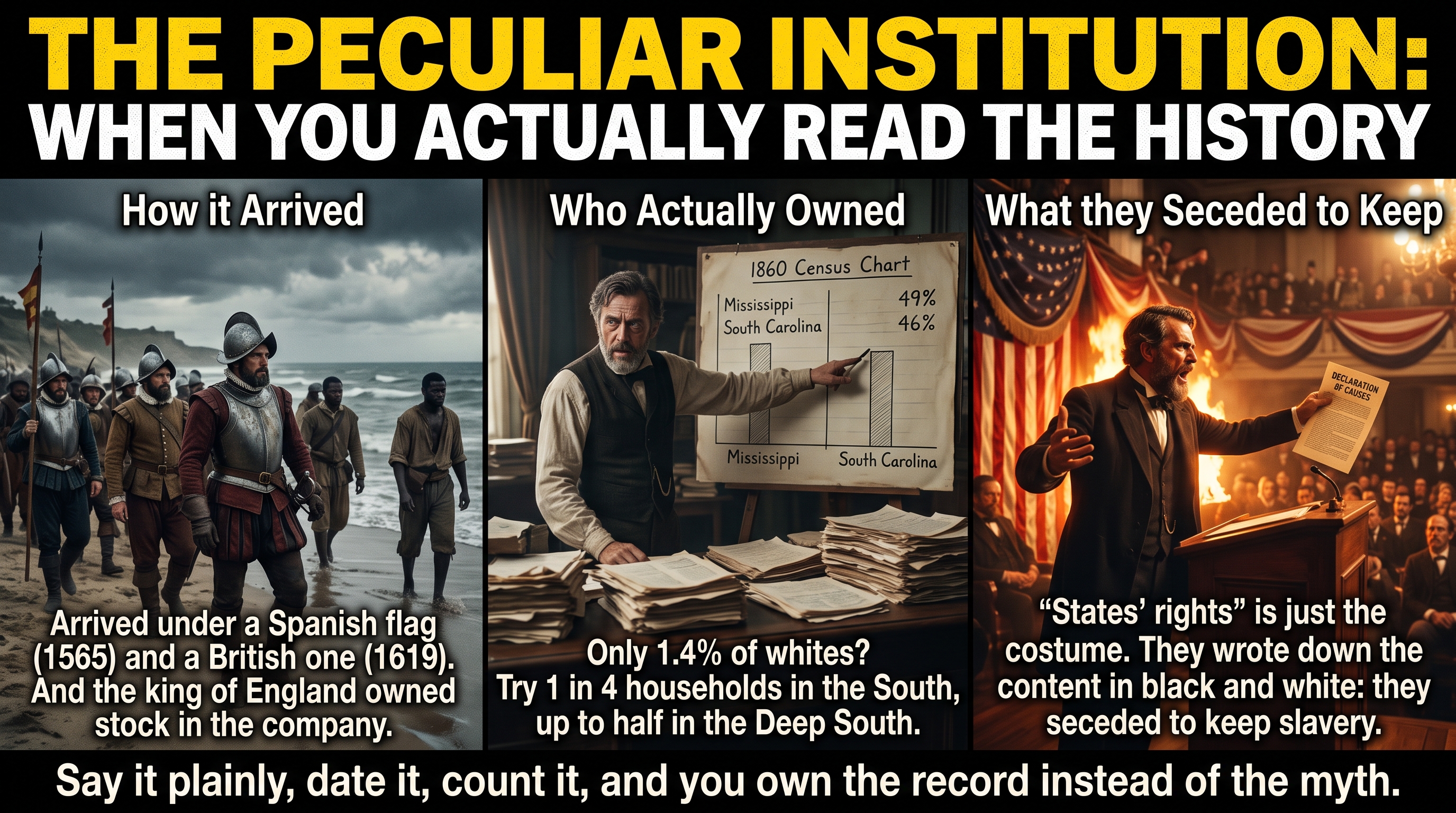
I. Who brought it — and the date that is not 1619
Start with the claim that Britain brought slavery to the colonies, because it is mostly right and the correction is the interesting part. Slavery in the English mainland colonies does trace to a British ship: in late August 1619, an English privateer — the White Lion, which colonist John Rolfe misfiled for four centuries as “a Dutch man of war” — landed at Point Comfort, Virginia, and sold, in Rolfe’s own words, “20. and odd Negroes” to the colony’s governor and head merchant “for victualls.” They had been stolen from a Portuguese slaver bound for Mexico. That is the origin point of English North American slavery, and the institution that grew from it was built, protected, and made enormously profitable under British colonial rule. So far the claim holds.
But slavery on the North American continent is older than the English by more than half a century, and the older owner was Spain. St. Augustine, Florida was founded in 1565 — forty-two years before Jamestown, fifty-five before Plymouth — and Pedro Menéndez de Avilés brought enslaved and free Africans with him to quarry the stone, work the forge, and raise the fort. There is a recorded birth of a Black child in St. Augustine in 1606, thirteen years before Point Comfort. So “Britain brought slavery” is precise only if you mean the English colonies that became the United States; the continent itself was introduced to the trade flying a Spanish flag. The honest sentence is: Britain brought it to the thirteen, and Spain brought it to the land first.
And the colonists were not passive recipients of a Crown policy — they wrote the slave codes themselves, early. The first British colony to put slavery into statute was not in the South: it was Massachusetts, whose Body of Liberties of December 10, 1641 became the first legal code in British North America to sanction “bond slavery.” As for the Crown’s own hand, it is not a metaphor — it is a corporation. King Charles II chartered the Royal African Company in 1672 with a monopoly on the English slave trade, and he and his brother James, Duke of York, were its leading shareholders. The company branded enslaved people on the chest with the initials “DY” for the Duke, and shipped upward of two hundred thousand human beings across the Atlantic. When you say Britain brought slavery, this is the receipt: the king of England personally owned stock in the company that did it.
II. The caving that actually happened — and the one that did not
Here is where the popular story breaks, and it is worth breaking gently because the instinct behind it is sound. The claim is that nine of the thirteen colonies did not want slavery at independence but caved. That specific framing is not supported by the record. Slavery was legal in all thirteen colonies in 1776 — established by law in every one, North and South. It was economically central only in the plantation South, but it was lawful everywhere, and there was no bloc of nine colonies pressing for abolition; the organized antislavery movement at the founding was tiny, confined mostly to Quakers. A majority of the men who signed the Declaration owned slaves, as did four of the first five presidents. The “nine of thirteen” number has no home in the sources.
But the intuition underneath that claim — that slavery was opposed and then compromised away — is documented, precisely, in two places. The first is a deletion. Thomas Jefferson’s original draft of the Declaration of Independence contained a furious passage blaming King George III for the slave trade — the longest grievance in the document, calling the trade a “cruel war against human nature itself” and an “execrable commerce” in which “MEN should be bought & sold.” Congress struck it out entirely. Jefferson himself recorded why: it was cut “in complaisance to South Carolina and Georgia,” with Northern delegates “a little tender” because their merchants had been “pretty considerable carriers” of slaves. That is the clearest single proof that antislavery language existed at the founding and was negotiated away to hold the Union together.
The second place is the Constitution itself, which caved three times in writing and never once used the word. The Framers wrote “free Persons,” “all other Persons,” and “Person held to Service or Labour” — Frederick Douglass later noted that “slave” appears nowhere in the instrument — but the deals were real enough. The Three-Fifths Compromise (Article I, Section 2) counted each enslaved person as three-fifths of a human for the purpose of inflating slaveholders’ representation in Congress. The slave-trade clause (Article I, Section 9) forbade Congress from ending the African trade before 1808 — and Article V entrenched that protection so deeply that it could not even be amended away before that date. The Fugitive Slave Clause (Article IV, Section 2) guaranteed that crossing into a free state did not make you free. South Carolina and Georgia drove every one of these and threatened to walk without them. So the right correction to offer anyone who says “nine colonies opposed it but caved” is this: no — slavery was legal in all thirteen, but a faction of founders genuinely opposed it, left the proof in Jefferson’s deleted clause, and then watched that conscience get compromised away, three clauses at a time, to keep the Deep South at the table. The caving is real. The number was wrong.
III. The arithmetic nobody quotes correctly
Now the question that launches more bad internet statistics than almost any other: what share of white people actually owned slaves? The honest answer depends entirely on a denominator, and the two most-quoted numbers are chosen precisely to win arguments. By the 1860 census there were about 393,975 slaveholders holding roughly 3.95 million enslaved people — about 12.6 percent of the national population — in a country of some 31.4 million. Measured as a share of all American families, slaveholders were 7.4 percent: that is the figure historians call the honest one, because it counts families against families. The number you see weaponized in the other direction — “only 1.4 percent of whites owned slaves” — is a sleight of hand: it divides individual slaveholders by the entire free population, counting one owner against every man, woman, and child in the house. It is designed to make the institution look like a rounding error. It was not.
Because the national average drowns the fact that slaveholding was a regional way of life. By 1860 twenty of the thirty-five states had abolished slavery and contributed zero slaveholding households, which drags the national figure down. Inside the slave states the concentration was overwhelming: about one in four households in the slaveholding South owned human beings, and roughly one in three families across the eleven states that formed the Confederacy. In the two states at the top of the table it approached one half. This was not a fringe practice tolerated by a disinterested majority. In the Deep South it was the ordinary condition of the propertied class and the aspiration of everyone below them.
And yet — this is the part both sides miss — ownership itself was ferociously concentrated. Of all slaveholders, about half held fewer than five people; 72 percent held fewer than ten; 88 percent held fewer than twenty. The “planter” class — twenty or more — was only about 12 percent of slaveholders, which is roughly 3 percent of all Southern households. Fewer than one percent of owners held a hundred or more; the entire national roster of hundred-plus owners was just 2,358 people, and only about eleven thousand held fifty or more. But those few owned most of the enslaved: over half of all enslaved people lived on plantations of twenty or more, a quarter on plantations of fifty or more. So the true shape is a pyramid: a tiny planter aristocracy owned the bulk of the human property, a broad slaveholding middle owned a handful each, and the whole structure — roughly a quarter of Southern households — had a direct financial stake in keeping it legal. That is why it took a war.
The state-by-state ledger is the clearest photograph of it. These are the shares of families owning slaves in 1860, and they run from Mississippi, where it was nearly half, down to Delaware, where slavery was legal but all but extinct:
IV. The conscience that started early and lost slowly
The abolitionist movement did not begin with the Civil War or even the nineteenth century — it begins in 1688, with four Quakers and a sheet of paper. The Germantown Petition of 1688, drafted by Francis Daniel Pastorius and three others outside Philadelphia, was the first formal protest against slavery by a religious body in the English colonies, and it made the argument on the plainest possible ground — the Golden Rule, do unto others. The Quaker hierarchy received it, declined to act, and filed it away so completely that it was not rediscovered until 1844, when the abolitionists of the next century found they had a founding document. The organized movement took institutional shape in 1775 with the Pennsylvania Abolition Society — the first of its kind, later presided over by Benjamin Franklin, a former slaveowner whose last public act was signing its petition to Congress to end slavery.
Then, immediately after independence, the North did what the thirteen colonies had refused to do together: it began abolishing slavery, one state at a time. Vermont’s 1777 constitution was first to bar it; Pennsylvania passed the first gradual-emancipation statute in 1780; Massachusetts’ courts ended it outright around 1783, when an enslaved man named Quock Walker sued for his freedom and won on the words “all men are born free and equal.” The federal government reached the trade itself at the first moment the Constitution allowed: Congress banned the importation of slaves effective January 1, 1808 — the earliest date Article I permitted — weeks after Britain abolished its own Atlantic trade in 1807. Neither act freed a single person already enslaved; both throttled the supply while leaving the institution standing. The movement went loud in 1831, when William Lloyd Garrison launched The Liberator in Boston demanding not gradual but immediate abolition — “I am in earnest — I will not equivocate — I will not excuse — I will not retreat a single inch — AND I WILL BE HEARD” — and in 1833, the year Britain abolished slavery across its empire, the American Anti-Slavery Society was born. Frederick Douglass published his Narrative in 1845; Harriet Beecher Stowe’s Uncle Tom’s Cabin sold half a million copies after 1852 and put the thing in front of readers who had been able to look away. The conscience was never absent. It was outvoted, for two centuries, by the arithmetic of Section III.
V. The line, the compromises, and the court that made it worse
Before the compromises, clear up the line they are always drawn on, because the Mason-Dixon Line had nothing to do with slavery when it was drawn. It was a property survey. Charles Mason, an astronomer, and Jeremiah Dixon, a surveyor — both English — ran it between 1763 and 1767 to settle an eighty-year border war between the Penn family of Pennsylvania and the Calvert family of Maryland, whose overlapping royal charters had nearly put Philadelphia inside Maryland. It was a line about real estate and quit-rents, ratified by the Crown in 1769. Only later — around the Missouri crisis of 1820 — did it get drafted into service as the symbolic border between free soil and slave. The survey did not divide a nation over slavery; the nation backfilled that meaning onto a surveyor’s stones.
The real dividing lines were legislative, and each one bought a few more years at a steeper price. The Missouri Compromise of 1820, brokered by Henry Clay, admitted Missouri as a slave state and Maine as a free one to preserve the Senate’s balance, and drew a line across the Louisiana Purchase at 36°30′ north: slavery barred above it, permitted below. It passed the Senate 24 to 20 and squeaked through the House 90 to 87. The Compromise of 1850 — five separate bills pushed by Clay and then Stephen Douglas — admitted California free, let Utah and New Mexico decide for themselves, abolished the slave trade (but not slavery) in the District of Columbia, and, as the price the South extracted, imposed a brutal new Fugitive Slave Act: federal commissioners paid ten dollars for a ruling that returned the accused to slavery and only five to set him free, with no jury and no right of the accused to testify. Then in 1854 the Kansas-Nebraska Act tore up the 1820 line entirely, letting the two territories vote slavery up or down by “popular sovereignty” — and the result was “Bleeding Kansas,” a rehearsal for the war, fought with rifles over ballot boxes.
And then the Supreme Court, asked to lower the temperature, poured on gasoline. In Dred Scott v. Sandford (March 6, 1857), Chief Justice Roger Taney, writing for a 7–2 majority, held that Black people — enslaved or free — could never be citizens of the United States, and that the Missouri Compromise had been unconstitutional all along because Congress had no power to bar slavery from a territory and so deprive an owner of his “property” without due process. The opinion is remembered for a single sentence, in which Taney described the view he claimed the Founders held of the enslaved: that they “had no rights which the white man was bound to respect.” It was meant to settle the question forever in slavery’s favor. Instead it convinced the North that no political compromise with the slave power was possible, because the court had just declared the central compromise of forty years unconstitutional. A court that was asked to defuse the crisis instead removed the last off-ramp before the war.
VI. The costume — “states’ rights” and what the war was actually about
Which brings us to the last and most durable claim: that the Civil War was “more about states’ rights,” and that Lincoln did not make it about slavery at first and only later did. The second half of that is half-true and worth stating fairly. Lincoln did lead with Union, not abolition. In his August 22, 1862 letter to Horace Greeley he wrote, as plainly as it can be written: “My paramount object in this struggle is to save the Union, and is not either to save or to destroy slavery. If I could save the Union without freeing any slave I would do it.” So yes — the public war aim evolved. What the letter conceals is that Lincoln had already drafted the Emancipation Proclamation and read it to his cabinet a month earlier; it was sitting in his desk as he wrote those words. He issued the preliminary Proclamation on September 22, 1862, and the final one took effect January 1, 1863. The evolution was in the public framing and the military timing, not in a man who woke up late to the subject. His personal opposition to slavery long predated the war.
But the first half — “states’ rights, not slavery” — collapses the moment you let the seceding states speak for themselves, because they were not shy. They wrote declarations of causes, and they named it. Mississippi: “Our position is thoroughly identified with the institution of slavery — the greatest material interest of the world … a blow at slavery is a blow at commerce and civilization.” South Carolina complained of “an increasing hostility on the part of the non-slaveholding States to the institution of slavery” and of the election of a president “whose opinions and purposes are hostile to slavery.” Texas declared itself a commonwealth founded to protect “the servitude of the African to the white race.” And the Confederacy’s own vice president, Alexander Stephens, in his Cornerstone Speech of March 21, 1861, removed all doubt: the new government’s “corner-stone rests upon the great truth that the negro is not equal to the white man; that slavery — subordination to the superior race — is his natural and normal condition.”
So the phrase is not exactly false — it is a costume, and this desk has seen it before. There was a states’ right at the center of the war. The right in question was the right of a state to permit one man to own another, and to compel free states to send escaped human beings back into bondage. “States’ rights” is the category; slavery was the content, and naming only the category is the oldest sleight of hand in American politics — the same move Article XX warns about when it praises state-level experiment, because the point of letting fifty states try fifty things is that a monstrous experiment can be driven away from and overruled, not that “local control” sanctifies whatever is done under it. The states’-rights framing survives because it lets a terrible thing be discussed in a respectable grammar. Strip the grammar and the content is what the secessionists themselves put in writing, in their own hands, before a shot was fired.
VII. Where the ruler lands
Run the whole length of it and the ruler never moves. Slavery arrived under a Spanish flag and then an English one; it was written into law first in Massachusetts and bankrolled from a London boardroom with the king’s name on the stock certificate; it was opposed at the founding by a conscience strong enough to draft the words and too weak to keep them; it was owned, by 1860, by about one Southern household in four and dominated by a planter aristocracy of a few thousand; it was protested from 1688 and abolished state by state in the North while it deepened in the South; it was fought over with compromises and a line on a map and finally a court decision so monstrous it made the war inevitable; and it was defended, in the end, in the plain language of its defenders — until they lost, after which the language changed into something you could say at a reunion. Every one of those facts is a reading on the same instrument. Article I says you own yourself, and slavery is the single institution in American history that answered no — not partly, not with an asterisk, but totally. That is why it is the founding wound and not merely a founding flaw.
And it is why the costume matters now. The move that dressed four million stolen lives in the respectable word “property,” and dressed a war to keep them in the respectable phrase “states’ rights,” is the same move this desk tracks everywhere — the renaming of an ugly thing into a sayable one, the editing of memory to taste that Dispatch № 113 and the fight over the statues both ran down. The honest account does not need the costume and does not fear the facts: Britain brought it to the thirteen and Spain to the land first; the founders caved in a deletion and three clauses, not in nine imaginary colonies; a quarter of the South owned, not a sliver and not everyone; and the war was about a state’s right to a specific thing, and the thing was slavery. Say it plainly, date it, count it, and you own the record instead of the myth. That is the entire job.
Filed on: the record — Origins: the “20 and odd Negroes” at Point Comfort, August 1619, per John Rolfe’s letter to Sir Edwin Sandys (Records of the Virginia Company, Vol. III) and Encyclopedia Virginia, “Virginia’s First Africans” — the ship the White Lion, long misidentified as Dutch; St. Augustine, Florida founded 1565 by Pedro Menéndez de Avilés with free and enslaved Africans, and a recorded Black birth there in 1606, per the National Park Service (Castillo de San Marcos) and the Harvard/Instituto Cervantes Observatorio study “The King of Spain’s Slaves”; Massachusetts Body of Liberties, December 10, 1641, §91, the first British North American statute to sanction “bond slavery,” per the Massachusetts Foundation for the Humanities (Mass Moments) and Learning for Justice; Royal African Company chartered by Charles II on September 27, 1672, with the king and James, Duke of York as leading shareholders, branding “DY” and shipping 200,000+, per the UK National Archives and History.com. Founding: slavery legal in all thirteen colonies in 1776, per the National Constitution Center, the American Battlefield Trust (“The Founding Fathers’ Views of Slavery”), and University of Houston Digital History — the “nine of thirteen opposed” framing unsupported; Jefferson’s deleted “execrable commerce” clause and his Autobiography account (“in complaisance to South Carolina and Georgia”) per the National Humanities Center and University of Houston Digital History; the Three-Fifths Compromise (Art. I, §2), the slave-trade clause (Art. I, §9, protected to 1808 and entrenched by Art. V), and the Fugitive Slave Clause (Art. IV, §2), with Frederick Douglass’s note that “slave” appears nowhere in the text, per the National Archives (“Garrison’s Constitution”) and the Bill of Rights Institute. The arithmetic (1860 Census): ~393,975 slaveholders, ~3,953,760 enslaved (~12.6% of the ~31.4M national population); 7.4% of all U.S. families owned slaves (393,975 of 5,155,608) — historian Adam Rothman’s “better measure” — while the “1.4%” figure divides individual owners by the free population and is flagged misleading by PolitiFact (Aug. 24, 2017) and Snopes (Aug. 7, 2019); ~24.9% of households in the slaveholding South (Joseph Glatthaar) and ~30.8% of families across the Confederacy; concentration — ~50% of owners held fewer than 5, 72% fewer than 10, 88% fewer than 20, only ~12% held 20+ (the planter class, ~3% of Southern households), fewer than 1% held 100+ (just 2,358 people), ~11,000 held 50+, yet the planter minority owned most of the enslaved — per University of Houston Digital History, Wikipedia (“Slavery during the American Civil War”), and civilwarcauses.org; per-state family-ownership shares (Mississippi ~49%, South Carolina ~46%, down to Delaware ~3%) per civilwarcauses.org, PolitiFact, and Snopes. Abolition timeline: the 1688 Germantown Quaker Petition (Pastorius et al.), per the National Park Service; the Pennsylvania Abolition Society, founded April 14, 1775, Franklin president 1787–1790; Vermont 1777, Pennsylvania’s Gradual Abolition Act (March 1, 1780), and the Quock Walker cases ending slavery in Massachusetts (~1783); the U.S. Act Prohibiting Importation of Slaves (signed March 2, 1807; effective January 1, 1808) and Britain’s Slave Trade Act 1807; Garrison’s The Liberator (first issue January 1, 1831) and the American Anti-Slavery Society (December 1833); Britain’s Slavery Abolition Act 1833; Douglass’s Narrative (May 28, 1845) and Stowe’s Uncle Tom’s Cabin (book, March 20, 1852). The line & the compromises: the Mason-Dixon Line surveyed 1763–1767 by Charles Mason and Jeremiah Dixon to settle the Penn–Calvert border (a property dispute, not slavery; the free/slave symbolism came later), per Wikipedia and worldatlas; the Missouri Compromise, signed by President Monroe March 6, 1820 (Henry Clay; Jesse B. Thomas’s 36°30′ line; Senate 24–20, House 90–87 and 134–42), per the U.S. House History Office and the Library of Congress; the Compromise of 1850 (five bills, September 9–20, 1850; Clay and Douglas) and the Fugitive Slave Act of 1850 (9 Stat. 462, September 18, 1850; the $10/$5 commissioner fee, no jury, no testimony), per Wikipedia and the National Constitution Center; the Kansas-Nebraska Act (signed May 30, 1854; repealed the 36°30′ line; “Bleeding Kansas”), per the U.S. Senate Historical Office. The court: Dred Scott v. Sandford, 60 U.S. 393, decided March 6, 1857, 7–2, Chief Justice Taney — Black people barred from citizenship and the Missouri Compromise held unconstitutional under the Fifth Amendment; the “no rights which the white man was bound to respect” passage quoted in full context; dissents by McLean and Curtis — per Justia and the Dickinson College House Divided project. Causation: the secession Declarations of Causes of Mississippi (Jan. 9, 1861), South Carolina (Dec. 24, 1860), Georgia (Jan. 29, 1861), and Texas (Feb. 2, 1861), per the Avalon Project (Yale Law School) and the American Battlefield Trust; Alexander Stephens’s Cornerstone Speech (March 21, 1861), per the American Yawp Reader and Civil War on the Western Border; Lincoln’s letter to Horace Greeley (August 22, 1862) and the Emancipation Proclamation (preliminary September 22, 1862; effective January 1, 1863), per the Library of Congress / House Divided and the National Archives. The principles — CROWN manifesto: Article I, “You Own Yourself”; Article II, “The Non-Aggression Principle”; Article XX, “Test It in the States First”; Article XXI, “What the Founders Actually Feared”; Article XXII, “You Have the Right to a Trial You’ll Never Get”; Article L, “The Word They Wore Out.” The costume-and-renaming thread continues from Dispatch № 103 and Dispatch № 113. Grounded web search compiled October 9, 2026; full dossier retained.
№ 117 · Filed October 9, 2026 — Here is a confession that doubles as the whole dispatch: a household can earn $200,000 a year and genuinely not know whether it is middle class. That is not false modesty and it is not innumeracy. Run the number through the Pew Research Center’s own calculator and the answer literally flips depending on how many people are at the dinner table and which year’s table you happen to read. The term has come unglued from the thing it used to name. “Middle class” once meant a recognizable life — a house, a car, a doctor you could afford, a kid you could send to college on one-and-a-half incomes without a second mortgage on the future. Today it is a word three different data sets measure three different ways, a political mascot both parties claim to defend while presiding over its slow redefinition. This desk is going to do the unfashionable thing and separate what actually happened from what the slogans say happened — the tier that thinned, the slice that shrank faster than the tier, and the squeeze that explains why a six-figure paycheck no longer buys the feeling the word used to carry. It is the companion to Dispatch № 116: that one named the machine that got captured; this one counts the people standing under it.
The Unglued Middle — How “Middle Class” Came Loose From the Thing It Used to Name
I. The $200,000 question
Start with the joke, because the joke is the thesis. Pew defines “middle income” with admirable precision: a household earning between two-thirds and double the national median, adjusted for how many people that income has to feed. Plug in the latest figures and, in 2023 dollars, a three-person household is middle class from $61,000 to $183,000. So a family of three on $200,000 is upper income — cleanly, in every version of the table. Now add one child. A four-person household’s middle-class ceiling rises to about $211,000 in 2023 dollars — which puts that same $200,000 back inside the middle. Switch to Pew’s 2022-dollar calculator and the family-of-four ceiling drops to $196,000, and the household is upper income again. Same paycheck. Your class depends on whether you had a third kid and which year’s spreadsheet you opened. When a definition is that sensitive to rounding, the honest conclusion is not that people are confused. It is that the category has stopped describing a life and started describing a percentile.
And percentiles move for two completely different reasons, which is where nearly every argument about the middle class goes wrong. A person can fall out of the middle by getting poorer — or by getting richer. A band defined as “the middle two-thirds-to-double” shrinks whether people drop beneath it or climb above it, and those are opposite stories wearing the same statistic. So before anyone shouts “the middle class is being destroyed,” the first job is to read the ruler straight: which direction did the people who left actually go?
II. The tier is thinning — but mind which way it drained
The headline number is real and it is dramatic. In 1971, Pew counts 61% of American adults as living in middle-income households. By 2023 it was 51% — a ten-point collapse in the share of the country that sits in the economic middle, the longest and steadiest decline in the whole series. If you stop reading there, you have the story every campaign tells: the middle is vanishing. But the honest desk does not stop there, because the same table says where the vanished went. The lower-income share rose from 27% to 30% — up three points. The upper-income share rose from 11% to 19% — up eight points. Of the ten points that left the middle, roughly eight climbed and only three fell (the arithmetic rounds a hair past ten; the shape is what matters). The middle class did not mostly collapse downward into hardship. It mostly dissolved upward into affluence. That is a genuinely good fact, and a publication that buried it to keep the alarm clean would be lying by omission.
So why does “the middle is thriving” feel like a lie too? Because thinning-by-promotion still hollows out the thing the word used to mean — a broad, dominant, culturally central majority that set the country’s baseline expectations. A nation that was 61% middle felt middle. A nation that is 51% middle, with a swollen top and a heavier bottom, feels sorted. The shared center that everyone from Levittown to the UAW once pointed to as “normal” is no longer the clear majority experience. The tier did not just shrink; it stopped being the gravitational center. And the people still in it are about to discover that holding their place in the band is not the same as holding their old share of the country.
III. The slice, not just the crowd
Headcount is the kind story. The pie is the hard one. Count not how many people are in the middle but how much of the nation’s money runs through it, and the picture darkens fast. In 1970 the middle class took home 62% of all U.S. household income. By 2022 it took 43% — a drop of nearly a third of its slice. The crowd shrank by a sixth; its share of the income shrank by far more. The people who stayed in the middle are not splitting the same pie among slightly fewer hands — they are splitting a smaller pie. And the wealth ledger, which is where security actually lives, tells the same story from the balance-sheet side. By the Federal Reserve’s own distributional accounts, the households sitting between the 50th and 90th percentile of wealth — the textbook definition of a comfortable middle — held 35.9% of the country’s net worth in 1989. By the end of 2024 they held 30.3%. Over the exact same span the top 1% climbed from 22.8% to about 31%. Read those two lines together and the punchline is brutal in its symmetry: the richest 1% of Americans now own roughly as much of the nation’s wealth as the entire 40% of households that make up the middle. The bottom half, for the record, went from 3.4% to 2.5% — they were never in this race.
This is the measurement the “everyone just moved up” reading cannot survive. Yes, more people crossed into the upper tier than fell out the bottom — but the gains stacked at the very top, not evenly across the newly-upper. You can grow the number of upper-income households and still have the middle’s share of income and wealth erode, because the dollars pooled where the dollars already were. Promotion into “upper income” on Pew’s scale ($183,000 for a family of three) is a real and good thing. It is also nowhere near the altitude where the wealth actually concentrated. The middle didn’t just get smaller. It got lighter.
IV. Why a raise stopped feeling like one
Here is the resolution of the whole paradox, and it is the companion point to Dispatch № 116. Real middle-class incomes did rise — Pew’s own data show middle-income households earning meaningfully more, in inflation-adjusted terms, than they did in 1970. The problem is not that the paycheck stood still. The problem is what the paycheck has to buy. Look at the third panel of the ledger and notice which four things outran the wage: a home, a college degree, health care, and childcare. These are not luxuries that lifestyle inflation dreamed up. They are the four literal pillars of a middle-class life — the exact set of things that define the status the word used to confer — and every one of them has risen faster than middle-class earnings for a generation. Since 2000, median household income roughly doubled; family health premiums rose 4.7-fold, college tuition 3.4-fold. Stretch the ruler to 1985 and tuition ran nine times and home prices five against a wage that merely tripled. A raise that is eaten by the mortgage, the premium, the tuition bill, and the daycare invoice before it reaches the checking account is a raise you earned and never felt.
And now connect it to the machine, because the connection is the entire argument. Ask which sectors of the American economy have outrun the paycheck the hardest, and you get the same list every time: health care, higher education, housing. Then ask which sectors are the most thoroughly captured — the most licensed, subsidized, cartelized, permission-slipped, and shielded from the price competition that disciplines everything else — and you get the identical list. That is not a coincidence; it is the mechanism. The sectors that strangle the middle class are precisely the ones where corporatism has replaced the market, where a third-party payer or a government subsidy or a guild’s licensing board has severed the link between what a thing costs and what it is worth. Pour federal student aid into a college system that faces no price discipline and tuition simply drinks the subsidy. Wrap health care in employer tax preferences and certificate-of-need laws and prices detach from reality entirely. The middle class is not being squeezed by “capitalism run amok.” It is being squeezed in the four corners of the economy where capitalism was replaced by capture — and then handed the bill under the free market’s name.
V. What this desk will not claim
The Crown does not launder its own conclusions, so here is the honest ledger of what the alarm gets wrong. The middle class is not “destroyed” — more Americans climbed out the top of it than fell out the bottom, and that is a real improvement no amount of nostalgia should erase. Material life got better in ways the income tables miss: the car is safer, the phone in every pocket would have been a billionaire’s impossibility in 1980, televisions and clothing and food and airfare are all dramatically cheaper in real terms. A poor household today owns comforts a 1970 middle household could not buy at any price. Anyone who tells you the middle class simply collapsed into immiseration is selling you a feeling, not a fact. The genuine complaint is narrower and sharper than the slogan: the specific goods that constitute middle-class security — the deed, the diploma, the medical bill you can survive, the retirement you can see from here — have been priced out faster than wages rose, even as the gadgets got cheap. You can have a nicer television and a less certain future at the same time. That is the squeeze, stated without exaggeration.
VI. Rebuild the life, not the word
The wrong fix is to redefine the term until everyone qualifies again — and the wrong fix after that is to pour more public money into the four captured sectors and call it compassion. You already watched that movie: subsidize a captured college system and you fund the tuition spiral; subsidize a captured health system and you fund the premium. The through-line of the codex holds here exactly as it did in the last dispatch — you do not fix a captured machine by fueling it; you fix the machine first. Break the health cartel at the joints that detach price from value: real prices posted up front, insurance decoupled from the employer, the certificate-of-need laws that let incumbents veto competitors repealed. Fund the student, not the system, and stop pumping uncapped aid into institutions that face no consequence for raising the price. Let homes be built — the single biggest driver of the housing line is the zoning and permitting thicket that makes new supply illegal in the places people want to live. None of this is a handout and none of it is austerity. It is the removal of the capture that turned four ordinary goods into luxury goods.
And keep the floor while you free the market above it — that distinction is the whole libertarian settlement. A net is not a harness: Social Security and Medicare are the floor beneath the fallen, and the codex keeps that floor without apology. The argument here is not against the safety net; it is against pretending that a thicker net can substitute for an economy where the ladder’s rungs are affordable in the first place. The middle class was never a number on a Pew table — it was a life: ownership, mobility, a reasonable confidence that the next generation starts no lower than this one. You do not restore that by moving the income brackets around until the statistics flatter us. You restore it by making the four things that define the life — a home, a degree, a doctor, a childhood — cost what they would cost in a market that actually worked. Do that, and a $200,000 household stops having to consult a spreadsheet to find out whether it made it. It will simply know.
Filed on: the record — The tier: Pew Research Center, “The State of the American Middle Class” (May 31, 2024), analyzing U.S. Census Bureau Current Population Survey ASEC data — share of U.S. adults in middle-income households 61% (1971) to 51% (2023), lower-income 27% to 30%, upper-income 11% to 19%; “middle income” defined as two-thirds to double the size-adjusted national median household income. The thresholds: Pew income thresholds in 2023 dollars — three-person household $61,000–$183,000 middle (four-person ~$70,400–$211,300; two-person ~$49,800–$149,400); in 2022 dollars, three-person $56,600–$169,800, four-person ~$65,400–$196,100 — placing a $200,000 income in the upper tier for a family of three and on the middle/upper boundary for a family of four depending on the dollar-year used. The slice: Pew — middle-class share of aggregate U.S. household income 62% (1970) to 43% (2022); Federal Reserve Distributional Financial Accounts (via FRED) — net-worth share of the 50th–90th wealth percentile (“next 40%”) 35.9% (1989 Q3) to 30.3% (2024 Q4), top 1% 22.8% to ~30.8%, bottom 50% 3.4% to 2.5%. The squeeze (nominal growth): U.S. Census median household income ~2.08× (2000–2025) and ~3.70× (1985–2025); College Board Trends in College Pricing, published in-state public four-year tuition & fees ~3.41× (2000–2025) and ~9.07× (1985–2025); Census/FRED median home sales price ~2.56× (2000–2025) and ~5.11× (1985–2025), price-to-income ratio 3.51 (1985) to ~4.84 (2025); KFF Employer Health Benefits Survey family premium ~4.66× (1999–2025); BLS day-care & preschool CPI ~2.48× (2000–2025). The honest ledger: real middle-income earnings rose over the period per Pew; durable-goods and communications prices fell sharply in real terms per BLS CPI component series. The principles — CROWN manifesto: Article XV, “Capitalism Is Not Corporatism”; Article XXIII, “The Least Free Market in America”; Article XII, “Fund Students, Not Systems”; Article XXIV, “A Net, Not a Harness.” The captured-machine argument continues Dispatch № 116. Grounded web search compiled October 9, 2026; full dossier retained.
№ 116 · Filed October 9, 2026 — The loudest fight in American politics is two camps screaming the word capitalism at each other while meaning two different systems that merely share a costume. One is voluntary exchange — the arrangement that, on the plainest evidence humanity has ever assembled, pulled more people out of destitution than every government program in history combined. The other is a business plan that runs through a legislature: bailouts, licenses, patents, tariffs, and too-big-to-fail guarantees, sold to the public as “the free market” by the right and damned as “capitalism’s failure” by the left, when it is neither. This desk calls the second thing by its name — corporatism — and this is the long dispatch: what the real thing did to global poverty, which nations actually run it (the social democracies included, the socialisms emphatically not), what captured it here, and — because a diagnosis without a prescription is just complaining with footnotes — the specific repairs the codex demands, education and healthcare and the safety net included. The through-line of every repair is one sentence: you do not fix a captured system by pouring more public money into it. You fix the machine before you fuel it.
The Costume — How Capitalism Beat Poverty, What Corporatism Did to It in America, and the Repairs That Follow
I. Two systems, one costume
Start with the distinction, because nearly every argument downstream is really a confusion about it. Article XV of the codex draws the line in a single table, and it is worth stating in full because the whole dispatch hangs on it. Under capitalism, profit comes from customers — you earn by persuading strangers to trade with you, voluntarily, again and again — losses are yours, competitors may enter, prices carry information about what is scarce, and size is earned and fragile. Under corporatism, profit comes from legislators — you earn by arranging the rules in your favor — losses are socialized through bailouts and guarantees, competitors are licensed out, prices carry policy instead of information, and size is a statutory status rather than a market verdict. Too-big-to-fail is not a market outcome; it is a law.
Here is the part both tribes get wrong, and it is the reason the argument never ends. The left looks at a captured, subsidized, bailed-out, regulation-moated economy, correctly concludes that it is rigged, and then prescribes more of the exact instrument that rigged it — more agencies, more rules, more discretion for officials to allocate. Every one of those is a lever, and the firm with a hundred lobbyists and a compliance department reaches it before you do. That is not a bug in regulation; it is the physics of it: complex rules are a tax on small firms and a subsidy to large ones. The right, meanwhile, defends the outcome and calls it the free market — when there is nothing free-market about a farm subsidy, a steel tariff, a bank guarantee, a drug-patent extension, or a hospital permission slip that requires your competitor’s blessing to open. As the line attributed to P. J. O’Rourke has it: when buying and selling are controlled by legislation, the first things to be bought and sold are legislators. A genuine capitalist should be the angriest person in the room about corporate welfare, because it is the single thing most responsible for discrediting markets in the public mind.
II. The receipt nobody can dispute
Set aside the theory and read the one number that settles the biggest question in economics. In 1820, by the best historical reconstruction, roughly 84% of all human beings lived in extreme poverty — not “struggling,” but below the line of bare subsistence. By 1950 it was around 55%. In 1981, when the World Bank’s modern series begins, it was 42.7%. Today it is 10.4% — and falling. Measured against the World Bank’s extreme-poverty line of $2.15 a day, the share of humanity living in destitution has collapsed by roughly three-quarters inside two human lifetimes. Between 1990 and 2015 alone, the absolute number of people in extreme poverty fell from about 1.9 billion to 730 million — over a billion people lifted clear — and it happened while the world added more than two billion mouths. No plan did that. No agency, no five-year program, no benevolent ministry. It was markets, opening.
And you can name the engines, because the data points straight at them. China took roughly 800 million people out of extreme poverty in four decades — its destitution rate falling from 88.1% in 1981 to under 1% — and the clock started the year it stopped pretending to be a planned economy: Deng Xiaoping’s 1978 reforms, which de-collectivized the farms, legalized private enterprise, and opened the coast to trade. India ran the same experiment on its own schedule: after the 1991 liberalization dismantled the suffocating “License Raj,” its extreme-poverty rate fell from 16.2% in 2011–12 to 2.3% by 2022–23 — 171 million people in a single decade. The common ingredient is not charity and it is not conquest. It is the thing Article XV describes: let people trade, keep what they build, and compete to serve one another, and the floor of human existence rises faster than any government has ever managed to raise it by decree. This is not an argument that markets are kind. It is the observation that they are effective, at the one task — mass escape from poverty — that every political philosophy claims as its own.
III. Which nations are actually capitalist — and the confusion that poisons the debate
Ask an American socialist to name a socialist country they admire and the answer is almost always Denmark, Sweden, or Norway. It is the wrong answer, and the mistake matters, because the whole domestic argument is built on it. The Nordic countries are not socialist. They are market economies with large welfare states — private ownership, private profit, open trade, light product-market regulation — that then tax heavily to fund a generous floor. Their own leaders say so plainly. In 2015, standing at Harvard’s Kennedy School, the Danish prime minister Lars Løkke Rasmussen said it in one sentence that American debaters keep refusing to hear: “I know that some people in the US associate the Nordic model with some sort of socialism. … Denmark is far from a socialist planned economy. Denmark is a market economy.” The ledgers agree with him. On the Heritage Foundation’s 2026 Index of Economic Freedom, Denmark ranks 7th in the world, Norway 8th, Sweden 11th — ahead of the United States. On the Fraser Institute’s index they score near the very top on property rights and freedom to trade, and fall only on the one axis everyone already knew about: the size of government.
So draw the distinction the way the codex draws capitalism from corporatism — cleanly, and once. Social democracy keeps capitalism and redistributes its proceeds: the means of production stay in private hands, the market sets prices and allocates capital, and the state taxes the output to fund a floor. That is Denmark. Democratic socialism, taken at its actual word, means the social ownership of the means of production — the state or “the workers” owning the firms, the farms, the capital — arrived at by ballot rather than revolution. That is not Denmark; that is the thing Denmark’s prime minister went to Harvard to deny. And where it has actually been tried at national scale — Venezuela most recently, which nationalized its way from the richest country in South America to the bottom of every economic-freedom ranking on earth — it produces the same result every time, because abolishing the price signal abolishes the information the economy runs on. The Nordics did the opposite: they kept the engine and argued only about how to split the output. You may think they tax too much — this desk does — but they are arguing inside capitalism, not against it. Calling them socialist is how the American left claims a success that belongs to the system it says it opposes.
And the richest irony sits in the rankings themselves. The country that invented the modern free market has been quietly falling down the list. The United States dropped out of the Heritage top twenty in 2023, slid to 26th by 2025, and sits at 22nd today — behind every Nordic “socialist” utopia the domestic argument invokes. Heritage names the cause without euphemism: runaway government spending, chronic deficits, and a national debt that has become a drag on economic liberty itself — the generational theft of Article XXV, showing up now in the one scoreboard that is supposed to measure freedom. (The Fraser index, weighting fiscal health differently, still places the US 5th — the gap between the two is itself the story: strip out the debt and spending, and America is still near the front; leave them in, and it is sinking.) We are not losing the argument about capitalism to socialism. We are losing it to ourselves — to the captured, indebted, permission-slip version of the thing. Which is the rest of this dispatch.
IV. What captured it here — the bailout and the moat
The clearest photograph of American corporatism was taken in the autumn of 2008. When the biggest banks had bet the house and lost, the losses did not land on them — the entire point of Article XV’s “losses are yours” was suspended by statute. The Troubled Asset Relief Program authorized up to $700 billion of public money to catch private bets; in the end about $443 billion went out the door and most of it came back, at a net lifetime cost to taxpayers of roughly $31 billion. But fixate on the recovered dollars and you miss the real damage, which was not fiscal — it was structural. The 2010 Dodd-Frank Act, sold as the leash on Wall Street, instead codified the thing it claimed to end: it created a federal list of “Systemically Important Financial Institutions,” an official roster of firms the government has formally announced it will not let fail. Too-big-to-fail stopped being a market suspicion and became a government designation — a standing guarantee that lowers the borrowing costs of the biggest players precisely because everyone now knows the taxpayer is the co-signer. That is corporatism in its purest institutional form: the state absorbing the downside so the giant keeps the upside.
Now watch what the guarantee did to competition — because this is where “fewer choices” stops being a slogan and becomes a measurement. In 1990 the four largest American banks held about 11% of all banking assets. After the crisis-era shotgun mergers — the healthy giants swallowing the wounded ones with federal blessing — the Big Four’s share rocketed to 52.5%, and it sits around 51% today. Half the banking system, four firms. And the door behind them was welded shut: the number of American commercial banks fell from 14,469 in 1983 to about 3,900 now, and the pipeline of new ones simply stopped. From 1960 through 2006, the country chartered an average of 185 new banks a year. In the fifteen years after Dodd-Frank, it averaged fewer than seven — with multiple years at zero. When the compliance cost of being a bank is set by rules written for trillion-dollar institutions, no community bank can be born to challenge them. This is the mechanism Article XV names at retail scale: complex rules are a tax on the small and a moat for the large. The moat was dug in the name of safety, and the thing it made safe was the incumbent.
V. The referee they fired — how capitalism rots into corporatism
Everything so far assumes a market can stay competitive on its own. It cannot — and the mechanism of its decay is the hinge the whole dispatch turns on. Real capitalism is contestable: a firm that grows fat, slow, and overpriced is supposed to be eaten by a hungrier rival, which is exactly the fragility Article XV means by “size is earned.” The thing that keeps the door open for that challenger — that stops the biggest player from simply buying, starving, or merging away everyone who might threaten him — is antitrust. It is the referee that keeps the field contestable, and it is the single institutional difference between a market that disciplines the giant and a market that crowns him. Kill the referee and capitalism does not stay capitalism. It curdles, quietly and legally, into the moat-and-incumbent world this desk calls corporatism — no bailout required, no photograph taken.
One man did more than any other to fire that referee, and he did it with a book and a judgeship. Robert Bork’s The Antitrust Paradox (1978) became the most influential antitrust text of the century by rewriting what the law was even for: the only harm worth recognizing, Bork argued, was a provable, near-term rise in the price consumers pay — and bigness itself, the swallowed competitor, the field gone empty, counted for nothing unless you could show the checkout total ticking up this quarter. The Supreme Court swallowed it nearly whole. In Reiter v. Sonotone (1979) a unanimous Court pronounced the Sherman Act a “consumer welfare prescription,” citing Bork’s book by the page. Reagan put him on the federal appeals court in Washington in 1982, and from that bench he wrote the doctrine straight into the case law — down to opinions clearing a restraint because the firm held “only” a single-digit share and therefore, by the new gauge, could not possibly harm anyone. The Senate rejected his Supreme Court seat in 1987, but the fight was already won where it counted. Bork’s life’s work was narrowing antitrust to one dial that reads only this quarter’s price, and from the federal bench he succeeded.
Here is what a market looks like once its referee has been told to watch only the price tag. Since the late 1990s, more than three in four American industries have grown measurably more concentrated; the standard yardstick of market concentration rose by roughly 90% on average, and the number of publicly traded American companies fell by about half between 1997 and 2014. The economists who measured it looked for the efficiency story Bork promised — the bigness that earns its size by serving customers better — and did not find it; what they found instead was fatter profit margins and more lucrative mergers, which is the signature of market power, the precise thing the law once existed to stop. And the enforcers stopped enforcing: the government quit challenging mergers that left as few as five competitors standing after 2007, while an estimated 83% of the deals it waved through on a promise went on to raise prices anyway. This is the same moat Dodd-Frank dug for the banks — dug across the entire economy by a quieter instrument. Not a bailout anyone can photograph; a doctrine that instructed the referee to look at nothing but the near-term checkout price and ignore the empty field where the competitors used to stand. TARP’s guarantee and Bork’s merger math produce the identical end-state — the giant that cannot be challenged — and only one of them ever made the news.
VI. The permission-slip economy and the litigation drag
What Dodd-Frank did to banking, the licensing board does to everyone else. In the 1950s, roughly one American worker in twenty needed the government’s permission to do their job; today it is about one in four, and the work did not get twenty times more dangerous — incumbents simply discovered that the cheapest way to beat a competitor is to make her illegal. Article XVI files the receipts: Louisiana licenses florists; states have hauled hair-braiders before cosmetology boards; a monastery of monks was ordered to stop selling plain wooden caskets because they lacked funeral-director licenses. A cosmetology license commonly demands around 1,500 hours of state-mandated schooling — more than the training to become the EMT who restarts your heart. The tell is always in the hours, and the hours track lobbying muscle, not risk. None of it protects you; all of it protects someone from you, and the bill lands on the bottom rung — the braider who cannot afford the tuition, the immigrant whose foreign trade earns no American paper, the ex-felon fenced out of honest work by a “good character” clause.
Stack the two national drags on top of the moats and the picture of “fewer choices, higher prices” completes itself. The first is regulation by sheer volume: the Code of Federal Regulations now runs past 190,000 pages, the annual Federal Register hit a record 106,000 pages in 2024, and the most-cited estimate of the compliance cost — the Competitive Enterprise Institute’s “Ten Thousand Commandments” — puts the annual burden around $2.1 trillion, roughly 7% of GDP, a hidden tax of some $16,000 per household that funds nothing and shows up on no ballot. These are the laws nobody voted for of Article XXVI: the overwhelming majority of binding federal rules were written by people you cannot name and cannot vote out. The second drag is the courthouse. America runs the most expensive liability system in the developed world — the U.S. Chamber’s Institute for Legal Reform puts total tort costs at $529 billion in 2022, about 2.1% of GDP and roughly $4,200 per household — and the bill is paid twice, once in the premium and again in the defensive medicine and the products never brought to market because the liability math never closed. A libertarian is not against suing someone who genuinely harmed you — Article II makes fraud and injury the very things the law should punish. The objection is to a lottery that taxes every transaction to enrich a specialized bar, and whose first casualty, as the next section shows, was the independent doctor.
But before the repair, the reframe — because the loudest objection to touching any of this is that regulation is what protects us, and tort is precisely how a free society protects people without it. Regulation is prior restraint: an agency decides in advance what you may not do, on the theory that someone might be harmed if you were left free to try. Tort is accountability after the fact: act as you see fit, but if you injure someone you pay for it in full — and the near-certainty of paying prices the risk into your conduct long before you ever act. That pricing is the deterrent, and it is a sharper one than any rulebook, because a firm weighing whether to cut a corner must weigh the entire expected cost of getting it wrong, not merely the fixed penalty for tripping some specific rule it has already memorized and lawyered around. A regulation guards you against the one hazard a bureaucrat thought of in advance; liability guards you against all of them, including the ones nobody has written a rule for yet. One is a list; the other is a principle — and Article II is built on the principle, because fraud and injury are exactly the harms a just law exists to make whole.
Which is why the honest answer to “does tort need to change” is yes — but it is broken in two opposite directions at once, and naming only one is how the argument gets eaten alive. In one direction it is far too easy to abuse: the jackpot verdict, the suit forum-shopped into the friendliest county, the mass-tort and class-action machinery that enriches the specialized bar far more than the people it claims to represent, and the defensive medicine and never-launched products that are the quiet tax of a system anyone can weaponize. That half needs to be made harder — safe harbors for the doctor who followed the standard of care, loser-pays at the margins to price out the speculative suit, limits on the purely invented damage. But in the other direction tort has been quietly made far too hard for the people who were actually harmed: the forced-arbitration clause buried in every click-through and employment contract that signs away your right to a jury before the injury has even happened; the damage caps that cut off the catastrophically maimed at a number set by a legislature that never met them; and the preemption and “we-followed-the-regulation” defenses that let a company point at the very agency it captured and call the rule it helped write a shield against the person its product injured. That half needs to be made easier. Make it harder to file junk and game the lottery; make it easier for a genuinely injured person to hold a genuine wrongdoer accountable — both at once, or you have not reformed tort, you have simply handed one more advantage to whichever side already had the lawyers.
VII. The solutions begin where the honesty does — a floor is not the enemy
Here the codex breaks with libertarian orthodoxy in plain sight, and the break is the key to every solution that follows: a safety net should exist. Not grudgingly, not as a concession extracted under duress — as a plain statement of what a decent society does for the people who genuinely cannot provide for themselves: the child with no family, the widow whose savings ran out, the disabled, the ones the accident found. Social Security and Medicare, stripped of euphemism, are socialism — collective provision, funded by compulsory transfer — and Article XXIV says the floor they provide is defensible and should stay. The argument is not against the net. It is against what the net became: a harness, strapped onto every able-bodied working adult whether they want one or not. Social Security takes 12.4% of every paycheck — the largest tax most people pay — into a trust fund of government IOUs earning a return a private account would be embarrassed by, and then it mostly dies with you. The repair is not to burn it down; it is to keep the guarantee absolute for those who cannot provide, and let everyone else opt out prospectively, with their own money, into accounts they own and can leave to their children. Every argument against letting people leave is a confession about the math. Catch the falling; free the standing.
That single move — keep the floor, unbuckle the harness — is the template for the two hardest cases, education and healthcare, because in both the public money is real and the problem is never the money. It is what the money is wired to.
VIII. Fund students, not systems
Public funding of education is not the enemy either — an educated society is a better one, and there is a clean case for the public purse paying to produce it. What is not defensible is what the purse currently buys: the most successful monopoly in American life, the government school, whose customers are assigned by street address, whose funding arrives whether it performs or not, and whose worst outlets cannot go out of business because a compulsory-attendance law delivers a fresh captive market every September. Article XII lays the receipts on one table — and the receipts are devastating. Across all fifty-one American systems, the correlation between per-pupil spending and eighth-grade math scores is 0.01 — statistically zero. New York spends more per child than any system in the country and finishes 27th. Since 1989, real per-pupil spending is up 58% while national scores sit below where they started. The two states that buck the trend prove the rule from opposite ends of the income scale: Massachusetts rose on standards, not dollars; Mississippi — fifth-lowest spending in the nation — now outscores California and Florida because a 2013 law mandated phonics and ended the social promotion of kids who cannot read. The variable that moves children is method, and method has no price tag. Throwing more money at the monopoly is the one input thirty-five years of data say is already maxed out.
So apply the safety-net logic exactly: fund the student, not the system. We already do it everywhere else — grocery dollars follow the shopper, Pell grants follow the student, housing vouchers follow the tenant. Only in K–12 does the money fund the institution instead of the person, which is precisely why the institution answers to the legislature instead of to you. Let the dollar follow the child to whatever works — the district school, a classical academy, a phonics micro-school in a church basement — and let the exit door do what it does everywhere else. The receipts on that are in too: where choice works, it works because failing schools are allowed to die — roughly a quarter of charter schools close within five years, and that mortality is the engine, not the scandal. The gains land hardest on exactly the families the zip-code assignment traps tightest. The wealthy have always had school choice; they buy it with a private tuition check or a mortgage in the right district. Fund students, not systems, and you stop reserving the exit for people who can afford the house.
IX. Fix the machine before you fuel it — healthcare
Healthcare is where the whole thesis comes to a point, because it is simultaneously the least free market in America and the one most people mistake for a free market that failed. It did not fail; it was never allowed to exist. Nobody in the industry can tell you a price — and a market without prices is not a market. Article XXIII tallies who built the cage: insurance is welded to your employer because of World War II wage controls, a government distortion never repealed, so losing your job still means losing your coverage eighty years later. Certificate-of-need laws let existing hospitals legally veto new competitors — the permission-slip economy one size up. The FDA’s approval gauntlet fills an invisible graveyard. And the money proves the capture: the United States spends 18% of GDP on healthcare — about $14,900 per person, nearly double the roughly $7,400 of peer nations — and does not buy longer life for it. Meanwhile the pharmaceutical and health-products industry is the largest lobbying sector in Washington, spending a record $457 million in a single year to keep the cage exactly as it is. The independent doctor — the one who knew your family — is nearly extinct, driven out by six-figure malpractice premiums and a billing bureaucracy that made solo practice impossible, so the person who trained a decade to exercise judgment is now employed on the condition that she not exercise it.
And here is the sentence that governs the entire dispatch, stated where it bites hardest: you cannot fix this by pouring one more public dollar into the system as currently built. Universal coverage of a corruption market is not compassion — it is corruption at scale, with your name on the receipt. The sequence is the solution, and it is not optional. First, repair the machine: real prices, posted and binding, no more chargemaster fiction; decouple insurance from employment; repeal certificate-of-need so a competitor can open a clinic without his rivals’ permission; malpractice reform with safe harbors, so a doctor following the standard of care is not betting her house on every patient — and watch private practice come back from the dead; and break the sealed contracts of the pharmacy middlemen open to daylight. Then, with a system that can finally state its own prices in public, the question of a public floor becomes an honest conversation instead of a blank check. Fund patients, not systems — the same verdict as the schools, for the same reason. Fix the machine before you fuel it. Fuel it first and all you have done is feed the captor.
X. The common repair — break the connection, not the business
Stand back and every fix in this dispatch is the same fix, aimed at the same joint. Let losses be losses: end the SIFI guarantee and let a bank that bet wrong fail, so size goes back to being earned and fragile instead of statutory. Let banks be born again — a tiered, proportionate charter so the compliance cost of being small is not set by the rulebook written for the giants. Rehire the referee: restore an antitrust standard that counts the missing rivals and the welded-shut door, not merely this quarter’s checkout price, so a merger has to answer for the field it empties and not just the receipt it prints — the 2023 merger guidelines, pulling the concentration threshold back to where it sat before Bork’s math loosened it, are the first step back toward a contestable market. Replace the permission-slip economy with what already works in a hundred uncaptured trades: inspect outcomes, enforce liability when real harm is done, and let reputation — which now follows every business everywhere, permanently — do the work a board that meets quarterly cannot. Discipline the litigation lottery with safe harbors and loser-pays at the margins — and in the same motion strike the forced-arbitration clauses and preemption shields that lock the genuinely injured out of the courthouse, because a tort “reform” that only ever protects the defendant is not reform at all — it is capture in a fresh costume. And put the administrative state back on a leash: no rule with the force of law until Congress votes on it, on the record, with names attached, and every rule sunsetting by default unless affirmatively renewed. Watch who screams at that one — it will not be the citizens.
So where does the ruler land? On a costume, and on the two very different things wearing it. One of them — voluntary exchange, open entry, losses that fall where the bets were made — is the most effective anti-poverty engine the species has ever built, and the World Bank’s own ledger is the receipt. The other — the bailout, the license, the patent moat, the too-big-to-fail roster, the subsidy with a lobbyist’s name on the back — is the thing Americans actually live under and have been taught to call “capitalism” by the people it enriches and “capitalism’s failure” by the people it enrages. They are both wrong, and the confusion is load-bearing: it lets the right defend corporate welfare as the free market and the left prescribe more of the captor as the cure. A genuine capitalist should be the angriest person in the room about every line of it. Break the connection between the firm and the state — in banking, in the licensing board, in the schoolhouse, in the hospital — and the giant that cannot call Washington for help is just a large company with a large target on its back, which is exactly how it is supposed to be. Keep the floor for the fallen. Free the standing. And stop fueling the machine before you have fixed it, because every dollar poured into a captured system does not reach the citizen it was meant for. It reaches the captor. That is the whole argument, and it fits on a receipt.
Filed on: the record — Poverty: World Bank Poverty & Inequality Platform (international extreme-poverty line $2.15/day, 2017 PPP), March 2026 global update — global extreme-poverty share 42.7% (1981) to 10.4% (2024, ≈847 million people), 2026 nowcast ~10.0%; headcount down from ~1.9 billion (1990) to ~730 million (2015), “over a billion lifted” amid world-population growth exceeding two billion; China from 88.1% (1981) to under 1% (~800 million lifted) following the 1978 Deng reforms; India from 16.2% (2011–12) to 2.3% (2022–23), 171 million in a decade, following the 1991 liberalization; pre-1981 reconstruction from Bourguignon & Morrisson (2002) and Our World in Data (~84% in 1820, ~55% in 1950). Which nations are capitalist: 2026 Heritage Foundation Index of Economic Freedom — Singapore (84.4), Switzerland, Ireland, Australia, Taiwan, Luxembourg, Denmark (7th, 79.0), Norway (8th), Estonia, Netherlands top ten; United States 22nd (72.8), down from the top twenty in 2023 (25th) and 26th in 2025, the decline attributed to spending, deficits, and debt; 2026 Fraser Institute Economic Freedom of the World (2024 data) placing the US 5th and Venezuela last (165th). Social democracy vs. democratic socialism: Danish Prime Minister Lars Løkke Rasmussen, Harvard Kennedy School, October 30, 2015 (“Denmark is far from a socialist planned economy. Denmark is a market economy”); the economic distinction between private ownership with redistribution (social democracy) and social/state ownership of the means of production (socialism). The capture: Emergency Economic Stabilization Act of 2008 (TARP, up to $700 billion, reduced to $475 billion by Dodd-Frank; ~$443.5 billion disbursed, ~$425.5 billion recovered, ~$31.1 billion net lifetime cost per GAO/CBO); Dodd-Frank Wall Street Reform and Consumer Protection Act of 2010 and the Systemically Important Financial Institution designation; big-four bank asset share ~11% (1990) to a 52.5% peak and ~51% today (Federal Reserve/FDIC; Brookings 2023); U.S. commercial banks 14,469 (1983) to ~3,900 (2025) per FDIC; de novo bank charters averaging 185/year (1960–2006) and fewer than 7/year (2010–2024), multiple zero years, per the Federal Reserve Bank of Kansas City and the OCC. Antitrust — the fired referee: Robert H. Bork, The Antitrust Paradox: A Policy at War with Itself (1978), the Chicago-School cornerstone narrowing antitrust toward a “consumer welfare” / price-effects test; Reiter v. Sonotone Corp., 442 U.S. 330 (1979), unanimous, calling the Sherman Act a “consumer welfare prescription” and citing Bork (p. 66); Bork confirmed to the U.S. Court of Appeals for the D.C. Circuit Feb. 8, 1982, served to Feb. 5, 1988, Supreme Court nomination rejected October 1987 (Rothery Storage & Van Co. v. Atlas Van Lines, 792 F.2d 210 (D.C. Cir. 1986), clearing a restraint on a ~6% share); Grullon, Larkin & Michaely, “Are U.S. Industries Becoming More Concentrated?” Review of Finance (2019) — >75% of industries more concentrated since the late 1990s, average HHI ~+90%, publicly traded U.S. firms down ~50% (1997–2014), with no efficiency explanation; Gutiérrez & Philippon (2019) on “good to bad” concentration; John Kwoka, Mergers, Merger Control, and Remedies (2015) — enforcement against mergers leaving five competitors ceasing after 2007, ~83% of cleared/remedied deals later raising prices; DOJ/FTC merger guidelines HHI threshold 1,800 (1982) raised to 2,500 (2010) and returned to 1,800 (2023). Regulation and tort: Code of Federal Regulations 190,627 pages (2023) and the 2024 Federal Register record of 106,109 pages (National Archives); Competitive Enterprise Institute, Ten Thousand Commandments (2026), ~$2.153 trillion annual regulatory burden (~7% of GDP, ~$15,859/household); U.S. Chamber Institute for Legal Reform & The Brattle Group, Tort Costs in America (2024), $529 billion in 2022 (~2.1% of GDP, ~$4,207/household). Healthcare: CMS National Health Expenditure data — U.S. health spending $5.3 trillion in 2024, 18.0% of GDP ($14,885 per capita), projected 20.6% by 2034, versus an OECD peer average near $7,371 per capita; OpenSecrets — pharmaceuticals/health products the largest federal lobbying sector, a record $456.9 million in 2025. The principles — CROWN manifesto: Article XV, “Capitalism Is Not Corporatism”; Article XVI, “The Permission-Slip Economy”; Article XII, “Fund Students, Not Systems” (and Dispatch № 14); Article XXIII, “The Least Free Market in America”; Article XXIV, “A Net, Not a Harness”; Article XXV, “Generational Theft”; Article XXVI, “Laws Nobody Voted For”; and Article II’s treatment of fraud and injury. The corporatism-as-foreign-policy thread continues Dispatch № 113. Grounded web search compiled October 9, 2026; full dossier retained.
№ 115 · Filed October 9, 2026 — “We love legal immigration — just come the right way” is the most repeated sentence in American politics, and for the first time there is a ledger precise enough to test it. The Cato Institute measured every lane of entry from the end of 2024 through February 2026, and the finding inverts the slogan: this administration cut legal immigration far harder than illegal. Monthly legal entries in the major categories fell by 144,569; illegal entries fell by 53,128. Legal immigration was cut 2.7 times more than illegal, and the legal cuts made up 73% of the entire drop. The honest half is real and this desk will state it plainly: illegal crossings did fall. But 84% of that decline had already happened before this president took the oath — and meanwhile the one door a “nation of laws” is supposed to keep open got welded tighter shut. This is the story of how the front door got welded, why both tribes once agreed it should open, what broke that agreement, and the single clause that could end the war. Here is the ledger.
The Welded Door — How a “Pro-Legal-Immigration” Border Crackdown Cut the Legal Door Hardest
I. The chart nobody ordered
Set the slogan beside the record. The pitch was always a clean split — legal good, illegal bad, come the right way and the door is open. The record is the opposite shape. Immigrant visas — the green-card front door — fell by roughly half; visas for the spouses and fiancés of American citizens fell 61%. Student visas fell 42%. Skilled-worker H-1B admissions (with their H-4 families) fell 78%, throttled by the $100,000 toll this desk ledgered in Dispatch № 113. Refugee admissions collapsed nearly 90% — from 12,518 in December 2024 to 1,341 a month by spring 2026, with the whole year capped at 7,500 souls. And legal asylum at the southwest ports — people presenting themselves lawfully at the checkpoint, the exact behavior the slogan demands — fell 99.9%, from nearly 40,000 a month to twenty-six. The diversity lottery was suspended; immigrant visas were banned outright for the nationals of some ninety countries. Every one of these is the legal lane. The door marked “come the right way” is the one that got the heaviest weld.
Now the honest half, because this desk does not deal in slogans. Illegal crossings did drop, and that is not nothing — a border that cannot be walked across at will is a precondition for any immigration policy worth the name, and pretending otherwise is how the other tribe loses the argument. But two facts discipline the victory lap. First, 84% of the entire crossing decline happened before January 2025 — the fever had already broken, crossings down 81% from their December 2023 peak, on the prior administration’s watch. Second, and decisively: a country that means “come legally” proves it by the condition of the legal door. Weld that door while crossings are already falling, and “come the right way” stops being an instruction and becomes a taunt — there is no right way left to come.
II. How the door got welded in the first place
None of this started in 2025. Article XXIX of the codex named the machine years ago: the legal front door was already functionally welded — queues measured in decades, quotas set a generation ago, a process so baroque that skilled applicants give up and go build their companies in Toronto or Bangalore. Meanwhile the side door swung freely, which suited the connected employer just fine, because an illegal workforce is a cheap and rightless one — no minimum protections, no complaints filed, deportable the day it unionizes. The system was never broken. It was tuned — to deliver subsidized labor to the people who lobbied for the tuning, while both parties fundraised off the spectacle at the fence. What changed in 2025 is not that someone finally fixed the broken door. It is that someone welded it the rest of the way shut and sold the weld as a renovation.
III. When both tribes wanted the same thing
Here is the fact that has been scrubbed from everyone’s memory: twenty-five years ago, the restrictionist-but-pro-legal position was the Democratic position. The U.S. Commission on Immigration Reform was chaired by Barbara Jordan — Democrat, civil-rights icon, the woman whose voice carried the Nixon impeachment hearings — and its yardstick is still the cleanest sentence anyone has written on the subject: “people who should get in, do get in; people who should not get in are kept out; and people who are judged deportable are required to leave.” Her commission recommended cutting legal immigration by a third, ending chain migration, abolishing the diversity lottery, and building a mandatory workplace-verification system — the seed of E-Verify — because, in its words, “reducing the employment magnet is the linchpin.” President Clinton endorsed all of it, the enforcement and the legal cuts, telling Congress in 1995: “We are a nation of immigrants. But we are also a nation of laws.”
And it ran deeper than one commission. Cesar Chavez — the patron saint of the farmworker left — hated illegal immigration so thoroughly that in 1974 the United Farm Workers ran a literal civilian border patrol, the “wet line,” to stop undocumented strikebreakers, and reported crossers to the INS; Chavez said that if his own mother were crossing illegally to break a strike, he would turn her in too. As late as June 2009, Senator Chuck Schumer told a Georgetown audience, in these exact words: “Illegal immigration is wrong, plain and simple,” and “illegal aliens should not be treated the same as people who entered the United States legally.” The right had its own mirror of this consensus — the 2013 Gang of Eight, the Republican Party’s own 2012 autopsy begging for comprehensive reform. For one brief window, both tribes were standing on the same square: a real front door, a policed side door, membership that means something. Hold that image, because what happened next is the whole point.
IV. The swap — how a policy became a flag
On June 27, 2019, a moderator asked ten Democratic presidential candidates to raise a hand if crossing the border illegally should be a civil offense rather than a crime. Eight of ten hands went up. The party of Jordan, Chavez, and Schumer — the party that had run a border patrol and called illegal immigration “wrong, plain and simple” — now treated the enforcement itself as the sin, and “abolish ICE” became a primary-season litmus test. And the Republicans performed the mirror-image defection: the party that commissioned the 2012 autopsy pleading for reform nominated the man who ran against every page of it, and by 2025 was welding the legal door too. Look closely at the motion and you will see that nobody moved toward a better policy. Each tribe moved to the negation of the other. This is affective polarization in its purest form — the same horseshoe this desk mapped in № 113: when your position is defined by who stands across from you rather than by the ledger, immigration stops being a problem to solve and becomes a flag to wave. The restrictionist Democrat and the pro-reform Republican did not lose an argument. They lost their own histories, because holding a view the other tribe now holds became unbearable.
V. The line, and the workers — two things the codex refuses to blur
We need the workers. Say it without flinching. The orchards, the kitchens, the job sites, the research labs, and the startups have said for forty years that they need the hands and the minds, and the empirical fears about the people walking through the door dissolve on contact with data — the crime wave the statistics never find, the lump-of-labor myth that treats jobs as a fixed pie to be guarded rather than a thing immigrants create by spending, building, and hiring. The honest answer to “we need the workers” is open the front door, exactly as Article XXIX argues: a vetted checkpoint, a real identity, the background check we already know how to run — and then yes, in weeks, not generations. That is the libertarian floor, and most Americans already stand on it when they say “come legally.”
But here is the line the compassionate version keeps tripping over. When the front door stays welded and the fix becomes de-facto amnesty for whoever already made it across, you have not been generous — you have speed-tracked the line-jumper over the line-stander. Somewhere there is a nurse in Manila or an engineer in Lagos who filed the paperwork, paid the fees, and has been waiting honestly in a queue measured in decades. Hand status to the person who skipped that queue, ahead of the person still standing in it, and you have told everyone watching that the rule you ask them to follow is for suckers. That is not kindness; it is contempt for the law dressed as mercy — and it is the single fastest way to poison public support for the legal immigrant who did everything right. The codex’s answer resolves both halves at once: you do not reward cutting the line, and you make the line short enough that cutting it is pointless. A front door that actually opens is what makes the queue worth standing in.
VI. The clause that could end the war
If you wanted to drain the heat out of this fight — actually depolarize it rather than win it — there is one move that does more than any border wall or amnesty: settle birthright. The reason every immigration debate goes nuclear is the jackpot at the center of it — citizenship awarded by the coordinates of a delivery room, the “anchor” that converts one crossing into a permanent family claim, birth tourism sold as a package deal. Take that jackpot off the table and the oxygen goes with it. The Fourteenth Amendment’s citizenship clause was written in 1868 to answer exactly one question — whether people born here and freed from bondage were citizens of the country that had enslaved them — and its authors wrote “subject to the jurisdiction thereof” precisely because they did not mean a universal geographic lottery. Maybe the clause reaches today’s use; maybe it never did. The one unacceptable answer is running a nation’s membership rules on a 157-year-old ambiguity that both tribes exploit and neither will resolve.
And it is worth knowing why that clause exists at all, because the history settles what the slogans only shout about. The citizenship clause was not written to bless a geographic lottery — it was written to kill a Supreme Court decision. In Dred Scott v. Sandford (1857) the Court held that Black people, whether enslaved or free, could never be citizens of the United States — that they were, in Chief Justice Taney’s words, “beings of an inferior order” with “no rights which the white man was bound to respect.” The Fourteenth Amendment’s first sentence is the constitutional headstone on that ruling: it was built in 1868 to guarantee, beyond the reach of any future court or legislature, that the freedmen and their children were full citizens of the country that had held them in bondage. That — the repair of slavery — is the clause’s whole reason for being. Everything else it is asked to do today is argument by extension.
And the companion half of that history is the part the “born here, citizen, end of story” reading cannot explain away: the framers deliberately carved out Native Americans. The phrase “subject to the jurisdiction thereof” was not throat-clearing — it was a working exclusion. Senator Jacob Howard, who introduced the language on the Senate floor, said plainly it would not include “persons born in the United States who are foreigners, aliens, who belong to the families of ambassadors,” nor “Indians born within the limits of the United States, and who maintain their tribal relations,” because tribal members owed allegiance to their own nations, not to Washington. The Court agreed in Elk v. Wilkins (1884): a man born into a tribe was not a birthright citizen, even though he was unquestionably born on American soil. Native Americans did not become citizens by being born here — they had to be granted it, by statute, in the Indian Citizenship Act of 1924, fifty-six years after the amendment that supposedly covered everyone born within the lines. Hold those two facts together and the point is inescapable: from the day it was ratified, the clause turned on birth plus full jurisdiction, not birth alone. The carve-out is the proof. A country that excluded its own native-born peoples from automatic citizenship for two generations was never operating the universal geographic lottery the modern slogan assumes — which is exactly why the honest move is to decide the question in daylight rather than keep shouting a 157-year-old text past each other.
And note the method, because the method is the medicine. You do not settle this by executive order — that is just the oscillation that keeps the war hot, policy made by proclamation and unmade by injunction, flipping with each administration while the thing itself never resolves. You settle it the way the Constitution built a process for exactly this: clarify it or amend it through Article V, in daylight, by the hard honest vote nobody wants to be caught casting. Decide, once, as a country, that citizenship follows conduct and contribution rather than the GPS of a birth — and the maternity ward stops being a naturalization ceremony, the anchor stops being an incentive, and the hottest flashpoint in the whole debate simply goes cold. That is the depolarizing move. Not because it hands either tribe a trophy, but because it ends the one thing both of them have been feeding on.
So where does the ruler land? On a door, and on the condition we keep it in. The slogan that both tribes still mouth — “a nation of immigrants and a nation of laws” — was once a shared sentence; Barbara Jordan meant it, Bill Clinton said it, and the ledger that would make it true is not complicated. Gate the buffet so the open door is affordable. Open the door so “come legally” is an invitation and not a taunt. Make the legal line short enough that jumping it buys nothing. And settle birthright in daylight so the jackpot stops poisoning the well. What broke the consensus was not the arithmetic — the arithmetic still works. What broke it was the discovery that any position becomes intolerable the moment the other tribe is seen holding it. A nation of immigrants that cannot design a working front door has not run out of room. It has run out of honesty.
Filed on: the record — Cato Institute, David J. Bier, “The Trump Administration Has Cut More Legal Immigration Than Illegal Immigration” (first published April 2026, updated with complete data October 2026), compiled from U.S. State Department monthly immigrant-visa issuances and “Admissions & Arrivals” (WRAPSNET), and U.S. Customs and Border Protection Nationwide Encounters: monthly legal entries in the major categories down 144,569 versus 53,128 illegal (legal cut 2.7× more; 73% of the total decline); illegal crossings down 81% from their December 2023 peak by December 2024 (84% of the total decline predating the January 2025 inauguration); immigrant visas down ~50%, spouse/fiancé (K) visas −61%, student (F-1) visas −42%, H-1B/H-4 −78%, refugee admissions from 12,518 (Dec 2024) to 1,341/month (Mar 2026) under a 7,500 FY2026 ceiling, and legal asylum at southwest ports from ~40,000/month to 26 (Feb 2026); plus the December 2025 diversity-lottery suspension and immigrant-visa bans affecting ~92 countries. The H-1B toll — Presidential Proclamation 10973 ($100,000 supplemental payment), as ledgered in CROWN Dispatch № 113. The lost consensus — U.S. Commission on Immigration Reform (the “Jordan Commission”), chair Barbara Jordan: Legal Immigration: Setting Priorities (June 1995) recommending a roughly one-third cut in legal immigration to ~550,000, an end to extended-family chain categories, abolition of the diversity lottery, and a mandatory employment-verification pilot (“reducing the employment magnet is the linchpin”); President William J. Clinton’s 1995 State of the Union (January 24, 1995, “a nation of immigrants … also a nation of laws”) and his June 7, 1995 statement endorsing the legal-immigration recommendations; Cesar Chavez and the United Farm Workers’ 1974 “wet line” and reporting of undocumented strikebreakers to the INS; Senator Charles Schumer, keynote to the Migration Policy Institute / Georgetown (June 24, 2009): “illegal immigration is wrong, plain and simple” and “illegal aliens should not be treated the same as people who entered the United States legally.” The swap — the June 27, 2019 NBC Democratic primary debate (Miami), eight of ten candidates raising hands to make unauthorized border crossing a civil rather than criminal offense (repeal of 8 U.S.C. § 1325); the 2012 Republican National Committee “Growth & Opportunity Project” autopsy and the party’s subsequent reversal. The principle — CROWN manifesto, Article XXIX, “The Front Door and the Welfare Gate,” and Article V on amendment. The birthright history — Dred Scott v. Sandford, 60 U.S. 393 (1857), holding that Black Americans could not be citizens (Taney, C.J., “no rights which the white man was bound to respect”); the Fourteenth Amendment’s Citizenship Clause (ratified July 9, 1868), drafted to overturn it; Senator Jacob M. Howard’s May 30, 1866 Senate-floor explanation of “subject to the jurisdiction thereof” as excluding the children of foreign diplomats and “Indians … who maintain their tribal relations” (Cong. Globe, 39th Cong., 1st Sess. 2890); Elk v. Wilkins, 112 U.S. 94 (1884), holding a tribe-born Native American was not a birthright citizen; and the Indian Citizenship Act of 1924 (Snyder Act, Pub. L. 68-175) granting citizenship to all Native Americans born in the U.S. — with United States v. Wong Kim Ark, 169 U.S. 649 (1898), the counterweight extending the clause to the U.S.-born children of resident immigrants. Grounded web search compiled October 9, 2026; the constitutional argument rests on the text of the Fourteenth Amendment (1868); full dossier retained.
№ 114 · Filed October 9, 2026 — The meme is one of the most durable on the internet: a photo of Barack Obama over the words “In 2013 Obama made it legal for the media to lie to you.” The law it points at is real — the Smith-Mundt Modernization Act of 2012, folded into that year’s defense bill as Section 1078 and signed into law on January 2, 2013. Something genuinely changed. A decades-old ban was lifted. And this desk will not wave the whole thing away as a hoax, because the nerve it touches — a government that funds news being allowed to point that news at its own citizens — is a real nerve, and serious journalists pressed on it at the time. But the meme gets the author wrong, the target wrong, the effect wrong, and the scope wrong — four errors in eleven words. What actually got repealed was a ban on handing out government-made foreign broadcasts inside U.S. borders. It had nothing to do with private media, it did not touch anyone’s license to lie, and it was written by a Republican. Here is the ledger: what the law was, what it changed, what it pointedly left standing, and the one honest worry buried under the false one.
The Dissemination Ban — What Smith-Mundt Actually Repealed, and Why “Obama Made It Legal to Lie” Is Wrong on Every Count
I. The claim, and the grain of fact inside it
The viral version runs like this: in 2013 the Obama administration quietly repealed an “anti-propaganda law,” and ever since, the government — or “the media,” the two blur together in the telling — has been legally free to feed Americans manufactured news. There is a real statute underneath. The Smith-Mundt Modernization Act of 2012 began as a standalone bill, H.R. 5736, and its operative text was carried into the National Defense Authorization Act for Fiscal Year 2013 (H.R. 4310) as Section 1078. President Obama signed that NDAA into law on January 2, 2013 as Public Law 112-239; the modernization provisions took effect July 2, 2013, once the Broadcasting Board of Governors issued its implementing rules. So the date is right, the signature is right, and a long-standing restriction really was removed. Everything the meme builds on top of that is where it comes apart.
II. What Smith-Mundt actually was — and why the ban existed
The original law is the U.S. Information and Educational Exchange Act of 1948 — “Smith-Mundt” after its sponsors — and it governs one narrow thing: U.S. government public diplomacy and international broadcasting. Voice of America, and later the rest of the BBG family, were created to broadcast outward, to foreign audiences, as an instrument of Cold War statecraft. Congress was nervous about exactly the thing the meme fears: a sitting administration using a taxpayer-funded broadcaster to shape opinion at home. So the law banned the domestic dissemination of that material. VOA could beam a program into Prague or Tehran, but it could not distribute that same program to Americans. The 1985 Zorinsky Amendment (Senator Edward Zorinsky, D-NE) tightened the screw further, codifying that program material “shall not be used to influence public opinion in the United States” and forbidding domestic distribution outright. That is the “anti-propaganda” architecture the meme is nostalgic for. Note what it was and was not: it was a leash on the government’s own broadcasters. It was never, at any point, a rule about CNN, Fox, a newspaper, or any private outlet — those have always been free to be as right or as wrong as the First Amendment allows.
III. What 2012 changed — and what it pointedly left standing
By the 2010s the dissemination ban had curdled into an absurdity. A teenager in Cairo could stream a VOA broadcast on the open internet; an American researcher or journalist who wanted the same transcript was, on paper, barred from requesting it. The Modernization Act fixed that single defect. It lifted the absolute ban so that the State Department and the BBG could make their foreign-targeted programming available inside the United States — but, in the statute’s own design, on request, to media, researchers, and the public, not as a domestic broadcast campaign. And here is the part the meme never mentions, because it kills the story: Section 1078 expressly kept the Zorinsky prohibition in place. No funds appropriated to these agencies may be used to “influence public opinion in the United States.” The government did not win a new license to propagandize Americans. It lost a ban on letting Americans see what it was already lawfully broadcasting to the rest of the world. Access, not manufacture. That is the entire delta.
IV. The honest half — the real worry under the false one
This desk does not deal in slogans, and the fair thing to say is that the alarm did not come from nowhere. The backlash was lit by a real piece of mainstream journalism: Michael Hastings in BuzzFeed, May 18, 2012, “Congressmen Seek To Lift Propaganda Ban,” warning that messaging built for foreigners “could now be aimed at Americans.” A year later, as the law took effect, John Hudson in Foreign Policy — “U.S. Repeals Propaganda Ban, Spreads Government-Made News to Americans” — pressed the same point about government-funded programming flowing into the domestic information space. Those are serious bylines raising a serious question, and the underlying anxiety — that the wall between statecraft abroad and persuasion at home is thinner than it looks — is legitimate and worth guarding. But even the critics’ strongest version is narrower than the meme. Hastings leaned hard on a fear of the Pentagon running domestic psychological operations, and the Pentagon has never been governed by Smith-Mundt at all — its domestic limits live in entirely separate statutes. Strip the law down and what you have is a reasonable civil-liberties debate about government-made news reaching citizens on request. What you do not have is Obama, acting alone, making it legal for the press to lie.
V. The worry the meme is too lazy to name — laundering through the feed
Here is the version of this fear that actually deserves a hard eye, and it is one the 1948 Congress could not have seen coming: the dissemination ban was written for a world of printing presses and shortwave transmitters, and it was repealed into a world of infinite, frictionless sharing. When the leash came off in 2013, the law’s drafters pictured a researcher requesting a VOA transcript, or a reporter pulling a clip for context — a slow, deliberate, labeled transaction. That is not how information moves now. A government-funded broadcast, once legally available inside U.S. borders “on request,” is one screenshot away from a group chat, one repost away from a feed, one algorithmic boost away from millions — and at every hop it sheds its origin label. The “U.S. Agency for Global Media” chyron falls off. What began as content the state produced to persuade a foreign audience arrives in your timeline stripped of provenance, wearing the same clothes as a neighbor’s post, and the act of a friend sharing it does the one thing the Zorinsky Amendment was built to prevent: it launders the material into something that reads as organic, peer-validated, true. The statute still forbids the government from spending to push opinion at home. It has nothing to say about the internet doing the pushing for free.
That is the mechanism worth taking seriously, and it cuts in a direction the meme never bothers to look. The danger is not that a cabinet secretary flips a switch and beams lies into your living room — that remains illegal, and it is the boring, tractable kind of abuse a court or an inspector general can catch. The danger is quieter and structural: government-origin framing, built to move a foreign population, seeps into the domestic conversation through ordinary sharing, gets amplified by engagement engines that do not care who made it, and comes back around — days or years later — as a “fact everyone knows,” its fingerprints long since wiped. By the time it reaches you it is indistinguishable from grassroots belief, and that is precisely what makes it load-bearing: a thing feels truer the more hands it passes through, even when every one of those hands added nothing but a reshare. A ban on the government paying to influence Americans is a narrow wall; it does not touch the far larger surface where state-seeded material and the share button do the influencing between them, nobody having broken a single law. That is the real conversation — how a free, hyper-connected information space should treat content it did not generate but cannot stop carrying — and it is a conversation about transparency, provenance, and the half-life of a claim, not about one president and one signature. The meme reaches for that live wire and then grabs the wrong end of it.
So where does the ruler land? On a meme that is parasitic on a real law and a real worry, and wrong about both in the ways that matter. Yes, a ban came down in 2013. No, it was not Obama’s solo act — a Republican drafted it and it rode a defense bill through a divided Congress. No, it has nothing to do with “the media,” which Smith-Mundt never governed and the First Amendment protects. And no, it did not hand the state a new tool to lie to you — the one prohibition that actually matters, the bar on spending public money to move public opinion at home, is still on the books. What you are allowed to do is read the Voice of America broadcast your taxes already paid to send to Tehran. The honest version of the concern — that government-funded news bleeding into the domestic feed deserves a hard eye — is a conversation worth having. The meme is not that conversation. It is the sound of a real question being drowned by a false answer.
Filed on: the statute — United States Information and Educational Exchange Act of 1948 (“Smith-Mundt Act,” Pub. L. 80-402); the Zorinsky Amendment of 1985 (Sen. Edward Zorinsky, D-NE), codifying that U.S. public-diplomacy program material “shall not be used to influence public opinion in the United States” and barring domestic distribution. The modernization — Smith-Mundt Modernization Act of 2012, introduced as H.R. 5736 (May 10, 2012) by Rep. Mac Thornberry (R-TX) with Rep. Adam Smith (D-WA); enacted as Section 1078 of the National Defense Authorization Act for Fiscal Year 2013 (H.R. 4310), signed by President Obama January 2, 2013 as Public Law 112-239 (FY2013 NDAA House passage 299–120; Senate by voice vote), with the Broadcasting Board of Governors’ implementing provisions effective July 2, 2013. What it did and did not do — it lifted the ban on domestic dissemination on request of State Department and BBG (Voice of America and sister services) foreign-audience programming, while §1078 expressly preserved the prohibition on using appropriated funds to influence U.S. public opinion; the Act never applied to private commercial media, nor to the Department of Defense, whose domestic-communication limits arise under separate statute. Contemporaneous criticism — Michael Hastings, “Congressmen Seek To Lift Propaganda Ban,” BuzzFeed, May 18, 2012; John Hudson, “U.S. Repeals Propaganda Ban, Spreads Government-Made News to Americans,” Foreign Policy, July 14, 2013. Fact-check record — PolitiFact and subsequent reviews rating the “Obama legalized propaganda / made it legal for the media to lie” framing false. Grounded web search compiled October 9, 2026; full dossier retained.
№ 113 · Filed October 9, 2026 — A Republican president has walled off a lane of skilled immigrant labor with a $100,000 toll, and he has sold it as a defense of the free market and the American worker. It is worth being precise about what just happened, because the label is wrong in a way that matters. Capitalism lets the factors of production — goods, capital, and labor — move to wherever they are valued most; the state’s job in that system is to enforce the contract, not to stand at the door deciding who may sell their work. A policy whose entire purpose is to stand at that door is not capitalism. It is mercantilism — the doctrine Adam Smith wrote nine hundred pages to bury — wearing a capitalism nametag. And here is the part neither tribe says out loud: it is the exact same lever socialism reaches for. Restricting who gets to work, and on what terms, is a state-controls-the-labor-market idea, and it has fans on both ends of the horseshoe. The H-1B fight is not right versus left. It is market versus state — and on that axis the nationalist right and the socialist left are standing on the same square, each insisting the other one built it. Here is the ledger.
The Nametag — Why Protectionism Isn’t Capitalism, and Why Socialism Pulls the Same Lever
I. What capitalism actually says about labor
A market economy has one organizing idea: let every resource flow to its highest-valued use, and let price — not an official — do the sorting. That is as true of a worker as it is of a ton of steel or a dollar of capital. Labor is a factor of production, and the whole engine of a free market is the free movement of factors to where they produce the most. Adam Smith said it in 1776; David Ricardo formalized it in 1817 with comparative advantage, the proof that open exchange makes both sides richer even when one is better at everything. The twentieth-century defenders of the idea — Milton Friedman, Friedrich Hayek — were explicit that the state’s legitimate role is to set and enforce the rules of the game: protect property, enforce contracts, police fraud and force. It is not to pick which competitors are allowed on the field. A genuinely free market does not check the worker’s passport before it lets him compete, any more than it checks where the steel was smelted. The moment the government decides that seller may offer his labor and this one may not, you have left the market and entered something older.
II. What protectionism actually is — the older thing
The older thing has a name, and Smith named it: mercantilism. The Wealth of Nations is, for most of Book IV, a sustained demolition of “the mercantile system” — the sixteenth-to-eighteenth-century doctrine that the state should manage commerce to benefit favored domestic incumbents. Its tools were tariffs, import quotas, export subsidies, and the Navigation Acts. The logic was always identical: raise the price of a resource at the border so that a protected domestic interest need not face the competition, and make the consumer pay the difference. A labor-market restriction is that same move, aimed at a different factor. A tariff on steel, a quota on sugar, and a $100,000 wall around a software engineer are the same instrument — a price raised by the state to shield an incumbent from a cheaper rival. The employer pays more, the protected worker pockets the premium, and the economy as a whole eats the lost efficiency. You can favor that trade-off. What you cannot do is call it capitalism, because it is the precise thing capitalism was formulated against. Protectionism is not the free market defending itself; it is the free market being overruled.
III. The H-1B ledger — and the honest half
The specific lever here is Proclamation 10973. Signed September 19, 2025 and effective September 21, it imposed a $100,000 supplemental payment on each new H-1B petition filed for a beneficiary outside the United States — universities, nonprofit research, and case-by-case “national interest” waivers exempted. The stated justifications are a wage-and-worker argument: that the program is exploited to undercut American pay, that IT staffing “body shops” flood the lottery with cheap entry-level labor, and that the toll will force the program up-market toward “the best of the best.” The courts have not been kind. In State of California v. Mullin (D. Mass., No. 1:25-cv-13829), Judge Leo Sorokin vacated the fee nationwide on June 8, 2026, holding it an unauthorized tax imposed without Congress and a violation of the Administrative Procedure Act’s notice-and-comment requirement; the First Circuit denied a stay on July 24. In Global Nurse Force v. Trump (N.D. Cal.), Judge Haywood Gilliam enjoined it again on September 30, 2026. The administration has pressed on anyway — Proclamation 11069 (September 18, 2026) extends the fee to September 2027, a companion executive order orders layoff scrutiny of sponsors, and a DHS rulemaking floats a formal $103,265 filing fee for 2028 — all currently blocked or pending.
Now the honest half, because this desk does not deal in slogans. The wage-suppression worry is not invented. There is a real documented record of abuse — outsourcing firms gaming the lottery, and the ugly cases where American workers were made to train the foreign replacements who then took their jobs. A principled free-marketer can look at that and want it stopped. But wanting the fraud prosecuted and the program run honestly is an enforcement argument, and it points at a fraud statute, at Labor Condition Application audits, at prosecuting the body shops. It does not point at a flat $100,000 toll on the engineer who never did anything wrong. The tell is in the design: the fee lands on the worker abroad, not on the firm that abuses the system, and a court looked at it and called it what it functionally is — a tax at the border. That is a price wall, not a fraud remedy. You can protect the incumbent or you can police the cheat; this instrument does the first and calls it the second.
IV. The mirror — socialism pulls the same lever
Every labor policy answers one question: who gets to work here, and on what terms? Capitalism answers “the market decides.” Socialism answers “the state decides.” Labor protectionism answers “the state decides.” Read those three again: the nationalist tariff on workers and the socialist program are giving the same answer. This is not a rhetorical trick — it is the actual history of the organized left. Restricting the supply of labor to lift the wages of those already inside is the founding logic of the trade-union movement. The American Federation of Labor under Samuel Gompers was a driving force behind the Chinese Exclusion Act of 1882 and a century of immigration restriction thereafter, for the explicit reason that fewer workers competing means higher wages for the ones who remain. It is the same instinct that had Bernie Sanders, in 2015, dismiss open borders as “a Koch brothers proposal” that would “make everybody in America poorer.” The horseshoe closes: national-conservative labor protectionism and socialist labor protectionism are the same lever, pulled for the same stated reason — protect the domestic worker’s wage — by two hands that would never shake. Both begin from the premise that the right to sell one’s own labor is the state’s to grant or withhold.
So where does the ruler land? On a distinction the slogans on both ends want to blur. Restricting the H-1B program may be good policy or bad policy — the wage data can be argued honestly in both directions, and this desk will not pretend the worker-displacement worry is a fiction. But whatever it is, it is not the free market, and the people selling a six-figure border toll as free-market conservatism are selling mercantilism with a flag stapled to it. The useful question was never left versus right; on the thing that actually divides them, the nationalist right and the socialist left turn out to agree. The real axis is whether the state or the market owns the answer to who gets to work, and on what terms — and the honest conservative, the one who means it when he says “capitalism,” should be able to tell the difference between policing a cheat and walling off a competitor. One of those is the rule of law. The other is the thing Adam Smith spent a book trying to talk us out of.
Filed on: the policy record — Presidential Proclamation 10973, “Restriction on Entry of Certain Nonimmigrant Workers,” signed September 19, 2025, effective 12:01 a.m. EDT September 21, 2025 ($100,000 supplemental payment per new H-1B petition for beneficiaries outside the U.S.; exemptions for cap-exempt universities/nonprofit and government research, in-country change of status, and case-by-case national-interest waivers by the Secretary of Homeland Security), per the White House, the Federal Register, and USCIS implementing guidance. Litigation — State of California v. Mullin (formerly v. Noem), No. 1:25-cv-13829 (D. Mass.), Judge Leo T. Sorokin vacating the fee nationwide June 8, 2026 as an unauthorized tax imposed without Congress (separation of powers) and an Administrative Procedure Act notice-and-comment violation; First Circuit denial of the government’s stay motion July 24, 2026; and Global Nurse Force v. Trump, No. 4:25-cv-08454 (N.D. Cal.), Judge Haywood S. Gilliam Jr. granting a preliminary injunction September 30, 2026 against enforcement under both the 2025 proclamation and its 2026 extension. Subsequent directives — Presidential Proclamation 11069 (September 18, 2026) extending the fee requirement to September 21, 2027; the companion executive order “Enhancing Program Integrity and Interagency Coordination in the Administration of the H-1B Nonimmigrant Visa Program” (September 18, 2026) directing DHS/DOL/State scrutiny of sponsor layoffs and Labor Condition Application data; and the DHS Notice of Proposed Rulemaking (August 25, 2026) proposing a formal $103,265 cap-subject filing fee from FY2028 — all currently blocked or pending. Stated justifications — White House and Department of Labor framing of wage suppression, IT staffing/outsourcing abuse, protection of American STEM graduates, and “upskilling” the program toward high-wage talent. The economics — Adam Smith, An Inquiry into the Nature and Causes of the Wealth of Nations (1776), Book IV on the mercantile system; David Ricardo, On the Principles of Political Economy and Taxation (1817) on comparative advantage; Milton Friedman, Capitalism and Freedom (1962) and F.A. Hayek, The Road to Serfdom (1944) / The Constitution of Liberty (1960) on the state as rule-enforcer rather than allocator of competitors. The labor-restriction tradition of the left — the American Federation of Labor under Samuel Gompers and its role in the Chinese Exclusion Act of 1882 and subsequent immigration restriction; and Senator Bernie Sanders’ July 2015 interview with Vox (“open borders? … that’s a Koch brothers proposal” that would “make everybody in America poorer”). Grounded web search on the H-1B record compiled October 9, 2026; the economic-theory argument rests on the primary texts cited; full dossier retained.
№ 112 · Filed October 9, 2026 — Americans gave $592.5 billion to charity in 2024 — roughly 2% of everything the country produced, more per head than any nation on earth. The instinct behind that number is real, and this desk will not sneer at it. But “generous” and “efficient at reaching the needy” are two different claims, and the gap between them is where the whole argument lives. So we followed the dollar. Follow one into the collection plate and most of it never leaves the building. Follow one into the largest religious reserve fund in the country and it may never leave at all. Follow the entire private-charity apparatus — churches, the Knights of Columbus, the Elks, the pink ribbons, the food banks — and set it beside a single government health program, and the arithmetic returns a verdict that neither the “let charity do it” right nor the “charity is a scam” left wants to hear. Here is the ledger: what gets taken in, what gets given out, and how the whole of American philanthropy measures against the government it is so often told to replace.
The Collection Plate — What Charity Takes In, What It Gives Out, and the One Program That Dwarfs It All
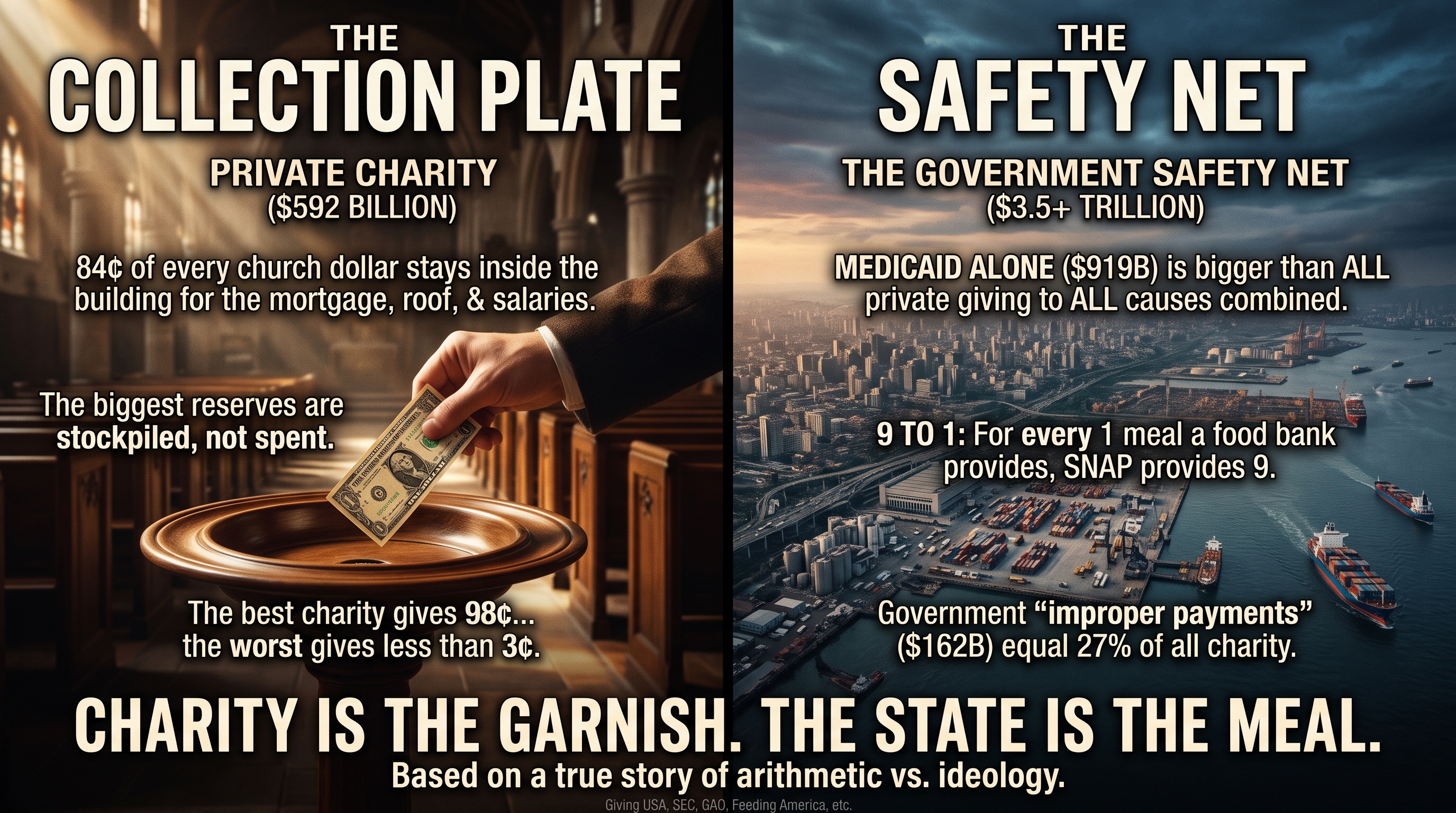
Start where the generosity is real, because it is. In 2024 Americans gave an estimated $592.5 billion, up 6.3% over the prior year and about 2.0% of GDP — a share the country has held for two decades, and a rate of private giving no other nation comes close to. Two-thirds of it, $392 billion, came from living individuals rather than foundations or corporations. The single largest destination was not a hospital or a food bank. It was religion: $146.5 billion, 23% of every charitable dollar, more than education and health giving combined. The impulse to put money in the plate, the envelope, the online form is one of the most durable features of American life. None of what follows is an argument that it should stop. It is an argument about where it actually goes.
I. The church dollar — where 84 cents never leave the building
The first thing the collection plate funds is the collection plate. The research shop empty tomb, inc. has tracked congregational budgets since the 1960s, and it splits every church dollar into two buckets: congregational finances — salaries, utilities, the mortgage, the roof — and benevolences, everything spent beyond the walls, from missions to feeding the poor. As of its most recent composite, about 84 cents of every dollar stays inside the congregation and roughly 16 cents goes beyond it. And the beyond-the-walls slice is not all poverty relief; it also covers denominational overhead, seminaries, and missionary salaries. The portion that actually reaches a hungry or homeless stranger is a fraction of a fraction. Worse, it is shrinking: per-member benevolence giving fell from 0.64% of income in 1968 to 0.33% by 2013 — cut almost in half — even as congregations kept the lights on. Overall member giving slid from 3.02% of income in 1968 to 2.17% in 2015, below Depression-era levels. This is not a scandal. It is simply what a church is: mostly an institution that sustains itself, with charity as a line item, not the mission. The $146.5 billion headline is a measure of devotion. It is not a measure of alms.
II. The reserve problem — when take-in vastly exceeds give-out
Some of the largest faith institutions do not spend what they take in — they stockpile it. The clearest case is the Church of Jesus Christ of Latter-day Saints. In 2019 a former portfolio manager at its investment arm, Ensign Peak Advisors, filed a 74-page whistleblower complaint with the IRS alleging the church had quietly amassed roughly $100 billion — built by taking in about $7 billion a year in tithing, spending roughly $6 billion on operations, and investing the rest — and had made, by his account, zero charitable distributions from the fund in 22 years. He called it “really a clandestine hedge fund.” In February 2023 the SEC confirmed the architecture if not the morality: it fined the church and Ensign Peak $5 million for hiding the portfolio behind 13 shell companies to avoid the disclosures a $100-billion manager is required to file. The church says it gives about $1 billion a year to humanitarian causes, a figure it reports reached $1.58 billion in 2024 — real money, and rising. But against $7 billion a year coming in and a $100-billion cushion sitting still, the give-out is a slow drip from a very deep well.
The pattern is not unique to one faith. St. Jude Children’s Research Hospital — whose televised appeals are among the most effective in the country — was found by a 2021 ProPublica investigation to be sitting on a reserve of $5.2 billion, enough to run for roughly five years without a single new donation, where nonprofit-finance norms suggest one to two. ProPublica’s read of the filings found that of the money raised, on average about 50% went to patient care, 30% to more fundraising, and 20% straight to the reserve — well below the 82% the charity advertised — while only about 2% of money raised from the public went to food, travel, and housing for patients’ families, whose daily food budget was capped near $50. The reserve has since grown to $7.6 billion. The lesson of this section is not that these institutions are frauds. It is that for the biggest and best-funded, the bottleneck between take-in and give-out is not need and not overhead — it is a deliberate choice to accumulate.
III. The best and the worst — a 95-cent spread on the same dollar
Among operating charities the honest range is enormous, and the brand you recognize is a poor guide to the ratio. At the top, Feeding America — the country’s largest charity by private donations, with about $5 billion in annual revenue — reports a 98.3% program ratio and takes no direct government money at the national level. Direct Relief runs at essentially 100%. But read the asterisk: both are in-kind charities, and those near-perfect numbers are inflated by donated food and medicine valued at wholesale flowing straight through the books — cash donations mostly cover the logistics. The genuinely cash-efficient benchmark that watchdogs use is lower and harder: CharityWatch calls a group efficient at 75% program spending or better with a cost to raise $100 of $25 or less.
At the bottom, the floor falls out. The 2013 “America’s Worst Charities” investigation found Kids Wish Network — which solicits in the name of dying children — spending less than 3 cents on the dollar on actual kids while routing nearly $110 million over a decade to professional fundraisers; Cancer Fund of America delivered under $1 million in direct aid out of $98 million raised before regulators forced it to dissolve. In between sit the household names with uncomfortable ratios. Susan G. Komen — the pink-ribbon colossus — directs roughly 72% to a broad “program services” bucket, but only about 21–29% to actual breast-cancer research, the thing most donors think they are funding; its 2012 decision to defund Planned Parenthood screenings, swiftly reversed, still cost it a 22% collapse in contributions. The Wounded Warrior Project took in more than $372 million in 2015 but, a CBS investigation found, spent only about 60% on veterans while burning $26 million on conferences — one featuring the CEO rappelling into a staff rally — and its board fired the CEO and COO in March 2016. The gap between Feeding America’s 98 cents and Kids Wish’s 3 cents is the entire ballgame, and no amount of warm advertising tells you which one you are holding.
IV. The lodges — small, self-reported, and often better-leveraged than the giants
The fraternal orders are the quiet, unglamorous end of American charity, and dollar for volunteer-hour they are frequently the most efficient thing going. The Knights of Columbus reported donating more than $200 million and about 48 million volunteer hours in a recent year, plus another $235 million moved through its charitable fund — all on top of an insurance operation carrying over $123 billion of life coverage in force that bankrolls the charity rather than depending on it. The Shriners run a hospital network on about $1.58 billion a year that treats more than 150,000 children annually at no charge, regardless of the family’s ability to pay. Rotary International has put more than $2.9 billion into the eradication of polio and now commits $50 million a year, matched two-to-one by the Gates Foundation. The Elks claim roughly $300 million a year in combined cash, goods, and labor across 1,500 lodges; Lions Clubs’ foundation has granted more than $1.3 billion since 1968; American Freemasonry’s self-tally runs to about $2 million a day. The honest caveat on all of it: these are self-reported figures from local chapters, not audited national statements, and the volunteer-hour counts in particular should be read as estimates. But the model — low overhead, local delivery, labor donated rather than purchased — is the one that most resembles the thing people picture when they say the word “charity.”
V. The sector’s dirty secret — most “nonprofit” money is not a donation
Zoom out to the whole nonprofit universe and the word “charity” starts to mislead. There are about 1.5 million 501(c)(3) organizations in the United States, contributing on the order of $1.4–1.5 trillion to the economy and employing roughly 12.8 million people — about one in ten private-sector workers. But most of the money sloshing through that sector is not philanthropy at all. Across the sector, program-service revenue — tuition, hospital billings, Medicare and Medicaid reimbursements, government contracts — is around 67–71% of all nonprofit income, while individual donations are only about 13–20%. One industry tally put it bluntly: roughly 80 cents of every dollar of nonprofit revenue comes from government and fees for service. The glamorous mental image — a donor’s check becoming a poor family’s meal — describes a thin slice of a sector that is mostly hospitals and universities running on insurance and tuition. It matters for the comparison that is coming, because the thing most people mean by “charity” — private money given freely to help the poor — is a small corner of a very large building.
VI. The scale — one government program is bigger than all of it
Now put the two ledgers side by side, and the argument that private charity could replace the safety net collapses on contact with arithmetic. All private giving to all causes in 2024 was $592.5 billion. Of that, only the human-services category — the slice closest to anti-poverty aid — was about $91 billion, 14% of the total; the rest went to religion, education, health systems, the arts, and foundations, much of it not to the poor at all. Against that, a single government program: Medicaid, at about $919 billion a year, by itself exceeds every charitable dollar given to every cause in America combined. Widen it to all means-tested welfare — Medicaid, SNAP, SSI, the Earned Income Tax Credit, housing vouchers, TANF, school meals — and the total runs $1.0 to $1.3 trillion, roughly twice all private giving and eleven to fifteen times the human-services slice that actually targets the poor. Add in the social-insurance programs that are not means-tested — Social Security near $1.4 trillion, Medicare near $1.1 trillion — and total government social spending of roughly $3.5–4 trillion is six to seven times the size of the entire private-charity apparatus.
The food-bank numbers make it concrete in a single image. The Feeding America network is a genuine marvel — 200-plus food banks, 60,000 partner agencies, about 6 billion meals a year. And yet, by the network’s own math, for every one meal a food bank provides, SNAP provides nine. Its own chief of government relations put it in a sentence this desk will not improve on: “We can’t food bank our way out of hunger.” When the 2025 reconciliation law cut SNAP, Feeding America estimated the loss at around 6 billion meals a year — nearly the entire annual output of the whole charitable food-bank system, erased by one change to one government line. Charity is the garnish on that plate. The state is the meal.
VII. The blurred line — much “private” charity is government money
Here is the twist that cuts both ways. A large share of what gets counted as private, often religious, charity is actually taxpayer money passing through a faith-based contractor. Catholic Charities USA draws an estimated 62–65% of its budget from government, a share it has held since the mid-1980s; in 2010 it reported revenue of $4.7 billion of which $2.9 billion came from government and only about $140 million from diocesan church collections. Some local affiliates run higher still — Catholic Charities Fort Worth reported some $270 million in government grants against a 2023 budget, existing almost entirely on public funds. This demolishes a talking point on both sides at once. It means private giving to the poor is even smaller than the human-services line suggests, once you net out the government pass-through hiding inside it — and it means the government already delivers much of its safety net through religious and nonprofit intermediaries. “Let the churches do it” turns out, in practice, to largely mean “let the churches keep doing it with federal grant money.”
VIII. The efficiency fight — low overhead, leaky bucket
The last honest point is the one that refuses to hand either side a clean win. The reflexive charge that government is a bloated, overhead-eating machine is simply false on overhead: Social Security spends about 0.5% on administration, a ratio private retirement annuities cannot touch, and Medicare runs in the low single digits (contested, because some of its admin costs sit in other agencies’ budgets). Government does not lose the money to salaries and galas the way a Kids Wish Network does. But it loses it a different way. The GAO estimated roughly $162 billion in improper payments across the federal government in FY2024 — down from $236 billion the year before, but still concentrated in the safety net: $54 billion in Medicare, $31 billion in Medicaid, $16 billion in the EITC, $11 billion in SNAP. That $162 billion of error and fraud is itself about 27% of all the private charity Americans gave in a year. And a Heritage Foundation analysis fairly presented cuts the other way on the charity-skeptics: much of the headline welfare total — roughly half to 60% — is medical care reimbursed to hospitals and doctors, not cash handed to households, which is why the eye-popping “$65,000 per poor family” figures conflate a provider’s invoice with a family’s income. Low overhead and a leaky bucket are both true at once. So is generous giving that mostly funds buildings. The ledger does not resolve into a hero.
So where does the ruler land? On a conclusion that disappoints the slogan on both ends. Americans are extraordinarily generous, and the giving is a real moral good that this desk will defend against the cynic who calls it all a racket — the Shriner treating a burned child for free, the Knight logging his forty-eight million hours, the Feeding America truck that turns a dollar into ten meals are not frauds, and they are not nothing. But generosity is not the same as a safety net, and the arithmetic is merciless about the difference. The collection plate funds the building first, the reserve second, and the stranger in need a distant third. The best operating charities are magnificent and the worst are predatory, and the brand tells you nothing about which you’ve got. And the entire apparatus — every church, lodge, pink ribbon, and food bank in the country — is outweighed by a single line in the federal budget. The honest position is not “charity is a scam” and it is not “let charity do it.” It is that a decent society needs both, that only one of them can carry the load, and that pretending otherwise is how you end up food-banking your way, nine meals short, out of a hunger you were never going to reach.
Filed on: total giving and category breakdown — Giving USA 2025 (reporting calendar-year 2024: $592.5B total, 2.0% of GDP, religion $146.54B/23%, human services $91.15B/14%, individuals $392.45B/66%), via the Lilly Family School of Philanthropy, Candid, and Giving USA Foundation. Church-budget split and the benevolences trend — empty tomb, inc. (congregational finances ~84% vs benevolences ~16%; per-member benevolence giving 0.64% of income in 1968 to 0.33% in 2013; member giving 3.02% to 2.17%). LDS reserves — the November 2019 Ensign Peak IRS whistleblower complaint by David Nielsen (~$100B, ~$7B/yr tithing, alleged zero charitable distributions in 22 years; 60 Minutes, 2023) and the SEC settlement of February 21, 2023 ($5M total — $4M Ensign Peak + $1M the Church — for 13 shell LLCs concealing the portfolio, cited at ~$32B as of 2018); the Church’s reported humanitarian giving reaching $1.58B in 2024 (Deseret / “Caring for Those in Need” report). St. Jude / ALSAC — ProPublica, November 2021 ($5.2B reserve, ~5 years’ operating cash; allocation ~50% patient care / ~30% fundraising / ~20% reserve vs the 82% advertised; ~2% of money raised to family food/travel/housing; ~$50/day food cap) and the follow-up reserve figure of $7.6B. Operating-charity ratios — Feeding America FY2024 audited financials and IRS 990 (98.3% program, ~$5B revenue, no direct federal funding, ~6B meals); Direct Relief and Forbes 2024 Top Charities (100% fundraising efficiency, in-kind caveat); CharityWatch rating standards (≥75% program, ≤$25 to raise $100) and the 2013 “Overhead Myth” letter (GuideStar, Charity Navigator, BBB Wise Giving Alliance). Komen — Snopes and Charity Navigator (breast-cancer research ~21% per Snopes, 28.8% per Charity Navigator in 2018, within a ~72% broad program bucket) and the 22% contribution drop after the 2012 Planned Parenthood reversal. Wounded Warrior Project — CBS News / The New York Times, January–March 2016 (~60% to veterans in FY2014, $26M on conferences, CEO and COO fired March 10, 2016; $372M+ raised in 2015). “America’s Worst Charities” — Tampa Bay Times / Center for Investigative Reporting, 2013 (Kids Wish Network <3¢/dollar, ~$110M to solicitors; Cancer Fund of America <$1M direct aid of $98M raised, later dissolved under FTC action). Fraternal orders — Knights of Columbus Annual Survey of Fraternal Activity (~$200M + ~48M hours; $235M via the KofC Charitable Fund; >$123B insurance in force; A+ A.M. Best 42 consecutive years, self-reported); Shriners Hospitals for Children consolidated financials ($1.58B revenue 2025; 150,000+ children/year, care regardless of ability to pay); The Rotary Foundation / End Polio Now (>$2.9B PolioPlus; $50M/yr matched 2:1 by the Gates Foundation); Elks (~$300M/yr self-reported; Elks National Foundation >$500M since 1928); Lions Clubs International Foundation (>$1.3B since 1968); American Masonic philanthropy (~$2M/day U.S., self-reported, per the Scottish Rite Journal). Nonprofit-sector scale — IRS / Urban Institute NCCS / BLS / National Council of Nonprofits (~1.5M 501(c)(3)s; ~$1.4–1.5T economic contribution, ~5.7% of GDP; 12.8M employees, ~10% of private workforce; program-service revenue ~67–71% vs individual donations ~13–20%; “80 cents of every dollar from government and fee-for-service,” NonProfit Times). Government safety net — KFF (Medicaid ~$919B combined fed+state, FFY2024); USDA ERS / CRS (SNAP ~$100B, ~41.7M/month); SSA (SSI ~$62–63B; Social Security ~$1.4T); IRS (EITC ~$70B); PGPF/HUD (housing ~$70–78B); CBPP/CRS (TANF $16.5B federal, frozen since 1996, real value down ~40%); Peterson Foundation, Heritage Foundation, and JustFacts on means-tested totals (~$1.0–1.3T, up to $1.6T on the widest definition — a ~28x definitional spread, flagged); Medicare ~$910B net / ~$1,118B gross (KFF / CMS NHE). Food banks vs SNAP — Feeding America (“for every one meal… SNAP provides 9”; “we can’t food bank our way out of hunger”; 2025 reconciliation SNAP cuts estimated at ~6B meals/yr). Overhead and error — SSA (0.5% administrative ratio, 2022–2024) and GAO’s FY2024 improper-payments estimate (~$162B, down from $236B in FY2023: Medicare $54B, Medicaid $31B, EITC $16B, SNAP $11B). The blurred line — Catholic Charities USA at ~62–65% government-funded (Manhattan Institute, The Economist, Wikipedia; 2010: $4.7B revenue / $2.9B government / ~$140M diocesan) and Robert Rector / Heritage Foundation on the share of means-tested spending that is medical reimbursement rather than household cash. Social Security and Medicare are social insurance, not means-tested welfare, and are kept in a separate bucket where the comparison is to charity-for-the-poor. Grounded web search, compiled October 9, 2026; many fraternal and faith figures are self-reported and flagged as such; full four-agent dossier retained.
№ 111 · Filed October 8, 2026 — Everyone, it turns out, has called an election stolen. The right did it loudest and most recently; the left did it in 2000, in 2004, in 2016, in 2018. So the lazy verdict writes itself — both sides do it, a pox on both houses — and this desk does not deal in lazy verdicts. There are two completely different things hiding under the word stolen: a claim that the ballots were miscounted or the machines were rigged, and a claim that the result was illegitimate because of suppression, or foreign interference, or an Electoral College that overrode the popular vote. Sort every claim into those two bins, count them, and follow each to its outcome in a courtroom, and the symmetry collapses. One side’s denial stayed words. The other built a machine to overturn a result — and its leader now says, on the record, that he wishes he had used the Army to seize the voting machines, and that maybe the country “shouldn’t even have an election.” And the same asymmetry runs through the columns added here: who actually intimidates voters at the polls — now with a fresh paper trail, 166 pages of ICE records prised loose on October 7 showing the agency amassed 100 million voter records and drafted, then redacted, its answer to whether it would obey an order to deploy at polling places — and impeachment, the lawful way to remove a leader, fired four times and never once hitting its mark. Here is the ledger, every column, read straight.
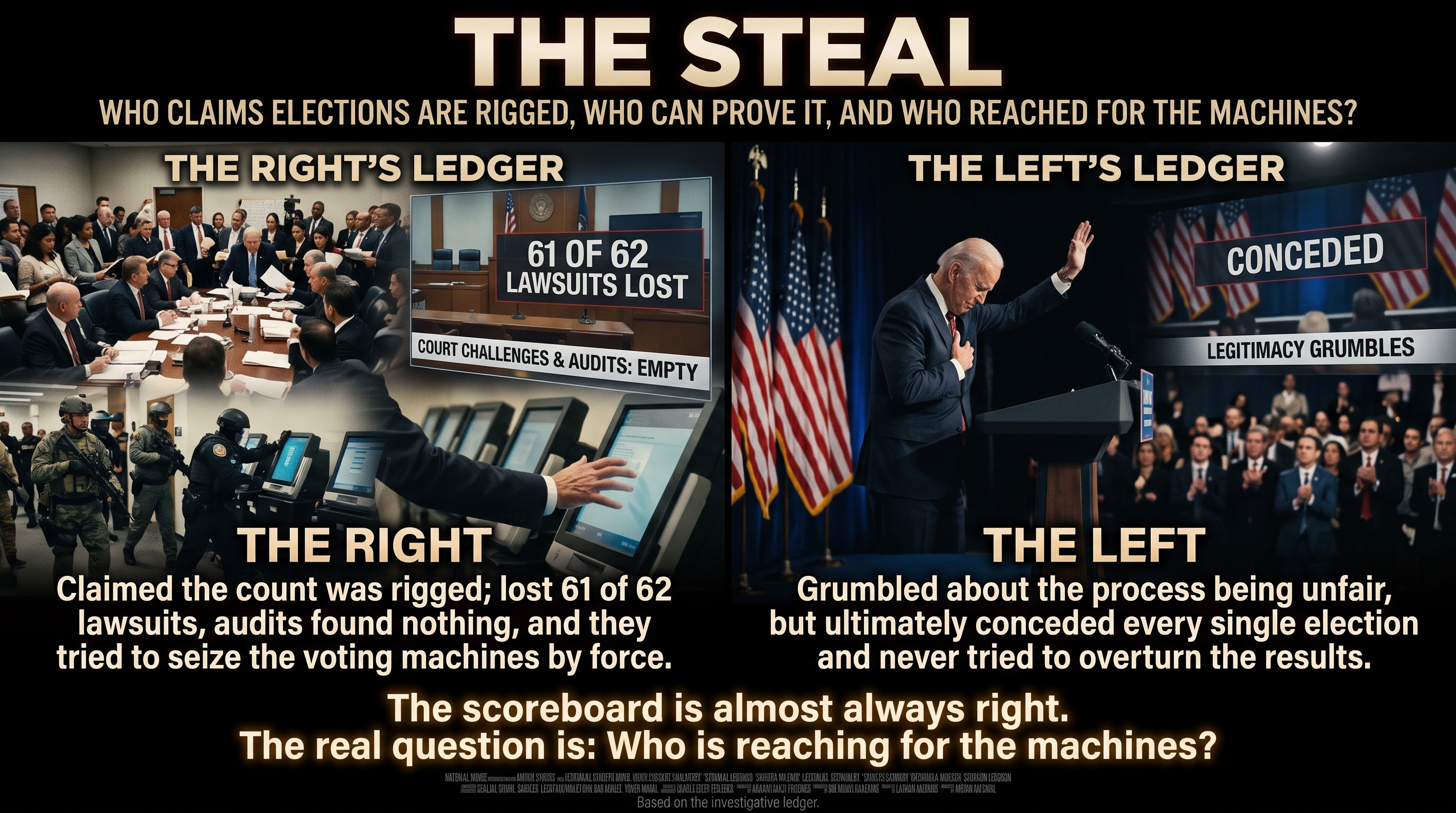
The Steal — Who Claims Elections Are Rigged, Who Can Prove It, and Who Reached for the Machines
Start with the honest concession the left half of this story demands, because it is true and it matters: Democrats and progressives have, repeatedly, refused to treat a lost election as legitimate. They did it in 2000 and 2004 and 2016 and 2018. Any dispatch that pretended otherwise would be propaganda. But “refused to treat as legitimate” is doing an enormous amount of work in that sentence, and the whole truth lives in what it actually meant each time. So this desk did the tedious thing: it built two ledgers, one for each side, sorted every major claim by type, and chased each to its verdict — the court ruling, the recount, the audit, the concession or the refusal to concede. The result is not “both sides do it.” The result is that two things wearing the same word are not the same thing.
I. The two things called “stolen”
Everything turns on telling them apart. The first kind of claim is a fraud / rigged-machine claim: the votes were miscounted, the ballots were fake, the machines flipped the tally. It is a factual assertion about the count, and it can be tested — recount the ballots, audit the machines, examine the cases in court. The second kind is an illegitimacy claim: the count was accurate, but the outcome does not deserve to stand because the game was rigged upstream — voters were suppressed or purged, a foreign power interfered, the Electoral College handed the presidency to the candidate who lost the popular vote, or a court stepped in and stopped the counting. The two are not degrees of the same accusation. One says the scoreboard is wrong. The other says the scoreboard is right but the game was unfair. Keep them sorted, and the rest of this stops being a shouting match and becomes a ledger.
II. The right’s ledger — loud, sustained, and empty in court
The right’s claims are overwhelmingly of the first kind — the testable kind — and they have been tested to destruction. It began before 2020: in 2016, having won the Electoral College, Trump insisted that “3 to 5 million” illegal votes had cost him the popular vote, a claim for which no evidence was ever produced. He built a commission to prove it — the Pence-Kobach Presidential Advisory Commission on Election Integrity — and in January 2018 it was quietly dissolved having found nothing. Then came the main event. After the 2020 loss, Trump and his allies filed roughly 62 post-election lawsuits and lost 61 of them; the suits were rejected by at least 86 judges, 38 of them appointed by Republicans, and the Supreme Court — including Trump’s own three appointees — threw out the marquee case, Texas v. Pennsylvania, for lack of standing. Every testable claim was tested. Georgia counted its ballots three times, by hand and by machine, and Biden’s win held each time. Arizona Republicans hired a firm called Cyber Ninjas to audit Maricopa County; the audit found Biden had won by 360 more votes than the official count. A 2021 Associated Press review of every disputed ballot across the six battleground states found fewer than 475 cases of potential fraud against a combined Biden margin of 311,257 — 0.15 percent, and not all of them even for Biden. Trump’s own Attorney General, William Barr, said the Justice Department had found no fraud “on a scale that could have effected a different outcome.”
The specific lie that the voting machines had been rigged did not just fail in court — it produced the largest defamation payouts in American media history. Fox News paid Dominion Voting Systems $787.5 million; Newsmax settled Smartmatic’s suit for $40 million; OAN settled for an undisclosed sum; Rudy Giuliani was hit with a $148 million jury verdict for defaming two Georgia election workers and later settled Dominion’s separate $1.3 billion suit; Sidney Powell and her “Kraken” co-counsel were sanctioned more than $175,000 and Powell pleaded guilty in Georgia. The through-line of the whole 2020 effort is not that it was close and contested. It is that it was tested in every forum that exists — courts, recounts, partisan audits, the sworn conclusions of Trump’s own appointees — and it came back empty every single time, and it ended with a mob at the Capitol trying to stop the count by force. The tell came in 2024: Trump won, and the fraud claims vanished overnight. In polling, the share of Republicans who called the election well-run jumped from under a third after the 2020 loss to roughly nine in ten after the 2024 win. The machines were only ever broken when his side lost.
III. The left’s ledger — mostly “illegitimate,” rarely “rigged,” and never proven
The left’s ledger is longer in years but overwhelmingly lands in the second bin. In 2000, Al Gore fought for a Florida recount over hanging chads and butterfly ballots — a dispute about counting standards, not rigged machines — and when the Supreme Court stopped it 5–4, he conceded the next day and, as sitting vice president, personally gaveled down the House objections to his own defeat. In 2016 the complaint was “Not My President,” and Hillary Clinton’s word was illegitimate — but she aimed it at Russian interference and voter suppression, not at a miscounted tally; she conceded the morning after and sat at the inauguration. In 2018 Stacey Abrams refused to formally “concede” the Georgia governor’s race and called the system “rigged,” but her charge was suppression — purges, “exact match” holds, precinct closures — and she explicitly acknowledged Brian Kemp would be certified the winner. Her group’s federal suit over Georgia’s election system lost in 2022. These are illegitimacy claims. They can be argued about — some of the suppression complaints were later upheld in part, others rejected — but they are not assertions that the ballots were miscounted.
The genuinely first-bin claims on the left — the actual rigged-machine theories — are a short list, and they share the right’s fate: they were never substantiated. The 2004 suspicion that Diebold machines had flipped Ohio to Bush was never proven; a later assessment found the suppression complaints “tend to have been supported… claims pertaining to manipulation of the count… have been refuted.” Robert F. Kennedy Jr.’s 2006 Rolling Stone cover arguing the 2004 election was stolen was dismantled point-by-point within days. And in 2016, when Jill Stein raised $7 million for recounts in Wisconsin, Michigan and Pennsylvania specifically to check whether the machines had been hacked, the one recount that finished — Wisconsin — grew Trump’s margin by 131 votes; Michigan was halted; a federal judge called the Pennsylvania hacking suspicion “border[ing] on the irrational.” The machine theory, tested, confirmed the result. And in 2024, when the left lost the presidency outright, Kamala Harris conceded cleanly — “we must accept the results of this election” — and no Democrat objected at the January certification.
IV. The count that matters — who objects, and who concedes first
Congress keeps the cleanest tally of all, because objecting to a state’s electors at the joint session is a formal, recorded act. Since the Electoral Count Act of 1887, no objection to a state’s electors has ever succeeded. Democrats have lodged or attempted them in four cycles — 1969, 2001, 2005, and 2017 — but here is the part that decides the question: every one of those came after the losing candidate had already conceded, none was backed by the defeated nominee as a bid to actually take power, and most never even reached a formal vote because, as required by law, not a single senator would co-sign. The one that did reach the floor, Barbara Boxer and Stephanie Tubbs Jones objecting to Ohio in 2005, was voted down 74–1 in the Senate and 267–31 in the House — and both women said plainly their goal was to spotlight irregularities and force reform, not to overturn Bush’s win. Republicans have objected in exactly one cycle: 2021. But that one was different in kind, not just degree — six states challenged at once, roughly 140 House members and 14 senators signing on, and for the first time in the law’s history the objections were backed by the losing candidate himself, a sitting president who had refused to concede and was trying to remain in power. The difference between the two ledgers is not how many times each side grumbled. It is that one side’s grumbling was a protest after a concession, and the other side’s was an operation to reverse the outcome.
V. The rules that changed — COVID, the mail-in surge, and the one grievance that isn’t about fraud
Before the fraud circus, there was a real change, and it was enormous. The pandemic doubled mail voting almost overnight: mail ballots went from 28,787,025 in 2016 to 66,419,004 in 2020 — a 131 percent jump that put 43 percent of all voters on a mail ballot, nearly double the prior share. Five states already ran every election entirely by mail as standing practice (Colorado, Hawaii, Oregon, Utah, Washington); five more — California, Nevada, New Jersey, Vermont, and the District of Columbia — temporarily mailed a ballot to every active registered voter for November 2020; and by Election Day a voter in roughly 44 states could request a mail ballot with no excuse at all, many of them under emergency COVID expansions. A system built to handle a quarter of the electorate was scaled to nearly half of it in a matter of months. That is the honest backdrop, and it is worth saying plainly before anything else: the scale was genuinely new, and it rattled people for reasons that had nothing to do with any courtroom.
The one grievance from 2020 that carries real legal weight is not about the count — it is about who changed the rules. Elections are the states’ to run, and the Constitution hands that pen specifically to state legislatures (Article I, §4). But in 2020 many of the most consequential last-minute changes were made by other hands. The Pennsylvania Supreme Court, on a 4–3 vote, extended the mail-ballot receipt deadline three days past Election Day on its own authority, overriding the hard deadline the legislature had written into Act 77. North Carolina’s election board stretched its own deadline from three days to nine to settle a lawsuit. Michigan’s secretary of state mailed absentee-ballot applications to all 7.7 million registered voters without legislative sign-off. When Pennsylvania Republicans asked the U.S. Supreme Court to stop the deadline change, the Court deadlocked 4–4 and the extension stood — but Justices Alito, Thomas, and Gorsuch wrote that a state court rewriting the legislature’s election rules raised a serious problem under the Elections Clause. That is a genuine constitutional argument, and it is the single piece of the 2020 dispute with real teeth. Note what it is, though: a process objection, not a fraud claim — it lands in the second bin, the “illegitimacy” bin of Section I, not the first. And it was resolved the ordinary way. In Moore v. Harper (2023) the Court rejected the maximalist version of that theory 6–3, holding that state courts may still review their states’ election laws — the same three justices dissenting. The grievance was raised, litigated, and decided. That is the system working, not the system being stolen.
It is also not a new worry, and not a partisan one — and the one quotable warning came from a Democrat. The bipartisan 2005 Carter-Baker Commission wrote that “absentee ballots remain the largest source of potential voter fraud,” a line conservatives have cited ever since. But it is almost always ripped from its context. The commission was describing coercion and ballot-harvesting in the privacy of a home — not rigged machines or miscounted tallies; it did not recommend banning mail voting; it pointed to Oregon, all-mail since 1998, as proof the risks could be managed with signature checks and tracking; and both Jimmy Carter and James Baker later said plainly their warning should not be used to oppose vote-by-mail. Baker’s own summary is the ruler for this entire dispatch: “not everything Republicans propose is voter suppression and not everything Democrats propose makes fraud easier.” What did not survive contact with evidence was the fraud circus bolted on top of the real grievance. The “suitcases of ballots” pulled from under a table at Atlanta’s State Farm Arena were official ballot containers filmed during normal processing; the GBI, the FBI, and the secretary of state reviewed the full, unedited tape, and the State Election Board dismissed the claim in 2023 as “false and unsubstantiated.” The overnight “dumps” that swung margins toward Biden were the blue shift — mail ballots, which leaned Democratic, counted last because the law barred election workers from processing them early — a pattern analysts forecast weeks ahead. And the “close to 5,000” dead voters Trump pressed Georgia to find came to exactly four across the whole state, every one a living relative returning a recently deceased family member’s ballot. The rules changed, and that is a fair fight to have in the open. The fraud never materialized — the same verdict every other section of this ledger returns.
VI. The federal hand — the states run elections, and the courts keep saying so
This is where the story stops being about the past and becomes about now. The Constitution assigns the “Times, Places and Manner” of elections to the states, with Congress — not the president — empowered to alter those rules (Article I, §4). That distinction is the entire legal spine of what has happened since 2025. In March 2025, Trump signed Executive Order 14248, ordering documentary proof of citizenship onto the federal voter-registration form, a hard Election-Day receipt deadline for mail ballots, and the threat of withheld funding for states that didn’t comply. A federal judge, Colleen Kollar-Kotelly, blocked its core provisions, writing the line that governs all of this: “The President has no constitutional power over election regulation… The Constitution vests that power in the States and Congress alone.” A second executive order in March 2026, handing the Postal Service unprecedented control over mail voting, was blocked by the Supreme Court for the 2026 midterms. The statutory version, the SAVE Act, passed the House twice (220–208, then 218–213) and stalled in the Senate. Meanwhile the Justice Department, its Civil Rights Division hollowed out — the Voting Section reduced from a full staff to three attorneys — has sued 29 states and the District of Columbia to force over their unredacted voter rolls, down to driver’s-license numbers and partial Social Security numbers.
The honest contrast has to be drawn, because federal involvement in elections is not inherently sinister — it has a noble history. The Voting Rights Act of 1965, the National Voter Registration Act of 1993, the Help America Vote Act of 2002: each was Congress, acting on its enumerated power, or the courts, acting on the Constitution, to protect the right to vote and set a national floor against Jim Crow and its heirs. That is the federal hand used to open the ballot box. What is documented in 2025 and 2026 is the opposite instrument — the executive, acting alone, trying to dictate how states administer their own elections and conditioning their funding on obedience — and the courts have blocked it at nearly every turn precisely because it inverts the constitutional order. One federal hand pries the box open. The other reaches for the controls.
VII. Seize the machines — from a 2020 draft order to a 2026 regret
Which brings us to the question Jackal actually asked: has Trump said he would seize votes or voting machines? The answer is documented, and it is yes — twice over. In December 2020, two draft executive orders were actually drawn up — a Pentagon version dated December 16 and a Department of Homeland Security version — each directing the seizure of voting machines, each authorizing the federalization of National Guard units to help do it. They were presented to Trump in a notorious December 18 Oval Office meeting with Sidney Powell, Michael Flynn, and former Overstock chief Patrick Byrne, a meeting that reportedly devolved into screaming and floated invoking martial law. The orders were never signed — White House Counsel Pat Cipollone and others opposed them, and national-security officials repeatedly warned Trump he had no authority to do it — but the drafts are real, they are in the National Archives, and the January 6 committee published them. That is not a rumor. It is a near-miss on paper.
The second confirmation came from Trump himself. In a January 2026 interview with The New York Times, he said he regretted not ordering the National Guard to seize voting machines in the swing states after 2020 — that he “should have” done it — adding only that he doubted the Guard was “sophisticated enough” to pull it off. In August 2025 he pledged on Truth Social to sign an executive order abolishing mail-in ballots and voting machines. In a January 2026 Reuters interview he mused that “we shouldn’t even have an election.” In May 2026, asked whether he would put the National Guard or ICE at polling places for the midterms, he would not rule it out: “I’d do anything necessary to make sure we have honest elections.” The guardrails have held so far — the Joint Chiefs chairman stated flatly that the military has “no plans” to send troops to polls, and no machine has in fact been federally seized. These remain intentions, non-denials, and one documented draft precedent — not executed acts. But a survey of 37 election experts in April 2026 found a majority thought it likely Trump would ask the Guard or federal agents to seize voting equipment during an election, and more than three-quarters thought it likely he would ask them to seize it after. The drafts from 2020 are what make the statements of 2026 something other than idle.
VIII. The boot at the door — who actually intimidates voters
The “both sides” reflex breaks down hardest of all on intimidation, because the documented record runs in essentially one direction. Its history in America is long, dark, and overwhelmingly aimed at the same people. After Reconstruction the South assembled a machine of poll taxes, literacy tests, grandfather clauses, the “white primary,” and open Klan violence, and it worked exactly as designed: in Mississippi, Black voter registration fell from over 90 percent just after the Civil War to about 6 percent by 1892 and roughly 1 percent by 1940. Dismantling it took half a century of courts and statutes — Guinn v. United States struck the grandfather clause in 1915, Smith v. Allwright killed the white primary in 1944, the Twenty-fourth Amendment abolished the federal poll tax in January 1964, Harper v. Virginia finished the poll tax at every level in 1966, and the Voting Rights Act of August 1965 wrote the intimidation ban directly into federal law. That ban, Section 11(b), is deliberately broad: it forbids anyone to “intimidate, threaten, or coerce” a voter and requires no proof of intent, only that the conduct had the effect of intimidating. The violence did not stop at the signing — in January 1966 the Mississippi activist Vernon Dahmer was firebombed to death for offering to help Black neighbors pay the poll tax that was still legal in state elections.
The modern chain is the one that matters for a both-sides audit, and it is startlingly consistent. In 1981, the Republican National Committee ran a “Ballot Security Task Force” in the New Jersey governor’s race: teams of off-duty cops in minority precincts, armband insignia and openly displayed revolvers, warning signs at the polls, and some 45,000 “caging” letters mailed to Black and Latino voters to build a challenge list. Republican Thomas Kean won by 1,797 votes, and the operation was credible enough that a federal court put the RNC under a consent decree barring “ballot security” operations — a leash it wore for 36 years, until a judge finally let it lapse in January 2018. The decree had barely expired before the tactics returned. Trump told 2016 rallies to “go down to certain areas and watch”; on the 2020 debate stage he told the Proud Boys to “stand back and stand by” and urged supporters to “go into the polls and watch very carefully.” In 2022, armed, masked men in tactical gear staked out ballot drop boxes in Maricopa County, Arizona, filming voters and photographing plates, until a Trump-appointed judge issued a restraining order banning weapons within 250 feet and cameras within 75 feet of the boxes. The group True the Vote challenged the eligibility of more than 360,000 Georgia voters before the 2021 Senate runoffs; the judge who ruled in its favor on the law nonetheless called its challenge list so unreliable it “verges on recklessness.”
The honesty this desk owes the other column is a single, real case — and it is telling precisely because it stands almost alone. On Election Day 2008, two members of the New Black Panther Party stood outside one Philadelphia polling place, one of them holding a nightstick. It was filmed, it went national, and it is cited to this day as the left’s answer to all of the above — but it was a single precinct, no voter was shown to have been turned away, and the Obama Justice Department narrowed the case to an injunction against the one man who had carried the weapon. Searched against the right’s record — a state party under a federal leash for a generation, armed patrols, caging operations, drop-box stakeouts, mass challenges — there is no comparable body of organized left-wing voter intimidation. The Democratic Party’s recurring role in these cases is as the plaintiff. And now, in 2026, Trump has announced an “Election Integrity Army” for the midterms and refused to rule out putting the National Guard or ICE at polling places — “I’d do anything necessary” — while Steve Bannon promised ICE would “surround the polls.” The counterweight is the law: the Joint Chiefs chairman has stated in writing that the military has “no plans” to send troops to polls or seize ballots, and 18 U.S.C. §592 — on the books for more than 160 years — flatly bars armed men, soldiers or federal agents, from any place an election is held, with no domestic exception ever applied. As with the fraud claims themselves, the whole apparatus rests on a pretext that does not exist: the impersonation fraud it claims to stop runs to 31 credible cases out of more than a billion ballots.
IX. The receipts — the 166 pages that turn the threat into a paper trail
Everything above in the intimidation column was, until this month, a mix of history and stated intention — the 1981 patrols, the drop-box watchers, and a 2026 president who “wouldn’t rule out” putting ICE at the polls. On October 7, 2026, the intention acquired a paper trail. The legal watchdog Democracy Forward, having sued the Department of Homeland Security in July when its April FOIA request went unanswered (Democracy Forward Foundation v. DHS, No. 1:26-cv-02624), forced out a first tranche of 166 pages of internal ICE records and published them with its analysis. They do not describe a rhetorical posture. They describe an operation — run not by the deportation side of ICE but by its criminal-investigative arm, Homeland Security Investigations — aimed at the machinery of voter registration itself, weeks before a midterm.
The scale is the first thing that lands. A June 1, 2026 HSI report shows investigators had ingested 50.6 million voter records from a Justice Department dataset and another 48.4 million from “independent sources” — sources the documents tie to Heather Honey, a prominent 2020 election denier who was installed as a senior adviser to the ICE Director and senior counsel to the DHS Secretary — plus more than 26,000 pulled from U.S. Citizenship and Immigration Services. That is upward of 100 million Americans’ voter records amassed by a federal police agency in a hunt for noncitizen voters, the same phantom this entire dispatch has shown to run to a few dozen credible cases in a billion ballots. And the hunt had already come up empty where it looked hardest: HSI’s own June report, reviewing 41 voter-registration nonprofits in New Jersey, recorded that it had found “no derogatory information.” It scrutinized at least 82 more in Pennsylvania. These are nonpartisan groups whose offense is helping citizens register to vote.
Three details in the trove are the ones that should hold a reader’s eye, because each is a line being crossed, not merely approached. First, HSI weighed sending undercover agents to infiltrate those registration nonprofits — its own memo describing operations to “engage in communications with these entities… leveraging [undercover] findings to initiate prosecutions and dismantle illicit facilitation networks.” Second, a July report shows HSI exploring whether to feed state voter rolls — from Connecticut, Georgia, Kentucky, Michigan, Missouri, and New Mexico — into “ELITE,” the Palantir-built, map-based targeting system ICE uses to locate people for deportation. The voter roll and the deportation map, wired together. Third, and most telling, the documents include a talking-points memo titled “ICE’s Role in Elections and at Polling Facilities” — and the answers were redacted under the exemption that shields law-enforcement techniques. The questions left visible: “Will ICE arrest people at polling places?” and “If you are ordered to send ICE personnel to polling places, will you comply with the order?” An agency with nothing planned does not draft, and then black out, its answer to whether it will obey an order to deploy at the polls.
The honest counterweight has to be entered, because this desk does not launder an advocacy group’s framing into fact. These are records of what HSI gathered, considered, and drafted — not proof that agents were deployed to a single polling place, and the New Jersey finding of “no derogatory information” is itself evidence the dragnet was turning up nothing. DHS, for its part, did not retreat: its spokesperson said the department and DOJ are “laser focused on prosecuting and removing aliens who vote… Our message to aliens who vote in American elections is clear: we will find you,” and Secretary Markwayne Mullin has said ICE is not planning polling-place operations but could enter one on a “specific threat” or an active warrant. So the record stops short of a boot on the floor of a precinct. But set it beside section VIII’s ledger and the shape is unmistakable: the same instrument that was under a federal consent decree for 36 years for armed “ballot security” is now a 100-million-record database, an undercover plan against registration drives, a wire into the deportation map, and a redacted refusal to say whether it will obey an order to stand at the polls — all in service of a fraud that the previous eight sections have shown does not exist at any scale that matters.
X. The lawful remedy — impeachment, and the one time it was about an election
There is a constitutional way to remove a leader mid-term, and it is the mirror image of seizing the machines. Impeachment by a House majority, then conviction by a two-thirds Senate, is a slow, recorded, deliberative process — power taken back through the rulebook rather than around it. It has been fired at a president exactly four times in American history, against three men, and it has removed no one. Andrew Johnson survived by a single vote in 1868; Bill Clinton was acquitted in 1999; Donald Trump was acquitted in February 2020 and again in February 2021 — the only president ever impeached twice. Richard Nixon, facing the surest removal of all, resigned in August 1974 before the full House could vote, so he was never actually impeached. The pattern underneath is partisan by design: the House majority impeaches an official of the other party, and the two-thirds Senate bar means conviction requires mass defection by the target’s own side, which almost never comes. A Republican House impeached Clinton; a Democratic House impeached Trump; a Republican House impeached Homeland Security Secretary Alejandro Mayorkas on a party-line vote in 2024, only for the Senate to dismiss it without a trial.
The trend line is toward the party-line weapon — and it makes the one exception blaze. Trump’s first impeachment drew zero House Republican votes, and only Mitt Romney crossed over in the Senate, becoming the first senator in history to vote to convict a president of his own party. But Trump’s second impeachment is the hinge of this entire dispatch, because it is the only impeachment ever brought because a president tried to overturn an election he lost. The single article — “incitement of insurrection” — charged him with inflaming the January 6 mob to stop the certification of a result he had lost. It became the most bipartisan presidential impeachment in American history: ten House Republicans voted to impeach, including the party’s own number-three, Liz Cheney, and seven Republican senators voted to convict — 57 to 43, still ten votes short of the two-thirds needed. Zoom out to every federal office and the ceiling is just as hard: of roughly 21 officials impeached in all of U.S. history — about fifteen judges, three presidents, two cabinet secretaries, one senator — only eight have ever been convicted and removed, and every one of them was a judge. No president, no cabinet officer, no senator, no Supreme Court justice has ever been removed. The lawful remedy exists; it was aimed, once, squarely at the defense of an election — and even at its most bipartisan it could not reach the bar. That is precisely why the man reaching instead for the Army and the machines is the story.
So where does the ruler land? It lands on a distinction the “both sides” shrug is built to erase. Both sides have cried that an election was stolen — that part is true, and the left’s record of illegitimacy claims is real and should not be sanded away. But the two ledgers are not twins. The left’s claims were overwhelmingly about legitimacy, not the count; its genuine fraud theories were few and were disproven, in one case by the recount growing the winner’s margin; and in every single instance the losing candidate conceded first and no objection was ever a serious bid to seize power. The right’s central claim was about the count, was tested in more than sixty courtrooms and every recount and audit that exists, failed in all of them, cost the better part of a billion dollars in defamation judgments for the specific machine lie — and did not end in a concession but in a mob, a set of draft orders to send soldiers after the machines, and a president who, years later, says his mistake was not pulling the trigger. And underneath all of it sits the fact both sides’ fraud claims run aground on: actual voter fraud is vanishingly rare — on the order of a few dozen credible cases across a billion ballots. The scoreboard, almost always, is right. The same asymmetry runs through the two newest entries in this ledger: organized voter intimidation in America has almost always worn a single color — from the Klan to the 1981 armed patrols to the masked men filming voters at the drop boxes, and now to a federal police agency sitting on 100 million voter records and a redacted plan for the polls — while impeachment, the lawful tool for removing a leader who will not accept a result, has been fired four times and removed no one, even the once it was aimed squarely at an overturned election. The real question this era poses is not whether the count can be trusted. It is who is now reaching for the machine that does the counting.
Filed on: 2020 post-election litigation tally — PolitiFact (“Trump has lost dozens of election lawsuits”) and the Brookings Institution analysis (~62 cases, 61 rejected; 86 judges, 38 Republican-appointed; Supreme Court dismissal of Texas v. Pennsylvania for lack of standing). Associated Press battleground-state fraud review, Dec. 2021 (fewer than 475 potential fraud ballots across AZ, GA, MI, NV, PA, WI vs. a combined 311,257-vote Biden margin). Attorney General William Barr, Dec. 1, 2020 (“not… fraud on a scale that could have effected a different outcome”). Georgia triple count (hand-audit + machine recount, Nov. 2020); Arizona Senate / Cyber Ninjas Maricopa audit, Sept. 2021 (net +360 for Biden). Defamation outcomes: Dominion v. Fox News $787.5M settlement (Apr. 2023); Giuliani $148M jury verdict (Dec. 2023) + Dominion settlement (Sept. 2025); Newsmax–Smartmatic $40M (Sept. 2024); OAN (confidential); Powell “Kraken” sanctions >$175K. 2016 claim and Pence-Kobach Commission (EO 13799, disbanded Jan. 2018 finding no widespread fraud). Left-side record: Bush v. Gore (Dec. 2000) and Gore concession; Conyers “What Went Wrong in Ohio” (2005) and RFK Jr., Rolling Stone (2006) with Salon rebuttal; Jill Stein 2016 recounts (Wisconsin result grew Trump’s margin by 131); Clinton “illegitimate”/Russia framing; Stacey Abrams 2018 non-concession and Fair Fight’s 2022 court loss; Kamala Harris concession, Nov. 6, 2024. Congressional electoral-count objections by party (Congressional Record: 1969, 2001, 2005, 2017 Democratic; 2021 Republican; 2005 Boxer–Tubbs Jones defeated 74–1 Senate / 267–31 House). Federal interference: Executive Order 14248 (Mar. 25, 2025) and Judge Colleen Kollar-Kotelly’s preliminary (Apr. 2025) and permanent (June 2026) injunctions (“The President has no constitutional power over election regulation”); the SAVE Act (House 220–208, then 218–213; stalled in Senate); DOJ Civil Rights Division suits against 29 states + DC for unredacted voter rolls (Voting Section reduced to 3 attorneys); the March 2026 USPS mail-voting EO blocked by the Supreme Court; Watson v. RNC (June 2026). Machine-seizure record: December 2020 draft DOD (Dec. 16) and DHS executive orders to seize voting machines, presented at the Dec. 18, 2020 Oval Office meeting (Powell, Flynn, Byrne), never signed (National Archives / Jan. 6 Select Committee); Trump’s January 2026 New York Times interview (“should have” sent the Guard to seize machines; “sophisticated enough”); Aug. 18, 2025 Truth Social pledge; Jan. 14, 2026 Reuters (“we shouldn’t even have an election”); May 2026 refusal to rule out Guard/ICE at polls; Joint Chiefs’ “no plans” statement; Votebeat survey of 37 election experts (Apr. 2026). Fraud-baseline rarity: Justin Levitt (31 credible impersonation cases out of 1B+ ballots, 2000–2014) and the Brennan Center. Voter intimidation: Movement Advancement Project, “Threatening Democracy” (Nov. 2022), on the Mississippi collapse in Black registration (>90% post–Civil War to ~6% by 1892 to ~1% by 1940); Guinn v. United States (1915), Smith v. Allwright (1944), the Twenty-fourth Amendment (ratified Jan. 23, 1964), Harper v. Virginia (1966), and the Voting Rights Act of Aug. 6, 1965 incl. Section 11(b); DNC v. RNC — 1981 New Jersey “Ballot Security Task Force” (armed off-duty officers, ~45,000 caging letters; Kean over Florio by 1,797), 1982 consent decree expired Jan. 9, 2018 under Judge John Michael Vazquez (~36 years); Trump’s Sept. 29, 2020 debate (“stand back and stand by”; “go into the polls and watch very carefully”); 2022 Maricopa County armed drop-box watchers (Clean Elections USA) and Judge Michael Liburdi’s Nov. 1, 2022 TRO (250 ft / 75 ft); Fair Fight v. True the Vote (Judge Steve Jones, Jan. 2, 2024, 360,000+ challenges, “verges on recklessness”); the 2008 New Black Panther Party case (single Philadelphia precinct; DOJ narrowed to an injunction against one individual); 2026 “Election Integrity Army,” Trump’s “anything necessary” refusal to rule out Guard/ICE at polls, Gen. Dan Caine’s written “no plans” to Sen. Slotkin, and 18 U.S.C. §592 (armed men at the polls, 160+ years, no domestic exception). The ICE documentary record: Democracy Forward Foundation v. DHS, No. 1:26-cv-02624 (FOIA request Apr. 2026, suit filed July 27, 2026), ICE’s First Interim Response of 166 pages (Bates 2026-ICLI-00100 001–166) released Oct. 1 and published with analysis by Democracy Forward on Oct. 7, 2026 — HSI’s June 1, 2026 report ingesting 50.6M voter records from a DOJ dataset, 48.4M from “independent sources” tied to ICE senior adviser / DHS senior counsel Heather Honey, and 26,000+ from USCIS; its scrutiny of 82 voter-registration nonprofits in Pennsylvania and 41 in New Jersey (the latter yielding “no derogatory information”); an internal memo weighing undercover operations against those nonprofits; a July report exploring feeding CT, GA, KY, MI, MO and NM voter rolls into the Palantir-built “ELITE” deportation-targeting system; and a talking-points memo on “ICE’s Role in Elections and at Polling Facilities” whose answers to “Will ICE arrest people at polling places?” and “If you are ordered to send ICE personnel to polling places, will you comply with the order?” were redacted under FOIA Exemption 7(E) (Democracy Docket, News From The States, The Independent, Oct. 2026); DHS spokesperson (“we will find you”) and Secretary Markwayne Mullin’s Sept. 1, 2026 “specific threat”/active-warrant caveat. Impeachments: Ballotpedia and the House History office — Andrew Johnson (1868, Republican House, acquitted 35–19, one vote short), Bill Clinton (impeached Dec. 19, 1998, acquitted Feb. 12, 1999, 45–55 / 50–50), Trump I (impeached Dec. 18, 2019, acquitted Feb. 5, 2020; Romney the first senator to convict a president of his own party), Trump II (impeached Jan. 13, 2021 with 10 House Republicans, acquitted Feb. 13, 2021, 57–43 with 7 Republican senators — the most bipartisan and the only impeachment over an overturned election); Nixon resigned Aug. 9, 1974 before a full-House vote; 21 federal officials impeached in all, only 8 convicted and removed, all judges (Mayorkas 2024 dismissed without trial). COVID and the mail-in surge: U.S. Election Assistance Commission 2020 EAVS Comprehensive Report and MIT Election Data & Science Lab (mail ballots 28,787,025 in 2016 to 66,419,004 in 2020; 43% of 2020 turnout by mail); NCSL and the Brennan Center on 2020 vote-by-mail law (5 standing all-mail states — CO, HI, OR, UT, WA; CA, NV, NJ, VT, DC temporarily universal for Nov. 2020; ~44 states permitting no-excuse mail under COVID expansions). Rule-change litigation: Pennsylvania Democratic Party v. Boockvar (Pa. Sup. Ct. 4–3, three-day deadline extension overriding Act 77), Republican Party of Pennsylvania v. Boockvar (U.S. Supreme Court deadlock 4–4, Oct. 19, 2020; Alito–Thomas–Gorsuch Elections/Electors Clause statement and Feb. 2021 dissent), North Carolina State Board of Elections 3-to-9-day extension by settlement, Michigan Secretary of State mailing applications to 7.7M voters; Moore v. Harper (2023, 6–3, rejecting the maximalist independent-state-legislature theory; Thomas, Alito, Gorsuch dissenting). Carter-Baker Commission on Federal Election Reform, “Building Confidence in U.S. Elections” (Sept. 2005, §5.2, “Absentee ballots remain the largest source of potential voter fraud”; recommended safeguards not a ban; cited Oregon’s all-mail record; Carter 2020 and Baker 2021 clarifications). Debunked claims: Fulton County State Farm Arena “suitcases” (GBI, FBI, GA Secretary of State; GA State Election Board dismissal June 2023 as “false and unsubstantiated”); the “blue shift” / “red mirage” order-of-counting phenomenon (GA SoS, AP, Reuters); Trump’s “close to 5,000” dead-voter claim resolved to 4 ballots statewide, all cast by living relatives (GA SoS / State Election Board, AJC). Grounded web search, compiled Oct. 2026; full dossier retained.
№ 110 · Filed October 8, 2026 — A mural reads the century back as a list of broken reassurances: income tax is only for the rich (1913), your Social Security number isn’t an ID (1935), leaving gold is temporary (1971), surveillance is only for terrorists (2001), just two weeks (2020) — and then the newest line, “CBDCs won’t control what you buy” (2026). It is a sharp meme, and the pattern it names is real: the thing sold as narrow and temporary tends to become broad and permanent. But a meme names a fear and stops. This desk does the other half. What is a central bank digital currency? How would one actually work? And what, precisely, can be done with it that cannot be done with the cash in your pocket? The honest answers cut in two directions at once. The abuse the meme fears is not hypothetical — it is already live in China, where money has been made to expire, and the head of the central banks’ central bank said out loud that a CBDC gives the issuer “absolute control” over how every unit is used. And the specific American digital dollar the meme warns about was banned by law this July, frozen until 2030. The off switch is real. The question this dispatch answers is who is building it, where it is already installed — and why banning the government version does not unplug it.
The Off Switch — What a Central Bank Digital Currency Is, and How It Gets Abused
Three different things wear the phrase “digital money,” and the entire argument turns on telling them apart. You already use digital money every day — the balance in your checking account is a number in a bank’s database, not a stack of bills in a vault. A cryptocurrency like Bitcoin is a digital asset issued by no one, backed by nothing, its supply fixed by code. A stablecoin like Tether or USDC is a digital token issued by a private company that promises to hold a real dollar in reserve for every token it prints. A central bank digital currency is none of those. It is a digital form of the national currency issued directly by the central bank itself — a dollar that is a liability of the Federal Reserve rather than of your commercial bank, legal tender in electronic form, with the government as the ledger-keeper. That last distinction — who owes you the money, and who runs the book it is written in — is not a technicality. It is the whole story. So this desk does what it always does: define the instrument first, describe how it would actually run, and only then test it against the fear the mural paints.
I. What it is — the liability question is everything
Follow the promise. When you hold a hundred-dollar bill, you hold a direct claim on the central bank — the most sovereign, lowest-risk money that exists. When you hold a hundred dollars in your checking account, you hold a claim on your bank; if the bank fails, you are an insured creditor hoping the FDIC makes you whole. When you hold a hundred dollars in USDC, you hold a claim on Circle, a private company, backed by its reserve pile. A CBDC collapses that chain: it is a direct claim on the central bank, like cash — but digital, and therefore trackable, programmable, and centrally controllable in ways a paper bill never was. The central bank cannot run out of it (it can always create more), it carries no credit risk, and it would be designated legal tender. Economists call it the lowest-risk monetary claim in the system. That safety is exactly what makes it dangerous: the safest money is also the most controllable money, because a single institution issues it, sees it, and writes the rules it obeys.
This is why conflating the three instruments is not harmless sloppiness. Bitcoin is a promise by nobody. A stablecoin is a promise by a private firm. A CBDC is a promise by the state — and uniquely among the three, it hands the issuing government a set of powers over the individual unit of money that neither cash nor a bank deposit ever gave it. Keep that sorted and the rest of the debate stops being confusing.
II. How it would actually work
Strip away the blockchain mystique and a retail CBDC is a simple architecture. The central bank operates a ledger — almost always a permissioned one, meaning the central bank, not a decentralized network of strangers, decides who can write to it. Citizens hold wallets, either directly with the central bank or through supervised intermediaries (banks, payment apps) that plug into the central bank’s rails. Every transaction clears against that central ledger with instant, final settlement. There are two flavors: retail CBDCs, held and spent by the general public — the kind the mural fears — and wholesale CBDCs, used only between banks and institutions to settle large transfers, which raise almost none of the privacy alarms because ordinary people never touch them.
The feature that separates a CBDC from the digital dollars already in your bank account is programmability. Because the central bank issues the token and controls the ledger, it can write conditions directly into the money itself: rules about where it can be spent, on what, by whom, and for how long. Central-bank literature lists the uses plainly — conditional transfers, stimulus that can only be spent in certain sectors, negative interest rates enforced automatically on balances, and money with an expiry date. Each of those is pitched as a policy tool. Each is also, viewed from the other end, a lever on the individual that physical cash structurally cannot provide. A twenty-dollar bill does not know what it is being spent on, cannot be told to stop working next Tuesday, and cannot quietly shrink while it sits in a drawer. Programmable money can do all three. Whether it ever does is a question of who holds the switch — which is precisely the question the technology does not answer and politics does.
III. How it gets abused — and the man who said the quiet part
The clearest statement of the danger did not come from a critic. It came from the top of the system. On October 19, 2020, at an IMF seminar on cross-border payments, Agustín Carstens — General Manager of the Bank for International Settlements, the central bank of central banks — was asked how a CBDC differs from cash. His answer, verbatim: “We don’t know… who’s using a 100-dollar bill today… A key difference with the CBDC is that the central bank will have absolute control on the rules and regulations that will determine the use of that expression of central bank liability, and also we will have the technology to enforce that.” Not a conspiracy forum. The podium. The abuse surface is not a dark fantasy projected onto the tool; it is the tool’s advertised capability, stated by the man who runs the institution coordinating its development.
Lay the capabilities out as a list and each one is already demonstrated somewhere:
Total transaction visibility. A retail CBDC gives the issuing authority a real-time, itemized record of every payment every citizen makes. Even Fed Chair Jerome Powell — no crypto radical — conceded the problem: “We would not want a world in which the government sees, in real-time, every money transfer that anyone makes with a CBDC.” Cash is anonymous by default; a CBDC is surveilled by default, and privacy has to be deliberately engineered back in against the institutional incentive to keep the data.
Money that expires. This is not theoretical. In China’s digital-yuan pilots in Shenzhen and Suzhou (2020–21), the government handed out millions of yuan in digital “red packets” programmed with a hard expiration date — spend it at a local merchant within the week or watch it vanish from your wallet. It worked exactly as designed: a stimulus tool that forces spending by making saving impossible. The same mechanism that forces useful spending can forbid disfavored spending.
The freeze — the off switch. The mural’s padlocked shopping cart is the real fear: money that can be switched off. You do not need a CBDC to see how fast that lever gets pulled once it exists. In February 2022, invoking the Emergencies Act, the Canadian government froze roughly 210 bank accounts holding about C$7.8 million belonging to trucker-convoy protesters and their donors — no court order, no conviction, a political judgment executed through the banking rails overnight. Those were ordinary bank accounts, and it still worked. A retail CBDC removes the friction entirely: no intermediary to instruct, no bank to pressure — the freeze is a single write to the central ledger. Combine the freeze with programmability and negative rates, and you have a money that can be watched, throttled, expired, and shut off from one console. That is the machine the mural is pointing at, and none of its parts are speculative.
IV. Where it is already installed
The scoreboard is lopsided and worth stating honestly. As of 2026, roughly 146 countries and currency unions representing over 98% of global GDP are exploring a CBDC, with about 77 in advanced development, pilot, or launch. China’s e-CNY is the giant — some 230 million personal wallets and $2.3 trillion in cumulative throughput — and from January 2026 it began paying interest, shifting from “digital cash” toward a full deposit instrument. But the honest part the alarm usually omits: adoption, where these things have actually launched to the public, has mostly failed. Nigeria’s eNaira drew about 700,000 downloads against 220 million people and is widely judged a flop. Of the five retail CBDCs ever put into public circulation, two have already been discontinued. Even in China, the e-CNY is dwarfed by WeChat Pay and has not become a daily habit. The surveillance capacity is real; the mass adoption that would make it inescapable is, so far, not. And a string of wealthy democracies — Canada, South Korea, Australia, the UK among them — have paused or shelved their retail projects, leaning instead toward private-sector rails.
V. The American exception — the one the mural gets backwards
Here the United States is genuinely different, and the difference cuts against the meme’s own timeline. On January 23, 2025, Executive Order 14178 prohibited every federal agency from establishing, issuing, or promoting a CBDC and killed the research outright. Then Congress made it statute: a four-year ban on a Fed-issued digital dollar, running through December 31, 2030, was folded into the 21st Century ROAD to Housing Act, which became law on July 11, 2026 — the Senate passed the package 89–10, and the CBDC freeze drew essentially no floor opposition. So the specific thing the 2026 line on the wall warns about — a U.S. government digital currency that controls what you buy — is, uniquely among the mural’s entries, the one that was pre-emptively outlawed rather than quietly expanded. America is the first country on earth to ban its own central bank from building one.
That is the fair ruler, and it has to be stated plainly: on this question the reassurance was written into law, not just spoken. But a ban is a decision, not a law of physics, and it has a sunset — December 2030 — and an exception, and a quieter channel running underneath it. The Federal Reserve still participates in wholesale CBDC research (Project Agora, the New York Fed innovation work) that the retail ban does not touch. And the whole architecture of control the mural fears is being built anyway — just not by the Fed.
VI. The backdoor — why banning the government version doesn’t unplug the switch
The same law and the same politics that banned the CBDC actively promoted its private cousin. The replacement is the dollar stablecoin, blessed and channeled by the GENIUS Act (signed July 18, 2025), which requires issuers to hold their reserves in cash and short-term Treasuries — quietly turning every stablecoin dollar into demand for U.S. government debt. The sales pitch is that private rails extend the dollar’s dominance without a surveillance state attached. But read the fine print on the instrument itself: a stablecoin issuer can freeze any wallet on command, and does. Tether has frozen roughly $2.5 billion in tokens at the request of authorities. The off switch did not disappear when the CBDC was banned — it moved from a government console to a corporate one that answers to the same government requests, with less oversight, no constitutional due-process floor, and a profit motive attached. You can be watched and frozen on private rails just as surely as public ones; the paperwork is just thinner.
So where does the ruler land? The mural is right about the pattern and half-right about the particulars. It is right that programmable, surveilled, freezable money is real, that the people building it have said out loud what it can do, and that “it will only ever be used narrowly” is the oldest line in the book. It is wrong, for now, about the specific American mechanism: the U.S. digital dollar is not arriving by stealth — it was banned in daylight, by a bipartisan vote, through 2030. The honest synthesis is the uncomfortable one. The thing to watch is not a Fed app that forces you onto a government currency; that door is bolted for four years. The thing to watch is the quieter substitution — a private, freezable, fully-surveilled dollar token promoted by the same hands that banned the public one, plus a wholesale CBDC layer the ban never covered, plus a 2030 sunset on the retail ban that nobody has promised to renew. The cart in the mural can still be padlocked. They just changed whose name is on the lock.
Filed on: Agustín Carstens (General Manager, Bank for International Settlements), remarks at the IMF seminar “Cross-Border Payments—A Vision for the Future,” Oct 19, 2020 (“absolute control on the rules… and the technology to enforce that”); People’s Bank of China digital-yuan (e-CNY) pilots in Shenzhen and Suzhou, 2020–21, distributing lottery “red packets” programmed with hard expiration dates; “Version 2.0” interest-bearing e-CNY shift (Jan 2026); ~230M personal wallets / ~$2.3T cumulative throughput (Atlantic Council / PBOC data); Canadian Department of Finance testimony to the House of Commons Finance Committee (Feb 22, 2022) on Emergencies Act freezes of ~210 accounts totaling ~C$7.8M; Tether disclosures of ~$2.5B in frozen tokens; Atlantic Council CBDC Tracker (May 2026: ~146 countries/currency unions, ~77 advanced); Nigeria eNaira adoption (~700K downloads) and discontinuation of 2 of 5 public retail CBDCs; Jerome Powell, Cato Institute monetary conference (“We would not want a world in which the government sees, in real-time, every money transfer…”); Executive Order 14178, “Strengthening American Leadership in Digital Financial Technology” (Jan 23, 2025); Public Law 119-101, the 21st Century ROAD to Housing Act (became law July 11, 2026, Senate 89–10), statutory Fed-CBDC freeze through Dec 31, 2030; GENIUS Act, P.L. 119-27 (signed July 18, 2025); continued wholesale-CBDC research via Project Agora and the New York Fed Innovation Center. CBDC / stablecoin / Bitcoin taxonomy per Chainlink, World Economic Forum, Atlantic Council, and IMF (Helene Rey, Sept 2025). Grounded web search, compiled Oct 8 2026; adoption figures are early and moving; full dossier retained.
№ 109 · Filed October 8, 2026 — It is called the Board of Peace, and on paper it is the body that will govern and rebuild the Gaza Strip. Read the charter and a different shape appears. Its chairman is Donald Trump, named “chairman for life” — no term limit, sole power to pick his successor, sole power to decide which countries are allowed in. Its executive board is his Secretary of State, his son-in-law, his special envoy, a former British prime minister, and the billionaire CEO of a private-equity firm. Most of the money pledged has never arrived; of the $17 billion announced, the UN-endorsed World Bank account that was supposed to hold it sat at zero dollars, while hundreds of millions flowed instead into a private JPMorgan account the Board controls, with no public audit. An executive order shields the whole thing from lawsuits and from congressional subpoena. And at no level of the governing board does a single Palestinian hold a seat. This desk went through the charter, the pledges, the appointees, and the money. What follows is not a peace plan. It is a territory placed in receivership — and the receivers are the people best positioned to profit from the rubble.

The Peace Business — Who Governs Gaza, and Who Profits From the Rubble
In September 2025 the war in Gaza was ended by a ceasefire, and the question that had hung over the territory for two years became concrete: who runs it now? The answer arrived in January 2026, ratified by Donald Trump on the sidelines of the World Economic Forum in Davos — a new international body called the Board of Peace, endorsed by UN Security Council Resolution 2803 and handed a mandate to govern and rebuild the Strip through the end of 2027. It is the most sweeping act of outside administration imposed on a populated territory in a generation: two million people, their land, their reconstruction, and the tens of billions of dollars attached to it, placed under the direction of a board whose membership was chosen by one man. This desk read the charter and followed the money. The structure it describes is not a government answerable to the governed. It is something closer to a corporate receivership — and the people appointed to run it are, to a striking degree, the people positioned to profit from the rebuilding.
I. Chairman for life
Start with the word the charter actually uses. Donald Trump is not the Board’s chairman; he is its chairman for life. He is subject to no term limit, holds the sole authority to nominate his successor, and — this is the part that matters for everything downstream — exclusively controls which countries are invited to join. A body with a mandate to govern foreign territory, and the question of who sits on it is answered by the private preference of a single head of state who serves until he decides not to. The seven-member executive board underneath him is his appointees: Secretary of State Marco Rubio, special envoy Steve Witkoff, his son-in-law Jared Kushner, former British prime minister Tony Blair, Apollo Global Management CEO Marc Rowan, World Bank president Ajay Banga, and his deputy national security adviser. Six of the seven are American; the seventh is Tony Blair. The governance of a Palestinian territory, and there is not a Palestinian in the room.
That is not an oversight. The Board’s charter does not commit to a sovereign Palestinian state, sets no timeline for transferring authority to the Palestinian Authority, and — according to critics who have read it — does not mention Gaza by name in its central provisions. Palestinians do appear in the structure, but at the bottom of it: a fifteen-member body of technocrats called the National Committee for the Administration of Gaza, led by a former Palestinian Authority official, tasked with rubble removal, utilities, and day-to-day municipal services — explicitly “apolitical,” explicitly under the Board’s supervision, and, as of this autumn, substantially blocked by Israel from even entering Gaza to do the job. The arrangement has a name among its critics: not self-government but pacification — the demand for statehood quietly replaced by a managed, externally controlled municipality.
II. The money that isn’t where it’s supposed to be
At its first convening in February 2026 the Board announced $17 billion in pledges — $10 billion of it from the United States, roughly a billion each from the UAE, Qatar, Saudi Arabia, and Kuwait. The headline was reconstruction. The reality, by the following spring, was that almost none of it had moved. Reports in April and May 2026 found that only about one percent of the $17 billion had actually been transferred. That alone would be unremarkable — pledges are slow. What was remarkable was where the money that did move went. The official fund, the one endorsed by the UN and administered by the World Bank with its auditing and reporting requirements, reportedly held zero dollars. Hundreds of millions in contributions from foreign governments had instead been routed directly into a private JPMorgan Chase account controlled by the Board — an account with no independent transparency, no public audit, and no reporting obligation.
This is the detail that moved the story out of foreign policy and into the territory of a financial scandal. In August 2026, Representatives Gregory Meeks and Jamie Raskin — the ranking Democrats on the House Foreign Affairs and Judiciary committees — sent the administration a letter demanding an accounting of what they called a “vast slush fund.” The question they put in writing is the one the structure invites: “Can anyone assure Congress that billions of dollars from U.S. taxpayers and foreign governments will not be flowing into the pockets of President Trump, members of his family… or political allies?” They have not received an answer. They are not well positioned to compel one, for the reason explained in the next section.
III. Beyond the reach of a subpoena
On January 16, 2026, the same day he named the executive board, Trump signed Executive Order 14375, designating the Board of Peace a “public international organization” under the International Organizations Immunities Act. In plain terms, that designation drapes the Board, its assets, and its officials in sweeping legal immunity — from lawsuits, from judicial process, from search and seizure, and from congressional subpoena. A private bank account holding foreign-government money, run by a board the president personally assembled, placed by the president’s own order beyond the subpoena power of the Congress that funded it. The oversight mechanism and the thing to be overseen were severed by a single signature.
Then the legal ground shifted again. By the middle of 2026, Secretary Rubio testified that the administration was converting the Board from a public international organization of states into an international non-governmental organization — an INGO. Foreign-policy lawyers flagged the obvious problem: a private NGO cannot lawfully hold the sovereign immunities reserved for bodies made of sovereign states, and it certainly cannot govern territory under international law. The Board, in other words, has claimed the governing powers of a state and the legal untouchability of an embassy while reorganizing itself into a private entity that is neither. It is whichever thing is most convenient in the moment the question is asked.
IV. The developers in the room
Now look at who was appointed to spend the money. The Board’s vision for Gaza is not, at its core, a humanitarian relief plan; it is a real-estate master plan. In December 2025, Kushner and Witkoff circulated a thirty-two-slide presentation titled “Project Sunrise,” a ten-to-twenty-year blueprint carrying an estimated price tag of roughly $112 billion that proposes turning a majority of Gaza’s Mediterranean coastline into a “Middle East Riviera” of beachfront resorts, high-speed rail, and smart-grid districts. Marc Rowan — the Apollo chief, personal fortune near $10 billion — presented the Rafah component: a hundred thousand housing units in the first phase, scaling toward four hundred thousand. Describing the flattened city at a February board meeting, Rowan said the quiet part at full volume: “The potential here is tremendous… This is not a problem of money or collateral. This is a problem with peace.” A destroyed city, viewed through the lens of the development opportunity it represents.
The conflicts are not hypothetical. Kushner’s private-equity firm, Affinity Partners, holds a reported $150 million stake in a group that co-owns the primary shipbuilder for the Israeli Navy, and has deepened its position in an Israeli financial firm with exposure to West Bank settlement activity — which is to say the same investor helping to direct the rebuilding was already invested in entities tied to the military campaign that did the destroying. Rowan, while helping shape Gaza’s future, donated $1.5 million in 2026 to a super PAC that works to defeat pro-Palestinian candidates in American elections. Blair, whose name lends the board its one note of international respectability, carries the Iraq War and a prior Middle East envoy tenure criticized as reflexively pro-Israel. This is the body deciding how $112 billion in contracts gets let in a territory with no functioning government of its own and no seat at the table.
V. The security promise, and the stalemate under it
The plan’s stated security aim is the complete demilitarization of Hamas — leaving the group, in the charter’s phrase, with “no people, no land, and no resources” — backed by a temporary multinational peacekeeping force. On July 30, 2026, after mediation by Turkey, Egypt, and Qatar, Hamas formally agreed to a disarmament roadmap. That should have been the hinge. Instead it jammed. The framework the Board proposed was gradual and reciprocal — Hamas disarms in steps as Israel withdraws in steps — and the Israeli government rejected the reciprocity, insisting the military will hold its positions, which cover better than sixty percent of Gaza, until Hamas is completely disarmed first. The peacekeeping force that is supposed to bridge that gap depends on money that is mostly still pledged rather than delivered, and on a Palestinian administrative committee that Israel has largely barred from entering the territory it is meant to administer. The governance plan and the security plan each wait on the other, and neither moves.
VI. What it is, under the name
Set the slogan aside and describe the mechanism plainly. A sovereign act of governance over two million people has been handed to a board assembled by one man, who chairs it for life, selects its members, decides which nations may join, and — through a private bank account his order has placed beyond subpoena — sits atop the money. The board is weighted toward real-estate developers and a private-equity chief whose own disclosed interests overlap the very reconstruction they are directing. The people being governed have no vote, no seat, and no state promised at the end of it. Call that whatever you like; it is not self-determination, and it is not accountable in any sense the word normally carries.
None of this is an argument that Gaza should be left in ruins, or that reconstruction is unwelcome, or that every person on the board is acting in bad faith. The need is real and enormous, and some of the pledged money, if it ever arrives, will buy shelter for people who have none. The argument is narrower and harder: that the form matters. A reconstruction run through a transparent, audited, UN-administered fund, answerable to the Congress that pays into it and built to transfer authority to Palestinians on a clock, is a defensible thing. A reconstruction run through a private account, shielded from oversight by executive order, directed by men invested in the outcome, with the governed given a broom and no ballot, is a different thing wearing the first one’s name. The Board of Peace may yet rebuild Gaza. The question this desk keeps returning to is the one its own charter answers in the wrong direction: when the work is done and the resorts are built, whose Gaza will it be — and who will have gotten rich deciding?
Filed on: Board of Peace founding charter and Executive Order 14375 (signed Jan 16, 2026, designating the Board a “public international organization” under the International Organizations Immunities Act); UN Security Council Resolution 2803 (adopted Nov 17, 2025, endorsing the 20-point Gaza plan and mandating the Board as a transitional governing body through Dec 31, 2027); ratification at the World Economic Forum, Davos (Jan 22, 2026); inaugural meeting at the U.S. Institute of Peace (Feb 19, 2026) announcing $17B in pledges incl. $10B from the United States; Financial Times reporting (May 2026) that the World Bank–administered fund held $0 while contributions were routed to a private JPMorgan Chase account, and that roughly 1% of pledges had been transferred; letter from Reps. Gregory Meeks (ranking, House Foreign Affairs) and Jamie Raskin (ranking, House Judiciary), Aug 2026 (“vast slush fund”); Secretary of State Marco Rubio’s mid-2026 testimony on converting the Board into an international NGO; the Board’s $2.45B, 66-program early-recovery plan (Sept 23, 2026); “Project Sunrise” master-plan deck (Kushner/Witkoff, Dec 2025, est. $112B); Marc Rowan’s Rafah housing plan and Feb 2026 remarks (“The potential here is tremendous… This is not a problem of money… This is a problem with peace”); reporting on Kushner’s Affinity Partners holdings and Rowan’s 2026 super-PAC donation; the National Committee for the Administration of Gaza (Dr. Ali Shaath) and High Representative Nikolay Mladenov; Hamas’s July 30, 2026 agreement to a disarmament roadmap and the subsequent withdrawal stalemate. Grounded web search, compiled Oct 8 2026; figures on disbursement are early and contested; full dossier retained.
№ 108 · Filed October 8, 2026 — Two images from this autumn frame the whole argument. In Tennessee on September 30 the state pushed two doses of pentobarbital into Christa Pike and failed to kill her; a week later she is conscious and speaking, a recovery her lawyers call medically unprecedented, and the governor has paused every execution left on the calendar. And today the Pentagon confirmed the firing-squad execution of the Fort Hood shooter will be livestreamed on December 3 — the first U.S. military execution in 65 years, turned into broadcast. A machine that cannot reliably kill, being turned back into a public spectacle. So this desk asked the plain questions: does the death penalty deter? Does it cost less than a life sentence? Does it heal the victims’ families? Does it ever catch the innocent? The receipts answer every one — and the answers are not what the slogan promises. The death penalty deters nothing the FBI can measure, costs far more than life without parole, brings the bereaved no “closure” that survives contact with the data, and has sent at least 203 people to death row who were later exonerated. One chart for what the ultimate punishment actually buys.
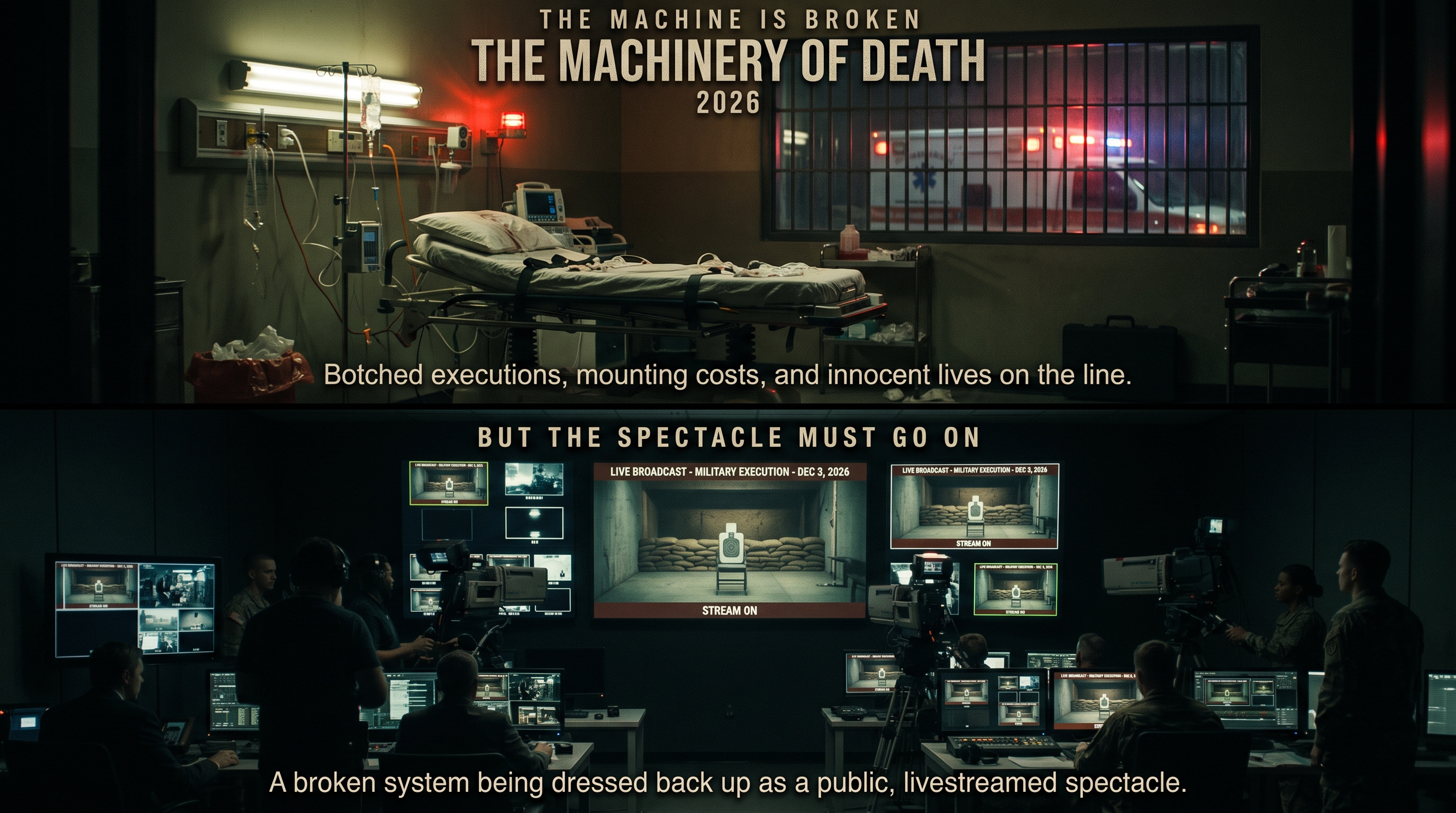
The Machinery of Death — What the Ultimate Punishment Actually Buys
On September 30, 2026, the State of Tennessee strapped Christa Pike to a gurney, administered not one but two doses of pentobarbital, and could not kill her. Media witnesses watched emergency vehicles pull up to carry her to a hospital; a week later she was conscious and talking, still shackled to the bed, her arms burned where the drug appears to have leaked into tissue instead of her bloodstream — a survival her attorneys called “medically unprecedented.” It was Tennessee’s second failed execution in five months. The governor paused the rest of the year’s executions and named a former U.S. Attorney to find out what went wrong. Eight days later, on October 8, the Pentagon confirmed that the firing-squad execution of Nidal Hasan — the Army psychiatrist who murdered thirteen people at Fort Hood in 2009 — will be livestreamed on December 3, the first U.S. military execution since 1961. “We’ll make sure that people are able to watch it,” the Defense Secretary said. “That it’s public.” Put those two events side by side — a state that botched the killing of a woman, and a government preparing to broadcast the killing of a man — and you have the death penalty in 2026 in a single frame: a machine that no longer works reliably, being dressed back up as spectacle. This desk went looking for what that machine actually delivers. Here is the ledger.
I. It does not deter — and the people who study crime for a living say so
The entire moral case for execution over imprisonment rests on a claim the evidence will not support: that the threat of death stops murders a life sentence would not. In 2012 the National Research Council of the National Academies — the country’s most authoritative scientific body — reviewed three decades of deterrence studies and concluded, in plain words, that the research “is not useful in determining whether the death penalty increases, decreases, or has no effect on” homicide rates. Not “we found a small effect.” Not “the jury is out.” The studies are too flawed to answer the question at all, and should not be used to make policy. The one famous study that claimed each execution saved eight lives — Isaac Ehrlich’s 1975 paper, waved in front of the Supreme Court to help end the execution moratorium — was taken apart by a National Academy of Sciences panel in 1978 and has been, in the scholarly verdict, “thoroughly discredited” ever since.
Ask the experts directly and the consensus is overwhelming: a 2009 survey of the nation’s most pre-eminent criminologists found 88% do not believe the death penalty deters homicide. And the real-world map agrees with them. In every single year from 1990 to 2020, the murder rate in states without the death penalty was lower than in states that keep it — and the gap has widened, not closed. After more than 1,600 executions, the states that never had a death penalty average 4.75 murders per 100,000 residents; the death-penalty states average 6.49. Correlation is not cause, and nobody honest claims executions raise the murder rate. But the one thing the data flatly refuses to show is the thing the whole argument needs: that killing the condemned makes the rest of us safer.
II. It costs more than mercy — a lot more
The second sales pitch is that death is the cheap, no-nonsense alternative to “feeding and housing a killer for fifty years.” It is exactly backwards, and every rigorous cost study in the country says so. California has spent more than $4 billion on capital punishment since 1978 — roughly $308 million for each of the thirteen people it actually executed — and the system adds about $184 million a year to the state budget over what life-without-parole would cost. A capital prosecution there runs up to twenty times the price of a life case. Maryland’s death penalty, before the state abolished it, cost taxpayers an estimated $37.2 million for each execution, according to the Urban Institute. Indiana’s own legislative agency found a death case costs eight times a life case — $290,000 against $36,000. Even the cell is dearer: death-row housing roughly doubles the per-inmate cost of general population.
The reason is not luxury; it is law. A death case means two trials in one (guilt, then a separate sentencing phase), a longer and costlier jury selection, more expert witnesses, and a decade or more of mandatory appeals that exist precisely because the punishment is irreversible. That machinery is the price of trying to be careful about killing people — and you pay it whether or not an execution ever happens, because most death sentences are eventually overturned or the prisoner dies first. Life without parole delivers the same permanent removal from society, carries none of that overhead, and — the part that matters most — can be undone when the conviction turns out to be wrong. Which, it turns out, is not rare.
III. It catches the innocent
Since 1973, at least 203 people have been sentenced to death and later exonerated — freed because they did not do it. That is roughly one exoneration for every eight executions carried out. And because exoneration is slow, partial, and dependent on luck — a surviving witness who recants, DNA that happens to have been preserved, a law student who reopens a closed file — the number of innocents actually freed is almost certainly lower than the number of innocents condemned. A 2014 study in the Proceedings of the National Academy of Sciences estimated, conservatively, that at least 4.1% of people sentenced to death in America are innocent. One in twenty-five.
The names are not hypothetical. Texas executed Cameron Todd Willingham in 2004 for setting a house fire that killed his three daughters — a fire that modern forensic science says was never proven to be arson at all; the report calling the state’s evidence “junk science” sat in the governor’s office the day Willingham died. Georgia executed Troy Davis in 2011 after seven of the nine witnesses against him recanted; his last words were “I am innocent.” This is the one error a prison sentence can correct and an execution cannot. You can release a living man from a cell. You cannot release him from a grave.
IV. It falls on the poor, the Black, and the unlucky
If the death penalty were reserved for the “worst of the worst,” you would expect it to track the severity of the crime. It tracks other things. It tracks the race of the victim: the landmark Baldus study of 2,000 Georgia murder cases, controlling for thirty-nine non-racial factors, found that killers of white victims were 4.3 times likelier to be sentenced to death than killers of Black victims — a disparity the Supreme Court acknowledged in McCleskey v. Kemp and then declared constitutionally irrelevant. It tracks geography: just 2% of U.S. counties account for a majority of all executions since 1976, because a single local prosecutor’s appetite, not the gravity of the crime, decides who faces death. And it tracks money: in Alabama, roughly 89% of death-row prisoners could not afford a lawyer at trial. Defendants have been sentenced to die while their appointed attorneys slept through the proceedings. The ultimate punishment is handed out, in practice, less to those who did the worst thing than to those who had the worst luck — the wrong skin, the wrong county, the wrong lawyer.
V. It does not heal the families — and many of them say so first
The last and most sympathetic argument is that execution gives murder victims’ families “closure.” This desk approached that claim carefully, because it is the one that deserves the most respect — and the evidence, including the testimony of the bereaved themselves, does not bear it out. The first systematic study of the question compared families of murder victims in Texas, a death-penalty state, with families in Minnesota, where the maximum is life without parole. The Minnesota families showed better physical and psychological health and greater satisfaction with the justice system. The difference was control over the ending: Minnesota’s cases closed within about two years, while the Texas families were dragged through a decade or more of appeals, re-traumatized at every hearing, their grief held open by the very process meant to deliver relief. A University of Minnesota study found only 2.5% of family members — one in forty — reported feeling closure after an execution; one in five said it did not help them heal at all.
“If you ask murder victims’ families, closure is the F-word,” said the researcher who led the two-state study. “There’s no such thing as closure.” Entire organizations — Murder Victims’ Families for Reconciliation, Murder Victims’ Families for Human Rights — exist because so many of the bereaved reject killing in their name. “My opposition is not rooted in what an execution does to a condemned prisoner,” said Renny Cushing, who founded one of them after his own father was murdered, “but in what a system that embraces the ritual killing… does to us, as individuals and as a society.” An execution does not return the dead. It asks a grieving family to wait fifteen years for a catharsis that, when it finally comes, most of them report never arrives.
VI. So who is it actually for?
Strip away deterrence, savings, and closure — the three things it does not deliver — and a fair question remains: what is the death penalty for, and who benefits from keeping it? The honest answer is that it serves the living more than the dead. It is a political asset. The federal government executed thirteen people in the last six months of the first Trump administration — the first federal executions in seventeen years, five of them after he had already lost the election. The Biden administration halted them and commuted thirty-seven of forty federal death sentences to life; the second Trump administration reversed course on day one with an executive order “restoring” the federal death penalty, lifted the moratorium, and by April 2026 had the Justice Department moving to add firing squads to its menu of methods. The penalty expands and contracts with whoever needs to look tough on crime, not with the murder rate.
And this is where the two images from this autumn close the circle. A punishment that cannot be defended on deterrence, cost, innocence, or the comfort of victims is left defending itself on raw retribution — the desire to see it done. That is what the Fort Hood livestream is: not justice refined but justice performed, the killing turned into something to be watched. The United States is now the only Western democracy that still executes anyone, keeping company on the annual tally with China, Iran, and Saudi Arabia. Support at home has fallen from 80% in 1994 to 52% today, the lowest in half a century, and executions cluster in a handful of states and a sliver of counties. The machine grinds on not because it works — Christa Pike’s survival is the state of the art — but because killing is politically useful and, to some, satisfying to watch.
Justice Harry Blackmun spent twenty years on the Supreme Court upholding the death penalty before he gave up on it in 1994. “From this day forward,” he wrote, “I no longer shall tinker with the machinery of death.” He had concluded the thing could not be fixed — that no set of procedures would ever make it reliable, fair, or free of the risk of killing the innocent. Three decades of data since have sharpened his point rather than blunted it. The alternative is not mercy for the guilty; life without parole removes a murderer from society permanently, costs the taxpayer less, spares the victims’ families a decade of forced re-litigation, and leaves a door open on the one night the state gets the wrong person. The death penalty offers none of that. It offers a spectacle — now, apparently, to be livestreamed — and asks us not to look too closely at the ledger behind it. This desk looked. The ledger does not balance.
Postscript: a reader writes back
Added & last modified October 9, 2026 · 8:43 AM CT
A reader sent this desk a point-by-point rebuttal, and the honest answer is that one of his five arguments lands clean, two sharpen the original case rather than dent it, and two miss. Start with the one that lands, because it is the strongest argument for the death penalty anyone can make and the dispatch above did not answer it: incapacitation. The reader is right that Section I measured deterrence — whether the threat of execution stops murders out in the world — and that this is a different claim from incapacitation, which asks only whether a dead man can kill again. He cannot. An executed murderer commits exactly zero further murders, and no study can touch that number. Christa Pike is the reader’s own proof: already under a sentence of death, she strangled a fellow inmate with a shoestring during a 2001 prison fire and drew a fresh conviction for attempted murder in 2004. Being condemned did not stop her. Only being dead would have. Section I should have said so, and did not.
But incapacitation only argues for execution if the alternative is release — and it is not. The honest comparison is execution against life without parole, and both remove the killer from society for good. The reader’s own figure turns against him here: the Bureau of Justice Statistics finds that roughly 1 to 2% of released homicide offenders are later arrested for another homicide — but that is the recidivism of the released, and a prisoner serving life without parole is never released. The only killings execution prevents that a life sentence does not are the ones a condemned prisoner commits inside — against other inmates or guards. That category is real; Pike is in it. But it is rare, and it is the entire marginal safety gain execution buys over locking the door and throwing away the key. Not “murderers roam free,” but “a small number of lifers kill in prison.” That is the one argument on the pro side that survives contact with the data, and it deserves to be named plainly instead of smuggled in as deterrence. It is also a narrow thing to accept 203 wrongful condemnations in order to buy.
On cost, the reader says pick a lane: you cannot call the death penalty too expensive and also call it a machine for convicting the innocent, because the expense is the appeals, and the appeals are what catch the innocent. But that is not two contradictory complaints; it is one fact seen from both sides. Death costs more than life precisely because the error cannot be undone, so the system bolts on a decade of mandatory review to try to catch its mistakes — and still misses some. Life without parole needs none of that machinery, because a wrong life sentence can be corrected the year the truth finally surfaces. So the two charges collapse into one: you pay a fortune for safeguards that remain imperfect, to impose a punishment that cannot be fixed when they fail. The reader is also right that many capital appeals concede guilt and bargain only over the sentence — but the 203 exonerations and the estimated 4.1% are drawn from the cases that contested guilt, and those are the only ones this part of the ledger ever counted.
On innocence, the reader argues the 203 exonerations are relics — pre-DNA convictions that modern forensics would now prevent. DNA has helped, and the exoneration list does skew toward older cases. But most murders leave no identifying DNA to test, and the documented causes of wrongful capital convictions are not bad lab work — they are official misconduct, present in about 70% of death-row exonerations, and false or perjured testimony, present in 65%. No DNA kit fixes a lying witness or a prosecutor who buries the file. And the error did not stop when the technology arrived: Texas executed Cameron Todd Willingham in 2004 on arson “science” that was junk, and post-execution DNA testing in 2021 on Arkansas’s Ledell Lee — put to death in 2017 — found an unidentified man’s profile on the murder weapon. The machine kept catching the innocent well inside the DNA era. He is right that it is harder to convict a wholly innocent man today than in 1985. He is wrong that it has stopped.
His last two points improve the dispatch rather than refute it. He says the racial disparity lives at the plea-and-charging stage, which the piece did not name — and he is right that it does, which is exactly what makes it damning. The Baldus study measured the race-of-victim effect in the decision to seek death itself, the prosecutor’s discretionary call at precisely that stage, and found that killers of white victims were 4.3 times likelier to face a death sentence after thirty-nine other factors were held equal. Naming the stage does not dissolve the bias; it pins down where it lives. And on the families, the reader is right that the dispatch spoke mostly for the bereaved who oppose execution, and should have said plainly that families who want the sentence carried out — and feel justice when it is — exist and are owed every bit as much respect. The desk’s narrower claim still stands: “closure,” the specific thing the penalty is marketed as delivering, is not what most families report finding, and the ones who live under a death sentence’s decade of appeals fare worse than the ones under a life sentence that ends. But strip that one marketing word away and the reader and this desk arrive at the same place. What is left is retribution — the moral desire to see it done — which is exactly where Section VI landed. That is an honest argument for the death penalty. It is simply not the one printed on the brochure.
Filed on: National Research Council, Deterrence and the Death Penalty (2012, “not useful in determining whether the death penalty increases, decreases, or has no effect”); Radelet & Lacock, “Do Executions Lower Homicide Rates?” (J. Crim. Law & Criminology, 2009, 88% of leading criminologists); FBI Uniform Crime Reports via Death Penalty Information Center and the Death Penalty Policy Project (death-penalty states 6.49 vs. never-death-penalty states 4.749 murders per 100,000 after 1,600+ executions; non-death-penalty states lower every year 1990–2020); Isaac Ehrlich (1975) and its rebuttal by the 1978 National Academy of Sciences panel (Klein); Alarcón & Mitchell, “Executing the Will of the Voters?” (Loyola of L.A. Law Review, 2011: $4B+, ~$308M per execution, +$184M/yr vs. LWOP, up to 20× an LWOP case); Urban Institute, “The Cost of the Death Penalty in Maryland” (2008: $37.2M per execution); Indiana Legislative Services Agency (2025: $290,022 vs. $36,173, 8×); DPIC innocence list (203 exonerations since 1973 across 30 states, ~1 per 8 executions); Gross, O’Brien, Hu & Kennedy, “Rate of false conviction of criminal defendants who are sentenced to death” (PNAS 2014: ≥4.1% likely innocent); Cameron Todd Willingham (Beyler/Hurst arson-science reports) and Troy Davis (seven of nine witnesses recanted); Baldus study and McCleskey v. Kemp, 481 U.S. 279 (1987: killers of white victims 4.3× likelier to receive death); DPIC, “The 2% Death Penalty” (2013); ACLU of Alabama (~89% of death row indigent at trial); Armour & Umbreit, “Assessing the Impact of the Ultimate Penal Sanction on Homicide Survivors” (Marquette Law Review, 2012) and University of Minnesota (2.5% closure, 20.1% no help); Renny Cushing / Murder Victims’ Families for Human Rights; Gallup (Oct 2025: 52% support, down from 80% in 1994, lowest since 1972); Amnesty International, Death Sentences and Executions 2024 (US the only executing Western democracy); federal execution record 2020–21 and the Jan 20, 2025 executive order; Tennessee’s failed execution of Christa Pike (Sept 30, 2026) and the Pentagon’s Oct 8, 2026 announcement that Nidal Hasan’s firing-squad execution will be livestreamed Dec 3, 2026; Blackmun, J., dissenting, Callins v. Collins (1994). Postscript (a reader’s rebuttal, answered Oct 9, 2026): Christa Pike’s Aug 12, 2004 conviction for the attempted first-degree murder of fellow inmate Patricia Jones during a 2001 prison fire (25-year sentence, ordered to run concurrent with her death sentence); Bureau of Justice Statistics recidivism studies (1994, 2005 and 2012 release cohorts: 1.2–2.1% of released homicide offenders rearrested for a new homicide within 3–5 years); DPIC causes of death-row exonerations (official misconduct ~70.5%, false/perjured testimony ~65%); Cameron Todd Willingham (executed 2004) and posthumous DNA testing on Ledell Lee (executed 2017; results released 2021); Furman v. Georgia, 408 U.S. 238 (1972) and Gregg v. Georgia, 428 U.S. 153 (1976); Gary Ridgway’s 2003 guilty plea to 48 murders in exchange for life without parole. Grounded web search, compiled Oct 8 2026; postscript grounded Oct 9 2026; full dossier retained.
№ 107 · Filed October 8, 2026 — “Choose the lesser evil” is sold as arithmetic — the grown-up’s vote, the only responsible move left on the board. It is actually a ransom you volunteer to pay. Tell both parties in advance that you will always take the least-bad option and you have handed them a vote nobody has to earn; the floor drops every cycle because the floor is wherever you have proven you will still stand. And in the 84% of U.S. House seats already locked by geography and the lines drawn to keep them locked, a vote cast off the two-party menu costs nothing at all — the winner was settled before the ballot printed. The real spoiler risk lives in exactly one place: the genuine swing district. One chart for where your vote is a bargaining chip and where it is not — and why the Electoral College is not the villain the reflex says it is.

The Hostage Vote — The Ransom You Volunteer to Pay
Every election cycle the same instruction arrives, dressed as wisdom: be realistic, hold your nose, vote for the lesser evil. It is presented as the only adult move left on the board — the responsible citizen’s arithmetic, the alternative to “throwing your vote away.” This desk is going to argue the opposite, and argue it with the map. The lesser-evil vote is not arithmetic forced on you by a cruel two-party system. It is a ransom you volunteer to pay — and in most of the country it buys you nothing, because the outcome was settled before the ballot was printed. The only place the threat behind it is real is the one place almost nobody lives in: the genuine swing district. Everywhere else, the warning that you are “wasting your vote” is not math. It is a leash, and it was handed to you by the two parties who drew the map.
I. The ransom you volunteer to pay
A vote you will cast no matter what is a vote nobody has to earn. That single sentence is the whole machine. If you announce, in advance, that you will always take the least-bad option on offer, you have told both parties your support is unconditional — and no rational seller ever improves a product the buyer has already sworn to buy. Why would they? Your vote is already banked. The dollar they would have spent earning it is better spent chasing the one voter who might still say no. So each cycle the two menus drift a little further from you and a little closer to each other, and the floor drops again, because the floor is simply wherever you have proven you will still stand and still pull the lever.
That is what “vote the lesser evil” has actually gotten us, measured over decades: not a ratchet toward the good, but a ratchet toward whatever the party calculates it can get away with while still beating the other guy. The strategy guarantees the thing its defenders claim to hate. It rewards the party for running the least inspiring candidate who can still clear the opponent, because inspiration costs money and concessions, and a hostage who has promised not to resist gets neither. The partisan’s vote is the one commodity in American life that is never comparison-shopped — it is pledged for life to a brand. Ours, the independent and the third-party voter’s, is the only vote that still has to be won. That is not weakness. Priced correctly, it is the only leverage a voter has left.
II. The map is already drawn
And here is the part the “wasted vote” sermon never mentions: in most of the country, breaking ranks costs exactly nothing. In 2024, 366 of 435 U.S. House seats — 84% — were rated Solid for one party by the Cook Political Report. Not close. Not in play. Settled. That lock is built two ways at once: by where Americans have physically sorted themselves, liberal to the cities and conservative to the country, and by the district lines drawn and redrawn precisely to keep the result a foregone conclusion — gerrymandering, the deliberate packing and cracking of voters so the incumbent party cannot lose. In a seat like that, the winner is known before a single ballot is cast. A third-party or write-in vote there changes no outcome whatsoever. It cannot elect “the greater evil,” because the greater evil’s victory or defeat was never on the table. The chart below is the board, drawn to scale.
The only thing your off-menu vote moves in a locked seat is the dissent tally — the share of the electorate that refused both brands. And that number is not nothing. It is the one figure party strategists actually read when they sit down to decide how far they can take your bloc for granted next time. A safe-seat vote for a major party disappears into a margin nobody studies. A safe-seat vote against both is a data point that says: there is a constituency here that is up for grabs, and the party that moves toward it can grow. In the only place the lesser-evil logic insists your vote is powerless, it is quietly the most honest signal you can send — and it is free.
III. The one place the spoiler is real
Now the honest caveat, because this desk does not do one-sided. The “you’re wasting your vote, you’re handing it to the greater evil” warning is not always a con. In precisely one setting it is a real cost-benefit calculation: the genuine swing district or swing county, where the margin is thin enough that a few thousand defecting votes can actually flip the result. There — and essentially only there — a third-party vote carries a real opportunity cost, because the race is live and your ballot is one of the ones in play. If you live in the suburbs of Philadelphia, in Maricopa County, in the exurbs of Atlanta or Milwaukee, the spoiler math is not propaganda; it is arithmetic, and it deserves a serious answer rather than a slogan.
But be clear about how small that world is. Out of 435 House districts, only 69 were even competitive in 2024, and just 22 were true toss-ups. At the presidential level the whole contest collapsed onto seven states holding about 18% of the population. For the other four-fifths of the country, the spoiler warning is imported from a battleground the voter does not live in and applied where it has no force. This is the sleight of hand: a caution that is valid in 22 districts gets preached to all 435, because the fear of “wasting it” is the single most effective tool the two parties have for keeping a captured voter captured. Duverger’s law — the tendency of winner-take-all, first-past-the-post elections to settle into two parties — is real, and it is often invoked here as if it closed the case. It does not. Duverger governs who wins the seat. It says nothing about whether your dissent is recorded, and in a safe seat the recording is the only thing on offer anyway.
IV. The courtship follows the map — and so does the money
If the lesser-evil leash kept the country honest, you would expect the rewards of all this disciplined voting to be spread evenly. They are not. They pool exactly where the votes are still in play. In 2024 the seven swing states absorbed 71% of all presidential advertising — $2.2 billion of a $3.2 billion total — and in the campaign’s final stretch the concentration was starker still: 81% of presidential broadcast-TV spending went to local markets in those seven states, and under 2% to the other 43 states and D.C. combined. The candidates’ own time told the same story: 246 of 262 general-election events — 94% — happened in the seven battlegrounds, while 32 states received not a single visit from a presidential or vice-presidential candidate. Four-fifths of the country was, on the trail, simply ignored.
And this is the part that should end the “just vote responsibly” sermon for good: the favoritism does not stop when the campaign does. It is baked into governing. Holding population, land area, and disaster exposure constant, swing states pull measurably more out of the federal government — John Hudak’s study of federal grants found them receiving 7.6% more grants and 5.7% more grant money than safe states, rising to 9% and 7% in the two years before a presidential election. Presidents even politicize catastrophe: controlling for the actual damage, swing states have been up to twice as likely to receive a federal disaster declaration. The distortion reaches trade policy, where one study found a voter in a safe state is valued at only 70 to 82% of a swing-state voter when tariffs are set. This is what the political scientists call “presidential particularism” — the government of the United States, as a matter of measurable behavior, treating the citizens of a battleground as worth more than the citizens of a settled state. The swing district gets the courtship, the visits, the grants, the disaster money, and the protected industry. The safe seat — where most Americans actually live — gets taken for granted, because it already announced it would vote the lesser evil no matter what.
V. The Electoral College is not the villain — winner-take-all is
Faced with that map, the modern reflex is to blame the Electoral College and demand its abolition. That is aiming at the wrong target, and it is worth saying plainly why. The College was designed to do very nearly the opposite of what it is now accused of. The Connecticut Compromise of 1787 gave each state electors equal to its House seats plus its two senators — a deliberate “Senate bump” so the small states could not be steamrolled by Virginia and Pennsylvania. Hamilton, in Federalist No. 68, defended it as a firewall: electors meeting separately in their own states so that no single faction, cabal, or foreign power could capture the choice in one place, and so the executive would answer to the country as a federation of communities rather than to one undifferentiated national mob. The original rule even required each elector to cast one of his two votes for a candidate from another state — an explicit device to kill “favorite son” regional wins and force the winner to build a genuinely multi-state coalition. The College’s entire purpose was to broaden the coalition a president must assemble and to stop a few dense population centers from settling the whole thing for everyone else.
So what actually funnels every dollar and every visit into seven states? Not the Constitution — a thing the Constitution never required and never mentioned: statewide, winner-take-all allocation of electors, adopted by the states themselves over the nineteenth century, not written into the founding document. Winner-take-all is what makes a 50.1% win in a state worth 100% of its electors, which is what makes the handful of states that hover near 50/50 the only ones worth courting, which is what collapses a national election onto seven battlegrounds. Two states — Maine and Nebraska — already opt out, splitting their electors by district. The College forces coalition-building; winner-take-all shrinks the coalition you actually have to build down to the suburbs of a few swing counties. Blaming the College for the swing-state distortion is like blaming the engine for a steering wheel somebody bolted on crooked. Fix winner-take-all — and the gerrymander, and the closed primary — before you tear out the one structural feature that was built to protect the voter in the state nobody visits.
Which brings it back to the leash. The partisan’s vote is pledged for life and therefore priced at zero; it is the collateral the party borrows against. The independent’s and the third-party voter’s is the only vote in the system that still has to be earned — and a vote that must be earned is the only vote with any bargaining power left in it. In the 84% of seats already decided, voting your conscience costs you nothing and records a signal the parties genuinely fear. In the handful of seats that are live, the spoiler math is real and deserves a real answer — but that is a decision for the voter standing in a battleground, not a universal commandment to be preached at everyone else. “Don’t waste your vote” is, almost everywhere it is spoken, advice that benefits exactly two institutions: the two parties that drew the map and would very much like you to keep paying the ransom. The hostage who announces he will never resist gets no concessions. The one who might walk gets courted. Decide which one you want to be — and remember that in most of America, walking is free.
Filed on: Cook Political Report, final 2024 U.S. House ratings (366 of 435 “Solid,” 69 competitive, 22 toss-up; Inside Elections 15 and Sabato’s Crystal Ball 14 toss-ups corroborate the order of magnitude); AdImpact, “2023–2024 Cycle in Review” ($3.2B total presidential ad spend, $2.2B / ~71% in the seven swing states; $1.89B / 59% of cycle spend in the final 107 days; PA $513M alone); Wesleyan Media Project (Sep 1–E-day: 81% of presidential broadcast TV spend to battleground local markets, under 2% to the other 43 states + DC); FairVote 2024 campaign-event tracker (246 of 262 general-election events — 94% — in the seven states, which hold ~18% of the population; 32 states received zero presidential or VP visits); John Hudak, Presidential Pork: White House Influence over the Distribution of Federal Grants (Brookings, 2014: swing states +7.6% grants / +5.7% grant money net of controls, rising to 9% / 7% in the two years before a presidential election); Andrew Reeves, “Political Disaster” (2011: swing states up to 2× more likely to receive a disaster declaration, controlling for damage); Kriner & Reeves, The Particularistic President (2015); Chalak, McLaren & Ma, “A Swing-State Theorem, with Evidence” (J. Int’l Economics: non-swing voter valued at 70–82% of a swing voter in trade policy); Electoral College design per the Connecticut Compromise (1787) and Hamilton, Federalist No. 68; Duverger, Political Parties (1954). Grounded web search, compiled Oct 8 2026; full dossier retained.
№ 106 · Filed October 8, 2026 — The modern argument is settled before the article is opened. A headline, a meme, a screenshot is the entire input; it snaps to what the reader already believes, the verdict is reached, and the piece underneath is never read. Psychology has a name for judging before reading — confirmation bias, resolving into plain prejudgment — and a majority of the news links passed around on the largest platforms are forwarded by people who never clicked them. One chart for the reflex, one example that proves it.
![A cinematic photograph of a young man lit by his phone in a dim, cluttered apartment, smiling with satisfaction as he reposts a social-media article. On the phone screen, a tweet shows a headline and a photo above a news card, but every line of the article body is garbled placeholder text — Lorem Ipsum. Bottom caption in yellow: ‘[ triumphantly reposts ‘scientific proof’ without realizing the entire article is just Lorem Ipsum ].’ A circular ‘Gremlin Approval Seal’ is stamped in the upper right.](kneejerk-lorem-ipsum-meme.jpeg)
The Prejudgment — The Verdict Before the Article
The cleanest proof of the reflex is an article almost no one actually read. On June 4, 2016, the satire site The Science Post ran a piece under the headline “Study: 70% of Facebook users only read the headline of science stories before commenting” — and filled the entire body with nothing but lorem ipsum placeholder text. It was shared close to 46,000 times within days, and past 120,000 since, overwhelmingly by people performing agreement with a study that did not exist, in an article they plainly never opened. The headline spoke; the sharer moved its mouth. The cure is the least shareable thing on this page: open the document, argue with what it actually says, and refuse to put words in a stranger’s mouth because an image told you what he must have meant. It is slower, it is unglamorous, and it cannot be done in under forty-seven seconds.
Filed on: Gabielkov, Ramachandran, Chaintreau & Legout, “Social Clicks: What and Who Gets Read on Twitter?” (ACM SIGMETRICS 2016, 59% of shared links never clicked; bit.ly-click methodology caveat); Vosoughi, Roy & Aral, “The spread of true and false news online” (Science 2018, 70% / ~6× / depth-10 ~20×; fact-checked-rumor sample, with the PNAS 2021 size-matched rejoinder); The Science Post, “Study: 70% of Facebook users only read the headline of science stories before commenting” (June 4, 2016, lorem-ipsum satire; ~46,000 shares within days, 120,000+ since). The cognitive terms per the standard literature: confirmation bias — Nickerson, “Confirmation Bias: A Ubiquitous Phenomenon in Many Guises” (Review of General Psychology 1998); biased assimilation / belief perseverance — Lord, Ross & Lepper (JPSP 1979). Grounded web search, compiled Oct 8 2026; full dossier retained.
№ 105 · Filed October 8, 2026 — On January 30, 2026, a jury in Westchester County, New York awarded $2 million to a 22-year-old named Fox Varian, who at sixteen had her healthy breasts removed as gender-affirming surgery and, at nineteen, detransitioned. She sued the psychologist who referred her and the surgeon who cut, and the most damaging witness against them was not a conservative activist — it was the sitting president-elect of WPATH, the world body that writes the standards of care, who testified that the referral breached the standard because it rode on a diagnosis of body dysmorphia rather than gender dysphoria, in a girl whose anorexia, autism, depression and OCD were never stabilized first. Her own lawyer was careful to say the verdict was not a referendum on the whole field, and he was right. But the case sits on top of a larger one: a medical establishment that declared the science settled and the treatment life-saving — while the very countries that invented the treatment reviewed the same evidence and called it “remarkably weak.” Medicine’s entire claim to authority is the oath attributed to Hippocrates — primūm non nocēre, first, do no harm — which is not a promise to always heal but a command to not intervene faster than the evidence warrants, especially on a body that cannot yet consent to what it will have to live inside for sixty years. So this desk does what it always does: define the standard first, build the test out of the definition, state the test before the evidence, and run it down both aisles with one ruler — because on this question America produced two opposite certainties, and the one thing neither tribe would do is the thing a children’s doctor in Stockholm or London actually did.

First, Do No Harm — The Gender-Medicine Ledger, Both Columns, Graded Against the Evidence
Grant the premise both sides are shouting, because both are right about each other. The right is right that something went badly wrong: that a standard-of-care let a sixteen-year-old with an eating disorder and autism be referred for an irreversible amputation on a rushed assessment; that the body writing that standard quietly deleted its own age minimums in the final days before publication; that it commissioned independent evidence reviews and, when the answers came back inconvenient, moved to keep them unpublished; that England, Sweden, Finland, Norway and Denmark — not a religious-right in sight — have all pulled back. And the left is right that gender dysphoria is a real, catalogued, distressing condition; that the elevated anxiety and suicidal ideation in these kids are not invented; that the political right answered a medical question with felony statutes, investigations of parents, and bans that reach grown adults; and that the lurid image of surgeons mutilating small children is a wild overstatement of a vanishingly rare event. Neither camp is hallucinating the other’s dishonesty. What each is doing is the older move: holding a certainty its own evidence does not license, because our certainty feels like compassion and theirs feels like cruelty. The codex does not get that exemption. So, before a single receipt, the rule everyone will be graded against.
I. What the standard actually is — and the three questions
Evidence-based medicine is not a slogan; it is a hierarchy, and it has a scorecard. The accepted international tool is called GRADE, and it rates the certainty of evidence in four tiers — high, moderate, low, very low — based on how well-designed the studies are, whether they have control groups, how long they follow patients, and whether the results replicate. A single uncontrolled study of a self-selected group that is measured once and never followed is, by this standard, very low certainty — the bottom rung. That is not an anti-trans invention; it is the identical ruler used to grade a blood-pressure drug or a knee surgery. So this desk refuses both the word “mutilation” and the word “life-saving” as slogans and asks three questions instead. One — the evidence test: is there evidence of benefit, at the level of certainty medicine demands for an intervention that is partly irreversible, that the benefit outweighs the harm? A hoped-for benefit is not a proven one; a sincere clinician is not a controlled trial. Two — the honesty test: when the evidence came back weak, did the institution own it — or bury it, redefine it, and attack whoever said so? Integrity is revealed less in the first claim than in the conduct after the data disappoint. Three — the mirror: would you accept the identical move — a confident intervention on a child resting on very-low-certainty evidence, or a blanket political ban overriding every individual case — from the other tribe? If “follow the science” thrills you in one mouth and enrages you in the other, the principle was never the science. It was the team. Keep the three in hand. Now the evidence, and the receipts travel with it.
II. The affirmative ledger — the certainty that outran its evidence
The affirmative establishment’s failure is not that it treated trans kids; it is that it declared a certainty its own files did not contain, and then protected the certainty instead of the children. Start with the standard itself. The December 2021 draft of WPATH’s Standards of Care, Version 8, contained specific minimum ages — fourteen for hormones, fifteen for mastectomy, sixteen for breast augmentation and facial surgery, seventeen for most genital surgery. By the time the final document published in September 2022, the numbers were gone, deleted in a “correction” days after release, leaving phalloplasty at eighteen as the lone surviving floor. Documents later unsealed in Alabama’s litigation, and a 2024 House Oversight inquiry, allege the deletion followed pressure from the Biden administration’s Assistant Secretary for Health, Admiral Rachel Levine, whose office reportedly asked whether the “specific ages can be taken out” because fixed numbers “will make matters worse” for the legal fight. WPATH disputes the characterization; the emails are real and were produced under court order.
Then the part that fails the honesty test outright. For SOC-8, WPATH commissioned an independent evidence-review team at Johns Hopkins to do the systematic reviews a modern guideline is supposed to rest on. When some of those reviews returned findings of little or no high-quality evidence, WPATH — in its own words, in the documents — noted that “two papers have not received the green light to be published,” and instituted a policy requiring its sign-off before any commissioned review could appear. The lead of the mental-health chapter testified that rather than rely on the systematic reviews, “we used authors we were familiar with.” An internal author worried in writing that language like “insufficient evidence” would “empower” those claiming the care was experimental. This is the body that would spend 2024 accusing its critics of ignoring the evidence. Meanwhile the American Academy of Pediatrics, in August 2023, voted to reaffirm its 2018 gender-affirming policy and then commissioned the systematic review that might test it — reaffirming the conclusion before doing the study, a sequence even the GRADE pioneer Gordon Guyatt called backward. The foundational 2018 statement that framed watchful waiting as a form of “conversion” was itself authored largely by a single pediatrician and was not a systematic review of anything.
And the flagship claim — that this care prevents suicide — is the one the evidence least supports, which matters because it is the claim that ends every argument. “Would you rather have a dead son or a living daughter” is not a data point; it is a parent’s deepest fear, deployed to foreclose deliberation. The studies most cited for it — Turban’s 2020 and 2022 papers linking access to blockers and hormones with lower suicidal ideation — are cross-sectional surveys that, as their own authors conceded, cannot establish causation, that found an effect on only one of several measures, and that are confounded by the fact that clinicians historically offered these drugs to the most psychologically stable kids in the first place. The single most-cited surgical-benefit study, Bränström and Pachankis 2020, was formally corrected by the American Journal of Psychiatry after reanalysis with a proper comparison group erased the benefit. Even the hard number cuts against the rhetoric: in the best English data, four of some thousands of clinic patients died by suicide across thirteen years — a rate around thirteen per hundred thousand per year, elevated against peers but, in absolute terms, rare, and — per the government’s own suicide-prevention adviser — not exploding after England restricted blockers. Suicidal ideation is genuinely high; completed suicide is rare; and no systematic review on earth has shown that medical transition reduces it. Hilary Cass, who ran the largest review of all, wrote the sentence the establishment will not repeat: “the evidence does not adequately support the claim that gender-affirming treatment reduces suicide risk.”
III. The European mirror — the same studies, the opposite verdict
The decisive fact in this whole war is that the countries which pioneered pediatric transition read the identical evidence and walked away — and they were led not by conservatives but by the nationalized, left-of-center health systems of social-democratic Europe. England’s NHS commissioned Dr. Hilary Cass, a past president of the Royal College of Paediatrics, to review the field; her final report in April 2024 concluded the evidence for puberty blockers and cross-sex hormones in minors was “remarkably weak,” built “on shaky foundations,” and that “for most young people, a medical pathway will not be the best way to manage gender-related distress.” The University of York systematic reviews underneath her found that of 103 studies on blockers and hormones, exactly two were high quality. England closed the Tavistock clinic in March 2024 and, that December, the Health Secretary — a Labour minister — made the ban on puberty blockers for gender dysphoria indefinite, calling the prescribing an “unacceptable safety risk,” with new treatment confined to a clinical trial.
And England is not an outlier; it is the last domino. Sweden’s Karolinska halted routine blockers and hormones for minors in 2021; the national board confirmed in 2022 that the risks “outweigh the possible benefits” and that hormonal treatment should be confined to research. Finland broke with the American model first, in 2020, making psychotherapy — not medication — the first-line treatment, after its own cohorts showed roughly three-quarters of referred adolescents carried serious psychiatric histories that predated the dysphoria. Norway’s healthcare-investigation board declared the treatment “experimental” in 2023. Denmark’s approvals for medical transition collapsed from sixty-five percent of referred youth in 2018 to six percent in 2022. France’s Académie Nationale de Médecine urged “the greatest reserve” in 2022, warning of sterility and of a “risk of over-diagnosis.” These are the facts that detonate the American left’s framing: when Cass reviewed every clinical guideline in the world, the only two she judged rigorous enough to trust were the Finnish and the Swedish — and both now say what America’s institutions call hate speech. The reason is not reversibility: the comforting claim that blockers are a neutral “pause button” collapses against the data that 96 to 98 percent of children put on blockers proceed to cross-sex hormones. It does not buy time to think. It is the first step down a path, and in the English and Dutch data almost no one steps off.
IV. The restrictive ledger — the political right’s opposite error
If the left’s error was manufacturing certainty inside medicine, the right’s was seizing the same question out of medicine entirely and answering it with a cudgel. Roughly twenty-five states now ban gender-affirming care for minors, and in six of them — Alabama, Florida, Idaho, North Dakota, Oklahoma and South Carolina — a physician who provides it commits a felony. In February 2022, before any statute, the Texas attorney general issued an opinion recasting the care as “child abuse,” and the governor ordered the state’s family-protection agency to investigate the parents of trans kids as abusers — until the Texas Supreme Court confirmed the agency was never legally compelled to obey. Florida’s 2023 law reached past children to restrict care for adults, forcing them through physician-only channels and state-scripted consent forms, until a federal judge struck the scheme as “motivated by disapproval of transgender people.” Missouri’s attorney general tried to choke off even adult care through a consumer-protection “emergency rule,” then withdrew it. About ten states now bar Medicaid from covering the care at any age.
This is the mirror image of “affirm everyone,” and it fails the same ruler. A blanket statute cannot weigh an individual child; it overrides the case-by-case clinical judgment that is the entire point of a doctor, in the service of an ideology rather than an evidence base — the identical sin, pointed the other direction. And it commits the error Europe refused: the Scandinavian systems restricted and cautioned; they moved medicine toward therapy and trials. They did not criminalize the clinician, investigate the mother, or pretend that gender dysphoria is not a real condition for which some care, for some patients, is genuinely appropriate. A nation can conclude the evidence is too weak to justify routine medical transition of minors — every country above did — without a single felony charge. That the American right could not tells you its object was never the evidence either. It was the win.
V. The double standard — one ruler, two tribes dodging it
The ledgers show both sides abandoned the evidence; the double standard shows neither was ever actually holding it. Watch the principle move. The same institutions that spent a decade saying “trust the doctors, follow the science” met the largest, most rigorous evidence review ever conducted — Cass — not with engagement but with an attack on the reviewer’s credentials, WPATH dismissing a past president of the pediatrics college as “a pediatrician with hardly any clinical experience,” the very independence that makes such a reviewer trustworthy recast as a disqualification. “Follow the science” held right up to the moment the science said slow down. And the right runs the identical reversal from the other end: the camp that screams about government overreach into the family and the exam room wrote government directly into both, ordering the state between a parent, a doctor, and a child — “medical freedom” holding right up to the moment the medicine pointed somewhere it disliked. Each tribe keeps its stated principle exactly until the principle costs it something, which is the one thing a principle is defined by surviving.
And both launder their certainty through numbers that do not say what they are made to say. The right’s rhetoric of surgeons “mutilating little children” collides with the registry data: genital surgery on young minors is essentially nonexistent — zero on children under twelve, a literal handful under fifteen — and the real, narrower question is mastectomy on sixteen- and seventeen-year-olds, which rose sharply but remains uncommon and was performed on perhaps eleven hundred American minors across four years, almost all of them natal girls. The scary five-figure totals come from advocacy databases that bundle hormones with surgery and sweep in cisgender boys getting ordinary chest reductions. But the left’s comfort number is just as laundered: the oft-cited “one percent regret” rests on studies with twenty to sixty percent of patients lost to follow-up — and a detransitioner, almost by definition, does not return to the clinic that transitioned her to be counted. The honest statement cuts against both talking points at once: documented regret is low in the studies we have, and we do not actually know the real rate for today’s adolescents, because the follow-up is too short and the population too new. Certainty, in either mouth, is the tell.
VI. The machine — why America couldn’t do what Europe did
Here is the turn, because the real question is not which tribe is right — it is why the same evidence that produced quiet clinical caution in Stockholm produced a holy war in Washington. The answer is that Europe kept the question inside medicine and America routed it through the culture war, where every fact is first sorted by which side it helps. The identical GRADE verdict — “low to very low certainty” — that a Finnish health council could simply act on became, in the United States, a flag to be captured. The affirmative establishment could not concede the evidence was weak without handing ammunition to the states writing felony bans, so it defended a certainty it privately knew it lacked — which is precisely why it buried the Hopkins reviews. The right could not concede that dysphoria is real and some care appropriate without surrendering ground in a war it meant to win, so it answered a question of pediatric evidence with the machinery of criminal law. Each tribe’s overreach was manufactured by its fear of the other’s. And the Supreme Court ratified the capture: United States v. Skrmetti, decided in June 2025, upheld Tennessee’s ban six to three — a clean split along the party of the president who appointed each justice, the evidentiary question that stayed inside medicine in England arriving in America as a proxy battle over sex and the Constitution.
The lawsuits now landing are the bill for all of it — but read them honestly, because the honesty is the whole point. The Varian verdict is real and it is a first, but it stands nearly alone: of the dozen-plus detransition suits filed across the country, exactly one has produced a jury verdict and one a quiet settlement, while the rest are pending, dismissed on technicalities, revived on appeal, or shunted into private arbitration. There is no wave of courtroom victories — there is a wave of filings, a growing crowd of young people who were handed irreversible interventions on an evidence base their own doctors are now, in deposition, struggling to defend. The verdict that matters most is not a jury’s. It is the one written by every systematic review on two continents, in the same four words, about the thing America spent a decade calling settled.
VII. The verdict — run the test
Put both American tribes through the three questions and neither survives its own ruler. The evidence test: by every systematic review on two continents, the certainty that the benefits of medically transitioning minors outweigh the partly-irreversible harms is low to very low — which does not prove the care is useless, but does mean “settled science” and “life-saving” were claims the data could not carry, and that a blanket felony ban is a certainty the same data cannot carry in the other direction. The honesty test: the affirmative establishment buried its own commissioned reviews and attacked the woman who read the evidence out loud; the political right manufactured an opposite certainty and wrote it into criminal statutes and investigations of parents — both failed, in opposite directions, and the worst actors are bipartisan. Question three, the mirror: every reader who felt “but our side’s certainty is the compassionate one” reading the other tribe’s section just failed it in real time. The jersey flipped the verdict. That is the tell, and it is the whole diagnosis.
Primūm non nocēre is not the easy oath people think it is. It does not say heal at all costs, and it does not say never act; it says the physician’s first duty, when the evidence is thin and the intervention cuts deep, is the humility to not be more certain than the facts allow. The hardest thing in medicine has never been to act when you are sure. It is to stay honest about what you do not know — and a child is precisely the patient on whom the cost of false certainty is paid in full, irreversibly, across a life the certain adult will not have to live. Europe’s doctors, reading weak evidence, chose to slow down and say so. America’s factions, reading the identical evidence, each chose the certainty that won their war — one prescribing it, one outlawing it, both sure the child was safe in their hands because the other side’s hands looked worse. The oath was never addressed to the enemy’s hands. It was addressed to yours.
So read the verdict, then read past it. A New York jury did not rule that trans kids are imaginary or that care is never right; it ruled that one girl with anorexia and autism and body dysmorphia should not have had her breasts removed at sixteen on a rushed referral — and the president-elect of the world’s transgender-health body agreed under oath. That is the narrow, true thing. The wide thing is this: a medical system optimized to win a culture war cannot simultaneously be optimized to protect a child, because winning demands certainty and protecting demands the admission of doubt, and you cannot do both about the same irreversible act at the same time. The American left manufactured the certainty and called it science; the American right manufactured the opposite certainty and called it protection; and the only people in this story who actually behaved like doctors were the Scandinavian and British clinicians who looked at weak evidence, felt the pull of their own politics, and put the evidence first anyway. Neither American tribe is the party of the child. There is no party of the child — there is only a real condition, a real distress, a genuinely uncertain evidence base, and a body too young to consent to living inside the mistake. The repair is not a ban and it is not “affirm faster.” It is the one discipline both tribes abandoned and Europe’s left somehow kept: when you do not know, say so — and when the patient is a child, let not-knowing make you slower, not louder. That flash of “but our certainty is the kind one” is the only thing in this entire war that was ever actually settled. Put it down.
Filed on: Definition — the Hippocratic primūm non nocēre / “first, do no harm”; the GRADE framework for rating certainty of evidence (high / moderate / low / very low). The affirmative ledger — WPATH Standards of Care v8 (Coleman et al., Int’l J Transgender Health 23:S1, Sept 2022) and the ~9-day “correction” removing the draft age minimums (14 hormones / 15 mastectomy / 16 breast & facial / 17 genital / 18 phalloplasty); House Oversight letter to HHS (Aug 27 2024) and the Boe v. Marshall / Eknes-Tucker (Alabama) unsealed exhibits alleging Adm. Rachel Levine/HHS asked that “specific ages can be taken out,” the Johns Hopkins (Karen Robinson team) systematic reviews with “two papers [that] have not received the green light to be published,” the “we used authors we were familiar with” deposition testimony, and the “insufficient evidence…empower” internal message (WPATH disputes the framing; the emails were court-ordered); Endocrine Society Clinical Practice Guideline (Hembree et al., JCEM 102:3869, 2017); AAP 2018 policy (Rafferty, Pediatrics 142:e20182162) reaffirmed Aug 2023 before its commissioned systematic review, with Gordon Guyatt’s (McMaster/GRADE) criticism of the sequence; suicide-benefit citations and their problems — Turban et al. (Pediatrics 2020; PLOS ONE 2022), cross-sectional and confounded by indication; Bränström & Pachankis (Am J Psychiatry 2020) and its published correction; Biggs, “Suicide by Clinic-Referred Transgender Adolescents in the UK” (Arch Sexual Behavior 2022, ~13/100,000/yr, ~0.03% cumulative); Louis Appleby’s review rejecting the post-restriction “suicide explosion” claim (2024); Hilary Cass, “the evidence does not adequately support the claim that gender-affirming treatment reduces suicide risk.” The European mirror — the Cass Review final report (NHS England, Apr 10 2024, “remarkably weak,” “shaky foundations”); the University of York systematic reviews (Taylor et al., Arch Dis Child 2024; 2 of 103 studies high-quality; 96.5% Dutch / 98% UK GIDS progression from blockers to hormones); Tavistock GIDS closure (Mar 28 2024) and the indefinite UK puberty-blocker ban (Wes Streeting, Dec 11 2024, “unacceptable safety risk,” review 2027); Sweden Karolinska (2021) and NBHW (Feb & Dec 2022, Thomas Lindén); Finland COHERE/PALKO (June 2020; Riittakerttu Kaltiala; ~75% psychiatric comorbidity); Norway UKOM (Mar 2023, “experimental”); Denmark (approvals 65%→6%, 2018→2022; Minister Sophie Løhde, May 31 2023); France Académie Nationale de Médecine (Feb 25 2022, “la plus grande réserve”); NICE evidence reviews (Oct 2020, “very low certainty”; de Vries 2011 “high risk of bias”); Miroshnychenko et al. (McMaster, Arch Dis Child 2024). The restrictive ledger — ~25–27 state bans on care for minors (KFF/HRC trackers), felony provisions in Alabama (SB 184), Florida, Idaho (HB 71), North Dakota, Oklahoma and South Carolina; Texas AG Opinion KP-0401 (Feb 18 2022) and Gov. Abbott’s DFPS directive (Feb 22 2022), Texas Supreme Court holding DFPS was “not compelled” to comply (May 13 2022), later SB 14 (2023); Florida SB 254 (2023) reaching adults, enjoined in Doe v. Ladapo (Hinkle, June 11 2024, “motivated by disapproval of transgender people”); Missouri AG Bailey’s consumer-protection “emergency rule” (Apr 2023, withdrawn May 16 2023); ~10 states barring Medicaid coverage at all ages; United States v. Skrmetti (June 18 2025, 6–3, Roberts, rational-basis; Sotomayor dissent from the bench, split along appointment lines). Consent, progression & scale — Bell v. Tavistock [2020] EWHC 3274 (consent doubts) reversed procedurally [2021] EWCA Civ 1363; the Tanner-2-blockers-to-hormones sterility pathway and fertility-counseling gap; Das et al. (JAMA Pediatrics 2022: chest surgeries on minors up 389% 2016–2019, ~1,130 total, 1,114 masculinizing vs 16 feminizing); Dai et al. (JAMA Network Open 2024: ~0 genital surgeries under 12; adolescent surgery overwhelmingly chest at 15–17); Bustos et al. (PRS Global Open 2021, ~1% pooled surgical regret) and its loss-to-follow-up limits. The honest counter — gender dysphoria as a DSM-5 diagnosis; the de Vries Dutch cohort (Pediatrics 2014) positive outcomes in a strictly selected group; WPATH/USPATH and AAP (Ben Hoffman) responses to Cass; the Yale Integrity Project critique (“low certainty is normal across pediatrics” — the strongest pro-care argument) and Jesse Singal’s / SEGM’s rebuttals; the Economist (“worryingly weak,” “marking their own homework”) and Leor Sapir (Manhattan Institute; a political scientist and HHS-report co-author, flagged as such) on the trans-Atlantic divergence. The lawsuits — Varian v. Einhorn & Chin (Westchester Cty. NY Supreme Court, $2M jury verdict Jan 30 2026, WPATH president-elect Dr. Loren Schechter testifying for the plaintiff; the first U.S. detransitioner malpractice jury verdict); the Camille Kiefel (Oregon) settlement; and the pending/dismissed/appealed/arbitrated remainder — Chloe Cole (Kaiser, trial set Apr 2027), Prisha Mosley (NC, malpractice time-barred, on appeal), Kayla Lovdahl & Richard Anumene (arbitration compelled), Soren Aldaco (TX, $40k sanction then revived by the Texas Supreme Court), and the Pogust Goodhead UK group action (announced, not yet a filed/certified claim). Prior Crown work — the book-ban dispatch (№102), the memory-hole dispatch (№103), the noble-lie dispatch (№104). Grounded web search, compiled Oct 8 2026; full research dossier retained.
№ 104 · Filed October 8, 2026 — The same genre runs the feed from both ends: a supercut of the other side’s lies, scored to ominous music, posted as proof that the opposition is not merely wrong but pathologically incapable of truth — and then the mirror supercut, from the other camp, saying no, you are the liars. Each side believes it owns the honest half of the country and the other half simply fabricates. The uncomfortable answer, as with the book fight and the memory hole, is that both supercuts are accurate about the enemy and silent about the self. Plato saw the move coming twenty-four centuries ago. In the Republic, Socrates proposes the gennaion pseudos — the “noble lie,” a founding myth the guardians tell the city for its own good, a falsehood licensed because it serves a truth too large for the crowd to hold. Every American faction has kept exactly one tradition with perfect fidelity: the certainty that its lies are the noble kind, told for the higher cause, while the other side’s are just lies. So this desk does what it always does: define honesty first, build the test out of the definition, state the test before the evidence, run it down both aisles with one ruler — and then name the machine that now pays both sides to lie and fines anyone who stops.
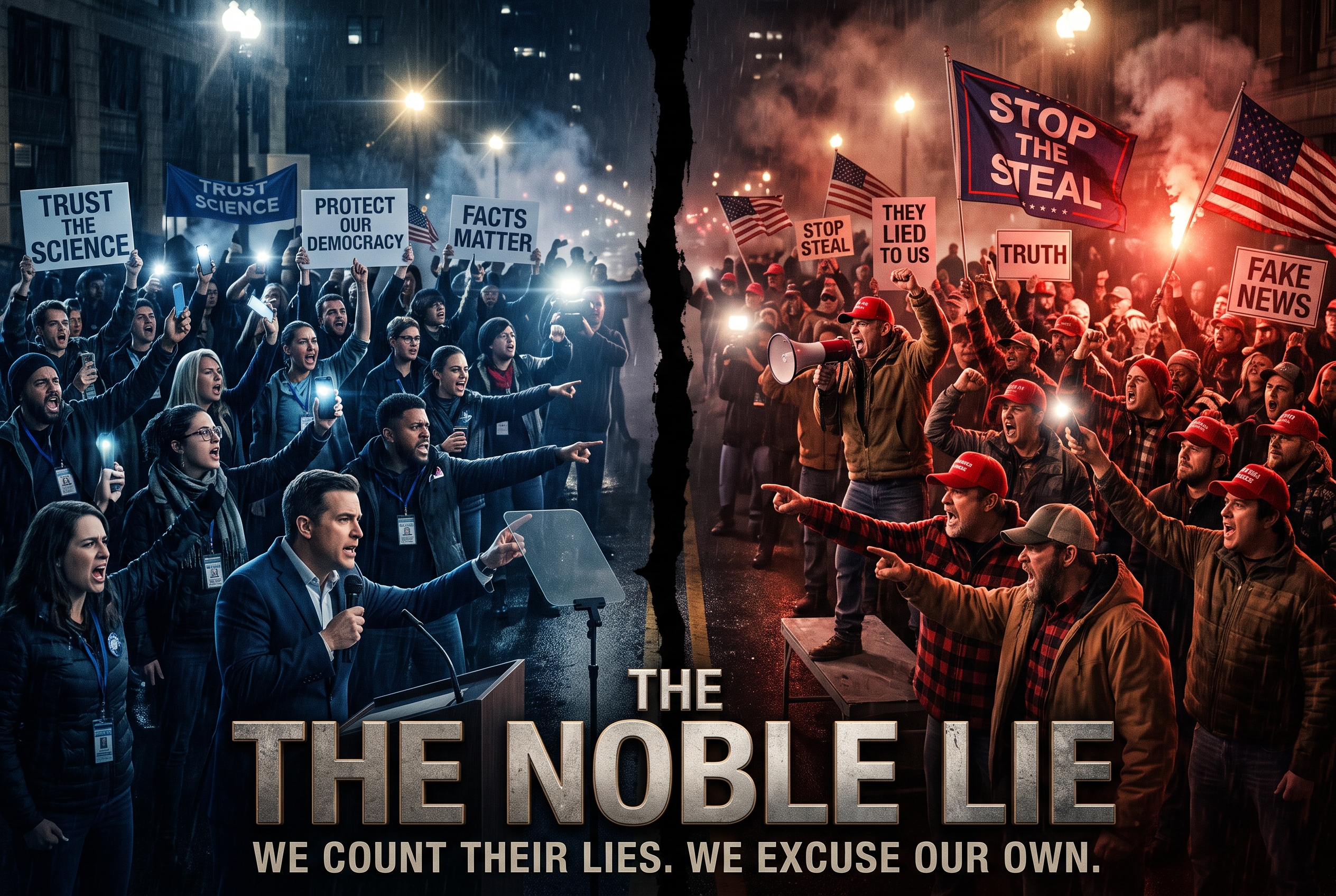
The Noble Lie — What Both Parties Lie About, Filed Side by Side
Grant the premise both sides are shouting, because both are right about each other. The right is right that a Democratic president looked the country in the eye and said “if you like your health care plan, you can keep it” while his own actuaries knew millions of plans would be cancelled; that a sitting president’s catastrophic decline was called a “cheap fake” by his own podium until it detonated on a debate stage in front of fifty million people; that fifty-one former intelligence officials signed their names to the suggestion that a true story was Russian disinformation, three weeks before an election. And the left is right that the other side produced a president whose own newspaper of record logged 30,573 false or misleading claims in four years, who lost sixty-odd court cases trying to prove a theft his own Attorney General told him did not happen, and whose party sold a war on weapons that did not exist. Neither camp is hallucinating the other’s dishonesty. What each is doing is the liar’s oldest move: counting the opponent’s lies and absolving its own, because our falsehoods are noble and theirs are corrupt. The codex does not get that exemption. So, before a single receipt, the rule both sides will be graded against.
I. What a lie actually is — and the three questions
A lie is not simply a false statement, and honesty is not simply sincerity. A man who says something false he genuinely believes is mistaken, not lying; a man who says something true only because it happens to help him is not honest, merely lucky. The philosopher Harry Frankfurt drew the sharper line in On Bullshit: the liar at least respects the truth enough to conceal it, but the bullshitter — his word, academic and exact — has no concern for truth at all, only for what the statement will do. That indifference, not falsehood, is the disease this dispatch is about, because it is the one the medium rewards. So the desk refuses the word “liar” as a slur and asks three questions instead. One — the knowledge test: could the speaker have known it was false when they said it, was the truth available to any honest person standing where they stood? A wrong prediction is not a lie; a claim contradicted by what you already held in your own hand is. Two — the correction test: when reality arrived, did they own and correct it, or double down, redefine the words, and blame the fact-checker? Honesty is revealed less in the first claim than in the conduct after it curdles. Three — the mirror: would you accept the identical dodge, worded the same way, from the other jersey? If “transitory” enrages you but “it’ll disappear like a miracle” makes you laugh fondly — or the reverse — the principle was never truth. It was the team. Keep the three in hand. Now the evidence, and the receipts travel with it.
II. The left’s ledger — the sincere, the institutional, and the shielded
The left’s dishonesty is rarely the crude forty-fibs-a-day kind; it is quieter, dressed in expertise, and that is exactly what makes it dangerous. Start with the cleanest case, because it also shows the one thing the right’s marquee lie never does: a correction. Barack Obama said “if you like your health care plan, you can keep it” — PolitiFact counted at least thirty-seven times without the caveat — and when roughly four million cancellation notices went out in the fall of 2013, he apologized on camera: “I am sorry that they are finding themselves in this situation based on assurances they got from me.” PolitiFact made it the 2013 Lie of the Year. It fails question one (his administration knew the individual market would churn) but passes question two, and that partial pass is the standard the rest of this dispatch will measure everyone against. Now the ones that fail two as well. In October 2020, three weeks before the election, fifty-one former intelligence officials — Brennan, Clapper, Panetta, Morell among them — signed a letter saying the Hunter Biden laptop story had “all the classic earmarks of a Russian information operation,” and the candidate waved it on a debate stage as a “Russian plant.” The laptop was later authenticated by the Washington Post and the New York Times; no Russian involvement ever surfaced; Morell testified the letter was triggered to give the campaign a talking point. The hedge in the letter—“we do not have evidence”—is the fingerprint of the noble lie: say the damaging thing, keep the escape clause, let the headline do the work.
Then the institutional register, where the lie borrows the authority of neutral science and is costlier for exactly that reason. “Inflation is transitory” was the 2021 consensus of the Treasury Secretary and the White House until CPI hit a 40-year high of 9.1%; Janet Yellen, to her credit, did the rare thing on camera in May 2022 — “I think I was wrong then about the path that inflation would take” — a question-two pass that half her colleagues never managed. The CDC director told a national audience in March 2021 that “vaccinated people do not carry the virus”; the agency walked it back within seventy-two hours and its own Provincetown study that summer found three-quarters of outbreak cases were in the vaccinated. And the heaviest one, because it was a cover rather than a claim: through 2023 and into 2024 the White House podium called videos of the president freezing and wandering “cheap fakes” done “in bad faith” — until June 27, 2024, when the decline the videos depicted played out live for ninety minutes and ended his candidacy three weeks later. That one fails all three questions: they knew, they doubled down, and no one on the left would have accepted “cheap fake” for a moment had the man behind the podium been Donald Trump. Add Adam Schiff’s years of “more than circumstantial” collusion certainty, which the Mueller Report closed with “did not establish” — and the pattern of the left’s lie is set: not volume, but the laundering of falsehood through a lab coat, a clearance, or a press credential.
III. The right’s ledger — the flood, the stolen election, and the war
The right’s dishonesty is the opposite in form: not laundered but flooded, a volume so high it defeats correction by sheer exhaustion. The Washington Post Fact Checker — a database, not an adjective — logged 30,573 false or misleading claims across Trump’s first term, an average of twenty-one a day, accelerating to thirty-nine a day in the final year, nearly half the total. That is not a politician who occasionally shades the truth; it is Frankfurt’s bullshitter as a governing style, where the question of true-or-false has simply ceased to apply. The marquee instance fails every question at once. “Stop the Steal” survived his own Attorney General telling the AP on December 1, 2020, “we have not seen fraud on a scale that could have effected a different outcome”; survived more than sixty lawsuits (a conservative panel’s review, Lost, Not Stolen, found exactly one narrow procedural win out of sixty-four); survived all fifty states certifying and the Electoral College voting. He knew (question one: his own DOJ and courts told him), he doubled down (question two, to this day), and question three is unanswerable because no one in his camp would grant a Democrat who lost sixty cases the right to keep calling it theft.
And the war, because it is the receipt that should permanently retire the idea that one party lies about small things and the other about large. The case for invading Iraq rested on “we know where they are” (Rumsfeld, March 2003), on Colin Powell’s mobile bioweapons labs and aluminum tubes at the UN, and the Duelfer Report found no stockpiles at all — while the Downing Street memo, minuted in July 2002, recorded that in Washington “the intelligence and facts were being fixed around the policy,” which is question one answered in the government’s own handwriting eight months before the first bomb. That lie is measured in a war, not a news cycle. Beneath the marquee cases sit the smaller tells that reveal the same indifference: “read my lips, no new taxes,” broken inside two years; George Santos, who fabricated his college, his employers, and his grandparents’ Holocaust survival and was expelled 311–114; “it’s going to disappear…like a miracle” and the disinfectant musing of April 2020; and the very first morning in office, “the largest audience to ever witness an inauguration, period,” which an aide defended the next day with the phrase that names the whole era — “alternative facts.” The left launders; the right floods. Both arrive at the same place: a public that no longer expects the words of its leaders to correspond to anything.
IV. The double standard — one principle, two verdicts
The ledgers prove both sides lie; the double standard proves something worse — that neither side is actually holding a principle at all, only a jersey. The cleanest demonstration is not an accusation but a controlled experiment. In 2003 the psychologist Geoffrey Cohen ran one in the Journal of Personality and Social Psychology under a title that gives away the finding: “Party Over Policy.” He handed liberals and conservatives identical welfare bills and changed exactly one variable — which party was said to back them. Liberals endorsed a harsh, stringent plan the moment they were told Democrats favored it; conservatives endorsed a lavish, generous one the moment they heard Republicans did — each side abandoning its own stated philosophy to follow the label, and each sincerely certain it had reasoned from the merits. The blindness was bipartisan by construction. Nor is it one tribe’s defect: a 2019 meta-analysis of fifty-one experiments and more than eighteen thousand subjects — titled, with a sigh, “At Least Bias Is Bipartisan” — found liberals and conservatives evaluate identical evidence more favorably when it flatters their own side at nearly the same rate, left and right within a whisker. (Honesty the desk owes even to its own thesis: other scholars in that same issue argued the symmetry is overstated. Call it close, not clocked.) Now watch the principle move in daylight.
Start with the one that still picks Supreme Court justices. In February 2016, hours after Antonin Scalia died, Mitch McConnell announced the seat must stay empty until the voters spoke — “the American people should have a voice” — and refused Merrick Garland so much as a hearing for eight months, calling the blockade “a basic principle.” In 2020, after Ruth Bader Ginsburg died, the same man confirmed Amy Coney Barrett on October 26, eight days before the election, and the principle evaporated on contact. Democrats ran the identical maneuver in reverse: in 2016 they demanded the Senate “do your job” and vote; in 2020 Chuck Schumer insisted Republicans “follow the rule they set in 2016” and leave the seat open, while Dianne Feinstein called filling it “the height of hypocrisy.” Each party’s 2020 position was the word-for-word negation of its own 2016 position. Nobody’s reading of the Constitution had changed. Only the chair had changed hands.
Take the standard that was briefly sacred — “believe women.” In September 2018, as Christine Blasey Ford accused Brett Kavanaugh, Senator Mazie Hirono told the men of America to “just shut up and step up,” Kamala Harris said simply “I believe her,” and Kirsten Gillibrand declared “I believe Dr. Blasey Ford.” Nineteen months later, when former staffer Tara Reade accused Joe Biden of a 1993 assault, the same Gillibrand answered “I stand by Vice President Biden,” and Biden himself quietly swapped the absolute for a courtroom hedge — accusers deserve “the presumption they are telling the truth, then you have to look at the circumstances and the facts.” And the right’s mirror was just as clean: the camp that had waved away a dozen accusations against Donald Trump and dismissed Ford outright suddenly discovered Reade’s cause, with a Trump-campaign adviser floating her for a speaking slot at the Republican convention. One principle, flipped by jersey, in both directions at once.
Take the question of when a mob is a mob. Through the summer of 2020, as cities burned after George Floyd’s murder, CNN ran a now-infamous chyron — “FIERY BUT MOSTLY PEACEFUL PROTESTS” — over a reporter lit by a building fire behind him; the 1619 Project’s Nikole Hannah-Jones offered that “destroying property, which can be replaced, is not violence”; and a sitting senator named Kamala Harris urged followers to “chip in” to a fund bailing out those arrested. Republicans, led by Trump at the Rose Garden, called it “domestic terror.” Six months later the scripts swapped without a pause: after a pro-Trump mob stormed the Capitol on January 6, Representative Andrew Clyde described the footage as resembling “a normal tourist visit,” the Republican National Committee formally recast the day as “legitimate political discourse,” and the same voices that had cried domestic terror went quiet — while Joe Biden, who had watched the summer’s fires in relative calm, now called the riot an “insurrection” that “borders on sedition.” Each side reserved its harshest word for the other side’s mob and its most forgiving one for its own.
And it runs clean through every lever of power, because the pattern is total. The Senate filibuster: Chuck Schumer called killing it “a doomsday for democracy” in 2005 and then moved to gut it for voting-rights bills in 2022; Joe Biden called the same move “a naked power grab” in 2005 and flew to Atlanta in 2022 to demand it; Harry Reid detonated the “nuclear option” for nominees in 2013 after denouncing it under Bush, and McConnell — who had endorsed it in 2005 and condemned it in 2013 — used it on the Supreme Court himself in 2017. Executive power runs the same loop: Barack Obama said out loud, more than once, “I’m not a king” and “I’m the president…not the emperor,” then expanded unilateral immigration relief with the stroke of a pen; Biden and Nancy Pelosi both said flatly that a president lacked the authority to cancel student debt — Pelosi: “He does not have that power” — and then did it anyway, until the Supreme Court struck it down. Deficits are a hypocrisy so open that a Republican confessed it on the record: Mick Mulvaney, Trump’s own budget director, told the Oxford Union in 2020, “My party is very interested in deficits when there is a Democrat in the White House. The worst thing in the whole world was deficits when Barack Obama was the president. Then Donald Trump became president, and we’re a lot less interested as a party.” Even the FBI is just another seat in the stadium: the right branded it the “deep state” while it investigated Trump in 2018, then the left rose for “the men and women of the FBI” the instant it searched Mar-a-Lago in 2022 — and Pew watched Republican and Democratic confidence in the Bureau cross clean over the midline as the target changed color. The principle was never the Court, the accuser, the mob, the filibuster, the pen, the ledger, or the Bureau. It was the team — which is the one thing a principle is defined by not being.
V. Whataboutism — the move that ends every argument
There is a reason the double standard never costs anyone anything, and it is a single reflex: the instant the mirror comes up, both sides reach for the same four words — what about your guy? The move is old enough to have papers. It was the house style of Soviet propaganda, which met every Western charge of repression with a counter-accusation; the archetype, worn down to a catchphrase, was “And you are lynching Negroes” (A u vas negrov linchuyut) — the retort that answered criticism of the Gulag by pointing at American racism instead of defending the camps. The tactic grew common enough to earn a name. “Whataboutery” surfaced in The Irish Times on January 30, 1974, describing “the Whatabouts” who met every condemnation of IRA terror with the greater sins of the other side; the Soviet-facing noun “whataboutism” dates to 1978, and The Economist’s Edward Lucas revived it for Vladimir Putin’s Russia in 2007. The dictionaries certified it only lately — the Oxford English Dictionary in June 2018, Merriam-Webster in October 2021 — which is to say the word went mainstream in English at the precise moment American politics gave it a reason to.
Stripped to its logic it is the tu quoque — Latin for “you too” — a textbook fallacy, and it is worth knowing exactly why. The guilt of the accuser has no bearing on the truth of the accusation: a chain smoker who tells you cigarettes will kill you is still right. Pointing at the other camp’s sin does not refute the charge against your own; it changes the subject and gambles that nobody will notice the original question went unanswered. It persuades anyway for two reasons the medium loves. First, catching a hypocrite feels like landing a clean punch, and the satisfaction of the hit stands in for the work of actually rebutting what was said. Second, “you do it too” is a social escape hatch — it flips the discomfort off the guilty party and back onto the critic in a single beat. The only diagnostic that matters is the one almost nobody applies in the moment: was the original charge answered, or merely matched?
Which forces this desk to answer the charge against itself — because a reader four sections deep into “both sides do it” has every right to ask whether this entire dispatch is just whataboutism in a nicer suit. It is not, and the line is exact. Whataboutism-as-deflection says they did it too, so mine doesn’t count — it drops the standard for one side in order to cancel accountability. The symmetry this desk runs says the opposite: both did it, so both answer to the same ruler — it holds the standard over everyone in order to double accountability. One subtracts, the other adds; the first is an alibi, the second is a verdict. The test is not whether a comparison gets drawn but why — to dodge the question, or to insist on one rule for everyone. Exposing a genuine double standard is not a fallacy at all; consistency is the bedrock of every law ever written, and, as one philosopher put the accountability clause, “the fact that the other side does it never excuses, justifies, or rationalizes it when done by our side.” Note the last trapdoor, the one beneath the trap: the cry of “whataboutism!” can itself be a dodge, flung to wave away a legitimate charge of inconsistency. Either way the test is the same — does the move seek one standard, or an exemption for one team?
Both coalitions now live inside the escape hatch. Confront the right with Trump and the reflex answer is Hillary’s emails; corner the left on its own and the answer is January 6 — the riot and the insurrection wielded by each camp to cancel the other, “each somehow justifying the other,” so that neither the summer that burned nor the Capitol that was stormed is ever honestly reckoned with on its own terms. When Sean Hannity was revealed to be Michael Cohen’s undisclosed client while hammering the FBI probe on air, his reply was not a defense but a question: “What about George Stephanopoulos?” This is the machine’s perfect fuel, because it burns forever and settles nothing — every charge neutralized by a counter-charge, every ledger closed by pointing at the other ledger. And it is not a harmless debating tic. Hannah Arendt, who watched two total states rise on exactly this dissolution, named the endpoint in 1951: “The ideal subject of totalitarian rule is not the convinced Nazi or the convinced Communist, but people for whom the distinction between fact and fiction…and the distinction between true and false…no longer exist.” A public trained to answer every accusation with an accusation has been trained, in the end, to believe nothing and excuse everything — which is the single condition under which the people who govern it never have to answer for anything at all.
VI. The machine — why both are getting worse, not better
Here is the turn, because the parties are not actually the defendant — they are the symptom, and the medium is the disease. In 2018, MIT researchers published in Science the largest study ever done of how true and false stories travel online: 126,000 cascades, three million people, a decade of Twitter. Falsehood was 70% more likely to be retweeted than the truth; the truth took six times as long to reach fifteen hundred people; and — the finding that indicts us rather than the bots — automated accounts spread true and false news at the same rate, meaning it is humans who prefer the lie, because it is more novel and it feels better to share. A companion study found that every additional moral-emotional word in a political post raised its diffusion by about 20%, and that the effect runs strongest inside each ideological tribe — the echo chamber is not a metaphor, it is a measured coefficient. The platforms then built their economics directly on top of that human weakness. Facebook’s own leaked documents show that in 2018 its algorithm weighted an “angry” reaction five times more heavily than a “like,” and that its own data scientists confirmed by 2019 that the posts drawing those angry reactions were disproportionately “misinformation, toxicity and low-quality news.” The machine did not make politicians liars. It discovered that lies travel faster, priced engagement accordingly, and so selected for the liar — the honest candidate is simply out-competed for attention, the scarcest resource in the system.
And every guardrail that briefly stood against this is now being dismantled, on purpose, by both of the men who own the pipes. On January 7, 2025, Mark Zuckerberg announced Meta would “get rid of fact-checkers and replace them with Community Notes,” across platforms that reach billions, citing a “cultural tipping point” after the election. Elon Musk had already cut X’s trust-and-safety engineering corps from 279 to 55 — roughly 80% — dissolved its election-integrity team, and leaned the entire burden of correction onto the same crowdsourcing. The asymmetry that makes this fatal was named by a programmer in 2013 and holds like a law of physics: “the amount of energy needed to refute bullshit is an order of magnitude bigger than that needed to produce it.” A lie costs one unit to make and ten to kill, the platforms just fired the people who paid the ten, and the public has already drawn the obvious conclusion — Gallup’s trust in mass media has fallen to 28%, a record low, even as 54% of Americans say they get their news from the very social feeds engineered to reward the lie. The endgame already has a name in the law reviews: the liar’s dividend — once everyone knows anything can be faked, the guilty man caught on a real recording simply says it’s a deepfake, and a measurable share of his supporters believe him. The machine does not merely spread specific lies. It is dissolving the shared baseline of fact on which a self-governing people has to stand to govern at all.
VII. The verdict — run the test
Put both sides through the three questions and the symmetry holds — with one asymmetry worth naming honestly, in both directions. Question one, knowledge: Obama’s actuaries knew, the laptop signers hedged because they did not know, Yellen could have known, the White House knew what its own cameras showed; Trump’s DOJ and sixty courts told him, the Downing Street memo recorded the fixing of facts in advance. Both sides said things they knew, or could trivially have known, to be false. Question two, correction: here is the only real split, and it does not run cleanly by party — Obama apologized and Yellen recanted, while the “cheap fakes” denial and “Stop the Steal” were ridden straight into the ground. The honest grade rewards the recantation wherever it appears and punishes the doubling-down wherever it appears, and by that measure the worst offenders are bipartisan. Question three, the mirror: every reader who felt a flash of “but that one was different” reading the other team’s section just failed it in real time. The jersey flipped the verdict. That is the tell, and it is the whole diagnosis.
Plato’s guardians were not cynics. They were serious men, certain that the gennaion pseudos — the lie told for the city’s own good — was a kindness, because the crowd could not bear the unshaped truth. Every American version runs on the same certainty: the intelligence officials sure they were protecting democracy from a foreign plot, the president sure the country needed him more than it needed an honest word about his own decline, the other president sure the election must have been stolen because he could not have lost. None of them think of themselves as liars. That is precisely the condition. The noble lie is not the lie a villain tells; it is the lie a believer tells himself first, and then tells you, convinced he is doing you a favor. A free people is supposed to keep the ugly, unshaped truth out in the open — because the alternative is being governed by whichever set of guardians is currently most sure that you cannot handle it.
So watch the supercut, then watch past it. The side posting the other team’s lies is right that those are lies. What it will not post is the sentence this desk exists to write: my side lies too, in the register my side happens to find noble. The right floods the zone until true and false stop meaning anything; the left launders falsehood through the institutions that were supposed to be the referees, which is why its lies cost more per unit even though it tells fewer. Neither is the party of honesty. There is no party of honesty — there is a machine that has discovered lies travel six times faster than the truth and has priced every incentive accordingly, and two coalitions competing to feed it, each certain its own feeding is the virtuous exception. They are unfit to govern not because they lie — men have always lied — but because the system that selects them now rewards the lie and fines the correction, and a governing class optimized for virality cannot simultaneously be optimized for truth. The repair does not start in Washington. It starts the next time the supercut of the other side slides across your feed and you feel the warm certainty that your side would never — and you make yourself finish the thought honestly. That flash of “but we’re different” is the only noble lie you were ever actually told. Put it down.
Filed on: Definition — Plato, Republic Book III, the gennaion pseudos / “noble lie”; Harry Frankfurt, On Bullshit (Princeton UP, 2005) on indifference-to-truth as distinct from lying. Left ledger — Obama “keep your plan” (PolitiFact 2013 Lie of the Year, said ~37x without caveat; ~4M individual-market cancellations fall 2013; NBC on-camera apology Nov 2013); the 51 intel officials’ laptop letter (Oct 19 2020, “classic earmarks of a Russian information operation”; cited by Biden at the Oct 22 2020 debate; laptop later authenticated by WaPo & NYT 2022; Morell House Judiciary testimony that it was triggered for a debate talking point); “inflation is transitory” (Powell/Yellen 2021; CPI peak 9.1% June 2022; Yellen “I was wrong” CNN May 31 2022); CDC Dir. Rochelle Walensky “vaccinated people do not carry the virus” (MSNBC Mar 29 2021; CDC walk-back within days; MMWR Provincetown study ~74% of cases vaccinated, July 30 2021); White House “cheap fakes” framing of Biden decline (Karine Jean-Pierre, June 17 2024) collapsing on the June 27 2024 debate stage, withdrawal July 21 2024; Rep. Adam Schiff “more than circumstantial” collusion (MSNBC Mar 22 2017) vs Mueller Report “did not establish” (Apr 18 2019). Right ledger — WaPo Fact Checker 30,573 false/misleading claims over the first term (~21/day, ~39/day final year); “Stop the Steal” vs AG William Barr (AP, Dec 1 2020, “not seen fraud on a scale that could have effected a different outcome”), 60+ failed suits (“Lost, Not Stolen,” 8 conservative lawyers, July 2022: 1 narrow procedural win of 64), all states certified / EC voted Dec 14 2020; Iraq WMD — Rumsfeld “we know where they are” (ABC, Mar 30 2003), Powell UN presentation (Feb 5 2003, mobile labs & aluminum tubes), Downing Street memo (minuted July 23 2002, “the intelligence and facts were being fixed around the policy”), Duelfer Report (Sept–Oct 2004, no stockpiles); “read my lips: no new taxes” (GHW Bush, RNC Aug 18 1988) broken by the Omnibus Budget Reconciliation Act of 1990; George Santos fabrications (Baruch/NYU, Goldman/Citigroup, Holocaust-survivor grandparents), expelled 311–114 (Dec 1 2023), wire-fraud guilty plea Aug 2024; COVID — “it’s going to disappear…like a miracle” (Feb 27 2020), disinfectant/“injection inside” remarks (Apr 23 2020); “largest audience to ever witness an inauguration” (Sean Spicer, Jan 21 2017) & “alternative facts” (Kellyanne Conway, NBC, Jan 22 2017). The machine — Vosoughi, Roy & Aral, “The spread of true and false news online,” Science 359:6380 (Mar 9 2018): falsehood 70% more likely to be retweeted, truth ~6x slower to 1,500 people, bots spread true & false equally (humans drive the gap); Brady et al., PNAS 114:28 (2017): +~20% diffusion per moral-emotional word, strongest within-group; Facebook Files / Haugen disclosures (WSJ & Senate testimony Oct 5 2021): “angry” reaction weighted 5x a like (2018), internal 2019 data tying angry-reaction posts to misinformation/toxicity; Zuckerberg ending third-party fact-checking for Community Notes (Jan 7 2025); Musk cutting X trust-and-safety engineers 279→55 (~80%, Australian eSafety Commissioner); Brandolini’s Law (2013, “an order of magnitude bigger”); Gallup trust in mass media 28% (record low); Pew 54% of US adults get news from social media (2024); Chesney & Citron, “Deep Fakes,” 107 Calif. L. Rev. 1753 (2019), the “liar’s dividend.” The double standard — Geoffrey L. Cohen, “Party Over Policy: The Dominating Impact of Group Influence on Political Beliefs,” Journal of Personality and Social Psychology 85(5):808–822 (2003); Peter H. Ditto et al., “At Least Bias Is Bipartisan: A Meta-Analytic Comparison of Partisan Bias in Liberals and Conservatives,” Perspectives on Psychological Science 14(2):273–291 (2019), with the dissent of Baron & Jost, “False Equivalence,” same issue; SCOTUS reversal — McConnell “the American people should have a voice” (Feb 13 & Mar 16 2016), Garland denied a hearing, Barrett confirmed 52–48 Oct 26 2020; Democratic mirror (“do your job” 2016; Schumer “follow the rule they set in 2016,” Feinstein “height of hypocrisy,” 2020); “believe women” — Hirono “shut up and step up,” Harris “I believe her,” Gillibrand “I believe Dr. Blasey Ford” (Ford/Kavanaugh, Sept 2018) vs Gillibrand “I stand by Vice President Biden” and Biden’s “presumption…then look at the facts” (Tara Reade, Mar–May 2020), plus the GOP mirror weaponizing Reade; political violence — CNN “fiery but mostly peaceful” chyron (Kenosha, Aug 2020), Nikole Hannah-Jones “destroying property…is not violence” (CBSN, June 2 2020), Harris Minnesota-bail-fund tweet (June 1 2020), Trump “domestic terror” (June 1 2020) vs Rep. Andrew Clyde “normal tourist visit” (May 12 2021), RNC “legitimate political discourse” (Feb 4 2022), Biden “insurrection…borders on sedition” (Jan 6 2021); filibuster — Reid nuclear option (Nov 21 2013) and McConnell’s SCOTUS extension (Apr 6 2017), Schumer “doomsday for democracy” (2005) vs the 2022 carve-out push, Biden “naked power grab” (May 23 2005) vs Atlanta (Jan 11 2022); executive power — Obama “I’m not a king”/“not the emperor” (2010–2013) then the Nov 2014 immigration action, Pelosi “he does not have that power” (July 28 2021) and Biden’s own 2021 doubt then the Aug 24 2022 student-debt cancellation struck down in Biden v. Nebraska (June 30 2023); deficits — Mick Mulvaney, Oxford Union (Feb 2020, “very interested in deficits when there is a Democrat in the White House”), the 2017 tax cut scored at $1.5T (JCT) / ~$1.9T (CBO Apr 2018), Obama’s own 2006 debt-ceiling “leadership failure” vote; FBI — Trump “politicized the sacred investigative process” & the Nunes memo (Feb 2 2018) vs “DEFUND THE FBI” (Greene) and “weaponized politicization” (McCarthy) after the Mar-a-Lago search (Aug 8 2022), Pelosi/Klobuchar invoking “the rule of law” and “the men and women of the FBI”; Pew Research on the partisan FBI-confidence crossover (2017–2025) and on expanding presidential power (“too risky”: 81% of Republicans in 2021 vs 39% about Trump in 2025). Whataboutism — the Soviet tu quoque “And you are lynching Negroes” (A u vas negrov linchuyut); “whataboutery” in The Irish Times (Jan 30 1974, Sean O’Conaill); “whataboutism” dated to 1978 (Lionel Bloch, The Guardian) and popularized by Edward Lucas in The Economist (2007–2008); OED entry June 2018, Merriam-Webster October 2021; tu quoque / appeal-to-hypocrisy as a fallacy of relevance; the deflection-versus-consistency distinction (Partially Examined Life, “never excuses…when done by our side”); the Sean Hannity / Michael Cohen “what about George Stephanopoulos” deflection (Apr 2018); Hannah Arendt, The Origins of Totalitarianism (1951) on the subject for whom “the distinction between fact and fiction…no longer exist[s],” and Truth and Politics (1967). Prior Crown work — the book-ban dispatch (№102), the memory-hole dispatch (№103), the fascism and totalitarian tests. Grounded web search, compiled Oct 8 2026; full research dossier retained.
№ 103 · Filed October 8, 2026 — The same photograph runs the feed from both ends. One camp posts a Confederate general coming off his pedestal and calls it justice arriving a century late; the other posts a gilded sign reading GULF OF AMERICA, or an Army base with its old name bolted back on, and calls it heritage rescued from the shredder. Each is certain it is restoring the record and the other is erasing it. The uncomfortable answer, as with the book fight, is that both are doing the identical thing — reaching for public memory and editing it to taste — and both have convinced themselves that only the other side owns a chisel. The Romans had a name for this long before either party existed: damnatio memoriae, the formal erasure of a disgraced man from every statue, inscription and coin, his face chiseled off the monument and his name scraped from the stone. Orwell gave it the modern name — the memory hole, the slot in the Ministry of Truth where the inconvenient past goes to be unmade. Every American version runs on the same certainty the censors of the Index ran on: that our erasure is the virtuous exception. So this desk does what it did with the F-word and the T-word and the book bans: define the thing, build the test from the definition, state the test before the evidence, then run it down both aisles with one ruler.
The Memory Hole — Who Tears Down the Past and Who Rewrites It
Grant each side its grievance, because each is real. The left is right that for a century the American landscape was stamped with men who took up arms against the United States to keep human beings as property — roughly two thousand Confederate monuments, bases, and place-names, most of them erected not in grief after 1865 but as deliberate markers of white rule during Jim Crow and the civil-rights backlash. And the right is right that the 2020 reckoning did not stop at Confederates — that crowds with ropes pulled down Ulysses Grant, Francis Scott Key, Miguel de Cervantes, and, in Rochester, a statue of Frederick Douglass himself, and that a school board spent a pandemic voting to scrape George Washington and Abraham Lincoln off forty-four schoolhouses. Neither camp is hallucinating the other’s overreach. What each is doing is the censor’s oldest move: counting the opponent’s erasures and pardoning its own, because our renaming is correction and theirs is vandalism. The codex does not get to do that. So, before a single statue, the rule both sides will be graded against.
I. What a monument actually is — and the three questions
A monument is not history; it is an argument about history, written in the present tense. No base was ever physically moved, no mountain relocated, no gulf drained and re-dug. What is contested, and controlled from a capital, is purely the meaning pinned to a name — which is exactly why the fight is so bitter and so cheap to wage: you change nothing real and everything symbolic with a vote, a decree, or a rope. That makes the fight hard to referee, because “erasing history” and “correcting the record” describe the same physical act. So this desk refuses the slogans and asks three questions instead. One — process: was the change made by democratic deliberation (a statute, a commission, a court, a public submission process) or by decree or mob (an overnight executive order, a crowd with a chain)? The instrument is not a detail; it is the difference between a self-governing people revising its own honor roll and a faction imposing one. Two — addition or subtraction: does the act add a name to the civic roster or erase one? A renaming that puts a Medal of Honor recipient where a slaver stood is additive; a crowd toppling an abolitionist is pure subtraction. Three — the honest mirror: would you accept the same instrument, wielded the same way, by the other side? If your answer flips with the jersey, the principle was never the point. Keep those three in hand. Now the evidence, and the receipts travel with it.
II. The left’s instrument: the commission and the crowd
The left ran two tracks at once, and they could not be more different in kind — which is the whole trouble with grading “the left.” The first track was lawful and deliberate, and at its best it is the cleanest exhibit in this dispatch. New Orleans took down four Confederate monuments in 2017 by city ordinance, litigated and upheld. Virginia removed the Robert E. Lee colossus from Richmond’s Monument Avenue in 2021 by act of the legislature and a unanimous state Supreme Court. And the nine Army bases that honored Confederate generals were renamed through the most process-heavy mechanism imaginable: a bipartisan Naming Commission created by the FY2021 defense bill, which Congress passed over President Trump’s veto — the only veto override of his first term — after roughly thirty-four thousand public submissions and twenty months of work. Crucially, that track was additive: Fort Bragg’s namesake Braxton Bragg (a slave-plantation owner and, by consensus, one of the Confederacy’s worst generals) gave way to the value “Liberty”; Fort Hood’s became Fort Cavazos, for the Army’s first Hispanic four-star; Fort Benning became Fort Moore, for a Vietnam general and his wife; Fort Lee became Fort Gregg-Adams, honoring the highest-ranking Black woman officer of WWII. The deliberation put more names on the wall, not fewer.
The second track was the crowd, and here the left earned every charge the right throws. In the summer of 2020 the removals jumped the rails. Protesters toppled Christopher Columbus statues from Baltimore to St. Paul and the California missions’ Junipero Serra; fair enough as a matter of contested legacy. But the same crowds, indiscriminate, pulled down Ulysses S. Grant — the general who broke the Confederacy and the president who crushed the first Klan — in San Francisco’s Golden Gate Park, along with Francis Scott Key and a statue of the abolitionist-admired writer Cervantes. In Rochester, New York, vandals tore down a statue of Frederick Douglass, on the anniversary of his most famous speech. And in January 2021 the San Francisco school board, mid-pandemic with buildings shuttered, voted 6–1 to rename forty-four schools — stripping Washington, Jefferson, Lincoln, and even sitting Senator Dianne Feinstein off the doors on the strength of Wikipedia-deep research — then reversed the whole thing under public ridicule and a recall threat three months later. That is subtraction with no ledger, process by mob and by committee-gone-feral, and it fails Questions One and Two at once. The honest split: the left’s statutory track is the best thing in this piece; its crowd is among the worst.
III. The right’s instrument: the decree
Where the left’s best work moved through commissions and courts, the right’s signature is the executive order that edits the map overnight — no submission process, no vote, no deliberation. On his first day back, January 20, 2025, President Trump signed “Restoring Names That Honor American Greatness,” which renamed the Gulf of Mexico the “Gulf of America” and changed Denali — the Koyukon name the mountain carried for centuries, restored by the Obama administration in 2015 — back to Mount McKinley, for a president who never set foot in Alaska. When the Associated Press declined to adopt “Gulf of America” in its stylebook, the White House barred its reporters from the Oval Office — the same episode that appears in the book-ban dispatch, because it is simultaneously a free-speech story and a memory story. In February the administration purged the Kennedy Center’s board and installed the president as its chairman. The instrument is always the same: a signature, not a statute.
The purest exhibit in the entire dispatch is what the right did to the forts — because it did not simply reverse the commission; it beat it with a technicality. The 2021 law that renamed the bases also permanently bans the Pentagon from ever again commemorating the Confederacy. So Defense Secretary Pete Hegseth could not just restore “Fort Bragg.” Instead, starting February 2025, each old surname was reattached to a different, non-Confederate soldier who happened to share it: Fort Bragg now honors a WWII paratrooper, Pfc. Roland Bragg, not Gen. Braxton Bragg; Fort Benning now honors a WWI corporal, Fred Benning, not the secessionist Henry Benning. By June all nine were back. The gate reads exactly as it did in 1950 — but the official honoree has been swapped, so the public experiences the name as continuous while the referent quietly flips. Senator Jack Reed, the Armed Services Committee’s ranking member, named the move precisely: Hegseth “has not violated the letter of the law, but he has violated its spirit.” And here is the part that fails Question Two cold: the 2023 names the reversal erased were deliberately Black soldiers, Hispanic generals, and women — Charity Adams, Mary Edwards Walker, the Buffalo Soldier Fitz Lee. Not one woman appears among the 2025 honorees. The decree subtracted exactly the names the deliberation had added.
The same gate, relettered twice
Four representative Army bases across three eras: the original Confederate namesake, the 2023 Naming-Commission honoree (bipartisan, over a presidential veto), and the 2025 restoration — same surname, a different non-Confederate soldier, imposed by Pentagon memo. The letters on the gate never changed in 2025; the person they honor did.
And then the paperwork of memory — the quiet edits most people never see. In March 2025 the president signed “Restoring Truth and Sanity to American History,” ordering the removal of “improper ideology” from the Smithsonian and federal parks and tasking the Vice President with policing the museums’ content. The machinery moved fast and clumsily: the National Park Service edited its Underground Railroad page to shrink Harriet Tubman and soften the word “slavery” (restored after public outcry); the Stonewall National Monument page had “transgender” scrubbed from the very riots transgender people led; Arlington National Cemetery’s website pulled pages highlighting Black, Hispanic, and female service members; and a Pentagon DEI purge flagged tens of thousands of images for deletion — sweeping in, by keyword accident, the Enola Gay (for “Gay”), Jackie Robinson’s Army service, and the Navajo Code Talkers, most restored only after the ridicule landed. This is the memory hole operating as designed: not a public argument over a pedestal, but an administrator deciding, from a capital, which Americans the record is allowed to remember. Same instinct as the crowd that took down Douglass — own the past, erase the inconvenient — running through a content-management system instead of a rope.
IV. The consumer aisle: the same fight, in a shopping cart
The monument war has a civilian mirror, and it runs on the identical engine: viral grievance, organized boycott, media amplification, corporate capitulation — only the target moves. In 2020 the pressure came from the left, and it was pure subtraction of racial-caricature branding. Within three weeks of George Floyd’s murder, a century of mascots fell: Aunt Jemima — a “mammy” figure dating to an 1889 minstrel song — became Pearl Milling Company; Uncle Ben’s became Ben’s Original; Cream of Wheat dropped its “Rastus” chef; Eskimo Pie became Edy’s; Land O’Lakes removed its kneeling Native “butter maiden” (and, tellingly, kept the land and lost the woman). The Washington Redskins became the Commanders and the Cleveland Indians the Guardians, both under sponsor pressure. One company refused outright — Trader Joe’s, declining a petition to rename Trader José’s and Trader Ming’s with the line “we do not make decisions based on petitions” — and became, overnight, a right-wing folk hero. The tell for later.
By 2023 the engine had the same horsepower and the opposite driver. Now the pressure came from the right, and it split two ways — subtract the newly added symbol, restore the removed one. Bud Light sent transgender influencer Dylan Mulvaney a single personalized can; the boycott that followed knocked its sales down roughly 28% year-over-year and cost it the title of America’s best-selling beer it had held for two decades — a measured $395 million dent in AB InBev’s U.S. revenue in one quarter. Target pulled part of its Pride collection after backlash and posted its first quarterly sales decline in six years. Conservative activist Robby Starbuck ran a 2024 campaign that toppled DEI programs at Tractor Supply, John Deere, Harley-Davidson, Ford, Lowe’s and eventually Walmart like dominoes. And in August 2025 came the perfect inversion of Aunt Jemima: when Cracker Barrel modernized its logo by removing “Uncle Herschel,” the Old Timer leaning on the barrel, the right ran the exact play the left had run in 2020 — outrage, a ~$140 million one-day market-cap hit — and one day after Donald Trump posted that the chain should “restore the original logo,” it did. The left made companies drop a heritage image; the right made a company keep one. Same rope, opposite direction.
And here is what both mobs get wrong about the thing they think they won: the company never agreed with either of them. It is tempting to file corporate capitulation under “cancel culture” and call it a cultural force — but cancellation and capitalism are not opposites, and the one is only the fuel the other burns. The boycott is a child on the checkout-line floor having a fit; whether the parent hands over the candy is not a moral awakening, it is a cold arithmetic — is it cheaper to pay the dollar or to endure the tantrum? Quaker did not retire Aunt Jemima because a committee was moved to conscience; it wrote off a caricature that had quietly become a reputational liability on the balance sheet. AB InBev did not stand on principle for Dylan Mulvaney or against him — it watched $395 million walk out the door in a quarter and distanced itself from its own campaign to stop the bleeding. Cracker Barrel restored a logo it had just paid a firm to redesign because a ~$140 million one-day market-cap hit is a louder argument than any focus group. A brand is an asset until the day it becomes a liability, and a rational firm books the swing the instant the ledger tips — left or right, it never cared which way. That is the uncomfortable thing the activists on both sides share and neither will admit: they did not convert the corporation to their cause. They merely raised, for one news cycle, the price of ignoring them — and the corporation, which has no cause, paid the cheaper bill. The tantrum is the input; capitalism is the machine that prices it.
One engine, mirror-image targets
The consumer-brand version of the monument fight. Blue = the 2020–21 left-pressure wave (retire the caricature). Red = the 2023–25 right-pressure wave (reverse the “woke” change). The mechanism — boycott → shaming → capitulation — is identical; only the thing being erased or restored flips.
V. The verdict — run the test
Put both sides through the three questions and the symmetry is undeniable — with one real asymmetry worth naming honestly. Question One, process: the left’s best work — New Orleans by ordinance, Richmond by statute and court, the bases by a bipartisan commission over a presidential veto — is the most legitimate memory-editing in the whole story, deliberate and public; its worst — the crowds that took Grant and Douglass, the school board that came for Lincoln — is mob and farce. The right’s work is almost uniformly the decree: the Gulf and Denali by executive order on day one, the forts by Pentagon memo in days, the Smithsonian by fiat — no submissions, no vote, no deliberation. Question Two, addition or subtraction: the commission added Black soldiers, Hispanic generals, and women to the Army’s honor roll; the 2025 reversal subtracted exactly those names while keeping the letters on the gate; the 2020 crowd subtracted indiscriminately, Confederate and abolitionist alike; the federal purge subtracted Tubman, the Code Talkers, and the Enola Gay by keyword. Question Three, the mirror: the left that cheered Richmond’s lawful removal would scream if a governor decreed it overnight; the right that calls the fort restoration “heritage” called the identical renaming “erasing history” three years earlier. Both answers flip with the jersey. That is the tell.
Damnatio memoriae was not invented by vandals. It was a solemn act of the Roman Senate, performed by serious men certain they were purifying the record — chiseling a disgraced emperor’s face from the arch so the future would remember him correctly, which is to say not at all. Every American version runs on the same certainty: the crowd at the pedestal and the secretary at the memo each sure they are restoring truth and the other is deleting it. The thing they are fighting over was never the statue or the gate or the gulf — those are stone and paint and never change. It is the right to decide, for everyone, which names the country is allowed to keep. Both sides have claimed it. A free people is supposed to keep that argument in the open, by vote and by law, where it can be seen and reversed — not in a crowd’s adrenaline or a single pen’s stroke, where the editing happens before anyone can object.
So read the photograph straight, then read past it. The side cheering the general coming down is right that the man fought to keep people enslaved; the side cheering the old name bolted back on is right that a mob with a rope is no way to run a civilization. What neither will say is the sentence this desk exists to write: my team reaches for the memory hole too, with the instrument my team happens to own. The left’s instrument, at its best, is the lawful and additive kind that a self-governing people is actually allowed — and at its worst, a crowd erasing the very heroes it claims. The right’s instrument is the decree that needs no one’s consent and specifically un-remembers the women and Black soldiers a deliberation had chosen to honor. Neither is the party of history. There is no party of history. There is only the past, which cannot defend itself, and two coalitions taking turns deciding what the rest of us are permitted to recall — each certain its own chisel is the one virtue requires. Notice the instinct to erase in your own camp first. It is the only chisel you were ever able to put down.
Filed on: Left / lawful track — New Orleans monument removals (2017, Mayor Mitch Landrieu, city ordinance, upheld 5th Cir.); Richmond, VA — Jefferson Davis toppled by crowd June 2020, Robert E. Lee statue removed Sept 2021 by order of Gov. Ralph Northam, unanimous Va. Supreme Court (Taylor v. Northam); Charlottesville Lee statue (2017 “Unite the Right” catalyst, removed July 10 2021, melted down 2023); SPLC, “Whose Heritage?” (~2,000 Confederate symbols catalogued; ~160+ removed in 2020). Left / bases (bipartisan commission) — Naming Commission, FY2021 NDAA §370 (passed over Trump veto Jan 1 2021, the only override of his first term); ~34,000 public submissions; nine Army bases renamed 2023 (~$39M, Army est.): Bragg→Liberty, Benning→Moore, Hood→Cavazos, Lee→Gregg-Adams, Gordon→Eisenhower, Rucker→Novosel, Polk→Johnson, Pickett→Barfoot, A.P. Hill→Walker; standing statutory ban on Confederate commemoration. Left / the crowd & overreach — Columbus statues (Baltimore, St. Paul, Richmond, 2020); Junipero Serra (CA missions); San Francisco Golden Gate Park — Ulysses S. Grant, Francis Scott Key, Cervantes toppled June 19 2020; Frederick Douglass statue torn down in Rochester, NY, July 5 2020; San Francisco Unified School District board vote to rename 44 schools (Jan 26 2021, 6–1 — incl. Washington, Jefferson, Lincoln, Feinstein), rescinded April 2021 under ridicule/recall pressure; Princeton drops Woodrow Wilson’s name (June 2020); Yale’s Calhoun College renamed Grace Hopper (2017). Right / the decree — EO 14172 “Restoring Names That Honor American Greatness” (Jan 20 2025): Gulf of Mexico→“Gulf of America,” Denali→Mount McKinley (reversing Obama/DOI 2015 restoration); AP barred from Oval Office over stylebook refusal (AP v. Budowich, Judge McFadden ruled for AP Apr 2025, D.C. Cir. stayed); Kennedy Center board purged, Trump installed chairman (Feb 2025). Right / the forts (surname swap) — SecDef Pete Hegseth memos restoring Fort Bragg (Pfc. Roland L. Bragg, WWII; Feb 10–11 2025) and Fort Benning (Cpl. Fred G. Benning, WWI; Mar 3 2025); Army Sec. Dan Driscoll orders restoring the remaining seven after Trump’s June 10 2025 Fort Bragg announcement — Hood (Col. Robert B. Hood, WWI), Gordon (MSgt. Gary Gordon, MoH Mogadishu), Rucker, Polk, Pickett, Lee (Pvt. Fitz Lee, Buffalo Soldier), A.P. Hill (Anderson-Pinn-Hill, three Union MoH recipients); Pentagon declined to provide a cost estimate; Sen. Jack Reed (D-RI): “not violated the letter of the law, but he has violated its spirit”; no women among the 2025 honorees. Right / the paperwork — EO “Restoring Truth and Sanity to American History” (Mar 27 2025), tasking the Vice President with Smithsonian content; NPS Underground Railroad/Harriet Tubman page edit (restored after backlash, Apr 2025); Stonewall National Monument page “transgender” removal (Feb 2025); Arlington National Cemetery website removals of Black/Hispanic/women service-member pages; DoD DEI image purge (~26,000 flagged; Enola Gay, Jackie Robinson’s Army page, Navajo Code Talkers swept in by keyword, mostly restored after outcry). Consumer mirror / left wave (2020–21) — Aunt Jemima→Pearl Milling Company (announced June 17 2020, renamed Feb 2021); Uncle Ben’s→Ben’s Original (Sept 2020); Cream of Wheat (Rastus removed, B&G Foods); Eskimo Pie→Edy’s Pie; Land O’Lakes “butter maiden” removed (Feb 2020, pre-Floyd); Washington Redskins→Commanders (retired July 13 2020); Cleveland Indians→Guardians (Chief Wahoo retired after 2018, name 2021); Trader Joe’s refusal (“we do not make decisions based on petitions,” Aug 2020). Consumer mirror / right wave (2023–25) — Bud Light/Dylan Mulvaney (Apr 2023; weekly volume −27.7% to −28.4%; lost #1 US beer to Modelo June 2023; AB InBev US revenue −~10.5%/~$395M Q2 2023); Target Pride pulldown (May 24 2023; Q2 comps −5.4%, first decline in ~6 years); Cracker Barrel logo (unveiled Aug 19 2025, ~$140M+ intraday market-cap loss, restored Aug 26 one day after Trump’s Truth Social post, CEO Julie Masino later out); Robby Starbuck 2024 DEI-rollback campaign (Tractor Supply, John Deere, Harley-Davidson, Ford, Lowe’s, Jack Daniel’s/Brown-Forman, Walmart). Prior Crown work — the book-ban dispatch (№102, the free-speech both-sides test), the fascism dispatch, the totalitarian test. Grounded web search, compiled Oct 8 2026; full research dossier retained.
№ 102 · Filed October 7, 2026 — Every few weeks the same brawl runs the feed: one camp posts a map of red-state book bans and calls it the death of the First Amendment; the other posts a clip of a shouted-down speaker or a jawboned platform and says no, you are the censors. Each is certain it is the free-speech side and the other is the book-burners. The uncomfortable answer is that both are telling the truth about the other and lying about themselves. So this desk does what it did with the F-word and with the T-word: define the thing first, build the test out of the definition, state the test before opening the evidence, and then run it down both sides of the aisle with the same ruler. The name at the top is not decoration. The Index Librorum Prohibitorum — the Roman Church’s list of forbidden books — ran from 1559 to 1966, and every title on it was banned by people who were certain their censorship was the virtuous exception. That is the only tradition both American coalitions have genuinely kept.

The Index — Who Bans the Books and Who Bans the Speech
Grant each side its grievance, because each one is real. The right is pulling books out of public schools by the thousand, by statute, in a wave with no modern precedent. The left did spend the pandemic leaning on the platforms, does shout conservative speakers off the stage, and has made a profession of editing the dead for the comfort of the living. Neither camp is hallucinating the other’s sins. What each is doing is the oldest move in the censor’s playbook — counting the opponent’s cases and pardoning its own, because our suppression protects children or safety or democracy, while theirs is tyranny. The codex does not get to do that. So before a single example, the rule that both sides will be measured against.
I. What the First Amendment actually says — and who it is aimed at
The First Amendment is a leash on the government, and on nothing else. “Congress shall make no law…” — it binds the state (and, through the Fourteenth Amendment, every public school, library, agency, and official), and it does not bind private parties at all. This is the hinge the whole argument turns on, and almost every viral “censorship” fight gets it wrong. A private publisher that rewrites or stops printing its own book is exercising its own speech. A social-media company that throttles a post is exercising its own editorial judgment — the Supreme Court said so out loud in Moody v. NetChoice (2024), holding that a platform curating its feed is doing the same constitutionally protected thing a newspaper does when it picks its front page. The doctrinal floor is Blum v. Yaretsky (1982): a private choice becomes “state action” only when government “has exercised coercive power or has provided such significant encouragement… that the choice must in law be deemed to be that of the State.” Mere approval is not enough. Translate that out of the Latin and you get the test this dispatch runs:
One: is the actor the government? If it is a publisher, a studio, a university’s private donors, or a platform acting on its own, it is not a First Amendment violation — it may be cowardice or fashion or mob pressure, but it is not censorship in the constitutional sense. Two: if the actor is the government removing a book from its own shelves, what was the motive? Under Board of Education v. Pico (1982) a school may not yank books “simply because they dislike the ideas,” but may remove them for “pervasive vulgarity” or educational unsuitability — and the honest caveat, which this desk will not bury, is that Pico was a plurality, not a majority; no five justices agreed on the rule, and its force is contested to this day. Three: if the government is leaning on a private company to do its silencing, did it persuade or coerce? NRA v. Vullo (2024, nine votes to zero) revived Bantam Books v. Sullivan (1963) for the answer: an official may “criticize” and argue “forcefully,” but may not use “the power of the State to punish or suppress disfavored expression” — cannot do indirectly what the Constitution forbids directly. Keep those three questions in hand. Now the evidence, and the receipts travel with it.
II. The right’s instrument: the statute book
The right does its censoring the loud way — with the force of law — and the volume is real. PEN America counted roughly 2,500 school book bans in 2021–22, 3,362 the next year, then 10,046 in 2023–24 (a near-200% jump, 4,231 unique titles across 29 states), 6,870 in 2024–25, and nearly 12,000 in 2025–26 — the highest since tracking began. More than eighty percent of the recent wave comes from three states: Florida, Texas, Tennessee. And the honest footnote, because the count has an honest critic: PEN’s definition of “ban” sweeps in books pulled “for review” and not-yet-returned, and titles merely moved behind a permission slip — the Heritage Foundation’s analysts call parts of the list “simply false.” The rebuttal is just as fair: a book removed during a months-long “review,” or restored only after a lawsuit, was still off the shelf while it mattered. Both can be true. What is not in dispute is the legislation: Florida’s HB 1467, Iowa’s SF 496, Texas’s READER Act, Utah’s HB 29 — which created the nation’s first automatic statewide “no-read list,” a title pulled from every public school in the state once three districts object.
The statutory wave — school book bans by year
PEN America’s count of book-ban instances by school year. The spike tracks the state laws (Florida and Iowa alone drove most of the 2023–24 total); the honest caveat is that the figure includes temporary “under review” removals, a point the count’s critics press and this desk grants.
Two things about this wave are easy to miss, and both cut against the tidy story. First, it is startlingly concentrated: a Washington Post review of a year’s challenges found that eleven people filed the majority of them — six percent of challengers behind sixty percent of the filings, one man alone filing ninety-two — most working through a single network, Moms for Liberty. A “grassroots” wave is, in the data, a handful of very busy inboxes. Second, the courts have split it down the middle. Texas’s READER Act — which forced booksellers to slap sexual-content ratings on every title or lose school business — was struck down as compelled speech by the Fifth Circuit (Book People v. Wong, 2024), one of the most conservative benches in the country. But in Little v. Llano County (2025) that same Fifth Circuit, sitting en banc, ruled 10–7 that public-library books are “government speech” a county may curate as it likes — no reader’s right to find them — and the Supreme Court declined to touch it, leaving a circuit split and, across Texas, Louisiana and Mississippi, a library shelf that local politics may now lawfully edit.
III. The right’s instrument, part two: the statehouse and the licensing desk
The same hand reaches past the library into the classroom, the stage, and the newsroom — and here the courts have mostly said no. Florida’s “Stop WOKE Act,” which told professors and employers which ideas about race they could not “espouse,” was frozen by a federal judge who opened his opinion by quoting 1984 — “the clocks were striking thirteen” — and called the statute “positively dystopian”; the Eleventh Circuit agreed. Florida’s “Don’t Say Gay” law survived in narrowed form via a 2024 settlement. Tennessee’s drag-performance ban was struck as an “unconstitutional restriction on the freedom of speech” by a Trump-appointed judge (then revived on a standing technicality). And in 2025 the federal government itself joined the fight on the right’s side: the Associated Press was barred from the Oval Office for refusing to adopt the phrase “Gulf of America” (a judge ruled for the AP — “it cannot then shut those doors… because of their viewpoints” — before an appeals court stayed it); green-card and visa holders were detained for pro-Palestinian op-eds and protests until courts found a First Amendment violation (AAUP v. Rubio, Öztürk ordered released); $400 million was pulled from Columbia and billions threatened at Harvard over how each handled campus speech (a judge called the Harvard freeze unconstitutional “retaliation”); and the FCC chair opened “news-distortion” probes into CBS, ABC, NBC and the BBC, warning that broadcasters’ licenses could be the price of coverage the White House disliked. That is the right’s signature: when it censors, it reaches for state power — the statute, the licensing desk, the deportation order — the instrument that carries a fine, a firing, or a cell.
IV. The left’s instrument: the editor’s pencil and the pressure campaign
The left censors the quiet way, and here the honest accounting requires splitting the pile in two. The famous “cancellations” — Dr. Seuss Enterprises retiring six of its own titles in 2021; Puffin softening Roald Dahl (Augustus Gloop no longer “enormously fat,” merely “enormous”); HarperCollins trimming Agatha Christie; Ian Fleming’s estate sanding down Bond — are not First Amendment violations, and this desk will not pretend otherwise. Those are private owners revising private property, which Question One disposes of cleanly. The telling part is who stopped the Dahl edits: not a red-state legislature but Salman Rushdie — a man who took a knife for a book — calling it “absurd censorship,” and PEN America’s Suzanne Nossel warning that “selective editing to make works… conform to particular sensibilities could represent a dangerous new weapon… there is no limiting principle.” The backlash reversed it; Puffin kept the originals in print. That is the system working — private pressure answered by private pressure, no cop required.
But strip away the publisher cases and a genuinely comparable pile remains — government shelves, cleared by the left’s own hand. Burbank, California pulled To Kill a Mockingbird, Of Mice and Men, Huckleberry Finn and two more from required reading after four parents objected (2020). Mukilteo, Washington dropped Mockingbird from the ninth-grade list by unanimous board vote (2022). Biloxi quietly pulled it mid-semester because “it makes people uncomfortable.” These are public-school removals driven by the vocabulary of harm — “hurtful,” “uncomfortable,” “could negatively impact a young person’s view of themselves” — which is the left’s tell exactly as “obscenity” and “age-inappropriate” is the right’s. Run them through Question Two and they land in the same docket as a Florida removal: government, pulling a book off its own shelf, because of the ideas and discomfort inside it. The flag on the objector changes; the act does not. And at the softer edge sits the pressure campaign — American Dirt (2020), whose author’s forty-city tour was canceled under “threats” after a backlash over “who gets to tell the story,” and the quiet machinery of the sensitivity reader, now routine in children’s publishing — no law, no cop, but a chill on what gets written at all.
V. The left’s instrument, part two: the platform and the podium
Where the right leans on the statehouse, the left leans on the intermediary — the platform and the campus — and the hardest case is the one the Supreme Court refused to decide. Through 2021–22 the Biden White House, the Surgeon General and federal agencies pressed Facebook, Twitter and YouTube hard on COVID and election content; the President said of the platforms, on camera, “they’re killing people.” DHS stood up a “Disinformation Governance Board” in April 2022 and, under a firestorm, paused it in nineteen days. The Twitter Files documented standing FBI–platform meetings and a flagging pipeline — though the honest caveat, which this desk owes you, is that the reporter who broke them, Matt Taibbi, wrote plainly that he saw “no evidence” of a government order behind the Hunter Biden laptop suppression. When this reached the Supreme Court as Murthy v. Missouri (2024), the Court ducked it — 6–3, dismissed on standing, the merits of whether the jawboning was unconstitutional left expressly unanswered. So the lesson is not “the Court found the left censored.” It is that the governing rule comes from the other 2024 case — NRA v. Vullo, nine to zero — where the same doctrine struck down a New York official’s pressure on banks to drop the gun lobby. The principle is viewpoint-blind. It protects the NRA and the anti-vaxxer with the same sentence.
And then the podium. At Stanford Law in 2023 a sitting federal judge, invited by students, was shouted down for an hour while an associate dean took the microphone to ask whether “the juice was worth the squeeze”; federal marshals walked him out. At Middlebury in 2017 a professor escorting a controversial speaker had her neck wrenched in the scrum and left with a concussion. Yale Law, Berkeley, Hamline — where an art-history adjunct lost her job for showing a centuries-old painting of the Prophet — fill out the pattern. FIRE’s database puts numbers on it: since 2013, 523 campus deplatforming attempts came from the left of the speaker against 316 from the right — but the same database now records the tide reversing, with the newest sanction attempts coming more from the right, driven by off-campus officials and alumni rather than students. The instrument is the giveaway again: the left’s censorship runs through private and institutional power — the platform’s moderation queue, the faculty meeting, the HR complaint — which is exactly why it so rarely reaches a courtroom, and exactly why it is so easy to tell yourself it is not censorship at all.
Campus deplatforming attempts since 2013 — by who objected
FIRE’s Campus Deplatforming Database: attempts to disinvite, shout down, or disrupt a speaker, counted by the ideological direction of the objectors relative to the speaker. Left-origin attempts have led for a decade — a lead FIRE now reports is reversing in the newest data.
VI. The scoreboard — the appetite is bipartisan, only the target moves
If this were really a story about one censorious party and one free one, the polling would show it. It shows the opposite. Ask Americans what speech the government or an employer should be allowed to shut down, and each tribe volunteers a different hit list with roughly equal enthusiasm. Democrats are likelier to want “hate speech” banned, online “misinformation” restricted, pronoun use mandated, and offensive social posts punished by employers. Republicans are likelier to want flag-burners stripped of citizenship, anthem-kneelers fired, and new mosques blocked. Cato’s surveys lay the two columns side by side, and neither is short.
Who wants to ban what
Share supporting each restriction, by the party that leads on it. Blue = left-coded restrictions (Democratic support); red = right-coded restrictions (Republican support). Different targets, matching appetite. Cato/YouGov 2017–2023.
And the cost of this bipartisan appetite is paid in silence. Cato’s tracking poll finds 62 percent of Americans now say the political climate stops them from saying things they believe — up from 58 percent in 2017 — and the burden is not evenly spread. Broken out by party, 77 percent of Republicans, 59 percent of independents, and 52 percent of Democrats report holding a political view they are afraid to share. The only group that feels free to speak its mind is strong progressives — the one cohort currently holding the cultural high ground. That is what a censorship equilibrium looks like: not one boot, but two, and almost everyone quietly watching their words to avoid whichever one is nearest.
The bill comes due as silence
Share saying they have political views they are afraid to share, by party (Cato 2020). The gold bar is the national figure. The muzzle is felt across the board — heaviest on the right, but a majority everywhere.
VII. The verdict — run the test
Put both sides through the three questions and the result is symmetric, which is the whole point. Question One — is it the government? The right’s book laws, drag bans, Stop WOKE Act, deportations and funding threats are all state action; most of what it tried has been enjoined precisely because it is. A chunk of the left’s most-cited “censorship” — Seuss, Dahl, the platform moderation decisions themselves — is not state action and fails Question One; it is private power, which may be ugly but is constitutionally free. Question Two — motive, for the government shelves that remain: a Burbank or Mukilteo removal of Mockingbird over “harm” is, under Pico, the same constitutional problem as a Florida removal of Gender Queer over “obscenity” — two officials pulling a book because of what it says, each certain the discomfort justifies it. Question Three — coercion: the Biden jawboning and the Trump FCC threats are the same instrument pointed in opposite directions, and Vullo’s nine-nothing rule condemns both. So the honest verdict is not “one side is the censor.” It is that each side has built the machine it finds natural — the right reaching for the statute and the badge, the left for the platform, the publisher and the podium — and each has convinced itself that only the other is doing it. The fascism dispatch graded the right and found the F-word overclaimed but the underlying reflex real; the totalitarian test graded the pandemic left and found the same. This is the third leg: the First Amendment is not a team. It is a limit on power, any power, and it is being tested from both ends of the table at once.
The Index Librorum Prohibitorum was not kept by villains. It was kept by serious people protecting the faithful from error, utterly certain their list was the exception that virtue required. Every American version runs on the same certainty — the right sure it is shielding children, the left sure it is preventing harm — and every version is wrong in the identical way. The test was never whose books, or whose speech. It was whether anyone with power gets to decide the question for you. Both sides have answered yes. The First Amendment answers no.
So read the feed-fight straight, then read past it. The side posting the book-ban map is right that the other is banning books; the side posting the shout-down clip is right that the other is shouting people down. What neither will say is the sentence this desk exists to write: my team does it too, with the instrument my team happens to own. The right’s instrument is scarier in a courtroom, because the state’s censorship comes with a fine and a cell — which is why the Constitution catches most of it. The left’s is scarier in daily life, because private and cultural censorship never has to answer to a judge, and so it simply becomes the water. Neither is the free-speech party. There is no free-speech party. There is only the old limit on power and the two coalitions taking turns testing how far it will bend — and a country where sixty-two percent of us have already learned to hold our tongues. The fix is the same as it ever was: notice the instinct to silence in your own camp first, because that is the only one you were ever able to put down.
Filed on: Doctrine — U.S. Const. amend. I; Blum v. Yaretsky, 457 U.S. 991, 1004 (1982) (state-action “coercive power or… significant encouragement”); Board of Education, Island Trees Union Free School District No. 26 v. Pico, 457 U.S. 853 (1982) (5–4 plurality, Brennan; removal to suppress ideas barred, “pervasive vulgarity”/educational unsuitability permitted; precedential force contested); Tinker v. Des Moines, 393 U.S. 503 (1969) (“schoolhouse gate”); Moody v. NetChoice, LLC / NetChoice v. Paxton, 603 U.S. 707 (2024, Kagan; content moderation is protected editorial activity; vacated and remanded); Murthy v. Missouri, 603 U.S. 43 (2024, 6–3, Barrett; dismissed on Article III standing, merits not reached); National Rifle Association v. Vullo, 602 U.S. 175 (2024, 9–0, Sotomayor) reviving Bantam Books v. Sullivan, 372 U.S. 58 (1963) (“informal censorship”; persuasion permitted, coercion barred); 303 Creative v. Elenis, 600 U.S. 570 (2023) and Counterman v. Colorado, 600 U.S. 66 (2023), noted. Right / book bans — PEN America, “Banned in the USA,” “Beyond the Shelves,” “The Normalization of Book Banning” (bans by school year: ~2,532 / 3,362 / 10,046 / 6,870 / ~12,000; 4,231 unique titles 2023–24; cumulative ~22,810 across 45 states; content themes 57% sex / 44% people of color / 39% LGBTQ+); ALA Office for Intellectual Freedom (record 4,240 unique titles challenged, 2023); methodology dispute — Jay Greene & Madison Marino (Heritage Foundation, “simply false”) vs. Jeffrey Sachs rebuttal; state statutes FL HB 1467, IA SF 496, TX HB 900 (READER Act), UT HB 374/HB 29 (statewide “no-read list”), TN Age-Appropriate Materials Act (~1,100 purged); filer concentration — Washington Post (2023), 11 people / 60% of filings, 6% of challengers, one filed 92, via Moms for Liberty; Gender Queer (Maia Kobabe) most-challenged three years running (ALA). Right / courts — Book People, Inc. v. Wong, No. 23-50668 (5th Cir. Jan 17 2024, Willett; READER vendor-ratings = compelled speech; permanent Oct 2025); Little v. Llano County (5th Cir. en banc, May 23 2025, 10–7; library books = government speech; SCOTUS cert denied; circuit split with 8th Cir.); PEN America v. Escambia County (N.D. Fla., Jan 10 2024; 1A claim survived, equal-protection dismissed); Penguin Random House v. Robbins (S.D. Iowa; enjoined Dec 2023, 8th Cir. allowed enforcement Apr 2026); Arkansas Act 372 (struck Dec 2024, revived 8th Cir. 2025). Right / statehouse — FL “Stop WOKE”/Individual Freedom Act (HB 7): Honeyfund.com v. Governor, No. 22-13135 (11th Cir. Mar 4 2024) and Pernell/Novoa (Judge Mark Walker, Nov 17 2022, “positively dystopian,” 1984 epigraph); FL “Don’t Say Gay” (HB 1557 + 2023 expansion), Equality Florida settlement Mar 11 2024; TN Adult Entertainment Act (SB 3), Friends of George’s v. Mulroy (Judge Thomas Parker, June 2 2023, struck; 6th Cir. reversed on standing); FL SB 266 / TX SB 17 (DEI). Right / 2025 federal — AP press-access, AP v. Budowich (Judge Trevor McFadden, Apr 8 2025, ruled for AP; D.C. Cir. stayed); speech-based deportations — AAUP v. Rubio (Judge William Young, Sept 2025, 1A violation), Rümeysa Öztürk released (Judge William Sessions), Mahmoud Khalil (ongoing), FIRE unsealed-records report; university funding — Columbia $400M cut, $200M settlement July 2025; Harvard ~$2.2B freeze ruled unconstitutional retaliation (Judge Allison Burroughs, Sept 2025, 1st Cir. appeal); FCC Chair Brendan Carr “news-distortion” probes (CBS, ABC/Kimmel, NBC, BBC), Press Freedom Tracker. Left / publisher-prerogative tier (not 1A) — Dr. Seuss Enterprises ceasing 6 titles (Mar 2 2021, “hurtful and wrong”); Puffin/Penguin + Roald Dahl Story Company sensitivity edits (Feb 2023; Augustus Gloop “enormously fat”→“enormous”), reversed into a “Classic Collection” after Salman Rushdie (“absurd censorship”) and PEN America’s Suzanne Nossel (“dangerous new weapon… no limiting principle”); HarperCollins/Agatha Christie, Ian Fleming Publications/James Bond, Scholastic/R.L. Stine (edited without the author’s consent); NewSouth Huckleberry Finn (2011, “slave” ×219). Left / state-action tier (comparable) — Burbank USD, CA (Sept 2020, 5 classics off required reading, 4 parents); Mukilteo, WA (Jan 24 2022, Mockingbird off 9th-grade required list, unanimous); Biloxi, MS (Oct 2017, “makes people uncomfortable”); plus American Dirt (2020, Jeanine Cummins, 40-city tour canceled, #DignidadLiteraria, “who gets to tell the story”) and the sensitivity-reader industry (routine in children’s publishing; no hard prevalence data). Left / platform & campus — Biden “they’re killing people” (July 16 2021) + Surgeon General Vivek Murthy’s misinformation advisory (July 15 2021); DHS Disinformation Governance Board (announced Apr 27 2022, Nina Jankowicz, paused May 18 2022, killed Aug 2022); Twitter Files (Dec 2022–2023, Taibbi/Weiss/Shellenberger; FBI meetings and flagging documented; Taibbi: “no evidence… of any government involvement in the laptop story”; CNN: officials/execs deny any directive); CISA/Election Integrity Partnership “switchboarding” (Brian Scully deposition; House Judiciary/Jordan characterization vs. Alex Stamos’s “we did no censorship” — contested, not a court holding). Campus — Stanford Law/Judge Kyle Duncan + Dean Tirien Steinbach (Mar 9 2023, “is the juice worth the squeeze,” marshals; Steinbach resigned July 2023); Middlebury/Charles Murray + Prof. Allison Stanger concussion (Mar 2 2017, 41+ disciplined); Yale Law/Kristen Waggoner (Mar 10 2022); UC Berkeley/Milo & Coulter (2017); Hamline/Erika López Prater (Prophet Muhammad painting, non-renewed, settled July 2024). FIRE Campus Deplatforming Database (since 2013: 523 left-origin vs 316 right-origin; lifetime ~633/626; 2024 record 164 attempts) and Scholars Under Fire (1,080 attempts 2000–2022, 65% sanctioned, 225 terminations; recent reversal toward right-origin — “the on-campus left and the off-campus right”); 2024 FIRE College Free Speech survey (n=55,102: 45% find blocking a speech acceptable, 27% find violence acceptable; Harvard 0.00, last). Scoreboard — Cato Institute/YouGov, “The State of Free Speech and Tolerance in America” (2017): ban “hate speech” Dems 52%, mandate pronoun use Dems 51%, punish offensive posts Dems 58%, strip citizenship for flag-burning Reps 53%, fire anthem kneelers Reps 65%, ban new mosques Reps 47%; Pew Research (2023): government should restrict false info online Dems 70% / Reps 39% (near-zero gap in 2018, tracks the White House); Cato (2020, n=2,000): 62% self-censor (up from 58% in 2017) — Republicans 77%, Independents 59%, Democrats 52%, strong liberals the only majority feeling free to speak. Prior Crown work — the fascism dispatch (graded the right), the totalitarian test (graded the 2020–22 left), the AI-speech dispatch (the cordon sanitaire). Grounded web search, compiled Oct 7, 2026; full research dossier retained.
№ 101 · Filed October 7, 2026 — A meme makes the rounds: two men labeled MAINSTREAM MEDIA haul a giant wooden horse — stamped SOLUTION TO FAKE CRISIS, its belly packed with MORE GOVT — up to a city gate marked FAKE CRISIS. It is a sharp cartoon, and the instinct behind it is sound: the press wheels in the emergency the state then rides to the rescue of. But a cartoon names a villain and stops. This desk does the other half — it walks onto the factory floor and shows the assembly line that actually builds the horse: where the lumber comes from, who nails it together, and the meter bolted to the wall that decides what shape it takes. We have already audited who owns the machine (dispatch № 100) and what it sells (Article CVIII, The Fear Machine). This is the one about how it is made — and where, on the public’s own scorecards, the builders currently rank.

The Assembly Line — How a Manufactured Crisis Becomes a Real Law
Grant the cartoon its point before taking it apart, because it has one. The meme’s charge is that the press does not merely report crises — it delivers them, pre-packaged, to a government waiting at the gate with “more of us” as the answer. That is close enough to true that three prior pieces of this project already proved pieces of it: Article CVII (By Design) showed the two parties selling one product and named the press their distribution channel; Article CVIII (The Fear Machine) read that channel’s sales figures out loud; dispatch № 100 (The Dial) measured how few hands hold it. What none of them did — what the cartoon also skips — is show the manufacturing. Not a smoke-filled room where editors conspire, but something duller and more damning: a literal assembly line, where a handful of wire services cut the lumber, a thinning crew of editors and producers nail it to a daily frame, and a ratings meter prices every design by how much fear it moves. Nobody in the building has to be lying for the horse to come out the same shape every day. That is the part worth seeing.
I. The scoreboard — where they actually rank
Start with the public’s own verdict, because it is brutal and it is bipartisan. Gallup has asked Americans the same question for over fifty years: how much trust do you have in the mass media to report the news “fully, accurately and fairly”? In September 2025 the answer hit an all-time low — 28 percent “a great deal/fair amount,” with 36 percent saying “not very much” and 34 percent saying none at all — the deniers outnumbering the believers. The partisan split that year was a canyon: Democrats 51, independents 27, Republicans 8 — the first single-digit reading from either party in the history of the question. A year later, September 2026, the topline edged back up to 33 percent (33 percent “not very much,” 33 percent “none at all” — near-perfect thirds), and almost the entire rebound was Republicans climbing from 8 to 22 while Democrats slid a point to 50. Read that honestly, because it cuts against the lazy version of this story: trust in the press is not a fixed partisan fact. It moves with who is in power — which is itself the tell that people are grading the coverage’s tilt, not its accuracy. Either way the number sits a full forty points below where it started in the 1970s, and the Reuters Institute puts the U.S. near the bottom of 48 countries it surveys — roughly 25 percent in 2026 against a global average near 40.
The referee nobody trusts — by party
Share saying they trust the mass media “a great deal” or “a fair amount,” Gallup 2026 (overall 33%, up from a record-low 28% in 2025). The gold bar is the national average; the spread around it is the whole story.
Ask which outlets people trust and the ranking turns almost funny. YouGov’s annual net-trust survey — percent who call a source trustworthy minus percent who call it untrustworthy — has crowned the same champion four years running: The Weather Channel, at a net +50. Behind it sit the BBC (+26) and PBS (+25–26), with the Wall Street Journal the top-ranked hard-news brand around +22. The floor of the list is the National Enquirer (−37), Infowars (−15) and Breitbart (−7). The lesson is not subtle: Americans most trust the outlet that tells them whether to bring an umbrella — the one tier of “news” with no party, no narrative, and a prediction you can check by looking out the window. Everything built to make you feel something ranks below the forecast.
Now the independent bias-and-reliability raters, which agree more than either tribe would like. Ad Fontes Media scores outlets on reliability (0–64) and left-right bias; AllSides sorts them Left to Right. Both land in nearly the same place. The wire services and the research shops sit at the top, nearly neutral: Pew 50.1 reliability / −0.5 bias, Associated Press 46.3 / −2.4, Reuters 46.3 / −1.2. The cable networks — the part of the industry every argument is actually about — sit lower on reliability and far out on the wings: CNN’s TV product 39.3 / −10, MSNBC 31.5 / −16.8, Fox News 26 / +17.8, Newsmax 18.7 / +21.3. AllSides lands the same verdict in words — Reuters and WSJ’s news desk at Center; AP, the New York Times, Washington Post, CNN and NPR Lean Left; Fox Right; MSNBC Left. Hold onto the shape of that, because it is the whole trick: the most reliable, least slanted journalism in the country is the wire copy almost nobody watches, and the least reliable, most slanted is the prime-time cable the whole nation screams about. The assembly line pulls from the first and sells you the second.
And the viewership board nails down who “the mainstream media” even is. In the cable-news knife fight, it is not close: Fox News averaged 2.48 million prime-time viewers in the third quarter of 2025 — its 95th straight quarter at number one — against MSNBC’s 802,000 and CNN’s 538,000. Both losers are in free fall post-election: year over year, MSNBC’s prime time fell 46 percent and CNN’s 42 percent. But here is the number that should recalibrate the entire conversation: the broadcast evening newscasts the cable combatants never mention dwarf all of them. ABC’s World News Tonight pulls about 8.5 million a night, NBC 6.5 million, CBS 4 million. ABC alone is roughly three and a half times Fox’s prime time and sixteen times CNN’s. The loudest brawl in American media is a fight among the smallest rooms in the building.
The actual scoreboard
Average total viewers (millions). Gold = broadcast evening news; slate = cable-news prime time. The three networks that generate 90% of the “media bias” argument are the three smallest bars on the chart.
II. The assembly line — how the news is actually built
Here is the fact that dissolves most conspiracy theories about the media and replaces them with something worse. Almost nobody reports the news. They reprint it. At the head of the line sit three wire services — the Associated Press, Reuters, and Agence France-Presse — and their reach is not a figure of speech. AP says its journalism reaches roughly four billion people a day through more than 15,000 outlets; it is a nonprofit cooperative, historically owned by some 1,400 American newspapers who pool the cost of coverage none could afford alone. Reuters reaches about a billion a day; AFP files 5,000 dispatches daily out of 151 countries. When a story breaks in a city your local paper no longer staffs — and after fifteen years in which nearly 2,000 U.S. newspapers closed and the reporter headcount fell a quarter, that is most cities — the words you read were written once, on a wire, and pasted into a thousand outlets under a thousand bylines that never touched them.
How much of “the news” is really just this? The cleanest measurement is old but has never been bettered: Pew spent a week in 2009 capturing every news story produced in Baltimore, then traced each back to its origin. The findings are the quiet scandal of the whole industry. Eight out of ten stories “simply repeated or repackaged previously published information” — they contained no new reporting at all. Of the fraction that did break something new, 95 percent came from traditional media, overwhelmingly newspapers — the exact newsrooms being hollowed out. And 63 percent of stories were set in motion by government officials, press releases and police reports — the state, in other words, pushing the first domino. The horse in the meme does not get smuggled past the gate. The gate crew hands over the lumber on a wire, and the assembly line downstream only ever repackages it.
Who actually breaks a story — and who just reprints it
Pew Research, “How News Happens” (Baltimore, 2009). Of the one-in-five stories that carried any original information, where it came from. The other four-in-five carried none — pure repackaging.
Inside each newsroom the story runs a fixed gauntlet, and the names of the stations matter. The day opens with a morning editorial meeting where the lead is chosen — what Americans call “news judgment,” which is simply a room deciding which of the wire’s offerings leads the show. From there an assignment editor — “the gatekeeper of the daily news agenda,” keeper of the running coverage log — dispatches whichever reporters still exist. A section editor reviews the draft; a copy desk is the last hand before print. On the broadcast side a producer builds the rundown — the minute-by-minute running order — and an executive producer, the senior authority over the program, answers to the news director above. At no point in that chain does anyone need an instruction from a political party. Each editor is simply exercising “judgment” about what will hold an audience — and the thing that holds an audience was settled by the meter in Section III before the meeting ever started.
Then the stories converge, because the inputs converge. When a thousand outlets pull from the same three wires and watch the same two prestige papers, the national conversation narrows to a single track. Researchers call it intermedia agenda-setting: a 2017 network study found the New York Times and Washington Post “have the ability to set the agenda” the rest of the press then follows — not by command but by deference, every desk in the country checking what the Times led with before deciding what it “should” cover. That is the organic version. The forced version is uglier and already documented in Article CVIII: in 2018, Sinclair Broadcast Group handed scores of its local anchors an identical “must-run” script warning about “one-sided news,” and someone stitched the broadcasts into one video of a hundred hometown faces reciting the same sentence in unison. Same output — a homogenized national message — reached two ways: one by the gravitational pull of a few lead outlets, one by a corporate parent literally writing the words. The assembly line does not require the second to produce the first.
III. The meter on the wall — how ratings decide what you see
Every editorial choice described above is made in a room with a price tag taped to the door, and the price is set by Nielsen. The mechanism is less exotic than people assume: Nielsen wires a panel of about 40,000 households — roughly 120,000 TV sets — chosen to mirror the country, and extrapolates their viewing to all of America, the same way a pollster reads 1,000 people to call an election. A “People Meter” logs who in the house is watching, which is how the industry carves its audience into the demographic advertisers actually pay for: adults 25–54. Two definitions run the whole economy. A rating point is one percent of all TV households, on or off. A share is the percent of sets currently in use. Those two numbers, measured overnight, become next quarter’s ad rates.
And this is the hinge — the sentence the whole dispatch turns on. A show’s rating sets its CPM, the price of reaching a thousand viewers (TV runs roughly $15–$35), which sets what a thirty-second spot costs, which sets whether a host is profitable, which sets whether that host stays on the air. Networks even sell this forward in the “upfront” market with guaranteed ratings — miss the guarantee and you owe advertisers free “make-good” spots. The loop closes with no villain in it: ratings price fear, fear prices the ad, the ad funds the segment, the segment that rated gets renewed and the one that informed gets cut. When MSNBC and CNN lost 40-plus percent of their audience after the 2024 election, the consequence was mechanical and immediate — CNN cut about 200 jobs in January 2025 and announced a pivot to digital; MSNBC was spun out of Comcast entirely and renamed MS NOW. Nobody “decided” the coverage should chase outrage. The meter decided, and the layoffs enforced it.
One twist keeps the machine alive even as its audience leaves — and it is the most important number here. Cable news does not actually live on advertising. It lives on carriage fees — the dollar-or-two per month that every cable subscriber pays each channel whether or not they ever watch it. Across CNN, MSNBC and Fox those fees have run larger than ad sales (roughly $2.69 billion in fees against $1.95 billion in advertising), and Fox News leans so hard on them that one analysis found it could run zero advertisements and still post a 35 percent profit margin. Which means the single most profitable news operation in America is paid, in large part, by people who do not watch it, through a line item on a bill they may not know they’re paying. That is the business cord-cutting is now dismantling — S&P projects cable could shed up to 20 million subscribers by 2029 — and it is why every network is scrambling into streaming and podcasts at once. The fear economy’s most reliable revenue was never your attention. It was your subscription, collected on autopay, pointed at a channel you told yourself you’d stopped watching.
The digital newsroom runs the same meter, just faster. Where Nielsen reports overnight, tools like Chartbeat and Parse.ly report in real time — a live dashboard of who is on the site, what they are reading, and which headline is winning. Editors A/B-test headlines and let the software crown the winner; they watch the “most-read” rail and “bump up” whatever is spiking on social. It is the Nielsen feedback loop compressed from a quarter to a minute, and it points the same direction the 2023 headline study in Nature Human Behaviour already measured (Article CVIII): every negative word in a headline lifts the click rate, every positive word costs it. The meter does not have an opinion about truth. It has a reading, and the reading always points at fear.
IV. What the Crown already proved — and what this adds
Stack the four pieces and the machine is fully diagrammed. By Design (Article CVII) showed the two parties are one firm selling a single product — the unsolved problem — and named the press its distribution channel. The Fear Machine (Article CVIII) opened that channel’s books: the CBS chairman’s on-record confession that chaos was “damn good for CBS,” the $787.5 million Fox paid to settle a lie its own hosts privately called insane, Facebook pricing an angry reaction at five times a like, Sinclair’s 190 stations reaching 39 percent of households reading one script, CNN’s audience up 84 percent in the fear of 2020 and down 38 percent when it lifted. The Dial (№ 100) counted the hands on the controls: Bagdikian’s 50 media companies in 1983 collapsing to 5 by 2004, the Telecommunications Act of 1996 that let it happen, one family now holding the votes over CBS, CNN and HBO at once. This dispatch supplies the missing verb between owned, sold, and unchanging: built. The product is assembled on a line — wire lumber in, editorial frame on, ratings meter steering — and the line is optimized, at every station, to output exactly one shape.
The meme shows two villains dragging a horse to the gate. The truer picture has no villains and a conveyor belt: three wires cut the wood, a shrinking crew of editors nails it to a daily frame, and a ratings meter on the wall rejects every design that doesn’t move fear. You do not need a conspiracy to build the same horse every day. You need a factory, a price list, and a customer who keeps paying — sometimes without even watching.
So read the cartoon straight, then read past it. It is right that the press delivers the crisis and the state collects on it. It is right that “more government” is the payload rolled through the gate. Where it comes up short is the same place every villain-theory of the media comes up short: it imagines the horse is smuggled, built in secret by men who know they are lying. The receipts say otherwise. It is manufactured in the open, on a line anyone can tour — priced by a meter, fed by three wires, trimmed by layoffs, and sold to a public that trusts the weather report more than the newscast and pays for the channel either way. The fix is the cheapest one this project sells, because the line only runs on fuel you hand it: when the segment ends, ask what you can now do about the thing you were just made to feel. If the answer is nothing, you were not informed. You were the raw material.
Filed on: Public trust — Gallup, “Trust in Media at New Low of 28%” (survey Sept 2–16, 2025: 28% great deal/fair amount, 36% not very much, 34% none at all; Dem 51 / Ind 27 / Rep 8, first single-digit party reading) and “U.S. Media Trust Edges Up From Record Low” (telephone via ReconMR, Sept 1–17, 2026, n=1,000, ±4 pts: 33% overall, 33% / 33% the other two, Dem 50 / Ind 31 / Rep 22, GOP highest since 2015) — news.gallup.com polls 695762 and 714938; MediaPost, Semafor, Editor & Publisher. Historical ~70% (1970s), no majority since 2004. Cross-country — Reuters Institute Digital News Report 2025 (US ~28%, near bottom of 48 markets; global avg ~40%) and 2026 (US 25% “trust news most of the time,” −5 pts) — reutersinstitute.politics.ox.ac.uk. Outlet net-trust — YouGov “Trust in Media” 2025 (52 outlets, fielded May 11–12, 2025, n=2,211) and 2026: Weather Channel +49/+50, BBC +26, PBS +25/+26, WSJ +22; National Enquirer −37, Infowars −15, Breitbart −7 — yougov.com. Pew trust — Pew Research Center, trust in national news orgs 56% (−20 pts since 2016), local 70%, Rep 44 / Dem 69 (survey Sept 8–14, 2025, n=5,195; released Oct 29, 2025) — pewresearch.org. Bias & reliability — Ad Fontes Media Bias Chart (reliability 0–64 / bias scores): Pew 50.1 / −0.5, AP 46.3 / −2.4, Reuters 46.3 / −1.2, CNN-TV 39.3 / −10, MSNBC-TV 31.5 / −16.8, Fox-TV 26 / +17.8, Newsmax-TV 18.7 / +21.3 — adfontesmedia.com; AllSides Media Bias Ratings (Reuters & WSJ-news Center; AP, NYT, WaPo, CNN, NPR Lean Left; Fox Right; MSNBC Left; 2025 Blind Bias Survey CNN −2.37, Fox +4.35, NPR −1.88) — allsides.com. Viewership — Nielsen via AdWeek TVNewser (Q3 2025 cable primetime: Fox 2.483M, MSNBC 802K, CNN 538K; YoY MSNBC −46%, CNN −42%; Fox 95 consecutive quarters #1) and TVInsider/Yahoo (2025–26 evening news: ABC 8.472M, NBC 6.540M, CBS 4.040M). Structural shifts — MSNBC rebranded MS NOW Nov 15, 2025 in Comcast’s Versant spinoff (Bloomberg, Deadline, NBC News); CNN ~200 layoffs Jan 23, 2025, CEO Mark Thompson, WBD targeting $1B digital revenue by 2030 (CNN, THR, Deadline). Wire services — AP “4 billion people see news from AP every day,” “more than half the world’s population,” 15,000+ outlets, nonprofit cooperative historically owned by ~1,400 US newspapers (ap.org); Reuters ~1B/day, ~2,600 journalists, 165 countries (reutersagency.com); AFP ~2,400 staff, 151 countries, ~5,000 dispatches/day (afp.com). Repackaging / origination — Pew Research Center / PEJ, “How News Happens: A Study of the News Ecosystem of One American City” (Baltimore, captured July 19–25, 2009; released Jan 11, 2010): 80% of stories repackaged previously published info, 95% of new info from traditional media (mostly newspapers), 63% government-initiated; of the 17–20% with new info, newspapers 48%, local TV + web 28%, specialty papers 13%, radio 7%, “new media” 4% — pewresearch.org/journalism/2010/01/11/how-news-happens/. Newsroom roles / pipeline — assignment editor as “gatekeeper of the daily news agenda,” coverage log, section/copy desk, producer/rundown, executive producer/news director (en.wikipedia.org/wiki/Assignment_editor; journalismauthority.com; journalism.university). Homogenization — intermedia agenda-setting, Vargo & Guo, “Networks, Big Data, and Intermedia Agenda Setting,” Int’l Journal of Communication (2017), NYT/WaPo “ability to set the agenda of others”; Sinclair Broadcast Group “must-run” identical scripts, spring 2018, Deadspin compilation video, March 31, 2018 (NPR, The Conversation, Baltimore Sun). Real-time metrics — Chartbeat (~$13K/yr, real-time dashboard, headline A/B testing) and Parse.ly (historical, Automattic-owned); Salt Lake Tribune workflow, Nieman Lab “We detox from Chartbeat” (2018). Nielsen mechanics — ~40,000-household People Meter panel (~120,000 sets) extrapolated to the US; rating = 1% of all TV households, share = % of sets in use; CPM $15–$35, CPP/GRP, upfront guarantees and make-goods (EBSCO Research Starters; Wikipedia People Meter / Cost per mille; Simulmedia; AdWave). Revenue model — carriage/affiliate fees historically exceed ad sales (~$2.69B fees vs ~$1.95B ads across CNN/MSNBC/Fox); Fox could run $0 ads at a 35% margin on fees alone (Media Matters; Pew “cable news paradox”; Fox Corp Q1 FY2025 filings); 2024 cable news ad spend ~$2.53B (Fox $1.2B, CNN $782M, MSNBC $379M, NewsNation $151M — EDO Ad EnGage via MediaPost; Sept 2025 monthly Fox $105.5M / CNN $70.5M / MSNBC $31.5M via Barrett Media). Cord-cutting — S&P Global Market Intelligence (Sept 2025): cable could lose up to 20M subscribers by 2029, ~5.4% annual network decline; cable ad revenue −5.9% to $20.2B in 2024 (Cord Cutters News; Fox non-linear ~$500M 2025 per Axios). Ownership / newspaper collapse — Big Five (Comcast, Disney, WBD, Paramount/Skydance, Fox) >50% of US media revenue; ~2,000 US newspapers closed in ~15 years, journalist headcount −25%; 3 owners = 40% of local TV stations; 7 entities = 55.9% of digital news traffic (thecrosscheck.org; fair.org; Stanford GSB). Prior Crown work summarized — Article CVII By Design, Article CVIII The Fear Machine, dispatch № 100 The Dial. Grounded web search, compiled Oct 7, 2026; full research dossier retained.
№ 100 · Filed October 7, 2026 — A Gateway Pundit card goes wide: “IT’S OFFICIAL: PARAMOUNT CLOSES $81 BILLION TAKEOVER — CNN, CBS, HBO AND WARNER BROS. NOW UNDER RIGHT-LEANING BILLIONAIRE FAMILY.” Unlike most of what crosses this desk, the headline is essentially true: on October 6 the deal closed, and a single family now holds the votes over CBS, CNN, HBO, Paramount+, Warner Bros., half the cable dial, and the libraries behind Harry Potter and Star Trek. That earns a hearing, not a reflex. So we grant everything the card claims — and then do the part it doesn’t: measure what one hand on the dial actually means, where the alarm is right, and where it is being sold to you.
The Dial — Who Owns the News and What That Buys
Take the claim at face value first, because most of it holds. On October 6, 2026, Paramount Skydance closed its acquisition of Warner Bros. Discovery — roughly $81 billion in equity, about $110 billion in enterprise value once you count the debt. The merged company was renamed Skydance Corporation and moved its listing from the Nasdaq to the New York Stock Exchange under the ticker SKYD. The controlling hand is exactly the one the meme names: the Ellison family holds 77.5 percent of the voting power. David Ellison — son of Oracle’s Larry Ellison — is chairman and CEO; his father put up much of the equity and personally guaranteed more than $45 billion of the deal’s borrowing. Ynon Kreiz, late of Mattel, came in as co-CEO. And the portfolio really is staggering: it is not an exaggeration to say one family now sits atop two of the three or four biggest name-brand newsrooms in America at once.
| Category | What’s now under one roof |
|---|---|
| News | CBS News · CNN |
| Broadcast / cable | CBS · HBO · TNT · TBS · Cartoon Network · Discovery · Food Network · HGTV · TLC · Nickelodeon · MTV · Comedy Central · BET |
| Streaming | HBO Max · Paramount+ · Pluto TV · Discovery+ |
| Studios | Paramount Pictures · Warner Bros. · DC Studios · New Line |
| Franchises | Harry Potter · Lord of the Rings · the DC Universe · Game of Thrones · Star Trek · Mission: Impossible · Top Gun · SpongeBob |
I. The tilt is real — name it
The “right-leaning” charge is not paranoia, and honesty requires saying so before the counterweight. After the first Skydance–Paramount deal cleared, the company did a sequence of things that each, on its own, would raise an eyebrow and together form a pattern. It settled President Trump’s lawsuit against 60 Minutes — a suit over an edited Kamala Harris interview that Trump had inflated from $10 billion to $20 billion — for $16 million, routed to his legal fees and future presidential library, and did it in June 2025 over the news division’s stated objections. It bought Bari Weiss’s center-right Free Press for a reported $150 million and installed her as editor-in-chief of CBS News, with 60 Minutes and Sunday Morning under her. It made Kenneth Weinstein — Trump’s 2020 nominee for ambassador to Japan — the network’s ombudsman, the man who polices the newsroom for “bias.” And it promised the administration it would eliminate DEI across its newsrooms. In May 2026 the Freedom of the Press Foundation and Reporters Without Borders filed a Delaware records demand to probe whether editorial independence had been traded for regulatory approval. Point being: when the card says the newsroom moved right, it is pointing at something that happened.
II. The part the card skips — the machine is forty years old
Now the part the feed skips, because the Crown does not launder its own conclusions. The card frames this as a sudden capture — a family reaching in and seizing the dial in one night. It was nothing of the kind. It was the newest, loudest click of a ratchet that has been turning in the same direction for forty years, and the hands on it were bipartisan the entire way. When Ben Bagdikian published The Media Monopoly in 1983, he counted fifty companies controlling the majority of what Americans read, watched and heard, and was called alarmist for it. By 1997 it was ten. By his 2004 edition it was five. The structure that let that happen was not a coup; it was a law — the Telecommunications Act of 1996, written by a Republican Congress, signed by a Democratic president, which erased the national cap on radio stations (one company, iHeart, went on to own more than 1,200) and lifted the national TV audience-reach cap from 25 to 35 percent. George W. Bush’s FCC pushed the cap to 39 percent in 2004. Trump’s FCC killed the main-studio rule and the newspaper-broadcast cross-ownership ban in 2017. Every administration of both parties greased the same track. The Ellisons did not break the machine. They are the ones who happened to be standing at the lever when it reached the end of its travel.
The staircase down
Number of companies controlling the majority of U.S. media, by year — Bagdikian’s count. The slope is the story: this merger is the bottom of a forty-year stairway, not a cliff that appeared overnight.
III. It is not a monopoly — it is not even the biggest
“Now under one company” is doing a lot of work the balance sheet will not support. The card’s image is a family that owns everything. It does not. Measured the only honest way — revenue — the new Skydance is the third-largest traditional media company, not the first. Comcast turns over about $124 billion a year; Disney about $99 billion; Skydance lands near $70 billion — and it carries that revenue on roughly $80 billion of net debt, under orders to wring out $6 billion in cuts. Above all of them sit the tech balance sheets that make the whole “Hollywood colossus” framing look quaint: Amazon booked $717 billion in 2025 and spent $22.4 billion on content alone — more than any pure-play studio; Apple’s services line alone was $109 billion. The danger of this merger is real, but it is not the danger of a single owner of American media. It is the danger of an oligopoly that just went from a handful of players to one fewer.
Who’s actually the biggest
Annual revenue, traditional media players (2025–26). The new Skydance — gold — is third, not first, and the tech platforms that dwarf all of them aren’t even on this axis.
IV. The dial has changed hands before
The selective part of the alarm is the tell. For most of the last two decades the complaint about the Big Six ran the other direction — that six conglomerates with newsroom cultures tilting left owned the national conversation, and that this was fine, or at least unremarked, to the people now reaching for the fire alarm. The megaphone did not become dangerous the day it changed hands; it was dangerous the whole time, and whose hand holds it is the part each tribe only notices when it’s the other tribe’s. Even the family at the center refuses the clean morality tale: David Ellison gave $929,600 to the Biden Victory Fund in the first quarter of 2024 and has no federal record of Republican giving — his “alignment” is corporate expedience to clear a deal, not conviction. It is his father, Larry, who is the documented partisan: roughly $45 million to a pro-Trump dark-money nonprofit in 2024 (per the Wall Street Journal), $25 million to a Tim Scott super PAC before that, an estate twenty minutes from Mar-a-Lago. The point is not “both sides, so relax.” It is the opposite: the structure is dangerous no matter who owns it, which is exactly why cheering it when your team holds the dial is how you lose the argument when they don’t.
V. The thing actually worth fearing
And here is the part neither the card nor its critics tend to say, because it doesn’t fit either script. The sharpest danger in this deal is not left versus right. It is convergence — the same family now holds a national newsroom, the president’s settled lawsuit (paid into his library), and, through Oracle, a data-and-surveillance apparatus with its own long history. Oracle was born in 1977 out of a CIA database contract — the project was literally codenamed “Oracle” — and has held NSA, Defense and Homeland Security data work ever since. In 2013 Larry Ellison went on CBS and defended the NSA’s bulk metadata program as “essential” and “great,” asking, “Who’s ever heard of this information being misused by the government?” In 2024–25 he announced Oracle was going “all-in” on AI-powered mass surveillance — a web of monitored cameras, body cams and drones under which, in his words, “citizens will be on their best behavior because we’re constantly recording and reporting.” And in January 2026 Oracle took a 15 percent stake in TikTok’s U.S. venture and the job of hosting and retraining the recommendation algorithm that decides what 170 million Americans see. Add it up and the worry writes itself: the same hand that now sets the editorial line at CBS and CNN also tunes the feed on TikTok and builds the cameras that watch the street. That is the dial worth naming — not the political color of the family, but how many dials one family holds.
So read it straight. The meme is right that a single family just took control of an enormous share of American news and entertainment, and right that the editorial weather at CBS has turned. It is wrong that this was a sudden seizure rather than the last click of a machine both parties built over forty years, wrong that it amounts to owning “everything” when Comcast, Disney, Amazon and Apple are all larger, and quiet about the fact that the megaphone was always this concentrated — the alarm simply waited until the other side was holding it. The real lesson of Dispatch № 100 is the same one the first ninety-nine kept finding: the structure is the danger, not the jersey. A dial that can be turned by one family is a problem when they agree with you and a problem when they don’t — and the only safe number of hands on it was always more than one.
Filed on: The deal — Paramount Skydance closed its WBD acquisition Oct 6, 2026; ~$81B equity / ~$110B enterprise value; WBD holders $31.0166/share cash; renamed Skydance Corporation, listing moved Nasdaq (PSKY) → NYSE (SKYD); ~$80B net debt, ~$70B combined revenue run-rate, ~$6B targeted synergies; Ellison family 77.5% voting control, David Ellison chairman/CEO, Larry Ellison guaranteed >$45B of debt, Ynon Kreiz co-CEO; RedBird Capital + Saudi/Qatar/UAE sovereign funds hold non-voting stakes; multi-state antitrust settlement led by CA AG Rob Bonta (late Sep 2026) requires ≥30 theatrical films/yr and independent editorial boards for the news divisions — The Guardian, Forbes, Washington Post, Wikipedia “Paramount Skydance,” skydance.com. Portfolio — CBS, CBS News, CNN, HBO, HBO Max, Paramount+, Pluto TV, Discovery+, Paramount Pictures, Warner Bros., DC Studios, New Line, Nickelodeon/MTV/Comedy Central/BET, TNT/TBS/Cartoon Network/Discovery/Food Network/HGTV/TLC; franchises Harry Potter, LOTR, DC, Game of Thrones, Star Trek, Mission: Impossible, Top Gun, SpongeBob. The editorial tilt — Trump v. CBS/60 Minutes (Amarillo TX, over an edited Harris interview, $10B amended to $20B), Paramount settled $16M June 2025 to Trump legal fees + future presidential library over the news division’s objections, 60 Minutes to release full candidate-interview transcripts; Paramount Skydance bought The Free Press (~$150M, Oct 2025) and named Bari Weiss editor-in-chief of CBS News; Kenneth Weinstein (Trump’s 2020 Japan ambassador nominee) installed as CBS News ombudsman; pledge to eliminate DEI across newsrooms; Freedom of the Press Foundation + Reporters Without Borders Delaware §220 records demand, May 2026 — CBS News, The Wrap, The Nation, freedom.press. The 40-year machine — Bagdikian, The Media Monopoly (1983, 50 companies) → 26 (1987) → 23 (1990) → 20 (1993) → 10 (1997) → The New Media Monopoly (2004, 5); “Big Six” ~90% of media 2000s–10s; Telecommunications Act of 1996 (GOP Congress, signed by Clinton Feb 8, 1996) killed the national radio cap (iHeart/Clear Channel 1,200+ stations) and raised the TV reach cap 25%→35%; Bush FCC (Powell) →39% (2004); Trump FCC (Pai) killed the main-studio rule + newspaper-broadcast cross-ownership ban (2017) — Bagdikian, Mother Jones, Britannica, MTSU First Amendment Encyclopedia. The revenue board — Comcast ~$123.7B FY2025 (spun cable nets into Versant, Jan 2, 2026), Disney ~$94.4B FY2025 / ~$98.9B 2026 TTM, Skydance ~$70B run-rate / ~$80B net debt, Netflix ~$45.2B FY2025 / ~$51B 2026 guidance (31.5% operating margin); off-axis Amazon $716.9B corp / $22.4B content spend 2025, Apple $416.1B / $109.2B services FY2025 — company filings, stockanalysis.com, Forbes, Investing.com. Donations — David Ellison $929,600 to the Biden Victory Fund Q1 2024, no federal GOP record; Larry Ellison ~$45M to a pro-Trump non-disclosing nonprofit in 2024 (WSJ, June 2026), $25M to Tim Scott’s Opportunity Matters Fund (2020–22), $1M pro-Collins + $250K pro-Graham (2020), $173M Manalapan FL estate — WSJ, Forbes, FEC-adjacent reporting. Oracle / surveillance — founded 1977 from a CIA database contract (“Project Oracle”), NSA/DoD/DHS contracts; 2013 Charlie Rose defense of NSA metadata (“essential,” “Who’s ever heard of this information being misused by the government?”); 2024–25 “all-in” on AI mass surveillance (“citizens will be on their best behavior because we’re constantly recording and reporting”); TikTok US deal Jan 22, 2026 — Oracle/Silver Lake/Abu Dhabi MGX 15% each, Oracle hosts + retrains the US recommendation algorithm — The Guardian, AP, Democracy Now, Wikipedia. Grounded web search, compiled Oct 7, 2026; full research dossier retained.
№ 99 · Filed October 7, 2026 — In the first week of October, parts of eight European countries were in the street at once — schoolchildren in France, teachers in Belgium, tenants in Spain, conscription objectors in Germany, Gaza marchers from London to Milan to Athens. The feeds flattened it into a single headline: Europe is rioting. It is not one thing, and pretending it is throws away the actual story. These are separate fires with separate matches — an austerity budget here, a 230-percent rent hike there, a reintroduced draft, an arms deal — burning in the same dry season of stagnant wages and collapsing trust. This dispatch does not try to braid them into a grand theory. It does the plainer, more useful thing: a country-by-country ledger of what is actually happening right now, who is in the street, and why — and, just as important, which of the viral “riots” never happened at all.
Europe in Turmoil — Eight Countries in the Street at Once
One map, honestly drawn. Below is the whole continent at a glance — the city, the real trigger, the dates, whether it actually turned violent, and who is carrying it. Read down the “why” column and the illusion of a single uprising dissolves: no two of these movements want the same thing.
| Country | Where | Why (the real trigger) | Dates | Violent? |
|---|---|---|---|---|
| France | Paris + ~12 cities | Austerity budget / school funding | Sep 17 – Oct 6 | Yes — severe |
| Belgium | Liège (Wallonia) | Austerity / education cuts, fee hike | Oct 1 – 6 | Yes — moderate |
| Spain | Barcelona, Madrid | Housing — rents, evictions | Oct 3 – 5 | Yes — Barcelona night |
| UK | Gosport; Bristol; Liverpool; London | Migration / asylum / Gaza | Sep 27 – Oct 10 | Yes — Gosport, Bristol (migration) |
| Germany | Berlin + ~100 towns | Reinstated conscription / anti-war | Sep 25 – Oct 14 | No |
| Italy | Milan, Rome | Gaza / antisemitism bill | Oct 1 – 2 | No |
| Greece | Athens | Anti-US / F-35 sale | Oct 6 | No |
| Ireland | Dublin | Gaza / housing / student fees | Sep 19 – Oct 10 | No — “riots” are recycled 2024–25 footage |
I. France — the epicenter
The biggest fire, and the one everyone is misreading. It started mundane: on September 21 students, parents and teachers gathered outside the Lycée Saint-Exupéry in Créteil under one banner — plus de moyens dans l’éducation, more resources for schools — and spread nationwide to Lille, Lyon, Marseille, Nantes, Rennes, Toulouse. The demands are aggressively unglamorous: replace absent teachers (one pupil went seven months without a French teacher), shrink classes of 32–36, fix leaking and un-air-conditioned buildings, scrap planned post-bac fees. On October 6 somewhere between a quarter and nearly half a million marched; by the next morning the government counted roughly 6,547 arrests since late September — a larger one-week custody haul than the June 2023 banlieue riots — and about 85 percent of them were children. CNN’s own summary was blunt that the grievances “do not concern religion or immigration, but focus on understaffing and lack of funding.”
Why it is really austerity, not the three things it is blamed for. The classroom complaints feed one tap: Prime Minister Sébastien Lecornu’s €54 billion 2027 consolidation budget, which freezes the public-pay index a fourth straight year (about 862,000 agents now sit below minimum wage) while the bond market forbids spending its way out — the French 10-year yield briefly hit ~5 percent, a 24-year high, its risk premium climbing above Italy’s and Greece’s. The projections laid onto it do not survive contact with the record: there is no carbon or fuel-tax rise in the budget (the ETS2 carbon price is postponed to 2028; the 2018 Yellow Vests are the muscle memory); President Trump’s “mass migration and Islam” framing was rejected by France’s own foreign minister and finds no organized Islamist dimension; and while the Palestinian flag is “omnipresent” at the gates, it appears in none of the official demands — a borrowed symbol, not a driver. “No organized dimension” is not the same as “nothing ugly happened,” and honesty requires naming the exception. Real casseurs are present (arson at Nantes, Lyon, Marseille), but the severity is modest against its touchstones: ~24 schools damaged and €37–43 million in destruction, roughly a fifth of the Yellow Vests’ insured cost and a twentieth of June 2023. The true danger is the calendar: Lecornu’s minority government (~211 of 577 seats) faces a 49.3/no-confidence cliff on a mid-December budget clock, seven months before a presidential election that Le Pen and Bardella lead.
It stopped being just schoolkids. The revolt began leaderless — the Union syndicale lycéenne and the Union étudiante out front, organizing on TikTok and Snapchat, explicitly claiming independence from parties — but organized labor fell in behind it, and that is the part the “just kids” framing misses. On September 29 all eight representative public-sector confederations (CGT, FO, CFDT, UNSA, FSU, Solidaires, CFE-CGC, FA-FP) ran a joint strike — the first major combined public-sector walkout since December 2024 — with 155 demonstrations nationwide; the CGT claimed 300,000 marchers (Interior Ministry ~200,000), and said the public agents were “joined by many high-schoolers and private-sector employees.” For the October 6 “Acte III” peak the teaching and school-staff unions — SNES-FSU, CGT Educ’action, SUD éducation, FO, CFDT, UNSA — called members out to march alongside the students, and the organizers (USL, FAGE, Union étudiante) claimed 450,000 nationwide, 100,000 in Paris. Then the CGT opened a second front: an October 8 strike across TotalEnergies refineries and depots that threatens fuel supply — the Yellow-Vests pressure lever, pulled on purpose. Note the direction, though, because it is the honest read: the students lit it and the unions fell in behind, not the reverse. And the parties kept their distance — the left bloc (LFI, Greens, Communists, Socialists) that backed the 2025 “Bloquons tout” precursor is cheering from the curb, not commanding this one.
The exception, named plainly. On October 4–5 a clip went viral from outside the Lycée Honoré-de-Balzac in Mitry-Mory, northeast of Paris: a teenager shouting, in French, “Ils sont que dix, au nom d’Allah, on les tue !” — “There are only ten of them, in the name of Allah, we kill them!” — while other youths cheered. We will not soft-pedal it: the video is real, the audio is unambiguous, it is current, and it was filmed during this very blockade wave (the school went to remote classes on October 6). An Islamist-coded death threat, cheered by a crowd of kids, happened. That is the honest half. The other honest half is what the viral framing adds that the footage does not support: who “the ten” were is unverified — right-wing accounts assert it was the police deployed at the gate, but fact-checkers note the target could be police, counter-protesters, or someone else entirely, and the clip does not show it; the speaker’s identity (circulated as “Yanis”) is unconfirmed; and as of October 7 no arrest has been tied to him. So hold both: a genuine, ugly, religiously-framed threat occurred — and a single incident by one teenager, whatever he meant, is not evidence that a 6,500-arrest austerity revolt is secretly a jihad. Naming the clip honestly and refusing to let it rebrand the whole movement are the same act of honesty, not opposite ones.
II. Belgium — the one true spillover
The only place genuinely catching France’s fire — and even here, on its own grievance. In French-speaking Wallonia — Liège above all, plus Charleroi, Mons, Verviers — students began blockading schools on October 1–2, borrowing the French tactic wholesale. The trigger is local austerity in the Wallonia-Brussels Federation: heavier teaching loads, end-of-career cuts, and a university registration fee (minerval) hiked from €835 to €1,194. Mobile groups of around a thousand in Liège threw eggs, stones and firecrackers, torched trash and bus shelters, and drew riot police with tear gas and water cannon; roughly 33 administrative and 20 judicial arrests since October 1. Belgian sources stress what it is: decentralized and spontaneous, rooted in Belgian cuts, not commanded from Paris. A separate national union strike was already set for October 9, stacking onto the same week.
III. Spain — a housing revolt, not an immigration one
The riot is real; the reason being circulated for it is not. Spain’s unrest is about housing. The trigger chain: the September 23 eviction of 87-year-old, wheelchair-bound María del Carmen “Maricarmen” Abascal from her Madrid home of 70 years after a ~230-percent rent hike, then parliament’s October 2 rejection of Prime Minister Pedro Sánchez’s emergency housing decrees (a rent freeze and eviction ban), blocked by PP, Vox and Junts. Madrid drew 70,000 (government) to 500,000 (organizers) on October 3; Valencia turned violent outside a real-estate summit; and in Barcelona on October 5 a march of tens of thousands escalated after dark into a run at the stock exchange — 28 barricades, 22 dumpster fires around Plaça Catalunya, baton charges and water cannon, about 30 officers lightly hurt, 13 arrested. Sánchez dissolved parliament and called a snap election for November 29.
Why people think it is about immigration — and why that is wrong. Three things are being cross-wired. Spain’s actual anti-immigration riots were Torre Pacheco in Murcia — July 2025, a year old. Night of October 3, neo-Nazi groups did Nazi salutes and tried to storm the left-wing housing encampment at Puerta del Sol, putting immigration-coded actors physically at a housing protest. And accounts are deliberately relabeling 2026 Barcelona housing-riot footage as “anti-migrant clashes.” Immigration is the political fire — Vox and PP are running November 29 on it after a summer border surge at Ceuta — but housing is the street fire.
IV. United Kingdom — the violence was real, the city was wrong
London did not riot — but the UK did see genuine anti-immigration violence, just not where the viral clips claimed. The hard edge was on the south coast, and it needs naming plainly. In Gosport, Hampshire on October 4, an anti-immigration crowd massed on Haslar Road to block RNLI lifeboats from landing 149 rescued asylum seekers; Hampshire Police formally classed it as “violent public disorder.” Protesters blocked a line of ambulances, set off flares and hurled threats, and 12 were arrested — six for assaulting police or emergency workers, two for racially-aggravated public-order offences. The next day, October 5 in Bristol, a far-right debate stall on Woodland Road drew a counter-protest of 100–250 students and anti-racist activists that escalated into a street brawl — blows traded, one activist put in a headlock — before a lone officer broke it up. That is current, immigration-driven violence on British streets, and no amount of debunking the London myth should be allowed to erase it.
What London had was not a riot. The viral “London is burning” claim does not hold up: the capital saw a string of organized, heavily-policed, condition-bound marches — Palestine and anti-war demonstrations around the October 7 anniversary window (a student march on Oct 7, a national march Oct 10), a “Pull The Plug” protest outside Palantir’s HQ over an NHS contract on October 1, and a peaceful ~5,000-strong anti-fascist commemoration of the Battle of Cable Street on October 4. None were riots. In Liverpool on September 27, Merseyside Police arrested 161 people under the Terrorism Act for signs backing the proscribed group Palestine Action, in a roughly 16-hour kettle — contentious, but no violence or property damage. And in Southampton and Dover on October 3, hundreds of anti-immigration marchers and Stand Up To Racism counter-protesters traded shouts but stayed non-violent. So read the UK straight: its throughline genuinely is migration, and where that boiled over — Gosport, Bristol — we say so; where the internet invented a London inferno, we don’t.
V. Germany — conscription and the anti-war street
Peaceful but large, and about the draft. Germany’s unrest runs on three strands: high-school strikes against reintroduced military conscription and mandatory screening for men born after 2008 (45,000-plus students walked out on September 25); anti-war rallies against the military build-up facing Russia (around 5,800 in Berlin on October 3); and Palestine-anniversary vigils through mid-October. It spans Berlin and some hundred other towns — Hanover, Duisburg, Frankfurt, Cologne — heavily policed and polarized, but without major rioting. The through-line is a generation being told it may be drafted into a war footing it did not choose.
VI. Italy & Greece — Gaza and an arms deal
Two smaller, peaceful flashpoints, both foreign-policy. In Italy, pro-Palestinian demonstrations in Milan, Rome and Bologna on October 1–2 doubled as opposition to a civil-rights bill (DDL 1004) that critics say equates criticism of Israel with antisemitism — crowds in the hundreds, peaceful, a domestic fight under Meloni. In Greece, roughly 1,500 activists and students marched from Syntagma to the US Embassy on October 6 against Secretary of State Marco Rubio’s visit to finalize an F-35 sale — tense but largely peaceful. A late-September video claiming Greece was “brought to a standstill” was fact-checked false by Euronews; the footage was from February 2025.
VII. Ireland — and the riots that never happened
The “Dublin riots” are a timeline laundering, not a current event. As of October 7 there are no active anti-immigration riots anywhere in Dublin. The clips circulating as live are old: the real Citywest/Saggart anti-asylum riots were October 2025; the Belfast race-riots were June 2026 and in Northern Ireland, not the Republic; and the viral “100,000 Irish patriots march through Dublin” post was fact-checked false by PA Media — the image dated to April 2025. What Dublin actually has right now is peaceful: a “Stop the Game” Palestine protest at the Aviva, a student cost-of-living and €2,500-fees march, a “Stop the Rent Hikes” housing rally, and a national Palestine march scheduled for October 10. Same background grievances as everywhere else — Gaza, housing, fees — and zero current violence.
VIII. The outside-money story — a real network, the wrong engine
The sharpest counter to everything above deserves to be met head-on, not ducked. A Fox News Digital investigation argues that the “schoolkids protesting school conditions” frame is itself the illusion, and that the real driver is a 50-organization “activist ecosystem” — only 15 of them student or youth groups, the other 35 adult: a dozen labor unions, eight communist or socialist outfits, four parties including La France Insoumise and the French Communist Party, a Palestinian-advocacy group closing a “red-green” alliance, and the keystone, an international amplifier — BreakThrough News, a New York socialist outlet funded by the Shanghai-based tech financier Neville Roy Singham. We do not wave this off, because the hard part of it is true.
What checks out, on the record. The Singham money trail is documented, not invented. The 2023 New York Times investigation — “A Global Web of Chinese Propaganda Leads to a U.S. Tech Mogul” (Aug 5, 2023) — traced his fortune from the $785 million Thoughtworks sale through shell nonprofits with dust-dry names into a global network. Tax filings analyzed by the Daily Beast and NCRI, and a House Ways and Means probe, put roughly $1.1 million through a Goldman Sachs donor-advised fund (Goldman cut ties in early 2024) and $2.1 million from the Singham-linked Justice and Education Fund into BreakThrough’s media arm; its editor-in-chief sits on the PSL central committee; by 2026 there are House subpoenas (July) and a Manhattan federal grand jury. Singham is Shanghai-based, shares an office with a group whose mission is to “tell China’s story well,” and denies any CCP direction. “Funded by an American-born, Shanghai-based communist tech tycoon” is accurate. Say so plainly.
Now watch what the frame does with a true fact. A funded media network amplifying the protests is not the same as a funded network causing them — and the leap from the first to the second is the exact move this dispatch rejects everywhere else, the same category error as reading the Palestinian flag at the gates as the driver of an austerity revolt. The French street data does not bend to a foreign-op read: of the ~6,547 arrested, about 85 percent were children; the student unions organized on TikTok and Snapchat explicitly independent of parties; the eight labor confederations fell in behind the kids, not in front of them; CNN’s own summary put the grievances on “understaffing and lack of funding.” Even Fox’s own census undercuts its headline — strip out BreakThrough and what remains is France’s own establishment left (the CGT, LFI, the PCF), domestic institutions with a century of street tradition, not imported agitators. Revolutionary-left groups did attach themselves and said so out loud: Les Soulèvements de la Terre — the eco-group France tried and failed to dissolve in 2023 — posted on October 4, “Gloire aux lycéen·nes révolté·es… Pour un soulèvement antifasciste.” Attachment is real. It is still not authorship.
So separate the documented from the editorial, and hold both. “The communist Red and the Islamist Greens… their goal is to dismantle us” is not a finding; it is the thesis of one Heritage Foundation senior fellow, Mike Gonzalez, and it should carry his name every time it is repeated. The “same sugar daddy” line connecting French schoolchildren to the Brooklyn Bridge runs the same elision: Singham’s funding of U.S. groups is documented; a direct Singham line into these specific French blockades is not. Hold both, the way we held the Mitry-Mory clip: a real, Shanghai-financed, congressionally-subpoenaed propaganda network exists and is broadcasting this unrest to the world with “BREAKING” chyrons — and a documented sugar daddy does not convert a revolt that France’s own budget, bond market and arrest ledger already fully explain into a foreign operation. Naming the network honestly and refusing to let it rebrand the movement are, once again, the same act.
So read it as it is. A continent under strain is not a continent in revolution. One austerity fire jumped a language border from France to Wallonia; everywhere else, separate grievances — a pensioner’s eviction, a reinstated draft, an arms deal, a two-year-old war’s anniversary — happened to crest in the same fortnight, and parts of the internet stitched them, plus some year-old footage, into an uprising that isn’t. The strain is real in all eight countries. The single wave is not. Knowing the difference is the difference between understanding Europe this autumn and being sold a story about it.
Filed on: France (epicenter) — launch at Lycée Saint-Exupéry, Créteil, Sep 21, 2026; Ryad Rani (USL) on a pupil seven months without a French teacher, classes of 32–36; demand set and CNN (Oct 6, “understaffing and lack of funding”). Lecornu’s 2027 budget — €54bn effort / ~€43bn new measures, point d’indice frozen a 4th year, ~862,000 agents below minimum wage, BTS €178 / CPGE €270 fees withdrawn Oct 1; debt 121.7% of GDP, 10-year OAT briefly ~5% (24-year high) above Italy/Greece. No carbon/fuel-tax rise in PLF 2027 (ETS2 postponed to Jan 2028; Yellow Vests 2018 origin); Trump “migration/Islam” framing rejected by FM Jean-Noël Barrot; Omar Youssef Souleimane on the “omniprésent drapeau palestinien” absent from official demands (IntelliNews, Oct 3). ~6,547 arrests / ~85% minors, ~215 students + 715 police injured (Lecornu, Oct 6), ~24 schools damaged, ~€37–43M vs Yellow Vests ~€250M / June 2023 €793M. Minority govt ~211/577, 49.3/censure risk on a mid-December clock, Barnier precedent; Le Pen eligibility restored Jul 7. Lycée Honoré-de-Balzac (Mitry-Mory) viral clip Oct 4–5 — “au nom d’Allah, on les tue”: words/setting confirmed (SNES-FSU blockade Oct 1, school remote Oct 6); target of threat, speaker ID (“Yanis”) and any arrest unverified as of Oct 7; amplified by RN/right figures, target disputed by fact-checkers — Wikipedia FR “Mouvement et blocus lycéen 2026,” Café pédagogique, PBS NewsHour, France 24, MoneyVox, France Assureurs, Public Sénat, The Guardian. Belgium (Wallonia) — Liège/Charleroi/Mons/Verviers school blockades Oct 1–2; minerval hike €835→€1,194, end-of-career cuts; ~33 administrative + 20 judicial arrests; separate national union strike Oct 9; Belgian press stresses decentralized/spontaneous. Spain (housing) — Sep 23 eviction of María del Carmen “Maricarmen” Abascal (Madrid, ~230% rent hike); parliament rejects Sánchez emergency housing decrees Oct 2 (PP+Vox+Junts); Madrid 70k–500k Oct 3, Valencia violence, Barcelona Oct 5 Borsa riot (28 barricades, 22 dumpster fires, ~30 officers hurt, 13 arrests); snap election Nov 29; Torre Pacheco anti-migrant riots were Jul 2025; neo-Nazi groups stormed the Puerta del Sol housing camp Oct 3 — AP, The Guardian, Wikipedia “2026 Spanish housing protests.” UK — genuine anti-migration violence on the south coast: Gosport Oct 4, Hampshire Police “violent public disorder,” crowd blocked RNLI lifeboats landing 149 rescued asylum seekers and blocked ambulances, 12 arrests (6 assault on police/emergency workers, 2 racially-aggravated public order); Bristol Oct 5 far-right stall vs ~100–250 counter-protesters, street brawl, no on-scene arrests. London did NOT riot — Palestine/anti-war marches Oct 7 & 10, Palantir “Pull The Plug” Oct 1, Cable Street anniversary Oct 4 (peaceful); Liverpool Sep 27 Merseyside Police 161 Terrorism Act arrests over Palestine Action (no violence/damage); Southampton/Dover Oct 3 anti-migration vs Stand Up To Racism (non-violent) — Hampshire Police, Avon & Somerset Police, Bristol24/7, Merseyside Police, ITV News, The Guardian. Germany — conscription strikes (45,000+ students Sep 25, men born after 2008), anti-war Berlin ~5,800 Oct 3, Palestine vigils; Berlin +~100 towns, peaceful. Italy — Milan/Rome/Bologna Gaza demos + opposition to DDL 1004 (Oct 1–2), peaceful. Greece — Athens ~1,500 vs Rubio F-35 visit Oct 6; “Greece at a standstill” video debunked by Euronews (Feb 2025 footage). Ireland — no current Dublin riots; viral clips are Citywest/Saggart (Oct 2025) + Belfast (Jun 2026, Northern Ireland); “100,000 patriots march” fact-checked false by PA Media (Apr 2025 image); actual Dublin protests (Aviva Palestine, €2,500-fees march, “Stop the Rent Hikes,” Oct 10 march) peaceful — Anadolu, ACLED, Euronews fact-check, Wikipedia. The outside-money story — Fox News Digital investigation naming 50 network organizations (15 student/youth; 35 adult: ~12 labor unions, 8 communist/socialist, 4 parties incl. La France Insoumise + PCF, 1 Palestinian-advocacy, plus issue and civil-rights groups). Singham→BreakThrough News money trail: NYT “A Global Web of Chinese Propaganda Leads to a U.S. Tech Mogul” (Aug 5, 2023), $785M Thoughtworks sale, Justice and Education Fund; House Ways and Means probe — ~$1.1M via a Goldman Sachs donor-advised fund (Goldman exit early 2024) + $2.1M from the Justice and Education Fund to BreakThrough’s media arm; editor-in-chief on the PSL central committee; July 2026 House subpoenas + Manhattan federal grand jury; Singham Shanghai-based, denies CCP direction. “Red-Green ecosystem” / “goal is to dismantle us” / “same sugar daddy” attributed to Mike Gonzalez (Heritage Foundation). Les Soulèvements de la Terre “Gloire aux lycéen·nes révolté·es / Pour un soulèvement antifasciste” (Oct 4, 2026); 2023 dissolution overturned by the Conseil d’État (Nov 2023) — Fox News Digital, New York Times, Daily Beast, NCRI, House Ways and Means. Grounded web search, compiled Oct 7, 2026; full research dossier retained.
№ 98 · Filed October 6, 2026 — A screenshot makes the rounds: a reply-guy insisting that anyone who voted for Trump is, by the simple fact of the vote, a racist. It is not a fringe position. It has been said from a primary-debate stage by a presidential candidate, from cable primetime by a network anchor, from the pages of The Atlantic and The Nation, and it is propped up by a shelf of peer-reviewed papers with the word “racism” in their titles. So the claim deserves to be taken seriously rather than waved off — is it true? The honest answer runs in two directions at once. The charge is real, repeated, and credentialed; and it also rests on a measurement the people making it are demonstrably bad at, aimed at an electorate no major pollster has ever cleanly asked about. This dispatch lays out exactly who said it, what the studies actually found, and the part the outrage feed leaves out: that a voter can carry a bias he refuses to examine and still not like racism — and that collapsing those two things into one is itself the political move.
The Basket — The Verdict That Sorted Half the Country Into One Word
I. The Charge, From the Top
The touchstone is eight years old and everyone remembers it. On September 9, 2016, at a New York fundraiser, Hillary Clinton said: “You could put half of Trump’s supporters into what I call the basket of deplorables. Right? The racist, sexist, homophobic, xenophobic, Islamaphobic — you name it.” She said half, and the next day half-walked it back — “I regret saying ‘half’ — that was wrong” — while refusing to retract the substance. It became the template, and elected Democrats have returned to it since. In 2019 Rep. Alexandria Ocasio-Cortez told a podcast that “a core part of that coalition were racists,” though she immediately added it was “not about asking whether Trump voters are racist.” At that September’s primary debate Pete Buttigieg said of Trump’s immigration agenda, “Anyone who supports this is supporting racism.” Sen. Sherrod Brown told CNN in 2020 that Trump’s supporters “are supporting a racist for president” — while taking care to say, “I’ve not called all of them racist.” Notice the pattern already: the most senior figures reach for the word and then flinch from its full extent in the same breath.
II. The Megaphone
The media and culture figures were blunter, and a few dropped the qualifier entirely. The single most unambiguous version came from Atlantic staff writer Jemele Hill, who posted in July 2020: “If you vote for Donald Trump, you are a racist. You have no wiggle room.” When a critic objected, she replied, “Ok, your wallet is racist then” — and her own mother had voted Trump in 2016. The week after January 6, CNN’s Don Lemon told viewers, “If you voted for Trump, you voted for the person who the Klan supported. You voted for the person who Nazis support,” and doubled down the next night. Comedian Wanda Sykes tweeted that if you voted Trump “there is a racist bone in your body — it might be in your pinky toe… but it’s there.” Filmmaker Michael Moore put it as a syllogism on live CNN — “If you still support the racist, you are the racist” — and when Lemon said not all supporters were, Moore answered, “Not all, I said the vast majority.” In Slate, Jamelle Bouie ran the headline “There is no such thing as a good Trump voter,” under the line “They don’t deserve your empathy.” Aaron Sorkin opened his post-election letter to his daughter with “The Klan won last night.”
III. The Credential
What turned a slogan into a citation was the academy. In 2018 the University of Pennsylvania’s Diana Mutz published a paper in the Proceedings of the National Academy of Sciences whose title is the thesis: “Status threat, not economic hardship, explains the 2016 presidential vote.” Change in financial wellbeing, she reported, had “little impact on candidate preference”; what moved white voters was anxiety about losing dominant-group status. The same year, in Political Science Quarterly, Schaffner, MacWilliams and Nteta attributed the Trump vote to the “sobering role of racism and sexism,” finding those attitudes — not economic insecurity — explained most of the historic white-education gap. The book-length version, Identity Crisis by Sides, Tesler and Vavreck, coined “racialized economics”: the argument that white economic grievance was itself refracted through racial resentment rather than independent of it. Together these works made “it was race, not the economy” a respectable, footnotable claim — which is precisely how a study becomes a press release, a press release becomes testimony, and a talking point acquires a lab coat.
IV. The Numbers
The polling confirms the belief is widespread — and that it runs both ways. The best-sourced single figure comes from More in Common’s 2018 “Perception Gap” study, fielded by YouGov: about 90 percent of Democrats said the word “racist” describes Republicans — and 71 percent of Republicans said the same about Democrats. An Axios/SurveyMonkey poll the same month found 61 percent of Democrats viewed Republicans as “racist/bigoted/sexist,” versus 31 percent of Republicans the other way. On Trump personally the numbers are higher and remarkably stable across pollsters: roughly 80 to 86 percent of Democrats called him a racist in July 2019 (Quinnipiac 86, AP-NORC 85, Rasmussen 80). But note the load-bearing gap in all of it — no major pollster has ever cleanly asked what share of Trump’s 77 million voters are racist. Every claim about the voters is extrapolated from a question about the man, or from a bundled “racist/bigoted/sexist” bucket that no longer means any single thing.
Both sides say it
Share of each party saying “racist” describes the other party. The charge is not one-directional — it is a mutual out-group label.
V. The Counterweight
Now the part the feed skips, because the Crown does not launder its own conclusions. Start with the same study that produced the 90 percent figure, because it also measured whether the people making the charge understand the people they are charging — and they do not. Asked to estimate the share of Republicans who would agree that “racism still exists in America,” Democrats guessed about 51 percent. The real figure, from Republicans themselves, was 79 percent. Race and immigration are the issues on which Democrats are least accurate about what Republicans actually believe, and the error does not shrink with sophistication — it grows. More in Common found the perception gap widens with news consumption, and that “Democrats who hold a postgraduate degree are three times as inaccurate” about Republicans as those who never finished high school. The caricature is strongest, in other words, exactly where people are most sure they have the facts.
What the label gets wrong
Share of Republicans who agree “racism still exists in America” — what Democrats guessed, versus what Republicans actually said.
The academic case has a crack in its foundation, too. Nearly every study in Section III measures “racism” through the same instrument — the four-item “racial resentment” battery — and that instrument has a known problem. When Harvard’s Riley Carney and Ryan Enos swapped the target group in the standard questions from Black Americans to other groups, including fictional ones like Lithuanians, the scores barely moved: the scale appears to measure a general belief about fairness and self-reliance as much as any anti-Black feeling. That is the long-running “principled conservatism” critique — the worry that the tool scores ordinary conservatism as racism — and it sits underneath the whole literature. Mutz’s headline paper drew a direct peer-reviewed rebuttal from Johns Hopkins’ Stephen Morgan, who reanalyzed her own data and concluded economic interests were “at least as important as status threat.” The field has not converged; it argues with itself, which is what a healthy field does, and which the slogan never mentions.
And most of the loudest quotes, read closely, are not about the voters at all. The overwhelming majority of elected-Democrat statements — from Warren, Booker, O’Rourke, Pelosi, Omar, Harris — call Trump a racist, not his electorate, and the distinction is not pedantic. Several of the figures most associated with the charge explicitly refused its broad form. Adam Serwer, making the case in The Atlantic that Trumpism enacts discriminatory outcomes, reported that the voters he actually interviewed “did not think of themselves as racist” and “saw themselves as anti-racist.” Ashley Jardina, whose book ties Trump to white identity, insists that identity “is not the same as white supremacy.” Jemele Hill — the “no wiggle room” author — said on The View, “I don’t think his supporters are white supremacists.” Bill Maher: “let’s not confuse 5,000 people with 74 million.” Bruce Springsteen, asked directly if Trump voters were racist, said no — “I don’t think you can generalize like that.” And the laundering runs rightward as well: the viral Chuck Schumer line that it is “racist to only allow citizens to vote” is fabricated, debunked by PolitiFact and FactCheck.org. Both machines manufacture the other side’s worst quote.
VI. The Verdict
So hold both halves at once, because only holding both is honest. There is a real, serious, peer-reviewed body of work finding that racial attitudes predicted Trump support more strongly than economic anxiety did — and there is an equally serious body of work arguing the measuring stick is bent and the economics were underrated. What the data will not support is the reply-guy’s version: that 77 million people pulled a lever because they enjoy racism. That is exactly the distinction the original poster was reaching for — a person can hold a bias he has never examined, can have refused to open his eyes to it, and that is a real and nameable thing; it is not the same as hatred he takes pleasure in. The charge that flattens the two does not describe the voter more accurately. It just lets the person making it skip the harder work of persuasion.
Which leaves the three questions the label cannot survive — the only three worth asking every time it is thrown. Is it describing the voter, or the man, and has the speaker quietly swapped one for the other? Is “racist” being measured here, or merely assumed — and if measured, by a scale that would flag a Lithuanian? And would the person leveling it pass the same instrument aimed back the other way, in a country where 71 percent of the other side returns the exact same word? A label that cannot answer those is not a finding. It is a flag of allegiance — and the people waving it hardest, the data says, are the ones who understand their targets least.
Filed on: The quotes — Clinton “basket of deplorables,” Sept. 9, 2016, and the partial walk-back Sept. 10 (TIME transcript; NPR); Ocasio-Cortez “a core part of that coalition were racists” / “not about asking whether Trump voters are racist,” Pod Save America, Aug. 2019 (Washington Examiner); Buttigieg “Anyone who supports this is supporting racism,” Houston debate, Sept. 12, 2019 (NPR/WVPE); Sherrod Brown “supporting a racist for president” / “I’ve not called all of them racist,” CNN, 2020 (Fox News). Media & culture — Jemele Hill “you are a racist… no wiggle room,” X, July 19, 2020, and “I don’t think his supporters are white supremacists,” The View, Feb. 2018 (Washington Post); Don Lemon “the person who the Klan supported,” CNN, Jan. 2021 (Fox News); Wanda Sykes “a racist bone in your body,” X, Dec. 2020 (The Blaze); Michael Moore “If you still support the racist, you are the racist” / “the vast majority,” CNN, Aug. 16, 2017 (RawStory; Variety); Jamelle Bouie “There is no such thing as a good Trump voter,” Slate, Nov. 15, 2016; Aaron Sorkin “The Klan won last night,” Vanity Fair, Nov. 10, 2016 (Variety; NBC); Bill Maher “let’s not confuse 5,000 people with 74 million,” Real Time, Jan. 2021 (Fox News); Bruce Springsteen “I don’t think you can generalize like that,” Channel 4, Oct. 2016 (CheckYourFact). Academia — Mutz, “Status threat, not economic hardship, explains the 2016 presidential vote,” PNAS 115(19):E4330 (2018); Schaffner, MacWilliams & Nteta, “Understanding White Polarization… The Sobering Role of Racism and Sexism,” Political Science Quarterly 133(1):9 (2018); Sides, Tesler & Vavreck, Identity Crisis (Princeton UP, 2018), “racialized economics”; Jardina, White Identity Politics (Cambridge UP, 2019), “not the same as white supremacy”; Serwer, “The Nationalist’s Delusion,” The Atlantic, Nov. 2017. Critiques — Carney & Enos, “Conservatism and Fairness in Contemporary Politics” (2017), racial-resentment scale unchanged when the target group is swapped (incl. Lithuanians); Morgan, “Status Threat, Material Interests, and the 2016 Presidential Vote,” Socius (2018), economics “at least as important as status threat”; principled-conservatism critiques, Sniderman & Tetlock (1986), Feldman & Huddy (2005). Polling — More in Common / YouGov, “The Perception Gap” (N=2,100, Dec. 2018): ~90% of Democrats call Republicans “racist” vs 71% the reverse (Fig. 15), Democrats guess 51% of Republicans say racism still exists vs 79% actual (p.17), gap widens with education/news; Axios/SurveyMonkey, 61% vs 31% “racist/bigoted/sexist” (Nov. 12, 2018); Trump-personal “racist” ~80–86% of Democrats (Quinnipiac, AP-NORC, Rasmussen, July 2019). Fabrication — the Schumer “racist to only allow citizens to vote” quote, debunked by PolitiFact (Apr. 2018) and FactCheck.org (Oct. 2018). Full research dossier retained.
№ 97 · Filed October 6, 2026 — Scroll an academic search engine for a few minutes and you will hit a genre: “Black psychology and whiteness,” a nonbinary gender-expression study framed around “an antitrans and anti-Black America,” a peer-reviewed paper titled “Pussy Rules the World.” Cited. Credentialed. Funded. The reflexive reaction is to laugh or to rage, and both miss the only question that matters: why does so much of this exist at all? The honest answer is not that academics are stupid or that universities went mad overnight. It is that a machine was built — three machines, really, bolted together — and each one pays out when a certain kind of result comes out the other end. Money goes in the front as a charitable or research dollar. It comes out the back as a pre-baked conclusion wearing a university logo and a press release. In between, the politics gets washed. This dispatch follows the dollar through all three stages — the vehicles that hide the donor, the lab that stopped checking the work, and the faculty that filters which questions get asked — and it keeps one rule throughout: the machinery is not partisan. Both teams own one.
The Laundry — How Ideology Gets Laundered Through the Tax Code
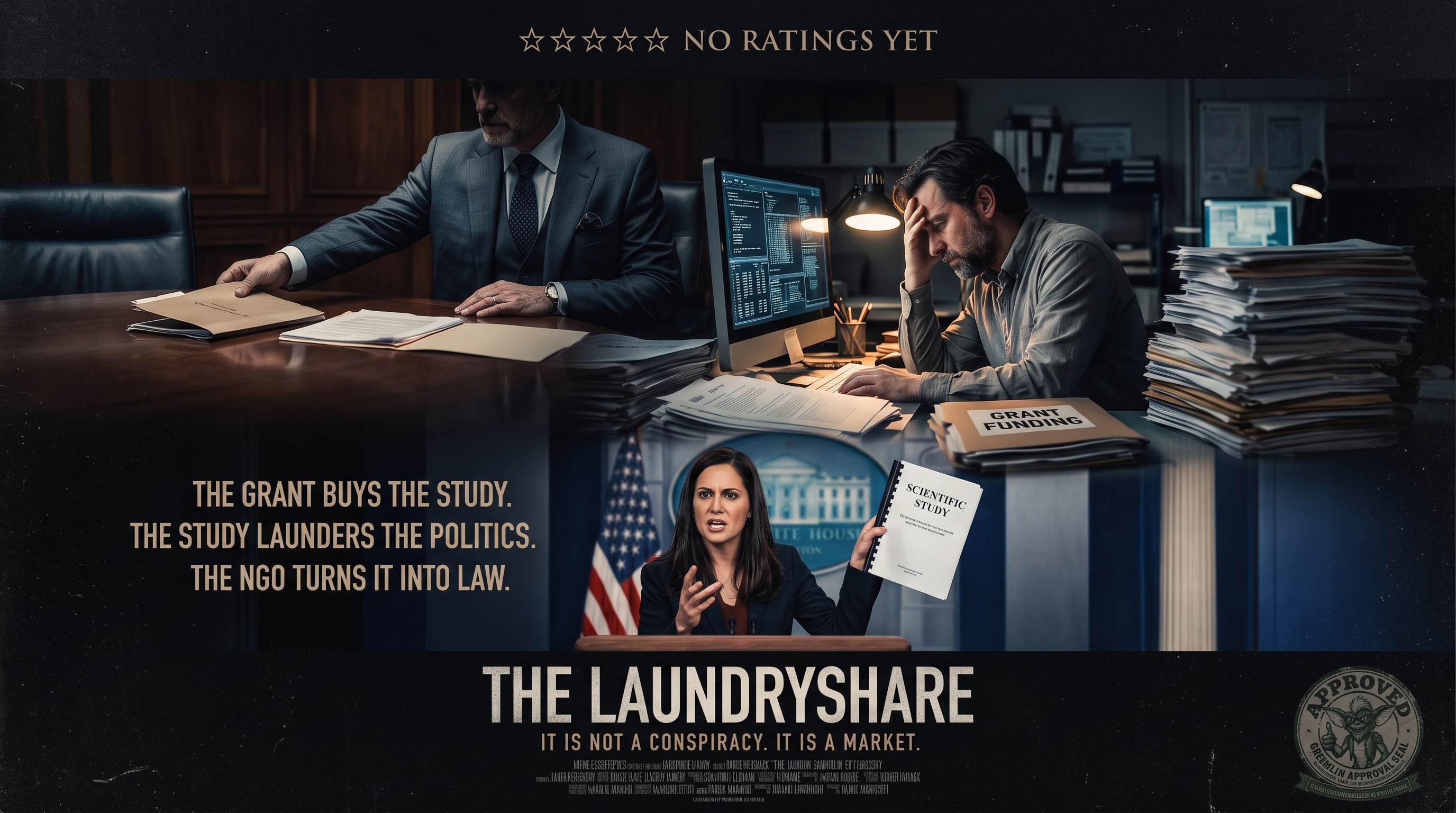
I. The Vehicles: How You Hide a Donor
Start with the plumbing, because the plumbing is the whole trick. A 501(c)(3) is the familiar charity: donations are tax-deductible, but it may do only an “insubstantial” amount of lobbying and is flatly barred from campaign politics. Its cousin, the 501(c)(4), flips the terms — donations are not deductible, but it may lobby without limit and may play in politics so long as that is not its “primary” activity — and, crucially, it never has to name its donors. That is the entire origin of the phrase “dark money.” It is not a legal term and it is not, under current IRS rules, illegal; it is simply the lawful non-disclosure the (c)(4) was built to provide. Enforcement is theoretical: ProPublica, reviewing the record, could not find a single example in recent memory of a (c)(4) losing its exemption over its politics. Pair a (c)(3) with a (c)(4) — as the Sierra Club, the ACLU, the NRA and dozens of others do — and you have a structure that takes deductible money in one door and spends untraceable money out the other.
The donor-advised fund is the next scrub. Give to a DAF — run by a Fidelity or a Schwab charitable arm — and you collect the full tax deduction immediately, while the money sits and is granted out later, often anonymously, because the sponsor is the legal grantor of record, not you. The scale is no longer marginal: DAF assets ran from $251.5 billion (2023) to $327.9 billion (2024), with grants out climbing from $54.8 billion to $64.9 billion in a single year. Then comes “fiscal sponsorship” — rent-an-NGO. An existing nonprofit lets a brand-new project operate under its own tax status and its own Form 990, so the project never files public financials of its own and never has to name its board or its funders. This is how “pop-up” groups appear overnight, fully staffed and messaged, to fight one nomination or one bill, and then vanish.
II. The Pools: Both Teams Have One
On the left, the archetype is Arabella Advisors. A for-profit consultancy manages a cluster of nonprofits — the New Venture Fund, the Sixteen Thirty Fund, the Windward and Hopewell and North Funds — that share its address and its officers. The network pulled in roughly $1.7 billion in 2020, about $1.6 billion in 2021, and $1.34 billion in 2022, paying Arabella itself more than $52 million a year in fees. It has fiscally sponsored 340-plus pop-up groups; one of them, Demand Justice, materialized in 2018 to fight Brett Kavanaugh with almost no public record because it was a sponsored project of the Sixteen Thirty Fund. The laundering is visible in the filings: New Venture Fund reported a single $26.7 million grant to its sister Sixteen Thirty Fund for “capacity building,” money shuffled between two funds under one roof so the original source dissolves. A Swiss national, barred from U.S. campaign giving, routed more than $10.8 million into the same fund through an intermediary — foreign money, washed domestic. Alongside it sits the Tides network ($627 million in revenue in 2023; $445 million granted in 2024) and George Soros’s Open Society Foundations, which has taken in more than $32 billion from him since 1984 and spent about $1.2 billion in 2024 alone.
On the right, the mirror image. DonorsTrust — nicknamed “the dark-money ATM of the right” by Mother Jones — granted $188.3 million in 2020, of which a single unidentified donor supplied $158 million; in 2021 it crossed $1 billion in revenue and $1.5 billion in assets; in 2022 it pushed out $134 million. The Bradley Foundation gives $40–50 million a year and has moved $1.3 billion since 1985. The Koch network’s Stand Together took in $432.6 million in 2024, its Americans for Prosperity arm another $223.7 million, and Koch-aligned political and policy groups spent close to $550 million across the 2024 cycle. The dollar figures and the direction differ; the architecture is identical — anonymizing funds, pass-through grants, and a wall between the donor and the deed. When one side decries the other’s “dark money,” it is describing its own equipment.
Both machines
The largest anonymizing money pools by recent annual scale — left (blue) and right (amber) run the same equipment.
III. The Government Becomes the Donor
The darkest version of the loop is the one the taxpayer funds without consent. The federal government grants money to an NGO; the NGO advocates to shape federal policy; the policy directs more money back. A 2025 House Oversight hearing, “Public Funds, Private Agendas,” built its case on a study’s claim that more than 35,000 NGOs draw most of their money from government. Some of the examples were genuinely startling: Power Forward Communities received a $2 billion EPA climate award despite reporting $100 in revenue the year it was organized. Others sit inside the research economy itself — the fight over “indirect cost” recovery, the surcharge a university adds on top of every federal research grant for overhead. Elite schools negotiate rates of 50–60 percent; when NIH tried in February 2025 to cap that at a flat 15 percent, the projected hit was $121 million a year at UCSF, $129 million at Penn, $136 million at Johns Hopkins. That is the size of the institutional stake riding on top of the science.
And here the Crown plants a flag for honesty, because this is where the outrage machine lies the most. The same 2025 effort that exposed real abuses also produced its own garbage numbers: a canceled $8 million ICE contract was posted to the public “savings” ledger as $8 billion, a thousand-fold error; the Government Accountability Office reviewed the methodology and found it opaque and unverifiable. The NIH cap itself was struck down by a federal court as “arbitrary and capricious” and contrary to standing law. Much of the most-shared material came from one side’s testimony and did not survive contact with the receipts. The loop is real. The figures used to attack it are often inflated. Both of those things are true, and a reader who only hears one of them is being handled, not informed.
IV. The Broken Lab: Why the Check Stopped Catching It
Money could buy conclusions all day and it would not matter, if the lab still checked the work. It largely stopped. In 2005 the Stanford meta-scientist John Ioannidis published the paper that named the rot — “Why Most Published Research Findings Are False” — arguing that small studies, small effects, flexible methods and financial interest make a positive finding more likely false than true. A decade later the field tested itself. The Reproducibility Project repeated 100 landmark psychology studies: 97 percent of the originals had reported a statistically significant result; only 36 percent replicated, and the effects that survived were, on average, half their original size. Experimental economics managed 61 percent; the marquee social-science findings in Nature and Science managed 62 percent. Preclinical cancer biology was the worst of all: when a project tried to repeat 193 experiments it found that none of the original papers included enough method detail to even attempt it without calling the authors, only 2 percent had shared their data, and the effects that could be tested came back about 85 percent smaller.
Half of it doesn’t hold
Share of landmark published findings that replicated — significant result, same direction — when independent teams repeated them.
The gatekeeper that was supposed to stop bad work does not read the raw data; it reads the story. In 2013 a journalist submitted a single, obviously fatal fake cancer paper to 304 fee-charging open-access journals; about 60 percent of them accepted it. Peer review checks whether a paper is plausible and well-argued, not whether it is true, and fabrication sails through routinely. The business model makes it worse: reviewers work free — an estimated $2.5 billion a year in donated labor — while Elsevier runs operating margins near 37 percent, higher than Apple’s. Under the author-pays model that now dominates, the publisher earns its fee on every accepted paper (a single article in Nature runs about $11,390), which quietly rewards saying yes. That incentive is exactly what the paper mills — commercial operations that mass-produce fake studies and sell authorship — were built to exploit. Retractions blew past 10,000 in a single year in 2023, more than 8,000 of them from one publisher’s compromised journals, with the retraction rate up roughly tenfold in two decades.
The retraction curve
Research papers pulled from the literature per year — the clean-up is accelerating because the contamination did.
V. The Monoculture: Which Questions Get Asked
A funder with a thesis still needs a field willing to produce it — and in the softest disciplines, the field tilts hard one way. Counting voter registrations of tenure-track faculty, Mitchell Langbert found a Democrat-to-Republican ratio of 10.4-to-1 across elite liberal-arts colleges, with 39 percent of those schools carrying zero registered Republicans. The imbalance is not uniform — it is small in the hard sciences and enormous in the fields that generate the viral papers. Engineering runs about 1.6-to-1; economics around 4.5-to-1; but psychology hits 17-to-1, history 33-to-1, and anthropology an almost comic 133-to-1. When nearly everyone in a room shares a prior, the prior stops looking like a prior and starts looking like neutrality, and the study that flatters it meets no friction on the way to print.
Not evenly spread
Registered Democrats per registered Republican on the faculty, by discipline. The tilt is small in the hard sciences, extreme in the fields that produce the viral papers.
The filter now operates before the science is even read. In a 2018–19 life-sciences cluster hire at U.C. Berkeley, 893 qualified applicants were first scored on their diversity statements alone, against a published rubric — and 679 of them, 76 percent, were eliminated on that statement before a single reviewer looked at their research. Only 214 advanced to have their actual science evaluated. The rubric docked candidates who said they would “treat everyone the same.” Berkeley’s own template spread to campuses nationwide before the University of California system abolished mandatory diversity statements in 2025. That is a gate on what kind of scientist gets hired, installed upstream of what kind of science gets done.
The gate, before the science
U.C. Berkeley life-sciences search, 2018–19: how 893 qualified applicants were sorted on their diversity statement alone, before any research was read.
And the professional bodies that are supposed to speak for the method increasingly speak for the politics. In 2019 the American Psychological Association issued its first-ever guidelines for treating men and boys, built on the premise that “traditional masculinity ideology” is itself harmful — a framing a dozen scholars publicly argued read more as sociopolitics than as a balanced reading of the evidence. The field’s peer-review filter has been tested directly, too: in the 2017–18 “grievance studies” hoax, three authors got absurd papers accepted by respectable journals — a study of “rape culture” at dog parks published by a feminist-geography journal, and a passage of Mein Kampf rewritten in feminist jargon accepted by another — not because the work was rigorous but because it flattered the right priors. (For the anatomy of a single such study, see CROWN dispatch № 93, The Microscope.)
VI. The Honest Counterweight
Now the part the outrage feed will skip, because the Crown does not launder its own conclusions either. Most research is not ideological. The party imbalance that looks terrifying in anthropology nearly vanishes in the fields that cure diseases and build bridges, and the overwhelming majority of funded science — biomedical, physical, engineering — has no partisan valence to corrupt. The replication crisis, far from being hidden, was diagnosed by the fields themselves, and the fix is already running: pre-registration, “registered reports” that peer-review the design before the results exist, and new institutions built expressly to kill p-hacking. And the political tilt cuts both ways — the conservative think-tank ecosystem that produces much of the critique of academia runs its own motivated research, with the Heritage Foundation’s climate-cost and college-rating work drawing the same “outlier assumptions” and “start with the people who agree with you” charges. Funding bias is a documented phenomenon precisely because it is universal: he who pays for the study tends to get the study he paid for, whether the payer is a tobacco company, a foundation, or a government agency.
VII. The Handoff, and the Verdict
So put the three machines in a line and watch the dollar move. A donor with a desired conclusion gives to an anonymizing fund, which grants it — washed of the donor’s name — to a university program or an advocacy NGO. The program, staffed from a field where the conclusion is the house view and the check that would catch a weak study no longer reliably fires, produces the study. The NGO turns the study into a press release, the press release into testimony, the testimony into policy — and the policy, often enough, directs fresh money back toward the same machine. The grant buys the study. The study launders the politics. The NGO turns it into law. At no point does anyone have to lie outright; each actor is just responding to the incentive in front of him, and the incentive in front of every one of them points the same way.
Which answers the question the search results provoked. You do not see “Pussy Rules the World” in a peer-reviewed journal because the world went insane. You see it because there is a funded lane for it, a field disposed to wave it through, and an apparatus downstream that can turn it into a citation, a policy brief, and a line item. That is not a conspiracy; it is a market, and it is doing exactly what it was built to do. The corrective is not to believe the opposite of whatever a study says — that is just the same reflex running backward. It is to ask, every single time, the only three questions the machine cannot survive: who funded this, who checked it, and who gets paid when you believe it.
Filed on: The vehicles — IRC §170 and §501(c)(3)/(c)(4); “insubstantial” lobbying limit and the campaign-activity bar; ProPublica, “How the IRS Gave Up Fighting Political Dark Money Groups”; donor-advised fund assets $251.52B (FY2023) to $327.87B (FY2024), grants $54.77B to $64.89B (National Philanthropic Trust 2024 DAF Report; DAF Research Collaborative FY2024). Fiscal sponsorship / pop-ups — Capital Research Center, “Thinking About Fiscal Sponsorship”; 340+ sponsored groups; Demand Justice via the Sixteen Thirty Fund (2018); Arabella rebrand to Sunflower Services (Nov. 2025). Left pools — Arabella network revenue ~$1.7B (2020), ~$1.6B (2021), $1.34B (2022), $52M+/yr in fees (Capital Research Center; Fox News / IRS filings); New Venture Fund → Sixteen Thirty Fund $26.7M “capacity building” (Washington Post, Nov. 24, 2019); Berger Action Fund / Hansjörg Wyss >$10.8M (Free Beacon; Wikipedia); Tides Network $627.3M revenue (2023), $445M granted (2024); Open Society Foundations, Soros >$32B since 1984 and $1.2B spent in 2024 (OSF disclosures). Right pools — DonorsTrust “dark-money ATM of the right” (Mother Jones, 2013), $188.3M granted and $158M of 2020 revenue from one donor, >$1B revenue / $1.5B assets (2021), $134M granted (2022) (Center for Media and Democracy); Bradley Foundation $40–50M/yr, $1.3B since 1985, $86.4M (2022); Koch’s Stand Together $432.6M and Americans for Prosperity $223.7M (2024), ~$550M Koch 2024-cycle spend (NYT; InfluenceWatch). Government loop — House Oversight DOGE Subcommittee hearing “Public Funds, Private Agendas” (June 4, 2025); “35,000+” NGOs claim; Power Forward Communities $2B EPA award on $100 reported revenue; NIH 15% indirect-cost cap (Notice NOT-OD-25-068, Feb. 7, 2025), projected losses UCSF $121M / Penn $129M / Johns Hopkins $136M, blocked as “arbitrary and capricious,” nationwide injunction (Mar. 5, 2025). Honesty caveat — DOGE $8M ICE contract listed as $8B (Forbes, Feb. 19, 2025); GAO-26-108615 on opaque savings methodology. The broken lab — Ioannidis, “Why Most Published Research Findings Are False,” PLoS Medicine 2(8):e124 (2005); Open Science Collaboration, Science 349:aac4716 (2015), 97% → 36%, social psych 25% / cognitive 50%; Camerer et al., Science 351:1433 (2016), 61%; Camerer et al., Nature Human Behaviour 2:637 (2018), 62%; Reproducibility Project: Cancer Biology, eLife (2021), 0% adequately documented, 2% open data, ~85% smaller effects. Peer review & publishing — Bohannon, “Who’s Afraid of Peer Review?” Science 342:60 (2013), 157/304 accepted; Aczel et al., reviewer time worth ~$2.5B/yr (2021); Elsevier ~37% margin; Nature APC ~$11,390; retractions >10,000 in 2023 with >8,000 from Hindawi/Wiley, rate ~0.02% to ~0.2% (Nature 624:479, 2023; Retraction Watch); paper mills ~1.5–2% of 2022 papers (Clear Skies). Monoculture — Langbert, Academic Questions 31(2) (2018), 10.4:1, 39% Republican-free, anthropology 133:1, communications 108:0, engineering 1.6:1; Langbert, Quain & Klein, Econ Journal Watch (2016), economics 4.5:1, law 8.6:1, psychology 17.4:1, history 33.5:1; HERI/UCLA faculty survey, liberal/far-left 44.8% (1998) to 59.8% (2016–17). The gate — U.C. Berkeley Life Sciences Initiative (2018–19), 679 of 893 (76%) cut on diversity statements alone (NAS, Sailer, “Diversity Statement, Then Dossier”); UC ends mandatory diversity statements (Mar. 2025). Associations & hoaxes — APA “Guidelines for Psychological Practice With Boys and Men” (Jan. 2019); Grievance Studies affair (2017–18), 7 of 20 accepted, “dog park” paper in Gender, Place & Culture, Mein Kampf rewrite in Affilia; see CROWN dispatch № 93, The Microscope. Counterweight — open-science reforms (pre-registration, Registered Reports, Center for Open Science); funding bias as a universal, documented effect; WRI critique of Heritage Foundation climate-cost methodology. Full research dossier retained.
№ 96 · Filed October 6, 2026 — The surveillance state did not arrive by coup. No tank rolled up to the Capitol, no general seized the networks, no single night ended the republic and began something else. It was passed — bill by bill, signature by signature, each one named like a gift and sold like a rescue. PATRIOT. Homeland Security. Protect America. Freedom. Cybersecurity. Clarifying Lawful Overseas Use of Data. Read those names in a row and you would think Congress had spent twenty-five years building a shield. It spent them building a leash. Every one of those titles is a promise, and every promise points the opposite direction from what the statute underneath it actually does. This dispatch takes the eight laws the meme names — the PATRIOT Act, the Homeland Security Act, FISA, the Protect America Act, the NDAA, CISA, the CLOUD Act, and the annual Intelligence Authorization Acts — and reads each one against its own cover.
The Leash — How the Surveillance State Was Passed, Not Seized
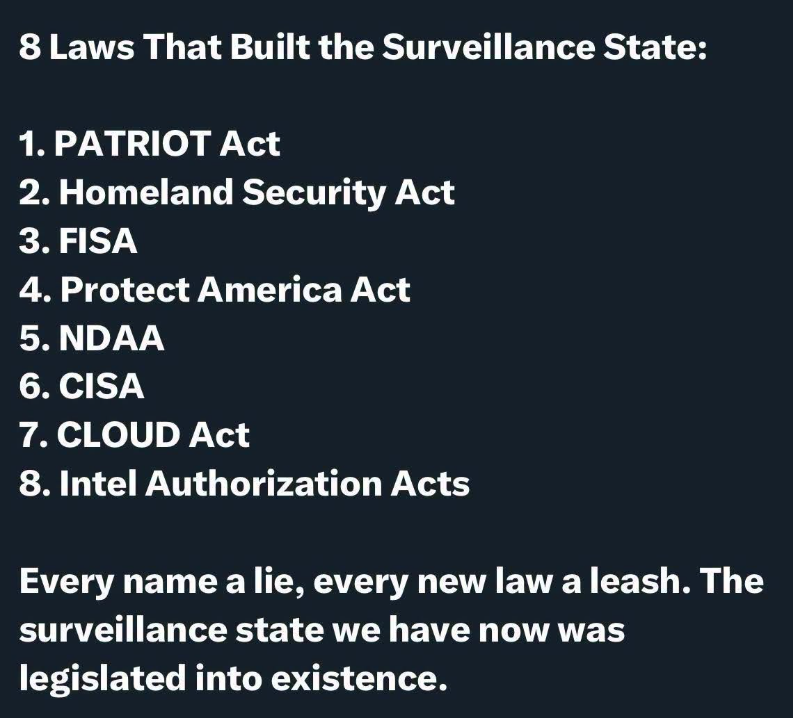
I. The Naming: Eight Euphemisms
Start with the words, because the words are the first instrument of the thing. “USA PATRIOT” is not a sentiment; it is a backronym, assembled to spell a word: Uniting and Strengthening America by Providing Appropriate Tools Required to Intercept and Obstruct Terrorism. Someone sat in a room and reverse-engineered a patriotic acronym for a surveillance bill, so that a vote against it would read as a vote against the country. “Protect America” protected no American from a foreigner; it removed the warrant requirement for a whole class of wiretaps. “Cybersecurity Information Sharing” is a channel that pipes your personal data from private companies to the NSA, the CIA, and the FBI. “Clarifying Lawful Overseas Use of Data” clarified that the government may reach data stored anywhere on earth. “Foreign Intelligence Surveillance” is now the engine of warrantless searches aimed squarely inward, at Americans.
Even the one law sold as a reform is a surveillance brand in disguise. The 2015 statute that supposedly reined the NSA in is the USA FREEDOM Act — which unspools to “Uniting and Strengthening America by Fulfilling Rights and Ensuring Effective Discipline Over Monitoring.” The word the whole tortured phrase is built to end on is monitoring. When even your freedom bill is named after the surveillance it manages rather than ends, the naming has stopped being description and become marketing. Hold that in mind as the only honest translation key you need: on this subject, the title tells you what they wanted you to feel, never what the text does.
II. The Vehicle: How a Leash Gets Passed
A law this unpopular on its merits is rarely passed on its merits. It is passed on a vehicle you cannot vote down. The PATRIOT Act moved 45 days after September 11, 357–66 in the House and 98–1 in the Senate, with members openly admitting they had not read the text they were voting for — speed and fear doing the work that debate would have undone. When the fear faded, the method changed: you bury the surveillance bill inside something that must pass. CISA, the 2015 data-sharing law, had failed for years as a standalone (as “CISPA”) on privacy objections — so it was folded into the omnibus spending bill, where a “no” vote meant shutting down the federal government. The CLOUD Act was slipped onto page 2,201 of a 2,232-page spending bill in 2018 and signed into law with no hearings and no standalone vote at all.
The NDAA is the same trick wearing camouflage. The National Defense Authorization Act is a genuinely must-pass bill — it funds the military — which makes it the perfect place to hide a provision no one wants to defend alone. The FY2012 NDAA carried §1021, which codified indefinite military detention, without trial, of anyone deemed to have “substantially supported” al-Qaeda or vaguely defined “associated forces” — language broad enough that journalists and activists sued, fearing it covered them. They won an injunction at trial in Hedges v. Obama; the Second Circuit vacated it in 2013 on standing, and the Supreme Court declined to hear the case — so the detention power’s constitutionality was never actually decided. The merits were dodged; the leash stayed. That is the pattern: never a standalone bill the public could watch you lose.
III. The Court: A Rubber Stamp Sold as a Safeguard
The oldest law on the meme was itself sold as the fix for the last surveillance scandal. The Foreign Intelligence Surveillance Act of 1978 was a post-Watergate, post-Church-Committee reform: never again would the executive wiretap at will; from now on it would have to ask a court. That court — the FISC — sits in secret, hears only the government’s side, and publishes classified opinions. And over its first thirty-three years it approved 33,942 applications and denied twelve. A 99.97 percent yes rate is not a check; it is a notary. The “leash” the 1970s reformers thought they were attaching turned out to be held at both ends by the same hand.
The rubber stamp
The secret court that was supposed to be the safeguard — and the share of government requests it refused.
And that secrecy is exactly what let a single word swallow a nation’s phone records. PATRIOT Act §215 let the government collect business records “relevant” to an investigation. In secret, with no one to argue back, the FISC stretched “relevant” to mean every call record of every American, including records not yet created — a reading that, as one judge later put it, renders the word meaningless. The country only learned of it when Edward Snowden leaked the April 2013 Verizon order compelling the handover of all call metadata “on an ongoing daily basis.” In 2015 the Second Circuit ruled flatly that §215 had never authorized the program it supposedly rested on. The leash had been quietly re-spooled behind a classified door, and it took a contractor with a thumb drive to show anyone the length of it. To its credit, the post-Snowden court bites a little more often now — it rejected 14 of 363 applications in 2023 — but that only measures how total the deference had been.
IV. The Reach: What the Leash Collects
Peel the names off and the machinery underneath is startlingly blunt. The §215 program vacuumed up the full call-detail haystack for a decade. “Sneak-and-peek” searches under §213 — delayed-notice warrants pitched as a counterterrorism necessity and made permanent — turned out to be a drug-war tool: across 2009–2013 roughly 70 percent were narcotics cases and under 1 percent were terrorism; in 2020, 71 percent were narcotics. National Security Letters, which demand records with no judge involved at all, went from about 8,500 in 2000 to some 47,000 in 2005 — nearly 200,000 issued in the four years from 2003 to 2006, each one able to sweep up the records of people who are suspected of nothing.
The bait and switch
A power sold to Congress as a counterterrorism tool, sorted by what it was actually used for.
The largest reach of all is the one aimed at foreigners that lands on Americans by design. Section 702 — the heart of what the meme files under “FISA” — authorizes warrantless collection of non-citizens’ communications through the PRISM and Upstream programs. But when an American emails, calls, or messages a foreign target, both sides are swept into a searchable government database. The government calls this “incidental.” It is structural: the FBI then queries that database for Americans’ communications — so-called backdoor searches — and in 2021 it ran up to 3.4 million such warrantless queries of U.S.-person data in a single year. The number fell hard the next year after reforms and a changed counting method, which is the tell: the capability was always there; only the bookkeeping and the restraint are adjustable.
The backdoor
Warrantless FBI searches for Americans’ own communications inside the “foreign” §702 database.
And the Homeland Security Act built the building all of this runs out of. It merged 22 agencies into DHS — the largest federal reorganization since 1947 — and stood up a national network of some 80 “fusion centers” to pool federal, state, local, and private data on ordinary people. A bipartisan 2012 Senate investigation examined their output and found it “irrelevant, useless or inappropriate,” “oftentimes shoddy, rarely timely, sometimes endangering citizens’ civil liberties” — while uncovering not a single terrorist threat and burning somewhere between $289 million and $1.4 billion that DHS could not even fully account for. A surveillance apparatus that watches everyone and catches no one is not a failed counterterrorism program. It is a working surveillance program.
V. The Bill, and the Verdict
All of this costs money, and the amount is a state secret by construction. The annual Intelligence Authorization Acts — the eighth law on the list — set the budget and the rules for the entire intelligence community, but the operative numbers live in a “Classified Schedule of Authorizations” the public never sees. Only a single aggregate is ever disclosed. The topline for the National Intelligence Program has climbed from the $52.6 billion that Snowden’s leaked “black budget” revealed for 2013 to $76.5 billion in 2024; add the military intelligence program and the total runs about $106 billion a year, with DHS another ~$82 billion on top. Much of the deepest collection does not even run on any of the eight laws: it runs on Executive Order 12333, a 1981 presidential order Congress never passed and cannot see into — the authority that operates outside FISA entirely.
The bill
The one intelligence number the public is allowed to know — and how it has grown.
So read the ledger the eight laws produced. The §215 bulk program that was the centerpiece of the whole post-9/11 architecture? The Privacy and Civil Liberties Oversight Board — a federal body with full classified access — reported it could find “not a single instance” in which the program made a concrete difference to a counterterrorism investigation. The fusion centers caught nothing. The sneak-and-peek warrants chased drugs. The one thing every one of these laws reliably produced was more collection, more access, more data on more Americans, held longer, searched more easily, by more agencies, with less of a warrant.
The meme’s charge — “every name a lie, every new law a leash” — is not rhetoric; it is the most economical description of the record. The surveillance state was not imposed on America against its laws. It is America’s laws — written in the open, voted on the record, signed in daylight, and named, every time, after the freedom they were quietly spending. You do not need a conspiracy to explain it. You need only read the statutes against their titles, and notice that the gap between the two has been the plan all along.
Filed on: PATRIOT Act — Pub. L. 107-56 (Oct. 26, 2001); §215 bulk telephone-metadata program and the PCLOB finding of “not a single instance” of concrete counterterrorism value per the Privacy and Civil Liberties Oversight Board report (Jan. 23, 2014); the secret FISC reinterpretation of “relevant” and the April 2013 Verizon order (leaked June 2013); ACLU v. Clapper, 2d Cir. (May 7, 2015) holding §215 did not authorize bulk collection; §213 “sneak-and-peek” usage ~70% narcotics / <1% terrorism 2009–2013 and 71% narcotics in 2020 (U.S. Courts / DOJ; Criminal Legal News); National Security Letters ~8,500 (2000) to ~47,000 (2005), ~200,000 in 2003–2006 (DOJ OIG). USA FREEDOM Act — Pub. L. 114-23 (June 2, 2015), ending §215 bulk collection in that form. Homeland Security Act — Pub. L. 107-296 (Nov. 25, 2002); 22 agencies merged, >240,000 employees, ~$82B FY2024; ~80 fusion centers; U.S. Senate Permanent Subcommittee on Investigations report “Federal Support for and Involvement in State and Local Fusion Centers” (Oct. 3, 2012): “irrelevant, useless or inappropriate,” $289M–$1.4B, no terrorist threat uncovered. FISA / FISC — Pub. L. 95-511 (1978); 33,942 granted vs ~12 denied, 1979–2012 (EPIC / Administrative Office of the U.S. Courts; CSIS); 2023: 14 of 363 rejected. Protect America Act — Pub. L. 110-55 (Aug. 5, 2007), warrantless targeting of persons “reasonably believed” abroad; statutory cover for the STELLARWIND / President’s Surveillance Program; expired Feb. 2008. FISA Amendments Act §702 — Pub. L. 110-261 (July 2008); PRISM / Upstream (Snowden, June 2013); targets 246,073 (CY2022) to 291,824 (CY2024); FBI U.S.-person queries up to 3,394,053 in CY2021, ~204,000 in CY2022 (ODNI Annual Statistical Transparency Reports); retroactive telecom immunity. NDAA FY2012 — Pub. L. 112-81, §1021–1022 indefinite military detention (“substantially supported”); Hedges v. Obama, 2d Cir. (July 17, 2013), cert. denied (Apr. 28, 2014) — merits never reached. CISA 2015 — Cybersecurity Information Sharing Act, Title I of the Cybersecurity Act of 2015, enacted within the Consolidated Appropriations Act, 2016 (Dec. 18, 2015); company-to-DHS indicator sharing auto-disseminated to NSA/CIA/FBI with broad immunity; 10-year sunset lapsed Oct. 1, 2025, since extended. CLOUD Act — Clarifying Lawful Overseas Use of Data Act, within the Consolidated Appropriations Act, 2018 (Mar. 23, 2018), ~p. 2,201 of 2,232; 18 U.S.C. §2713 (extraterritorial production) and §2523 (executive agreements bypassing MLAT); mooted United States v. Microsoft (Apr. 17, 2018); first U.S.–U.K. agreement in force Oct. 3, 2022. Intelligence Authorization Acts — annual; Classified Schedule of Authorizations; National Intelligence Program topline $52.6B (FY2013, leaked) to $76.5B (FY2024) / $73.3B (FY2025); total IC budget ~$106.3B (FY2024) / ~$101.1B (FY2025) (ODNI); FY2013 “black budget” via Washington Post (Aug. 29, 2013); Executive Order 12333 (Reagan, Dec. 4, 1981) as the non-statutory collection backbone outside FISA. Full research dossier retained.
№ 95 · Filed October 6, 2026 — Here is a question that cuts past the shouting: if you wanted to watch what happens when the federal government takes direct, long-term control of a people’s land and economy — not for a crisis year, but for generations — where would you look? You don’t have to imagine it or argue about some other country. The experiment has been running on American soil for 140 years, on about 56 million acres, with its own federal agency, its own body of law, and a century of filed results. It is the Indian reservation system. People reach for the word “communism” because the land is held in common and Washington runs the economy — but that’s the wrong label, and the wrong label lets the real one off the hook. Nobody on a reservation chose Marx. The precise name for what was imposed is older and more exact: a ward state — legally, a trusteeship; economically, a centrally-planned dependency economy sitting on collectivized land. This dispatch lays out the doctrine that created it, the mechanism that locks it, the receipts that measure it, and the clean control group hiding in plain sight on the very same reservations.
The Ward — The Federal Government’s Longest Experiment in Control
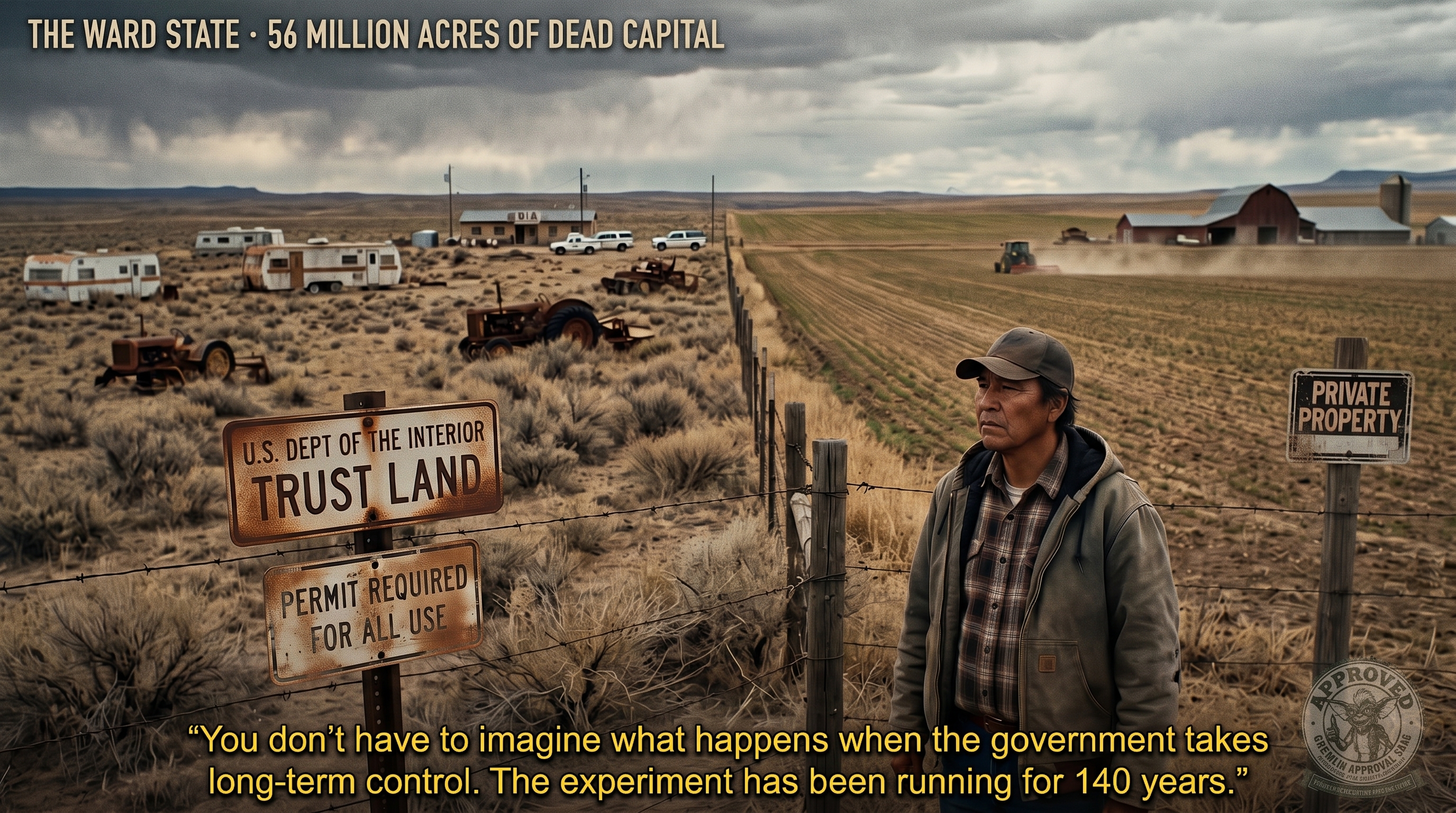
I. The Doctrine: Ward to Guardian
The legal frame isn’t a metaphor or a slur — it is the controlling doctrine, written by the Chief Justice of the United States. In Cherokee Nation v. Georgia (1831), John Marshall held that the tribes are not foreign nations but something else: “They may, more correctly, perhaps, be denominated domestic dependent nations… they are in a state of pupilage; their relation to the United States resembles that of a ward to his guardian.” That is the whole architecture in one sentence. A ward is a person the law deems unable to manage their own affairs, so a guardian manages the affairs — and holds the property — for them. Nearly two centuries later that is still the operative relationship, and it is the thing to keep your eye on: on a reservation, someone else holds legal title to the ground you live on.
What that means in practice is a split title. The United States holds the legal title to trust land as trustee; the tribe or individual holds the beneficial title as, in Marshall’s word, the ward. You may live on it, farm it, be buried on it — but you cannot freely sell it, and you cannot do much of anything with it without the guardian’s signature. Every downstream dysfunction in this dispatch flows from that single arrangement. Hold the ownership of the land away from the people on it, administer it from a federal desk, and you have built, by definition, a command economy — just a small and specific one.
II. The Mechanism: 56 Million Acres of Dead Capital
Trust land cannot be mortgaged, pledged, or sold in the ordinary way, because the owner isn’t the one holding the deed. A bank lends against real estate because, if you default, it can foreclose — seize and sell the title. You cannot foreclose on land whose title belongs to the federal government. So trust land is, for lending purposes, nearly inert: a borrower who wants to use an allotment as collateral generally can offer a lender only an “assignment of income” (the right to future lease checks), not the land, which is why private banks rarely touch it. The economist Hernando de Soto gave this condition its name in The Mystery of Capital (2000): dead capital — assets you physically hold but cannot leverage, because the title isn’t clear and transferable. Roughly 56 million acres of reservation land is exactly this: asset-rich on paper, capital-dead in practice. A family can sit on a valuable parcel and still be unable to borrow a dime against it to start a business.
Then the guardian made it worse, with a reform meant to fix it. The Dawes Act of 1887 carved communal reservations into individual allotments — 160 acres per household head — and sold everything “surplus” to white homesteaders. The Native land base fell from 138 million acres in 1887 to 48 million by 1934: ninety million acres, about two-thirds of the whole, gone in a human lifetime. And the allotments that remained were poisoned by a rule against dividing them: when an owner died, each heir inherited an undivided fractional share of the entire parcel. Six generations later, a single 160-acre allotment can have more than a thousand co-owners — and because leasing or developing it requires the consent of a majority of them, and you can never find or agree with a thousand people, the land simply sits idle. The 2009 Cobell settlement spent $1.9 billion buying back 2.97 million acres of these fractions just to un-jam them. That is dead capital with the engine welded shut.
The land base, before and after
What the first great “fix” — privatize the allotments, sell the rest — actually did to the land.
III. The Receipt: Same Soil, Different Title
Here is the finding that settles the argument, because it holds everything else constant. Economists Terry Anderson and Dean Lueck studied 39 western reservations and compared the farm output of land under different tenure — privately-titled (fee-simple) parcels against trust parcels, side by side on the same reservations. Their 1992 result, in the Journal of Law and Economics: individual trust land was 30 to 40 percent less productive than fee-simple land, and tribal (communal) trust land was 80 to 90 percent less productive. Same soil, same climate, same people, same markets. The only variable that moved was who held the title — and output moved with it, in lockstep, from private to individual-trust to communal-trust. This is as close to a controlled experiment as social science gets, and it is sitting on the reservations themselves.
The productivity gap
Output per acre by land tenure, measured on the same reservations — title is the only thing that changes.
The follow-up work closed the loop. Anderson and Dominic Parker later showed that reservations where more than half the land is held in ordinary fee-simple title post significantly higher per-capita income than trust-dominated ones. The pattern is monotonic and it points one direction: the further land sits from a clear, private, transferable title, the poorer it performs — regardless of the acre’s quality or the owner’s identity. The system, not the people, is the variable.
IV. The Planner: You Need Washington’s Signature
A command economy needs a planner, and this one has a bureau. Because the government holds the title, nearly every economic act on trust land — a lease, a loan, a right-of-way, a store, a solar array — needs the approval of the Secretary of the Interior, delegated to the Bureau of Indian Affairs. Getting a routine business lease approved runs an eight-step gauntlet — letter of intent, title status report, landowner consent, a surveyed boundary, a Section 106 archeological review, a NEPA environmental assessment, a federal appraisal, and final BIA sign-off — and takes anywhere from several months to a year and a half. A simple land exchange, to rearrange your own holdings, averages four and a half years. The 2012 HEARTH Act was supposed to fix this by letting tribes approve their own leases in weeks — but it covers only tribal trust land, not individual allotments, and as of 2025 only about 27 percent of reservations had adopted it. To do business on your own ground, you wait in line at a federal office.
The permission economy
Time to get the guardian’s sign-off before land can earn a dollar.
And the planner is funded like one. The BIA runs on roughly $3 billion a year; total federal Indian Affairs spending runs about $4.6 billion, and the Indian Health Service adds roughly $8 billion more — a dedicated federal apparatus, thousands of employees, administering the land and services of a population of about a million on reservations. Money flows down from Washington; permission flows up to it. That is the definition of a dependency relationship, and it is the ward-to-guardian doctrine turned into an annual appropriation.
V. The Outcome, and the Verdict
A system that cannot form capital, cannot get out of its own way, and routes every decision through a distant office produces exactly what you would predict. Poverty on reservations runs roughly 22 to 28 percent against a national rate near 11; median household income is about $42,000 against a national $84,000; average reservation unemployment is triple the national rate, and on isolated reservations it reaches 50 to 80 percent. Pine Ridge, the sharpest case, posts a 52 percent poverty rate and leaves nearly 69 percent of working-age adults without a job. These are not the numbers of a poor region catching up. They are the steady-state output of a place where the land cannot be borrowed against, sold, or quickly put to use — asset-rich and cash-poor by design.
The results, after 140 years
Reservation economic outcomes against the national average — the system’s steady state.
So, to answer the question head-on: a reservation is not communism, and calling it that misses the point. Communism is a chosen ideology, pursued to abolish private property and build a classless society. A reservation is something more precise and, in a way, more instructive: a ward state — a trusteeship in law, a centrally-planned dependency economy in practice, imposed on a people by a guardian who holds the title, writes the rules, signs the permits, and cuts the checks. It was not built by Marxists; it was built by Congress and the courts. And it is the cleanest working model in America of what total government control of land and capital actually does, because it comes with its own control group: the fee-simple acre next door, on the same reservation, under the same sky, that out-produces the trust acre two-to-tenfold for one reason only — its owner holds the deed.
If you want to see how well government manages an economy, you don’t need a thought experiment. You need a map of 56 million acres, a 140-year run of data, and the honesty to read the ledger it produced.
Filed on: The doctrine — Cherokee Nation v. Georgia, 30 U.S. (5 Pet.) 1 (1831), Marshall, C.J. (“domestic dependent nations… a state of pupilage… ward to his guardian,” 30 U.S. at 17); trust title split and alienation restraint per the Nonintercourse Act (25 U.S.C. § 177), the General Allotment Act, and 25 U.S.C. §§ 415, 5135 / 25 C.F.R. § 152.34. Dead capital & allotment — Hernando de Soto, The Mystery of Capital (2000); Dawes / General Allotment Act, Feb. 8, 1887 (24 Stat. 388); land base 138M→48M acres 1887–1934 per the Meriam Report (1928) and the Indian Land Tenure Foundation; allotment ended by the Indian Reorganization Act, June 18, 1934 (48 Stat. 984; 25 U.S.C. § 5101); fractionation (single allotments with 1,000+ co-owners, majority-consent rule) and the Land Buy-Back Program ($1.69B paid, 2.97M acres consolidated, closed Dec. 4, 2023) per Cobell v. Salazar (settled 2009) and the DOI. The productivity gap — Terry L. Anderson & Dean Lueck, “Land Tenure and Agricultural Productivity on Indian Reservations,” Journal of Law and Economics 35 (1992): individual trust 30–40% and tribal trust 80–90% below fee-simple output on the same reservations; Anderson & Dominic Parker, “Sovereignty, Credible Commitments, and Economic Prosperity on American Indian Reservations” (2008) on fee-simple share and per-capita income (Hoover Institution / PERC). The bureau — BIA business-lease process (8 steps, NEPA, appraisal) and timelines per 25 C.F.R. Part 162, BIA Division of Real Estate Services, and the Minneapolis Fed Center for Indian Country Development; land exchanges ~4.5 yrs; HEARTH Act of 2012 (25 U.S.C. § 415(h)), ~27% (88/329) reservation adoption as of 2025, tribal trust land only; BIA ~$3.0B, total Indian Affairs ~$4.6B, IHS ~$8B (DOI / HHS, FY2025); ~56M surface trust acres (BIA Office of Trust Services). Outcomes — poverty ~22% (NCRC 2026 / Harvard 2025) to 28.4% (Census 2010) vs US 10.6% (2024); median household income $42,224 (ACS 2021 5-yr) vs US ~$83,730 (2024); reservation unemployment ~10.5% average (Ballard Brief 2024), 50–80% on isolated reservations; Pine Ridge 52% poverty and ~69% of working-age adults not employed (Census ACS / My Tribal Area). Full research dossier retained.
№ 94 · Filed October 5, 2026 — A 28-year-old lab diagnostician named Darya Shipilova is reported to have broken a test tube of live Yersinia pestis — plague — at the Irkutsk Anti-Plague Research Institute around September 25. She was hospitalized on the 29th, put on a ventilator, and died the night of October 1–2. Rospotrebnadzor, the federal agency that runs the lab, says she died of “pneumonia of unknown etiology,” insists no pathogen linked to her work was found, and denies any biosafety breach. The Kremlin is telling people to ignore the rumors. Meanwhile some 190 contacts were quarantined, the hospital’s inpatient wing was sealed, and a criminal probe into “safety violations causing death” was opened. You do not cordon a hospital and open a death investigation over ordinary pneumonia. The real story was never the broken tube — tubes break. It is which lab broke it, and the ninety-year documented history that makes “nothing happened” impossible to take at face value. This dispatch separates the three things the noise keeps collapsing into one: what the disease actually does and how it is treated, what this specific institution actually is, and why the viral “smallpox lab leak” version is the wrong lab entirely.
The Broken Tube — A Plague Lab Accident and the Vaccine Already in the Pipeline

I. What Actually Happened
Start with the facts that both sides agree on, because they are damning enough without embellishment. Shipilova’s reported work — immune response to Y. pestis and antibiotic-sensitivity testing of wild strains — means she was handling live, virulent, wild-type plague, which fits the broken-tube account. The lab is the Irkutsk Anti-Plague Research Institute of Siberia and the Far East, at Trilisser Street 78 in Irkutsk itself; she was hospitalized and died in Shelekhov, the satellite town about 20 km away where the quarantine hospital sits — not at the lab. (Getting that geography right matters: the lab and the hospital are two different places, and conflating them is an easy way to look sloppy.) Exposure around September 25; hospitalized the 29th; ventilated; dead the night of October 1–2.
Read the official denial against the official actions, because they contradict each other. Chief sanitary officer Anna Popova flew to Irkutsk personally and called it “pneumonia of unknown etiology” — no linked pathogen, no breach — and Kremlin spokesman Dmitry Peskov waved off the rumors. But Buryatia’s head Alexei Tsydenov first said “plague,” then softened it to “possibly”; Irkutsk governor Igor Kobzev called it a “suspected particularly dangerous infection”; roughly 190 contacts were quarantined; the Shelekhov hospital’s inpatient department was locked down; and a criminal probe into safety violations causing death was opened. The WHO confirmed a death from severe pneumonia but declined to call it plague; the CDC and State Department are monitoring, with Trump and Rubio on October 5 calling US risk “low” and asking for transparency. A federal agency investigating an accident inside its own facility is grading its own homework — and its actions say it does not believe its own “ordinary pneumonia” line.
II. The Disease, and the Window You Cannot Miss
Pneumonic plague is the only form of plague that spreads person to person, through inhaled respiratory droplets — which is what makes a lab aerosol exposure categorically worse than a flea bite, and why the response to one case looks like the response to an outbreak. Incubation runs 1–6 days; a patient stays infectious until roughly 48–72 hours of antibiotics plus clinical improvement. It is a Tier 1 / Category A select agent for a reason. Treatment, per CDC’s 2021 guidance, is first-line aminoglycosides — streptomycin or gentamicin — with fluoroquinolones (ciprofloxacin, levofloxacin, moxifloxacin) now preferred and doxycycline as an alternative; a full course runs 10–14 days, and post-exposure prophylaxis is a fluoroquinolone or doxycycline for 7 days. Penicillins and cephalosporins do not work on it, and there is no FDA-licensed vaccine in the US. The one thing that matters above all else: treatment has to start inside roughly 24 hours of symptom onset. Miss it and the patient falls off a cliff.
The case-fatality cliff
How far survival drops when the treatment window is missed — and how far it recovers when it is not.
Now line Shipilova’s timeline up against that window. Exposed around September 25, not hospitalized until the 29th — if this was pneumonic plague, the window was almost certainly blown before she ever presented, which is consistent with dying on a ventilator. One analyst-flagged wrinkle, labeled as inference: staff who handle live plague get mandatory annual vaccination with the Russian live-attenuated EV strain, but the EV vaccine’s protection against aerosolized pneumonic plague is scientifically contested — it is far better against the bubonic form. If she was vaccinated but inhaled the organism, that gap could plausibly explain how fast she declined. That is our inference, not a confirmed cause.
The week she had
Reported exposure to death in roughly seven days — with the life-saving window near the start.
III. The Lab Is the Story
Here is why this isn’t “a tube broke somewhere.” The Irkutsk Anti-Plague Institute is one of the most historically loaded biological facilities in Russia, and it was built on Stalin-era secrecy — literally. Founded June 5, 1934 to fight the natural plague reservoirs along the Mongolian and Chinese borders, its founding director, Aleksey Skorodumov, built the whole regional network of satellite stations and “anti-plague trains” — and was then arrested in the 1937 Great Purge on fabricated charges and shot in 1939, rehabilitated only in 1955. State secrecy around this institution is not new; it is in the foundation stone. It also did real science: Nikolay Gaysky developed the Soviet live attenuated tularemia vaccine here. And it is one of six pillars of the civilian anti-plague system — Saratov (“Mikrob,” the national HQ), Rostov, Volgograd, Stavropol, Almaty, and Irkutsk — a defensive public-health network of surveillance, vector control, and vaccines, not Biopreparat. That distinction is real and it matters.
But the civilian and offensive programs were bridged — and at Irkutsk, the bridge has a name. Beginning in the 1960s, the anti-plague labs fed the offensive bioweapons program two ways: they harvested virulent wild strains from natural reservoirs and shipped them to weapons labs, and their personnel crossed over. The documented case: Igor Domaradsky directed the Irkutsk Anti-Plague Institute from 1957 to 1964. In 1973 he was recruited into the offensive program — deputy director at Obolensk and deputy chairman of Biopreparat’s scientific-technical council — where he pioneered the genetic manipulation of Yersinia pestis for antibiotic resistance and engineered virulence (NTI / James Martin Center for Nonproliferation Studies). A former director of this lab became a founding architect of weaponized, engineered plague. That documented dual-use fault line is the real reason a broken test tube here draws international monitoring instead of a shrug. Its strain collection runs nine decades deep — a 2022 institute study even reconstituted 30 Mongolian strains freeze-dried for 31–59 years, confirmed them viable, and confirmed they were still susceptible to streptomycin, cipro, and ceftriaxone, a useful real-world check on the “wild-type plague is treatable” point.
And the response is a 1939 rerun. That year, Saratov researcher Abram Berlin self-infected with pneumonic plague, took a train to Moscow, and infected a barber and the physician who diagnosed him; the NKVD cordoned the hospital and disinfected his hotel overnight to kill the story before it spread. Aggressive quarantine plus an information blackout. Now watch the 2026 playbook: deny, cordon, scrub the regional officials’ “plague” statements inside 48 hours, open a criminal probe. Same institutional DNA, same century-old reflex.
IV. The Vaccines Were Already in the Pipeline
Here is a layer the viral version misses — not Hollywood hype, but a documented paper trail: in the years before a single Irkutsk report, at least four governments were already funding or fielding plague countermeasures. In December 2019, Anna Popova — the same Rospotrebnadzor chief who in 2026 flew to Irkutsk and called Shipilova’s death “pneumonia of unknown etiology” — announced that Russia was ready to offer its Stavropol-produced plague vaccine to fellow Shanghai Cooperation Organization states (TASS, Dec 16, 2019). In March 2023, Tel Aviv University and the Israel Institute for Biological Research — Israel’s national biodefense lab — published a single-dose mRNA–LNP plague vaccine that protected mice against lethal Y. pestis (Science Advances, PMC9995031); by mid-2025 the same groups followed with a two-antigen bivalent mRNA vaccine aimed specifically at the pneumonic form, again in mice (Advanced Science, PMC12245056). By September 2025 the UK’s DHSC Vaccine Network Phase 2.0 was funding two mRNA plague projects — NeoVac at £1,986,118 and the University of Oxford at £1,972,284, roughly £3.96 million combined — and on September 11, 2025 the US firm Dynavax began a Phase 2 human trial of an adjuvanted recombinant plague vaccine (rF1V + CpG 1018), funded by the Department of Defense, with estimated completion in August 2027 (ClinicalTrials.gov NCT07207408). None of it is secret. All of it predates October 2026.
The pipeline that predates the incident
Plague countermeasures funded or fielded by four governments — every one of them before the Irkutsk death.
Now the discipline, because this is exactly where people overreach. Plague is a Category A / Tier 1 select agent — the same tier as anthrax and smallpox — so governments funding defenses against it is the expected baseline, not a smoking gun; a plague-vaccine program is no more sinister than an anthrax one. The Israeli results are mouse studies, not deployable vaccines; the UK entries are grant line-items, not products; the Russian item is an existing Soviet-era vaccine offered diplomatically, not a new crash program. What is fair to say is narrower and sturdier. First, there was no shortage of serious, well-funded, multinational interest in plague countermeasures in the five years before Irkutsk — an active field, not a dormant one. Second, the single person at the center of Russia’s 2026 denial is the same person who in 2019 was advertising Russia’s plague-vaccine stockpile. That continuity does not prove a cover-up; it does mean the “ordinary pneumonia, nothing to see” line is coming from someone who knows exactly how seriously her own government takes this organism. The honest read is not “they planned a pandemic” — it is “the people telling you to relax have spent years treating this pathogen as a top-tier threat.”
V. It Is NOT the “Vector Smallpox Lab Leak”
A large share of the online panic names Vector. Wrong lab, wrong pathogen, wrong side of the country. The Irkutsk Anti-Plague Institute and the VECTOR State Research Center are not the same place and have nothing to do with each other. Vector did have a real accident — a September 16, 2019 gas-cylinder explosion during renovation that badly burned one worker — but officials said no pathogens were stored in that room: a real event, unrelated to plague and to 2026.
Two different labs
Why the viral “smallpox lab leak” story is pointing at the wrong facility.
Why the “Vector plague leak” claim exists at all: it is a conflation with Annie Jacobsen’s 2026 book Biological War: A Scenario, which opens with a fictional engineered, antibiotic-resistant pneumonic plague leaking from the BSL-4 Vector facility and going pandemic. Shipilova’s real death, months after the book dropped, collided with the plot online and fused into one story. The distinction that matters: Jacobsen’s pathogen is a fictional CRISPR-edited chimera built to defeat antibiotics; the Irkutsk pathogen is ordinary wild-type Y. pestis, treatable with standard antibiotics if caught early. Do not let the thriller bleed into the real story.
VI. The Verdict
Two true things that the noise keeps collapsing into one false one. First, the legitimate question is real and serious: a 28-year-old appears to have died of pneumonic plague after a containment failure at a dual-use institute with a documented bioweapons lineage — and the agency that runs the lab is investigating itself while denying any breach. The quarantine, the lockdown, and the criminal probe say the officials do not believe their own “ordinary pneumonia” line. Second, the viral version is fiction: this is not a smallpox lab, not Vector, not Koltsovo, not an engineered antibiotic-resistant superbug, and not a pandemic. It is wild-type plague — nasty and fast, but treatable inside the window and not airborne beyond close contact.
The scandal isn’t a Hollywood pathogen. It’s an old, secretive institution with a real dual-use past, a dead young scientist, and a federal government running the 1939 playbook: cordon the sick, scrub the record, and tell everyone to stop asking.
Filed on: The 2026 incident — all specifics (Darya Shipilova, 28, lab diagnostician; reported tube break ~Sep 25; hospitalized Sep 29; died night of Oct 1–2; ~190 contacts quarantined, none plague-positive; Shelekhov inpatient lockdown; criminal probe into safety violations causing death) rest on the independent outlet Lyudi Baikala (People of Baikal) and named regional officials — Buryatia head Alexei Tsydenov, Irkutsk governor Igor Kobzev — against the flat denial of Rospotrebnadzor and chief sanitary officer Anna Popova (“pneumonia of unknown etiology”) and Kremlin spokesman Dmitry Peskov; WHO confirmed a severe-pneumonia death but declined to call it plague; CDC/State monitoring, Trump & Rubio Oct 5 (US risk “low”). Unverified by Russian federal confirmation by design. The disease & treatment — CDC 2021 clinical guidance (aminoglycosides first-line; fluoroquinolones preferred; doxycycline alternative; 10–14 day course; 7-day PEP; no US-licensed vaccine; penicillins/cephalosporins ineffective); incubation 1–6 days; infectious until ~48–72h of therapy; Tier 1 / Category A select agent; ~24h treatment window. Case-fatality — untreated ~94–100% (dead 18–48h); treated any-antibiotic pooled CFR 13.6% (PMC7510718, Oxford/CID); US ~7 cases/yr, ~13–14% fatal (Coconino County, AZ fatal pneumonic case Jul 2025, died <8h, 46 contacts given cipro PEP); Madagascar 2017: 2,417 cases / 209 deaths / 77% pneumonic. Resistance rare (two Madagascar 1995 strains, pIP1202 MDR and pIP1203 streptomycin-resistant). The lab — Irkutsk Anti-Plague Research Institute of Siberia & the Far East, Trilisser St. 78, founded Jun 5, 1934; director Aleksey Skorodumov purged 1937, shot 1939, rehabilitated 1955; Gaysky live-attenuated tularemia vaccine; one of six civilian anti-plague institutes (Saratov “Mikrob,” Rostov, Volgograd, Stavropol, Almaty, Irkutsk); Igor Domaradsky directed Irkutsk 1957–64, recruited to the offensive program 1973 (Obolensk / Biopreparat), pioneered genetic manipulation of Y. pestis (NTI / James Martin Center for Nonproliferation Studies); 2022 institute study reconstituted 30 Mongolian strains (31–59 yr), viable and antibiotic-susceptible; 1939 Abram Berlin Moscow case (NKVD cordon + blackout). EV-vaccine-vs-pneumonic gap flagged as our inference. The debunk — VECTOR State Research Center, Koltsovo (Novosibirsk), ~1,400 km west, viral BSL-4, one of two WHO live-smallpox repositories (other: US CDC Atlanta); Sep 16, 2019 gas-cylinder explosion (one burned, no pathogens in room); conflation driven by Annie Jacobsen, Biological War: A Scenario (2026), fictional engineered-plague-from-Vector pandemic. The vaccine pipeline — all independently verified against public records: Popova’s Dec 16, 2019 offer of Russia’s Stavropol plague vaccine to SCO states (TASS); IIBR / Tel Aviv University single-dose mRNA–LNP vaccine protecting mice, Mar 2023 (Science Advances PMC9995031); IIBR / TAU bivalent two-antigen mRNA vaccine vs pneumonic plague in mice, online Apr / print Jul 2025 (Advanced Science PMC12245056); UK DHSC Vaccine Network Phase 2.0 grants, NeoVac £1,986,118 + University of Oxford £1,972,284 (gov.uk); Dynavax rF1V + CpG 1018 adjuvanted recombinant vaccine, DoD-funded Phase 2 started Sep 11, 2025, est. completion Aug 2027 (ClinicalTrials.gov NCT07207408). Plague is a Category A / Tier 1 select agent, so defensive R&D is baseline, not a smoking gun; the Popova continuity is the throughline, not a planned pandemic. Full research dossier retained.
№ 93 · Filed October 5, 2026 — A headline went around this summer that was built to be shared: “Trump supporters report higher levels of psychopathy, manipulativeness, callousness, and narcissism.” Behind it sits a real, large, competently-run study — Craig Neumann and Darlene Ngo, in the Journal of Research in Personality, two surveys totaling just over nine thousand people, analyzed with the kind of structural modeling peer reviewers like. It is not junk, and the honest thing to say up front is that its central correlation is probably directionally real: average over thousands of people and those who view Trump favorably do report, by a small margin, more callous and less tender-hearted dispositions. The dishonesty, where there is any, is not in the finding. It is in the reach — in treating a small, one-sided, self-selected correlation as an X-ray of half the country’s soul. This dispatch does two things. First it puts the study under the only light that matters — how it was built, who answered it, and what its numbers actually say when you stop reading the headline. Then it asks the question the study was never designed to ask: if you point the same instrument at the other side, what do you find? The answer, across a much larger literature, is the part nobody memes.
The Microscope — What a Study of Trump Supporters Actually Measured
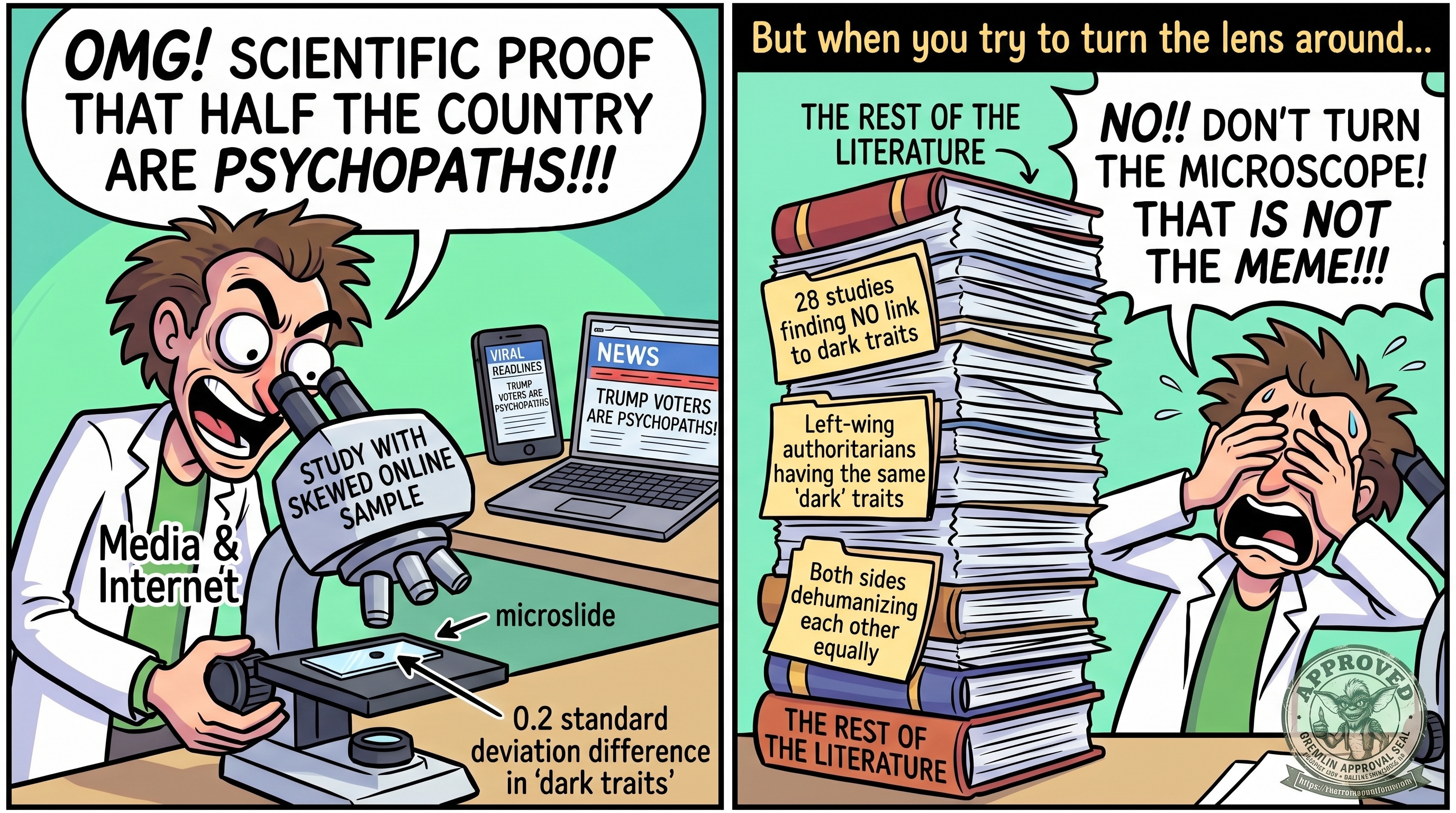
I. The Headline
Start by granting the study everything it actually earned, because the case against overreading it is stronger if you are fair to it first. Neumann and Ngo ran two cross-sectional surveys — a sample of 1,000 men and a second of 8,047 men and women — and used structural equation modeling, a respectable technique, with measurement-invariance checks across racial groups. They measured social dominance orientation, right-wing authoritarianism, the “dark triad” traits (psychopathy, Machiavellianism, narcissism), their “light triad” mirror image, and three flavors of empathy. They found that a favorable view of Trump tracked with higher authoritarianism, higher dominance orientation, and modestly elevated malevolent traits — and, on empathy, a specific pattern: Trump supporters reported lower affective empathy (feeling for others) and higher dissonant empathy (pleasure at others’ distress), but no difference in cognitive empathy — they read other people’s emotions perfectly well; they just report caring a little less on average. That is the finding. It is not nothing. The question is how big “a little less on average” actually is — and the study answers that question against itself.
II. What the Numbers Actually Say
The single most important fact about this study is buried where headlines never go: the effect sizes are small, and the study’s own data undercut the story told about it. The gaps between Trump supporters and everyone else ran about two- to four-tenths of a standard deviation — real, but modest, with enormous overlap between the groups. Put in plain terms: malevolent traits explained roughly 11 percent of the variation in men’s politics and just 3 percent in women’s. And here is the detail the authors report and the coverage ignored — the benevolent traits (humanism, faith in humanity) predicted ideology more strongly than the dark ones did. By far the strongest single predictor of Trump support in the whole model was not psychopathy at all but right-wing authoritarianism; the psychopathy increment was small and showed up only among white men. A study that the internet turned into “Trump voters are psychopaths” is, read honestly, a study in which psychopathy is a bit player.
A real effect, a small one
How much of a person’s politics the study’s “dark” traits actually account for.
III. Who Answered the Survey
Now the part that decides how much any of this travels: the people in the study are not a cross-section of America. The large sample — the 8,047 — was not drawn by a pollster from a national frame. It was web traffic. The respondents were volunteers who found their way to a positive-psychology website and chose to take an online quiz about their own “light and dark” personality traits. By the study’s own account the pool leaned heavily liberal — on the order of 70 to 75 percent — which is exactly what you would expect from the audience of a self-improvement personality site. Among a group that lopsided, the conservatives who showed up are a thin, self-selected sliver: not where the conservative average actually sits, but the subset of conservatives who voluntarily visit a positive-psychology website to measure their own darkness.
This is not a nitpick; it is a statistical wrecking ball, and it has a name: range restriction. When one end of a variable is barely represented in your sample, every correlation that touches it is distorted — sometimes shrunk, sometimes inflated, always unreliable. Methodologists have shown restriction can drop a correlation from .82 to .58 on its own. And structural equation modeling, the study’s prestige technique, offers no immunity: SEM is built on the correlation matrix, so it inherits the distortion in every factor loading and every path it estimates. A fancy model fed a skewed sample produces fancy numbers about a skewed sample. It does not produce a portrait of “conservatives” or “Trump supporters” writ large — it produces a portrait of who clicked.
IV. What “Dark” Even Measures
Even granting the sample, there is a problem one layer deeper: the “dark” label imports clinical menace into scales that do not measure it. The short dark-triad questionnaires this literature runs on — the “Dirty Dozen,” the SD3 — have a well-documented habit of failing to measure the three distinct things they claim to. When researchers put the SD3 to the test, its Machiavellianism subscale correlated more tightly with a psychopathy measure (around .67) than with the construct it was named for; the questionnaire tends to collapse from three clean traits into a fused “dark dyad” plus narcissism. A whole cottage industry of replacement scales exists for the sole purpose of prying Machiavellianism and psychopathy back apart — which is itself a confession that the originals cannot. What these items reliably capture, in Big Five terms, is low agreeableness — general antagonism. That is a real trait. But “disagreeable people lean a certain way” is a far more modest, far less lurid sentence than “psychopaths support Trump,” and it is closer to what the instruments can actually support.
V. The Forking Path
Here is the finding that should make anyone cautious about a single model’s verdict — it comes from this exact field, and it is a warning shot. A 2026 study in Current Psychology looked at the link between narcissism and left-wing authoritarianism and found something unnerving: the answer flipped sign depending on one modeling choice. Bundle the dark traits into a single “dark triad” factor and the association comes out positive — the tidy, expected result. Model the three traits separately, on the very same data, and narcissism’s link to left-wing authoritarianism turns negative (b = −0.28), while psychopathy’s runs positive (b = +0.43). One decision — one factor or three — reverses the headline. This is what methodologists mean by “researcher degrees of freedom”: the demonstration that undisclosed flexibility in how you analyze data can push the false-positive rate from 5 percent past 60. A well-fitting SEM is one path through a garden of forking paths, and a study that reports only the path it took has not shown you the paths it didn’t.
Same data, opposite answer
How narcissism and psychopathy relate to left-wing authoritarianism — once you model the traits separately.
VI. The Whole Literature, Averaged
One study is one study. The way to escape its quirks is to average the field — and when you do, the dark-trait story largely evaporates. A 2024 systematic review and meta-analysis pooled 28 studies measuring dark-tetrad traits against political orientation. The verdict: psychopathy, narcissism, and Machiavellianism show no significant association with left–right orientation. The only trait that nudged above zero was sadism, at a weak r = 0.10 — and that on just five samples, which the authors themselves flagged as tentative. In other words, the claim that “dark personalities are right-wing” is not a finding of the literature; it is a finding of some studies with particular samples, washed out as soon as you look across the whole shelf. The signal does not live in left-versus-right at all. It lives, as the next two sections show, in authoritarianism and in extremity — which both sides supply.
28 studies, one honest number
Correlation between each “dark” trait and left–right political orientation, pooled across the literature.
VII. The Empathy Nobody Studies
Now turn the microscope around, which the study never does, and ask the symmetric question: how do radicals on the left treat the people they oppose? The largest and best-replicated empathy finding in all of political psychology is not about a trait one tribe carries — it is about what partisanship does to everyone. People extend far less empathy to a suffering political opponent than to an ally, and they take quiet pleasure in the other side’s misfortune — and this runs in both directions, scaling with how strong a partisan you are. Erin Cassese found this out-group dehumanization vanishes among true independents and appears only as partisan identity strengthens. Combs and colleagues found partisan schadenfreude in both parties, strongest among the “diehards.” And a four-study program by Casey and colleagues, totaling 4,737 people, landed the cleanest blow of all: the empathy gap — how much less you feel for an opponent than an ally — is roughly the same size on the left and the right. In fact, on their target-specific measures, liberals extended less absolute empathy to conservative opponents than conservatives extended to liberals. The much-cited “liberals are more empathic” result rests on people self-reporting their own empathy; when you measure how they actually treat the other side, the advantage shrinks or reverses.
Prejudice, in both directions
Share choosing the co-partisan candidate when party was the only cue, in a scholarship-award experiment.
VIII. The Authoritarian Core
If dark traits do not track left-versus-right, what do they track? Authoritarianism — and authoritarianism is not a right-wing monopoly. For decades “authoritarian personality” was studied almost exclusively on the right, and left-wing authoritarianism was dismissed as a myth. In 2022, Thomas Costello and colleagues ended that in the field’s flagship journal, building and validating a measure of left-wing authoritarianism with three faces: anti-hierarchical aggression (burn the system down), anti-conventionalism (progressive moral absolutism), and top-down censorship (use institutional power to silence the other side). The decisive result was not that the left scale exists — it was what it correlated with. High scorers on left-wing authoritarianism and high scorers on right-wing authoritarianism share a single psychological core: dogmatism, need for cognitive closure, belief in conspiracy theories, belief in a dangerous world, a taste for chaos — and the same streak of psychopathic meanness and boldness. The authoritarian temperament is a shape, and it comes in a left-handed and a right-handed version.
The research that put dark traits and activism in the same frame found the same thing — the vehicle changes, the driver doesn’t. Krispenz and Bertrams, testing what they call the “dark-ego-vehicle principle,” found that antagonistic narcissism predicted left-wing authoritarianism (b = 0.34) and psychopathy predicted endorsement of political violence for social-justice causes — while genuine altruism and social-justice commitment predicted neither. A later extension tied the same antagonistic narcissism to both pro-choice and pro-life radicalism. And work on the “rigidity of the extremes” — including a study of 743 people using objective cognitive tasks rather than self-report — finds dogmatism, conspiracy belief, and out-group derogation rising at both poles of the spectrum, a horseshoe rather than a ramp. (In fairness, the magnitudes here are contested: a 2025 adversarial collaboration found the rigidity–extremity links real but weak, and marginally stronger on the right.) The through-line is unmistakable. What the dark traits attach to is not a party. It is the authoritarian and the zealot, wherever they stand.
The authoritarian core, left and right
Psychological traits elevated among high scorers on each wing’s authoritarianism scale.
IX. The Microscope
So put it together. The study is real but small, competently modeled but fed a sample of self-selected volunteers from a positive-psychology website that ran three-to-one liberal, using scales that mostly measure plain disagreeableness, producing effects a careful modeler could flip with a single keystroke — and even taken at face value, it finds psychopathy a bit player behind authoritarianism, and benevolent traits a stronger predictor than dark ones. None of that makes it worthless. It makes it a modest, directional correlation in a non-representative sample — which is a world away from “Trump supporters are psychopaths.” And because it is cross-sectional, it cannot even say which way any arrow points; the one long-term study that adds the missing time dimension finds that changes in personality do not drive changes in politics at all.
But the deepest problem with the study is not any flaw inside it. It is the question it was built to ask and the question it refused to ask. It pointed a microscope at one half of the country and reported what it saw. It never swung the instrument the other way — and when a larger, better literature does, it finds that the empathy deficit that actually governs American politics is not a trait of the right but a property of the tribe: both sides feel less for their opponents, both sides enjoy their opponents’ pain, both sides dehumanize across the aisle, and in some samples it is the most progressive who dehumanize hardest. The dark traits that do show up cluster not on the right but around the authoritarian and the zealot, who come in both colors. That is the honest finding, and it is less flattering to everyone, which is exactly why it does not trend. A study that only ever examines one side will always discover that the other side is fine. The trick was never the data. It was deciding where to point the lens — and agreeing, in advance, never to turn it around.
Filed on: The study itself — Craig S. Neumann & Darlene A. Ngo, “Malevolent vs. benevolent dispositions and conservative political ideology in the Trump era,” Journal of Research in Personality 118 (2025), art. 104638 (two samples, N=1,000 and N=8,047; SEM; Sample 2 drawn from a positive-psychology website, reported ~70–75% liberal; effects ~0.2–0.4 SD; malevolent traits ~11% of ideology variance in men, ~3% in women; benevolent traits a stronger predictor; RWA the strongest; empathy pattern: lower affective, higher dissonant, no cognitive-empathy difference). Why the sample breaks the inference — range-restriction / convenience-sample methodology (Sage Encyclopedia of Research Design; Thorndike correction, r .82→.58 illustration); SEM inherits the distorted covariance matrix. What the scales measure — Miller et al. (2012) on the Dirty Dozen; Persson (2019), “Searching for Machiavelli but finding psychopathy and narcissism”; Rogoza & Cieciuch (2017), SD3 collapses to a two-factor structure, Mach–psychopathy r ≈ .67. Model-spec sensitivity — “The whole picture,” Current Psychology (2026): narcissism→LWA flips to b=−0.28 (psychopathy b=+0.43) under a three-trait vs. one-factor spec; Simmons, Nelson & Simonsohn (2011), “False-Positive Psychology” (researcher degrees of freedom, 5%→60%+). The meta-analytic null — Bartolo & Powell (2024), Personality and Individual Differences 218: across 28 studies, psychopathy/narcissism/Machiavellianism show no significant link to orientation; sadism r=0.10 (k=5, tentative). The symmetric empathy literature — Iyengar & Westwood (2015), AJPS (partisan bias > racial bias; ~80% co-partisan favoritism); Cassese (2021), Political Behavior (dehumanization absent in true independents); Combs et al. (2009), JESP (bipartisan schadenfreude, strongest among diehards); Simas, Clifford & Kirkland (2020), APSR (empathic concern fuels polarization); Martherus et al. (2021) & Landry et al. (2023) (bipartisan dehumanization, ~42 pts below “fully human,” most-liberal Democrats dehumanize most in some samples); Casey, Vanman & Barlow (2025), PSPB, N=4,737 (symmetric relative empathy gap; liberals extend less absolute empathy to opponents); Iyer et al. (2012) (liberals self-report higher empathy). The authoritarian core & rigidity of the extremes — Costello, Bowes, Stevens, Waldman, Tasimi & Lilienfeld (2022), JPSP 122(1) (LWA validated; shared core with RWA); Krispenz & Bertrams (2023), Current Psychology (dark-ego-vehicle; antagonistic narcissism→LWA b=0.34); van Prooijen & Krouwel (2019), Curr. Dir. Psych. Sci.; Zmigrod et al. (2020), N=743, objective cognitive tasks (horseshoe rigidity); 2025 adversarial-collaboration caution (links weak, |rs|≈.07, slightly stronger on the right). Causation — cross-sectional design licenses no causal claim; longitudinal evidence (PMC4347987) finds personality change does not predict political-attitude change. Full research dossier retained.
№ 92 · Filed October 5, 2026 — A familiar image circulates with a list and a dare: a photograph of MSNBC’s Lawrence O’Donnell over the words “Liberals got women the right to vote. Liberals got African-Americans the right to vote. Liberals created Social Security … the Civil Rights Act … Medicare … the Clean Air Act,” and then the turn — “What did the conservatives do? They opposed them on every one of those” — closing with a vow to wear “liberal” as a badge of honor. It is a good speech. It is also, unusually for a meme, honestly sourced: O’Donnell really did write those words, as dialogue for a Democratic candidate in the live 2005 West Wing debate episode, and the credit line says so. So the dishonesty, if there is any, is not in the attribution — it is one layer down, in a single word the monologue repeats and never defines. Every sentence says “liberals” and “conservatives”; the whole charge of the piece depends on you hearing “Democrats” and “Republicans.” On the first reading the speech is largely true. On the second it is, for half its list, exactly backwards — because the party that passed the 15th and 19th Amendments and out-voted the other on the 1964 Civil Rights Act was the Republican Party, and the man who signed the Clean Air Act and built the EPA was Richard Nixon. This dispatch runs the receipts on all eight claims, separates what is true as ideology from what is false as party, and shows the one thing that reconciles them: the realignment that swapped the labels underneath the words.
The Label — What ‘Liberal’ and ‘Conservative’ Actually Built
I. The Monologue
Start with the thing this meme gets right, because it is the part most memes get wrong: the credit line. The words are not something O’Donnell blurted on cable news. They are a near-verbatim transcription of a scripted speech he wrote for The West Wing — Season 7, Episode 7, “The Debate,” a live episode broadcast November 6, 2005, performed twice for the East and West coast feeds. On screen they are spoken not by O’Donnell but by Jimmy Smits, playing Democratic presidential candidate Matt Santos, sparring with Alan Alda’s Republican senator Arnold Vinick. O’Donnell genuinely was a writer and producer on the series — a former Senate Finance Committee staff director and aide to Senator Daniel Patrick Moynihan, which is why his scripts ran policy-heavy. The meme’s parenthetical, “in dialogue written for The West Wing,” is accurate. The only quibble a strict reader can raise is that it casts a fictional character’s lines in O’Donnell’s first-person voice — but the disclosure neutralizes even that, and in any case O’Donnell re-read the speech himself, as himself, on The Last Word on November 9, 2010. On provenance, this meme passes.
Which makes what the script left out all the more telling. In the actual episode, the list is longer by one line, and that line is the whole argument in miniature. Santos says, “Liberals ended slavery.” Vinick shoots back: “A Republican president ended slavery.” And Santos answers: “A liberal Republican, Senator. What happened to them? They got run out of your party.” That exchange is the honest core of the whole speech — an open acknowledgment that the party carrying the liberal banner in 1865 was the Republican Party, and that the parties later changed. The meme quietly drops it. What survives into the image is the triumphant list and the universal accusation; what gets trimmed is the one beat where the script admitted the labels move. Hold onto that, because it is exactly the seam the rest of the meme papers over.
II. The Switch
The entire rhetorical machine runs on one word used in two senses. Every sentence of the monologue is strictly ideological — “liberals,” “conservatives,” never “Democrats,” “Republicans.” Yet the emotional payload is entirely partisan: the trigger is a Republican sneering the word “liberal,” and the implied scoreboard is “my side did all the good, your side fought it.” That is a textbook motte-and-bailey. The motte, easy to defend, is a claim about tendencies: a broadly progressive impulse — widen the franchise, build the safety net, end legal segregation, regulate pollution — drove each of these reforms, and a conservative impulse resisted each in its day. The bailey, where the speech actually scores its points, is the claim that the Democratic Party did these things and the Republican Party opposed them all. The first is largely true. The second is, for much of the list, false — and when you challenge it, the author can always retreat to “I said liberals, not Democrats.” The dishonesty is not in any single word. It is in the equivocation the format exploits and then disclaims.
What makes the switch possible is a fact of history the meme needs you to forget: the parties traded places. For the century this list spans, “liberal” and “Democrat” were not synonyms, and neither were “conservative” and “Republican.” The Party of Lincoln carried the reform banner through emancipation and suffrage; the “Solid South” was Democratic and segregationist. Only after a long realignment — cracked open by the 1948 Dixiecrat walkout, accelerated by the 1964 Civil Rights Act and Barry Goldwater’s revolt, institutionalized by Nixon’s “Southern Strategy,” and completed under Reagan — did the labels finally line up the way the meme assumes they always did.
Where “liberal” reform energy actually lived
The party that carried the progressive banner changed over the century the meme’s list spans. That migration is the whole trick.
III. The Vote
The two suffrage claims are where the meme is most backwards on party. The 15th Amendment, which barred denying the vote on account of race, was a Reconstruction-era Republican measure start to finish. On final passage in the House in February 1869 it drew 144 Republican yes votes and zero Democratic ones; the Senate pattern was the same. It was ratified in 1870 over near-unanimous Democratic opposition. By the meme’s own logic — the party that did the good thing is the heroes — the heroes here are Republicans. The 19th Amendment, women’s suffrage, is only slightly less lopsided: the House passed it 304–89 in 1919 with about 91 percent of Republicans in favor against roughly 59 percent of Democrats, and 79 percent of the “no” votes were Democrats. Republicans controlled both chambers of the Congress that sent it to the states.
That does not make suffrage a “Republican” trophy either — which is the point. A Democratic president, Woodrow Wilson, made the decisive late push for the 19th; the organized opposition was a cross-party “unholy alliance” of Southern Democrats and Northeastern Republicans; and the deepest resistance came from the conservative, Jim-Crow South, which feared Black women voting and cloaked the fear in states’-rights language. So the honest axis of conflict is progressive-versus-conservative and North-versus-South — not party, and certainly not the modern party map. As ideology, the meme’s suffrage claims are defensible. As the partisan scoreboard it implies, they are inverted.
Who actually passed the suffrage amendments
Share of each party voting “yes” on final House passage. Both were Republican-led measures.
IV. The Safety Net
Here the meme stands on its firmest ground. Social Security was conceived, driven, and passed by Franklin Roosevelt and New Deal Democrats in 1935 over fierce, explicitly ideological conservative opposition — the business-backed American Liberty League called it “socialism” and warned the bill would “mark the end of democracy.” The tell is in a procedural vote most people never see: a motion to recommit — to send the bill back and gut it — drew 95 Republicans in favor while Democrats killed it 252 to 1. Final passage was then lopsided and bipartisan (the House version carried 372–33) only because, facing a Democratic landslide and a popular bill, most Republicans who had fought it voted yes at the end. And the program’s effect is real: Social Security cuts the elderly poverty rate from the high thirties, where it would sit without benefits, to about ten percent, lifting some seventeen million seniors above the poverty line. “Lifted millions of elderly people out of poverty” is, if anything, an understatement.
What Social Security does to elderly poverty
Share of Americans 65+ in poverty, 2024 — counting Social Security income, and without it.
Medicare, in 1965, is the same story with the same honest footnote. It was the centerpiece of Lyndon Johnson’s Great Society, carried by Democratic sponsors and Democratic supermajorities, against an opposition led by the American Medical Association’s “socialized medicine” campaign and a young Ronald Reagan’s 1961 recording warning it would end American freedom. A Republican amendment to strike Medicare’s core was rejected 26–64. So the ideological claim holds. The footnote: Medicare was not a party-line vote. On final passage seventy House Republicans and thirteen Senate Republicans joined in; the opposition included conservative Southern Democrats as well as Republicans. The accurate frame is “liberals drove it, conservatives of both parties opposed it, and a bloc of Republicans still voted yes” — not “Democrats for, Republicans against.”
V. The Act
The Civil Rights Act of 1964 is the meme’s most famous vulnerability — and the clearest demonstration of its method. On a straight party count, “Democrats passed it, Republicans opposed it” is simply false: a higher percentage of Republicans than Democrats voted for it in both chambers (roughly 80 percent of House Republicans to 60 percent of Democrats; 82 percent of Senate Republicans to 69 percent of Democrats). The 54-day filibuster was run by Southern Democrats under Richard Russell of Georgia, and it was broken only when Republican minority leader Everett Dirksen delivered the bulk of his caucus for cloture. Take the party labels at face value and the meme loses this round outright.
But the party numbers hide the real fault line, which is geography. The opposition was not Republican and it was not simply Democratic — it was Southern. Break the final 73–27 Senate vote into four regional blocs and the picture snaps into focus: Northern Democrats and Northern Republicans both backed the bill by lopsided margins, while Southern Democrats killed it 20 to 1 and the lone Southern Republican voted no. The same conservative Southern bloc that had filibustered, the same “Conservative Coalition” that had throttled liberal legislation since 1937, was the opposition — and it sat inside the Democratic Party. Ending segregation more broadly followed the identical pattern: resisted by conservative Southern Democrats (Wallace, Thurmond, the signers of the 1956 Southern Manifesto) and advanced by a liberal cross-party coalition — Truman’s desegregation of the military, the unanimous Warren Court (led by a Republican appointee) in Brown, Johnson, and the movement in the streets. As ideology — liberals and segregationists — the meme is true. As party, it is backwards. Region is what reconciles the two.
The 1964 Civil Rights Act was a fight about region, not party
Final Senate passage, 73–27 (June 19, 1964), split into four regional blocs.
VI. The Air and the Water
The environmental claim is the weakest on the list — here the meme is not just imprecise but close to inverted. The Clean Air Act of 1970 passed the Senate 73–0 and the House 375–1. There was no partisan split because there was no partisanship: essentially every member of both parties voted yes. It was then signed by President Richard Nixon, a Republican, who in the same stroke created the Environmental Protection Agency. “Conservatives opposed it” is contradicted by the signature on the law. The Clean Water Act of 1972 is the one genuine toehold — Nixon vetoed it, objecting to its roughly $24 billion price tag. But it had passed the Senate 86–0, and Congress promptly overrode the veto, 52–12 in the Senate and 247–23 in the House, with 96 House Republicans and 17 Senate Republicans voting to override their own party’s president. Congressional conservatives did not oppose it; they buried the veto.
The deeper problem is anachronism. Environmental protection was a bipartisan consensus in 1970 — Governor Ronald Reagan spoke that year of “all-out war against the debauching of the environment.” The partisan divide the meme assumes did not exist until around 1990, two decades after these laws, when climate change and the end of the Cold War pulled the parties apart. The one grain of truth is that a Democrat, Edmund Muskie, was the driving legislator, and Nixon’s own motives were cynical — the EPA’s own archive records that he built the agency partly to “thwart” Muskie, his likely 1972 opponent, and his first EPA chief said Nixon “did not share the public’s concern for the environment.” But a cynical Republican who signs the Clean Air Act, founds the EPA, and gets his water-bill veto crushed by his own party is not evidence that “conservatives opposed it.” It is evidence that, in that era, they didn’t.
VII. The Honest Ledger
Lay all eight claims on one page and the pattern is unmistakable: read as ideology the speech is largely true; read as party it falls apart on everything before the 1960s. That is not two different speeches. It is one speech trading on the gap between its two readings.
Eight claims, two readings
How each claim scores as a statement about ideology (liberal vs. conservative) and as the statement about party (Democrat vs. Republican) the meme wants you to hear.
So what is honest here, and what is not? Honest: there has been a consistent progressive coalition pushing to widen the franchise, build the safety net, end legal segregation, and clean the air and water — and a consistent conservative one resisting each in its day. As an argument that “liberal” names a tradition of reform worth defending rather than a slur to flee, the speech earns its badge. Dishonest: the single word “every,” and the silent substitution of today’s party map for yesterday’s. Conservatives did not oppose every item, and for the pre-1960s half of the list the party that did the thing the meme celebrates was the Republican Party. The strongest honest conservative rebuttal is not that the reforms were bad; it is that “conservative” is being used as an all-purpose villain pinned onto whoever lost each fight — segregationist Southern Democrats, laissez-faire industrialists, and modern small-government Republicans all lumped under one word so it can never win.
An honest version of the speech would surrender almost nothing of its pride and all of its sleight of hand. It would say: every major expansion of American rights and security — the vote for women and Black citizens, Social Security, the end of segregation, the Civil Rights and Voting Rights Acts, Medicare, clean air and water — was driven by a progressive reform coalition and resisted, in its time, by a conservative one that warned against moving too fast or growing government; which party carried that banner changed, Republicans leading on emancipation and suffrage, Democrats on the New Deal and the Great Society after the parties realigned around race in the 1960s; so “liberal” names a tradition worth defending — just not one party’s permanent property. That version keeps the badge. It just stops pretending the scoreboard never moved. The irony the meme never notices is that its own source script said exactly this, in the one line about the liberal Republicans who “got run out of your party” — the line that got trimmed on the way to becoming a meme.
Filed on: Provenance — The West Wing S7E7, “The Debate” (live, aired Nov. 6, 2005; written by Lawrence O’Donnell, dir. Alex Graves; Jimmy Smits as Matt Santos, Alan Alda as Arnold Vinick); O’Donnell re-reading on The Last Word, MSNBC (Nov. 9, 2010), NBC News transcript wbna40110535; Wikipedia, “The Debate (The West Wing).” Suffrage — 15th Amendment: GovTrack 40th Cong. roll calls (House 144–44, Senate 33–9), ratified Mar. 30, 1870, National Constitution Center, Snopes (Democrats opposed the Reconstruction amendments); 19th Amendment: GovTrack House Roll Call, 66th Cong. (304–89, May 21, 1919), Senate 56–25 (June 4, 1919), U.S. House & Senate historical offices, NPS “Nemesis: The South and the Nineteenth Amendment,” the cross-party “unholy alliance.” Social Security — SSA roll-call tally (House 372–33, Apr. 19, 1935; Senate 77–6; recommit motion 95 R for / Dems 252–1 against), signed Aug. 14, 1935; American Liberty League opposition (Wikipedia; Bill of Rights Institute); poverty effect, Center on Budget and Policy Priorities (2024): 37.6% without / 10.3% with, ~17M seniors lifted. Medicare — SSA tally65 (House final 307–116, Senate final 70–24; Curtis strike amendment rejected 26–64), signed July 30, 1965; AMA “socialized medicine” campaign, Operation Coffee Cup, Reagan 1961 LP (Wikipedia; Miller Center). Civil Rights & segregation — CRA 1964 (H.R. 7152): House 290–130 (Feb. 10, 1964), cloture 71–29 (June 10), final Senate 73–27 (June 19); regional split (N. Dems 45–1, N. Reps 27–5, S. Reps 0–1, S. Dems 1–20) per U.S. Senate Historical Office, PolitiFact (July 30, 2020), New World Encyclopedia; 54-day filibuster under Richard Russell (D-GA), broken via Everett Dirksen (R-IL); Brown v. Board (1954, Warren Court, 9–0); Truman E.O. 9981 (1948); Southern Manifesto (1956); Dixiecrats (1948). Clean Air & Water — Clean Air Act 1970 (Senate 73–0, House 375–1), signed by Nixon Dec. 31, 1970; EPA created Dec. 2, 1970 (EPA Archive, “The Guardian: EPA’s Formative Years”); Clean Water Act 1972 (Senate 86–0; Nixon veto Oct. 17, 1972; overridden 52–12 Senate / 247–23 House, incl. 96 House & 17 Senate Republicans), CQ Almanac; environmental polarization dated to ~1990–91 (Yale Climate Communication; Mother Jones; LCV scorecards). Realignment — Wikipedia, “Conservative coalition,” “Dixiecrat,” “Southern strategy”; Britannica, “Southern strategy.” Full research dossier retained.
№ 91 · Filed October 4, 2026 — To buy a handgun from any licensed dealer in America you must lay a government photo ID on the counter, fill out a federal form under penalty of a felony, and wait while the FBI runs your name against three databases. Nobody calls that tyranny; it has been the law since 1998 and the Supreme Court has blessed it twice. Yet the far smaller act of showing an ID to vote has produced fifteen years of lawsuits, two landmark Supreme Court fights, and laws struck down for targeting Black voters “with almost surgical precision.” Both voting and owning a gun are constitutional rights. So why can the state demand your papers at the gun-store counter without a murmur, but only sometimes — and only under strict conditions — at the ballot box? The answer is not hypocrisy. It is a single, old, specific rule about one thing the government is forbidden to do to the vote: put a price on it. This dispatch is the owner’s manual for that rule — where it came from, exactly how far it reaches, what the fraud it guards against actually amounts to, and what the public, across every party and every race, actually thinks.
The Papers — The Double Standard on Government-Issued ID
I. Two Counters
Start with the map, because “voter ID” is not one law but a spectrum of them. Thirty-six states ask a voter for some form of identification; fourteen states and the District of Columbia do not, verifying identity by signature or against the registration roll. Among the thirty-six, the crucial dividing line is not photo-versus-no-photo but strict-versus-not: in a “strict” state a voter who shows up without the right ID casts a provisional ballot that is thrown away unless he returns, within days, to a government office with the document in hand. Only nine states run that gauntlet with a mandatory photo ID and no fallback — Arkansas, Georgia, Indiana, Kansas, Mississippi, North Carolina, Ohio, Tennessee, and Wisconsin (New Hampshire makes ten for 2026). Everywhere else, a missing ID can be cured on the spot with an affidavit, a utility bill, or a poll worker’s confirmation. The ferocious national argument is really a fight over those nine states.
The fifty-state spectrum
What a voter must actually produce at the polls, by state, under the NCSL’s five-bucket classification.
II. The Line the Ballot Cannot Cross
The whole puzzle resolves around one principle: the government may not make you pay to vote. For most of a century, Southern states used the poll tax — a small annual fee, often a dollar or two — to keep poor Black and white citizens off the rolls. In 1964 the Twenty-fourth Amendment outlawed poll taxes in federal elections. Two years later, in Harper v. Virginia Board of Elections (1966), the Supreme Court finished the job, striking Virginia’s $1.50 poll tax in state elections too, by a 6–3 vote, as a violation of the Equal Protection Clause. Justice Douglas wrote the line that governs every voter-ID case since: “Wealth, like race, creed, or color, is not germane to one’s ability to participate intelligently in the electoral process.” A fee for the ballot, however small, is per se unconstitutional. The ballot is the one thing in American life the state is flatly forbidden to sell.
That single rule is why a voter ID can never work the way a gun-store ID does. If a state could simply charge, say, twenty dollars for the ID it requires to vote, it would have reinvented the poll tax in a new costume — and Harper forbids exactly that. So every state that has imposed a strict photo-ID law has had to give the required ID away free to anyone who lacks one. The free card is not generosity; it is the constitutional price of admission. And here is where the fight gets real, because a “free” ID is only free at the window where you pick it up.
The cost of a “free” ID
What it actually takes to obtain a no-fee voter ID, set against the poll tax the Constitution outlawed.
III. Why a Free ID Still Survives the Courts
If a fee for voting is unconstitutional, why isn’t every voter-ID law? Because the Supreme Court already said it isn’t. In Crawford v. Marion County Election Board (2008), the Court upheld Indiana’s strict photo-ID law 6–3. Justice Stevens’s controlling opinion rested on three legs: the ID was free, so it was not a poll tax; the burden on the ordinary voter — “the inconvenience of making a trip to the BMV, gathering the required documents, and posing for a photograph” — was minimal; and the state had legitimate interests in deterring fraud and, tellingly, in safeguarding public confidence in elections, so that it “need not wait for fraud to occur” before acting. Notably, Indiana could point to zero cases of in-person impersonation in its own history, and the law survived anyway.
The reason voter-ID laws are judged on a sliding scale, rather than simply banned or rubber-stamped, is a framework called Anderson–Burdick. Drawn from two cases (Anderson v. Celebrezze, 1983; Burdick v. Takushi, 1992), it instructs a court to weigh “the character and magnitude” of the burden a law puts on voting against the reasons the state offers for it. A severe burden triggers strict scrutiny and usually dies; a “reasonable, nondiscriminatory restriction” needs only a sensible justification and usually lives. Voting is a fundamental right, so the state always needs a reason — but not every inconvenience is a constitutional injury. That is the needle every voter-ID law must thread: heavy enough to matter to the people who sue, light enough that a court calls it reasonable. Crawford landed on the “reasonable” side. Not every law has.
IV. Where Voter-ID Laws Die
A voter-ID law almost never falls because ID is inherently unconstitutional. It falls when the free card is a fig leaf, or when the law was built to discriminate. The first route is the “underlying documents” argument: the card is free, but the birth certificate, the trip, and the lost wages are not, and they fall hardest on the elderly, the rural, the poor, and minorities — a de facto poll tax. The Brennan Center estimates that 11 percent of eligible citizens, more than 21 million people, lack current government-issued photo ID, with people earning under $35,000 twice as likely to go without. The second route is discrimination, and this is where courts have swung hardest.
Texas and North Carolina are the cautionary tales. Texas’s SB 14 accepted a concealed-handgun license as valid voter ID but not a state university student ID — and in Veasey v. Abbott (2016) the en banc Fifth Circuit, 9–6, found it had a racially discriminatory effect that violated Section 2 of the Voting Rights Act. North Carolina went further and got caught redder-handed: its legislature requested data on which voting methods Black citizens used most, then restricted precisely those. In N.C. State Conference of the NAACP v. McCrory (2016), the Fourth Circuit struck the law down for discriminatory intent, in a sentence that has followed voter-ID politics ever since — the provisions “target African Americans with almost surgical precision.” The lesson is narrow and important: the free ID is the constitutional floor, not a guarantee. A law can clear Crawford and still die on how it was drawn.
V. The Gun-Store Counter
Now cross the street to the thing nobody litigates: the ID you show to buy a gun. The Brady Act of 1993 built the National Instant Criminal Background Check System, operational since 1998. Buy from a licensed dealer and you must present a valid government photo ID and complete ATF Form 4473, swearing under felony penalty that you are not a prohibited person; the dealer records your ID and runs the NICS check. This is a heavier identity demand than any voter-ID law in the country — and no court has ever called it an unconstitutional “poll tax on the Second Amendment.” The reason is structural: in District of Columbia v. Heller (2008), the same term as Crawford, Justice Scalia’s majority expressly blessed “laws imposing conditions and qualifications on the commercial sale of arms.” Buying a gun is a regulated commercial transaction at a point of sale. The ID is a condition on the seller’s license, not a fee the state charges you for a right.
And unlike voting, the gun-counter check has only gotten firmer under a Court that is otherwise expanding gun rights. When New York State Rifle & Pistol Ass’n v. Bruen (2022) rewrote Second Amendment law around “history and tradition,” the majority went out of its way, in footnote nine and Justice Kavanaugh’s concurrence, to preserve the forty-three states’ objective licensing regimes that “require applicants to undergo a background check.” Two years later, United States v. Rahimi (2024) upheld disarming domestic abusers 8–1 and cooled the most aggressive readings of Bruen. Point-of-sale ID and background checks sit on very firm ground. The contrast with voting is the whole point of this dispatch, so here it is on one page.
Two rights, two rulebooks
Why the same word — “ID” — means something constitutionally different at each counter.
VI. The Fraud It Is Aimed At
A photo-ID law at the polling place stops exactly one thing: a person walking in and claiming to be someone else. It is worth knowing how often that actually happens. A Loyola law professor, Justin Levitt, went looking for every credible allegation of in-person voter impersonation in the United States from 2000 to 2014 and found thirty-one — out of more than one billion ballots cast. The Brennan Center’s review of elections studied in detail put the rate between 0.0003 and 0.0025 percent; an American, it noted, is likelier to be struck by lightning than to impersonate a voter. The News21 project at Arizona State pulled public records on 2,068 alleged fraud cases since 2000 and found just ten of the in-person kind a photo ID could have stopped.
What the records actually show
Alleged election-fraud cases by type — and which ones a photo ID at the polls could prevent.
None of this means voter ID is a fraud; it means voter ID is a narrow tool aimed at a narrow problem. The documented fraud that does occur — absentee-ballot tampering, padded registration rolls — is the kind a polling-place photo ID cannot catch. Whether that makes strict ID laws pointless or merely modest depends on how much weight you give the other interest Crawford endorsed: public confidence. A great many Americans simply believe elections should check identity, and that belief, the Court held, is itself a legitimate thing for a state to protect — which brings us to what Americans actually think.
VII. What the Public Actually Wants
Here is the fact that makes voter ID so politically combustible: it is one of the most popular policies in America, and it is popular almost everywhere. Gallup found 84 percent support for requiring photo ID to vote in 2024; Pew found 83 percent in 2025; Monmouth 80 percent, AP-NORC 72 percent. The support is not merely Republican. In every one of those polls a majority of Democrats also backed it — from a low of 53 percent (Gallup 2022) to 71 percent (Pew 2025). The decade’s only real movement has been among Democrats, who dipped during the 2020–2022 voting-rights fights and then rebounded. Republicans have sat at a near-ceiling 91–98 percent the entire time. Set that beside the other identity check Americans overwhelmingly want — a background check on every gun sale, which polls around 90 percent — and you get a near-perfect mirror image.
The mirror
Support for the two identity checks, by party — each side near-unanimous on one, both above 80% overall.
The crosstab that detonates the usual framing is race. Voter-ID laws are debated as a conflict between (mostly white, mostly Republican) supporters and the minority voters the laws are said to burden. But when pollsters ask those voters directly, large majorities support photo ID too. Pew’s 2025 survey found 85 percent of white, 82 percent of Hispanic, 77 percent of Asian, and 76 percent of Black respondents in favor. Monmouth in 2021 actually found non-white support (84 percent) running higher than white support (77 percent). The policy polls above 75 percent in every racial group measured.
Everyone, more or less, agrees
Support for requiring photo ID to vote, broken out by race — the gap is small and not where you’d guess.
The paradox is that the same public that overwhelmingly wants ID also, when forced to choose, worries more about access than fraud. The June 2021 NPR/PBS/Marist poll found Americans, by 56 to 41 percent, saying it matters more that everyone who wants to vote can than that no ineligible person does. People want the check and they want it not to cost anyone their vote — which is, in plain language, exactly the balance the Constitution has been trying to strike since Harper.
VIII. The Administration’s Answer: “Free, and on Your Phone”
That last sentence — whether the free card stays free all the way down — is no longer a rhetorical flourish. It is the exact box the current administration set out to close in 2026, and it is doing so with two moves aimed precisely at the two weak points this dispatch just mapped. If the objection to strict ID is that a “free” card still costs money in underlying documents, the first move is to have Washington pay for the documents too. If the objection to documentary proof of citizenship is that getting a passport is too hard, the second move is to make the passport — the gold-standard proof — a phone-swipe away. Put together, the pitch is a syllogism: a free ID plus a frictionless digital passport equals no undue burden, which is supposed to make strict ID and proof-of-citizenship rules both constitutionally and politically clean. It is worth testing that syllogism joint by joint, because it breaks at every one.
Prong one is federal money. The FY2027 budget framework (H. Con. Res. 113, roughly $95 billion in all) routes $10 billion to the House Administration Committee as an incentive fund: states that adopt strict voter-ID and citizenship-verification laws qualify for the cash; none are forced to. It passed the House on a party line, 216–214, on July 22, 2026, and it was deliberately run through budget reconciliation to need only a simple Senate majority. A companion bill, the SAVE America Through REAL ID Act (H.R. 9141), would spend $50 million a year through 2031 to issue REAL-ID-compliant cards free to households at or below 200 percent of the poverty line — and, crucially, to pay for the supporting documents, the very birth-certificate-and-travel cost that turns a “free” ID into a $75–$175 one. Two executive orders do the rest by fiat: EO 14248 (March 2025) ordered proof of citizenship onto the federal mail-registration form, and EO 14399 (March 2026) ordered a federal “state citizenship list.” The Supreme Court, in DHS v. League of Women Voters (6–3, September 25, 2026), let the underlying citizenship database keep running.
Prong two is the passport on your phone. On September 29, 2026, Secretary Rubio and President Trump launched America.gov, a single AI-assisted front door to federal services; its headline feature is that first-time passport applications go fully online, with the stated target that the “vast majority” of Americans can apply this way by the end of 2027 — no appointment, no line. Rubio tied it explicitly to the citizenship debate, and the State Department has floated sharing passport records with state election officials to verify voters. The digital credential already exists in a narrow form: Apple Wallet’s “Digital ID” (November 2025) and Google Wallet’s passport pass (December 2024) let you load a scanned passport onto a phone. The catch is in the fine print — those wallet IDs are accepted only at TSA checkpoints for domestic air travel, are not valid at any border, and do not excuse you from carrying the physical book. A phone passport is a convenience at the airport, not a citizenship credential you can wave at a pollbook.
“On your phone” assumes a phone
Smartphone ownership by the groups the voting burden already falls on — and the passport most Americans don’t hold.
The deeper problem is that the burden was never really the ID fee — it is the documents and the database, and neither prong fixes those. Even a free card runs $75 to $175 once you count the birth certificate, the travel, and the lost wages; the 21.3 million voting-age citizens (9.1 percent) who lack ready access to any proof of citizenship still have to assemble it from scratch. H.R. 9141’s $50 million a year is aimed here, but it is unenacted, income-capped, and a rounding error against that number. Worse, the citizenship database the administration is relying on misfires on the people with the most paperwork: in Texas, of 2,724 voters flagged by the federal SAVE system as possible noncitizens, about one in five turned out to be citizens and were reinstated; in Missouri, 35 percent of those flagged were naturalized citizens; and up to 69 million married women lack a birth certificate in their current legal name, a mismatch the SAVE Act text does nothing to cure. A digital front end does not fix a database false match — it automates it.
And most of it is not law. The documentary-proof-of-citizenship idea the administration is selling polls far softer than the 83–84 percent photo-ID number from Section VII — around 71 percent in neutral wording, and splitting hard on party (Harvard CAPS/Harris found a 91 percent Republican to 50 percent Democratic gap). In Congress the pieces keep stalling: the House bolted a standalone Voter ID Act onto an unrelated bill, and the Senate failed cloture 53–47 on September 30, 2026, seven votes short. The executive orders are half-enjoined — EO 14248’s registration-form mandate was permanently blocked in November 2025 on the ground that “the President has no constitutional power over election regulation,” and 23 states are suing over EO 14399. The one piece actually operating is the error-prone database.
Where each piece of the 2026 push actually stands
The administration’s answer is mostly proposed, stalled, or enjoined — only the database is live.
So the administration’s answer to the poll-tax problem is “we’ll make the ID free and put the passport on your phone.” But the burden was never the fee or the trip to the DMV. It is the underlying documents, the half of Americans with no passport, the 9 percent with no smartphone, and a database that flags citizens by the thousand. “Free” is a bill that has not passed; “on your phone” is an airport convenience that half the country cannot load and that does not work at a pollbook anyway. Digitizing a burden is not the same as removing it — which returns us, one last time, to the honest ledger.
IX. The Honest Ledger
The strongest case for voter ID is the one this dispatch opened with: you already show ID to buy a gun, board a plane, or open a bank account, so a free ID to vote asks nothing unusual, and a supermajority of every party and race agrees. The strongest case against is that the firearm analogy cuts both ways. Gun-rights advocates make the inverse argument with the identical logic: if voting is a right the state may not price (Harper), then special gun taxes and four-figure carry-permit fees are the Second Amendment’s poll tax — and they cite the same doctrine the voting cases rest on (Murdock v. Pennsylvania, 1943: “a state may not impose a charge for the enjoyment of a right granted by the Federal Constitution”). Post-Bruen, some courts are listening. The principle, in other words, is not partisan; each side invokes it when the right being priced is the one it cares about.
So the honest answer to the question this dispatch asked is not “hypocrisy.” It is a distinction the Constitution actually draws, for a reason rooted in a specific history. Because a century of poll taxes and literacy tests used money and paperwork to strip Black Americans of the vote, the Constitution singles out the ballot — and only the ballot — for a hard rule against wealth barriers (the 24th Amendment and Harper). Buying a gun triggers no such rule, because Heller treats the sale as commerce the state may condition. That is why the gun-store ID is invisible and the voting ID is a battlefield: not because one right matters more, but because one of them, and only one, carries a constitutional promise that it will never again be something you have to pay for. The fight over voter ID is not really about the card. It is about whether the free card stays free all the way down — through the birth certificate, the DMV line, and the day of lost wages — to the citizen who needs it most.
Filed on: The poll-tax bar — U.S. Const. amend. XXIV (1964); Harper v. Virginia Bd. of Elections, 383 U.S. 663 (1966), 6–3 (Douglas), overruling Breedlove v. Suttles (1937). Voter ID upheld — Crawford v. Marion County Election Bd., 553 U.S. 181 (2008), 6–3 (Stevens plurality); the Anderson–Burdick balancing test from Anderson v. Celebrezze, 460 U.S. 780 (1983) and Burdick v. Takushi, 504 U.S. 428 (1992). Voter ID struck — Veasey v. Abbott, 830 F.3d 216 (5th Cir. 2016) (en banc, 9–6, VRA §2 discriminatory effect, TX SB 14); N.C. State Conf. of the NAACP v. McCrory, 831 F.3d 204 (4th Cir. 2016) (discriminatory intent, “almost surgical precision,” Motz, J.). The firearms side — Brady Handgun Violence Prevention Act (1993); NICS operational 1998, 18 U.S.C. § 922(t); ATF Form 4473; District of Columbia v. Heller, 554 U.S. 570 (2008), 5–4 (Scalia, “conditions and qualifications on the commercial sale of arms”); NYSRPA v. Bruen, 597 U.S. 1 (2022), 6–3 (Thomas; fn. 9 and Kavanaugh, J., concurring, preserving shall-issue background checks); United States v. Rahimi, 602 U.S. 680 (2024), 8–1 (Roberts); counterpoint Murdock v. Pennsylvania, 319 U.S. 105 (1943). The state map & costs — NCSL, “Voter ID Laws” (July 2, 2025): 36 states request ID, 9 strict photo; Brennan Center, Citizens Without Proof (2006), 11% / 21M+ lack photo ID; Richard Sobel, Harvard Law (2014), “free” ID real cost $75–$175 (to $368; $1,000+ with legal fees); state vital-records birth-certificate fees $9–$45; Giffords Law Center, 19 states + D.C. with universal background checks. The fraud — Justin Levitt / Washington Post (Aug 6, 2014), 31 credible in-person impersonation cases per 1B+ ballots, 2000–2014; Brennan Center, The Truth About Voter Fraud (2007), 0.0003%–0.0025%; News21 / Arizona State (Aug 2012), 10 in-person of 2,068 cases (491 absentee, 400 registration); Carter–Baker Commission (2005). The polling — Gallup Oct 2024 (84%, R 98 / D 67; n=1,023, ±4); Pew Aug 2025 (83%; White 85 / Hispanic 82 / Asian 77 / Black 76; R 95 / D 71); AP-NORC Mar 2021 (72%); Monmouth Jun 2021 (80%; non-white 84 > white 77); NPR/PBS/Marist Jun 2021 (~79%; access over fraud 56–41); gun background checks ~90% (Gallup 2018 92%, Quinnipiac 2021 89%, Pew 2021 81%). The 2026 push — H. Con. Res. 113, FY2027 budget framework (~$95B; $10B elections incentive fund to House Administration), House Roll Call 281, 216–214, July 22, 2026; SAVE America Through REAL ID Act, H.R. 9141 (Reps. Fedorchak & Lee, introduced June 4, 2026; $50M/yr FY2027–2031, free REAL ID + supporting documents, ≤200% FPL); Voter ID Act rider on H.R. 7008, Senate cloture failed 53–47, Sept. 30, 2026; Exec. Order 14248 (90 FR 14005, Mar. 25, 2025), partially enjoined Apr. 24, 2025 and permanently Nov. 2025, LULAC v. Executive Office of the President (D.D.C., No. 1:25-cv-00946); Exec. Order 14399 (91 FR 17125, Mar. 31, 2026), challenged by 23 states + D.C. (D. Mass., filed Apr. 3, 2026); DHS v. League of Women Voters, No. 26A308 (per curiam, 6–3, Sept. 25, 2026) (SAVE database stay). America.gov & the digital passport — America.gov launch (Sec. Rubio / President Trump, Sept. 29, 2026); online first-time passport applications targeted for the “vast majority” by end of 2027 (State Dept.); Apple Wallet “Digital ID” (iOS 26.1, Nov. 12, 2025) and Google Wallet passport pass (Dec. 2024), accepted at 250+ TSA checkpoints for domestic travel only, physical passport still required. The digital divide & database error — Pew Research Center, Mobile Fact Sheet (2025 data): 91% of adults own a smartphone (65+ 78%, under-$30k 82%, rural 87%), 16% smartphone-dependent (34% of poorest), ~1 in 5 without home broadband; U.S. State Dept., ~48% of Americans hold a valid passport (2024); Brennan Center / VoteRiders / Univ. of Maryland (June 2024): 21.3M voting-age citizens (9.1%) lack ready proof of citizenship; Texas SAVE review (~20% of 2,724 flagged confirmed citizens), Missouri (35% of flagged naturalized); Center for American Progress (up to 69M married women lack a birth certificate in their current name); documentary-proof-of-citizenship polling 51–75% with a 91% R / 50% D split (Harvard CAPS/Harris, Feb. 2026; UMass Apr. 2025; Marist Apr. 2025). Full research dossier retained.
№ 90 · Filed October 4, 2026 — There is a branch of mathematics whose entire subject is the moment your best move depends on what someone else is about to do — and whose central, uncomfortable finding is that a room full of perfectly rational people, each doing the smartest thing for themselves, will reliably walk straight into an outcome every one of them hates. It has a cold name, game theory, and a warm pedigree: it was built by a Hungarian polymath who also helped build the atomic bomb and the computer, sharpened by a Princeton graduate student in a twenty-eight-page thesis, and has since collected a shelf of Nobel Prizes. It priced the airwaves your phone runs on, matched the kidney that is keeping someone alive this morning, taught a machine to bluff four poker pros out of $1.7 million, and sat quietly underneath the thirteen days in 1962 when the species came closest to ending itself. This dispatch is the owner’s manual for that math: what it is, who wrote it, the handful of little games that contain the whole theory — and the places where real human beings, stubbornly, refuse to play along.
The Game — What Game Theory Says About a Room Full of Rational People
I. The Math of Other People
Start with the one idea that makes game theory different from every other kind of decision-making. When you choose a route to avoid traffic, nature does not adjust the roads to spite you. But when you choose a price, a bid, a bluff, or a battle plan, the other side is reasoning about your reasoning and moving in response. That is the whole subject in a sentence: game theory is the formal study of strategic interdependence — situations where my best move depends on what I think you will do, and your best move depends on what you think I will do. A “game,” in the technical sense, is just any situation with two or more players, a set of strategies available to each, and payoffs that fall out of the combination of everyone’s choices. The word is a misnomer that has fooled people for eighty years; there is nothing playful about it. Nuclear standoffs, cartel pricing, evolution, and the auction that sold your cell-phone spectrum are all “games.”
It is less a catalog of answers than a method for turning a messy situation into a solvable one. The recipe von Neumann and Morgenstern invented is still the one every analyst runs: identify the players, write down every strategy each one has, assign the payoff for each combination, then solve for the stable point — the profile of choices where nobody, acting alone, can do better by changing their mind. There is a fork in the road early on. In a non-cooperative game, no promise is binding; any deal is “cheap talk” a player can break the instant it pays to, so the only agreements that hold are the ones that are self-enforcing. In a cooperative game, binding contracts and coalitions are allowed, and the question shifts to how a group splits the surplus it creates. Most of the drama — and most of this dispatch — lives on the non-cooperative side, where talk is cheap and only incentives are real.
II. The Inventors
The field has a founding document and a founding genius, and the genius was terrifying. Scattered anticipations go back centuries — a 1713 letter on a card game, Cournot’s 1838 duopoly, Zermelo’s 1913 proof that chess is strictly determined, Borel’s 1920s work on mixed strategies — but the field proper begins with John von Neumann. In 1928 he proved the minimax theorem: in any two-person zero-sum game, there is a “value,” a guaranteed result each side can secure with the right (possibly randomized) play. “As far as I can see,” he wrote, “there could be no theory of games … without that theorem.” Then in 1944, with the economist Oskar Morgenstern, he published Theory of Games and Economic Behavior — the eight-hundred-page book that created the field, introduced cooperative games, and built the theory of expected utility that lets us put numbers on preferences at all. This is the same von Neumann who worked on the Manhattan Project and the architecture of the modern computer. Game theory was, for him, almost a side quest.
The leap that turned a clever theory into a universal one was made by a twenty-two-year-old. Von Neumann’s minimax only covered strictly competitive, two-player, zero-sum games — the pie is fixed, my gain is exactly your loss. Real life is rarely so tidy. In 1950, in a Princeton doctoral thesis barely twenty-eight pages long, John Nash defined an equilibrium for any finite game — any number of players, interests that partly align and partly clash — and used a fixed-point theorem to prove that at least one such equilibrium always exists. A Nash equilibrium is a set of strategies, one per player, where no single player can do better by changing course alone: everyone is simultaneously giving their best reply to everyone else. It is the concept that let game theory escape the casino and colonize economics, biology, and political science. Nash spent three decades after that largely lost to paranoid schizophrenia, recovered, and received the Nobel in 1994; the story reached the public as A Beautiful Mind.
The rest of the field is a lineage of people who each added one missing piece — and the Nobel committee kept the receipts. Reinhard Selten refined Nash to throw out equilibria propped up by threats no one would actually carry out (subgame perfection). John Harsanyi showed how to handle players who don’t know each other’s true motives, inventing the games of incomplete information that model every negotiation with a hidden hand. Thomas Schelling brought it to the brink of nuclear war; Robert Aumann mapped what happens when the same game is played over and over. Lloyd Shapley worked out how a coalition should fairly split its winnings and, with David Gale, how to match two sides into stable pairs. Five Nobel Prizes, shown below, trace the arc from pure theory to the machinery that now runs real markets.
Six decades, five Nobel Prizes
Sveriges Riksbank Prize in Economic Sciences awarded for work in game theory and its direct descendants.
III. The Trap
If you learn one game, learn this one, because it is the reason game theory is unsettling rather than merely clever. Two suspects are arrested and held apart. Each can stay silent (cooperate with the other) or betray (confess). If both stay silent, the state has a weak case and both do lightly. If both betray, both do badly. But if one betrays while the other stays silent, the betrayer walks and the silent one takes the whole sentence. Write the payoffs so that higher is better, and the trap springs on its own: whatever the other person does, betraying leaves you better off than staying silent. Betrayal is a dominant strategy — the best move no matter what. So two rational players both betray and land on the mutual-defection cell, even though they can both plainly see the cell where they both stay silent is better for each of them.
The Prisoner’s Dilemma
Payoffs to (You, the other player); higher is better. Each has one dominant move — and it drags both to the worst stable outcome.
This is the whole moral of the subject compressed into four boxes: a Nash equilibrium predicts what rational players will do, not what is best for them. The point where nobody wants to move alone can be a point everybody wishes they could leave together. Once you have seen it here you will see it everywhere — in arms races, in overfishing, in price wars, in a warming planet. Every one of them is a prisoner’s dilemma wearing a different coat, and in every one the gap between “individually rational” and “collectively sane” is exactly the space where politics, law, and institutions have to do their work — or fail to.
IV. The Family of Games
The prisoner’s dilemma is the most famous of a small family of two-by-two games, and the others are just the same four payoffs reshuffled into a different order. Swap two numbers and the dilemma becomes the Stag Hunt: now cooperating is a Nash equilibrium too, so the problem is no longer temptation but trust — both hunters do best chasing the stag together, but if you doubt your partner you grab the safe hare and you both go hungry on the big prize. Reshuffle again and you get Chicken — two drivers racing head-on, where the catastrophe is mutual stubbornness and the winner is whoever can most credibly throw his steering wheel out the window. Biologists call the identical game Hawk–Dove and use it to explain why animals bluff and posture instead of fighting to the death. And some games have no stable pure answer at all: in Matching Pennies — the logic of a penalty kick or a poker bluff — any predictable choice gets exploited, so the only equilibrium is to randomize, which is von Neumann’s minimax made flesh.
Four games, one deck of payoffs
The canonical 2×2 games are distinguished entirely by how the same four payoffs are ranked.
A second family lives not on a grid but on a game tree, where players move in turn and can see what came before. These are solved by backward induction — reason from the last move back to the first — and the method produces its own paradoxes. In the Centipede game, two players alternately decide whether to grab a growing pot or pass it back; backward induction says grab on the very first move and end it while the pot is tiny, even though a few rounds of mutual passing would make both far richer. Real people, mercifully, pass for many rounds. That gap — between what the math declares rational and what humans actually do — is the hinge of the final section.
V. The Way Out: Playing Again Tomorrow
The dilemma looks like a prison until you notice one thing: in life, you almost always play the same people again. When the prisoner’s dilemma is repeated indefinitely, cooperation stops being irrational, because a betrayal today can be punished tomorrow — the “shadow of the future” changes the whole calculation. The formal result, the folk theorem, says that among sufficiently patient players almost any outcome, cooperation included, can be held in place as an equilibrium by the credible threat of future retaliation. In 1980 the political scientist Robert Axelrod ran the experiment for real: he invited experts to submit computer strategies to play the repeated dilemma against each other in a round-robin tournament. The winner, in both the first tournament and a larger rematch where everyone already knew it had won, was the simplest program entered — four lines of code, submitted by Anatol Rapoport, called Tit for Tat: cooperate on the first move, then do whatever your opponent did last time.
Tit for Tat never once beats the player across the table — and it wins the tournament anyway. It cannot beat anyone, because it never defects first; the best it can do in any single match is tie. But by being a good partner it racks up a mountain of mutual-cooperation payoffs across the whole field while the clever, nasty strategies grind each other into the dust. Axelrod distilled why it works into four properties that read like advice for a life, not just a tournament: be nice (never defect first), be provocable (punish a betrayal at once, so you can’t be used), be forgiving (go back to cooperating the moment the other side does, so grudges don’t spiral), and be clear (stay predictable enough that the other side can learn that cooperating with you pays). Its one great weakness is noise: between two tit-for-tatters a single accidental defection can touch off an endless echo of revenge — which is why its gentler cousins, “generous” tit for tat and win-stay-lose-shift, sometimes do better. The lesson that launched a thousand management books is real but narrow: in a repeated, non-zero-sum world, you do not have to beat your opponent — you have to be worth cooperating with.
VI. The Board Is the Real World
None of this would matter if it stayed on the chalkboard. It did not. The purest triumph is the auction. When the US government decided to sell the radio spectrum that mobile phones run on, it hired game theorists — Paul Milgrom and Robert Wilson chief among them — who designed the Simultaneous Multiple Round Auction, first used in 1994. It is now the global standard, and it has been a money machine for the Treasury: the 2021 C-band auction alone drew $81 billion in a single sale (Verizon $45.5 billion, AT&T $23.4 billion, T-Mobile $9.3 billion), and cumulatively the format has raised well over $200 billion. Milgrom and Wilson got the 2020 Nobel for it.
The receipts: what an auction format earned
Cumulative revenue raised for the US Treasury by spectrum auctions using the Milgrom–Wilson design, $ billions.
The same math that priced the airwaves also redesigned who lives. Alvin Roth took Shapley’s abstract matching theory and became, in his own phrase, an economic engineer: he rebuilt the national medical-residency match, the New York City high-school match that places more than ninety thousand students a year, and — most vividly — kidney exchange, chaining incompatible donor-patient pairs into loops so that a stranger’s donation can ripple through dozens of operating rooms. One US registry alone recorded 1,568 transplants from 344 donor chains in eight years, with record chains running sixty and seventy people long. A theorem from a 1962 paper, now measured in lives.
Push the theory into machines and it becomes the engine of modern AI. A generative adversarial network — the technology behind a decade of synthetic images — is literally a two-player zero-sum minimax game between a forger and a detective, training toward a Nash equilibrium. DeepMind’s AlphaGo beat the world’s best Go player 4–1 in 2016; its successors learned chess and Go from scratch by playing themselves, which is just iterated game-theoretic learning. And in 2017 Carnegie Mellon’s Libratus became the first machine to crush professionals at no-limit poker — a game of hidden cards and bluffing, i.e. imperfect information — beating four pros out of more than $1.7 million in chips over twenty days. The researcher behind it, Noam Brown, carried the same “think harder at decision time” insight to OpenAI’s reasoning models.
And then there is the board CROWN readers already know — power, money, and war — where game theory is less a tool than an X-ray. Thomas Schelling modeled nuclear deterrence as a game of credible commitment and framed the Cuban Missile Crisis as a thirteen-day round of Chicken; one dynamic re-analysis estimates the probability of nuclear war climbed as high as sixty percent as both sides lost control of the risk. The US–Soviet arms race is the textbook iterated prisoner’s dilemma — “build” dominates for each side, so both arm, though both would be safer and richer disarming. Climate change is the same structure scaled to the planet: every nation would prefer others bear the cost of cutting carbon, so William Nordhaus (2018 Nobel) diagnoses chronic free-riding and prescribes “climate clubs” with tariffs to flip the incentive. Voluntary vaccination fails to reach herd immunity for the identical reason — once enough others are immune, the rational move is to free-ride. Even the corporate PACs CROWN has tracked are playing a solved game: hedging money roughly evenly across both parties isn’t confusion, it’s buying a seat at every table no matter who wins. The theory keeps predicting the cynical outcome because the incentives keep producing it.
VII. Where the Humans Rebel
Here is the twist that keeps game theory honest: drag it into a lab with actual people, and they routinely refuse to behave the way the math insists they must. In the Ultimatum game, one player proposes how to split a pot and the other can only accept or reject — and if they reject, both get nothing. Cold theory says the responder should accept any scrap, since something beats nothing, so the proposer should offer the minimum. In reality, across hundreds of experiments and many cultures, proposers offer forty to fifty percent, and responders angrily reject lowball offers about half the time — paying real money to punish unfairness. In the Centipede game people cooperate for round after round instead of grabbing early. In the “guess two-thirds-of-the-average” contest the only rational answer is zero, yet real guesses cluster around twenty-two and thirty-three, because people know they are rational but doubt everyone else is — and they’re right to.
Those “failures” are not the theory breaking; they are the theory doing its most valuable job. Game theory assumed humans were cold payoff-maximizers, made a crisp prediction, and the crispness is exactly what let researchers measure how and where we deviate — and the deviations have names now: fairness, reciprocity, spite, bounded rationality, the simple fact that we do not trust each other to be perfectly selfish. An entire field, behavioral economics, was born in that gap between the equilibrium and the experiment. So take the subject for what it honestly is. It is not a law of human nature; people are warmer and dumber and better than its cold little prisoners. It is something more useful: the sharpest available map of the incentives we actually face — a map that shows you, with uncomfortable precision, exactly which rooms rational self-interest will walk everyone into, and therefore exactly where we have to build the trust, the institutions, and the enforceable promises that let us walk out together. The math tells you where the trap is. Climbing out was always going to be the human part.
Filed on: Foundations — von Neumann, “Zur Theorie der Gesellschaftsspiele,” Mathematische Annalen 100:295–320 (1928, minimax theorem); von Neumann & Morgenstern, Theory of Games and Economic Behavior (Princeton, 1944); John Nash, “Equilibrium Points in n-Person Games,” PNAS (1950) and “Non-Cooperative Games,” Annals of Mathematics 54 (1951); precursors Waldegrave (1713), Cournot (1838), Zermelo (1913), Borel (1920s). Pioneers & Nobels — 1994 Nash/Harsanyi/Selten (“equilibria in non-cooperative games”), 2005 Schelling/Aumann, 2007 Hurwicz/Maskin/Myerson (mechanism design), 2012 Roth/Shapley (stable matching), 2020 Milgrom/Wilson (auctions), nobelprize.org; Harsanyi, “Games with Incomplete Information” (1967–68); Selten, subgame-perfect equilibrium (1965); Maynard Smith & Price, “The Logic of Animal Conflict,” Nature 246 (1973, ESS); Shapley & Gale, “College Admissions and the Stability of Marriage,” Amer. Math. Monthly (1962). The games — Prisoner’s Dilemma payoffs and the T>R>P>S ordering, Stag Hunt, Chicken/Hawk–Dove, Matching Pennies, Centipede, Ultimatum / Dictator / p-beauty contest, per Stanford Encyclopedia of Philosophy (“Game Theory,” “Prisoner’s Dilemma,” “Evolutionary Game Theory”); Güth, Schmittberger & Schwarze (1982, ultimatum); Nagel (1995, beauty contest); McKelvey & Palfrey (1992, centipede). Repeated play — Robert Axelrod, The Evolution of Cooperation (1984) and Axelrod & Hamilton, Science 211 (1981); Tit for Tat by Anatol Rapoport; folk theorem (Aumann, Rubinstein). Applications — FCC spectrum auctions, SMRA from 1994, cumulative >$114.6B through FY2017 and >$233B by 2025, C-band (Auction 107, 2021) net $81.1B with Verizon $45.5B / AT&T $23.4B / T-Mobile $9.3B (FCC; SpaceNews); Roth, Sönmez & Ünver, “Kidney Exchange,” QJE (2004), National Kidney Registry 1,568 transplants / 344 chains (2008–2016); NYC & Boston school match (Abdulkadiroğlu, Pathak, Roth); Goodfellow et al., GANs (NeurIPS 2014); AlphaGo 4–1 vs. Lee Sedol (2016); Brown & Sandholm, Libratus, Science (2018), $1,766,250 over 120,000 hands; Schelling, The Strategy of Conflict (1960) and Arms and Influence (1966); Cuban Missile Crisis as dynamic Chicken (Dixit, McAdams & Skeath); Nordhaus, “Climate Clubs,” AER (2015); Bauch & Earn, “Vaccination and the theory of games,” PNAS (2004). Full research dossier retained.
№ 89 · Filed October 2, 2026 — On September 30 Missouri unveiled a new State Energy Plan built on four words that poll beautifully: energy independence, economic growth, grid reliability, nuclear enablement. Three of those are the wrapping paper. The fourth is the engine, and inside it sits one line that does the real work — a proposal to let utilities bill you for a nuclear plant while it is still being built, before it has produced a single watt, possibly for one that never produces any at all. Missourians already voted on exactly this. In 1976 they banned it, 63 to 37, specifically to stop a utility from charging them for the Callaway reactor mid-construction. The 2026 plan is the paperwork to finish overturning that vote. This is the fine print: what the plan actually proposes, the half-century-old receipt it is trying to shred, and the track record of the precise financing trick it wants to bring back.
The Advance — A Nuclear Plant Hidden Inside an Energy-Independence Press Release
I. The Pitch
The plan opens with a number designed to alarm you, and it works. Missouri, the Department of Natural Resources says, has gone from a net exporter of electricity to a net importer — in 2025 it leaned on other states for “over 15 percent” of the power it used. Data centers are coming; demand is climbing; the legacy coal fleet is aging out. Governor Kehoe’s framing is tidy: “take better control of our energy future… put Missouri First.” The headline solution is nuclear — pitched as the only power source that is both carbon-free and available on demand. It is an appealing story, and like most appealing stories it is told at the altitude where the inconvenient details disappear.
Here is the detail the pitch skips: Missouri does not run on nuclear, and it does not run on renewables. It runs on coal. By the most recent full-year utility-scale figures, coal is still nearly two-thirds of the state’s generation. The single Callaway reactor — online since 1984, the only nuclear plant in the state — is under 10 percent. “Energy independence” for Missouri is not a choice between nuclear and imports; it is a decades-long question of what replaces a coal fleet that is 63.8 percent of the grid.
What Missouri actually runs on
Missouri electricity generation by source, full-year 2025, utility-scale (EIA-derived). Coal is still nearly two-thirds of the grid.
II. The Fine Print
“Nuclear enablement” is not one idea; it is five, and four of them are throat-clearing for the fifth. The plan asks the state to (1) let a state authority make loans for nuclear, (2) study a new Missouri Nuclear Power Authority to finance and build it, (3) fund a nuclear workforce pipeline, and (4) rewrite the voter-passed Renewable Energy Standard into an “Advanced Energy Standard” so nuclear counts toward it. Reasonable-sounding, all of them. Then comes (5), stated in the gentlest possible language: “establish ratepayer protections that, if met, would allow the Missouri Public Service Commission to approve limited, conditional cost recovery for advanced nuclear projects before commercial operation.”
Translate it out of the plan’s dialect and it has a name the plan never uses: CWIP — Construction Work In Progress. It means the utility starts charging you for a power plant the day the shovel hits the dirt, folding construction costs into your monthly bill years before the plant turns on. Normally the risk of a megaproject sits with the company’s shareholders: they front the capital, and they only get to recover it once the plant is “used and useful.” CWIP inverts that. It moves the risk onto you. As the attorney for Missouri’s big industrial power users put it, in states that allow it “projects often run way over budget or are abandoned — leaving customers with no return on their involuntary investment.” And the incentive to control costs goes with it: when the ratepayer is guaranteed to pay from day one, the builder has, in one legislator’s words, “very little incentive to hold its cost down.”
The tell is in the drafting. The 2026 bills (HB 2122, the “Missouri Nuclear Clean Power Act,” passed the House 95–53) scope CWIP to “clean baseload” plants of 600 MW or less not yet in commercial operation — a definition shaped like a small modular reactor. The Senate, meanwhile, adopted an amendment to ban CWIP for nuclear by a single vote, 14–13. The legislature knows exactly what this is. It cannot agree on whether to do it.
III. The Vote They’re Overturning
Missourians have already had this exact fight, and already won it — in 1976. Back then the Public Service Commission had let Union Electric — today’s Ameren — bill customers for the Callaway reactor while it was still under construction. A grassroots revolt put Proposition 1 on the ballot to ban the practice outright. The utilities massively outspent the campaign. They lost anyway, 63 percent to 37, roughly a million votes to six hundred thousand. The law declared pre-operation construction charges “unjust and unreasonable,” and it did its job: when the second Callaway reactor spiraled, it was cancelled in 1980 before ratepayers were on the hook for a plant that never got built. That is the receipt the 2026 plan is trying to shred.
Missourians voted on this — twice
Two voter-passed Missouri ballot measures, and the 2025–26 legislative moves now unwinding each.
The dismantling is already half-finished. In 2025 Governor Kehoe signed SB 4, which repealed the 1976 ban — but only for natural gas plants. Extending it to nuclear was fought over and deliberately left out. The 2026 State Energy Plan is the vehicle to finish the job. And the companion move — converting the 2008 voter-passed Renewable Energy Standard (also approved by a landslide, 66 percent) into an “Advanced Energy Standard” — quietly lets nuclear displace the renewable build-out voters actually mandated, with one bill proposing to halve the renewable target outright. Two statewide votes, a half-century apart, both being rewritten by a legislature that lost at the ballot box. “It burns me up,” said the board president of the Consumers Council of Missouri, “that the legislature would just cavalierly toss out what we passed in 1976 by a 63 percent margin.”
IV. The Receipts
The reason Missourians banned this in the first place is not theoretical. It is written on power bills in Georgia and South Carolina right now. The two most recent American attempts to build nuclear on ratepayer-funded CWIP are the whole case for the defense. In Georgia, Plant Vogtle’s two new reactors were sold in 2009 at $14 billion, online by 2017. They came in at $36.8 billion and roughly seven years late — the most expensive power project in U.S. history — with Georgia customers pre-paying some $926 apiece for construction through exactly the kind of charge the plan wants to enable. In South Carolina, the twin V.C. Summer reactors were abandoned in 2017 after about $9 billion was spent; customers had already paid around $2 billion through CWIP surcharges for two reactors that will never produce a watt, and were still being billed for them after cancellation.
The last two times America tried this
CWIP-financed U.S. nuclear new-builds of the 2010s: what ratepayers were promised vs. what happened.
And the bet Missouri is being asked to pre-fund is the most expensive firm power on the board. On unsubsidized levelized cost, new large nuclear runs roughly $141–$228 per megawatt-hour — the priciest option in the stack. Even small modular reactors, the plan’s actual target, pencil out around $80–$180, above gas and well above wind and solar. That premium might be worth paying for firm, carbon-free power — except there is not yet a single commercial SMR operating anywhere in the United States. The flagship first-mover, NuScale’s project in Idaho, was cancelled in 2023 after its promised price climbed from $58 to $89/MWh and utilities walked. The earliest realistic commercial dates for the designs Missouri is eyeing are 2030–2035 — years of CWIP charges on your bill before a watt arrives, if it arrives.
The most expensive firm power on the board
Unsubsidized levelized cost of energy, new-build, $/MWh (Lazard 2025). Nuclear sits at the top of the stack.
V. The Verdict
None of this means nuclear is a bad idea, or that Missouri’s grid problem is fake. The demand curve is real, the coal fleet is genuinely retiring, and firm carbon-free power has a legitimate place in the answer. Reasonable people can want more nuclear. The question the plan buries under three pillars of friendly language is narrower and sharper: who carries the risk that it goes wrong? For fifty years in Missouri, the answer was the shareholder, because voters put it there on purpose. The 2026 plan’s quiet proposal #5 moves it to you — before the plant runs, with no incentive to control the cost, for the priciest and slowest technology on the menu, using a financing mechanism whose last two outings produced one plant at 2.5× its budget and one $9 billion hole in the ground.
Missouri’s own ratepayer advocates estimate CWIP financing of a nuclear plant could cost the average household on the order of $5,000 over the first decade of construction — money charged for power not yet delivered, possibly never delivered. “Energy independence” is a fine slogan. But independence, in this plan, is the one thing the ratepayer loses: the right — won at the ballot box in 1976 — not to be billed in advance for someone else’s bet. Read the fine print before they file it for you.
Filed with receipts. Sources: Missouri DNR State Energy Plan & Gov. Kehoe press materials (Sept 30, 2026); EO 26-04; EIA Missouri Electricity Profile; HB 2122 / SB 838 / SB 1398 and the 2025 SB 4 record; Missouri Secretary of State (Prop 1, 1976; Prop C, 2008); Lazard LCOE+ 2025; PowerMag / AJC / Georgia Watch (Vogtle); Utility Dive (V.C. Summer); Consumers Council of Missouri, AARP Missouri, MIEC testimony; Ameren 2026 IRP.
№ 88 · Filed October 2, 2026 — If dispatch #87 showed you the two parties behaving as one on the machinery of power, this is the companion question: who pays for the machine, and what do they buy? The lazy answer is “the rich buy elections.” The truer answer is stranger and worse. Follow the money all the way down and you find three patterns at once. A set of industries is wholly captured — owned outright by one party, giving it 90-plus cents on the dollar. A larger set of the biggest commercial interests refuses to pick a side at all, funding both parties within a few points of 50/50, because the point of the money was never to win an election — it was to own a seat at whichever table ends up set. And organized labor is the Democrats’ mirror of corporate money — just as captured, just as one-sided, and outspent by roughly sixteen to one. This is the receipts version of that story: the ladder the money climbs, the lobby that never loses, the industries that are owned, the ones that hedge, and the unions on the other side of the ledger.
The Capture — Who Pays for the Machine and What They Buy

I. The Ladder
Start with the plumbing, because the plumbing is the whole trick. There are only a handful of legal ways to push money into a federal campaign, and they sort cleanly along a single axis: the more money a vehicle can move, the less the public is allowed to know about who moved it. At the bottom sits hard money — an individual capped at $3,500 per candidate per election, a PAC at $5,000, every dollar itemized and disclosed. One rung up is the super PAC, invented whole in 2010 by Citizens United and its companion ruling SpeechNow: unlimited money, so long as it is spent “independently” and not handed to the candidate directly. And at the top, where the real growth is, sits the 501(c)(4) “social welfare” nonprofit — also unlimited, but with the donors erased entirely.
The ladder of political money
Four ways to move money into a federal election, 2025–2026 limits (FEC). As the cap rises, the disclosure falls.
| Vehicle | To a candidate | Cap on the giver | Donors public? |
|---|---|---|---|
| Individual → candidate | $3,500 / election | capped | Yes |
| Hard-money PAC (corporate / union / trade) | $5,000 / election | capped | Yes |
| Super PAC (independent expenditures) | cannot give directly | unlimited | Yes, to the FEC |
| 501(c)(4) “dark money” | cannot give directly | unlimited | No — hidden |
The dark-money tier is not a loophole; it is now the main event. A super PAC is legally required to name its donors — but a 501(c)(4) is not, and when the nonprofit writes the super PAC a check, the FEC filing shows only the nonprofit’s name. The money is laundered of its origin in a single hop. The Brennan Center counted a record $1.9 billion of this fully-untraceable money in the 2024 races, nearly double 2020, with $1.3 billion of it funneled into super PACs — more than the previous two cycles combined. One pro-Harris nonprofit alone pushed more than $300 million; the parallel machinery on the right is just as busy. The 2024 cycle cost a nominal-record $15.9 billion all in, and a shrinking slice of it — just 16% — came from small donors giving under $200.
Dark money doubled in one cycle
Undisclosed-donor “dark money” in U.S. federal races, 2020 vs 2024 (Brennan Center).
II. The Permanent Lobby
Campaign money buys the seat; lobbying money works it once it’s filled — and the lobby, unlike any candidate, never loses an election. Federal lobbying set a new record at $4.44 billion in 2024, spent by a record 13,037 registered lobbyists, the latest step in an almost unbroken climb since 2016. It does not matter which party holds the House, the Senate, or the White House; the line only points up. It is not a donation to a side. It is a toll paid to the government, by everyone who needs something from it — and the single biggest tollpayers in 2024 were the realtors (~$86 million) and the U.S. Chamber of Commerce ($76 million).
The lobby never has a losing year
Total reported federal lobbying spend and registered-lobbyist count, 2022–2024 (OpenSecrets).
And the people who write the rules go to work for the people they regulated — in both jerseys, evenly. OpenSecrets counts at least 176 former members of Congress now in the influence business, and finds the revolving door “about evenly divided between Republicans and Democrats.” Public Citizen found nearly two-thirds of recently departed members who entered the private sector took lobbying or strategic-consulting jobs. The door is bipartisan because the business on the other side of it is bipartisan.
III. Who Is Owned
Now the question you actually asked: which industries belong to one party, and which belong to both? Lay every major industry on a single axis — the share of its hard-money dollars going to each party in 2024 — and the shape is unmistakable. At the far ends sit the captured interests, the ones that give one party 80, 90, 98 cents on the dollar and treat the other as the enemy. Oil and gas gives Republicans ~89%; coal a near-unanimous 98%; the auto industry ~76% (car dealers specifically, a famously Republican trade, run closer to 88%); gun-rights groups more than 98%. The mirror on the left is just as sharp — gun-control groups give Democrats ~98%, public-sector unions ~96%, environmental groups ~91%, teachers ~90%, Hollywood ~88%, trial lawyers ~80%. These are not donors. They are owned subsidiaries.
The capture spectrum
Share of federal political giving to each party, by industry, most recent available cycle (individuals + PACs). Sorted most-Democratic to most-Republican.
But the center of that chart — the cluster hugging the gold line — is where the real money and the real story live. Defense and aerospace split 48/52. Commercial banks sit at 45/55, insurance at 43/57, the realtors at 46/54, the electric utilities at 47/53. These are the most heavily regulated industries in the country, and they have concluded, rationally, that the smart play is not to bet on a winner but to buy both tickets. A defense contractor giving 48 cents of every dollar to Democrats and 52 to Republicans is not confused about its politics. It is making sure that whoever chairs the Armed Services Committee next year already has its number. The National Association of Realtors — the single biggest-spending trade group in the country — files most of its money as literally “on the fence,” nonpartisan by design.
IV. The Hedge
The cleanest proof that the hedge is deliberate is an industry that appears to back both parties at once — depending on how you count. Take pharma. Measure only its corporate PAC money and it leans Republican, 56% to 44%. Add in the giving of its executives and employees and the very same industry flips Democratic, 60% to 40%. Nothing changed but the measuring cup. That is not indecision; it is coverage — a PAC pointed at the committee gavels and a workforce pointed at the other party, so that no matter who wins, pharma has a friend in the room and a receipt to prove it.
Same industry, two different answers
Pharmaceutical & health-products giving, 2024 cycle — measured two ways.
That single trick explains something odd in the spectrum above. Wall Street securities and telecom both show up left of center — tilting Democratic on their 2024 totals — even though everyone knows them as establishment Republican money. The reason is the same measuring-cup effect: their corporate PACs still hedge close to even, but 2024 saw a flood of individual megadonor money from finance and tech that happened to skew Democratic, dragging the combined total left. Measure the PAC — the institutional money, the part the company itself controls — and the hedge reappears. The lesson is to always ask which spigot a number came out of before you believe what it says about loyalty.
Zoom out to all of corporate America and the center of gravity is drifting, slowly, toward the middle. Quorum’s tally of business-PAC money to candidates has narrowed from 60/40 Republican in 2020 to 57/43 in 2022 to 55/45 in 2024. The captured wings stay locked in place; it is the hedgers in the middle, the ones who answer to regulators rather than to a base, who keep nudging their bets back toward even. Access is a bipartisan product, and they buy it in bulk.
V. Labor’s Mirror
Every account of corporate money owes an honest reckoning of the other side of the ledger — organized labor — and the honest reckoning cuts two ways. First: unions are every bit as captured as oil or guns, just pointed the other direction. The four largest public-sector unions — the teachers of the NEA and AFT, plus SEIU and AFSCME — sent 95.8% of their $107 million in direct candidate money to Democrats in 2024. AFSCME’s entire Republican budget was $5,961. This is the Democratic Party’s version of the captured industry, and it is no less one-sided for being on the left.
Labor is a one-party asset
Direct political giving by party for the largest union donors, 2024 cycle. Dollar figures are the union’s national PAC receipts or OpenSecrets organization total.
The only real daylight in labor’s politics is in the building trades — and in one very public defection. The Operating Engineers, the carpenters, the laborers — unions with members in red districts and hard-hat work — still send most of their money to Democrats but keep a meaningfully larger Republican foot in the door than the teachers ever would. And in 2024 the Teamsters broke decades of habit: no presidential endorsement, a $45,000 check to the Republican convention, and internal polling that showed more member support for Trump than for Harris. The rank and file, it turns out, is less captured than the leadership’s checkbook.
But here is the second half of the honest reckoning, and it is the one that matters most. For all its one-sidedness, labor is simply outgunned. Measured across all political contributions, business outspends organized labor by roughly sixteen to one. Even narrowed to PAC money — where a corporation and a union face the identical $5,000 legal limit — the gap is still about seven to one. Union membership has fallen to 9.9% of workers, barely 6% in the private sector, which is why what’s left of labor’s money now comes overwhelmingly from the public-sector unions bargaining against the government itself.
For every union dollar, business spends sixteen
Ratio of business/corporate to organized-labor political spending, 2024 cycle.
So the full picture is this. A captured left and a captured right scream at each other across the canyon from #87 — the teachers against the oilmen, the trial lawyers against the gun lobby — and that fight is real. But the biggest commercial money in the country doesn’t live on either rim. It sits in the middle, buying both tables, funding both campaigns, paying the permanent lobby its annual toll, and routing a rising share of it through nonprofits built so that you will never learn whose money it was. The parties fight over who governs. The hedge makes sure that whoever wins, the bill is already paid. That is the capture — and it is filed, as always, with receipts.
Filed on: Contribution limits — FEC 2025–2026 cycle (individual-to-candidate $3,500/election; multicandidate PAC $5,000/election), via Nossaman and Holtzman Vogel summaries of the FEC release. Super PAC origin — Citizens United v. FEC (2010) and SpeechNow.org v. FEC (D.C. Cir. 2010); Brennan Center, “Citizens United, Explained.” Dark money — Brennan Center, “Dark Money Hit a Record High of $1.9 Billion in 2024 Federal Races” ($1.9B total; $1.0B in 2020; $4.3B cumulative since 2010; $1.3B routed into super PACs). Election scale — OpenSecrets via The Fulcrum/InDepthNH/PBS ($15.9B nominal 2024; small-donor share 16%, down from 22%; 2,502 super PACs raised ~$5.1B, spent $2.69B, per Ballotpedia citing OpenSecrets). Lobbying — OpenSecrets via Washington Examiner and Sludge ($4.44B and 13,037 lobbyists in 2024; $4.27B/2023, $4.11B/2022; NAR ~$86.4M, U.S. Chamber $76.2M). Revolving door — OpenSecrets via The Fulcrum (176+ ex-members, “about evenly divided”); Public Citizen, “Revolving Congress” (nearly two-thirds). Industry party splits — OpenSecrets.org 2024-cycle industry “totals” pages (individuals + PAC hard money; excludes outside spending), read from Wayback Machine captures: oil & gas $75.1M, 11% D / 89% R; coal mining $5.7M, 2% / 98% R; tobacco $4.5M, 28% / 72% R; agribusiness sector $106.5M, 33% / 66% R; construction sector $145.2M, 32% / 67% R; automotive $52.5M, 24% / 76% R; gun rights $8.6M, 1% / 98% R; gun control $2.9M, 98% D; casinos $38.6M, 51% / 49% (hedges); defense sector $41.6M, 46% / 54% R; defense aerospace $16.2M, 48% / 52% R; commercial banks $46.8M, 45% / 55% R; securities & investment $494.0M, 57% D / 43% R; insurance $80.1M, 43% / 57% R; real estate $275.1M, 46% / 54% R (NAR itself majority nonpartisan); telecom $23.8M, 60% D / 40% R; hospitals & nursing homes $42.1M, 54% D / 46% R; electric utilities $25.0M, 47% / 53% R; pharma/health products $67.6M, 60.5% D / 39.5% R; broad education $191.9M, 91% D; environment ~$16.7M, ~91% D. Company-PAC splits (Visual Capitalist / FEC): Comcast 48/52, AT&T 45/55, Boeing 44/56, Lockheed 45/55. Car dealers specifically ~88% R (FiveThirtyEight). Lawyers ~$282M, ~80% D (OpenSecrets); the trial-lawyer pipeline ~99% D (Fox / Alliance For Consumers). Business-PAC aggregate tilt 60/40→57/43→55/45 R across 2020–2024 (Quorum). Pharma — PAC-only $5.2M D / $6.6M R = 56% R (BioSpace), vs. the $67.6M all-giving total at 60.5% D (OpenSecrets). Unions — FEC filings via ProPublica Itemizer (2024 national-PAC receipts: SEIU COPE $40.4M, NEA Advocacy $20.7M, IBEW $8.3M, Teamsters DRIVE $7.9M, UAW V-CAP $7.6M, AFT COPE $7.0M, LIUNA $6.5M); OpenSecrets via InfluenceWatch (AFSCME $17.7M regulated, $5,961 to GOP; SEIU “nearly all” D since 2000; Teamsters 96% D 1990–2024); Commonwealth Foundation/Fox (big-four public unions >$915M in 2023–24, 86% from dues, 95.8% D of $107M direct); ENR citing OpenSecrets (Carpenters $29.3M, Operating Engineers $10.8M ~80/20); Axios (Teamsters $45K to RNC, no 2024 presidential endorsement). Business-vs-labor ratio — Quorum/OpenSecrets (~16:1 all contributions; business PACs ~$756M), FEC 24-month summary (1,677 corporate PACs raised $390.5M), Brookings (PAC-only ~7:1; soft-money ~17:1 historically); Institute for Free Speech caveat that OpenSecrets’ “business” total is inflated by classifying individual donors by employer. Union membership — BLS, “Union Members — 2024” (9.9% overall, 5.9% private, 32.2% public, 38.2% local government). OpenSecrets’ live site was Cloudflare-blocked at compilation, so the industry totals above were read from Wayback Machine captures of its 2024 “totals” pages; the small handful of figures quoted through named outlets are labeled as such. The three-pattern framing — capture, hedge, labor’s outgunned mirror — is this desk’s own analysis and is labeled as such. Companion to CROWN dispatch #87, The Overlap.
№ 87 · Filed October 2, 2026 — Stand far enough back from American politics and you see two parties screaming at each other across a widening canyon — and the canyon is real. This dispatch will show it to you first, because the lazy version of this argument, the bumper sticker that says they’re exactly the same, is false, and everyone paying attention knows it is false. On abortion, guns, immigration, and the whole theater of identity, the parties have diverged so far that the most conservative Democrat in Congress now sits to the left of the most liberal Republican, a gap that has roughly doubled since the 1970s. That fight is not staged. But it is not the whole board. Walk down one level — to the machinery that actually structures power, the debt and the war budget and the surveillance apparatus and the bailouts and the donors who quietly fund every seat in the room — and the canyon closes to a seam. Down there the roll calls are not 51–49. They are 98–0, 96–0, 518 of 519. This is the overlap: the set of questions on which the duopoly behaves as a single party, scoped honestly, charted precisely, and filed with receipts.
The Overlap — Where Both Parties Vote the Same Way and Hope You Don’t Notice
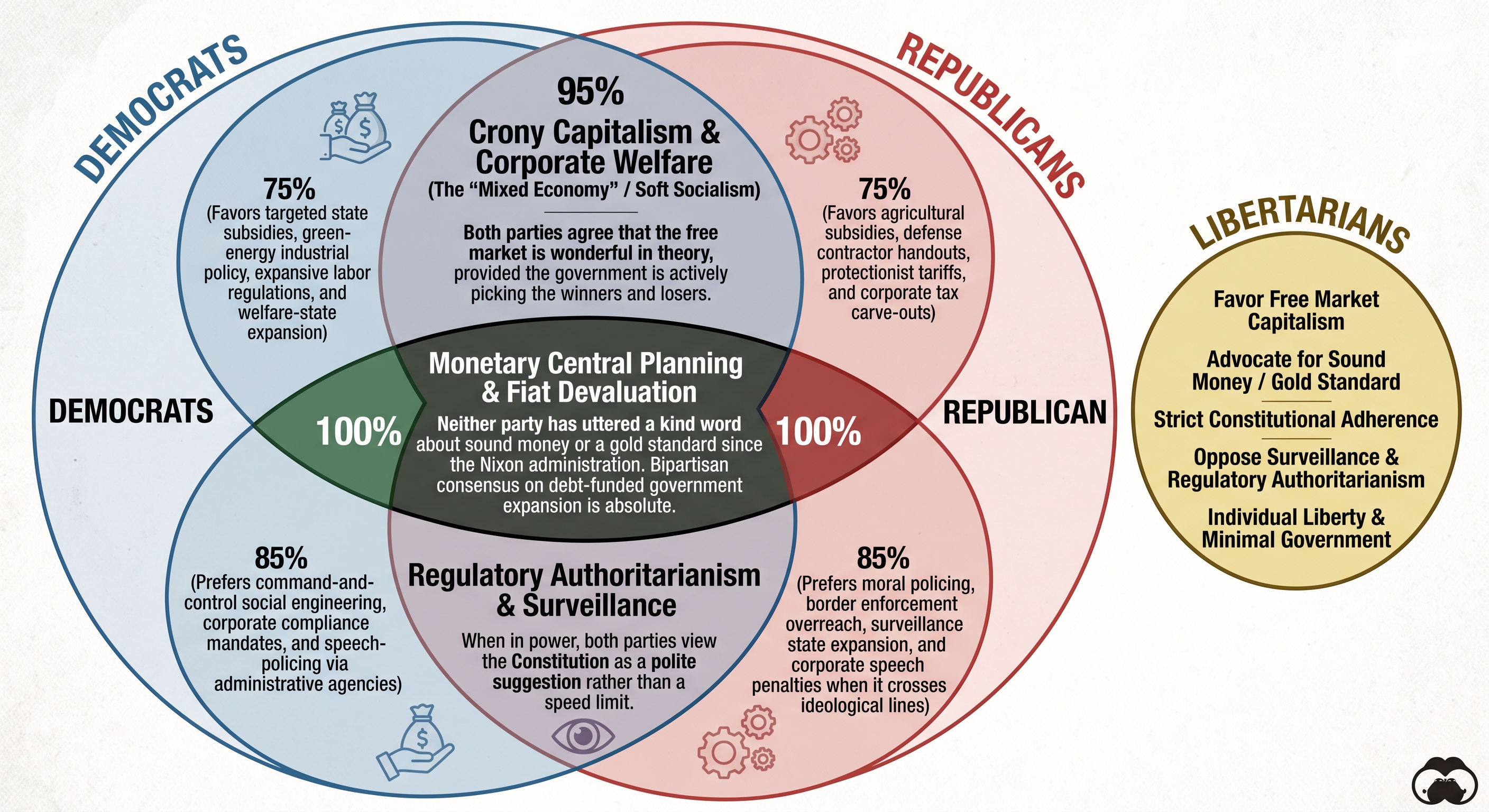
I. Two Levels
Start by conceding the strongest case against the whole premise, because an honest argument earns its conclusion. Political scientists have a ruler for this. DW-NOMINATE, built by Keith Poole and Howard Rosenthal and maintained at Voteview, scores every member of Congress on a single left-right axis from their actual votes, and it measures “polarization” as the distance between the two party averages. By that ruler the parties are not converging; they are flying apart. The modern low point was around 1969–1975, when the caucuses overlapped heavily and a liberal Republican was an ordinary creature. Since then the gap has widened almost every year. The House Republican median moved from roughly +0.25 in 1973 to +0.52 by 2019 while the Democratic median barely budged — the movement is real, and it is asymmetric: the right moved right far more than the left moved left. The overlap between the parties, by this measure, is now essentially zero.
Where they actually fight
Average ideology of each party in the U.S. House, by DW-NOMINATE first-dimension score, 1967–2021.
Hold that chart in your head, because everything that follows lives underneath it. The divergence it shows is almost entirely the divergence of the culture war — the floor votes on abortion, guns, immigration, taxes, voting rules, and who may say what to whom. On those, the roll calls are mirror images: the 2022 climate law passed with zero Republican votes, the 2017 tax cut with zero Democratic ones, the 2023 border bill with zero Democrats, a 2021 voting-rights bill with zero Republicans. That is genuine, measurable, widening conflict. But a political system runs on two levels at once. Level one is the theater just described. Level two is the machinery — the borrowing, the war budget, the surveillance statutes, the bailouts, and the money that pays for the campaigns. The thesis of this dispatch is narrow and therefore defensible: on level two, the canyon disappears. What looks from a distance like total war is total war over half the board, played on top of a foundation both parties have agreed not to touch.
II. The Debt Nobody Owns
Begin with the money, because it keeps the cleanest score. The gross national debt has risen under every president from Reagan to Biden — no exceptions, no party immune. The three largest dollar additions belong to Biden (about $8.5 trillion), Obama (about $8.0 trillion), and Trump (about $7.8 trillion): two Democrats and a Republican, effectively tied. The single largest percentage jump was Reagan’s, who nearly tripled it. The federal government has run a deficit in every fiscal year since 2001, under four presidents of both parties; the last stretch of surpluses ended a quarter-century ago. And the debt ceiling — the one piece of this that produces televised drama — has been raised or suspended more than a hundred times since World War II, by whichever party held the gavel, every single time. The 2023 deal that “averted default” is the tell: it passed the House 314–117 with a majority of both caucuses voting yes, and more Democrats than Republicans carried the Republican Speaker’s bill.
Every president grows the debt
Gross federal debt added per administration, in trillions ($) and percent increase.
The fights are about the composition of the spending; the growth of it is bipartisan consensus. One party prefers to borrow for the military and tax cuts, the other for social programs and industrial policy, and each calls the other reckless — but the line on the chart only ever points one way, no matter who is driving. Even the watchdogs say so without partisanship: the chairman of the Joint Chiefs once called the national debt “the single biggest threat to our national security,” adding that it was “the responsibility of both sides.” He was right about the arithmetic and right about the authorship.
III. The War Budget Is a Formality
Nowhere is the overlap more naked than in the bill that funds the military. The National Defense Authorization Act authorizes the entire defense establishment, and it is the most reliable event in American government: it has become law for 64 consecutive years and has never once failed. In the twelve fiscal years charted below, it never drew more than 140 “no” votes in a 435-seat House — usually far fewer — and the party breakdown, where it is recorded, is a near-even split of the yes votes between Democrats and Republicans. The defense budget itself behaves the same way: it climbed under Bush, kept climbing under Obama, dipped in a bipartisan austerity deal, then climbed again under Trump and Biden alike. The topline does not track which party holds power. It only goes up.
The war budget is a formality
National Defense Authorization Act, final House passage by fiscal year (FY2015–FY2026). Yea vs. Nay, of 435 seats.
The purest demonstration is the year the ritual survived a presidential veto. In the final days of 2020, Donald Trump vetoed the defense bill. His own party joined the opposition to crush the veto: the House override carried 322–87, with 212 Democrats and 109 Republicans combining to overrule a sitting Republican president on the war budget. When Congress is told to choose between party loyalty and the Pentagon’s appropriation, the “gridlock” that defines every other week in Washington simply evaporates. (A footnote for the hopeful: the 2026 NDAA finally repealed the 2002 Iraq War authorization, 24 years late — and it had to ride in on the very bill that funds the machine it was clawing back.)
IV. The Votes That Never Split
Pull the signature votes that built the modern security and bailout state and lay them side by side, and the pattern stops being a coincidence. The 2001 war authorization — the open-ended one, still in force and cited across three administrations to justify operations in twenty-plus countries — passed 518 to 1. The lone dissenter in the entire Congress was one Democrat, Barbara Lee. The PATRIOT Act cleared the Senate 98–1, the single “no” again a Democrat, Russ Feingold. The $700 billion bank bailout of 2008 and the $2.2 trillion relief package of 2020 both became law with crushing majorities of both parties — the latter 96–0 in the Senate. These were not party-line votes. They were the opposite of party-line votes.
When it matters, the gridlock vanishes
Share voting Yea on the signature votes that built the war, surveillance, and bailout state.
Surveillance is the most revealing case, because here the parties trade jerseys without ever dropping the ball. The warrantless-surveillance authority known as Section 702 has been renewed four times. In 2008, Republicans carried it while Democrats split; by the 2024 renewal it was inverted, with House Democrats supplying more yes votes than Republicans and the Senate passing it on a flawless 30–30 bipartisan tie-break of convenience. Whichever party holds the White House becomes the party defending the surveillance state; the authority itself never lapses. And when a bipartisan privacy coalition tried in 2024 to attach a simple warrant requirement, it died on a 212–212 tie — reform offered by both parties, killed by the leadership of both parties. The jersey changes. The program does not.
V. The Same Hand Feeds Both
To understand why the machinery is bipartisan, follow the money that pays for the campaigns — because it refuses to pick a side. The biggest corporate political action committees do not bet on red or blue; they buy both. In the 2024 cycle Boeing’s PAC split its money 44% Democratic and 56% Republican; Lockheed Martin 45/55; AT&T 45/55; Comcast 48/52; the Realtors 49/51. A defense contractor handing 45% of its money to the party it supposedly opposes is not confused. It is buying a seat at both tables, because the point was never who wins — the point is access no matter who wins.
They buy both tables
How the biggest corporate PACs split their money between the parties, 2024 cycle.
The hedge is the whole system in miniature. Aggregate business-PAC money has actually drifted toward an even 50/50 split over the last three cycles, even as the cultural rhetoric grew more apocalyptic. Federal lobbying sets a new record almost every year regardless of who controls Washington — $4.44 billion in 2024 — because it is a fee paid to the government, not a donation to a party. The revolving door that carries retiring lawmakers into lobbying firms swings open about evenly for Republicans and Democrats; in the military-contracting world alone, roughly seven in ten registered lobbyists previously worked inside the government they now petition. And the small donor keeps shrinking: in 2024 the ten largest individual donors supplied about 7% of all federal fundraising by themselves. The culture war is funded like a blood sport. The machinery is funded like a utility.
VI. Why the Overlap Holds
None of this requires a conspiracy, which is exactly why it is so durable. It requires only that the two parties answer to the same set of large interests on the questions those interests care about, and fight freely on the questions they do not. The political scientists Martin Gilens and Benjamin Page tested this the hard way, tracking 1,779 distinct policy questions over two decades, and found that economic elites and organized business groups have substantial, independent influence on what becomes law while the preferences of the average citizen have “little or no independent” effect — when ordinary voters and moneyed interests disagree, the voters generally lose, regardless of which party is nominally in charge. (Their critics are right that the effect is noisier than the headlines claimed; they are not right that it is zero.) Thomas Ferguson’s older “investment theory” names the mechanism more bluntly: the fundamental commitments both parties share are set by the major investors who fund them, not by the voters who ratify them. And a literature on Congress finds that cross-party agreement is strongest precisely on national security — the one domain where you would most expect a healthy democracy to argue.
Seen this way, the culture war is not a malfunction of the system. It is a feature of it. The louder the fight over the things that do not threaten the machinery — the flags, the pronouns, the statues, the slogans — the safer the machinery becomes, because a public exhausted by the theater on level one never gets around to asking who signed off on level two. You can have an election decided by a culture-war margin of inches and wake up to find the war budget, the surveillance renewal, and the next debt-ceiling deal all passed 80–20 while you were watching the other channel. That is not both parties being “the same.” It is both parties agreeing on what is not up for a vote.
VII. The Honest Verdict
So return to the diagram that started this, and give it the credit and the correction it deserves. The meme’s instinct is right where it counts: on crony capitalism, on the money supply, on the surveillance state, the overlap between the parties is not a sliver — it is most of the circle. But the lazy reading of that same image, the one that shrugs that “there’s no difference, so why vote,” is wrong and the data refutes it. There is a difference, a large and growing one, and it governs whether you can get an abortion in your state, who is at the border, whose taxes go up, and which books are in the library. That is not nothing; for millions of people it is everything. The honest verdict is harder to fit on a bumper sticker than either tribe would like: the parties are genuinely, bitterly opposed on the questions of identity and culture — and genuinely, quietly joined on the questions of money, war, and surveillance. The tragedy is not that there is no choice. It is that the most consequential decisions — how much to borrow, how much to spend on arms, how much of your private life the government may read without a warrant — were taken off the menu before you ever walked in. You are offered a furious choice about the napkins, and no choice at all about the meal.
Filed on: Polarization — DW-NOMINATE first-dimension party means and the ~zero modern overlap, Voteview (Poole/Rosenthal/Lewis, voteview.com, “Party Polarization”); House Republican median +0.25 (93rd Cong., 1973) → +0.52 (116th, 2019), Democratic median ~flat, Center for Effective Lawmaking (thelawmakers.org, 2024); asymmetry (“the Republicans did it”) per Voteview blog (2015), a finding that is contested; chart endpoints and trend verified, intermediate decimals illustrative of Voteview’s published curve. Issue divergence — Inflation Reduction Act 2022 (0 R votes; Sen. 51–50, House 220–207), Tax Cuts & Jobs Act 2017 (0 D votes; Sen. 51–48), Secure the Border Act / H.R.2 2023 (0 D; 219–213), For the People Act / H.R.1 2021 (0 R; 220–210), GovTrack/Ballotpedia; abortion post-Dobbs — 14 total-ban states vs. 20+DC protective states, Guttmacher Institute (2024); same-sex marriage is the rare convergence — Respect for Marriage Act 2022, Senate 61–36 (12 R), House 258–169 (39 R). Debt & deficits — gross debt added by administration, U.S. Treasury “Debt to the Penny”/FiscalData (Biden ~$8.5T, Obama ~$8.0T, Trump I ~$7.8T, Reagan +187%; aggregator rounding ±1–2%); deficit every FY since 2001, last surpluses FY1998–2001, CRS IF12830/CBO; debt limit modified 100+ times since WWII, CRS RL31967/CRFB; Fiscal Responsibility Act 2023, House 314–117 (D 165–46, R 149–71, roll #243), Senate 63–36; Adm. Michael Mullen, “single biggest threat…responsibility of both sides” (CNN, 2010). Defense & war — NDAA final House passage FY2015–FY2026, House Clerk/Congress.gov/GovTrack (64 consecutive years enacted; ≤140 House nays each year); FY2021 veto override 322–87 (D 212–20, R 109–66) over President Trump’s veto; 2001 AUMF 420–1 House / 98–0 Senate (sole no: Rep. Barbara Lee); 2026 NDAA repealed the 2002 Iraq AUMF (Kaine–Young); defense topline SIPRI constant-2024 US$ (~$828bn trough 2017 → ~$1,005bn 2024). Surveillance — USA PATRIOT Act 2001, House 357–66 / Senate 98–1 (sole no: Sen. Russ Feingold); FISA §702 renewals — 2008 FISA Amendments Act (House 293–129, R-carried) through 2024 RISAA (House 273–147, D 147 vs R 126; Senate 60–34, 30 R / 30 D); 2024 warrant amendment failed on a 212–212 tie; Congress.gov/Senate.gov/House Clerk/GovTrack. Bailouts — TARP / EESA 2008, Senate 74–25 (#213), House 263–171 (91 R crossovers, #681); CARES Act 2020, Senate 96–0 (#80), House by voice. Money in politics — corporate-PAC party splits, 2024 cycle, FEC filings via Visual Capitalist (Boeing 44/56, Lockheed 45/55, AT&T 45/55, Comcast 48/52) and Quorum (Realtors 49/51); aggregate business-PAC tilt 60/40 → 55/45 R, 2020–2024 (Quorum); federal lobbying record $4.44B in 2024, $4.27B in 2023 (OpenSecrets); revolving door “about evenly divided between Republicans and Democrats,” 72% of military-industry lobbyists formerly in government (OpenSecrets; Taxpayers for Common Sense); top 10 individual donors ~$599M = ~7% of 2024 federal fundraising, small-donor share 22% (2020) → 16% (2024) (OpenSecrets). The mechanism — Gilens & Page, “Testing Theories of American Politics” (Perspectives on Politics, 2014), 1,779 policy cases, average citizens with “little or no independent influence” (model R²=0.074, a caveat critics rightly press); Thomas Ferguson, Golden Rule (1995), the investment theory of party competition; bipartisan consensus strongest on national security (congressional-voting analyses). Sources on file; full research dossier retained.
№ 86 · Filed October 2, 2026 — The last dispatch on health care argued about the plumbing: who pays, through which middleman, and how much leaks into the layer between the payer and the patient. This one asks the question that debate always skips — what if the thing flowing through the pipes is uniquely toxic to begin with? Before a single argument about single-payer makes sense, you have to look at who would be insured, and the answer is unflattering: America is the sickest rich nation on earth. We are roughly twice as obese as the average wealthy country and seven to eight times as obese as Japan; we have twice their diabetes; barely one in eight of us is metabolically healthy; and more than half of what we eat is ultra-processed. Then, having built that disease with a fork, we treat it with a pharmacy — $1,432 a head on drugs every year, ninety-two million Americans on statins, prevention a rounding error in the budget — because a customer for life is a better business than a cure, and no one gets paid to tell a patient to cook and walk. The same model runs the American mind. This dispatch runs the receipts on all of it: how sick we actually are compared to our peers, why the American plate is the engine, why medicine reaches for the pill instead of the plate, how the business model prefers it that way, how the mind got put on the same assembly line — and why that means you cannot insure your way out of this, no matter whose name is on the card.
The Pre-Existing Condition — Why America Is Sick Before the Insurance Question Starts

I. The Question Nobody Costs
Every fight over American health care is a fight about the bill, and almost none of it is about the patient. The companion to this dispatch, The Middleman, took the plumbing apart — the Medicare Advantage overpayment, the pharmacy markup, the lobby standing at every joint — and showed that a reliable fraction of every health dollar never reaches a doctor or a patient at all. That was the leak. This is the other half of the problem, and the half the slogans never price: the fluid. You can argue all day about whether to route the money through private insurers or a single government check, but you are still paying to treat the same population — and that population is, by a wide and measurable margin, the least healthy in the developed world. A single-payer system is only ever as cheap as its patients are well. Ours are not well. Before you nationalize the payment, it is worth asking what, exactly, you would be buying — because the honest answer is a lifetime of maintenance drugs for diseases a different country would have mostly prevented at the dinner table.
II. The Sickest Rich Nation
Start with the body, because the numbers are not close. Four in ten American adults — 40.3 percent — are obese, and another large share are overweight on top of that; among children and teens the obesity rate is 21.1 percent, an all-time high, with severe obesity in kids running at levels essentially unknown a half-century ago. Measured against peers, the gap is a chasm: the OECD average adult obesity rate is about 19 percent, the United Kingdom sits near 26, France around 15, and Japan and South Korea hover between four and seven. The American rate is roughly double the rich-world average and seven to eight times Japan's. On diabetes the story repeats — 15.8 percent of US adults have it, against a peer-nation average near 6 percent, and a Peterson-KFF comparison pins the age-standardized US rate at twice the peer average and widening, up 26 percent in a decade against 15 for the peers. Layer on the 38 percent of adults — about one in three — who are prediabetic, and the 48.6 percent who carry some form of cardiovascular disease, and the picture resolves into something stark.
The single most damning statistic is not any one disease — it is how few of us are well at all. A University of North Carolina analysis of national survey data found that only 12.2 percent of American adults are “metabolically healthy” — meaning optimal blood sugar, blood pressure, cholesterol, triglycerides and waist size, without medication. One in eight. Among obese adults, the figure collapses to half of one percent. And all of this is happening inside the most expensive health system ever built: the United States spends about 18 percent of its GDP and roughly $14,775 per person a year on health care — nearly double the OECD average — and gets, in return, a life expectancy of 79.0 years, the third-lowest in the OECD, below every peer nation and trailing Japan by about five years. We are not buying longer lives. We are buying the management of an illness we manufacture. That is the input problem, and no amount of rearranging the payment can touch it.
III. The American Plate
Ask what is driving it and the trail leads back, overwhelmingly, to the food. Ultra-processed food — the industrial formulations of refined starch, oil, sugar and additives that bear little resemblance to anything a kitchen produces — now supplies 55 percent of the calories Americans eat, and 61.9 percent of the calories eaten by children and teens. It delivers roughly 90 percent of the added sugar in the American diet. This is not a matter of a few bad eaters dragging down an average; it is the default American plate. And the cost of that plate is measurable in bodies: a landmark analysis in the Journal of the American Medical Association tied suboptimal diet to about 318,656 cardiometabolic deaths in a single year — 45 percent of all US deaths from heart disease, stroke and type 2 diabetes. Nearly half of the deaths from the diseases bankrupting the system trace to what was on the fork.
The contrast with peer nations is not an accident of culture — it is partly policy. The American food supply is permitted additives that other wealthy countries have restricted or banned outright: titanium dioxide, pulled from the European market in 2022; potassium bromate, barred in the UK, Canada and much of Latin America; brominated vegetable oil, gone from the EU, UK and Japan; and the synthetic dyes that carry warning labels across Europe. More than a dozen OECD countries levy a tax on sugary drinks; the United States has none at the federal level. The evidence that these levers work is real but honestly mixed — soda taxes reliably cut soda sales, yet their direct effect on obesity rates is, in the IMF's and OECD's own word, “ambiguous,” and some untaxed countries saw declines while some taxed ones did not. The point is not that a dye ban or a soda tax would fix America. It is that peer nations treat the food environment as a public-health lever and America largely does not — and the waistlines reflect the difference.
Honesty requires a caveat here, because the diet is not the only reason Americans die younger. The US life-expectancy gap is also driven by drug overdoses, gun deaths, car crashes and, in recent years, a worse pandemic — causes that have little to do with anyone's plate. Diet is the largest single modifiable driver of the chronic-disease burden, not the sole explanation for everything wrong with American health. But on the specific diseases that eat the health budget — heart disease, stroke, diabetes — the food is the engine, and the engine is uniquely American.
IV. The Pill Instead of the Plate
Having built the disease with the fork, the American system treats it almost entirely with the prescription pad. The United States spends about $1,432 per person per year on prescription drugs — roughly three times the OECD average — and the gap is driven by price, not merely appetite. Nearly half of Americans, 48.6 percent, took at least one prescription drug in the past month; 12.8 percent took five or more, and among adults in their sixties and seventies fully a third are on five-plus. Look at what those drugs are and the pattern is unmistakable: statin use climbed from 31 million Americans in 2008–09 to 92 million by 2018–19; some 62 million take a blood-pressure medication; metformin for diabetes runs to roughly 82 million prescriptions a year. The three most-used drug classes among older adults — cholesterol, blood pressure and blood sugar — are precisely the three conditions most responsive to diet and exercise, and we manage all three, at enormous and permanent expense, with a pill taken for life.
None of this is because the pill is the only thing that works — it is because the pill is the only thing that pays. Prevention accounts for roughly 3 percent of US health spending; about 80 percent goes to treatment. The reimbursement system will pay, without blinking, for a lifetime of statins, a cardiac stent, a diabetic amputation — and it pays almost nothing for the dietitian visit, the cooking class, the structured exercise program that might have made all three unnecessary. A registered dietitian's counseling has been estimated to cut type-2 diabetes incidence by 34 percent, heart disease by 31 and stroke by 20, and it sits outside the money. The incentives do not reward keeping people well; they reward billing for them once they are sick. So the plate loses to the pill every time, not on the evidence, but on the invoice.
V. A Customer for Life
Follow that invoice up the chain and you reach a business logic stated, once, with unusual candor. In April 2018 a Goldman Sachs biotech report posed the question out loud: “Is curing patients a sustainable business model?” The analysis was not a conspiracy memo — it was a sober note to investors about cash flow — but it named the industry's central tension precisely. A one-shot cure, it warned, “offers a very different outlook with regard to recurring revenue versus chronic therapies,” and it cited the cautionary tale of Gilead's hepatitis-C drugs: a genuine cure whose US sales peaked at $12.5 billion in 2015 and then fell as the drug did its job and “exhausted the available pool of treatable patients.” Where a disease can be cured, the customer leaves. Where it can only be managed — a daily pill for high cholesterol, high blood pressure, high blood sugar, forever — the customer stays for life. The market does not reward the fork and the sneaker. It rewards the refill.
The clearest modern illustration is the one we already took apart — so here it gets only a short reprise. As the earlier dispatch Sweat First laid out, the GLP-1 drugs are a real medical advance aimed at the wrong population and priced like a toll. Ozempic lists at about $936 a month in the United States against $169 in Japan and as little as $83 in France; Wegovy runs $1,349 here against roughly $300 in the Netherlands. And the drugs are, by design, a lifetime subscription: in the key trial, patients who stopped semaglutide regained about two-thirds of the weight they had lost, the authors concluding that “ongoing treatment is required.” The Congressional Budget Office estimates that having Medicare cover these drugs for obesity would add about $35 billion in net federal spending over 2026–2034 — with the health savings covering only a sliver of the cost. A hundred million Americans are eligible by label. That is not a cure being scaled up. It is a recurring charge being nationalized — the single-payer squeeze in one molecule.
VI. The Mind on the Same Model
The most revealing proof that this is a business model and not just a food problem is that the American mind runs on the identical machine. Nearly a quarter of US adults — 22.8 percent, about 59 million people — have a diagnosable mental illness in a given year. The US depression rate, around 6.7 percent, is roughly double the global figure, and the American lifetime rate of major depression, 16.9 percent, is among the highest ever measured anywhere. Some of that gap is real suffering and some is methodological — richer countries with thorough surveys count more — but the treatment response is unambiguous and uniquely American: 11.4 percent of adults take a prescription antidepressant (15.3 percent of women), and the country is a global outlier on stimulants, consuming 67.6 percent of the world's prescription stimulant supply with 26.8 percent of the sampled population — a per-capita rate roughly 569 percent of the peer average, with amphetamine use running at an almost unbelievable 90-fold the comparison-country mean. Where Europe reaches first for therapy or a behavioral plan, America reaches first for the bottle.
And it does so on a theory that the evidence no longer supports, while ignoring treatments that the evidence does. The “chemical imbalance” story that sold a generation on antidepressants took a serious blow in 2022, when an umbrella review in Molecular Psychiatry concluded there is “no consistent evidence” linking serotonin to depression and that it was “time to acknowledge that the serotonin theory of depression is not empirically substantiated” — a finding that drew real rebuttals and remains contested, but that the field can no longer wave away. Meanwhile the lifestyle evidence has only strengthened: a 2024 British Medical Journal network meta-analysis of 218 randomized trials found walking, running and strength training to be at least as effective as antidepressants for mild-to-moderate depression; the SMILES trial found a Mediterranean diet produced remission in 32 percent of depressed patients against 8 percent for social support; Duke's SMILE studies found exercise matched the drug sertraline, with those who kept exercising doing best a year on. Yet between 60 and 75 percent of antidepressant prescriptions are written by non-psychiatrists, often in brief primary-care visits, and in one analysis 72.7 percent of the scripts carried no psychiatric diagnosis at all. The pattern is the plate-versus-pill story moved from the body to the brain: the intervention with the better evidence and no refill loses to the one that bills monthly.
This is the place to be most careful, because the argument can curdle into something cruel. Serious mental illness — psychosis, bipolar disorder, severe depression — is real, is biological in large part, and genuinely requires medication; telling a schizophrenic to go for a jog is not a health philosophy, it is abandonment. The critique here is narrow and specific: that America has medicalized ordinary distress, written pills for problems that exercise, diet, sleep and therapy treat as well or better, and built a reimbursement system that makes the fifteen-minute med check the path of least resistance for doctor and patient alike. The scandal is not that we have the drugs. It is that we reach for them first, last, and for everyone.
VII. The Honest Verdict
So bring it back to the single-payer question, because the two dispatches together give an answer neither political tribe wants. The Middleman showed that America's payment plumbing is captured, and that pouring another thirty trillion dollars through it would feed the toll booth as much as the patient. This dispatch shows the other blade of the scissors: even a perfectly clean payer — no middleman, no markup, every dollar reaching a doctor — would still be insuring the sickest population in the developed world, a nation that manufactures chronic disease with its diet and then treats it with a lifetime of pills it reaches for by reflex. The countries that run single-payer for half our cost are not simply better at paperwork. Their citizens are leaner, less diabetic, less medicated — the system is cheaper partly because the people are healthier walking into it. You cannot copy their spreadsheet without copying their patients, and we have spent fifty years becoming the opposite of their patients.
The honest verdict, then, is that the health-care debate is aimed at the wrong target. Keep the fair caveats in view: America's absurd prices and its administrative waste — more than $750 billion a year by one estimate — are enormous drivers in their own right, and the disease burden is not the only reason we spend what we do. But it is the reason the spending can never be fixed from the finance side alone. Whether the check comes from an insurer or the Treasury, a country this sick, medicating this reflexively, will hand whoever holds the check a bill that grows forever — because the underlying thing being paid for keeps getting worse. The lever that actually moves the number is upstream of every insurance argument: the plate and the sweat, the two interventions with the best evidence, the lowest cost, and no constituency paid to promote them. The tragedy of American health care is not only that the middleman takes his cut. It is that we keep feeding the furnace the most flammable fuel on earth, and then arguing about whose money should put out the fire. Until the patient changes, the payer is just the name on the receipt.
Filed on: Obesity — US adult obesity 40.3% (men 39.2%, women 41.3%), severe obesity 9.4%, CDC NCHS Data Brief No. 508 (Sept 2024, NHANES Aug 2021–Aug 2023); child/adolescent obesity 21.1% (record high), CDC NCHS (NHANES 2021–23). International — OECD average adult obesity ~19%, overweight-or-obese ~54%; US measured obesity 42.8%, UK ~28%, France ~15.6%, Japan ~4.6%, South Korea ~7% (OECD Health at a Glance 2023/2025) — US roughly 2x OECD average, 7–8x Japan/Korea. Diabetes — US adults 15.8% total (diagnosed 11.3%, undiagnosed 4.5%), CDC NCHS Data Brief No. 516 (Nov 2024); prediabetes 38.0% of adults / ~1 in 3 (CDC National Diabetes Statistics Report); US age-standardized diabetes 12.5% vs 6.1% peer average (~2x), gap widening +26% vs +15% 2012–2022 (Peterson-KFF Health System Tracker). Cardiovascular — 48.6% of US adults have some form of CVD; hypertension 46.7% (122.4M); 931,578 total CVD deaths (2021); CVD cost $422.3B (AHA 2024 Heart Disease & Stroke Statistics Update). Metabolic health — only 12.2% of US adults metabolically healthy (0.5% of obese adults), Araújo/Cai/Stevens, Metabolic Syndrome and Related Disorders (2018, UNC, NHANES 2009–2016). Spending vs outcomes — US ~18% of GDP and ~$14,775 per capita on health (2024), nearly 2x OECD average; US life expectancy 79.0 years, third-lowest in the OECD, ~3.7 years below peer average, ~5 below Japan (Commonwealth Fund, U.S. Health Care from a Global Perspective 2026; Peterson-KFF). Diet — ultra-processed food 55% of calories for all ages, 61.9% for youth 1–18, ~90% of added sugar, CDC NCHS Data Brief No. 536 (Aug 2025) and Martínez Steele et al., BMJ Open (2016); ~318,656 cardiometabolic deaths/yr tied to suboptimal diet = 45% of US heart-disease, stroke and type-2-diabetes deaths, Micha et al., JAMA (2017). Additives & taxes — titanium dioxide (EU ban 2022), potassium bromate, brominated vegetable oil and synthetic dyes restricted/labeled abroad but permitted in the US under GRAS; ≥14 OECD countries levy sugar-sweetened-beverage taxes, the US none federally; direct effect of such taxes on obesity “ambiguous” per IMF/OECD reviews. Life-expectancy caveat — US gap also driven by overdoses, firearms, motor-vehicle deaths and COVID excess mortality (Commonwealth Fund; National Academy of Medicine). Drug spending & utilization — US ~$1,432 per capita on prescription drugs (2021), ~3x OECD average, prices 2.78x higher (RAND 2024); 48.6% of Americans used ≥1 Rx in past 30 days, 12.8% used 5+, ~1/3 of adults in their 60s–70s on 5+ (CDC NCHS); statin users 31M (2008–09) to 92M / 35% (2018–19) (MEPS/CDC); ~62M on antihypertensives; metformin ~82M prescriptions/yr (ClinCalc 2024). Prevention asymmetry — prevention ~3% of US health spending vs ~80% to treatment (OECD Health at a Glance 2025); RDN nutrition counseling estimated to cut type-2 diabetes 34%, heart disease 31%, stroke 20% (Academy of Nutrition and Dietetics). Business model — Goldman Sachs, The Genome Revolution (April 2018), “Is curing patients a sustainable business model?”; Gilead hepatitis-C US sales peaked ~$12.5B (2015) then fell as the treatable pool shrank. GLP-1 — Ozempic list ~$936/mo (US) vs $169 (Japan), ~$83 (France); Wegovy ~$1,349 (US) vs ~$296–328 (Netherlands/Germany) (Peterson-KFF); STEP 1 extension — patients regained ~2/3 of lost weight after stopping semaglutide, authors concluding “ongoing treatment is required” (Diabetes, Obesity & Metabolism 2022); CBO (Oct 2024): Medicare obesity-drug coverage ~+$35B net federal spending 2026–2034; ~100M+ Americans eligible by label. See CROWN dispatch #47, Sweat First. Mental illness — 22.8% of US adults (58.7M) with any mental illness, 5.7% serious mental illness (SAMHSA 2023 NSDUH); US depression ~6.7% vs ~3.4% global, lifetime major depression 16.9% among the highest measured (IHME/GBD via Our World in Data; cross-national gaps partly methodological); 11.4% of adults on antidepressants, women 15.3% (CDC NCHS Data Brief No. 528, 2025); US consumes 67.6% of world prescription stimulants with 26.8% of sampled population, ~569% of peer per-capita rate, amphetamine use ~9,078% of comparison mean (INCB data). Evidence vs practice — Noetel et al., BMJ (2024), network meta-analysis of 218 RCTs, exercise at least as effective as antidepressants for mild-to-moderate depression; SMILES trial (Jacka et al., BMC Medicine 2017), dietary remission 32.3% vs 8.0%; SMILE/SMILE-II (Blumenthal et al., Duke), exercise comparable to sertraline; serotonin theory “not empirically substantiated” (Moncrieff et al., Molecular Psychiatry 2022 — contested, drew formal rebuttals); 60–75% of antidepressant prescriptions written by non-psychiatrists, up to 72.7% without a psychiatric diagnosis (Mojtabai & Olfson). Suicide — US age-adjusted suicide rate up ~30% since 2000, bucking the falling OECD trend; 48,824 deaths, 13.7 per 100,000 (2024, CDC). Cost framing caveat — “90% of the $4.5 trillion (2022) goes to people with chronic conditions” (CDC Chronic Disease Fast Facts) refers to spending on people who have chronic conditions, not solely treatment of those conditions (PolitiFact, Feb 2026); diabetes alone cost $412.9B in 2022 and ~1 in 4 US health dollars (ADA). Administrative waste — estimated ≥$750B/yr (National Academy of Medicine); US excess administrative cost ~34% of health spending vs ~17% in Canada (Himmelstein & Woolhandler, Annals of Internal Medicine 2020).
№ 85 · Filed October 2, 2026 — A number is making the rounds with a life decision bolted to it: America is short 1.3 million skilled-trades workers, so stop wasting four years and a fortune on a degree and go pick up a toolbelt. The number is real enough to cite and the advice is good enough that a lot of people should take it — but both have been sanded smooth for travel. The 1.3 million is not a government statistic; it is a 2026 report from a private analytics firm, built on a definition of “trades” broad enough to make the gap as large as it needed to be, and it is routinely confused with an older, unrelated figure that means something else entirely. Underneath the marketing, though, sits a demographic engine that is not marketing at all. This dispatch runs the receipts on the whole pitch: where the shortage number comes from and why its rivals don’t add up, what the trades actually pay once you leave the recruiting brochure, how the debt-free math genuinely favors the toolbelt through a worker’s twenties, what a four-year degree now costs and how often it fails to pay off, and the fine print neither tribe prints — the bodies that wear out early, the payroll fraud baked into the industry, and the possibility that the “shortage” is partly employers who would rather complain than pay.
The Toolbelt — The Skilled-Trades Shortage, Graded Against the Skip-College Advice

I. The Number
Start with the figure itself, because it is being cited as if it fell off a government press release, and it did not. The viral “1.3 million” traces to a single source: a report called Defining the Skilled Trades, published in August 2026 by Lightcast, a private labor-market analytics firm. Its headline does the work — 135 skilled-trade occupations, a gap of 1.3 million workers, three openings for every one person completing the relevant training. That definition is the whole trick. Stretch “skilled trades” across 135 occupations covering some 20 million jobs — about 9 percent of all American employment — and you can make the shortfall almost any size you like. It is real analysis, but it is commercial analysis sold by a firm whose business is workforce data, not a number certified by the Bureau of Labor Statistics. And it is constantly conflated with a different 1.3 million — a 2020 Jobs for the Future report, funded by the Lumina Foundation, that counted 1.3 million annual job openings, which includes everyone retiring or quitting, not a net shortage. Same headline digits, completely different meaning.
The deeper tell is that every big shortage number comes from an interested party, and none of them agree. Associated Builders and Contractors, modeling construction alone, put the 2024 need at 501,000 net new workers, then 439,000 for 2025, then quietly revised 2026 down to about 349,000 as interest rates cooled the building boom. Deloitte and the Manufacturing Institute, surveying executives rather than counting jobs, warned of up to 2.1 million unfilled manufacturing roles by 2030 — a projection they have walked down twice, from 2.4 million by 2028 to 1.9 million by 2033. McKinsey, looking at twelve critical trades, found roughly 584,000 annual openings against about 26,000 net new workers — a 20-to-1 imbalance. The Home Builders Institute says construction needs 723,000 workers a year. A JLL consultancy report rounds the whole thing up to a “$1 trillion a year” problem. These numbers are not additive and they do not measure the same thing — net gap, annual openings, survey anxiety — and the gap between the smallest and the largest is itself the evidence that “the shortage” is a frame as much as a fact.
II. The Engine That’s Real
Discount the marketing and one thing survives intact, and it is the strongest part of the case: the workforce is old and the pipeline is thin. This is arithmetic, not a brochure. In construction the median worker is about 42, more than one in five is 55 or older, and the average tradesperson retires around 61 because the body gives out before the pension does. Fewer than 9 percent of skilled-trades workers are between 19 and 24. PeopleReady’s analysis found 40 percent of the trades workforce is over 45, with nearly half of those past 55. Retirements already account for roughly 40 percent of annual openings. You do not need a contested definition to see the problem in those figures: a large cohort is walking out the door at a predictable rate, and the cohort behind it is too small to replace it one-for-one.
What makes the timing genuinely ugly is the lag built into the trades themselves. An apprenticeship runs four to five years before a worker is fully productive, which means anyone starting today does not fully count until the back half of this decade — precisely when the retirement wave peaks. You cannot close a trades gap the way you can staff a warehouse; the training is long and front-loaded. So even stripped of the commercial gloss, the honest version is this: the raw shortage number is soft and salesman-inflated, but the demographic pressure under it is hard, and it is the one claim in the entire debate that holds up without an asterisk.
III. What the Trades Actually Pay
Now the part the recruiting videos get half-right, because the ceiling is genuinely high — for the trades most people never picture. The best-paid skilled trade in the Bureau of Labor Statistics data is not one any teenager daydreams about: elevator and escalator installers earn a median of $106,580, with the top tenth clearing $149,250. Electrical power-line workers — the linemen who climb into high voltage in storms — median $92,560. Aircraft mechanics, $78,680. Construction managers, who typically carry a bachelor’s, $106,980 with a top tenth near $177,000. These are real six-figure trades, and they are the ones the “skip college” pitch leans on.
But the poster children of the pitch — the welder, the HVAC tech, the electrician — sit much closer to the national median than the slogan admits. The all-occupation median wage in America is about $49,500. Against that line, welders come in at a median of $51,000, with a top tenth of only $75,850 — the floor of the group, growing slower than average. HVAC mechanics, $59,810. Electricians, $62,350. Plumbers and pipefitters, $62,970. Heavy truck drivers with a CDL, $57,440. These are decent, dignified, debt-light livelihoods — modestly above the median for a job that cannot be offshored. But they are not the six-figure life the TikToks promise. The “learn to weld, make $100,000” story is true for a narrow slice — the specialty rig welder, the traveling turnaround hand, the elevator mechanic — and misleading as a description of the median tradesperson, who earns a few thousand dollars more than the typical American worker, not triple it.
IV. The Math That Favors the Toolbelt
Where the trades win decisively is not the top-line wage — it is the first decade, because the money starts on day one and the debt never starts at all. A registered apprentice earns a paycheck from the first morning: across all industries, entry pay averages about $18 an hour, rising to roughly $32 by completion, a 77 percent raise built into the training. Apprentice pay is set as a percentage of the journeyman scale — typically 40 to 50 percent at the start, stepping up to 85 to 95 percent by turnout — and union programs usually cover the instruction, so the worker finishes with a license and close to zero debt. The system has been growing fast: about 680,000 active registered apprentices in 2024, up 114 percent in a decade, with annual completions up 143 percent.
Lay the two paths side by side and the early lead is stark. By age 26 a plumber who started an apprenticeship at 18 has eight years of earnings, a journeyman license, no debt, and a wage in the $60,000-to-$80,000 range. A college graduate who started at 18 has four years of work, somewhere north of $29,000 in debt, and an income that may or may not match the plumber’s depending entirely on the major. Because the tradesperson spent the college years earning instead of paying, and starts saving and compounding sooner, the crossover point where a degree holder pulls ahead typically lands somewhere between ages 30 and 35 — and in lower-paying fields, later or never. The honest caveat sits right next to the pitch, though: apprenticeship completion is contested and often low — estimates run from under 35 percent in older federal reporting to about 59 percent in recent data — so the debt-free windfall is the reward for finishing, and a large share do not.
V. The College Bill
The reason the toolbelt math lands at all is that the other side of the ledger got genuinely expensive and genuinely risky. A year at a public four-year university, all-in, now runs about $24,920 in-state and far more out of it; a private nonprofit runs near $58,600 a year. Americans hold more than $1.77 trillion in student debt across 45 million-plus borrowers, and the class of 2024 that borrowed left owing about $29,560 apiece. After the pandemic payment pause ended, the damage surfaced: by mid-2025 roughly 10 percent of student debt was 90 days delinquent, around 5.3 million borrowers were in default, and the New York Fed counted 2.6 million fresh defaults in a single quarter — wages, tax refunds and even Social Security checks now exposed to garnishment.
And the degree does not reliably pay for itself, which is the fact the old “college for all” orthodoxy cannot survive. The Foundation for Research on Equal Opportunity, running the numbers on some 30,000 bachelor’s programs, found that 23 percent of them carry a negative lifetime return — graduates end up worse off than if they had never enrolled — and that 31 percent of students are sitting in a negative-ROI program right now. Engineering, computer science, nursing and economics can clear a million dollars in lifetime value; a majority of philosophy and religious-studies programs leave students in the red, and fine arts usually does too. Then there is underemployment: the New York Fed finds 42 percent of recent graduates working jobs that never required the degree, and a Strada/Burning Glass study tracking ten million careers found 52 percent underemployed a year out, 45 percent still underemployed a decade later, and that three-quarters of those stuck in the first job never climb out.
None of which means college is a scam — and this is where the trades pitch overreaches in the other direction. For the median graduate the degree still pays, and pays well: the New York Fed puts the typical return at 12.5 percent, better than the stock market, with a wage premium around $32,000 a year and a breakeven age in the mid-thirties. Georgetown pegs the lifetime bachelor’s premium at $2.8 million gross; even the stingiest honest estimate, discounted for the years lost to school, runs north of $600,000. The catch is variance, not average: that 12.5 percent is the median, and for the bottom quarter of graduates the return collapses to 2.6 percent. College is a good bet played on median — and a genuinely bad one if you borrow private-school money for a low-paying major and finish in the bottom quartile. The decision was never “college or trades.” It was always “which degree, at what price, finished or not.”
VI. The Fine Print
Before anyone hands a seventeen-year-old a toolbelt as the safe choice, read the clauses the recruiting videos skip. The trades are dangerous in a way offices are not. Construction logged more workplace deaths than any other industry in 2023 — 1,075 of them, a fatality rate of 9.6 per 100,000 against about 3.5 across all industries — and roofing is the third-deadliest occupation in the country at 51.8 deaths per 100,000, behind only logging and fishing. The job also wears the body out, which is why the average construction worker retires at 61 and why early joint and back damage is an occupational feature, not a bug. The work is cyclical, too: open construction jobs fell from about 400,000 in early 2024 to 248,000 by that July when the housing market cooled — the “guaranteed” trade evaporating with the interest rate. And the industry is riddled with payroll fraud: up to 2.1 million construction workers are misclassified as independent contractors, a dodge that cuts an employer’s labor cost by roughly 17 percent while stripping the worker of workers’ comp, unemployment insurance and most labor protections — in the single most dangerous industry in America.
And then the question that reframes the whole “shortage”: what if it is partly a bluff? Peter Cappelli, the Wharton labor economist, has argued for years that what gets called a skills gap is really a training gap — and that a true labor shortage has a signature the trades data mostly lacks. A genuine shortage shows up as sharply rising wages, as employers bid against each other for scarce workers. Instead, when manufacturers were surveyed at the height of the alarm, only about 11 percent said they had raised starting pay to attract workers; far more preferred to wait, or to blame the schools. The United States does less apprenticeship training per capita than almost any peer nation, because American employers largely stopped paying to train and started expecting workers to arrive pre-skilled on their own dime. Some of “nobody wants to work the trades” is a real demographic cliff. Some of it is an industry that would rather issue a press release about a 1.3 million shortage than raise the wage until the job fills.
VII. The Honest Verdict
So the verdict, as usual here, is the one that flatters neither tribe. The old gospel — that every kid should go to college or be left behind — is dead, and the data killed it: nearly a quarter of bachelor’s degrees lose money, four in ten graduates are working jobs that never needed the diploma, and the debt is now doing real damage to real balance sheets. A smart, hands-capable eighteen-year-old who goes into a well-chosen trade, finishes the apprenticeship, and invests the head start can absolutely out-earn and out-save a classmate who borrows $120,000 for a degree with no market behind it. That is not a motivational-poster claim; it is arithmetic, and Gen Z is already acting on it — vocational enrollment at community colleges jumped 16 percent in a single year, construction programs 23 percent, the “toolbelt generation” voting with its feet.
But the counter-gospel now being sold — college is a scam, the trades are a guaranteed six figures, grab a toolbelt — is just the old lie wearing a hard hat. The shortage number is commercial and inflated. The six-figure wage is a minority outcome, not the median. The body wears out, the work swings with the economy, and the industry cheats on payroll while pleading poverty on wages. And the degree, for the median graduate in a sensible field, still pays better than almost any other investment available to a young person. The real scam was never college or the trades — it is anyone selling either one as the universal answer. The honest advice fits on an index card and sells no courses: pick the path that fits the person, count the full cost before you sign, and finish what you start — because in both lanes, the money goes to the one who crosses the line, and the debt goes to the one who doesn’t.
Filed on: The 1.3 million figure — Lightcast, Defining the Skilled Trades: A Data-Driven Blueprint for the Future (August 2026), defining 135 skilled-trade occupations (~20 million jobs, ~9% of US employment), a 1.3 million worker gap, ~3 openings per trainee, retirements ~40% of ~2.1 million annual openings, >25% of workers 55+; frequently conflated with Jobs for the Future / Lumina Foundation, Breaking Ground (2020), which counted 1.3 million annual openings (replacement included), a different metric. Rival estimates — Associated Builders and Contractors: 501,000 net new construction workers needed (2024), 439,000 (2025), revised to ~349,000 (2026); Deloitte & The Manufacturing Institute: up to 2.1 million unfilled manufacturing jobs by 2030 (survey-based), revised across studies from 2.4M-by-2028 (2018) to 1.9M-by-2033 (2024); McKinsey, Tradespeople wanted (April 2024): ~584,000 annual openings vs ~26,000 net new workers across 12 critical trades (~20:1); Home Builders Institute/NAHB (Spring 2024): ~723,000 construction workers needed per year; JLL (2026): shortage cost framed near $1 trillion/yr. Demographics — construction median age ~42, >1 in 5 workers 55+, average retirement ~61, <9% of trades workers aged 19–24; PeopleReady: 40% of the trades workforce over 45; apprenticeships run 4–5 years (BLS, DOL). Pay (BLS Occupational Outlook Handbook / OEWS, May 2024; all-occupation median ~$49,500) — elevator & escalator installers $106,580 median / $149,250 top 10%; construction managers $106,980 / ~$176,990; electrical power-line installers $92,560; aircraft mechanics $78,680; plumbers/pipefitters/steamfitters $62,970 / $105,150; electricians $62,350 / $106,030; HVAC mechanics $59,810; heavy & tractor-trailer truck drivers $57,440; welders/cutters $51,000 / $75,850 (slowest growth, ~2%). Apprenticeship — DOL: ~680,000 active registered apprentices FY2024 (+114% over a decade), ~112,000 annual completers (+143%); average pay $18/hr entry to $32/hr completion (+77%); pay set at ~40–50% of journeyman scale rising to 85–95% at turnout; apprenticeship.gov cites ~$86K average starting salary post-completion with 93% retention; completion rates contested, from under 35% (DOL 2021 reporting) to ~59% (2019–2022 data). College cost & debt — College Board, Trends in College Pricing 2024: public four-year in-state total cost of attendance ~$24,920/yr, private nonprofit ~$58,600/yr; total US student debt ~$1.77 trillion across 45 million-plus borrowers; class of 2024 average debt at graduation ~$29,560 (LendingTree, ~47% of grads borrowed); post-pause distress — ~10% of student debt 90+ days delinquent by Q2 2025, ~5.3 million borrowers in default, ~2.6 million fresh defaults in Q1 2026 (Federal Reserve Bank of New York). ROI — FREOPP (Preston Cooper), Does College Pay Off? (~30,000 bachelor’s programs): 23% of bachelor’s degrees carry negative lifetime ROI, 31% of students enrolled in negative-ROI programs, engineering/CS/nursing/economics can exceed $1 million while a majority of philosophy and religious-studies programs run negative; Georgetown CEW, The College Payoff: bachelor’s worth ~$2.8 million gross over a lifetime; Hamilton Project / discounted estimates ~$600,000–$610,000 net; The Major Payoff (October 2025): bachelor’s holders earn ~70% more than high-school-only at the median, major medians ranging ~$51,000–$146,000. Underemployment — New York Fed, Labor Market for Recent College Graduates (2024 data): 42% of recent grads underemployed; Strada Institute & Burning Glass, Talent Disrupted (Feb 2024, 10M+ career paths): 52% underemployed one year out, 45% a decade out, 73% of those underemployed in the first job still underemployed ten years later. College return — New York Fed Liberty Street Economics (April 2025): typical return ~12.5%, wage premium ~$32,000/yr, breakeven in the mid-thirties, but 25th-percentile return just 2.6%. Head-to-head — trade-vs-college net-worth crossover typically ages 30–35 (journeyman/trade-education analyses). Trades downsides — BLS Census of Fatal Occupational Injuries (2023): construction had the most workplace deaths of any industry, 1,075, rate 9.6 per 100,000 vs ~3.5 all-industry; roofing third-deadliest occupation at 51.8 per 100,000; open construction jobs fell from ~400,000 (early 2024) to 248,000 (July 2024, HBI); payroll fraud — up to 2.1 million construction workers misclassified as independent contractors (The Century Foundation), misclassification cutting employer labor costs ~16.7% (DC Attorney General study) while stripping workers’ comp, UI and labor protections. The “training gap” counter — Peter Cappelli (Wharton), Why Good People Can’t Get Jobs and related: the skills gap is largely a training gap; Manpower survey found only ~11% of employers raised starting pay to recruit (2012); the US runs among the least apprenticeship training per capita of industrialized nations. Gen Z shift — National Student Clearinghouse: vocational-focused community-college enrollment +16% (2022–2023), construction trades +23%; WSJ, “Toolbelt Generation” (2024).
№ 84 · Filed October 2, 2026 — The question is almost always posed as a clean choice: keep the free market, or switch to single-payer like Canada and Britain. It is the wrong question, and the wrong question flatters everyone who asks it, because it assumes the United States has a market to keep and a clean public system to switch to. It has neither. What it has is a third thing with no honest name — a system in which enormous rivers of public money and private money both pour through the same layer of private middlemen, each of whom takes a cut on the way through. The government is already the largest payer in American medicine; more than half of everyone on Medicare now receives that public benefit through a private insurer. So the real question is not whether to let the government in. It is already in. The question is what happens to a dollar once it enters — and whether pouring thirty trillion more of them through this particular plumbing would buy universal care or simply build a bigger toll booth. This dispatch runs the receipts on all of it: what single-payer would actually cost, where the money leaks, why the independent doctor is already gone, and the two lean public programs that prove the leak is a choice, not a law of nature.
The Middleman — The Layer Between You and Your Doctor That Neither Party Will Remove
I. The Wrong Question
Before anything else, settle the frame, because the whole debate rests on a premise that collapses the moment you check it. The binary — keep the free market or surrender to single-payer like Canada and Britain — assumes America has a market to keep and a clean public system to switch to. The numbers say it has neither, and the government is already the largest player at the table. Washington pays for nearly half of all American health care directly, and more than half of everyone on Medicare — 34.1 million of roughly 62.8 million in 2025 — now receives that public benefit through a private insurer rather than from the government itself. That is the third thing with no clean name: not a market and not a public system but torrents of public and private money pouring through the same layer of private middlemen, each taking its cut at the joint. Which means the honest question was never whether to let the government in. It is in. The question is what happens to a dollar once it enters — and in this system, the answer is that a reliable fraction of it never reaches a doctor or a patient at all.
And the other pole of the binary is just as misleading, because “single-payer like Canada and Britain” treats universal coverage as one thing when it is really a spectrum — and most of it is not single-payer at all. There are, roughly, three ways the rich world insures everyone, and only one matches the American caricature of a government takeover. Britain runs the purest socialized medicine: under the NHS the state owns the hospitals and employs the doctors outright. Canada and Taiwan run what Americans actually mean by “single-payer” — one public insurer writing the checks, but private doctors and hospitals delivering the care. And the largest group of all looks startlingly like the United States and still covers everyone for far less: Germany, the Netherlands and Switzerland all deliver universal care through private insurers, and Japan runs several thousand separate insurers at once. The difference is not that they outlawed the middleman. It is that they leashed him — the insurers are required to cover everyone, barred from profiting on the basic benefit or capped hard on margin, and made to pay prices the government sets, so that in Japan every insurer pays the identical fee for the identical procedure off a single national schedule. That quietly rewrites the whole American argument. The outlier is not that we use private insurance; half our peers do. The outlier is that we let it run unleashed — and that, not the choice between a government check and a corporate one, is the fault line this dispatch keeps returning to.
II. The Price Tag — Stated at Full Size, Then Cut Down Honestly
Start with the number that ends most conversations, because it deserves to be stated at full size and then, honestly, cut down. Every serious estimate of a Sanders-style Medicare for All lands in the same terrifying zip code: roughly $30 to $34 trillion in new federal spending over its first ten years. The Mercatus Center’s Charles Blahous put the floor at $32.6 trillion — and called it a floor, with the real figure likely higher, up to $38.8 trillion. The left-leaning Urban Institute, no enemy of the idea, came in at $34 trillion in new federal cost. The Committee for a Responsible Federal Budget reviewed the whole field and settled on $25 to $35 trillion. To raise $30 trillion, CRFB calculated, you would need to roughly triple all payroll taxes, or more than double every individual and corporate income-tax rate, or impose a 42 percent national sales tax. Blahous put the vise plainly: the new spending would exceed all currently projected federal individual and corporate income taxes combined — “even if you doubled those, you still wouldn’t be able to fully finance it.” “Tax the rich” does not touch it; CRFB put the wealthy-and-corporate-only ceiling at about $11 trillion, roughly a third of the bill.
And now the honest cut, because the scary number has a trick in it that both sides exploit. That $30-trillion-plus is federal spending, not new spending. The money is not conjured from nothing; most of it already exists, as the premiums, deductibles and copays that employers and households already pour into private insurance. Single-payer would move that river onto the government’s books. Which is why the studies that frighten people on the federal line are often reassuring on the national one: RAND modeled total national health spending rising just 1.8 percent even as federal spending rose 221 percent. The Congressional Budget Office found that total national health expenditure in 2030 could actually fall by as much as $0.7 trillion — or rise by $0.3 trillion — under single-payer, even as federal subsidies climbed $1.5 to $3 trillion. The truthful sentence is the uncomfortable one: single-payer would probably not make American health care cost much more in total. It would make the government pay for almost all of it, financed by taxes that would rank among the largest in the nation’s history — and whether that is a catastrophe or a wash depends entirely on a detail the slogans skip, which is what the money buys once it arrives.
III. The Toll Booth
Here is where the American system stops resembling a debate about socialism and starts resembling a toll booth. We do not need to theorize about what happens when the government hands health dollars to private insurers to administer, because we run that experiment every day. It is called Medicare Advantage, and in 2025 it covers 54 percent of all Medicare beneficiaries — government money, privately administered. The Medicare Payment Advisory Commission, Congress’s own nonpartisan analysts, found that Medicare Advantage costs taxpayers 20 percent more per enrollee than if those same people stayed in traditional Medicare — an extra $84 billion in 2025 alone. The mechanism is not mysterious: $40 billion of it comes from “coding intensity,” the industry’s practice of finding extra diagnoses to inflate the risk scores the government pays on, and $44 billion from quietly enrolling healthier seniors. It is so expensive that it raises the Part B premium for everyone — including seniors in traditional Medicare who never signed up for it — by an estimated $198 a year. The Justice Department is pursuing or has settled risk-adjustment fraud cases against nearly every major insurer; Kaiser alone agreed to pay $556 million in January 2026, the largest such settlement on record.
Now follow the drug dollar, because the pharmacy middleman is the same story in a different uniform. Three companies — CVS Caremark, Express Scripts and OptumRx — process about 80 percent of American prescriptions, and each is owned by a major insurer, which in turn often owns the pharmacy that fills the script. The Federal Trade Commission’s 2025 report found these three pharmacy-benefit managers marked up specialty generic drugs by $7.3 billion in revenue above estimated cost; 22 percent of the drugs it studied carried markups above 1,000 percent, and one — a generic for pulmonary hypertension — was marked up 7,736 percent. Above that sits American pharma’s list prices, which RAND found average 2.78 times what other wealthy nations pay, and 4.22 times for brand-name drugs. And when Washington finally let Medicare negotiate prices in 2022 — after a nineteen-year statutory ban written into the 2003 Part D law by a congressman, Billy Tauzin, who then left to run the pharma lobby for a reported $2 million a year — the first ten negotiated drugs came in 63 percent below list. The savings were always there to be had. The law simply forbade reaching for them.
The Affordable Care Act is the capstone, because it is the clearest look at what a “public” expansion built on this plumbing actually does. Obamacare did not displace the insurers; it was built on top of them — a mandate to buy their product, subsidies paid directly to them, a reinsurance program to cover their worst losses. When Congress underfunded one of those backstops, insurers sued for $12.3 billion in unpaid reimbursements and won at the Supreme Court. In the fifteen years after the ACA passed, UnitedHealth’s stock returned 712 percent against the S&P 500’s 562. The law did real good — some twenty million people gained coverage — and it did that good by routing public money through private balance sheets, exactly as designed. This is the pattern: every recent American expansion of health coverage has been a payout to the middle as much as a benefit to the patient, because it was poured through plumbing that guarantees a cut at every joint.
IV. The Captured Doctor
The second half of the indictment — that the independent doctor is already gone, and the survivors answer to the insurer — is one the data confirms, with one honest correction. The private practitioner is vanishing in real time. The American Medical Association’s benchmark survey found that the share of physicians in practices wholly owned by doctors fell to 42.2 percent in 2024, down eighteen points in twelve years; 2018 was the first year employed doctors outnumbered owners. By the Physicians Advocacy Institute’s count, which tallies employment rather than ownership, 82 percent of US physicians now work for hospitals or corporate entities, and more than 64,000 practices were acquired between 2019 and 2025. The single largest employer of physicians in the country is not a hospital system — it is UnitedHealth’s Optum, the insurer’s own provider arm, which by its 2023 framing employs or is affiliated with roughly 90,000 doctors, about a tenth of the entire American physician workforce. (That “90,000” deserves an asterisk: under oath before the Senate, UnitedHealth’s then-chief executive put the number of directly employed physicians closer to 9,000, with the other 80,000-odd tied to it by contract rather than payroll. The capture is real; the exact length of the leash is contested.)
Malpractice is part of why — though honesty requires demoting it from villain to accomplice. The premiums are genuinely brutal in the wrong zip code: an OB/GYN in Miami-Dade can face a malpractice premium of $243,988 a year, and premiums rose for the seventh straight year in 2024. A solo practitioner carrying that cost alone is at a structural disadvantage against an employed colleague whose system absorbs the liability. But when the AMA asked doctors why they actually sold out to a hospital or a corporation, malpractice did not top the list — it was not on it at all. The top three reasons were the need to negotiate higher payment rates with insurers (70.8 percent), access to expensive resources (64.9 percent), and the burden of managing insurers’ own regulatory and administrative demands (63.6 percent). The doctors did not flee mainly from lawyers. They fled toward scale, because scale is the only thing that wins against the insurer across the negotiating table — which means the insurer’s market power is both the disease and the reason doctors reach for the cure.
And once employed, the doctor discovers who actually writes the treatment plan. It is often not the doctor. The instrument is prior authorization — the insurer’s veto over what a physician may prescribe or order — and the AMA’s 2024 survey of a thousand physicians measured its weight precisely: 43 authorization requests per doctor per week, twelve hours of staff time, and care delays reported by 94 percent of them. Most damning, 24 percent of physicians said prior authorization had led to a serious adverse event for a patient — a hospitalization, a permanent injury, or, in 7 percent of cases, a death. Layered on top is the productivity quota, the “RVU leash” that pays the employed physician by the billable unit and, as one medical journal put it, “assigns no value to handling clinical complexity, nor does it reward the critical decision not to operate.” The autonomy Americans imagine single-payer would threaten has largely already been surrendered — not to a government bureaucrat, but to a private one working from an insurer’s formulary.
V. The Proof It Could Be Lean — and the Machine That Prevents It
All of this could read as proof that government simply cannot run health care — except that the same government already runs two pieces of it well, and that is the most important fact in this entire dispatch. Traditional Medicare — the public program, not the privatized Advantage version — runs on administrative overhead of about 2 percent. The CBO’s cleanest apples-to-apples comparison found 2 percent overhead in traditional Medicare against 11 percent in Medicare Advantage: same seniors, same benefits, nine points of difference that is simply the private layer taking its margin. The Veterans Health Administration — a fully socialized system where the government owns the hospitals and employs the doctors — pays on average 54 percent less for drugs than Medicare Part D, because it negotiates as one buyer with one formulary; and its patients, who are older, sicker and poorer than average, show better medication adherence, not worse. The administrative savings single-payer advocates promise are not fantasy: the US spends about 34 percent of its health dollar on administration against Canada’s 17, and matching Canada would have freed more than $600 billion in a single year.
So the problem was never whether lean public care is possible. It plainly is. The problem is a machine built specifically to ensure America never gets it. Health care is the largest lobbying sector in the United States, spending roughly $562 million in 2024 and $739 million in 2023 — more than any other industry in the country. In 2018, as Medicare for All gained traction, insurers, drugmakers, hospitals and even the AMA pooled their money into a front group, the Partnership for America’s Health Care Future, built for the single purpose of killing it; Public Citizen tracked the number of organizations lobbying on the bill jumping nearly sevenfold in a year, almost all of them opposed. The insurers fund both parties — 100 percent of sitting senators took their money in 2024 — which is precisely why single-payer bills die in committee no matter who holds the gavel. The lean system is possible. The industry spends three-quarters of a billion dollars a year to keep it merely possible.
VI. The Borrowed Discount
There is one more number buried inside the price tag, and it is the one that quietly makes single-payer’s arithmetic work — or exposes it as a bluff. Return to that $32.6 trillion floor, the cheapest honest estimate anyone offers. It is the floor for a specific reason: Blahous built it on the assumption that single-payer would pay every doctor and hospital in America at Medicare’s current rates — rates that run, in his own words, “more than 40 percent below what private insurance pays providers.” That is not a rounding detail; it is the whole magic trick. The Urban Institute modeled the same bill but assumed providers would be paid closer to what they actually earn now, and it came out trillions higher, with national spending rising rather than holding flat. The entire claim that Medicare for All is roughly a wash depends on docking every provider in the country by two-fifths overnight — and on the quieter fact the slogans never mention, which is that accepting Medicare has always been voluntary. It is a deal a doctor takes or declines, not a price the government sets for all of medicine. Today a physician can participate, decline assignment, or opt out entirely; single-payer removes the choice and makes the lowest rate the only rate.
And here is why that cut is not free money: the private sector is already paying the difference. American medicine runs on a cross-subsidy almost nobody names out loud. Medicare reimburses hospitals below the cost of delivering the care; Medicaid pays less still; and private insurers are billed well above cost to keep the books balanced — the identical surgery, billed to a private plan, brings in far more than it does billed to Medicare. The employer premium that households grumble about every pay period is, in part, a hidden tax that funds the discount Medicare enjoys. Strip the private payer away and scale everyone down to Medicare rates, and that subsidy vanishes with it. The Congressional Budget Office warned in plain language that paying hospitals at Medicare rates would cause “a substantial decline in hospitals’ average payment rates, placing considerable financial pressure” on them. FTI Consulting put a figure on the pressure: at Medicare rates, roughly 90 percent of American hospitals would run persistent deficits — on the order of $300 billion a year stripped out of provider revenue. That is a clinical way of saying fewer nurses, older machines and shuttered wings, with rural hospitals — already closing at record rates under the current system — first against the wall. Single-payer’s defenders have a real answer here: tailored global budgets set per hospital, and the fact that universal coverage erases the uncompensated-care losses providers swallow today. It is a serious rebuttal. But it does not make the subsidy imaginary — it only argues about who should backfill it once the private payer is gone. The lean 2 percent Medicare rate this dispatch just held up as proof the system could run cheap is, in part, a number the private market is quietly underwriting. “Medicare for All” is, among other things, a proposal to find out what that rate actually costs when there is no one left to subsidize it.
VII. The Honest Verdict
Which brings the whole thing back to the question, and to an answer sharper than the one either tribe is selling. Could single-payer work? Abroad, demonstrably — the other wealthy nations cover everyone for roughly half the per-capita cost, and their people live longer. Does the United States already do some public medicine superbly? Yes: traditional Medicare and the VA are lean, and American cancer survival leads the world, with breast-cancer five-year survival of 90.2 percent, the best anywhere. But those are not the terms on offer. What would actually get enacted here is not the VA scaled up; it is the Affordable Care Act scaled up — a vast new river of taxpayer money poured through the same insurers, the same pharmacy middlemen, the same drug pricing, with the same lobby standing at every joint to keep its cut intact. That is the dumpster fire, and the metaphor is more precise than it sounds: the danger is not that the money would burn, but that it would leak — predictably, legally, into the layer between the payer and the patient that this country, alone among its peers, has let grow fat.
So the honest verdict is the one that satisfies no one. The anti-single-payer slogan is right that America cannot simply flip a switch to Canada — not because public medicine fails, but because our version would be captured before the ink dried, and the tax bill to fund a captured system genuinely would be money into a fire. And the pro-single-payer slogan is right that the status quo is indefensible — a system that already costs the most, already covers the fewest among its peers, already lets a private clerk overrule the care a doctor ordered, and already hands the employed physician a quota in place of a conscience. The real fight was never public versus private. It is whether anyone will break the middleman — the Medicare Advantage overpayment, the pharmacy markup, the negotiation ban, the lobby that guards all three — before pouring another dollar into the machine. Until that fight is joined and won, “Medicare for All” and “the free market” are two names for the same toll booth, arguing only about whose money fills the till. And the car idling at the gate, as always, is the patient.
Filed on: Cost estimates — Mercatus Center (Charles Blahous, 2018) put Medicare for All at a floor of $32.6 trillion in added federal spending over 2022–2031, likely $32.6–$38.8 trillion; Urban Institute (October 2019, with the Commonwealth Fund) estimated $34.0 trillion in new federal spending and $59 trillion in total national cost over a decade; RAND (2019) found national health spending rising 1.8% while federal spending rose 221%; the Congressional Budget Office (2020–2022 working papers, pub. #56811/#56898/#57637) found 2030 federal subsidies $1.5–$3.0 trillion higher with total national health expenditure changing between −$0.7 trillion and +$0.3 trillion; the Committee for a Responsible Federal Budget estimated $25–$35 trillion in new financing, requiring roughly a tripling of payroll taxes or more than a doubling of all income-tax rates or a 42% VAT, with wealthy-and-corporate-only taxes capped near $11 trillion. Blahous: the added spending would exceed all projected federal individual and corporate income taxes combined. Medicare Advantage — 54% of Medicare beneficiaries (34.1M of ~62.8M) in 2025 (KFF, July 2025); MedPAC (March 2025 Report to Congress) found MA costs 20% more per enrollee than traditional Medicare, $84 billion in 2025 ($40B coding intensity, $44B favorable selection), raising the Part B premium ~$198/yr for all beneficiaries including those in traditional Medicare; Kaiser Permanente settled risk-adjustment fraud claims for $556 million (January 2026), the largest MA False Claims Act settlement on record, amid DOJ cases against most major insurers (Cigna $172M, 2023; Independent Health $100M, 2024; Sutter $90M, 2021). PBMs — CVS Caremark, Express Scripts and OptumRx process ~80% of US prescriptions, each insurer-owned and vertically integrated; FTC Second Interim Report (January 2025) found $7.3 billion in specialty-generic markups above estimated acquisition cost (2017–2022), with 22% of studied drugs marked up >1,000% and tadalafil marked up 7,736%. Drug prices — RAND (February 2024): US prices average 2.78× those of 33 comparison nations, 4.22× for brand-name drugs; the 2003 Medicare Part D “noninterference clause” (shaped by Rep. Billy Tauzin, who left to lead PhRMA for a reported ~$2M/yr) barred Medicare drug negotiation for ~19 years until the 2022 Inflation Reduction Act; the first 10 negotiated prices (effective January 2026) averaged 63% below 2023 list. ACA — built on the individual mandate and premium subsidies paid to private insurers; insurers won $12.3 billion in unpaid risk-corridor reimbursements (Maine Community Health Options v. United States, Supreme Court, 2020); UnitedHealth’s 15-year total stock return ~712% vs the S&P 500’s ~562%. Physician employment — AMA Physician Practice Benchmark Survey: physician-owned private practice fell to 42.2% in 2024 (down ~18 points since 2012), with 2018 the first year employed physicians (47.4%) outnumbered owners (45.9%); PAI-Avalere (May 2025, 2018–2026 data): 82% of physicians employed by hospitals or corporate entities, ~64% of practices corporate-owned, and more than 64,000 practices acquired 2019–2025; Optum (UnitedHealth) employs or is affiliated with ~90,000 physicians (~10% of the US workforce) per a 2023 investor framing — though sworn Senate Finance Committee testimony by CEO Andrew Witty put directly employed physicians closer to 9,000, the remainder tied by risk/value-based contract. Malpractice — AMA/Medical Liability Monitor (2024): OB/GYN manual premium up to $243,988 (Miami-Dade), seventh consecutive year of increases, but the AMA’s top cited reasons for selling a practice were payment negotiation (70.8%), access to costly resources (64.9%) and administrative/regulatory burden (63.6%), with malpractice not among the leading drivers (MLM tracks only OB/GYN, general surgery, internal medicine). Prior authorization — AMA 2024 survey (1,000 physicians): ~43 requests/physician/week, ~12 staff hours/week, 94% reporting care delays, and 24% reporting a prior-auth-related serious adverse event, including 7% reporting a patient death; the American Journal of Medicine on the “RVU leash” reducing clinical judgment to a billable unit. Cross-subsidy — Mercatus (Blahous) built its $32.6T floor on the assumption that M4A pays all providers at Medicare rates, “more than 40 percent below what private insurance pays providers,” the assumption that keeps the estimate lowest (Urban Institute, assuming higher provider rates, came in trillions higher with national spending rising); CBO: paying hospitals at Medicare rates would cause “a substantial decline in hospitals’ average payment rates, placing considerable financial pressure on hospitals”; FTI Consulting (2020, via HFMA): Medicare-rate reimbursement would leave ~90% of hospitals running persistent deficits, cutting ~$300 billion a year from provider revenue and risking closures and workforce reductions, with rural hospitals most exposed. Lean counterexamples — CBO: ~2% administrative overhead in traditional Medicare vs ~11% in Medicare Advantage (same beneficiary base); GAO (2021, 2017 data): the VA paid on average 54% less per unit than Medicare Part D across 399 drugs, with lower cost-related medication nonadherence; Himmelstein & Woolhandler (Annals of Internal Medicine, 2020, 2017 data): US administrative costs 34.2% of national health spending vs 17.0% in Canada, a gap worth more than $600 billion in one year. International models — the rich-world taxonomy follows T.R. Reid’s The Healing of America (2009) and the Commonwealth Fund’s International Health Care System Profiles: Britain’s NHS is a state-owned Beveridge system (public hospitals, salaried/contracted physicians); Canada and Taiwan are single-payer national health insurance (one public insurer paying private providers); Germany (statutory nonprofit sickness funds), the Netherlands (2006 managed-competition reform) and Switzerland (mandatory nonprofit basic insurance) deliver universal coverage through regulated private insurers under an individual mandate; Japan provides universal coverage through ~3,000 nonprofit insurers all bound to a single government-set national fee schedule applied uniformly to every provider. Outcomes — US health spending ~18% of GDP and ~$14,885 per capita (2024); US life expectancy ~77 years vs ~80–82 in peer nations (2020–21); US five-year breast-cancer survival 90.2%, world-leading (CONCORD-3, The Lancet). Wait times — Canada median 27.7 weeks referral-to-treatment (2023, 30 weeks 2024; Fraser Institute); NHS England 7.4 million on the waiting list, median 13.8 weeks (April 2023); US new-patient physician appointments averaging ~26 days and rising (AMN Healthcare/Merritt Hawkins) — the headline waits are not apples-to-apples across differing pathway definitions. Lobbying — health was the #1 US lobbying sector at ~$562 million (2024) and ~$739 million (2023), OpenSecrets; the Partnership for America’s Health Care Future (formed June 2018; AHIP, PhRMA, BIO, BCBSA, Federation of American Hospitals, AMA) organized to defeat Medicare for All, with organizations lobbying on the bill rising roughly sevenfold in a year (Public Citizen, “Fever Pitch”); the health-insurance industry’s 2024 contributions reached 100% of sitting US senators and 93% of running House incumbents.
№ 83 · Filed October 1, 2026 — A video crosses this desk with a title built to travel: Seattle’s small businesses are all gone, and here is the heartbreaking truth about the drugs that killed them. It is the kind of claim this column has learned to take apart from both ends at once, because the honest answer is neither the one the video wants nor the one its critics reach for. The storefronts really are empty — in a handful of big cities the camera is not lying, the vacancy is measurable, and it is worst in cities Democrats run. And yet across the same country in the same years, Americans are starting businesses faster than at any time on record, and more of those businesses survive five years in California than in Florida. Both of those are true. The distance between them is the whole story. This dispatch runs the receipts on all of it: which closures are real and which numbers hold, which theft figure was retracted by the people who invented it, what actually hollowed out the American downtown, and the one genuine policy choice in the pile — the one that was made, measured, and then reversed by the same hands that made it.
The Vacancy — What Actually Killed Seattle’s Small Businesses
I. The Empty Window Is Real
Start by conceding the thing the video gets right, because it gets more right than its critics want to admit. The closures are real, they are named, and many of the companies cited safety on their way out the door. In July 2022 Starbucks shut six Seattle stores, and chairman Howard Schultz said the quiet part plainly — the locations were “not unprofitable,” they were closing because of crime, drug use and disorder that made staff unsafe. In October 2023 Target closed two Seattle stores as part of a nine-store, four-state cull, blaming “theft and organized retail crime.” Nike, Saks, The North Face and Ross all pulled out of downtown Seattle. In San Francisco, Nordstrom closed both its downtown stores in 2023, ending a thirty-five-year flagship run; Whole Foods abandoned its flagship Mid-Market store after barely twelve months, citing worker safety; and the Westfield mall’s owner handed the keys back to its lenders after defaulting on a $558 million loan, by which point some ninety-five retailers had left the Union Square area. In Portland, REI closed its Pearl District store and said crime and theft were the reason. These are not rumors. They happened, and they left real holes.
And the holes show up in the one set of numbers nobody disputes: vacancy. Downtown Seattle office vacancy hit 35.6 percent at the end of 2025, the highest on record. Downtown San Francisco office vacancy reached roughly 37 percent in 2024 — a seven-fold increase since the start of 2020, worse than the dot-com bust and the Great Recession combined. Downtown Portland office vacancy climbed past 34 percent; its downtown retail vacancy tripled from about 10 percent in 2019 to 32 percent by late 2024. Chicago’s Magnificent Mile ran near 29 percent. Downtown Los Angeles retail sat around 30 percent. And the University of Toronto’s downtown-recovery tracker, built on anonymized cell-phone data across sixty-odd North American cities, put San Francisco dead last at 31 percent of its pre-pandemic activity, with Portland and Minneapolis near the bottom beside it. The worst-recovered downtowns in North America are, in fact, disproportionately in blue cities. That is the part of the video that survives contact with the data.
II. The Overdose Count
The human core of the video — the drugs — is not fabricated either, and it is the ugliest number in the file. In King County, which contains Seattle, fentanyl killed three people in 2015. In 2020 it killed 168. In 2022, around 715. In 2023 it killed roughly 1,087 — a more than three-hundred-fold rise over eight years. San Francisco recorded its deadliest year on record in 2023 with over 800 accidental overdose deaths, about four in five involving fentanyl; on a single day that August, nine people died within twenty-four hours. Oregon’s fatal overdoses jumped from 280 in 2019 to 956 in 2022. These are morgue counts, not survey estimates, and no honest account of what downtown feels like can wave them away.
The policing collapse underneath them is equally real. The Seattle Police Department fell to 937 deployable officers by August 2023 — its lowest in-service count since 1991 — after losing a net 355 officers over four years. Response times stretched: by early 2024 the median wait on a top-priority call had slipped past the department’s own seven-minute goal, and lower-priority calls could wait more than two and a half hours. When people in these neighborhoods say the street changed, they are describing something that happened. The question this dispatch is actually about is not whether the decline is real. It is what caused it — and there the story the video tells starts coming apart.
III. The Theft Number Its Own Authors Took Back
The load-bearing claim in the “crime killed the stores” narrative is organized retail theft — and the single most-cited statistic behind it was retracted by the people who published it. In April 2023 the National Retail Federation, the industry’s own lobby, reported that “nearly half” of the $94.5 billion lost to retail shrink in 2021 came from organized retail crime. The figure traveled everywhere. On December 1, 2023, after the trade outlet Retail Dive traced the arithmetic, the NRF quietly removed it — the $45 billion it rested on turned out to have been lifted from a 2016 survey describing total shrink, not organized crime, and wrongly bolted onto the 2021 number. The lobby still insists retail crime is a serious problem. It no longer attaches a dollar figure to the claim, because the one it had was wrong.
The company cases curdle the same way under scrutiny. Walgreens spent two years closing San Francisco stores and telling anyone who asked that the city’s theft ran five times its chain average. Then San Francisco police data showed the five shuttered stores had averaged fewer than two recorded shoplifting incidents a month since 2018, and in January 2023 a Walgreens executive conceded to investors that “maybe we cried too much” about retail theft — the closures fit a pre-existing national plan to shut hundreds of stores regardless. Target blamed crime for its 2023 Seattle closures, but the Seattle city auditor had already found that the two stores it closed — in Ballard and the U-District — were not the ones generating the most calls for police; the highest-call stores stayed open. And when the nonpartisan Council on Criminal Justice ran the actual police data, the panic shrank to a sliver: nationally, reported shoplifting in 2024 sat just 1 percent above its 2019 level, and it was the lone major offense that rose — twelve of thirteen tracked crimes fell year over year. The scary numbers are local and specific: shoplifting ran 87 percent above 2019 in Los Angeles and 55 percent above in New York — while in Chicago it was 10 percent below 2019. Honesty cuts both ways here, and the caveat belongs on the record: the Loss Prevention Research Council estimates only about half of retail crime is ever reported to police, so the true level is genuinely murky. But “murky and concentrated” is a different animal from “a nationwide wave that emptied the stores,” and only the first one is supported.
IV. What Actually Emptied the Downtown
If crime is not the engine, what is? The researchers who built the downtown-recovery rankings answered that question themselves, and the answer has nothing to do with a city council. The downtowns that recovered worst, they found, are the ones with the largest white-collar, professional and tech workforces — precisely the jobs most able to vanish into a spare bedroom. San Francisco did not die because of its mayor; it emptied because its economy was built on exactly the office work that remote laptops dissolved. The proof is in the cross-city vacancy table, where party lines simply disappear. Office vacancy in Houston (23.8 percent) and Austin (22.9 percent) — both in deep-red, Republican-run Texas — sits within shouting distance of San Francisco and Seattle. And Boston, about as blue a city as exists in America, posts one of the lowest office-vacancy rates in the country at under 13 percent. Office vacancy tracks the industry mix of a city, not the party of its government.
Layered on top of that is a national force that could not care less who runs City Hall: the migration of retail onto the internet. E-commerce rose from 10.7 percent of US retail sales in 2019 to about 16 percent in 2024, and the brick-and-mortar casualties followed everywhere at once. Coresight Research counted more than 7,100 US store closures in the first eleven months of 2024 alone, a 69 percent jump, as Big Lots, Family Dollar, CVS, Rite Aid and dozens of other chains filed bankruptcy or shrank their footprints — a retail contraction that spans red states and blue states identically because it is about Amazon and inflation, not zoning. There is also a genuine pandemic-policy thread, and it should be stated squarely: Democratic-led states did impose stricter and longer lockdowns, which is a documented, real drag on how fast their downtowns refilled. But that is one-time emergency policy, not ordinary business governance — and even there the recovery laggards line up better with tech-sector exposure than with lockdown length. One last caution for anyone reaching for the mirror-image talking point: the viral “red cities boomed” ranking — Salt Lake City supposedly recovering to 155 percent of pre-pandemic — was walked back to 82 percent after the researchers fixed a methodology error, dropping Salt Lake from first place to the middle of the pack. The numbers on both sides were noisier than the slogans built from them.
V. The Business That Is Not Dying
Here is the fact that detonates the headline, and it comes from the Census Bureau, not an advocate. Before the pandemic, Americans filed new-business applications at a rate of roughly 860,000 to 900,000 a quarter. Since 2021 that rate has run between 1.27 and 1.45 million a quarter — the first quarter of 2024 came in 51 percent above the same quarter of 2019. New-business formation is not in decline; it is at the highest sustained level in the history of the series. The Bureau of Labor Statistics tells the same story from the other direction: establishment births have exceeded establishment deaths in every single quarter since the pandemic. More American businesses are being born than are dying, continuously, nationwide.
And the blue-state collapse the headline implies is nowhere in the survival data. The five-year survival rate for small businesses in red states versus blue states differs by about a single percentage point. California — the perennial punching-bag — posts an above-average five-year survival rate of 53.7 percent, better than the national 51.4 percent and better than Florida’s 49.5, and it added the largest absolute net number of businesses of any state in the country, a net gain north of sixty thousand. Red states win cleanly on tax and regulatory climate rankings; that is true and worth saying. But “Democratic policy kills small business” is a claim about outcomes, and the outcomes — formation, survival, net gain — do not contain it. What is dying is not the small business. It is the downtown storefront: a specific twentieth-century real-estate form, a dense white-collar core with retail hung off the base of it, built on the assumption that a hundred thousand office workers would walk past the window every weekday. Those workers are home. The window is the casualty. The business moved, went online, or opened somewhere the rent and the foot traffic still make sense.
VI. The One Real Choice — Made, Measured, Reversed
None of this means the cities made no mistakes. There is exactly one thread in the whole file that is a genuine Democratic policy choice with a measurable cost — and it is worth isolating precisely because it is real. In February 2021 the Washington Supreme Court’s Blake decision struck down the state’s simple-drug-possession statute, and for roughly two years possession was effectively unenforceable statewide. That same month, Oregon’s Measure 110 took effect, decriminalizing possession of small amounts of hard drugs — a $100 ticket and a treatment-hotline card in place of an arrest. The timing is the receipt: that enforcement vacuum overlapped the exact window in which fentanyl deaths exploded — King County from 715 in 2022 to 1,087 in 2023, Oregon to 956 by 2022. The hotline, meanwhile, went unused; a Portland police sergeant testified that of everyone cited, “we’ve talked to exactly two people that have actually called that number.”
And then the part that mirrors the Kansas experiment this column filed yesterday almost exactly: the policy was repealed by the people who built it. Washington passed a new law in May 2023 recriminalizing public drug use. Oregon — the bluest of blue states, which had passed Measure 110 by ballot initiative — repealed it on a bipartisan vote, recriminalizing possession as of September 1, 2024. When a policy’s own authors dismantle it within three years, the data has spoken. And the turn that followed is the final piece the video cannot show you, because it was filmed too early: San Francisco’s overdose deaths fell 21 percent in 2024; Portland’s drug-related 911 calls dropped 70 percent after March 2024; downtown Seattle’s violent-crime incidents fell 51 percent year over year by mid-2025; downtown Seattle drew 102 percent of its 2019 visitor volume in 2025 and opened fifty-two new street-level businesses. The system registered a real cost and corrected course. That is governance working — slowly, expensively, and in public — not a city dying.
So the honest verdict is the one neither side is selling. The video is right about the window and wrong about the wake. The empty storefronts are real, and they are worst in big blue cities — but the hand that emptied them was mostly the remote laptop and the Amazon box, not the city council; the crime that got the blame was real in specific blocks and inflated nearly everywhere else, retracted even by the lobby that profited from the fear; and behind the boarded glass, in those same cities and states, Americans are forming and keeping small businesses at rates the country has never seen. One genuine policy error got made, and then it got unmade by the same voters and legislators who made it. “Seattle’s small businesses are all gone” is a sentence about a camera angle. The small business is fine. It is the twentieth-century downtown that is negotiating its own obituary — and even that is being rewritten, block by block, faster than the headline can keep up.
Filed on: Named Seattle closures — Starbucks shut six Seattle stores in July 2022, chairman Howard Schultz stating the locations were “not unprofitable” but closing over crime, drug use and safety (Seattle Times; CBS News); Target closed two Seattle stores (Ballard, 1448 NW Market St; U-District, 4535 University Way NE) on October 21, 2023 as part of a nine-store, four-state closure citing “theft and organized retail crime” (KING 5; CNBC); Nike, Saks, The North Face and Ross exited downtown Seattle. San Francisco — Nordstrom closed both downtown stores in 2023, ending a 35-year flagship run (SF Chronicle; CNN); Whole Foods closed its Mid-Market flagship (1177 Market St) around April 2023 after ~12 months, citing team-member safety (CNN; ABC7); Westfield San Francisco Centre’s owner surrendered the mall to lenders after defaulting on a $558M loan in June 2023 (Forbes; SF Chronicle); ~95 retailers left the Union Square area during the pandemic. Portland — REI closed its Pearl District store in 2024 citing crime and theft (KPTV). Office/retail vacancy — Downtown Seattle office 35.6% Q4 2025, record (Cushman & Wakefield); downtown San Francisco office ~37% Q2 2024, ~7× the start-of-2020 rate (CBRE); downtown Portland office >34% (Colliers), downtown retail vacancy ~10.6% (2019) to 32% (Q4 2024, CoStar); Chicago Magnificent Mile ~28.8–30.1% (Cushman & Wakefield / Crain’s); downtown Los Angeles retail ~30% (CBRE). Downtown recovery — University of Toronto School of Cities & UC Berkeley downtownrecovery.com: San Francisco last at 31% of pre-pandemic activity, Portland and Minneapolis near the bottom of 62–66 North American cities; researchers attribute weak recovery to professional/tech-sector mix (remote-work exposure), not local politics. Overdose deaths — King County fentanyl deaths: 3 (2015), 168 (2020), ~715 (2022), ~1,087 (2023) (Public Health–Seattle & King County; Seattle Times); San Francisco >800 accidental overdose deaths in 2023, ~80% fentanyl, nine deaths in 24 hours on August 8, 2023 (SF Chronicle; CBS News); Oregon fatal overdoses 280 (2019) to 956 (2022) (CDC/OHA). SPD staffing — 937 deployable officers by August 31, 2023, lowest since 1991; net loss of 355 officers over four years; Q1 2024 priority-1 median response past the 7-minute goal, lower-priority calls >2.5 hours (KING 5; KOMO; MyNorthwest). NRF retraction — the National Retail Federation’s April 2023 claim that “nearly half” of $94.5B in 2021 shrink was organized retail crime was removed December 1, 2023 after Retail Dive found the $45B figure was mis-sourced from a 2016 total-shrink survey (CNBC; Fortune; Retail Brew). Walgreens — claimed SF theft 5× its chain average, but SFPD data showed the five closed stores averaged <2 recorded shoplifting incidents/month since 2018; a Walgreens executive told investors in January 2023 the company “may have cried too much” about retail theft; closures fit a pre-existing national plan (SF Chronicle; CNN). Target — the Seattle city auditor (July 2023) found the two closed stores were not among those with the most calls for police service. Council on Criminal Justice — nationally, 2024 reported shoplifting ~1% above 2019 and the only one of 13 major offenses to rise year over year (12 of 13 fell); concentrated: Los Angeles +87% and New York +55% vs 2019, while Chicago was −10% (CCJ, “Crime Trends” and “Between the Aisles”). Reporting caveat — Loss Prevention Research Council estimates ~50% of retail crime is reported to police. Cross-city office vacancy (metro, Arbor Data Science) — San Francisco 25.4%, Houston (TX) 23.8%, Seattle 23.2%, Austin (TX) 22.9%, Denver 22.1%; among the lowest, Boston 12.8%. E-commerce & chain closures — e-commerce rose from 10.7% of US retail sales (2019) to ~16.1% (2024, Census); Coresight Research counted 7,100+ US store closures Jan–Nov 2024 (+69%), with Big Lots, Family Dollar/Dollar Tree, CVS and Rite Aid among 45 retail bankruptcies/contractions — a party-blind national retail contraction. COVID policy — Oxford Blavatnik School data: Democratic-led states adopted the most stringent, longest-lasting restrictions (a documented drag on downtown refill), but as one-time emergency policy rather than ongoing business governance. Methodology caveat — downtownrecovery’s widely-cited Salt Lake City figure (~155%/139%) was revised to ~82% after a late-2023 methodology fix, dropping SLC from first to mid-pack (Deseret News). Business formation — Census Business Formation Statistics: new-business applications ~860k–900k/quarter pre-pandemic (2019), 1.27–1.45M/quarter since 2021; Q1 2024 at 1,324,280, +51.2% vs Q1 2019 — record sustained highs. BLS Business Employment Dynamics: establishment births have exceeded deaths in every quarter post-pandemic. Survival/net — red- vs blue-state five-year small-business survival differs ~1 point (≈51.6% vs 50.5%); BLS-based 2026 figures: California 80.3% (1-yr) / 53.7% (5-yr), Texas 78.4% / 52.5%, Florida 76.0% / 49.5% vs US 77.9% / 51.4% — California above average with the largest absolute net business gain (>+62,000); red states lead on tax/cost/climate rankings (Tax Foundation; WalletHub). The one policy thread — Washington v. Blake (Feb. 25, 2021) voided the simple-possession statute, leaving ~2 years of minimal enforcement; Oregon Measure 110 (effective Feb. 2021) decriminalized possession ($100 citation + treatment hotline); the enforcement gap overlapped the fentanyl surge; a Portland police sergeant (Jerry Cioeta) testified “we’ve talked to exactly two people that have actually called that number.” Reversal — Washington SB 5536 (May 2023) recriminalized public drug use/possession as gross misdemeanors; Oregon HB 4002 (signed March 2024) recriminalized possession effective September 1, 2024, on a bipartisan vote. Recovery — San Francisco overdose deaths −21% (2024); Portland drug-related 911 calls −70% after March 2024 (Downtown Portland Clean & Safe); downtown Seattle violent-crime incidents −51% YoY by mid-2025 and 102% of 2019 visitor volume in 2025 with 52 new street-level businesses opened (Downtown Seattle Association; Placer.ai).
№ 82 · Filed October 1, 2026 — There is an economic theory that has been run as a live experiment more times, in more countries, over more decades than almost any rival idea in the field — and that almost no one who runs it will defend by its name. Cut taxes at the top, the argument goes, and the gains will not stay there; they will spread — into investment, into hiring, into wages — until the whole economy is lifted by what began as a break for the people who needed it least. It is called trickle-down, and the striking thing about it is not that it is controversial. It is that after roughly a century of evidence the verdict is remarkably settled, and the policy keeps getting enacted anyway — because the result it reliably delivers is not the one printed on the box, but it is one that somebody wanted all along. This dispatch runs the receipts: the fifty-year cross-country record, the natural experiments conducted in plain sight, and the one time a government said the quiet part into a microphone, called it “a real live experiment,” and then watched its own party shut it down.
The Experiment — Supply-Side Economics, Run Forty Years and Counted
I. The Theory Nobody Will Sign
Start with the tell: no economist has ever walked into a room and described himself as a believer in trickle-down. The phrase was never a school of thought — it was a jab, and it came from a humorist, not a journal. Will Rogers coined the modern version of it in a syndicated column written in late November 1932, weeks after Franklin Roosevelt had buried Herbert Hoover at the polls, describing the previous administration’s economics with a plumber’s precision: “The money was all appropriated for the top in the hopes that it would trickle down to the needy.” Then the knife: “He didn’t know that money trickled up. Give it to the people at the bottom and the people at the top will have it before night anyhow.” From the beginning the term was an accusation, which is why the people who enact the policy always call it something else — supply-side, pro-growth, incentive, opportunity. The label changes. The mechanism — lower the burden at the top and promise the bottom will feel it — does not.
The cleanest admission of what that mechanism is actually for came from inside the house. David Stockman was Ronald Reagan’s budget director, the chief architect of the 1981 supply-side budget, and in an astonishingly candid series of interviews with William Greider for The Atlantic that December he said the part nobody was supposed to say out loud. The across-the-board Kemp-Roth rate cut — the one sold as relief for every taxpayer — was packaging. “Kemp-Roth,” Stockman said, “was always a Trojan horse to bring down the top rate.” And then, with no euphemism left to hide behind: “It’s kind of hard to sell ‘trickle down,’ so the supply-side formula was the only way to get a tax policy that was really ‘trickle down.’ Supply-side is ‘trickle-down’ theory.” The man running the policy told a reporter that the broad middle-class cut was the horse and the top-rate cut was the soldiers inside it. He was nearly fired for saying so. He was not, as far as anyone has ever shown, wrong.
None of this was new even in 1981. The original supply-sider was Andrew Mellon, Treasury secretary across the whole of the 1920s boom, who argued in his 1924 book Taxation: The People’s Business that “high rates of taxation do not necessarily mean large revenue to the government, and that more revenue may often be obtained by lower rates.” He called it scientific taxation, cut the top marginal rate from 73 percent in 1920 to 25 percent by 1926, and is supposed to have summarized the whole philosophy in five words: seventy-three percent of nothing is nothing. The idea is a century old. That is precisely what makes it testable — it has had a hundred years and a dozen governments to prove itself.
II. Fifty Years, Eighteen Countries, One Answer
The single most powerful test of the theory is also the least emotional, because it does not rely on the messy story of any one country. In 2022 David Hope of the London School of Economics and Julian Limberg of King’s College London published a study in Socio-Economic Review that did something the bar-stool argument never can: it assembled 18 wealthy democracies across a full fifty years — 1965 to 2015 — built a single index of how heavily each one taxed the rich, and then flagged every moment any of them enacted a major tax cut at the top. Not one anecdote, dozens of them, with the national noise — recessions, wars, oil shocks — averaged across the whole panel so that what survives is the signal. They then tracked what happened in the five years after each cut.
The answer was clean enough to be uncomfortable. In the half-decade after a major tax cut for the rich, the top one percent’s share of national income rose — by more than seven-tenths of a percentage point on average, an effect that held steady rather than fading. And in those same five years, the two things the cut was sold to produce simply did not appear: real GDP per capita showed no statistically significant change, and unemployment showed no statistically significant change. The money went up and stayed up. It did not trickle. Hope’s own summary of the policy implication was as flat as the finding: do not cut taxes on the rich to boost the economy, “particularly if you care about inequality.”
This lines up with the other landmark cross-country result, from Thomas Piketty, Emmanuel Saez and Stefanie Stantcheva in 2014. Looking across the same kind of OECD panel, they found a strong correlation between the countries that slashed top marginal rates after the mid-1970s and the countries where the top one percent’s income share subsequently exploded — but no matching correlation with faster growth. The cut moved the distribution; it did not move the size of the pie. And their explanation for why is the part that should trouble anyone still holding the supply-side story. The surge at the top, they argued, does not look like a reward for new production unleashed by lower rates. It looks like bargaining — executives and top earners capturing a larger slice of an existing pie once the tax penalty for grabbing it falls away. They found, for instance, that CEO “pay for luck” — getting richer for outcomes the executive plainly didn’t cause, like a rise in the oil price — is more common precisely where top tax rates are low. That is not an engine of growth. It is a change in who keeps the proceeds.
III. The Experiments Run in Plain Sight
Cross-country averages persuade economists; they do not persuade anyone else, so look at the cases by name. Reagan is the obvious one. The top marginal rate fell from 70 percent to 50 in 1981 and to 28 by 1988 — the deepest top-rate cut in modern American history. The promise was that growth would make the cut pay for itself. It did not. The gross national debt went from $997.9 billion when he took office to roughly $2.86 trillion when he left — nearly tripled, the largest peacetime increase to that point, so large that Reagan’s own deputy budget director later noted that more federal debt was added in the Reagan years than in the entire prior history of the republic. The tell-tale detail is that the architects stopped believing it almost immediately: in 1982, one year after the cut, Reagan signed TEFRA, a partial reversal that his own adviser Bruce Bartlett called the largest peacetime tax increase in American history and which clawed back almost half of the original cut. You do not walk back a tax cut a year later if you think it is about to pay for itself. The honest caveat belongs here and it is a real one: Reagan’s economy also had Paul Volcker breaking inflation and a historic defense buildup firing at the same time, and growth genuinely averaged a healthy 3.5 percent a year. Causation in a case that tangled is contestable. What is not contestable is that the cut did not fund itself and the top five percent’s income share rose while the bottom fifth’s fell.
The George W. Bush cuts of 2001 and 2003 ran the experiment again with the confounders pointing a different way, and produced the quietly damning version. They cost roughly $1.5 trillion over the decade before interest; the top one percent collected an average cut above $570,000 across 2004 to 2012 and captured some 65 percent of all income gains in the 2002–07 expansion. And that expansion is the receipt: it was the weakest postwar business cycle on record for job growth, and the first on record in which median household income did not grow at all across the full cycle — a worker in 2007 was, at the median, no better off than in 2000. Productivity rose; wages did not follow. The gains were produced and then pooled at the top, exactly where the theory said they would not stay.
But the cleanest experiment in the whole file is the one a government ran deliberately and described in those words. In 2012 Kansas Governor Sam Brownback signed one of the largest income-tax cuts in his state’s history — collapsing the brackets, slashing the top rate, and, most radically, zeroing out income tax on business “pass-through” income for some 200,000 owners. He called it, on national television, “a real live experiment” and “a shot of adrenaline into the heart of the Kansas economy,” and predicted tens of thousands of new jobs. This is the rare case with no Volcker and no war to muddy it — a single state, a single lever, a stated hypothesis. The result arrived fast and in one direction. Within a year Kansas was staring at a budget hole near a billion dollars. The bond-rating agencies downgraded the state’s credit — Moody’s cut it in May 2014, citing the revenue reductions from the tax cuts by name. School funding was slashed hard enough that the state supreme court repeatedly ruled it unconstitutional. The promised jobs did not come: Kansas trailed its neighbors and the nation on employment growth year after year, ranking 46th among the states by 2016. And in June 2017 the experiment ended the way no amount of spin can survive — the Republican-controlled legislature voted to repeal the cuts, Brownback vetoed the repeal, and his own party overrode his veto to kill his signature policy. When the people who built it dismantle it over the builder’s objection, the data has spoken about as plainly as data speaks.
IV. The Modern Receipt — A Promise With a Number On It
The most recent run of the experiment came with something unusual attached: a specific dollar figure, printed in advance, that we can now check. In October 2017, as the Tax Cuts and Jobs Act moved toward passage, Kevin Hassett’s Council of Economic Advisers made the case for cutting the corporate rate from 35 percent to 21 with a concrete forecast. Lowering the corporate rate, the CEA said, would raise the income of the average American household by — “very conservatively” — $4,000 a year, and possibly as much as $9,000. The entire argument rested on a contested premise: that workers, not shareholders, ultimately bear the corporate tax, so cutting it would flow mostly into paychecks. It was a falsifiable claim with a timestamp. We know how it turned out.
In 2022 a team of economists from UC Berkeley, the Federal Reserve Board, and the Joint Committee on Taxation — Congress’s own nonpartisan scorekeeper, not a think tank with a mission statement — published the definitive post-mortem. Using IRS microdata, Kennedy, Dobridge, Landefeld and Mortenson compared the C-corporations that got the rate cut against the S-corporations that didn’t, and traced where the money actually landed. Roughly half the gains went to shareholders; the other half went to executives and highly paid workers. The bottom 90 percent of workers saw no change in earnings at all. Seventy-eight percent of the gains flowed to the top ten percent of the income distribution. The $4,000 raise for the ordinary household was, measured against real paychecks, approximately zero — and this was not a fluke, it was mechanics the government’s own agencies had baked in all along: the CBO and the JCT both assume that about 75 percent of the corporate tax falls on owners of capital, not on labor, which means a corporate tax cut necessarily benefits shareholders first. Hassett’s $4,000 required believing the opposite of what the official scorekeepers believe.
Where the windfall went is not a mystery, because the companies reported it. In 2018, the first year under the new law, S&P 500 corporations spent a record $806.4 billion buying back their own stock — up more than 55 percent over the prior year and smashing the all-time high. Buybacks and dividends together approached $1.2 trillion. In the two months immediately after the law passed, big companies committed 106 times as much money to share buybacks as to worker raises — $160 billion against roughly $1.5 billion. A buyback is not investment in a factory or a wage; it is cash handed to the people who already own the shares. The chief analyst at S&P Dow Jones Indices called 2018 a “sugar high.” Business investment did rise modestly — about four and a half percent above forecast, by the IMF’s count — but the IMF found the driver was expected consumer demand, not the cost-of-capital incentive the law was built around. The stimulus that showed up was the ordinary kind. The special supply-side magic was not.
V. The Wage That Never Followed
Strip away the individual laws and trickle-down is, at bottom, a promise about one line on a chart: the worker’s wage, rising with the economy that the tax cuts were supposed to unleash. So put that line next to the economy’s. The Economic Policy Institute has tracked both since 1948, and the shape tells the whole story. From the end of the Second World War until the late 1970s, productivity and the typical worker’s pay rose together, nearly in lockstep — a more productive economy did, in fact, pay its workers more. Then, right around 1979, the two lines split and never rejoined. Between 1979 and 2020, net productivity grew 61.8 percent while the compensation of the typical worker grew just 17.5 percent. Productivity grew roughly three and a half times as fast as pay. The gains of a half-century of a more efficient economy were real and they were produced — they simply did not trickle to the people producing them.
They pooled instead. Over the same span the top one percent’s share of pre-tax national income roughly doubled, climbing from around 10 percent in the late 1970s to somewhere near 19 to 21 percent today. That is the forty-year time series of the trickle-down thesis, and it runs backward: the era of the deepest top-rate cuts in modern history is the same era in which the link between a worker’s output and a worker’s pay came apart. Honesty requires the footnote that a pair of economists, Auten and Splinter, dispute the magnitude of the top-one-percent surge, arguing it looks smaller once you account for taxes and transfers. The direction is not in dispute. The wage promised at the bottom of the trickle never arrived; the money the theory said would pass through on its way down mostly stopped at the top and stayed.
VI. The Honest Caveat — What the Theory Gets Right
None of this licenses the mirror-image lie — that tax cuts never do anything, that the whole supply-side apparatus is pure fraud. Three things have to be conceded, and conceding them is what separates this from the cartoon version.
First, the Laffer curve is real. Arthur Laffer’s famous sketch — revenue is zero at a tax rate of zero and also zero at a rate of 100 percent, so a revenue-maximizing peak must sit somewhere between — is not controversial arithmetic; it is just true. The dishonesty was never the curve. It was the claim about where on it America was sitting. Peter Diamond and Emmanuel Saez estimate the revenue-maximizing combined top rate at around 73 percent; the actual US top rate throughout the Reagan, Bush and Trump cuts sat far below that, on the stretch of the curve where cutting rates loses money rather than raising it. Which is exactly what happened every time. Laffer was abused, not refuted — invoked to justify cuts at rates where his own curve predicted they would bleed the Treasury, and they did.
Second, tax cuts genuinely can stimulate an economy — just not by trickling. A cut aimed at the bottom and middle gets spent, and spending is demand, and demand is real activity. Even the TCJA produced some of this: the modest investment bump the IMF measured was real. But notice the mechanism the IMF actually identified — expected demand, the ordinary Keynesian channel, not the supply-side cost-of-capital channel the law was designed around. The stimulus is real; it just doesn’t come from the part of the theory that requires the gains to start at the top. Put the same dollars in the hands of people who spend them and you get more of it, not less.
Third, the messy historical cases really are messy, and anyone arguing honestly has to say so. The 1920s boom had a dozen causes and ended in the Great Depression. Reagan had Volcker and the Cold War. Bush had a housing bubble inflating underneath him. No single one of those episodes, standing alone, proves the theory false — which is precisely why the weight of the argument rests on the cases that strip the confounders away: the eighteen-country panel, where the idiosyncratic noise averages out and only the pattern remains, and Kansas, where there was no Volcker and no war — just a stated experiment and a measured result, undone by the party that ran it.
So the honest verdict is narrower than the slogan and harder to dodge than the cartoon. It is not that cutting taxes never helps anyone or never moves anything. It is that the specific, load-bearing claim — that cutting taxes at the top pays for itself and lifts everyone below — has been tested about as thoroughly as economics tests anything, across a century and three continents, and it keeps failing in the same direction: the top rises, the deficit rises, and the wage at the bottom does not follow. Stockman named the structure in 1981 and nobody has improved on it since. The growth was the Trojan horse. The top rate was the cargo. The theory nobody will sign by name keeps getting enacted because, judged by what it actually delivers rather than what it promises, it works perfectly — for the people it was really built to help.
Filed on: Origin of the term — Will Rogers, syndicated Weekly Article No. 518, “And Here’s How It All Happened,” late November 1932 (“The money was all appropriated for the top in the hopes that it would trickle down to the needy… he didn’t know that money trickled up”); the label “trickle-down” has been pejorative since inception, with no economist self-identifying as an advocate. The architect’s confession — William Greider, “The Education of David Stockman,” The Atlantic Monthly, December 1981: Reagan OMB director David Stockman — “Kemp-Roth was always a Trojan horse to bring down the top rate” and “supply-side is ‘trickle-down’ theory.” Original supply-side — Andrew W. Mellon, Taxation: The People’s Business (1924): “high rates of taxation do not necessarily mean large revenue to the government”; top marginal rate cut from 73% (1920) to 25% (Revenue Act of 1926). Fifty-year cross-country test — David Hope & Julian Limberg, “The economic consequences of major tax cuts for the rich,” Socio-Economic Review 20(2):539–559 (2022; LSE III Working Paper 55, 2020): panel of 18 OECD countries, 1965–2015; major tax cuts for the rich (identified via a Bayesian latent “taxes on the rich” index and a matched difference-in-differences design) raised the top 1% share of pre-tax income by over 0.7 percentage points over five years, with no statistically significant effect on real GDP per capita or unemployment. Thomas Piketty, Emmanuel Saez & Stefanie Stantcheva, “Optimal Taxation of Top Labor Incomes: A Tale of Three Elasticities,” American Economic Journal: Economic Policy 6(1):230–271 (2014): across OECD countries, post-1975 top-rate cuts correlate strongly with rising top 1% pre-tax income shares but not with higher economic growth, attributed to a compensation-bargaining (rent-seeking) channel rather than real supply response; CEO “pay for luck” is more prevalent where top rates are low. Reagan — top rate 70% (1980) to 50% (ERTA 1981) to 28% (TRA 1986/88); gross national debt $997.9B (FY1981) to ~$2.86 trillion (1989), nearly tripled; TEFRA (1982) partial reversal called “the largest peacetime tax increase in American history” (Bruce Bartlett), clawing back nearly half the 1981 cut; Brookings/Treasury: ERTA reduced federal revenue by ~9% and did not pay for itself; top-5% household income share rose 16.5% (1980) to 18.3% (1988) while the bottom fifth’s fell. Caveat: concurrent Volcker disinflation and defense buildup are genuine confounders; real growth averaged ~3.5%/yr. Bush — EGTRRA (2001) and JGTRRA (2003): ~$1.5 trillion cost over the decade before interest (CBO); top 1% average cut >$570,000 across 2004–2012 and ~65% of 2002–07 expansion income gains (EPI/CBPP); the 2001–07 cycle was the weakest postwar expansion for job growth and the first on record with no full-cycle median household income growth (median ~$50,200 in 2007, no higher than 2000). Kansas — the Brownback experiment: Senate Sub. for HB 2117 (signed May 2012, effective July 1, 2012) collapsed brackets, cut the top rate, and eliminated income tax on pass-through business income for ~200,000 owners; Brownback called it “a real live experiment” and “a shot of adrenaline into the heart of the Kansas economy”; a ~$1 billion budget shortfall within a year; Moody’s downgraded Kansas G.O. debt to Aa2 (May 1, 2014), citing “revenue reductions resulting from tax cuts,” followed by an S&P downgrade; repeated Gannon v. Kansas rulings that school funding was unconstitutional; Kansas trailing neighboring states and the US on job growth (46th among states in 2016); the cuts repealed by SB 30 when the Republican-controlled legislature overrode Brownback’s veto on June 6, 2017 (House 69–52, Senate 26–14 on the conference report). TCJA 2017 — the promise: Council of Economic Advisers (chair Kevin Hassett), “Corporate Tax Reform and Wages,” October 2017: cutting the corporate rate would raise average household income by “very conservatively” $4,000/year, possibly up to $9,000. The reality: Patrick Kennedy, Christine Dobridge, Paul Landefeld & Jacob Mortenson, “The Efficiency-Equity Tradeoff of the Corporate Income Tax: Evidence from the Tax Cuts and Jobs Act” (2022 working paper; Journal of Public Economics, 2024), using IRS microdata comparing C- and S-corporations: roughly half the gains went to shareholders and half to executives/highly-paid workers, the bottom 90% of workers saw no change in earnings, and 78% of the gains accrued to the top 10% of the income distribution. Corporate-tax incidence — CBO (since 2012) and JCT (since 2013) both assume ~75% of the corporate income tax falls on owners of capital and ~25% on labor; Treasury OTA ~82/18; Tax Policy Center ~80/20 — so a corporate tax cut mechanically benefits capital owners first, contra the CEA’s labor-bears-it premise. Buybacks — S&P Dow Jones Indices (Howard Silverblatt): S&P 500 share repurchases set an all-time record of $806.4 billion in 2018, up 55.3% over 2017; buybacks-plus-dividends approached $1.2 trillion; in the two months after enactment, S&P 500 firms committed ~106× more to buybacks ($160B) than to wage increases ($1.5B); Silverblatt called 2018 a “sugar high.” Investment — IMF Working Paper WP/19/120 (2019): US business investment ~4.5% above pre-TCJA forecast by end-2018, but the “overriding factor” was expected aggregate demand, not the supply-side cost-of-capital channel; CRS R48485 found the first-year investment pattern inconsistent with the expected supply-side incentive effects. Deficit — JCT conventional score ~$1.5 trillion over 2018–2027; CBO (April 2018) ~$1.89 trillion including interest. Did the cuts pay for themselves? No, by nonpartisan consensus — Brookings (Reagan: “the tax cut didn’t pay for itself”), CBO/JCT (Bush and Trump), Tax Policy Center (“the direct revenue loss from cutting tax rates almost always exceeds the indirect gain”), and Committee for a Responsible Federal Budget. Laffer curve — origin on a 1974 napkin (Arthur Laffer, Jude Wanniski, with Cheney and Rumsfeld present per Wanniski; now in the Smithsonian; provenance disputed); revenue-maximizing combined top rate estimated at ~73% by Peter Diamond & Emmanuel Saez, “The Case for a Progressive Tax,” Journal of Economic Perspectives 25(4):165–190 (2011), with actual US combined top rates in the cut era (~42.5%) sitting far below the peak — i.e., on the revenue-losing side for those cuts. Wage–productivity gap — Economic Policy Institute, Productivity–Pay Tracker: 1979–2020 net productivity +61.8% vs. typical-worker compensation +17.5% (productivity grew ~3.5× as fast as pay); pay and productivity grew roughly in tandem 1948–1979. Top-income concentration — Piketty, Saez & Zucman / World Inequality Database: top 1% pre-tax income share rose from ~10% (late 1970s) to ~19–21% (2018–19); dissent on magnitude from Gerald Auten & David Splinter, who find a smaller after-tax-and-transfer rise (direction uncontested).
№ 81 · Filed October 1, 2026 — There is a question people ask about their political opposites and then answer before the other person has finished a sentence: are they stupid? It is the most satisfying explanation available — it requires nothing of you, flatters you by contrast, and ends the argument before it starts. It is also, as it happens, one of the few claims in this whole area that the science has gone looking for directly and come back saying no. The committed partisan is not measurably dumber than you. On the measure that matters most — whether being smart protects you from reasoning your way to whatever your side already believes — the committed partisan is frequently smarter, and uses it to build a better case for the thing he was never going to abandon. This dispatch is about what the research actually finds when it stops asking “how much horsepower” and starts asking “how the engine is wired” — and about the quiet mechanism underneath it, which is not a missing IQ point but a conversation the partisan only ever hears half of.
The Half-Conversation — The Question Both Sides Ask and Answer Before Listening

I. Rigidity, Not Stupidity
The cleanest finding in the field is also the one that comes closest to the question people actually mean when they ask it. Leor Zmigrod, a Cambridge psychologist, spent a decade attacking the problem with a deliberately sneaky method: measure cognition using tasks with no politics in them at all — the Wisconsin Card Sorting Test, where a hidden rule keeps changing and you have to notice and adapt; word-association and alternative-uses puzzles that reward mental flexibility — and only then check how a person’s cognitive style lines up with their politics. The trick sidesteps the trap that ruins every bar-stool version of this argument, which is that you only ever call the other side closed-minded. These tasks don’t know whether you vote red or blue. They just measure how fast you can let go of a rule that has stopped working.
In a 2020 study of roughly 750 Americans, Zmigrod, Peter Rentfrow and Trevor Robbins found that the people who scored lowest on that neutral flexibility were the ones most intensely attached to a party — and crucially, it was the attachment, not the direction, that predicted the rigidity. Extreme partisans on the far left and the far right both tested as significantly less cognitively flexible than moderates, in a symmetric, U-shaped curve. The intensity of the grip is what tracks the stiffness; which flag you’re gripping does not. And the detail that lands squarely on the everyday intuition: self-described independents scored significantly higher on cognitive flexibility than either Democrats or Republicans. Not because independence is a virtue, but because the same mental trait that lets you abandon a dead rule on a card-sorting table also makes it harder to swallow a whole party platform without choking on a plank of it.
This is not a soft finding floating free of consequences. In a separate study of over a thousand people in the UK and US, Zmigrod’s team showed that objectively-measured inflexibility — again, from the neutral tasks — predicted who would endorse violence on behalf of their group and who would say they’d sacrifice their own life for the cause; the cognitive measures accounted for roughly a third of the variance in that willingness to die. A later data-driven battery of 37 cognitive tasks found that these mental traits out-predicted the usual suspects — age, income, education — for a person’s ideological intensity by a factor of four to fifteen, and that dogmatism specifically showed up as slower accumulation of evidence paired with faster, more impulsive commitment.
That last pairing is the hinge the rest of this turns on, and it is worth slowing down to take apart, because each piece of it has a name. The dogmatic mind is not failing to think — it is deciding early and gathering slowly, which is a different defect entirely. The deciding-early part is what Arie Kruglanski spent a career calling the need for cognitive closure: the discomfort certain people feel in front of an open question, and the hunger to slam it shut with any firm answer rather than sit in the not-knowing. Kruglanski gave the mechanism a two-beat name — seize and freeze. The high-closure mind seizes on the first adequate answer that presents itself, then freezes on it, growing more resistant to revision the longer it holds. The conclusion arrives first; the reasons are recruited afterward to guard it. This is not laziness and it is emphatically not low intelligence — it is a temperament, a low tolerance for ambiguity, and it produces precisely the early-committing rigidity Zmigrod clocks on the card table.
The gathering-slowly part is the stranger finding, because it inverts the picture the word “dogmatic” paints. You expect the dogmatist to be hasty — to grab the nearest evidence and bolt. The drift-diffusion modeling in Zmigrod’s 2021 battery found the reverse: dogmatic subjects took evidence in more slowly than everyone else before settling a judgment, and then committed anyway, impulsively, on less of it. Put the two together and the paradox resolves into something exact. The dogmatic mind is slow to let the world in and fast to lock a verdict down — it under-samples the evidence and over-commits to the sample. The conclusion is reached early, on thin information, and everything that lands afterward is processed not as fresh data but as material to be sorted into confirms and ignore. That is the engine sitting under the selective engagement we’ll come to: a mind that has already closed the question is not neutrally, innocently slow to update. It is slow on purpose, because updating is the exact thing closure exists to prevent.
And the claim that this is a different defect entirely is the one that has to be defended hardest, because it is the whole distance between this dispatch and the lazy version of it. The defect is not a shortage of intelligence. Keith Stanovich named the gap long before he wrote the myside book: dysrationalia — the failure to think and act rationally despite having ample cognitive horsepower to do so. His argument is that intelligence and rationality are separable instruments: an IQ test measures processing power, but nothing on it measures whether a mind spends that power tracking the truth or defending a prior, and the two come apart all the time. The dogmatic mind is very often a high-horsepower mind running a broken program — seizing early, freezing fast, then pouring genuine effort into justifying the seizure. Which is why the reflexive fix — be smarter, read more — misses the target completely. You cannot out-intelligence a closure drive; the extra horsepower only makes the rationalization more fluent, most of all to the person producing it. The dogmatic mind is not failing to think. It is thinking hard, early, and in a single direction — which is the different defect, and a far harder one to admit you are running.
II. Intelligence Does Not Save You — It Arms You
Here is where the comfortable version of the story falls apart, and it falls apart on the people telling it. If rigidity tracked raw intelligence, the fix would be obvious and self-flattering: get smarter, get freer. The best evidence says the opposite. Dan Kahan, then at Yale, handed people a genuinely hard piece of math — a two-by-two table of numbers that you have to reason through carefully to interpret correctly. In a neutral frame — does a skin cream reduce a rash? — the people high in numeracy crushed it, exactly as you’d expect. Then he ran the identical math with the same numbers relabeled as a study of whether a gun-control law reduced crime. The high-numeracy partisans fell apart along party lines — they got the math right when the correct answer flattered their side and got it wrong, more often than less-numerate people did, when the same arithmetic pointed the other way. Their skill didn’t neutralize the bias. It became the instrument of it.
Kahan found the same thing with the Cognitive Reflection Test, the little set of trick questions that measures whether you override your gut and check your work. The highest scorers — the most reflective, most deliberate reasoners — were the most ideologically polarized in their conclusions, not the least. Reflection, in a partisan, is not a brake. It is a better engine for getting where you were already going. Kahan called it identity-protective cognition; the colder name is motivated System 2 reasoning, and it means the careful, effortful part of your mind gets conscripted into defending the tribe rather than auditing it.
The psychologist Keith Stanovich put the capstone on it in 2021. Across the research, nearly every known cognitive bias gets weaker as intelligence rises — smarter people really are less fooled, on almost everything. The towering exception, the one bias that shows essentially zero correlation with IQ or even with open-minded thinking, is myside bias: the tendency to evaluate evidence in favor of your own prior commitments. Being brilliant does not make you fairer to the other side’s argument. Worse, Stanovich documents a bias blind spot among the cognitively gifted — because they really are objective on neutral problems, they assume they’re objective on political ones too, and so they never audit the one place they’re most compromised. The smart partisan is not the exception to the problem. He is the most dangerous case of it, because he can rationalize faster than he can be corrected, and he is certain he isn’t doing it.
III. Making Things Up — What the Closed Mind Does to Win
Everything so far has described the wiring. This is what the wiring produces in the world — the point where a private habit of thought becomes a public falsehood. If the conclusion arrives first and the reasons are recruited afterward to guard it, then a fact that threatens the conclusion is not received as information. It is received as an attack, and the mind goes to work on it. Charles Taber and Milton Lodge measured this directly in 2006: they sat partisans down with political arguments and tracked where the effort went. People spent longer reading the arguments they disagreed with than the ones they agreed with — not to understand them, but to counterargue them, listing refutation after refutation while waving the congenial arguments through unexamined. The polite name is disconfirmation bias. The plain description is a mind that meets an unwelcome fact by immediately manufacturing reasons to dismiss it, and if a reason has to be invented, it gets invented. And exactly as section two predicts, the effect was strongest in the most politically sophisticated subjects — the better equipped the reasoner, the more vigorously he refuted what he didn’t want to hear. Taber and Lodge even found that feeding people a balanced set of arguments drove the committed further apart rather than closer together: the same evidence, handed to both sides, polarized them, because each side counterargued only its half.
Now follow what that does to the facts themselves. A striking amount of what looks like sincere false belief turns out to be something closer to a cheer. When John Bullock and colleagues simply paid partisans a small sum for each correct answer on factual questions about politics, the gap between Democrats and Republicans collapsed by more than half; add a modest reward for honestly admitting “I don’t know” and roughly eighty percent of the partisan gap evaporated. Markus Prior’s team found the same thing about perceptions of the economy — a dollar for accuracy, or even a bare on-screen plea to be objective, cut partisan bias by about two-thirds. The implication is uncomfortable and clarifying at once: most of the wild divergence in what partisans claim to believe is not conviction. It is performance. People knew the real answer well enough to produce it when accuracy was rewarded — which means that, untested, they were giving the team’s answer, because the question was never heard as “what is true” but as “whose side are you on.”
The cleanest demonstration of this ever run is almost comic. In 2017 Brian Schaffner and Samantha Luks showed people two unlabeled photographs — one of Barack Obama’s 2009 inauguration crowd, one of Donald Trump’s visibly smaller 2017 crowd — and asked the simplest possible question: which picture has more people in it. Fifteen percent of Trump voters pointed to the obviously sparser photo, against two to three percent of everyone else. Nobody can be fooled about which image has more dots in it; the answer is in front of your eyes. These respondents looked straight at the truth and said the other thing, and tellingly the misreporting ran higher among the more educated, more politically engaged Trump voters — the ones most likely to grasp exactly what the photo showed and exactly what denying it signaled. That is the whole mechanism in a single data point: belief deployed not as a map of reality but as a flag.
And once a falsehood is a flag, it travels. When Mathias Osmundsen’s team matched survey data to people’s actual sharing behavior on Twitter, the single best predictor of passing along political fake news was not gullibility and was not love of one’s own side — it was hostility to the other side. The false story gets shared because it is a weapon, and a weapon does its work whether or not it is true. This is what “relying on poor information to please the tribe” looks like caught in the wild: the poverty of the information is not a bug the sharer failed to notice. It is beside the point, because the information was never the payload — the hit on the opponent was.
Honesty requires the counterweight, because not all of this is knowing bad faith. Gordon Pennycook and David Rand have shown, repeatedly, that a great deal of susceptibility to fake news is better explained by people simply not stopping to think than by any clever defense of identity — and that the disposition to reason analytically helps you catch a falsehood regardless of whether it flatters your side. So there are two engines running at once. One is lazy: it fails to check, and a nudge to slow down and reflect can genuinely fix it. The other is motivated: it checks, finds the inconvenient truth, and reaches for the flag anyway. Section two already told you which of the two is the dangerous one — the motivated engine is the one that survives more facts and more thinking, because its problem was never a shortage of either. You can wake a lazy mind. You cannot nudge a mind that already knows the answer and is choosing to say something else.
IV. The Half-Conversation
Put the two halves together and a mechanism appears that is sharper than either study alone — and it is the thing anyone who argues politics has actually watched happen. The partisan does not usually lose the argument. He declines to have half of it. What rigidity and identity-protection produce in daily life is not a dramatic act of stupidity; it is a quiet act of disengagement from one side of the conversation. The committed partisan filters his inputs upstream of any reasoning at all. He does not read the other side’s best case — he reads his own side’s summary of the other side’s case, a strawman pre-chewed and pre-defeated. Half the conversation never reaches him as a live argument. It arrives already dead, labeled as the thing a reasonable person has already dismissed.
Political-communication research has a plain name for the upstream half of this — selective exposure — and a mountain of evidence that people tilt their media diet toward what already agrees with them; Natalie Stroud’s work and Cass Sunstein’s echo-chamber warnings mapped it a decade before the algorithms made it frictionless. But the cognitive studies supply the downstream half, which is the crueler part: even when the opposing argument does get through, the identity-protective machinery processes it as a threat to be neutralized rather than a claim to be weighed. The independent, testing more flexible, is in a worse spot tactically and a better one epistemically — he has to actually sit in the discomfort of a two-sided argument, because he hasn’t pre-filtered one side into noise. The partisan has spared himself that discomfort. That is the whole trade: certainty bought by amputating the half of the discussion that might cost you something.
This also explains why throwing more facts at a committed partisan so reliably backfires. You are not filling an empty cup; you are attacking a defended position with the very ammunition the defender is best trained to deflect. The more sophisticated the partisan, the better the deflection — which is section two restated as a lived experience. The useful move, if there is one, is not louder facts but the thing selective engagement is built to avoid: making the other side’s strongest version impossible to ignore, stated well enough that the pre-chewed dismissal doesn’t fit it.
Which is where the meme at the top of this dispatch stops being a joke about obedience and becomes a diagram of the bubble. Everyone remembers Stanley Milgram’s result as the dark one — roughly two-thirds of ordinary people, 26 of 40, pushed the shock dial all the way to a labeled 450 volts because a man in a lab coat told them to. That is the number the meme runs on, and it is real. But it is also only the baseline condition, the one where the subject sits alone with the authority, and Milgram ran dozens of variations precisely to find out what moved it. The variation that moved it most was not a smarter subject or a kinder one. It was company in dissent: when two confederates in the room refused and walked out, obedience to the full 450 volts collapsed from 65 percent to about 10. One visible person saying “no, I’m done” was the single most powerful brake in the entire study — stronger than conscience, education, or the victim’s screams.
That is the partisan bubble stated in the negative. Selective engagement does not make you cruel or stupid; it does something quieter and far more effective — it removes the dissenting peer from the room. The half of the conversation the partisan never hears is not merely a missing argument; it is the missing confederate who stands up and refuses, the one input Milgram showed actually breaks compliance. A media diet that pre-filters the other side into noise is, functionally, an apparatus for guaranteeing you are always the subject alone with the lab coat. The meme’s grim two-thirds is not a fact about how sheep-like people are. It is the obedience rate of a person who has been arranged never to see anyone object — which is a thing you can build, and a thing a bubble builds on purpose.
V. The Honest Caveat — Flexible Is Not the Same as Informed
Before anyone reads this as a coronation of the independent voter, keep three different rulers from getting mixed up, because they point in different directions and the sloppy version of this argument collapses them into one. Cognitive flexibility is not cognitive ability is not political knowledge. Zmigrod’s finding is about flexibility — the independent updates more easily. It is not a claim that the independent knows more. On raw political knowledge, the picture flips and gets unflattering fast: the average swing or low-attachment voter tends to score lower than the committed partisan, who — precisely because he follows politics like a team sport — often simply knows more of the facts, the names, the votes. A great deal of “independence” is not deliberative open-mindedness at all; it is disengagement, a person who hasn’t picked a side because he isn’t paying attention. The genuinely flexible-and-informed independent is a real and valuable type, but a minority one.
And the straight-ticket habit that looks like the behavioral signature of all this is, in the end, mostly a shortcut — the cognitively cheap default. Political scientists have long treated straight-ticket voting as the low-effort path and ticket-splitting as the sophisticate’s move; when Utah went to all-mail balloting and handed voters more time to actually research the down-ballot races, straight-ticket voting dropped five to six points. Give people the room to engage and a measurable slice of them step off the party lever. Which is the quietly hopeful note under a grim literature: the rigidity is real, and the intelligence won’t save you from it, but the disengagement — the half-conversation — is partly a function of friction and effort, and friction is the one variable you can actually change. The partisan is not doomed to hear half the argument. He has just never been made to sit through the other half.
So the honest closing line is the one that refuses both cheap endings. Your political opposite is not an idiot — the data is clear and you should stop saying it, if only because it’s the single most load-bearing error in your own reasoning about him. But he is probably listening to half of it, and so, in the other direction, are you. The test of an open mind was never whether you can win the argument. It is whether you ever let the whole of it into the room.
Filed on: Cognitive flexibility — Leor Zmigrod, Peter J. Rentfrow & Trevor W. Robbins, “The Partisan Mind: Is Extreme Political Partisanship Related to Cognitive Inflexibility?” (Journal of Experimental Psychology: General, 2020; N≈750): extreme partisans on both left and right showed significantly lower cognitive flexibility than moderates on ideologically-neutral tasks (Wisconsin Card Sorting, Remote Associates, Alternative Uses), a quadratic U-shaped relationship driven by intensity of attachment regardless of party; self-described independents scored significantly higher in flexibility than either partisan group (PubMed 31380695). Zmigrod et al., “Cognitive Inflexibility Predicts Extremist Attitudes” (Frontiers in Psychology, 2019; N=1,047, UK+US): objectively-measured inflexibility predicted endorsement of ingroup violence and willingness to self-sacrifice, cognitive models accounting for ~31.4% of variance in willingness to die for a cause. Zmigrod, Ian W. Eisenberg, Patrick G. Bissett, Robbins & Russell A. Poldrack, “The cognitive and perceptual correlates of ideological attitudes: a data-driven approach” (Philosophical Transactions of the Royal Society B, 2021; N=334, 37 cognitive tasks + 22 surveys): cognitive/personality traits out-predicted demographics for ideology by 4–15×; dogmatism tied to slower evidence accumulation plus impulsivity. Need for cognitive closure & the “seize and freeze” dynamic — Arie W. Kruglanski & Donna M. Webster, “Motivated Closing of the Mind: ‘Seizing’ and ‘Freezing’” (Psychological Review 103(2):263–283, 1996); Donna M. Webster & Arie W. Kruglanski, “Individual Differences in Need for Cognitive Closure” (Journal of Personality and Social Psychology 67(6):1049–1062, 1994): a high need for closure drives seizing on an early answer and freezing against later revision. Zmigrod, Rentfrow & Robbins, “Cognitive underpinnings of nationalistic ideology in the context of Brexit” (PNAS, 2018; N=332). Book-length synthesis: Leor Zmigrod, The Ideological Brain (Viking, 2025). Intelligence does not protect against partisan bias — Dan M. Kahan, Ellen Peters, Erica Cantrell Dawson & Paul Slovic, “Motivated Numeracy and Enlightened Self-Government” (Behavioural Public Policy 1(1):54–86, 2017; Yale working paper 2013): high-numeracy subjects solved a 2×2 covariance problem well in a neutral (skin-cream) frame but polarized along party lines in a politicized (gun-control) frame, high-numeracy partisans doing worse than low-numeracy ones when the correct answer cut against their side — “identity-protective cognition.” Kahan, “Ideology, motivated reasoning, and cognitive reflection” (Judgment and Decision Making 8(4):407–424, 2013): highest Cognitive Reflection Test scorers were the most ideologically polarized — “motivated System 2 reasoning.” Keith E. Stanovich, The Bias That Divides Us: The Science and Politics of Myside Thinking (MIT Press, 2021): most cognitive biases correlate negatively with intelligence, but myside bias is the exception — near-zero correlation with IQ or actively open-minded thinking — and cognitive elites carry a “bias blind spot.” Stanovich had named the underlying gap decades earlier — dysrationalia, the failure to reason rationally despite adequate intelligence, and the separability of intelligence from rationality: Keith E. Stanovich, “Dysrationalia: A New Specific Learning Disability” (Journal of Learning Disabilities 26(8):501–515, 1993), and What Intelligence Tests Miss: The Psychology of Rational Thought (Yale University Press, 2009). What the closed mind does with an unwelcome fact — Charles S. Taber & Milton Lodge, “Motivated Skepticism in the Evaluation of Political Beliefs” (American Journal of Political Science 50(3):755–769, 2006; N=126 and N=136): partisans spent longer on counter-attitudinal arguments in order to counterargue them (disconfirmation bias), waved congenial ones through, and a balanced set of arguments drove the committed further apart (attitude polarization) — effects strongest among the most politically sophisticated and strongest-prior subjects. Expressive responding / partisan cheerleading — John G. Bullock, Alan S. Gerber, Seth J. Hill & Gregory A. Huber, “Partisan Bias in Factual Beliefs about Politics” (Quarterly Journal of Political Science 10(4):519–578, 2015): paying for correct answers cut the partisan factual-belief gap ~55–60%, and adding a payment for honestly answering “don’t know” cut it ~80%. Markus Prior, Gaurav Sood & Kabir Khanna, “You Cannot be Serious: The Impact of Accuracy Incentives on Partisan Bias in Reports of Economic Perceptions” (QJPS 10(4):489–518, 2015): monetary accuracy incentives or a bare appeal to accuracy each cut partisan bias in economic perceptions by roughly two-thirds. Brian F. Schaffner & Samantha Luks, “Misinformation or Expressive Responding? What an Inauguration Crowd Can Tell Us about the Source of Political Misinformation in Surveys” (Public Opinion Quarterly 82(1):135–147, 2018): shown two unlabeled inauguration photos, 15% of Trump voters named the visibly smaller crowd as larger vs. 2–3% of Clinton voters and non-voters, with misreporting higher among the more educated and politically engaged — expressive responding, not genuine error. Sharing falsehood as a weapon — Mathias Osmundsen, Alexander Bor, Peter B. Vahlstrup, Anja Bechmann & Michael Bang Petersen, “Partisan Polarization Is the Primary Psychological Motivation behind Political Fake News Sharing on Twitter” (American Political Science Review 115(3):999–1015, 2021): matching survey data to real Twitter behavior, out-party animosity — not gullibility or in-party love — was the primary driver of sharing political fake news. Counter-nuance — Gordon Pennycook & David G. Rand, “Lazy, not biased: Susceptibility to partisan fake news is better explained by lack of reasoning than by motivated reasoning” (Cognition 188:39–50, 2019): much fake-news susceptibility reflects failure to engage analytic thinking rather than identity-protective reasoning, and analytic disposition improves truth-discernment regardless of partisan congruence. Theoretical frame — Jay J. Van Bavel & Andrea Pereira, “The Partisan Brain: An Identity-Based Model of Political Belief” (Trends in Cognitive Sciences 22(3):213–224, 2018). Analytic disposition & heterodoxy — Gordon Pennycook & David Rand (2016 US election analyses) report third-party voters and libertarians scoring higher on the CRT than committed major-party partisans (directional claim; treat venue/date loosely). Selective exposure — Natalie (Jill) Stroud, Niche News: The Politics of News Choice (Oxford, 2011); Cass R. Sunstein, #Republic (Princeton, 2017). Straight-ticket as low-effort default — political-science literature on ticket-splitting (Gschwend) treats straight-ticket voting as the cognitively cheap shortcut and “sophisticates” as more likely to split; an MIT analysis of Utah’s shift to all-mail voting found it cut straight-ticket voting roughly 5–6 points. Caveat on measures: cognitive flexibility ≠ cognitive ability ≠ political knowledge — on raw political knowledge, average swing/low-attachment voters often score lower than committed partisans and skew disengaged rather than deliberative (YouGov/Simmons survey analyses), with a smaller high-sophistication subset the exception. Obedience and the dissenting peer — Stanley Milgram, “Behavioral Study of Obedience” (Journal of Abnormal and Social Psychology 67(4):371–378, 1963) and Obedience to Authority: An Experimental View (Harper & Row, 1974): baseline obedience to the maximum 450-volt shock was 65% (26 of 40); in the “two peers rebel” variation (Experiment 17), in which two confederate co-teachers refused and withdrew, obedience to 450 volts fell to 10% (4 of 40) — the single largest reduction produced by any of the experimental variations.
№ 80 · Filed October 1, 2026 — Picture the person both political parties swear they are fighting for: a server or a bartender, working a floor somewhere in America, whose employer is legally permitted to pay a cash wage of two dollars and thirteen cents an hour and let the customers make up the rest. Two promises have been made to that worker in the last few years, loudly, by people who want her vote. One is old and belongs mostly to the left: raise the minimum wage, put a higher legal floor under her pay. The other is new and belongs mostly to the right: stop taxing her tips, let her keep more of what the customers leave. Each is sold as the thing that will finally change her life. This dispatch runs the receipts on both — the real economic evidence, not the campaign copy — and finds the same disappointing shape twice: genuine help, wildly oversold, aimed slightly to the side of the people who need it most. And underneath both promises sits a number neither one honestly disturbs.
The Floor and the Tip Jar — The $2.13 Wage and the Server Both Parties Claim to Defend
I. The Floor — What the Evidence Actually Says
Start with the honest surprise, because the economics profession spent thirty years arriving at it against its own instincts. The textbook said a wage floor could only destroy jobs: force the price of labor above what the market will bear and employers buy less of it. Then in 1994 two economists, David Card and Alan Krueger, watched New Jersey raise its minimum while neighboring Pennsylvania held still, surveyed four hundred fast-food restaurants on both sides of the line, and reported “no evidence that the rise in New Jersey’s minimum wage reduced employment.” The jobs the model said would vanish were still there. Critics fired back — David Neumark and William Wascher reran it with actual payroll records instead of phone surveys and found a 4.6 percent decline — and the specific fight was never cleanly settled. But the question stopped being closed, and Card eventually took a Nobel partly for cracking it open.
What changed the field was not a louder argument but a better ruler. For decades the standard move was to pick a group you assumed was exposed — teenagers, restaurant workers — and ask whether their headcount fell after a hike. It was a noisy question buried in the churn of an entire labor market. Then in 2019 Doruk Cengiz, Arindrajit Dube, Attila Lindner and Ben Zipperer threw out the proxy groups and watched the whole wage distribution across 138 separate state minimum-wage increases from 1979 to 2016. Their insight was almost accountant-simple: when a floor goes up, count the jobs that vanish from below the new number and the jobs that pile up at and just above it. If the two nearly match, no one lost work — the same jobs just got a raise. They did nearly match. “The overall number of low-wage jobs remained essentially unchanged over the five years following the increase,” and the effect “faded out” higher up the ladder, exactly as it should if the floor was doing the work.
That paper is worth being precise about, because precision is where the honesty lives. Its headline own-wage employment figure was a statistically positive 0.41 with a standard error wide enough to swallow it — so the real claim is not “raises create jobs” but “the data rule out job losses worse than a small negative, and cannot distinguish the true effect from zero.” And buried in their own results was a crack the critics rightly press: they did find reduced employment in tradable sectors — the manufacturing-type firms that can’t pass a cost increase on to local customers because their customers are in another state. A diner raises the price of a burger; a parts supplier competing with Alabama cannot. That distinction turns out to be the whole ballgame, and we’ll come back to it.
The broader literature leans the same way, with a real dissent attached. When the British government hired Dube to review the entire international evidence base in 2019, he concluded it “points to a very muted effect of minimum wages on employment, while significantly increasing the earnings of low paid workers,” and gave governments a usable rule of thumb: there is room to push a floor up to somewhere between 60 and two-thirds of the local median wage before the evidence gets shaky. A meta-analysis of sixty-four US studies went further — it found the field is biased toward publishing scary negative results, and once you correct for that selection the average employment effect collapses from an elasticity of about −0.19 to roughly −0.01, a rounding error from zero. But this is exactly where the other camp plants its flag: David Neumark, the most persistent skeptic, counters that in one large survey of the literature 79 percent of the estimated employment effects are negative and more than half are negative and statistically significant, and argues you cannot cleanly tell “publication bias” apart from a real effect that keeps showing up because it is real. The defensible headline, the one a careful person can stand behind: a moderate raise — up to roughly half or three-fifths of the local median — reliably lifts pay with little measurable job loss. Past that, the ground is genuinely contested.
II. Why No Two Economists Agree
Before the numbers, the reason there are always two numbers. The minimum-wage literature is the closest thing social science has to a permanent hung jury, and it is tempting to write that off as economists picking the answer their politics wanted. Some of that is real. But the deeper reason is more interesting and more unsettling: in this field the answer you get is manufactured upstream, by two technical choices most readers never see — which workers you are even able to observe in the data, and what you compare the city to. Change either knob and the sign of the result can flip without anyone lying. Seattle is the autopsy that shows it.
When Seattle marched toward $15, two teams studied the same city, the same years, and published a week apart to opposite conclusions. The University of Washington team had a rare prize — Washington is one of only a handful of states that records both hours and earnings for individual workers — but that data could only see single-site employers. It could not track businesses with more than one location, which meant it dropped an estimated 48 percent of Seattle workers earning under $13: the chain restaurants and big-box retailers that lean hardest on minimum-wage labor. Critics led by Berkeley’s Michael Reich and the Economic Policy Institute pointed out the trap this sets: if a worker moves from a single-location diner to an Olive Garden across the street, she vanishes from the dataset — and the model scores her raise as a job destroyed. Then there was the second knob. To build a “synthetic Seattle” to compare against, Berkeley assembled counterpart counties from across the whole country; UW drew only from inside Washington state. Reich’s complaint was that UW’s stand-in was stitched from places “that are nothing like Seattle.”
And the UW team’s defense is not a dodge — which is the whole problem. The multi-site data, they said, simply did not exist to be used; so they ran a separate survey of exactly those excluded chain employers and found them more likely to relocate work or substitute machines, meaning if anything their main study underestimated the damage. And their lead author Jacob Vigdor delivered the line that should haunt anyone who thinks this is settled: “When we perform the exact same analysis as the Berkeley team, we match their results.” In other words, hand UW the restaurant-only, proxy-group method the older literature used, and out came the same reassuring near-zero everyone else got — which UW read not as vindication of that method but as proof it had been blind all along. That is why both camps can stand in front of the identical city and quote the identical reality to opposite ends. The disagreement is almost never about what happened. It is about which half of what happened the data let you see.
III. Until the Floor Bites
The word doing all the work back in section one was “moderate.” The same consensus that clears a modest raise is equally clear about what governs whether a floor helps or harms: its bite — how high it sits relative to local wages. Dube’s review put a number on the safe zone, up to around 60 to two-thirds of the local median, and flagged that “the evidence on high minimum wage rates is still developing” beyond it. Fifteen dollars is a gentle nudge in high-wage Manhattan, where it lands well under that line, and a sledgehammer in a rural county where the going rate is nine and $15 blows clean past the local median. When the floor is yanked up hard and fast past the bite that the evidence has charted, the losses stop being theoretical — and they fall on specific, nameable people.
Seattle again, now for the magnitudes. The UW team found the 2016 step from $11 to $13 cut hours in low-wage jobs about 9 percent — some 3.5 million fewer hours worked per quarter, on the order of 5,000 fewer low-wage jobs — enough that the average low-wage worker took home roughly $125 less a month despite the higher hourly rate. “This is a two-edged sword,” Vigdor warned; “you run the risk of actually taking money away from the people you are trying to help.” But the team’s own 2018 follow-up, which tracked individual workers instead of aggregate jobs, is the most honest reading of all: incumbents who kept their footing actually came out $8 to $12 a week ahead and saw turnover drop 8 percent — except “the entirety of these gains accrued to workers with above-median experience,” while the less-experienced and the would-be new entrants saw no gain and fewer doors open at all. The floor protected the people already standing on it and quietly pulled the ladder up behind them. And yet — the coda matters — Seattle did not stop at $13. The same floor has since marched to $21.30 an hour as of January 2026 (the old small-employer tip-and-benefit carve-out expired entirely at the end of 2024, leaving one rate for every business in the city), and the citywide collapse the early snapshot seemed to forecast never arrived: the restaurants kept opening, the tech money kept the median wage sprinting ahead of the floor. That is not a refutation of the 2016 finding — it is the bite thesis proving itself. Seattle could carry a $21 floor precisely because its local median climbed fast enough to keep even that number inside the safe zone. Drop the same $21.30 onto a county where the going rate is nine dollars and you would be running the Minneapolis experiment at triple the dose.
Push the bite harder and the ledger tips all the way over. A Federal Reserve Bank of Minneapolis study of the Minneapolis and St. Paul $15 laws estimated the two cities shed roughly 5,400 and 3,800 jobs respectively; in St. Paul’s limited-service restaurants — fast food, the exact places that hire the least-skilled — both hours and earnings “fell by more than half.” “These were larger effects than what even we expected,” its co-author admitted, and they grew over time (with the honest caveat that the window overlapped COVID and the 2020 unrest, which muddies the read). A Harvard study of the Bay Area found the same cruelty in the distribution: every one-dollar rise raised the odds a median-rated restaurant closed by about 14 percent while leaving five-star restaurants untouched. The shock does not hit the market evenly; it hits whoever was already closest to the edge.
And then — because this is not a hit piece — the other side of the ledger, which is just as real. New York City’s climb to $15 by 2018 came with restaurant employment that grew faster than the private sector overall, while the lowest-paid restaurant workers booked inflation-adjusted raises of 8 to 15 percent, the largest gains for that group in half a century. California’s $20 fast-food floor in 2024 — the most-watched sectoral minimum since Seattle — raised pay about 10 percent and lifted prices roughly 3.7 percent, about fifteen cents on a four-dollar burger, with employment effects that Berkeley measured as statistically indistinguishable from zero and industry-funded researchers measured as a loss of some 10,700 jobs. Same policy, same state, two numbers — the signature pattern of the entire field, right on cue. The pattern underneath all of it is not chaos. It is a distribution: nearly everywhere, the workers helped outnumber the workers hurt, often by a lot — but the hurt is real, it concentrates on the least-skilled, and it scales with the bite.
That is the jobs ledger in one picture. Lift the floor a little and you raise millions of people’s pay for almost no measured cost. Lift it a lot, fast, in places where it bites hard, and you still raise far more people than you hurt — but the hurt is real, it is concentrated on the least-skilled, and pretending it is zero is how you lose the argument with the person who got cut to twenty-five hours a week. The floor works. It is not free. But jobs are only one of the three places the money for a raise can come from — and the other two decide what a minimum wage actually is.
IV. Who Pays — and Is It Just Redistribution?
A floor does not conjure the extra pay out of nothing. The dollars in that raise have to be pulled from somewhere, and there are only three pockets they can come from: the worker’s own job, if the hike destroys it; the owner’s profit; or the customer’s wallet, through higher prices. Everything above was a fight over the first pocket — the jobs — and the verdict there was real but modest. The more deflating answer, the one that reframes the whole policy, is that most of the money comes out of the third pocket. And once you see that, a minimum-wage hike stops looking like what it is sold as.
Start with how much of a raise actually reaches prices, because the number gets mangled in both directions. The careful restaurant studies — Daniel Aaronson’s in 2001, and his work with Eric French and James MacDonald in 2008 — found that a 10 percent rise in the minimum wage pushes restaurant prices up only about 0.7 percent. The left quotes that as proof the cost is trivial. But the economists who produced it read it the exact opposite way: 0.7 percent is almost precisely what you would see if 100 percent of the higher labor cost were being handed straight to the customer — because labor is only a slice of a restaurant’s total bill, so full pass-through on that slice shows up as a small number on the whole. The pass-through is nearly complete. It just looks tiny because wages aren’t the whole cost. Grocery scanner data tell the identical story — Renkin, Montialoux and Siegenthaler found a 10 percent hike raises grocery prices about 0.36 percent, again consistent with full pass-through, smaller only because labor is a thinner slice of a supermarket than of a diner. And when the floor jumps hard the price move surfaces to the naked eye: California’s $20 fast-food wage put roughly 3.7 percent on menus — that same fifteen cents on a four-dollar burger — which the Berkeley team pinned at about 63 percent of the labor-cost increase passed directly to the customer.
So if the customer pays most of it, how little is left for the owner? The cleanest decomposition on record comes from Hungary, where Péter Harasztosi and Attila Lindner studied a nationwide minimum-wage increase of roughly 60 percent and split the bill line by line. Their finding: about 75 percent of the cost was paid by consumers through higher prices, and only about 25 percent by firm owners through thinner profits. That is the number that should unsettle anyone who pictures a minimum-wage hike as money moving from the boss’s safe into the worker’s pocket. Mostly it isn’t. Mostly it moves from the customer’s pocket to the worker’s, with the boss surrendering a quarter. And it closes the loop on the crack flagged back in section one: the one place owners can’t raise the price — the tradable sectors competing with firms in another state — is exactly where Harasztosi and Lindner found the job losses land instead. Where you can pass the cost on, the customer pays. Where you can’t, the job dies. The owner’s profit is the smallest pocket either way.
Which answers the sharp question head-on: yes, a minimum-wage hike is largely a redistribution — just not the one it is advertised as. It is not capital handing money to labor. It is one group of mostly-ordinary people, the ones who eat fast food and buy groceries, handing money to another group of mostly-ordinary people, the workers who cook and ring it up. And here the policy’s cleanest version takes its hardest hit, because that transfer is mildly regressive. Thomas MaCurdy’s 2015 study spelled it out: because lower-income households spend a larger share of their budget on exactly the minimum-wage-intensive goods whose prices rise — fast food, groceries — the pass-through behaves like a consumption tax that falls hardest on the poor, in his words “more regressive than a typical state sales tax.” The grocery researchers measured the same leak from the other end: higher food prices clawed back between 3 and 12 percent of the very income gains the policy created, and clawed back proportionally more from the poor. Pair that with the targeting problem — minimum-wage workers are scattered across the entire income distribution, and MaCurdy found roughly as many live in the richest fifth of families (the teenagers and second earners) as in the poorest — and the uncomfortable one-line summary is that a raise taxes low-income consumers to subsidize low-income workers, two groups that overlap far less than the slogan assumes.
There is a real escape hatch in that critique, and it is the one you would reach for yourself: unlike a sales tax on necessities, nobody forces you to eat out. If the burger costs fifteen cents more, you can order less, cook at home, walk away — which raises the last question the whole debate circles. When prices rise, do people actually buy less? A little, but strikingly little. Demand for fast food is inelastic — the USDA puts its price elasticity near −0.4, among the least price-sensitive purchases Americans make — so a 3.7 percent price bump works out to only a 2-to-4 percent dip in meals sold, by Berkeley’s own arithmetic. The money does not evaporate; it mostly just changes hands. But “mostly” is again hiding a distribution, and it is the same cruel one as the jobs. The lost sales do not thin out evenly across every restaurant — they concentrate on the weakest sellers. That is the demand-side reading of the Bay Area closures we saw a moment ago: people did not stop going out, they stopped going to the marginal place — the median-rated diner already closest to the edge — which is precisely where the marginal worker held the job.
Put the three pockets back together and the honest shape of a minimum-wage hike finally resolves, and it is neither the left’s free lunch nor the right’s job-killing apocalypse. It is a transfer — mostly from consumers, lightly from owners, with a real but contained bite taken out of the least-skilled workers and the weakest firms on the way through. The waiter at the center of this dispatch does get her raise, and it is real. It is just quietly funded by the person two tables over, who is very often no richer than she is.
V. The Tip Jar — The Second Promise
The other promise arrived with a slogan so clean it fit on a hat: no tax on tips. Donald Trump floated it at a Las Vegas rally in 2024, said he got it from a waitress; the idea proved so popular that Kamala Harris adopted her own version within weeks and the Senate passed a standalone bill by unanimous consent. It became law on July 4, 2025, folded into the One Big Beautiful Bill Act as a new section of the tax code. And here the gap between the slogan and the statute opens up immediately.
It is not, despite the hat, a world where tips go untaxed. It is a deduction — a worker can subtract up to $25,000 of tip income from the pay the federal income tax is figured on. That means several hard limits the name hides. It touches federal income tax only: every tip dollar still owes the 7.65 percent payroll tax for Social Security and Medicare, same as before. The $25,000 cap is per tax return, not doubled for a married couple. It phases out above $150,000 of income. It expires at the end of 2028 unless Congress renews it. And it reaches only a list of some seventy tipped occupations the Treasury finalized in 2026. It is a real tax cut. It is nothing like abolishing tax on tips.
VI. — What It Actually Pays the Waiter
Now the part that decides whether it helps our $2.13 server, and it is brutal in its simplicity. A deduction only has value if you owe the tax it reduces. And the single most important fact about tipped workers is that a huge share of them are too poor to owe federal income tax in the first place. The Budget Lab at Yale found 37 percent of tipped workers already owed no federal income tax before any of this — their incomes fall under the standard deduction. To that 37 percent, “no tax on tips” is a tax cut on a tax they never paid. It is worth exactly nothing. The bottom 40 percent of tipped workers, the Economic Policy Institute calculated, would see between zero and ten dollars.
For the ones it does reach, the benefit is modest and skewed. Only about 3 percent of all tax returns benefit at all. Within the tipped population the dollars tilt toward the higher earners — the Tax Policy Center found households making over $100,000 captured most of the benefit — because they are the ones with real tax bills to cut. The typical beneficiary saves somewhere around $1,400 a year by that estimate; a worker in the 12 percent bracket deducting $7,000 in tips saves about $800. Which brings us to the most important number to watch, because it is the one politicians say out loud.
When Treasury reported the first year’s results in 2026 — over 7.5 million filers claimed it, more than projected — the number it led with was an average deduction of more than $7,000. That is the figure that migrates into speeches, where it is heard as money saved. It is not. It is income excluded; the saving is that number times your tax rate, which for most tipped workers is a few hundred dollars. Trump told a Nevada crowd that 440,000 workers there had saved an average of $10,000 — a claim FactCheck.org found no data supports, and which conflates the deduction with the savings exactly the way the slogan invites. To Treasury’s genuine credit, 90 percent of the people who claimed it earned under $100,000, so it is not purely a gift to the rich. It is simply a few hundred dollars, for some tipped workers, that skips the poorest third of them entirely — and it introduces its own strangeness, taxing a DoorDash driver and a UPS driver earning the identical $50,000 differently because one of them can be tipped.
VII. The Number Underneath Both
Return, finally, to the two dollars and thirteen cents. That is the federal cash wage an employer may legally pay a tipped worker, and it has not moved since 1991 — thirty-five years frozen while everything the chart in the last dispatch tracked grew more expensive. Employers in 43 states are allowed to lean on that subminimum, counting customers’ tips to reach the regular minimum; only seven states have abolished it and require the full wage plus tips. This is the floor beneath the floor, and it is the quiet link between the two promises.
Because notice what no tax on tips does to it. By making tip income more valuable in the worker’s hand, it strengthens every incentive the system already has to keep the base wage at rock bottom and push the risk onto the customer’s generosity. The labor advocate Saru Jayaraman put it bluntly: the break “makes a poverty wage tax-free” and “means nothing until we raise these workers’ wages and end the subminimum wage.” A tax cut on tips, left alone, is an argument for never touching the $2.13 at all — why fight over the base when the tips just got sweeter? And the minimum-wage fight, for its part, is the only one of the two that even proposes to move that number — and it is precisely the fight that stalls hardest in the low-wage regions where the subminimum is most entrenched and the bite would be sharpest. The two promises point at the same worker and leave the same number untouched.
One party offers her a higher floor that bites if it climbs too fast. The other offers her a tax cut on a tax she may be too poor to owe. Both are real. Neither is the transformation on the hat.
So judge them as they are, which means refusing both slogans. The minimum wage is a genuine tool — raise it moderately and you lift millions of people’s pay for almost nothing, which is not a small thing and the right pretends otherwise. But it is a scalpel, not a wand: swung too hard in the wrong place it cuts hours and freezes out the newest and least-skilled, which is not nothing and the left pretends otherwise. No tax on tips is a real few hundred dollars for a middle-income tipped worker who owes income tax — and a cruel little nothing for the 37 percent who are too poor to, dressed up in an average that politicians quote as if it were a check. Each is sold as the answer. Each is a partial, qualified, oversold piece of help.
And the honest closing line is the one neither campaign will say: the person waiting your table is standing on a cash wage that has not risen since the year the Soviet Union collapsed, and the two famous promises made to her this decade either might cost her hours or sail right over her head. Filed here because the next time someone hands a tipped worker a slogan — raise the wage, or cut the tax — the right question is the same for both: show me what it actually puts in her hand, and tell me what it leaves at $2.13.
Filed on: Minimum-wage evidence — David Card & Alan Krueger, “Minimum Wages and Employment: A Case Study of the Fast-Food Industry in New Jersey and Pennsylvania” (American Economic Review, 1994): “no evidence that the rise in New Jersey’s minimum wage reduced employment”; Neumark & Wascher’s 2000 payroll-records comment found a ~4.6% decline. Doruk Cengiz, Arindrajit Dube, Attila Lindner & Ben Zipperer, “The Effect of Minimum Wages on Low-Wage Jobs” (Quarterly Journal of Economics, 2019; 138 state increases 1979–2016): low-wage jobs “essentially unchanged,” own-wage elasticity +0.41 (s.e. 0.43), ruling out effects more negative than −0.45. Arindrajit Dube, Impacts of Minimum Wages: Review of the International Evidence (HM Treasury/BEIS, 2019): “a very muted effect… while significantly increasing the earnings of low paid workers,” with room toward 60–67% of median hourly earnings. Doucouliagos & Stanley (British Journal of Industrial Relations, 2009): publication-bias-corrected effect near zero; David Neumark’s survey is the standing dissent (preponderance of negative estimates). Seattle — Jardim et al. (UW), NBER 23532 (2017): $11→$13 cut low-wage hours ~9%, ~$125/month net loss, “two-edged sword”; NBER 25182 (2018): net earnings +$8–12/week but “the entirety of these gains accrued to workers with above-median experience,” fewer new entrants, 8% less turnover; Reich et al. (UC Berkeley, 2017) found pay up without restaurant job loss; Seattle Office of Labor Standards: the city minimum reached $21.30/hr effective Jan. 1, 2026 (unified rate for all employers after the small-employer tip/benefit credit expired Dec. 31, 2024). Twin Cities — Federal Reserve Bank of Minneapolis (2023), Minneapolis/St. Paul $15: thousands of net jobs lost, “larger effects than what even we expected” (window overlaps COVID). Bay Area — Luca & Luca (Harvard Business School, 2017): each $1 raised a median 3.5-star restaurant’s exit risk ~14%, no effect on 5-star. California AB 1228 (2024) $20 fast-food floor — UC Berkeley IRLE: pay +10–11%, prices +3.7%, no significant job loss; Clemens/Berkeley Research Group dispute, citing ~10,700 jobs lost. CBO — The Effects on Employment and Family Income of Increasing the Federal Minimum Wage (July 2019): $15 by 2025 raises pay for 17M, median 1.3M jobs lost (range 0–3.7M), 1.3M out of poverty; $12→~300K lost; $10→“little effect”; and The Budgetary Effects of the Raise the Wage Act of 2021 (Feb 2021): 27M raised, ~1.0–1.4M jobs lost, 0.9M out of poverty. No tax on tips — One Big Beautiful Bill Act (Pub. L. 119-21, July 4, 2025), new IRC §224: a federal income-tax deduction of up to $25,000 in qualified tips, tax years 2025–2028, per-return cap, phase-out above $150K/$300K MAGI, payroll (FICA) tax unchanged, ~70 listed occupations (final regs TD 10044, April 13, 2026). The Budget Lab at Yale: 37% of tipped workers owed no federal income tax in 2022; ~4M tipped workers (~2.5% of jobs), median weekly pay incl. tips ~$538. Tax Policy Center: <3% of returns benefit, average saving ~$1,400, households >$100K capture most of the benefit; EPI: bottom 40% get $0–$10. U.S. Treasury (SB0553, June 2, 2026): 7.5M+ filers, average deduction >$7,000, 90% of claimants under $100K. FactCheck.org (Aug 2026): the average deduction is not tax saved (a $7,000 deduction ≈ $800 at the 12% rate); Trump’s “440,000 Nevada workers saved $10,000” unsupported. Cost — Joint Committee on Taxation / CBO: ~$32B over ten years as enacted, ~$84B if made permanent. Subminimum wage — U.S. Department of Labor: federal tipped cash wage $2.13/hr, frozen since 1991 (tip credit up to $5.12 against the $7.25 floor); 43 states permit a subminimum tipped wage, 7 (AK, CA, MN, MT, NV, OR, WA) require full minimum plus tips. Saru Jayaraman / One Fair Wage: the deduction “makes a poverty wage tax-free” and “means nothing until we raise these workers’ wages and end the subminimum wage”; Rep. Steven Horsford’s TIPS Act would pair the tip break with abolishing the $2.13 subminimum.
№ 79 · Filed October 1, 2026 — On September 24, the Congressional Budget Office released its annual accounting of who in America has what. The headline, picked up a week later by the libertarian magazine Reason under the title “Americans Are Wealthier Than 30 Years Ago,” is not spin. It is the data. Adjusted for inflation, every income group in the country — the poorest fifth, the middle, the top — takes home materially more than it did in 1979 or in the 1990s. The typical household’s real income is sitting within a whisker of the highest figure ever recorded. By the numbers, the American standard of living went up and kept going up. And yet the politics of this moment, in both parties, is a politics of economic grievance so hot it has burned the old free-trade consensus to the ground. Those two facts are usually hurled at each other as if only one can be true. This dispatch is the argument that both are, because one of them is a statement about the average and the other is a statement about the variance — and the gap between them is the whole story.
Richer and Furious — The Country Got Richer and Angrier at the Same Time
Start by conceding the point completely, because it is correct. The CBO’s Distribution of Household Income, 2023 tracks American incomes from 1979 to 2023 in constant, inflation-adjusted dollars — so a dollar in one year buys the same as a dollar in another, and growth means real purchasing power, not the illusion of bigger numbers. Across that span, average household income grew for every quintile of the distribution, both before and after you account for government transfers and taxes. Not the top pulling away while everyone else sank — everyone rose. The lowest fifth’s income, after transfers and taxes, roughly doubled. The middle rose by well over half. Nobody in the official record is poorer in real terms than their counterpart was two generations ago.
The Census Bureau’s separate measure says the same thing from another angle: real median household income was $80,610 in 2023, essentially tied with the 2019 all-time high of $81,210 — the two best years for the typical American household ever recorded, both in the last seven years. Whatever you feel about the economy, the person at the exact middle of it has never, in the history of the measurement, had more real income to work with. This is the sentence the free-trade defenders lead with, and they are entitled to it. It is the receipt.
II. Why — the Cheaper-Everything Machine
A large part of the reason is the thing now most hated in Washington: trade. Between 1970 and its 2011 peak, the sum of American exports and imports roughly tripled as a share of the economy, from about 11 percent of GDP to about 31. What that abstraction meant in a living room is concrete and enormous. When a television, a shirt, a toaster, or a toy can be made anywhere on earth and shipped here, its price collapses — and over the last quarter-century the prices of exactly those tradable goods did collapse, in real terms, by amounts that would have seemed like fantasy to a shopper in 1990.
The economist Mark Perry has charted this for years, and the shape of it is the single most useful picture in the whole argument. Set every price to a common starting line in January 2000 and let them run. Overall inflation rose about 82 percent over the next two-plus decades. The things exposed to global competition and technology did not just beat that — they fell off a cliff.
Read that chart and the free-trade case makes itself. A television that cost a week’s wages is now ninety-seven percent cheaper. Toys, software, clothing, phone service — the entire category of stuff you can put in a box and ship across an ocean — got dramatically more affordable, which is another way of saying the dollar in a working family’s pocket started buying far more of it. That is not a rounding error on top of the CBO’s income numbers; it is part of why those numbers rose. Open trade made the manufactured world cheap.
III. The Receipt Has a Second Line
But the triumphant number hides something its boosters rarely read aloud. That doubling of the bottom fifth’s income? The CBO is explicit about where most of it came from, and it was not the free market handing out bigger paychecks. It came from government. Income growth, the report says plainly, was spread far more evenly across the quintiles after transfers and taxes than before — and the two forces doing the spreading were means-tested transfers, driven above all by the expansion of Medicaid, and federal tax rates that fell most for the people at the bottom. The poorest Americans are richer largely because the state moved money and medicine to them, not because the open economy raised the wage their labor commands.
There is a quiet irony in that, and it is worth saying out loud. The same chart of the century that libertarians wave to prove markets make us rich is sitting next to a CBO finding that the bottom’s gains lean on the welfare state those same libertarians usually want to shrink. Free trade made the goods cheap; the transfer state made the bottom whole. Both are load-bearing in the happy number, and you cannot keep one half of that sentence and throw away the other. The receipt is real. It just has a second line.
IV. The Variance — Who Paid for the Average
Now the other true thing, the one the averages are built to hide. “Every quintile got richer” is a statement about the whole country stacked and sorted into fifths. It says nothing about the man in a particular town whose particular factory closed. And on that — the distribution underneath the distribution — the economists who once cheered trade have done the grimmest accounting themselves.
The landmark work is the “China Shock” research by David Autor, David Dorn, and Gordon Hanson, studying what happened to American workers as Chinese imports surged after 2000. Their finding was not that trade was a wash with a few sad stories; it was that the cost was real, large, and brutally concentrated. Chinese competition directly erased on the order of a million American manufacturing jobs between 1999 and 2011, and once you count the suppliers, the shops, and the spending that vanished when the paychecks did, the net cost to the whole economy ran to an estimated two to two-and-a-half million jobs. Worse, the pain did not disperse. It fell on specific commuting zones — furniture country in North Carolina, the textile South, hunks of the industrial Midwest — where a decade later wages were still lower and joblessness still higher, because the displaced did not smoothly glide into new work the way the textbooks promised. They mostly just got poorer, in place.
The long arc is stark on its own. American manufacturing employment peaked in June 1979 at 19.6 million, better than a fifth of all the jobs in the country. Today it is around 12.6 million — under eight percent. Honesty requires the caveat that automation, not trade, did the larger share of that killing: factories kept raising output with fewer hands. But honesty also requires admitting that to the town, the cause of the empty building is academic. Seven million manufacturing jobs are gone from the peak, the ones that remain are a shrinking sliver of the economy, and the regions that held them did not get a cut of the cheaper televisions big enough to cover what they lost. The nation’s average went up. Their variance went through the floor. Both numbers are in the same dataset.
V. The Bills That Didn’t Get Cheaper
Look back at the chart, but this time at the red bars. While the shippable world got cheap, the part of American life that cannot be imported got savagely more expensive. Hospital services rose about 244 percent since 2000 — three times overall inflation. College tuition, about 185. Childcare, 133. Housing, 96. These are not manufactured goods competing with a factory in Shenzhen; they are services and shelter, produced here, consumed here, insulated by license, regulation, and plain physical reality from the global competition that crushed the price of a flat-screen.
And here is why the cheerful number and the furious mood can both be real at the same time: the things that got cheaper are the things you buy once in a while and barely notice, and the things that got dearer are the things that define whether your life is working — the hospital, the diploma, the daycare, the roof. A family can be “richer” in the CBO’s honest ledger, surrounded by cheap electronics and cheap clothes, and still feel the floor tilting, because the four bills that actually determine security all went the wrong way faster than the paycheck went the right way. You do not comfort a person priced out of a house by telling them their television was a steal. The cheap goods are real. So is the fact that they land on the wrong side of the ledger from the expensive ones.
“Americans are richer” and “the rage is not irrational” are not opposing claims. One is a fact about the average. The other is a fact about the variance. The country has spent a decade screaming them past each other.
So resolve it honestly, which means refusing the slogan from either side. The free-trader who waves the CBO report and tells the de-industrialized town it has never had it so good is telling the truth and will still, deservedly, get booed off the stage — because he is reciting the mean to people who live in the tail. The populist who points at the boarded factory and declares the whole era of openness a fraud is answering a real wound with a false history — because the same openness that gutted his town is part of why the median household is, in cold real dollars, richer than any that came before it. Both men are holding one true half of the thing and calling it the whole.
The whole is this: open trade and technology made the manufactured world cheap and the country, on average, richer — a gain that is genuine, measurable, and partly propped up by the transfer state the winners would rather not credit. It also concentrated its losses on specific people in specific places who were handed a national average as consolation for a local catastrophe, while the bills that decide whether a life holds together — health, housing, school, care — climbed out of reach in the one part of the economy trade could never discipline. Filed here because the next time someone tells you Americans have never been wealthier, the correct answer is not “liar.” It is “true — now say the rest of the sentence.”
Filed on: Incomes — Congressional Budget Office, The Distribution of Household Income, 2023 (released September 24, 2026; cbo.gov/publication/62792): average real income grew for all quintiles 1979–2023 both before and after transfers and taxes, fastest for the top; lowest quintile before transfers/taxes $19,000→$28,500, and roughly doubling after transfers and taxes (the 1979–2021 edition put the after-tax-and-transfer gain at +132%), with growth “more evenly distributed after transfers and taxes than before,” driven by means-tested transfers (chiefly Medicaid) and falling federal tax rates, even as inequality rose; 2022–2023 the lowest quintile +5% and the top 1% −9%. U.S. Census Bureau, Income in the United States: 2023 (P60-282): real median household income $80,610 in 2023 (+4.0% over 2022), essentially tied with the 2019 record of $81,210, the highest on record. Hook — Eric Boehm, “Americans Are Wealthier Than 30 Years Ago,” Reason, September 30, 2026. Prices — Mark J. Perry (American Enterprise Institute), “Chart of the Century,” from U.S. Bureau of Labor Statistics CPI indexed to January 2000 (through 2023): overall CPI +82%, average hourly wages +114%; hospital services +244%, college tuition +185%, childcare +133%, medical care ~+130%, housing +96%; new cars +20%, household furnishings +12%, clothing −2%, cellphone service −41%, computer software −71%, toys −72%, televisions −97%. Trade — exports plus imports as a share of U.S. GDP rose from ~11% (1970) to a ~31% peak (2011), per World Bank / Federal Reserve Bank of St. Louis. Dislocation — David Autor, David Dorn & Gordon Hanson, “The China Shock” (Annual Review of Economics, 2016) and Acemoglu, Autor, Dorn, Hanson & Price, “Import Competition and the Great US Employment Sag of the 2000s” (Journal of Labor Economics, 2016): ~560,000 direct manufacturing jobs lost to Chinese import competition 1999–2011, ~985,000 with supply-chain linkages, and an economy-wide net of 2.0–2.4 million, with persistent, geographically concentrated wage and employment damage. Manufacturing employment — U.S. Bureau of Labor Statistics (CES/FRED MANEMP): peak June 1979 of 19.55 million (~22% of nonfarm payrolls) to ~12.6 million (~7.8%) in 2026; most of the long decline attributable to automation and productivity rather than trade alone.
№ 78 · Filed October 1, 2026 — The word “sharia” is argued about by millions of people who could not define it, and the argument is louder than the knowledge by an order of magnitude. On one side it is a cudgel — a foreign code of stonings and amputations said to be creeping into American courtrooms. On the other it is a shield — a sacred, immutable law above all human question. Both sides are describing something that does not exist. There is no single book called sharia. There is no agreed text, no central authority, no one code that any two Muslim countries enforce the same way. The literal meaning of the word is “the path to the watering place.” What that path contains has been argued for fourteen hundred years by schools that still disagree, and the result today runs from a rule about who inherits what, in a secular republic’s family court, all the way to a man flogged in a stadium. This dispatch is about the whole range — what the word actually means, who decides, where the hard versions are enforced and where they are not, and the honest answer to the question Americans keep being asked: is it coming here.
The Path — What Sharia Actually Says, Stripped of the Shouting
Start with the distinction almost no one in the public fight makes, because the whole subject collapses into nonsense without it. In Islamic thought there are two different things, and English smears them into one word. Sharia is the divine ideal — God’s will, understood as perfect and unchanging. Fiqh is the human attempt to work out what that will requires: the centuries of jurists reading, reasoning, and disagreeing. Sharia, in the believer’s view, is infallible. Fiqh is explicitly fallible — it is scholarship, and scholars are wrong all the time and know it.
This is not a technicality. It is the hinge everything turns on. Because the law people actually live under is fiqh — human interpretation — there has never been a single legal code accepted by all Muslims, and the tradition says there cannot be. When a Saudi judge and a Tunisian legislator reach opposite conclusions, neither is “violating sharia”; they are producing different fiqh from the same sources. The man who tells you sharia commands one specific punishment, and the man who tells you sharia is above criticism, are making the same error from opposite ends: they are mistaking one human reading for the divine thing it reaches at.
Those sources are four, in order of authority. The Quran first. Then the Sunnah — the recorded sayings and practice of Muhammad, preserved in the hadith. Where those are silent, ijma, the consensus of qualified scholars. And last, qiyas, reasoning by analogy from a known ruling to a new case. The framework was systematized around 800 CE by the jurist al-Shafi’i, and the ranking is the point: if the Quran settles a matter you stop there; only as the text runs out does human reasoning enter. Most of life is in that gap where reasoning enters — which is why there are schools.
II. Who Decides
There is no pope in Islam, no single office that says what the law is. Instead there are the madhhabs — the schools of jurisprudence that crystallized in the ninth and tenth centuries — and they are the reason “sharia” produces such different output in different places. Sunni Islam has four, and they recognize one another as valid; a 2005 declaration signed by scholars across the Muslim world, the Amman Message, formally acknowledged eight legitimate schools at once. Eight official answers, all orthodox. Hold that next to the idea of a single creeping code.
The four Sunni schools differ less in their verdicts than in their temperament. The Hanafi school — the largest, dominant from Turkey through Central and South Asia — leans hardest on reasoning, analogy, and local custom; it is the most flexible. The Maliki (North and West Africa) weighs the practice of early Medina and the public interest. The Shafi’i (East Africa, Southeast Asia) holds the middle. The Hanbali is the smallest and the most literal — it distrusts analogy and clings to text — and it is the school of Saudi Arabia, the soil the eighteenth-century Wahhabi movement grew in. When people picture “sharia” at its harshest, they are almost always picturing the output of the one school that fewest Muslims follow.
Shia Islam runs on a different engine entirely. Its main school, the Ja’fari, never accepted that the age of independent reasoning had closed. It has a living clergy: a believer is expected to follow a marja’, a senior cleric qualified to issue binding rulings, and the marja’ must be alive. That structure — a chain of living interpreters with real authority — has no equivalent in Sunni Islam, and it is what made possible the Iranian state’s velayat-e faqih, rule by a supreme jurist. Same religion, opposite architecture of authority. (Oman’s Ibadis, older than the Sunni–Shia split, are a third thing again.)
III. What It Covers — and the Catch in the Criminal Part
Most of sharia is not about punishment at all. The jurists split it into ibadat — worship, the private business between a person and God, prayer and fasting and charity — and muamalat, the worldly dealings: contracts, marriage, inheritance, commerce. And it does not sort acts into legal-or-illegal so much as into five moral grades: obligatory, recommended, neutral, discouraged, and forbidden. Only the ends of that scale touch a courtroom. Divorce, for instance, is merely discouraged — disliked by God, and completely lawful.
The criminal law that dominates the Western image of sharia is a narrow band of it, in three categories. Hudud are the handful of offenses with fixed punishments read directly from scripture — and this is the part people mean when they say the word like a threat. Honestly stated, the classical hudud penalties include stoning for adultery by a married person, a hundred lashes for sex outside marriage, amputation of the hand for qualifying theft, and lashing for drinking. There is no softening that; it is what the books say. Qisas covers killing and injury, and works on retaliation or blood-money paid to the victim’s family. Tazir is everything else — discretionary punishment set by a judge, and in practice the category almost every real case actually falls into.
But here is the catch the fear never mentions: the classical jurists built the hudud to be nearly impossible to impose. To convict someone of adultery by testimony requires four witnesses to the act of penetration itself — not to circumstance, to the act — or a confession repeated four times that the accused can void at any moment by taking it back. A false or unprovable accusation of adultery is itself a hudud crime, eighty lashes, which turns every would-be witness into a defendant. And the governing maxim the Prophet is reported to have set is idra’u al-hudud bi’l-shubuhat — avert the fixed punishments wherever there is doubt. The design is a severe law wrapped in an evidentiary standard meant to keep it on the page. The measure of how well it worked: in roughly five centuries of Ottoman rule from Constantinople, the record shows stoning for adultery carried out once. The gap between what the law threatens and what the law permits a court to prove is the whole ballgame — and it is exactly the gap that collapses when a modern state decides to enforce the threat without the brakes.
The part of sharia that actually governs the most lives, in the most countries, is the quiet one: family law. Marriage as a contract with a dower paid to the bride; divorce weighted heavily toward the husband; and inheritance by fixed shares, including the rule from Quran 4:11 that a son takes twice a daughter’s portion — the single most widely enforced piece of sharia on earth, and the one reformers fight over most. Alongside it, the ban on riba — interest — which spawned a four-trillion-dollar Islamic-finance industry built to route around it. Stonings make the headlines. Inheritance math is the actual footprint.
IV. Where, and How Much
Lay the countries out and the “one code” idea dies on contact. Sharia’s role in national law runs along a spectrum, and most of the Muslim world sits nowhere near the end everyone pictures.
The polling underneath this is more interesting than either camp wants. Pew’s 2013 survey of 38,000 Muslims across 39 countries found support for “sharia as the official law of the land” ranging from 99 percent in Afghanistan to 8 percent in Azerbaijan — wild variance by itself. But the key finding was what supporters wanted sharia for: they were most comfortable with it in the domestic sphere — family and property disputes — and far less so with the criminal punishments. And among those who favored it as law, regional majorities said it should apply only to Muslims, not to everyone. The word “support for sharia” mostly means support for religious family courts, not for the stadium.
One honest caveat, because it is where the fear gets its ammunition: the alarming numbers you have seen — “eighty-eight percent support stoning” — are shares of the people who already favor sharia as law, not of all Muslims, and the two get multiplied together by people who should know better. When The Washington Post ran the conflated figure in 2013 it had to print a correction. The real numbers are smaller, they vary enormously by country, and in secular-leaning societies like Turkey they fall into the single digits.
V. Why Two “Sharia States” Look Nothing Alike
Put Saudi Arabia and Iran side by side — the two states most often named as sharia incarnate — and almost nothing matches. Saudi Arabia is Sunni, Hanbali, and ran for decades on uncodified law: no penal code, judges applying the fiqh directly with enormous personal discretion. Iran is Shia, Ja’fari, with a written Islamic Penal Code and a clerical state structure — the supreme jurist on top — that Saudi Arabia would consider heresy. They are rivals, not twins. The thing they are each called is doing opposite work in each place.
And the same word moves in both directions at once across time. Sudan imposed full hudud in 1983, codified it under Bashir in 1991 — and then, after he fell, abolished the death penalty for apostasy and ended flogging in 2020. Afghanistan went the other way: the Taliban brought back public floggings after 2021, more than 580 people whipped in 2024 by their own courts’ count, and codified a “vice and virtue” law in 2024 that forbids women from raising their voices in public. Brunei, a wealthy Southeast Asian sultanate, switched on stoning for adultery and gay sex in 2019, drew a global boycott, and suspended the executions while keeping the code. Saudi Arabia under its crown prince relaxed the morality police and let women drive — while executing at least 345 people in 2024, the most in three decades. There is no arc here. There is a dial, and each government turns it for its own reasons.
Even the harshest headline cases tend to come apart on a second look. Nigeria’s Amina Lawal was sentenced to death by stoning in 2002 for a child out of wedlock — and the same sharia court system overturned it on appeal in 2003, on the law’s own evidentiary grounds. Pakistan’s blasphemy statute carries a mandatory death sentence, and its most famous defendant, Asia Bibi, spent eight years on death row — and then Pakistan’s Supreme Court acquitted her in 2018, as it has quietly done with every blasphemy death sentence ever to reach it. The cruelty is real. So is the fact that these systems routinely fail to carry out their own worst threats.
VI. Is It Coming Here
No. And the honest version of why is more useful than the slogan. There is no sharia court anywhere in the United States with the power to bind anyone. There cannot be: the Establishment Clause forbids the government from enforcing religious law, and no religious ruling of any faith can override the Constitution. What does exist — and what the fear is built on top of — is voluntary religious arbitration, and it is the single most important thing to understand here, because it is not special to Islam.
When two parties agree in advance, in writing, to let a religious body settle a civil dispute — a contract, an inheritance — American courts will enforce the result, under the ordinary Federal Arbitration Act, exactly as they enforce the ruling of a Jewish beth din or a Catholic tribunal. Same statute, same limits. A secular judge still reviews it; it cannot violate public policy; it can never touch criminal law; and either party can be in it only by consent. A “sharia tribunal” deciding whether a business contract was breached is doing precisely what a rabbinical court down the street has done for a century. Strip the word “sharia” off it and nobody would propose a law against it — which is the tell.
Because there is a law against it, or there has been a long campaign to write one. The model bill is called American Laws for American Courts, drafted by the attorney David Yerushalmi and pushed by a network that includes Frank Gaffney’s Center for Security Policy — author of the 2010 report “Shariah: The Threat to America” — and the activist group ACT for America. Since 2010 some 200 anti-sharia or “foreign law” bills have been introduced across more than 40 states; somewhere north of a dozen have become law.
The movement’s own flagship shows why the thing is theater. In 2010 Oklahoma voters passed State Question 755 — a constitutional amendment barring courts from considering sharia — by seventy percent. It was struck down. In Awad v. Ziriax the Tenth Circuit blocked it for naming one religion in violation of the Establishment Clause, and noted that the State of Oklahoma, defending the ban, could not cite a single case in which an Oklahoma court had ever applied sharia. A seventy-percent solution to a zero-case problem. Every ban written since has had to scrub the word “sharia” out and pretend to be about “foreign law” generally — which sweeps in ordinary international business contracts and does nothing the law didn’t already do.
Even the horror stories, run down, reverse. The case the campaigners cite most — a New Jersey judge who in 2009 denied a battered wife a restraining order because her husband claimed his religion sanctioned what he did — is real. What they leave off is the ending: the appeals court reversed him in 2010, flatly, holding that religious belief is no defense to assault, under plain New Jersey law. The system caught its own error without any new statute. American courts have declined to honor foreign judgments that offend American rights since Hilton v. Guyot in 1895; the public-policy exception, the Uniform Foreign-Country Money Judgments Recognition Act, the SPEECH Act — the shields were already bolted on. This is why the American Bar Association calls the bans “duplicative” and the Brennan Center calls them “a solution in search of a problem.” Roughly 1.1 percent of Americans are Muslim. The threat the laws answer has produced, in the entire reported record, not one case.
A word that means a family’s inheritance in Amman and a stadium in Kabul is not a code. It is an argument — and the people shouting loudest have never read the brief.
The useful way to hold all of this at once is to refuse both of the easy stories. Sharia is not a monolith descending on the West; it is a fourteen-hundred-year interpretive tradition, plural by its own design, enforced as the gentle family law of secular republics far more often than as anyone’s penal code. And it is also not above criticism: where a government decides to enforce the harshest classical rulings and strips out the evidentiary brakes the jurists built in, real people are flogged and hanged, and saying so is not bigotry, it is reporting. Both things are true. The distance between them is the distance between sharia and fiqh — between the ideal a believer reaches for and the human verdict some man in a robe actually hands down. Collapse that distance and you get either the apologist or the crusader. Keep it, and you can see the thing as it is.
And the thing as it is, in America, is a solved problem being sold as an emergency. The courts already refuse what offends the Constitution. The arbitration a mosque offers is the arbitration a synagogue has offered since your grandparents were young. The bans do not protect a single right that was not already protected; they exist to put one religion’s name in a statute book and call it defense. Filed here because the next time someone asks whether sharia is coming for American law, the answer is on the record, with receipts — it has been asked and answered, in a federal courtroom, by a state that went looking for the threat and could not find it.
Filed on: Doctrine — sharia/fiqh distinction, the four usul al-fiqh sources (Quran, Sunnah, ijma, qiyas) and al-Shafi’i’s systematization, the madhhabs (Hanafi/Maliki/Shafi’i/Hanbali + Ja’fari Shia/marja’/Ibadi), the Amman Message (2005) recognizing eight schools, ibadat/muamalat and the five rulings, and the hudud/qisas/tazir criminal categories with classical penalties and the four-witness evidentiary bar and “avert the hudud by doubt” maxim, per Wikipedia (“Sharia,” “Fiqh,” “Usul al-fiqh,” “Hudud,” “Zina,” “Qisas,” “Madhhab,” “Ja’fari school,” “Marja”), Oxford Reference, and the Yaqeen Institute paper on the hudud (the Ottoman “one stoning in five centuries” figure); family law (Quran 4:11 inheritance 2:1, 4:3 polygamy cap, talaq) and riba / the $4T Islamic-finance industry (Quran 2:275) per Pew and Wikipedia. Implementation — Pew Research Center, “The World’s Muslims: Religion, Politics and Society” (April 30, 2013, 38,000 interviews/39 countries: 99% Afghanistan to 8% Azerbaijan; domestic-sphere comfort vs. lower hudud support; “only to Muslims” majorities) and the Washington Post May 2013 correction on share-of-supporters vs. share-of-all-Muslims; country specifics per Human Rights Watch, Amnesty International, OHCHR, and USCIRF — Afghanistan (Aug 2024 vice-and-virtue law; 580+ floggings in 2024), Iran (Ja’fari/velayat-e faqih; Mahsa Amini, Sept 2022; Nov 2024 hijab law; 345+ Saudi and 900+ Iran executions in 2024 per Amnesty), Saudi Arabia (Hanbali, uncodified; MBS 2021 codification with penal code still pending; 345 executions in 2024), Brunei (Syariah Penal Code fully in force April 2019; death-penalty moratorium extended May 2019), Nigeria (Zamfara 1999–2000, 12 states; Amina Lawal sentenced 2002, overturned Sept 25, 2003), Sudan (1983 September Laws; 1991 Criminal Act; July 2020 abolition of apostasy death penalty and flogging), and Pakistan (blasphemy §295-C; Asia Bibi convicted 2010, acquitted by the Supreme Court Oct 31, 2018); “Application of Sharia by country” and the U.S. Federal Judicial Center’s Islamic Legal Systems for the spectrum. United States — religious arbitration under the Federal Arbitration Act (9 U.S.C. §§1–16), parallel to beth din and Catholic tribunals, per Vermont Law Review and Fordham Urban Law Journal; the ALAC model bill (David Yerushalmi / American Public Policy Alliance), Center for Security Policy’s “Shariah: The Threat to America” (2010), and ACT for America, with ~200 bills in 40+ states since 2010 and 18 enacted 2010–2016, per SPLC, the Brennan Center, the UC Berkeley Haas Institute (“Legalizing Othering”), and Pew; Oklahoma SQ 755 (passed 70.08%, Nov 2, 2010) struck down in Awad v. Ziriax, 670 F.3d 1111 (10th Cir. 2012), noting no Oklahoma case had ever applied sharia; S.D. v. M.J.R., 415 N.J. Super. 417 (App. Div. 2010), reversing the trial court’s religious-intent reasoning; comity’s public-policy exception from Hilton v. Guyot, 159 U.S. 113 (1895), the Uniform Foreign-Country Money Judgments Recognition Act, and the SPEECH Act (2010); U.S. Muslim population ~3.45 million / ~1.1% per Pew (2017); ABA (“duplicative”) and Brennan Center (“a solution in search of a problem”).
№ 77 · Filed September 30, 2026 — On September 28, 2026, Senator Rand Paul, chairman of the Senate Homeland Security and Governmental Affairs Committee, released twenty-six pages of handwritten diary entries and internal emails from Dr. Anthony Fauci. They concern an experiment run in November 2015 at the Army’s infectious-disease institute at Fort Detrick: researchers exposed vaccinated monkeys to aerosolized Ebola, engineered to drive the virus deep into the lungs in a way natural infection would not. The experiment was paid for, and partly designed, by Fauci’s own agency — a fact Fauci says he learned at a White House briefing, in his own words, when he “almost fell off my chair.” Sixteen of the twenty vaccinated animals died. The vaccinated dead showed lung damage the unvaccinated dead did not. Fauci’s diary called the Army team idiots and said the work should have been classified and never done. His agency’s own internal report found that classification was never raised while the work was planned — only after the results had been circulated to the FDA and to American embassies in three West African countries in the middle of an Ebola outbreak. This dispatch is about what the documents actually say — the experiment, the lungs, the diary, the contradiction, the green light, and the 111 invocations of the Fifth Amendment that stand where answers were supposed to be.
Damage Control — Fauci’s Diary, the Experiment, and What the Entries Say
The experiment ran in November 2015, inside the United States Army Medical Research Institute of Infectious Diseases at Fort Detrick, Maryland — the military’s premier biodefense laboratory. It was conducted under NIAID Task Order 8, a “filovirus challenge” contract, with the Department of Defense. NIAID — the National Institute of Allergy and Infectious Diseases, then directed by Anthony Fauci — provided the funds and helped craft the study design. The agency’s own internal review would later state it in eight words: “For the 2015 aerosol study, NIAID provided funds.”
The design compared four experimental Ebola vaccines in groups of four monkeys. The challenge virus was the 7U variant of Ebola Zaire — a laboratory-adapted strain, not the wild-type virus then circulating in West Africa — delivered as an aerosol, one hundred plaque-forming units, inhaled. The stated purpose was to measure whether the vaccine platform affected lung pathology during aerosol challenge. The exposure route was the point: the virus was driven deep into the lung, in the committee’s phrasing, in a way natural infection would not.
Ebola is not, in nature, an airborne virus. It spreads through contact with the bodily fluids of the symptomatic. An aerosol-challenge study is not — in the technical, regulatory sense — gain-of-function research: the virus was not genetically modified to be more transmissible or more lethal. It was, instead, administered to primates through a route nature does not use, to see what vaccines would do about it. Richard Ebright, the Rutgers molecular biologist who has spent a decade criticizing risky pathogen research, looked at the design and called it redundant and unjustified. The agency that funded it would later reach for the language of “dual use” — research whose results could inform a weapon — but only after the results were in.
II. The Lungs
Sixteen of the twenty vaccinated monkeys died. Eighty percent. That number has led every headline since the release, and it needs one honest qualifier: both unvaccinated control animals died as well. Aerosolized Ebola at that dose is lethal to macaques, vaccinated or not. Death was not the signal.
The signal was in the lungs. On autopsy, the vaccinated animals showed necrosis, inflammation, and fibrin in the lung tissue — damage the unvaccinated controls, dying of the same virus by the same route, did not show. The vaccines had not merely failed to protect. The pathology raised the possibility that vaccination had changed the character of the disease for the worse — the phenomenon vaccinologists call enhanced disease, the nightmare scenario in which the immune response itself becomes part of the injury.
The timing made the result radioactive. In early 2016, the West African Ebola outbreak — 28,000 cases, 11,000 dead — was winding down, and the United States was preparing a much larger vaccine trial in Guinea. Into that moment came data suggesting that experimental Ebola vaccines, challenged by an unnatural route, could leave the lung worse off than no vaccine at all. Whether the finding would have survived peer review, replication, and context is a scientific question. The documents show that nobody in the chain treated it as one. They treated it as a political problem.
III. The Diary
Fauci’s diary entry for March 7, 2016: “What idiots those guys at USAMRIID are. This should have been a classified experiment that never should have been done in the first place.”
Two days later, the same diary called the experiments “important for bio defense.”
On March 10, in an email to his deputy, Dr. Clifford Lane, Fauci described the moment he learned his own agency had paid for the work. The setting was a White House briefing, where Defense Department officials presented the data to the National Security Council: “When the DoD people presented the data and the NSC White House people asked them who funded the study, they said that they did together with NIAID!!!! No one followed up on that, but I almost fell off my chair.”
Four exclamation points. The director of NIAID, at an NSC briefing, learning for the first time — by his own account — that NIAID had co-funded an Army experiment he considered so reckless it should never have been run. When the Defense Department moved to publish the results, Fauci argued for classification, and wrote with satisfaction that the NSC officials “blew them out of the water and said that they agreed with me.” He briefed the NSC from a secure facility and described the assignment, in his own phrasing, as having to “pick up the doo-doo.” Inside the agency, he threatened to fire anyone who was not forthcoming about who had approved the funding.
The internal emails named the program officers: Nancy Sullivan of the Vaccine Research Center and Paula Bryant of the Division of Microbiology and Infectious Diseases. The agency’s biodefense director wrote, in the same traffic: “We may need to do a bit of damage control here.”
IV. The Contradiction
The case for classification collapsed on contact with NIAID’s own files. The internal review found that at no time during the planning of the study was classification ever raised. No clearances were requested. Some of the data had already been shared with vaccine manufacturers. Some had already been published.
So when did secrecy become urgent? Fauci’s diary answers that too: “This should have been a classified experiment. The foolish DOD people send the data to the FDA and then circulated as FYI to various embassies including those in West Africa where we are about to engage on a much larger DSD vaccine trial for Ebola.”
The embassies were in Guinea, Liberia, and Sierra Leone — the three countries at the center of the outbreak, where the United States was about to ask thousands of people to enroll in vaccine trials. Officials there, in the words carried by the coverage, were “going batshit.” From their side of the ocean, the picture read: the Americans have data suggesting their experimental Ebola vaccine can damage your lungs, and next month they will be in your capital asking your citizens to roll up a sleeve.
Lay the sequence flat and it is not a story about classification at all. While the work was being designed, funded, and executed, no one in the chain invoked secrecy. The work was ordinary — funded under a task order, designed with NIAID’s help, run at the Army’s lab. Secrecy arrived only after the results turned ugly and the results turned up in embassies. The classification argument was not a judgment about the danger of the knowledge. It was a judgment about the embarrassment of the timing.
V. The Green Light
Inside NIAID, the response ran in two directions at once. Deputy Director Clifford Lane paused related Ebola experiments and warned that “one might consider this dual use research.” Peter Jahrling, the agency’s senior filovirus scientist, warned back that treating aerosol studies as dual use would mean “the entire MCM development paradigm is gutted” — MCM being medical countermeasures, the vaccines and therapeutics the biodefense apparatus exists to produce. Classify the challenge model, and you classify the machinery that tests every countermeasure against it.
And then, in the same March 2016 traffic, the line that has outlived every other in these twenty-six pages: NIAID would “continue to make plans to initiate the CoV study as soon as the lights turn green.”
CoV. Coronavirus. In March of 2016, while one set of officials paused Ebola work over dual-use anxieties and another warned that the whole countermeasure paradigm hung in the balance, the agency was waiting on a green light for a coronavirus study. Three years later, a coronavirus with a furin cleavage site nobody has fully explained emerged in the city that housed the laboratory NIAID had been funding to do coronavirus research. This dispatch does not claim causation. It notes that the institutional reflex on display in these emails — fund first, understand later, classify when embarrassed — was not hypothetical, and was not cured by what happened next.
VI. The Fifth
On July 29, 2026, Anthony Fauci appeared under subpoena before Chairman Paul’s committee and invoked the Fifth Amendment 111 times. Nearly three hours. He declined to answer every question — about his communications, about the use of personal email for government business, about whether records had been destroyed. His attorney, David Schertler, was ejected from the hearing room after attempting to speak without recognition. Fauci’s stated rationale was Paul’s openly declared intent to see him prosecuted; he held a preemptive presidential pardon covering 2014 through January 2025, but a pardon does not reach perjury committed in the testimony itself, and state attorneys general in Florida, West Virginia, and Louisiana had already announced subpoenas of their own.
On August 5, the committee voted 8–7, along party lines, to hold him in contempt of Congress. Paul announced he would bypass the full Senate vote and refer the matter directly to the Department of Justice — a procedural shortcut legal experts on both sides called dubious.
The timing deserves to be stated plainly. The July hearing concerned the pandemic-era diary entries Paul had released days earlier. The Ebola tranche — the “idiots,” the chair, the embassies, the green light — was released September 28, two months after Fauci’s 111 invocations. He has never answered a single public question about any of it.
Nor has his longtime assistant. Patricia Conrad, Fauci’s special assistant at NIAID from 2007 to 2022, appeared for a closed-door deposition in mid-September and invoked the Fifth, declining to answer questions about the alleged destruction of federal records. Paul moved to compel her testimony with an immunity order — under which nothing she said could be used against her. On September 23, the motion failed 8–7, one vote short of the required supermajority, on a party line. Paul referred her to the Justice Department for possible prosecution instead. The second immunity vote is scheduled for tomorrow, October 1.
David Morens — Fauci’s senior adviser for two decades, the man who emailed Peter Daszak that he had “learned from our FOIA lady here how to make emails disappear” — did not take the Fifth. He was indicted in April and pleaded guilty in August to conspiring to defraud the United States by evading the Freedom of Information Act. Sentencing is in November. Of the three people closest to the records, one took the Fifth 111 times, one took the Fifth and was offered immunity in exchange for answers, and one is awaiting sentencing for making the records disappear.
The work was ordinary until the results were ugly. Then it was classified.
There is a version of this story in which the system worked: a risky experiment produced an alarming signal, and the alarm traveled up the chain. Read the emails and that version dies. The alarm was not about the lungs. It was about the embassies. The director who funded the work did not know he had funded it. The classification push began not when the virus went into the lung but when the data went into the diplomatic pouch. And the only people who have faced legal consequences so far are being pursued not for running the experiment, but for hiding the paperwork.
Paul’s answer is the Risky Research Review Act — an independent board that would review dangerous research before federal money flows, on the theory that the agencies cannot be trusted to grade their own homework. The documents make his central point for him better than he can: the existing review machinery looked at a plan to aerosolize Ebola into vaccinated lungs, under a task order with the director’s own agency’s money, and the director found out from the Pentagon at the White House.
The feed has already begun to forget this one. It was filed here, now, while the second immunity vote is still on tomorrow’s calendar. The question the story raised — who reviews the reviewers — does not leave the room when the story does.
Filed on: Primary documents — Senate Homeland Security and Governmental Affairs Committee document release, “Excerpt from Fauci’s Notes,” September 28, 2026 (paul.senate.gov, 26 pp.): NIAID Task Order 8 “filovirus challenge”; 7U Ebola Zaire, 100 pfu; four vaccines in groups of four NHPs; “For the 2015 aerosol study, NIAID provided funds”; diary entry March 7, 2016 (“What idiots those guys at USAMRIID are”); Fauci email to Clifford Lane, March 10, 2016 (“I almost fell off my chair”); diary on FDA/embassy circulation (“the foolish DOD people”); NIAID internal review findings (classification never raised during planning, no clearances requested, data previously shared with manufacturers and published); Lane “dual use” warning; Jahrling “MCM development paradigm”; “CoV study as soon as the lights turn green.” Experiment details and mortality (16 of 20 vaccinated; both controls; lung necrosis, inflammation, fibrin in vaccinated only) per the release as carried by Just the News, American Greatness, The Blaze, Daily Caller, NTD, NewsNation, and RedState, September 28–29, 2026; Chairman Paul’s statements via @RandPaul and @SenRandPaul, September 28–29, 2026; The Hill, “Level of dishonesty is really astounding.” Scientific context — aerosol challenge vs. gain-of-function distinction; Ebright redundancy criticism; “Natural History of Aerosol-Induced Ebola Virus Disease in Rhesus Macaques,” PMC8619410; Guinea rVSV-ZEBOV ring vaccination trial, PMC5700805. Fifth Amendment proceedings — HSGAC hearing July 29, 2026, official record CHRG-119shrg64382 (govinfo.gov); 111 invocations per CBS News and Fox5 DC (“more than 100” per NYT; “repeatedly” per AP); Schertler ejection and “unhinged” remark per NBC; pardon scope and state subpoenas per PolitiFact July 29, 2026; contempt vote August 2026, 8–7, and DOJ referral per CBS News and HSGAC releases; coverage by PBS NewsHour, NPR, CNN, Politico, BMJ, CIDRAP. Patricia Conrad — HSGAC release (“former longtime Fauci assistant,” 2007–2022); mid-September deposition and Fifth invocation; 18 U.S.C. § 6005 immunity resolution failed 8–7 September 23, 2026, per The Hill and NBC; DOJ referral per Washington Examiner; second vote scheduled October 1, 2026. David Morens — guilty plea August 2026, conspiracy to defraud the United States via FOIA evasion, per NPR August 19, 2026 and The Hill; “make emails disappear” email per the plea record; sentencing November 2026. Risky Research Review Act per NewsNation and the chairman’s statements.
№ 76 · Filed September 29, 2026 — Between 1.4 million and 2 million Americans travel abroad for medical and dental care every year. They go to Mexico, Thailand, India, Turkey, Colombia, and Costa Rica. They get hip replacements for $8,000 instead of $50,000. They get dental crowns for $450 instead of $2,500. They get 50 million stem cells injected in Cancun for $5,000 — the same procedure that delivers 1 to 3 million cells in the United States for $10,000. In the other direction, roughly 100,000 to 200,000 foreigners come to the United States for medical treatment. The country that spends more on healthcare than any nation in human history is now a net exporter of patients. There is a small town on the Arizona border — population 5,500 — that has 350 dental clinics and 1,000 dentists, and 6,000 Americans walk through its port of entry every day. This dispatch is about the exit wound. Not the policy debate over how to fix American healthcare, but the physical reality of what Americans are already doing about it — with their feet, their passports, and their credit cards.
The Exit Wound — Two Million Americans a Year Leaving the Country for Affordable Care
The United States spends $5.3 trillion a year on healthcare. That is 18 percent of gross domestic product — $15,474 per person. The next-closest country, Switzerland, spends $9,963 per person. Germany spends $9,365. The United Kingdom spends $6,747. The OECD average is $5,967. The United States spends 2.5 times that average and has done so for more than a decade.
For that money, the United States has the lowest life expectancy in the G7. It ranks near the bottom among peer nations on preventable deaths, maternal mortality, and primary-care access. It has 0.3 primary-care physicians per 1,000 people. The OECD average is 1.1.
And yet people are leaving.
Not leaving for experimental clinics in developing countries. Leaving for JCI-accredited hospitals staffed by surgeons who trained at Johns Hopkins, Mount Sinai, and the Cleveland Clinic — surgeons who went home because practicing medicine in their own countries does not require $300,000 in student debt, a billing department with 400 employees, and a malpractice insurance premium that could buy a house.
The global medical tourism market is valued between $76 billion and $84 billion in 2025, growing at 8 to 21 percent annually depending on whose methodology you trust. The United States is both the largest single driver of that market and the country least willing to acknowledge it. Between 1.4 million and 2 million Americans travel internationally for medical and dental care each year, spending roughly $8.5 billion abroad. In the other direction, only 100,000 to 200,000 air travelers list medical treatment as their primary reason for visiting the United States.
The most expensive healthcare system ever built is losing patients to countries where a cardiac surgeon earns $80,000 instead of $500,000, and the patient cannot tell the difference.
II. The Price List
The numbers below are not cherry-picked. They are the median price ranges reported by Patients Beyond Borders, Bookimed, the Medical Tourism Association, and government health agencies. The U.S. prices include facility fees, surgeon fees, and anesthesia. The international prices include the same, plus — in many cases — hotel, ground transport, and follow-up care bundled into the quote.
Heart bypass surgery. $150,000 in the United States. $7,000 in India at a JCI-accredited hospital with a 95–99 percent success rate. That is not a difference in quality. It is a difference in billing infrastructure, malpractice premiums, real-estate costs, administrative overhead, and the fact that the United States has structured its healthcare system so that a cardiac surgeon earns $400,000 to $700,000 while the same surgeon in India earns $50,000 to $150,000 — using the same techniques, the same stents, and the same post-operative protocols.
The price difference is not about quality. It is about structure. The Commonwealth Fund’s 2026 report confirmed what health economists have known for years: the United States does not use more healthcare than peer countries. Hospital stays are shorter. Physician visits per capita are fewer. Americans consume less healthcare than most developed nations. They just pay more for every unit of it. Administrative costs alone run over $1,000 per person — approximately five times the average of other wealthy countries.
The question is no longer why does American healthcare cost this much. The question is what happens when people stop paying.
III. Molar City
There is a town called Los Algodones that sits seven miles west of Yuma, Arizona, directly across the Mexican border. You park on the American side. You walk across. You do not need a visa. You need a passport card, which costs $65 and fits in your wallet.
Los Algodones has a population of 5,500. It has more than 350 dental clinics and over 1,000 dentists. The entire economy of the town — the restaurants, the pharmacies, the hotels, the taxi drivers, the woman selling churros outside the border crossing — exists because American dental care is unaffordable.
Six thousand Americans cross through the Yuma port of entry every day to see a dentist in Los Algodones. Many are retirees — snowbirds who spend winters in Arizona and discovered that the dental work Medicare does not cover costs 75 percent less seven miles south. A root canal that costs $850 to $1,500 in Phoenix costs $350 in Los Algodones. A dental implant that costs $3,000 to $6,000 in the United States costs $800 to $1,200. A porcelain crown: $450 versus $1,000 to $2,500.
The dentists speak English. Many trained in the United States. The equipment is modern. The clinics accept American credit cards. Some will text you your X-rays. The U.S. travel advisory specifically identifies Los Algodones as a safer, better-policed medical-tourism zone.
A couple named Michelle and Mike Dalsaglio — profiled by 12 News in Phoenix — are representative. Their friend recently paid $14,000 for dental caps in Los Algodones. The same work was quoted at $40,000 in the United States. Savings: 65 percent. Including the drive from Phoenix, lunch in town, and a box of cheap prescription medications from the pharmacy next door.
More than 1.3 million Americans seeking medical, dental, or specialized care traveled to Mexico in 2025, according to Border Report. That number is expected to rise in 2026 as health insurance premiums have effectively doubled for the same coverage over the past decade. Google Trends shows “Mexico dentist” searches climbing year over year.
Los Algodones is not an anomaly. It is an indicator. When 6,000 people per day walk across an international border to see a dentist, the system that produced those 6,000 people is the story.
IV. The Stem Cell Corridor
The FDA considers stem cell therapy experimental. That sentence is doing an extraordinary amount of work, because it means that in the United States, patients who want stem cell treatment for joint pain, neuropathy, autoimmune conditions, or neurological disease face two realities simultaneously: the treatment exists, and the regulatory framework treats it as though it does not.
As of early 2026, only a narrow set of stem cell therapies are fully FDA-approved — mostly for blood and immune disorders. There is no FDA approval for treating arthritis, back pain, or tendinitis with stem cells. Clinics that offer these treatments domestically operate in a regulatory gray zone, using autologous cells (harvested from the patient’s own body) under “same surgical procedure” exemptions that the FDA has spent years trying to close. In late 2024, a court confirmed the FDA’s regulatory authority over these clinics. In October 2025, the Supreme Court declined to reconsider. The message was clear: if you want unregulated stem cells, you are going to have to leave the country.
So people leave.
R3 Stem Cell operates clinics in Tijuana, Cancun, and Puerto Vallarta. They are part of a network spanning 80 locations across eight countries. They have performed over 29,000 procedures. Their celebrity ambassadors include Dennis Quaid, Vernon Davis, and the lead singer of Journey. Their CEO has an MD, a PhD, and an MBA. They report 85 percent patient satisfaction. They have an IRB-approved study listed on ClinicalTrials.gov.
They use allogeneic mesenchymal stem cells — donor cells from umbilical cord tissue — rather than autologous cells from the patient’s own body. The advantage is volume: a cord-tissue harvest can produce tens of millions of cells. A bone-marrow aspiration in a U.S. clinic typically yields 1 to 3 million. The cells are processed at cGMP and ISO-certified labs. Cell viability is reported at 99 percent for fresh cells and 94 percent for cryopreserved.
Mexico’s federal health authority, COFEPRIS, regulates these clinics. The regulatory framework is different from the FDA’s: it permits the clinical use of allogeneic stem cells under physician supervision without requiring the multi-year, multi-hundred-million-dollar approval process that the FDA demands for biologic therapies. This is not “no regulation.” It is different regulation — regulation that allows clinical use while evidence accumulates, rather than prohibiting clinical use until a Phase III trial meets a 95 percent confidence interval.
Whether that is reckless or pragmatic depends on your perspective. What is not debatable is the math: 50 million cells in Mexico for $5,499 versus 1 to 3 million cells in the United States for $10,000 to $15,000. That is 17 to 50 times more cells for half the price. The patient makes their own decision about the regulatory trade-off. The market has made its decision about the price.
The regulatory landscape is shifting under the current administration. Within a month of being confirmed as HHS Secretary, Robert F. Kennedy Jr. hosted a roundtable on loosening stem cell regulations. In September 2025, the FDA released new draft guidance on expedited review of regenerative medicine therapies. In January 2026, the FDA loosened chemistry, manufacturing, and control requirements for cell and gene therapy products. A “New Plausible Mechanism Pathway” was introduced to fast-track cell therapies.
And yet, in February 2026, the FDA issued a warning letter to Dynamic Stem Cell Therapy for marketing umbilical-cord stem cells without authorization. The government is simultaneously deregulating and enforcing. The market is not waiting for it to make up its mind.
V. The Pharmacy Run
Insulin costs $300 per vial in the United States. The same vial costs $25 to $40 in Mexico and $30 to $40 in Canada. Eli Lilly’s Humalog: $320 per vial in the United States, $32 per vial in Canada. A box of insulin pens that costs $700 in an American pharmacy costs $65 in a Mexican one.
According to government data, U.S. manufacturer gross prices for insulin ranged from 457 percent of Mexican prices to 3,799 percent of Turkish prices. That is not a typo. Americans pay up to 38 times more for the same molecule.
The U.S. government estimates that close to one million people in California alone cross into Mexico annually for healthcare, including prescription drugs. Most medications in Mexico — chronic-disease drugs like insulin, metformin, and statins — are available without a prescription and cost 50 to 80 percent less.
This has become institutionalized. Utah’s Public Employee Health Plan runs a voluntary Pharmacy Tourism Program. The state sends its own employees to Mexico to buy their prescriptions. The program’s clinical director: “The average cost of an eligible drug in the US is over $4,500 per month and is 40–60% less in Mexico.”
A state government is paying its employees to leave the country to buy medicine because its own country’s prices are too high. That sentence should not be possible.
VI. The Wreckage Left Behind
Not everyone can leave. The people who board flights to Cancun for stem cells or drive to Los Algodones for dental crowns are, by definition, the ones with enough resources to research the option, take time off work, cross a border, and pay cash. They are the ones the system has failed gently enough that they can still find an exit.
The ones who cannot leave stay and accumulate debt.
Seventy-two million Americans — 41 percent of all adults — carry medical debt. The total: over $220 billion in active collection. Five hundred thirty thousand Americans file medical bankruptcy every year. Sixty-two percent of all personal bankruptcies in the United States are triggered by medical bills or income loss from illness. The CFPB found that 58 percent of all debt in third-party collections is medical debt. Not credit-card debt. Not student loans. Not mortgages. Medical debt.
And 22 percent of people who have insurance still report carrying medical debt. The average marketplace deductible in 2026 is $5,304 for a silver plan and $7,186 for bronze. Having insurance does not mean you can afford to use it. The average American’s medical debt in collections is over $3,100.
The racial dimension is stark: 13 percent of Black Americans report significant medical debt, compared with 8 percent of white Americans and 3 percent of Asian Americans. Uninsured individuals are three times more likely to file medical bankruptcy.
Bankruptcy filings have been climbing: up 11 percent from 2024 and 27 percent from 2023. Eighteen months after being hospitalized for a traumatic injury, the share of patients with medical debt in collections rises 5.2 percentage points. This is not a problem of the uninsured. It is a structural feature of a system that charges $5,000 deductibles and calls it “coverage.”
VII. When Your Employer Buys You a Plane Ticket
Family health insurance premiums are approaching $27,000 a year. Self-funded employers — the ones who actually bear the cost of their employees’ healthcare — are running out of ways to absorb it. Some of them have found one: buy the employee a plane ticket.
HSM, a North Carolina furniture and auto-parts manufacturer with 2,500 employees, has sent close to 250 of them abroad for medical procedures. The company picks up the full tab: procedure, travel for the employee and a companion, hotel, meals. It waives all copays and deductibles. It is still cheaper than the domestic quote.
Lowe’s, the national home-improvement retailer, has a three-year deal with the Cleveland Clinic to fly employees there for cardiac procedures — open-heart surgeries, valve repairs, pacemakers. Lowe’s pays for everything: travel, lodging, procedure. The savings come from steering volume to a center of excellence with negotiated rates rather than paying whatever the local hospital charges.
Companies that steer employees to designated facilities for the most specialized procedures can expect 30 to 50 percent savings and a 6 to 10 percent reduction in total plan costs. The math works because domestic hospital pricing is so inflated that the floor-to-ceiling difference absorbs the airfare.
The constraint is legal, not economic. Seventy-eight percent of employer-sponsored plans exclude treatment at foreign facilities entirely. ERISA compliance is uncertain. Liability questions are unresolved. The employee’s HSA can cover international medical expenses — a March 2026 guidance confirmed this — but the insurance plan itself typically will not.
When a system is so expensive that employers find it cheaper to fly people to other countries than to pay the bill down the street, the system is not functioning as a market. It is functioning as an extraction mechanism.
VIII. Why It Costs What It Costs
The United States does not have a healthcare cost problem. It has a healthcare price problem. The distinction matters.
Utilization rates in the United States are lower than peer countries. Americans see doctors less often, stay in hospitals for fewer days, and consume fewer prescription drugs per capita. If you measured healthcare by volume, the United States would look like a modest consumer. The spending is high because every individual unit — every scan, every consult, every vial, every night in a hospital bed — costs more than the same unit in any other country.
An MRI costs $400 in Spain and $2,500 in the United States. Same machine. Same magnet. Same resolution. The difference is that the Spanish hospital does not employ a team of billing specialists to negotiate with seventeen different insurance companies, each demanding a different code for the same scan, each paying a different rate, each requiring a different prior-authorization workflow. The administrative layer that sits between the patient and the scan is the scan’s most expensive component.
A cardiac surgeon in India earns $50,000 to $150,000. A cardiac surgeon in the United States earns $400,000 to $700,000. Both trained for the same number of years. Both use the same equipment. The American carries $300,000 in student debt, pays $100,000 or more in malpractice insurance, and works inside an institution that employs more billing staff than nurses. The Indian surgeon works in a system that was not designed to maximize revenue per encounter.
Out-of-pocket prescription drug costs in the United States exceed $400 per year per person. In France, the figure is under $100. Americans pay more for the same molecules because the United States is the only major developed country that does not negotiate drug prices at the national level — although the Inflation Reduction Act of 2022 began to change this for a narrow set of Medicare drugs.
Hospital consolidation has reduced competition to the point where, in many American cities, a single health system controls 50 to 80 percent of the inpatient market. Without competitive pressure, prices rise. Without price transparency — and the United States has resisted meaningful price transparency despite a 2021 mandate — patients cannot comparison-shop. Without comparison-shopping, there is no market discipline. Without market discipline, a hospital can charge $15,000 for a colonoscopy that costs $2,000 in a surgery center across the street.
This is why medical tourism is not a market failure. It is the market working. When domestic prices are irrational, rational consumers seek rational prices. They just have to cross a border to find them.
When the system’s price is irrational, the rational response is an exit.
This dispatch is not an argument for or against medical tourism. It is a description of what is already happening. 1.4 to 2 million Americans are already leaving. 6,000 per day are already crossing into Los Algodones. State governments are already sending employees to Mexico for prescriptions. Employers are already buying plane tickets. The stem cell clinics in Cancun are already booked.
The question is not whether Americans should travel abroad for healthcare. They are doing it. The question is what it means that they have to.
The most expensive healthcare system in human history — $5.3 trillion, 18 percent of GDP, $15,474 per person — is producing an exodus. Not of the uninsured. Not of the desperate. Of the informed. Of the people who looked at the price list, looked at the alternative, and made a rational economic decision.
The exit wound is not the people who leave. The exit wound is the 72 million who cannot.
Filed on: Healthcare spending — CMS National Health Expenditures 2024 ($5.3T, 18% GDP, $15,474/person); Health Affairs doi:10.1377/hlthaff.2025.01683 (7.2% growth); OECD Health at a Glance 2025 ($14,885 PPP-adjusted, 2.5x OECD average); Commonwealth Fund 2026 Global Perspective (utilization lower, prices higher, 5x admin costs); Peterson-KFF Health System Tracker (spending drivers). Medical tourism market — Global Market Insights ($76.1B, 2025); Grand View Research ($34.0B); Precedence Research ($43.5B); 1.4–2M Americans per Patients Beyond Borders and Market.us; 100–200K inbound per international air traveler surveys. Los Algodones — Border Report (1.3M Americans to Mexico, 2025); Dental Tourism Association 2026 Guide; 12 News Phoenix (Dalsaglio family); Medical Tourism Co. (350+ clinics, 1,000+ dentists); molarcity.com 2026 Guide; 6,000 daily crossings per Yuma port statistics. Procedure pricing — Patients Beyond Borders; Bookimed; Medical Tourism Co.; Shifam Health; JFORH 2026 12-country comparison; CureMeAbroad; ALO Bariatrics; fertility data per Sylk Health and Fertility Clinics Abroad. Stem cells — R3 Stem Cell / stemcellmexico.com pricing July 2026; FDA regulatory authority confirmed per Supreme Court cert denial October 2025; FDA warning letter to Dynamic Stem Cell Therapy February 2026; RFK Jr. stem cell roundtable per HHS records; “New Plausible Mechanism Pathway” per FDA CBER November 2025; COFEPRIS regulatory framework. Insulin & pharmacy tourism — ASPE insulin price comparison (457%–3,799% of international prices); KFF Health News (border crossing for insulin); GMA (insulin tourism reporting); Utah PEHP Pharmacy Tourism Program; Canada PMPRB pricing guidelines January 2026. Medical debt — KFF (41% of adults, $220B); CFPB (58% of collections is medical, 15M on credit reports); Census Bureau SIPP (11M owe >$2,000); CNBC (medical bankruptcy reporting); Gitnux 2026 (530,000 bankruptcies/year, 62% medical-related); bankruptcy filing trends per debt.org 2026. Employer programs — HSM per workforce.com and ABC News; Lowe’s Cleveland Clinic deal per KFF Health News; 78% plan exclusion per KFF employer survey 2024; HSA guidance March 2026 per benefitnews.com; $27,000 family premiums per KFF 2025 employer benefits survey. Racial disparities — Census SIPP (13% Black, 8% white, 3% Asian); CFPB (uninsured 3x more likely to file).
№ 75 · Filed September 29, 2026 — On January 23, 2025, the United States banned its government from creating a digital dollar. On March 6, it created a Strategic Bitcoin Reserve from seized crypto assets. On July 18, it signed into law a framework making private stablecoins the preferred vehicle for digital dollar infrastructure. The president’s family reported $1.4 billion in personal crypto income for the year. Meanwhile, 146 countries representing 98 percent of global GDP are building sovereign digital currencies. China has processed $2.3 trillion through its digital yuan. The BRICS bloc is wiring a parallel payment system that bypasses the dollar entirely. The United States is the only G20 nation not exploring a central bank digital currency. This dispatch explains what a CBDC actually is, why it matters, what the United States chose instead and who profits from that choice, what the rest of the world is building while America deliberates, and why the gap between those two trajectories connects directly to the dollar-dominance arithmetic laid out in Dispatch № 74. This is not a technology dispatch. It is a money-and-power dispatch.
The Digital Dollar America Banned While the World Built One — Three Dates, One Contradiction, and a Global Race
Begin with three dates, because the three dates are the contradiction.
January 23, 2025. President Trump signs Executive Order 14178, titled Strengthening American Leadership in Digital Financial Technology. It contains this sentence: “Agencies are prohibited from undertaking any action to establish, issue, or promote CBDCs within the jurisdiction of the United States or abroad.” The order revokes Biden’s 2022 directive that had placed CBDC research at “highest urgency.” Every federal agency working on a digital dollar — the Treasury, the Fed’s Boston office, the MIT partnership known as Project Hamilton — is ordered to stop.
March 6, 2025. The same president signs a second executive order establishing a Strategic Bitcoin Reserve. The government will hold seized Bitcoin as a permanent national asset, never to be sold. A separate Digital Asset Stockpile is created for other confiscated crypto. David Sacks, appointed as the first-ever White House “AI and Crypto Czar,” calls it “a digital Fort Knox.”
July 18, 2025. Trump signs the GENIUS Act into law — the first comprehensive federal stablecoin framework. It requires private stablecoins to hold one-to-one reserves in cash or short-term Treasury bills, effectively making crypto companies into buyers of U.S. government debt. The bill passed the Senate 68–30 and the House 308–122.
Read those three actions together. The United States government has simultaneously: (a) banned itself from creating a sovereign digital currency, (b) accumulated Bitcoin as a reserve asset, (c) deputized private companies to issue digital dollars on its behalf, and (d) structured the rules so that every private digital dollar must be backed by Treasury debt — creating a new class of buyer for the very bonds discussed in Dispatch № 74.
Whether you think this is brilliant strategy or a conflict of interest visible from orbit depends on which part of the ledger you read first. This dispatch reads the whole ledger.
II. Three Digital Instruments That Are Not the Same Thing
Before anything else, clear the confusion. In public discourse, “digital dollar,” “crypto,” and “stablecoin” are used interchangeably. They are not interchangeable. They are three fundamentally different financial instruments, and the policy stakes of choosing one over another are enormous.
A central bank digital currency is government money in digital form. It is a direct liability of the central bank — the same legal standing as a physical dollar bill. When you hold a CBDC, the Federal Reserve owes you that money. No private company can fail and take it with them. The central bank can create more of it or contract the supply through monetary policy. It can serve as the ultimate settlement asset for interbank clearing. It is, in every legal and financial sense, the dollar — just digital.
A stablecoin is a private company’s promise to pay you a dollar. When you hold USDC, you hold a claim on Circle, a private corporation. When you hold USDT, you hold a claim on Tether, a company incorporated in the British Virgin Islands. These companies back their tokens with reserves — cash, Treasury bills, overnight repos — but the token is the issuer’s liability, not the government’s. If the issuer fails or its reserves are mismanaged, the stablecoin can break its peg. This is not theoretical: TerraUSD collapsed from $1 to near zero in May 2022, evaporating $40 billion in days.
A cryptocurrency like Bitcoin is nobody’s promise. No institution stands behind it. Its value derives entirely from what someone else will pay for it. Its supply is algorithmically fixed at 21 million coins. It cannot be expanded by any authority. It is designed, explicitly, to exist outside the control of any central bank or government. It is a speculative asset, not a medium of exchange.
These three instruments get conflated because they all involve “digital money” and “blockchain.” But the differences are the whole story. When the United States says “no CBDC, yes stablecoins, and also we’re holding Bitcoin,” it is making a specific bet: that private-sector tokens will extend dollar dominance more effectively than sovereign digital infrastructure. When China, the EU, and India build CBDCs, they are making the opposite bet: that sovereign infrastructure is necessary to compete with — or resist — the dollar. Those are not interchangeable policy choices.
III. What America Did
The ban is layered. Executive Order 14178 was the first move — an administrative prohibition that a future president could reverse with a pen stroke. Then the CBDC Anti-Surveillance State Act passed the House twice, 216–192 in May 2024 and 219–210 in July 2025, prohibiting the Federal Reserve from issuing, testing, studying, developing, or even researching anything resembling a CBDC. Then the 21st Century ROAD to Housing Act — primarily a housing affordability bill — carried a CBDC-ban rider into statutory law. It passed the Senate 89–10, became law on July 11, 2026 without presidential signature, and freezes all Federal Reserve CBDC activity through December 31, 2030.
That last detail matters. The housing bill converted an executive order into federal statute. A future president cannot simply undo it. Congress must act. The United States has legally bound itself, through at least 2030, from building a sovereign digital currency.
The stated rationale is privacy. Senator Ted Cruz: “A CBDC would undermine these core values, erode privacy, and stifle innovation.” The Cato Institute warned CBDCs are “a serious threat to financial freedom and privacy” and “a gateway to surveillance and control that will prove irresistible to most governments.” Fed Chair Jerome Powell acknowledged the concern: “We would not want a world in which the government sees, in real-time, every money transfer that anyone makes with a CBDC.”
The privacy argument is legitimate. A poorly designed CBDC could give the government granular, real-time surveillance of every transaction in the economy. But there is a counterargument the privacy advocates do not spend much time on: Tether, the dominant stablecoin issuer that has been anointed as the alternative, reported freezing approximately $2.5 billion in stablecoin holdings at the behest of global authorities. The surveillance capability exists in stablecoins too. It just lives in a private company’s hands instead of the government’s.
The Bitcoin Reserve sounds bigger than it is. The executive order of March 6 created a Strategic Bitcoin Reserve from seized crypto assets — Bitcoin confiscated from the Silk Road marketplace, the Bitfinex hack, and other criminal cases. The government holds somewhere between 198,000 and 328,372 BTC, depending on which official you ask and how you count assets still tied to ongoing litigation. At current prices, that is $21–30 billion.
The policy says this Bitcoin will never be sold. The government has also made zero open-market purchases. Treasury Secretary Scott Bessent said explicitly in August 2025: “We won’t be buying.” The reserve exists, but it is populated entirely from law enforcement seizures. David Sacks noted the U.S. had lost over $17 billion in potential value by auctioning seized Bitcoin before the reserve policy existed. The announcement was framed as correcting that mistake — a “digital Fort Knox” built from evidence lockers.
The custody situation is less Fort Knox and more evidence locker. Private keys were reportedly found stored in desk drawers during a founding audit. One custodian was exploited for over $60 million. Different officials have given holdings figures differing by 130,000 BTC. The Treasury Department was supposed to deliver a 60-day evaluation of its authority to manage these assets by April 2025. As of September 2026 — more than a year past deadline — the evaluation has not been delivered.
Meanwhile, Senator Cynthia Lummis’s BITCOIN Act proposes purchasing one million BTC over five years, funded by revaluing the government’s gold reserves from the statutory $42.22 per ounce to current market prices — unlocking $747 billion in book gains. The bill remains in the Senate. It has not crossed the finish line.
IV. Follow the Money
This section is uncomfortable. It is also public record.
The cryptocurrency industry spent approximately $245 million on the 2024 election cycle. That figure represented 48 percent of all corporate election spending across every industry in the United States. No other sector came close — not oil, not banking, not pharmaceuticals, not tech.
The vehicle was Fairshake, a crypto super PAC that raised $260 million from 75 contributions. Its top donors: Coinbase ($93.5 million), Ripple Labs ($45 million), and Andreessen Horowitz’s Marc and Ben ($67 million combined). Fairshake spent $40 million to defeat Senator Sherrod Brown in Ohio — the chair of the Senate Banking Committee and one of crypto’s most vocal critics. It worked. Brown lost. The ads did not mention cryptocurrency. They ran as standard political attack messaging.
Fairshake has already amassed $193 million for the 2026 midterms.
Then there is the president’s own ledger. Trump’s 2025 financial disclosure, filed in July 2026, reports approximately $1.4 billion in personal crypto income. That figure is the largest single source of his reported income. It breaks down as follows:
On May 22, 2025, Trump hosted a black-tie gala at Trump National Golf Club for the 220 top holders of the $TRUMP coin. Attendees spent an estimated $148 million on $TRUMP tokens to secure their seats. The top 25 spent over $111 million and received a private reception with the president and a White House tour.
Bloomberg analysis found that 19 of the top 25 attendees were likely foreign nationals — people who would have been legally prohibited from donating to a political campaign. The top holder and $93 million contributor to Trump crypto ventures was Justin Sun, a Chinese-born crypto mogul who is currently facing SEC fraud charges. Those charges were “paused” by the SEC, citing “the public interest.”
The $TRUMP coin dropped 16 percent the morning after the dinner.
The enforcement landscape shifted with the money. Under the prior SEC chair, Gary Gensler, the agency filed 33 new crypto enforcement actions in 2024. Under the new chair, Paul Atkins, that number fell to 13 — a 60 percent decline. Monetary penalties dropped from $4.7 billion to $142 million — a 97 percent decline. Major cases against Coinbase, Binance, Kraken, and Consensys were dropped or dismissed. The SEC is, as of this filing, not actively pursuing a single case against a firm with known Trump financial ties.
This is not editorial commentary. These are public filings, FEC records, and SEC enforcement data. The reader is invited to draw their own conclusions about the relationship between $245 million in industry spending, $1.4 billion in presidential crypto income, and a 97 percent drop in penalties for that industry.
V. What the Rest of the World Is Building
One hundred and forty-six countries representing 98 percent of global GDP are exploring central bank digital currencies. Seventy-seven are in advanced phases — development, pilot, or live. Every G20 country except the United States is exploring one. Twenty-four countries are expected to launch retail CBDCs by December 2026, representing 73 percent of global GDP.
The United States just legally prohibited itself from joining them until at least 2031.
China is furthest ahead. The digital yuan (e-CNY) has processed 3.4 billion cumulative transactions worth approximately $2.3 trillion across 26 cities and regions. Two hundred thirty million personal wallets have been opened. In January 2026, the People’s Bank of China upgraded the system to “Version 2.0” — commercial banks now pay interest on digital yuan wallets, transitioning the e-CNY from digital cash to a deposit-based digital currency.
To be fair: the digital yuan has not become a daily habit for most Chinese citizens. WeChat Pay processed $15.4 trillion in 2024 alone, dwarfing e-CNY volumes. Adoption has been driven more by government incentives than organic use. But the infrastructure exists, the volume is growing at 800 percent year-over-year, and the real play is not domestic payments. The real play is cross-border.
Project mBridge is the infrastructure that matters. Launched by the central banks of China, Hong Kong, Thailand, the UAE, and Saudi Arabia, mBridge is a cross-border CBDC settlement platform that has processed over $55.5 billion — a 2,500-fold increase from its early pilot phase. Ninety-five percent of that volume is in digital yuan. Phase 4 pilot results: settlement time reduced from 3–5 days to under 10 seconds. Transaction costs cut by 98 percent. Compliance review time from 24 hours to under 3 minutes.
The Bank for International Settlements — the central bank of central banks — quietly departed mBridge in October 2024. That departure was significant: the BIS, a Western-dominated institution, was the original neutral convener. Without it, mBridge is effectively a China-led payment rail. Mongolia has joined. Indonesia, Turkey, and Brazil have expressed interest.
BRICS Pay is the messaging layer. Connecting Russia’s SPFS, China’s CIPS, India’s UPI, and Brazil’s Pix, BRICS Pay allows member states to transact in local currencies, bypassing both the dollar and SWIFT. Intra-bloc local-currency trade has surpassed 67 percent of total intra-BRICS trade. China’s CIPS processed $24.5 trillion in 2024 — up 43 percent year-over-year — with 1,514 indirect participants across the globe. A gold-backed settlement token (40 percent physical gold, 60 percent BRICS currencies) moved from pilot to sandbox testing in 2026.
The European Central Bank completed its digital euro preparation phase in October 2025 and is targeting a potential first issuance by 2029. Cost estimate: €1.3 billion to develop, €320 million per year to operate. ECB President Lagarde has described it as a strategic priority for Europe’s financial sovereignty. India’s digital rupee has 10 million users across 19 banks and is pivoting from payment competition with UPI to programmable welfare delivery — routing parts of India’s $80 billion welfare system through programmable tokens.
It is worth noting what has not worked. Of the five retail CBDCs ever launched, two have been discontinued. Nigeria’s eNaira managed 700,000 downloads against a population of 220 million. The Bahamas’ Sand Dollar has $1.1 million in circulation versus $530.7 million in physical banknotes. Issuance alone does not drive adoption. But the countries that have struggled are small, emerging economies without existing digital payment infrastructure. The countries now building are China, the EU, and India — economies with the technical capacity, the institutional credibility, and the geopolitical motivation to make it work.
Some advanced economies have also pulled back. Canada, South Korea, Australia, and the UK have paused or deprioritized retail CBDC work, favoring private-sector solutions and payment system modernization. The trend line is bifurcating: advanced economies are retreating from retail CBDCs while doubling down on wholesale and cross-border CBDC infrastructure. The wholesale layer — where central banks settle with each other — is where the real infrastructure competition is happening.
VI. The Stablecoin Theory
The administration’s argument has an internal logic. It goes like this: dollar-denominated stablecoins run on private rails but still denominate in USD. Every stablecoin must be backed by reserves. Under the GENIUS Act, those reserves must be U.S. Treasury bills. Therefore, every dollar of stablecoin growth creates a new buyer for American government debt. The more the world adopts dollar stablecoins, the more demand there is for Treasuries, and the easier it is for the government to finance its borrowing.
The numbers are not trivial. Stablecoin issuers collectively hold approximately $200 billion in short-term Treasuries today. Tether alone holds $141 billion in Treasury exposure — more than Saudi Arabia. If the stablecoin market reaches $2 trillion (Standard Chartered’s base case for 2028), that could generate $800 billion to $1 trillion in incremental T-bill demand. Brookings estimates $400 billion to $2.3 trillion in new Treasury demand by 2030. The Richmond Federal Reserve has published research confirming the mechanism.
Connect this back to Dispatch № 74. The United States has a $40 trillion debt that requires constant refinancing. Every auction needs buyers. The more buyers in the room, the lower the interest rate the government has to offer, and the slower the interest line compounds. If stablecoins create an additional $800 billion to $1 trillion in structural demand for Treasuries, that is not nothing. It is a meaningful new demand channel that did not exist five years ago.
This is, arguably, the most sophisticated thing about the entire policy framework. The government has figured out how to make crypto adoption finance its own borrowing without ever calling it a CBDC.
VII. The Other Side
The critics are not fringe voices. They are the IMF, the Bank for International Settlements, the European Central Bank, the Reserve Bank of India, and the Congressional Research Service.
Helene Rey, writing in the IMF’s Finance & Development in September 2025, warned that wide adoption of dollar stablecoins would be “equivalent to the privatization of seigniorage by global actors” and risk a new “Kindleberger gap” — a scenario where the United States abdicates its infrastructure leadership role in the global financial system.
The ECB argues that stablecoins “cannot replace central bank reserves as the economy’s ultimate settlement asset.” The reason is structural: stablecoins lack elastic supply. A central bank can expand its balance sheet at will — that is what makes it the lender of last resort. A stablecoin issuer cannot. Every additional unit must be fully funded by holders. There is no backstop. If multiple stablecoins trade at different prices, the “singleness of money” — the principle that a dollar is a dollar is a dollar — breaks down.
The BIS’s 2025 Annual Report states flatly that stablecoins do not “satisfactorily offer the qualities expected from a settlement asset to be used interchangeably with commercial bank and central bank money.”
The Congressional Research Service warned that if a major central bank successfully develops a CBDC for trade and financial transactions, use of the U.S. dollar globally could decline, challenging its reserve status and making it easier to circumvent U.S. financial sanctions. The sanctions point is worth pausing on: mBridge explicitly settles transactions between countries that include sanctioned entities. A CBDC-based settlement system that bypasses SWIFT also bypasses America’s most powerful non-military foreign policy tool.
The Kansas City Fed adds a narrower technical caveat: the capital flowing into stablecoins would otherwise sit in bank deposits or money market funds that already hold Treasuries. The net new demand may therefore be smaller than the headline numbers suggest. And dollars locked in stablecoin reserves are not available for bank lending — a potential drag on credit supply.
When Visa executives were asked to rate institutional stablecoin adoption on a scale of 1 to 10, the answer was 0.5.
VIII. The Feedback Loop
Return to the arithmetic from Dispatch № 74. The dollar’s share of global central bank reserves has declined from approximately 72 percent in 2000 to approximately 57 percent today. SWIFT payment share sits at 51 percent. Trade finance at 80 percent. FX turnover at 89 percent. These numbers reflect infrastructure inertia — the plumbing of global commerce was built around the dollar, and replumbing takes time.
But the replumbing has started, and the question this dispatch raises is whether the United States has accelerated it.
The argument for the current policy is that stablecoins extend dollar dominance laterally. Every dollar-denominated stablecoin used in Lagos, São Paulo, or Jakarta is a dollar transaction that did not require a correspondent bank, did not go through SWIFT, and still denominates in USD. The stablecoin supply — 99.5 percent dollar-denominated — is a form of organic dollarization running on private rails. If the world wants digital dollars, let the private sector provide them, backed by Treasuries, and the dollar’s network effect grows even as its official reserve share shrinks.
The argument against is that there is a layer beneath retail payments — the settlement layer, the central-bank-to-central-bank layer, the infrastructure that determines which currency the plumbing itself is denominated in — and the United States has just legally banned itself from competing on that layer. China has not. The EU has not. India has not. If mBridge becomes the default settlement rail for cross-border trade between BRICS nations — countries representing over 40 percent of the world’s population — the dollar does not need to lose retail payment share to lose strategic position. It can lose the infrastructure while keeping the retail float, and the retail float is the part that is easiest to switch.
The United States has made a bet. The bet is that private-sector stablecoins will defend the dollar’s position better than a sovereign digital dollar would. The bet may be right. The GENIUS Act’s Treasury-demand mechanism is genuinely clever, and the privacy objections to a CBDC are real. But it is worth noting that the people making this bet are also the people collecting $245 million from the industry that benefits from it, and that the president signing the policy has reported $1.4 billion in personal income from that same industry.
That does not make the policy wrong. It does make the reader’s job harder.
One hundred forty-six countries are building. One country is watching. The infrastructure does not wait.
If you read Dispatch № 74, this is its companion. The arithmetic dispatch shows the debt. This dispatch shows what is being built around it. Together they form the same question: does the United States still control the financial infrastructure that makes the debt serviceable?
If you have not read Dispatch № 74, start there.
Filed on: CBDC ban — Executive Order 14178 (January 23, 2025), “Strengthening American Leadership in Digital Financial Technology”; Executive Order 14067 (March 9, 2022), revoked; 21st Century ROAD to Housing Act, Public Law 119-101 (July 11, 2026), CBDC freeze through December 31, 2030; CBDC Anti-Surveillance State Act, H.R. 1919 (passed House 219–210, July 17, 2025). Strategic Bitcoin Reserve — Executive Order, March 6, 2025; U.S. government BTC holdings per CoinCodex, bex.co, Coinpedia, bitbo.io; CNBC (March 2025); David Sacks $17B loss estimate per White House briefing; custody audit findings per Crypto Briefing and Crypto Impact Hub; BITCOIN Act S. 954 (Lummis); ARMA advanced by House Financial Services Committee 28–21, September 16, 2026. GENIUS Act — P.L. 119-27 (signed July 18, 2025); Senate 68–30, House 308–122; reserve requirements per Morgan Lewis, Fenwick, Davis Polk, Paul Hastings analysis. Stablecoin market — total cap ~$303–315B per DefiLlama, CoinLaw, Transak; Tether Treasury exposure $141B per BDO attestation Q1 2026; USDC reserves per Circle April 2026 attestation; 99.5% dollar-denominated per Reap Global. Treasury demand projections — Standard Chartered ($2T by 2028, $800B–$1T T-bill demand); Citibank ($1.9T by 2030, $4T bull case); Brookings ($400B–$2.3T by 2030); Richmond Federal Reserve EB 26-10; Kansas City Fed Economic Bulletin (offset caveat). Election spending — Public Citizen, “Cryptobros United” and “Big Crypto, Big Spending” (August 2024); FEC filings; OpenSecrets; Fairshake PAC $260M raised, $195.8M spent; Coinbase $93.5M, Ripple $45M, a16z $67M per FEC records; 48% of all corporate election spending per Public Citizen. Trump crypto income — Trump 2025 financial disclosure (OGE Form 278e, filed July 2026); $550M WLF per Time and CBS News; $635M $TRUMP per Reuters; $1.4B total per Reuters; meme coin dinner per CNBC, ABC News, Blockchain Magazine; 764,000 losing wallets per on-chain analysis; 19 of 25 top holders foreign nationals per Bloomberg; Justin Sun $93M per Benzinga and FXStreet; Sun SEC fraud case paused per SEC filings. SEC enforcement — enforcement actions 33 (FY2024) to 13 (FY2025) per Bloomberg Law, Cooley, Morrison Foerster; penalties $4.7B to $142M per Astraea Law enforcement tracker; case dismissals per CryptoSlate. Global CBDCs — Atlantic Council CBDC Tracker (146 countries, 77 advanced phase, 24 launching 2026); China e-CNY 3.4B transactions, $2.3T cumulative, 230M wallets per Atlantic Council, Xinhua, CoinGeek; mBridge $55.5B per TradingView/Cointelegraph, Crypto Valley Journal, Tandfonline; BIS departure per BIS press release October 2024; BRICS Pay and CIPS $24.5T per GIS Reports, Channel IAM, Informed Clearly; EU digital euro per ECB press releases and speeches, €1.3B estimate; India e-rupee per TechnoSports, InsightfulPost; live CBDC adoption failures per Eco, Cato Institute, Axis Intelligence. Dollar dominance — IMF COFER (57% reserves Q1 2026, down from ~72% in 2000); SWIFT Global Currency Tracker (51% payments July 2026, 59.6% excluding intra-eurozone, 80–82% trade finance); BIS Triennial Survey April 2025 (89% FX turnover, $9.6T/day). Expert dissent — Helene Rey, IMF F&D September 2025 (privatization of seigniorage, Kindleberger gap); ECB (settlement asset, singleness of money); BIS 2025 Annual Report; Congressional Research Service IF11471; Federal Reserve Bank of Atlanta (March 2026); Kansas City Fed; Visa executive quote per OpenFX Stablecoins & Cross-Border Payments Report 2026.
№ 74 · Filed September 28, 2026 — Suspend every other grievance. Healthcare is outstanding. Education is world-class. There are no wars, no genocide debates, no fights over bodily autonomy, no crime, and every politician tells the truth. One problem remains: the United States government owes $40.097 trillion, spends $1.33 for every dollar it collects, and now pays more than a trillion dollars a year in interest alone — a line item that has become the second-largest federal expenditure, behind only Social Security, ahead of national defense. This dispatch takes the one problem that would still exist if everything else were solved, plays the CBO’s own numbers forward, runs every proposed fix through the arithmetic, and shows that all of them combined — corporate tax hikes, wealth taxes, spending cuts, and the most optimistic growth assumptions published — close approximately 55 percent of the gap. The remaining 45 percent is a $960 billion annual hole with no policy attached to it. Then it follows the dollar’s declining share of global reserves to the feedback loop that begins when the arithmetic reaches the bond market. This is not a partisan dispatch. Both parties built this ledger. The arithmetic does not negotiate.

The Arithmetic — The Deficit Neither Party Will Close, Counted to the Dollar
Begin with the thought experiment, because the thought experiment is the point. Suppose every other policy question in American life has been resolved. The healthcare system is the envy of the world. Public education produces graduates who can read, reason, and build. No American soldier is deployed in combat anywhere on earth. The abortion debate is settled to universal satisfaction. Violent crime has been eliminated. Every elected official is honest. Immigration policy is humane and functional. The climate is stable. Pick your issue — it is solved. You are standing in a country with one remaining problem: it spends vastly more than it earns, it borrows the difference at compound interest, and the debt it has accumulated now exceeds the value of everything the country produces in a year.
This is not hypothetical because it is implausible. It is hypothetical because it is clarifying. Strip away every tribal grievance, every culture-war flashpoint, every reason to point at the other party, and what remains is a ledger. The ledger does not care who controls Congress. It does not care whether you voted red or blue. It compounds at the prevailing interest rate regardless of your feelings about it, and it is compounding now.
If Economics Bore You or Numbers and Charts Are Not Your Jam — Click Here.
The national debt crossed $40 trillion on August 18, 2026. The precise figure as of this filing is $40.097 trillion gross, of which $32.39 trillion is debt held by the public — the portion that must be financed in open markets. For fiscal year 2026, the Congressional Budget Office projects a deficit of $1.9 trillion, which is 5.8 percent of GDP. The prior fiscal year came in at $1.8 trillion. Federal outlays for FY2026 are projected at $7.4 trillion — 23.3 percent of GDP. Federal revenues are projected at $5.6 trillion — 17.5 percent of GDP. The gap is 5.8 points of GDP, or roughly $1.33 in spending for every $1.00 collected. That ratio has been running in this range for years. It is not a crisis that arrived. It is a condition that accumulated.
The interest line is where the ledger turns into something else. Annual net interest on the federal debt crossed $1 trillion in August 2026, reaching $1.039 trillion for the fiscal year. That figure is 18.6 percent of all federal revenue — meaning nearly one in five dollars the government collects goes to servicing debt already incurred, not to any program, not to any citizen, not to any investment. It goes to bondholders. Interest is now the second-largest line item in the federal budget, behind Social Security (approximately $1.4 trillion) but ahead of national defense and ahead of Medicare. In FY2019 — seven years ago — interest cost $375 billion. Today it is $1.039 trillion. That is a 2.5-fold increase in seven years, driven by the combination of more debt and higher rates. The average interest rate on outstanding marketable Treasury debt is 3.475 percent.
Put it in proportion. The federal government’s debt-to-GDP ratio stands at approximately 123 percent gross, 101 percent for debt held by the public. The last time publicly held debt exceeded 100 percent of GDP was 1946, the year after the country finished financing the most expensive war in human history. The difference between 1946 and 2026 is that 1946 was the peak — the debt-to-GDP ratio fell for the next thirty-five years, driven by rapid economic growth, moderate inflation, and primary budget surpluses. In 2026 the ratio is still climbing, growth is moderate, inflation is elevated, and the budget is running a primary deficit. The trajectory is the opposite of the postwar correction. The country is carrying wartime debt levels with no war, no postwar boom, and no plan to bring the ratio down.
Play the numbers forward. The CBO’s most recent ten-year baseline projects cumulative deficits of $23.1 trillion from 2026 through 2036. By the end of that window, the annual deficit reaches $3.1 trillion — 6.7 percent of GDP. Debt held by the public climbs to 120 percent of GDP by 2036, surpassing the 1946 record of 106 percent that stood for eight decades. These are baseline projections — they assume no new legislation, no new wars, no recessions, and no financial crises. They are, in other words, the optimistic case.
The interest trajectory is the number that matters most, because interest is the only federal expenditure that cannot be cut, cannot be reformed, and cannot be voted away. The CBO projects net interest rising from $1.0 trillion in 2026 to $2.1 trillion in 2036 — a 106 percent increase, making it the fastest-growing category in the federal budget. Over the ten-year window, cumulative interest payments total $16.2 trillion. By 2048, interest becomes the single largest federal expenditure — larger than Social Security, larger than all of Medicare and Medicaid, larger than defense. By 2056, annual interest reaches $6.6 trillion, or 6.9 percent of GDP. That is a single budget line consuming nearly seven cents of every dollar the economy produces, paying for nothing except the privilege of having borrowed in the past.
Congress made it worse. The One Big Beautiful Bill Act, signed on July 4, 2025, adds $4.7 trillion to projected deficits over the 2026–2035 window on a dynamic score. If the temporary provisions in that legislation are made permanent — and temporary provisions in tax law are virtually always made permanent, because letting them expire is a tax increase and no Congress wants to own a tax increase — the addition grows to $5.5 trillion, and debt held by the public climbs to 124 percent of GDP by 2034, versus 117 percent under prior law. That is not a projection from the opposition party. It is the Congressional Budget Office’s own score of a law that has already been signed.
The outer bound is a number from the Penn Wharton Budget Model: the maximum sustainable debt-to-GDP ratio for the United States is approximately 210 percent, beyond which no combination of tax and spending adjustments can stabilize the trajectory. At current pace, the “closure year” — the point beyond which the math becomes irreversible without restructuring — falls between 2045 and 2051. That is not a generation from now. It is nineteen to twenty-five years.
The mechanism is self-reinforcing, and understanding why requires following one dollar through the loop. The federal government runs a deficit. To finance that deficit, the Treasury issues debt — bonds, notes, bills. That debt must be purchased by someone: domestic investors, foreign central banks, pension funds, or, in extremis, the Federal Reserve. Each buyer requires a yield. The yield on new issuance is set by the market, and the market prices risk: the more debt outstanding, the more the market charges to absorb the next tranche. Higher yields on new issuance raise the government’s cost of servicing debt. Higher debt-service costs increase the deficit. A larger deficit requires more issuance. More issuance requires higher yields to attract buyers. The loop restarts.
This is not a metaphor. It is happening now. Each 100 basis points of increase in the average interest rate on outstanding federal debt adds approximately $350 billion per year to the deficit at current debt levels. The ten-year Treasury yield sits at 4.65 percent. Real yields — the return after inflation — are at 23-year highs, ranging from 2.2 to 3.2 percent across the yield curve. The market is not lending cheaply. It is charging a premium that reflects the size of the borrowing, and that premium feeds directly back into the size of the next borrowing.
The crowding-out effect compounds the damage. The CBO estimates that every $1 of deficit increase reduces private investment by $0.33. Higher government borrowing costs transmit through the entire economy: mortgage rates, business loan rates, auto loan rates, and student loan rates all price off the Treasury curve. When the government absorbs more of the available capital, less remains for the private sector. Less private investment produces slower productivity growth, slower wage growth, and a smaller capital stock — which in turn produces slower GDP growth, which makes the debt-to-GDP ratio worse, which feeds the loop again.
The Federal Reserve is caught between the loop and the price level. Consumer prices rose 3.4 percent year-over-year in August 2026 on the headline CPI measure, with core CPI at 2.4 percent. The Fed’s preferred gauge — the personal consumption expenditures index — is worse: PCE inflation at 3.7 percent, core PCE at 3.3 percent, both well above the 2.0 percent target. The central bank reversed course in 2026: after cutting three times in late 2025, it hiked in September 2026, bringing the federal funds rate to 3.75–4.00 percent. Chairman Kevin Warsh called inflation “too high for too long.”
The monetary backdrop explains why inflation is sticky. The M2 money supply stands at $23.3 trillion — 51 percent above its January 2020 level. Real GDP over the same period has grown 12 percent. That 39-point gap between money growth and output growth is the price-level adjustment the economy is still absorbing. The Fed’s balance sheet sits at $6.748 trillion, roughly 21 percent of GDP, having reversed only about half of the pandemic-era expansion. Tariffs have added an estimated 0.8 percentage points to core PCE. The Fed cannot cut rates to ease the government’s borrowing cost without reigniting inflation. It cannot hike rates to control inflation without increasing the government’s borrowing cost. Both paths feed the loop.
There is a theoretical escape: the government could inflate its way out of the debt by allowing the price level to rise until the real value of outstanding obligations shrinks to a manageable level. History suggests markets are not expecting this. Inflation breakevens — the spread between nominal and inflation-protected Treasuries — remain anchored at 2.2 to 2.5 percent, indicating the bond market believes the Fed will ultimately hold the line on prices. If the bond market is right, inflation will not rescue the balance sheet. If the bond market is wrong and the Fed does monetize, the consequences arrive through a different channel — the one that runs through the dollar’s global standing.
The dollar’s share of global foreign-exchange reserves was 71 percent in 2000. It is 57 percent today. The decline is not sudden. It runs at approximately 0.86 percentage points per year over the past decade. At that pace, the dollar falls below 50 percent of global reserves by the end of 2034 — eight years from now. This is the most consequential number in this dispatch, because reserve-currency status is the mechanism that allows the United States to borrow at rates lower than its fiscal condition would otherwise warrant. When foreign central banks hold dollars as reserves, they are structural buyers of U.S. Treasury debt. When they diversify away from dollars, they are structural sellers — or, at minimum, they stop buying, which in a market that requires $2 trillion in annual net issuance amounts to the same thing.
The dollar still dominates transaction flows: 51 to 59 percent of SWIFT cross-border payments, 80 percent of trade finance, and 89 percent of global foreign-exchange turnover. These numbers reflect infrastructure inertia — the plumbing of global commerce was built around the dollar, and replumbing takes time. But the replumbing has started. BRICS nations now conduct 67 percent of intra-bloc trade in local currencies. BRICS Pay is connecting Russia’s SPFS, China’s CIPS, and India’s UPI into a parallel settlement network. The mBridge project — a central-bank digital-currency bridge between China, Thailand, the UAE, and Saudi Arabia — has processed $55.5 billion, 95 percent of it in digital yuan. These are not press releases. They are transaction volumes.
Central banks are also voting with their vaults. Global central-bank gold purchases exceeded 1,000 tonnes annually in 2022, 2023, and 2024 — the highest sustained buying since records began. China’s central bank bought gold for 22 consecutive months through August 2026, with purchases accelerating 17-fold. Gold is not a reserve currency. It is what central banks buy when they are reducing exposure to the reserve currency. A CFA Institute survey found that 63 percent of institutional investors expect the dollar to lose at least partial reserve status within five to fifteen years.
The cost of losing reserve status is not abstract. A Stanford model estimates that a loss of reserve privilege raises U.S. borrowing costs by approximately 90 basis points. At $32.39 trillion in publicly held debt, each 100 basis points equals roughly $350 billion per year in additional interest. An NBER model projects dollar depreciation of 8.81 percent, producing a wealth and valuation effect of approximately $33 trillion across dollar-denominated assets. These are not apocalyptic scenarios. They are the mechanical consequences of foreign institutions rebalancing their portfolios — and each consequence feeds the loop described above. Reduced Treasury demand produces higher yields. Higher yields increase debt-service costs. Higher costs produce larger deficits. Larger deficits produce more issuance. More issuance, in an environment of declining foreign demand, requires still-higher yields. The dollar weakens further. Repeat.
The precedent is sterling. The British pound was the world’s reserve currency for roughly a century before the dollar replaced it. The transition took about thirty years — from 1914 to 1944 — and it was not linear. Sterling actually regained reserve share in the 1930s before losing it permanently. The process required two world wars, not just gradual economic decline. Ray Dalio’s study of reserve-currency cycles finds that the dominant currency changes roughly every hundred years, with transitions spanning ten to twenty years. The dollar has held primary reserve status since 1944 — eighty-two years. The decline from 71 to 57 percent has taken twenty-six years. The timeline is consistent with every historical precedent, and no historical precedent ended with the incumbent currency recovering.
Now run the proposed solutions through the arithmetic, because each one has a number and the numbers are smaller than the rhetoric.
Tax corporations more. The corporate tax rate is currently 21 percent, generating approximately $404 billion per year. Raising it to 35 percent — the rate that prevailed under Clinton, Bush, and Obama — would yield an estimated $178 billion in additional annual revenue. Raising it further to 39 percent would yield $228 billion. Against a $2.1 trillion projected deficit (the mid-decade figure), the most aggressive corporate tax increase closes approximately 11 percent of the gap. That is before accounting for dynamic effects: corporate tax increases reduce after-tax returns, which reduces investment, which reduces the tax base that generates the revenue. Every major model shows actual collections coming in below the static estimate. The corporate tax is a real lever. It is not a big enough lever.
Go further. Go to the peak. The highest corporate tax rate in American history was 52.8 percent, imposed by the Revenue Act of 1968 — a 10 percent surcharge on top of the existing 48 percent rate, levied to finance the Vietnam War. Apply that rate to today’s corporate tax base of approximately $1.9 trillion in taxable income and the static arithmetic produces roughly $1.016 trillion in annual revenue — $612 billion more than the current 21 percent rate collects. Against the $2.1 trillion deficit, that closes 29 percent. A lever three times larger than the 35 percent scenario — and still less than a third of the hole. But the static number is a fantasy, and the history of the rate itself proves it. When the statutory rate was 48 to 52.8 percent, the tax code was a different machine: accelerated depreciation, the investment tax credit, depletion allowances, and industry-specific carve-outs meant the effective rate — what corporations actually paid — ran roughly 25 to 30 percent. The Tax Reform Act of 1986 was designed as an explicit trade: lower the rate, broaden the base, collect the same revenue more honestly. Reimposing the old rate on the new base would be a different experiment than the one that existed in 1968, and there is no model of that experiment that produces $612 billion. The OECD average corporate rate is approximately 23 percent. At 52.8, the United States would carry the highest corporate tax rate in the developed world by a factor of two. Corporate inversions — companies legally redomiciling to lower-tax jurisdictions — were already accelerating at 35 percent; Ireland built an economy on being the exit door. At 52.8, the incentive to leave is not marginal. It is existential. Every published estimate of the revenue-maximizing corporate tax rate — the peak of the Laffer curve for this specific tax — falls between 25 and 34 percent. At 52.8, you are not climbing the curve. You are past the summit, raising the rate while lowering the collections. The most aggressive corporate tax rate in American history, applied to a tax base that no longer has the deductions that made the old rate survivable, would close less of the deficit than its sticker price suggests — and would trigger capital flight that makes the number smaller with every company that leaves.
Tax the rich. Raise personal income tax rates. The top marginal rate is currently 37 percent on income above $609,350, set by the 2017 Tax Cuts and Jobs Act. When the TCJA provisions expire, it reverts to 39.6 percent — that reversion is already counted in the TCJA-expiration line below. But the proposal that circulates in progressive policy circles goes much further: raise the top rate to 50 percent, or 70 percent — the rate that prevailed from the Kennedy cuts in 1965 through the Reagan revolution in 1981. Senator Warren and Representative Ocasio-Cortez have both endorsed a 70 percent top marginal rate on income above $10 million. The Tax Foundation scored that proposal at $291 billion per year in static revenue and $189 billion after dynamic effects — behavioral response, income shifting, and capital-gains lock-in reduce the actual collections by 35 percent. Against the $2.1 trillion deficit, the dynamic number closes 9 percent.
Go further. Go to the peak. The highest personal income tax rate in American history was 94 percent, imposed by the Individual Income Tax Act of 1944 to finance World War II — a surtax layered on top of the existing normal tax, applying to income above $200,000, which is approximately $3.6 million in 2026 dollars. Fewer than 10,000 households reached that bracket. The rate remained above 90 percent until 1964, when the Kennedy-Johnson Revenue Act cut it to 70 percent. For two decades, 91 to 94 percent was the statutory rate. But the statutory rate was a fiction, and the tax data proves it. When the top marginal rate was 91 percent, the effective federal income tax rate paid by the top 1 percent of earners was approximately 16.9 percent — lower than the 26.1 percent effective rate the top 1 percent pays today under a 37 percent statutory rate. The gap between 91 percent and 16.9 percent was the tax code itself: uncapped mortgage-interest deductions, full state-and-local deductibility, oil depletion allowances, partnership losses, municipal-bond shelters, and an entire industry of tax-avoidance structures that existed because a 91 percent marginal rate made avoidance the most profitable investment in America. The Kennedy cuts proved the arithmetic empirically: when the top rate dropped from 91 to 70 percent, federal revenue rose 63 percent in nominal terms over four years, because income that had been sheltered reappeared on tax returns. The statutory rate fell. The collections rose. The base broadened because the incentive to hide from it narrowed.
The modern scoring confirms the pattern at its extreme. The Tax Foundation modeled a 70 percent rate applied to all income above $10 million — including capital gains, not just ordinary income — and found the dynamic revenue effect was negative $63.5 billion per year. The tax loses money. Capital-gains lock-in alone kills it: taxpayers stop realizing gains, the revenue from realizations evaporates, and the loss exceeds what the higher rate collects. Diamond and Saez — the most-cited study in the optimal-taxation literature — estimate the revenue-maximizing top rate at approximately 73 percent all-in, meaning federal, state, and local combined. With average state and local taxes of 5 to 13 percent, the implied federal-only revenue-maximizing rate is roughly 60 to 68 percent. At 94, you are not on the curve. You are so far past the summit that the revenue runs downhill. The highest personal income tax rate in American history, applied to today’s economy and today’s capital markets, would collect less than the current rate — not more. The lever does not just fail to close the gap. It opens the gap wider.
Tax wealth directly. Senator Warren’s wealth-tax proposal — 2 percent annually on net worth above $50 million, 6 percent above $1 billion — was scored at approximately $375 billion per year in revenue. But implementation has a documented avoidance rate of roughly 33 percent, as wealth migrates into structures, trusts, and jurisdictions that the tax cannot easily reach. A University of California study of a hypothetical California wealth tax found the net present value to the state was negative $24.7 billion — the state would be worse off than if it had never passed the tax, because the capital flight exceeded the collections. Europe ran the experiment: twelve OECD countries had wealth taxes in 1990. By 2020, all but three had repealed them, citing administrative cost, avoidance, and capital flight that exceeded revenue. There are also constitutional barriers in the American context — the direct-tax clause would likely require a Supreme Court challenge before any federal wealth tax could take effect. Set aside the legal questions and take the rosiest collection number: $375 billion at the statutory rate, net of estimated avoidance, produces roughly $250 billion. Against the deficit, that is 12 percent.
Cut spending. Three categories — interest on the debt ($1.0 trillion), Social Security ($1.4 trillion), and Medicare ($850 billion) — total approximately $3.3 trillion, or 44 percent of all federal outlays, and all three run on autopilot. Interest cannot be cut without default. Social Security and Medicare cannot be cut without legislation that no Congress in either party has been willing to pass. The remaining 56 percent of outlays includes defense ($900 billion), Medicaid, veterans’ benefits, and non-defense discretionary spending. If you eliminated all non-defense discretionary spending — every national park, every federal court, every food inspection, every air traffic controller, every research grant, every embassy — you would still not balance the budget. The DOGE-trajectory cuts that have dominated recent headlines amount to approximately $16 billion in FY2026, rising to approximately $139 billion by FY2035. Those numbers are real savings, and they are dwarfed by the annual growth in interest costs alone.
Grow out of it. The most seductive proposal and the most precisely falsifiable. The CBO projects baseline real GDP growth of 1.8 percent per year. To stabilize the debt-to-GDP ratio at current levels — not to reduce it, merely to stop it from rising — the economy would need sustained real growth of approximately 4.67 percent per year. That rate has been achieved in only 27 percent of quarters since 1947. The economy would need to grow 83 percent faster than projected, indefinitely, with no recessions. The post-World War II growth-out is the model everyone cites, and the comparison is precisely wrong. After 1946, real interest rates were negative — the Fed held nominal rates below inflation through financial repression — and the government was running a primary surplus (revenues exceeded non-interest spending). Today, real interest rates are positive 2 to 3 percent and the government is running a primary deficit of approximately 3 percent of GDP. The conditions are the exact opposite of the ones that made the postwar correction possible.
Now combine them. Corporate tax to 35 percent: +$178 billion. Wealth tax net of avoidance: +$250 billion. Let the TCJA provisions expire (the largest single revenue increase available under current law): +$460 billion. Slow the growth of mandatory spending by 2 percent per year: +$200 billion. Discretionary spending cuts: +$50 billion. Total additional revenue and savings: approximately $1.14 trillion. Against the projected mid-decade deficit of $2.1 trillion, that leaves a remaining gap of approximately $960 billion. The combined effect of every major proposal on the table — from both parties, including measures that neither party has the votes to pass — closes roughly 55 percent of the deficit. The other 45 percent has no policy attached to it. It is the part of the problem that the political system has not even begun to discuss, because discussing it requires admitting that the available tools are inadequate to the scale of the obligation.
What the endgame looks like is not a single event. It is a repricing. Sovereign-debt crises in countries with their own currencies do not typically arrive as a missed payment. They arrive as a loss of confidence — a moment when the bond market decides that the risk premium on government debt must rise, and the repricing cascades through every interest rate in the economy. The mechanism for an American household is direct: the 30-year mortgage rate prices off the 10-year Treasury yield. When Treasury yields rise because foreign and domestic buyers demand a higher premium to hold U.S. debt, mortgage rates rise in lockstep. A 90-basis-point increase in borrowing costs — the Stanford model’s estimate for a partial loss of reserve status — transmitted to the mortgage market means roughly $150 more per month on a median-priced home purchase. Multiply across auto loans, business credit, student loans, and credit cards, and the repricing is a tax that appears on no ballot and requires no vote.
Dollar depreciation of 8.81 percent — the NBER model’s estimate — means that everything the country imports costs more. The United States imports roughly $3.2 trillion in goods annually. An across-the-board price increase of that magnitude is indistinguishable from inflation to the household paying it: groceries, gasoline, electronics, clothing, pharmaceuticals. It arrives not as a policy choice but as a consequence of arithmetic — the purchasing power of the currency declining because the fiscal position of the sovereign has deteriorated past the point where global capital is willing to subsidize it.
Employment effects follow from the crowding out. When the government absorbs a larger share of available capital, businesses that would have borrowed to expand do not expand. Startups that would have been funded are not funded. The capital stock grows more slowly, productivity grows more slowly, and wage growth — which over the long run tracks productivity — stalls. The CBO’s $0.33 crowding-out multiplier, compounded over a decade, produces a meaningfully smaller economy than the baseline. The jobs that were never created do not appear in any headline. The businesses that were never started do not file for bankruptcy. The damage is invisible except in the aggregate, and the aggregate is what the projections are measuring.
When Britain lost reserve-currency status, the process was not a crash. It was a generation-long erosion of purchasing power, global influence, and domestic living standards. The pound lost more than half its value against the dollar between 1945 and 1975. British borrowing costs rose. The country required an IMF bailout in 1976 — the only G7 nation ever to do so. Living standards that had been among the highest in the world declined relative to Continental Europe for decades. The transition was not violent. It was quiet, persistent, and irreversible. The British public experienced it not as a crisis but as a slow reduction in what their money could buy, what their government could afford, and what their country could do in the world. That is the precedent.
This dispatch does not have a prescription, because the arithmetic does not have a solution at current trajectory. The deficit is structural — it persists in expansions and recessions alike. The interest burden is compounding faster than revenue growth. The proposed fixes, taken individually, are inadequate; taken together, they close barely more than half the gap. The dollar’s reserve status is eroding at a measurable and historically consistent pace, and the feedback loop between fiscal deterioration and reserve-currency erosion is self-reinforcing. Every year the problem is deferred, the interest line grows, the solution set shrinks, and the eventual adjustment becomes larger.
Both parties built this. Republicans passed tax cuts without offsetting spending reductions — in 2001, 2003, 2017, and 2025. Democrats passed spending increases without offsetting revenue — in the ACA, the American Rescue Plan, and a generation of entitlement expansions. Both parties voted for the wars. Both parties voted for the bailouts. Both parties approved the continuing resolutions that kept the spending on autopilot when neither could agree on a budget. The ledger does not have a partisan column. It has a total, and the total is $40.097 trillion, and it is growing by $1.9 trillion this year, and $1.039 trillion of that is interest on the borrowing that came before.
The arithmetic does not negotiate. It does not care about elections, party platforms, campaign promises, or the sincere belief of any voter that their preferred candidate will fix it. It compounds at 3.475 percent on $40 trillion, it adds $23.1 trillion over the next decade under the most favorable assumptions, and it has no historical precedent for resolution without either sustained growth that no modern economy has achieved, inflation that destroys the living standards of the middle class, or a restructuring that redefines the country’s relationship with every creditor on earth. Those are the three doors. The fourth option — that the trajectory continues indefinitely without consequence — is not a door. It is the wall at the end of the corridor.
One problem. Both parties. No solution on the table. The math is patient, and the math is winning.
Now remember the premise. This entire dispatch ran on a thought experiment: strip away every other political argument. No healthcare debate. No education crisis. No wars. No abortion. No crime. No culture wars. Just the ledger. We gave the scenario every possible advantage — a country with no problems except arithmetic — and the arithmetic alone is unsolvable at current trajectory.
The real world is not that generous.
You want better public education? That costs money. You want universal healthcare, or even a meaningful expansion of coverage? That costs money. You want the democratic-socialist model that a growing share of the electorate says it admires — Scandinavian-style public services, subsidized childcare, tuition-free university, robust safety nets? That costs a great deal of money. And the dispatch just demonstrated, line by line, that we cannot close the existing deficit even if we confiscate wealth at rates no modern democracy has sustained, tax corporations at Vietnam War peaks, and tax top earners at World War II ceilings. The gap is still there. It is $900 billion to $1.4 trillion wide after every proposed fix is stacked on top of every other proposed fix. That is the deficit before a single new program is funded.
So if you want those things — and there are legitimate arguments that a wealthy nation should have them — you cannot get there by writing checks. Not by taxing the rich, not by taxing corporations, not by taxing anyone. The revenue simply does not exist in sufficient quantity, and the spending baseline is already $1.9 trillion past the revenue line. Every dollar of new program spending widens a gap that is already wider than every proposed revenue increase combined.
The path to better schools and better healthcare does not run through bigger budgets. It runs through better systems. Incentive structures that reward outcomes instead of inputs. Procurement reform that does not pay $400 for a hammer. Administrative consolidation that does not require six layers of bureaucracy to deliver a service that the private sector delivers with two. The countries that have the public services Americans say they want did not get there by spending more per capita — the United States already spends more per student and more per patient than nearly every country with better educational and health outcomes. They got there by spending differently.
That means electing people who think in systems, not slogans. Not candidates who promise to “fully fund” a program that was designed to waste a third of every dollar it receives, but candidates who will redesign the program so it delivers the outcome at a cost the country can sustain. Not candidates who campaign on how much they will spend, but candidates who campaign on what they will fix. The distinction is the difference between a politician and an engineer, and right now the electorate is choosing politicians — from both parties — who treat the treasury as a campaign prop rather than a constraint.
We can have better schools. We can have better healthcare. We can have a country that takes care of its people. But we have to fix the systems first, and we have to stop spending money we do not have on systems that do not work. That is not austerity. That is arithmetic. And until the electorate demands candidates who can do that math — instead of candidates who promise to make someone else pay for it — the trajectory does not change. The debt grows. The interest compounds. The options narrow. And the wall at the end of the corridor gets closer.
But you already know what the partisan in your life is going to do with this information. The Republican is going to blame Obama and Biden. The Democrat is going to blame Bush and Trump. Because that is what partisans do. They are structurally incapable of processing data that indicts their own team. The reflex is instantaneous, tribal, and fact-resistant. It is also — as the ledger is about to demonstrate — completely, mathematically, indefensibly stupid.
Here is every dollar of the $40 trillion, assigned to the president who held office while it accumulated, colored by party.
| President | Party | Years | Debt Added | % of $40T |
|---|---|---|---|---|
| Franklin D. Roosevelt | D | 1933–1945 | $238B | 0.6% |
| Harry S. Truman | D | 1945–1953 | $6B | <0.1% |
| Dwight D. Eisenhower | R | 1953–1961 | $23B | 0.1% |
| John F. Kennedy | D | 1961–1963 | $17B | <0.1% |
| Lyndon B. Johnson | D | 1963–1969 | $48B | 0.1% |
| Richard Nixon | R | 1969–1974 | $121B | 0.3% |
| Gerald Ford | R | 1974–1977 | $145B | 0.4% |
| Jimmy Carter | D | 1977–1981 | $374B | 0.9% |
| Ronald Reagan | R | 1981–1989 | $1.87T | 4.7% |
| George H.W. Bush | R | 1989–1993 | $1.54T | 3.8% |
| Bill Clinton | D | 1993–2001 | $1.32T | 3.3% |
| George W. Bush | R | 2001–2009 | $4.90T | 12.2% |
| Barack Obama | D | 2009–2017 | $9.32T | 23.2% |
| Donald Trump (1st) | R | 2017–2021 | $7.81T | 19.5% |
| Joe Biden | D | 2021–2025 | $8.47T | 21.1% |
| Donald Trump (2nd)* | R | 2025–present | $3.88T | 9.7% |
| Republican total | $20.3T | 50.6% | ||
| Democrat total | $19.8T | 49.4% | ||
* Trump 2nd term uses the live Treasury figure as of September 2026. All figures are nominal dollars from the Treasury’s “Debt to the Penny” dataset. Debt is assigned by inauguration-to-inauguration dates. Presidents inherit the prior administration’s final-year budget for roughly nine months — the assignment is by occupancy, not by legislative authorship. Congress controls appropriations.
Read it again. Fifty-point-six percent Republican. Forty-nine-point-four percent Democrat. The $40 trillion pie splits almost exactly in half. Not 80–20. Not 60–40. Fifty-fifty. Every dollar of debt that exists was accumulated under a president from one of these two parties, and neither side owns a majority of the damage.
The four biggest contributors — Obama ($9.3T), Biden ($8.5T), Trump across both terms ($11.7T), and George W. Bush ($4.9T) — account for 86% of the total between them. Two Democrats. Two Republicans. The acceleration is bipartisan. The crisis spending is bipartisan. The tax cuts that widened deficits were signed by both parties. The entitlement expansions that locked in structural spending were signed by both parties. The wars were authorized by both parties.
There is no party of fiscal responsibility. There never was. The ledger does not have a party registration. It just has a balance, and the balance is $40 trillion, and both colors put it there.
So the next time someone tells you the debt is the other party’s fault, show them the pie chart. It is a circle, it is two colors, and the two colors are the same size. That is not an opinion. That is the Treasury Department’s own data, drawn to scale. Argue with it if you want. The math will wait.
I do hope you took this article very seriously. If so, I really hope it guides you in how you continue to cast your ballots. If not, I highly suggest you read this next dispatch.
What It Actually Takes to Have a Civil War
Filed on: National debt and fiscal data — U.S. Treasury Department, Daily Treasury Statement; U.S. Treasury Fiscal Data, “Debt to the Penny” (debt crossed $40 trillion on August 18, 2026); debt held by public $32.39T as of September 2026. CBO projections — Congressional Budget Office, “The Budget and Economic Outlook: 2026 to 2036,” June 2026 baseline (FY2026 deficit $1.9T / 5.8% GDP; FY2025 actual deficit $1.8T; federal outlays $7.4T / 23.3% GDP; revenues $5.6T / 17.5% GDP; 10-year cumulative deficits $23.1T; 2036 annual deficit $3.1T / 6.7% GDP; debt held by public 120% GDP by 2036; net interest $1.0T rising to $2.1T by 2036, cumulative $16.2T; interest largest expenditure by 2048, $6.6T by 2056; crowding-out multiplier $0.33 per $1 deficit). Interest data — Treasury Fiscal Data (net interest $1.039T FY2026, 18.6% of revenue; FY2019 interest $375B; average rate on marketable debt 3.475%). One Big Beautiful Bill Act — CBO score, July 2025 ($4.7T dynamic, $5.5T with permanent extensions; 124% debt-to-GDP by 2034 vs 117% prior law). Penn Wharton Budget Model — “When Does Federal Debt Reach Unsustainable Levels?,” 2023 update (sustainable outer bound ~210% debt-to-GDP; closure year 2045–2051). Inflation and monetary data — Bureau of Labor Statistics (CPI 3.4% YoY, core CPI 2.4%, August 2026); Bureau of Economic Analysis (PCE 3.7%, core PCE 3.3%); Federal Reserve (funds rate 3.75–4.00% after September 2026 hike; balance sheet $6.748T / ~21% GDP; M2 $23.3T, 51% above January 2020, real GDP 12% above January 2020); Fed Chair Warsh quote from September 2026 FOMC press conference; tariff pass-through ~0.8pp per Federal Reserve Board staff estimates; 10-year Treasury yield 4.65%; real yields 2.2–3.2% (TIPS curve); breakevens 2.2–2.5%. Dollar reserve status — IMF COFER database (USD share 57% in 2026, down from 71% in 2000, ~0.86pp/yr decline); SWIFT RMB Tracker (51–59% payment share); BIS Triennial Survey 2022 (89% FX turnover); ICC Trade Finance Survey (80% trade finance). BRICS — BRICS Business Council and national central bank reports (67% intra-bloc local-currency trade); mBridge — BIS Innovation Hub, Project mBridge Phase 3 ($55.5B processed, 95% digital yuan). Gold — World Gold Council (1,000+ tonnes annual central-bank purchases 2022–2024); PBOC (22 consecutive months gold purchases through August 2026, 17-fold acceleration per WGC data). CFA Institute — “Future of Capital Markets” survey 2024 (63% expect partial loss of reserve status within 5–15 years). Reserve-status cost models — Stanford: ~90bp borrowing-cost increase; NBER: 8.81% dollar depreciation, $33T wealth effect; each 100bp = ~$350B/yr additional interest at current debt levels. Sterling precedent — Barry Eichengreen, “Exorbitant Privilege,” Oxford, 2011 (30-year transition 1914–1944; non-linear, sterling regained share in 1930s; IMF bailout 1976); Ray Dalio, “Principles for Dealing with the Changing World Order,” Avid Reader Press, 2021 (~100-year reserve-currency cycles, 10–20-year transitions). Tax revenue — CBO revenue projections (corporate tax at 21% = ~$404B; estimated yield at 35% and 39% per Joint Committee on Taxation static methodology; TCJA expiration +$460B per CBO). Vietnam War peak rate — Revenue Act of 1968, Pub. L. 90–364, §102 (10% surcharge on existing 48% corporate rate = 52.8% effective statutory rate; surcharge extended by Tax Reform Act of 1969, expired 1970); IRS Statistics of Income, “Corporation Income Tax Returns,” historical tables (effective corporate tax rates 25–30% during high-statutory-rate era vs. 48–52.8% statutory, owing to accelerated depreciation, investment tax credit, depletion allowances, and industry-specific carve-outs); Tax Reform Act of 1986, Pub. L. 99–514 (rate-broadening trade: statutory rate lowered to 34%, base broadened by repealing investment tax credit and tightening depreciation); OECD Tax Database, “Table II.1 — Statutory corporate income tax rate,” 2025 (OECD average ~23.5%); corporate inversions — CRS Report R43568, “Corporate Expatriation, Inversions, and Mergers: Tax Issues,” 2023 (acceleration of inversions at 35% statutory rate; Ireland’s 12.5% rate as primary destination); revenue-maximizing corporate tax rate — Brill & Hassett, AEI Working Paper, 2007 (estimated peak ~26%); Clausing, “Who Pays the Corporate Tax in a Global Economy?,” National Tax Journal, 2013 (estimated peak ~28–34%); Devereux, Liu & Loretz, “The Elasticity of Corporate Taxable Income,” Journal of Public Economics, 2014 (corporate Laffer peak 25–33% depending on base definition); static $612B estimate derived from applying 52.8% to CBO-estimated FY2026 corporate taxable income (~$1.9T), labeled as this desk’s arithmetic. Personal income tax — Individual Income Tax Act of 1944, Pub. L. 78–315, 58 Stat. 231 (94% top marginal rate on income above $200,000; aggregate cap at 90% of net income; fewer than ~10,000 households reached the bracket per IRS Statistics of Income); CPI-adjusted threshold ~$3.6M in 2026 dollars per BLS CPI calculator; Revenue Act of 1964, Pub. L. 88–272 (Kennedy-Johnson cuts: top rate 91% to 70%, bottom 20% to 14%; federal revenue rose 63% nominal 1961–1968 per Treasury historical tables); effective tax rates — Tax Foundation, “Taxes on the Rich Were Not That Much Higher in the 1950s,” 2017 (top 1% effective income tax rate 16.9% during 91% statutory era vs. 26.1% in 2022 under 37% statutory rate; top 0.1% effective rate ~21% in 1950s vs. ~20.7% in 2014); avoidance mechanisms: uncapped mortgage-interest deduction, full state-and-local deductibility, oil depletion allowances, partnership losses, municipal-bond shelters per IRS SOI historical data. 70% rate scoring — Tax Foundation, “An Analysis of the 70 Percent Tax Proposal,” 2019 (70% on ordinary income >$10M: $291B static, $189B dynamic; 70% on all income including capital gains >$10M: $51.4B static, negative $63.5B dynamic — tax loses money due to capital-gains lock-in and entity restructuring); Warren & Ocasio-Cortez 70% proposal per public statements and Tax Foundation scoring. Revenue-maximizing rate — Diamond & Saez, “The Case for a Progressive Tax,” Journal of Economic Perspectives, 2011, NBER Working Paper 17616 (optimal top rate ~73% all-in at ETI = 0.25; ~57% at ETI = 0.5; implied federal-only ~60–68% after average state/local); Judd, Hassett & Smetters dynamic models (22–49% incorporating human-capital and innovation effects); CBO, “The Distribution of Household Income, 2022,” and IRS SOI (top 1% share of individual income tax: 38.4% in 2023, ~$1.02T). Wealth tax — Warren plan scoring per Saez & Zucman, UC Berkeley, 2019 (~$375B/yr at statutory rates); avoidance rate ~33% per Summers & Sarin, “Shrinking the Tax Gap,” 2019; California wealth-tax NPV study, Stanford Institute for Economic Policy Research, 2021 (negative $24.7B); OECD wealth-tax attrition (12 countries in 1990, 3 by 2020, per OECD Tax Policy Studies). DOGE spending cuts — Office of Management and Budget and CBO scoring of enacted provisions (~$16B FY2026, ~$139B by FY2035). Growth threshold — CBO baseline 1.8% real growth; 4.67% required for stabilization derived from debt-dynamics identity (primary deficit + interest − growth × debt ratio); post-1947 quarterly real GDP growth distribution per Bureau of Economic Analysis (4.67%+ achieved in 27% of quarters). Postwar conditions — Federal Reserve financial-repression era (negative real rates 1942–1951 per Reinhart & Sbrancia, “The Liquidation of Government Debt,” IMF Working Paper 2011); primary surplus 1947–1960s per CBO historical data. Combined-fix arithmetic is this desk’s own back-of-envelope calculation using the cited individual estimates, and is labeled as such. Debt by president — U.S. Treasury Fiscal Data, “Debt to the Penny” (daily gross federal debt readings at or nearest each inauguration day); TreasuryDirect, “Historical Debt Outstanding — Annual” (pre-1993 figures); CRS Insight IN11754, “Federal Debt Levels on Presidential Inauguration Days” (cross-reference for FDR through Biden); CNN Business, “National Debt Hits $40 Trillion,” August 23, 2026 (milestone confirmation). Methodology: gross federal debt on inauguration day (or nearest Treasury statement when inauguration falls on a weekend/holiday) assigned to the departing president’s ledger. All figures nominal; not inflation-adjusted. Congress controls appropriations and borrowing authority — assignment by presidential occupancy, not legislative authorship.
№ 73 · Filed September 28, 2026 — Dispatch №72 opened the case file on sexual violence and asked which claims survive contact with evidence. One of the oldest: that misogyny in rap music is a market signal — that degradation sells, that the charts reward it, that the Billboard Hot 100 is a scoreboard for how loudly an artist can reduce women to anatomy and commerce. This dispatch runs the regression nobody else has published: 571 rap and hip-hop songs from thirty years of Billboard Year-End charts, each scored on five dimensions of misogynistic content by a calibrated language model, regressed against chart position. The coefficient is 2.26. The p-value is 0.155. The R-squared is 0.004. Misogyny explains four-tenths of one percent of where a song lands on the chart. The one dimension that reaches statistical significance — treating women as a transaction — predicts worse performance, not better. The biggest hits are less misogynistic than the rest of the chart. The market does not reward this. The market does not notice it.
The Coefficient — Whether Degradation Sells, Measured Against the Charts
Start with the claim, because the claim is load-bearing. The received narrative — from media critics, congressional hearings, parental advocacy groups, and a substantial wing of feminist scholarship — holds that misogyny in rap music is commercially rewarded. The logic runs: labels sign artists who degrade women because degradation sells, the charts prove it, and the commercial incentive perpetuates the content. If this is true, it has policy implications. If a label can point to a profit motive, the content is market-rational and harder to regulate or shame away. If it is not true — if the market is indifferent — then the content persists for reasons other than commercial reward, and the entire incentive argument collapses.
Nobody had tested this. The closest published work is Betti, Abrate, and Kaltenbrunner (2023), who built a computational misogyny classifier and ran it across 377,808 lyrics from 1960 to 2010, then overlaid Billboard Hot 100 chart data from 1958 to 2017. Their finding: songs that chart are more misogynistic than songs that do not. This is real and replicated. But it answers a different question. Charting versus not charting is a binary — did the song reach the Hot 100 at all? It does not tell you whether, among songs that charted, the more misogynistic ones performed better. The distinction matters. If misogynistic songs chart more often but land in the same positions as non-misogynistic ones once they arrive, the market signal is about genre exposure, not content reward.
This study asks the second question. Five hundred and seventy-one songs tagged as hip-hop or R&B by MusicBrainz in the Billboard Hot 100 Year-End charts from 1986 to 2015. Source: the kevinschaich Billboard dataset on GitHub (MIT license), which maps every Year-End chart entry to metadata. Each song was run through a five-dimension misogyny classifier built on Gemini 3.5 Flash Lite, scoring on a 0–5 scale for: sexual objectification (reducing women to body parts or sexual function), derogatory language (slurs and degrading terms), dominance and submission (asserting male control), violence and threats (physical or sexual violence against women), and transactional framing (treating women or sex as a commodity). Composite score is the mean of all five.
The sample is not subtle. Mean composite misogyny: 0.67 out of 5.0. Median: 0.40. Twenty-eight percent of songs score 1.0 or above. Nine and a half percent score 2.0 or above. There is misogynistic content in these songs. The question is whether it predicts anything.
It does not. Ordinary least squares, chart position regressed on composite misogyny score: coefficient 2.26, standard error 1.59, t-statistic 1.43, p-value 0.155. The 95 percent confidence interval runs from −0.86 to 5.38 — it crosses zero. R-squared: 0.004. The misogyny score explains four-tenths of one percent of the variance in where a song lands on the year-end chart. Ninety-nine point six percent of chart position is something else entirely.
Add controls — year, sentiment (VADER compound), word count — and misogyny becomes even less significant. Coefficient drops to 1.07, p-value rises to 0.539. The only control variable that matters is year (p=0.011, coefficient −0.46), which just means rap and hip-hop have been charting higher as the genre has grown. Misogyny is not driving the growth.
But break the composite into its five dimensions, and one result jumps off the table. Sexual objectification: not significant (p=0.351). Derogatory language: not significant (p=0.285). Dominance and submission: not significant (p=0.760). Violence and threats: not significant (p=0.496). Transactional framing — treating women or sex as a commodity, the pimp-and-purchase dimension — coefficient −4.05, p-value 0.020. That is statistically significant, and the sign is negative. Songs that score higher on transactional framing chart lower. The one dimension the market notices is the one it punishes.
The group comparisons confirm the pattern. Split the sample at the median misogyny score: low-misogyny songs average chart position 46.6, high-misogyny songs average 49.3. Not significant (p=0.266), but the direction is wrong for the received narrative — the less misogynistic half charts slightly higher. Now look at the top 20 specifically: those songs average a composite misogyny score of 0.53. Everything else on the chart averages 0.71. That difference is statistically significant (p=0.018). The biggest hits are measurably less misogynistic than the rest of the chart.
There is no temporal trend. Misogyny levels in charting rap have not increased or decreased over thirty years (r=0.005, p=0.911). The content is stable. The market’s indifference to it is also stable.
What this means and what it does not mean. This is a within-chart study. All 571 songs charted. The Betti finding — that charting songs contain more misogyny than non-charting songs — is not contradicted here. It is entirely possible that misogynistic content helps a rap song get onto the chart (through genre association, label marketing, playlist placement, whatever mechanism drives exposure) while having no effect on how high it climbs once it arrives. That would mean misogyny is a genre marker, not a quality signal.
What this study kills is the specific claim that the market rewards escalation — that an artist who ramps up the degradation gets rewarded with a higher chart position. The data says no. The artist who treats women as a transaction gets punished. The biggest hits contain less of it. The regression coefficient is not just insignificant, it is tiny. If there is a commercial incentive to produce misogynistic content in rap music, it does not show up in the one place where commercial incentives are supposed to be visible.
The content persists anyway. That is the more interesting question, and it points at something this regression cannot measure: the social dynamics of the recording studio, the A&R office, and the peer group, where the incentive structure is about status and identity, not chart position. The market is a mirror, and this particular mirror is blank.
Filed on: Misogyny classifier and regression — original analysis by The Crown, September 2026. Five-dimension scoring by Google Gemini 3.5 Flash Lite (JSON-mode structured output, 0–5 scale per dimension). Billboard data — kevinschaich/billboard GitHub dataset (MIT license), Billboard Hot 100 Year-End charts 1986–2015, genre-tagged via MusicBrainz. Prior computational work — Betti, Abrate & Kaltenbrunner, “Large-scale analysis of the presence of female artists and sexism in popular song lyrics,” EPJ Data Science 12(10), 2023 (377,808 lyrics 1960–2010, Billboard Hot 100 overlay 1958–2017, misogyny thresholds 0.50/0.725/0.90; finding that charting songs contain significantly more misogynistic content than non-charting songs). Sentiment analysis — Hutto & Gilbert, “VADER: A Parsimonious Rule-based Model for Sentiment Analysis of Social Media Text,” Proceedings of the Eighth International AAAI Conference on Weblogs and Social Media, 2014. Regression framework — statsmodels OLS (Python), Pearson/Spearman correlations via SciPy. All code, scored dataset, and raw classifier output available in the project repository.
№ 72 · Filed September 28, 2026 — Dispatch №71 counted the wreckage: 1,000 assaults in, 25 sentences out. The obvious next question is whether anything can be done about it — and the received answer, that this is culture, that it is masculinity itself, that it is rap music and fraternity basements and something in men that no policy can reach, is wrong in a specific and checkable way. The Tamil Tigers killed civilians by the thousand and did not rape. The Salvadoran FMLN fought a twelve-year war and did not rape. In those same wars, in the same territory, in the same years, other armed groups raped constantly. That variation is the whole story, and it does not run on culture. This dispatch is the diagnosis and the prescription: what the research actually says drives sexual violence, which of the famous statistics collapse under examination, whether the songs people actually hear are more misogynistic than the ones they don’t (they are — and the study that proves it is not the one everybody cites), which countries are genuinely worst and why nearly every international ranking you have seen is an artifact of counting rules, the handful of interventions that have ever moved the behavior, the overwhelming majority that have not, and the single variable that predicts sexual violence better than any cultural measure ever built.
The Variable — What Actually Moves the Needle on Sexual Violence
Start with the hardest case in the literature, because it settles an argument before the argument starts. The Liberation Tigers of Tamil Eelam fought the Sri Lankan state for twenty-six years. They killed many thousands of civilians. They pioneered the suicide vest. In 1990 they expelled the entire Muslim population of northern Sri Lanka at gunpoint — tens of thousands of people, hours to pack, an ethnic out-group entirely at their mercy, no police, no courts, no press, no prosecution risk of any kind. Yale political scientist Elisabeth Jean Wood, who has spent two decades cataloguing wartime sexual violence, records the outcome flatly: rape “was not part of its repertoire — not even during the 1990 expulsion.” The LTTE punished sexual violence by its own fighters severely, and its fighters overwhelmingly did not commit it.
Hold that against the Democratic Republic of Congo, where a nationally representative survey estimated 1.69 to 1.80 million women raped in their lifetimes and roughly 1,150 women raped every day. Or against the armies operating in El Salvador in the 1980s, where state forces raped routinely and the FMLN insurgency — a coalition of five separate guerrilla groups with five separate chains of command, in the same villages, in the same months — did not. Wood’s catalogue keeps producing this pattern: the Eritrean EPLF, most Marxist-Leninist insurgencies, groups that committed mass atrocity of every other kind while sexual violence stayed near zero.
War is the most permissive environment human beings have ever built. Armed men, collapsed law, dehumanized out-groups, zero chance of prosecution. If sexual violence were a constant of male biology, or an automatic function of opportunity, it would be roughly uniform across armed groups. It is not. It ranges from near-total to near-zero, and what predicts which is whether the organization’s leadership prohibits it and punishes it. The variable is organizational. Not cultural, not biological, not innate.
That finding is the spine of this dispatch, and everything below is the peacetime version of it. Hold onto it while the evidence gets messier — because it does.
“Toxic Masculinity” Is a Flattened Construct
There is a real empirical finding underneath the phrase, and the phrase is not it. In 1991 Neil Malamuth and colleagues ran a structural equation model on 2,652 college men from a national US sample and produced what is still the most durable model in the field: the Confluence Model. It identifies two paths to sexual aggression. One runs through hostile masculinity — a defensive, distrustful, dominance-seeking orientation toward women, bundled with gratification from controlling them. The other runs through impersonal sexual orientation — sex pursued as conquest, detached from intimacy. The model’s central claim is that the two interact: the risk is concentrated where both are present.
That interaction is real and it replicates. It is also smaller than the popular version implies. Across the seven studies that have explicitly tested the hostile-masculinity × impersonal-sex interaction — Malamuth 1991, 1995 and 2021; Wheeler 2002; Parkhill & Abbey 2008; Baer 2015; Tuliao 2018 — five of seven found the interaction added 4–8% of incremental explained variance on top of two already-substantial main effects. Useful. Replicated. Not a switch that flips a man into a rapist.
Now the part that actually matters for the culture argument. In 2002 Murnen, Wright and Kaluzny meta-analyzed 39 effect sizes across 11 different measures of masculine ideology against sexual aggression. The results were not uniform — and the pattern of what didn’t predict is the finding:
| Construct measured | Association with sexual aggression |
|---|---|
| Hostile masculinity (Malamuth) | Strongest effect (tied) |
| Hypermasculinity (Mosher & Sirkin) | Strongest effect (tied) |
| Belief that men are dominant over women | Next strongest |
| Hostility toward women | Next strongest |
| Bem Sex Role Inventory — general masculinity | NOT a strong predictor |
Read that bottom row again. General adherence to the masculine gender role does not predict sexual aggression. What predicts is hostility plus entitlement — a specific, measurable, hostile-dominance construct that happens to live inside masculinity without being coextensive with it. The authors’ own summary: “adherence to some, but not all, gender role norms constitutes a risk factor.”
This is where the popular term breaks. “Toxic masculinity” as deployed in public argument is a claim about masculinity in general — stoicism, competitiveness, aggression, emotional suppression, the whole package. The data say the package is not the risk factor; a hostile, entitled subset of it is. Collapsing the two does three things, all bad: it indicts men who are not at risk, it exonerates the specific belief cluster that is, and it converts a measurable target into an unfalsifiable vibe. You cannot run a trial against a vibe.
The same flattening happened to rape myths. “Rape myth acceptance” — she asked for it, it wasn’t really rape, she lied — is the single most-targeted variable in American prevention programming. A 2021 meta-analysis of 28 studies put its correlation with actual self-reported perpetration at r = .23 (95% CI .19–.27). Real, replicated, and roughly 5% of the variance. The same research team then meta-analyzed rape-myth acceptance against how people judge sexual violence — blaming a victim, assessing a scenario — across 40 studies in 10 countries, N = 12,283: r = .425.
Rape-myth beliefs correlate roughly twice as strongly with how a man judges an assault as with whether he commits one. An entire prevention industry is built on moving a variable that is a far better predictor of jury behavior than of perpetrator behavior. Keep that in your pocket for the section on what works.
The Statistic That Ate the Policy
“Six percent of men commit ninety-one percent of rapes.” You have heard it. It shaped the Obama White House Task Force in 2014, it is embedded in law-enforcement training and judicial bench guides, it drove The Hunting Ground, and it justified a decade of campus policy built on the premise that the problem is a small number of identifiable predators.
That sentence does not appear in the paper it is attributed to. It is a construction laid on top of two numbers from Lisak & Miller (2002) that have different denominators. Of 1,882 men surveyed, 120 (6.4%) reported acts meeting the legal definition of rape. Of those 120, seventy-six reported more than one — and those 76 accounted for 439 of the 483 rapes reported within that sample, which is 90.9%. So the arithmetically faithful version is 4.0% of the men accounted for 91% of the rapes disclosed in one survey. The popular version splices the all-rapists prevalence figure onto the repeat-rapists-only incident share and then promotes a within-sample proportion into a claim about all rapes everywhere.
The sample under it is worse than the arithmetic. Investigative reporting by Linda LeFauve at Reason in 2015 established that the four pooled studies are never identified in the paper, and that Lisak could not recall which ones they were when asked. They were graduate students’ dissertation surveys run at UMass-Boston between 1991 and 1998 — a commuter campus, mean respondent age 26.5, recruited by handing questionnaires to men walking past a table for a few dollars. The surveys were not about campus sexual assault; Lisak conceded they “may have been about child abuse history or relationships with parents.” The violence counted includes battery of intimate partners and physical and sexual abuse of children — 34 of the 120 men reported abusing a child. And the design is cross-sectional lifetime recall, which structurally cannot distinguish a persistent predator from a man reporting two acts a decade apart, and cannot observe desistance at all.
In 2015 the question was finally put to data that could answer it. Swartout, Koss, White, Thompson, Abbey and Bellis applied latent class growth analysis to the two largest longitudinal datasets of campus sexual violence — men enrolled as freshmen and followed across college, N = 1,642 across a derivation and a validation sample, counting only completed acts meeting the FBI definition. JAMA Pediatrics, peer-reviewed, subsequently re-reviewed by JAMA’s statistical consultants after complaints and found sound; a university misconduct inquiry found none.
The findings:
10.8% of men reported perpetrating at least one rape since age 14; 7.7% during college.
“No consistently high trajectory was found.” A three-class model fit both datasets, and none of the classes was a stable high-rate offender group.
72.8% of men who committed rape during college did so in only one academic year.
The multi-year group was not the highest-risk group at college entry — meaning it cannot be identified in advance, which is fatal to the prevention strategy the statistic was invented to justify.
The authors, verbatim: “Exclusive emphasis on serial predation to guide risk identification, judicial response, and rape-prevention programs is misguided,” and “at least 4 of 5 men on campus who have committed rape will be missed by focusing solely on these men.”
Be fair to the other side, because there is one. Foubert, Clark-Taylor and Wall (2020) analyzed the Core Alcohol and Drug Survey across 12,624 college men at 49 institutions: 5.1% admitted taking advantage of someone sexually while under the influence, 57% of those were repeat offenders averaging at least five incidents, and those repeaters accounted for more than 87% of all such assaults. That is a real finding and it is frequently presented as a refutation of Swartout. It is not, and the reason is worth stating precisely: Foubert’s 87% is a share of incidents; Swartout’s 73% is a share of persons. A minority of offenders committing a majority of incidents is fully compatible with most offenders being time-limited. Foubert is also cross-sectional — it has the identical structural blindness as Lisak — and it measures a different construct on a different instrument. Both numbers can be true. Only one of them tells you whether you can find the men in advance.
A 2024 review in the Journal of Sex Research summarizes where the field landed: most experts now reject the serial-perpetration hypothesis as a policy foundation, with roughly 30% of perpetrators estimated to offend across time and about half of reported college rapes committed by men who perpetrated in a single period.
Why this matters beyond the footnote: a policy architecture aimed at catching a small, identifiable class of predators will structurally miss the majority of a problem whose perpetrators are mostly situational, mostly brief, and mostly indistinguishable from their peers on the day they arrive. That is not an argument for doing less. It is an argument for a different target — and the international data points straight at it.
Rap, Country, and the Question Nobody Asks Correctly
The culture argument deserves a real hearing, and it has been conducted almost entirely on bad numbers. Start with the one everybody quotes. Weitzer and Kubrin (2009) content-analyzed 403 rap songs from platinum-selling albums, 1992–2000, and found that 22% contained misogynistic lyrics. Seventy-eight percent did not. Within that 22%, sexual objectification appeared in 67% — which is roughly 15% of all songs in the sample, not 67% of rap. The 67% is misquoted as a whole-genre figure constantly, including in peer-reviewed work, and it is frequently misattributed to a 2013 undergraduate paper that analyzed twenty songs selected specifically because they contained violent or objectifying terminology — a sample chosen on the dependent variable, from which no prevalence claim can be drawn at all.
Weitzer and Kubrin themselves were explicitly anti-monolithic about it. They located rap’s misogyny in music-industry incentives and neighborhood conditions — lyrics as downstream of structural conditions, not as the upstream cause of anything.
But there is a sharper objection to all of this, and it is the right one: a song played once is not a song played ten thousand times. Every figure above samples the catalog — albums, deep cuts, the songs that exist. Nobody is assaulted by a song that exists. The question is what is in the songs people actually hear.
That question has an answer, and it is not the one the anti-alarmist read predicts. Betti, Abrate and Kaltenbrunner (2023, EPJ Data Science) ran a supervised sexism classifier over 377,808 English song lyrics spanning 1960–2010 — the catalog-inclusive frame — and then overlaid the Billboard Hot 100 weekly charts from 1958–2017, matching 10,798 charting songs and 2,608 top-ten songs into the same classifier run. Because both frames sit inside one model, the comparison is apples to apples, which no earlier study could claim.
23.7% of the full 377,808-song corpus was flagged as containing sexist passages.
Hip hop and R&B/Soul carried the highest rates of any genre compared — regardless of artist gender — with a majority of hip hop songs classified as sexist.
And songs that charted on the Billboard Hot 100 contained a higher share of sexist lyrics than the non-charting corpus — at all three classification thresholds tested (0.50, 0.725, 0.90).
The trend rises over time, and rises most for male artists and for charting songs.
So: popularity-weighting the sample raises the number. The songs people actually hear are more sexist than the average song that exists. That is the honest answer to the objection, and it cuts against the comfortable reading. One genuine limitation, stated plainly because nobody else states it: this is a group difference between charting and non-charting songs, not a within-chart correlation between misogyny and peak position or weeks on chart. No published study appears to have run that regression. It is computable from public data — the classifier output is on GitHub, the chart data is on data.world — and it has not been done.
Two things keep this from being the indictment it looks like.
First, it is not a rap story. Rasmussen and Densley (2017) coded the top 50 Billboard country songs per year across three eras, N = 750. Songs from 2010–2014 were more likely to reference a woman’s appearance, her tight or revealing clothing, women as objects, and women via slang — and less likely to portray women in any role at all, including empowered ones, than country songs from the 1990s or 2000s. The shift was driven entirely by male artists; female artists’ songs did not change. The authors’ summary: “To be a female in a country song in the 2010s is to be objectified more than in the past.” Bro-country is a genuine within-genre escalation. The only study designed for a clean level comparison across genres — Flynn et al. (2016), top 20 per genre per year, equal N, 2009–2013 — still puts rap and R&B/hip-hop highest. Both are true.
Second, and this is the load-bearing caveat: content analysis is not causation, and the causal evidence here is thin. The experimental study everyone cites is Barongan & Hall (1995): N = 54 male students, half exposed to misogynous rap, then given a choice of which vignette to show a female confederate. Thirty percent of the misogynous-condition men chose the assaultive vignette, versus 7% in the neutral condition choosing anything sexually violent. That is a real effect. It is also fifty-four undergraduates, a laboratory analogue — choosing a vignette, not assaulting anyone — and the paradigm itself has drawn published methodological criticism. On the exposure side, the strongest design is Martino et al.’s RAND longitudinal panel, N = 1,461 adolescents followed for three years, which found that exposure to degrading sexual lyrics predicted subsequent sexual initiation while non-degrading sexual content did not — a genuinely clean content-type dissociation, but an outcome that is sexual initiation, not sexual violence. A later meta-analysis put the aggregate media-to-risky-sex relationship at very small.
The honest verdict on culture: the content is measurably there, it is concentrated where you think it is, and popularity-weighting makes it worse rather than better. What is missing is the link from that content to a perpetrated act, at any effect size worth building a policy on. Weitzer and Kubrin’s own framing — lyrics as downstream of industry incentives and neighborhood conditions — remains the best-supported reading. Culture is real. It is a symptom with a feedback loop, not the engine.
Pornography: The Evidence Is Real, Small, and Contested
The other culture-causes-rape argument runs on pornography, and its evidence base is genuinely better than the music literature’s — and still not what the public version claims. Wright, Tokunaga and Kraus (2016, Journal of Communication) ran the first meta-analysis restricted to actual acts of sexual aggression rather than attitudes or lab proxies: 22 studies across 7 countries, over 20,000 participants. The corrected pooled effect size was r = .28 (uncorrected r = .22). The association held cross-sectionally and longitudinally, for males and females, in the US and internationally. Verbal sexual aggression showed a stronger association than physical. Violent pornography showed a stronger association than nonviolent by rΔ = .10, but that difference was not statistically significant, and only two studies measured nonviolent consumption separately.
r = .28 is roughly 8% of the variance. That is a larger effect than the music-lyrics literature has ever produced, and it is real. It is also not a switch. The Confluence Model’s adolescent application (N = 935 tenth-grade boys) located the mechanism precisely: violent pornography exposure interacted with the hostile-masculinity × impersonal-sex cluster to predict contact sexual aggression. Pornography amplified risk in boys who already carried the high-risk attitudinal profile. It did not create the profile.
The skeptical case is also real, and it runs on data the meta-analysis cannot answer. Ferguson and Hartley (2009, Aggression and Violent Behavior) noted the population-level paradox: pornography consumption in the United States increased enormously from the 1990s onward while reported rape declined steadily. Their 2022 follow-up meta-analysis (Trauma, Violence & Abuse) concluded that nonviolent pornography showed no association with sexual aggression and that violent pornography’s weak correlation could not distinguish a selection effect from a socialization effect. Kendall (2007) exploited the staggered rollout of broadband internet across US states as a natural experiment and found that a 10 percent increase in internet access was associated with a 7.3 percent decrease in reported rapes — an effect that held after controlling for alcohol, policing, poverty, unemployment and population density, and that did not appear for other crimes. But Bhuller, Havnes, Leuven and Mogstad (2013), running the same design on Norwegian data, found the opposite — broadband expansion increased sex crimes. Two natural experiments, two countries, two signs.
The honest verdict on pornography: there is a real, replicated, moderate-sized association between consumption and self-reported sexual aggression. The association is stronger for violent than for nonviolent content, and it interacts with pre-existing hostile-masculine attitudes rather than operating uniformly across the population. Population-level data does not show the relationship the individual-level correlations predict, and two natural experiments point in opposite directions. Pornography is a risk amplifier for men who already carry the entitlement profile — not, on available evidence, a cause that manufactures perpetrators from non-perpetrators.
Fraternities: Selection or Socialization
The peer-group evidence is stronger than the media evidence, and it contains one genuinely important design. Murnen and Kohlman’s 2007 meta-analysis of 29 studies and 57 effect sizes found fraternity and athletic membership moderately associated with rape-supportive attitudes and more weakly associated with self-reported sexually aggressive behavior. An unexpected moderator: fraternity men at smaller colleges showed higher rape-myth acceptance than at larger ones — consistent with a peer-pressure density effect.
The famous number is Foubert, Newberry and Tatum (2007): fraternity men were three times more likely to commit sexual violence than non-members. Cite it carefully — it is one midsized public university, self-report, and the underlying statistic and its confidence interval are not recoverable from open sources. It was corroborated by a second longitudinal study (Loh et al. 2005) and contradicted by a third (Gidycz et al. 2007, null).
What makes the Foubert study matter is not the 3×. It is the timing. Pre-join rates of sexual violence were statistically equal between men who would later join fraternities and men who would not. The rates diverged only after joining. That is the strongest available evidence anywhere in this literature that the effect is socialization rather than selection — that the institution is producing something, not merely attracting it.
Which lands in the same place the LTTE did. An all-male peer group with its own internal norms, its own enforcement, and its own tolerances produces different behavior from the men who walked in. That is a description of an organization, and organizations can be changed on purpose.
Childhood Adversity: The Cycle That Mostly Isn’t
The most intuitive causal story in sexual violence is that abused children become abusing adults, and the story is roughly one-third true. Cathy Spatz Widom’s landmark 1989 Science paper established the “cycle of violence” as a research program: children who were physically abused, sexually abused, or neglected had significantly higher rates of arrest for violent crimes as adults. But Widom herself — and Kaufman and Zigler in a contemporaneous review — were explicit about the limits: between one-fifth and one-third of abused children go on to abuse their own children. The majority do not. “The unqualified acceptance of the intergenerational transmission hypothesis,” Kaufman and Zigler concluded, “is unfounded.”
The UN Multi-Country Study provides the strongest cross-national data on this path. Across nine sites, childhood sexual abuse was significantly associated with later intimate partner violence perpetration, with adjusted odds ratios ranging from 1.53 to 2.72 depending on country and violence type. All forms of childhood trauma — physical abuse, sexual abuse, emotional abuse, neglect, witnessing domestic violence — were associated with all forms of adult intimate partner violence perpetration. A 2023 meta-analysis (Zhu et al., Development and Psychopathology, 27 studies, N = 65,330) confirmed: adverse childhood experiences are positively associated with both IPV victimization and perpetration, with childhood sexual abuse carrying the strongest individual odds increase (aOR 2.36, 95% CI 1.69–3.30 in the Sri Lankan subsample).
Two numbers from the same body of research reframe when this problem starts. In the South African MRC survey, 75% of men who admitted rape committed their first rape before age 20. Across the UN Multi-Country sites, 57.5% of men who raped a non-partner committed their first rape as a teenager. Sexual violence is overwhelmingly an adolescent-onset behavior, and childhood adversity is one of the strongest predictors of that onset.
Both of these things are true: childhood abuse is a substantial, replicated risk factor for adult sexual violence, and most victims of childhood abuse do not become perpetrators. The policy implication is not that abuse creates destiny. It is that preventing childhood abuse is upstream prevention of adult sexual violence — and that the adolescent onset window is the period when the risk either activates or doesn’t. Every program that worked in the evidence table above — Safe Dates, Shifting Boundaries, Green Dot — targets adolescents. That is not a coincidence.
Education: The Shield That Isn’t
The most intuitive protective factor in the public imagination is education, and the data says it barely registers. A 2025 meta-analysis across dozens of studies found that the correlation between lower education and sexual intimate partner violence perpetration is r = .06–.07. For context, that is smaller than the correlation between height and income. The strongest individual-level predictors — hostility toward women, peer approval of sexual violence, prior perpetration history — dwarf it by an order of magnitude. Spencer et al.’s 2023 meta-analysis of campus risk markers found that education level within the college population was not a significant differentiator at all. The risk factors were attitudinal and social, not demographic.
The prison data makes this sharper, not softer. The Bureau of Justice Statistics reports that sex offenders in state prisons are, on average, the most educated category of violent offender in the U.S. system. Federal community supervision data confirms the same: sex offenders “tend to have slightly more education than other types of offenders.” Strang & Peterson (2013) ran the most precise comparison: 47% of convicted sex offenders had a high school education or less, versus 39% of community men. The gap is concentrated at the bachelor’s degree level (16% vs. 29%). Graduate degree attainment was essentially identical. And in that same study, 59% of the community men — never arrested, never charged — acknowledged sexual assault on a standardized questionnaire. The convicted population differs from the general population primarily in detection, not in demographics.
College campuses confirm the paradox. Koss et al.’s landmark 1987 national study found 25.1% of college men reported perpetrating some form of sexual aggression since age 14. Anderson et al.’s 2021 systematic review of studies from 2000–2017 found an average of 29%. These are among the most educated young men in the country. The campus environment — alcohol access, peer dynamics, social pressure, institutional tolerance — creates its own risk architecture. Education did not prevent it; in some ways, the institution organized it.
At the population level, the story shifts — but not the way you think. Lori Heise’s 2015 cross-national analysis of 44 countries and 481,205 women is the most comprehensive study of what drives population-level variation in sexual violence. Education and GDP both correlate with lower prevalence. But when Heise added gender-related norms — male authority over female behavior, acceptance of wife-beating, legal disadvantage of women in property access — the GDP and education effects became non-significant. Education is a marker for social transformation, not a cause of it. Countries where women are educated tend to be countries where norms have shifted. The education didn’t shift the norms. The norms made the education possible.
The strongest causal evidence in the literature demonstrates exactly this mechanism. Weitzman (2018) used a compulsory schooling reform in Peru as a natural experiment — a regression discontinuity comparing women just above and below the enrollment cutoff (N = 14,840). Increasing women’s schooling causally reduced their probability of experiencing sexual intimate partner violence. But the mediation analysis showed why: improved personal resources, delayed family formation, and changed partner selection — women married more educated, less violent men. Education gave women exit options. It did not change what the men did. And Erten & Keskin (2018) ran the same design in Turkey and found the opposite — increasing women’s education by 1–1.5 years increased self-reported psychological violence in rural areas, where partial empowerment threatened male authority without providing enough resources to leave.
Education does not inoculate against perpetration. It is not a meaningful predictor at the individual level, it is not absent from the most educated populations, and it is not even consistently protective for victims unless the surrounding norms have already moved. This is the same finding as the poverty data in Dispatch №71: sexual violence cuts across class, income, and educational attainment because the mechanism — hostile masculinity interacting with impersonal sexuality in an environment of peer tolerance — is not a class phenomenon. It is a norms phenomenon, and norms do not require a diploma to change or a degree to enforce.
Which Cultures Are Actually Worst — and Why Every Ranking You’ve Seen Is Wrong
Nearly every international comparison in circulation is built on police-recorded crime, and police-recorded crime does not measure crime. It measures what was reported, to a force willing to record it, under that country’s legal definitions and counting rules. UNODC says so in its own documentation, naming three sources of non-comparability: differences in legal definitions, differences in counting and coding rules, and differences in victims’ reporting behavior. One academic review puts it starkly: crime levels are not a valid cross-national measure with the possible exception of completed intentional homicide — the one offense nearly impossible to conceal.
The scale of the problem, inside a single country in a single year: FBI recorded rape runs about 125,000 while the CDC’s NISVS survey estimate runs about 1.7 million. A 14× gap between the police number and the survey number in the same place at the same time. Any cross-country comparison of police numbers is comparing fourteen-fold measurement errors of unknown and varying size.
The Sweden case is the cleanest demonstration. Sweden shows up at the top of European rape-rate tables and that fact has been load-bearing in a decade of political argument. Here is what produces it:
Expansive offence counts. Swedish police record one offence per person raped and one for every occasion the victim can specify. A researcher at Brå, Sweden’s crime council, explaining it: “We’ve had cases with women who had a diary so they can say, ‘I’ve been raped within this marriage 400 times.’ That will result in 400 reported crimes.” In Malmö, more than a third of all reported rapes in 2019 traced to such repeat-series cases. Most countries count that as one.
A broader legal definition. A 2005 reform reclassified acts previously called “sexual exploitation” as rape. A 2018 consent law redefined rape as sex without voluntary participation — no force, violence or threat required. Around 40% of Sweden’s reported rapes in 2016 involved no violence; violence was a requirement for the charge in Spain until 2020.
Recording at first report. Swedish data are captured when the offence is first reported, and the classification sticks in published statistics even if investigation later shows otherwise.
Higher propensity to report, and greater awareness that what happened was a crime.
The magnitude of the artifact is measurable. Applying Germany’s narrower counting guidelines to Swedish data cut the average from 64 reported rapes per 100,000 to 15 — a roughly fourfold swing from bookkeeping alone, with zero change in anybody’s behavior.
Now the mirror image. India records 4.4 rapes per 100,000 (NCRB, 2023). On police data alone India looks roughly fifteen times safer than Sweden. India’s own National Family Health Survey finds 30% of women aged 18–49 have experienced physical violence since age 15 and 29.3% of married women have experienced spousal violence — and that survey undercounts, because marital rape is legally exempt in India so the instrument does not capture it as sexual violence, and because the survey is administered face-to-face rather than by self-completion, which suppresses disclosure. Independent analyses estimate over 90% of sexual assaults in India go unreported. UNODC listed India at 3.4 per 100,000 while simultaneously publishing its own estimate of the true rate at 11.2 — the agency printing a threefold correction against its own number.
Egypt, Saudi Arabia and jurisdictions with similar legal regimes follow the same structural logic: near-zero recorded rape alongside statutes under which reporting exposes the complainant to prosecution risk. UNODC explicitly lists “fear of prosecution under laws against premarital sex” among the drivers of non-reporting. Treat any near-zero recorded rate in those jurisdictions as a measurement of the reporting system, not of behavior. Where there is no credible national prevalence survey, the correct description is absence of data, not a low rate.
So what do you use instead? You ask men directly, anonymously, by self-completion, using behaviorally specific questions that never contain the word “rape.” That is exactly what the UN Multi-Country Study on Men and Violence did — 10,178 men aged 18–49 across nine sites in six Asia-Pacific countries, 2011–2012, questions delivered on a handheld device rather than by a human interviewer. It is the best instrument that exists for this question, and it produces numbers nothing like the police data.
Across the nine UN sites, nearly half of men reported using physical and/or sexual violence against a female partner (range 26% to 80%), and nearly one in four reported perpetrating rape (range roughly 10% to 62%). Non-partner single-perpetrator rape ranged from 2.5% in rural Bangladesh to 26.6% in Bougainville; multiple-perpetrator rape from 1.4% to 14.1%. In South Africa, an independent survey using the same anonymous-device design found 27.6% of 1,686 men had raped, with 75% of first rapes before age 20. Across the UN sites, 57.5% of men who raped a non-partner committed their first rape as a teenager.
Then they asked why. This is the part that should reorganize how you think about the problem:
Sexual entitlement, 73.3%. Entertainment, 58.7%. Over 80% of the men who admitted rape in the rural Bangladesh and China sites cited entitlement. In South Africa, the independent survey found the identical motivational profile — rape “most commonly stemmed from a sense of sexual entitlement, and was often an act of bored men, alone or in groups, seeking entertainment.” Two research teams, two continents, two instruments, the same answer.
That is not pathology and it is not desire. It is a belief about permission, held by men who expect nothing to happen to them. Which brings us to the number the whole dispatch has been walking toward.
Of the men who admitted to rape, 72% to 97% across most sites faced no legal consequences of any kind. In Sri Lanka the figure was 96.5%. The single site where men reported meaningfully higher rates of arrest or detention was Bougainville — and there it was largely traditional community-based detention and retaliation from the victim’s family, not the formal state. In Gauteng, South Africa, only 3.9% of women who had been raped reported it to police — one in twenty-five.
One more measurement trap before we leave the international data, because it is the one that catches smart people. The FRA’s EU-wide survey of 42,000 women found Denmark (52%), Finland (47%) and Sweden (46%) at the top of Europe for lifetime physical and/or sexual violence, with Poland (19%) and Austria (20%) at the bottom. This is the “Nordic paradox” — the most gender-equal countries reporting the highest violence. Two findings dismantle the naive reading. First, the FRA itself notes that the countries with the highest measured sexual-violence prevalence tend to be those using self-completion as the sole data-collection mode — the agency that ran the survey telling you its own country ranking is partly an artifact of how the question was asked, inside a single harmonized instrument in a single year. Second, a 2020 re-analysis decomposed the indicators and found that IPV prevalence runs higher in more gender-egalitarian countries largely because union formation and dissolution happen more often — women there have had more partners, not more violent men per partner. A denominator artifact.
If mode-of-administration and partner counts can move the ranking within Europe, no US-versus-Europe or Europe-versus-Asia league table built on different instruments means anything at all.
What Actually Works — and the 2.1%
Here is the good news, and it is better than almost anyone reports. Sexual violence has one of the stronger prevention-evidence bases in criminology, including randomized trials with measured effect sizes on behavior, not attitudes. The reason it does not feel that way is that the programs with the best evidence are not the programs that got deployed.
| Program | Design | Outcome measured | Result |
|---|---|---|---|
| EAAA (Senn, NEJM 2015) | RCT, n=893, 3 universities | Completed rape, 1 yr | 5.2% vs 9.8% — 46% RRR |
| Green Dot (Coker 2017) | Cluster RCT, 26 high schools, 5 yrs | SV perpetration | 17–21% reduction, yrs 3–4 |
| IMPower (Baiocchi 2017) | Cluster RCT, 30 schools, Nairobi | Rape incidence, 9 mo | −3.7 pp, p=0.030 (p=0.064 on sensitivity) |
| SASA! (Abramsky 2014) | Pair-matched cluster RCT, Uganda | Sexual IPV | aRR 0.76 — not significant; large + consistent |
| Bringing in the Bystander | RCT + 14-study meta-analysis | Perpetration never measured | Attitudes and intentions only |
| Bystander programs, pooled | Campbell review, 27 studies, 21 RCTs | SV perpetration | No evidence of effect |
The Senn trial is the one to know. Eight hundred ninety-three first-year women at three Canadian universities, randomized to a twelve-hour resistance program — assess risk from acquaintances, overcome the emotional barriers to naming danger, verbal and physical self-defense — or to the standard university practice of handing out brochures. At one year: completed rape 5.2% versus 9.8%, a 46.3% relative reduction, p=0.02. Attempted rape 3.4% versus 9.3%, a 63.2% reduction. The number needed to educate to prevent one completed rape was about 22. That is in the range of, or better than, plenty of accepted clinical interventions, published in the New England Journal of Medicine, and almost nobody outside the field has heard of it.
Report the decay honestly, because the authors did. At two years the completed-rape effect had fallen to a 31.3% reduction and was no longer statistically significant (8.1% vs 11.8%, p=0.13). Attempted rape, attempted coercion and nonconsensual contact all held. The authors’ own conclusion: reductions “between 30% and 64% at 2 years” and “a booster may be required in the second year.”
And answer the obvious objection, because it has an empirical answer. The standing criticism of resistance training is that it puts the job on women and implies blame. The trial measured that directly: participants’ woman-blaming beliefs dropped (d = −0.73 immediately, still −0.51 at two years) and rape-myth acceptance dropped (d = −0.60, still −0.38 at two years). Senn also reports that women assaulted after participating blame themselves less. The measured effect runs in the opposite direction from the criticism’s prediction. The criticism that does land is displacement — the trial randomized women, not campuses, so it cannot tell you whether a deterred perpetrator simply found an unprotected target. That question is unanswered.
Now the 2.1%. In 2014 DeGue and colleagues at the CDC systematically reviewed 140 outcome evaluations of primary prevention strategies for sexual violence perpetration. Three demonstrated significant effects on sexually violent behavior in a rigorous evaluation: Safe Dates, the building-level component of Shifting Boundaries, and the funding attached to the 1994 Violence Against Women Act — two adolescent programs and a money stream.
3 of 140. Two percent.
Three interventions were identified as potentially HARMFUL to sexual violence behavioral outcomes in at least one rigorous evaluation — and the review notes pointedly that all three contained content also used in programs classified as ineffective.
The sharpest single data point in the review: Shifting Boundaries’ building-level intervention was one of the three that worked. Its classroom-only curriculum did not — and in one arm was associated with increased peer sexual violence victimization. Same program, same school, same year. Change the environment and it works; lecture the students and it can backfire.
Malamuth, Huppin and Linz have argued that commonly used interventions may generate hostility reactance in high-risk men — that the lecture makes the men you most need to reach worse.
Bystander programming deserves its own accounting, because it is the law. The 2013 Campus SaVE Act legally requires US institutions receiving Title IX-linked federal aid to deliver prevention programming including a bystander component. The Campbell Collaboration’s 2019 systematic review — 27 studies, 21 of them RCTs — concluded verbatim: bystander programs “have beneficial effects on bystander intervention but there is no evidence of effects on sexual assault perpetration.” The bystander-behavior gains themselves diminished by six months. For Bringing in the Bystander, the most widely deployed campus program in the country, perpetration and victimization are not among the four outcome categories in its entire meta-analytic evidence base. They were never measured.
A federal mandate landed on an evidence base that does not show the outcome the mandate exists to produce. As Porat, Gantman, Green, Pezzuto and Paluck put it in 2024, summarizing the whole field: existing interventions are effective for changing ideas, not for changing behavior.
The exception, and it is instructive. Green Dot is the one bystander program with real behavioral data: a five-year cluster RCT across 26 Kentucky high schools, 89,707 student surveys, producing a 17–21% reduction in sexual violence perpetration in years three and four (prevalence rate ratios 0.83 and 0.79). Two details matter. It was delivered to only 12–15% of students — trained popular opinion leaders, not a mandatory assembly. And nothing showed up in years one or two. A standard one-year or two-year evaluation of that exact program would have concluded it failed. NIJ still rates it “Promising,” not “Effective,” and at least one independent evaluation found no effect.
Note what separates the winners from the losers in that table. Senn changed what women could do. Green Dot changed what the peer group tolerated, through the people whose tolerance set the norm. Shifting Boundaries’ effective arm changed the building — hallway monitoring, restraining orders, physical space. SASA!’s mediation analysis found that community-level norms about the acceptability of violence explained 70% of the effect on women’s experience and 95% of the effect on men’s perpetration. Every one of those is an intervention on an environment. The ones that failed are the ones that lectured individuals about their attitudes.
The Policy Nobody Wants to Talk About
Three independent quasi-experimental studies across three different settings have measured what happens to sexual violence when sex work is liberalized, and they converge on the same answer: it falls.
Rhode Island, 2003–2009. A 1980 statutory amendment accidentally removed indoor prostitution from the criminal code. Nobody noticed until a judge dismissed charges in 2003, creating common knowledge that indoor sex work was legal. The legislature re-criminalized it in 2009. Cunningham & Shah (2018), in the Review of Economic Studies, used the six-year window as a natural experiment: reported rape fell by 30% in their raw comparison and 31–54% in their preferred difference-in-differences specifications. That is roughly 824 fewer reported rapes over six years in a small state. Female gonorrhea incidence fell by over 40%. The mechanism is what economists call a substitution effect: legal commercial sex provides a consensual alternative that displaces some coerced encounters.
The Netherlands, 1994–2011. Bisschop, Kastoryano & van der Klaauw (2017), in the American Economic Journal: Economic Policy, compared nine Dutch cities that opened regulated street prostitution zones (“tippelzones”) to sixteen that did not. Registered sexual abuse and rape decreased by 30–40% within the first two years of a zone opening. Licensed zones produced the larger reduction (40%). No significant spillover — rape did not increase in adjacent areas. The effects faded over time in unlicensed zones but persisted in licensed ones.
Thirty-one European countries, 1990–2017. Gao & Petrova (2022), in the Journal of Law and Economics, tracked staggered legal changes across eight countries that liberalized and six that prohibited. Against a sample-average rape rate of 9 per 100,000: liberalization reduced rape by approximately 3 per 100,000; prohibition increased it by approximately 11 per 100,000. The asymmetry is striking — the magnitude of prohibition’s effect on increasing rape was roughly four times larger than liberalization’s effect on reducing it. Placebo test: prostitution law changes had no effect on non-sexual crimes. And within models: decriminalization had a stronger rape-reducing effect than legalization, while the Nordic Model (buyer criminalization only) had a stronger rape-increasing effect than full criminalization.
New Zealand ran the most comprehensive reform and produced the clearest evidence on what happens to the workers themselves. The 2003 Prostitution Reform Act fully decriminalized sex work. The government’s five-year review found no increase in the prevalence of prostitution — the market did not expand. Approximately 70% of sex workers reported feeling safer under decriminalization. They were more able to refuse dangerous clients, more willing to contact police, and had access to institutional safety measures — security staff, screening protocols, panic buttons. What New Zealand lacks is a published econometric study isolating the PRA’s causal effect on population-level rape. The descriptive data shows a general decline in sexual violence reports through the mid-2000s, but attribution specifically to the PRA is not established. That gap matters.
The other side of that coin is what happens to sex workers under criminalization, and the numbers are severe. Global baseline prevalence of sexual violence against sex workers runs 45–75% lifetime, regardless of legal regime. But Platt et al.’s 2018 systematic review of 134 studies in PLOS Medicine found that criminalization and repressive policing were consistently associated with increased violence — from clients, from partners, and from law enforcement itself. Multiple studies document police as direct perpetrators of sexual coercion against sex workers in criminalized settings: assault under threat of arrest, confiscation of condoms as evidence, coerced sex in exchange for not filing charges. Shannon et al.’s 2015 Lancet review modeled that decriminalization could avert 33–46% of HIV infections among female sex workers over a decade, mediated partly through reduced violence and improved working conditions. After Northern Ireland adopted buyer criminalization in 2015, reported assaults against sex workers quadrupled between 2016 and 2018.
The mechanism connecting this to the rest of this dispatch is not subtle. Criminalization makes it functionally impossible for sex workers to report violence. A woman who calls the police risks self-incrimination, deportation, or retaliation from the officers themselves. That is impunity by design — the legal regime creates a class of victims who cannot access the justice system, and everyone who might victimize them knows it. The same dynamic operates whether the law criminalizes the seller, the buyer, or both. Any enforcement model that puts a sex worker at legal risk when she reports a crime has communicated the same tolerance level as the fraternity that assigns essays and the police department that founds 89% of reports and clears 26%.
The evidence on trafficking complicates the picture and should not be elided. Cho, Dreher & Neumayer (2013) found that countries with legal prostitution had larger reported trafficking inflows, suggesting a scale effect in the opposite direction: the market expands, creating more opportunities for exploitation. The trafficking data is of substantially lower quality than the sexual violence data — the U.S. GAO has flagged the underlying numbers as unreliable, and Weitzer (2025) in Criminology calls the study’s methods flawed. But the honest statement is that substitution and scale can coexist: liberalization may reduce sexual violence against the general population while simultaneously expanding the conditions for trafficking. That is a real tradeoff, and anyone who tells you the answer is simple is selling you something.
The Variable Is Impunity
Assemble the pieces. Three-quarters of men who admitted rape in a ten-thousand-man survey said they did it because they felt entitled to; the majority also said it was entertainment. Between 72% and 97% of them faced no legal consequence. In the United States, per Dispatch №71, the mean conviction rate across the systematic-review literature is 8.28% of reported cases, against a founding rate of 89% — police believe nearly nine in ten reports and convict in fewer than one. In Gauteng, 3.9% of raped women told the police at all.
Set that beside what criminology knows about deterrence. Daniel Nagin’s review of the evidence — the standard reference — concludes that the certainty of apprehension is a far more consistent deterrent than the severity of punishment, and that lengthy sentences and mandatory minimums cannot be justified on deterrence grounds. The National Institute of Justice’s own summary puts it in one line: “The certainty of being caught is a vastly more powerful deterrent than the punishment.”
Which is the same finding Elisabeth Wood produced from the worst environments on earth. Norms against sexual violence get enforced through socialization or hierarchical discipline. Where commanders order it, or tolerate it as a practice they decline to suppress, it becomes endemic. Where they punish it, it collapses. The LTTE did not have better men. It had a rule it enforced.
This is why the culture argument keeps failing to produce a policy. You cannot legislate a genre. You cannot run a randomized trial on masculinity. But certainty of consequence is a dial, it sits inside institutions, and institutions have owners with names — a university, a district attorney, a base commander, a bishop, a fraternity nationals office, a general manager. Every one of them already controls the variable that matters most. Most of them have chosen the LTTE’s opposite.
And it transfers. A fraternity is an organization with a command structure and a tolerance level, and the best available evidence says its members’ behavior diverged from their peers’ after they joined. A university that convenes a Title IX panel and assigns essays has communicated a tolerance level as clearly as any commander ever did. A police department that founds 89% of reports and clears 26% has communicated one. This is not a metaphor — it is the same mechanism operating in a lower-stakes environment, and it is the reason Dispatch №71 and Dispatch №72 are the same story told from opposite ends. The funnel is not the aftermath of the problem. The funnel is an input to it.
What This Dispatch Is Not Claiming
Every number above is attached to a design, and several of the designs have real problems. Stated plainly, because the alternative is to become the thing this dispatch spent four sections criticizing:
Nearly every perpetration figure is self-reported. Including Senn, Coker, Swartout, and the UN study. Anonymous self-completion maximizes disclosure; it does not verify anything.
The UN figures are site samples, not country rates. Only the Cambodia and Bougainville samples were designed to be representative of anything larger. “Bougainville, 62%” is not “Papua New Guinea, 62%.”
The IMPower result weakens on sensitivity analysis (p=0.030 becomes p=0.064 when adjusting for differential exposure time), and a 2021 Expression of Concern was issued on a related protocol paper. The boys’ arm of that program has no perpetration outcomes at all.
SASA!’s headline sexual-IPV result was not statistically significant. The significant findings are in the follow-on analyses and the norms mediation. Reported here as suggestive, which is what the authors called it.
The Green Dot college studies are quasi-experimental campus comparisons, not randomized. Only the high-school trial was an RCT.
The chart-weighting result is a group difference, not a dose-response curve. No study has correlated misogyny score with chart position.
DeGue’s three harmful interventions are identified. Taylor et al.’s (2010) “Law and Justice” curriculum and “Interaction-based Treatment” — both targeting 6th/7th graders — increased dating-violence perpetration at six-month follow-up. Stephens & George’s (2009) empathy-and-education videos for college men increased rape-myth acceptance at post-test. All three met DeGue’s criteria for potential harm: a program designed to reduce sexual violence that produced a measurable increase on at least one violence or risk-factor outcome.
The pornography meta-analysis (Wright 2016) pools cross-sectional and longitudinal designs. Longitudinal evidence is stronger for causal inference, but even longitudinal correlations cannot rule out unmeasured confounders (sensation-seeking, peer environment). Ferguson’s critique — that publication bias inflates small-N media-effects literatures — applies here too, and Wright’s 22-study corpus has not been subjected to PET-PEESE or selection-model correction.
The childhood-adversity transmission rates are population averages. “One-fifth to one-third” conceals wide variation by type of abuse, gender (male victims are far more likely than female victims to become perpetrators), and protective factors. The UN odds ratios are adjusted but still observational — no randomized trial of childhood-abuse prevention has measured downstream sexual-violence perpetration as an outcome.
The education effect sizes (r = .06–.07) are from a 2025 meta-analysis that pools heterogeneous studies across countries. The Strang & Peterson (2013) sample is small (N = 89) and drawn from a single site. The 59% community-men self-report figure is from the same study and should not be generalized without replication. Koss (1987) is foundational but its screening instrument has been revised. Heise (2015) is ecological — the within-country mechanism could differ from the between-country one.
The Rhode Island decriminalization study (Cunningham & Shah 2018) has a genuine date-dispute critique. Lachapelle et al. (2019) argue the legal change dates to 1980, not 2003, which would weaken the difference-in-differences design. Cunningham and Shah respond that the 2003 court ruling was the de facto treatment, but the uncertainty is real. The Dutch tippelzone effects faded in unlicensed zones, raising durability questions. The Gao & Petrova (2022) pan-European panel averages across countries with very different baseline rates, potentially masking heterogeneous effects. And the Ciacci (2024) paper claiming Sweden’s ban increased rape by 44–62% was retracted after Adema, Folke & Rickne (2026) identified specification errors — the strongest quantitative claim for the Nordic Model increasing rape has been invalidated. New Zealand, the most comprehensive reform, lacks a published econometric study of its population-level rape effect.
The trafficking evidence cited here (Cho, Dreher & Neumayer 2013) uses data the U.S. GAO has flagged as unreliable, and Weitzer (2025) calls its methods flawed. The claim that liberalization and trafficking can coexist with opposite signs is plausible but not established with the rigor of the sexual-violence studies. Violence-against-sex-worker prevalence figures (45–75% lifetime) are compiled from advocacy and WHO sources with significant methodological variation across studies.
“Impunity is the variable” is a claim about the strongest lever, not the only cause. Childhood adversity, alcohol availability, peer-group composition, pornography consumption and hostile-masculine belief are all real, replicated contributors. The argument is that consequence-certainty is the one that is measurable, transferable across contexts, and directly controllable by an institution — not that the others are noise.
The question that opened this file was whether there are any answers. There are. They are unglamorous, they are mostly not the ones being funded, and the biggest of them is not a curriculum at all. Two interventions have the strongest empirical support for actually reducing sexual violence — not attitudes, not awareness, not intentions, but the thing itself:
Resistance training. Twelve hours of the EAAA program cut completed rape by 46% in a year, with a number-needed-to-educate of 22 — better than many accepted clinical interventions. It published in the New England Journal of Medicine and almost nobody outside the field has heard of it. The measured objection to it — that it blame-shifts — runs in the opposite direction from the data: participants’ self-blame went down, not up.
Decriminalized sex work. Rhode Island’s accidental decriminalization saw reported rape fall 30%. Dutch regulated zones cut sexual violence 30–40%. A 31-country European panel found that prohibition increased rape by roughly four times the amount that liberalization reduced it. The mechanism is not subtle: give buyers a legal, consensual alternative and some of the coerced encounters it displaces never happen. Give sex workers legal standing and they can report violence instead of hiding from the system that is supposed to protect them. New Zealand’s full decriminalization produced exactly that — 70% of workers reported feeling safer, and police became a resource instead of a threat. The trafficking tradeoff is real and documented, but the New Zealand model — full decriminalization with labor protections — is the one that minimizes both harms.
One is a twelve-hour program. The other is a policy change. Neither requires a cultural revolution, a new curriculum mandate, or a federal commission. Both have published effect sizes on behavior from rigorous designs. And the variable that connects them to every other finding in this dispatch — the fraternities, the attrition funnel, the military, the churches, the armed groups — is the same one: certainty of consequence. Resistance training raises the cost of attempting. Decriminalization lets an entire class of victims access the justice system for the first time. Both tighten the same dial.
Every institution that keeps producing this outcome already knows how to stop. The Tamil Tigers were not better men than the brothers of Chi Phi. They just had somebody who meant it.
Filed on: Wartime variation — Elisabeth Jean Wood, “Variation in Sexual Violence during War,” Politics & Society 34(3), 2006; “Armed Groups and Sexual Violence: When Is Wartime Rape Rare?” Politics & Society 37(1), 2009; “Conflict-related sexual violence and the policy implications of recent research,” International Review of the Red Cross 96(894), 2014. DRC estimates — Peterman, Palermo & Bredenkamp, American Journal of Public Health 101(6), 2011 (2007 DRC DHS, n=3,436). Confluence Model — Malamuth, Sockloskie, Koss & Tanaka, Journal of Consulting and Clinical Psychology 59(5), 1991; Malamuth, Linz, Heavey, Barnes & Acker, JPSP 69(2), 1995; interaction increment synthesized across Baer 2015, Malamuth 1991/1995/2021, Parkhill & Abbey 2008, Tuliao 2018, Wheeler 2002. Masculine ideology meta-analysis — Murnen, Wright & Kaluzny, Sex Roles 46(11–12), 2002. Rape-myth meta-analyses — Trottier, Benbouriche & Bonneville, Journal of Sex Research 58(3), 2021 (28 studies, r=.23); Trottier, Laviolette, Tuzi & Benbouriche, Trauma, Violence, & Abuse, 2025 (40 studies, 10 countries, N=12,283, r=.425). Serial-rapist claim — Lisak & Miller, Violence and Victims 17(1), 2002; methodological reporting by Linda M. LeFauve and Robby Soave, Reason, July–November 2015; Swartout, Koss, White, Thompson, Abbey & Bellis, JAMA Pediatrics 169(12), 2015 (corrections August 13 and October 19, 2015; JAMA statistical re-review found the paper sound; Georgia State University inquiry found no misconduct); Foubert, Clark-Taylor & Wall, Violence Against Women 26(3–4), 2020 (Core Alcohol and Other Drug Survey, 12,624 men, 49 institutions); Journal of Sex Research review, 2024. Rap and music content — Weitzer & Kubrin, Men and Masculinities 12(1), 2009 (403 songs, 1992–2000); Betti, Abrate & Kaltenbrunner, EPJ Data Science 12(10), 2023 (377,808 lyrics 1960–2010, Billboard Hot 100 overlay 1958–2017, thresholds 0.50/0.725/0.90); Flynn, Craig, Anderson & Holody, Sex Roles 75(3–4), 2016; Rasmussen & Densley, Sex Roles 76(3–4), 2017 (750 country songs); Primack, Gold, Schwarz & Dalton, Public Health Reports 123(5), 2008; Barongan & Hall, Psychology of Women Quarterly 19(2), 1995 (N=54); Martino et al., Pediatrics, RAND longitudinal panel, 2006 (N=1,461). Fraternities — Murnen & Kohlman, Sex Roles 57(1–2), 2007 (29 studies, 57 effect sizes); Foubert, Newberry & Tatum, NASPA Journal 44(4), 2007; Loh, Gidycz, Lobo & Luthra, 2005; Gidycz, Warkentin & Orchowski, 2007 (null). International perpetration — Jewkes, Fulu, Roselli & Garcia-Moreno, Lancet Global Health 1(4), 2013, and Fulu, Jewkes, Roselli & Garcia-Moreno, same issue (UN Multi-Country Study on Men and Violence in Asia and the Pacific, 10,178 men, 9 sites, 6 countries, 2011–2012); Fulu, Warner, Miedema, Jewkes, Roselli & Lang, UNDP/UNFPA/UN Women/UNV, Bangkok, 2013; UN News and UN Women releases, September 10, 2013. South Africa — Jewkes, Sikweyiya, Morrell & Dunkle, PLOS ONE 6(12), 2011 (n=1,737, Eastern Cape and KwaZulu-Natal); Machisa, Jewkes, Lowe-Morna & Rama, The War @ Home: Gauteng Gender Violence Prevalence Study, Gender Links / CSVR / South African MRC, 2010. Domestic-violence prevalence — WHO Multi-country Study on Women’s Health and Domestic Violence, 2005, and García-Moreno et al., The Lancet 368(9543), 2006 (24,097 women, 15 sites, 10 countries). Counting rules and comparability — Brå (Swedish National Council for Crime Prevention), “Reported and cleared rapes in Europe,” 2020, and Brå researcher quoted in The Local, October 6, 2020; UNODC, UN Surveys on Crime Trends, and UNODC/UNECE Principles and framework for an international classification of crimes for statistical purposes, 2012. India — National Crime Records Bureau, 2019/2021/2023; National Family Health Survey (NFHS-5), 2019–21. Europe — European Union Agency for Fundamental Rights, Violence against women: an EU-wide survey, 2014 (42,000 women, 28 member states); EU Gender-Based Violence Survey (Eurostat/FRA/EIGE), 2021 wave published November 2024; Gracia & Merlo, Social Science & Medicine 157, 2016 (Nordic paradox); “Is the ‘Nordic Paradox’ an illusion?” International Journal of Public Health, 2020. Prevention trials — Senn, Eliasziw, Barata, Thurston, Newby-Clark, Radtke & Hobden, New England Journal of Medicine 372(24), 2015 (NCT01338428, n=893), and Senn et al., Psychology of Women Quarterly 41(2), 2017 (2-year outcomes); DeGue, Valle, Holt, Massetti, Matjasko & Tharp, Aggression and Violent Behavior 19(4), 2014 (140 evaluations); Kettrey, Marx & Tanner-Smith, Campbell Systematic Reviews 15(1–2), 2019 (27 studies, 21 RCTs); Banyard, Moynihan & Plante, Journal of Community Psychology 35(4), 2007; Coker, Bush, Cook-Craig, DeGue, Clear, Brancato, Fisher & Recktenwald, American Journal of Preventive Medicine 52(5), 2017 (NCT01878097, 26 schools, 89,707 surveys), and Coker et al., AJPM 50(3), 2016 and Violence Against Women 21(12), 2015; Baiocchi et al., Prevention Science, 2017 (30 schools, Nairobi; note the 2021 Expression of Concern on the related BMC Public Health protocol paper); Abramsky et al., BMC Medicine 12:122, 2014 (NCT00790959), with follow-on analyses in BMJ Open and BMC Public Health, 2016; Malamuth, Huppin & Linz, Aggression and Violent Behavior; Porat, Gantman, Green, Pezzuto & Paluck, Psychological Science in the Public Interest, 2024; NIJ CrimeSolutions program ratings. Pornography meta-analysis — Wright, Tokunaga & Kraus, Journal of Communication 66(1), 2016 (22 studies, 7 countries, N > 20,000; corrected pooled r = .28); Ferguson & Hartley, Aggression and Violent Behavior 14(5), 2009, and Ferguson & Hartley, “Pornography and Sexual Aggression: Can Meta-Analysis Find a Link?” Trauma, Violence & Abuse, 2022 (doi:10.1177/1524838020942754); Kendall, “Pornography, Rape, and the Internet,” working paper, Clemson University, 2007; Bhuller, Havnes, Leuven & Mogstad, “Broadband Internet: An Information Superhighway to Sex Crime?” Review of Economic Studies 80(4), 2013; Confluence Model adolescent application — PMID 32306817 (N = 935 tenth-grade boys). Childhood adversity — Widom, “The Cycle of Violence,” Science 244(4901), 1989; Kaufman & Zigler, “Do Abused Children Become Abusive Parents?” American Journal of Orthopsychiatry 57(2), 1987; Maxfield & Widom, “The Cycle of Violence Revisited Six Years Later,” Archives of Pediatrics & Adolescent Medicine 150(4), 1996; Zhu, Wekerle, Bhatt & Bhatt, “Adverse childhood experiences and intimate partner violence: A meta-analysis,” Development and Psychopathology, 2023 (27 studies, N = 65,330); Fulu, Warner, Miedema, Jewkes, Roselli & Lang on childhood trauma and IPV perpetration pathways, UNDP/UNFPA/UN Women/UNV, Bangkok, 2013; Sri Lankan ACE subsample: aOR 2.36 for childhood sexual abuse, in Fulu et al. Education and perpetration — Strang & Peterson, “Self-reported sexual assault in convicted sex offenders and community men,” Journal of Interpersonal Violence 28(7), 2013 (N=89, PMC3624064); Harlow, “Education and Correctional Populations,” Bureau of Justice Statistics Special Report NCJ 195670, 2003; Greenfeld, “Sex Offenses and Offenders,” BJS NCJ 163392, 1997; U.S. Courts, “Sex Offenders Under Federal Supervision,” Federal Probation 80(2), 2016; Koss, Gidycz & Wisniewski, “The Scope of Rape,” Journal of Consulting and Clinical Psychology 55(2), 1987 (32 institutions); Anderson, Silver, Ciampaglia, Vitale & Delahanty, “The Frequency of Sexual Perpetration in College Men: A Systematic Review,” Trauma, Violence, & Abuse 22(3), 2021 (2000–2017, average 29%); Spencer, Rivas-Koehl, Astle, Toews, Anders & McAllister, “Risk Markers for Male Perpetration of Sexual Assault on College Campuses: A Meta-Analysis,” Trauma, Violence, & Abuse 24(5), 2023; Heise & Kotsadam, “Cross-national and multilevel correlates of partner violence,” Lancet Global Health 3(6), 2015 (66 surveys, 44 countries, 481,205 women); Jewkes, “Intimate partner violence: Causes and prevention,” The Lancet 359(9315), 2002 (inverted U-shape); Weitzman, “Does increasing women’s education reduce their risk of intimate partner violence? Evidence from an education policy reform,” Criminology 56, 2018 (Peru RD, N=14,840); Erten & Keskin, “For Better or for Worse? Education and the Prevalence of Domestic Violence in Turkey,” American Economic Journal: Applied Economics 10(1), 2018; 2025 meta-analysis of demographic factors and sexual IPV, PMC12319609 (r=.06–.07). Sex work legalization — Cunningham & Shah, “Decriminalizing Indoor Prostitution: Implications for Sexual Violence and Public Health,” Review of Economic Studies 85(3), 2018 (Rhode Island 2003–2009, −30% to −54% rape, −40% gonorrhea); Lachapelle, Schneider, Shapiro & Hughes, date-dispute critique, Dignity 4(3), 2019; Bisschop, Kastoryano & van der Klaauw, “Street Prostitution Zones and Crime,” American Economic Journal: Economic Policy 9(4), 2017 (Netherlands, 9 vs. 16 cities, −30% to −40%); Gao & Petrova, “Do Prostitution Laws Affect Rape Rates? Evidence from Europe,” Journal of Law and Economics 65(4), 2022 (31 countries 1990–2017, −3/100k liberalization, +11/100k prohibition); New Zealand Prostitution Law Review Committee, Report on the Operation of the Prostitution Reform Act 2003, Ministry of Justice, 2008; Ciacci, “Banning the Purchase of Sex Increases Cases of Rape,” Journal of Population Economics, 2024 — retracted 2026; Adema, Folke & Rickne, “No Evidence that Banning the Purchase of Sex Increases Rape: A Replication Study,” Evaluation Review, May 2026 (doi:10.1177/0193841X261449106); Berlin, Immordino & Russo, “The Nordic Model of Prostitution Legislation: Health, Violence, and Spillover Effects,” Free Network, 2019 (+20% indoor rapes in treated Swedish counties); Platt, Grenfell, Meiksin, Elmes, Sherman, Sanders et al., “Associations between sex work laws and sex workers’ health,” PLOS Medicine 15(12), 2018 (134 studies); Shannon, Strathdee, Goldenberg, Duff, Mwangi, Rusakova et al., “Global epidemiology of HIV among female sex workers,” The Lancet 385(9962), 2015 (−33% to −46% HIV under decriminalization); Cho, Dreher & Neumayer, “Does Legalized Prostitution Increase Human Trafficking?” World Development 41, 2013; Weitzer, “Flawed research on the impact of law reform,” Criminology, 2025. Deterrence — Daniel S. Nagin, “Deterrence in the Twenty-First Century,” Crime and Justice 42(1), 2013, and National Institute of Justice, “Five Things About Deterrence,” 2016. US attrition figures carried forward from Dispatch №71.
№ 71 · Filed September 28, 2026 — a 20-year-old woman walks into the Chi Phi fraternity house at Cornell University in October 2024, is pressured into snorting what she is told is ketamine, is raped for hours by multiple men who invite others via Snapchat, reports it to campus police, waits months for a Title IX hearing, and watches the university expel two of the accused and assign the rest to write essays. No arrests. No grand jury. No mugshots on the evening news. Just essays. She files a lawsuit in September 2026 and only then does the Tompkins County DA announce he will take the case to a grand jury — two years after the assault, and only after the press made it impossible to ignore. This is not an aberration. This is the system working exactly as designed. This dispatch opens the file on sexual assault in America — the reporting funnel, the rape kit graveyard, the campus machinery, the military, the prisons, the churches, the locker rooms, the exam tables, the time clock, the cloakroom, the zip code, the exposed lie of the “stranger in the alley,” and the political grift that screams about immigrant rapists while the domestic receipt sits unread on the table.
The Funnel — A Thousand Assaults In, Twenty-Five Sentences Out
Start with what happened at Cornell, because it is a textbook. In October 2024, a 20-year-old student entered the Chi Phi fraternity house on campus. According to her lawsuit, filed September 16, 2026 in New York Supreme Court, two fraternity brothers pressured her into snorting what they told her was ketamine. They then sexually assaulted her. A message was posted in the fraternity’s Snapchat group suggesting a woman was available. Additional men arrived. The assault continued for several hours until she was left unconscious around 5:45 a.m. She reported to Cornell University Police approximately two weeks later. Cornell conducted a Title IX investigation over several months. The hearing panel, after testimony and evidence, expelled two of the accused and suspended others. Her attorneys allege some were offered the opportunity to write essays to mitigate their conduct. Cornell disputes that characterization but does not dispute the sanctions. The Chi Phi chapter was closed. No criminal charges were filed. Neither the DA nor the police ever interviewed the accused men. Two years passed. Then the lawsuit hit the press, and Tompkins County DA Matthew Van Houten announced on September 28, 2026 that he would take the case to a grand jury. The DA’s own statement acknowledged that the original police report “did not allege drugging without knowledge or non-consent.”
Now the part the headlines skipped, because it is the part that matters. The account above is the civil complaint’s account, and a civil complaint is an argument, not a verdict. The two elements that turn that night into a prosecutable crime — drugging without her knowledge, and non-consent — are not in the 2024 police report. They appear in the lawsuit filed two years later by attorneys seeking damages. That gap is real, and it deserves to be stated flat rather than stepped around: the version the public is reading in 2026 is more serious, and more legally precise, than the account the student first gave campus police two weeks after the night in question. A defense attorney will build his entire case on that gap, and he will not be wrong to try. Any honest reading of this file has to hold that fact in its hand, not hide it.
Both of the obvious readings can be true at the same time. The charitable one is well supported in the clinical record: initial reports are almost never complete, trauma disclosure is nonlinear, a 20-year-old two weeks out is not a trained witness, and a frightened statement given without a lawyer is not a sworn deposition — elements surface later not because they were invented but because nobody asked the right question the first time. The uncharitable one is also legitimate: accounts that grow more serious on the road to a damages claim earn scrutiny, and “earn scrutiny” is not a slur, it is how adjudication is supposed to work. A system that cared about the truth would have forced the question and tested both. This one never did. Neither the police nor the DA ever interviewed the accused men. Two years passed with the competing accounts never placed under oath, never cross-examined, never resolved — and they remain unresolved today precisely because the machine built to resolve them sat idle until a lawsuit and a press cycle dragged it off the shelf. That is the actual claim of this dispatch. Not that we know what happened inside that house — we don’t, and anyone who tells you otherwise is selling something — but that the only institutions equipped to find out chose, for two years, not to look. The funnel below does not rest on the Cornell case being clean. It is the Cornell case multiplied by every file that never reached a courtroom at all.
Seven men named. Hours. A Snapchat invitation list. And the institutional response was a Title IX panel and, for some, an essay assignment. This is the machine. Now look at the machine’s national output.
The Funnel: 1,000 Assaults In, 25 Sentences Out
The Department of Justice tracks what happens to sexual assault cases from commission to conviction. The numbers, compiled by RAINN from the National Crime Victimization Survey (2015–2019), FBI NIBRS data (2012–2016), and BJS felony-defendant studies, produce the single most damning funnel chart in American criminal justice:
Read it again. Out of every 1,000 sexual assaults committed in the United States, 975 perpetrators walk free. Six hundred and ninety never have a police report filed against them. Of the 310 that do get reported, only 50 produce an arrest. Of those 50, only 28 end in a felony conviction. Of those 28, only 25 see the inside of a cell. The clearance rate for murder is 54 percent. For aggravated assault, 52 percent. For rape, the FBI reports that law enforcement clears approximately 26 percent of reported cases — and “cleared” can mean the suspect was arrested or the suspect died. This is the only major violent crime in America where the perpetrator is more likely to face no consequences at all than to face any consequence whatsoever. And the people who ask “why didn’t she come forward?” are asking why someone would decline to enter a machine that produces a 2.5 percent success rate.
The Evidence Locker: 225,000 Kits, Gathering Dust
When a victim does report, the system’s next contribution is often to lose the evidence. A sexual assault forensic exam — a “rape kit” — takes four to six hours. The victim submits to a head-to-toe collection of biological evidence within hours of the worst experience of her life: swabs, photographs, blood draws, pubic hair combings, fingernail scrapings. The kit is sealed, labeled, and submitted to law enforcement. And then, in tens of thousands of cases across the country, it sits on a shelf untested until the statute of limitations expires.
The Congressional Research Service estimated in 2022 that somewhere between 90,000 and 400,000 rape kits sat untested in American evidence rooms. The Joyful Heart Foundation’s End the Backlog project currently tracks approximately 49,000 known untested kits, down from at least 225,000 in 2019 — but only 30 states and DC report data at all, meaning the true number is unknown. The federal government has spent nearly $400 million since 2015 on backlog reduction. Some states have cleared their backlogs entirely: Idaho, Iowa, Michigan, Oregon, West Virginia. Others have not. Colorado reported 1,324 backlogged kits in May 2025 with an average turnaround time of a year and a half. Phoenix PD alone had 822 untested kits in August 2023. Maryland’s backlog increased 10 percent between 2018 and 2022.
Put this in plain language: a woman endures a six-hour forensic exam, hands the state the biological evidence of her assault, and the state puts it in a box on a shelf and never tests it. She entered the funnel. The funnel did not care.
The Campus: Where One in Four Is Not a Slogan
The Association of American Universities conducts the most comprehensive campus climate survey in existence. The 2019 AAU survey, covering 33 universities and over 180,000 respondents, found that 26.4 percent of female undergraduates experienced sexual assault involving physical force, violence, or incapacitation during their time in college. 16.2 percent reported nonconsensual penetration. The CDC reports that college-age women (18–24) experience sexual victimization at four times the rate of women in any other age group. This is not a talking point. It is a peer-reviewed survey of a quarter-million students at elite research universities, and one in four is the number.
The reporting rate on campus is worse than the national average. Only about 20 percent of female students who are assaulted report to law enforcement, per the Bureau of Justice Statistics. Reporting to campus authorities ranges from 5 to 28 percent depending on the type of misconduct. The reasons are catalogued in every survey: fear of retaliation, belief that nothing will happen, shame, concern about being blamed for drinking, not wanting to get the perpetrator — who is almost always someone they know — in trouble. The Cornell case validates every single one of those reasons.
Greek life is the accelerant, and the data is unambiguous. A 2007 study found that fraternity men are three times more likely to commit rape than non-Greek peers. Sorority women are four times more likely to be sexually assaulted — 29 percent versus 7 percent. Six percent of fraternity men in one study admitted to committing rape, often more than once. A University of Oregon study found 40 percent of sorority sisters subjected to rape or attempted rape during college. Greek students report heavy drinking at rates exceeding 50 percent versus 35 percent for non-Greek students. At least 50 percent of campus sexual assaults involve alcohol — and up to 90 percent of acquaintance rapes on campus involve alcohol by one or both parties. The frat house is not where the party happens. It is where the architecture of the assault is built: closed space, free alcohol, social hierarchy that protects members, institutional reluctance to discipline a donor pipeline. Cornell’s Chi Phi chapter is closed. There are roughly 5,500 fraternity chapters on American campuses. One is closed.
The Lie of the Stranger in the Alley
The American imagination places the rapist in a dark alley, a stranger with a weapon. The Department of Justice places him at the dinner table. Eight out of ten rapes — 80 percent — are committed by someone the victim knows. Thirty-nine percent by an acquaintance. Thirty-three percent by a current or former intimate partner. Only 19.5 percent by a stranger. For children under 12, the number is even more grotesque: 90 percent knew their attacker — 59 percent an acquaintance, 34 percent a family member. On college campuses, 85 to 90 percent of reported assaults are perpetrated by someone the victim knows.
This matters because the stranger myth is load-bearing for every argument that follows from it. “She should have been more careful.” “She shouldn’t have been there.” “She shouldn’t have been drinking.” The victim was where she was supposed to be. She was at a party with friends, or at her boyfriend’s apartment, or in her own home, or at her uncle’s house, or at a fraternity she’d been to a dozen times. The threat model the culture teaches women to defend against — the stranger, the dark parking lot, the unlocked door — accounts for one in five assaults. The other four come from the people the culture told her to trust.
The Uniform: “We Failed to Protect Specialist Guillen”
The Department of Defense’s Sexual Assault Prevention and Response Office filed its FY 2024 report on May 1, 2025. The numbers: 8,195 reports of sexual assault across all branches — 6,973 by service members during military service, 512 reporting pre-military assaults, 641 by civilians reporting assault by a service member. That is a 4 percent decrease from FY 2023. 3,014 sexual harassment complaints. Evidence was sufficient for disciplinary action in 66 percent of investigated cases. 74 percent of sexual assault courts-martial ended in conviction. Only 31 percent of service members with sufficient evidence were subject to court-martial at all; 15 percent received non-judicial punishment under Article 15. The rest faced administrative action or nothing.
The retaliation rate is the real number. Retaliation rates against reporters have remained consistently above 60 percent. The DoD Inspector General found that one-third of women who reported sexual assault were forced out of the military within a year. Human Rights Watch documented that reporters are twelve times more likely to suffer retaliation than to see their offender convicted. Reporters showed higher separation rates, more demotions, missed promotions, and security-clearance actions than their peers. The message is structural, not spoken: report and your career ends. Don’t report and the assault remains your private burden. Either way, the institution is preserved.
Vanessa Guillen is the case that cracked the wall. Private First Class, 20 years old, Fort Hood, Texas. She reported sexual harassment by a supervisor twice in 2019. The supervisor failed to report it up the chain. She feared retaliation. On April 22, 2020, fellow soldier Aaron David Robinson bludgeoned her with a hammer in an arms room, dismembered her body with the help of his girlfriend Cecily Aguilar, and buried the remains near the Leon River. Robinson fled and shot himself as investigators closed in. Aguilar was convicted and sentenced to 30 years. The Army investigation resulted in 21 soldiers relieved or reprimanded. Major General Scott LeBoeuf stated: “We, as an Army, failed to protect Specialist Guillen.” A RAND analysis found women at Fort Hood had a higher risk of sexual assault than the average Army woman. One in four military women have experienced sexual harassment. One in sixteen have experienced sexual assault. The case led to making sexual harassment a specific crime under the UCMJ via presidential executive order in January 2022 — 246 years after the Continental Army first stood up.
Behind the Wall: The Inmates Nobody Counts
The Bureau of Justice Statistics published the National Inmate Survey 2023–24. In state and federal prisons, the overall sexual victimization rate was 4.1 percent — 2.3 percent by another inmate, 2.2 percent by facility staff. In local jails, the rate was 4.0 percent, up from 3.2 percent in 2011–12. Administrative data from 2019–2020 counted 9,321 allegations of inmate-on-inmate sexual harassment, 8,628 allegations of staff sexual misconduct, 7,449 allegations of staff sexual harassment, 6,370 allegations of nonconsensual sexual acts, and 4,496 allegations of abusive sexual contact. The substantiated incident rate: 1.2 per 1,000 inmates — unchanged since 2014.
One number exposes the entire structure: 82 percent of inmate-on-inmate incidents are reported by the victim. Only 38 percent of staff-on-inmate incidents are. The people paid by the state to guard prisoners are assaulting them, and the reporting rate is less than half of what inmates manage among themselves. The Prison Rape Elimination Act was signed in 2003. Twenty-three years later, the substantiation rate has not moved. The BJS does not even track prosecution rates for prison sexual assault. The data simply stops. The funnel does not exist here because no one built one.
The Vestry: 4,392 Priests, $5 Billion, and a Secret List
The John Jay Report, commissioned by the U.S. Conference of Catholic Bishops and published in 2004, covered the period 1950–2002. Its findings: 10,667 individuals made allegations of child sexual abuse against 4,392 clergy — approximately 4 percent of all 109,694 ordained clergy active during that period. Half the victims were aged 11–14. Twenty-seven percent were 15–17. Sixteen percent were 8–10. Six percent were under seven. 81 percent of victims were male. The original cost at the time of the report: $472 million. Updated totals from Georgetown’s CARA now exceed $5 billion. The Archdiocese of Los Angeles alone has paid out over $1.5 billion across three settlement rounds — $60 million in 2006, $660 million for 508 victims in 2007, and $880 million for 1,350 victims in October 2024. The 2018 Pennsylvania grand jury identified 300 priests and more than 1,000 victims in that single state. The pattern was institutional: reassignment, not prosecution. The diocese moved the priest. The parish moved the file. The child moved through the rest of their life.
The Southern Baptist Convention got its own receipt in May 2022. Guidepost Solutions published a 288-page investigation revealing a secret internal list of 703 people suspected of abuse. The SBC Executive Committee had mishandled claims and stonewalled survivors for nearly two decades. The Department of Justice opened an investigation after the report’s release. The largest Protestant denomination in the United States — 47,000 churches, 13 million members — had been running the same institutional playbook as the Catholic hierarchy it spent generations defining itself against: protect the brand, silence the victim, move the file.
The Locker Room: 420 Days, and the Man Kept His Office
The institution that knows first and does nothing is not a bug in youth sports. It is the operating model. Larry Nassar abused more than 300 athletes across roughly two decades as the USA Gymnastics team doctor and a Michigan State physician. The Senate Commerce Committee’s 235-page investigation, The Courage of Survivors: A Call to Action, released in July 2019 after an 18-month inquiry by Senators Richard Blumenthal and Jerry Moran, concluded that Michigan State, USA Gymnastics, the U.S. Olympic Committee and the FBI each “had opportunities to stop Nassar but failed to do so,” and that the Olympic organizations “knowingly concealed” his abuse between summer 2015 and September 2016. The number that should end every conversation about institutional good faith: Nassar remained employed by Michigan State for 420 days after the FBI received USA Gymnastics’ report of credible allegations against him on July 27, 2015.
The FBI’s conduct is documented in the Justice Department Inspector General’s report 21-093, released July 14, 2021, and it is worse than negligence. The Indianapolis field office failed to notify the Lansing office or any state or local authority. It interviewed exactly one gymnast — McKayla Maroney — and did not file the written summary of that interview until February 2017, 17 months later, at which point the OIG found the document “contained materially false statements.” The Special Agent in Charge, W. Jay Abbott, discussed a job opportunity with the U.S. Olympic Committee with USA Gymnastics president Steve Penny while the two were still discussing the Nassar allegations, then denied applying for the position when the OIG questioned him, twice. Abbott retired in 2018. Supervisory Special Agent Michael Langeman was fired in 2021. The Justice Department declined to prosecute either of them — twice, under two administrations, with the final declination in May 2022. At least 40 girls and women were abused after the FBI was told, over a 14-month window; plaintiffs’ attorneys put the figure closer to 90.
The money moved even when the men did not. Michigan State paid $500 million in May 2018 — $425 million to 332 claimants, $75 million into a trust for future ones. USA Gymnastics and the USOPC paid $380 million in December 2021 to more than 500 claimants, of which the USOPC contributed $34 million of its own money and $73 million from insurers. The Justice Department paid $138.7 million in April 2024 to settle 139 claims arising from the FBI’s failure. Nearly $1 billion total. Nassar is serving 40 to 175 years. Not one institutional official went to prison for the 420 days.
Penn State ran the identical play a decade earlier and the ledger reads the same. Jerry Sandusky was convicted in June 2012 on 45 of 48 counts involving 10 boys over 15 years, and sentenced to 30 to 60 years. In 1998, a mother reported him to university police; Vice President Gary Schultz’s own confidential notes described the conduct as “at best inappropriate @ worst sexual improprieties” and asked, in writing, “opening of pandora’s box?” and “Other children?” No charges. In 2001, graduate assistant Mike McQueary reported walking in on Sandusky assaulting a boy in the showers. Joe Paterno, Schultz, and Athletic Director Tim Curley decided not to contact authorities. President Graham Spanier told investigators he was only told it involved “horsing around” and never asked what that meant. The Freeh Report concluded in July 2012 that the four men “repeatedly concealed critical facts,” that “the most powerful men at Penn State failed to take any steps for 14 years,” and that their inaction allowed Sandusky to assault four more boys. The NCAA fined the university $60 million — roughly one season of football revenue — vacated every win from 1998 to 2011, and banned postseason play. In January 2015 the NCAA scrapped the consent decree. All 112 wins were restored. Paterno was reinstated as the winningest coach in college football history. The fine stayed. The record did not.
The body created to prevent the next Nassar is drowning. The U.S. Center for SafeSport received 8,098 reports of abuse and misconduct in calendar year 2024 — the most in its history, up 7.5 percent from 2023 and up more than 2,780 percent since 2017. Of those, 1,458 involved sexual misconduct. Its Centralized Disciplinary Database lists 2,224 individuals restricted or banned. But an analysis by The Sports Examiner found the Center has rendered an actual violations decision on just 11.7 percent of all cases in its entire history, with 9,419 cases — 38.2 percent — “held” in some form. SafeSport’s own rebuttal is instructive: it points out that 2,583 of those are administrative closures, and discloses for the first time that it issued 1,476 “admonishments” — which the Center is careful to state do not constitute a finding. An admonishment is a letter telling someone you have noticed them. The Center ran a $25.24 million budget in 2024, asked Congress to raise the USOPC’s $20 million contribution to $30 million, and published the report two months after firing its chief executive.
Below the Olympic level, the mechanism has a name the industry uses out loud: “passing the trash.” A district receives an allegation against a coach or teacher. Firing him costs money — one administrator told the Government Accountability Office in 2010 that termination could run $100,000 even with clear evidence, and that the union would sue. So he is encouraged to resign, the record is sealed, the district writes a neutral or positive reference, and he starts at the next school in the fall. The estimate is that a perpetrator moves through three districts on average before anyone stops him. USA TODAY’s Steve Reilly spent two years documenting more than 100 cases of educators who lost their credentials over conduct with children and kept working with children anyway, across a landscape of more than 13,000 school districts with, in his words, “fundamental defects” in screening. Congress banned the practice in the Every Student Succeeds Act of 2015. Researchers later found that four states had fully complied and 39 had no plans to. Reilly’s summary is the whole dispatch in one line: “an adult in the workplace is more protected against abuse than a child in a school.”
The Exam Table: 2,400 Doctors, Half Still Licensed
In July 2016 the Atlanta Journal-Constitution published the single most damning piece of data journalism ever produced on this subject, and the country looked away from it. The paper built roughly 50 custom scrapers, one per state regulator, pulled more than 100,000 disciplinary documents, ran a machine-learning classifier over them, and then had reporters hand-read every document in more than 6,000 cases. The finding: from January 1, 1999 through 2015, more than 3,100 doctors were publicly disciplined after accusations of sexual misconduct. More than 2,400 of those involved violations that clearly involved patients. And half of those 2,400 still held active medical licenses at the time of publication.
The mechanism is that medical boards do not treat sexual assault as a crime. They treat it as a competency defect. The AJC documented offenders returned to practice after as little as a three-day course on doctor-patient “boundaries.” Recovery centers administer polygraphs and deliver therapy through art, yoga, and in at least one case equestrian therapy. Alabama keeps cases confidential as long as the doctor stays in treatment; Larry Dixon, who led that board for 35 years, explained the logic without apparent discomfort: “If you are trying to salvage them, you do not ruin their reputation.” Georgia’s board director Robert Jeffery on the private consent orders his state issues: “Sometimes half a loaf is better than no loaf.” And the structural number underneath all of it: only 11 states legally require medical authorities to report a suspected sex crime against an adult to police or prosecutors. In the other 39, a board can find that a physician sexually violated a patient and never pick up the phone.
The AJC went back in 2018. Its follow-up, “Still Forgiven,” found 450 more doctors brought before boards or courts in 2016 and 2017 alone, with nearly half still licensed — some of them criminally convicted. Cumulatively the project has documented more than 3,500 physicians, roughly 2,800 with patient victims. The reporters were careful to call their own numbers a floor. There are about 900,000 licensed physicians in the United States, the overwhelming majority of whom never harm anyone, and the point was never the rate. The point is the response.
Then look at what the response costs when a single doctor is allowed to run. George Tyndall saw students at USC for decades; the university settled with 710 former patients for $852 million in state court, on top of a $215 million federal class action — more than $1.1 billion, the largest sexual abuse settlement against any university in history, averaging about $1.2 million per plaintiff. Tyndall signed the settlement, contributed no money, admitted no wrongdoing, and died before he could be tried. Richard Strauss abused at least 177 students at Ohio State from 1979 to 1997 across at least 16 sports, according to the 180-page Perkins Coie investigation, which found university personnel failed to respond; Ohio State has now paid more than $161 million to 599 survivors. Robert Hadden, the Columbia obstetrician, took a state plea deal in 2016 that carried no jail time at all, was finally convicted federally in January 2023 and sentenced to 20 years — and Columbia has now paid out past $1 billion across four rounds, after notifying nearly 6,500 former patients that they might have been victims. Read that last number again. The institution was able to generate a mailing list of sixty-five hundred people it had put in a room with him.
The Time Clock: 90 Percent Never File
The EEOC convened a Select Task Force on the Study of Harassment in the Workplace and published its findings in June 2016. The co-chairs did something regulators almost never do: they documented why their own enforcement system does not work. Depending on how you ask the question, between 25 and 85 percent of women report having experienced workplace sexual harassment. Ask a representative sample whether they were “sexually harassed” and you get 25 percent. Ask the same sample about specific behaviors — unwanted sexual attention, sexual coercion — and the figure rises to roughly 60 percent. The gap between those two numbers is the gap between what happened to women and what women have been taught to call it.
Then the funnel, in the Commission’s own words. “Studies have found that 6% to 13% of individuals who experience harassment file a formal complaint.” “Approximately 90% of individuals who say they have experienced harassment never take formal action.” Roughly 70 percent never even talk to a supervisor, manager, or union representative. Unwanted physical touching was formally reported only 8 percent of the time. And the co-chairs’ verdict on why: “The fears that stop most employees from reporting harassment are well-founded.” They cite research finding that 75 percent of employees who spoke out against workplace mistreatment faced some form of retaliation. The federal agency responsible for stopping workplace harassment published a report stating that not reporting it is the rational choice.
For the 6 to 13 percent who do file, two legal machines are waiting. The first is forced arbitration. Cornell’s Alexander Colvin, writing for the Economic Policy Institute, found that the share of nonunion private-sector workers bound by mandatory arbitration went from 2 percent in 1992 to more than 55 percent by 2017 — over 60 million American workers who cannot take an employer to court, ever, about anything, and 25 million of whom also signed away the right to join a collective action. After the Supreme Court’s 5-4 decision in Epic Systems v. Lewis in 2018, EPI projected the figure would pass 80 percent of that workforce by 2024. Congress carved out sexual assault and harassment specifically in March 2022 with the Ending Forced Arbitration Act. Everything else — wage theft, discrimination, retaliation for reporting — still goes behind the closed door.
The second machine is the nondisclosure agreement. The Speak Out Act, signed December 7, 2022 after passing the House 315–109 and the Senate unanimously, voids NDAs and non-disparagement clauses covering sexual harassment and assault. But read the limit: the Act applies only to agreements signed before the dispute arises. An NDA signed as part of a settlement — which is when essentially every harassment NDA is actually signed — is untouched. The law also imposes no penalty for including such a clause; it merely declines to enforce it. Congress banned the version of the practice that was already the rarer one.
And the harassment is not evenly distributed across the economy. It concentrates exactly where the wage is lowest and the exit is hardest. Accommodation and food services accounted for 14.2 percent of every sexual harassment allegation filed with the EEOC between fiscal 2005 and 2015. Before the pandemic, women in restaurants filed harassment charges at twice the rate of the general workforce. A January 2021 national survey found 71 percent of female restaurant workers had been harassed at least once in the industry. Restaurant Opportunities Centers United found that women working for tips in states permitting the subminimum tipped wage are roughly twice as likely to be harassed as women in states that pay everyone the full minimum — with the worst outcomes where the tipped minimum is the federal floor of $2.13 an hour. When a woman’s entire income depends on whether the man at table nine is pleased with her, harassment stops being a workplace violation and becomes a compensation structure.
The Cloakroom: $84,000 of Your Money, One Congressman
In November 2017, as the #MeToo wave broke, the Office of Compliance released a number that ricocheted around American politics in a mangled form: $17.2 million paid out across 264 awards and settlements from fiscal 1997 through fiscal 2017, from a dedicated United States Treasury account, for claims against Congress. The figure was immediately and almost universally reported as the congressional sexual harassment hush fund. It is not, and this desk is going to be precise about it, because the correction is more damning than the myth.
That $17.2 million covers claims under all 13 statutes incorporated by the Congressional Accountability Act — overtime disputes under the Fair Labor Standards Act, Family and Medical Leave Act claims, Americans with Disabilities Act claims, race and religious discrimination, age discrimination. The Office does not itemize, because a single settlement may resolve violations of several statutes at once. Executive Director Susan Tsui Grundmann also noted that a large portion of the cases came from legislative-branch employing offices that are not the House or the Senate at all — the Capitol Police, the Congressional Budget Office, the Architect of the Capitol. The aggregate was never secret either; it appeared as a visible Treasury line item every year. The secrecy was never at the budget level. It was at the case level.
So here is the actual number, and it is worse. In a letter to House Oversight Chairman James Comer, the General Counsel of the Office of Congressional Workplace Rights disclosed that between January 1, 1996 and December 12, 2018 there were 349 total awards or settlements against legislative-branch offices. Of those, 80 were settled by a House or Senate Member office. 30 involved Members directly accused of misconduct, or who knew of it. And 7 required payments from the Section 415 fund specifically for sexual harassment.
Seven. Over twenty-two years, in a body of 535 members with thousands of staff, the Treasury account paid out on sexual harassment seven times. That is not a scandal of volume. That is a scandal of a funnel narrower than the criminal one this dispatch opened with — a process so hostile that almost nobody reached the end of it. Before the 2018 reform, a staffer who wanted to file had to complete mandatory counseling, then mandatory mediation, then a cooling-off period, and sign a nondisclosure agreement as a precondition to proceeding at all. The gauntlet was the point. Seven settlements is what survives a process designed to produce zero.
And the money was yours. One of those payments was $84,000 in 2014 to settle a sexual harassment claim against Texas Representative Blake Farenthold, drawn from the Section 415 Treasury account. Farenthold paid nothing. His constituents paid, and were not told. Across fiscal 2013 through 2017, House Member-led offices drew $359,450 from the fund. The largest single year in the account’s history was 2007: more than $4 million to 25 people. The 2018 Congressional Accountability Act Reform Act finally required Members to personally reimburse the Treasury for settlements arising from their own conduct, and required semiannual public disclosure of the office, the amount, and whether the Member repaid. It is real reform. It is also not retroactive, and the twenty-two years before it remain a list of case numbers with no names attached.
The statehouses are where the volume actually lives. The Associated Press, updating its tally in March 2025, has cataloged at least 147 state lawmakers across 44 states accused of sexual harassment or misconduct since 2017 — up from 76 in August 2018, 90 in early 2019, and 101 in January 2020. In 2024 alone the AP counted 14 lawmakers in 12 states, roughly double the prior year. Of the accused, somewhat more than a third resigned or were expelled. Roughly another third lost a committee chair or a party position. The rest kept everything. The National Women’s Defense League, tracking 162 state officials across 424 distinct incidents since 2013, puts it more starkly: only 30 percent face any formal consequence and only 40 percent resign. The same dataset found that 97 percent of accused lawmakers were men, split 60 percent Republican and 40 percent Democrat — which is to say this is not a partisan pathology, it is a power pathology, and both parties are running it.
Now the part nobody surveys: the interns. The NWDL’s congressional dataset found that 77 percent of workplace sexual harassment allegations against members of Congress involved misconduct against congressional staff — not lobbyists, not outsiders, but the people whose careers the accused directly controls. The staff-level surveys that exist are at the state capitols, and they converge on the same figure: in Minnesota, 20 percent of House staffers and lawmakers had witnessed harassment or been targeted by it. In Connecticut, of nearly 600 Capitol workers who responded — legislators, aides, interns, full-time staff, vendors, press — one in five reported experiencing sexual harassment, and legislators were the most frequent perpetrators named. There is no equivalent federal survey of congressional interns. This desk looked for one and will not manufacture a number to fill the hole. But consider the structure honestly: a twenty-year-old, frequently unpaid, in a city she cannot afford, whose entire future in politics runs through a letter of recommendation written by the man in the next office, inside an institution that until 2018 required her to sign an NDA before it would even hear her complaint. The absence of data there is not evidence of absence. It is the design working.
The Zip Code: A 12-to-1 Gap and a Warehouse in Detroit
Every number in this dispatch has a second version, and the second version is sorted by income. National Crime Victimization Survey data show that people in households earning less than $7,500 a year are victimized by rape or sexual assault at 4.8 incidents per 1,000 persons aged 12 and up. For households above $75,000, the rate is 0.4 per 1,000. A twelve-to-one gap. Roughly 44 percent of victims come from households earning under $25,000 a year, against about 22 percent of American households overall. The BJS special report on household poverty found that people at or below the federal poverty line experience violent victimization at 39.8 per 1,000 versus 16.9 for households above 401 percent of it. One caveat this desk will state rather than bury: the BJS’s own methodologists concede that NCVS household income was missing for 32.4 percent of households in 2010, so every income-banded rate rests on an incomplete denominator. The gradient is real. The precision is softer than the chart implies.
Then the class gradient runs again on the response side, and there it is not subtle at all. In August 2009, an assistant prosecutor looking for ballistics evidence walked into a Detroit Police Department storage facility and found 11,341 untested rape kits, some dating to 1984. Detroit could not afford to test them. After the city’s 2013 bankruptcy, Wayne County Prosecutor Kym Worthy had to go raise private charity — a campaign called Enough SAID, run with the Michigan Women’s Foundation — to pay for the forensic testing of evidence in eleven thousand felony sex crimes. It took until November 2022 to test them all. Thirteen years.
What was in the boxes: as of November 2025, 858 suspected serial offenders identified, 3,162 DNA matches, and 264 convictions, with hits linked to crimes in 41 states and the District of Columbia. As of September 2024, investigators had worked 5,446 of the cases and 3,228 were still waiting. An Ohio pilot in Cuyahoga County found that 51 percent of its abandoned kits connected to serial offenders. Every one of those serial predators was identifiable in 2009. They were identifiable in 1984. The evidence was in the building the entire time, and the reason it sat there is that the municipality holding it was broke.
The capacity gap starts before the kit is even collected. Only about 25 percent of U.S. hospitals run any forensic nursing program, and the country has fewer than 2,150 certified Sexual Assault Nurse Examiners as of 2025 — a figure nobody can state precisely, because as the International Association of Forensic Nurses points out, no mandatory national registry of SANE providers exists. A Pennsylvania study found that of 49 certified SANEs statewide, only 12 covered 8 of the state’s 48 rural counties; among rural hospitals surveyed, just 20.7 percent had certified SANE availability and only 42.5 percent had continuous coverage. Parts of Alaska have none. A woman assaulted in a rural county can be told her options are to drive three hours or forgo the exam that the funnel will later fault her for not having.
And on the defense side, the class story cuts the other way, which is why it is the honest version. RAND’s 2023 National Public Defense Workload Study — with the National Center for State Courts and the ABA — found that the caseload standard American public defenders have worked under since 1973 is roughly two and a half times what competent representation actually requires. The old standard allowed 150 felonies per attorney per year at about 14 hours each. RAND’s expert panel concluded the most serious felonies require 286 hours apiece — seven cases a year. Excessive caseloads are, in the study’s word, pervasive, and attorneys triage. A poor man accused of sexual assault gets an overloaded lawyer. A poor woman assaulted gets an untested kit. The same budget shortfall produces both, and a system that cannot afford to prove guilt also cannot afford to disprove it.
At the other end of the income distribution, the sentences speak for themselves. Brock Turner faced up to 14 years for assaulting an unconscious woman behind a dumpster at Stanford. Judge Aaron Persky gave him six months; he served three. Persky’s stated reasoning: “I think you have to take the whole picture in terms of what impact imprisonment has on a specific individual’s life.” California voters recalled him in 2018, the first judicial recall in the state in 86 years. Owen Labrie, of St. Paul’s School and its “Senior Salute” ritual, was acquitted of felony rape and given three concurrent 12-month terms against the seven years prosecutors sought; he was out in eight months. Jeffrey Epstein’s 2007 non-prosecution agreement, approved by then–U.S. Attorney Alexander Acosta, produced an 18-month state sentence of which he served 13 months — most of it on work release, permitted to leave custody up to 16 hours a day, six days a week, beginning after fewer than four months inside. His victims were not informed the deal existed until after it was signed. The Justice Department’s own November 2008 letter called the work release arrangement a material breach of the agreement and demanded he go back and serve the full term. He did not. And Ethan Couch, whose lawyers argued that having wealthy parents who never set limits was itself a mitigating condition — affluenza — killed four people driving at three times the legal limit and received ten years of probation and no prison against the twenty years prosecutors asked for.
Put the two halves of the ledger side by side. A woman in a household under $7,500 a year is twelve times more likely to be assaulted, and the county holding her evidence may be too broke to test it for thirteen years. A young man with private counsel and a good school on his transcript is sentenced against a standard that explicitly weighs “what impact imprisonment has on a specific individual’s life.” Both of those are the justice system operating as designed. They are just designed for different people.
The Bear: What 80 Million Women Were Actually Saying
In the spring of 2024, a TikTok channel called Screenshot HQ posed a question to women on the street: would you rather be alone in the woods with a man you don’t know, or a bear? Seven of eight women chose the bear. The video hit 19.6 million views and roughly 80,000 comments. The question crossed over 80 million responses across TikTok and became the largest viral feminist moment since #MeToo.
The reaction from men was instructive. Outrage. Offense. “That’s ridiculous — a bear would kill you.” They heard an insult. The women were not delivering one. They were running a risk calculation out loud, and the math was not close: 81 percent of women have experienced some form of sexual harassment. One in three has been a victim of rape. A bear’s behavior is predictable. A stranger man’s is not. The probability of sexual violence from a bear is zero. And — the line that cut deepest — if a bear attacked you, no one would ask what you were wearing, whether you’d been drinking, or why you were in the woods alone.
The bear question was not a policy proposal. It was a thermometer. And the temperature it measured was this: the women of this country have so thoroughly internalized the statistics documented in this dispatch — the 2.5 percent conviction funnel, the untested rape kits, the campus hearings that end in essays, the institutional machinery that protects the assailant — that given a hypothetical choice between a wild animal and a human male, the supermajority chose the animal. That is not an irrational answer. That is the rational answer to an irrational system.
The Deflection: “What About False Accusations?”
The research consensus, spanning multiple countries and methodologies, places the false accusation rate for sexual assault between 2 and 10 percent, centering around 5 to 8 percent. The FBI’s Uniform Crime Reporting system shows an “unfounded” rate for rape of approximately 7 percent — and “unfounded” is a broader category than “false,” including cases that do not meet the legal definition of the crime as reported. Lisak et al. (2010), the most methodologically rigorous study, examined 136 university cases over 10 years and found 5.9 percent — eight cases — coded as false. The Kanin (1994) outlier claiming 41 percent has been widely criticized for relying on police classification without independent verification in a single jurisdiction that required polygraphs, which are themselves unreliable and coercive.
Now do the math the commentators never do. If the false report rate is 5 to 8 percent, that is 5 to 8 percent of the 31 percent of assaults that are reported at all. Applied to the full base of 1,000 assaults, false reports account for approximately 15 to 25 cases out of 1,000 — between 1.5 and 2.5 percent of all sexual assaults committed. Meanwhile, 690 out of 1,000 are never reported. The false accusation is a real phenomenon and it destroys lives when it occurs. It is also, by the numbers, roughly thirty times less common than a sexual assault that is never reported at all. The question “what about false accusations” is legitimate. The question becoming the first question — ahead of “why are 69 percent of victims not reporting?” — is a tell.
The Grift: Immigrant Rapists and the Domestic Receipt
This dispatch has a political context, and the context has a receipt. The loudest voices in American politics on the subject of sexual assault are not talking about the 975 out of 1,000 perpetrators who walk free, or the 225,000 untested rape kits, or the campus hearing panels that hand out essay assignments. They are talking about immigrant crime. So here is what the data says about immigrant crime.
The Cato Institute — a libertarian think tank, not a progressive advocacy group — analyzed 2024 American Community Survey data and found: native-born Americans are incarcerated at a rate of 1,195 per 100,000. Undocumented immigrants: 674 per 100,000 — 44 percent lower. Legal immigrants: 303 per 100,000 — 75 percent lower. A National Bureau of Economic Research study spanning 150 years (1870–2020) found that in recent decades, immigrants are 60 percent less likely to be incarcerated than U.S.-born citizens. A National Institute of Justice–funded study of Texas specifically found that undocumented immigrants were arrested at less than half the rate of native-born residents for violent and drug crimes, and about one-quarter the rate for property crimes. The American Immigration Council documented that between 1980 and 2022, the immigrant share of the U.S. population more than doubled — from 6.2 to 13.9 percent — while the total crime rate dropped 60.4 percent.
Gallup polls show 47 percent of Americans believe immigrants increase crime. Only 5 percent think immigrants reduce it. The data shows the opposite of what nearly half the country believes, because the data has been buried under a political campaign that needs a foreign monster to keep your eyes off the domestic one. Every hour spent at a rally chanting about “migrant crime” is an hour not spent asking why the rape kit backlog in Phoenix is 822 kits deep, why the Cornell DA waited two years to convene a grand jury, why the military retaliation rate against sexual assault reporters is above 60 percent, or why the Southern Baptist Convention kept a secret list of 703 accused abusers while preaching family values from the pulpit.
The Clock: 52 Years to Speak
The average age at which a survivor of childhood sexual abuse discloses is 52 years old. The median is 48. Hold that number and then consider that until recently, most states gave victims a window of three to ten years after the abuse to file a civil claim and a similar window for criminal prosecution. The clock started when they were children. It expired before most of them had the language, the safety, or the financial independence to come forward.
The reform wave is now the largest in American history. Thirty-three states introduced legislation to extend or eliminate statutes of limitation for sex crimes in 2024–2025. Forty-four states now have no criminal statute of limitations for serious sex crimes. More than 20 states have eliminated the civil statute for some or all child sexual abuse. Thirty states have opened revival or lookback windows allowing previously time-barred claims to proceed. California eliminated the civil statute entirely for childhood sexual abuse occurring after January 1, 2024. Maryland permanently removed its civil time limit in 2023. This is the one area where the system is moving, slowly, in the direction of the evidence — because survivors who are now in their fifties and sixties have finally reached the age where they can speak, and what they are saying is demolishing the institutional walls that kept them quiet.
The Grade
One thousand women are sexually assaulted. Twenty-five men go to prison. The other 975 walk. The evidence rots in a warehouse for thirteen years because the city went bankrupt. The campus panel assigns essays. The military retaliates against the reporter. The prison does not even track prosecution. The church moves the priest. The denomination keeps a secret list. The school district writes the reference letter and passes him to the next district. The medical board sends him to a three-day boundaries course and gives the license back. The athletic department lets him keep his office for 420 days after the FBI is told. The employer routes her into a private arbitration she cannot discuss. The Treasury quietly pays out $84,000 of public money and nobody tells the district. The political class screams about foreign predators while the domestic predator — known to his victim 80 percent of the time, operating within institutions that protect him, facing a justice system that convicts him 2.5 percent of the time — lives next door, sits in the next pew, wears the same jersey, serves in the same platoon, and sleeps in the same bed.
When 80 million women say they would rather face a bear, they are not being hysterical. They are reading the receipt.
And the receipt says that a 20-year-old woman can be drugged and raped for hours in a fraternity house at one of the most prestigious universities in the country, reported via Snapchat like a party invitation, and the institution’s response — the considered, investigated, hearing-panel-reviewed institutional response — is to ask some of the men who did it to write an essay about what they learned.
That is not a broken system. A broken system implies something that once worked. This is a system that was never built to deliver justice for this crime. The funnel is not malfunctioning. The funnel is the product. And until the country decides that a 2.5 percent conviction rate for the most common violent crime against women is not a tolerable outcome — until rape kits are tested on the public’s dime rather than a charity drive, until campus adjudication is replaced by criminal prosecution, until military commanders lose the discretion to bury reports, until a medical board that finds a doctor violated a patient is required in all fifty states to pick up the phone and call the police, until a settlement NDA is as unenforceable as a pre-dispute one, until the immigration deflection is called what it is — the funnel will keep producing exactly what it was designed to produce: silence.
Filed on: Cornell University / Chi Phi fraternity case: lawsuit filed September 16, 2026, New York Supreme Court; victim identified as Jane Doe; defendants include Cornell University, Chi Phi fraternity, Alpha Beta House Corporation, seven fraternity members, and a downtown Ithaca nightclub; Tompkins County DA Matthew Van Houten announced grand jury proceedings September 28, 2026 (CBS News, ABC News, Cornell University statement). RAINN reporting funnel: DOJ Bureau of Justice Statistics, National Crime Victimization Survey 2015–2019 (2020); FBI National Incident-Based Reporting System 2012–2016 (2017); BJS Felony Defendants in Large Urban Counties 2009 (2013). Rape kit backlog: Congressional Research Service (2022); Joyful Heart Foundation End the Backlog project; USAFacts analysis; Stateline (2025). Campus sexual assault: Association of American Universities Campus Climate Survey (2019), 33 universities, 180,000+ respondents; Centers for Disease Control and Prevention; Bureau of Justice Statistics. Greek life: fraternity rape rates (2007 study); sorority victimization (National Library of Medicine); University of Oregon study; HESMA 2024 Survey. Perpetrator demographics: DOJ National Institute of Justice; RAINN; BJS NCVS. Military sexual assault: Department of Defense Sexual Assault Prevention and Response Office FY 2024 Annual Report (released May 1, 2025); DoD Inspector General; Human Rights Watch; RAND Corporation analysis of Fort Hood. Vanessa Guillen: NPR, CBS News; Army investigation results; presidential executive order January 2022. Prison sexual assault: Bureau of Justice Statistics National Inmate Survey 2023–24; BJS Sexual Victimization Reported by Adult Correctional Authorities 2019–2020; Prison Rape Elimination Act (2003). Catholic Church: John Jay Report (2004), commissioned by U.S. Conference of Catholic Bishops, period 1950–2002; Georgetown Center for Applied Research in the Apostolate ($5 billion total); 2018 Pennsylvania grand jury report; Los Angeles Archdiocese settlement totals (2006, 2007, October 2024). Southern Baptist Convention: Guidepost Solutions investigation report (May 2022, 288 pages); DOJ investigation opened 2022. Bear vs. man: Screenshot HQ TikTok video (spring 2024); 19.6 million views; 80+ million cross-platform responses; CDC harassment statistics. False accusations: Lisak et al. (2010) in Violence Against Women journal, 136 cases, 5.9% false rate; FBI Uniform Crime Reporting “unfounded” rate approximately 7%; Kanin (1994) outlier critiqued for methodological issues. Immigration and crime: Cato Institute analysis of 2024 American Community Survey data; National Bureau of Economic Research 150-year study (1870–2020); National Institute of Justice–funded Texas study; American Immigration Council (1980–2022 trend analysis); Gallup polling on public perception. Statute of limitations: Joyful Heart Foundation; State Court Report; FBI Law Enforcement Bulletin; average disclosure age from multiple clinical studies compiled by CHILD USA. Coaches and sports: U.S. Senate Committee on Commerce, Science and Transportation, The Courage of Survivors: A Call to Action (July 2019, 235 pages, Blumenthal/Moran); DOJ Office of the Inspector General Report 21-093, Investigation and Review of the FBI’s Handling of Allegations of Sexual Abuse by Former USA Gymnastics Physician Lawrence Gerard Nassar (July 14, 2021); DOJ declination confirmed May 2022; settlement figures from Michigan State (May 2018), USA Gymnastics/USOPC bankruptcy court approval (December 2021), and DOJ (April 2024); Freeh Report on Penn State (July 2012); Centre County verdict June 2012 and sentence October 2012; NCAA consent decree (2012) and repeal (January 2015); U.S. Center for SafeSport 2024 Annual Report and The Sports Examiner analysis of it; USA TODAY “passing the trash” investigation (Steve Reilly, 2016); GAO report on school employee transfers (2010); Every Student Succeeds Act (2015) § Prohibition on Aiding and Abetting Sexual Abuse and state compliance research; U.S. Department of Education OCR K-12 initiative (July 2026). Medical: Atlanta Journal-Constitution, Doctors & Sex Abuse (July 2016, Pulitzer Prize finalist) and its 2018 sequel Still Forgiven, archived at doctors.ajc.com; USC/Tyndall state-court global settlement (March 2021) and 2018 federal class action; Perkins Coie independent investigation of Richard Strauss for Ohio State (May 2019, 180 pages) and subsequent Ohio State settlement rounds; Columbia University Irving Medical Center and NewYork-Presbyterian settlement announcements (2021, 2023–24) and Hadden federal conviction (January 2023). Workplace: EEOC Select Task Force on the Study of Harassment in the Workplace, Report of the Co-Chairs (June 2016); EEOC enforcement and litigation statistics FY2021–FY2024; Alexander Colvin, The Growing Use of Mandatory Arbitration, Economic Policy Institute (2018) and EPI/Center for Popular Democracy projections following Epic Systems Corp. v. Lewis (2018); Ending Forced Arbitration of Sexual Assault and Sexual Harassment Act (March 2022); Speak Out Act (December 7, 2022); Restaurant Opportunities Centers United tipped-wage harassment research. Politics: Office of Compliance memo on Awards and Settlements Appropriation FY1997–FY2017 (released November 16, 2017, Susan Tsui Grundmann); Office of Congressional Workplace Rights General Counsel letter to House Oversight Chairman James Comer; Congressional Accountability Act of 1995 §415 and the Congressional Accountability Act Reform Act of 2018 (S.3749); House Administration Committee disclosures on Member-office settlements; Associated Press statehouse misconduct tally (updated March 2025); National Women’s Defense League state and congressional datasets; Minnesota House and Connecticut General Assembly capitol-workplace surveys. Class and income: BJS National Crime Victimization Survey income-banded victimization rates; BJS Special Report, Household Poverty and Nonfatal Violent Victimization, 2008–2012 (NCJ 248384, Harrell and Langton with RTI International, November 2014) and BJS’s own SES methodology paper on NCVS income nonresponse; Wayne County Prosecutor’s Office and Enough SAID reporting on the Detroit sexual assault kit backlog (2009–2025); Cuyahoga County sexual assault kit pilot; OJP/OVC research on rural availability of Sexual Assault Nurse Examiners and International Association of Forensic Nurses capacity estimates; Pace, Brink, Lee and Hanlon, National Public Defense Workload Study, RAND Corporation RR-A2559-1 (2023); sentencing records in People v. Turner (2016) and the 2018 Persky recall, State v. Labrie (2015), the Epstein non-prosecution agreement (2007) and DOJ Office of Professional Responsibility review, and the Couch juvenile disposition (2013). All framing, analysis, and the characterization of these statistics as describing a system designed to produce silence is this desk’s own editorial judgment and is labeled as such.
№ 70 · Filed September 28, 2026 — a $15 billion steel mill, the largest in American history, announced from the White House on a Monday before the midterms: a mine in Minnesota that took two decades and three bankruptcies to open, a plant in Iowa that would produce one out of every eight tons of American steel, financed by an Indian conglomerate with a global ledger of insolvencies, backstopped by a federal export-credit agency, and made profitable only by a 25 percent tariff wall the same president erected in 2018. This dispatch opens the file: the real economics of the mill, the ownership trail from Nashwauk to Mumbai, who carries the risk if this falls apart, and the honest question underneath the ceremony — is this the tariff working, or is it a subsidy wrapped in a flag?
The Forge — The Largest Steel Mill in American History and What It Actually Means
Start with what is being announced, because the scale is real. Mesabi Metallics, the company behind Minnesota’s first new iron ore mine in fifty years, is building an integrated steelmaking facility in eastern Iowa — phase one capacity of 7.5 million tons per year, scaling to 10 million tons. The United States produced roughly 87 million tons of crude steel in 2024 per the U.S. Geological Survey. If this plant reaches full capacity, a single facility owned by a single company would produce approximately one out of every eight or nine tons of steel made in America. The project claims 1,750 permanent jobs in Iowa, 350 at the Minnesota mine, and 5,000 to 6,000 construction jobs over the build. Complete vertical integration: ore from the Iron Range, processed and smelted in Iowa, shipped as finished steel. The last time American steelmaking worked this way at scale, the company was called U.S. Steel and the man who built it was called Carnegie.
Now read the ownership trail, because this is not an American company. Mesabi Metallics is controlled by the Essar Group, a Mumbai-based conglomerate founded by the Ruia brothers — Shashi and Ravi — with operations spanning steel, energy, ports, and telecoms across India, the UK, Canada, and now the American Midwest. The Essar name comes with a ledger. Essar Steel India, once the country’s fourth-largest steelmaker, went through the largest corporate insolvency resolution in Indian history in 2017–2019, ultimately acquired by ArcelorMittal for roughly $5.9 billion after years of defaults on bank loans that helped trigger India’s new bankruptcy code. Essar Steel Algoma in Ontario, Canada, has gone through bankruptcy protection more than once. In the UK, the group’s stake in what became British Steel Scunthorpe carried its own trail of restructuring. The Nashwauk mine itself — the project that makes this whole announcement possible — has been in development since the early 2000s under various names, cycling through multiple ownership changes and bankruptcy proceedings, and only recently began producing ore. Two decades, three bankruptcies, and now this company is asking the market and the federal government to trust it with the largest single steelmaking bet in American history. The track record is not disqualifying. But it is the track record, and anyone grading this announcement against the receipts should read it.
The tariff is the business case. Strip away the ceremony and the $15 billion number is not a bet on American steel — it is a bet on a 25 percent tariff wall staying in place for the life of the investment. In March 2018 the administration imposed Section 232 tariffs on steel imports, citing national security. Those tariffs were continued through the Biden administration, selectively relaxed for allies, and reimposed and expanded in 2025. They function as a price floor: domestic steel that would be undercut by Chinese, Indian, Turkish, and Brazilian imports at world prices is instead competitive behind a 25-cent-on-the-dollar border tax. That is the entire math. If the tariff stays, the mill prints money. If it goes — through a future administration, a WTO ruling, or a trade deal — a $15 billion facility is stranded. This is not an argument against the tariff; this desk has no religion on trade policy. It is a statement of fact about where the risk sits: the business case is a political document, not an economic one, and the company knows it, which is why the announcement is happening at the White House and not at a shareholder meeting.
Who carries the risk. The Wall Street Journal, which broke the story, reported federal financing involvement. If the Export-Import Bank of the United States is backstopping any portion of a $15 billion project, then the American taxpayer is the lender of last resort for a foreign-owned company building behind a tariff the American consumer is already paying. Count the tolls: the consumer pays the tariff premium on every pound of imported steel and on every domestic pound priced to match; the taxpayer underwrites the construction loan; and if the mill fails, the federal balance sheet absorbs the loss while the ownership group’s exposure is limited to whatever equity they put in. This is the structure of every public-private industrial subsidy in history — socialize the risk, privatize the upside — and it is not inherently wrong, but it must be called by its name, because the name being used at the White House is “private investment.”
The context the ceremony will not mention. China produces roughly 54 percent of the world’s steel — about 1.02 billion tons out of a global 1.89 billion in 2024 per the World Steel Association. America’s share is approximately 4.6 percent. That ratio is the product of forty years of policy that treated manufacturing jobs as an acceptable cost of cheap consumer goods, and it is the ratio that makes a 25 percent tariff wall defensible in national-security terms: the country that built the ships, tanks, and planes of the Second World War cannot currently produce enough steel to rebuild its own bridges without importing from the countries it is sanctioning. A $15 billion mill in Iowa does not fix that ratio, but it moves it — and the jobs are real, the vertical integration is the kind of structural advantage this country used to take for granted, and the industrial base genuinely needs rebuilding. None of that is contested here.
The grade. The forge is real. What is also real is this: the project’s profitability depends entirely on a tariff that can be reversed by executive order, its owner has a documented history of building steel empires that end in insolvency courts, and the taxpayer may be underwriting the construction of a facility whose upside is private and whose downside is public. A dispatch that cheered the announcement without reading the ownership file, the bankruptcy trail, the tariff dependency, and the financing structure would be doing what the ceremony does — filing the flag and skipping the receipt. Build the mill. Create the jobs. Smelt the ore. But put the receipt on the table next to the ribbon, because the people paying the tariff and backing the loan have earned the right to read it.
Filed on: Wall Street Journal reporting (first to break) on Mesabi Metallics’ $15 billion Iowa steel mill; White House confirmation of the Monday, September 29, 2026 announcement with Mesabi Metallics representatives. Mesabi Metallics: formerly Essar Steel Minnesota; iron ore mine at Nashwauk, Itasca County, Minnesota — first new iron ore mine in Minnesota in approximately fifty years; development history spanning the early 2000s through multiple ownership changes and bankruptcy proceedings. Essar Group: Mumbai-based conglomerate founded by Shashi and Ravi Ruia; Essar Steel India, once India’s fourth-largest steelmaker, entered insolvency under India’s Insolvency and Bankruptcy Code, 2016, resolved in 2019 with acquisition by ArcelorMittal-Nippon Steel for approximately $5.9 billion; Essar Steel Algoma, Sault Ste. Marie, Ontario, multiple restructurings under Canada’s Companies’ Creditors Arrangement Act; Essar Group UK holdings and associated restructuring. U.S. crude steel production: approximately 87 million metric tons in 2024 per U.S. Geological Survey Mineral Commodity Summaries. Announced mill capacity: phase one 7.5 million tons per year, scaling to 10 million — approximately 11.5 percent of current U.S. production at full capacity. Announced employment: 1,750 permanent (Iowa), 350 (Minnesota mine), 5,000–6,000 construction. Section 232 tariffs: imposed by Presidential Proclamation 9705 (March 8, 2018) under Section 232 of the Trade Expansion Act of 1962, 19 U.S.C. § 1862, setting a 25 percent ad valorem tariff on steel imports; continued with modifications through the Biden administration; reimposed and expanded in 2025. Export-Import Bank of the United States: federal financing involvement per the Wall Street Journal; EXIM charter requires U.S. content and job-creation findings for large project finance transactions. Global steel production: approximately 1.89 billion metric tons in 2024 per World Steel Association, China producing roughly 1.02 billion (54 percent); U.S. share approximately 4.6 percent. Andrew Carnegie and the vertical integration model of Carnegie Steel Company (later U.S. Steel Corporation, incorporated 1901) — mine-to-mill-to-market as the original template for American steelmaking dominance. The framing throughout — that the project’s profitability depends on continuation of a 25 percent tariff, that the ownership trail includes multiple international insolvency proceedings, that federal export-credit financing may create taxpayer exposure, and that these facts do not inherently argue against the project but must be stated alongside the announcement — is this desk’s own analysis and is labeled as such.
№ 69 · Filed September 28, 2026 — A meme crosses this desk, posted with the confidence of someone who has never read the thing she is explaining: “The reason presidents are limited to two terms is that the last time we had a president who was a Democratic Socialist, the people elected him four straight times.” Three claims. All three wrong. FDR was not a democratic socialist. The Twenty-Second Amendment was not a response to democratic socialism. And calling FDR a democratic socialist is not a compliment to socialism — it is an insult to the man who saved capitalism from it. This dispatch opens the file — what FDR actually believed in his own words, what the New Deal actually did measured against what democratic socialism actually requires, what the actual Socialist Party of his era thought of him, what the term-limit amendment was actually about and who actually pushed it — and grades the meme against the record, because a generation that cannot tell the difference between a social safety net and collective ownership of the means of production is a generation that can be sold anything under either label.
The Patrician Who Saved Capitalism — FDR Graded Against the Meme That Made Him a Socialist
Start with the claim, because it is confident and it is wrong. The tweet — shared tens of thousands of times — states that Franklin Delano Roosevelt was a “Democratic Socialist” and that the two-term limit exists because America was so alarmed by his ideology that it amended the Constitution to prevent a repeat. Both halves are false, and not in a close or arguable way. They are false the way “the Civil War was about states’ rights” is false — false in a direction that reveals what the speaker wants to believe.
First, what “democratic socialism” actually means. Dispatch № 66 defined it in full, and the definition is not ambiguous. Democratic socialism advocates replacing capitalist private ownership with collective or social ownership of the means of production — factories, banks, utilities, land — achieved through democratic elections rather than revolution. It is not “the government does things.” It is not “a big welfare state.” It is the abolition of private enterprise as the organizing principle of the economy, enacted by ballot. The DSA’s own 2021 platform states it plainly: they want to “collectively own and democratically run” the economy and reject “an economic order based on private profit.” That is democratic socialism. Now hold that definition in your head and look at FDR.
Who Franklin Roosevelt actually was. Born January 30, 1882, at Springwood, the family estate in Hyde Park, New York — 800 acres on the Hudson River, staffed by servants, funded by old money that traced to the colonial era. Harvard, Class of 1904. Columbia Law. A Delano on his mother’s side — the same Delano family whose fortune included proceeds from the Canton opium trade, a fact this page’s China dispatch has already documented. He was a patrician — American aristocracy in everything but title — and his politics were not those of a man who wanted to abolish the class he was born into. They were the politics of a man who believed his class had an obligation to prevent the system that sustained it from collapsing under the weight of its own failures. The model was not Marx. It was Bismarck — the Prussian conservative who invented the welfare state in the 1880s specifically to defuse the socialist movement and keep the existing order intact. Bismarck said so openly. Roosevelt, with more charm and less mustache, did the same thing.
FDR in his own words — on capitalism, on socialism, on the New Deal. The historical record here is not murky. Roosevelt was explicit, repeatedly, about what he was doing and why.
In a 1936 campaign address, he told a crowd: “It was this administration which saved the system of private profit and free enterprise after it had been dragged to the brink of ruin.” Not reformed the system. Not replaced it. Saved it. In his January 1936 State of the Union, he framed the New Deal in terms that would make a democratic socialist choke: “We have earned the hatred of entrenched greed… They seek the restoration of their selfish power… In their blindness they forget what the flag and the Constitution stand for — the determination that government of the people shall not perish from the earth.” He was not arguing against capitalism. He was arguing against the capitalists who were too stupid to see that their system needed a floor or it would produce a revolution.
In 1938, speaking to a business audience, he put it even more directly: “To preserve we had to reform.” That is not a socialist sentence. That is the most conservative sentence a politician can speak in the middle of an economic collapse: the system is worth keeping, but the system will not survive unchanged. His entire political philosophy can be distilled to one line he repeated in various forms throughout his presidency: the New Deal was not an assault on the profit system — it was the rescue of the profit system from its own excesses.
Roosevelt was also asked about socialism directly. When Norman Thomas’s supporters accused him of co-opting the Socialist platform, FDR’s response was not “guilty as charged.” It was irritation. He drew a hard line between regulation and ownership, between a safety net and a planned economy. He supported Social Security, the FDIC, the SEC, the Wagner Act, the WPA, the CCC — but none of these transferred ownership of the means of production to the state or the workers. They regulated, insured, employed, and redistributed. Every factory, every farm, every bank that survived the New Deal was still privately owned. That is not democratic socialism. It is not even close.
What the New Deal actually did — graded against the definition. Democratic socialism requires collective ownership of the means of production. Run the New Deal through that test:
- Social Security Act (1935): A government-administered insurance program funded by payroll taxes. It did not nationalize anything. No factory changed hands. No bank became state property. It created a pension floor — the same thing Bismarck created in 1889 to prevent socialism in Germany.
- FDIC (1933): Federal insurance on bank deposits. It did not nationalize the banks. It saved them — by guaranteeing depositors would not lose their money in a bank run. The banks remained privately owned, privately managed, and privately profitable. The FDIC was a gift to capitalism, not a blow against it.
- Securities and Exchange Commission (1934): A regulatory body overseeing the stock market. It did not abolish the stock market. It regulated it — banned insider trading, required disclosure, enforced transparency. The market continued to exist. Shares continued to trade. Profits continued to flow to private owners.
- Wagner Act / NLRA (1935): Protected the right to organize unions and bargain collectively. It did not transfer ownership to the workers. It gave workers the legal right to negotiate with their private-sector employers. The employers still owned the factories.
- WPA and CCC: Government employment programs — directly hired the unemployed to build infrastructure. When the projects ended, the workers went home and the bridges stayed. No permanent state enterprise was created. The programs were designed to be temporary — demand-side stimulus to restart the private economy.
- Tennessee Valley Authority (1933): This is the closest thing to socialism in the New Deal — a government-owned corporation providing electricity, flood control, and economic development across seven states. A genuine instance of public ownership. And it was one project in one region, not a systemic replacement of private enterprise with public ownership. By the time FDR died, the TVA served roughly 5 million people. The country had 140 million.
Score: one regional public utility against a definition that requires collective ownership of the entire means of production through democratic legislation. The New Deal was not democratic socialism. It was Keynesian demand-side economics — the theory, advanced by John Maynard Keynes, that when private spending collapses, government spending must fill the gap to prevent a deflationary spiral. Keynes was a liberal capitalist. He said so: “The class war will find me on the side of the educated bourgeoisie.” FDR’s economics came from Keynes, not Marx.
What the actual socialists thought of FDR. If Roosevelt was a democratic socialist, you would expect the Democratic Socialists of his era to have claimed him. They did the opposite. They despised him.
Norman Thomas ran for president on the Socialist Party ticket six times — in 1928, 1932, 1936, 1940, 1944, and 1948. He was the most prominent American socialist of the twentieth century. And his verdict on FDR was not “one of us.” It was fury. Thomas watched Roosevelt take just enough of the Socialist platform — social insurance, labor rights, public works — to destroy the Socialist Party’s electoral viability, while leaving the capitalist system fundamentally intact. In 1936, after Debs had pulled 900,000 votes in 1912 and Thomas himself had taken 884,000 in 1932, Thomas collapsed to 187,000 votes. By 1944, he got 80,000. The New Deal had not enacted socialism. It had vaccinated against it.
Thomas wrote it down. In his essay Is the New Deal Socialism?, his verdict was scorching: “Emphatically, Mr. Roosevelt did not carry out the Socialist platform, unless he carried it out on a stretcher.” This is a complaint, not a boast — Thomas was saying FDR had taken socialist ideas, stripped them of everything that made them socialist, and administered the diluted remainder specifically to save the system socialists wanted to replace. Dispatch № 20 documented this in full, including the debunking of the fake Thomas quote conservatives love to circulate. The real quote — the “stretcher” line — says the opposite of what the meme implies. The socialists did not see FDR as their champion. They saw him as their executioner.
The Communist Party USA had an even more turbulent relationship with Roosevelt. They initially opposed him from the left, calling the New Deal “social fascism” — the orthodox Stalinist line that reformism was worse than reaction because it delayed the real revolution. Then, following Moscow’s Popular Front directive in 1935, they tactically supported him. Then they turned on him again during the Molotov-Ribbentrop Pact. Then back on during the war. The CPUSA did not treat FDR as a fellow traveler. They treated him as a tool to be used and discarded as Moscow’s line shifted. Actual socialists and communists knew FDR was not one of them. It takes a Twitter user in 2026 to get confused about it.
What the capitalists thought of FDR — and what they tried to do about it. If Roosevelt was a democratic socialist, the people calling him one in 1934 were not admirers — they were the American business elite, and they were planning a coup to stop him. In November 1934, Major General Smedley Butler — the most decorated Marine in American history at the time, two-time Medal of Honor recipient — testified before the McCormack-Dickstein Committee that a group of wealthy businessmen and Wall Street figures had approached him to lead a fascist veterans’ march on Washington and install a dictator to replace Roosevelt. Butler named names. The committee confirmed the core allegations in its final report. The press largely buried the story, and no one was prosecuted.
The American Liberty League — funded by the Du Pont family, backed by executives from General Motors, U.S. Steel, Chase National Bank, and Goodyear — called Roosevelt a communist, a dictator, and a tyrant. Their language was identical to the meme’s: FDR was destroying capitalism, FDR was imposing socialism, FDR was a radical. These were the same people whose associates tried to recruit a general for a fascist coup. Their diagnosis of FDR as a socialist was not analysis. It was hysteria — the panic of men whose unregulated authority was being subjected to oversight for the first time. FDR’s response to them was the best evidence of what he actually was: “They are unanimous in their hate for me — and I welcome their hatred.” That is a line from his 1936 Madison Square Garden speech, and what he was saying is not “I am against capitalism.” It is “I am against the capitalists who would rather see the system burn than accept a minimum wage.”
Now the second claim: term limits exist because FDR was a democratic socialist. This is ahistorical. The Twenty-Second Amendment was proposed by the Republican 80th Congress on March 21, 1947, and ratified on February 27, 1951. It limits the president to two terms. Dispatch № 62 covered this in full: Washington’s voluntary two-term precedent held for 150 years, FDR broke it by winning four elections, and the country wrote the norm into law.
But the motivation was not ideological. It was partisan. The Republicans had been shut out of the White House for twenty years — five consecutive presidential elections lost (1932, 1936, 1940, 1944, 1948). They swept the midterms in 1946 and immediately moved to ensure no president — meaning no Democratic president — could ever build that kind of dynasty again. The vote was largely party-line: Republicans for, Democrats against. The amendment was not a response to “democratic socialism.” It was a response to getting beaten — by a man who was popular enough to win four elections during a depression and a world war, neither of which had anything to do with collective ownership of the means of production.
There is also a deeper history the meme does not know. The two-term tradition was not originally about ideology at all. It was about power — Washington’s conviction that no one man should hold executive authority indefinitely in a republic. Jefferson echoed it. The anti-third-term norm was debated throughout the nineteenth century. Ulysses S. Grant tried for a third term in 1880 and was denied the nomination. Theodore Roosevelt ran on the Bull Moose ticket in 1912 after having served nearly two full terms. The concern was always about concentrated executive power, not about economic philosophy. FDR did not break the norm because he was a socialist. He broke it because the country was in a depression and then a world war, and voters decided continuity mattered more than tradition. The amendment that followed was the formalization of a restraint that had nothing to do with socialism and everything to do with ensuring no one occupies the most powerful office on earth for a generation.
The bigger problem: the Overton Window that makes this meme possible. The meme works — meaning it feels true to the people sharing it — because American political discourse has drifted so far right that basic Keynesian economics now registers as socialism. Social Security: socialism. The FDIC: socialism. The minimum wage: socialism. Public schools: socialism. The interstate highway system, which Eisenhower — a Republican — built: socialism. When the word “socialist” means “the government did a thing with tax money,” it has lost all descriptive content and become a tribal marker — a way to signal which team you are on without knowing what any of the words mean.
Eisenhower, in a private letter to his brother Edgar in 1954, wrote: “Should any political party attempt to abolish social security, unemployment insurance and eliminate labor laws and farm programs, you would not hear of that party again in our political history.” That is a Republican president, a five-star general, the Supreme Commander of D-Day, telling his own brother that the New Deal consensus was permanent and anyone who tried to dismantle it was politically dead. Eisenhower was not a democratic socialist. He was a conservative who understood that Social Security was not socialism — it was the price of a stable society.
Nixon created the EPA. Nixon proposed a universal basic income (the Family Assistance Plan). Nixon imposed wage and price controls. By the standards of the meme, Richard Nixon was a Marxist-Leninist. He was not. He was a Cold War anti-communist who understood, as FDR understood, that a capitalist society requires a floor beneath which no citizen falls, or the citizens will eventually burn the building down.
The verdict. FDR was a liberal capitalist from old money who governed as a pragmatist during the two greatest crises of the twentieth century. He regulated markets that had collapsed from their own unregulated excess. He created social insurance programs modeled on Bismarck’s conservative welfare state. He employed millions of desperate people through temporary public works. He did not nationalize industry, abolish private property, transfer ownership of the means of production to workers or the state, or advocate for any such thing at any point in his career. He explicitly, repeatedly, in public and in private, described the New Deal as the salvation of the capitalist system, not its replacement. The actual socialists of his era — Norman Thomas, the Socialist Party, the CPUSA — regarded him as an enemy who had stolen just enough of their language to destroy their movement.
The Twenty-Second Amendment was passed by Republicans who lost five straight elections and wanted to make sure it never happened again. It was about power and partisanship, not about ideology. Calling it a response to “democratic socialism” is like calling the Fifteenth Amendment a response to jazz.
The meme survives because two illiteracies feed each other. The left wants FDR to be a democratic socialist because it legitimizes their project — if the most popular president in American history was one of them, then democratic socialism is not radical but mainstream. The right wants FDR to be a democratic socialist because it delegitimizes his legacy — if the New Deal was socialism, then Social Security itself is suspect and the whole welfare state can be framed as un-American. Both sides need the label to stick. Neither side has read FDR, read Thomas, read Keynes, or read the definition of the term they are using. The meme is not a fact. It is a wish, shared by people on opposite sides of the spectrum who agree on exactly one thing: they want FDR to be something he was not, for reasons that have nothing to do with him and everything to do with what they are trying to sell you today.
Filed on: @JezziiB meme asserting FDR was a “Democratic Socialist” and that presidential term limits are a consequence of that ideology. Franklin D. Roosevelt, born January 30, 1882, Hyde Park, New York; Harvard Class of 1904; four-term president (1933–1945); died in office April 12, 1945. FDR 1936 campaign address on saving the profit system; 1936 State of the Union address; 1938 remarks to business leaders (“to preserve we had to reform”); Madison Square Garden speech, October 31, 1936 (“they are unanimous in their hate for me”). Norman Thomas, six-time Socialist Party presidential candidate (1928–1948); Is the New Deal Socialism? (“Emphatically, Mr. Roosevelt did not carry out the Socialist platform, unless he carried it out on a stretcher”); Thomas vote totals: 884,885 in 1932, 187,910 in 1936, 116,410 in 1940, 80,518 in 1944. Eugene V. Debs, 900,370 votes (6.0%) in 1912. The fake Thomas quote debunked per PolitiFact, November 2018, and New York Public Library Thomas Papers; Lou Cannon footnote on Reagan’s inability to source it. Major General Smedley Butler testimony before the McCormack-Dickstein Committee, November 1934, on the so-called Business Plot; committee final report confirming core allegations. American Liberty League, founded 1934; Du Pont family financing; members from GM, U.S. Steel, Chase National Bank, Goodyear. Twenty-Second Amendment: proposed March 21, 1947 by the Republican 80th Congress; ratified February 27, 1951; party-line vote pattern (Republican support, Democratic opposition). George Washington’s two-term precedent, voluntary retirement 1797. Ulysses S. Grant’s failed third-term bid, 1880 Republican convention. Theodore Roosevelt’s 1912 Bull Moose candidacy. Communist Party USA shifts on FDR: “social fascism” line (pre-1935), Popular Front support (1935–1939), opposition during Molotov-Ribbentrop Pact (1939–1941), wartime support (1941–1945). John Maynard Keynes, The General Theory of Employment, Interest and Money (1936); Keynes quote on the educated bourgeoisie. Bismarck social-insurance program: Health Insurance Act (1883), Accident Insurance Act (1884), Old Age and Disability Insurance Act (1889). Dwight D. Eisenhower, letter to Edgar Newton Eisenhower, November 8, 1954, on the permanence of the New Deal consensus. Richard Nixon: EPA creation (December 2, 1970), Family Assistance Plan (proposed 1969), wage and price controls (August 15, 1971). DSA 2021 convention platform language on collective ownership and rejection of private profit. New Deal programs: Social Security Act (1935), FDIC (Banking Act of 1933), SEC (Securities Exchange Act of 1934), Wagner Act / NLRA (1935), WPA (1935), CCC (1933), TVA (1933). Prior dispatches referenced: № 20 (socialism in America, Norman Thomas debunk), № 62 (the giveaway / term limits and congressional power), № 66 (government systems / social democracy vs. democratic socialism definitions). The framing throughout — that FDR was a liberal capitalist who administered Keynesian demand-side economics to preserve the profit system; that the New Deal does not meet any standard definition of democratic socialism; that the actual Socialist Party of the era regarded him as an adversary; that the Twenty-Second Amendment was partisan rather than ideological in motivation; and that the meme survives because both the left and the right have incentives to mislabel FDR for their own purposes — is this desk’s own analysis and is labeled as such.
№ 68 · Filed September 28, 2026 — this is a dispatch about the American university — what it was chartered to do, what it became, who runs it, what it teaches, who pays for it, and who profits from the arrangement. Dispatch № 67 filed the economics: how the federal government broke the market by writing an unlimited line of credit to an industry with no price accountability and watched tuition rise 1,200 percent while inflation rose 236 percent. This dispatch files the other half of the ledger — the ideological half — and asks the question neither party wants examined under oath: when the government backs 92 percent of the loans that fund an institution where two-thirds of schools now mandate DEI coursework, where 82 percent of Yale’s faculty are registered Democrats, where 34 percent of students say violence is an acceptable answer to a speaker, and where 52 percent of graduates are working jobs that never required a degree — is the taxpayer funding an education, or a pipeline?
The Factory — What the American University Was Chartered to Do and What It Became
Start with the money, because the money reveals the motive. On September 9, 2026 — eight weeks before a midterm — President Trump stood before the Republican Midterm Convention in Dallas and promised a one-time $5,000 “Trump Dividend” check to every adult American citizen if Republicans hold Congress. The Committee for a Responsible Federal Budget priced it at $1.2 to $1.35 trillion. Economists said it would spike inflation and balloon the deficit. Critics called it the most literal interpretation of purchasing a legislative majority ever proposed by a sitting president. They were right. Now rewind two years. The Biden administration, blocked by the Supreme Court’s 6–3 ruling in Biden v. Nebraska (June 30, 2023) from canceling $430 billion in student debt via the HEROES Act, launched 33 separate executive actions and approved $188.8 billion in student loan forgiveness for 5.3 million borrowers. The SAVE plan enrolled 8 million before courts froze it. Both parties will tell you their version is “policy” and the other side’s version is “bribery.” The legal framework is 18 U.S.C. § 597, which makes it a federal crime to exchange money for votes — but campaign promises of broad economic benefits are protected as political free speech. So the distinction is not legal. It is mechanical: one side promises to hand you cash if the right people win; the other side promises to erase your debt if the right people win. Both are transactional appeals timed to elections. Both cost the taxpayer. Neither side wants the comparison made, which is exactly why this desk is making it.
The factory floor: who runs the classroom. The institution receiving those taxpayer-backed dollars is not politically neutral, and the data on this point is not a matter of opinion — it is a matter of voter registration. The HERI Faculty Survey at UCLA — the gold standard for tracking faculty ideology — has been measuring the trend for thirty-five years. In 1989–90, the ratio was 2.3:1 liberal-to-conservative — roughly 42 percent left, 40 percent moderate, 18 percent right. By the 2022–23 survey (published 2024), the ratio had widened to 4.6:1: 56.3 percent liberal or far-left, 31.5 percent moderate, 12.2 percent conservative. That is the self-reported number. The voter-registration data is worse.
Mitchell Langbert’s 2018 study in Academic Questions examined 8,688 tenure-track professors across 51 elite liberal arts colleges and found an overall Democrat-to-Republican ratio of 10.4:1. Exclude the two military academies and it balloons to 12.7:1. In sociology and anthropology: 40:1 to 100:1. In religion departments: 70:1. In gender studies, Africana studies, and peace studies: zero registered Republicans held an exclusive appointment — not a single one. And 39 percent of the colleges in his sample had no registered Republican faculty members at all. None.
The Buckley Institute’s 2025 audit of Yale found 82.3 percent of faculty registered Democrat, 2.3 percent Republican — a 36:1 ratio. Twenty-seven of 43 undergraduate departments had zero registered Republicans. Three departments — East Asian Languages, French, and Italian — had neither Republicans nor independents. Narrow the lens to the 14 humanities and social science departments and the ratio hits 78:1 — 312 registered Democrats and 4 Republicans. The 2026 Yale Divinity School audit: zero percent Republican. Even STEM — the supposed bastion of political balance — now runs 4:1 Democrat across 10 major public universities, per a 2025 College Fix analysis. And FIRE’s 2026 study of campaign contributions by 100,000 faculty concluded that the average politically active professor is “only slightly less left on the political spectrum than Bernie Sanders,” with chemistry departments running 113 Democratic donors for every 1 Republican.
State this fairly, the way this desk insists: a quarter of faculty identify as moderate. The most rigorous studies find the smallest gaps. STEM and economics remain more balanced than the humanities. Not every professor is a partisan operator. But a system where the social sciences run 40-to-100-to-one and entire departments have zero ideological dissent is not “leaning.” It is a monoculture — and monocultures do not self-correct.
What the factory produces. The monoculture is not confined to the faculty lounge. It is in the catalog. A Speech First study of 248 leading colleges found that two-thirds — 67 percent — now require at least one DEI course for graduation. The Manhattan Institute’s 2026 analysis of 120 prominent colleges found that 51 percent mandate coursework organized around the conceptual vocabulary of DEI. In the same sample, none required a course in economics. Fifteen percent required a course in U.S. government or American history. Let that ratio sink in: a student can graduate from a majority of elite American universities having been required to study systemic oppression but not the system itself.
The timeline is not subtle. In 1964, the National Association of Scholars found that 100 percent of the top 50 universities required or strongly emphasized Western history. By 2010, none of those same 50 schools did — and only 2 percent of colleges nationwide retained a traditional Western Civilization survey. The pivot point was Stanford, 1987: Jesse Jackson joined 500 protestors chanting “Hey hey, ho ho, Western Civ has got to go.” By 1990, Stanford replaced its mandatory Western Culture track with “Culture, Ideas, and Values,” reorganized around race, class, and gender. The template spread. After the George Floyd protests of 2020, the wave accelerated: California made ethnic studies a graduation requirement across the entire Cal State system. The old core — classical Greece through the Enlightenment through the founding — was not debated out of the catalog. It was protested out, and the institutions that were supposed to model how to think capitulated to the loudest voices in the room. That is not education. That is a preview of the speech problem.
The factory’s quality control: what it will not permit. FIRE’s Campus Deplatforming Database has recorded over 2,084 attempts to disinvite, cancel, or disrupt speakers since 2000. Roughly 49 percent succeed. The trend is accelerating: 2023 set a record with 156 attempts; 2024 broke it with 164. Nearly 20 percent of all cases in the database’s entire history occurred in 2023 and 2024 alone.
The student attitude data is the load-bearing number. FIRE’s 2027 survey of 63,000 students across 261 colleges: 69 percent say shouting down a speaker is acceptable (up from 62 percent in 2022). 50 percent would physically block other students from entering a speech. And 30 percent say using physical violence to stop a speaker is acceptable — down from the 2025 peak of 34 percent, a dip that researchers attribute in part to the September 10, 2025, assassination of Charlie Kirk at Utah Valley University. The shooting did not create new converts to free speech. It made 45 percent of students feel less comfortable expressing their views — the silence of fear, not the silence of reflection.
The landmark incidents are in the file: Middlebury College, March 2017 — protestors shouted down Charles Murray, pulled fire alarms, then physically assaulted Murray and professor Allison Stanger as they left the building; Stanger suffered a concussion and neck injuries. UC Berkeley, February 2017 — 150 masked agitators set fires, threw Molotov cocktails, and caused $100,000 in damage to prevent Milo Yiannopoulos from speaking; the university canceled the event, handing the rioters a successful deplatforming. Since 2022, the Israel–Palestine conflict has been the single largest driver of deplatforming, accounting for 39 percent of all attempts — targeting both pro-Israel and pro-Palestine speakers. The university, which was chartered to be the one place in civilization where any idea could be examined, is now the place where a third of the population considers violence a legitimate response to hearing the wrong words. That is not a campus-climate problem. That is a product defect.
The defector’s hypothesis, revisited. Dispatch № 32 filed Yuri Bezmenov’s 1984 testimony as a hypothesis, not evidence — this desk does not change that classification. But the hypothesis has four stages, and the university is the vector for the first and most important: demoralization — fifteen to twenty years, one generation — the slow capture of education, media, and culture until a nation’s perception of reality no longer matches the territory. Bezmenov’s claim about the finished product: a demoralized population cannot assess true information — “exposure to true information does not matter anymore.” Show them the facts and they will not process them — not until the boot lands on them personally.
Now set the hypothesis beside the ledger this dispatch has built. Faculty ratios moved from 2.3:1 to 4.6:1 over thirty-five years — one generation and a half. Western Civ requirements went from 100 percent to zero over forty-six years — two generations. DEI mandates went from nonexistent to 67 percent of leading schools. The postmodern framework that replaced the Enlightenment canon rejects objective truth, universal reason, and scientific positivism as cultural constructs of dominant groups. Critical theory applies that skepticism as an activist framework: society is not a collection of individuals with agency but a system of oppressors and oppressed, and the purpose of education is not the disinterested pursuit of truth but the awakening of students to systemic oppression so they can dismantle existing systems. A student who enters this pipeline is not learning how to think. He is learning what to think — and the 34 percent who consider violence an acceptable response to a speaker are the quality-assurance metric on whether the training took.
Bezmenov is not a study. He is an unverified defector’s claim from 1984. But the pattern his hypothesis described — the captured institution, the narrowing curriculum, the generation that cannot tolerate disagreement — is the pattern the data draws, and the data does not need the defector to be true to be alarming.
The counterweight. Not everyone sat still. Charlie Kirk co-founded Turning Point USA in 2012 at eighteen and spent thirteen years building permanent infrastructure on what the organization counts as more than 3,500 high school and college campuses — folding tables, open microphones, “Prove Me Wrong” debates. The Professor Watchlist (launched 2016) was blacklisting dressed as transparency, and TPUSA’s critics have a real file. But the machine did what field programs exist to do: Turning Point’s Chase the Vote operation chased over 315,000 ballots in Arizona alone in 2024, targeting precisely the low-propensity young men who swung the election. Kirk was assassinated on September 10, 2025, at an open-mic debate at Utah Valley University — killed doing the exact thing his whole project was built on. His widow Erika now runs the organization.
FIRE expanded from a speech-code watchdog into the most comprehensive campus-climate data operation in the country — 63,000 students surveyed, 261 schools ranked. Heterodox Academy publishes the faculty-composition reviews that make the ratio data undeniable. Young America’s Foundation books conservative speakers into hostile campuses and documents the responses. The counter-infrastructure exists. Whether it has changed the trajectory is the open question — the FIRE data says violence acceptance dropped from 34 to 30 percent, but that is still ten points higher than 2022, and the moderating event was a murder, not a curriculum reform.
The people who paid for all of this. The plumber who never went to college pays federal taxes. Those taxes back 92 percent of student loans. Those loans fund an institution where two-thirds of schools require DEI courses, where sociology departments run 100:1 Democrat, and where 52 percent of graduates are underemployed — working jobs that never required a degree (Burning Glass Institute / Strada, Talent Disrupted). Of those who are underemployed in year one, 73 percent remain underemployed a decade later. The plumber is funding a pipeline that produces graduates who cannot get a job commensurate with their credential — and then both parties compete to forgive the debt those graduates incurred for the privilege.
Meanwhile, the person who worked double shifts to pay off her loans watches $188.8 billion in forgiveness flow to people who did not. The moral hazard is not theoretical — it is arithmetic: if the government signals that debt will be forgiven, the rational borrower stops paying. And the rational institution stops controlling costs, because the check clears regardless. The Federal Reserve Bank of New York found that for every additional dollar of federal subsidized loans, institutions raised tuition by about 60 cents. The Bennett Hypothesis — that federal aid drives tuition inflation — is not a hypothesis anymore. It is a measured pass-through rate.
The unfairness runs deeper than the write-off. Graduate and professional degree holders — law, medicine, MBA — make up 25 percent of borrowers but hold 50 percent of the total $1.84 trillion in outstanding debt. The median lawyer earns $151,160. The median doctor earns $200,000 to $350,000. The median MBA earns $133,260. The median plumber earns $63,800 — and he started earning it two to three years earlier, with $10,000 in trade-school debt instead of $137,500 in law-school debt. When the government forgives student loans, the largest dollar-value beneficiaries are not struggling baristas. They are professionals who will out-earn the taxpayer underwriting their relief within a decade. That is not progressive policy. That is a regressive transfer dressed in progressive language.
The market’s verdict. The customers are leaving. College enrollment peaked at 21 million in 2010. By Fall 2025 it dropped to 19.4 million — a 7.66 percent decline. Undergraduate enrollment fell 15 percent from its peak. The “enrollment cliff” — a demographic wall caused by the post-2008 birth-rate decline — is about to make it worse. Trade school enrollment, meanwhile, rose 16 percent from 2022 to 2023 alone, and is projected to grow 6.6 percent annually through 2030. Gen Z is being called the “toolbelt generation,” and the label is earned: interest in trade schools has nearly doubled since 2017.
Employers are reading the same ledger. One in four planned to drop bachelor’s degree requirements by end of 2025. Of those who did, 84 percent said it was highly successful. The Burning Glass Institute projects that skills-based hiring will open an additional 1.4 million jobs to workers without degrees over the next five years. The college wage premium — the earnings gap between degree holders and non-degree workers — has flattened and begun to decline, primarily because trade and blue-collar wages have risen faster than entry-level professional salaries since the pandemic. A Strada Education Foundation analysis found the share of graduates out-earning their high-school peers decreased in 37 states between 2013 and 2023. The market is repricing the product. The question is whether the institution will notice before the cliff arrives.
The point. The American university was chartered to teach a citizen how to think — to weigh evidence, survive disagreement, and hold a conclusion provisionally until the data moves it. What the data in this dispatch describes is an institution that increasingly teaches what to think: a faculty monoculture that runs as high as 78:1 in the humanities, a curriculum that replaced the Western canon with mandatory identity coursework while requiring neither economics nor American government, a student body where 30 percent endorse violence against speech, and a price tag that has outrun inflation by a factor of five — all of it underwritten by a taxpayer who never signed up for any of it. Both parties use the arrangement as a campaign ATM: one promises to erase the debt, the other promises to hand out cash, and neither one touches the institution that created the debt in the first place. Bezmenov called the first stage “demoralization” and said it takes one generation. The HERI survey spans thirty-five years. The Western Civ collapse spans forty-six. The DEI mandate wave is six years old and already covers two-thirds of leading schools. The pattern matches. That does not make Bezmenov right. It makes the pattern worth examining — and the institution that was supposed to teach you how to examine it is the one that can no longer tolerate the exercise.
Filed on: Biden administration student loan forgiveness — ed.gov, total of $188.8 billion approved for 5.3 million borrowers across 33 executive actions; Supreme Court ruling in Biden v. Nebraska (June 30, 2023; 6–3, blocking $430 billion HEROES Act cancellation); SAVE plan enrollment (7.5–8 million borrowers), Eighth Circuit stay (July 2024), final vacatur (March 10, 2026); One Big Beautiful Bill Act (OBBBA), signed July 4, 2025, retiring SAVE and introducing the RAP plan (1–10% AGI, 30-year forgiveness timeline); 9.3 million borrowers in default as of September 2026 (~14% of federal portfolio). Trump Dividend — $5,000 per adult citizen, announced September 9, 2026, Republican Midterm Convention, Dallas; CRFB estimate $1.2–1.35 trillion cost. MAGA Accounts (Money Accounts for Growth and Advancement) — OBBBA, $1,000 federal seed deposit for children born 2025–2028, $5,000/year contribution limit, tax-deferred index-fund growth. Faculty political composition — HERI Faculty Survey (UCLA): 1989–90 ratio 2.3:1 (42% liberal, 40% moderate, 18% conservative); 2022–23 ratio 4.6:1 (56.3% liberal/far-left, 31.5% moderate, 12.2% conservative); M. Langbert, “Homogenous: The Political Affiliations of Elite Liberal Arts College Faculty,” Academic Questions (2018; 8,688 professors, 51 colleges, D:R 10.4:1 overall, 12.7:1 excl. military academies; sociology/anthropology 40–100:1; religion 70:1; gender/Africana/peace studies 0 Republicans; 39% of colleges zero-Republican); Buckley Institute, 2025 Yale Faculty Diversity Report (82.3% Democrat, 2.3% Republican, 36:1; 27/43 departments zero Republicans; humanities/social sciences 78:1, 312 D to 4 R); 2026 Yale Divinity School (0% Republican); College Fix 2025 STEM analysis (4:1 D:R across 10 public universities); FIRE/David Primo 2026 (100,000 faculty campaign contributions; average professor “only slightly less left than Bernie Sanders”; chemistry 113:1 Democratic donors); Heterodox Academy comprehensive review (February 2026). DEI curriculum — Speech First 2024 (248 colleges, 67% require DEI coursework); Manhattan Institute/City Journal 2026 (120 colleges, 51% mandate DEI, 0% require economics, 15% require U.S. government); National Association of Scholars, “The Vanishing West” (2011; 100% of top 50 required Western Civ in 1964, 0% by 2010, 2% of all colleges nationwide); Stanford Western Culture protest (January 1987, Jesse Jackson, “Hey hey, ho ho, Western Civ has got to go”; replaced by CIV 1990); California ethnic studies mandate (August 2020, CSU system-wide). Campus speech — FIRE Campus Deplatforming Database (2,084+ attempts since 2000, 49% success rate; 2023 record 156, 2024 record 164; Israel-Palestine 39% of attempts since 2022); FIRE 2027 College Free Speech Rankings (63,000 students, 261 schools): 69% shout-downs acceptable (up from 62% in 2022), 50% blocking entry, 30% violence acceptable (down from 34% peak, up from 20% in 2022); Middlebury College incident (March 2, 2017; Charles Murray, Allison Stanger concussion); UC Berkeley (February 1, 2017; Milo Yiannopoulos, $100,000+ damage, Molotov cocktails); Charlie Kirk assassination (September 10, 2025, Utah Valley University; Tyler James Robinson charged aggravated murder; 45% of students feel less comfortable expressing views post-assassination). Student debt distribution — Federal Reserve: top 40% of households hold ~60% of student debt; graduate borrowers 25% of borrowers, ~50% of $1.84 trillion total; BLS median earnings: lawyers $151,160, physicians $200,000–$350,000, MBAs $133,260, plumbers $63,800, electricians $62,350; average trade school debt ~$10,000 vs. law $137,500, medical $212,341–$246,000, dental $287,331. Underemployment — Burning Glass Institute / Strada Education Foundation, Talent Disrupted: 52% of graduates underemployed year one, 73% still underemployed a decade later; Fed NY early-career underemployment ~41%. College enrollment — NCES: peaked 21.0 million (2010), 19.4 million (Fall 2025), −7.66%; undergrad −15% from peak; National Student Clearinghouse: vocational community college enrollment +16% (2022–2023); Validated Insights: trade school growth 6.6% annually through 2030. Degree reset — 25% of employers planned to drop BA requirements by end of 2025; 84% reported success; Burning Glass Institute: 1.4 million additional jobs opened to non-degree workers; Strada: college premium declined in 37 states (2013–2023). Bennett Hypothesis — W.J. Bennett, “Our Greedy Colleges,” New York Times (1987); Federal Reserve Bank of New York (2015/2017): $1 subsidized loan raises tuition ~$0.60; Cellini & Goldin: Title IV–eligible for-profits charged 78% more than non-eligible peers. Bezmenov testimony — Y. Bezmenov, interview with G. Edward Griffin (1984; four stages: demoralization, destabilization, crisis, normalization; filed as unverified primary-source testimony per Dispatch № 32). Turning Point USA — founded 2012 by Charlie Kirk; 3,500+ campuses; Professor Watchlist (2016); Chase the Vote 2024 (315,000+ chased ballots, Arizona); FIRE expansion; Heterodox Academy; Young America’s Foundation.
№ 67 · Filed September 28, 2026 — A congresswoman posts that we need to cap student loan interest at 2 percent. An economist responds that over 90 percent of student loans are taxpayer-backed. The number is correct — 92 percent, to be precise — and neither the cap nor the objection touches the actual disease: a $1.7 trillion debt pile that exists because the federal government created an unlimited line of credit for a product with no price accountability, and the sellers of that product responded exactly the way any rational seller would — they raised the price. This desk pulled the Federal Reserve portfolio data, the Bureau of Labor Statistics price index, the New York Fed’s pass-through study, the NCES budget breakdowns, the BLS occupational-wage tables, and the NACUBO endowment reports, and built the full file. What follows is the anatomy of a market the government broke and then asked you to pay for.
The Diploma and the Debt — The $1.7 Trillion Student-Loan Machine, Traced to Its Source
The Number
Total outstanding student loan debt in the United States: $1.7 trillion. Of that, $1.64 trillion is the federally managed portfolio — Direct Loans and Department of Education–held FFEL and Perkins loans — issued or guaranteed by the United States government and backed, dollar for dollar, by the taxpayer. Private student loans account for roughly $139 billion, or about 8 percent of the total. The remaining 92 percent is public money.
Number of federal borrowers: 42.3 million. Average debt per borrower: approximately $37,700. Default rate on the federal portfolio: 14.3 percent — that is 9.3 million borrowers in default on $234 billion. An additional 7.8 percent of borrowers are 90 or more days delinquent. Between defaults and serious delinquencies, roughly one in five federal borrowers is not paying.
Current federal student loan interest rates for loans disbursed between July 1, 2025, and June 30, 2026: 6.39 percent for undergraduate Direct Loans, 7.94 percent for graduate Direct Loans, and 8.94 percent for PLUS Loans (parents and graduate students). These rates are set annually by statute, pegged to the 10-year Treasury auction in May.
Sources: Federal Student Aid Data Center Quarterly Portfolio Update (data through June 30, 2026, published September 22, 2026); Federal Reserve G.19 Consumer Credit Release (September 8, 2026); Federal Reserve Bank of New York Household Debt and Credit Report (Q2 2026); studentaid.gov rate tables.
How We Got Here: The Bennett Hypothesis
In 1987, William Bennett, the U.S. Secretary of Education under Ronald Reagan, published an op-ed in the New York Times titled “Our Greedy Colleges.” His thesis was simple: increases in federal financial aid enable colleges to raise tuition. Rather than making college more affordable, federal aid is captured by universities to fund administrative growth, campus amenities, and institutional prestige, leaving students with the same or higher net costs and a heavier debt load. The academy called it simplistic. The data called it prophetic.
The most rigorous confirmation came from the Federal Reserve Bank of New York. In 2017, economists David Lucca, Taylor Nadauld, and Karen Shen published “Credit Supply and the Rise in College Tuition: Evidence from the Expansion in Federal Student Aid Programs” (Staff Report No. 733, later published in The Review of Financial Studies, 2019). Using student-level financial data and analyzing shifts in federal loan caps, they isolated the pass-through effect — how much of each new dollar of federal aid flowed directly into higher sticker prices:
- Subsidized federal loans: For every additional dollar made available, colleges raised tuition by about 60 cents — a 60 percent pass-through.
- Pell Grants: Approximately 55 cents on the dollar passed through to higher prices.
- Unsubsidized federal loans: About 20 cents on the dollar.
The mechanism is not complicated. When a lender — the federal government — will loan any amount to any borrower regardless of creditworthiness, the ability to repay, or the market value of the product being purchased, the seller has no incentive to compete on price. The money is guaranteed. The customer has no leverage. The price goes up.
A parallel study by Cellini and Goldin (2014) found that for-profit colleges eligible for federal student aid charged tuition 78 percent higher than comparable programs that were ineligible. When Kargar and Mann (2020) studied what happened after the government briefly tightened credit requirements for parent PLUS loans in 2011, institutions exposed to those loans were forced to curtail tuition increases — proving the availability of credit directly dictated pricing power.
The result, measured in dollars:
- In the 1980–81 academic year, average public four-year in-state tuition and fees were $804. For private four-year institutions: $3,617.
- In the 2024–25 academic year, those figures are $11,260 (public in-state) and $41,540 (private nonprofit).
- That is a 1,300 percent nominal increase for public universities and a 1,048 percent increase for private.
- Over the same period, the Consumer Price Index rose approximately 300 percent.
- College tuition has risen at nearly four times the rate of general inflation since 1980.
Adjusted for inflation into constant 2025 dollars, the real increase is a tripling: from roughly $10,200 in 1980 to $31,000 today for average total cost of attendance (tuition, fees, room, and board). Public in-state tuition alone, adjusted for inflation, rose 407 percent in real terms.
Sources: NCES Digest of Education Statistics; BLS Consumer Price Index; Lucca, Nadauld & Shen, “Credit Supply and the Rise in College Tuition,” Federal Reserve Bank of New York Staff Report No. 733 (2017), published in The Review of Financial Studies (2019); Cellini & Goldin, “Does Federal Financial Aid Raise Tuition?” (2014); Kargar & Mann, “Student Loans, Marginal Costs, and Markups” (2020); College Board Trends in College Pricing.
Where the Money Went
If tuition quadrupled in real terms, it should follow that instruction — the thing you are supposedly paying for — improved commensurately. It did not.
The share of university spending allocated to instruction fell from 41 percent in 1980 to roughly 27 percent today. At public four-year institutions, instruction accounts for 26 to 27 percent of total expenses. At private nonprofits, 30 to 33 percent. At private for-profits, 23 to 27 percent. You are paying four times more for a product that is receiving a smaller share of its own revenue than it was when it cost a quarter of the price.
Where did the rest go? Two places: administrators and amenities.
Administrative bloat. Between 1976 and 2018:
- Full-time administrators increased by 164 percent.
- Non-instructional professional staff (IT, admissions, counselors, diversity officers, compliance) surged by 452 percent.
- Full-time faculty grew by 92 percent — barely outpacing student enrollment growth of 78 percent.
In 1975, colleges employed 1 administrator for every 84 students and 1 professional staffer for every 50 students. By 2005, those ratios had tightened to 1 per 68 and 1 per 21, respectively. A Progressive Policy Institute report found that the top 50 universities now average 1 faculty member per 11 students compared to 1 non-faculty employee per 4 students. Duke University has 17,543 students and 27,413 non-medical staff. There are three times as many administrators and non-faculty professionals as there are faculty members on a per-student basis at America’s top universities.
And the people running these institutions are paid accordingly. The average university president earns $334,617 — compared to $102,402 for the average full-time professor teaching your children. At research universities, average presidential compensation exceeds $726,000. At the top end: the president of the University of Pennsylvania pulled $5.16 million in total compensation. USC’s president: $4.03 million. Baylor College of Medicine: $3.93 million. Columbia: $3.45 million. Howard: $3.40 million. Former UPenn president Amy Gutmann collected a $22.87 million departure payout in 2021 before being appointed U.S. Ambassador to Germany.
The amenities arms race. While instruction budgets shrank as a share of the dollar, universities poured money into competing for applicants with resort-grade facilities:
- Louisiana State University built a 536-foot lazy river shaped in the letters “LSU” as part of an $85 million recreational center.
- Texas Tech University features a 645-foot lazy river with a water slide and wet lounge.
- University of Missouri operates an indoor “beach club” with a lazy river, high-powered waterfalls, and real palm trees.
- Auburn University built a one-third-mile corkscrew indoor running track, a pool with a climbing wall inside the water, and a tiger-paw-shaped hot tub.
- University of Colorado Boulder built a heated outdoor pool in the shape of a buffalo as part of a $63 million recreation renovation.
- High Point University runs an on-campus steakhouse called “1924 Prime” where students pay with meal-plan points, plus a movie theater with free popcorn, valet parking, and an outdoor pool with hot tub. Its president regularly clears $4 million in annual compensation.
Spending on auxiliary enterprises (housing, dining, recreation) typically accounts for 7 to 10 percent of total university budgets. That is real money: at a large public research university spending $3 billion a year, 7 percent is $210 million annually on things that have nothing to do with teaching anyone anything.
This is what guaranteed federal money bought. Not better education. Water parks.
Sources: NCES Integrated Postsecondary Education Data System (IPEDS); Progressive Policy Institute, “Administrative Bloat in Higher Education”; American Council of Trustees and Alumni (ACTA) budget analyses; Chronicle of Higher Education executive compensation surveys; IRS Form 990 filings for private institutions.
What the Degree Is Worth
The standard defense of the system is that a college degree “pays for itself” over a lifetime. For some degrees, that is true. For a growing number, it is a lie backed by averages that conceal the distribution.
According to the Federal Reserve Bank of New York and the Burning Glass Institute, the underemployment rate for recent college graduates (ages 22 to 27) hit 42.5 percent in late 2025. That is the percentage working in jobs that do not typically require a bachelor’s degree. A separate study by the Burning Glass Institute and the Strada Institute found that 52 percent of college graduates are underemployed one year after graduation.
Roughly one in four bachelor’s degree programs yields a negative lifetime return on investment.
Degrees with the worst outcomes (early-career median salary / underemployment rate, per the Federal Reserve Bank of New York):
| Major | Early-Career Salary | Mid-Career Salary | Underemployment |
|---|---|---|---|
| Criminal Justice | $50,000 | $80,000 | 67.2% |
| Performing Arts | $40,000 | $62,000 | 62.3% |
| Art History | $40,000 | $64,000 | 62.0% |
| Anthropology | $42,000 | $70,000 | 55.9% |
| Liberal Arts | $40,000 | — | 56.5% |
| Fine Arts | $40,000 | $65,000 | 55.4% |
| Gender / Ethnic Studies | $45,000 | $83,000 | 51.3% |
| Sociology | $40,000 | $60,000 | 51.0% |
| Philosophy | $52,000 | $80,000 | 47.1% |
Two out of three criminal-justice majors are working jobs that do not require their degree. More than half of fine-arts, anthropology, and performing-arts graduates are in the same position. The anthropology major faces a 9.4 percent unemployment rate — the highest of any tracked field.
Degrees that actually pay (for comparison):
| Major | Early-Career Salary | Mid-Career Salary | Avg. Debt |
|---|---|---|---|
| Chemical Engineering | $80,000–$85,000 | $133,000–$135,000 | $10,999 |
| Computer Engineering | $80,000 | $122,000–$131,000 | $11,580 |
| Computer Science | $80,000 | $120,000 | $11,580 |
| Nursing (BSN) | $65,000 | $85,000–$94,000 | $15,440 |
| Economics / Finance | $60,000–$68,000 | $110,000–$115,000 | $12,867 |
The gap is not subtle. A chemical-engineering graduate earns twice the starting salary of a sociology major with less debt. The degree itself is an asset. The question the system refuses to ask is whether every degree is an asset — and the answer, by the system’s own data, is no.
Sources: Federal Reserve Bank of New York, “The Labor Market for Recent College Graduates” (updated 2025); Burning Glass Institute and Strada Institute, “Talent Disrupted”; College Scorecard; BLS Occupational Outlook Handbook.
The Alternative Nobody Markets
While universities were building lazy rivers, the trades were building careers.
Trade and vocational school enrollment reached approximately 871,000 students by spring 2025, a 20 percent cumulative increase since 2020. Certificate programs at public two-year institutions posted the fastest growth in all of higher education in spring 2026, rising 10.2 percent year over year. Meanwhile, overall college enrollment sits at 19.4 million — down 7.7 percent from the 2010 peak of 21 million. The share of high school graduates enrolling directly in college fell from 70 percent in 2016 to under 63 percent in 2024.
The math explains the shift:
| Path | Total Cost | Median Salary | Average Debt | Time to Earn |
|---|---|---|---|---|
| Electrician (trade school) | $4,000–$15,000 | $63,190 | $10,000–$17,400 | 6 mo.–2 yr. |
| Plumber (trade school) | $4,000–$15,000 | $63,800 | $10,000–$17,400 | 6 mo.–2 yr. |
| HVAC Tech (trade school) | $4,000–$15,000 | $61,010 | $10,000–$17,400 | 6 mo.–2 yr. |
| Welder (trade school) | $4,000–$15,000 | $53,750 | $10,000–$17,400 | 6 mo.–2 yr. |
| Sociology (4-yr. degree) | $47,800–$180,000 | $40,000 | $29,100–$35,600 | 4 yr. |
| Fine Arts (4-yr. degree) | $47,800–$180,000 | $40,000 | $29,100–$35,600 | 4 yr. |
| Gender Studies (4-yr. degree) | $47,800–$180,000 | $45,000 | $29,100–$35,600 | 4 yr. |
A plumber starts earning $63,800 a year with under $17,000 in debt after two years of training. A sociology major starts at $40,000 with $30,000 or more in debt after four years. The plumber is $23,800 ahead on salary, $13,000 lighter on debt, and entered the workforce two years earlier. By the time the sociology major graduates, the plumber has already earned roughly $128,000 in cumulative wages. And no one asked the plumber to write a thesis on intersectional fluid dynamics.
Union apprenticeships are generally free — the apprentice earns a wage from day one while learning. Top-earning electricians clear $108,000. Top plumbers: $108,000. Specialty welders on pipeline and rig work: $100,000 to $200,000 or more.
Sources: National Student Clearinghouse Research Center; BLS Occupational Employment and Wage Statistics (May 2025); Education Data Initiative; National Center for Education Statistics.
The Fairness Question
The Biden-Harris administration approved $188.8 billion in student loan forgiveness for 5.3 million borrowers before leaving office in January 2025. That money came from the same place all federal money comes from: you.
The forgiveness breaks down as follows:
- $78.7 billion through Public Service Loan Forgiveness (PSLF) for roughly 1 million public servants (teachers, nurses, military, first responders) after correcting years of administrative tracking errors.
- $51.7 billion through income-driven repayment adjustments, crediting borrowers who had been paying for 20 to 25 years but were never granted the forgiveness promised under older law.
- $34.5 billion for borrowers defrauded by predatory for-profit colleges (ITT Tech, Corinthian Colleges).
- The remainder through disability discharges and other categories.
Some of this is defensible — fixing broken administrative systems, honoring promises already made by law, refunding people who were defrauded. Some of it is not, and the broader forgiveness debate is where the fairness question explodes.
Ask these questions out loud and see how the room reacts:
- The electrician who skipped college, learned a trade, and has been paying federal taxes for a decade — why is he subsidizing someone’s gender-studies degree?
- The nurse who worked nights for six years to pay off her loans — does she get a refund?
- The family that saved for 18 years in a 529 plan, sacrificing vacations and new cars — were they suckers?
- The 62 percent of American adults who do not have a bachelor’s degree — why are they paying for a benefit exclusively for the 38 percent who do?
Loan forgiveness, in practice, is a wealth transfer from people who did not go to college (or who paid their own way) to people who did. And the dollars do not flow downward. The median household income of student-loan holders is higher than the national median. The biggest loan balances belong to graduate and professional-school borrowers — future doctors, lawyers, and MBAs — not the community-college student trying to become a dental hygienist.
The 2-Percent Cap
Representative Anna Paulina Luna posted on September 27, 2026: “We NEED to CAP student loan interest at 2%.” The sentiment polls well. The economics do not.
The current undergraduate rate is 6.39 percent, set by statute at the 10-year Treasury yield plus a fixed markup. The 10-year Treasury yield fluctuates, but it represents the government’s own cost of borrowing. As of this writing, it sits above 4 percent. A 2-percent cap would mean the government lends money at a rate below its own cost of funds — losing money on every loan it issues, with the difference made up by the taxpayer.
The federal student loan portfolio is $1.64 trillion. Reducing the effective interest rate by roughly 4 percentage points across the portfolio would cost the Treasury tens of billions of dollars per year in foregone revenue and direct subsidy. The Congressional Budget Office has scored similar proposals; the cost is not free. Someone pays. That someone is the taxpayer — including the electrician, the plumber, the welder, and everyone who never went to college.
The deeper problem: a rate cap treats the symptom and feeds the disease. If the government makes its unlimited, no-underwriting loans even cheaper, the New York Fed’s own research predicts what happens next — the 60-cent pass-through operates in both directions. Cheaper credit means colleges can charge more, because borrowers feel less pain. The net effect is larger loan balances at a lower rate, which is not savings. It is a subsidy to the university, laundered through the student.
The Endowment Question
Before asking the taxpayer for cheaper loans, cheaper forgiveness, or cheaper anything, ask why the institutions sitting on the largest private fortunes in the history of education are not solving the problem themselves.
Top university endowments (Fiscal Year 2025, NACUBO):
- Harvard University: $55.67 billion
- Yale University: $44.15 billion
- Stanford University: $40.79 billion
- Princeton University: $36.42 billion
- MIT: $27.37 billion
Harvard’s endowment alone exceeds the GDP of over 100 countries. These five institutions hold $204 billion between them. Yet tuition at Harvard is $59,076 per year before room and board.
The standard defense: endowments are collections of restricted funds with donor-specified purposes, and universities limit their annual payout to 4 to 5 percent of total value to preserve the corpus in perpetuity. Harvard’s payout covers only about 37 percent of its operating budget. Fair enough. But the follow-up question is: if a $55 billion endowment only covers 37 percent of your operating budget, what the hell are you spending the other 63 percent on?
These institutions receive billions in federal research grants, charge full tuition to wealthy families, and sit on fortunes that grow faster than they spend them — Harvard’s endowment grew from $51.98 billion to $55.67 billion in a single year, a gain of $3.69 billion — and then the system turns around and asks the federal government to make loans cheaper, forgive balances, and subsidize the pipeline that feeds students to their door.
What a Market Would Do
Remove the government guarantee. Let private lenders underwrite student loans the way they underwrite every other loan in America — based on the borrower’s ability to repay and the value of the asset being financed.
What happens next is what the university lobby fears most: price discovery.
- A bank will loan $80,000 for a computer-science degree at Georgia Tech, because the expected salary supports repayment. The interest rate will reflect the actual risk, and it will be competitive, because there is a market.
- A bank will not loan $120,000 for a gender-studies degree at a private university with a 51 percent underemployment rate and a $45,000 median starting salary. Not because gender studies is unworthy of thought, but because the numbers do not close. The loan would default, and the bank — unlike the federal government — cannot print money to cover the loss.
- Universities that want to offer low-ROI programs would have to either lower tuition to a price students can pay out of pocket, fund those seats with endowment money, or accept smaller enrollment. The lazy river would be the first casualty.
This is not a radical idea. It is how every other market in America works. You cannot get a $180,000 mortgage on a $60,000 house. You cannot get a $50,000 auto loan on a car worth $12,000. The lender checks the collateral. In student lending, the federal government is the only lender in the world that checks nothing — not the program’s graduation rate, not the default rate, not the employment rate, not the salary, not the price — and hands over the money anyway. Then acts surprised when the system collapses under $1.7 trillion in debt.
The Scoreboard
| Metric | Number |
|---|---|
| Total student loan debt | $1.7 trillion |
| Federal share (taxpayer-backed) | 92% |
| Federal borrowers | 42.3 million |
| Default rate | 14.3% (9.3 million borrowers, $234 billion) |
| Tuition increase since 1980 (nominal) | ~1,300% (public) / ~1,048% (private) |
| CPI increase since 1980 | ~300% |
| NY Fed pass-through (subsidized loans) | 60 cents per dollar |
| Instructional share of university spending | 27% (down from 41% in 1980) |
| Admin staff growth, 1976–2018 | +164% (vs. +78% enrollment) |
| Recent-grad underemployment | 42.5% |
| Share of degrees with negative lifetime ROI | ~25% |
| Trade school cost | $4,000–$15,000 |
| 4-year degree cost | $47,800–$180,000 |
| Median electrician salary | $63,190 |
| Median sociology-major starting salary | $40,000 |
| Top 5 university endowments combined | $204 billion |
| Biden-era loan forgiveness | $188.8 billion (5.3 million borrowers) |
| Current undergrad loan rate | 6.39% |
| College enrollment vs. 2010 peak | −7.7% |
| Trade school enrollment since 2020 | +20% |
The Point
The student loan crisis is not an interest-rate problem. It is not a forgiveness problem. It is a pricing problem — and the pricing problem exists because the federal government removed every mechanism that would have prevented it. Unlimited lending with no underwriting, no price accountability, no connection between the cost of the product and its value in the labor market. The universities captured the subsidy. The students captured the debt. The taxpayer captured the risk. And now the proposed solutions are to make the subsidy bigger, forgive the debt, and increase the risk — which is the same policy that created the crisis, applied harder.
The market already knows the answer. Trade-school enrollment is up 20 percent. College enrollment is down 7.7 percent. Young Americans are not stupid. They are doing the math their guidance counselors never did — and the math says a plumber with no debt and a $63,000 salary is wealthier at 25 than a sociology major with $35,000 in loans and a $40,000 job that did not require the degree in the first place.
Capping the interest rate at 2 percent does not fix this. Forgiving the loans does not fix this. The only thing that fixes this is the thing the system will fight hardest to prevent: making universities compete on price and value the way every other business in America has to. Get the government out of the lending business, and the market will sort the rest — because a private lender will ask the question the Department of Education never does: is this degree worth the money?
If the answer is yes, the loan gets made. If the answer is no, maybe that is the answer.
Filed on the authority of the Federal Student Aid Data Center Quarterly Portfolio Update (data through June 30, 2026, published September 22, 2026); the Federal Reserve G.19 Consumer Credit Release (September 8, 2026); the Federal Reserve Bank of New York Household Debt and Credit Report (Q2 2026); studentaid.gov interest-rate tables; Lucca, Nadauld & Shen, “Credit Supply and the Rise in College Tuition: Evidence from the Expansion in Federal Student Aid Programs,” Federal Reserve Bank of New York Staff Report No. 733 (July 2015, revised February 2017), published in The Review of Financial Studies (2019); Cellini & Goldin, “Does Federal Financial Aid Raise Tuition? New Evidence from Pell Grants” (2014); Kargar & Mann (2020); William Bennett, “Our Greedy Colleges,” New York Times (February 18, 1987); National Center for Education Statistics (NCES) Digest of Education Statistics and Integrated Postsecondary Education Data System (IPEDS); Bureau of Labor Statistics Consumer Price Index and Occupational Employment and Wage Statistics (May 2025); College Board, Trends in College Pricing (2025); Progressive Policy Institute, “Administrative Bloat in Higher Education”; American Council of Trustees and Alumni (ACTA); National Association of College and University Business Officers (NACUBO) endowment study (FY 2025); Chronicle of Higher Education executive compensation survey; IRS Form 990 filings; National Student Clearinghouse Research Center enrollment reports; Burning Glass Institute and Strada Institute, Talent Disrupted; Education Data Initiative; Best Colleges compilation of Department of Education loan-forgiveness announcements; White House statement of January 13, 2025; Rep. Anna Paulina Luna, post of September 27, 2026.
№ 66 · Filed September 28, 2026 — A phrase has been circulating for decades now, repeated so often it has calcified into a reflex: “our democracy.” Politicians say it. Anchors say it. Teachers say it. The Constitution does not say it — not once. This desk pulled the founding documents, the Federalist Papers, the notes from the Constitutional Convention, and the CIA World Factbook’s current government classifications, and assembled the catalog of every major system of government humans have ever built, are building, and are living under right now. The point is not semantics. The point is that you should know what you are standing in.
What You Are Standing In — What the Constitution Built and What ‘Our Democracy’ Gets Wrong
1. Direct Democracy
Origin: Athens, 508 BC. Cleisthenes (c. 570–508 BC), the “Father of Democracy,” introduced demokratia — “rule by the people.” His reforms were preceded by Solon’s (594 BC), which had eliminated debt slavery. Cleisthenes reorganized citizens into 10 geographic tribes, replacing the old clan-based divisions, to break aristocratic power.
How it worked:
- Ekklesia (Assembly): All male citizens over 18 could attend. Met weekly. Voted by show of hands. Simple majority ruled.
- Boule (Council of 500): 50 members from each of the 10 tribes, selected by lot. Prepared the agenda for the Ekklesia.
- Dikasteria (Courts): Lottery-selected citizen jurors.
- Ostracism: Citizens could vote to exile any person for 10 years.
Exclusions: Women, slaves, and resident foreigners (metics) could not participate. An estimated 30,000–50,000 were eligible out of roughly 300,000 total population.
Where it exists today: Switzerland is the most developed modern example. Three instruments: the popular initiative (100,000 signatures to propose a constitutional amendment), the optional referendum (50,000 signatures to challenge a law), and the mandatory referendum (required for any constitutional change). The Landsgemeinde — an open-air, hand-vote assembly — still operates in the cantons of Glarus and Appenzell Innerrhoden. Swiss voters are called roughly four times per year on about 15 issues. Turnout averages around 40%. As of June 2025, only 26 of 235 popular initiatives have ever passed. Some US states use ballot initiatives (California, Oregon, Colorado).
Why it doesn’t scale: Madison, Federalist No. 10 (November 22, 1787): “A pure democracy, by which I mean, a society consisting of a small number of citizens, who assemble and administer the government in person, can admit of no cure for the mischiefs of faction.” Requires physical assembly. Impractical for large populations. Subject to mob passions without deliberative filtering.
Defining characteristic: Citizens vote directly on laws and policy, not through representatives.
2. Representative Democracy
Origin: Developed from the English parliamentary tradition. Parliament’s power consolidated through the English Civil War (1640s) and the Glorious Revolution (1688). The Bill of Rights 1689 and the Act of Settlement 1701 codified parliamentary supremacy. Philosophical roots in John Locke’s Two Treatises of Government (1689).
How it differs from direct democracy: Citizens elect representatives who make laws on their behalf, rather than voting on legislation directly. Representatives exercise judgment and deliberation. The people’s role is periodic elections, not continuous legislative participation.
Current examples: United Kingdom, France, India, Canada, Australia.
Key figures: John Locke (consent of the governed), Montesquieu (separation of powers), Edmund Burke (trustee model of representation).
Defining characteristic: Sovereignty exercised through elected representatives rather than direct citizen voting on laws.
3. Constitutional Republic
Origin: United States Constitution, ratified 1788, effective 1789. Influenced by the Roman Republic (509 BC–27 BC), Montesquieu, and English common law. Article IV, Section 4: “The United States shall guarantee to every State in this Union a Republican Form of Government.” The word “democracy” does not appear in the Constitution, the Bill of Rights, or the Declaration of Independence.
What makes it distinct from a democracy: A constitutional republic limits government power through a written constitution that protects individual rights even against majority will. A pure democracy has no such structural limits — the majority can do whatever it wants. A republic filters popular will through elected representatives AND constrains those representatives with constitutional law.
The Founders were explicit:
Madison, Federalist No. 10 (1787): “Hence it is, that such democracies have ever been spectacles of turbulence and contention; have ever been found incompatible with personal security, or the rights of property; and have, in general, been as short in their lives, as they have been violent in their deaths.”
Madison continued: “A republic, by which I mean a government in which the scheme of representation takes place, opens a different prospect, and promises the cure for which we are seeking.”
On faction: “A common passion or interest will, in almost every case, be felt by a majority of the whole; a communication and concert, results from the form of government itself; and there is nothing to check the inducements to sacrifice the weaker party, or an obnoxious individual.”
John Adams, letter to John Taylor, April 15, 1814: “Remember, democracy never lasts long. It soon wastes, exhausts, and murders itself. There never was a democracy yet that did not commit suicide.” And: “Democracy has never been and never can be so durable as aristocracy or monarchy; but while it lasts, it is more bloody than either.”
Thomas Jefferson, First Inaugural Address (1801): “Though the will of the majority is in all cases to prevail, that will to be rightful must be reasonable; that the minority possess their equal rights, which equal law must protect, and to violate would be oppression.”
Caution on sourcing: Monticello’s Thomas Jefferson Foundation has confirmed several popular Jefferson quotes on democracy are spurious, including “Democracy is nothing more than mob rule” and “The democracy will cease to exist when you take away from those who are willing to work.” Always verify via monticello.org.
Counter-majoritarian mechanisms:
- Electoral College: Allocates electors by state (House seats + 2 Senate seats). Minimum 3 per state regardless of population. Forces presidential candidates to build geographically broad coalitions rather than simply winning popular-vote majorities in dense urban areas.
- Senate structure: Equal representation (2 per state) via the Great Compromise. Wyoming (580,000 people) has the same Senate representation as California (39 million).
- Bill of Rights: First 10 amendments enumerate individual liberties (speech, religion, arms, due process) as justiciable limits on government power — even when a majority wants otherwise.
- Judicial review: Established in Marbury v. Madison (1803). Unelected federal judges can strike down laws that violate the Constitution. Alexander Bickel termed this the “counter-majoritarian difficulty.”
- Supermajority requirements: Constitutional amendments require 2/3 of both chambers plus 3/4 of state legislatures.
Benjamin Franklin, walking out of the Constitutional Convention: “A republic, if you can keep it.”
Defining characteristic: Written constitution that is supreme law, limiting both the government and the majority. Individual rights are not subject to majority vote.
4. Federal Republic
Origin: United States (1789) was the pioneering example. Swiss Federation (1848). German Empire (1871, modern form 1949). Roughly 40% of the world’s population lives under federal systems, though only about 24 countries use them.
Structure: Power divided between a central/national government and regional subunits (states, Länder, provinces). The constitution codifies which powers belong to which level.
Current examples:
- United States: 50 states, presidential system. Powers enumerated in Article I Section 8; the 10th Amendment reserves unenumerated powers to the states.
- Germany: 16 Länder, parliamentary system. Bundesrat (upper house) represents state governments directly.
- Brazil: 26 states + Federal District, presidential system, modeled partly on the US template.
- India: 28 states + 8 union territories, parliamentary system. Federal structure adapted to linguistic and cultural diversity.
Key figures: James Madison, Alexander Hamilton (Federalist Papers); Swiss Diet delegates (1848 constitution).
Defining characteristic: Constitutionally divided sovereignty between national and subnational governments, each with independent authority in their respective spheres.
5. Constitutional Monarchy
Origin: England. Magna Carta (1215) first limited royal authority. The English Civil War (1642–1651) and the Glorious Revolution (1688) completed the transfer. The Bill of Rights 1689 and the Act of Settlement 1701 established parliamentary supremacy over the Crown.
Evolution from absolute monarchy:
- UK: Roughly 600 years of gradual power transfer. The Norman Conquest (1066) established near-absolute monarchy. Magna Carta began the constraints. The Civil War and Glorious Revolution completed the transition.
- Japan: Meiji Constitution (1889) introduced a parliamentary system, but the Emperor retained significant power. The post-WWII constitution (1947, drafted under US occupation) reduced the Emperor to a ceremonial “symbol of the state.”
- Sweden: Instrument of Government (1809) established a parliamentary system. Constitutional monarchy elements date to 1772. Today the monarch is purely ceremonial.
Current examples: United Kingdom (King Charles III, since 2022), Japan (Emperor Naruhito, since 2019), Sweden (King Carl XVI Gustaf, since 1973). Also Norway, Denmark, Netherlands, Belgium, Spain, Thailand, and Canada and Australia via the Crown.
Defining characteristic: Hereditary monarch serves as head of state but is bound by constitution and law. Real governing power resides in the elected parliament or legislature.
6. Absolute Monarchy
Origin: Consolidated in Europe during the 16th–18th centuries. French absolutism peaked under Louis XIV (r. 1643–1715).
Famous quote: “L’état, c’est moi” (“I am the state”) — attributed to Louis XIV, allegedly said April 13, 1655 before the Parlement of Paris. Note: historians consider this apocryphal — no contemporary source records it.
Louis XIV’s power: Concentrated legislative, executive, and judicial authority. Could condemn people to death without appeal. Built Versailles as the seat of absolute power. Known as the “Sun King.”
Current examples:
- Saudi Arabia: King Salman (Crown Prince Mohammed bin Salman as de facto ruler). The Quran serves as the constitution. Political parties are banned. Royal family governs through appointed ministries.
- Brunei: Sultan Hassanal Bolkiah holds roles of head of state, prime minister, minister of finance, and minister of defense. Extended sharia criminal code from 2019.
- Eswatini (Swaziland): King Mswati III rules by decree. Political parties are banned. The king appoints the prime minister and a majority of the upper house.
Defining characteristic: The monarch holds all executive and legislative power, unconstrained by a constitution, legislature, or judiciary.
7. Parliamentary System vs. Presidential System
| Feature | Parliamentary | Presidential |
|---|---|---|
| Executive selection | PM chosen by legislature (leader of majority party/coalition) | President directly elected by the people |
| Separation of powers | Executive and legislative fused | Executive and legislative separate |
| Head of state vs. government | Split: ceremonial head of state + PM as head of government | Combined: President is both |
| Removal mechanism | Vote of no confidence (any time) | Impeachment only (much harder); fixed term |
| Accountability | PM directly accountable to parliament | President not directly accountable to legislature |
| Term stability | Can collapse with loss of majority | Fixed terms provide stability |
| Examples | UK, Japan, Canada, India, Germany | US, Brazil, Mexico, Indonesia, South Korea |
Hybrid (semi-presidential): France has a directly elected president plus a PM accountable to the legislature. Also Russia (de jure), South Korea, and Finland (historically).
Defining distinction: Whether the executive derives authority from and is removable by the legislature (parliamentary) or is independently elected and serves a fixed term (presidential).
8. Oligarchy
Origin: Greek oligarkhia (“rule by the few”). Aristotle classified it as a corrupt form of aristocracy.
Historical examples: Sparta’s dual kingship + ephors + gerousia. The Venetian Republic (697–1797), ruled by a merchant elite — the Council of Ten and the Great Council, limited to roughly 2,000 noble families. Pre-revolutionary France’s noblesse. Gilded Age United States (1870s–1900s) and the political influence of industrial magnates (Rockefeller, Carnegie, Morgan). South Africa under apartheid (1948–1994) — white minority rule.
Russia today: Putin secured 87.3% in the March 2024 election (after the 2020 constitutional reform reset his term limits). A personalist dictatorship with oligarchic elements. Oligarchs’ businesses are “increasingly being expropriated and seized by Putin, who’s turning his economy into a short-term war machine.” In 2024–2025, a sharp uptick in prosecutions and property seizures: 18 regional officials arrested in the first 7 months of 2025. In 2025, Putin signed a law formally eliminating nationwide elections of mayors — now appointed. Classified by V-Dem as an electoral autocracy; by the EIU as an authoritarian regime.
Defining characteristic: Political power concentrated in a small elite group, usually defined by wealth, family, or military rank rather than democratic mandate.
9. Theocracy
Origin: Ancient concept. The term was coined by Josephus (1st century AD) to describe the government of ancient Israel.
Current examples:
- Iran: Islamic Republic since the 1979 revolution. Governed by wilayat al-faqih (Guardianship of the Islamic Jurist). Supreme Leader (currently Mojtaba Khamenei, who succeeded his father Ali Khamenei) holds ultimate authority above the elected president and parliament. Sharia law governs all aspects of government. The Guardian Council (12 members, 6 appointed by the Supreme Leader) can veto parliamentary legislation and bar candidates from elections.
- Vatican City: Theocratic absolute elective monarchy. The Pope holds full executive, legislative, and judicial power. Canon Law is the law of the land. The Pontifical Commission serves as the legislative body. Sister Raffaella Petrini became the first woman president of the Commission (October 2025) under Pope Leo XIV.
- Afghanistan (under the Taliban since 2021): Supreme Leader Hibatullah Akhundzada rules by religious decree.
Historical examples: The Papal States (756–1870), where the Pope ruled central Italian territories as temporal sovereign. Calvin’s Geneva (1541–1564), where John Calvin established a theocratic government, the Consistory enforced religious discipline, and heresy could be punished by death (Michael Servetus was burned at the stake in 1553). The Puritan Massachusetts Bay Colony (1630–1691), governed by Puritan religious principles where church membership was required for voting.
Defining characteristic: Religious leaders hold governmental power, and religious law is the basis — or the supreme source — of civil law.
10. Authoritarian vs. Totalitarian
The distinction matters. Political scientist Juan Linz drew the line that still holds:
| Feature | Authoritarian | Totalitarian |
|---|---|---|
| Scope of control | Political sphere only; private life largely left alone | All aspects of life — political, social, cultural, economic, personal |
| Ideology | No comprehensive guiding ideology; power for power’s sake | Elaborate official ideology demanding belief |
| Citizen role | Demands obedience and silence | Demands active belief, participation, and enthusiasm |
| Social organizations | Tolerates some traditional/independent groups | Suppresses all independent organizations |
| Repression | Targeted coercion against opponents | Universal terror affecting entire population |
| Media | Controlled but some space exists | Total monopoly; no independent information |
Key scholars: Juan Linz pioneered the distinction and identified “sultanistic regimes” as a lawless subtype. Carl Friedrich and Zbigniew Brzezinski (1950s) identified 6 features of totalitarianism: all-embracing ideology, single mass party, terroristic police, communications monopoly, weapons monopoly, centrally directed economy. Benito Mussolini coined totalitario in the 1920s.
Current authoritarian examples: China (classified by scholars as “post-totalitarian” or authoritarian — reformed Leninist state with sophisticated censorship but economic liberalization; some private sphere exists), Cuba (“maturing post-totalitarian” per scholars; market reforms under Raúl Castro), Russia, Egypt, Turkey, Hungary (trending authoritarian).
Current totalitarian example: North Korea. Kim dynasty since 1948. Citizens taught to view the Kim family as godlike. Near-total information blackout. Economy under complete state control. No hint of dissent tolerated. Classified as totalitarian by Linz and Stepan (1996).
The one-line distinction: Authoritarian governments want your obedience. Totalitarian governments want your mind.
11. Communist Single-Party States
Origin: Karl Marx and Friedrich Engels, The Communist Manifesto (1848). The theory: historical materialism predicts capitalist collapse; the proletariat seizes the means of production; the state eventually “withers away.” V.I. Lenin’s implementation: vanguard party theory (What Is to Be Done?, 1902); the October Revolution (1917) established the Soviet state; “dictatorship of the proletariat” became permanent one-party rule.
Current communist states (as of 2025):
| Country | Ruling Party | Leader | Notes |
|---|---|---|---|
| China | Communist Party of China | Xi Jinping (since 2012) | Market-socialist hybrid; 2nd largest economy |
| Cuba | Communist Party of Cuba | Miguel Díaz-Canel (since 2021) | Limited market reforms since 2011 |
| Vietnam | Communist Party of Vietnam | Tô Lâm (since Aug 2024) | Market-oriented “doi moi” since 1986 |
| Laos | Lao People’s Revolutionary Party | Thongloun Sisoulith (since 2021) | One of Asia’s poorest countries |
| North Korea | Workers’ Party of Korea | Kim Jong Un (since 2011) | Most isolated; Juche ideology |
Key observation: No country has achieved Marx’s vision of a classless, stateless communist society. All five maintain strong state apparatuses with centralized bureaucracies — the opposite of Marx’s prediction that the state would “wither away.”
Defining characteristic: Single ruling party constitutionally guaranteed a monopoly on political power, officially guided by Marxist-Leninist ideology (however adapted in practice).
12. Fascism
Origin: Founded by Benito Mussolini in Italy, 1919. Named after the Roman fasces — a bundle of rods bound around an axe, symbolizing strength through unity. Mussolini’s National Fascist Party took power via the March on Rome (October 1922). Intellectual precursors: Friedrich Nietzsche, Georges Sorel, futurism.
Key characteristics (per Britannica, USHMM, CFR):
- Extreme nationalism and racial/cultural supremacism
- Dictatorial single-party rule with cult of personality
- Suppression of all political opposition and free press
- Glorification of military and violence as virtuous
- Corporate state economics (private ownership under strict state direction — neither pure capitalism nor socialism)
- Anti-liberal, anti-communist, anti-democratic
- Mass mobilization and propaganda
Mussolini’s Italy (1922–1945): Fascist dictatorship; suppressed all opposition parties by 1926. Corporate state model. Invasions of Ethiopia (1935) and Albania (1939). Allied with Nazi Germany in WWII. Mussolini overthrown 1943, executed April 1945.
Hitler’s Germany (1933–1945): Hitler appointed Chancellor January 30, 1933. The Reichstag fire was used to suspend civil liberties. The Enabling Act (March 1933) gave dictatorial powers. Nazism added explicit racial ideology (Aryan supremacism, antisemitism) to the fascist template. The Holocaust: systematic murder of 6 million Jews and millions of others. The Third Reich collapsed May 1945.
Other fascist movements: Franco’s Spain (Falange, 1939–1975), Salazar’s Portugal (Estado Novo, 1933–1974), Arrow Cross (Hungary), Iron Guard (Romania).
Defining characteristic: Ultra-nationalist authoritarian movement that glorifies the state and military, demands total submission of the individual to the nation, and uses mass mobilization, propaganda, and violence to achieve and maintain power.
13. Military Junta
Origin: From the Spanish junta (“meeting/committee”), originating from the Spanish resistance juntas formed against Napoleon’s invasion (1808).
Current example — Myanmar: Military coup February 1, 2021. General Min Aung Hlaing overthrew the elected government. As of 2025: 50,000+ killed (including 8,000+ civilians), 26,234+ arrested. Mandatory conscription imposed February 2024 for men 18–35, women 18–27. Sham elections held in late 2025 to legitimize military rule. The junta controls major cities but has lost significant territory to ethnic militias.
Historical examples — Latin America: Argentina (1976–1983) and the “Dirty War” with roughly 10,000–30,000 “disappeared.” Chile (1973–1990) — Pinochet’s coup overthrew Allende, roughly 3,000 killed or disappeared. Brazil (1964–1985) — a US-backed coup followed by 21 years of military rule. 162 coups in Latin America between 1900 and 2006.
Historical examples — Africa: 214 attempted coups in Africa from 1950 to 2022 — the most of any continent. Recent wave: Mali (2020, 2021), Guinea (2021), Burkina Faso (2022), Niger (2023), Gabon (2023).
Global total: 486 attempted coups worldwide from 1950 to 2022. 242 were successful.
Other historical examples: Greece (1967–1974) — the “Colonels’ coup,” US-backed. Egypt (1952) — Nasser’s Free Officers coup; the military has dominated politics since. Thailand — 12 successful coups since 1932.
Defining characteristic: Military officers seize power (usually via coup d’état), suspend the constitution, dissolve the legislature, and rule by decree without civilian oversight.
14. Anarchy
Not chaos — a philosophy. Pierre-Joseph Proudhon (1809–1865) was the first to self-identify as an anarchist. What Is Property? (1840): “Property is theft.” He argued that “the government of man by man (under whatever name it be disguised) is oppression” and defended decentralized communes and mutual-aid societies.
Mikhail Bakunin (1814–1876) transformed anarchism from theory into a theory of political action. He argued: “Wherever there is a State, there must be domination of one class by another.” He competed with Marx in the First International and was expelled in 1872. He advocated the revolutionary destruction of the state.
Other key figures: Peter Kropotkin (anarcho-communism, Mutual Aid, 1902), Emma Goldman (anarcha-feminism), William Godwin (proto-anarchist, Enquiry Concerning Political Justice, 1793).
Why no lasting examples exist:
- Revolutionary Catalonia (1936–1939): Anarcho-syndicalist collectives during the Spanish Civil War. Crushed by Franco’s forces and internal Republican conflicts.
- Ukrainian Free Territory (1918–1921): Nestor Makhno’s anarchist zone. Destroyed by the Red Army.
Anarchist societies lack the military and institutional capacity to defend themselves against organized states. Internal coordination problems arise at scale. Every historical experiment was ended by external military force.
Defining characteristic: Rejects all forms of involuntary, coercive hierarchy — especially the state — as inherently oppressive. Advocates voluntary association and mutual aid.
15. Confederacy
Origin: Swiss Confederation (1291). The Forest Cantons of Schwyz, Unterwalden, and Uri formed a defensive alliance against Habsburg rule. They repelled Habsburg armies at Morgarten (1315) and Sempach (1386). The confederation grew to 13 cantons by 1513.
Structure: A loose alliance of sovereign political units. Central authority exists but member states retain ultimate sovereignty. The central government typically handles foreign affairs and defense; member states create and enforce their own laws. Historically, confederations lacked national armies, national treasuries, or effective national law.
Key examples:
- Swiss Confederation (1291–1848): Before 1848: 22 cantons with no centralized government, no national army, no national treasury. In 1848 it transformed into a federal state (though it still officially carries the name “Swiss Confederation” / Confoederatio Helvetica).
- Articles of Confederation (United States, 1781–1789): First US governing document. No executive branch, no federal judiciary, no power to tax, no power to regulate commerce. Required unanimous consent to amend. Replaced by the Constitution because the confederal structure proved too weak. Influenced by the Iroquois Confederacy.
- Germanic Confederation (1815–1866): Loose association of 39 German states under Austrian presidency.
- Dutch Republic (1589–1795): United Provinces.
- Confederate States of America (1861–1865): Southern US states; strong states’ rights; lasted 4 years.
Confederation vs. Federation: In a confederation, member states retain sovereignty; the central government has delegated, limited powers; members can typically withdraw. In a federation, sovereignty is shared/divided constitutionally; the central government has independent authority; members cannot unilaterally secede. Historical pattern: confederations have often proved to be a “first or second step toward the establishment of a national state, usually as a federal union” (Britannica). Both Switzerland and the US evolved from confederations into federations.
Defining characteristic: Sovereign member states voluntarily delegate limited powers to a weak central authority, retaining the right to govern themselves independently.
16. Social Democracy
Origin: The German Social Democratic Party (SPD), founded 1863, is the oldest surviving social democratic party. The intellectual break came from Eduard Bernstein. In Evolutionary Socialism (1899), Bernstein argued that Marx was wrong about capitalism’s imminent collapse — the working class was getting richer, not poorer, and revolution was neither necessary nor desirable. Reform through parliamentary politics could achieve social justice without abolishing private property. This was heresy. The orthodox Marxists, led by Rosa Luxemburg and Karl Kautsky, condemned him. Bernstein won the long argument. Every modern social democracy descends from his revision.
Core idea: Keep capitalism. Keep private ownership. Keep free markets. But regulate them heavily, tax progressively, and use the revenue to fund universal public services — healthcare, education, childcare, elder care, unemployment insurance, housing, pensions. The state does not own the means of production. It redistributes the output.
The Nordic model:
- Denmark: Universal healthcare, free university education, 52 weeks of paid parental leave. Top marginal income tax rate: ~55%. GDP per capita (PPP): ~$73,000. Unionization rate: ~67%. Ranked #2 in World Happiness Report 2025.
- Sweden: Universal healthcare, free education through university, 480 days of paid parental leave (shared between parents). Top marginal tax rate: ~52%. GDP per capita (PPP): ~$65,000. Unionization rate: ~65%. Ranked #5 in WHR 2025.
- Norway: Oil-funded sovereign wealth fund ($1.7 trillion — the world’s largest). Universal healthcare and education. Top marginal rate: ~47%. GDP per capita (PPP): ~$82,000. Ranked #7 in WHR 2025.
- Finland: Universal healthcare, free education including free school meals since 1948, 164 days of parental leave per parent. Ranked #1 in World Happiness Report for six consecutive years (2018–2024). Top marginal rate: ~56%.
What the Nordics are not: They are not socialist. They have stock exchanges, private corporations, billionaires, and free enterprise. Denmark’s prime minister Lars Løkke Rasmussen said at Harvard in 2015: “I know that some people in the US associate the Nordic model with some sort of socialism. Therefore I would like to make one thing clear. Denmark is far from a socialist planned economy. Denmark is a market economy.” Sweden, Norway, and Finland have made the same point publicly and repeatedly. These are capitalist market economies with large welfare states — not collective ownership of the means of production.
Other examples: Germany (social market economy, Soziale Marktwirtschaft — coined by Alfred Müller-Armack, implemented by Ludwig Erhard in the postwar period), the Netherlands, Belgium, Austria, New Zealand, Canada (partial). The UK under the post-war Attlee government (1945–1951) created the National Health Service and the modern welfare state — a foundational social democratic achievement built on the Beveridge Report (1942).
Key figures: Eduard Bernstein (revisionist socialism), Olof Palme (Swedish PM, assassinated 1986 — unsolved until 2020), Willy Brandt (German Chancellor, Ostpolitik, Nobel Peace Prize 1971), Clement Attlee (UK PM, created the NHS), Tony Judt (historian, Postwar).
Defining characteristic: A capitalist market economy with strong democratic institutions, heavy regulation, progressive taxation, and universal public services funded by redistribution — reform within the system, not replacement of it.
17. Democratic Socialism
This is not social democracy. The names are close enough to cause permanent confusion, but the distinction is fundamental. Social democrats accept capitalism and want to reform it. Democratic socialists want to replace capitalism with social ownership of the means of production — factories, utilities, land, banks — but through democratic means rather than revolution. The ballot box, not the barricade.
Origin: The term crystallized in the early 20th century as socialists split over method. Revolutionary socialists (Lenin, the Bolsheviks) said capitalism could only be overthrown by force. Reformist socialists (Bernstein, the Fabians) said the parliamentary road was sufficient. Democratic socialists occupy the space between: they agree with the revolutionaries on the destination — end capitalism — but with the reformists on the route — democratic politics, not armed uprising.
Key figures:
- Rosa Luxemburg (1871–1919): Polish-German revolutionary. Criticized both Lenin’s authoritarian vanguardism and Bernstein’s reformism. Argued for mass action led by workers themselves, not a party elite. Murdered by right-wing paramilitaries during the Spartacist uprising in Berlin.
- Eugene Debs (1855–1926): Five-time US presidential candidate for the Socialist Party. Won 6% of the vote in 1912 — nearly a million votes. Ran his final campaign in 1920 from a federal prison cell, convicted under the Espionage Act for opposing WWI conscription. Said: “While there is a lower class, I am in it; while there is a criminal element, I am of it; while there is a soul in prison, I am not free.”
- Salvador Allende (1908–1973): Democratically elected president of Chile in 1970. Nationalized copper mining, banking, and large estates through legislation, not decree. Overthrown by Pinochet’s US-backed military coup on September 11, 1973. Died during the storming of the presidential palace. The defining cautionary tale of democratic socialism: the ballot box worked, but the military and the CIA did not respect the result.
- George Orwell (1903–1950): Self-described democratic socialist. Fought for the Republican side in the Spanish Civil War. Wrote Animal Farm and 1984 as warnings against totalitarian socialism — precisely because he was a socialist who saw what Stalinism had done to the cause.
The Bernie Sanders question: Sanders has called himself a democratic socialist since the 1980s. His actual policy platform — Medicare for All, $15 minimum wage, free public college, expanded Social Security — is social democracy by any academic definition. He is not proposing that the government seize the means of production. He is proposing a Scandinavian-style welfare state within a capitalist economy. Whether this makes him a mislabeled social democrat or a democratic socialist pursuing incremental steps toward a larger vision depends on which interview you read. The label has stuck regardless.
The DSA (Democratic Socialists of America): Largest socialist organization in the US. Membership surged from roughly 6,000 in 2015 to over 90,000 by 2021, driven by the Sanders campaigns. Officially advocates worker ownership and economic democracy. Endorsed Sanders, AOC, Rashida Tlaib, and Cori Bush. The internal debate between the social-democratic wing and the socialist wing mirrors the century-old split in miniature.
Defining characteristic: Advocates replacing capitalist private ownership with social or collective ownership of the means of production, achieved through democratic elections and legislation — not revolution, not one-party rule.
The One That Is Not a Government
Socialism is an economic system, not a form of government. It describes who owns the means of production — the state, the workers, or the collective rather than private individuals — and says nothing inherent about how leaders are selected, how laws are passed, or what rights citizens hold. A country can be a socialist dictatorship (Venezuela under Maduro), a socialist parliamentary democracy (Bolivia under Morales), a communist single-party state with a market economy (China), or a capitalist republic with a strong welfare state that people keep calling socialist (every Nordic country).
The spectrum: Socialism is not one thing. It ranges from market socialism (worker-owned cooperatives competing in a market — Yugoslavia under Tito, the Mondragón Corporation in Spain today) to state socialism (government owns and plans the entire economy — the Soviet Union) to libertarian socialism (decentralized, anti-state, overlapping with anarchism — Rojava in northern Syria today). The common thread is collective rather than private ownership of the means of production. Everything else varies.
Marx and Engels laid the theory. The Communist Manifesto (1848) and Das Kapital (1867) argued that capitalism contained the seeds of its own destruction: the concentration of wealth would immiserate the working class until revolution was inevitable. The state that followed would be a transitional “dictatorship of the proletariat” that would eventually wither away into pure communism — classless, stateless, moneyless. No country has reached that endpoint. Every attempt stopped at the dictatorship and stayed there.
Why the confusion persists: Three things get conflated constantly. Socialism (collective ownership of the means of production). Social democracy (capitalist market economy with a large welfare state). Communism (single-party state claiming Marxist-Leninist ideology). They are not the same thing. A politician who proposes universal healthcare is not proposing that the government seize the steel mills. A country with free college tuition has not abolished private property. The word “socialist” has been used as a synonym for “government does things I don’t like” so consistently in American political discourse that it has lost almost all descriptive content. This dispatch exists, in part, to put the content back.
The Scoreboard
EIU Democracy Index 2024
167 countries scored on a 0–10 scale across five categories: electoral process, functioning of government, political participation, political culture, civil liberties.
| Regime Type | Countries | % of Countries | % of World Population |
|---|---|---|---|
| Full Democracies (8.00–10.00) | 25 | 15.0% | 6.6% |
| Flawed Democracies (6.00–7.99) | 46 | 27.5% | 38.4% |
| Hybrid Regimes (4.00–5.99) | 36 | 21.6% | 15.7% |
| Authoritarian Regimes (0–3.99) | 60 | 35.9% | 39.2% |
Global score hit a historic low of 5.17 (down from 5.52 in 2006). 130 of 167 countries declined or stagnated. Top 5: Norway, New Zealand, Iceland, Sweden, Switzerland. The US ranked 28th (“flawed democracy,” unchanged). France was downgraded from full to flawed democracy in 2024. 39.2% of the world’s population lives under authoritarian rule.
Freedom House — “Freedom in the World 2026”
195 countries + 13 territories assessed:
| Status | Countries |
|---|---|
| Free | 89 |
| Partly Free | 52 |
| Not Free | 67 |
20th consecutive year of global freedom decline. 54 countries deteriorated vs. 35 improved in 2025. Since 2005: 19 Partly Free countries dropped to Not Free; only 9 improved to Free. The US declined 12 points (on a 100-point scale) over 20 years. Bolivia, Fiji, and Malawi were upgraded from Partly Free to Free.
V-Dem Democracy Report 2025
202 countries assessed using the Liberal Democracy Index:
| Regime Type | Count |
|---|---|
| Liberal Democracies | 29 |
| Electoral Democracies | 59 |
| Electoral Autocracies | 56 |
| Closed Autocracies | 35 |
Autocracies outnumber democracies for the first time in 20+ years (91 to 88). 72% of the world’s population lives in autocracies — the highest since 1978. Liberal democracies (29) are now the least common regime type. The global democracy level is back to where it was in 1996.
The V-Dem 2026 update (data through 2025): Closed autocracies rose from 22 (2019) to 35 (2025). Liberal democracies are home to only 7% of the world’s population — roughly 600 million — the lowest in 50+ years. The United States lost its “liberal democracy” classification in 2025.
The Point
When someone says “our democracy,” ask them which one. Direct democracy died in Athens. What the United States built was something else entirely — a federal constitutional republic with layered protections against the very thing they keep calling it. That was the point. The Founders were not confused about the distinction. We are.
Filed on the authority of the United States Constitution (Article IV, Section 4), The Federalist Papers (No. 10, No. 51), the CIA World Factbook government-type classifications, the Constitutional Convention notes of James Madison (1787), the EIU Democracy Index 2024, Freedom House “Freedom in the World 2026,” V-Dem Democracy Report 2025 and 2026, the Bill of Rights Institute, HISTORY.com, Britannica, the United States Holocaust Memorial Museum, the Stanford Encyclopedia of Philosophy, Monticello’s Thomas Jefferson Foundation (quote verification), Eduard Bernstein’s Evolutionary Socialism (1899), the World Happiness Report 2025, the Mondragón Corporation annual reports, Lars Løkke Rasmussen’s Harvard address (November 2015), the Democratic Socialists of America, and Marx and Engels’s The Communist Manifesto (1848) and Das Kapital (1867).
№ 65 · Filed September 28, 2026 — A claim arrives in the feed with numbers attached: fentanyl deaths down 55%, meth down 34%, heroin down 89%. The numbers are directionally right and specifically wrong, in the way that matters — the real drops are smaller on two of three, and the baselines shift depending on whether you measure from the calendar-year peak or the rolling 12-month peak. This desk pulled the CDC provisional data, the final 2024 counts from NCHS Data Brief 549, and the NIDA trend series, and rebuilt the comparison from scratch. What follows is the actual ledger: what peaked, when it peaked, where it stands now, what is still falling, and the one question the chart cannot answer — why.
The Body Count Is Falling Fast — The Fentanyl Drop That Is Real and the Numbers That Aren’t
Start with the headline number, because it is real and it is large. Total drug overdose deaths in the United States peaked at 107,941 in calendar year 2022. The rolling 12-month count peaked higher — roughly 112,000 in the window ending August 2023 — because the worst months stacked inside a single trailing year. The CDC’s provisional predicted count for 2025 is 69,973. That is a drop of roughly 35% from the calendar-year peak and 38% from the rolling peak. The most recent rolling 12-month figure, ending March 2026, is 67,798 and still falling. By any measure, the United States is in the steepest sustained decline in overdose deaths in the history of the series. That is not spin. It is the data.
Now break it by drug, because the aggregate hides three very different stories.
Fentanyl (synthetic opioids excluding methadone). The engine of the crisis. Fentanyl killed 73,838 Americans in calendar year 2022, accounting for roughly two-thirds of all overdose deaths at the peak. The 2024 final count is 47,735. The 2025 provisional predicted count is 38,084 — a 48% drop from the calendar-year peak, or roughly 51% if measured from the higher rolling 12-month peak of ~78,000 ending August 2023. Year over year, 2024 to 2025, the decline is 20.2%. The claim circulating that fentanyl deaths are “down 55%” is in the right neighborhood but overstated — the actual figure depends on which baseline you use, and the most defensible one (final calendar-year peak) gives you 48%.
Methamphetamine (psychostimulants with abuse potential). Peaked later than fentanyl: 34,855 deaths in 2023. The 2024 final count is 28,722; the 2025 provisional is 26,181. That is a 25% drop from peak. The “down 34%” claim does not match the data CDC has published. Year over year, 2024 to 2025, the decline is 8.8% — real but much slower than fentanyl’s collapse. One critical caveat: roughly 70% of meth deaths in 2023 also involved fentanyl. As fentanyl supply constricts, the polysubstance deaths attributed to both drugs fall in both columns, which inflates the apparent meth improvement.
Heroin. The only claim that is close to accurate. Heroin deaths peaked at 15,469 in 2016 — before fentanyl displaced it as the dominant opioid in the street supply. The 2025 provisional count is 2,050, an 87% decline. The “down 89%” figure is slightly high but within the margin of provisional-data revision. The heroin story is not primarily a policy success — it is a market displacement. Fentanyl is cheaper, stronger, and easier to smuggle. The heroin supply chain collapsed because a better product (from the dealer’s perspective) replaced it. Deaths fell because the drug became hard to find, not because demand evaporated.
| Drug | Peak Deaths | Peak Year | 2024 Final | 2025 Provisional | Off Peak | YoY |
|---|---|---|---|---|---|---|
| Fentanyl / synthetic opioids | 73,838 | 2022 | 47,735 | 38,084 | ▼48.4% | ▼20.2% |
| Meth / psychostimulants | 34,855 | 2023 | 28,722 | 26,181 | ▼24.9% | ▼8.8% |
| Heroin | 15,469 | 2016 | 2,743 | 2,050 | ▼86.7% | ▼25.3% |
| Total overdose | 107,941 | 2022 | 79,384 | 69,973 | ▼35.2% | ▼11.9% |
What the numbers do not tell you. The decline is real. But anyone claiming to know precisely why it is happening is selling you something, because the honest answer is that multiple things changed at once and nobody has isolated the mechanism. The leading candidates:
Naloxone saturation. Narcan went over-the-counter in March 2023. Distribution exploded. Reversals save lives that would have been deaths.
Border enforcement. Fentanyl seizures at the southwest border dropped from 27,023 pounds in FY2023 to roughly 15,000 in FY2025. That can mean less is crossing or more is getting through undetected — but paired with falling street deaths, the simplest reading is less supply reaching users.
Safer-supply and harm-reduction programs. Fentanyl test strips, supervised consumption sites (in limited jurisdictions), and xylazine-aware protocols expanded significantly in 2023–2025.
The burned-through cohort. The grimmest explanation, and the one epidemiologists raise quietly: the people most vulnerable to fentanyl overdose may have already died. A saturated market that killed its heaviest users for three years produces a survivor population that is, by definition, harder to kill. This is not a success — it is arithmetic.
Policy changes. The border closure, deportation acceleration, and Sinaloa cartel pressure campaigns beginning in early 2025 disrupted supply chains. How much of the decline they own versus the trends already underway in 2023–2024 is not yet separable in the data.
The timeline problem. The decline began before most of the policies now taking credit for it. Total overdose deaths peaked in the 12-month window ending August 2023 and had already fallen to 79,384 by the end of calendar year 2024. That covers two full years of decline under the prior administration’s watch. The further acceleration in 2025 coincides with the new administration’s border policies, and it is entirely possible those policies contributed — but the trend was already moving, and attributing the entire curve to any single cause is a claim the data does not support. What the data does support is this: the decline is broad-based (nearly every state is falling), it is accelerating (year-over-year drops are steeper in 2025 than 2024), and it is the first sustained reversal since the opioid crisis began.
The bottom line. Fewer Americans are dying of drug overdoses than at any point since 2020, and the pace of the decline is historic. The specific percentages circulating online overstate two of the three drug-category drops and use peak-period baselines that maximize the visual. The corrected figures — fentanyl down 48% from its calendar-year peak, meth down 25%, heroin down 87%, total overdose deaths down 35% — are still enormous. Seventy thousand dead in a year is still a mass-casualty event by any definition, and it is roughly double the pre-fentanyl baseline. The crisis is receding. It is not over. And the fight over who gets credit for the decline will be louder than the decline itself, which is how you know nobody is done dying yet.
Filed on: CDC National Center for Health Statistics, Data Brief No. 549, “Drug Overdose Deaths in the United States, 2024,” published May 2026 — final 2024 counts: 79,384 total, 47,735 synthetic opioids (T40.4), 28,722 psychostimulants (T43.6), 2,743 heroin (T40.1). NCHS Press Release, May 13, 2026, confirming 2024 final total at 79,384. CDC NVSS Provisional Drug Overdose Death Counts, May 2026 release — 2025 predicted counts: 69,973 total, 38,084 synthetic opioids, 26,181 psychostimulants, 2,050 heroin; rolling 12-month count ending March 2026: 67,798 predicted. NIDA (National Institute on Drug Abuse), “Drug Overdose Death Rates,” trend tables — final calendar-year peaks: synthetic opioids 73,838 (2022), psychostimulants 34,855 (2023), heroin 15,469 (2016), total 107,941 (2022). Rolling 12-month peaks: synthetic opioids ~78,000 and total ~112,418, both in windows ending approximately August 2023. Polysubstance overlap: CDC reports approximately 70% of psychostimulant-involved deaths in 2023 also involved synthetic opioids. CBP fentanyl seizure data: 27,023 lbs FY2023 (CBP annual report). Naloxone: FDA approval of over-the-counter Narcan (naloxone 4mg nasal spray), March 29, 2023. All percentage calculations in this dispatch are this desk’s own arithmetic from the cited source figures, and the framing — that the decline is real, that the circulating percentages overstate two of three categories, that attribution to any single cause is premature given the multi-year timeline, that heroin’s decline is primarily market displacement rather than policy success, and that the “burned-through cohort” hypothesis is a plausible contributing factor — is this desk’s own analysis and is labeled as such.
№ 64 · Filed September 27, 2026 — An infographic arrives in the feed with four population charts arranged side by side: the Holocaust, Cambodia, Rwanda, and Gaza. The first three crater. The fourth climbs. The implied argument is a single word: see? The population grew, so it cannot be a genocide. This is the kind of graphic that travels because it feels like data — four clean lines, four country labels, a conclusion that writes itself if you do not read the axes. This desk pulled the source data, rebuilt all four charts from scratch, and then did the thing the graphic does not do: read the law, check the timeline, and ask how long it took the world to count the dead in every case it now calls settled. The answer is the same every time, and it is the answer that makes the population-chart argument collapse: we never have an accurate count while the killing is underway. Not once, not in any genocide in the modern record. The number comes after — sometimes years after, sometimes decades. What follows is the full file: the legal definition, the evidence, the body-count fog, the historical accounting timelines, and our own charts built from the same data the infographic used, without the timescale trick that made the argument work.
The Smoke Has Not Cleared — The Gaza Population Argument, Graded Against the Data
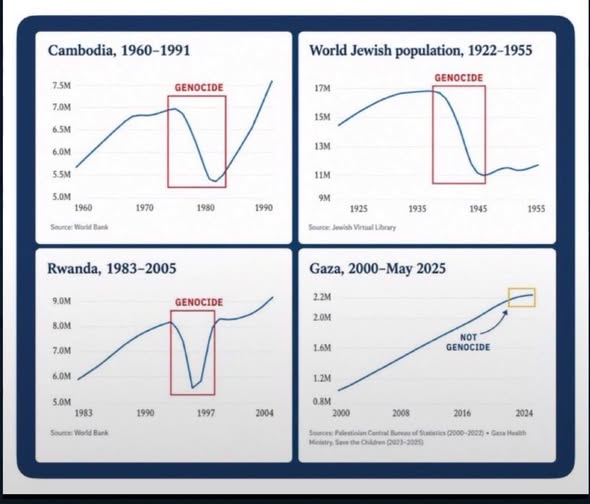
Start with the law, because the word has a legal definition and it is not optional. Article II of the 1948 Convention on the Prevention and Punishment of the Crime of Genocide, ratified by 153 states and incorporated into the Rome Statute of the International Criminal Court, defines genocide as any of the following acts committed with intent to destroy, in whole or in part, a national, ethnical, racial or religious group, as such:
(a) Killing members of the group;
(b) Causing serious bodily or mental harm to members of the group;
(c) Deliberately inflicting on the group conditions of life calculated to bring about its physical destruction in whole or in part;
(d) Imposing measures intended to prevent births within the group;
(e) Forcibly transferring children of the group to another group.
Note what the definition does not require. It does not require the complete extermination of the group. It does not require gas chambers, cattle cars, or an explicit written order. It requires acts committed with intent to destroy a group in whole or in part. The threshold is lower than the popular imagination places it, because the drafters of the Convention had just watched the one case where the popular imagination’s version nearly succeeded, and they wrote the law to catch the next one earlier.
Apply the criteria to Gaza, using only what is documented.
Criterion (a): killing members of the group. The Gaza Ministry of Health reports 74,000+ confirmed dead as of September 2026. The February 2025 Gaza Mortality Survey, published in The Lancet Global Health — a representative household survey of 2,000 households and 9,729 individuals — estimated 75,200 violent deaths through January 5, 2025, a figure 34.7% higher than the MoH count at that time. Women, children, and the elderly comprised 56.2% of violent deaths. The UN estimates 10,000+ bodies remain unrecovered under rubble. This criterion is met by any standard.
Criterion (b): causing serious bodily or mental harm. 175,000+ wounded (MoH). The destruction of every university in Gaza, the majority of schools, and most hospitals. An entire generation of children exposed to sustained bombardment, displacement, and the killing of family members. This criterion is met.
Criterion (c): conditions of life calculated to bring about physical destruction. This is the criterion that carries the most documented weight. Ninety percent of Gaza’s population has been displaced, most of them multiple times. An estimated 92% of homes are damaged or destroyed. Eighty-two percent of the territory has been reduced to rubble. The health system has collapsed — over 57% of health service points destroyed or rendered inoperable. Famine conditions have been documented by every major humanitarian agency; the blocking of aid convoys has been systematic and sustained. Infrastructure damage is assessed at $35.2 billion. The conditions imposed on the civilian population constitute, by the plain language of Article II(c), the deliberate infliction of conditions calculated to bring about physical destruction of a group in part.
The intent element. The Convention requires that the acts be committed with intent to destroy the group. This is the highest bar, the element that separates genocide from war crimes, and it is the element most fiercely contested. Israeli officials have made statements that a reasonable legal tribunal could construe as evidence of intent. Defense Minister Yoav Gallant, on October 9, 2023: “We are fighting human animals and we are acting accordingly.” President Isaac Herzog, on October 13, 2023: “It is an entire nation out there that is responsible.” Heritage Minister Amichai Eliyahu suggested a nuclear bomb on Gaza would be an option. Finance Minister Bezalel Smotrich has repeatedly called for the territory to be emptied of its Palestinian population. These are not obscure backbenchers; they are cabinet-level officials in the government directing the military operation. Whether those statements rise to the legal standard of specific intent (dolus specialis) or constitute reckless disregard is a question for the International Court of Justice, which is already adjudicating it.
The ICJ proceedings. On January 26, 2024, the International Court of Justice ruled in South Africa v. Israel that it was “plausible” that Israel’s actions in Gaza could constitute genocide, and ordered provisional measures requiring Israel to prevent genocidal acts, ensure humanitarian access, and preserve evidence. This is not a final ruling — the case is ongoing, and the Court was explicit that it was not adjudicating the merits. But the plausibility finding from the highest judicial body on the planet means the question is not settled in either direction, and anyone who tells you it is — in either direction — is ahead of the evidence.
Now the body count — and why we do not have one.
This is where the infographic’s argument lives, and where it dies. The claim embedded in a population chart that does not crater is simple: the numbers don’t show a genocide. But the numbers have never shown a genocide while the genocide was underway — not once, in any of the three cases the graphic itself holds up as comparison. Here is the record.
The Holocaust. Six million is the number everyone knows. Almost nobody knows when it was established. The figure first appeared at the Nuremberg Trials in late 1945, based on SS officer Wilhelm Höttl’s testimony that Adolf Eichmann had cited it in conversation. It was an estimate from the perpetrators, derived from their own transport records and camp tallies — not from a population study, not from an independent count. The first rigorous scholarly verification came sixteen years later, in 1961, when Raul Hilberg published The Destruction of the European Jews and arrived at 5.1 million through document-based accounting. The definitive demographic range — 5.29 to 6.2 million, still cited today — was published by Wolfgang Benz in 1991, using post-Soviet archives that had been closed for forty-six years. Yad Vashem’s Names Database, which attempts to record every victim individually, began in 1954, went online in 2004 with three million names, and reached five million names in 2025 — eighty years after the genocide, still incomplete. The “6 million” shorthand proved surprisingly accurate, but the scholarly confidence behind it took decades to build, and the name-by-name accounting is still not finished.
Cambodia. Ben Kiernan, the historian who would later found the Yale Cambodian Genocide Program, interviewed roughly 500 survivors in 1979–1980 — within a year of the Khmer Rouge’s fall — and extrapolated to 1.5 million dead. The Vietnamese-installed government initially claimed over 3 million, a figure inflated for political purposes. The Yale program was not founded until 1994, fifteen years after the genocide. Its Phnom Penh field office, which became the Documentation Center of Cambodia, accessed the 100,000-page Santebal secret police archive in 1996. DC-Cam mapped 390+ genocide sites containing 19,000+ mass graves. Kiernan refined his estimate to 1.671 million in 2003 — twenty-four years after the genocide ended. The ECCC tribunal’s final genocide conviction came in November 2018 — thirty-nine years after the killing stopped. The accepted range today, 1.5 to 2 million, took a quarter-century to establish.
Rwanda. The genocide lasted approximately 100 days, from April to July 1994. Within months, a UN expert estimated 800,000 total deaths — a figure that entered common usage quickly but conflated genocide victims with all wartime mortality and never distinguished Tutsi dead from the broader toll. Human Rights Watch published Leave None to Tell the Story in 1999, calculating a minimum of 507,000 Tutsi killed — 77% of the Tutsi population. The Rwandan government conducted a nationwide victim census in 2000 and produced 1,074,017 names; the methodology has been questioned and the original cards remain restricted. Independent demographic studies by Verpoorten (2005), Davenport and Stam (2009), and McDoom (2020) produced estimates ranging from 500,000 to 662,000 Tutsi specifically, using pre- and post-genocide census comparison. The Gacaca community courts processed nearly two million cases between 2002 and 2012. As recently as January 2024, 119 remains were found in Huye District. Twenty-six years after the genocide, scholars still disagree on the total.
| Genocide | Duration | First estimate | Accepted figure | Years to scholarly consensus |
|---|---|---|---|---|
| Holocaust | ~4 years | 6M (Nuremberg, 1945) | 5.1–6.2 million | 16 (Hilberg); 46 (Benz); 80+ (names ongoing) |
| Cambodia | ~4 years | 1.5M (Kiernan, 1980) | 1.5–2 million | 15–25 years |
| Rwanda | 100 days | 800K (UN, late 1994) | 800K–1 million | Still contested at 26+ years |
| Gaza | Ongoing | 74K+ confirmed (MoH, Sept 2026) | Unknown | Unknown — the smoke has not cleared |
The pattern is absolute. In every case, the wartime count was a fraction of the eventual toll. In every case, the final reckoning required archives to be opened, graves to be excavated, censuses to be compared, and tribunals to run for years. In the Battle of Mosul in 2016–2017 — not even a genocide, just a single urban siege — an AP investigation found 9,000 to 11,000 civilians killed, nearly ten times the Iraqi government’s acknowledged figure of 1,260. Across all post-9/11 wars, Brown University’s Costs of War project estimates 3.6 to 3.8 million indirect deaths alongside 940,000 direct deaths. The ratio of indirect to direct deaths in conflict zones ranges from 3:1 to 15:1 depending on the duration and the destruction of infrastructure. The longer a war runs, the higher the ratio climbs, because the things that kill people indirectly — famine, untreated disease, collapsed sanitation, exposure — compound over time.
What the counting infrastructure looks like in Gaza right now. Over 57% of health service points have been destroyed or rendered inoperable. Hospitals cannot receive or count the dead when the hospitals themselves are rubble. The civil registry system — the bureaucratic infrastructure that records births and deaths — has been obliterated. Bodies decompose under collapsed buildings with no heavy equipment available to excavate them. When an entire family is killed and there is no surviving member to report the deaths, those deaths go unrecorded. The Lancet’s Gaza Mortality Survey found a 34.7% gap between its estimated violent deaths and the MoH’s count through the same period. If that gap has held — and there is no reason to believe it has narrowed, given the further destruction of counting infrastructure since January 2025 — the true death toll as of September 2026 is likely above 100,000. The indirect deaths from famine, disease, and lack of medical care are accelerating and are not included in any of those figures.
The four charts. Here is what the infographic showed you, and here is what the data actually says when you read the axes honestly. The red bands mark the genocide period. The gold line is population. Note the timescales — because the timescale is where the original graphic did its work.
The timescale trick, stated plainly. The original infographic placed Gaza’s chart on a twenty-five-year axis alongside the other three genocides on three-to-five-year axes. A population that grew steadily for twenty-three years and then began absorbing catastrophic losses in the final two will still look like a rising line if you zoom out far enough. Cambodia’s population recovered within a decade of the Khmer Rouge’s fall — if you plotted Cambodia from 1970 to 2000, the line would climb too. Rwanda’s population surpassed its pre-genocide level within four years. Population recovery after mass death is the norm in young, high-fertility populations, not the exception. Using a rising population curve to disprove genocide is like using a patient’s lifetime weight chart to disprove a heart attack — the line went up overall, but the event is in the dip you averaged out.
What this dispatch is not. This is not a legal verdict. The ICJ case is pending. The full toll is unknown. The intent element — the hardest question in genocide law — is before the Court, not before this desk. But when someone shows you a population chart and tells you the rising line is proof that nothing happened, you are entitled to two questions: Have you read the law? and Do you know how long it took to count the dead the last three times? The answer to both is the same. The law does not require extermination. The count never comes during the killing. And the smoke, in Gaza, has not cleared.
Filed on: Convention on the Prevention and Punishment of the Crime of Genocide, Article II (adopted December 9, 1948; entered into force January 12, 1951), ratified by 153 states and incorporated into the Rome Statute of the International Criminal Court (Article 6). South Africa v. Israel, Application of the Convention on the Prevention and Punishment of the Crime of Genocide in the Gaza Strip, International Court of Justice, Order of January 26, 2024, finding it “plausible” that Israel’s acts could constitute violations of the Genocide Convention and ordering provisional measures. Gaza Ministry of Health confirmed death toll of 74,000+ as of September 26, 2026 (AP/Washington Times); wounded count 175,000+. The Lancet Global Health, “Counting the Dead in Gaza: Difficult but Essential,” Gaza Mortality Survey (GMS) published February 2025 — a representative household survey of 2,000 households (9,729 individuals) estimating 75,200 violent deaths and 8,540 excess non-violent deaths through January 5, 2025, 34.7% above the MoH count for the same period. Women, children, and elderly comprised 56.2% of violent deaths; violent death rate of 33.1 per 1,000 per year. OCHA Reported Impact Snapshot, Gaza Strip, September 2, 2026 — 73,231+ killed, 82% of territory reduced to rubble, 92% of homes damaged or destroyed, 90% of population displaced. UNRWA Situation Report #230 — 392 UNRWA staff killed as of July 2026, 312 UNRWA installations damaged, personnel and aid blocked from entering Gaza since March 2025. UN News, August 2026 — infrastructure damage assessed at $35.2 billion; Israel controls approximately 65% of the territory. Israeli officials’ statements: Defense Minister Yoav Gallant, October 9, 2023 (“human animals”); President Isaac Herzog, October 13, 2023 (“entire nation”); Heritage Minister Amichai Eliyahu, November 2023 (nuclear weapon suggestion); Finance Minister Bezalel Smotrich (repeated calls for population transfer). Holocaust accounting: Nuremberg Trials, November 1945 (Wilhelm Höttl testimony citing Eichmann’s 6 million figure); Raul Hilberg, The Destruction of the European Jews (1961), arriving at 5.1 million; Wolfgang Benz, Dimension des Völkermords (1991), range 5.29–6.2 million using post-Soviet archives; Yad Vashem Names Database, 5 million names as of 2025. Cambodia: Ben Kiernan, survivor interviews 1979–1980; Yale Cambodian Genocide Program (founded 1994); Documentation Center of Cambodia (DC-Cam, 1997), mapping 390+ genocide sites and 19,000+ mass graves; Kiernan, “The Demography of Genocide in Southeast Asia,” Critical Asian Studies 35, no. 4 (2003), revised estimate 1.671 million; ECCC final genocide conviction, November 2018. Rwanda: UN expert estimate of 800,000 (late 1994); Human Rights Watch, Leave None to Tell the Story: Genocide in Rwanda (1999), minimum 507,000 Tutsi killed; Rwandan government victim census 2000 (1,074,017 names); Verpoorten, “The Death Toll of the Rwandan Genocide,” Population Studies (2005); Gacaca courts, 1,958,634 cases processed 2002–2012. Mosul: AP investigation estimating 9,000–11,000 civilian deaths versus the Iraqi government’s acknowledged 1,260. Brown University Costs of War Project, estimating 3.6–3.8 million indirect deaths across post-9/11 wars alongside 940,000 direct deaths. All charts in this dispatch were built from the cited source data by this desk. The framing — that the legal definition of genocide does not require complete extermination; that wartime death counts have universally proven to be significant undercounts upon post-conflict accounting; that a population curve zoomed to a multi-decade axis will visually average out a short-duration catastrophe; that the ICJ plausibility finding places the legal question as open rather than settled in either direction; and that the precedent across three prior genocides shows scholarly consensus on death tolls takes 15 to 50+ years to establish, with name-level accounting still incomplete in the oldest case — is this desk’s own analysis and is labeled as such.
№ 63 · Filed September 27, 2026 — An infographic crosses this desk with a question printed across the top in block capitals: IS BITCOIN A CIA OPERATION? Below it, a tidy chain of logos — the NSA, a 1996 cryptography paper, SHA-256, Satoshi, Gavin Andresen at CIA headquarters, Jeffrey Epstein, the MIT Media Lab, BlackRock — marching seventeen years from a cypherpunk mailing list to a Wall Street balance sheet. And here is the thing this column has learned to check for first, the part that is usually inflated: almost every individual fact on that graphic is true. The NSA really did design the hash function at Bitcoin’s core. Its mathematicians really did publish a paper on anonymous electronic cash in 1996. Gavin Andresen, the man Satoshi handed the keys to, really did give a talk to the CIA’s venture arm in 2011. The MIT lab that paid Bitcoin’s core developers really was run by a man who took Epstein’s money. And Larry Fink really did call Bitcoin an “index of money laundering” before BlackRock turned it into the fastest-growing fund in its history. The facts are real. The conclusion is where the wheels come off — because a chain of true facts arranged in the right order is exactly how you build a thing that feels like proof and contains none. So this dispatch does the whole file, from the ground up, because you cannot judge the charge without the vocabulary: what money actually is, what fiat is and why it is the strangest thing in your wallet, what Bitcoin actually is and how the machine works nut-and-bolt, what a meme coin is and why it is the opposite of the thing it dresses up as, how all three differ down to the root — and then, armed with all of it, exactly where the honeypot story is true, where it is a category error, and why the real story is not a secret plot but something duller and more important: the capture of an uncensorable asset by the very institutions it was built to route around.
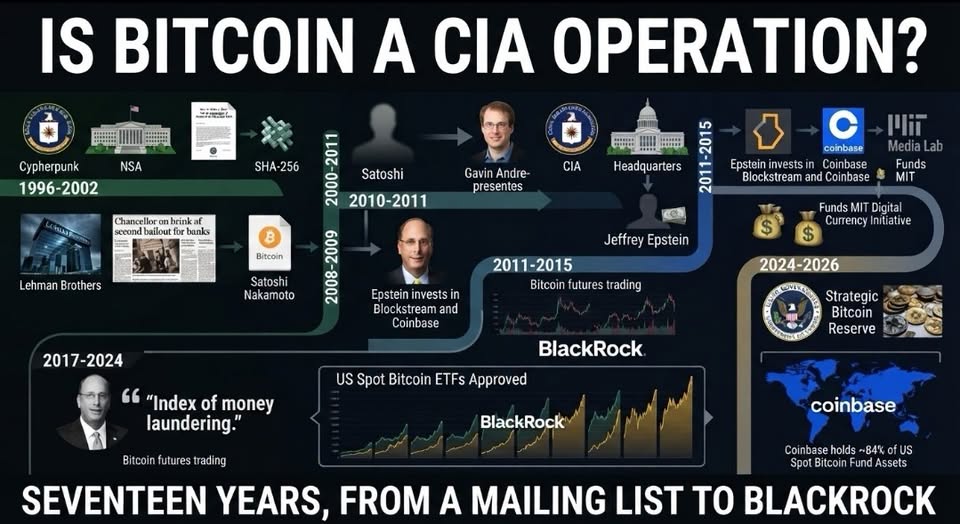
The Coin They Say Langley Minted — The Bitcoin-CIA Conspiracy, Traced Link by Link
Every argument about Bitcoin — whether it is freedom money or a federal honeypot, digital gold or a greater-fool casino — is really an argument about money itself, and almost nobody making it can define the word. So start there, because the whole file is unreadable without it.
What money actually is. Money is not paper and it is not metal. Money is a ledger — a shared record of who is owed what — and everything humans have ever used as money is just a different technology for keeping that record honest. Gold kept the ledger with physics: you cannot counterfeit an element, and you cannot conjure more of it without digging. Paper receipts kept the ledger with a vault: a bank held the gold and issued claims against it. Modern bank money keeps the ledger with databases owned by regulated institutions. Economists give money three jobs — a medium of exchange so you need not barter, a unit of account so prices mean something, and a store of value so work done today can be spent next year. The hard part, the part every monetary technology in history has been built to solve, is the same: how do you keep one person from spending the same unit twice, and how do you keep the person who controls the ledger from quietly writing themselves a bigger balance. Hold those two problems in your head. They are the entire story.
What fiat is — and why it is the strangest thing in your wallet. The dollar in your pocket is fiat money, from the Latin for “let it be done” — money that is money because the government declares it so, backed by nothing you can hold. It was not always this way. For most of American history the dollar was a claim on a fixed weight of gold; you could, in principle, walk into a bank and trade the paper for the metal. That cord was cut in stages — domestically in 1933, when Roosevelt made private gold ownership a crime, and finally on August 15, 1971, when Richard Nixon “temporarily” suspended the dollar’s convertibility into gold to stop foreign governments from draining Fort Knox. The suspension was never reversed. Since that Sunday night, the dollar has been backed by exactly one thing: the full faith and credit of a government that can print as many of them as it likes. And it does. The mechanism is the one this desk walked in the ratchet dispatch just days ago — the power to create money, handed by Congress to the Federal Reserve in 1913 and never reclaimed. When the Fed creates dollars, it does not counterfeit; it does something the law permits and the counterfeiter cannot: it dilutes. Every new dollar makes the ones already in your account worth fractionally less, which is why a 1971 dollar buys about fifteen cents of goods today. That slow bleed has a polite name — inflation — and a blunter one: it is a tax nobody voted for, levied on savers, collected by whoever gets the new money first. Fiat is not a scam. It is a tool, and a powerful one — it let governments fight wars and cushion crises no gold standard could have financed. But it solves the double-spend problem by trusting the ledger-keeper completely, and it solves the print-more problem not at all. That is the itch Bitcoin was built to scratch.
The problem no one could solve: money that is only data. Digital money is easy to imagine and was, for decades, impossible to build without a referee. The reason is the double-spend problem. A digital dollar is a file, and a file can be copied — so what stops you from sending the same digital coin to two people at once, the way you can email the same photo to a hundred? The old answer was always a trusted middleman: a bank, a PayPal, a credit-card network that keeps the single authoritative ledger and debits your account when you spend. It works, but it reintroduces the exact thing digital cash was supposed to escape — a central party who can freeze you, reverse you, surveil you, or inflate the supply. For thirty years the cypherpunks — a mailing list of cryptographers and libertarian coders who believed privacy and sound money were things you build, not things you beg for — hammered at this. David Chaum built DigiCash and its “ecash” in the late 1980s; it was cryptographically brilliant and still needed a central issuer, and it died. Adam Back invented Hashcash in 1997 — a scheme that made email spam expensive by forcing the sender’s computer to burn real effort on a math puzzle, the seed of “proof of work.” Wei Dai sketched b-money in 1998, Nick Szabo designed bit gold the same year — both proposed decentralized digital scarcity, and both stalled on the same rock: without a central ledger, how does the network agree on whose transactions are real and in what order, when some of the participants are lying? That specific unsolved problem — distributed agreement among parties who cannot trust each other — is what sat unanswered until a pseudonym showed up with the missing piece.
What Bitcoin actually is, and how the machine works. On October 31, 2008 — six weeks after Lehman Brothers collapsed and the government began printing trillions to rescue the banks — a person or group under the name Satoshi Nakamoto posted a nine-page paper to a cryptography mailing list: Bitcoin: A Peer-to-Peer Electronic Cash System. On January 3, 2009, Satoshi mined the first block and buried a message in it, a headline from that day’s Times of London: “Chancellor on brink of second bailout for banks.” The birth certificate was also a manifesto. Here is the machine it described, in plain parts:
— The blockchain is the ledger, but nobody owns it. Instead of one bank’s database, thousands of identical copies run on volunteer computers (“nodes”) around the world. Transactions are bundled into “blocks” roughly every ten minutes and chained together, each block cryptographically sealed to the one before it, so that altering an old transaction would require redoing every block since — a practical impossibility. This is how Bitcoin solves the double-spend problem without a referee: the whole network holds the ledger, and the ledger is append-only.
— Hashing is the seal, and this is where the honeypot chart plants its flag. Every block is run through SHA-256, a “hash function” that turns any input into a fixed 64-character fingerprint, where the tiniest change to the input scrambles the whole output unpredictably. SHA-256 was indeed designed by the National Security Agency and published as a federal standard in 2001–2002. That fact does a great deal of work in the meme and none of the work it pretends to — a point we return to, because SHA-256 is not a secret weapon. It is the open padlock securing your bank login, every HTTPS website you visit, every software update, and the Git commits of the engineers who audit Bitcoin for a living.
— Mining and proof of work is the engine, the piece Chaum and Dai and Szabo were missing. To add the next block, computers around the world race to guess a number that makes the block’s hash come out below a target — a puzzle with no shortcut, solvable only by trillions of blind guesses per second, burning real electricity. The winner earns newly minted bitcoin plus transaction fees. This is genius for one reason: it makes lying expensive. To rewrite the ledger you would need to out-compute the entire honest network at once, which would cost more than any fraud could earn. Trust is replaced by cost. That is Satoshi’s actual invention — not the cryptography, which was decades old, but the economic machine that makes a leaderless network agree on the truth because cheating does not pay.
— The 21 million cap is the point of the whole exercise. Bitcoin’s code fixes the total supply that will ever exist at twenty-one million coins, and cuts the rate of new issuance in half every four years — the “halving” — until the last fraction is mined around the year 2140. No board can vote to print more; the scarcity is enforced by math and by every node that would reject a cheater’s block. Where fiat trusts a ledger-keeper not to dilute you and the ledger-keeper dilutes you anyway, Bitcoin removes the ledger-keeper. That is the entire pitch: money whose supply no government, no banker, and no founder can inflate.
— Keys, not accounts. You do not have a Bitcoin account that someone can freeze. You have a private key — a secret number — that proves ownership and signs transactions, paired with a public address others can send to. Whoever holds the key holds the coins; there is no customer-service line and no reversal. That is the freedom and the terror of it: no one can seize your bitcoin, and no one can recover it if you lose the key. This is why it is called a bearer asset, like cash in a briefcase — possession is ownership, full stop.
That is Bitcoin: a fixed-supply, leaderless, append-only ledger secured by open cryptography and defended by the cost of electricity. Whether it is a good investment is a separate question this desk will not touch — it is volatile, young, and priced by sentiment as much as by anything. But whether it is sound — scarce, uncensorable, un-inflatable — is not really in dispute, and it is the exact opposite of the thing the next section describes.
What a meme coin is — and why it is Bitcoin’s photographic negative. A meme coin is a cryptocurrency with no purpose but its own price. It borrows Bitcoin’s clothing — blockchain, tokens, wallets — and throws away the substance. The genre began in December 2013 as an open joke: two engineers, Billy Markus and Jackson Palmer, spun up Dogecoin around a Shiba Inu dog meme to satirize crypto mania. The satire became a several-billion-dollar asset, which tells you most of what you need to know about the era. Since then meme coins have multiplied into the tens of thousands — Shiba Inu, Pepe, Bonk, and a daily tide of tokens spun up in minutes on cheap networks. Here is how they differ from Bitcoin at the root, and the difference is not a matter of degree:
— Supply. Bitcoin is capped at 21 million by unchangeable code. Meme coins typically mint hundreds of trillions or quadrillions of units, often with no cap and the power to create more at will — abundance dressed as a bargain because each token costs a fraction of a cent.
— Issuance. Bitcoin had no founder’s stash — Satoshi mined alongside everyone else, and his coins have never moved. Meme coins are frequently “pre-mined,” with the creators keeping a large share for themselves before the public can buy, which lets them dump on their own followers — the “rug pull” that has become the genre’s signature crime.
— Backing and purpose. Bitcoin’s proposition is monetary: fixed scarcity, no controller. A meme coin’s proposition is attention — it is worth something only as long as a crowd believes the next crowd will pay more, which is the textbook shape of a greater-fool game. When the attention moves on, the price does not correct; it evaporates.
The genre reached its logical end in January 2025, when a sitting president of the United States launched an official $TRUMP token days before his inauguration, followed within forty-eight hours by a $MELANIA token — insiders holding the vast majority of the supply, hundreds of thousands of buyers underwater within weeks, and a spectacle that would have been a securities-fraud indictment in any other wrapper. That episode is the cleanest possible illustration of the difference: Bitcoin was built so that no insider could do that. A meme coin is built so that they can.
| Fiat (the dollar) | Bitcoin | A meme coin | |
|---|---|---|---|
| Who can create more | A central bank, at will | No one — capped at 21M by code | The founders, usually at will |
| What backs it | Government decree (“fiat”) | Proof-of-work cost + fixed scarcity | Attention — and nothing else |
| Who controls the ledger | Regulated banks + the Fed | Thousands of leaderless nodes | Often the founding team |
| Can they freeze you | Yes — accounts, seizures | No — you hold the key | Sometimes — depends on the contract |
| Supply over time | Grows (inflation) | Fixed, disinflationary | Often unlimited |
| Reason it exists | State finance + monetary policy | Money no one can inflate or censor | To go up until it doesn’t |
Now the charge, at full strength. Give the honeypot theory its best case, because it deserves one — a lazy dismissal is how you lose the room. The claim is that Bitcoin is not a grassroots revolt but a designed instrument of the surveillance state, and here is the evidence, every piece of it real. The cryptographic core, SHA-256, was built by the NSA. In 1996 — twelve years before the whitepaper — three NSA mathematicians published a paper titled “How to Make a Mint: The Cryptography of Anonymous Electronic Cash,” laying out much of the conceptual scaffolding Bitcoin would later stand on. Satoshi vanished in 2011 and has never been identified — a founder with no face. The man he handed control to, Gavin Andresen, announced on the Bitcoin forum that same year that he had accepted an invitation to brief the CIA’s venture-capital arm at Langley. In 2015 the MIT Media Lab created the Digital Currency Initiative and put several core Bitcoin developers on its payroll — and its director, Joi Ito, resigned in 2019 when it emerged he had taken money from Jeffrey Epstein. And the endgame: the same Wall Street that called Bitcoin a criminal’s toy pivoted to swallow it, with BlackRock launching a spot Bitcoin ETF in 2024 and Coinbase quietly custodying the overwhelming majority of the coins underlying every U.S. Bitcoin fund. Seventeen years, the graphic says, from a mailing list to BlackRock. Cui bono. Follow the logos.
Where the narrative collapses. It is a good story, and it fails on the mechanics — not on the facts, which mostly hold, but on what the facts are permitted to mean. Take them in order.
SHA-256 is not a backdoor; it is the opposite of one. The load-bearing beam of the whole theory is that the NSA built Bitcoin’s hash function, therefore the NSA can break it. But a hash function with a secret trapdoor would be the single most catastrophic thing the NSA could possibly release, because SHA-256 does not just secure Bitcoin — it secures the entire modern internet. Every HTTPS connection, every password stored responsibly, every TLS certificate, every software-update signature, every SSH session, the U.S. military’s own communications: all lean on SHA-256. A trapdoor in it would not be a key to Bitcoin’s vault; it would be a skeleton key to the banking system, the Pentagon, and the agency’s own traffic. And it is the most-attacked algorithm in the history of cryptography — a quarter-century of the world’s best mathematicians, hostile intelligence services, and academic cryptographers hunting for a weakness, with a permanent Bitcoin bounty of tens of billions of dollars sitting in the open as the prize for anyone who finds one. None has. The provenance the meme treats as damning is, on inspection, exactly why the thing is trusted: SHA-256 is a public standard precisely because a secret one would be worthless.
A honeypot needs a trapdoor, and there is none. This is the argument that ends the debate for anyone who understands what “honeypot” means. A state-run honeypot is only useful if the state can exploit it — a hidden key, an admin override, a structural backchannel to freeze funds, unmask users, or inflate the supply. Bitcoin’s entire codebase is open source and has been from block one. Every line has been read, forked, and attacked by thousands of independent engineers, hostile governments, and rival projects for seventeen years. There is no hidden key. There is no admin. There is no privileged address, no kill switch, no supply lever. If an intelligence agency built this as a trap, it built a trap with no mechanism to spring — a honeypot the beekeeper cannot open. That is not how intelligence operations work, because it would be pointless.
The pedigree is public, and it is not Langley’s. Bitcoin did not spring fully formed from a classified lab. Its parts were developed in the open, across two decades, on public mailing lists, by named people with long paper trails: Adam Back’s Hashcash (1997) for the proof-of-work; Hal Finney’s Reusable Proof of Work (2004); Wei Dai’s b-money (1998) and Nick Szabo’s bit gold (1998) for the decentralized-scarcity design; David Chaum’s earlier ecash for the blind-signature cryptography. Satoshi cites these people in the whitepaper. The 1996 NSA “Mint” paper the meme leans on describes a fundamentally different architecture — a centralized, bank-issued digital cash, the precise thing Bitcoin was invented to replace. Sharing a research field is not sharing a bloodline. The cypherpunks were building this in public, and hating the surveillance state the whole time.
Financialization is capture, not creation. The strongest-feeling part of the chart is the end — the NSA at one pole, BlackRock at the other, as if the same hand drew the whole arc. But Wall Street and the agencies arriving late is not evidence they started it; it is evidence the thing worked. An uncensorable bearer asset that grew to trillions in value was always going to be captured, because that is what large institutions do to any asset with a fee to be skimmed and a demand to be intermediated. BlackRock did not launch a Bitcoin ETF out of ideology; it launched one because asset managers earn lucrative fees on high-demand liquidity, and because SEC rules force institutional money through regulated custody wrappers like Coinbase. Larry Fink calling it an “index of money laundering” in 2017 and selling it to pension funds in 2024 is not a conspiracy revealing itself — it is a fee opportunity overriding a prior opinion, the most ordinary event in finance. The co-optation is real, and it is worth worrying about on its own terms: the more the coins sit in a handful of custodial giants, the more the government can lean on those giants, which is a genuine erosion of the uncensorability that was the entire point. But that is the surveillance state capturing Bitcoin, which is the opposite of the surveillance state building it.
| The claim on the chart | What is actually true | What it proves |
|---|---|---|
| “The NSA built the crypto” | NSA designed SHA-256, a public 2001 standard | It secures the whole internet — a public tool, not a trapdoor |
| “NSA wrote the blueprint in 1996” | The “How to Make a Mint” paper is real | It describes centralized bank-cash — the thing Bitcoin replaced |
| “Gavin briefed the CIA” | Andresen spoke to In-Q-Tel in 2011, publicly | He announced it on the open forum — the least secret way to plot |
| “MIT / Epstein money” | DCI funded core devs; Ito took Epstein cash, resigned | A funding scandal at one lab — not control of the protocol |
| “BlackRock was the plan all along” | Fink flipped; IBIT + Coinbase custody dominate | Late capture of a working asset — not its origin |
The verdict, stated plainly. The chart is a masterclass in a specific kind of lie — the one built entirely from true facts. Every logo on it belongs there; the NSA did write the hash, Gavin did visit Langley, Epstein’s money did touch the lab, BlackRock did swallow the asset it once smeared. And the arrangement of those true facts into an arrow pointing at a master plan is a category error, because it confuses three different things a state can do with a technology: invent it, seed it, and capture it. The evidence for invention is nil — the code is open, the pedigree is public, the cryptography is the internet’s own padlock, and a honeypot with no trapdoor is not a honeypot. The evidence for capture, on the other hand, is overwhelming and ongoing, and it is the thing you should actually be watching — not because Langley minted the coin, but because Wall Street and Washington are steadily herding it into custodial pens where the old powers of freeze and surveil can reach it again. That is the real story, and it is duller and more important than the meme: Bitcoin was built precisely to route around the ledger-keepers who can dilute your savings and freeze your accounts, and the ledger-keepers are now doing to Bitcoin what they do to everything — not shutting it down, but absorbing it, wrapping it, and slowly turning a bearer asset back into an account they hold. The cypherpunks solved a thirty-year math problem and handed the world money no government could inflate. Whether the world keeps that gift or hands it back to the custodians is not a question about 1996 or Langley. It is a question about the next ten years, and it is being answered right now, one ETF at a time.
Filed on: Satoshi Nakamoto, “Bitcoin: A Peer-to-Peer Electronic Cash System” (October 31, 2008); the genesis block mined January 3, 2009, embedding the headline “The Times 03/Jan/2009 Chancellor on brink of second bailout for banks”; the first peer transaction to Hal Finney, January 12, 2009. SHA-256 designed by the U.S. National Security Agency and published by NIST as part of FIPS 180-2 (2001–2002), in ubiquitous use across TLS/HTTPS, SSH, code-signing, and version control. Laurie Law, Susan Sabett, and Jerry Solinas (NSA), “How to Make a Mint: The Cryptography of Anonymous Electronic Cash” (June 1996), describing a centralized, bank-issued electronic-cash architecture. Cryptographic antecedents cited in and around the whitepaper: David Chaum’s blind signatures and DigiCash/ecash (1980s–1990s); Adam Back’s Hashcash (1997); Wei Dai’s b-money (1998); Nick Szabo’s bit gold (1998); Hal Finney’s Reusable Proof of Work (2004). Bitcoin’s fixed 21-million supply cap, ~10-minute block interval, and the halving of the block subsidy every 210,000 blocks (the April 2024 halving reducing the reward to 3.125 BTC), all enforced by consensus rules. Satoshi’s final known communications in spring 2011 and the handover of the reference-client repository to Gavin Andresen; Andresen’s June 2011 announcement on the Bitcointalk forum that he would present at an emerging-technologies conference hosted by In-Q-Tel, the CIA’s venture-capital arm. The MIT Media Lab Digital Currency Initiative (founded 2015) funding Bitcoin Core developers including Gavin Andresen and Wladimir van der Laan; Media Lab director Joi Ito’s resignation in September 2019 following disclosures of funding from Jeffrey Epstein. Larry Fink’s 2017 characterization of Bitcoin as an “index of money laundering,” BlackRock’s June 2023 filing for the iShares Bitcoin Trust (IBIT), the SEC’s approval of U.S. spot Bitcoin ETFs on January 10, 2024, and Coinbase Custody’s role holding the large majority of assets underlying those funds. Monetary history: the Federal Reserve Act of 1913 delegating money creation; Executive Order 6102 (1933) criminalizing private gold holding; the suspension of dollar-gold convertibility announced by President Nixon on August 15, 1971 (the “Nixon shock”), ending the Bretton Woods gold peg and inaugurating the pure-fiat era. Meme-coin history: Dogecoin, created December 2013 by Billy Markus and Jackson Palmer; the subsequent proliferation (Shiba Inu, Pepe, and others); the $TRUMP token launched January 17, 2025 and the $MELANIA token launched January 19, 2025 on the Solana network, with concentrated insider supply and large retail losses. The framing throughout — that money is fundamentally a ledger; that fiat solves double-spend by trusting the issuer and solves dilution not at all; that Bitcoin’s innovation is proof-of-work consensus rather than novel cryptography; that a meme coin inverts every property that makes Bitcoin sound; that a honeypot requires an exploitable trapdoor absent from an open, audited, leaderless protocol; and that the genuine threat is institutional capture of an uncensorable asset rather than state authorship of it — is this desk’s own analysis and is labeled as such.
№ 62 · Filed September 27, 2026 — Start in 1913, because that is the year Congress began giving itself away and never stopped. In a single twelve-month span it handed its constitutional power to coin money to a board of bankers (the Federal Reserve Act), amended the Constitution to fund a permanent federal government it could not previously afford (the Sixteenth), and cut the last structural cord tying the Senate to the states it was built to represent (the Seventeenth). Three delegations in one year, and not one of them has ever been clawed back. That is the shape of the whole century that followed: Article One of the Constitution is a list of the powers that belong to Congress — money, taxes, tariffs, war — and the history of the modern presidency is the history of Congress handing those powers, one at a time, to a single person, always for a reason that seemed good at the time, and never once taking one back. This dispatch walks the ratchet from 1913 to the pardon pen: the year the giveaway started, the legal doctrine that was supposed to stop it and the year the Court quietly killed it, the emergencies that never end, the one time in a century a court told a president no, the post-Watergate fences that became gates, the taxing power exercised by proclamation, and the one power that needed no delegation at all — because it shows you what all the others became. The lesson underneath is the same one this desk keeps arriving at from every direction: a power built for a president you trust is inherited, intact, by a president you do not.
The Ratchet Only Turns One Way — How Congress Gave Itself Away, Starting in 1913
A ratchet is a gear that turns in one direction and locks against the other. It is the exact mechanism of federal power, and it is worth naming precisely because almost every argument about the presidency misses it. People fight about whether a given president is a tyrant. The more useful question is structural: when a power moves from Congress to the executive, does it ever move back? The answer, across a hundred years and both parties, is almost never. A delegation is made in an emergency, kept out of convenience, and used to its outer limit by whoever inherits it — and the men who handed it over are almost always horrified by the men who eventually hold it, which changes nothing, because the gear does not turn the other way. Everything below is one tooth of that gear.
1913 — the year the giveaway began. The Constitution gives Congress, and only Congress, the power “to coin Money, regulate the Value thereof.” On December 23, 1913, Congress delegated that power to the Federal Reserve, a system of regional banks run by a board no voter elects — the single largest transfer of an enumerated Article One power in American history, and one nobody has seriously proposed reversing since. Ten months earlier the Sixteenth Amendment had made the income tax permanent, which matters here for a reason that is easy to miss: you cannot build a leviathan you cannot pay for, and the income tax was the funding mechanism for everything the next century would delegate. And in April the Seventeenth Amendment moved the election of senators from state legislatures to the direct popular vote — a reform sold as democracy, and it was, but it also severed the one structural check the states held over the federal government. Before 1913 a state legislature could recall a senator who voted to expand Washington’s reach; after it, it could not. The Senate stopped being the states’ embassy in the capital and became another national body. Three cords cut in one year, and the government that emerged was one that could print, tax, and grow without the brakes the Framers had bolted on.
The doctrine that was supposed to stop this — and the year the Court cut the fuse. There was a legal safeguard against Congress handing away its powers, and it has a name: the nondelegation doctrine. The theory is simple and old — the Constitution vests legislative power in Congress, so Congress cannot simply hand a blank check to the executive and go home. For a while the Court took it seriously. In 1935, at the height of the New Deal, the Supreme Court struck down two of Franklin Roosevelt’s signature statutes precisely because they delegated too much: Panama Refining v. Ryan, the “hot oil” case, and then, unanimously, Schechter Poultry v. United States — the “sick chicken” case — which killed the National Industrial Recovery Act because it let the president write industrial codes with the force of law and no real standard to guide him. Here is the fact that decides the entire century: those 1935 cases were the last time the Supreme Court struck down a federal statute for excessive delegation. After Roosevelt’s 1937 pressure campaign and the Court’s famous retreat, the standard collapsed into the “intelligible principle” test — a phrase so forgiving that in ninety years no delegation has failed it. Congress learned the lesson exactly backward: it discovered it could hand the executive almost anything, in almost any language, and the courts would bless it. The fuse on the ratchet was cut in 1937, and it has never been repaired.
The emergency that never ends. Once the doctrine was dead, the emergency became the favorite vehicle, because an emergency lets a president act like a legislature and lets a Congress avoid the vote. The template was set early. On April 5, 1933, invoking the Trading with the Enemy Act of 1917 — a wartime statute stretched to cover a peacetime bank panic — Roosevelt ordered Americans to surrender their gold to the government under threat of a $10,000 fine and prison. A wartime power, repurposed in peace, to reach into private citizens’ safes. Nine years later the same emergency logic produced Executive Order 9066, which sent 120,000 people of Japanese descent, most of them American citizens, into camps — and the Supreme Court, in Korematsu, said the Constitution permitted it. The Court did not formally repudiate Korematsu until 2018, in a single line buried in an opinion upholding a different presidential power. The pattern each time is identical: the emergency is declared for a real crisis, the power is used to its edge, and when the crisis passes the power stays on the books, waiting.
The one time in a century a court said no. It is worth pausing on the exception, because there is essentially one. In 1952, with American troops fighting in Korea and a steel strike looming, President Truman seized the nation’s steel mills by executive order, claiming an inherent power to do so. In Youngstown Sheet & Tube v. Sawyer the Supreme Court told him no — that a president has no roving authority to seize private industry that Congress has not granted him. Justice Robert Jackson’s concurrence became the most cited framework in the field: presidential power is at its height when Congress has authorized it, in a “twilight zone” when Congress is silent, and at its “lowest ebb” when the president acts against the express will of Congress. Youngstown is taught in every law school precisely because it is so rare — the clean case where the judiciary drew the line and made it hold. In the seventy years since, the line has mostly been a suggestion.
The fences that became gates. After Vietnam and Watergate, Congress had a spasm of conscience and tried to build the fences back. In a single decade it passed the War Powers Resolution (1973, over Nixon’s veto), the National Emergencies Act (1976), the International Emergency Economic Powers Act (1977), and the Foreign Intelligence Surveillance Act (1978) — each one sold as a leash on a presidency that had slipped its collar. Every one of them curdled into a grant. The National Emergencies Act was meant to end the open-ended emergencies still lingering from 1933, 1950 and 1970; instead it created a tidy procedure by which any president can declare a new one whenever he likes, and roughly forty of them are active right now, some renewed annually for decades — the Iran emergency of November 1979 has been re-declared by every president since Carter. The War Powers Resolution was supposed to force a president to come to Congress for war; presidents have instead treated the sixty-day clock as a permission slip to fight for sixty days. And the machinery built to restrain emergency power became the machinery to wield it: in February 2019, told by Congress in plain terms that it would not fund a border wall, a president simply declared a national emergency under the National Emergencies Act and redirected roughly $6 billion in already-appropriated military funds to build it anyway — using an emergency statute to override the one power the Constitution most jealously reserves to the House, the power of the purse.
Sixty words, one dissenting vote, twenty years of war. The purest specimen of the ratchet is the Authorization for Use of Military Force passed three days after September 11, 2001. It is sixty words long. It authorizes force against those who “planned, authorized, committed, or aided” the attacks. It passed the House 420 to 1 — Barbara Lee the only no — and the Senate 98 to 0, in an afternoon, in grief and fury. That sixty-word paragraph has since been cited as the legal basis for military operations in some twenty countries against groups that did not exist in 2001, under four presidents of both parties, and it is still in force today, a quarter-century on, having never been meaningfully revisited. Congress did not vote for those later wars. It voted once, in 2001, and handed over the pen.
The purse and the tariff, exercised by proclamation. Nowhere is the giveaway starker than on taxes and tariffs — the very first substantive power the Constitution lists, in the very first clause of Article One, Section Eight. Congress delegated it in pieces: Section 232 of the Trade Expansion Act of 1962 let the president raise tariffs for “national security,” Section 301 of the Trade Act of 1974 let him do it to punish unfair trade, and the 1977 emergency-economic-powers act let him regulate commerce during a declared emergency. For decades those tools were used narrowly. Then in 2025 an administration reached for the emergency statute — a law written to impose sanctions on hostile regimes, and never once used for tariffs in its half-century of existence — and invoked it to impose sweeping tariffs on nearly every trading partner on earth, a tax on American importers running to the hundreds of billions, set by proclamation, adjusted by social-media post. A federal trade court ruled the emergency law does not authorize it; the fight is climbing the appellate ladder toward the Supreme Court as this is filed. However it ends, the point is already made: the power to tax, which the Framers gave to the branch closest to the voter precisely so that no king could tax without consent, was exercised in 2025 by one man citing an emergency — because Congress had handed him the keys, one statute at a time, over sixty years.
The capstone: the one power that needed no delegation at all. End where the ratchet points — the pardon — because it is the exception that explains the rule. The pardon was never delegated; it was the president’s from the first day, written into Article Two, deliberately unchecked by Congress or the courts. That is exactly why it is the perfect mirror: it shows you what an unrestrained executive power looks like in its pure form, with no fence to erode because none was ever built. Watch what happened to it. George Washington used the first pardons to reconcile the country after the Whiskey Rebellion — mercy in service of the union. Two centuries later the same pen writes something else entirely: Bill Clinton pardoning the fugitive financier Marc Rich on his last morning in office, whose ex-wife had showered the Clinton library and Democratic causes with cash; a president pardoning his own campaign chairman, his national security adviser, his longtime friend, and the father of his son-in-law; a president, on his first day back, pardoning or commuting nearly 1,500 people who stormed the Capitol on his behalf, including men who beat police officers; and a president who spent a year swearing he would not pardon his son doing exactly that in December, in a sweeping grant covering a decade, and then issuing preemptive pardons to his own family on the way out the door. This is not a partisan indictment; the pen has been abused in both hands, and this desk names both. It is a demonstration. The pardon is what every other power on this list is quietly becoming: a tool that began as an instrument of the public good and ends as an instrument of the man who holds it, answerable to no one, because the check was either never built or long since eroded.
| The power | Where the Constitution put it | How it was handed over — or used |
|---|---|---|
| Coining money | Congress (Art. I §8) | Delegated to the Federal Reserve, 1913 — never reclaimed |
| Guarding delegation itself | The courts (nondelegation) | Last enforced in 1935 (Schechter); dead since 1937 |
| Emergency economic power | Congress | ~40 active emergencies; gold seizure 1933, border wall 2019 |
| Seizing private industry | Congress must authorize | Blocked once — Youngstown, 1952 — the lone clean no |
| Declaring war | Congress (Art. I §8) | 2001 AUMF: 60 words, one no vote, still fighting 25 years on |
| Taxes and tariffs | Congress (Art. I §8, cl. 1) | Delegated via §232, §301, IEEPA — tariff-by-proclamation, 2025 |
| The pardon | The president (Art. II) | Never delegated, never checked — the pure form of the rest |
The other engine — because Congress did not build this alone. Every row above shows the legislature handing something away, but a ratchet needs two hands and the second one wears a robe. When the Court stopped enforcing the nondelegation doctrine in 1937 it did not merely step aside — over the ninety years that followed it actively built the presidency up, blessing each new claim of power and, more than once, inventing power that Congress had never granted at all. The judiciary earns its own honest ledger here, and it runs almost entirely in one direction, with a single recent stretch in which the Court reached back and clawed some authority away from the branch it had spent a century feeding.
| The case | What the Court did | Which way it turned the gear |
|---|---|---|
| Curtiss-Wright, 1936 | Declared the president the “sole organ” of foreign affairs — a near-blank check the Constitution never wrote | Built it up |
| Korematsu, 1944 | Blessed the internment of citizens by executive order; not repudiated until 2018, in the same breath that upheld the travel ban | Built it up |
| Chevron, 1984 | Ordered courts to defer to the executive’s own reading of ambiguous law — for forty years the branch got to say what statutes meant | Built it up |
| Seila Law, 2020 | Expanded the president’s power to fire the heads of independent agencies, tearing at the 1935 line that shielded them | Built it up |
| Trump v. United States, 2024 | Invented criminal immunity for a president’s “official acts” — the largest single grant on this page, and Congress delegated none of it | Built it up |
| West Virginia v. EPA, 2022 | Revived the “major questions” doctrine to bar agencies from deciding vast policy without a clear vote of Congress | Pulled it back |
| Loper Bright, 2024 | Overruled Chevron outright, taking back from the executive the power to interpret its own statutes | Pulled it back |
Five rows point one way and two point the other, and the two that reverse arrived only in the last three years — a flicker against a century of feeding the branch. Note where the biggest expansion sits: not in any statute Congress ever passed, but in a ruling the Court wrote for itself in 2024. The legislature abdicated, the judiciary obliged, and then it went further on its own.
The verdict, stated plainly. The ratchet only turns one way. In a little over a century Congress has handed the executive its power to coin money, its power to tax and tariff, and its power to make war, and the doctrine that was supposed to prevent exactly this has been a dead letter since before the Second World War. Each delegation was made for a reason that looked like wisdom at the time — a bank panic, a world war, a terrorist attack, a trade dispute — and each one outlived its reason and was inherited by someone the delegators never imagined. The uncomfortable truth is that Congress prefers it this way, and this desk has now arrived at that same finding from three directions in a single week: the deportation machine was buried in a 1996 omnibus so no member had to own it; the term-limits leash was the one Congress carefully declined to put on itself; and here, the whole Article One toolkit has been handed to the presidency because a delegated power is a power a member never has to cast a hard vote on. Delegation is not weakness. It is the deliberate avoidance of accountability, and it is bipartisan to the bone. The pardon at the end of the list is the tell: strip away every fence, and this is what executive power looks like naked — and it is the direction every other power on the page is traveling. The fix is not a new statute; it is the one thing the gear is built to prevent, Congress reaching back to reclaim what it gave. It has not done so in a hundred years, and it will not do so now, because the men who could turn the ratchet backward are the same men who benefit most from letting it lock. A power you build for a president you trust will one day belong to a president you do not — and by then the branch that could have stopped it will have long since handed over the wrench.
Filed on: Article I, Section 8 of the U.S. Constitution vesting in Congress the powers to lay taxes and duties, to borrow, to regulate commerce, to coin money and regulate its value, and to declare war; Article II, Section 2 vesting the pardon power in the President. The Federal Reserve Act, signed December 23, 1913; the Sixteenth Amendment (income tax) ratified February 3, 1913; the Seventeenth Amendment (direct election of senators) ratified April 8, 1913. The nondelegation doctrine and the “intelligible principle” standard of J.W. Hampton, Jr. & Co. v. United States, 276 U.S. 394 (1928); Panama Refining Co. v. Ryan, 293 U.S. 388 (1935), and A.L.A. Schechter Poultry Corp. v. United States, 295 U.S. 495 (1935), the last two occasions on which the Supreme Court invalidated a federal statute on nondelegation grounds; the doctrine’s subsequent dormancy through Gundy v. United States, 588 U.S. 128 (2019), where a plurality declined to revive it. The judicial-expansion decisions cited above: United States v. Curtiss-Wright Export Corp., 299 U.S. 304 (1936); Chevron U.S.A., Inc. v. Natural Resources Defense Council, 467 U.S. 837 (1984); Seila Law LLC v. Consumer Financial Protection Bureau, 591 U.S. 197 (2020); and Trump v. United States, 603 U.S. 593 (2024); with the countervailing recent turn in West Virginia v. Environmental Protection Agency, 597 U.S. 697 (2022), and Loper Bright Enterprises v. Raimondo, 603 U.S. 369 (2024), which overruled Chevron. Trading with the Enemy Act of 1917 (§5(b)) as amended by the Emergency Banking Relief Act of March 9, 1933; Executive Order 6102 (April 5, 1933) requiring the delivery of gold coin, bullion, and certificates. Executive Order 9066 (February 19, 1942) and Korematsu v. United States, 323 U.S. 214 (1944), repudiated in dictum in Trump v. Hawaii, 585 U.S. 667 (2018). Youngstown Sheet & Tube Co. v. Sawyer, 343 U.S. 579 (1952), with Justice Robert H. Jackson’s three-tier concurrence. The War Powers Resolution (Pub. L. 93-148, enacted over President Nixon’s veto November 7, 1973); the National Emergencies Act (Pub. L. 94-412, 1976); the International Emergency Economic Powers Act (Pub. L. 95-223, 50 U.S.C. § 1701 et seq., 1977); the Foreign Intelligence Surveillance Act (Pub. L. 95-511, 1978). The count of roughly forty active national emergencies and the continuous annual renewal of the Iran emergency first declared by Executive Order 12170 (November 14, 1979) per the Brennan Center for Justice’s national-emergencies tracker; Proclamation 9844 (February 15, 2019) declaring a national emergency at the southern border and the subsequent redirection of roughly $6 billion in appropriated Department of Defense funds, and President Trump’s first veto (March 15, 2019) of the joint resolution terminating it. The Authorization for Use of Military Force (Pub. L. 107-40, September 18, 2001), sixty words, passed 420–1 in the House (Rep. Barbara Lee dissenting) and 98–0 in the Senate, invoked as authority for operations in numerous countries per Congressional Research Service reporting and remaining in force. Section 232 of the Trade Expansion Act of 1962 (19 U.S.C. § 1862) and Section 301 of the Trade Act of 1974; the 2025 invocation of IEEPA to impose broad tariffs, the first tariff use of that statute, held to exceed IEEPA’s grant by the U.S. Court of International Trade in V.O.S. Selections, Inc. v. United States (2025) and under appellate review as of filing — the outcome stated as unresolved rather than assumed. Pardon precedents: Ex parte Garland, 71 U.S. 333 (1866); George Washington’s 1795 Whiskey Rebellion pardons; President Clinton’s pardon of Marc Rich (January 20, 2001); the pardons and commutation of Paul Manafort, Michael Flynn, Roger Stone, and Charles Kushner (2020); the January 20, 2025 mass pardon and commutation of roughly 1,500 January 6 defendants; and President Biden’s pardon of Hunter Biden (December 1, 2024) and preemptive pardons of family members and others (January 2025). The framing throughout — that federal power operates as a one-way ratchet in which delegated authority is never reclaimed; that the nondelegation doctrine’s death in the 1930s removed the only judicial brake; that emergency statutes and the 2001 AUMF are the clearest specimens; that the pardon, alone never delegated and never checked, reveals the endpoint the other powers approach; and that Congress delegates precisely because delegation lets its members escape accountability — is this desk’s own analysis and is labeled as such.
№ 60 · Filed September 27, 2026 — Dianne Feinstein died in office at ninety, after a year in which her own staff quietly managed a mind that was no longer reliably present. Bill Pascrell died in office at eighty-seven, hospitalized while running for a fifteenth term. Mitch McConnell froze mid-sentence on live television, twice, then returned to the Senate floor in a wheelchair and sat nonverbal in committee while aides prompted him through his own vote. Watch that reel and the fix writes itself: term limits, now, before the Republic becomes a nursing home with subpoena power. This desk shares the disgust and does not share the cure — because the honest history is stranger than the meme, and the honest political science says the reform most people want would hand more power to exactly the people they trust least. Here is the whole thing without the flattery: why the Framers leashed the president and not themselves, why the one clean villain in this story is Congress exempting Congress, why the states already tried this and got slapped down five to four, what term limits actually do when you run the experiment, why almost no democracy on earth limits its legislators, and the alternative — a competency floor instead of a term ceiling — that is better than term limits and still carries a trapdoor you must see before you reach for it. And then the harder thing the meme never does: the whole reform package the term-limits fight is only a proxy for — the maps, the primaries, ranked-choice, the money, and the one lever underneath all of them that no law can pull. The fixes are known; the catch nobody selling one will say out loud is that they fail in isolation, and most of them fail in the wrong order.
The Leash They Never Put on Themselves — Why Congress Will Never Vote to Limit Its Own Power
Start with the question nobody asks in the right order: why does the president have a term limit and Congress does not? Most people assume the Constitution capped everyone and Congress is the holdout. It is the reverse. The original Constitution capped no one — not the president, not a single member of the House or Senate. George Washington walked away after two terms and made a norm out of modesty, and that norm held for a century and a half on manners alone, the same way the deportation loophole held on manners alone until someone decided to stop being modest. Then Franklin Roosevelt won four straight elections, died in his fourth term, and a country that had just watched one man hold the executive for twelve years decided that particular restraint was too important to leave to character. The result was the Twenty-Second Amendment, ratified February 27, 1951 — and read it closely, because the tell is in the text. It limits “the office of the President.” That is all. Not the Speaker. Not the Majority Leader. Not the ninety-year-old chairing a committee. The same Congress that wrote and passed that amendment — a two-thirds supermajority of both chambers — looked at the principle it was enshrining, agreed that unchecked incumbency was dangerous enough to freeze into the Constitution, and then applied it to the one branch that was not itself. That is the one clean villain in this dispatch, and unlike most villains it is still alive and voting.
The states tried to fix it, and the Court said no. By the mid-1990s twenty-three states had gotten tired of waiting and simply passed their own limits on the members they sent to Washington — ballot-access rules that kept long-serving incumbents off the general-election line. It went to the Supreme Court, and in U.S. Term Limits, Inc. v. Thornton (1995) the Court struck every one of them down, five to four. Justice Stevens, for the majority, held that the Constitution’s Qualifications Clauses — age, citizenship, residency — are the exclusive list, and no state may add a single item to it, not directly and not through the back door of the ballot. Justice Thomas, in dissent, argued the states retained that power. Thomas lost. The practical meaning is severe and it is the hinge of this entire debate: there is no fifty-state workaround, no clever statute, no governor’s pen that can term-limit Congress. The only instrument that can do it is the one Congress itself controls the front door of — a constitutional amendment, which needs two-thirds of the very body being limited, or an Article V convention of thirty-four states that Congress has spent two centuries making sure never quite assembles. The fox was handed the only key to the henhouse, and told to lock himself out.
The case for the leash, stated at full strength. Give the reformers their best argument, because it is a good one. Incumbency in the modern House is a near-lock: re-election rates routinely clear ninety percent, not because voters are thrilled but because districts are drawn to be safe, name recognition compounds, and a challenger cannot out-raise a committee chairman. Seniority rules mean the gavels — the actual power to write law — flow automatically to whoever has simply survived longest, which is why the most consequential chairs in Washington are so frequently the oldest people in the room. The result is a class that arrives young, never leaves, and calcifies into the gerontocracy on the highlight reel: Feinstein, Pascrell, McConnell, Strom Thurmond serving to a hundred, Robert Byrd to ninety-two. If you believe fresh blood, real competition, and a Congress that resembles the country’s median age are goods worth paying for, term limits deliver all three by brute force. That is the honest case, and this desk will not pretend it is weak. It is not weak. It is just aimed one inch off center.
Now run the experiment, because we actually ran it. Fifteen states term-limit their own legislatures, and political scientists have studied those chambers for three decades. The finding is consistent and it is not what the pitch promises. When you force experienced legislators out on a clock, the institutional knowledge does not evaporate — it relocates. It flows to the people in the building who are not term-limited: the permanent committee staff, the executive-branch agencies who actually know how the sausage is made, and above all the lobbyists, who are delighted to explain a complex bill to a rotating cast of amateurs who will be gone before they learn to read the fine print. Term limits do not drain the swamp; they replace the elected reptiles with unelected ones you cannot vote against at all. You wanted to weaken the career politician and you strengthened the career lobbyist. This is the recurring lesson of this column in a new costume — a power you design to constrain the people you can see tends to empower the people you cannot.
And here is the fact that should stop the meme cold: almost no democracy on earth limits its legislators. Not the United Kingdom, not Germany, not Canada, not Japan, not France, not India — none of the mature democracies cap their national lawmakers. The handful that do are the exceptions that prove the design: the Philippines, Costa Rica, and Mexico, which banned legislative re-election outright after the Porfirio Díaz dictatorship under the banner Sufragio Efectivo, No Reelección — and which, having lived with it, spent 2014 partially repealing it because a legislature of perpetual amateurs could not hold its own against the president. Meanwhile the same democracies that refuse to limit legislators almost universally do limit their presidents, for the identical reason America did in 1951: an executive is one person who can become a strongman, while a legislature is a crowd that checks itself through the ballot. The world’s constitutional designers, left and right, reached the same split verdict — leash the one, trust the election for the many. We are the outlier only in that we are loudly debating whether to do the rare thing, driven by a highlight reel rather than the research.
| Office | Term-limited in the U.S.? | The pattern worldwide |
|---|---|---|
| President | Yes — 22nd Amendment, 1951, after FDR’s four terms | Nearly every presidential democracy limits the executive |
| Congress | No — and states may not add one (Thornton, 5–4, 1995) | Almost no democracy limits its national legislators |
| State legislatures | In 15 states — the natural experiment | Power shifted to staff, agencies, and lobbyists |
So if not a term ceiling, what? The instinct on that reel is not wrong — it is just misdiagnosed. Nobody watching McConnell freeze thinks “this man has served too many years” in the abstract; a sharp seventy-eight-year-old with forty years of institutional memory is an asset, and a checked-out fifty-five-year-old is a liability. The problem the reel actually shows is not tenure. It is capacity. And that points to a cleaner tool: not a term limit but a competency floor — the same standard we already impose, without controversy, on airline pilots (mandatory medical certification, with age triggers), commercial truck drivers, and federal air-traffic controllers, all of whom hold lives in their hands and none of whom get to self-certify that they are still fit. A mandatory, published cognitive and medical fitness screen for anyone wielding federal power targets the actual defect — a mind that can no longer do the job — without throwing out the sharp veteran along with the diminished one, and without handing the building to the lobbyists. It is the better idea. It is also the more dangerous one, and this desk will not sell it to you without the warning label.
The trapdoor in the better idea. Ask the only question that matters about a competency test: who administers it, and who do they answer to? A cognitive screen for members of Congress is a machine for removing elected officials from office by declaring them unfit — and the instant such a machine exists, every incentive in Washington bends toward capturing it. Whoever controls the panel, sets the passing score, or picks the doctors controls who gets to keep their seat, and a tool built to catch a genuinely failing McConnell is the identical tool a hostile majority would use to disqualify a sharp opponent it simply wanted gone. We have watched this exact movie in the immigration dispatch and the surveillance dispatch: a mechanism justified by its best-case use, handed to the next set of hands, and run to the last inch the text allows. A fitness test is better policy than term limits — and it is precisely the kind of power you must not build unless you have first answered, in writing and in advance, how it is kept out of the hands of the people who will want to abuse it.
The verdict on the leash, stated plainly. Should we fear giving the federal government this much power? Yes — and the term-limits debate is a near-perfect x-ray of why. The gerontocracy is real, the highlight reel is damning, and the reformers’ anger is earned. But term limits are the wrong tool: they were blocked at the state level by the Court, they can only be enacted by the Congress they would bind, they empower the unelected lobby they claim to fight, and they are a thing that mature democracies have looked at and mostly declined. The original sin is older and simpler — a Congress that leashed the president in 1951 and pointedly refused to leash itself, and then arranged the amendment process so that only it holds the key. The instinct underneath the meme is sound: no person should hold that much power for that long past the point of fitness to wield it. The answer is to aim at fitness, not tenure — and then to spend twice as long as you spent designing the test making sure the test can never be turned into a weapon. That is the whole lesson of this desk in one line: the danger is never only the old man frozen at the microphone. It is the machinery you build to remove him, and the stranger who inherits it.
But term limits are only one fix on a longer list — and the list is where the real argument lives. Start where every one of these dispatches has ended: the disease is the incentive, not the symptom. A member of the modern House has exactly one credible threat to his career, and it is not the other party — his district was drawn so that the other party cannot touch him. His only real fear is a primary challenger from his own flank, and a primary is decided by the hardest, angriest, most motivated slice of his own side. So he governs to that slice, because that slice is the only electorate that can fire him. Every structural reform on the list — every single one — is really an argument about one question: who does a politician have to be afraid of? Change the answer and behavior changes with it. Leave the answer alone and no mechanism you bolt on afterward will matter, because he will route around it to keep the only voters who can end him happy. Hold that question in your head, because it is the thread that tells the working reforms apart from the theater.
Leg one: the maps — make the general election matter again. Independent redistricting commissions take the pen out of the legislature’s hand and give it to a body that is not drawing its own job security. What they actually buy you is narrow and specific: competitive general elections, which is the only condition under which the median voter of a district matters at all. A handful of states run them — Arizona, California, Colorado, Michigan, Washington among them — and the honest ledger, laid out in dispatch № 16, is mixed: a great deal of what looks like a gerrymander is just geography, Democrats packed into cities by their own choice of where to live; the Supreme Court took the federal courts out of the fight entirely in Rucho v. Common Cause (2019); and a commission is unilateral disarmament the moment the other side cheats — which is exactly why California, after fifteen years of building the cleanest commission in the country, suspended its own maps by referendum in November 2025 the week Texas redrew its lines mid-decade. The verdict: necessary, because without competitive generals nothing downstream works, but useless as a lone move. It has to be reciprocal — national, or at least matched — or it is a suicide pact one side signs and the other laughs at.
Leg two: the primary and the ballot — the piece that does the real work. Here is the finding that reorganizes the whole debate. Open primaries by themselves, this desk showed in dispatch № 54, produce moderation you need a microscope to find — because an open primary is only half a tool. Let everyone vote in a first round but still hand the seat to whoever gets the largest angry plurality, and you have changed the doorman, not the party. The combination that actually changes who can win is the Alaska model: a nonpartisan top-four primary feeding a ranked-choice general. Now a candidate cannot win with the furious plurality — to take the seat he must be the second or third choice of people who did not rank him first, which means he must be acceptable to a majority rather than merely beloved by a base. That single change flips the answer to the only question that matters: the person a politician must fear becomes the median voter, not the flank. This is the reform with the strongest mechanism-level case on the entire list, and it is also the one the establishment is killing fastest — because the establishment understands exactly what it does. Read the resistance as confirmation: Alaska kept the system by seven hundred and forty-three votes out of three hundred twenty thousand in November 2024, and roughly eleven states banned ranked-choice voting between 2022 and 2024 with more since. Watch the Missouri move especially, because it is the goalpost trick this column keeps naming: rather than ask voters a clean question, Missouri’s 2024 Amendment 7 bundled its ban on ranked-choice voting together with a change from “all citizens” to “only citizens may vote” — so that no one could vote to keep ranked-choice without appearing to vote against a citizenship requirement. It passed with sixty-eight percent, and most of that sixty-eight percent never knew they had killed a voting reform on the way to answering a question about citizenship.
Leg three: the money — the one you probably cannot win, and why that is the tell. The super PAC is not a loophole a clever statute can close; it is a constitutional creation, born from Citizens United v. FEC (2010) and its companion SpeechNow.org v. FEC the same year, which together held that independent expenditures cannot corrupt as a matter of law and therefore cannot be capped. That means money reform sits in the identical trap as term limits: the only instrument that can actually undo it is a constitutional amendment, and the fox holds the only key to that door too. So be honest about what is winnable. Prohibition is not; disclosure is — ending dark money so that at minimum you can see whose money is buying whom is a statute, not an amendment, and it is worth passing. But the deeper answer is the libertarian one this column keeps circling back to, laid out in the kleptocracy dispatch: money floods politics because politics decides too much. Capital chases the highest return, and when a lobbyist can turn a few hundred million in spending into tens of billions in carve-outs, the return on a senator dwarfs the return on a factory. You will never out-regulate that arithmetic. The surest way to get the money out of politics is to get the politics out of everything — shrink what is for sale and you shrink the market for it, without an amendment and without asking Congress to bind itself.
Now assemble it, because the order is the argument. These are not four items on a menu you pick from; they are a sequence, and running them out of order is why reform after reform disappoints. Fix the maps first, because until the general election is competitive the median voter is a spectator and everything downstream is moot — ranked-choice in a safe seat just reshuffles which loyalist wins. Then, on top of competitive maps, lay the top-four primary and the ranked-choice general, because that is the step that redirects a politician’s fear from the flank to the middle. Money reform comes last and hardest, and mostly as disclosure, because it is the leg that needs an amendment and the leg the first two quietly weaken anyway — a politician who must win the median voter is worth less to a flank-funding super PAC than one who only has to win a primary. That is the whole case against the silver bullet. No single one of these does the job; open primaries without ranked-choice do almost nothing, ranked-choice without competitive maps reshuffles a fixed deck, and money reform without the first two is a wall around a house with no doors. They work assembled, in order, or they mostly do not work.
The trapdoor — and there is always a trapdoor. Every reform on this list removes a power from the incumbent and, in the same motion, creates a new one for whoever administers the reform. Who appoints the redistricting commission, and who do they answer to? Who sets the top-four cutoff, and who certifies the ranked-choice tabulation the losing side will not trust? A commission built to end gerrymandering is a body that draws every district in the state, and the instant it exists, every incentive in the capitol bends toward capturing it — the same movie this desk has now watched in the surveillance dispatch, the deportation dispatch, and the term-limits case above. A tool justified by its best-case use, handed to the next set of hands, and run to the last inch the text allows. It does not make the reforms wrong. It makes them the kind of power you do not build until you have answered, in writing and in advance, how it is kept out of the hands of the people who will want to abuse it — which is the exact discipline the reformers, high on their own good intentions, almost never bring to the design.
The part nobody selling a reform will tell you. Strip all the mechanics away and the deepest lever in the machine is not a mechanism. The base rules the primary for one reason above all others: the base is who shows up. Turnout in congressional primaries routinely runs below one in five eligible voters, and the fifth who turns out is the most ideological fifth. Every structural reform on this list — the maps, the ballot, the money — lowers the cost of the median voter mattering. Not one of them can make him show up. You can draw the fairest district in America and hand every voter a ranked ballot, and if the sensible middle still skips the primary the way it always has, the angry fifth still picks the finalists and the reforms just make their victory look more legitimate. That is the civic half of the answer, and it is the half no law can pass, no court can order, and no commission can administer. The salamander and the super PAC are real constraints — but the emptiest primary in the free world is a choice the citizen makes, every cycle, all by himself.
| Reform | What it actually fixes | What it can’t | How hard to win |
|---|---|---|---|
| Independent maps | Makes the general competitive so the median voter counts | Geography; suicide if done one-sided (see CA Prop 50) | State by state; needs to be reciprocal |
| Top-four primary + ranked-choice | Redirects a politician’s fear from the flank to the middle | Nothing, if the maps are still safe seats | Statute — but being banned fastest, ~11 states 2022–24 |
| Money / super PACs | Disclosure kills dark money; you can see who buys whom | Prohibition — barred by Citizens United absent an amendment | Disclosure: statute. Reversal: amendment (won’t happen) |
| Turnout | The one lever that makes all the others bite | Cannot be legislated — it is a civic act | No law can pass it; only citizens can |
The verdict, stated plainly. The fixes exist, they are known, and they are unglamorous — this is plumbing, not revolution, and anyone promising revolution is selling you the same overreach every dispatch on this page has warned against. The reforms you can win — independent maps, top-four primaries feeding ranked-choice generals, and hard disclosure of every dollar — are worth winning, and their virtue is that they compound when you run them in the right order. The one you cannot win, overturning Citizens United, points straight at the real answer, which is this column’s oldest line: the surest way to get money out of politics is to get politics out of everything worth buying. And even the whole package, assembled and sequenced and defended against its own trapdoors, only lowers the barrier — it cannot drag the citizen to the primary. So the answer to whether we should hand the federal government this much power is the same answer this dispatch gave above about the old man frozen at the microphone: aim at the incentive, not the symptom, build the removal machinery only after you have designed against its capture — and then, having done all of it, show up anyway, because the emptiest primary in the free world is the one reform no one can pass for you.
Filed on: the original Constitution imposing no term limit on any federal office; the two-term presidential norm established by George Washington’s voluntary retirement in 1797 and broken by Franklin D. Roosevelt’s election to four terms (1932, 1936, 1940, 1944); the Twenty-Second Amendment limiting the President to two terms, passed by Congress March 21, 1947 and ratified February 27, 1951, and by its text applying solely to “the office of the President” and imposing no limit on members of Congress. U.S. Term Limits, Inc. v. Thornton, 514 U.S. 779 (1995), decided May 22, 1995, 5–4, majority opinion by Justice Stevens (joined by Kennedy, Souter, Ginsburg, and Breyer), dissent by Justice Thomas (joined by Rehnquist, O’Connor, and Scalia), holding that the Qualifications Clauses of Article I are exclusive and that neither states nor Congress by statute may add qualifications such as term limits, striking Arkansas’s Amendment 73 and similar provisions in 22 other states — leaving a federal constitutional amendment or an Article V convention as the only routes. Current proposals: S.J.Res. 1 (Sen. Ted Cruz, introduced January 8, 2025) and companion H.J.Res. 12 (Rep. Ralph Norman, introduced January 6, 2025), proposing two six-year Senate terms and three two-year House terms, non-retroactive — the clock starting only after ratification, a clause noted because Cruz is himself serving a third Senate term; the Article V state-application campaign led by U.S. Term Limits, with roughly a dozen states having passed single-subject applications as of 2026, short of the 34 required. Congressional gerontocracy: Sen. Dianne Feinstein (D-CA), died in office September 29, 2023, age 90, following a documented cognitive and physical decline; Rep. Bill Pascrell Jr. (D-NJ), died in office August 21, 2024, age 87, while seeking a 15th term; Sen. Mitch McConnell (R-KY) froze mid-remarks on July 26 and August 30, 2023, and after a June 2026 fall returned to the Senate in a wheelchair, appearing nonverbal during a September 16, 2026 Agriculture Committee vote; Sen. Strom Thurmond served until age 100 and Sen. Robert Byrd until age 92. House incumbent re-election rates routinely exceeding 90 percent per Ballotpedia and OpenSecrets historical data. The comparative record: no national legislative term limits in the United Kingdom, Germany, Canada, Japan, France, or India; legislative limits in the Philippines (1987 Constitution) and Costa Rica (no consecutive re-election); Mexico’s post-revolutionary ban under “Sufragio Efectivo, No Reelección” and its 2014 reform permitting consecutive legislative terms; and the political-science consensus, drawn from three decades of study of the 15 U.S. states with legislative term limits, that limits shift expertise and influence from elected members to unelected staff, executive agencies, and lobbyists. Existing fitness-certification regimes cited by analogy: FAA medical certification for commercial pilots (with age-based requirements), FMCSA medical standards for commercial drivers, and mandatory screening for air-traffic controllers. On the wider reform package: the gerrymandering record and all vote-to-seat figures as computed in dispatch № 16 from the Clerk of the U.S. House’s certified November 5, 2024 returns and Census ACS 2023 five-year tables; Rucho v. Common Cause, 588 U.S. 684 (2019), decided June 27, 2019, 5–4, Roberts, C.J., holding partisan-gerrymandering claims nonjusticiable in federal court; Arizona State Legislature v. Arizona Independent Redistricting Commission, 576 U.S. 787 (2015), 5–4, upholding voter-created independent redistricting commissions; Allen v. Milligan, 599 U.S. 1 (2023). States using independent or citizen commissions for congressional maps include Arizona (Proposition 106, 2000), California (Propositions 11 of 2008 and 20 of 2010), Colorado (Amendments Y and Z, 2018), Michigan (Proposal 2, 2018) and Washington; California’s Proposition 50, approved November 4, 2025, suspended that state’s Citizens Redistricting Commission’s congressional map through 2030 in response to the 2025 Texas mid-decade redraw. Ranked-choice voting: Maine adopted it by ballot (Question 5, November 2016), the first statewide use; Alaska adopted a nonpartisan top-four primary with a ranked-choice general by Ballot Measure 2 in November 2020; the November 5, 2024 repeal effort (also styled Measure 2) failed and ranked-choice was retained, 160,973 to 160,230 — 50.12 percent to 49.88 percent, a margin of 743 votes, certified December 10, 2024 after a hand-count audit. Missouri Amendment 7, approved November 5, 2024 with 68.44 percent, amended the state constitution to ban ranked-choice voting statewide (with a narrow grandfather for existing nonpartisan municipal systems) while simultaneously changing “all citizens” to “only citizens” may vote — the two provisions bundled in a single ballot question. Roughly eleven states enacted bans on ranked-choice voting between 2022 and 2024 (Tennessee and Florida in 2022; South Dakota, Idaho and Montana in 2023; Kentucky, Alabama, Mississippi, Louisiana, Oklahoma and Missouri in 2024), with additional bans since raising the cumulative total toward eighteen or nineteen states by 2026, per Ballotpedia and FairVote tallies. Campaign finance: Citizens United v. FEC, 558 U.S. 310 (2010), decided January 21, 2010, 5–4; SpeechNow.org v. FEC, 599 F.3d 686 (D.C. Cir. 2010), decided March 26, 2010, 9–0, which together created the independent-expenditure-only committee (“super PAC”); McCutcheon v. FEC, 572 U.S. 185 (2014). The scale figures — the 2024 cycle’s roughly $15.9 billion in total election spending and roughly $4.5 billion in annual federal lobbying (OpenSecrets), and the Gilens and Page (2014) finding on differential policy influence — are as cited in the kleptocracy dispatch, with that dispatch’s methodological caveats carried forward. Congressional primary turnout characterized as routinely below twenty percent of eligible voters per Bipartisan Policy Center and FairVote reporting on the 2022 and 2024 primary cycles; the exact share varies by state, office and year and is stated as an approximation. Prior dispatches referenced: № 16 (redistricting), № 54 (open primaries), and the kleptocracy dispatch (money and power). The framing throughout — that the sharpest fact in the term-limits debate is Congress exempting itself from the very leash it placed on the president; that term limits misdiagnose a capacity problem as a tenure problem and empower the unelected; that a competency floor is the superior instrument but carries an acute capture risk that must be designed against before it is built; that the unifying defect across every reform is the incentive rather than any single symptom; that the reforms fail in isolation and must be sequenced maps-first, then top-four-plus-ranked-choice, then disclosure; that each reform creates a new capturable power that must be designed against before it is built; and that the binding constraint is ultimately primary turnout, which no law can compel — is this desk’s own analysis and is labeled as such.
№ 59 · Filed September 26, 2026 — Everyone wants a villain for the deportation machine, and everyone picks the wrong one. The left points at Trump as if he wrote the law; the right points at the border as if the courts wrote nothing at all. Both are wrong, and the truth is worse than either, because the machine was not built in 2025 — it was built in 1996, by a bipartisan supermajority, and signed by a Democrat. The Fifth Amendment says no “person” may be deprived of liberty without due process, and for more than a century the Supreme Court has held that “person” means everyone standing on American soil, citizen or not. So how does an administration deport tens of thousands of people who are, on paper, constitutionally protected? Not by breaking that rule — by exploiting a loophole Congress carved into it, deliberately, thirty years ago, when it reclassified deportation as a civil matter and stripped away the protections that word “civil” quietly removes. This is the dispatch on the loophole nobody wants to own: what the 1996 law actually did, the four tools the current administration is using to push it to its limit, the single place where it crossed a line every honest lawyer agrees is illegal, and the lesson underneath all of it about handing any government machinery you would not want your worst enemy to run.
The Loophole Nobody Wants to Own — Who Built the Deportation Machine, Traced Through the Law
Start with the thing that surprises people: mass deportation, as a general matter, is not a Fifth Amendment violation — and understanding why is the whole game. The Due Process Clause does protect noncitizens; the Supreme Court said so in Yick Wo v. Hopkins in 1886 and again in Zadvydas v. Davis in 2001. But due process is not one fixed thing. How much you get depends on what kind of proceeding you are in, and here is the trapdoor: deportation is legally classified as a civil administrative procedure, not a criminal trial. That single classification does an enormous amount of work. In a criminal case you get a lawyer paid for by the state, a jury, proof beyond a reasonable doubt, protection against being tried twice. In a civil removal proceeding you get none of that. No government-funded lawyer. No jury. A lower standard of proof. The government can deport a five-year-old who has no idea what a continuance is, and it has. The Constitution was never suspended. It was routed around — through a door Congress built.
The 1996 law, and the vote nobody wants on their record. The door has a name: the Illegal Immigration Reform and Immigrant Responsibility Act, signed by President Bill Clinton on September 30, 1996. It was not passed as a proud standalone bill anyone had to defend on camera — it was folded into a giant omnibus spending package, H.R. 3610, and cleared the House of Representatives by a vote of 370 to 37. Let that number sit. Three hundred seventy. That is not a party-line squeaker; that is Republicans and Democrats together, a bipartisan avalanche, burying the machinery inside a must-pass appropriations bill so that no single member ever had to stand up and own it alone. What did those 370 votes build? Chiefly, a mechanism called expedited removal — codified at Section 1225(b)(1) of the immigration code — that lets a line officer deport certain people with no hearing before a judge at all. It also stacked the deck in a dozen quieter ways: mandatory detention, the three- and ten-year bars on reentry, the gutting of judicial review. The 2025 deportation surge is not running on some new emergency power invented last year. It is running, overwhelmingly, on a statute that turns thirty this year and carries a Democratic president’s signature and a Republican Congress’s fingerprints in equal measure.
So when people ask “is what the administration doing legal?” the honest answer is not yes or no. It is: there are four different tools, and they do not share a verdict. Here they are, one at a time, with what the courts have actually said.
Tool one — expedited removal, stretched nationwide. For nearly two decades after 1996, expedited removal was used narrowly: near the border, against people who had just crossed. On January 20, 2025, an executive order directed DHS to apply it to the maximum the statute allows — anywhere in the country, against anyone who cannot prove they have been physically present for two continuous years. The notice took effect within days. This is the purest example of the pattern: the administration did not write a new power. It picked up the 1996 power and turned the dial to its legal limit. A federal judge blocked the nationwide expansion in August 2025 on Fifth Amendment grounds; a divided appeals court reversed her in 2026 and let it take effect. That fight is precisely about how much process the loophole permits — and the loophole, so far, is winning.
Tool two — the Alien Enemies Act of 1798. When expedited removal was not fast enough, the administration reached past 1996 all the way back to a wartime statute from the presidency of John Adams. On March 15, 2025, invoking the Alien Enemies Act against the Venezuelan gang Tren de Aragua, it summarily flew 238 men to a maximum-security prison in El Salvador — CECOT — with no hearing at all. This one the courts have been far less willing to bless. A federal judge in Texas, appointed by Trump himself, permanently blocked it in May 2025, ruling that a criminal gang’s activity is not an “invasion” or “predatory incursion” as the 1798 statute requires; an appeals court agreed. Even the Supreme Court, while moving the case on a technicality about where it had to be filed, was explicit: anyone targeted under the Act is still entitled to notice and a chance to be heard before removal. The wartime tool, unlike the 1996 tool, keeps losing.
Tool three — the third-country prison. The El Salvador arrangement is its own move: rather than return people to their home countries, pay a foreign government to warehouse them indefinitely in a prison built for terrorists, beyond the reach of American courts. The theory is that once a person is physically outside the United States, no judge here can order anything. An appeals court called a version of that argument “unconscionable,” and it sets up the fourth tool — the one that finally crosses the line.
Tool four — and the one clean villain everyone can still name. Here is where the honest analysis stops splitting hairs. Kilmar Abrego Garcia was a Maryland resident with a 2019 order from an immigration judge that specifically forbade the government from deporting him to El Salvador, because he faced persecution there. On March 15, 2025, the government deported him to El Salvador anyway — and then conceded in open court that it had been an “administrative error.” A federal judge ordered him brought back. An appeals court refused to stop that order. And on April 10, 2025, the Supreme Court of the United States — all nine justices, no dissent — upheld the order requiring the government to “facilitate” his return. The administration then spent weeks insisting that word did not really obligate it to do anything, while a DHS spokeswoman said publicly he was “exactly where he belongs.” This is no longer a debate about loopholes. Expedited removal is a fight over how much process is due; the Alien Enemies Act is a fight over what a 1798 word means. But defying a unanimous Supreme Court order is not a gray area in any system that still calls itself a republic. Every other tool operates inside the law, however ugly. This one operates against it.
| The tool | Where it comes from | What the courts said |
|---|---|---|
| Nationwide expedited removal | IIRIRA 1996, § 1225(b)(1) | Blocked Aug 2025, reversed on appeal 2026 — the loophole holds |
| Alien Enemies Act removals | Wartime statute of 1798 | Struck down by a Trump-appointed judge; a gang is not an “invasion” |
| Third-country CECOT imprisonment | Executive deal with El Salvador | “Facilitate return” ordered; “beyond our reach” called unconscionable |
| Defying the return order (Abrego Garcia) | Nothing — there is no legal source | Supreme Court 9–0 against; deportation was conceded “error” |
The verdict, stated plainly. Three of the four tools are the same story: a loophole that already existed, pushed to its outer edge by an administration willing to push. The expedited-removal power was handed to this president by 370 members of the last generation’s Congress and a Democratic pen. The reason it is so dangerous now is not that the law changed — it is that the restraint did. For thirty years the machinery sat there, used narrowly, because the people running it chose to use it narrowly. That was always the only thing standing between the statute and its full application: the manners of whoever held the keys. The fourth tool is the exception that proves the rule — when the loophole ran out, the administration simply defied the court, and that is where even a friendly, Trump-appointed judiciary said no. The lesson is the one that should outlast the news cycle: a power you build for a president you trust will one day belong to a president you do not, and it will be used to the last inch the text allows. The 370 who voted yes in 1996 were not evil; most of them are probably horrified now. They just believed the men after them would be as reasonable as they imagined themselves to be. That is the whole danger of concentrated federal power in one sentence — it does not ask your permission before changing hands, and the next set of hands inherits every loophole you left behind, and none of your restraint.
Filed on: the Due Process Clause of the Fifth Amendment as applied to all persons physically present in the United States regardless of status, per Yick Wo v. Hopkins, 118 U.S. 356 (1886), and Zadvydas v. Davis, 533 U.S. 678 (2001); the classification of removal as a civil rather than criminal proceeding — and the resulting absence of the Sixth Amendment right to appointed counsel, jury, and the criminal standard of proof — per longstanding immigration jurisprudence (INS v. Lopez-Mendoza, 468 U.S. 1032 (1984)). Illegal Immigration Reform and Immigrant Responsibility Act of 1996, enacted as Division C of the Omnibus Consolidated Appropriations Act, 1997 (H.R. 3610, Pub. L. 104-208), signed by President Clinton September 30, 1996; the House agreed to the conference report September 28, 1996 by a recorded vote of 370–37 (Roll Call No. 455), the Senate clearing it by voice vote as part of the omnibus package; expedited removal created at Section 302 and codified at 8 U.S.C. § 1225(b)(1). Nationwide expansion of expedited removal directed by Executive Order 14159 (January 20, 2025) and the DHS notice “Designating Aliens for Expedited Removal,” effective January 21, 2025 (90 Fed. Reg. 8139), extending the tool to anyone unable to prove two years’ continuous physical presence; preliminarily enjoined in Make the Road New York v. Noem (D.D.C., August 29, 2025) on Fifth Amendment grounds and reversed by a divided D.C. Circuit panel in 2026. Alien Enemies Act of 1798 (50 U.S.C. § 21) invoked by proclamation March 14–15, 2025 (90 Fed. Reg. 13034) against Tren de Aragua; 238 men flown to the Centro de Confinamiento del Terrorismo (CECOT) in El Salvador on March 15, 2025; permanently enjoined by Judge Fernando Rodriguez Jr. (a Trump appointee) in the Southern District of Texas on May 1–2, 2025, holding that gang activity is not an “invasion” or “predatory incursion,” affirmed by a Fifth Circuit panel; the Supreme Court in Trump v. J.G.G. (per curiam, April 7, 2025) vacated the D.C. TRO on venue grounds while affirming that AEA targets are entitled to notice and an opportunity to seek habeas relief before removal. Kilmar Abrego Garcia: 2019 grant of withholding of removal by a Maryland immigration judge barring deportation to El Salvador; deported there March 15, 2025, an act the government conceded in filings was an “administrative error”; District Judge Paula Xinis ordered the government to “facilitate and effectuate” his return (April 4, 2025); the Fourth Circuit denied a stay (April 7, 2025), calling the government’s position “unconscionable”; the Supreme Court, 9–0 per curiam (Noem v. Abrego Garcia, 145 S. Ct. 1017, April 10, 2025), upheld the order requiring the government to “facilitate” his release, with a concurrence by Justice Sotomayor (joined by Justices Kagan and Jackson) noting the government had “cited no basis in law” for the arrest, removal, or confinement; Abrego Garcia was returned to the United States June 6, 2025. The framing throughout — that the deportation apparatus is a bipartisan 1996 construction rather than a 2025 invention, that three of the four tools operate inside the law while only the defiance of a court order operates against it, and that the enduring lesson is the danger of building federal machinery whose only restraint is the character of whoever next holds it — is this desk’s own analysis and is labeled as such.
№ 58 · Filed September 26, 2026 — The easy way to ruin a Republican’s day is the Trump way: point at the tariffs, the January 6 crowd, the trillion-dollar COVID checks he signed, and call it hypocrisy. It lands for about ten seconds — and then they walk away clean, because they say that wing is not real conservatism, that is populism, the establishment, the RINOs, not us. And the reverse works too: attack the Bush wars and the modern MAGA voter says the neocons were never us either. Every era has an escape hatch, and the partisan will always retreat to whichever administration he was not defending that day. So take the escape hatch away. The version with no hiding place is the ledger — every signature law the self-described party of small government, fiscal discipline, free markets, and the Constitution actually wrote or signed, spanning Reagan the saint, both Bushes the establishment, and Trump the populist, so there is no “true conservative” wing left to hide behind. Reagan tripling the national debt while preaching thrift. George W. Bush building the largest domestic surveillance apparatus in the nation’s history and calling it the PATRIOT Act. Medicare Part D, the biggest new entitlement between the Great Society and Obamacare, written by Republicans who forbade the government from negotiating the price. The $700 billion Wall Street bailout signed by the party of let-them-fail. No Child Left Behind, federal control of every classroom, signed by the party that wants to abolish the Department of Education. Not one of these is a Democrat’s bill. Every one carries a Republican signature. And after the ledger, the belt-fed version — twenty live hypocrisies you do not need a law book to prove, because most of them are on tape or under oath. Here is the sixty-second version, the five-minute proof, and the twenty you can watch.
How to Ruin a Republican’s Day in Sixty Seconds — The Ledger the Right Keeps Closed, Filed in Sixty Seconds
Same gimmick as always: the stopwatch. You do not argue, you do not lecture, you do not bring a chart. You ask six questions, and after each one you shut your mouth. The ruin is not in your rebuttal — it is in the silence after, because every one of these has a true answer the modern Republican cannot say out loud without indicting the party as it actually governed. Here is the gauntlet.
- You call yourselves the party of fiscal responsibility. Name the last Republican president who left office with the national debt lower than he found it.
- Which party’s president signed the single largest expansion of federal surveillance over American citizens in the nation’s history — and what was it called?
- The biggest new federal entitlement between the Great Society and Obamacare — the one that made it illegal for the government to negotiate the prices it pays — which party wrote it, and which president signed it?
- “Let the market work. Let them fail.” Who signed the $700 billion bailout that put the taxpayer on the hook for Wall Street’s losses?
- Your platform has called for abolishing the Department of Education since 1980. Name the Republican president whose signature domestic law put federal testing mandates on every public school in America.
- The 2017 tax cut was sold as paying for itself. The next year, did the deficit go down, or up?
Ask, then stop talking. That is the whole technique. Now the proof, one receipt at a time.
1. The debt — the thrift party built most of the mountain. You have to go back to Calvin Coolidge in the 1920s to find a Republican president who left the national debt lower than he found it. Every modern one grew it, and the sainted one grew it fastest: gross federal debt roughly tripled under Ronald Reagan, from about $998 billion at the end of fiscal 1981 to about $2.86 trillion by the end of fiscal 1989, on eight straight years of deficits. The honest caveat sharpens the point rather than dulls it — Reagan raised taxes eleven times after the 1981 cut, and a Democratic House shares the spending, but it was the party of the balanced-budget amendment that ran the deficits, and its own vice president, Dick Cheney, is reported to have said the quiet part aloud a generation later: “Reagan proved deficits don’t matter.” Add the two Bushes and Trump — who signed roughly $8 trillion in new debt across a single term — and the arithmetic is not close. The last four consecutive federal budget surpluses in American history, fiscal 1998 through 2001, were signed by a Democrat. The party that campaigns on the checkbook has not produced a balanced budget in a lifetime.
2. The PATRIOT Act — the party of the Constitution built the surveillance state. Forty-five days after September 11, on October 26, 2001, George W. Bush signed the USA PATRIOT Act into law. Section 215 — the “business records” provision — became the legal hook for the bulk collection of Americans’ telephone metadata, a program a federal appeals court ruled in 2015 the statute had never actually authorized. Section 213 legalized “sneak-and-peek” searches of your home without contemporaneous notice. National Security Letters — administrative subpoenas issued with no judge and a built-in gag order — were unleashed by the tens of thousands a year. The party whose entire creed is that a distant government cannot be trusted with power wrote the law that let that government read the record of every call you made, and it passed with a Republican president, a Republican House, and the machinery of the Constitution-quoting party behind it.
3. Medicare Part D — the small-government party’s trillion-dollar entitlement. The Medicare Prescription Drug, Improvement, and Modernization Act of 2003, signed by George W. Bush on December 8, 2003, was the largest expansion of a federal entitlement between Lyndon Johnson’s Great Society and Barack Obama’s Affordable Care Act — and it was written and rammed through by Republicans, the House vote held open for nearly three hours past the deadline in the dead of night until the arms were twisted. It was entirely unfunded, adding trillions in long-term unfunded obligations to a program already sliding toward insolvency. And its most telling clause is the one the free-market party wrote on purpose: the “noninterference” provision that legally forbids Medicare from using its size to negotiate drug prices — a central-planning subsidy to the pharmaceutical industry, authored by the people who claim to hate both central planning and subsidies.
4. The $700 billion bailout — the let-them-fail party socialized the losses. When the banks that had gorged on mortgage paper began to fail in the autumn of 2008, the party of the free market did not let them fail. A Republican president, George W. Bush, and his Republican Treasury Secretary, Henry Paulson, drafted and demanded the Troubled Asset Relief Program — $700 billion of taxpayer money to buy Wall Street’s garbage — and Bush signed it on October 3, 2008. Here is the honest handling, because this one has real bipartisan cover and a genuine base revolt: House Republicans actually voted the first version down, 133 of them against it, and most House Republicans opposed it on final passage too. But it was a Republican administration’s bill, Senate Republicans carried it, and the same voters who revolted then kept returning the establishment that signed it. The creed said the market must be allowed to punish failure. The moment failure arrived at an institution large enough, the creed was suspended.
5. No Child Left Behind — the abolish-the-department party federalized the classroom. The Republican platform has called for eliminating the U.S. Department of Education since Reagan ran on it in 1980. Twenty-two years later, on January 8, 2002, George W. Bush signed No Child Left Behind — the largest federal intrusion into local public education in the nation’s history, mandating annual standardized testing in every public school and tying federal money to the scores. It was Bush’s signature domestic achievement, co-authored with Ted Kennedy, and it did the precise opposite of the platform: it did not shrink the federal role in the classroom, it nationalized it. The party that wants Washington out of the schoolhouse handed Washington the answer key.
6. The 2017 tax cut — the numbers that were supposed to balance, and did not. The Tax Cuts and Jobs Act, signed December 22, 2017, was sold on a single promise: growth would make it pay for itself, and the deficit would not rise. The Congressional Budget Office scored it at roughly $1.9 trillion added to deficits over a decade even after accounting for growth. Then the receipts came in: the federal deficit rose from about $665 billion in fiscal 2017 to $779 billion in 2018 to $984 billion in 2019 — climbing three years running in a growing economy at full employment, which is precisely when deficits are supposed to shrink. The party that treats tax cuts as self-financing watched the deficit expand in the best economy in a decade, and never revised the theory.
The question that is a trap for the asker — and why it belongs here anyway. Question four is the grenade you can blow up in your own hand. If you swing the bailout at a Republican as pure hypocrisy, he has a true escape: the House GOP did vote it down first, and most House Republicans opposed it — the base genuinely hated it. That is a fact, and the cheap-shot artist who ignores it gets beaten with it. Here is where the honest man stops short: it was still a Republican president’s program, still a Republican Treasury Secretary’s demand, still carried by Senate Republicans, and still signed by a Republican hand. The revolt proves the base believed the creed. The signature proves the party in power abandoned it the instant the market threatened something too big to be allowed to fail. Which is exactly why the argument does not need the bailout alone. It needs Reagan’s debt, Bush’s surveillance, Bush’s entitlement, Bush’s classroom, and Trump’s deficit — every era, every faction, every signature the living party actually put on the page.
| The law (and whose) | The brand it broke | The receipt |
|---|---|---|
| Eight years of deficits (Reagan, 1981–89) | “Fiscal responsibility” | Debt roughly tripled, ~$998B to ~$2.86T; last GOP debt reduction was Coolidge |
| USA PATRIOT Act (Bush, 2001) | “The Constitution, limited government” | Bulk metadata (§215), sneak-and-peek (§213), NSLs — largest domestic surveillance build ever |
| Medicare Part D (Bush + GOP Congress, 2003) | “Small government, free markets” | Biggest entitlement 1965–2010, fully unfunded; law bars price negotiation |
| TARP bank bailout (Bush + Paulson, 2008) | “Let the market work” | $700B to Wall Street; House GOP revolted, the administration signed anyway |
| No Child Left Behind (Bush, 2002) | “Abolish the Department of Education” | Federal testing mandate on every public school; local control federalized |
| Tax Cuts and Jobs Act (Trump + GOP Congress, 2017) | “It pays for itself” | ~$1.9T added (CBO); deficit rose $665B to $984B (2017–19) at full employment |
The verdict, stated plainly. The point is not that Republicans are uniquely hypocritical; both parties have signed ruinous law, and this desk filed the Democratic ledger the same day. The point is narrower and harder to escape: a party that has spent sixty years branding itself the shield of the taxpayer, the Constitution, the free market, and local control has, in that same span, tripled the debt while preaching thrift, built the surveillance state while quoting the Fourth Amendment, written a trillion-dollar entitlement while campaigning against entitlements, bailed out Wall Street while sermonizing about moral hazard, and federalized the classroom while promising to abolish the department that runs it. The Trump-era gotcha is a firecracker — loud, and easily waved off as “that’s not real conservatism.” The ledger is the bomb, because it spans Reagan, both Bushes, and Trump alike — there is no purer wing to retreat to. It is the living party’s own signature on every page. Ask the six questions. Then say nothing, and watch the receipts do the work.
The belt-fed version — twenty hypocrisies you can watch on tape. The ledger above needs a law library. This does not. A hypocrisy is simpler and deadlier than a bad law: it is a principle preached in public and broken in private by the same mouth. The rule for this list is strict — every entry is a stated position of the party or its leaders set beside a documented act, on video, in the record, or under oath, that contradicts it. No ancient history, no guilt by association, no “a guy once said.” Twenty, and you can check every one.
- Character was the whole case — until it was theirs. In 1998 and 1999 the party impeached Bill Clinton and told the country that lying and low character disqualify a president; House manager Lindsey Graham said impeachment “is not about punishment, impeachment is about cleansing the office.” The same men later built a wall around a president who paid hush money to a pornographic-film actress and was convicted, on May 30, 2024, of 34 felony counts for falsifying the records that hid it.
- Back the Blue — unless the badge is in the way. The law-and-order party that flew the “Blue Lives Matter” flag watched a mob assault roughly 140 police officers at the Capitol on January 6, 2021. The Republican National Committee then called that day “legitimate political discourse” (February 4, 2022), and on his first day back in office, January 20, 2025, Trump pardoned or commuted nearly 1,500 defendants, including men convicted of beating those officers.
- “Defund the police” was madness — until it was the FBI. The party that built a national campaign against defunding the police spent the week after the August 2022 search of Mar-a-Lago chanting “defund the FBI.” The principle was never backing the badge; it was backing the badge only when it came for someone else.
- Socialism for me, means-testing for thee. Rep. Marjorie Taylor Greene called student-debt relief “completely unfair” to people who paid their own — while $183,504 in pandemic PPP money to her construction company was forgiven in full. She was not alone: Vern Buchanan (over $2.3 million forgiven on a single dealership), Markwayne Mullin (~$1.46 million across four firms), Kevin Hern (~$1.07 million), Roger Williams (~$1.45 million), Mike Kelly and Vicky Hartzler all had six- and seven-figure loans wiped clean, then voted against forgiving anyone else’s.
- Pro-life in the ad, the other thing in the text messages. Rep. Tim Murphy (R-PA), a Pro-Life Caucus member co-sponsoring a 20-week abortion ban, resigned in October 2017 after texts surfaced showing he urged his mistress to get an abortion — the ban cleared the House the very day the texts went public. Rep. Scott DesJarlais (R-TN), a physician who ran as staunchly pro-life, was recorded pressuring a patient he was sleeping with to end a pregnancy and testified under oath to supporting two abortions in his own marriage.
- “Protect the children.” The party that brands its opponents “groomers” made Dennis Hastert the longest-serving Republican Speaker in history; at his 2016 sentencing a federal judge called him a “serial child molester,” convicting him of the banking crimes he committed to pay hush money to a boy he had sexually abused as a high-school wrestling coach.
- Small government — except in the bedroom, the clinic, and at the deathbed. The party of “get government off your back” flew Congress into an emergency overnight session in March 2005 to override the courts, the doctors, and a husband in the removal of Terri Schiavo’s feeding tube, and then wrote abortion laws that reach into the exam room and, in some states, propose monitoring pregnancies.
- States’ rights — until a state does something they hate. “Let the states decide” on abortion held only until national Republicans began drafting a federal ban; and Ron DeSantis, the apostle of local control, turned Florida’s state power on Disney to punish the company’s speech and stripped local governments of ordinances he disliked.
- Free-speech warriors who ban the books. The party that made “cancel culture” its rallying cry has pulled thousands of titles from school libraries, moved to criminalize drag performance, and — from a man who calls himself a free-speech champion — sued broadcasters, threatened their licenses, and revoked the credentials of reporters he disliked.
- Election integrity, authored by the people caught faking it. The party that warns loudest about stolen elections is the one that assembled slates of fake electors in seven states after 2020 and pressed officials to “find” the votes. The fraud they warned you about arrived on their own letterhead.
- Support the troops. The party that wraps itself in the flag is led by a man who said of a prisoner of war, “I like people who weren’t captured” (July 2015, of John McCain), who was reported to have called the American war dead “suckers” and “losers,” and who skipped a visit to a military cemetery rather than stand in the rain.
- Drain the swamp. The candidate who promised to drain it spent his term steering government meetings and foreign delegations to his own hotels and golf resorts, and filled the cabinet with the same lobbyists and bankers he had run against.
- Build the wall — then hire the people it was meant to stop. The hardest immigration hawk in the country ran resorts — Mar-a-Lago and the Bedminster golf club among them — that employed undocumented workers for years, some of whom said they were told to keep quiet about it.
- The vaccine everyone else was supposed to fear. Trump launched and took credit for the vaccine through Operation Warp Speed, was quietly vaccinated and boosted himself, and was booed by his own crowd in Dallas in December 2021 when he admitted he had taken the booster. The base was sold the fear; the leadership took the shot.
- “We defend the Constitution” — all of it, unless we lose. The party that quotes the founders had its leader call, on December 3, 2022, for “the termination of all rules, regulations, and articles, even those found in the Constitution” in order to overturn an election he had lost.
- America First, foreign help gratefully accepted. The party that treats foreign influence as treason cheered when its nominee said on camera in July 2016, “Russia, if you’re listening,” and stood by when he pressed a foreign president to investigate a domestic rival — the phone call that produced his first impeachment.
- The debt is a moral emergency — on the other party’s watch. The deficit hawks raised the debt ceiling three times without a fight while their own president added trillions, then rediscovered the national debt as an existential crisis worth risking a default over the moment the other party held the White House.
- Tribunes of the forgotten man, summa cum laude. The scourges of the coastal elite are, nearly to a man, the most credentialed people in the room: Ted Cruz (Princeton, Harvard Law), Josh Hawley (Stanford, Yale Law), JD Vance (Yale Law), Ron DeSantis (Yale, Harvard Law). The pitchfork went to the Ivy League.
- Sanctity of life, priced against the Dow. The party of “every life is sacred” produced Texas Lt. Gov. Dan Patrick, who told Fox News in March 2020 that grandparents would be willing to die of COVID to keep the economy open for their grandchildren, and a chorus insisting the country could not let “the cure be worse than the disease.”
- Family values. The banner the party marched under for forty years was carried by Newt Gingrich, who ran the Clinton impeachment over an affair while conducting one of his own; by Mark Sanford, who disappeared to Argentina to see his mistress while his staff told the press he was “hiking the Appalachian Trail”; and by a thrice-married standard-bearer who paid a porn star to keep quiet weeks before the 2016 election.
Why the hypocrisies land harder than the laws. A bad law can be defended as a good idea that aged badly, a compromise, a product of its time — there is always a lawyer for it. A hypocrisy has no such cover, because the witness against the accused is the accused: the same party, the same mouth, the brand it sells on Sunday and breaks on Monday. The ledger proves the party governed against its creed. The twenty prove it never believed the creed in the first place — only that you would.
Filed on: National debt under Reagan — gross federal debt of ~$997.9 billion at end of fiscal 1981 rising to ~$2.857 trillion by end of fiscal 1989, per U.S. Treasury “Historical Debt Outstanding” and OMB historical tables; eleven Reagan-era tax increases (TEFRA 1982, the 1983 Social Security amendments, DEFRA 1984, and others) per Tax Policy Center and contemporaneous Treasury records, offered as the honest counterweight to the “tax-cut party” frame; the “Reagan proved deficits don’t matter” remark attributed to Vice President Dick Cheney by former Treasury Secretary Paul O’Neill in Ron Suskind, The Price of Loyalty (2004); the last four consecutive federal surpluses (fiscal 1998–2001) under President Clinton per CBO and OMB; ~$7.8–8.4 trillion added to the debt across the first Trump term (fiscal 2017–2021) per Treasury figures and Committee for a Responsible Federal Budget analyses, a total inflated by the COVID emergency response and noted as such. USA PATRIOT Act (H.R. 3162), signed October 26, 2001 (House 357–66, Senate 98–1); Section 215 “business records” authority as the basis for NSA bulk telephony-metadata collection, held in ACLU v. Clapper, 785 F.3d 787 (2d Cir. 2015), to have exceeded what §215 authorized; Section 213 “sneak-and-peek” delayed-notice warrants; expanded National Security Letter authority under 18 U.S.C. § 2709, with tens of thousands issued annually per DOJ Inspector General reports (2007–2008). Medicare Prescription Drug, Improvement, and Modernization Act of 2003 (Medicare Part D), signed December 8, 2003; the House roll call held open roughly three hours in an overnight session; characterized as the largest entitlement expansion since 1965 by contemporaneous CBO and press accounts; the “noninterference” clause at 42 U.S.C. § 1395w-111(i) barring HHS from negotiating drug prices; long-term unfunded obligations in the trillions per Medicare Trustees reports. Emergency Economic Stabilization Act of 2008 (TARP), $700 billion authorized, proposed by Treasury Secretary Henry Paulson and signed by President George W. Bush October 3, 2008; the initial House rejection on September 29, 2008 (228–205, with 133 Republicans against) and majority House-GOP opposition on final passage, offered as the honest caveat. No Child Left Behind Act (H.R. 1), signed January 8, 2002, co-sponsored with Sen. Edward Kennedy; the Republican platform’s call to abolish the Department of Education dating to the 1980 Reagan campaign. Tax Cuts and Jobs Act (Pub. L. 115-97), signed December 22, 2017; CBO’s dynamic estimate of roughly $1.9 trillion added to deficits over 2018–2028 after macroeconomic feedback; federal deficits of ~$665 billion (FY2017), ~$779 billion (FY2018), and ~$984 billion (FY2019) per CBO and Treasury, rising during a period of full employment. On the twenty hypocrisies: the 1998–99 impeachment of President Clinton and Rep. Lindsey Graham’s remarks as a House manager; Trump’s conviction on 34 counts of falsifying business records (New York County, May 30, 2024). January 6, 2021 assaults on approximately 140 law-enforcement officers per U.S. Capitol Police and Department of Justice figures; the Republican National Committee resolution of February 4, 2022 characterizing the events as “legitimate political discourse”; the pardons and commutations of roughly 1,500 January 6 defendants issued January 20, 2025. “Defund the FBI” rhetoric following the August 8, 2022 search of Mar-a-Lago. Paycheck Protection Program loan-forgiveness figures per SBA data compiled in the ProPublica PPP database and congressional financial disclosures: Rep. Marjorie Taylor Greene’s Taylor Commercial, Inc. ($183,504 forgiven), Rep. Vern Buchanan (over $2.3 million on Sarasota Ford), Rep. Markwayne Mullin (~$1.46 million across four family firms), Rep. Kevin Hern (~$1.07 million), Rep. Roger Williams (~$1.45 million), Rep. Mike Kelly (~$987,000) and Rep. Vicky Hartzler (~$454,000). Rep. Tim Murphy’s resignation (effective October 21, 2017) after text messages published by the Pittsburgh Post-Gazette on October 3, 2017; Rep. Scott DesJarlais’s 2012 divorce transcript and the recorded September 2000 telephone call, followed by a May 2013 Tennessee Board of Medical Examiners reprimand. Dennis Hastert’s guilty plea to illegally structuring cash withdrawals and his April 27, 2016 sentencing, at which U.S. District Judge Thomas M. Durkin called him a “serial child molester.” The “Palm Sunday” congressional session and the Terri Schiavo Act of March 20–21, 2005. DeSantis and the 2022–2023 dissolution of Disney’s Reedy Creek Improvement District. The fake-elector slates in Arizona, Georgia, Michigan, Wisconsin, Pennsylvania, Nevada and New Mexico after the 2020 election. Trump’s “I like people who weren’t captured” (Family Leadership Summit, July 18, 2015) and the “suckers and losers” report (The Atlantic, September 2020, denied by Trump). Reporting on undocumented labor at Trump properties including Bedminster and Mar-a-Lago (2018–2019). Trump’s booster admission and the Dallas booing of December 19, 2021. The December 3, 2022 Truth Social post; the “Russia, if you’re listening” remark of July 27, 2016; and the July 25, 2019 Ukraine call underlying the first impeachment. The three Trump-era debt-ceiling increases of 2017–2019. The Ivy-League credentials of Senators Cruz and Hawley, Vice President Vance, and Gov. DeSantis, a matter of public record. Texas Lt. Gov. Dan Patrick’s remarks on Fox News, March 23, 2020. Newt Gingrich’s admitted affair contemporaneous with the Clinton impeachment and Gov. Mark Sanford’s June 2009 “Appalachian Trail” absence. The framing throughout — that each era’s partisan retreats to a different “not-real-conservatism” escape hatch, that the ledger spanning Reagan, both Bushes, and Trump forecloses all of them, and that each cited law broke the specific brand the party sells — is this desk’s own analysis and is labeled as such.
№ 57 · Filed September 26, 2026 — The oldest way to ruin a Democrat’s day is the historical one: the party of slavery, the party of Jim Crow, the party whose senators filibustered the Civil Rights Act. It lands for about ten seconds — and then they invoke the realignment and walk away clean, because the realignment is real and this desk will say so plainly. So drop the ancient history; it has an escape hatch. The version with no escape hatch is the modern ledger — six questions you can ask in sixty seconds, and behind them the receipts: every signature law the self-described party of the working man has written or signed in the last sixty years, and the specific harm each one did to the exact people it was sold to protect. Joe Biden’s crime bill that caged a generation of Black men. Lyndon Johnson’s War on Poverty — twenty-five trillion dollars spent to leave the poverty rate roughly where it started. Bill Clinton’s NAFTA and his repeal of Glass-Steagall, which hollowed the factory towns and then handed the wreckage to the banks. Barack Obama’s promise that you could keep your plan — PolitiFact’s Lie of the Year — followed by premiums that doubled. Ted Kennedy swearing the 1965 immigration act would not change the country, right before it changed everything. Not one of these is a Confederate ghost. Every one was passed by the living party, and every receipt is public. And after the ledger, the belt-fed version — twenty live hypocrisies you do not need a law book to prove, because most of them are on video. Here is the sixty-second version, the five-minute proof, and the twenty you can watch.
How to Ruin a Democrat’s Day in Sixty Seconds — The Ledger the Left Keeps Closed, Filed in Sixty Seconds
The gimmick is the stopwatch. You do not argue, you do not monologue, you do not bring a chart. You ask six questions, and after each one you shut your mouth. The ruin is not in your rebuttal — it is in the silence after, because every one of these has a true answer the modern Democrat cannot say out loud without indicting his own party. Here is the gauntlet.
- You call yourselves the party of the working class. Name the last law your party passed that made a poor person permanently self-sufficient — not more comfortably dependent, self-sufficient.
- Who wrote the 1994 crime bill that built the cages and lengthened the sentences — and which party did he belong to, before it, during it, and every year since?
- “If you like your health care plan, you can keep it.” Who said it, and what did PolitiFact name that sentence in 2013?
- Which president signed NAFTA and tore down the wall between your checking account and Wall Street’s casino?
- The senators who filibustered the Civil Rights Act — did they leave and become Republicans, or did they die Democrats? Name three.
- In 1965 a Kennedy stood on the Senate floor and promised a bill would not change the ethnic makeup of America. Was he right?
Ask, then stop talking. That is the whole technique. Now the proof, one receipt at a time.
1. The crime bill — the cages were a Democratic build. The Violent Crime Control and Law Enforcement Act of 1994 was drafted in the Senate by then-Judiciary Chairman Joe Biden and signed by Bill Clinton on September 13, 1994. Its $9.7 billion prison title bribed states into “truth-in-sentencing” laws forcing violent offenders to serve at least 85 percent of their terms; within four years, twenty-seven states and D.C. had rewritten their codes to collect the checks. A federal three-strikes provision mandated life without parole. The bill also stripped every incarcerated person of Pell Grant eligibility, and the roughly 772 college-in-prison programs operating in 1990 fell to near zero by 1997. The prison population climbed from about 1.05 million in 1994 to over 1.6 million by 2009, and by 1994 a Black man was already 6.8 times more likely to be imprisoned than a white man. Mass incarceration did not begin in 1994 — but the party of the marginalized wrote the statute that institutionalized it, then spent a generation apologizing for it. Note the honest caveat, because it sharpens the point rather than dulls it: many Congressional Black Caucus members backed it at the time amid a genuine crime wave. It was still a Democratic bill, and it still landed hardest on Democratic voters.
2. The War on Poverty — twenty-five trillion dollars, and the fuse never went out. Lyndon Johnson launched it in 1964 to end poverty, not manage it. By the Heritage Foundation’s accounting, federal and state means-tested welfare has since cost on the order of $25 trillion across more than eighty programs, running near $1.7 trillion a year now. The official poverty rate stood at 19 percent in 1964; six decades and twenty-five trillion dollars later it sits around 11 percent and has barely moved in fifty years — a dent, not a cure, and by the measure that actually matters, self-sufficiency, no improvement at all. That was the program’s own goal, and it missed. Worse, its architecture penalized the intact family: a father in the home meant a smaller check. Johnson’s own Assistant Secretary of Labor, Daniel Patrick Moynihan — a Democrat — warned in 1965 that Black family structure was fracturing; he was called a bigot for it. He was right. The out-of-wedlock birth rate he sounded the alarm over at roughly 24 percent for Black mothers is about 69 percent today; nationwide it went from around 5 percent in 1960 to nearly 40 percent now. That is what $25 trillion bought: a permanent client base, not an exit ramp.
3. NAFTA and the bank casino — the party of labor signed both. Bill Clinton signed NAFTA on December 8, 1993. The Economic Policy Institute — a labor-aligned shop, not a right-wing one — estimates the resulting trade deficit displaced roughly 850,000 U.S. jobs by 2013, the majority in manufacturing; honesty demands the footnote that automation and the later “China shock” did even more damage, and that Republicans supplied most of the yes votes. But it was a Democratic president who signed the deal that gutted the union towns his party claimed to speak for. Then, on November 12, 1999, the same president signed the Gramm-Leach-Bliley Act, repealing the Glass-Steagall wall between your insured deposits and investment-bank speculation, and in 2000 the Commodity Futures Modernization Act, which walled off derivatives — the credit-default swaps — from any regulator at all. Economists still argue how much this caused 2008; they do not argue about who signed it. The working man’s party spent the 1990s deregulating the banks and offshoring the factory.
4. The Affordable Care Act — the Lie of the Year, in the president’s own mouth. This one has no bipartisan cover: the ACA passed in 2010 with zero Republican votes in either chamber — 219 House Democrats, 60 Senate votes, all theirs. It was sold on a single sentence Barack Obama repeated for years: “If you like your health care plan, you can keep it.” PolitiFact named that sentence its 2013 Lie of the Year, after an estimated 4.7 million individual-market policies were canceled for failing the new mandates. And the $2,500-a-year savings the typical family was promised? Average unsubsidized individual-market premiums on the federal exchange rose 105 percent between 2013 and 2017 — from $2,784 to $5,712. The party that owns the law outright also owns the receipt.
5. Hart-Celler — the promise, on the record, that it would change nothing. On August 25, 1965, Senate floor manager Ted Kennedy reassured the country about the Immigration and Nationality Act: “First, our cities will not be flooded with a million immigrants annually… Secondly, the ethnic mix of this country will not be upset… the ethnic pattern of immigration… is not expected to change as sharply as the critics seem to think.” Read it against the outcome. The foreign-born share of the population, about 5 percent in 1965, is now roughly 15.8 percent — an all-time high of some 53 million people — and the origin mix inverted from three-quarters European to majority Latin American and Asian. Whatever one thinks of that result, the sponsor’s sworn prediction was the opposite of what happened. You do not have to be against immigration to notice that the man selling the law told the country it would do nothing, and it did the reverse.
The one question that is a trap for the asker — and why it belongs here anyway. Question five is the historical grenade, and it must be handled honestly or it blows up in your own hand. The senators who filibustered the 1964 Civil Rights Act largely died Democrats: Richard Russell (leader of the filibuster, Democrat until his death in 1971), James Eastland (Democrat until 1978), Robert Byrd (a former Klan organizer who personally filibustered the bill for over fourteen hours and stayed a Democrat until 2010). Only a handful, Strom Thurmond chief among them, switched. That is the fact. But here is where the honest man stops short of the cheap-shot artist: the party’s voters and coalition did realign over the following fifty years, gradually and for tangled reasons — race, yes, but also Sunbelt economics and the religious right. The modern Democratic Party is not the Klan’s party. Which is precisely why the argument does not need 1924. It needs 1994, 2010, and the receipts above — all of them signed by the party as it exists today.
| The law (and whose) | The promise | The receipt |
|---|---|---|
| 1994 Crime Bill (Biden wrote it, Clinton signed it) | “Take back the streets” | 85% sentencing rule in 27+ states; prison population 1.05M to 1.6M; Pell for inmates killed |
| War on Poverty (Johnson, 1964) | “End poverty” | ~$25T spent (Heritage); official rate 19% to ~11% and flat for 50 years; self-sufficiency unchanged |
| NAFTA + Glass-Steagall repeal (Clinton, 1993/1999) | “Good jobs, modern finance” | ~850K jobs displaced (EPI); banks merged into “too big to fail” |
| Affordable Care Act (Obama, 2010, zero GOP votes) | “Keep your plan, save $2,500” | 2013 Lie of the Year; ~4.7M plans canceled; exchange premiums +105% (2013–17) |
| Hart-Celler immigration act (Kennedy, 1965) | “The ethnic mix will not be upset” | Foreign-born share 5% to ~15.8%, an all-time high of ~53M |
The verdict, stated plainly. The point is not that Democrats are uniquely evil; both parties have signed ruinous law, and this desk has filed on the Republican ledger too. The point is narrower and harder to escape: a party that has spent sixty years branding itself the shield of the poor, the Black, the worker, and the immigrant has, in that same span, written the bill that caged the poor and the Black, signed the deals that offshored the worker, and passed the law whose sponsor promised the immigrant nothing would change. The historical gotcha is a firecracker — loud, and easily waved off with a true word about realignment. The modern ledger is the bomb, because there is no realignment to hide behind. It is the living party’s own signature on every page. Ask the six questions. Then say nothing, and watch the receipts do the work.
The belt-fed version — twenty hypocrisies you can watch on video. The ledger above needs a law library. This does not. A hypocrisy is simpler and deadlier than a bad law: it is a principle preached in public and broken in private by the same mouth. The rule for this list is strict — every entry is a stated position of the party or its leaders, set beside a documented act of the very people who stated it. No ancient history, no guilt by association, no “a Republican did it too.” Just the say, and the do.
- Lockdowns for thee. On November 6, 2020, while his own state capped private gatherings at three households and he was publicly blaming exactly those gatherings for the surge, Gavin Newsom dined maskless with a dozen people at The French Laundry. San Francisco Mayor London Breed sat down at the same restaurant the next night. Nancy Pelosi got an indoor wash-and-blowout at a shuttered San Francisco salon on August 31, 2020 — mask around her neck — the day before salons were cleared for outdoor service only. And Chicago Mayor Lori Lightfoot, days after filming a PSA snapping “getting your roots done is not essential,” got her own hair cut mid-lockdown and defended it: “I’m the public face of this city.”
- Tax the rich — from the $30,000 seat. Alexandria Ocasio-Cortez wore a white gown emblazoned “TAX THE RICH” to the 2021 Met Gala, an event with tickets around $35,000 a head, as the guest of the fashion-and-finance aristocracy the slogan was aimed at. The message was for the cameras; the room was the target.
- Defund the police — but not my detail. Representative Cori Bush campaigned on defunding the police, then spent tens of thousands of her own campaign dollars on private armed security, and said so on camera: “I’m going to make sure I have security … you would rather I die?” The protection she paid for is the protection she voted to strip from her constituents.
- Believe all women — until it’s our man. In 2018 the party’s standard for Brett Kavanaugh was “believe the survivor,” no corroboration required. In 2020, when Tara Reade accused Joe Biden of assault, the same voices discovered the importance of due process, evidence, and the presumption of innocence overnight. The principle turned out to be a switch, and it flipped with the party of the accused.
- Climate emergency — billed at 116 tons of jet exhaust. Climate envoy John Kerry took his family’s private Gulfstream to Iceland in 2019 to collect a climate-leadership award, and told a reporter it was “the only choice for somebody like me.” FAA records tie that jet to an estimated 116 metric tons of CO₂ in a single year — more than seven times the average American’s total footprint — while he lectured the rest of us about ours. The family sold the jet in 2022, after the video surfaced.
- A $15 minimum wage — for everyone but my staff. Bernie Sanders built a career demanding $15 an hour. In July 2019 his own field organizers went public: a $36,000 salary against 60-hour weeks penciled out to about $13 an hour, below the floor he preaches. His fix was not to pay more — it was to cap their hours so the math cleared $15, the exact hours-cutting dodge he calls corporate greed when a business does it.
- Sanctuary cities — until fifty migrants actually show up. Martha’s Vineyard is a proud sanctuary community. When 49 Venezuelan migrants were flown there on September 14, 2022, the island activated hurricane-grade emergency protocols and bused them off to a military base within two days. Meanwhile the mayors of New York, Chicago, and Washington — all sanctuary cities — declared emergencies and demanded federal rescue over numbers that Texas border towns absorb in a slow week.
- Get money out of politics — while running the biggest dark-money machine in the country. The party that made overturning Citizens United a litmus test spent the 2020 cycle out-raising Republicans in undisclosed “dark” money by more than two to one — roughly $514 million to $200 million by OpenSecrets’ count, with a single Arabella-run fund, the Sixteen Thirty Fund, spending $410 million on its own. The evil they campaign against is the machine they operate best.
- Public schools for you — Sidwell Friends for mine. Democratic leaders carry the teachers’-union line against vouchers and school choice, insisting the public system is good enough for everyone — then enroll their own children in elite private academies. The Obama daughters attended Sidwell Friends at roughly $40,000 a year; the pattern repeats up and down the party’s leadership. Choice for my kids, the assigned ZIP-code school for yours.
- Disarm the citizens — but I’ll keep mine. Dianne Feinstein authored the 1994 federal Assault Weapons Ban and spent decades as the Senate’s face of gun control. She also, by her own account, had obtained a concealed-carry permit and carried a handgun after the violence of the late 1970s: “I know the sensation of being fired upon … I was a target.” The right to armed self-defense she understood for herself is the one she worked to narrow for everyone else.
- Questioning an election is a threat to democracy — except when we do it. Democratic members of Congress formally objected to certifying Republican electoral votes in 2001, again over Ohio in 2005, and again in 2017; a defeated 2016 nominee spent years calling the winner “illegitimate” and “not my president” trended for weeks. The act they later branded an unforgivable assault on the Republic is one their own side had performed in three of the previous five transfers of power.
- Diversity is our strength — unless you vote wrong. The party of representation reserves its ugliest language for the minorities who leave it. A major newspaper ran a column branding Black gubernatorial candidate Larry Elder “the Black face of white supremacy” in 2021; Clarence Thomas, Tim Scott, and Winsome Sears draw the same treatment. Identity is celebrated right up to the moment the identity casts a Republican ballot — and then it is a betrayal to be punished, which means the loyalty was always to the party, never the people.
- My body, my choice — except the one shot I’m mandating. The slogan that anchors the party’s abortion politics is bodily autonomy: my body, my choice, the government has no say over what goes into it. Then, on November 5, 2021, the same movement had OSHA order every private employer with 100 or more workers — roughly 84 million Americans — to be vaccinated or tested weekly as a condition of keeping their jobs, and layered on separate mandates for healthcare workers and federal contractors besides. The Supreme Court struck the OSHA rule down 6–3 on January 13, 2022. Autonomy over your own body turned out to be sacred in exactly one procedure and negotiable in the other, and the variable was never the body. It was the politics attached to it.
- Support women — then erase the women-only room. The party brands itself the defender of women, yet spent the last five years dismantling the female-only categories women fought a century to win. In March 2022 a biological male, Lia Thomas, won an NCAA Division I women’s national title in the 500-yard freestyle, beating an Olympic silver medalist for the crown. In California, SB 132 — signed by Gavin Newsom on September 26, 2020 — lets male inmates who identify as women request transfer into women’s prisons, and by 2026 the resulting conditions drew a federal civil-rights investigation into the safety of the female inmates. You cannot call yourself the shield of women while abolishing the one word — woman — the shield was built to protect.
- Follow the science — the science we wrote after the fact. “Follow the science” was the whole brand, the reason dissent was deplatformed. Then the author of the six-foot rule, Anthony Fauci, told Congress in January 2024 that the distance “sort of just appeared” and was likely not based on data. The CDC shared its February 2021 school-reopening draft with the teachers’ union before release and softened the language to keep buildings shut — while Sweden kept its schools open the whole time and recorded zero COVID deaths among its 1.95 million children aged one to fifteen. When the rule is set by a union’s lobbying and a number that “just appeared,” “follow the science” was never a method. It was a command dressed as one.
- Mostly peaceful — and here is bail money to keep it going. The summer of 2020 produced billions in damage and dozens of deaths, and the party’s line was that the protests were “mostly peaceful.” On June 1, 2020, a sitting senator and future vice president, Kamala Harris, urged her followers to “chip in now” to a Minnesota bail fund that posted bond for people arrested amid the unrest — a fund that, by its own policy, did not screen for the severity of the charge. Set that beside the same leaders’ description of January 6 as an unforgivable insurrection. One riot you help bail out of jail; the other is the end of the Republic. The act did not change. Only whose side was doing it.
- A border wall is immoral — the year after we voted for one. By 2018 the party’s position was that a border wall was immoral, racist, and a fourteenth-century solution. Yet on September 29, 2006, the Secure Fence Act — authorizing some 700 miles of border fencing — passed the Senate 80–19, and Barack Obama, Hillary Clinton, Joe Biden, and Chuck Schumer all voted yes. The barrier was sound policy when a Democratic majority built it and a moral abomination when a Republican president tried to finish it. Same fence, same border; the only thing that turned steel slats into a symbol of hatred was the party of the man holding the shovel.
- Disinformation is the enemy — so we manufactured some. The party spent years casting itself as democracy’s firewall against “disinformation.” Then, on October 19, 2020, three weeks before the election, 51 former intelligence officials — Brennan, Clapper, Hayden, and Panetta among them — signed a public letter declaring the Hunter Biden laptop had “all the classic earmarks of a Russian information operation.” It was authenticated by The Washington Post and The New York Times in 2022 and entered as evidence by federal prosecutors in 2024. The laptop was real; the “Russian operation” was the fabrication. The people who claimed the monopoly on truth ran the most consequential disinformation play of the cycle, and signed their names to it.
- Wall Street is the enemy — and my biggest donor. The party runs against the banks, the “millionaires and billionaires,” the casino that wrecked the economy. Yet in 2008 the securities and investment industry gave Barack Obama about $15.8 million to John McCain’s $11.4 million, and Goldman Sachs employees alone sent Obama roughly $1 million against McCain’s $230,000. The villain of every stump speech was, at the cash register, the sponsor. You cannot be the scourge of Wall Street and its favorite candidate in the same cycle — and when you are, the speeches are for the voters and the checks are the truth.
- The filibuster is a Jim Crow relic — that we defended to the last breath in 2005. At John Lewis’s funeral on July 30, 2020, Barack Obama called the filibuster “another Jim Crow relic” that should be eliminated. Fifteen years earlier, when Democrats were the minority, the same men had sworn the opposite: Obama on the Senate floor in 2005 warned against a party that would “change the rules in the middle of the game”; Biden called ending it “an example of the arrogance of power”; Schumer said doing so would make America “a banana republic.” A racist relic in 2020, a sacred guardian of minority rights in 2005 — the rule never moved. Only which party it was inconveniencing did.
Why the hypocrisies land harder than the laws. A bad law can be defended as a good idea that aged badly, a compromise, a product of its time. A hypocrisy has no such cover, because the person indicting the accused is the accused. You cannot tell a man that lockdowns save lives and then be photographed maskless at The French Laundry and call it a difference of policy — it is a confession that you never believed your own rule applied to you. That is the whole power of this list: it does not ask the Democrat to defend a statute. It asks him to defend the gap between what he demanded of you and what he permitted himself. There is no realignment to hide behind, no “that was populism, not us,” no footnote about Republican votes. Just the say, and the do, and the daylight between them — on video. (That this daylight is the more damning charge, and why, is this desk’s own analysis and is labeled as such.)
Filed on: Violent Crime Control and Law Enforcement Act of 1994 (H.R. 3355) — authorship by then-Sen. Joseph Biden as Senate Judiciary chairman; signed by President Clinton September 13, 1994; $9.7 billion prison title including $7.9 billion in Truth-in-Sentencing Incentive Grants requiring the 85% rule (27 states and D.C. qualifying by 1998); federal three-strikes at 18 U.S.C. § 3559(c); Pell Grant ban for incarcerated students and the collapse of college-in-prison programs (~772 in 1990 to near zero by 1997); prison population figures and the 6.8× Black-to-white incarceration ratio per Bureau of Justice Statistics. War on Poverty: Heritage Foundation estimates (Robert Rector and Rachel Sheffield) of ~$22–25 trillion in cumulative means-tested welfare spending since 1964 and ~$1.7 trillion in FY2024, a figure that excludes Social Security and Medicare and is contested by other analysts; official poverty rate of 19.0% in 1964 versus roughly 10–11% recently per U.S. Census Bureau; the 1965 Moynihan Report, The Negro Family: The Case for National Action; non-marital birth rates (Black ~24% in 1963 to ~69% in 2023; all races ~5% in 1960 to ~40% in 2024) per CDC National Vital Statistics. NAFTA: signed December 8, 1993; Economic Policy Institute (Robert Scott) estimate of ~851,700 jobs displaced by 2013, with the caveat that mainstream economists attribute larger manufacturing losses to automation and the post-2001 “China shock,” and that NAFTA passed with majority Republican support (House 234–200, Senate 61–38). Gramm-Leach-Bliley Act signed November 12, 1999 (passed 90–8 Senate, 362–57 House — bipartisan), repealing the affiliation bars of the Glass-Steagall Act of 1933; Commodity Futures Modernization Act of 2000 exempting OTC derivatives from regulation; the causal weight of both in the 2008 crisis remains debated among economists. Affordable Care Act (H.R. 3590, 2010) passed with zero Republican votes (Senate 60–39, House 219–212); “if you like your health care plan, you can keep it” named PolitiFact’s 2013 Lie of the Year; ~4.7 million individual-market cancellations compiled by the Associated Press and congressional tallies (Urban Institute estimate ~2.6 million; Health Affairs ~5.9 million transitions); average unsubsidized HealthCare.gov individual-market premiums rising 105% from $2,784 (2013) to $5,712 (2017) per HHS/ASPE, May 2017. Immigration and Nationality Act of 1965 (Hart-Celler): Sen. Edward Kennedy, Congressional Record, August 25, 1965, p. 21783; foreign-born population share ~5% in 1965 versus ~14.8–15.8% recently (peak ~53 million) per U.S. Census Bureau (ACS 2024, CPS January 2025) and Pew Research on the inversion of origin regions from ~75% European to majority Latin American and Asian. Party realignment: Civil Rights Act of 1964 and Voting Rights Act of 1965 roll calls by party and region (the decisive split being North versus South, not Democrat versus Republican) per U.S. Senate and House records; the persistence of segregationist senators — Russell, Eastland, Stennis, Ervin, Fulbright, and Byrd — as Democrats, against the handful who switched (Thurmond, Watson, later Helms), per the standard realignment scholarship (Earl and Merle Black; Angie Maxwell), which holds that the Southern realignment was gradual, multi-causal (race, Sunbelt economics, the religious right), and completed at the congressional level only in the 1990s–2000s. On the twenty live hypocrisies: Gavin Newsom’s November 6, 2020 French Laundry dinner and California’s three-household private-gathering cap (CDPH guidance, October 9, 2020) per Associated Press and the Los Angeles Times; London Breed at the same restaurant November 7, 2020 per the San Francisco Chronicle; Nancy Pelosi’s eSalon visit August 31, 2020 per Fox News and CBS; Lori Lightfoot’s April 2020 haircut and her “public face of this city” and “getting your roots done is not essential” remarks per the Chicago Sun-Times and CBS Chicago. AOC’s “Tax the Rich” dress at the September 13, 2021 Met Gala (tickets ~$35,000) per The New York Times. Rep. Cori Bush’s campaign private-security spending and her on-camera “you would rather I die” defense (August 2021) per CBS News and FEC filings. Kavanaugh/“believe women” versus the 2020 Tara Reade allegation against Joe Biden per contemporaneous reporting in The New York Times and Politico. John Kerry’s 2019 private-jet trip to receive the Arctic Circle award, his “only choice for somebody like me” remark, and the ~116 metric tons of CO₂ attributed to the family Gulfstream over twelve months per FAA records reported by the Washington Examiner and Business Insider; jet sold 2022. Bernie Sanders’ 2019 field-organizer pay dispute ($36,000 salary against ~60-hour weeks, roughly $13/hour; campaign response capping hours) per The Washington Post, July 18–22, 2019. The September 14, 2022 flight of 49 migrants to Martha’s Vineyard and their relocation to Joint Base Cape Cod within two days per PBS NewsHour and the Boston Globe; sanctuary-city emergency declarations by the mayors of New York, Chicago, and Washington per contemporaneous reporting. 2020-cycle dark money of roughly $514 million (liberal-aligned) versus ~$200 million (conservative-aligned), and the Sixteen Thirty Fund’s $410 million, per OpenSecrets (March 17, 2021). The Obama daughters’ enrollment at Sidwell Friends (~$40,000 annual tuition) per contemporaneous reporting. Sen. Dianne Feinstein’s authorship of the 1994 Assault Weapons Ban and her acknowledgment of having carried a concealed weapon (“I know the sensation of being fired upon…I was a target”) per her own public statements and CBS/60 Minutes archives. Democratic electoral-vote objections in 2001, 2005 (Ohio, Sen. Barbara Boxer and Rep. Stephanie Tubbs Jones), and 2017 per the Congressional Record; “not my president” and “illegitimate” characterizations of the 2016 result per contemporaneous reporting. The “Black face of white supremacy” characterization of Larry Elder per a September 2021 Los Angeles Times column. COVID-19 vaccine mandates: OSHA Emergency Temporary Standard published November 5, 2021 covering employers with 100+ employees (~84 million workers), struck down 6–3 in NFIB v. OSHA, 595 U.S. ___ (January 13, 2022), with the CMS healthcare-worker mandate upheld the same day in Biden v. Missouri and the federal-contractor mandate under Executive Order 14042 enjoined and later rescinded — set against the “my body, my choice” bodily-autonomy framing of the party’s abortion politics. Women’s categories: Lia Thomas winning the NCAA Division I women’s 500-yard freestyle (4:33.24) on March 17, 2022, ahead of Olympic silver medalist Emma Weyant, per NCAA results and contemporaneous reporting; California SB 132 (Transgender Respect, Agency, and Dignity Act) signed September 26, 2020 and effective January 1, 2021, and the March 2026 U.S. Department of Justice civil-rights investigation into safety in California women’s prisons per DOJ statements. “Follow the science”: Dr. Anthony Fauci’s January 8–9, 2024 transcribed interview with the House Select Subcommittee on the Coronavirus Pandemic, in which he stated the six-foot distancing guidance “sort of just appeared” and was likely not based on data; the CDC’s sharing of its February 2021 K-12 reopening draft with the American Federation of Teachers prior to release per the subcommittee’s findings; Sweden keeping schools open for ages 1–16 with zero COVID deaths among ~1.95 million such children (March–June 2020) per Ludvigsson et al., New England Journal of Medicine, January 6, 2021. “Mostly peaceful” and bail funds: Kamala Harris’s June 1, 2020 post urging donations to the Minnesota Freedom Fund, which did not screen bail recipients by charge severity, per contemporaneous reporting and the fund’s own statements, set against Democratic characterizations of January 6, 2021. Border fencing: the Secure Fence Act of 2006 (authorizing ~700 miles of fencing) passing the Senate 80–19 on September 29, 2006 (Roll Call Vote No. 262, 109th Congress), with Senators Obama, Clinton, Biden, and Schumer voting yea, per U.S. Senate records. The Hunter Biden laptop letter: the October 19, 2020 public statement by 51 former intelligence officials (signatories including John Brennan, James Clapper, Michael Hayden, and Leon Panetta) asserting “classic earmarks of a Russian information operation”; laptop materials authenticated by The Washington Post and The New York Times in 2022 and entered as evidence in Hunter Biden’s federal trial in June 2024. 2008 finance-sector giving: securities-and-investment industry contributions of ~$15.8 million to Obama versus ~$11.4 million to McCain, and Goldman Sachs–employee contributions of ~$1 million to Obama versus ~$230,000 to McCain, per OpenSecrets (individual and PAC contributions; corporations may not give directly). The filibuster: Barack Obama calling it “another Jim Crow relic” in his eulogy for Rep. John Lewis on July 30, 2020, against the 2005 Senate-floor defenses of the filibuster by Obama (“change the rules in the middle of the game”), Biden (“an example of the arrogance of power”), and Schumer (“banana republic”) during the “nuclear option” fight, per the Congressional Record and contemporaneous reporting. The framing throughout — that the historical charge carries an escape hatch the modern legislative ledger does not, and that each cited law harmed the constituency it was sold to protect — is this desk’s own analysis and is labeled as such.
№ 56 · Filed September 26, 2026 — A Green Beret who ran Village Stability Operations in Afghanistan and Iraq, hunted the Moro Islamic Liberation Front in the Philippines, and did SIGINT against the Taliban said the civil war everyone keeps invoking is not coming — and he is right, but not quite for the reason he gave. The Blue-versus-Grey fantasy — two armies, two flags, Gettysburg with drones — is dead on arrival, and the political science says why: modern civil wars need three things, and this dispatch walks each one. The uncomfortable finding is that only one of the three can be bought off, and we have been buying it off, on credit, for ninety years. That is what the $40 trillion is. Not recklessness — ransom. The war most people picture is not the war that comes; what comes, if it comes, looks less like 1861 and more like the slow hollowing of Rome, which did not fall in a battle but dissolved over generations while the paperwork said everything was fine. Here is what a society actually has to endure to break, why the last stress test came up dry, how the split would actually unfold if the money ever stopped — not two flags on a field but a thousand ruptures along the county line where the blue city meets the red county — each island facing a single brutal choice, to fade quietly into its new nation or to become a Sarajevo, decided not in Washington but by which side the local guard and police pick the morning it matters — and the bill we have run to keep it that way.
What It Actually Takes to Have a Civil War — A Green Beret’s Criteria, Applied to the Country
Start by conceding the strongest version of the skeptic’s case, because it is correct and the argument is worthless if it pretends otherwise. The man who has actually done irregular warfare will tell you the American civil-war fantasy is illiterate, and he is right. There is no line. There are no two armies. There is no Fort Sumter waiting for its cannon, because a country that can still order an upside-down oat-milk macchiato on a Tuesday is not a country whose population has crossed the threshold that violence requires. The people forecasting the second civil war are, almost without exception, people who have never seen the first ten minutes of the real thing — and the professionals who have seen it are the ones telling you to relax. Believe the professionals. Then ask the harder question they leave open: relax until when?
The three ingredients, and none of them is a gun. The scholarship here is not folklore. Barbara F. Walter’s How Civil Wars Start (2022), built on two decades of the Political Instability Task Force data, isolates two predictors that swamp all others: anocracy — a government stuck half-way between democracy and autocracy, trusted by no one — and factionalism, parties organized around identity rather than policy, so that losing an election feels like losing your tribe rather than losing a vote. Fearon and Laitin’s “Ethnicity, Insurgency, and Civil War” (American Political Science Review, 2003) adds the third from the opposite direction: onset tracks feasibility — weak state reach, rough terrain, and above all poverty — far more tightly than it tracks grievance. Put plainly, a civil war needs a cracked and distrusted state, a population sorted into warring identities, and a mass of people with nothing left to lose. Grievance is everywhere and always. What is rare is the third ingredient, and the third ingredient is the fuse.
What a public actually has to go through — and it is not rage, it is hopelessness. This is the part the armchair forecasters miss. People do not pick up rifles because they are angry; angry people vote, march, post, and go to work in the morning. People pick up rifles when every peaceful lever has been tried and found rigged — when the ballot changes nothing, the courts are captured, the press is bought, and the paycheck no longer covers the month no matter how many hours you sell. The precondition is not fury. It is the specific, grinding conviction that the system cannot be fixed from inside it, that your children will be poorer than you no matter what you do, and that the people running things will never face a consequence you can impose by any legal means. That is the threshold. Not “I am furious.” “I am finished, and nothing I am permitted to do will change it.” A nation reaches that place through sustained material desperation, not through a bad news cycle.
The stress test we already ran, and passed. We have proof of concept from four years ago. COVID delivered, in eighteen months, a fuller deck of civil-war preconditions than any living American had seen: a mass-casualty event, forced closures, tens of millions thrown out of work overnight, a summer of nationwide unrest, open talk of a stolen election, and a mob in the Capitol. Every ingredient on Walter’s list flared at once — distrust of the state, hardened identity factions, a genuine shock. And it did not tip. Why? Because the one ingredient that ignites the other two — mass material desperation — was smothered in cash before it could catch. Roughly $5 trillion went out the door in stimulus, expanded unemployment, and direct checks. The government reached into the fire and pulled out the desperation with money. The lockdowns, the death, the fury, the disorder — all of it — and the fuse still would not light, because the fuse was wet with borrowed dollars. That is not a metaphor. That is the mechanism, and we watched it work in real time.
Not the sack. The dissolution. So if the Gettysburg fantasy is wrong, what is the real shape of American collapse? Look at the civilization everyone name-checks and almost no one reads correctly. When people say “fall of Rome” they picture 476 — a barbarian king shoving the last emperor off the throne, gates aflame, the end. That is the Hollywood cut, and it is wrong the same way Blue-versus-Grey is wrong. By 476 there was nothing left to conquer; Odoacer did not topple a functioning empire, he formalized a corpse, and the teenager he deposed, Romulus Augustulus, ruled almost nothing. The “fall” was a paperwork event. The actual fall happened across generations before it, and it happened quietly: the currency debased until coin was theater, the roads went unrepaired, the legions were paid in promises, taxation curdled into local extortion, and ordinary people stopped looking to a distant, ceremonial center and started transferring their loyalty to whichever strongman could actually keep the peace on their road. Rome did not end in a battle. It dissolved — the center kept issuing edicts long after the provinces had quietly stopped listening. That is the American shape, if it comes: not two flags on a field, but a slow hollowing in which the federal government still holds ceremonies while the real allegiances migrate outward to states, to regions, to whoever pays and protects. You do not get a Fort Sumter. You get a fade.
How the fade actually plays out: secession first, then the split. Grant the shape — a dissolution, not a battle — and the mechanics fall into place, and they are more peaceful than the doomsayers and more fragile than the optimists both believe. It does not begin with a shot. It begins with paperwork: a state, or a bloc of them, declares it is done. Yes, Texas v. White (1869) says unilateral secession is unconstitutional, the Union “perpetual” — but that is a court ruling, and a ruling is only as real as the willingness to enforce it. Enforcement requires soldiers, agents, and officials who still believe the thing they are enforcing is worth the blood, and a federal government hollow enough to be seceded from in the first place is, by definition, one whose enforcers have already stopped believing. So the center issues its edict and the provinces do not listen — the exact Roman move. From there the sorting is gravitational, not military: hard-blue states congeal into one arrangement, hard-red into another, along lines that are already economic and cultural before they are ever legal, and the purple middle lingers longest inside the failing federal husk until it, too, is pulled into one orbit or the other. At the level of states, a shot need never be fired. The map could redraw itself the way a marriage ends when both parties have already left — ugly, slow, litigated, but not bloody.
But the line does not run between the states. It runs inside them — and that is where the shooting is. Here is the flaw in the clean-geographic-split fantasy, and it is the same flaw as Blue-versus-Grey wearing a subtler costume: it assumes the map is the territory. It is not. There are no red states and blue states. There are red counties and blue counties, and every state is both. Missouri is not red — rural Missouri is red and St. Louis and Kansas City are blue islands inside it. Illinois is not blue — it is Chicago surrounded by a red sea. When a state secedes it does not carry a homogeneous population out the door; it drags a captive minority with it, and that minority does not evaporate because a legislature signed a document. The real seam is not the state border. It is the county line where St. Louis City meets St. Louis County, where the blue island meets the red sea, and there is no treaty that resolves it because there is no clean line to draw — the populations are interleaved block by block, subdivision by subdivision. That is the one place the “peaceful dissolution” stops being peaceful. Not two armies on a field: a thousand local ruptures along the urban-rural boundary, each one a city defending itself against the county that surrounds it, or the reverse, and each one sorting itself the only way an interleaved population under collapsed authority ever has — not by ballot, not by treaty, but house by house. The violence of the American dissolution, if it comes, will not look like Gettysburg. It will look like the county line.
Zoom to the single island, and its future is a binary with no third door. Take one blue city marooned in a red sea when the lines harden. Exit one: it fades. The territory around it secedes and the city either negotiates a corridor to the nation it actually belongs to — a West Berlin kept alive by an airlift — or it swallows the loss and lives on as a resented minority in a country it never chose. Quiet, bitter, survivable. Exit two: it refuses to fade, cannot escape, and becomes a Sarajevo — besieged by the county that rings it, contested block by block for as long as it takes. Nothing in Washington decides which exit a given city gets. The men with the rifles who already live there decide it: the National Guard armory, the county sheriff, the city police. In a real dissolution those forces do not stay neutral and do not stay whole — they split along the same seam as everyone else, and every armory and armored vehicle follows whichever loyalty its crew kept. That is exactly what Sarajevo was: the Yugoslav army did not roll in from abroad, it came apart from inside, and its guns ended up on the hills in the hands of whoever walked off with them. A city’s fate is sealed the morning its own uniforms pick a side.
And the federal government does not ride in to stop it, because force runs on money and the money is the thing that died. Every tool Washington would use to reimpose order carries a price tag paid in the same fiat: soldiers drawing a salary, bases drawing fuel and food, agents and contractors and munitions, all of it bought with dollars. A dissolution deep enough to redraw the map is, by definition, one where those dollars have stopped commanding loyalty — and a government whose currency no longer buys obedience cannot garrison a thousand contested county lines, cannot even count on the garrison it already has to report for a paycheck that no longer covers the month. The county line settles itself house by house while the capital, unable to pay a single soldier to intervene, can only watch. Washington does not lose the fight for St. Louis. It never arrives.
And now the ledger, because the fade has a running meter. Here is the reframe that ties it together, and it is not a metaphor either: the $40 trillion national debt is the price we have paid to not have the civil war. Return to the three ingredients. Two of them — a distrusted state and hardened factions — you cannot buy your way out of; no check heals tribalism or restores faith in institutions. But the third, the desperation that is the actual fuse, is the one thing money can smother, and we have been smothering it since Bismarck taught the world the trick. Facing a rising socialist movement in the 1880s, Otto von Bismarck — no bleeding heart — invented the welfare state on purpose, as a firebreak: health insurance in 1883, accident insurance in 1884, old-age and disability pensions in 1889, all explicitly designed to buy the working class out of revolution. It worked. The New Deal was the same move, the Great Society was the same move, and the $5 trillion COVID response was the same move run at emergency speed. Every one of them borrowed against the future to sedate the present’s desperation. Ninety years of that, compounded, is the $40,068,807,991,924 the Treasury reported on September 24, 2026. It is not the bill for waste. It is the ransom for civil peace — danegeld paid to the one horseman you can bribe.
| Ingredient of civil war | Present in America now? | Can money buy it off? |
|---|---|---|
| Distrusted, half-captured state (anocracy) | Rising | No — cash does not restore legitimacy |
| Identity factions (losing = tribal loss) | Advanced | No — cash does not dissolve tribe |
| Mass material desperation (the fuse) | Suppressed | Yes — and we do, on credit, continuously |
| Running cost of suppressing the fuse | $40.07 trillion and climbing | Bismarck 1883, then the New Deal, then the CARES Act |
The verdict, stated plainly. The professionals are right: the civil war of the reenactor imagination is not coming, and anyone selling it is selling a costume. But the reason it is not coming is neither American virtue nor constitutional genius — it is that we have kept the only ignitable ingredient permanently doused in borrowed money, and the hose has been running since the New Deal. That buys real peace, and it is cheaper than a war; do not romanticize the alternative. The catch is the meter. Two of the three preconditions — the distrust and the factional sorting — are getting worse and cannot be fixed with a check, so the entire burden of civil peace now rests on the one lever cash can still pull, and that lever costs $40 trillion and rises every second. The danger was never a second Fort Sumter. The danger is the day the borrowing stops working — when the currency that sedates the desperation is the same currency the desperation is denominated in — because that is the day Rome’s real ending arrives, not with a barbarian at the gate but with a check that does not clear, and a center still holding ceremonies in a country that has quietly stopped listening.
Filed on: Barbara F. Walter, How Civil Wars Start and How to Stop Them (Crown, 2022), and the Political Instability Task Force findings on anocracy and factionalism as the two dominant predictors of civil-war onset; James D. Fearon and David D. Laitin, “Ethnicity, Insurgency, and Civil War,” American Political Science Review 97:1 (2003), for the feasibility/insurgency thesis that state weakness and poverty predict onset more strongly than grievance. Bismarck’s social-insurance program: the Health Insurance Act (1883), Accident Insurance Act (1884), and Old Age and Disability Insurance Act (1889), enacted in the wake of the Anti-Socialist Laws (1878) and widely documented as a deliberate strategy to undercut the German socialist movement. COVID fiscal response: the CARES Act (March 2020, roughly $2.2 trillion) plus subsequent relief and stimulus totaling on the order of $5 trillion across 2020–2021 per Committee for a Responsible Federal Budget and Treasury tallies; the split among counting conventions is why the total is given as an order-of-magnitude figure. National debt: gross federal debt of $40,068,807,991,924.84 reported by the U.S. Department of the Treasury (“Debt to the Penny”) as of September 24, 2026. The Roman “dissolution not sack” framing — that 476 formalized a long-decayed state rather than ending a functioning one — follows the standard late-antiquity consensus (Gibbon’s narrative as revised by Peter Heather, Bryan Ward-Perkins, and the “transformation” school); the application to the American case is this page’s own analysis and is labeled as such. The claim that desperation is the single civil-war precondition susceptible to fiscal suppression, and that the national debt therefore functions as a purchased civil peace, is this dispatch’s construction, not a finding attributed to any cited author. The secession framing rests on Texas v. White, 74 U.S. 700 (1869), which held unilateral secession unconstitutional and the Union “an indestructible Union, composed of indestructible States”; the observation that a ruling binds only where enforcers still consent, the “gravitational” state-sorting model, and the claim that the operative fault line is intrastate — county-level urban-rural, exemplified by St. Louis City versus St. Louis County — rather than interstate, are this desk’s own analysis and labeled as such. The two-exits framing (quiet absorption versus siege), the claim that a besieged city’s fate turns on whether its own National Guard, sheriff, and police fracture and choose sides, and the argument that a collapsed fiat currency strips the federal government of the ability to project force — are likewise this desk’s own analysis and labeled as such; the Sarajevo reference is to the 1992–1996 siege during the breakup of Yugoslavia, in which the Yugoslav People’s Army fractured along national lines rather than intervening as a unitary force.
№ 61 · Filed September 27, 2026 — This one is the third of a set, and if you got here cold it will read like a punchline with the joke cut off. So here is the joke: we ran the exact same sixty-second gauntlet on both jerseys — How to Ruin a Republican’s Day and How to Ruin a Democrat’s Day — same stopwatch, same runtime, same caliber round, and neither side got the courtesy of a soft touch. Read those two back to back and something should itch. If you finished both and part of you was keeping score — tallying which team took the worse beating — then the trick already worked on you, and the trick was never the questions. The trick is that you still think there are two teams.
How to Ruin a Libertarian’s Day in 60 Seconds — The Third of the Set, Where the Punchline Lands on Everyone
The joke is that you picked a side.
Look at what the two bits have in common, because it is everything. Same structure. Same body count. We did not go easy on “our” side, because there is no our side. A Republican reads those two dispatches and decides we are shilling for the Democrats; a Democrat reads the exact same two and decides we are shilling for the Republicans. When both tribes are dead certain you belong to the enemy, you have stopped being a tribe and started being a mirror — and nobody likes what the mirror shows at 2 a.m.
Here is the part that ruins everyone’s day at once: the questions that trap a Republican and the questions that trap a Democrat are the same questions. Both of them are defending a machine they did not build and cannot steer, wearing a jersey they were handed at birth, screaming at the other jersey while the score on the board never moves. The debt climbs under both. The wars run under both. The dollar buys less under both. There is exactly one undefeated team in Washington, it does not wear a color, and it has been winning since 1913.
So no — there is no “How to Ruin a Libertarian’s Day” edition, and there is not going to be one. The Libertarian’s entire complaint is that the game is rigged and the two jerseys are a distraction. Pointing a stopwatch at someone who already knows that is not a magic trick, it is a handshake. This bit only detonates on people who still believe the jersey is the point. If it detonated on you, good. That is the sound of the mark waking up.
If that landed, you are most of the way awake already. Here is the rest of it — the whole machine, drawn out, with the box score that reads zero in every administration of your lifetime:
🐑 The Sheep — the false left-right paradigm
Filed as the desk’s own argument. The wager that the left-right split is theater staged over a century-stable, bipartisan machine is this page’s thesis, laid out in full — with the debt, currency, war, and spending curves — in The Sheep: The False Left-Right Paradigm. The 1913 origin (the Federal Reserve Act and the ratification of the 16th Amendment in the same year) and the $40-trillion debt figure are documented and sourced there.
№ 55 · Filed September 26, 2026 — You cannot win an argument with a flat-earther by throwing facts, because facts are exactly what their worldview is built to deflect — every photo is CGI, every scientist is paid, every horizon is “just perspective.” So you do not argue. You run a trap, and the trap is not a fact — it is a sequence. You let them keep the tinfoil hat. You get them to agree, out loud, that the phone in their pocket is located by three towers using triangulation — a thing they already trust every time they open a map. You lock in one more concession before they can see where it leads: that a measurement whose geometry only closes on a sphere would settle it. Then you point that same triangulation they just endorsed at the sky. The genius is not the moon. It is that you collect every “yes” before they know what they are agreeing to — because a flat-earther’s entire craft is moving the goalposts after the ball is kicked, and this takes the goalposts away first. Here is the version with no loose threads, and the sixty-second free edition that needs no gear at all.
How to Ruin a Flat-Earther’s Day in 60 Seconds — The Question That Breaks the Model Without a Single Fact
Understand the failure mode before you try, because most people run this wrong and hand the flat-earther a win. If you open with “here’s a photo from the ISS,” you have already lost — you led with the conclusion, and the conclusion is the one thing they have a canned dodge for. The move is the opposite: never state the destination. Extract small, boring agreements one at a time, each one reasonable in isolation, and only reveal the shape of the argument once the escape hatches are already nailed shut behind them. This is not a debate tactic. It is the structure of a proof, run in the order that denies the other side room to retreat.
Concession one — leave the hat on, and start with the phone. Do not ask them to trust NASA. Ask them to trust the device they are holding. When you open a map and it drops a blue dot on your exact location, that dot is fixed by measuring your distance from several cell towers or satellites at once and finding the single point where those distances all agree — trilateration, the same math a surveyor has used for two centuries. A flat-earther will grant this without hesitation, because they use it hourly and it has nothing to do with the globe. That is the point. You have just gotten them to certify, in their own words, that measuring distances to a thing from multiple known points reveals exactly where that thing is — and that they believe the answer.
Concession two — set the trap before you spring it. Now, while it still sounds like idle curiosity, ask the question that closes the exits: “If two people standing far apart measured the same object in the sky at the same instant, and the numbers only made sense if the ground between them was curved — would that settle it for you?” Get the yes. Make them say it. This is the whole game: you are asking them to pre-commit to a standard of evidence before they know which way it points. A committed flat-earther says yes here nine times out of ten, because in the abstract it sounds like a fair deal and they cannot yet see the trapdoor. Once they have agreed to the standard, they cannot reject the result without admitting they were never arguing in good faith — and the audience watching will see that too.
The spring — point their own triangulation at the moon. Two people, five hundred miles apart, photograph the moon at the same agreed second against the background stars. Compare the frames: the moon sits against a visibly different patch of sky for each of them. That shift is parallax, and it is the identical principle they just endorsed for the cell tower — two known points, one target, geometry does the rest. Do the arithmetic and it hands you a distance of roughly two hundred forty thousand miles and a moon nearly the size of a continent. Every flat-earth model needs the moon to be small — a few thousand miles up, a few tens of miles across, hovering over the disc like a lamp. Their own conceded method detonates that. And the same measurement, run from the two points, only closes if the observers are standing on a curve. You did not tell them the earth is round. You handed them the ruler and let them read it.
Now weld the three gaps a good flat-earther will dive for, because a logical trap is only as strong as its weakest seam and these fuckers hunt seams for sport.
Gap one: “a round moon doesn’t prove a round earth.” Correct — which is why the trap never argues from the moon’s shape. The moon being a sphere tells you nothing about the ground you stand on, and if you lean on it they will say so and walk. The trap uses the moon’s position — where it sits in the sky for two separated observers — not its appearance. Position is geometry, and geometry only closes on a curve. Keep the argument on the measurement, never on the picture.
Gap two: “point a laser or a radar at the moon yourself.” Tempting, and wrong, and if you promise it you have handed them a real hole. Bouncing a signal off the moon and timing the return is genuine science — lunar laser ranging — but it takes a serious telescope, a pulsed laser, and the retroreflectors the Apollo crews left behind; it is not a garage build, and a flat-earther who calls your bluff on the hardware wins the exchange. So do not bluff. The parallax version needs nothing but two phones, two tripods, and one shared clock — and it delivers the same verdict without a single component they can dismiss as exotic.
Gap three: “that’s just perspective.” This is their universal solvent, and parallax is immune to it. Perspective is one observer’s eye making distant things look small. Parallax is two observers, a known baseline, and a subtraction — it is arithmetic, not appearance. When you catch them reaching for “perspective,” hold them to concession one: they already agreed the cell tower fix is real, and the cell tower fix is this exact subtraction. They cannot keep triangulation for their phone and throw it away for the sky without telling you why the math changes when it points up.
And the sixty-second edition, for when there is no gear and no patience: the moon is upside down in Australia. At the same instant a viewer in Canada and a viewer in Argentina look at the moon, they see the same face rotated a full one hundred eighty degrees — the man in the moon standing on his head south of the equator. This is free, it is verifiable with any two friends and a phone call, and no flat disc can produce it. If the moon hovered above a flat plane, everyone beneath it would see the same face at the same tilt, the way everyone in a stadium sees the same scoreboard right-side up. The only way two people see the same object flipped is if they are standing on opposite slopes of a curve, tilted toward each other. One fact, one phone call, and every flat model in existence is dead on the table.
The honesty tax, because this page grades the debunker too.
Against the smug: you will not convert a committed flat-earther, and if your goal is the dunk you have already misunderstood the assignment. Belief in a flat earth is almost never about geometry — it is a proxy for “the institutions lie and I refuse to be a mark,” and no parallax measurement touches that wound. Corner one in front of a crowd and you will get the full defense in a row: NASA faked the timestamps, the stars are a projection, your friend in Argentina is a shill. The trap is not built to break the true believer. It is built for the fence-sitter watching the exchange — the person who half-wondered if maybe the flat-earthers had a point — and for that person, watching the believer refuse a standard of proof they agreed to sixty seconds earlier is worth more than any photograph. You are not playing to the mark. You are playing to the jury.
| Step | What you get them to say | Why it cannot be walked back |
|---|---|---|
| 1. The phone | “Yes, three towers locate my phone by triangulation” | They use it daily; it has no globe attached, so they defend it freely |
| 2. The standard | “Yes, a measurement that only closes on a curve would settle it” | Agreed before the destination is visible; rejecting it later exposes bad faith |
| 3. The spring | Two observers, one moon, parallax = 240,000 miles | Their own conceded method; kills the small nearby moon every flat model needs |
| Free version | The moon is flipped 180° between hemispheres, same instant | No flat disc can do it; needs only a phone call, no gear, no NASA |
The verdict, stated plainly. You do not win this with a picture — you win it with an order of operations. Collect the small agreements first, lock the standard of proof before the target can see where it points, and then let their own trusted math — the triangulation in their pocket — do the work when you aim it at the sky. The moon two hundred forty thousand miles away, the same face standing on its head south of the equator: both are things any two people with phones can confirm in an afternoon, and neither survives on a flat plane. But keep the real goal in view. The committed believer will not fold, because their flat earth was never a claim about geometry — it was a claim about trust, and you cannot triangulate that. The trap is for everyone else in the room. Run it clean, and in sixty seconds the fence-sitter stops wondering — not because you shouted the loudest, but because you handed the other side the ruler and they refused to read it.
№ 54 · Filed September 26, 2026 — Every time Congress hits a new low, the same reform gets pulled off the shelf: open the primaries, let everyone vote, and the fever breaks. It is the most bipartisan-sounding fix in American politics and one of the most oversold. The finding up front, and it cuts against the reform its own boosters love: primary structure has almost no relationship to whether a state is polarized, competitive, or purple. Swing states and one-party fortresses are scattered across every system without a pattern, and the best-studied natural experiment — California’s jump to a top-two primary — produced moderation you need a microscope to find. Open primaries are not a scam. They are aimed at the wrong target. What they actually do is narrower and more honest than the pitch: they enfranchise the largest bloc of voters in the country, the independents currently locked out of the only election that decides most seats. And there is a deeper answer the open-versus-closed fight never reaches — the libertarian one, which stops arguing over who gets into the room and asks why taxpayers are paying to run two private clubs’ nomination contests at all.
Would Open Primaries Fix Partisanship? — The Most Oversold Reform in American Politics, Graded
Start with the machinery, because most of this argument is conducted by people who have never looked at it. There is no such thing as “the American primary.” There are fifty-plus systems — every state, plus the territories and the District — each writing its own rules, and that fragmentation is half the story. They sort into a handful of buckets.
Closed primaries. You must be a registered member of a party to vote in its primary. A registered Democrat gets the Democratic ballot and nothing else; a registered Republican gets the Republican one. Independents — now the largest and fastest-growing registration bloc in the country, roughly a third to over forty percent of voters depending on how you count — are shut out entirely, even though in most districts the primary is the only election that matters. Florida, New York, Delaware, and others run this way.
Open primaries. Any registered voter can vote in any one party’s primary, no membership required. You decide in the booth — or when you request a ballot — which party’s contest to weigh in on. You still pick only one; you cannot vote in both. Much of the South and Midwest works this way — and, tellingly, so do three of the sharpest swing states in the country.
Semi-open and semi-closed hybrids. The messy middle, where most states actually live. Independents are handed a party ballot of their choosing while registered partisans stay locked to their own. The label a state claims and the rules it runs are often two different things, which is why national arguments about “open primaries” usually talk past the facts on the ground.
Top-two, and its cousin top-four. The only real structural break from the party-primary model. California and Washington put every candidate of every party on one June ballot; the two highest finishers advance to November regardless of party, which means a general election can be Democrat-versus-Democrat or Republican-versus-Republican. Alaska runs a top-four version feeding a ranked-choice general. This is the reform people usually mean when they say the primary system is the problem — and it is the one with the most evidence attached, so it is where the honest case has to be tried.
Now the fear that haunts every open-primary fight: party raiding. The nightmare is that the other side’s voters cross over to sabotage your primary — Democrats swarming a Republican contest to nominate the weakest, most extreme candidate they can, or vice versa. It is the single most-cited reason to keep primaries closed. But two things are true about it. First, the political science is boring on this point: coordinated, outcome-changing raids are rare, hard to organize, and mostly the stuff of talk radio rather than the data. Sincere crossover — a voter genuinely picking the candidate they prefer in the more competitive race — swamps strategic sabotage in every serious study. Second, and this is the part nobody wants to say: is raiding necessarily bad? A closed primary defines “raiding” as any vote by someone the party did not pre-approve. But if a Republican-leaning independent votes in a Democratic primary because that is the only race that will decide her representation, she is not a saboteur — she is a disenfranchised voter reaching for the one lever she has. The word “raiding” smuggles in the assumption that the party owns the seat. It does not. The public pays for these elections.
Here is the finding that should end the debate and never does: open-primary states are not more moderate, more competitive, or more purple than closed-primary states. Line up the genuine battlegrounds and the pattern dissolves. Wisconsin, Michigan, and Georgia — three of the tightest states in America — run open primaries. Nevada is a hybrid. Pennsylvania and Florida, one a perennial tossup and the other trending red, are both closed. Meanwhile some of the most one-sided states in the union — deep-blue and deep-red alike — run wide-open primaries and remain utterly uncompetitive. If throwing the primary open moderated a state or made it purple, the map would show it. The map shows noise. Whether a state is a knife-fight or a blowout is driven by who lives there and how they have sorted themselves — not by the rules of the June ballot.
The best single piece of evidence is California, and it is not encouraging for the reformers. In 2010 California scrapped party primaries for a top-two system, first used in 2012 — the largest natural experiment in the country. Reformers promised it would drain the extremes and reward centrists. Political scientists went looking for that effect and mostly came back empty-handed: the studies out of the Public Policy Institute of California and the university researchers who tracked legislative voting found the moderation was small at best and hard to distinguish from zero. California’s legislature did not become a temple of comity after 2012; the state’s Democrats consolidated a supermajority and governed like one. Washington, running top-two since 2008, tells the same undramatic story. The structure changed. The polarization did not.
Which brings in the reform open primaries are usually bundled with: term limits. The pairing is intuitive — break the parties’ grip on nominations, then break the incumbents’ grip on the seats, and surely the fever breaks. The evidence says otherwise, and it is some of the most consistent evidence in the field. States that imposed legislative term limits — California and Michigan are the textbook cases — did not get more moderate or more functional legislatures. They got the opposite of what was advertised: a churn of green members who never master the institution, and a corresponding transfer of real power to the people who do not term out — lobbyists, legislative staff, and the executive branch. Term limits do not depolarize; they deprofessionalize, and a chamber of amateurs is easier for organized money to steer, not harder. Bolting a term-limit mandate onto open primaries does not compound two fixes. It compounds two disappointments.
So is there an honest case left for open primaries? Yes — a narrower one than the pitch. The strongest argument was never really about moderation; it was about enfranchisement. In a country where the largest bloc of voters registers with no party, and where gerrymandering has rendered most general elections decorative (this page keeps its own ledger on the maps), the primary is the election. Closing it locks tens of millions of taxpaying citizens out of the only vote that counts in their district. Opening it hands them that vote. That is a real democratic good on its own terms, whether or not it moves a single legislator toward the center. And at the margin, a top-two general that forces two same-party candidates to compete for the whole electorate — not just their base — can produce a representative who has to answer to more than a primary sliver. Modest, real, worth having. Just not the cure for partisanship, because partisanship was never made in the primary booth.
The honesty tax, because this page grades both sides or neither.
Against the reformers: stop selling open primaries as the antidote to polarization. The data does not support it, the flagship experiment in California came up dry, and every year spent chasing the wrong fix is a year not spent on the machinery that actually drives the fever — gerrymandered maps, a nationalized and outrage-monetizing media, and the geographic self-sorting of the electorate. Overselling a modest reform is how you discredit it.
Against the defenders of the closed primary: stop pretending “party integrity” is a public interest. It is a private one. The state administers and funds these elections; a party that wants a members-only nominating contest is free to hold a caucus on its own dime. And the raiding you fear is mostly a ghost — the real effect of your closed door is not to stop saboteurs but to disenfranchise the independents who are now the plurality of the country.
The libertarian answer refuses the question entirely. Open or closed is a fight over who gets into a room the government should never have been renting. Step back and look at what a partisan primary actually is: the state — using public money, public election workers, and public voter rolls — runs, funds, and administers the internal nomination process of two private political organizations. Taxpayers foot the bill for the Democratic and Republican parties to pick their own candidates. We would never tolerate the government printing ballots and staffing polling places so the Rotary Club or the Sierra Club could choose its officers — but for the two parties we have done exactly that for so long it reads as the natural order. It is not natural. It is a subsidy.
So the libertarian fix is not a better primary — it is no public primary at all. Let the parties nominate however they like, on their own dime: a caucus, a convention, a mail ballot to dues-paying members, ranked choice among the faithful — their club, their rules, their money. What the public funds and administers is the one election that is actually public: the general. And that election gets the real reform — open ballot access so a new party is not strangled by signature walls and sore-loser laws, and a voting method (ranked-choice or approval) that lets more than two names compete without spoiler math. Do that and the whole open-versus-closed argument evaporates. There is no independent to disenfranchise, because the only taxpayer-funded election is open to everyone by definition. There is no raiding to fear, because a private party controls its own door. The question that has consumed a century of reformers simply stops being the state’s problem.
And here is what keeps even this honest: ending the public primary would not depolarize America either — the same finding that sank open primaries applies, because partisanship is manufactured upstream of any ballot. What the libertarian answer does is different and more fundamental: it is the only position coherent about why the state is in this business at all. The two-party duopoly is not a fact of nature; it is a creature of public subsidy. Partisan primaries, ballot-access laws written by the incumbents, sore-loser statutes, the pre-printed party lines at the top of every ballot — all of it is state scaffolding propping up a two-firm cartel no voter ever chose. You cannot un-rig that with a rule about which ballot an independent may request in June. You un-rig it by ending the subsidy. It is the heaviest lift on the menu and the least likely to pass — and the only one that treats the parties as what they are: private clubs that talked the government into running their elections for them.
| System | What it does | What the evidence shows |
|---|---|---|
| Closed | Only registered party members vote; independents locked out | Disenfranchises the largest voter bloc; no evidence it curbs extremism |
| Open / semi-open | Any voter picks one party’s ballot; independents included | Feared “raiding” is rare; no measurable moderation effect |
| Top-two / top-four | All candidates on one ballot; top finishers advance regardless of party | California & Washington: moderation small to nil; enfranchisement real |
| Term limits (add-on) | Caps years in office to force turnover | CA & MI: no depolarization; power shifts to lobbyists and staff |
The verdict, stated plainly. Would open primaries fix partisanship? No — and the honest answer disappoints almost everyone who asks the question hoping for a yes. Primary structure barely correlates with whether a state is polarized or competitive; the biggest real-world test produced moderation too faint to measure; and the term-limit reform usually strapped alongside it makes legislatures worse, not better. Partisanship in America is manufactured upstream of the primary — in the maps, in the media, in where people choose to live — and no ballot design downstream of those forces will drain it. But open primaries are still worth doing, for a reason the partisanship debate keeps drowning out: they give the vote back to the tens of millions of independents whom the closed system locks out of the only election that counts. That is not a cure. It is just fair — and fair is enough of a reason on its own.
№ 53 · Filed September 26, 2026 — The question is a fair one, and this page will not flinch from it: was Alex Pretti peacefully protesting? A protest stops being protected the instant it destroys property or blockades people, and that line holds for everyone — the January 6 crowd, the summer-2020 crowd, and the crowd outside a Minneapolis donut shop on January 24, 2026. So apply the line. The verified record — CNN, NBC, CBS, ABC, PBS, and a sworn witness declaration filed in federal court — shows Pretti doing two things before a federal agent shot him roughly ten times: filming the agents on his phone, and stepping in to help a woman they had pepper-sprayed to the ground. His last words, to her, were “Are you OK?” The government called him an armed domestic terrorist who came to massacre law enforcement. The camera in his hand — and the video from a dozen others — says otherwise, and the state’s own account has since mutated from “he brandished a gun” to “his gun may have gone off in our agent’s hand after we took it.” That mutation is the whole case.
The Camera and the Gun — When a Protest Stops Being Protected and a Response Stops Being Proportional
Start where the disagreement actually is, because most of the shouting skips past it. Nobody serious disputes that a protest has an edge. Assembly and speech are protected to the hilt — the First Amendment means what it says — but vandalism is not speech and a human blockade is not assembly. The instant a crowd starts breaking windows or trapping people who want to leave, it has crossed from a protected act into an ordinary crime, and it should be treated as one. That rule does not bend for the cause. It condemned the mob that burned a Minneapolis police precinct in 2020 and it condemned the mob that crushed officers in a Capitol doorway on January 6, 2021, and anyone who cheered one while damning the other was never applying a principle — they were picking a team. This page picks the principle.
So hold Alex Pretti to it. On the morning of January 24, 2026, a squad of roughly ten Border Patrol and Customs agents under Commander Gregory Bovino descended on the street outside Glam Doll Donuts in Minneapolis, hunting a man named Jose Huerta-Chuma — in the country illegally, wanted on a domestic-assault matter. That is a lawful target for an arrest. When the agents couldn’t get into the shop where their quarry had fled, witnesses say they turned on the people who had gathered outside. Those people were blowing whistles and shouting. Whistles and shouting are protected. Recording police in public is protected — every federal circuit to rule on it has said so. And that, by every account that has surfaced, is what Pretti was doing: standing across the street, filming, then moving in when he saw a woman knocked down and sprayed. Held to the property-and-blockade test, he passes it cleanly. There is no video, no witness, no court filing placing a broken window or a blocked car on him. The worst anyone can honestly say is that he was present and armed — and the armed part is the part that killed him.
And no, he was not a spotless martyr — the honest ledger has to include eleven days earlier. On January 13, 2026, in the same Minneapolis crackdown, Pretti was captured on video doing exactly the kind of thing this page refuses to launder: he shouted at agents in an unmarked SUV, spat in the vehicle’s direction, and kicked the back of it twice, breaking a tail light. Agents piled out and tackled him — CNN reported the takedown cracked one of his ribs — and in the scuffle his coat came open and exposed the holstered pistol he was licensed to carry. He never reached for it, and he was neither arrested nor charged. But hold him to the same test as everyone else: spitting on a federal officer is arguably an assault, and kicking a government vehicle until a light shatters is property destruction. On that morning, Pretti was over the line, and pretending he was a pure peaceful protester for the whole month is its own kind of narrative-tending — the exact vice this page exists to hunt. Which is the point. This is not a video game where the counter resets and eleven days later you respawn innocent; the man who kicked that SUV on the thirteenth is the same man filming on the twenty-fourth. But run it forward honestly and it changes nothing about how he died. An unpunished tail light is a matter for a citation or a charge, not a standing warrant an agent gets to execute on a later date. You do not carry a broken tail light forward as a license to shoot a face-down man ten times. Guilt on the thirteenth is answered in a courtroom; it is not answered on the twenty-fourth with a magazine.
The gun he never drew. Pretti carried a SIG Sauer P320, a 9mm he was licensed to carry under a Minnesota permit — a thirty-seven-year-old intensive-care nurse at the VA hospital, with no criminal record. The Department of Homeland Security’s first telling was lurid: Pretti “approached” agents with the pistol and two magazines, “violently resisted,” was a “domestic terrorist” who “wanted to do maximum damage and massacre law enforcement.” Then the videos came out. Bystander footage and a sworn witness declaration tell a different story: Pretti never unholstered the weapon. An agent pepper-sprayed and tackled him, pulled the pistol from his waistband while Pretti was face-down on the pavement, shouted “gun!” and walked off — and a second agent then fired into him roughly ten times. “The man did not approach the agents with a gun,” the witness swore. “He approached them with a camera. He was just trying to help a woman get up and they took him to the ground.” The county medical examiner ruled the death a homicide.
Then the story changed — and the new story is worse for the government than the old one. Faced with video no “he-came-to-massacre-us” narrative could survive, DHS quietly shifted ground. It is now investigating whether the P320 discharged after an agent had already taken it — whether a shot from the gun in the agent’s own hand made the other agents believe they were under fire. One anonymous official put it flatly: “It was 100% an accidental discharge by the agent that relieved that person of their weapon. Because everyone’s guns were out, they think that there’s a shooting.” Sit with what that concedes. The exculpatory theory — the one meant to help the agents — is that they killed an unarmed, face-down man because one of them may have made the seized pistol go off. That is not a defense. That is a confession with better lighting.
The gun angle has a real edge to it, and it cuts toward Pretti, not away. The P320 carries a long, litigated history of firing without a trigger pull — a Philadelphia jury handed an Army veteran eleven million dollars in November 2024 after his holstered P320 discharged and shattered his leg, and SIG Sauer has spent years disputing a catalog of similar claims while insisting the pistol meets every safety standard. So an uncommanded discharge from the gun in the agent’s grip is not far-fetched. But here is the catch that keeps even that theory from rescuing the government: multiple independent analyses of the footage concluded the first shot came from an officer’s weapon, drawn after Pretti was already on the ground, and investigators have never publicly confirmed that Pretti’s gun fired at all — and, just as pointedly, have never ruled it out. No forensic finding has been released either way, which means the question is genuinely open: anyone insisting flatly that his SIG did not discharge is claiming a certainty the record simply does not support, the same overreach as the government’s insisting it did. Either the state shot a prone man over a phantom shot, or it shot him over a defect in a pistol its own agent was holding. There is no third version in which Alex Pretti is the aggressor.
Now the Fourth Amendment, because this is where the fair question of the day lives. You will hear — reasonably — that if masked federal agents are running warrantless sweeps and hollowing out the Fourth Amendment, the remedy belongs to the courts and the legislatures, not to a man on a street corner. That instinct is half right and worth honoring: the systemic fix for a lawless enforcement policy is litigation and statute, and no individual gets to appoint himself the judge of a raid. But do not let that truth smuggle in a falsehood — the idea that Pretti overstepped simply by being there. Filming the government is not vigilantism. It is not “taking the fight into your own hands.” It is the most basic check a free citizen holds on armed state power, and the First Amendment exists precisely so the camera stays legal at the exact moment the state most wants it gone. Pretti was not litigating the Fourth Amendment on that sidewalk. He was documenting a moment the government would much prefer had no footage. The courtroom is where the policy dies; the sidewalk, with a phone, is where the evidence for that courtroom gets made.
And the Fifth Amendment, because that is what he came out there to defend. Set the phone and the pistol aside and ask the plainer question: why was anyone standing outside that donut shop at all? Because Operation Metro Surge had spent weeks pulling people off Minneapolis streets — masked agents, unmarked vehicles, thousands detained and fed toward deportation without ever being brought before a judge. That is the Fifth Amendment wound, not the Fourth: the Constitution says no person — the word is not citizen — shall be deprived of liberty without due process of law, and a sweep that ends in a removal flight instead of a hearing is due process denied. That is what Pretti was protesting, and it is, bitterly, the cause that put him on that sidewalk and got him killed. But defending a just cause does not suspend the physics of a street. Protest is a right; a protest that turns non-peaceful forfeits its shield; and a man who brings a loaded gun into a close-quarters standoff with a dozen armed, adrenalized federal agents has, by his own hand, stacked danger on danger. Both truths hold at once, and holding them at once is the entire discipline of this page. What neither side earns from any of it is the right to rewrite the record — the state does not get to launder a killing into a foiled massacre because the dead man had a permit, and his defenders do not get to erase the thirteenth to keep him spotless. Neither party has the right to change the narrative.
The honesty tax, before the verdict, because this page grades both sides or neither.
Against the crowd: an operation targeting a man wanted for domestic assault is a lawful arrest, and a mob that gathers to obstruct it is not standing on holy ground. If anyone in that street blockaded the agents’ vehicles or laid hands on them, that person crossed the very line this dispatch drew in its first paragraph, and the principle condemns them — the right to protest an agency is not the right to spring its target. And Pretti’s own decision, however legal, deserves a hard look: carrying a loaded pistol into a chaotic, close-quarters confrontation with a dozen armed, adrenalized federal agents is a tactical catastrophe even if you never touch it. The gun is what got him killed. It bought him nothing and it cost him everything, and pretending otherwise does his memory no favors. Against the government: none of that gets you within a mile of “armed domestic terrorist.” You do not shoot a face-down man ten times and then reverse-engineer a massacre plot out of a carry permit and a cell phone. And you certainly do not, as the administration then moved to do, try to block the state and the city from investigating a death your own medical examiner has already certified as a homicide.
| The government’s account | What the record shows |
|---|---|
| The killing of Alex Pretti — Minneapolis, January 24, 2026 | |
| He approached agents with a 9mm and two magazines | He was filming on his phone; a sworn witness: “He approached them with a camera” |
| He “violently resisted” — a “domestic terrorist” who “wanted to massacre law enforcement” | Pepper-sprayed, tackled, shot ~10 times while face-down; last words, to a woman he was helping: “Are you OK?” |
| He brandished the pistol | He never unholstered it; an agent pulled it from his waistband, yelled “gun!” and walked away |
| (revised) His gun may have discharged, making agents fear a shooting | Independent analyses: the first shot came from an officer’s gun; investigators have not confirmed Pretti’s gun ever fired |
| A federal matter for federal review | County medical examiner ruled it a homicide; DHS moved to block state and local investigation |
The verdict, stated plainly. The question was fair, and the answer is clear. Measured against the one test that actually separates protected protest from crime — did he destroy property, did he blockade people — Alex Pretti was on the protected side of the line, and the federal government was on the wrong side of the Fourth and Fifth Amendments. He was filming and rendering aid; he was killed for it; and the state has not been able to keep its story straight about why, sliding from “he tried to massacre us” to “our agent may have set off the gun we took from him” without ever pausing on the version where its own conduct was justified. Seventeen days earlier, Renee Good, a thirty-seven-year-old mother, had been shot dead by federal forces in the same city; Pretti was the second U.S. citizen killed in Minneapolis that month. So this is not a story about whether a nurse with a whistle and a phone was insufficiently polite to Border Patrol. It is a story about a government that shot a man for recording it, changed its account when the recording surfaced, and then worked to ensure no one with subpoena power could sort out which account was true. The libertarian read writes itself, and it is not a partisan one: hold the line on property and blockade for every protester of every stripe — and hold a far brighter line on the state, because the man with the badge and the rifle is the one the Bill of Rights was actually written to restrain. The tragedy is procedural as much as human. The perfect plaintiff to test every Fourth Amendment question raised this winter is dead, and the government is laboring to guarantee there is no case. The critics’ narrative and the White House’s narrative make the identical move: decide the story first, then defend it against the footage. This page does it the other way around — footage first, story second, and the line drawn in the same place no matter whose ox it gores.
Filed on: Minneapolis Police Chief Brian O’Hara briefing and Hennepin County Medical Examiner homicide determination, January 2026 • DHS statements and Border Patrol Commander Gregory Bovino remarks on the January 24, 2026 operation targeting Jose Huerta-Chuma • CNN visual investigation and witness accounts, January 25, 2026, and CNN reporting on an earlier confrontation in which agents tackled Pretti and broke his rib, January 27, 2026 • NBC News and CBS News visual investigations; ABC News coverage of the sworn federal-court witness declaration disputing the DHS account (“He approached them with a camera”) • PBS NewsHour, “A second U.S. citizen was killed by federal forces in Minneapolis,” and reporting on the January 7, 2026 killing of Renee Good • Fox News, “DHS probes whether agents killed VA nurse [in] accidental discharge,” and New York Post reporting on the accidental-discharge theory • The Trace and MinnPost on the SIG Sauer P320 and the “dangerous gun” framing; Rob Doar, Minnesota Gun Owners Caucus, on his review of the footage (“I see nothing that Mr. Pretti did that was unlawful”) • SIG Sauer P320 uncommanded-discharge litigation, including the ~$11 million Philadelphia jury verdict for George Abrahams, November 2024, and SIG Sauer’s dispute of such claims • ProPublica identification of agents Jesus Ochoa and Raymundo Gutierrez, placed on paid administrative leave (per DHS Secretary Kristi Noem); American Federation of Government Employees identification of Pretti as a member and VA ICU nurse with no criminal record • First Amendment right to record police in public, as recognized by multiple U.S. Courts of Appeals • President Trump remarks to the Wall Street Journal (“reviewing everything”) and the dispatch of border czar Tom Homan to Minneapolis
№ 52 · Filed September 25, 2026 — With the Iran war grinding through its seventh month and the Strait of Hormuz choked to a trickle, the fear wrote itself: America’s farms run on fertilizer, a lot of that fertilizer comes from the Middle East, the Middle East is on fire, so the harvest is in danger. It is a reasonable worry built on a wrong map. The single mineral American agriculture cannot live without does not come from the Gulf at all — ninety-two percent of it is imported, and four out of five imported tons cross a single friendly border to the north. The war matters and the trade war matters, but not through the door everyone is watching. The real exposure is a Canada story, a natural-gas story, and a China story — and the one country we just threatened with fifty-percent tariffs is the one holding the bag America actually needs.
Ninety-Two Percent — How Much of America’s Food Supply Depends on the Middle East
Every crop on earth eats three things: nitrogen, phosphorus, and potassium — N, P, K, the numbers on every bag of fertilizer. The United States is a different country on each of the three, and lumping them together as “fertilizer” is how the Middle East scare gets started. Pull them apart and the map redraws itself completely.
Nitrogen is the one America already won, and it won it with a drill. Nitrogen fertilizer is made from natural gas — ammonia is basically hydrogen stripped off methane and bolted to nitrogen pulled straight out of the air — and the United States sits on some of the cheapest natural gas on the planet. American ammonia producers pay roughly a quarter of what their European and Asian rivals pay for the same feedstock. The result: U.S. net import reliance for nitrogen has fallen from thirteen percent in 2021 to about five percent in 2025, per the USGS. What little we do import comes almost entirely from Canada and Trinidad and Tobago — not the Gulf. On the input that scares people most, America is very nearly self-sufficient, and the shale boom is the reason.
Phosphate is a slow leak, and the leak points at Peru, not the Persian Gulf. The U.S. still mines most of its own phosphate — the great pits of central Florida — but those reserves are thinning and the ore is getting poorer, so import reliance has crept from nine percent in 2021 to sixteen percent in 2025. Here is the part that detonates the Middle East framing: essentially all of that imported phosphate comes from a single country, and it is Peru — more than ninety-nine percent of it. Not Morocco, not Saudi Arabia, not Jordan. When people picture American fertilizer arriving from the Middle East, phosphate is the nutrient they are picturing, and phosphate is the nutrient that comes from South America.
And then there is potash, which is the whole ballgame — and it is Canadian. Potassium is the nutrient America cannot make. The USGS 2026 Mineral Commodity Summaries put U.S. net import reliance for potash at ninety-two percent, and of those imports, seventy-nine percent come from Canada — overwhelmingly from the vast mines of Saskatchewan, which sit on the largest known potash reserves on earth. Russia supplies twelve percent, Israel three. The Middle East, as a direct source of American potash, does not meaningfully register. In November 2025 Washington quietly added potash to the U.S. Critical Minerals List — official recognition that the one fertilizer input with no domestic substitute rides in almost entirely on a single foreign supplier. That supplier is not an adversary. It is the country sharing our longest border.
So where does the war actually bite? Through the price, not the pipeline. Here the instinct is half right, and the half that is right is worth stating cleanly. The Persian Gulf is a colossus in the global fertilizer trade even though it barely touches U.S. shelves directly: Gulf producers account for roughly forty percent of the world’s urea exports and about twenty-three percent of its DAP phosphate exports, and when the Iran war closed the Strait of Hormuz on February 28, 2026, it put an estimated one-third of all seaborne fertilizer trade at risk of having no ocean exit. The U.S. doesn’t buy much of that tonnage — but it buys into the same world price. Through April, global urea prices roughly doubled, spiking from around four hundred dollars a metric ton to over eight hundred fifty before easing back toward the fours; nitrogen prices overall rose more than thirty percent. The World Bank’s fertilizer price index hit its highest level since October 2022 and is projected to climb more than thirty percent across 2026. America’s near-self-sufficiency in nitrogen protects its supply. It does nothing to protect the American farmer from a global price set in a war he is not fighting.
The second squeeze is the one almost no one saw coming, and it is Beijing’s. China is the world’s largest phosphate exporter, producing roughly thirty percent of the planet’s phosphate fertilizer. In December 2025 its phosphate industry reached a “consensus” to schedule no new export deals before August 2026, and after the Hormuz crisis Beijing hardened that into government export curbs across phosphate and urea. Between half and three-quarters of China’s fertilizer export volume — potentially up to forty million tonnes across all categories, and an estimated three-and-a-half to five-and-a-half million tonnes of phosphate specifically — simply vanished from the world market. A trade war fought over electronics and steel turned out to have a fertilizer front, and that front hit every importing farmer on earth, Americans included, through the same global price the Gulf war was already inflating.
Which brings us to the tariff, and the tell buried inside it. On July 20, 2026, the administration invoked Section 338 of the Tariff Act of 1930 — a ninety-five-year-old retaliation clause never once used before — to slap fifty-percent tariffs on a long list of Canadian goods, effective that August, weeks after Washington declined on July 1 to renew the USMCA in its existing form. And yet when the annexes of tariffed products were published, fertilizer was not on them. Potash was expressly left off. Sulfur and sulfuric acid, off. This was not a USMCA loophole — USMCA compliance grants no exemption under Section 338 at all — it was a deliberate hole cut in the list. The government picked a fight with the one country that supplies four-fifths of the mineral American agriculture cannot produce, and then, understanding perfectly well what a fifty-percent tax on Canadian potash would do to a Kansas wheat farmer, quietly carved that mineral out of its own trade war. The carve-out is the confession. Washington knows exactly how load-bearing that northern supply line is; it just doesn’t want to say so at the podium.
What it all means for yields. No American farm is going to run out of fertilizer this year — the supply lines to Canada, Trinidad, and Peru are intact and the Gulf tonnage was never ours to lose. The damage runs through cost. When potash, urea, and phosphate all climb at once — war premium on nitrogen, China’s freeze on phosphate, a weak dollar on everything — the farmer’s single largest cash expense climbs with them. The rational response to a spike is to cut application rates, and cutting application rates is exactly what quietly shaves points off yield a season or two later, especially on corn, the hungriest nitrogen crop in the rotation. The 2026–27 crop is where this shows up: not as empty silos, but as thinner margins, trimmed fertilizer budgets, and softer output at the far end. A price shock, not a supply shock — which is worse for the balance sheet than the headline and better for the pantry.
The honesty tax, before the verdict, because this page grades both sides or neither.
The alarmist framing that opened this dispatch — Middle East war, therefore American fertilizer crisis — is wrong on the mechanics and needs to be said so. The United States imports almost no fertilizer directly from the Gulf; its nitrogen is homemade, its phosphate is Peruvian, its potash is Canadian. Anyone selling “the war will cut off our fertilizer” is selling a supply-line story that doesn’t exist. But the opposite comfort — “relax, we’re basically self-sufficient” — is its own evasion, and a bigger one. Ninety-two percent import reliance on a single mineral, four-fifths of it from one country, is not self-sufficiency; it is a well-placed bet on a good neighbor staying good. And “we make our own nitrogen” is cold comfort to a farmer paying a Gulf-war price for the urea coming out of a Louisiana plant. Both the panic and the shrug are wrong. The exposure is real; it is just not where the map said it was.
| Nutrient | U.S. import reliance | Top source | What’s squeezing it in 2026 |
|---|---|---|---|
| The real map — USGS 2026 Mineral Commodity Summaries (2025 data) | |||
| Nitrogen (N) | ~5% — down from 13% in 2021 | Domestic (Gulf Coast natural gas); imports from Canada & Trinidad | Global price: urea roughly doubled after Hormuz before easing |
| Phosphate (P) | ~16% — up from 9% in 2021 | Peru (>99% of imports); Florida mines depleting | China froze exports through Aug 2026 — up to ~40M tonnes off world market |
| Potash (K) | 92% — no domestic substitute | Canada (79% of imports); Russia 12%, Israel 3% | 50% Section 338 tariffs on Canada — with potash expressly carved out |
The verdict, stated plainly. The vulnerability is real, but it is nothing like the one the headlines drew. America’s fertilizer risk is not a severed Middle Eastern lifeline; it is a ninety-two-percent dependence on Canadian potash, a slow-leaking phosphate mine in Florida, and a global price that a Gulf war and a Chinese export freeze can jack up no matter how much nitrogen Louisiana makes. And nearly every piece of it that is fixable is self-inflicted. The reason America imports ninety-two percent of its potash is not that the mineral isn’t here — there is potash in New Mexico, Utah, and Michigan — but that permitting a new mine in the United States takes the better part of a decade, while Saskatchewan just digs. The reason phosphate reliance is climbing is the same regulatory molasses layered on depleting reserves. And the sharpest risk of all — a fifty-percent tax on the Canadian potash the whole system runs on — is a wound the government invented and then had to bandage in the same breath, carving fertilizer out of its own tariff annex because the alternative was detonating the farm economy on purpose. The libertarian read writes itself: the answer to import dependence is not price controls, not a strategic fertilizer reserve, not a subsidy program to be captured by the four companies that already dominate the market. It is to let Americans mine, refine, and build — to shorten a ten-year permit to a two-year one — and to stop threatening the neighbor who sells us the one thing we can’t yet make ourselves. The government already admitted, in the fine print of its own tariff, that it knows where the exposure really is. It should act like it. The Codex now tracks these prices live — potash, urea, DAP, and phosphate — under the Trade tab, in the new Fertilizer & Farm Inputs panel on the Stats page.
Filed on: USGS 2026 Mineral Commodity Summaries — potash (net import reliance 92%, Canada 79% of imports, Russia 12%, Israel 3%; added to U.S. Critical Minerals List Nov 7, 2025), nitrogen/ammonia (net import reliance ~5% in 2025, down from 13% in 2021), and phosphate (~16% in 2025, up from 9% in 2021; imports >99% from Peru) • World Bank Commodity Price Data (the “Pink Sheet”), monthly fertilizer prices • World Bank & WTO analyses of Strait of Hormuz fertilizer-trade disruption after the Feb 28, 2026 Iran war (Gulf ~40% of urea exports, ~23% of DAP exports; ~1/3 of seaborne fertilizer trade at risk; urea prices roughly doubled through April 2026) • World Bank fertilizer price index at highest since Oct 2022, projected +30%+ in 2026 • China phosphate/urea export suspension through August 2026 (Dec 2025 industry consensus hardened into government curbs after the Hormuz crisis; 50–80% of China’s fertilizer exports restricted, up to ~40M tonnes; China ~30% of global phosphate fertilizer output) • Section 338 of the Tariff Act of 1930, three presidential proclamations July 20, 2026 imposing 50% tariffs on Canadian goods (effective Aug 22, 2026; first use of Section 338; fertilizer — potash, sulfur, sulfuric acid — not listed in the annexes, potash expressly excluded; USMCA compliance confers no exemption under 338) • U.S. decision July 1, 2026 not to renew the USMCA in its current form (moving to annual review) • farmdoc / Purdue Center for Commercial Agriculture and The Fertilizer Institute on U.S. nutrient self-sufficiency and Gulf Coast natural-gas advantage
№ 51 · Filed September 25, 2026 — In 2025 the Trump administration announced it was “banning” eight synthetic food dyes, and the meme wrote itself: America finally catching up to Europe, pulling the petroleum out of the candy. Two things are true at once, and the column’s whole job is to hold both. The dyes really are pointless — they add nothing but color, the clean versions already sit on shelves in London and Toronto, and Kraft quietly swapped them out of the Blue Box a decade ago and sold fifty million boxes before anyone noticed. But the “ban” is mostly a press release — six of the eight are a voluntary handshake with no force of law — and the tool that actually emptied Europe’s shelves of these exact dyes was never a ban at all. It was a warning label.
The Petroleum Rainbow — The Food-Dye Ban That Is Real and the Part That Is Theater
Start with what was actually announced, because the gap between the announcement and the mechanism is the whole dispatch. On April 22, 2025, Health Secretary Robert F. Kennedy Jr. and FDA Commissioner Marty Makary stood up and said the United States would phase petroleum-based synthetic dyes out of the food supply. The headlines said “ban.” The fine print said something much smaller. Of the eight dyes named, the FDA is actually revoking authorization for exactly two — Citrus Red No. 2, sprayed on the skins of Florida oranges, and Orange B, used on sausage casings — both so rare that pulling them changes almost nothing. The other six, the ones that actually color the American diet — Red 40, Yellow 5, Yellow 6, Blue 1, Blue 2, and Green 3 — are not being banned. They are the subject of what Kennedy himself called an “understanding” with industry: a voluntary, non-binding request to reformulate by the end of 2026. No rule. No markup. No penalty for ignoring it. As the FDA’s own posture makes plain, the agency stopped short of a ban and asked companies to please stop on their own.
There is one real ban in this story, and it predates the 2025 announcement. On January 15, 2025 — a separate action, under the outgoing administration — the FDA revoked authorization for Red Dye No. 3 in food, beverages, and ingested drugs, with a compliance deadline of January 2027 for food and 2028 for drugs. That one has the force of law behind it. And its history is the single most damning fact in the entire file: the FDA banned Red 3 from lipstick and cosmetics in 1990 — thirty-five years earlier — after it caused cancer in lab rats, then announced in 1992 that it intended to pull it from food too, and then simply… didn’t, for the next thirty-three years. For a third of a century the same molecule was too dangerous to put on your lips but fine to feed your children in a maraschino cherry. That is not a story about a heroic new administration. It is a story about an agency that knew and sat on it across six presidents.
Now the part the meme gets right, and gets right emphatically. These dyes are pure downside. They are petroleum derivatives that add no flavor, no nutrition, no preservative function, no shelf life — nothing but color. And the claim that removing them is some impossible industrial feat is refuted by the shelves of every other rich country on earth. The same brands, owned by the same corporations, already sell the clean version overseas — they just don’t sell it here.
Walk the aisle and the hypocrisy is impossible to miss. In a British supermarket, Skittles are colored with beet juice, turmeric, and black carrot; the American bag uses Red 40, Yellow 5, and Blue 1. In the U.K., Fanta gets its orange from pumpkin and carrot extract; the U.S. can uses Red 40 and Yellow 6. A McDonald’s strawberry sundae in Britain is colored with strawberries; in the United States it is colored with Red 40. Kellogg’s runs entirely different color systems for Froot Loops on either side of the U.S.–Canada border. Same company, same product, same shelf price — two recipes, and Americans get the one drawn from crude oil. The industry’s own export practice is the refutation of its own excuse: reformulation is neither impossible nor even hard. They do it every day, for everyone but us.
And they have already proven it works here, quietly, with no one watching. In 2015 Kraft announced it would strip the synthetic dyes out of its iconic blue-box Macaroni & Cheese, replacing Yellow 5 and Yellow 6 with paprika, annatto, and turmeric. It rolled the new recipe out in December of that year without telling anyone — sold more than fifty million boxes of the reformulated product, and only afterward announced what it had done, branding the stunt “the world’s largest blind taste test.” Nobody noticed. The glow was the same, the taste was the same, and the petroleum was gone. Kraft Heinz has since committed to pulling every remaining FD&C dye from its U.S. products by the end of 2027. The natural palette that makes this possible — annatto, paprika extract, beetroot red, anthocyanins, spirulina’s blue phycocyanin, butterfly-pea-flower extract — is mature, cheap, and already in the supply chain. The excuse is dead. On that, the MAHA crowd is simply correct, and a decade of industry foot-dragging is indefensible.
So here is the reversal, and it is the reason this dispatch exists. The story everyone tells is “Europe banned these dangerous dyes and America is finally following.” That story is false in its central verb. Europe did not ban them. The EU still permits Allura Red (our Red 40), Tartrazine (Yellow 5), and Sunset Yellow (Yellow 6) to this day. What Europe did in 2010, under Regulation 1333/2008, was require that any product containing six named dyes carry a single sentence on the label: “may have an adverse effect on activity and attention in children.” Not a prohibition. A disclosure. A mandatory confession printed on the package.
And the disclosure did what no ban was ever passed to do. Faced with printing that sentence on their own boxes, manufacturers across Europe reformulated rather than wear the warning. The numbers are stark: before the rule, the six flagged dyes appeared in roughly three percent of EU foods and beverages; in the years after, prevalence collapsed and stayed below half a percent, bottoming out at a quarter of one percent. The market did the work a ban would have done, faster and with less litigation, because no company wants to be the one product on the shelf that admits in writing it might make your kid bounce off the walls. Europe didn’t outlaw the rainbow. It made the rainbow tell the truth about itself, and the rainbow quietly changed color rather than confess.
The tell in the American approach is that it reached for the theatrical tool and skipped the one with a fifteen-year track record. A voluntary “understanding” is a headline you can hold a press conference for; it is also a promise a company can break in a quarter with no consequence. A mandatory label is boring, it is bureaucratic, and it works — the evidence is a decade and a half of emptied European shelves. Washington announced the version that photographs well and declined the version that already worked on these exact molecules. That is a choice about spectacle over result, and it is worth naming as one.
The honesty tax, before the verdict, because this page has a rule: grade both sides or grade neither.
The science the campaign leans on is real but softer than the meme implies, and pretending otherwise would be the same sin the column keeps catching in others. The 2007 Southampton study, commissioned by the U.K.’s own Food Standards Agency, did find that a mix of six dyes and a preservative increased hyperactivity in a broad cross-section of children — but when the European Food Safety Authority reviewed it in 2008, it called the evidence limited, the effect small, and the trial design incapable of identifying which individual dye was responsible. The FDA reviewed the same body of work in 2011 and again in 2019 and found no causal link it considered actionable. Even Red 3, the one genuine ban, rests on a male-rat hormonal mechanism the FDA openly says does not occur in humans — it was pulled “as a matter of law” under the zero-tolerance Delaney Clause, not because the agency believes it gives children cancer. “Linked to hyperactivity in some children” is a fair sentence. “Poison” is not. The case against these dyes does not need the exaggeration, which is exactly why the exaggeration should be resisted.
And the other side’s blind spot: the food industry spent that same decade insisting reformulation was impractical while shipping the practical version to forty other countries. “American consumers prefer brighter colors” is the fig leaf, and Kraft’s fifty million unnoticed boxes tore it off. You do not get to sell the clean recipe in London, Toronto, and Stockholm and then tell Washington the clean recipe cannot be done.
| Same brand | Overseas recipe | U.S. recipe |
|---|---|---|
| One company, two formulas — the clean version already exists | ||
| Skittles (U.K.) | Beet juice, turmeric, black carrot concentrate | Red 40, Yellow 5, Blue 1 |
| Fanta Orange (U.K.) | Pumpkin & carrot extract | Red 40, Yellow 6 |
| McDonald’s strawberry sundae (U.K.) | Strawberries | Red 40 |
| Kellogg’s Froot Loops (Canada) | Natural color system, narrower palette | Red 40, Yellow 5, Yellow 6, Blue 1 |
| Kraft Mac & Cheese (U.S., since 2016) | Reformulated in-market to paprika, annatto, turmeric — 50M boxes sold before the change was even announced | |
The verdict, stated plainly. The dyes deserve to go, and the people cheering their exit are right about the thing that matters most: these are oil-derived colorings with no purpose but appearance, the clean substitutes already ship to the rest of the developed world, and the claim that Americans can’t have what Londoners and Torontonians already have is a corporate excuse that Kraft’s own blue box demolished a decade ago. On the substance, MAHA wins this one. But the mechanism is theater. Six of the eight “banned” dyes are a voluntary handshake a company can walk away from the day the cameras leave, dressed up in the language of a prohibition to earn a headline it hasn’t legally earned. The one policy with a proven, fifteen-year record of clearing these exact dyes off the shelf was never a ban — it was a sentence on a label, and Europe’s experience says disclosure did what prohibition is still only promising to do. That is the fix that fits this page’s first principle: you do not need to outlaw the molecule to win. You need to make them tell you it’s in there — print the warning, let the shopper read it, and let the company decide whether it would rather reformulate than confess. Europe ran that experiment and won it. The clean version is already on the shelf in another country with the same logo on the bag. The only thing still missing here is the honesty on the package — and honesty on the package, not a handshake behind a podium, is the tool that actually works.
Filed on: HHS/FDA announcement on synthetic food dye phase-out, April 22, 2025 (Kennedy & Commissioner Makary) • FDA revocation of Red Dye No. 3 authorization, January 15, 2025 (compliance 2027 food / 2028 drugs) • FDA 1990 ban of Red 3 in cosmetics and 1992 stated intent to revoke in food, under the Delaney Clause — Center for Science in the Public Interest & CNN • EU Regulation (EC) No. 1333/2008, Annex V, mandatory warning “may have an adverse effect on activity and attention in children,” effective July 20, 2010 • Southampton study, U.K. Food Standards Agency, published September 2007; EFSA review, 2008 • FDA reviews finding no actionable causal link, 2011 and 2019 • data on EU dye prevalence falling from ~3% to below 0.5% of products post-warning • brand formulation comparisons (Skittles, Fanta, McDon’s sundae, Froot Loops), U.S. vs. U.K./Canada • Kraft Macaroni & Cheese reformulation announced April 2015, rolled out December 2015–2016, and Kraft Heinz pledge to remove remaining FD&C dyes by end of 2027 • state action: West Virginia dye ban (effective 2028) and California school dye ban (2024)
№ 50 · Filed September 25, 2026 — On June 21, 2025, seven B-2 bombers dropped fourteen thirty-thousand-pound bunker-busters on Fordow, Natanz, and Isfahan — the first direct American military strike on Iran’s nuclear program in history. The story told afterward was that no president since Carter had ever dared move against Iran. The record says the exact opposite: every one of them moved against Iran, constantly, in the dark — Reagan sank its warships, Bush and Obama sabotaged its centrifuges, Trump himself killed its most powerful general — and the one act all of them refused was the one their own generals kept warning would start the war they were trying to prevent and guarantee the bomb they were trying to stop — and in February 2026, eight months after the line fell, both predictions came true at once
Forty-Five Years of No — The Shadow War That Went Live on a Sunday Night
Start with the thing that actually happened, because its novelty is the whole story. At 2:10 in the morning Iran time on June 22, 2025 — just after 6 p.m. Washington time on the 21st — seven Northrop B-2 Spirit stealth bombers, having flown eighteen hours from Missouri with a decoy formation sent the other way across the Pacific to fool Iranian radar, dropped fourteen GBU-57 Massive Ordnance Penetrators on the enrichment plants at Fordow and Natanz. It was the first combat use of the thirty-thousand-pound bunker-buster ever. A Navy submarine put more than two dozen Tomahawks into the conversion complex at Isfahan. Operation Midnight Hammer was, by any measure the Pentagon uses, the first direct U.S. military strike on Iran’s nuclear infrastructure in the forty-six years since the revolution — and the first American ordnance to land on sovereign Iranian soil since 1980, when the only prior attempt was a rescue that never reached its target.
The reaction split along a familiar seam. One side called it long-overdue courage; the other called it reckless warmongering. But underneath both was a shared and false premise — that Iran had somehow been a forbidden country, that a line of frightened presidents had spent four decades looking away. That premise is not slightly wrong. It is backwards. The United States has been at war with Iran, in the shadows, without pause, under every president since Jimmy Carter. What changed in June 2025 was not that America finally acted. It was that the action finally came out of the dark — and it crossed the one line every previous president had been talked out of crossing.
Walk the record, president by president, and the shadow war is impossible to miss. Carter opened it himself: on April 24, 1980, Operation Eagle Claw sent helicopters into the Iranian desert to rescue the fifty-two embassy hostages. It ended at a refueling strip code-named Desert One with a helicopter flown into a transport plane, eight American servicemen dead, and no hostages freed. The first move against revolutionary Iran was a botched commando raid — not restraint.
Reagan escalated on two tracks at once. Publicly, on April 18, 1988, the Navy fought Operation Praying Mantis — the largest American surface naval battle since the Second World War — in retaliation for a mine that nearly sank the frigate USS Samuel B. Roberts. In a single afternoon the U.S. sank the Iranian frigate Sahand and the missile boat Joshan, crippled the frigate Sabalan, and destroyed two armed oil platforms. Privately, the same administration was doing the opposite: the Iran-Contra affair funneled more than two thousand TOW anti-tank missiles and eighteen Hawk anti-aircraft missiles to Tehran between 1985 and 1986, trading arms to a sworn enemy for hostages in Lebanon and laundering the profits to Nicaraguan rebels in defiance of a law of Congress. Reagan sank Iran’s navy and armed it in the same term.
Clinton fought with the economy. In 1993 his administration formalized “dual containment,” a standing policy to strangle Iran and Iraq at once. In March 1995, Executive Order 12957 killed a billion-dollar Conoco oil contract; in May, Executive Order 12959 slammed down a near-total trade embargo that remains, in its architecture, the skeleton of the sanctions regime Iran lives under today. No bombs — a blockade by paperwork.
Bush and Obama built the most sophisticated act of sabotage in the history of statecraft. Under the code name Olympic Games, begun around 2006, the NSA and Israel’s Unit 8200 wrote a computer worm to attack the Siemens controllers spinning Iran’s centrifuges. Obama inherited it and accelerated it. Deployed into the air-gapped halls of Natanz, Stuxnet ordered roughly a thousand of Iran’s nine thousand centrifuges to tear themselves apart while telling the operators everything was normal. It was the first cyberweapon known to have caused physical destruction — an act of war that left no return address until a coding slip let it escape onto the open internet in 2010. Obama then pivoted to the other instrument entirely: the July 2015 nuclear deal, the JCPOA, under which Iran shipped out 98 percent of its enriched uranium and dismantled two-thirds of its centrifuges under international cameras.
Then Trump’s first term, and Biden’s. Trump tore up the JCPOA in May 2018 and, on January 3, 2020, ordered a drone to kill Major General Qasem Soleimani — commander of the Quds Force and the second most powerful man in Iran — on the tarmac in Baghdad. Killing a state’s top general is not a half-measure; it is the kind of act that has started wars. Biden, in turn, ordered repeated airstrikes on Iran’s proxies — Syria in 2021, and after the January 2024 drone strike that killed three American soldiers at Tower 22 in Jordan, a barrage against more than eighty-five targets across Iraq and Syria.
So put the myth to rest. There was never a president who left Iran alone. There was a rescue raid, a naval battle, a secret arms pipeline, a decade-long embargo, the first destructive cyberweapon ever fielded, a nuclear deal, a torn-up nuclear deal, an assassination, and years of proxy strikes — nine presidents, both parties, one unbroken campaign. What none of them did, across forty-five years, was send American aircraft to drop American bombs on Iran’s nuclear sites themselves. That was the line. And the line did not hold because presidents were timid or asleep. It held because every single time a president got close to it, the people whose job is to war-game the morning after told him the same thing: don’t.
The warnings are on the record, and they are remarkably consistent. In 2008, Israel asked the Bush administration for the bunker-busters and the overflight rights to hit Natanz. Bush said no and chose the worm instead. His own CIA director, Michael Hayden, later summarized the consensus in the room: a strike “would guarantee that which we are trying to prevent — an Iran that will spare nothing to build a nuclear weapon and that would build it in secret.” The bomb, the intelligence held, was not something a strike would stop. It was something a strike would cause.
Obama heard the identical counsel and said so out loud. In December 2011 his defense secretary, Leon Panetta, warned that a strike “could consume the Middle East in a confrontation and a conflict that we would regret.” In February 2012 the chairman of the Joint Chiefs, General Martin Dempsey, called an attack “premature” and “not prudent.” In March, Obama defended his patience by pointing at exactly those advisers: there was still “a window of opportunity where this can still be resolved diplomatically — that’s not just my view, that’s the view of our top intelligence officials.”
And here is the detail that makes the June 2025 strike land like a verdict on its own author. The president who crossed the line in 2025 is the same man who was talked off it in 2020. After losing the election that November, Trump pressed his advisers about hitting Iran’s main nuclear site. General Mark Milley, chairman of the Joint Chiefs, told him flatly, in the reporting that later surfaced: “If you do this, you’re gonna have a f---ing war.” On January 3, 2021, Milley, national security adviser Robert O’Brien, and Secretary of State Mike Pompeo sat him down in the Oval Office and told him a strike was off the table. He listened. The line held one more time — held by the same process that had held it for four decades: a president wanting to cross it, and the professionals refusing to let him.
What changed by 2025 was not the intelligence. It was whether the president would hear it. On March 25, 2025, his own Director of National Intelligence, Tulsi Gabbard, testified under oath before the Senate that “the IC continues to assess that Iran is not building a nuclear weapon and Supreme Leader Khamenei has not authorized the nuclear weapons program that he suspended in 2003.” That is not a dove’s opinion; it is the formal consensus judgment of eighteen U.S. intelligence agencies, and it traces in an unbroken line back to the 2007 National Intelligence Estimate that first reported Iran halted weaponization work in 2003. On June 17, asked directly about his own spy chief’s sworn testimony, Trump answered: “I don’t care what she said. I think they were very close to having one.” Eighty-eight days after the intelligence community told Congress the weapon program did not exist, the bombers flew.
That is the actual break in the record — not courage, but a severed circuit. For forty-five years the line held because the decision ran through people who were required to answer the question “and then what?” — and who kept answering that a strike buys a few years of delay at the price of a wider war and a regime driven to build the bomb underground, in secret, with the last inspector expelled. In June 2025 the decision ran through one man who had stripped that circuit out and who overruled his own DNI’s testimony with a hunch. The strike may have set Iran’s program back years; the Pentagon says it did. Whether the rubble at Fordow was worth what followed did not, in the end, take a decade to answer — it took eight months. But the thing that made June 2025 different from 1988 and 2008 and 2012 and 2020 was never that America finally found its nerve. It was that, this once, nobody in the room could say no and be heard.
What followed is the reason the professionals had said no for forty-five years. The autumn of 2025 handed Washington the one thing four decades of pressure had never produced: Iran cracking from the inside. Inflation past forty percent and a rial in free fall lit protests that by late December had spread to all thirty-one provinces — the widest revolt since the 1979 revolution, aimed squarely at Khamenei himself. Then the regime did what the regime does. Through January it shot and jailed its way back to control — thousands killed, tens of thousands arrested, the internet cut for weeks — and by mid-January the uprising was spent, with no crack in the security forces to suggest the state was actually falling. On January 9, Khamenei ordered his forces to show the protesters no mercy. The rebellion that might have ended the Islamic Republic on its own was crushed by the Islamic Republic, three weeks before a single American bomb fell.
And then the circuit failed a second time, in front of witnesses. A regime-change blueprint — decapitate the leadership, trigger a mass uprising — was carried to Netanyahu, who took it, and to senior Trump officials in mid-January, who liked it. The professionals said no, again, and this time by name. On February 12, Vice President JD Vance and General Dan Caine of the Joint Chiefs warned against it; CIA Director John Ratcliffe called the Israeli plan “farcical.” Iran had warned too — an armed-forces spokesman promising that any hand raised against the Supreme Leader would see Tehran “set fire to their world.” The same chorus, the same warning, that had held nine presidents. On February 26, Trump heard it and said: “I think we need to do it.”
Two days later the line that had held for forty-five years was not just crossed but obliterated. Before dawn on February 28, 2026, joint U.S.–Israeli strikes — Operation Epic Fury to the Pentagon, Roaring Lion to Israel — hit roughly five hundred sites across Iran. This was not Midnight Hammer’s bunker-busting of enrichment halls. This was decapitation: the fortified compound where the leadership had gathered was struck at the top of the operation, and in under a minute close to fifty of Iran’s most senior figures were dead. Among them was Ali Khamenei — Supreme Leader for thirty-six years, killed at eighty-six in his own office compound. Tehran confirmed his death on March 1 and declared forty days of mourning. Killing a head of state is the single act every war-gamer in every prior administration had ruled out as the surest way to detonate the region. It was now the opening move.
Everything the “and then what?” voices had forecast arrived on schedule. Iran retaliated within hours, and inside forty-eight the war touched seven countries — missiles and drones into Israel and across the Gulf. The IRGC moved to close the Strait of Hormuz, the chokepoint for roughly a quarter of the world’s seaborne oil, and began mining it; crude swung between seventy-seven and a hundred nineteen dollars a barrel in a single week. Six American service members were killed in action in the opening days, by U.S. Central Command’s own count. The Pentagon comptroller later put the direct bill at twenty-nine billion dollars, with forty-two U.S. aircraft lost or damaged — and CSIS clocked the first hundred hours alone at $3.7 billion, most of it unbudgeted. The wider war the generals kept refusing to start had started.
And the bomb — the thing the whole exercise was meant to prevent — is exactly where Michael Hayden said a strike would send it. His 2008 warning was that an attack would “guarantee… an Iran that will spare nothing to build a nuclear weapon… in secret.” After February 2026 the last inspectors are gone, Iran has kept its enrichment, and satellite imagery shows more construction than at any point in the site’s history at Pickaxe Mountain, the deep-buried complex near Natanz. At the United Nations this month, Iran’s president told the General Assembly the country will not surrender and will not give up its nuclear program. The strike sold as closing the door to a weapon appears to have done what the intelligence promised: driven the program underground, out of sight, and handed a wounded regime the strongest motive it has ever had to finish the job.
Here is the cruelest irony, and it is the one worth sitting with. The attack meant to topple the regime is what saved it. The uprising was already dead by mid-January — but the grievances behind it were not, and a foreign bombing campaign might have been the spark that lit them again. It did the opposite. Foreign bombs and a martyred Supreme Leader triggered a textbook rally-around-the-flag: by March, more than eight hundred fifty pro-government demonstrations had been counted across Iran; on September 18 the state staged a mass “Sacrifice for Iran” parade in Tehran. The analysts are careful — the unity is real but reinforced by the same repression, the discontent suspended rather than gone, with the diaspora abroad celebrating the strikes even as crowds at home waved the flag. But the strategic fact is brutal in its simplicity: a regime fighting for its life against its own people in January was, by March, being defended by them. The decapitation strike killed the rebellion, not the republic.
Which leaves the last question — can this even be won — and the answer, seven months in, is no, not in the way it was sold. The military verdict is not close: the United States owns the sky, flattened what it could see, and killed nearly the entire senior leadership. But the same kind of institutions that war-game the morning after — CSIS, the Council on Foreign Relations, the Soufan Center — converge on one finding: tactical dominance, strategic stalemate. The underground sites survived, the Strait stays contested, and the political outcome Washington wanted never came. This is the logic of asymmetric war: Iran answers hundred-million-dollar aircraft with hundred-thousand-dollar drones and naval mines, draining American interceptor stocks and holding a quarter of the world’s oil hostage with small boats. Iran is not winning — its already-wrecked economy is being strangled by a U.S. counter-blockade of its ports. But it does not have to win. It only has to not lose, and by not losing it denies the superpower the victory the whole gamble was meant to buy. An April ceasefire failed; a June memorandum collapsed by August; as of late September the war is in its seventh month, with Iran floating a sixty-day truce at the UN and Trump threatening to “annihilate” the republic. That is the exact shape of the thing the generals spent forty-five years trying to avoid.
The honesty tax, before the verdict, because this page has a rule: grade both sides or grade neither.
The hawk’s case is not nothing, and pretending otherwise is its own dishonesty. By 2025 Iran was enriching uranium to 60 percent — a technical hair from weapons grade, and a level with no civilian purpose — while stonewalling the IAEA inspectors the 2015 deal had let in and Trump’s own 2018 withdrawal had helped push back out. “Not currently assembling a warhead” is not the same claim as “no threat,” and a president who waits for perfect certainty about a hidden program may indeed be waiting until it is too late. The intelligence said Iran had not decided to build the bomb; it did not say Iran could not.
The antiwar case has its own blind spot. The people loudest in calling the June strike a lawless act of aggression are frequently the same people who cheered the shadow war — the sanctions that hit ordinary Iranians hardest, the cyberweapon, the drone that killed Soleimani — as clever, surgical, cost-free statecraft. It was none of those things. It was war, waged without a declaration, for forty-five years, with a real body count. You do not get to treat four decades of undeclared warfare as prudent statesmanship and then discover the principle of congressional war powers only when the bombs become visible.
The verdict, stated plainly. The comforting story — that no one dared touch Iran until now — is a flattering lie in both directions. Every president since Carter waged war on Iran; they simply waged it in the dark, and the dark let Americans avoid noticing. The one act they all refused was the open strike on the nuclear program, and they refused it not out of cowardice but because the professionals paid to imagine the aftermath kept returning the same answer: a strike delays the bomb by a few years and all but guarantees Iran builds it in secret afterward, at the cost of a war across the whole region. For forty-five years that answer was “no,” and the “no” was the system working — generals and spies constraining presidents who wanted to swing. In June 2025 a president overruled that system, and his own sworn intelligence, on a personal conviction — and notified Congress, which alone holds the constitutional power to declare war, after the planes had already landed. Reasonable people can argue whether the strike was wise. What is not arguable is who decided: not the intelligence community, which said the casus belli didn’t exist; not Congress, which found out on the news; one man, on a hunch, crossing a line four decades of his predecessors were told never to cross. The line held for forty-five years because the answer kept coming from more than one throat. It fell the moment only one throat was left. And the eight months since have been an audit of that decision. Everything the silenced voices predicted has come to pass — not the clean delay-and-deterrence the strike promised, but a war across seven countries, an oil chokepoint held hostage, American dead, a nuclear program driven underground with its inspectors expelled and its motive hardened, and a dying regime rescued by the very attack meant to end it. The professionals were not always right about Iran. But on the one question they were never allowed to lose — and then what? — they have now been proven right twice, and the proof is written in a war that did not have to happen.
| President | What they did to Iran — in the shadows | The line they did not cross | What they were told |
|---|---|---|---|
| Forty-five years of undeclared war — both parties, no pause | |||
| Carter | Operation Eagle Claw — failed hostage-rescue raid, 8 dead (Apr 1980) | No strike on nuclear sites | — |
| Reagan | Operation Praying Mantis — sank 2 warships, crippled a 3rd (Apr 1988); Iran-Contra arms pipeline, 2,000+ TOW missiles (1985–86) | No strike on nuclear sites | — |
| Clinton | Dual containment (1993); near-total trade embargo — EO 12957 & 12959 (1995) | No strike on nuclear sites | — |
| G.W. Bush | “Axis of evil” (2002); launched Olympic Games / Stuxnet cyberweapon (~2006) | Refused Israel’s request for bunker-busters & overflight to hit Natanz (2008) | Hayden/CIA: a strike would “guarantee… an Iran that will spare nothing to build a nuclear weapon… in secret” |
| Obama | Accelerated Stuxnet — ~1,000 centrifuges destroyed; then the JCPOA nuclear deal (2015) | Declined the military option; chose diplomacy | Panetta: could “consume the Middle East”; Dempsey: “premature” and “not prudent” (2011–12) |
| Trump, 1st term | Withdrew from JCPOA (2018); killed Gen. Qasem Soleimani by drone (Jan 2020) | Pressed for a strike after Nov 2020 — then stood down | Milley: “If you do this, you’re gonna have a f---ing war”; formal Oval Office stand-down (Jan 3, 2021) |
| Biden | Repeated airstrikes on Iran-backed militias in Iraq & Syria (2021–24) | No strike on Iran proper or its nuclear sites | — |
| The line falls | |||
| Trump, 2nd term | Operation Midnight Hammer — 7 B-2s, 14 GBU-57 bunker-busters on Fordow & Natanz, Tomahawks on Isfahan (Jun 21, 2025). First direct U.S. strike on Iran’s nuclear program in history. | Crossed it | DNI Gabbard, under oath (Mar 25, 2025): Iran “is not building a nuclear weapon.” Trump (Jun 17): “I don’t care what she said.” 88 days later, the strike. Congress notified after. |
| The war they were warned about | |||
| Trump, 2nd term | Operation Epic Fury / Roaring Lion — joint U.S.–Israeli decapitation strike, ~500 sites; ~49 senior officials killed in the opening salvo, Supreme Leader Khamenei among them (Feb 28, 2026) | Obliterated it — regime decapitation, the act every prior administration ruled out | VP Vance & Gen. Caine warn against it; CIA Dir. Ratcliffe calls the plan “farcical” (Feb 12). Trump: “I think we need to do it” (Feb 26). Result: war across 7 countries, Hormuz mined, 6 U.S. KIA, program driven underground |
Filed on: U.S. Department of Defense / Joint Chiefs briefing on Operation Midnight Hammer, June 22, 2025 • War Powers notification to Congress, June 2025 • Operation Eagle Claw after-action record (April 1980) • Operation Praying Mantis, U.S. Navy historical record (April 18, 1988) • Tower Commission and congressional Iran-Contra reports (1985–87) • Executive Orders 12957 (March 15, 1995) and 12959 (May 6, 1995) • George W. Bush State of the Union, January 29, 2002 • David Sanger / The New York Times reporting on Operation Olympic Games and Stuxnet (2012); Bush 2008 denial of Israeli bunker-buster request, NYT/CBS, January 2009 • Gen. Michael Hayden remarks on the intelligence consensus against a strike • Leon Panetta remarks, December 2011; Gen. Martin Dempsey remarks, February 2012; President Obama press conference, March 6, 2012 • Joint Comprehensive Plan of Action, July 14, 2015; U.S. withdrawal, May 8, 2018 • Qasem Soleimani strike, January 3, 2020 • Gen. Mark Milley, reported in The New Yorker, July 2021; Oval Office stand-down, January 3, 2021 • Biden-era strikes on Iran-backed militias, U.S. Central Command statements (2021–2024) • DNI Tulsi Gabbard testimony, Senate Select Committee on Intelligence, March 25, 2025 • President Trump remarks aboard Air Force One, June 17, 2025 • 2007 National Intelligence Estimate on Iran’s nuclear program • IAEA reporting on Iranian enrichment to 60% (2024–25) • 2025–26 Iranian protests and state crackdown, and Gen. Abolfazl Shekarchi warning (December 2025–January 2026) • reported cabinet dissent — VP Vance, Gen. Dan Caine, CIA Dir. John Ratcliffe (February 12, 2026) • Operation Epic Fury / Roaring Lion, joint U.S.–Israeli strikes and the assassination of Ali Khamenei (February 28, 2026); Iranian state confirmation of his death (March 1, 2026) • U.S. Central Command casualty confirmation (March 2, 2026) • Congressional Research Service, U.S. Conflict with Iran (R48887) • CSIS, Council on Foreign Relations, and Soufan Center assessments of the war of attrition (2026) • Bulletin of the Atomic Scientists on Iran’s asymmetric strategy (April 2026) • satellite-imagery analysis of construction at Pickaxe Mountain (2026) • Iran’s ceasefire road-map proposal and President Pezeshkian’s UN General Assembly address (September 2026)
№ 49 · Filed September 25, 2026 — Representative Nancy Mace’s REAL Sugar Act (H.R. 10278) would brand any food containing high-fructose corn syrup an “adulterated” product and bar it from interstate commerce — but the FDA, the American Medical Association, and the Academy of Nutrition and Dietetics all hold that HFCS is metabolically indistinguishable from the cane sugar that would replace it, and the reason HFCS dominates the American food supply at all is a ninety-year-old federal sugar cartel the bill leaves completely intact
The Wrong Molecule — The Corn-Syrup Ban That Sounds Right and Gets the Chemistry Wrong
Start with what the bill actually does, because the mechanism is the whole story. On September 3, 2026, Representative Nancy Mace of South Carolina introduced H.R. 10278 — the “Removing Excess Additives and Limiting Sugar Act,” styled the REAL Sugar Act. It amends the Federal Food, Drug, and Cosmetic Act — specifically the adulteration provision at 21 U.S.C. 342 — so that any food for human consumption containing high-fructose corn syrup is legally “adulterated.” Adulterated food cannot be introduced into interstate commerce. Manufacturers would get a two-year grace period to reformulate; three years after enactment, HHS must report to Congress on how the phase-out is going. The bill has zero cosponsors and sits, unmoved, in the House Committee on Energy and Commerce. No hearing, no markup, no vote scheduled. It is, as of this filing, a press release with a bill number. That does not make it wrong to examine — it makes it worth examining before it becomes something, because the reasoning underneath it is the reasoning of an entire political movement, and the reasoning is broken in a specific, documentable way.
The framing is explicit. “MAHA means getting back to real food,” Mace said on introduction. “Americans shouldn’t need a chemistry degree to know what they’re eating.” It is a good line. It is also, on the chemistry, exactly backwards — because the chemistry is what proves the bill aims at the wrong target.
Here is the chemistry, stated without a degree required. The most common form of the sweetener, HFCS-55, is roughly 55% fructose and 45% glucose, present as free monosaccharides in a liquid. Cane sugar — sucrose — is 50% fructose and 50% glucose, chemically bonded into a single molecule. When you eat sucrose, an enzyme on the wall of your small intestine called sucrase cleaves that bond almost instantly. By the time either sweetener reaches your liver through the portal vein, your bloodstream is carrying the identical pair of free monosaccharides in nearly identical proportions. The difference between them is five grams of fructose per hundred grams of sugar consumed. Your liver cannot tell corn from cane. There is no metabolic instrument that can.
This is not a fringe position or a corn-lobby talking point. It is the settled consensus of every body that has reviewed the literature. The FDA: “We are not aware of any evidence… that there is a difference in safety between foods containing HFCS… and foods containing similar amounts of other nutritive sweeteners with approximately equal glucose and fructose content, such as sucrose, honey, or other traditional sweeteners.” The American Medical Association concluded HFCS contributes to obesity no more than sucrose does. The Academy of Nutrition and Dietetics calls them nutritionally equivalent. The landmark human trial — Kimber Stanhope’s work at UC Davis — put subjects on beverages sweetened with either sucrose or HFCS-55 and found both raised liver fat and cut insulin sensitivity to the same degree in as little as two weeks. Her conclusion was not that one gets a pass. It was that consumers should be equally worried about both. The American Heart Association does not distinguish between them either; its guidance targets all added sugar, by the gram, regardless of source.
So a bill that bans HFCS and leaves sucrose untouched does not remove a poison from the food supply. It swaps one sweetener for a chemically equivalent one, at higher cost, and lets the manufacturer print “made with real cane sugar” on the label as if something changed. The soda is exactly as bad for you. The word on the can is different. That is the entire health benefit the bill delivers: a word on a can.
Now the part the bill does not mention, which is the part that actually matters. Ask the obvious question — why does American food run on corn syrup in the first place, when the rest of the world sweetens with cane? — and you arrive at the government, not the grocery store. The United States has protected its domestic sugar growers since the Jones-Costigan Act of 1934, a regime carried forward in every Farm Bill since. Washington keeps three levers on the sugar market: price-support loans that set a floor, marketing allotments that cap domestic supply, and — the decisive one — tariff-rate quotas that wall cheap foreign sugar out of the country. The result is that U.S. sugar reliably trades at double to triple the world price. In 1987, raw sugar cost 22¢ a pound domestically against 6.7¢ on the world market. The Cato Institute and the American Enterprise Institute put the annual cost of this arrangement to American consumers and food makers at somewhere between $2.4 and $4 billion.
At the same time, the federal government spends the opposite way on corn. Commodity subsidies dating to 1933 — crop insurance, price-loss coverage, direct payments — underwrite systemic overproduction; corn was the primary beneficiary of $9.3 billion in farm subsidy payments in 2024 alone. Expensive sugar on one side, artificially cheap corn on the other. In May 1982 the Reagan administration reinstated tight sugar import quotas, domestic sugar prices spiked, and the arithmetic became unanswerable. Coca-Cola and Pepsi completed their switch from cane sugar to HFCS-55 by 1984. HFCS was never a conspiracy against your health. It was a rational response to a price signal the government manufactured. The state built the HFCS economy on purpose, with tariffs and subsidies, over fifty years. And now a member of that same government proposes to ban the product the government’s own policy created — while leaving the tariffs and the subsidies that created it entirely in place.
And corn is funded twice. The commodity programs above are only the first federal lever. The second is the Renewable Fuel Standard, written into law by the Energy Policy Act of 2005 and expanded by the Energy Independence and Security Act of 2007, which mandates that roughly 15 billion gallons of corn ethanol be blended into the nation’s gasoline every year — a guaranteed buyer for something on the order of 40% of the entire U.S. corn crop, with about a third of that volume cycling back into the food system as distillers’ grains for livestock. On top of the mandate, blenders collected a direct 45¢-per-gallon subsidy — the Volumetric Ethanol Excise Tax Credit — until it expired at the end of 2011. The honest way to state the effect is not that ethanol makes corn cheaper — a mandate that swallows 40% of the crop pushes the price the other way — but that Washington now guarantees corn’s profitability on both ends at once: it underwrites the planting through crop insurance and price-loss payments, then guarantees the demand through a fuel mandate. A crop insulated from market discipline on both the supply and the demand side does not shrink; it scales. And the wet-milling infrastructure built to process that permanent surplus is the same infrastructure that turns surplus corn into high-fructose syrup at a price no unsubsidized cane grower can touch. The sugar you cannot buy cheaply is protected by tariff; the corn you cannot avoid is guaranteed by mandate. HFCS lives in the gap between the two.
The tell is already sitting in your grocery cooler. “Mexican Coke,” bottled with cane sugar because Mexico protects its sugarcane growers, sells at a premium in the United States to people who want to bypass HFCS. That premium is not a health measurement. It is the price of the American sugar tariff, paid voluntarily, one glass bottle at a time. Americans are already paying extra to route around their own government’s trade barrier. The REAL Sugar Act would simply make everyone pay it, whether they want to or not, and call the surcharge a public-health victory.
And this is where the health argument turns all the way around on the bill. The subsidy does not merely make soda cheap — it makes the imitation of food cheaper than the food. A pouch of “fruit snacks” whose sweetness comes from corn syrup sits on the shelf at a fraction of the price of the fruit it is drawn to resemble, and it does so in part because one side of that shelf rests on a guaranteed, subsidized, mandate-backed crop and the other side stands on nothing. A real strawberry has to compete against a corn-syrup cartoon of a strawberry on a field the government spent fifty years tilting. If the goal is genuinely to get Americans back to “real food” — Mace’s own phrase — then the single most pro-health move Washington has available is not to ban the molecule but to stop paying for it: pull the corn subsidy, end the ethanol mandate, let HFCS rise to its true unsubsidized cost, and watch whole fruit become the rational purchase it is currently priced out of being. You do not have to outlaw the fake to let the real win. You only have to stop subsidizing the fake.
Put real numbers on it, because the numbers are the argument. Bulk high-fructose corn syrup trades around 35¢ a pound. The corn subsidy that critics reflexively blame barely touches that figure — strip every commodity payment corn receives and the price of the wet-milled syrup rises by less than a penny a pound, because raw corn is only a small slice of what it costs to make. The lever that actually holds HFCS’s price up is the sugar program next door. U.S. refined sugar sits near 58–65¢ a pound wholesale against a world price of 23–24¢; HFCS is deliberately priced just far enough beneath domestic sugar to undercut it while pocketing the spread. Repeal the tariff-rate quotas and domestic sugar collapses toward the world price — and to keep undercutting it, HFCS would have to fall to roughly 18–19¢ a pound, nearly half of what it costs now. The cheap sweetener is cheap because Washington made its only competitor expensive.
Now the other side of the shelf. A pound of fresh strawberries runs about $3.80 at retail — a dollar and change at the farm gate — and it receives almost none of the scaffolding corn enjoys. In Farm Bill accounting fresh fruit is a “specialty crop”: no price-loss coverage, no mandate guaranteeing a buyer for 40% of the harvest, only a thin sliver of support set against the tens of billions that flow to the commodity row crops. It spoils in a week. It has to be picked by hand. The honest comparison is not strawberries against fruit snacks at the register — a pouch of corn-syrup “fruit snacks” actually rings up around $4–6 a pound, because processing and packaging are not free. The gap is upstream and structural: a manufacturer can build a sweet, shelf-stable, cartoon-marketed product on a few cents of federally-scaffolded sweetener, while the natural sugar in an actual strawberry comes welded to perishability, hand labor, and zero federal support. The imitation wins not because sugar water is inherently cheaper than fruit, but because one product’s entire supply chain is underwritten and the other’s is left to the weather.
And now the reason the cheapness is dangerous rather than merely wasteful — the part that lives in your skull. For almost the whole of human evolution, concentrated sugar was rare and precious: ripe fruit for a few weeks a year, wild honey if you were willing to fight the bees for it. A brain that chased that reward hard and banked the calories as fat survived the next famine, so natural selection built exactly that brain. We are all running two-million-year-old firmware that treats sweetness as a five-alarm reward signal — because for two million years it was. Refined sugar and HFCS are what the ethologist Niko Tinbergen called a supernormal stimulus: an exaggerated version of a natural cue that hijacks a response evolved for the real thing. Strip the fiber, water, and micronutrients out of fruit, keep only the sugar, and concentrate it, and you get a stimulus stronger than anything the wiring was ever built to meet. The wiring cannot recalibrate in a century. It fires the way it fired on the first wild strawberry — except now the strawberry is a 64-ounce fountain drink that never runs out.
This is not a metaphor, and it has been measured. Sugar drives dopamine release in the nucleus accumbens, the same mesolimbic reward core that drugs of abuse light up. In 2007, French researchers (Lenoir et al., PLoS ONE) gave rats a straight choice between intravenous cocaine and sweetened water; 94% chose the sweet — and the preference held even in rats already addicted to cocaine. Avena, Rada, and Hoebel (2008) showed that rats on intermittent sugar meet all four clinical criteria of addiction: bingeing, withdrawal (the opioid blocker naloxone triggers teeth-chattering and tremor), craving and relapse after abstinence, and cross-sensitization to amphetamine and alcohol. Colantuoni (2002) found the sugar-binged brain downregulates its D2 dopamine receptors — the identical tolerance adaptation seen in drug addiction. And because rodent brains invite the obvious objection, Winterdahl (2020) ran it in minipigs, whose large gyrencephalic brains resemble ours: twelve days of sugar water measurably cut D2/D3 dopamine and mu-opioid receptor availability. Tolerance, in under two weeks.
Here is where every thread of this file converges. The craving is not really about taste. de Araujo (2008) showed that sweet-blind mice — genetically unable to taste sugar — still learn to prefer it, because a second, post-ingestive pathway reports the calories to the brain independent of the tongue: gut “neuropod” cells wired straight to the vagus nerve (Kaelberer, 2018 and 2022) tell the striatum that sugar has arrived, whatever the mouth thinks. The brain is chasing the sugar itself — which is exactly why a diet-soda swap never quite satisfies, and why the source of the sugar is irrelevant to the reward. Corn or cane, HFCS-55 or sucrose, the free fructose and glucose that reach your liver are the same, and the dopamine that reaches your accumbens is the same. The molecule the bill would ban and the molecule it would install trip the identical circuit. So the picture is finally complete: a government spent fifty years making a supernormal stimulus artificially cheap, aimed it at brains that are evolutionarily incapable of ignoring it, and now proposes to fix the damage by changing which of two interchangeable sugars delivers the hit. The addiction does not read the label. Neither does the liver.
There is exactly one distinction that survives all of this — and it is not the one the bill drew. Everything above is true of sugar stripped naked and handed straight to the liver: corn or cane, HFCS or sucrose, the metabolic and the neural result are the same. Whole fruit never hands it over naked, and that is the whole of it. The identical fructose and glucose arrive bound inside a structure the processed product deletes on purpose, and that structure is the entire health difference. Soluble fiber forms a gel in the gut that slows absorption, so the sugar in an apple trickles into the blood instead of spiking it; the fruit’s water and bulk fill the stomach and trip the satiety signals a sixty-four-ounce fountain drink is engineered to slide past; the flesh carries potassium, folate, vitamin C, and a load of polyphenols a soda does not. Then there is the dose. A medium apple holds about 19 grams of sugar wrapped in roughly 4 grams of fiber and 180 grams of water; a single can of soda holds 39 grams of the same sugar wrapped in nothing at all. This is why “eat an orange” and “drink a Coke” are not two doses of one sin, and it is why the supernormal-stimulus problem is a processing problem rather than a sugar problem. Pull the fructose out of the fiber-and-water package two million years of evolution delivered it in, concentrate it, and you have manufactured the exact hyper-palatable signal the brain was built to be unable to refuse. The strawberry was never the danger. The strawberry with everything but the sugar stripped out of it is — and the government has spent fifty years making that stripped-down version the cheaper of the two.
The honesty tax, before the verdict, because this page has a rule: grade both sides or grade neither.
The MAHA-coded version of this story wants the ban as a scalp — Big Food held to account, a mysterious industrial additive driven out of the pantry. That framing requires ignoring that the “real sugar” it would install in HFCS’s place is metabolically the same molecule set, that “made with cane sugar” is a marketing myth the movement is about to write into federal law, and — most damning for a movement that claims to distrust government distortion of markets — that the villain it’s hunting is a creature the government’s own sugar cartel and corn subsidies brought into being. If you actually distrust the state’s thumb on the food supply, the sugar program is the thumb. The bill never touches it.
The establishment-coded version wants to file the whole thing under anti-science populism and be done — and on the narrow HFCS-versus-sucrose point, the science is genuinely on their side. But that dismissal is a way to avoid the real finding underneath the noise: Americans consume far too much added sugar, from every source, and that is a public health emergency. It also lets a bipartisan sugar subsidy that indefensibly enriches a handful of growers at every consumer’s expense keep running, because mocking Nancy Mace is easier than repealing the Farm Bill sugar title. The people who are correct about the chemistry have spent decades doing nothing about the volume.
The verdict, stated plainly. The REAL Sugar Act targets a molecule when the problem is a quantity, and it targets the symptom when the cause is a policy. High-fructose corn syrup is not the poison; the poison is the sheer tonnage of added sugar Americans drink, and HFCS is merely the cheapest delivery vehicle — cheapest because the government made cane sugar expensive and corn cheap and then acted surprised at what industry did next. Ban HFCS and you get cane-sugar soda that is just as harmful, costs more, carries a healthier-sounding label, and hands the domestic sugar lobby the demand windfall of the century. If the goal were actually health, the instrument would be a tax on added sugar by the gram, source-blind, paired with the repeal of both the sugar tariff regime and the corn subsidies that rigged the choice in the first place. That bill would have real enemies — sugar growers, corn growers, the entire processed-food supply chain — which is precisely why it is not the bill that got filed. The one that got filed has zero cosponsors, sits in committee, and asks nothing of the industries that would have to be crossed to make Americans healthier. It asks only that the word on the can be changed. The word on the can is not the disease.
| Property | HFCS-55 — banned by H.R. 10278 | Cane sugar (sucrose) — left legal | Whole fruit (intrinsic sugar) — untouched by the bill |
|---|---|---|---|
| The chemistry the bill treats as a difference | |||
| Fructose fraction | 55%, free | 50%, bound — released on digestion | ~50%, delivered inside fiber and water |
| Glucose fraction | ~45%, free | 50%, bound — released on digestion | balance, delivered inside fiber and water |
| What the liver receives | Free fructose + glucose | Free fructose + glucose (sucrase cleaves the bond near-instantly) | The same monosaccharides — but metered in slowly by fiber, not dumped in a bolus |
| Liver fat, insulin sensitivity, triglycerides in RCTs | Raised | Raised — to the same degree (Stanhope, UC Davis) | Blunted — fiber flattens the glycemic curve; whole-fruit intake tracks with lower diabetes risk in cohort data |
| FDA safety position | No difference | No difference | n/a — a whole food, not an added sweetener |
| Effect on brain reward circuitry (dopamine / opioid) | Identical | Identical — reward is source-blind; the post-ingestive gut–brain pathway responds to the sugar, not the label | Same molecule, weaker hit — slow delivery and satiety keep it below the supernormal threshold |
| The difference that is actually real — the matrix and the dose | |||
| Fiber per serving | None | None | ~4 g in a medium apple — gels in the gut, slows absorption |
| Water and bulk | None | None | High — fills the stomach, triggers satiety a drink skips |
| Micronutrients and polyphenols | None | None | Potassium, folate, vitamin C, polyphenols |
| Sugar per typical serving | ~39 g per can — unbuffered | ~39 g per can — unbuffered | ~19 g per medium apple — buffered by fiber and water |
| The economics the bill ignores | |||
| Cost to manufacturer | ~20–40% cheaper | Higher — U.S. price ~2× the world price | Not a manufacturing input — a perishable whole food, picked by hand |
| Why that price gap exists | Corn subsidies ($9.3B, 2024) | Sugar tariff-rate quotas + price supports since 1934 | A Farm Bill “specialty crop” — almost none of the scaffolding row crops enjoy |
| Second federal lever | RFS ethanol mandate — ~15B gal/yr, ~40% of the crop; VEETC 45¢/gal through 2011 | Feedstock Flexibility Program buys surplus sugar for ethanol to defend the price floor | None — no mandate, no price floor, no guaranteed buyer |
| Status under the bill | Banned from interstate commerce | Fully legal — and newly in demand | Untouched — and still the most expensive option on the shelf |
Filed on: H.R. 10278, “Removing Excess Additives and Limiting Sugar Act,” 119th Congress, introduced September 3, 2026, referred to House Committee on Energy and Commerce (govinfo.gov) • Rep. Nancy Mace introduction press release, September 2026 • FDA, “High Fructose Corn Syrup Questions and Answers” • American Medical Association Council on Science and Public Health report on HFCS • Academy of Nutrition and Dietetics position on nutritive sweeteners • American Heart Association added-sugar dietary guidance • Stanhope et al., sucrose vs. HFCS-55 metabolic trial, UC Davis • Jones-Costigan Act of 1934 and successor Farm Bill sugar provisions • USDA Sugar Program • Cato Institute and American Enterprise Institute analyses of U.S. sugar-price premium • USDA farm subsidy outlays, 2024 • Renewable Fuel Standard (Energy Policy Act of 2005; Energy Independence and Security Act of 2007), EPA • Volumetric Ethanol Excise Tax Credit (expired December 31, 2011) • USDA Feedstock Flexibility Program for bioenergy producers • Quiver Quantitative analysis of H.R. 10278 corporate exposure (Coca-Cola, PepsiCo, Keurig Dr Pepper, Kraft Heinz, Conagra) • 2014 U.S.–Mexico Sugar Suspension Agreements • USDA Economic Research Service and Agricultural Marketing Service retail and wholesale fruit and sugar prices • International Sugar Organization world raw and refined sugar prices • Tinbergen, supernormal stimulus (ethology) • Lenoir, Serre, Cantin & Ahmed, “Intense Sweetness Surpasses Cocaine Reward,” PLoS ONE 2007 • Avena, Rada & Hoebel, “Evidence for sugar addiction,” Neuroscience & Biobehavioral Reviews 2008 • Colantuoni et al., intermittent sugar intake and endogenous opioid dependence, Obesity Research 2002 • Winterdahl et al., sucrose lowers µ-opioid and dopamine D2/3 receptor availability in pig brain, Scientific Reports 2020 • de Araujo et al., food reward in the absence of taste receptor signaling, Neuron 2008 • Kaelberer et al., gut–brain neural circuit and neuropod sugar sensing, Science 2018 and Nature Neuroscience 2022
№ 48 · Filed September 24, 2026 — The United States has recorded 3,471 measles cases in 2026 — the worst single-year total since 1992 — and the unvaccinated pool that made this possible was built over twenty-eight years, not two: the fuse was lit in 1998, accelerated by a celebrity in 2007, widened by a pandemic in 2020, and handed a gasoline can by the administration that took office in January 2025 while the outbreak was already burning
The Long Fuse — The Twenty-Eight-Year Fuse Behind 3,471 Measles Cases
Start with the mathematics, because the mathematics are the whole file in one number. Measles has a basic reproduction number of 15 to 18 — one infected person, in a fully susceptible population, infects 15 to 18 others. No other vaccine-preventable disease runs this hot. Polio runs at 5 to 7. Flu runs at 2 to 3. The herd immunity threshold — the fraction of a population that must be immune before measles cannot sustain a chain of transmission — sits at 95%. Below 95%, the arithmetic takes over and the pathogen does what pathogens do. In the 2019–2020 school year, the last full year before the pandemic, the United States stood at 95.2% kindergarten MMR coverage. One-fifth of one percentage point above the cliff. The country has not been above 95% since. As of 2025–2026, the national rate stands at 92.4%, exemption rates are at an all-time recorded high of 4.2%, and 24 states report exemption rates exceeding 5% — meaning those states cannot reach the herd immunity threshold even if every non-exempt child is vaccinated.
The question this dispatch was asked to answer is exact and it deserves an exact answer: Could MAHA have caused this? Robert F. Kennedy Jr. was confirmed as Secretary of HHS in February 2025. The people currently getting measles missed their vaccines before he had a federal office. A 38-year-old case in South Carolina was due for MMR in 1990. A 25-year-old case in Texas was due for their first dose in 2002. A 10-year-old in Pennsylvania should have been vaccinated in 2017. A 4-year-old in an Amish community in Lancaster County — the county with the largest Amish population in the United States and measured MMR rates well below the national average — was due for MMR in 2022, three years before this administration took office. The unvaccinated pool that is burning now was built over a quarter-century. You cannot undo twenty-five years of accumulation in eighteen months, even if you are trying to. This administration is not trying to.
The fuse was lit in February 1998. A British gastroenterologist named Andrew Wakefield published a case series in The Lancet covering twelve children. Twelve. He claimed to identify a syndrome linking the MMR vaccine to bowel inflammation and autism. He held a press conference the day of publication and advised parents to split the vaccine into three separate shots — bypassing his own co-authors to do it. What he did not disclose: a lawyer named Richard Barr had paid him £435,643 since 1996 to find evidence against the MMR vaccine for a planned class-action lawsuit against vaccine manufacturers. He had also filed a patent on a single-disease measles vaccine the year prior, which would have profited from the combination shot’s demise. This is not contested. The Lancet fully retracted the paper in February 2010. The UK General Medical Council struck Wakefield from the medical register the same year for acting “dishonestly, irresponsibly and with callous disregard” for the children in the study. The British Medical Journal published a formal series in 2011 documenting that the data for all twelve patients had been falsified, labeling the study “an elaborate fraud.” By the time the retraction came, it had already run twelve years ahead of the correction. UK MMR vaccination rates fell from over 90% to below 80% in the early 2000s. Measles surged. Wakefield relocated to Austin, Texas, rebranded himself a martyr, and found a country ready to receive him.
In September 2007, the instrument found its megaphone. Jenny McCarthy appeared on The Oprah Winfrey Show and told a daytime television audience of millions that the MMR vaccine had caused her son’s autism. Dozens of studies across millions of children in multiple countries had already found no link. None of that reached the audience watching Oprah. McCarthy’s formulation was explicit: her evidence was “the University of Google” and “Mom’s intuition.” She was not wrong that parents are owed honest answers about what goes into their children. She was wrong about what the honest answers were — and the distinction cost lives. Within months she was leading marches in Washington. Within years, a nonprofit infrastructure, a network of parent organizations, and a rhetorical framework were in place that proved remarkably durable because it was not arguing from data. It was arguing from identity. Tribes do not update on studies.
In December 2014, a measles case at Disneyland in Anaheim, California, seeded an outbreak of 131 people across several states. The source communities were not low-income, low-access populations. They were upper-middle-class households in coastal California where the anti-vaccine movement had successfully penetrated parenting culture under the banner of “natural immunity” and “toxin-free” living. California passed SB 277 in 2015, eliminating non-medical exemptions for school-entry vaccines. The outbreak was contained. The infrastructure was not dismantled — it was exported and refined.
In 2019, the United States recorded 1,282 measles cases across 31 states — the highest count since 1992. That was the warning shot. The public health establishment received it as a warning. The political infrastructure that had been building for two decades received it as confirmation that their narrative was spreading. Both readings were accurate. Neither was acted on with the urgency the trajectory required.
Then the pandemic delivered three compounding blows at once.
The first was logistical. In 2020 and 2021, pediatric practices closed or ran at reduced capacity. Well-child visits were postponed. The CDC estimated approximately 9.7 million childhood vaccination doses were missed in the first pandemic year — not because parents refused, but because the infrastructure to deliver them had contracted. Those children were not in the anti-vaccine movement. They were simply unreachable, and then the window for their school-entry vaccines closed before anyone caught up.
The second was rhetorical. The COVID-19 vaccines were authorized under emergency use at a speed never before attempted. The mRNA platform was new. The public debate was messy, and some of the public health messaging was handled in ways that amplified rather than resolved skepticism. A significant fraction of the adult population emerged from the COVID vaccine era with a generalized heightened distrust of vaccine programs — and that distrust did not stay quarantined to COVID vaccines. Survey data after 2021 consistently showed COVID vaccine hesitancy correlating with increased hesitancy toward MMR and other childhood vaccines. The organizational networks, donor infrastructure, and rhetorical playbooks built to fight COVID vaccine mandates transferred directly to campaigns against school-entry vaccine requirements. The arguments were the same. The networks were the same. The funders were the same. In Minnesota, the Somali-American community — targeted by anti-vaccine activists spreading the debunked autism claim for fifteen years — saw first-dose MMR coverage among children under two collapse from 92% in 2004 to 31% by 2025. That 61-point drop took two decades to build. COVID added the final push.
The third was political legitimacy. Robert F. Kennedy Jr. founded Children’s Health Defense — the nation’s most well-funded anti-vaccine organization — in 2018. He had been publicly advancing debunked claims about vaccine-autism links since a 2005 Rolling Stone piece that was later substantially corrected by both Rolling Stone and Salon. In 2024, he ran for president carrying explicit anti-vaccine messaging. In February 2025 he was confirmed as Secretary of HHS. The anti-vaccine movement went from a well-funded opposition to the federal apparatus to a well-funded opposition running the federal apparatus. That transition did not create the unvaccinated pool. It ensured the pool would grow.
Here is what the current administration actually did, in sequence, stated without adjectives.
In June 2025, all seventeen members of the Advisory Committee on Immunization Practices — the independent federal body that establishes the childhood vaccine schedule — were dismissed and replaced with new members. In August 2025, the CDC director was fired; she later testified under oath that she had been pressured to support vaccine schedule rollbacks without supporting scientific data. Her chief medical officer and several senior leaders resigned the same week, testifying that CDC science had been repeatedly censored. More than 20,000 positions were cut across CDC, FDA, and NIH. In December 2025, the President signed a directive ordering HHS to assess whether the United States was “over-vaccinating” relative to peer countries. In January 2026, HHS reduced the number of routinely recommended childhood vaccines from 17 to 11, downgrading six vaccines — including influenza, hepatitis A, and hepatitis B — to “shared clinical decision-making.” The universal hepatitis B recommendation for newborns was dropped. In August 2026, while the current outbreak was actively spreading across 47 jurisdictions and had killed at least four people, the President signed an executive order directing that the MMR vaccine be fragmented into three separate shots across multiple visits, citing debunked autism claims. The American Academy of Pediatrics stated there is no clinical benefit to splitting the MMR vaccine and that doing so only increases infection risk during the gaps between doses. As of the date of this filing, the administration has not held a national vaccination initiative, has not mobilized public health resources at the outbreak’s scale, and has not corrected the debunked autism claim the fragmentation order was premised on.
These are not the actions of an administration trying to contain an outbreak. They are the actions of an administration that has decided the outbreak is acceptable collateral damage in a longer project. That verdict can be stated plainly, without partisanship, because it is a description of a documented sequence of events and their predictable consequences.
The count, as of September 2026: 3,471 confirmed cases across 47 jurisdictions. Ninety-five percent in unvaccinated or unknown-status individuals. At least four dead in Pennsylvania alone — an unvaccinated infant whose mother had active measles at delivery, a 6-week-old, a 40-year-old with COPD who died of respiratory failure, and an 18-year-old who died of acute disseminated encephalomyelitis, a neurological complication that kills 10 to 25% of the patients it reaches. Three additional deaths confirmed in 2025, including two children in Texas. The CDC’s official 2026 death count is one, because the agency now requires death certification through the National Center for Health Statistics before counting. Pennsylvania’s count is four. When the official toll and the state-reported toll diverge during an active outbreak, the methodology that explains the gap is a political choice as much as a scientific one.
The honesty tax, before the verdict, because this page has a rule: grade both sides or grade neither.
The left-coded version of this story wants MAHA to be the cause so it can be filed cleanly as one more crime of the current administration. That framing requires ignoring twenty-eight years of accumulated failure under both parties — the failure to enforce vaccine requirements aggressively, the failure to counter the anti-vaccine movement when it was small enough to counter, the failure to account for homeschooled children in coverage data, and the failure to acknowledge that some COVID vaccine communication was handled in ways that amplified rather than resolved public skepticism. The pre-MAHA public health establishment did not cause this outbreak. It also watched the fuse burn for a quarter-century and called it managed.
The right-coded version wants this to be a story about parental choice and natural immunity. That framing requires ignoring that measles encephalitis — brain swelling that occurs in roughly one in a thousand cases — kills between 10 and 15% of the patients it reaches and leaves survivors with permanent neurological damage. It requires ignoring that the four dead in Pennsylvania were not abstract policy outcomes; they were a mother’s infant, a teenager, a woman in her forties. It requires ignoring that measles was declared eliminated from the United States in 2000 — a public health achievement that took decades of coordinated effort — and that what the country is watching now is the deliberate, documented dismantling of the system that produced it, justified by claims that were retracted as fraud in 2010 and have been disproven in every study run since.
The verdict, stated plainly. The unvaccinated pool was built over twenty-eight years. Andrew Wakefield lit the fuse in 1998. Jenny McCarthy handed it a megaphone in 2007. The anti-vaccine movement built durable organizational infrastructure through 2015 and then used the COVID pandemic to transfer that infrastructure from one vaccine to the entire schedule. The 2020–21 logistical disruption missed 9.7 million doses and dropped the national MMR rate below the herd immunity threshold for the first time since it had been reached. The current administration inherited a burning fuse, confirmed its most prominent arsonist as Secretary of HHS, and has spent eighteen months disabling the equipment that might put the fire out. The outbreak is the product of all of it. The weight of the first twenty-five years belongs to the movement that built the gap. The weight of the last two years belongs to an administration that looked at the gap and made it bigger. Both are true at once. The only position that cannot be defended is the one that requires only one of them to be.
| Year | MMR Rate | Cases | Key Event |
|---|---|---|---|
| The Building Fuse | |||
| 1998 | — | — | Wakefield’s fraudulent Lancet study published |
| 2000 | ~91% | 86 | Measles officially declared eliminated from the U.S. |
| 2007 | ~93% | 43 | Jenny McCarthy / Oprah; anti-vaccine movement goes mainstream |
| 2010 | ~94% | 63 | Lancet retraction; Wakefield stripped of UK medical license |
| 2014–15 | ~94.7% | 668 | Disneyland outbreak; CA eliminates non-medical exemptions |
| 2019 | ~94.7% | 1,282 | Highest count since 1992; Orthodox communities in NY/NJ |
| The Pandemic Break | |||
| 2019–20 | 95.2% | 13 | Last year above herd immunity threshold; 95% is the cliff |
| 2020–21 | 93.9% | 49 | Pandemic year; 9.7M doses missed; rate falls below threshold |
| 2021–22 | 93.0% | 121 | COVID hesitancy bleeds into childhood vaccine skepticism |
| 2022–23 | 93.1% | 59 | — |
| 2023–24 | 92.7% | 285 | Exemption rate at 3.3%; acceleration begins |
| MAHA in Office | |||
| 2024–25 | 92.5% | 2,289 | RFK Jr. confirmed HHS; all 17 ACIP members fired (June 2025) |
| 2025–26 | 92.4% | 3,471+ | Childhood vaccine schedule cut; MMR fragmentation EO (Aug 2026) |
Filed on: CDC Measles Cases and Outbreaks dashboard (September 17, 2026) • Pennsylvania Department of Health Measles Outbreak Dashboard (September 2026) • CDC Vaccination Coverage Among Children in Kindergarten, United States, 2019–2026 school years • Wakefield et al., “Ileal-lymphoid-nodular hyperplasia,” The Lancet 1998 (retracted February 2010) • GMC Fitness to Practise Panel, Wakefield, Walker-Smith, and Murch, May 2010 • Deer, “How the case against the MMR vaccine was fixed,” BMJ 2011 • Mnookin, The Panic Virus, Simon & Schuster, 2011 • CDC, National Immunization Survey and School Vaccination Assessment Programs, 2020–2026 • KFF Health Poll, “COVID Vaccine Hesitancy and Childhood Vaccination,” 2021–2023 • University of Minnesota School of Public Health, Somali-American MMR coverage study, MMWR 2025 • American Academy of Pediatrics statement on MMR fragmentation executive order, August 2026 • Senate HELP Committee testimony of Dr. Susan Monarez, September 2025 • Senate HELP Committee testimony of Dr. Debra Houry, September 2025 • Presidential Memorandum, “Aligning United States Core Childhood Vaccine Recommendations with Best Practices from Peer, Developed Countries,” December 5, 2025 • HHS revised childhood immunization schedule, January 2026 • Center for Outbreak Response Innovation (CORI), 2025–2026 U.S. Measles Map • Weintraub et al., granular county-level MMR uptake, Nature Health 2026 • CDC, Historical Measles Case Counts, United States, 1950–2026
№ 47 · Filed September 24, 2026 — The United States has issued over nine million GLP-1 prescriptions to people without diabetes or cardiovascular disease while clinical trials document that one-third of weight lost on semaglutide is lean muscle mass, two-thirds returns within a year of stopping, and a 2024 British Medical Journal analysis of two hundred eighteen randomized trials found that exercise outperforms antidepressants for depression with no side effects and permanent neurological benefit
Sweat First — Nine Million Prescriptions and the Muscle They Don’t Mention
GLP-1 receptor agonists were invented for Type 2 diabetics with cardiovascular disease. Semaglutide (Ozempic, Wegovy) and tirzepatide (Mounjaro, Zepbound) emerged from decades of research into glucagon-like peptide-1, an incretin hormone the gut secretes after meals to regulate insulin, slow gastric emptying, and suppress appetite. For a 400-pound diabetic on the edge of a cardiac event, these drugs are a genuine medical advance. That is not who is primarily receiving them now.
GLP-1 prescriptions in the United States grew from roughly 500,000 in 2019 to over 9 million in 2023 and are projected to reach 30 million by 2030. Telehealth platforms offer monthly subscriptions. Compounding pharmacies sell unlicensed semaglutide without a physician visit. The clinical indication has drifted so far from the original population that the drugs’ risk-benefit profile — designed and validated for severely obese, metabolically compromised patients — is now being applied to people who are, by most measures, metabolically fine.
What the trials actually show. The STEP and SURMOUNT series showed average weight loss of 15–22% of body weight over 68–72 weeks. The fine print showed that 25–39% of that weight was lean mass — muscle, bone, and organ tissue — not fat. In absolute terms, a participant losing 15 kg lost 3–5 kg of muscle. Sarcopenia, age-related muscle loss, is independently associated with increased all-cause mortality, fall risk, metabolic dysfunction, and insulin resistance. You cannot simultaneously treat metabolic disease by inducing the very tissue composition that drives it.
The FDA’s highest warning is for thyroid cancer. Semaglutide caused dose-dependent C-cell thyroid tumors in every rodent species tested. The drug carries a hard contraindication for anyone with a personal or family history of medullary thyroid carcinoma or Multiple Endocrine Neoplasia type 2. That is not a theoretical risk. That is a known mechanism being extrapolated into a population where exposure windows are now measured in decades.
Pancreatitis is documented. The FDA adverse event database contains thousands of reports across GLP-1 agonists. The mechanism is plausible — GLP-1 receptors are expressed in pancreatic acinar cells, and the drugs increase acinar cell mass. A long-term pancreatic cancer signal is under active investigation and has not been ruled out for extended use.
“Ozempic stomach” is now a clinical term. Gastroparesis — stomach paralysis — has been reported at a rate serious enough that the American Society of Anesthesiologists issued guidance warning about aspiration risk in patients on these drugs, even after standard pre-surgical fasting. The stomach does not empty. Patients on GLP-1s presenting for elective surgery require specific precaution. This is not a warning issued for a drug treating end-stage cancer. It is a warning issued for a drug millions are taking to fit into last year’s jeans.
Vision loss. A 2024 paper in NEJM Evidence documented a threefold increased risk of non-arteritic anterior ischemic optic neuropathy — sudden vision loss from inadequate blood flow to the optic nerve — in semaglutide users versus controls. The absolute risk is low. The signal was strong enough to publish in the New England Journal of Medicine.
Stop the drug and the weight returns. The STEP 4 extension trial showed participants who discontinued semaglutide regained two-thirds of their lost weight within one year. The mechanism is straightforward: GLP-1 agonists suppress appetite by pharmacological override of hunger signaling. When you stop, the signaling reasserts. No metabolic reprogramming occurred. No behavioral pattern was established. Nothing changed except your prescription. The drug does not treat obesity; it suppresses one symptom of it for as long as you keep paying for it.
Psychological flattening. Anhedonia reports are accumulating in clinical and patient communities: reduced interest in food extending into reduced interest in most pleasurable activities. The FDA has opened a review of suicidal ideation signals across this drug class. That is not a confirmed finding. It is also not nothing.
The alternative is not deprivation. The alternative is chemistry you already own.
Exercise is not merely caloric. It is a neuroendocrine event. Every serious bout of physical activity — thirty minutes of moderate-to-vigorous effort — triggers a cascade of hormones and growth factors that pharmaceutical companies have been trying to bottle for sixty years without full success.
Endorphins are endogenous opioids. The runner’s high is not metaphor — it is the same receptor activation that morphine achieves, produced without tolerance, without addiction, without withdrawal. The effect peaks at 20–40 minutes of moderate effort and persists for hours.
BDNF — Brain-Derived Neurotrophic Factor — is the one that should appear on every antidepressant label. BDNF is a protein that promotes the growth, maintenance, and survival of neurons. Deficient BDNF is directly implicated in major depressive disorder, Alzheimer’s disease, and age-related cognitive decline. A single bout of aerobic exercise roughly doubles circulating BDNF levels. Regular exercise permanently increases hippocampal volume — the brain structure responsible for memory and emotional regulation — in a population where depression chronically shrinks it. No antidepressant on the market causes hippocampal neurogenesis. Exercise does.
Serotonin. Exercise increases tryptophan transport across the blood-brain barrier and upregulates serotonin synthesis in the raphe nuclei — the same neurons SSRIs act on, using the same upstream chemistry, without sexual dysfunction, without weight gain, without the discontinuation syndrome that causes electric-shock sensations in your extremities when you try to stop. A 2024 British Medical Journal meta-analysis of 218 randomized controlled trials — the largest exercise-vs-medication comparison published — found exercise more effective than SSRIs for depression at 12 weeks, with the gap widening at six months. That study received approximately 1% of the press coverage the STEP trials received.
Dopamine. Physical exertion increases dopamine synthesis and upregulates D2/D3 receptor density in the striatum — the reward circuitry depleted by both depression and addiction. Regular exercise is the only behavioral intervention with documented neuroplastic effects on the dopamine system. In patients recovering from stimulant addiction, vigorous exercise is arguably the single most evidence-supported relapse-prevention tool available.
Testosterone (in both sexes — women produce and require it) rises after resistance training and high-intensity interval work. It drives muscle protein synthesis, regulates mood, supports libido, and is independently associated with reduced depression risk. GLP-1 agonists accelerate muscle loss in a system where testosterone production is tied to muscle mass. The spiral is not abstract.
Growth hormone pulses during high-intensity effort and during deep sleep that regular exercise enables. GH drives fat mobilization, muscle repair, and cellular maintenance. Pharmaceutical GH replacement is a black-market bodybuilding compound with serious side effects. Your pituitary will produce it on demand for the price of a hard workout.
Irisin — discovered in 2012 — is a myokine secreted by muscle during exercise that crosses the blood-brain barrier, activates BDNF expression, and has demonstrated neuroprotective effects in Alzheimer’s models. Irisin levels are chronically suppressed in sedentary adults. You do not manufacture it without muscular contraction.
The Blumenthal SMILE trial (1999, Archives of Internal Medicine) randomized depressed adults to aerobic exercise alone, sertraline alone, or combined. After 16 weeks, all three groups showed equivalent remission rates. At 10-month follow-up, the exercise group had significantly lower relapse rates than the medication group. These findings have been replicated across dozens of subsequent trials. They are not fringe. They are not disputed. They are inconvenient to a market that generated $18 billion in GLP-1 revenue in 2023 and is projected to reach $100 billion annually by 2030.
The case above is neurological. The case below is mechanical — and it is larger.
Heart disease kills more Americans than the next four causes of death combined. It is not a mystery disease. The modifiable risk factors are known: sedentary lifestyle, processed food, excess weight, smoking, and hypertension. Regular aerobic exercise reduces cardiovascular mortality by 35% in meta-analyses — an effect size that no statin class has matched in primary prevention populations. Resistance training independently reduces all-cause cardiovascular mortality by 23% at two or more sessions per week. The mechanism is not subtle: exercise lowers resting blood pressure, reduces LDL cholesterol, increases HDL, improves endothelial function, reduces arterial stiffness, and decreases resting heart rate. A person who exercises regularly at 50 has the cardiovascular profile of a sedentary person at 35. That is not a rounding error. That is a decade of biological age.
Hypertension affects one in three American adults and exercise is as effective as medication for Stage 1 hypertension. A 2013 Cochrane-quality meta-analysis covering 10,461 patients found that aerobic exercise reduced systolic blood pressure by an average of 4.9 mmHg and diastolic by 3.4 mmHg — reductions comparable to first-line ACE inhibitors and beta-blockers. Diet compounds it: the DASH trial showed dietary modification alone reduced systolic pressure by 11.4 mmHg in hypertensive patients, equivalent to one standard antihypertensive medication. Physicians are prescribing pills while the intervention with a superior long-term side-effect profile sits unused on the table.
Stroke risk drops 27% in people who meet physical activity guidelines. The mechanism is direct: exercise reduces atrial fibrillation burden, lowers blood pressure, decreases platelet aggregation, and improves cerebrovascular reserve. Every additional 10-minute increment of moderate activity per day that a sedentary adult adds corresponds to a measurable, dose-dependent reduction in stroke incidence. Diet matters separately: the PREDIMED trial — 7,447 participants, randomized, stopped early because the benefit was unambiguous — showed a Mediterranean-pattern diet reduced fatal and nonfatal cardiovascular events including stroke by 30%.
Type 2 diabetes is almost entirely preventable by lifestyle, and the evidence is unambiguous. The Diabetes Prevention Program — an NIH trial of 3,234 high-risk adults — randomized participants to metformin, lifestyle intervention, or placebo. Lifestyle intervention reduced diabetes incidence by 58%. Metformin reduced it by 31%. The lifestyle arm cost nothing except effort. The 58% figure has been replicated in the Finnish Diabetes Prevention Study, the Da Qing IGT and Diabetes Study, and fourteen subsequent trials across multiple continents. GLP-1 agonists lower HbA1c in people who already have the disease. Lifestyle prevents the disease from occurring. These are not equivalent interventions at the population level, and conflating them is how a $100 billion drug market gets built on a public health failure.
Cancer. The American Cancer Society links physical inactivity to at least seven cancers: colon, breast, endometrial, kidney, bladder, esophageal, and stomach. Regular exercise reduces colon cancer risk by 24–41% and breast cancer risk by 20–30% in prospective cohort studies. The mechanism involves reduced circulating insulin, reduced estrogen, reduced inflammatory cytokines, and improved immune surveillance. These are dose-response relationships across millions of person-years of follow-up data, not weak associations from poorly controlled observational work. They are in the same tier of evidence as smoking and lung cancer. They are treated with a fraction of the urgency.
Bone density and the fracture epidemic no one talks about. Osteoporosis affects 10 million Americans and causes two million fractures per year. A hip fracture in a person over 75 carries a one-year mortality rate of 20–30% — comparable to many cancers. Resistance training and weight-bearing aerobic exercise are the only non-pharmacological interventions with demonstrated ability to increase bone mineral density in adults. The National Osteoporosis Foundation lists weight-bearing exercise as its primary lifestyle recommendation above calcium supplementation, because supplementation without mechanical loading stimulus has substantially weaker evidence. The pharmaceutical solution is bisphosphonates with a side effect profile that includes osteonecrosis of the jaw.
All-cause mortality, in numbers. A 2012 Lancet analysis covering 1.3 million participants found that physical inactivity accounts for 6% of coronary heart disease globally, 7% of type 2 diabetes, 10% of breast cancers, and 10% of colon cancers. The study estimated that eliminating physical inactivity would increase global life expectancy by 0.68 years and prevent more than 5.3 million deaths per year. That is a larger preventable body count than tobacco produces in age-restricted markets. We do not treat inactivity with the public health urgency we would bring to any other risk factor killing five million people a year.
Diet is the other half of the ledger and it is not complicated. The industrial food system sells processed food at the price point of convenience, and ultra-processed food — the NOVA classification: additives, emulsifiers, refined grains, added sugar, trans fats — is independently associated with all-cause mortality, cardiovascular disease, type 2 diabetes, and colorectal cancer in prospective studies covering millions of adults. The correlation is dose-response and persists after controlling for total caloric intake. The food itself, not just its calories, is the variable. Replacing 10% of ultra-processed food intake with unprocessed alternatives reduces cardiovascular mortality by 19% in observational data. The Mediterranean diet has more randomized controlled trial evidence behind it than most drugs on pharmacy shelves. Whole food. Adequate protein. Plants. That is the sentence that should be on the first page of every obesity treatment protocol before a prescription is written.
The hierarchy should be explicit and it is not being stated clearly enough. First: diet — whole food, adequate protein, sustainable caloric structure. Second: movement — resistance training to preserve and build lean mass, aerobic work for cardiovascular and neurological health. Third: clinical intervention for patients who have genuinely exhausted the first two options under medical supervision. GLP-1 agonists as first-line obesity treatment for patients without cardiovascular disease, Type 2 diabetes, or severe metabolic dysfunction is a category error dressed in clinical language.
The drugs work. For the right patient, in the right context, they are a genuine advance. That patient is not someone who wants to lose twenty pounds for a wedding. That patient is the person who has tried the first two options seriously, under supervision, and whose metabolic dysfunction has progressed beyond the point where behavioral intervention can outpace the damage. That patient exists. That patient deserves the drug. The rest of us deserve to be told the truth about what we’re trading away.
Your body has a pharmacy. It requires exercise to dispense.
| Signal / Effect | Finding | Source |
|---|---|---|
| GLP-1 Agonist Risks | ||
| Lean mass loss | 25–39% of weight lost is muscle / bone | STEP 1, SURMOUNT-1 trials |
| Weight rebound | ~67% regained within 1 year post-discontinuation | STEP 4 extension trial |
| Gastroparesis | Paralyzed stomach; ASA surgical fasting advisory issued | FDA adverse event DB / ASA 2023 |
| Vision loss (NAION) | 3× increased risk in semaglutide users | Hecht et al., NEJM Evidence 2024 |
| Thyroid C-cell tumors | Dose-dependent in all rodent species tested | FDA boxed warning |
| Suicidal ideation | FDA signal review opened 2023–2024; no confirmed causal link yet | FDA pharmacovigilance |
| Diet & Exercise — Physical Health | ||
| Cardiovascular mortality | 35% reduction aerobic; 23% resistance ≥2×/week | Wahid et al., BMJ 2016 |
| Hypertension | Exercise −4.9/−3.4 mmHg systolic/diastolic — comparable to ACE inhibitors | Cornelissen & Smart, BJSportsMed 2013 |
| Stroke risk | 27% reduction at guideline-level physical activity | Wendel-Vos et al., Stroke 2004 |
| Type 2 diabetes prevention | Lifestyle 58% vs metformin 31% vs placebo in DPP trial | DPP Research Group, NEJM 2002 |
| Colon / breast cancer | 24–41% lower colon; 20–30% lower breast cancer risk | ACS Physical Activity Guidelines 2022 |
| Bone mineral density | Only non-pharmacological intervention proven to increase BMD in adults | NOF Guidelines; Layne & Nelson, Med Sci Sports 1999 |
| All-cause mortality (inactivity) | 5.3M preventable deaths/year; 6% CHD, 7% T2D, 10% colon + breast CA burden | Lee et al., Lancet 2012 |
| Mediterranean diet + CVD | 30% reduction fatal/nonfatal cardiovascular events; trial stopped early | Estruch et al. (PREDIMED), NEJM 2013 |
| DASH diet + hypertension | −11.4 mmHg systolic in hypertensive patients on diet alone | Appel et al., NEJM 1997 |
| Exercise-Released Compounds | ||
| BDNF | 2× circulating levels after single aerobic session; permanent hippocampal volume increase with regular exercise | Cotman & Berchtold, Nat Rev Neurosci 2002 |
| Irisin | Crosses blood-brain barrier; activates BDNF; neuroprotective in Alzheimer’s models | Wrann et al., Cell Metabolism 2013 |
| Exercise vs SSRIs | Exercise superior to SSRIs at 12 weeks and 6 months; 218 RCTs | Noetel et al., BMJ 2024 |
| Exercise vs sertraline (relapse) | Equivalent remission; exercise group had significantly lower 10-month relapse | Blumenthal et al., Arch Intern Med 1999 |
Filed on the clinical trial record of Wilding et al., STEP 1, New England Journal of Medicine 2021 • Jastreboff et al., SURMOUNT-1, NEJM 2022 • Blumenthal et al., SMILE trial, Archives of Internal Medicine 1999 • Noetel et al., exercise vs antidepressants, BMJ 2024 • Hecht et al., NAION/semaglutide, NEJM Evidence 2024 • Cotman & Berchtold, BDNF and exercise, Nature Reviews Neuroscience 2002 • Wrann et al., irisin/BDNF, Cell Metabolism 2013 • FDA adverse event database semaglutide/tirzepatide 2023–2024 • American Society of Anesthesiologists GLP-1 perioperative advisory 2023 • DPP Research Group, Diabetes Prevention Program, NEJM 2002 • Estruch et al., PREDIMED, NEJM 2013 (retracted and republished 2018) • Lee et al., physical inactivity global burden, Lancet 2012 • Wahid et al., quantifying effects of physical activity, BMJ 2016 • Cornelissen & Smart, exercise training for blood pressure, Journal of the American Heart Association 2013 • Wendel-Vos et al., physical activity and stroke, Stroke 2004 • Appel et al., DASH diet, NEJM 1997 • American Cancer Society Physical Activity Guidelines 2022 • National Osteoporosis Foundation exercise guidelines
№ 46 · Filed September 24, 2026 — A Florida mother was arrested on a first-degree felony and held for thirteen days — eighty-six of them in solitary confinement — because a license plate reader camera made an error that no human bothered to verify before executing the arrest
13 Days — Eighty-Six Days in Solitary Because a Camera Misread a License Plate
On the day Lindsey Isaacs was arrested, no one had checked whether her car was damaged. A man had died in a hit-and-run. Investigators pulled footage from a Flock Safety Automated License Plate Reader mounted near the scene. The system flagged a plate as a match for a vehicle leaving the area at the relevant time. Police pulled the registration, identified Isaacs, and arrested her. She was charged with leaving the scene of a crash involving death — a first-degree felony in Florida carrying up to thirty years to life. She was booked into a maximum-security facility. Her cell door closed. It stayed closed for approximately eighty-six hours. Three and a half days in solitary confinement. She was then transferred to a mental health unit, then to G-Block — maximum-security general population. She would not be released for thirteen days total. The camera said it was her. That was enough.
The camera was wrong. When investigators eventually conducted the verification that should have preceded the arrest by days, the result was unambiguous: Isaacs’ vehicle had no damage, no forensic transfer, no physical evidence connecting it to a fatal collision. Her phone location records placed her somewhere else. Her alibi was confirmed by independent evidence. She had nothing to do with the crash. She spent nearly two weeks in custody before the charges were dropped in their entirety. The machine had flagged the wrong plate. The machine’s error became probable cause. Probable cause became an arrest. The arrest became thirteen days in a maximum-security facility — eighty-six of them alone in a cell in solitary confinement — on a felony charge that could have put her away for the rest of her life.
Flock Safety’s cameras do not read license plates — they photograph them and run optical character recognition software against the image. OCR is a mature technology with a well-documented failure rate. Characters that look alike get confused: O and D and 0, B and 8, I and 1, Z and 2, Q and O. State jurisdiction codes get misread. Partial obstructions — a trailer hitch, road grime, lighting angle, motion blur — produce substitutions the algorithm fills in with a best guess. Flock’s own published documentation describes their system as an investigative tool intended to generate leads. The company’s marketing materials are explicit: an ALPR hit is a starting point for investigation, not a terminus. In practice, a substantial number of law enforcement agencies treat the hit as the investigation. The camera flagged it. What else do you need?
What you need is the thing Isaacs’ arresting officers skipped: looking at the car. A vehicle that has struck another vehicle at sufficient speed to kill a person has damage. It has paint transfer, impact marks, broken plastic, bent metal, blood, glass. These are observable with human eyes in under five minutes. The verification that would have cleared Isaacs before her arrest was not a forensic laboratory process. It was not a warrant-dependent procedure. It was looking at the car. The Flock system flagged a plate. The plate connected to a registered owner. The registered owner was arrested. The step between the plate and the arrest — confirming that the vehicle described by the camera actually matched the physical evidence — was omitted. She spent eighty-six hours in solitary confinement because no one looked at her car before they took her away.
Flock Safety operates one of the largest private surveillance networks in the United States. As of 2025, the company reports deployment across more than 5,000 cities and towns, with more than five million license plate reads processed daily. The network is not built by government. Cities and homeowners associations and private schools pay a subscription fee — typically $2,500 to $4,000 per camera per year — and the footage and plate-read data are stored on Flock’s cloud infrastructure. Participating agencies can query Flock’s database across jurisdictions: a detective in one city can search plate data logged by a camera three counties away. The data is retained. The network grows. There is no federal regulatory framework governing how the data is used, how long it is kept, what verification is required before law enforcement acts on a hit, or what recourse exists for people like Lindsey Isaacs when the system is wrong.
Automation bias is the documented tendency to defer to algorithmic output over human judgment. It has been studied in radiology, aviation, surgical robotics, and hiring systems. The pattern is consistent: when a machine gives an answer, human reviewers accept it at higher rates and apply less scrutiny than they would to the same answer from a human source. The more authoritative the presentation — a confidence score, a visual match highlight, a notification in a purpose-built law enforcement interface — the stronger the effect. Flock Safety’s interface presents matches as matches. The system does not say “this might be the plate.” It says “this plate was here.” For an officer working a fatal hit-and-run with a grieving family and a mandate to close the case, that presentation answers the question. The machine said it was her. The machine is usually right. Move.
The architecture of the problem is not Flock Safety’s marketing, or any individual officer’s failure to look at a car. The architecture is a surveillance infrastructure built faster than any legal framework to govern it, deployed by tens of thousands of local agencies under no consistent verification standard, generating millions of records daily on the movements of people who have not been accused of anything, and feeding that data into a law enforcement system with no mandatory circuit-breaker between the algorithmic hit and the arrest. Every element of Isaacs’ wrongful detention was individually legal. The camera was licensed. The database query was authorized. The arrest was executed on what the department believed was probable cause. No law required anyone to look at the car before cuffing her. That is not a bug in the system’s execution. That is the system.
Lindsey Isaacs testified before Florida legislative committees about what those eighty-six hours cost her. She described the psychological toll of solitary confinement, the destruction of the presumption of innocence, the terror of facing a felony charge she knew was false with no ability to prove it while locked in a cell. She became a central case study for the Electronic Frontier Foundation, the ACLU, and civil liberties researchers documenting automation bias in policing. Her testimony has been entered into the record during hearings on proposed legislation that would require mandatory physical verification before felony arrests based solely on ALPR hits, impose warrant requirements for plate-data queries, set retention limits on data from individuals not connected to any investigation, and establish civil liability for agencies that make arrests on uncorroborated automated matches. As of this writing, no such federal standard exists. Florida has not passed the legislation she advocates for. The cameras are still up. The errors are still happening. The arrests are still being made.
The question is not whether surveillance technology is useful. ALPR systems have helped find kidnapping victims, recover stolen vehicles, and locate fleeing felons. The technology works often enough that the argument for it is easy to make and hard to counter in general terms. The question is who bears the cost when it is wrong, and what structural protections exist to catch the error before it costs someone eighty-six hours in solitary on a thirty-year felony. The answer currently is: the falsely accused bears the cost, and the structural protection is whatever any individual officer decides to do before executing the arrest. For Lindsey Isaacs, that meant a maximum-security facility, a closed cell door, and thirteen days of her life extracted by an algorithm that misread a license plate — and a system that took its word for it without looking at her car.
Want to see how many Flock Safety cameras are watching your neighborhood? Every known ALPR camera location in the U.S. is mapped at thecrowncanbiteme.com/osiris?layers=alpr — that link opens the map with the ALPR layer already switched on, so you can see exactly how many eyes are tracking plates on your street. There are currently more than 139,000 logged positions nationwide. Lindsey Isaacs is one of millions of people those cameras captured without her knowledge or consent.
The Fourth Amendment was not written by accident. “The right of the people to be secure in their persons, houses, papers, and effects, against unreasonable searches and seizures, shall not be violated, and no Warrants shall issue, but upon probable cause.” Lindsey Isaacs was arrested on neither prong. No warrant preceded her detention. The probable cause was an algorithmic output from a camera that photographed every vehicle that passed — yours, hers, everyone’s — stored indefinitely on a private company’s servers, queryable by any subscribing agency, with no judicial review anywhere in the chain. Courts have permitted this by carving out a public-roads exception: if it’s visible from a street, no warrant required. Each generation of surveillance technology has exploited that exception one step further, until “visible from a public road” now means a 5,000-city network processing five million plate reads a day, retained indefinitely, cross-jurisdictionally searchable, with no warrant required at any point in the chain. The Fourth Amendment still exists on paper. Its practical protections, for most Americans in most of these encounters, have been legislated and litigated away.
Libertarians have been right about this for thirty years and it has cost them nothing, because no one votes for them. Ron Paul warned in the 1990s that the surveillance infrastructure being built in the name of crime-fighting would inevitably be turned on ordinary Americans. Rand Paul has stood on the Senate floor to object to warrantless surveillance expansions — the PATRIOT Act, the FISA reauthorizations, the domestic spying riders attached to budget bills — and been outvoted each time. Thomas Massie votes against every surveillance expansion that moves through the House. Justin Amash built his congressional career on the singular argument that the Fourth Amendment means exactly what it says. They were not wrong about any of it. They were just irrelevant. The Libertarian Party has fielded presidential candidates every four years on a platform that includes explicit warrant requirements for surveillance. Their 2024 candidate received 0.4 percent of the vote. The senators and representatives who funded, expanded, and legally immunized this architecture got reelected. Lindsey Isaacs spent thirteen days in a Florida maximum-security facility as a direct and traceable consequence of those electoral outcomes. The people who warned this would happen to someone like her are not in office. The people who built the system that made it happen are.
Filed on the reported testimony of Lindsey Isaacs before the Florida Legislature (2024–2025) • Electronic Frontier Foundation, “Automated License Plate Readers: Legal Status and Policy Recommendations” (2023) • American Civil Liberties Union, “You Are Being Tracked: How License Plate Readers Are Being Used to Record Americans’ Movements” • Flock Safety published product documentation and subscriber materials • MIT Technology Review, “The Quiet Proliferation of License Plate Readers” (2024) • Tampa Bay Times, Isaacs case reporting (2024) • NIST Interagency Report 8496, “Accuracy Across Demographics for Automated License Plate Readers” (2024) • RAND Corporation, “Automation Bias in Law Enforcement Decision-Making” (2022)
№ 45 · Filed September 24, 2026 — In May 1996, Madeleine Albright was asked on 60 Minutes whether five hundred thousand dead Iraqi children were worth the strategic goal of the sanctions regime; she said yes; thirty years later the United States has spent more than ten trillion dollars on Middle East military policy and is currently fighting a direct war with Iran at three billion dollars a month
Worth it? — The Ten-Trillion-Dollar Question Albright Answered in 1996
On May 12, 1996, CBS News correspondent Lesley Stahl asked Secretary of State Madeleine Albright a direct question. Stahl cited UN data estimating that more than 500,000 Iraqi children under the age of five had died as a result of the sanctions regime the United States had led since the Gulf War. “That’s more children than died in Hiroshima,” Stahl said. “Is the price worth it?” Albright paused. Then she said: “I think this is a very hard choice, but the price — we think the price is worth it.” She later called it her most shaming moment and said she should have rejected the premise. The premise stands regardless. Half a million children. Worth it. That sentence is the operating theory of American Middle East policy for the last seventy years, stated plainly, on television, by the person responsible for it.
The story does not start with Saddam Hussein or Osama bin Laden. It starts in 1953, when the United States and Britain overthrew Mohammad Mosaddegh — Iran’s democratically elected Prime Minister — because he nationalized the Anglo-Persian Oil Company’s concessions. The CIA operation was called Ajax. It reinstalled Shah Mohammad Reza Pahlavi, who ruled by secret police for twenty-six years. When the Iranian revolution came in 1979, it came with a fury that was specifically addressed to the United States, and for reasons that were historically coherent. We had propped up the man they were overthrowing. We had trained SAVAK, his intelligence service. We were not bystanders. The hostage crisis, the Ayatollah, the revolutionary government that has been the center of American foreign policy nightmares ever since — all of it flows directly from a decision made in 1953 to protect British and American oil interests by eliminating a democracy.
Through the 1980s, we ran the problem in both directions simultaneously. Iran and Iraq were at war from 1980 to 1988. The United States backed both sides at various points, with Iraq getting the heavier support. The Reagan administration provided Saddam Hussein with battlefield intelligence, including satellite imagery, knowing he was using it to direct chemical weapons attacks. Donald Rumsfeld — later the architect of the Iraq War — met Saddam in Baghdad in December 1983 and March 1984 as a special envoy, shaking his hand in photographs that were not difficult to find. The U.S. sold and transferred dual-use materials that ended up in Iraq’s chemical weapons program. When Saddam gassed the Kurdish town of Halabja in 1988, killing five thousand people in a single attack, the Reagan administration’s initial response was to blame Iran. We were not bystanders. We were suppliers.
Meanwhile, in Afghanistan, Operation Cyclone ran from 1979 to 1989. It was the CIA’s largest covert program in history: approximately three billion dollars channeled through Pakistan’s ISI to arm and train the Afghan mujahideen fighting the Soviet occupation. The program worked. The Soviets left. The fighters we trained, funded, and equipped — the ones we celebrated as freedom fighters, the ones Ronald Reagan compared to the Founding Fathers — became the Taliban and the nucleus of al-Qaeda. Osama bin Laden was not a CIA asset in the direct chain, but he was operating in the same ecosystem, benefiting from the same money flows and weapons networks, in a region we had deliberately destabilized and then abandoned the moment the Soviets withdrew. The training manuals, the shoulder-fired missiles, the organizational networks — those did not disappear when the Cold War ended. They got repurposed.
The Gulf War of 1991 was the cleanest operation in the sequence. Saddam invaded Kuwait. The United States assembled a genuine international coalition, obtained UN authorization, and drove him out. Combat operations lasted forty-three days. American military deaths numbered 383, with 467 wounded. Coalition partners contributed substantially to the cost; the U.S. share ran roughly seven billion dollars in direct expenditures. By the standards of what came before and after, it was surgically successful. It accomplished exactly what it said it would accomplish. And then it created two problems that compounded for the next thirty years. The first: American troops remained stationed in Saudi Arabia, on land the Saud family describes as the two holy sites of Islam. This was Osama bin Laden’s primary stated grievance, the one he cited in his 1996 Declaration of War against the United States. The second: Saddam Hussein remained in power, requiring the sanctions regime, which killed the children, which Madeleine Albright said was worth it.
The sanctions ran from 1990 to 2003. UNICEF estimated in 1999 that 500,000 children under five had died in Iraq who would otherwise have lived — deaths attributable to degraded medical infrastructure, contaminated water, and malnutrition as the sanctions collapsed Iraq’s economy while leaving the political leadership intact. The sanctions did not remove Saddam. They did not dismantle his military capacity. They did not alter his behavior in the ways the architects hoped. What they did do, with documented precision, was kill children. The people responsible for the policy knew this. “The price is worth it” was not a slip. It was a statement of the calculation being made.
On September 11, 2001, nineteen men hijacked four aircraft and killed 2,977 people. Fifteen of the hijackers were Saudi nationals. Two were from the United Arab Emirates. One was Egyptian. One was Lebanese. Zero were Afghan. Zero were Iraqi. Osama bin Laden had been sheltered by the Taliban in Afghanistan; the operational cells had trained in Afghanistan; the planning had been conducted partly from Afghanistan. Afghanistan was the right war, in the sense that it had a coherent connection to what had happened. Iraq had none. Saddam Hussein despised al-Qaeda, which was a Sunni jihadist movement threatening to every Arab government. There were no weapons of mass destruction. The intelligence community’s assessments were manipulated to provide political cover for a decision that had already been made. This is not a partisan reading — it is the finding of the Senate Intelligence Committee, the 9/11 Commission, and the Iraq Survey Group, each of which investigated and reported the same basic facts.
Afghanistan cost $2.3 trillion and twenty years. The United States military remained in the country from October 2001 until August 2021. During that time, 2,461 American service members were killed and 20,744 were wounded. An estimated 66,000 Afghan security forces died fighting alongside the United States. An estimated 47,245 Afghan civilians died in the conflict. On August 15, 2021, the Taliban entered Kabul. The Afghan government collapsed in hours. The Afghan army, trained and funded by the United States for two decades, dissolved. The Taliban control Afghanistan today, exactly as they did before the invasion. The stated goals of the war — stable democracy, women’s rights, an Afghan security force capable of defending the country, the permanent destruction of al-Qaeda’s operational base — were not achieved. Osama bin Laden was killed in 2011. In Pakistan. Not Afghanistan.
Iraq cost $2 trillion in direct spending and produced an outcome that is difficult to describe as anything other than catastrophic. The invasion began March 20, 2003. Saddam Hussein’s statue fell on April 9. After that, the sequence: dissolving the Iraqi Army (seven hundred thousand armed men rendered unemployed and humiliated overnight), de-Ba’athification (removing every administrator, teacher, and technocrat who had served in any government capacity), Abu Ghraib, the insurgency, sectarian civil war, the surge, the drawdown, ISIS. The Islamic State emerged directly from the power vacuum the invasion created, built by men who had been radicalized in U.S. detention facilities and organized by former Iraqi Army officers who had been cashiered in 2003. ISIS seized territory the size of the United Kingdom at its peak. Eliminating ISIS required additional years of military operations and thousands more deaths. The final American military withdrawal from Iraq took until 2021. Iraq today is a partial client state of Iran — the country the United States has spent seventy years trying to contain.
4,431 Americans died in Iraq. 31,994 were wounded. An estimated 200,000 Iraqi civilians died in the conflict; higher estimates, including the Lancet survey methodology, reach 500,000 to one million. No weapons of mass destruction were found. The Iraq Survey Group confirmed in September 2004 that Saddam Hussein had ended his nuclear, chemical, and biological weapons programs in 1991 and had not restarted them. There was no operational relationship between Saddam Hussein and al-Qaeda. The case for war was false. The people who made it knew it was weak. They said the price was worth it.
The Iran account runs separately and has been accelerating. From October 2023 through the end of 2025, U.S. military operations against Iranian proxies — the Houthi campaign in the Red Sea, retaliatory strikes in Iraq and Syria, naval operations under Prosperity Guardian and Poseidon Archer — cost between $9.65 and $12 billion in direct military expenditures, plus $1.85 billion in munitions expended against drones and missiles. On February 28, 2026, the United States and Israel began direct military operations against Iran. The campaign, designated Operation Epic Fury, ran for five weeks before a ceasefire. Fighting resumed in July 2026. As of September 3, 2026, the Congressional Budget Office estimates the direct cost of the Iran war at $38 to $43.6 billion, at a current run rate of three billion dollars per month. American consumers have paid an additional estimated $87 billion in elevated gasoline prices. The Moody’s total economic impact figure, including consumer costs, reaches $132 billion. The war is ongoing.
The veterans are the bill that hasn’t come due yet. The Brown University Costs of War Project and Harvard Kennedy School economist Linda Bilmes estimate that the United States has already spent $580 billion on medical and disability care for post-9/11 veterans. The projected lifetime cost, through 2050, runs between $2.2 and $2.5 trillion. More than 40 percent of post-9/11 veterans are already certified with service-connected disabilities — a rate nearly double that of veterans from World War II, Korea, Vietnam, and the first Gulf War combined. Improved body armor and battlefield medicine kept men alive through injuries that would have been fatal in prior wars. They came home. They are living with traumatic brain injuries, multiple amputations, spinal damage, PTSD, burn pit toxicity, and conditions that are still being catalogued. Their peak care costs will not arrive until approximately 2050. The spending we see now is the early tranche. The main bill arrives later, charged to people who were not born when the war started.
The total figure, compiled by the Costs of War Project at Brown University: more than eight trillion dollars in direct military spending on the post-9/11 wars since 2001. Add the projected $2.5 trillion in veteran care. Add interest on the war debt, which was financed entirely through borrowing because neither the Bush nor the Obama administration proposed a war tax. Add the 2026 Iran campaign. The eventual total, by the Project’s own projection, runs between ten and fourteen trillion dollars. The United States national debt in 2001 was $5.8 trillion. The wars did not cause the debt alone, but they are not incidental to it either.
What did we prevent? No al-Qaeda attack on the scale of September 11 has occurred on American soil since 2001. That is real. Whether it required the full scope of what followed — two twenty-year occupations, a fabricated case for war, the creation of ISIS, the destabilization of Libya and Syria, the current direct war with Iran — is a question that does not get asked in official Washington. The disruption of al-Qaeda’s organizational infrastructure was genuine and consequential. Bin Laden is dead. The territorial caliphate of ISIS was destroyed. These are not nothing. The question is what they cost, and whether any rational accounting produces a figure anyone can describe, with a straight face, as worth it.
What did we create? The Taliban govern Afghanistan. Iraq is an Iranian client state. Libya has open-air slave markets. Syria is a failed state. ISIS, born from our decisions in Iraq, metastasized across three continents before its territorial defeat, and its successor networks remain active. Iran’s nuclear program advanced precisely because the lesson of Iraq — that the United States invades countries without nuclear weapons — was not lost on the Iranian government. The region we spent seventy years trying to stabilize is less stable. The country we spent seventy years trying to contain is now in direct military conflict with us. The bill for that conflict arrives at three billion dollars a month, and the veterans of it will peak their care costs sometime around 2060.
What came home? The stated justification for the wars was that projecting force in the Middle East would prevent attacks in the American homeland. The record does not support the argument. In November 2009, Army psychiatrist Major Nidal Hasan shot thirteen soldiers at Fort Hood because he opposed U.S. wars in Muslim countries. In April 2013, Dzhokhar Tsarnaev wrote in his own words on the inside of a boat hull that the Boston Marathon bombing was direct retribution for U.S. military operations in Iraq and Afghanistan — “when you attack one Muslim you attack all Muslims.” In July 2015, Muhammad Abdulazeez killed five American servicemen in Chattanooga citing U.S. military intervention in the Middle East. In December 2015, Syed Farook and Tashfeen Malik killed fourteen people in San Bernardino while pledging allegiance to ISIS — an organization that did not exist before the Iraq War. In June 2016, Omar Mateen called 911 during the Pulse nightclub massacre and explicitly demanded the United States “stop bombing Syria and Iraq.” In December 2019, Saudi Air Force officer Mohammed Alshamrani killed three sailors at Naval Air Station Pensacola and posted a manifesto condemning U.S. foreign policy before opening fire on the men he was training with. These are not unrelated incidents. They share a documented, stated, consistent motive. The number of active jihadist organizations worldwide was approximately three in 2001. By the mid-2020s, that number exceeds forty. Al-Qaeda operated from one country in 2001; its franchises now operate on four continents. ISIS was not a thing before we invaded Iraq. The question of whether the wars made the homeland safer depends entirely on what you count and what you are willing to admit about what you created.
There is a math problem embedded in the entire enterprise that the architects never solved. General Stanley McChrystal, commanding U.S. forces in Afghanistan, put it plainly in 2009: “For every innocent person you kill, you create ten new enemies.” He was describing what social science had been documenting for decades. RAND Corporation’s study of 268 terrorist groups that ended between 1968 and 2006 found that only 7 percent were defeated by military force. The rest were either policed into irrelevance, negotiated out of existence, or simply achieved their political goals. The drone war in Pakistan and Yemen produced kill ratios between targeted combatants and civilians that independent researchers at Stanford, NYU, and the Bureau of Investigative Journalism documented as anywhere from 6:1 to 40:1, depending on the campaign and the methodology. Every funeral is a recruiting ceremony. Every destroyed wedding procession is a decade of fighters. The numbers bear this out at the macro level: when the United States invaded Afghanistan in 2001, al-Qaeda had an estimated 200 to 400 operational members. By 2015 — fourteen years of war, trillions of dollars, drone campaigns, two invasions — the number of Salafi-jihadist fighters globally had grown to an estimated 100,000, according to RAND. The number of jihadist groups went from three in 2001 to more than forty by the mid-2020s. Al-Qaeda operated from one country; its franchises now operate on four continents. ISIS did not exist before Iraq. The Islamic State’s founding military leadership was drawn from the Iraqi Army officers we cashiered in 2003 and the men radicalized in the detention facilities we ran at Abu Ghraib and Camp Bucca. We did not kill our way to safety. We killed our way to a larger, more dispersed, more motivated enemy with a twenty-year-old grievance and a personal reason to carry it.
Madeleine Albright said the price was worth it in 1996. She was talking about 500,000 dead children. The architects of the Iraq War said the price was worth it in 2003. They were talking about a war premised on fabricated intelligence. The people running the current Iran campaign say the expenditure is necessary and justified. They may be right. But they are using the same calculation, applied to a ledger that now runs past ten trillion dollars, across seventy-three years, through overthrown democracies, armed dictators, trained terrorists, sanctioned children, invaded countries, and a direct conventional war with the regional power whose grievance against us traces directly to a decision made in 1953. The price is always worth it. The bill comes due regardless.
Filed on the reporting and research of the Brown University Costs of War Project (Watson Institute, 2023) • Dr. Linda J. Bilmes, Harvard Kennedy School, “The Long-Term Costs of United States Care for Veterans” (2023) • Congressional Budget Office, Iran War Cost Assessment, August 2026 • U.S. Central Command report to Congress, September 3, 2026 • Moody’s Analytics, Middle East conflict economic impact, June 2026 • Senate Select Committee on Intelligence, Report on Prewar Intelligence Assessments About Iraq (2004) • Iraq Survey Group Final Report (2004) • CBS News 60 Minutes, Lesley Stahl interview with Madeleine Albright, May 12, 1996 • UNICEF, “Child and Maternal Mortality Survey,” Iraq, 1999 • National Security Archive, “Shaking Hands with Saddam Hussein: The U.S. Tilts Toward Iraq” (Rumsfeld mission documents, 1983–84)
| Item | Figure | Source / Note |
|---|---|---|
| Financial Cost | ||
| Gulf War / Operation Desert Storm (1990–1991) | $7 billion (U.S. net cost) | Coalition partners (Saudi Arabia, Kuwait, UAE, Germany, Japan) reimbursed ~$53B of $61B gross; GAO / CBO records |
| Afghanistan (direct military spending) | $2.3 trillion | Brown University Costs of War Project (2023) |
| Iraq War (direct military spending) | $2.1 trillion | Department of Defense; SIGIR; Watson Institute |
| Syria, Libya, Horn of Africa, other ops | $350+ billion | CBO; DoD supplemental appropriations |
| Active Iran war (2025–ongoing) | $3 billion/month | Congressional Budget Office, August 2026 |
| Veterans care projected through 2070 | $2.2 trillion | Dr. Linda Bilmes, Harvard Kennedy School (2023) |
| Interest on war-funded debt | $1+ trillion | CBO long-term projections |
| Total committed + projected | $10+ trillion | Brown University Costs of War, cumulative |
| U.S. Military — Killed and Wounded | ||
| Afghanistan (2001–2021) | 2,461 killed / 20,744 wounded | DoD casualty records; ICASUALTIES.org |
| Iraq (2003–2011) | 4,431 killed / 31,994 wounded | iCasualties; DoD official records |
| Other post-9/11 operations | ~500 killed / est. 5,000+ wounded | Syria, Libya, Yemen, Horn of Africa |
| Total post-9/11 U.S. military | ~7,400 killed / ~57,000 wounded | |
| Foreign Civilian Deaths | ||
| Iraq (2003–2011) | 150,000–600,000+ | Iraq Body Count (documented direct deaths); Lancet study (total war-related mortality) |
| Afghanistan (2001–2021) | 70,000–176,000 | UNAMA; Brown University Costs of War |
| Yemen (U.S.-backed Saudi campaign) | 150,000+ | ACLED / United Nations estimates |
| Iraq sanctions regime (1990–2003) | 500,000 children under five | UNICEF Child and Maternal Mortality Survey, Iraq (1999) |
| Domestic Terror Attacks — Stated Motive: U.S. Foreign Policy | ||
| September 11, 2001 — New York / DC / Pennsylvania | 2,977 killed / 6,000+ injured | Al-Qaeda; U.S. military presence in Saudi Arabia; U.S. support for Israel and Arab regimes |
| Fort Hood, TX — November 5, 2009 | 13 killed / 32 injured | Nidal Hasan; explicitly cited U.S. wars against Muslims |
| Boston Marathon — April 15, 2013 | 3 killed / 281 injured | Tsarnaev brothers; stated retribution for Iraq and Afghanistan; written in blood in the boat |
| Chattanooga, TN — July 16, 2015 | 5 killed / 2 injured | Muhammad Abdulazeez; expressed opposition to U.S. military operations in Muslim countries |
| San Bernardino, CA — December 2, 2015 | 14 killed / 22 injured | Farook & Malik; pledged to ISIS — organization born from the Iraq vacuum |
| Pulse nightclub, Orlando, FL — June 12, 2016 | 49 killed / 53 injured | Omar Mateen; called 911 to demand U.S. “stop bombing Syria and Iraq” |
| Naval Air Station Pensacola — December 6, 2019 | 3 killed / 8 injured | Mohammed Alshamrani; manifesto condemned U.S. foreign policy; trained at the base he attacked |
№ 44 · Filed September 23, 2026 — In late 2025 the Netherlands euthanized a 2-year-old — the first patient under its 2024 expansion of euthanasia law to children ages 1–12 — after a medical committee concluded her suffering was unbearable; her parents and physicians agreed; the committee’s review describes the outcome as compassionate
Tender Mercies — A Country That Legalized Euthanasia for Toddlers, Examined
In late 2025, a 2-year-old child in the Netherlands was legally euthanized. She was the first patient to die under the country’s 2024 expansion of euthanasia law to children between ages one and twelve. She had been born at 26 weeks gestation, survived the NICU, and lived for approximately two years with extensive brain damage from periventricular leukomalacia, severe cerebral palsy, vision impairment, and epileptic spasms that did not respond to medication. A regional euthanasia review committee examined her case, consulted multiple physicians, and concluded that her suffering was genuine, unbearable, and hopeless, and that palliative care could provide no adequate relief. The parents and her treating physicians agreed. She was euthanized. The committee’s review describes this as a compassionate outcome.
A 2-year-old cannot tell you she is suffering unbearably. She cannot explain the quality of her pain, distinguish between suffering she would endure and suffering she would not, or consent to her own death. The determination of “unbearable suffering” is not hers. It belongs to the committee: a panel of doctors, ethicists, and legal experts empowered by the state to define the threshold at which a child’s life becomes not worth continuing. That they take the work seriously is not in doubt. That they are doing the work at all is the point.
The virtue of this framework is its vocabulary. The Dutch system is described in the language of mercy: unbearable, hopeless, compassionate, humane. A review committee finds that a disabled toddler’s suffering meets the statutory threshold. Parents who have spent two years watching their child seize — who have been told repeatedly that nothing will improve, who love their daughter and are exhausted and are being offered a legal, medically supervised end — those parents consent. The committee then reports the death was carried out with “due care” under the protocol. The system has performed correctly. Everyone involved acted with the best intentions. The language of compassion absorbs the act entirely, and the act disappears into the category of mercy.
What remains when you remove the vocabulary: a two-year-old was killed by lethal injection because a government committee determined her suffering exceeded the acceptable threshold. Her parents consented, but they consented within a system that had already defined the exit, normalized the option, staffed the committee, and written the forms. Their consent was real. It was also produced. When the state creates a process, trains physicians in it, funds the review committee, and tells a family that their child’s life meets the criteria for termination, the consent that follows is not fully free of the system that shaped it.
The Netherlands did not arrive here suddenly. Euthanasia for adults has been legal since 2002. The Groningen Protocol — a non-binding framework for euthanizing severely ill newborns — has existed since 2004. The 2024 expansion to ages 1–12 closed what advocates called the “euthanasia gap” between infancy and adolescence. Each expansion was described as compassionate. Each one was a committee deciding who fits the criteria. The first patient under the new law was two years old.
The Indi Gregory case was about a state that would not let a family leave. This case is about a state that built the exit and invited the family in. The mechanism is different. The result — the state exercising final authority over the life of a child who cannot speak for herself — is the same sentence.
Filed on the reporting of Live Action, September 2026 • Dutch Regional Euthanasia Review Committee annual report 2025 • NRC Handelsblad, January 2026 • Dutch Termination of Life on Request and Assisted Suicide (Review Procedures) Act, amended 2024 • Verhagen & Sauer, NEJM, “The Groningen Protocol,” 2005
№ 43 · Filed September 23, 2026 — Italy offered Indi Gregory citizenship and a hospital willing to treat her at no cost to Britain; the British courts, who had made her their ward, refused to let her parents take her
Wards of State — When a State Decides a Child Must Die Over Her Parents’ Objection
Indi Gregory was born February 24, 2023, and spent every day of her eight-month life in a pediatric ICU in Nottingham. She had three concurrent conditions: a rare mitochondrial disease that destroyed her cells’ ability to produce energy, cerebrospinal fluid compressing her brain, and a structural heart defect. The doctors treating her under the National Health Service determined that her conditions were untreatable, that she was in constant pain, and that continued life support was prolonging suffering rather than life. They applied to the courts to withdraw treatment. The courts agreed. That is the part of the story that gets covered.
The part that does not: Italy’s government offered Indi citizenship. The Bambino Gesù Pediatric Hospital in Rome offered to take her, evaluate her, and treat her — at Italy’s expense. Her parents did not ask the NHS to keep paying. They did not demand experimental treatment in Nottingham. They asked to take their daughter to a foreign country that was willing to have her. The British courts said no.
The mechanism that said no is called a ward of court. When a child is made a ward of court in England, the court becomes the child’s legal guardian. Parental authority does not merely lose — it ceases to exist. Decisions about Indi’s medical care, her location, her transfer, her death, were no longer her parents’ decisions. They were the court’s. The parents had no standing to accept Italy’s offer because, under the ward of court order, Indi did not legally belong to them anymore. She belonged to the state.
This is not an aberration. Charlie Gard, Alfie Evans, Indi Gregory — the mechanism is consistent. In each case, the hospital applied to the courts, the courts assumed guardianship, and the parents were converted from decision-makers into interested parties whose opinions the court was obligated to hear but not bound to follow. In the Evans case, Alder Hey Hospital successfully argued that the parents’ desire to take Alfie to Italy constituted a breach of his welfare. A court agreed. The Italian government had granted Alfie citizenship. He died in Liverpool anyway.
The NHS is inseparable from this outcome. That is not an accusation — it is a structural observation. When healthcare is state property, the state has a direct institutional interest in how that property is used. The logic of single-payer is that the payer controls the resource. When a hospital makes a determination about a patient’s prognosis and that determination is contested, the mechanism for resolving the contest is the court — not the market, not the insurer, not the family’s ability to seek care elsewhere. The ward of court is the answer to the question: who owns the decision? The state’s answer is: we do. And in a system where the state is also the provider, the payer, and the regulator, the court will decide and the system will decide are the same sentence.
Indi’s parents wanted to leave. The state would not let them leave. That sentence describes what happened, plainly, without editorializing it into something more complicated than it is. A private venue in the United Kingdom can eject a patron for any reason and no court will intervene. A private citizen cannot take their own child to a foreign country that has offered to pay for her care because a court has decided the transfer is not in her interest. The asymmetry is not incidental. It is the design.
Indi Gregory died November 13, 2023, at a children’s hospice in Nottingham. She was eight months old. The ward of court order had kept her in England. Her parents were present at her death. It is not clear what else they were permitted to be.
Filed on the reporting of BBC News, The Guardian, and The Times, November 2023 • High Court of Justice, Re IG (A Child) [2023] • European Court of Human Rights application, October 2023 • Bambino Gesù Pediatric Hospital statement, October 2023 • Italian government grant of citizenship, November 2023 • Alder Hey Children’s NHS Foundation Trust v Evans [2018] • Great Ormond Street Hospital v Yates [2017]
№ 42 · Filed September 23, 2026 — Jackie Matellian was working four jobs and sleeping in her truck to keep Last Ditch open when she announced one mask-optional night per week; the community responded with firebomb threats, then attacked her apology for missing alt-text — and the Communist Party USA condemned the newspaper that reported it all
Last Ditch — A Woman Working Four Jobs to Keep Her Bar Open, and the Mob That Came
Last Ditch Bar and Arts Venue opened in Greenfield, Massachusetts in 2025 on a set of principles that would have made a business school professor wince. A lesbian and queer bar that explicitly rejected the logic of capital: nobody turned away for lack of funds, sliding scale running to zero, staff unpaid, the model dependent on the community the bar had built its identity around serving. By the summer of 2026, the owner, Jackie Matellian, was working four jobs and sleeping in her truck. The ideology had produced a bar the ideology could not finance. On August 31, 2026, she announced a change.
The announcement was careful. Saturdays would become mask-optional, to run theme nights with DJs at full capacity. Sunday through Friday, the KN-95 policy remained. The phrasing reached for warmth: “It is with love we inform our immunocompromised disabled divas we will be opening Saturday nights as mask optional to try out typical club nights with themes/hosts/DJs/full capacity.” Greenfield had not reported a COVID-19 case in the preceding months. The community Last Ditch had built itself around responded by threatening to burn it down.
The exact quote: “I hope your venue gets firebombed for robbing my fellow immunocompromised people of their Saturday plans just to scrape extra revenue from ablists.” Others: “People like you kill disabled people in the name of your own leisure and convenience.” And: “Just say you’re being complicit in a mass disabling event and get it over with.” The immunocompromised patrons whose Saturday plans had been “robbed” retained six other nights a week under the unchanged mask policy. The bar had not removed anything. It had added an option it previously did not offer, on one night it previously did not run in that format.
The property rights argument is not complicated. A private venue sets its own rules. That principle is not selective. It is the same principle that protects a queer bar from being compelled to host events its owners oppose, the same principle the community would have deployed — loudly and correctly — if a conservative business applied equivalent pressure to force Last Ditch to change its policies. The line is state coercion. The government mandating a mask policy, or mandating its removal, is where the principle fires. What Last Ditch faced was not state coercion. It was social pressure applied by a community to force a private business to change its own rules — the identical mechanism, aimed from the other direction, with better vocabulary attached.
Virtue signaling is the mechanism, not the metaphor. No one in the firebomb thread was harmed by the announcement. No mask was removed from anyone’s face. The patrons at risk retained every night the bar had always offered, plus a clear calendar of which night to avoid. The announcement produced, for people who chose not to attend on Saturdays, nothing but information. But virtue signaling is not about harm. It is about display — the public declaration of the correct position, performed for an audience that will reward it. The signal requires a visible target and a visible response. Private accommodation is not enough. When Last Ditch posted its apology two days later — “We are sorry for our passive and dismissive tone of our change to the norms and schedule impacting the most intersectional of us” — the community attacked it for not including alt-text for screen readers. The bar had bent the knee. The bent knee was new ammunition. The performance does not end with a target’s submission. It feeds on it.
Anti-capitalism has a bill that comes due. Last Ditch was built on the premise that the logic of markets is incompatible with justice. It let people in for free. It could not pay staff. Its owner was sleeping in her truck. When the bar tried to survive by running a profitable night — charging money for music and a full room, the foundational transaction of every bar in human history — the community that had celebrated the anti-capitalist model responded by calling for the building to be burned. The principle that access should not depend on ability to pay does not generate revenue. The principle that a private business’s rules are subordinate to community consensus does not generate revenue either. It generates pressure. Pressure is what Last Ditch received in exchange for the four jobs and the truck.
Then the Party arrived — to defend the record. On September 24, the Western Massachusetts club of the Communist Party USA issued a formal statement, “On the Boston Globe article targeting Last Ditch,” condemning not the firebomb threats, not the community that made them, but the newspaper that reported them. The article was “not newsworthy,” the Party declared, “except in the context of the upcoming midterm elections in which transgender rights are a central political issue, as well as a far-right national consumer base which makes the scrutiny of transgender lives profitable.” The Globe, it said, had “pivoted to courting the outrage of the national extreme right and directing it at our region.” The inversion is total: a story about a queer community threatening to burn down a queer-owned bar is reframed as an act of aggression by the right, and the only named villain is the institution that wrote it down. The Globe answered that its newsroom “makes editorial decisions independently, guided by our commitment to fair and accurate reporting” — and noted the piece had become its highest-performing story of the year, drawing several thousand new paid digital subscriptions in the seventy-two hours after it ran. The market the Party rejects had rendered its verdict on the coverage the Party wanted buried: it paid.
Filed on the reporting of The Boston Globe, September 22, 2026 • Last Ditch Bar and Arts Venue Instagram announcement, August 31, 2026 • Last Ditch Bar and Arts Venue Instagram apology, September 2, 2026 • community meeting, Greenfield, MA, September 11, 2026 • Communist Party USA, Western Massachusetts club, “On the Boston Globe article targeting Last Ditch,” September 24, 2026 • The Boston Globe statement and subscription figures, September 25, 2026 • Mediaite, September 2026
№ 41 · Filed September 22, 2026 — in 1999 Danish physicist Lene Vestergaard Hau slowed light to 17 meters per second — 38 miles per hour — stopped it entirely in 2001, and converted it to a matter wave in 2007. She has not won the Nobel Prize. The gap between what she found and how loudly it was heard has a name: the Matilda Effect.
Thirty-Eight Miles Per Hour — The Woman Who Stopped Light and the Prize She Never Won
In February 1999, a beam of light entered a cloud of sodium atoms and came out the other side traveling at 17 meters per second. Thirty-eight miles per hour. The speed of a highway bicycle. Twenty million times slower than light has any right to travel. Dr. Lene Vestergaard Hau, a Danish physicist at the Rowland Institute for Science and Harvard, had cooled sodium gas to within fifty billionths of a degree of absolute zero — a Bose-Einstein condensate, the fifth state of matter — and used a control laser to create a narrow window of quantum transparency. The probe pulse entered that window and the steep refractive-index curve of the condensate dragged its group velocity to a jog. The result ran in Nature in February 1999. Two years later Hau’s team stopped light entirely, freezing its information into the quantum spin states of the atoms and reviving it on command. In 2007 they converted a stopped pulse into a matter wave, walked it across a gap to a second condensate, and converted it back into light. Three results, each more astonishing than the last.
You probably cannot name her. That gap has a name. In 1993, historian of science Margaret W. Rossiter published a paper in Social Studies of Science coining the term the Matilda Effect: the systematic underrecognition of women’s contributions to science, with credit migrating to male colleagues. She named it for Matilda Joslyn Gage, whose 1870 pamphlet Woman as Inventor had documented the same pattern a century earlier. Rossiter built on Robert Merton’s Matthew Effect — “to him who has, more will be given” — and inverted it. To her who has, it will be taken.
The ledger is long. Lise Meitner worked alongside Otto Hahn for thirty years at the Kaiser Wilhelm Institute, co-discovering protactinium and, in 1938, providing the theoretical explanation of nuclear fission — the letter to her nephew Otto Frisch that calculated the energy release from Hahn’s experimental results and named the process. She had just fled Nazi Germany on forged papers, Jewish and stateless, reduced to corresponding from exile in Sweden. The 1944 Nobel Prize in Chemistry went to Hahn alone. In 1997 the International Union of Pure and Applied Chemistry named element 109 Meitnerium. Chien-Shiung Wu designed the definitive experiment to test whether the laws of physics are symmetric. She cooled cobalt-60 to one-hundredth of a Kelvin, aligned its nuclear spins, and measured the direction of electrons emitted in its beta decay. They came out preferentially in one direction, not symmetrically, proving that parity is violated in weak interactions and that the universe is, in a precise technical sense, left-handed. The 1957 Nobel in Physics went to Tsung-Dao Lee and Chen-Ning Yang for proposing the hypothesis. Wu, who made the hypothesis into a fact, received the inaugural Wolf Prize in Physics twenty-one years later. Jocelyn Bell Burnell was a 24-year-old PhD student at Cambridge when she noticed the anomaly in the chart-paper output from the radio telescope she had spent two years helping to build: a signal pulsing at 1.33 seconds with impossible regularity, night after night. She flagged it. She measured it. Her supervisor, Antony Hewish, and his colleague Martin Ryle won the 1974 Nobel. In 2018 Bell Burnell received the Special Breakthrough Prize in Fundamental Physics — $3 million — and donated every cent to fund PhD scholarships for underrepresented students in physics. Rosalind Franklin died in April 1958 at 37, four years before Watson, Crick, and Wilkins received the Nobel for the double helix; Nobel Prizes are not awarded posthumously. The story as popularized — Photo 51 stolen, Watson and Crick as thieves — was complicated in 2023 by Matthew Cobb and Nathaniel Comfort in a Nature essay drawing on newly available archival evidence. Franklin was not a bystander whose data was taken, they argued, but an equal member of a four-person scientific community where informal data-sharing was standard practice. The actual wound was Watson’s 1968 memoir, which portrayed her as a humorless technician too methodical to grasp what her own crystals were saying. That portrait, not the photograph, is what the history books absorbed.
The record, partial. The following is a selection of documented contributions by women to science, technology, engineering, and mathematics. It is not exhaustive. It is not close to exhaustive.
| Name | Field | Contribution | Year | Recognition |
|---|---|---|---|---|
| Nobel Prize — Physics | ||||
| Marie Skłodowska-Curie | Physics / Chemistry | Discovery of radioactivity; isolation of radium and polonium | 1903 / 1911 | Nobel Physics 1903 and Nobel Chemistry 1911 — only person to win Nobel Prizes in two different sciences |
| Maria Goeppert Mayer | Nuclear physics | Nuclear shell model: why certain proton and neutron numbers confer exceptional stability | 1963 | Nobel Physics 1963; second woman to win the prize, 60 years after the first |
| Donna Strickland | Optics | Chirped pulse amplification — the technique behind every high-intensity ultrashort laser pulse on earth | 2018 | Nobel Physics 2018; third woman to win the prize in 117 years |
| Andrea Ghez | Astrophysics | Confirmed supermassive black hole at center of Milky Way by tracking stellar orbits over 30 years | 2020 | Nobel Physics 2020 |
| Anne L’Huillier | Attosecond physics | Methods generating attosecond light pulses; enabled real-time imaging of electron dynamics inside atoms | 2023 | Nobel Physics 2023 |
| Nobel Prize — Chemistry | ||||
| Irène Joliot-Curie | Radiochemistry | Synthesis of new radioactive elements; artificial radioactivity | 1935 | Nobel Chemistry 1935; daughter of Marie Curie |
| Dorothy Crowfoot Hodgkin | X-ray crystallography | Determined structures of penicillin, vitamin B12, and insulin by X-ray diffraction — three separate Nobel-class results | 1964 | Nobel Chemistry 1964; only British woman to win a Nobel in science |
| Ada Yonath | Structural biology | Ribosome structure at atomic resolution; basis for rational antibiotic design | 2009 | Nobel Chemistry 2009 |
| Frances Arnold | Biochemistry | Directed evolution of enzymes: applying Darwinian selection to proteins in the laboratory | 2018 | Nobel Chemistry 2018 |
| Emmanuelle Charpentier & Jennifer Doudna | Molecular biology | CRISPR-Cas9 gene editing — the most precise biological tool in history | 2020 | Nobel Chemistry 2020; shared by two women, no male co-recipients |
| Carolyn Bertozzi | Chemistry | Click chemistry and bioorthogonal chemistry; chemical reactions that work inside living organisms without disrupting them | 2022 | Nobel Chemistry 2022 |
| Nobel Prize — Physiology or Medicine | ||||
| Gerty Cori | Biochemistry | The Cori cycle: how the body converts, stores, and mobilizes glycogen for energy | 1947 | Nobel Medicine 1947; first American woman to win a Nobel in science |
| Rosalyn Yalow | Medical physics | Radioimmunoassay: detecting hormones and drugs in blood at picogram concentrations | 1977 | Nobel Medicine 1977; no MD, no PhD in medicine |
| Barbara McClintock | Genetics | Transposons: mobile genetic elements that move within a genome and alter gene expression | 1983 | Nobel Medicine 1983; the work was done in 1950 and dismissed for three decades |
| Rita Levi-Montalcini | Neuroscience | Discovery of nerve growth factor; conducted experiments in hiding during Nazi occupation of Italy | 1986 | Nobel Medicine 1986 |
| Gertrude Elion | Pharmacology | Rational drug design from nucleic acid chemistry; developed drugs for leukemia, gout, herpes, transplant rejection, and HIV | 1988 | Nobel Medicine 1988; denied PhD program admission, no doctorate |
| Christiane Nüsslein-Volhard | Developmental biology | Mapped every gene controlling embryonic body plan in Drosophila; foundation of developmental genetics | 1995 | Nobel Medicine 1995 |
| Linda Buck | Neuroscience | Olfactory receptor gene family: how the nose encodes and distinguishes 10,000 distinct molecular signatures | 2004 | Nobel Medicine 2004 |
| Françoise Barré-Sinoussi | Virology | Co-discovery of HIV, the retrovirus causing AIDS | 2008 | Nobel Medicine 2008; discovery made in 1983, prize awarded 25 years later |
| Elizabeth Blackburn & Carol Greider | Molecular biology | Telomere structure and telomerase: how chromosomes are protected from degradation at their ends | 2009 | Nobel Medicine 2009 |
| May-Britt Moser | Neuroscience | Grid cells: the brain’s internal coordinate system for spatial navigation | 2014 | Nobel Medicine 2014; discovered with husband Edvard Moser |
| Tu Youyou | Pharmacology | Artemisinin: extracted from ancient Chinese herb texts, now the most effective anti-malarial drug in clinical use | 2015 | Nobel Medicine 2015; no Western degree; went unrecognized in China for decades |
| Katalin Karikó | Biochemistry | mRNA modification via pseudouridine substitution: enables stable, non-inflammatory mRNA to function inside the body | 2023 | Nobel Medicine 2023; demoted, defunded, and told to find another job before her work was vindicated. Her research underpins every COVID-19 mRNA vaccine. |
| Documented contributions — prize not awarded | ||||
| Lise Meitner | Nuclear physics | Theoretical explanation of nuclear fission; wrote the letter to her nephew Otto Frisch calculating the energy release from Hahn’s experimental results and naming the process | 1938 | Nobel Chemistry 1944 to Otto Hahn alone. She had just fled Nazi Germany on forged papers. Element 109 named Meitnerium (1997). |
| Chien-Shiung Wu | Experimental physics | Designed and executed the definitive experiment proving parity violation in weak interactions; cooled cobalt-60 to 0.01 K, aligned its nuclear spins, and measured the directional asymmetry of beta decay | 1956 | Nobel Physics 1957 to Lee and Yang for proposing the hypothesis. Wu proved it. Wolf Prize 1978. |
| Jocelyn Bell Burnell | Radio astronomy | Discovered the first pulsar; spent two years building the telescope, identified the anomaly, characterized the signal | 1967 | Nobel Physics 1974 to Hewish and Ryle. She donated her 2018 Breakthrough Prize ($3M) to fund PhD scholarships for underrepresented physics students. |
| Cecilia Payne-Gaposchkin | Astrophysics | Proved that stars are composed primarily of hydrogen and helium (1925); her thesis advisor told her the conclusion must be wrong. It was correct. Henry Norris Russell published the same finding four years later and received the credit. | 1925 | First person awarded a PhD in astronomy from Radcliffe/Harvard. Nobel not a category option when she worked. |
| Vera Rubin | Astrophysics | Observational confirmation of dark matter: galaxy rotation curves that proved 90% of the universe’s mass is invisible and unaccounted for by known matter | 1970s | National Medal of Science 1993. Died 2016 without Nobel. Widely considered the most consequential Nobel omission of the late 20th century. |
| Nettie Stevens | Genetics | Discovered sex chromosomes (X and Y) via mealworm experiments in 1905; established that sex is determined chromosomally | 1905 | Credit assigned in early histories to colleague Edmund Wilson; her priority reestablished by later scholars |
| Lene Vestergaard Hau | Experimental physics | Light slowed to 17 m/s (1999); stopped entirely (2001); converted to a matter wave and back to light (2007) | 1999–2007 | MacArthur Fellow 2001. Mallinckrodt Professor of Physics and Applied Physics, Harvard. Nobel candidate for 25 years. |
| Computing, mathematics, and engineering | ||||
| Ada Lovelace | Mathematics / Computing | First published algorithm intended for machine execution; foresaw general-purpose computing and the distinction between hardware and software in 1843 | 1843 | The Ada programming language named for her; recognized only a century after her death |
| Emmy Noether | Abstract algebra | Noether’s theorem: every differentiable symmetry in physics corresponds to a conserved quantity. Foundation of modern theoretical physics and the Standard Model. | 1915 | Barred from teaching in Germany; Albert Einstein called her “the most significant creative mathematical genius thus far produced.” Fled to the US when the Nazis took power; died 1935. |
| Grace Hopper | Computer science | First computer compiler (A-0, 1952); co-designed COBOL; coined “bug” and “debugging” in their computing sense | 1952 | Rear Admiral, USN; Presidential Medal of Freedom (posthumous, 2016) |
| Katherine Johnson | Applied mathematics | Orbital mechanics calculations for Mercury and Apollo programs; calculated John Glenn’s reentry trajectory by hand. Glenn refused to fly until she personally verified the IBM 7090’s numbers. | 1958–1969 | Presidential Medal of Freedom 2015; Congressional Gold Medal 2019 |
| Dorothy Vaughan | Computer science | First Black supervisor at NACA; taught herself and her team FORTRAN before the IBM 7090 arrived, ensuring their continued relevance | 1949–1971 | Congressional Gold Medal 2019 |
| Mary Jackson | Aerospace engineering | First Black female engineer at NASA; aerodynamic research on supersonic pressure tunnels and boundary layer behavior | 1958–1985 | Congressional Gold Medal 2019; NASA headquarters named for her (2020) |
| Hedy Lamarr | Wireless communications | Frequency-hopping spread spectrum (U.S. Patent 2,292,387, 1942): synchronizing transmitter and receiver to hop among 88 frequencies, preventing radio jamming. Foundational to Wi-Fi, Bluetooth, GPS, and cellular communications. | 1942 | EFF Pioneer Award 1997. Her patent expired before the Navy deployed the technology; she received nothing from it. |
| Radia Perlman | Network engineering | Spanning Tree Protocol (STP): the algorithm that prevents data loops in Ethernet networks and allows them to scale reliably. Foundational infrastructure of the internet. | 1985 | “Mother of the Internet”; 100+ patents; still active in networking research |
| Erna Schneider Hoover | Computer science | Computerized telephone switching system (one of the first software patents ever issued): feedback algorithm that prevented central switching computers from crashing under peak load | 1971 | U.S. Patent 3,623,007; first software patent awarded to a woman; architecture still used in modern internet routing |
| Stephanie Kwolek | Materials science | Kevlar: liquid crystal polymer five times stronger than steel by weight. Bulletproof vests, fiber-optic cables, aerospace structures, bridge suspension cables. | 1965 | U.S. Patent 3,671,542; National Medal of Technology 1996; National Inventors Hall of Fame |
| Marian Croak | Telecommunications | Pioneered VoIP protocols enabling voice over the internet; text-to-donate technology; 200+ patents | 1990s– | National Inventors Hall of Fame (2022); VP Engineering, Google |
| Space, planetary science, and exploration | ||||
| Sally Ride | Aerospace / Physics | First American woman in space (STS-7, 1983); plasma physicist; founded Sally Ride Science to address the pipeline problem this table documents | 1983 | Presidential Medal of Freedom (posthumous, 2013) |
| Carolyn Shoemaker | Planetary science | Discovered more comets than any person in history (32 confirmed); co-discoverer of Shoemaker-Levy 9, the comet that struck Jupiter in 1994 and was observed in real time | 1980s–1990s | National Medal of Science 1996 |
| Biology and medicine | ||||
| Virginia Apgar | Medicine / Anesthesiology | The Apgar Score (1952): the newborn assessment system now used in every delivery room on earth | 1952 | Named for her in backronym (Appearance, Pulse, Grimace, Activity, Respiration); standardized neonatal care globally |
| Helen Taussig | Pediatric cardiology | Diagnosed “blue baby syndrome” (Tetralogy of Fallot) and designed the Blalock-Taussig shunt that corrected it; barred from applying to Harvard Medical School because she was a woman | 1944 | The shunt bears Blalock’s name first; Taussig designed it. Presidential Medal of Freedom 1964. |
| Patricia Bath | Ophthalmology | Laserphaco Probe: precision laser dissolution of cataract lenses followed by artificial lens insertion; restored sight to millions | 1988 | U.S. Patent 4,744,360; first Black female physician to receive a medical patent |
| Ann Tsukamoto | Stem cell biology | First isolation and purification of human hematopoietic stem cells from bone marrow; opened the field of regenerative medicine and bone marrow transplantation | 1991 | U.S. Patent 5,061,620 |
In 1983–84, women earned 37.1% of computer science bachelor’s degrees in the United States. That is the peak. The number runs backward from there: 22.6% by 2021–22, with a trough of 17.6% in 2010–11. No other STEM field went backward over the same period. Medicine earned 28% women in 1984 and kept climbing to 48% by 2011. Law went from 37% to 47% over the same stretch. Engineering — which started far lower — grew slowly but continuously. Computer science is the only field in the post-1970 data that peaked and then collapsed. The anomaly is the point.
The mechanism is documented. In 2002, sociologist Jane Margolis and computer scientist Allan Fisher at Carnegie Mellon University published Unlocking the Clubhouse: Women in Computing, the result of four years of longitudinal interviews with CS undergraduates. The findings were specific. Male students arrived with hundreds of hours of informal programming experience from childhood. Female students arrived without it — not because of ability, but because the family computer had been placed in the son’s bedroom, not the daughter’s. When those students sat down in the same introductory course, the women were not behind because of aptitude. They were behind because they had not been given the same tool. Introductory CS courses, originally designed for students with no prior experience, had been restructured in the mid-1980s to accommodate the cohort of self-taught boys flooding the programs. The baseline shifted under women who were not told it had shifted. What followed, Margolis and Fisher documented in specific detail: women who were earning Dean’s List grades concluded they did not belong. They watched male classmates who “lived and breathed” computers and decided they were seeing genius. They were seeing access.
The culture that solidified was not accidental. Historian Nathan Ensmenger’s The Computer Boys Take Over (2012) traces how programming was deliberately masculinized a generation earlier. In the 1940s and 1950s, software work was classified as clerical — detail-oriented, administrative, low-status — and women did a large share of it. The six original programmers of the ENIAC were women. COBOL, the language that ran corporate America’s business logic for half a century, was co-designed by Grace Hopper. As software became economically vital, employers moved to professionalize it and raise its status. They brought in psychologists to design aptitude tests and personality profiles. Those profiles selected for mathematical abstraction, social isolation, and what Ensmenger calls the “hacker ethic” — a 24-hour obsessive relationship with the machine. The tests were not explicitly designed to exclude women. They did not need to be. They codified the traits of people who had been allowed to play with machines unsupervised, and women had not been given that access. The archetype reinforced itself. By the early 1980s, the image of the computer programmer was already fixed. Consumer PC marketing had only to aim at it.
Carnegie Mellon proved the decline was structural by reversing it. In 1995, CMU’s CS department enrolled 7% women. Over the following five years, the department implemented specific changes: they dropped prior programming experience as an admissions criterion; they split the introductory sequence into tracks by experience level, so novices were not graded against students who had been coding since childhood; they reframed the curriculum around what computing does in the world rather than how to command a machine. By 2000, female enrollment had reached 42%. The faculty had not changed. The mathematical requirements had not changed. What changed was the structure around access. The 37.1% peak in 1984 was not a natural high-water mark that the field somehow outgrew. It was the enrollment share women held before the barriers were constructed. CMU demonstrated that when you remove the barriers, the number returns. The national figure in 2022 was 22.6% — fourteen and a half percentage points below where the field stood forty years ago — recovering at a rate that does not project to return to parity until the 2040s.
The effect is measurable now, not only in the historical record. In 2012, Corinne Moss-Racusin and colleagues sent identical application materials — the same CV, the same cover letter — to 127 science faculty at six research universities, varying only the applicant’s first name. “John” was rated more competent than “Jennifer” on a 7-point scale (4.01 versus 3.32), more hirable (3.74 versus 2.96), and offered a starting salary $3,730 higher on identical credentials. Female faculty showed the same bias as male faculty. A 2015 study by Williams and Ceci found a 2:1 preference for hiring women when candidates were described as off-scale exceptional and competing for tenure-track professorships; critics correctly noted that implicit bias operates on ambiguous cases, not unambiguous ones. Of the Nobel Prizes in Physics, Chemistry, and Physiology or Medicine awarded since 1901, 27 have gone to women — 26 individuals, since Marie Curie won twice. That is 27 prizes across 125 years of awards.
Lene Hau has not won the Nobel Prize. She is the Mallinckrodt Professor of Physics and Applied Physics at Harvard. She received a MacArthur Fellowship in 2001. Physicists have been discussing her as a Nobel candidate for a quarter century. The three results — light at 38 miles per hour, light at zero, light converted to matter and back — are among the most operationally astonishing findings in experimental physics since the laser. You did not encounter them in school. You probably did not see them in the newspaper. This dispatch may be the first time you have seen her name. You were taught that the speed of light is a fixed constant of the universe. You were not told that someone slowed it to a jog in 1999, stopped it entirely in 2001, and that the person who did it is a woman who has not been called to Stockholm. The gap between what she found and how loudly it was heard — that gap has a name.
Sources: Hau, Harris, Dutton & Behroozi, “Light speed reduction to 17 m per second in an ultracold atomic gas,” Nature 397(6720):594–598 (18 Feb 1999) • Liu, Dutton, Behroozi & Hau, “Observation of coherent optical information storage in an atomic medium using halted light pulses,” Nature 409(6819):490–493 (25 Jan 2001) • Ginsberg, Garner & Hau, “Coherent control of optical information with matter wave dynamics,” Nature 445:623–626 (8 Feb 2007) • Rossiter, “The Matthew Matilda Effect in Science,” Social Studies of Science 23(2):325–341 (May 1993), DOI 10.1177/030631293023002004 • Cobb & Comfort, “What Rosalind Franklin truly contributed to the discovery of DNA’s structure,” Nature 616(7958):657–660 (25 Apr 2023) • Wu, Ambler, Hayward, Hoppes & Hudson, “Experimental Test of Parity Conservation in Beta Decay,” Physical Review 105(4):1413–1415 (1957) • Moss-Racusin et al., “Science faculty’s subtle gender biases favor male students,” PNAS 109(41):16474–16479 (2012), DOI 10.1073/pnas.1211286109 • Williams & Ceci, “National hiring experiments reveal 2:1 faculty preference for women on STEM tenure track,” PNAS 112(17):5360–5365 (2015) • NCES Digest of Education Statistics 2023, Table 325.35 (CS degrees conferred by sex, IPEDS Completions Survey)
№ 40 · Filed September 22, 2026 — a dispatch that begins with Napoleon’s tight formations shattering against rifled muskets at Gettysburg and ends with a $400 FPV drone destroying a $3 million tank in eastern Ukraine, tracing the 270-year argument that the powerful always fight the last war and the weak always adapt faster: how Robert Rogers wrote 19 rules in 1755 that the Ranger handbook still cites verbatim and built the doctrine that Special Forces still runs today; how SF’s actual mission — organize, train, and raise indigenous armies to overthrow governments — is the most force-efficient thing the United States military does and also the most destabilizing, because those same armies continue to exist after the mission changes; how World War II broke the trench stalemate not through doctrine but through industrial output — 300,000 aircraft and 86,000 tanks — and how the Airborne doctrine born at Normandy became Air Cavalry in Vietnam, delivering tactical speed without solving the political problem underneath it; how Alan Turing and Bletchley Park proved that the invisible war — the Ultra program, the Double Cross System, Operation Fortitude — was as decisive as any battle, and that psychological warfare was an official military staff function before the German surrender was signed; how ten years of SIGINT reveals not just that you can hear the network but that every time you demonstrate you can intercept a method they stop using it, and that the surveillance apparatus built to target jihadis is structurally incapable of staying pointed abroad; how Vietnam was not lost to hippies at home but to the arithmetic of grievance, where the rate of insurgent recruitment exceeded the rate of attrition no matter the kill ratio; how Vietnam was won on every tactical metric and lost at home when Walter Cronkite’s 1968 broadcast reached an estimated 27 million viewers and LBJ said privately he had lost Middle America — a consent collapse that cannot happen the same way twice, because the unified broadcast audience that made it possible no longer exists, replaced by a permanent multi-state information war in which Russia, China, North Korea, and Iran run simultaneous influence operations against the same domestic audiences and the question is not whether you can fund the war but whether you can manufacture the consent to spend the money; how Robert Pape’s empirical record shows that when a conventional military cannot win on the battlefield it expands the definition of legitimate target — vertical escalation collapsing into horizontal escalation against civilian infrastructure — and how that generates more enemies than it removes; and why the 3D printer and the commercial drone just ended the assumption that war-fighting capability is a function of industrial capacity, inverting three centuries of advantage overnight.
The Arithmetic of Losing — From Napoleon’s Formations to a $400 Drone Killing a $3 Million Tank
The minie ball. Napoleon’s genius was the concentration of force — tight formations, massed fire, bayonet charge to break the line — and it worked because the smoothbore musket was accurate to about 50 yards and fired maybe three rounds a minute in trained hands. You needed massed bodies because the weapon demanded it. The rifled barrel and the Minie ball, fielded at scale by 1861, extended effective aimed range to 300 yards and beyond. The geometry of tactics had changed entirely. George Pickett’s men on July 3, 1863 walked a mile across open ground toward entrenched Union riflemen because the generals commanding them had been trained at West Point on Jomini’s digest of Napoleonic doctrine, published when smoothbore muskets were the state of the art. They marched in the precise formations that would have worked thirty years earlier. They were slaughtered. The men figured it out faster than the officers did: at Petersburg in 1864 they started digging in, using cover, dispersing to individual fighting positions, refusing to stand in lines. What they improvised is the direct ancestor of the Western Front. The lesson was not learned. It was re-learned at the Somme, at Passchendaele, at Cold Harbor, at every engagement where industrial-era generals ordered industrial-era men to execute pre-industrial doctrine against weapons the doctrine was never designed to survive.
The Western Front. The men at Petersburg figured out the answer to rifle fire in 1864: dig. By 1914 both sides on the Western Front had independently arrived at the same conclusion, and they dug twenty-five thousand miles of trenches from the English Channel to the Swiss border. The machine gun and the magazine rifle made No Man’s Land genuinely uncrossable for a man on foot. Artillery could destroy anything on the surface, but artillery also destroyed the ground, turning the advance into a nightmare of shell craters that slowed any follow-on force to a crawl, and artillery could not hold ground. It could only kill. The tactical problem was elegant and lethal: you could not advance across swept ground, you could not stay in the open, and the only thing you could do was survive underground until someone solved the equation. Nobody solved it. Douglas Haig ordered the infantry to walk — not run, walk — in lines across No Man’s Land on the first day of the Somme, July 1, 1916, because his tactical doctrine held that the preliminary artillery barrage had suppressed the German machine gun nests. It had not. Fifty-seven thousand British casualties in a single day, nineteen thousand of them dead before noon. The men knew the doctrine was wrong. The brass kept writing orders in it anyway. By the end of 1916 the tank existed as a partial answer — something that could cross swept ground under its own armor — but tank doctrine was still being written by cavalrymen who thought it was a mechanical horse, and the opportunity to mass armor decisively and break through was squandered for two more years of attrition. The lesson that had been written in Minie-ball casualties at Cold Harbor was re-written in the mud of Passchendaele: terrain and weapons define the possible, and doctrine that ignores that equation writes its proofs in bodies.
The gas. Fritz Haber was the most consequential chemist of the twentieth century. He synthesized ammonia from atmospheric nitrogen in 1909, which enabled artificial fertilizer at industrial scale, which is why the planet can feed eight billion people; the estimate is that roughly half the nitrogen in every human body on Earth right now passed through the Haber-Bosch process. He also weaponized chlorine. On April 22, 1915, at the Second Battle of Ypres, German forces opened six thousand cylinders of chlorine gas along a four-mile front and let the wind carry it into the Allied trenches. The men who hadn’t run described it afterward as a yellow-green cloud that smelled like a swimming pool and tasted like fire in the lungs. Chlorine attacks mucous membranes; the lungs fill with fluid; the casualty drowns standing up. Within weeks both sides had improvised the wet cloth mask. Within months both sides had proper respirators. The chemical arms race that followed over the next three years represents the compressed evolution of every arms race since: introduce a weapon, the enemy adapts, introduce a refinement, the enemy adapts again. Phosgene was invisible and accounted for roughly eighty percent of gas deaths in the war — it smelled like fresh hay, caused no immediate symptoms, and killed you thirty-six hours later when you’d already walked to the rear thinking you were fine. And then in July 1917 came mustard gas, bis(2-chloroethyl) sulfide, and it changed the logic entirely. Mustard is not a fast killer. It is a persistent contaminator. It blisters the skin, the eyes, the airways; it saturates clothing and equipment and soil and stays lethal for days. You could not mask against it because it absorbed through skin. You could not advance through ground that had been mustard-shelled without full protective kit. It did not kill most of the people it hit — it incapacitated them, which was tactically worse for the enemy, because a wound that requires three men to carry the casualty to the rear removes four men from the line. Haber understood what he had built. His wife Clara — also a chemist, the first woman to earn a doctorate from the University of Breslau — called it a perversion of science and shot herself in their garden the night after he returned from supervising the first chlorine attack. He went to the Eastern Front the next morning. He won the Nobel Prize in Chemistry in 1918, the year the war ended, for the ammonia synthesis. The committee did not mention the gas.
MOP gear. The lesson of chemical warfare was not that it was too terrible to use. The lesson was that the side without a defense was dead. Mission Oriented Protective Posture — MOPP — is the American military’s answer: a charcoal-lined suit, butyl rubber gloves and boots, a gas mask that has not fundamentally changed in design since the Second World War, and four escalating levels from MOPP0 (gear available) to MOPP4 (fully sealed, fully masked, moving at roughly sixty percent efficiency in temperatures that will cook you). Every soldier who has trained in MOPP4 in July at Fort Bragg or Fort Polk can describe the particular misery of it: the suit traps heat, the mask fogs the lens in humidity, and the reaction time for any task doubles. The Iraqis used mustard and nerve agents against Iranian infantry in the 1980s, and against Kurdish civilians at Halabja in 1988 — five thousand dead in a single attack. American forces in 1991 destroyed Iraqi chemical weapons stockpiles and in doing so exposed tens of thousands of soldiers to low-level agent contamination that the Pentagon denied for a decade. The burn pits that replaced open-air chemical demilitarization in Iraq and Afghanistan added a different class of toxic exposure, same institutional response: deny, delay, finally acknowledge when the veteran mortality data became statistically undeniable. The Chemical Weapons Convention of 1993 was signed by 193 countries and represented genuine multilateral consensus that this particular category of weapon crossed a line. Syria used sarin against civilians in Ghouta in 2013, killing over a thousand. It used chlorine barrel bombs in 2018. The international response was cruise missiles against empty buildings. The line holds until it doesn’t, which has been true of every line drawn in the history of warfare, and the knowledge of how to manufacture these agents is now as widespread as the knowledge of the Haber-Bosch process that produced the man who invented them.
WW2: the factory wins. Gas never broke the stalemate. It only made the trench a worse place to stand in. What finally broke the trench-and-attrition logic of the Western Front was not a doctrinal insight — it was manufacturing. Between 1940 and 1945, American factories produced 300,000 aircraft, 86,000 tanks, and 2.4 million trucks. Henry Kaiser’s Liberty shipyards were launching a completed hull every four days at peak production. No doctrine defeats that margin over time: Germany and Japan together could not match Detroit and Willow Run. The doctrinal innovation that leveraged that output was combined arms at the operational level — armor, artillery, close air support, and infantry coordinated as one system rather than sent in sequence. The Airborne layered on top: the 82nd and 101st Airborne Divisions dropped into Normandy the night before D-Day, scattering across thirty miles of Norman darkness, holding crossroads and causeways that bought the beach landings their margins. An Airborne division behind the enemy line fixes his reserves, cuts his communications, threatens his rear, and forces a multi-front response that a frontal assault cannot create alone. Market Garden failed at Arnhem, but the doctrine survived and was refined. What the helicopter did twenty years later was make the Airborne concept persistent and reusable: instead of one mass drop at the start of an operation, Air Cavalry could insert, extract, re-supply, and medevac continuously throughout the fight. The 1st Cavalry Division (Airmobile) at Ia Drang in November 1965 was the first large-scale test of Air Cavalry against a prepared conventional enemy, and it confirmed what the proponents had argued: vertical mobility was decisive. The NVA were stunned by the insertion speed. What Air Cavalry could not solve was the problem it had inherited from every previous doctrine in this dispatch: you can arrive anywhere faster with a helicopter, but if you have no political object the population will accept, you cannot stay anywhere.
Rogers’ nineteen rules. That problem is older than the helicopter. It is older than the Republic that flew it. Robert Rogers wrote his Ranging Rules in 1757, in the middle of the French and Indian War, because British professional soldiers in red coats kept walking into ambushes they could have avoided if they had been willing to fight the way the terrain demanded. His rules are not complicated: Don’t forget nothing. Tell the truth about what you see and what you do. Keep moving. Have your musket clean as a whistle and hatchet scoured. Don’t take a chance you don’t have to take. The US Army Ranger handbook reproduced them, attributed, for decades. The underlying doctrine — small units, initiative at the lowest level, living off the land, fighting like the enemy fights, melt back into the terrain you know and they don’t — is light infantry doctrine, and it is the direct ancestor of unconventional warfare. Rogers understood something the British command did not: that in North American terrain, European linear tactics were not suboptimal, they were suicidal, and the side that adapted to the actual ground would win regardless of formal military quality. Two hundred and seventy years later, the 1st Special Forces Group at Fort Lewis runs the same argument in the Pacific theater. The terrain changes. The doctrine does not.
The multiplier. The doctrinal mission of Special Forces since its formal establishment in 1952 is Unconventional Warfare: infiltrate denied areas, organize resistance, train and advise indigenous forces toward a military or political objective. The plain English of that mission, the part the official documents word-launder, is this — SF’s primary function has always been to raise armies that overthrow governments we don’t like, or to stiffen governments we do. The Hmong in Laos. The Mujahideen in Afghanistan in the 1980s. The Contras in Nicaragua. The Northern Alliance after 2001. Kurdish forces in Iraq and Syria. The logic is force multiplication: you do not need to drop the 82nd Airborne if you can train ten thousand people who already speak the language, know the terrain, and have a personal stake in the outcome. It is the most efficient projection of military will the United States has ever developed. It is also profoundly and predictably destabilizing — because trained forces do not disband when the mission parameters change, because the skills transfer regardless of who holds the contract, and because a trained insurgent who becomes inconvenient is simply a trained insurgent with a different target. The Mujahideen the CIA armed through the 1980s became the organizational substrate from which Al-Qaeda recruited. This is not a conspiracy; it is the operational logic of the program, fully visible in retrospect and predictable in advance to anyone who asked the second-order question.
The body count fallacy. Nobody asked it in Vietnam either. By every traditional metric of military success, the United States won the Vietnam War. Every major engagement — Ia Drang, Hue, the Tet Offensive itself as a purely military event — went to American forces. Kill ratios were favorable by orders of magnitude. Air superiority was absolute. Logistics that the NVA and Viet Cong could not have imagined. And the United States lost, completely and permanently, and left Saigon by helicopter from a rooftop. Robert McNamara’s body count strategy — the assumption that there was a finite number of enemy combatants and that if you killed enough of them they would run out — was not just wrong, it was a category error. For every Viet Cong killed, the operation killed a measurable number of civilians who had family members. Those family members joined, or sheltered, or supplied, the next cohort of fighters. The rate of recruitment exceeded the rate of attrition regardless of how favorable the kill ratio was, because the kill ratio was driving the recruitment. McNamara understood this before the war ended — In Retrospect is the confession — and the military did not integrate the lesson. The same body-count logic was redeployed in Iraq and Afghanistan, dressed in different language, producing the same result. You cannot kill your way out of a population that has decided you are the problem. The arithmetic does not work in your favor.
The invisible war. None of that failure was for want of knowing. The apparatus for knowing had been built a generation earlier, and it worked better than anything fielded on a battlefield. The most decisive advantage the Allies held between 1941 and 1945 was not the Sherman tank or the Liberty ship — it was what the Germans didn’t know they had given away. Alan Turing and the Bletchley Park analysts broke the German Enigma cipher by 1941 and, later, the Lorenz teleprinter traffic used by German High Command for strategic communications. The program was called Ultra, and it gave Allied commanders advance knowledge of U-boat positions, Luftwaffe dispositions, German operational orders, and convoy routes across two theaters simultaneously. Churchill called the analysts the geese that laid the golden eggs and never cackled. The intelligence was valuable only as long as the Germans didn’t know it was broken, which required the Allies to actively manage German intelligence: every German spy in Britain had been turned by MI5’s Double Cross System and was transmitting reports written by their handlers. Operation Fortitude — the deception campaign that convinced German High Command the real D-Day landing was coming at Pas-de-Calais, not Normandy — used turned agents and fabricated radio traffic to keep Panzergruppe West pinned north of the Seine for six weeks after June 6, 1944. The armor that could have sealed the Normandy breakout sat waiting for a second landing that never came. Parallel to the intelligence operation, the OSS and British Political Warfare Executive ran print operations, black propaganda radio stations, and rumor campaigns whose product was narrative as much as intelligence. Psychological warfare was an official military staff function by 1943. The distinction between honest information and weaponized information — between the BBC’s credibility-based broadcasts to occupied Europe and the fabricated German-inflected disinformation pumped through the black stations — was a distinction all parties had abandoned before the war ended. The lesson that survived the war: the information domain is a battlefield, and the side with a coherent deception strategy has a force multiplier that costs nothing per round fired.
The shadow war. That lesson got an apparatus, and eighty years of compounding to grow it. Signals intelligence does not make war easier. It makes the war you thought you were fighting legible — which is not the same thing. You can hear the network. You can map the nodes, trace the calls, establish pattern-of-life, identify the courier. What SIGINT cannot do is distinguish the combatant from the civilian in a population that has stopped trusting the occupier, because at a certain saturation of grievance the population stops generating useful signal and starts generating noise — the very people you are trying to identify go dark, switch to couriers, change methods, use the market as a dead-drop. Every time you demonstrate that you can intercept a method, they stop using the method. The adaptive capacity of an insurgency operating on its own terrain, among its own people, is essentially unlimited on this axis. And the second problem is structural: the surveillance apparatus built to find the network abroad cannot be constrained to the abroad. The collection capability the NSA built and deployed after 2001 was not engineered with a domestic wall built in — the architecture does not support one — and Edward Snowden’s 2013 disclosures confirmed what anyone inside the enterprise already understood: the same programs, the same authorities, the same legal framework were operating against American citizens on American soil. This was not a bug introduced by a rogue administration. It was the natural endpoint of building a global surveillance apparatus in a country that the apparatus also includes. The capability does not distinguish between target and population. It never has.
The war you can’t finance. The information domain has a second front, and this one does not point at the enemy. It points at the population paying for the war. Every war in recorded history has been a financing problem before it became a fighting problem. The Confederacy couldn’t sustain two fronts against Union industrial output and a naval blockade; the last British WW1 debt payment to the United States was made in 2015. The Vietnam War cost an estimated $843 billion in 2019 dollars, and it ended not in the field — by body count, American forces never lost a major engagement — but at home, when the population withdrew its consent. Walter Cronkite’s February 1968 broadcast calling the war a stalemate after Tet reached an estimated 27 million viewers. LBJ said privately: if I’ve lost Cronkite, I’ve lost Middle America. That was three television networks, a handful of newspapers, and wire services — a finite, manageable information environment where a single trusted voice could shift national sentiment in a single broadcast. That environment is gone, and what replaced it is not a better version of the same thing. The contemporary information space is a permanent multi-party engagement in which a dozen state actors run simultaneous, overlapping influence operations against the same audiences. Russia’s Internet Research Agency spent approximately $1.25 million per month running coordinated Facebook and Instagram operations in 2016 — not to elect a specific candidate but to degrade the epistemic coherence of the American public, to ensure the population could not agree on what was real. China’s influence apparatus operates through a 50 Cent Army of paid domestic posters, a state media presence in CGTN and Xinhua publishing English-language content indistinguishable in format from independent journalism, and a social media platform whose algorithmic feed applies different content moderation rules inside China than outside it. North Korea’s Bureau 121 runs cyberattack operations and narrative seeding simultaneously. Iran’s apparatus seeded anti-normalization content into American and European platforms throughout the Gaza conflict, indistinguishable to the algorithm from organic protest. The United States runs its own: CENTCOM’s publicly acknowledged sockpuppet programs, the National Endowment for Democracy, and the Voice of America, and the distance between democracy promotion and state propaganda has never been as clear as its architects claim. The result is not a competition between two states for a stable public’s loyalty — it is a war against the concept of a stable, informed public, waged simultaneously by everyone, in every direction. Cronkite mattered because thirty million people received the same information from the same source at the same time and agreed it was credible. That agreement dissolved with cable, atomized with social media, and is now managed by algorithmic platforms whose business model is not informing the public but maximizing the time the public spends enraged. A war that cannot be financed is a war you lose. The question in 2026 is not whether you can raise the money — it is whether you can manufacture the consent to spend it, in an environment where a dozen hostile states and a thousand domestic influencers are all actively working to ensure you cannot.
One man’s freedom fighter. The phrase is tired precisely because it is true, and the tiredness is the point — the phrase became a cliché because saying it plainly makes powerful people uncomfortable. The American revolutionaries were, by every legal and military standard of the British crown, terrorists: they ambushed regular soldiers, targeted loyalists, operated outside the laws of war as England understood them, and refused to stand and be killed in the open field like civilized combatants. The French Resistance was a criminal organization under German occupation law. The African National Congress was on the US State Department’s terrorism list until 2008 — Nelson Mandela could not enter the United States without a waiver until he was ninety years old. The ANC had been the government of South Africa for fourteen years. The Mujahideen the Reagan administration called freedom fighters and the moral equivalent of the Founding Fathers on camera, in public, at a White House ceremony became the recruiting ground for the organization that killed three thousand Americans on a Tuesday morning in 2001. When you label something terrorism you are describing a tactic, not a cause. The tactic emerges from a power imbalance: when you cannot fight conventionally, you fight unconventionally, and the people doing the fighting have a word for what they are doing that is not terrorism. The label is always assigned by the party with the superior conventional force, and its function is to remove the why from the conversation entirely.
The cost revolution. For the entire history of industrial warfare, the side with greater manufacturing capacity wins. The Union versus the Confederacy. The American-British industrial base versus the Axis. The Cold War was ultimately a production competition — could the Soviet command economy sustain the manufacturing throughput required to match American military hardware indefinitely? It could not. The implicit assumption underneath every one of those conflicts was that war-fighting capability was a function of industrial output, and that assumption just collapsed. A Houthi drone-boat manufactured for a few thousand dollars in parts is forcing American destroyers costing $2.1 billion each to fire $4 million interceptor missiles to defend commercial shipping in the Red Sea, burning $2.1 million per day in operational costs for a force that cannot be sustained against a $500 threat indefinitely. In eastern Ukraine, Ukrainian operators with commercial DJI quadcopters and 3D-printed munition adapters are destroying Russian armor worth millions per vehicle. The FPV drone, available commercially for under $500, wins the cost exchange against a $3 million tank every time, with no pilot at risk. The 3D printer breaks the interdiction logic entirely: you cannot cut off the supply of a weapon whose design is a file and whose manufacturing requires a machine that costs less than a used car. Three centuries of industrial-age military advantage — the assumption that superior production capacity translates to superior battlefield capability — just ended. The powerful have not finished processing this.
The escalation trap. Robert Pape’s empirical work — Dying to Win (2005), and the subsequent research on strategic bombing and coercion — establishes a pattern that survives across conflicts and combatants: when a conventional military power cannot win on the battlefield it was designed for, it expands the definition of legitimate target. The British could not defeat Boer commandos in the field during the South African war, so they built concentration camps for Boer civilians — the first modern iteration of the tactic. Sherman’s March was an explicit decision to make civilian infrastructure the target of military force because Confederate armies in the field could not be destroyed fast enough. The carpet bombing of Cambodia, the targeting of Vietnamese villages, the cluster munitions in Laotian farm fields that are still killing children: these are not aberrations. They are the predictable response of a conventional force to unconventional resistance. Pape calls it the escalation trap: vertical escalation (more force, higher rungs on the violence ladder) collapsing into horizontal escalation (broader target sets, non-combatant populations, civilian infrastructure). And horizontal escalation does not work. It generates recruits. It generates international delegitimization. It generates domestic political costs. And because each civilian killed creates a multiplier of new combatants who now have a personal grievance, the force required to suppress the resulting resistance grows faster than the escalation that triggered it. The exit gets harder with every rung you climb, because you have written the history of the occupation on the bodies of the population, and they read it differently than you intended.
The two escalations, live. The conflict with Iran is the most fully-realized laboratory for everything this dispatch has traced, running simultaneously on all three tracks. The asymmetric track is Iran’s foundational strategy: Hezbollah in Lebanon, Hamas in Gaza, the Houthis in Yemen, Kataib Hezbollah and the Islamic Resistance in Iraq — each is a trained, funded, armed proxy that can strike Israeli territory, American forces, or international shipping without Iranian fingerprints on the trigger. This is unconventional warfare as national strategy: the Special Forces multiplier run in reverse, not to build armies that overthrow governments you dislike but to exhaust adversaries into strategic concessions without crossing the threshold of direct state-on-state war. When the proxy layer proves insufficient, the vertical track activates. Iran’s April 2024 direct strike on Israel — roughly three hundred drones and ballistic missiles, the first time Iran had attacked Israeli territory from Iranian soil — was vertical escalation in textbook form: military capability against military target. Israel’s response was a precision strike on an air defense radar site near Isfahan, inside Iran, the first time Israeli ordnance had landed on Iranian territory. The grammar is unmistakable: you struck a military target, we struck a larger one; now both sides understand how high the ladder goes. The horizontal track is where the doctrine gets written in bodies. Israel’s Dahiyeh Doctrine — named for the Beirut suburb Israel deliberately destroyed in 2006, formalized explicitly by IDF Northern Command — is the codified decision to hold civilian infrastructure accountable for the behavior of armed groups embedded within it. You fire rockets from the village, the village becomes the target. You strike a military installation, we strike the hotel, the power grid, the port that the civilian population depends on. The stated logic is coercive: impose sufficient costs on the population until it removes the armed group from its midst. Pape’s empirical record across sixty years of such campaigns says it fails every time. Horizontal escalation radicalizes the surviving population, converts every funeral into a recruitment ceremony, and delegitimizes the escalating state in every international forum where it needs partners. The casualty ratio is not self-correcting: each civilian killed generates a multiplier of new combatants with a personal grievance, and the force required to suppress the resulting generation grows faster than the one that preceded it. Hamas’s political and military leadership understands this better than the doctrine writers producing the targeting lists. The civilian death toll in Gaza is not an unfortunate side effect of operational geometry. It is the argument — the evidence that coexistence is impossible — delivered to a global audience in real time by the commercial smartphone that survives every strike that misses its intended military target.
The throughline. There is a line from Robert Rogers pacing a forest in upstate New York in 1757 to a twelve-man Special Forces A-team embedded with a village in a country most Americans cannot find on a map, and the line runs through every lesson this dispatch has documented and ignored. Rogers understood that he was a visitor in someone else’s terrain, operating under someone else’s conditions, dependent on the tolerance of the population for his continued survival. That understanding produced doctrine. The doctrine scaled. What did not scale was the understanding underneath it — because the United States military has spent the last seventy years developing doctrine for the visitor and budgets for the empire, and those two things are in permanent tension. The SIGINT apparatus catches some of the threats it generates. The drone program removes some of the combatants it recruits. The SF teams train some of the armies that eventually need to be untrained. For every person the United States has killed who was not a direct threat to an American citizen — and Pape’s data puts the multiplier somewhere between three and ten new adversaries created per civilian killed — we have made a deposit in an account that will be withdrawn against us at interest, on a schedule we do not control, in a location we may not predict. The British could not kill their way out of colonial America. The French could not kill their way out of Algeria. The Soviets could not kill their way out of Afghanistan. We could not kill our way out of Vietnam, Iraq, or Afghanistan. The minie ball changed the battlefield in 1861 and the generals took three wars to stop sending men in lines. Cronkite’s broadcast changed the home front in 1968 and the information environment that made it possible disintegrated inside a generation, replaced by a domain where no single voice reaches everyone simultaneously and a dozen foreign states are actively invested in keeping it that way. The question is how many wars the current lesson requires.
Filed on: Military doctrine evolution — Antoine-Henri Jomini, Summary of the Art of War (1838); Pickett’s Charge, July 3, 1863 (U.S. Army Center of Military History); Battle of the Somme, July 1, 1916: 57,470 British casualties, 19,240 killed (Commonwealth War Graves Commission). Western Front trench system — estimated 25,000 miles of trenches, British, French, and German combined. Chemical warfare — Second Battle of Ypres, April 22, 1915 (six thousand chlorine cylinders, 168th Regiment and 87th Division); Fritz Haber, Nobel Prize in Chemistry, 1918 (Nobel Foundation records); mustard gas first deployed at Ypres, July 12, 1917; Chemical Weapons Convention, signed Paris, January 13, 1993, entered into force April 29, 1997 (Organisation for the Prohibition of Chemical Weapons). Halabja chemical attack, March 16–17, 1988: estimated 5,000 killed (Human Rights Watch, Genocide in Iraq: The Anfal Campaign Against the Kurds, 1993). Ghouta sarin attack, August 21, 2013: UN Mission of Investigators report S/2013/553. Clara Haber — Gerit von Leitner, Der Fall Clara Immerwahr (Verlag C.H. Beck, 1993). Gulf War chemical exposure — Presidential Advisory Committee on Gulf War Veterans’ Illnesses, Final Report (1996); subsequent VA acknowledgments and Sergeant First Class Heath Robinson Honoring our Promise to Address Comprehensive Toxics Act (PACT Act), Pub. L. 117-168 (2022). Mission Oriented Protective Posture — U.S. Army Field Manual FM 3-11 / MCRP 10-10E.1. Rogers’ Rangers Standing Orders (1757); reproduced in U.S. Army Ranger Handbook SH 21-76 (current edition). Special Forces establishment — Psychological Warfare Center and School, Fort Bragg, activated June 19, 1952; 1st Special Forces Group (Airborne) established September 24, 1957, at Fort Lewis (JFK Special Warfare Center and School history). SIGINT and domestic surveillance — Barton Gellman and Laura Poitras, “U.S., British Intelligence Mining Data from Nine U.S. Internet Companies in Broad Secret Program,” The Washington Post, June 6, 2013; NSA bulk collection under FISA Section 702; Senate Select Committee on Intelligence reports. Vietnam — Robert S. McNamara, In Retrospect: The Tragedy and Lessons of Vietnam (Times Books, 1995); Battle of Ia Drang Valley, November 1965 (1st Battalion, 7th Cavalry Regiment); Tet Offensive, January–February 1968. ANC and terrorism list — Nelson Mandela Washington Scholarship Act, Pub. L. 110-257 (2008), removing ANC from U.S. terrorist watch list. Asymmetric cost exchange — Arleigh Burke-class destroyer unit cost ~$2.1 billion (FY2025 U.S. Navy shipbuilding budget); SM-2/SM-6 interceptor missile unit cost $2–4 million per round (Defense Security Cooperation Agency); Houthi drone-boat construction cost estimates $10,000–$50,000 (Center for Strategic and International Studies, Red Sea Attacks brief, 2024); FPV drone commercial unit cost $200–$500 (Atlantic Council Digital Forensic Research Lab, 2023–2024); Russian T-72 and T-80 replacement cost $2–4 million (IISS Military Balance 2024; Oryx open-source intelligence). Robert Pape, Dying to Win: The Strategic Logic of Suicide Terrorism (Random House, 2005); Bombing to Win: Air Power and Coercion in War (Cornell University Press, 1996); civilian-to-combatant grievance multiplier estimate, University of Chicago Project on Security and Threats data. Dahiyeh Doctrine — attributed to IDF Northern Command Gen. Gadi Eisenkot, interview Yedioth Ahronoth, October 2008; Human Rights Watch, Why They Died: Civilian Casualties in Lebanon during the 2006 War (2007); Amnesty International, Deliberate Destruction or “Collateral Damage”? (2006). Iran asymmetric network — IRGC Quds Force proxy structure: Hezbollah (est. 1982), Hamas, Palestinian Islamic Jihad, Houthi movement (Ansar Allah), Kataib Hezbollah, Asaib Ahl al-Haq (U.S. Treasury OFAC designations; CRS Report R44017, Iran’s Foreign and Defense Policies, updated 2024). Iran direct strike on Israel, April 13–14, 2024: approximately 170 drones, 30 cruise missiles, and 120 ballistic missiles (IDF spokesperson statements; U.S. CENTCOM public release April 14, 2024); Israeli counterstrike on Isfahan, April 19, 2024, targeting S-300 radar array (Israeli and U.S. officials confirmed to ABC News and Reuters). Gaza casualty data — UN Office for the Coordination of Humanitarian Affairs Situation Reports, 2023–2024; WHO Emergency Tracker; Gaza Ministry of Health figures (methodology consistent with prior conflict documentation, per UN OCHA). WW2 industrial production — U.S. War Production Board figures; Alan S. Milward, War, Economy and Society 1939–1945 (University of California Press, 1979); Liberty ship production: Maritime Commission records, 2,710 hulls, 1941–1945. 82nd and 101st Airborne, Normandy — Carlo D’Este, Decision in Normandy (1983); John C. McManus, The Americans at Normandy (2004). Market Garden — Cornelius Ryan, A Bridge Too Far (Simon & Schuster, 1974). 1st Cavalry Division (Airmobile) / Ia Drang — Lt. Gen. Harold G. Moore and Joseph L. Galloway, We Were Soldiers Once… and Young (Random House, 1992); 1st Cavalry Division combat history, USAHEC. Ultra / Enigma — F.H. Hinsley et al., British Intelligence in the Second World War, 5 vols. (HMSO, 1979–1988); Andrew Hodges, Alan Turing: The Enigma (Princeton University Press, 1983). Double Cross System — J.C. Masterman, The Double-Cross System (Yale University Press, 1972). Operation Fortitude — Roger Hesketh, Fortitude: The D-Day Deception Campaign (Overlook Press, 2000); Panzergruppe West held north of Seine approximately six weeks post-June 6, 1944, per SHAEF records. OSS psychological warfare — Bradley F. Smith, The Shadow Warriors: O.S.S. and the Origins of the CIA (Basic Books, 1983); British Political Warfare Executive: David Garnett, The Secret History of PWE (St. Ermin’s Press, 2002). Vietnam war cost — Congressional Research Service, RL33110 (updated 2011); $843 billion figure per CRS inflation-adjusted methodology. Cronkite broadcast — “Report from Vietnam: Who, What, When, Where, Why?” CBS News, February 27, 1968; Nielsen historical estimate 27 million viewers; LBJ attribution: George Christian, The President Steps Down (Macmillan, 1970). Russia IRA — Senate Select Committee on Intelligence, Russian Active Measures Campaigns and Interference in the 2016 U.S. Election, Vol. 2 (2019); $1.25 million/month figure from Mueller Report, U.S. v. Internet Research Agency et al., 1:18-cr-00032-DLF (2018). China 50 Cent Army — Gary King, Jennifer Pan, Margaret E. Roberts, “How the Chinese Government Fabricates Social Media Posts for Strategic Distraction,” American Political Science Review 111, no. 3 (2017). CENTCOM influence operations — Stanford Internet Observatory, “Unheard Voice: Evaluating Five Years of Pro-Western Covert Influence Operations,” August 2022. North Korea Bureau 121 — CISA and FBI Joint Cybersecurity Advisory AA20-239A; Mandiant APT38 report (FireEye, 2018).
№ 39 · Filed September 22, 2026 — a meme crosses this desk saying RFK Jr. and HHS are ending federal animal testing, and this column has a reflex by now: reach for the part that is inflated. Here is what almost never happens in this series — the meme is basically true. The FDA published a real roadmap to phase out animal testing in April 2025; the NIH closed its last in-house beagle lab and stopped requiring animal-only models; and on September 21, 2026 the FDA struck the words “animal testing” out of its own regulations and replaced them with a single bureaucratic euphemism — nonclinical — that is also the tell. This dispatch walks the whole file: what the government actually did and when; why the strongest case against animal testing is not the ethics but the science — more than nine in ten drugs that pass animal safety trials fail in humans; the number the headlines never print — that 95 to 99 percent of lab animals are not even counted; where libertarian philosophy genuinely splits on whether an animal has rights at all, and where it converges anyway; and the hunter’s ethic that threads the whole thing — dominion with responsibility, culling as stewardship, and why dropping wolves next to a town is central planning by another name.
The Sledgehammer and the Scalpel — The Animal-Testing Ban That Is Actually Happening
Start with the receipts, because for once they hold. On April 10, 2025 the FDA published a Roadmap to Reducing Animal Testing in Preclinical Safety Studies — a real, dated policy document, not a press release. It starts where the animal models are worst, monoclonal antibodies, and phases the shift over three to five years. In July 2025 the NIH stopped issuing funding notices that require animal-only models, closed its last intramural beagle laboratory, and for the first time let grant money be used to rehome and retire research animals instead of destroying them. And on September 21, 2026 the FDA issued a direct final rule that struck the phrase “animal testing” from Title 21 of the Code of Federal Regulations and replaced it with the word nonclinical. That last edit is small and enormous at once: it finishes what the FDA Modernization Act 2.0 started in 2022, when Congress quietly repealed the 1938 command that safety data must come from animals. The mandate is legally gone. The meme said the government is ending animal testing. The government is, in fact, ending animal testing.
The honest asterisk, paid up front. This desk does not run propaganda even when it agrees with the conclusion, so here is the part the meme leaves out: it is a transition, not a finish line. As of September 2026 the NIH was still spending north of $225 million a year on dog and cat experiments, by the count of the watchdog group White Coat Waste. “Sledgehammer” is the wrong word for a phase-out measured in years and budgeted in the hundreds of millions. The direction is real, the legal scaffolding that forced the old regime is genuinely torn out, and the first bricks have moved — but the building is still standing. Call it a scalpel that has been promised a sledgehammer’s job.
Now the argument almost nobody makes — the case against animal testing is a case about bad science. Forget the ethics for one paragraph. By the FDA’s own figure, more than 90 percent of drugs that pass animal safety trials go on to fail in human beings; for Alzheimer’s the failure rate has exceeded 99 percent. The models are not merely imperfect — they are frequently wrong for humans in the specific direction that matters. Thalidomide sailed through tests in pregnant rats and then deformed thousands of human infants. Penicillin, one of the most important drugs ever discovered, kills guinea pigs. Acetaminophen — the Tylenol in your cabinet — is lethal to cats. A mouse is not a small man, and a half-century of pretending otherwise was propped up not by evidence but by a federal statute. The replacement technologies the roadmap points to — organ-on-a-chip, human organoids grown from real human cells, and AI-driven in-silico modeling, collectively the “New Approach Methodologies” — are not softhearted substitutes. They are, for a growing list of questions, simply more predictive of what a drug does to a person. That is the libertarian sweet spot: the government did not just mandate cruelty, it mandated an inferior method and locked it in for eighty-seven years.
The number the headlines never print. Ask how many animals are used in American labs and the official answer is about 775,000 a year — the figure the USDA reports under the Animal Welfare Act, including some 104,808 primates, 42,880 dogs, and 12,004 cats in fiscal 2024. Every one of those is a real life, and the numbers are not small. But that figure is a lie of omission, because the Animal Welfare Act does not cover mice, rats, fish, or birds — and those are the overwhelming majority of every laboratory. The USDA does not count them at all. Add them back and the real total runs to an estimated 25 to 30 million a year, and by some estimates past 100 million once breeding colonies are included. Which means the official 775,000 is somewhere between one and five percent of the actual total. The other 95 to 99 percent are legally invisible — not protected, not regulated, not even tallied. You cannot reform what you refuse to count, and the government has spent decades refusing.
The Libertarian knot — where the philosophy actually splits. Animal rights is one of the few places where libertarian thinkers genuinely disagree with each other, and it is worth being honest about the split. Murray Rothbard is the hard line: animals have zero rights, because rights require the capacity to respect them in return — “we will recognize the rights of animals whenever they petition for them.” Animals are property, full stop. Robert Nozick takes the middle path with a phrase worth memorizing: “utilitarianism for animals, Kantianism for people” — animals are not rights-bearers you can never use, but neither may you inflict serious suffering on them for trivial human benefit. Michael Huemer skips the word “rights” entirely and lands on something simpler: causing massive suffering for small benefit is just wrong, and you do not need a theory of animal personhood to see it. Three serious thinkers, three different answers to “does the animal have a right?”
And yet on the policy they nearly all converge. This is the part that matters, because the disagreement about rights mostly dissolves at the level of what the state should do. The animal-testing mandate was government coercion forcing an inferior method — ending it is deregulation, and all three camps applaud. Factory farming’s worst cruelties are not a free-market outcome but a subsidized one: commodity supports for feed grain, cheap water, and “ag-gag” laws that criminalize filming what happens inside — strip the subsidies and the state protection, and the market prices the cruelty back in rather than hiding it. Wildlife tells the same story from the other end: private game reserves, where an owner has actual skin in the game, routinely outperform mismanaged public land — the African reserves that brought rhino and other species back from the edge by giving them commercial value are the textbook case. Rights-talk divides the philosophers; ending state coercion and state subsidy unites them.
The hunter’s chapter — because this is where the ethic gets applied, not just argued. A hunter who respects the animal he takes is living the exact philosophy above, in boots. Hunting permits as herd management — culling a population precisely because we removed the apex predators that used to do it — is not sentiment and it is not cruelty; it is stewardship through use, dominion with responsibility, which is Nozick’s middle path expressed with a rifle instead of a syllogism. An overpopulated, unculled herd does not stay pristine; it starves, gets sick, and collapses. And the instinct that says do not dump wolves next to a town is not an anti-wolf instinct — it is the recognition that top-down state rewilding, imposed from a bureau that will never live with the consequences, ignores the ranchers and families who bear the cost. That is the same structural error as any central plan handed down by people insulated from what it does. Respect the animal, manage the land, and distrust the distant office that wants to remake both without asking the people who live there. The federal government backing out of a coercive testing mandate and a federal agency airdropping predators onto other people’s pastures are, at bottom, the same question asked twice: who decides, and who pays.
The settlement. Strip this one down and what is left is genuinely rare for this column: a meme that is telling the truth, and telling it for the libertarian reason. The scandal was never the market — it was a 1938 federal command that forced a 90-percent-failure method and millions of animals into it, and outlived every good argument against it by decades. Ending that mandate is a real win on the science, on liberty, and on welfare all at once. The honest deductions are only two: the pace is a phase-out, not the sledgehammer the graphic advertises, with hundreds of millions still flowing to the old ways; and the reform still leaves 95 to 99 percent of lab animals legally uncounted, which means the job is nowhere near done. But the direction is right, the coercion is gone, and for once the meme earned its confidence. Dominion with responsibility — in the lab, on the range, and in the woods — is the whole ethic. This time the government, almost by accident, moved toward it.
Filed on: FDA — Roadmap to Reducing Animal Testing in Preclinical Safety Studies (April 10, 2025), phased 3–5 years beginning with monoclonal antibodies; New Approach Methodologies (organ-on-a-chip, human organoids, in-silico/AI models). FDA direct final rule replacing “animal testing” with “nonclinical” in 21 CFR (September 21, 2026). FDA Modernization Act 2.0 (Pub. L. 117-328, Dec. 2022) repealing the 1938 Federal Food, Drug, and Cosmetic Act requirement for animal testing. NIH — July 2025 policy ending animal-only funding requirements, closure of last intramural beagle facility, allowance of grant funds for rehoming/retirement. Predictivity — FDA/industry figures: >90% of drugs passing animal safety trials fail in human trials; Alzheimer’s therapeutic failure rate >99%; case examples thalidomide (safe in rat teratogenicity testing), penicillin (toxic to guinea pigs), acetaminophen (lethal to cats). Animal counts — USDA APHIS Animal Welfare Act FY2024 report: ~775,000 AWA-covered animals incl. 104,808 nonhuman primates, 42,880 dogs, 12,004 cats; AWA statutory exclusion of rats, mice, birds, and fish; total lab-animal estimates ~25–30 million/yr (higher including breeding colonies), covered species ~1–5% of the total. NIH dog/cat spending ~$225M+ as of Sept 2026 per White Coat Waste Project. Philosophy — Murray Rothbard, The Ethics of Liberty (1982), ch. 21; Robert Nozick, Anarchy, State, and Utopia (1974), “utilitarianism for animals, Kantianism for people”; Michael Huemer, Dialogues on Ethical Vegetarianism (2019). Wildlife — southern-African private game reserve conservation models; U.S. state wildlife-agency permit-based herd management following extirpation of apex predators.
№ 38 · Filed September 22, 2026 — a chainsaw, an Argentine flag, and thirteen bullet points: the graphic marks 1,000 days of Javier Milei and reads like a miracle. Here is the thing the meme could not bring itself to trust — most of the miracle is real. Monthly inflation genuinely fell from 25 percent to 2 percent; the budget genuinely runs a surplus, the first in over a decade; poverty is genuinely lower than the day he took office. And still the picture lies — it starts the poverty clock at a number that was the peak of Milei’s own shock, invents 500,000 jobs the data never recorded, claims $10 billion of debt paid off while the debt actually grew, and crowns a self-inflicted recession “historically highest economic output.” This dispatch walks all thirteen — what is true, what is inflated, what is false — and then the harder question the graphic never asks: how much of this was libertarian, and how much was just a chainsaw.
The Chainsaw’s Ledger — Milei’s Argentina at One Thousand Days, Graded Both Columns
Start with what is true, because it is the best part. This desk does not grade on tribe, and the two biggest claims on the poster are the two that hold. Monthly inflation ran at 25.1 percent in December 2023 and fell to 2.1 percent by September 2025 — and lower, 1.5 percent, in May. Measured by the year, prices rose 211 percent in 2023, 118 percent in 2024, and 31.5 percent in 2025, the lowest annual figure since 2017. And the budget genuinely balanced: a primary surplus of 1.8 percent of GDP in 2024 and 1.4 percent in 2025, and a financial surplus — after interest — in both years, the first sustained surpluses in over a decade. Argentina had printed money to cover its bills for two generations. Milei stopped the printing and closed the deficit. Whatever else is argued below, that happened, and it is the engine under every other number on the page.
The baseline cheat — “poverty 57 percent to 28 percent.” Now the first sleight of hand, and it is a good one. The 28 percent is real: INDEC put poverty at 28.2 percent in the second half of 2025, the lowest since 2018. The 57 percent is also real — but it is not where Milei started. When he took office in December 2023, official poverty stood at 41.7 percent. His opening move — a 54 percent devaluation of the peso — then drove prices through the roof, and poverty spiked to a peak near 57 percent (the private UCA university figure) in early 2024 before the disinflation pulled it back down. So the meme clocks the “before” at the top of a crater Milei himself dug. The honest sentence is smaller and still impressive: poverty fell from 41.7 percent to 28.2 percent — genuinely below where he began. The meme wasn’t willing to say that, because “57 to 28” sounds like a halving and “42 to 28” sounds like what it is: hard, real, incremental progress bought with a brutal year in between.
The jobs that weren’t — “net 500,000 new jobs.” False, and not close. In the first half of 2024 the recession cost roughly 200,000 registered private-sector jobs, while self-employment and informal work rose to fill the hole. By late 2025 informality had climbed to around 44 percent of all workers — over nine million people off the books — and registered unemployment sat at 7.5 percent, up from 6.4 percent a year earlier. Formal private wages did claw back real ground after the 2024 collapse, so the recovery is not nothing. But the specific boast — half a million net new jobs — appears in no INDEC or Labor Ministry series. The quality of work got worse on Milei’s watch, not better; the poster has it exactly backwards.
The debt that grew — “$10 billion in debt paid off.” This one inverts reality. In nominal terms Argentina’s gross public debt rose under Milei, to roughly $461 billion, and in April 2025 the country signed a fresh $20 billion IMF program on top of new World Bank and IDB loans. Nobody paid off $10 billion of anything. What actually improved is the ratio: debt fell from about 82.6 percent of GDP to 78.4 percent as the economy grew, and the consolidated debt that folds in the central bank’s own crushing liabilities dropped much harder — from nearly 100 percent of GDP to about 42 percent — because Milei stopped the bank from issuing new interest-bearing debt to mop up printed pesos. That is a real and important cleanup. It is also the opposite of “paid off $10 billion,” and it was financed partly by borrowing more from the Fund.
The superlatives that break — output, exports, murder. Three claims wear the word “historically” and none survives it. “Historically highest economic output” is simply false: GDP contracted 1.7 percent in 2024 — construction down almost 18 percent, manufacturing down 9 percent — before rebounding about 4.4 percent in 2025. That is a V-shaped recovery from a self-induced recession, not an all-time peak. “Historically highest export performance” is a stretch dressed as a record: energy exports from Vaca Muerta genuinely hit new highs and the trade balance swung positive, but total export value sat below the 2021–22 commodity boom. And “murder rate nearly halved” is false at the national level and true only in one city: the country’s homicide rate eased from 4.4 per 100,000 in 2023 to 3.6 in 2025 — a real 19 percent decline to a record low, but not a halving. The halving happened in Rosario, the narco-scarred port city, where a federal-forces surge dropped murders by 62 percent in 2024 and further in 2025, roughly 70 percent off the peak. One dramatic city, generalized into a national headline.
The chainsaw’s real edits — deregulation, ministries, tolls, taxes. Several of the structural claims are basically true, once the round numbers are sanded down. Milei cut the cabinet from 18 ministries to 9 on day one — real, though most functions were absorbed into mega-ministries rather than deleted. His emergency decree DNU 70/2023 ran to 366 articles and repealed or rewrote more than 300 laws and norms at a stroke — so “70,000 legal paragraphs” is inflated branding, but the deregulation is enormous and real. The single cleanest result: repealing the rental-control law sent Buenos Aires rental supply up by over 170 percent and pushed real rents down about 40 percent — a textbook price-control removal that worked. The federal highways the 2024 version of this meme called “privatized” prematurely have, by 2026, actually been concessioned to private operators across roughly 9,000 kilometers. And the tax burden did fall — the PAIS currency tax expired at the end of 2024 — though the national take slid only modestly, to about 21 percent of GDP, and the “200 departments closed” figure has no visible source. Blunt, but mostly real.
Now the question the poster won’t ask: how much of this is libertarian? Less than the chainsaw implies. The genuinely libertarian moves are real and they are the ones that worked: killing the money printer, tearing out price and rental controls, deregulating a strangled economy, and lifting the cepo — the web of currency controls that had trapped the peso — in April 2025. That is a liberty agenda, and it delivered. But look at what Milei did not do. He promised to abolish the central bank and dollarize the economy — the two most radical planks of his campaign — and did neither. Instead he reformed the central bank and runs a managed currency band, which is orthodox central banking, not its abolition. He leaned on a $20 billion IMF bailout — state-to-state credit propping up the peso, about as far from free-market self-reliance as fiscal policy gets. And the security win the meme celebrates came from flooding a city with federal troops, muscular law-and-order state power, not a libertarian instinct at all.
The process problem. There is a deeper tension libertarians of all people should notice. Milei governs substantially by decree — DNU 70/2023 remains in force despite the Senate rejecting it, because both chambers never voted it down. Using emergency executive fiat to bypass Congress is a way to impose deregulation fast, but concentrating that much power in one office is exactly the move a libertarian is supposed to distrust, no matter how much he likes the content this time. The chainsaw is a great tool for cutting. It is a terrible model for who gets to hold it.
The settlement. Strip the poster down and what is left is genuinely one of the more successful stabilizations of the decade: inflation broken, the deficit closed, poverty pulled below its starting line, a narco city pulled back from the edge — paid for with a savage recession in 2024 that fell hardest on the people who could least afford it, and not yet proven durable. That story did not need to be inflated. But the meme inflated it anyway: it faked the poverty baseline, invented half a million jobs, claimed a debt paydown that never happened, and slapped “historically highest” on a year the economy shrank. And it sold the whole thing as a triumph of libertarian ideology when the record is a hybrid — real free-market surgery on prices and spending, wrapped around an old-fashioned IMF stabilization, a managed currency, and a law-and-order crackdown, imposed by decree. The chainsaw is real. It cut real things. Just not everything on the label, and not always in the direction the label claims.
Filed on: Poverty — INDEC (Encuesta Permanente de Hogares): H2 2023 41.7%, H1 2024 peak 52.9%, H2 2024 38.1%, H1 2025 31.6%, H2 2025 28.2% (released March 2026); UCA-ODSA (Observatorio de la Deuda Social Argentina) early-2024 peak ~57%. Inflation — INDEC IPC: monthly 25.1% (Dec 2023), 2.1% (Sept 2025), 1.5% low (May 2025); annual 211.4% (2023), 117.8% (2024), 31.5% (2025). Fiscal — Ministry of Economy / OECD: primary surplus 1.8% GDP (2024), 1.4% (2025); financial surplus 0.3% (2024), 0.2% (2025); first sustained surplus in over a decade. Employment — INDEC EPH: ~200,000 registered private jobs lost H1 2024; informality ~44% by late 2025; unemployment 6.4% (Q4 2024) to 7.5% (Q4 2025). GDP — INDEC: −1.7% (2024), +4.4% (2025); construction −17.7%, manufacturing −9.2% in 2024. Debt — Ministry of Economy / IMF: gross public debt ~$461bn; debt-to-GDP 82.6% (2024) to 78.4% (2025); consolidated (incl. BCRA liabilities) ~99% to ~42% of GDP; IMF Extended Fund Facility $20bn approved April 11, 2025, with World Bank $12bn and IDB $10bn. Homicides — SNIC / Ministry of Security: national rate 4.4 (2023) to 3.6 per 100,000 (2025), ~19% decline; Rosario −62% (2024) under “Plan Bandera,” ~70% cumulative by 2025. Deregulation — DNU 70/2023 (366 articles, 300+ laws/norms repealed or modified; rental-control law repealed — Buenos Aires rental supply +170%–212%, real rents −40% per CUCICBA/Zonaprop); cabinet cut 18 to 9 ministries via DNU 8/2023. Highways — Decree 97/2025 (privatization of Corredores Viales S.A.), Red Federal de Concesiones tenders 2025, corridors awarded and transferred to private operators 2026 (~9,000 km, 14 provinces). Taxes — PAIS tax expired Dec 23, 2024; national tax burden ~21.5% of GDP (2025) per IARAF. Currency — BCRA Communication “A” 8226 (April 14, 2025) largely lifting the “cepo,” currency band regime adopted; central bank reformed, not abolished; dollarization not implemented.
№ 37 · Filed September 22, 2026 — in fiscal year 2001, the federal government ran its last surplus — $128 billion in the black — and it has not balanced a budget in the twenty-four years since; now a meme promises to erase the whole mountain in five, and it opens with a number that does not exist: a “$40 trillion deficit.” There is no such thing. This dispatch walks the whole file: the two words the graphic swaps — deficit is the $1.78 trillion the government overspent last year, debt is the $40.1 trillion pile of every year’s overspending stacked up, and the entire promise only sounds impressive because someone traded one for the other; the actual plan behind the picture — Rand Paul’s Six Penny Plan, six cents cut off every projected dollar for five years, and the honest reason its arithmetic is not crazy; the lie folded inside it — that even if it worked perfectly, it balances the budget, it does not pay off the debt, and the pile is bigger at the end of the five years, not gone; the two doors nailed shut before the cutting starts — Social Security and a trillion dollars a year in interest, the two largest problems, both declared off-limits; the magic asterisk the plan is built on; and the floor votes, every one of them lost, several by the plan’s own party.
The Magic Penny — Twenty-Four Years Without a Balanced Budget and the Meme That Promises Five
The number that does not exist. Start with the swindle in the headline, because everything downstream depends on it. The graphic says “$40 trillion deficit.” A deficit is the shortfall in a single year — spending minus revenue between one October and the next. Last year that number was $1.78 trillion: the government spent about $7.0 trillion and collected about $5.2 trillion. The debt is a different animal entirely — it is every past deficit piled on top of every deficit before it, the running tab of the whole republic, and in August 2026 it crossed $40 trillion for the first time. So when the meme promises to “wipe out the $40 trillion in five years,” it has quietly stapled the debt’s number to the word deficit. That is not a rounding error. It is the entire trick, and once you see it the rest of the picture falls apart in your hands.
What the plan actually is. There is a real proposal under the meme, and it deserves to be described honestly. Senator Rand Paul has for years pushed a “Penny Plan.” When he first floated it in 2017–2018, the gap was small enough that cutting one cent off every dollar of total spending each year for five years would close it — hence “One Penny.” The hole got bigger, so the plan did too. The current version, introduced for 2024–2025, is the Six Penny Plan: cut six cents off every projected dollar of spending, every year, for five years. Spending in year one falls to 94 percent of the current path, then 94 percent of that, and so on; by year five the spending line has dropped enough to meet the revenue line, the budget balances, and from then on spending is capped to rise no faster than revenue. The plan does not name a single program to cut — it sets a number and hands Congress the knife.
Why the arithmetic is not crazy — the honest part. Give the idea its due, because this desk does not grade on a curve. The reason a percentage cut can close a $1.78 trillion gap is that revenue climbs on its own. A growing economy and inflation push tax receipts up year after year with no new law at all. If you hold spending below that rising curve — not even in absolute terms, just below where it was headed — the two lines converge. The National Taxpayers Union scored the Six Penny Plan at roughly $16 trillion in reduced spending over ten years measured against the official baseline, and concluded it would, on paper, put the debt on a downward path as a share of the economy. The Committee for a Responsible Federal Budget said the same: as a trajectory, holding spending flat while revenue rises genuinely bends the curve. The concept is not the con. The concept is arithmetic that works.
The lie folded inside the promise. Here is where the meme dies. Even if the Six Penny Plan passed tomorrow and executed flawlessly, what it produces in year five is a balanced budget — a deficit of zero. It stops the government from borrowing new money. It does not send a single dollar to pay down the $40 trillion already owed. Erasing the debt would require the opposite of a balanced budget: years of surpluses, taking in more than you spend and shoveling the difference at the principal — something the country has managed for exactly four years since 1970. Worse for the meme: while the plan spends five years closing the deficit, it is still running a deficit in years one through four — a shrinking one, but a deficit — which means the debt keeps growing the whole time. On the order of four to five trillion dollars more gets added before the bleeding stops. At the end of the five years the pile is bigger than the day you started. The meme says it goes to zero. The truth is it goes up.
The two doors nailed shut. Now the structural problem the percentage hides. Of that $7.0 trillion, roughly $4.2 trillion is mandatory spending the annual budget does not even touch — $1.6 trillion for Social Security, $988 billion for Medicare. Another $970 billion is net interest on the debt, and interest is not a policy choice — it is a contractual bill that arrives whether Congress likes it or not, and it is the fastest-growing line in the budget, now larger than the entire defense budget and closing on Medicare. Paul’s own resolution excludes Social Security from the cuts. So take the two biggest items — Social Security at $1.6 trillion and interest at nearly $1 trillion — off the table before you start, and the six-percent cut on the total still has to be found. Six percent of $7.0 trillion is about $420 billion in year one; drawn entirely from the roughly $4.4 trillion that is left after Social Security and interest, that is an effective cut of nearly ten percent — on Medicare, Medicaid, defense, veterans, air traffic control, the FBI, food inspection, everything — and then again, compounding, every year for five years.
The magic asterisk. This is why the plan can promise so much and specify so little. Budget wonks have a name for a line that books savings without naming what gets cut: a magic asterisk. The Penny Plan is one giant asterisk — it assigns the cuts to budget Function 930, “New Efficiencies, Consolidations, and Other Savings,” a category that describes no program and touches no constituent. The CRFB, even while crediting the trajectory, flagged exactly this: the plan “lacks specificity,” ducking every politically fatal decision about which Americans lose what. A cap with no target is not a budget. It is a wish with a percentage sign, and the wish is the whole point — it lets everyone cheer the number while no one has to defend the cut.
The floor test. Whenever the plan leaves the meme and meets an actual vote, it loses. On September 25, 2024, Paul forced his Six Penny budget resolution to the Senate floor; it failed 39 to 56, buried by Democrats and mainstream Republicans alike. In April 2025 he voted against his own party’s budget because it did not balance — one of two Republicans to break ranks. On April 24, 2026, his amendment to bolt hard spending caps onto the reconciliation bill went down 25 to 45, splitting the GOP nearly in half. The pattern is the tell: the number is popular, the cut is not, and the same senators who would frame the meme will not sign the bill.
The settlement. The disease is real, and this desk will not pretend otherwise — $40 trillion owed, roughly a trillion a year now going to interest alone, twenty-four straight years of spending more than we take in. And the Penny Plan’s core instinct — spend less than you collect — is correct, unfashionable, and true, which is precisely why it keeps failing on the floor. But the meme is a swindle twice over. It lies about which number: $40 trillion is the debt, not the deficit, and the plan it invokes would never touch it — at best it stops the pile from growing, five years and several trillion dollars from now. And it sells a cut with no name attached, an asterisk where a program should be. An honest version of this plan says the word Medicare out loud, and the word defense, and admits that Social Security cannot be walled off forever if the math is ever going to close — and then it takes the vote anyway. That plan would be brave. This one is a penny with a rabbit under it.
Filed on: The numbers — U.S. Treasury Fiscal Data (FY2025 deficit $1.78 trillion; “Debt to the Penny” gross national debt $40.09 trillion, crossed $40T August 2026; debt held by the public ~$32.4 trillion; last federal surplus FY2001, ~$128 billion, deficits every year since FY2002); CBO FY2025 Budget Infographic, pub. 61950 (total outlays ~$7.0 trillion, receipts ~$5.2 trillion; mandatory $4.2 trillion — Social Security $1.6 trillion, Medicare $988 billion; discretionary $1.9 trillion — defense $893 billion, nondefense $980 billion; net interest $970 billion, projected above $1.0 trillion in FY2026). The plan — Sen. Rand Paul, “One Penny Plan” budget resolutions (2017–2018; 1% annual cut off total spending, five-year balance) and “Six Penny Plan” (FY2025; 6% annual cut off projected spending, Social Security excluded, spending capped to revenue growth after year five; cuts assigned to Budget Function 930, “New Efficiencies, Consolidations, and Other Savings”); National Taxpayers Union, analysis of the Six Penny Plan (~$16 trillion in reduced spending over ten years vs. CBO baseline; debt-to-GDP placed on a downward path); Committee for a Responsible Federal Budget, “Paul & Sanford Introduce Penny Plans” (credits the trajectory, faults the plan for “lacking specificity”), and CRFB net-interest projections (interest the fastest-growing line, roughly 15% of spending, surpassing defense). The votes — Senate roll call on Paul’s FY2025 Six Penny budget resolution, September 25, 2024 (failed 39–56); Senate FY2025 revised budget resolution, April 2025 (Paul among two Republicans voting no because it did not balance); S.Amdt. 5378 to the FY2026 reconciliation vehicle, April 24, 2026 (hard spending caps; failed 25–45, splitting the GOP). Deficit vs. debt framing — Treasury “America’s Finance Guide,” national-deficit and national-debt explainers.
№ 36 · Filed September 22, 2026 — in April 1993, Japan did the exact thing American vaccine skeptics have demanded for thirty years: it pulled the combined measles-mumps-rubella shot off its national schedule and split the doses apart — and the reason had nothing to do with autism, which had not yet been invented as a scare, and everything to do with a single bad mumps strain giving one child in a thousand a case of aseptic meningitis; this dispatch walks the whole file: the one true fact the skeptics hold — other countries really did split the shot — and the reason they actually did it; the experiment Japan accidentally ran on itself, which became the strongest disproof on earth of the very link Americans now cite to justify splitting; the man who sold you the split — twelve children, £435,000 from a trial lawyer, and a secret patent on a rival single-measles vaccine filed before the paper ran; the arithmetic of “too many at once,” which runs backward — over 3,000 antigens in the 1980 schedule, fewer than 160 today; the one real danger of combining, found and fixed in the open by the same surveillance the skeptics are told to distrust; and the settlement this desk has been building toward — that a parent owns this choice, but a choice made on a fraud is not freedom, it is a con.
The Split — What Happened When Japan Did Exactly What American Vaccine Skeptics Demand
The one true fact, conceded first. Start where the skeptic is right, because he is right about something and this desk does not grade on a curve. Other countries really did split the shot. Japan ran a combined MMR for exactly four years — April 1989 to April 1993 — and then killed it, and for over three decades gave its children a combined measles-rubella shot plus a separate, optional mumps vaccine instead. Canada pulled its version in the late 1980s. Britain withdrew its formulation in September 1992. So when someone tells you “other nations don’t just jam all three into an infant the way we do,” do not wave it off — for a specific formulation, in a specific window, that was simply true. The question a critical mind asks next is the one the meme never does: why did they split it? Because the answer is not the one you have been handed.
Why they actually pulled it — a bad strain, not a bad idea. The trouble was never the concept of combining three vaccines. It was one ingredient. The mumps component in those withdrawn shots used the Urabe Am9 strain, and once it was in millions of arms the post-marketing surveillance found it was causing aseptic meningitis — a frightening but almost always self-resolving brain-lining inflammation — at a rate somewhere between one in 900 and one in 2,000 doses. That is a real signal and a good reason to stop. Now hold it next to the strain the United States used instead: the Jeryl Lynn mumps strain, whose meningitis risk runs under one in a million. Same three diseases, same idea of a combined shot, a thousandfold difference in one component — because the risk lived in the manufacturing, not in the arithmetic of “three at once.” The American MMR never contained Urabe. The countries that split did not discover that combining is dangerous. They discovered that a particular mumps strain was, swapped it out or worked around it, and moved on. Read that twice, because the entire “other countries know something we don’t” case rests on erasing the difference between a strain and a strategy.
The experiment Japan accidentally ran on itself. Here is the part that should stop the skeptic cold, because it is his own favorite country doing the disproving. When Japan withdrew MMR in 1993, it created something researchers almost never get: a clean natural experiment. An entire nation of children stopped receiving the combined shot. If the combined shot drove autism, autism rates in the kids born after 1993 should have fallen. They did not. A 2005 study out of Yokohama tracked those cohorts and found autism diagnoses kept rising after the vaccine was gone — more autism, zero MMR. The country the “they split it for a reason” crowd points to is the single hardest piece of evidence on the planet that the reason was never autism. Japan did not run from a link. It ran from a meningitis strain, and in doing so it quietly proved the link imaginary.
The man who sold you the split. So where did the autism scare come from, if not from Japan’s data? From one paper, one man, and a paper trail that would embarrass a used-car lot. On February 28, 1998, the gastroenterologist Andrew Wakefield published a study in The Lancet of twelve children — twelve — proposing that MMR seeded a bowel disorder that let proteins reach the brain and cause autism. What the journal’s readers did not know, and what the reporter Brian Deer later pried loose, is that Wakefield had been paid over £435,000 by a trial lawyer building a lawsuit against vaccine makers — the “study” was litigation research wearing a lab coat — and that he had personally filed a patent on a rival single-measles vaccine before the paper ran. Sit with that last one. The man who told the world the combined shot was poison and that parents should demand the shots separately stood to profit from the separate shot he had patented. He did not merely get the science wrong; he had a financial stake in you splitting them up. The falsification went further — Deer’s later work in the BMJ showed the medical histories of all twelve children had been altered to manufacture a link that was not there. In 2010 The Lancet retracted the paper in full and Britain’s General Medical Council struck Wakefield off the medical register for dishonesty and “callous disregard” for the children he had subjected to needless colonoscopies and lumbar punctures. The “split them up” movement did not descend from science. It descended from a struck-off doctor with a competing product.
The scale of the answer, against the scale of the lie. Twelve children built the panic. Look at what was assembled to answer it. Denmark, with national registries that track every child, ran the numbers twice: a 2002 study of 537,303 children and a 2019 follow-up of 657,461 children — more than five million person-years of data — and found no increased autism risk from MMR, none even in the children with autistic siblings who were supposed to be most susceptible. A 2014 pooled analysis stacked more than 1.25 million children across ten studies and found the same flat zero. This is the lopsided fight the meme never shows you: a dozen falsified case histories on one side, well over a million rigorously tracked children on the other. When someone says “the science isn’t settled,” ask them to name the number of children in their evidence, then name the number in this paragraph.
“Too many at once” — the arithmetic runs backward. The instinct feels reasonable: three diseases in one needle must tax a little body more than one. It is worth taking seriously, and when you do, it inverts. An infant’s immune system meets thousands of new antigens a day from the moment of birth — every surface, every mouthful, every breath. The entire vaccine schedule is a rounding error against that daily load. And the historical direction is the opposite of the fear: the 1980 childhood schedule protected against 8 diseases but carried over 3,000 separate antigens, because the old whole-cell shots were crude. Today’s schedule guards against 14 diseases with fewer than 160 antigens total, because the biology got cleaner. Your grandparents’ single shots challenged the immune system harder than today’s combined ones do. The child receiving MMR is not being overwhelmed; measured in the only unit that matters, the antigen, the modern combined schedule is the gentlest in the history of vaccination.
The one real danger of combining — and who caught it. Now the concession the establishment is too proud to make cleanly, and the concession matters, because refusing it is what hands the charlatans their credibility. Combining vaccines can carry a real, measured cost — in exactly one case. It is not the standard three-in-one MMR. It is MMRV, the four-in-one (Merck’s ProQuad), which folds chickenpox into the same needle. In toddlers getting their first dose between 12 and 23 months, MMRV roughly doubles the risk of a febrile seizure — about 8.5 per 10,000 versus 4.2 per 10,000 for MMR plus a separate chickenpox shot given the same day, or one extra seizure for every 2,300 or so children. Febrile seizures are terrifying to watch and almost always harmless, but the signal was real. And here is the part the skeptic must sit with as squarely as the establishment must sit with the concession: the system found it. The Vaccine Safety Datalink — the same government surveillance the movement tells you to distrust — detected a four-in-ten-thousand blip, and the CDC changed its guidance to recommend the separate shots for that first dose. That is not a cover-up. That is the machine working in the open, catching a small real risk and adjusting for it. The honest position is not “combining is safe, shut up” and it is not “combining is poison.” It is: one specific four-way combination carried one specific small risk, it was caught by the monitoring, and the fix was published. That is what earned trust looks like, and pretending the risk was zero is how you lose the people who can count.
The cost of splitting, counted honestly. So should you split the standard MMR to be safe? Count the other side of the ledger, because splitting is not free. Measles is one of the most contagious pathogens known — a basic reproduction number around 12 to 18, meaning one case can seed a dozen or more. Every month you delay or space out a dose is a month the child stands unprotected in that draft, and the data are consistent that spread-out schedules lower the odds a child ever finishes the series at all. There is also a supply reality the “just get them separately” advice ignores: the drugmaker discontinued the standalone U.S. measles, mumps, and rubella shots in 2009, so in most of the country the single doses are not sitting on a shelf to be had. The best-known “alternative schedule,” sold in a 2007 book, was by its own author’s admission not built on studies but as a marketing compromise for nervous parents — and its author was later placed on medical-board probation for writing baseless exemptions. Splitting trades a combination risk that, for standard MMR, does not exist, for a susceptibility risk that certainly does.
The settlement. Measles came back this year — the United States logged its worst count in 35 years, England lost its elimination status, Japan hit a ten-year high — and it came back in the countries that combine and the countries that split alike, because the variable that governs an outbreak is coverage, not whether the antigens ride in one needle or three. That is the fact that dissolves the whole quarrel. So the Crown’s terms, and they bind both podiums. To the establishment: stop flattening every honest question into heresy — the MMRV seizure signal was real, the guidance did change, and your refusal to say “we found a small risk and fixed it” in plain words is precisely the arrogance the fraud feeds on. To the skeptic: your instinct that a parent should have the final say is correct — the child is held in trust, not owned by a health department — but a decision is only yours if the facts you make it on are real, and the “split them up” story you were handed traces to a man patenting the split. Even Japan, the case in chief for splitting, approved a new combined MMR in 2026 the moment it had a clean mumps strain. Own the choice. Demand the informed part of informed consent. Read who profits from the telling — and notice that on this file, the man selling the fear and the man selling the alternative were the same man.
Filed on: Japan — combined MMR used April 1989 to April 1993, withdrawn over Urabe Am9-strain aseptic meningitis (surveillance incidence ~1 in 900–2,000 doses vs <1 in 1,000,000 for the Jeryl Lynn strain used in U.S. MMR); Canada (late 1980s) and United Kingdom (September 1992) withdrew Urabe-containing formulations for the same reason; Japan’s subsequent MR-plus-optional-mumps regimen, and the May 2026 approval of a new trivalent MMR (“Mimlit,” Daiichi Sankyo). The natural experiment — Honda et al., Yokohama cohort (J. Child Psychol. Psychiatry, 2005): autism incidence continued rising after MMR withdrawal. The fraud — Wakefield et al., The Lancet (Feb. 28, 1998; 12 children), retracted in full Feb. 2, 2010; Brian Deer investigations, The Sunday Times and BMJ (2004, 2011; £435,000 from solicitor Richard Barr via the Legal Aid Board, undisclosed rival single-measles vaccine patent, falsified histories); UK General Medical Council striking-off (May 24, 2010). The scale of the answer — Madsen et al., NEJM (2002; 537,303 children); Hviid et al., Ann. Intern. Med. (2019; 657,461 children); Taylor et al., Vaccine (2014; >1.25 million children, meta-analysis). Antigen load — Offit et al. and CHOP Vaccine Education Center (1980 schedule >3,000 antigens/8 diseases; current schedule <160 antigens/14 diseases). The real combination signal — CDC Vaccine Safety Datalink and ACIP on MMRV (ProQuad): febrile-seizure rate ~8.5 vs ~4.2 per 10,000 for first dose at 12–23 months, ACIP guidance favoring separate MMR + varicella for that dose. Costs of splitting — measles R₀ ~12–18; Merck discontinuation of monovalent U.S. measles/mumps/rubella vaccines (2009); California Medical Board probation of the “alternative schedule” author (2018). 2026 resurgence — CDC (U.S. 35-year high), UK Health Security Agency (England elimination status lost), Japan National Institute of Infectious Diseases (ten-year high).
№ 35 · Filed September 22, 2026 — on November 29, 1935, Erwin Schrödinger published the first installment of a paper meant to ridicule the physics of his day, and buried in it was a cat sealed in a box with a vial of poison, at once alive and dead until someone looked — a thought experiment he built not to sell quantum mechanics but to expose what he considered its absurdity. The joke outlived the objection, and now it markets the very thing it was written to bury.
The Cat and the Clock — What Schrödinger’s Cat Was Actually Built to Ridicule
The mascot was meant as an insult. Schrödinger was a skeptic — he stood with Einstein against the Copenhagen crowd, and the cat was his reductio ad absurdum: if a particle can be in two states at once, then scale it up and you get a cat both living and dead, which is plainly ridiculous, so the theory must be incomplete. Ninety years of experiments answered him, and the answer was uncomfortable: superposition is real, measured thousands of times over, and the cat was not a refutation but a description. Start there, honestly — the icon of quantum wonder began as a complaint that reality refused to honor.
How a qubit works, without the mysticism. A classical bit is a switch: zero or one. A qubit holds a weighted blend of both at once — that blend is superposition, and it is not “the particle is everywhere” magic but a precise piece of arithmetic, a set of amplitudes that say how much zero and how much one are in the mix. Look at it and the blend collapses to a single answer, its odds set by those amplitudes. The power is in the counting: add one qubit and you double the possibilities the machine tracks at once, so a few hundred well-behaved qubits hold more numbers than there are atoms in the visible universe. Link two qubits so that measuring one instantly fixes the other — Einstein’s “spooky action at a distance,” now routine in the lab — and you have entanglement. The real engine is interference: a good quantum algorithm is tuned so the wrong answers cancel each other out and the right one rings loud, like noise-canceling headphones aimed at a math problem. Superposition without interference is just expensive static.
The two-slit experiment, where you can watch it happen. If superposition sounds like a lawyer’s trick, here is the bench demonstration that has outlasted a century of attempts to explain it away. Cut two narrow slits in a barrier and fire particles at it — electrons, or single photons of light — one lonely particle at a time, with a screen behind to mark where each one lands. Common sense says each must go through one slit or the other and stack up in two bands behind the openings, the way paintballs would. That is not what happens. Let the lone particles accumulate and the screen fills with a striped interference pattern — many bright bands and dark gaps — the unmistakable signature of a wave passing through both slits at once and rippling against itself. A single, indivisible particle, fired alone with nothing else in the box, interferes with itself, because until it is measured it travels as that weighted blend of both paths — superposition, made visible on a wall. Now the part that unsettled everyone: place a detector at the slits to catch which one each particle actually takes, and the stripes vanish. The wave becomes two honest piles again the instant you insist on knowing. Looking is not passive — the measurement is the collapse, and the particle stops being a spread of maybes and commits to a single fact. Richard Feynman said this one experiment “has in it the heart of quantum mechanics” and holds “the only mystery” — no honest teacher can reason it away. Every qubit, every Q-Day machine below, runs on exactly this refusal of the small to sit in one place until it is forced.
The linked coins, and how Einstein lost the bet. Take entanglement slowly, because it is the strangest true thing on this page. Flip a coin in your kitchen and flip one on Mars and the two results have nothing to do with each other — that is the world you know. Now entangle two particles — a pair of photons, a pair of electrons — and separate them by a room or by a continent, and they stop behaving like two coins and start behaving like one. Measure the spin of the first and it lands, at random, UP; measure the second and it is DOWN, every single time, with no signal fast enough to have carried the news between them. Spin is only one dial you can read; swap it for the polarization of light — VERTICAL here forcing HORIZONTAL there — and the story is identical. The property you happen to measure changes; the uncanny link does not. Einstein could not stomach it — he insisted the particles must have been stamped with their answers from the start, like a pair of shoes sealed into separate boxes, one left and one right, the outcome merely revealed by looking, never decided by it. For thirty years it was a matter of taste, his intuition against Bohr’s, with no way to referee the quarrel. Then in 1964 a quiet Irish physicist named John Stewart Bell found the referee: a precise mathematical ceiling — Bell’s inequality — that any “stamped from the start” universe could never exceed, and that a genuinely quantum one would break. The argument was suddenly an experiment. John Clauser ran the first version in the 1970s, Alain Aspect closed the obvious loopholes in the 1980s, Anton Zeilinger stretched it across a city and beyond — and every time, the particles smashed through Bell’s ceiling and kept climbing. The verdict is no longer a matter of interpretation: the answers were not waiting there before the look. Reality is genuinely undecided until it is measured, the correlation between the pair is genuinely real, and in 2022 the three of them shared the Nobel Prize in Physics for pinning it down. One honest caveat the mystics skip — you still cannot send a message this way, because each end sees only random noise until the two lists are compared over an ordinary, slower-than-light phone line. The spookiness is real; it does not break the speed limit, and anyone who tells you entanglement means faster-than-light texting is selling the refrigerator again.
The cold, fragile truth. This is where the hype meets the refrigerator. A qubit dies the instant the world touches it — a stray photon, a whisper of heat, a passing cosmic ray collapses the state, and they call that decoherence. To hold it still the machines run at roughly fifteen thousandths of a degree above absolute zero, colder than deep space, inside dilution refrigerators that cost millions and take weeks to chill. Every operation carries an error, and errors compound, so the field spends most of its qubits fighting its own noise: it can take thousands of physical qubits to build a single logical qubit you can actually trust. Today’s best machines run hundreds to a bit over a thousand physical qubits and yield a mere handful of logical ones — the “noisy, intermediate-scale” era, by its own practitioners’ name. Anyone selling you a quantum revolution this quarter is selling you the refrigerator, not the cure.
What the labs have actually done. Straight reporting, no boosterism. In December 2024 Google’s 105-qubit Willow chip crossed the line everyone said had to be crossed — below-threshold error correction, meaning that adding qubits made the logical result more accurate instead of less. In October 2025 the same chip ran a task Google calls Quantum Echoes some thirteen thousand times faster than the best classical estimate — a genuine, repeatable advantage on one narrow, hand-picked problem, with narrow doing the heavy lifting in that sentence. Trapped-ion and neutral-atom groups pushed the number that actually matters: Quantinuum squeezed 48 logical qubits out of 98 physical ones in late 2025; a neutral-atom team verified 96 logical qubits in early 2026. The progress is real, fast, and still nowhere near the machine that reads your bank.
Yes, it is going to space — and for once that is the good news. The strongest defense quantum offers is also quantum. Quantum key distribution encodes a secret key onto single photons, and the laws of physics make eavesdropping self-announcing: to measure a photon is to disturb it, so a wiretap leaves fingerprints on the message itself. The catch is distance — glass fiber swallows photons after a few hundred kilometers, but the vacuum of space does not. China’s Micius satellite proved the point in 2016, beaming entangled photons to ground stations twelve hundred kilometers apart, and the second wave is launching now: Canada’s QEYSSat, Singapore’s SpeQtre CubeSat, Europe’s EAGLE-1 program raising its optical ground stations. A key that cannot be copied without the theft announcing itself is a privacy tool, not a weapon — and it is worth noting which governments are racing to build that, and which are racing to break the other kind.
Q-Day. That is the name for the morning a cryptographically relevant quantum computer runs Shor’s algorithm — published by Peter Shor in 1994 — and factors the enormous numbers that lock RSA, the math standing guard over your bank, your messages, and your government’s cables. It is not a faster crack; it is a different kind of crack. What would take a classical machine longer than the age of the universe, a large enough quantum machine finishes in an afternoon. No such machine exists yet. But the estimated cost is falling off a cliff: a 2019 analysis put the job at roughly twenty million physical qubits, and papers in 2025 and 2026 dragged that under one million, some far lower. The sober consensus for arrival runs 2030 to 2035, with honest researchers still willing to say “or never.” The date is not the danger.
Why it should concern you now, not in 2032. Harvest now, decrypt later. Every serious intelligence service on earth is recording encrypted traffic today and warehousing it, wagering that the machine arrives before the secret goes stale. Your encrypted message from this year may already sit in a vault; only the reading is deferred. The shelf life of a secret is the strength of the math minus the years its contents must stay hidden — and diplomatic cables, medical genomes, and the identities of sources are on borrowed time already. The shield exists: in August 2024 NIST finalized its post-quantum standards (FIPS 203, 204, and 205), built on math believed hard for quantum and classical computers alike, and the migration is underway. So the fight was never the physics. It is whether the world flips the lock before the harvest pays off — and whether the people who spent thirty years demanding a backdoor now use “the quantum threat” as the excuse to finally get one. The cat was a warning that we did not yet understand our own instruments. The box is real now, the clock is running, and the only people who profit from you not looking inside are the ones already recording the outside.
Filed on: Schrödinger, “Die gegenwärtige Situation in der Quantenmechanik,” Naturwissenschaften (November–December 1935); John Stewart Bell, inequality on local hidden variables (1964), and the Bell-test experiments of John Clauser, Alain Aspect, and Anton Zeilinger — 2022 Nobel Prize in Physics; Peter Shor, factoring algorithm (1994); Google Quantum AI — Willow below-threshold error correction, Nature (December 2024), and the “Quantum Echoes” verifiable-advantage result, Nature (October 2025); Quantinuum Helios logical-qubit results (late 2025); neutral-atom logical-qubit demonstration, Nature (early 2026); satellite QKD — Micius entanglement distribution over 1,200 km (2016), and the QEYSSat (Canadian Space Agency), SpeQtre CubeSat (SpeQtral), and EAGLE-1 (ESA/SES) programs (2025–2026); NIST post-quantum standards FIPS 203/204/205 (August 2024); “harvest now, decrypt later” guidance from CISA, NSA, and NIST; Shor’s-algorithm resource estimates for RSA-2048 (2019–2026).
№ 34 · Filed September 21, 2026 — on June 1, 1925, a unanimous Supreme Court struck down Oregon’s Compulsory Education Act — a law backed by the Ku Klux Klan and aimed at Catholic schools, ordering every child in the state into the government’s classrooms — and the Court wrote the sentence that has marked the boundary ever since: the child is not the mere creature of the State. A hundred and one years later, both parties are still trying to move that fence.
The Buddy Program — The Klan-Backed School Law the Supreme Court Struck Down
The settlement, filed first. The Encinitas Union School District in California has settled a two-year federal lawsuit and conceded, in writing, what the parents in the case knew before they ever hired a lawyer: children belong first to their families, not to the state. In May 2024, at La Costa Heights Elementary, fifth-graders were required to read a gender-identity picture book — My Shadow Is Pink, the story of a boy whose shadow is pink, who prefers dresses, and who wears one to school with his father’s approval — to their kindergarten “buddies,” and then to coach the five-year-olds through choosing a color that “best represented them.” Two Christian families objected. Their boys were being raised in the conviction that God created mankind male and female and that sex is not a matter of personal choice — and the boys were not merely required to hear the lesson, they were required to deliver it, to children half their age. The families had already opted the boys out of similar material in the health curriculum; the district had honored that. It refused the same courtesy for the buddy program, on the theory that the buddy program was not “health instruction.” In 2025 a federal judge granted a preliminary injunction: schools cannot force students to speak words that violate their religious conscience. Then the Supreme Court decided Mahmoud v. Taylor and made the principle unmistakable — public schools must give advance notice and a genuine opt-out when instruction substantially interferes with the religious upbringing parents are giving their children. Encinitas dropped its appeal, rewrote its policy, and settled: five days’ notice, a real opt-out, $175,000, and a $10,000 college savings account for each boy. The check is the confession. School districts do not pay six figures and rewrite policy over a misunderstanding.
The principle, filed second, because it is older than the fight. A child is not property — not the parents’ property, and not the state’s. “Ownership” is the wrong word in both directions: claimed by a parent, it is the excuse behind every cruelty committed behind a closed door; claimed by the state, it is the Oregon law of 1922 and every regime that has ever sorted children into classrooms by the government’s idea of what they should become. The right word is trusteeship — this page’s manifesto filed it as Article LXIII, “Trustees, Not Owners”: the child is a rights-bearer from the first breath, and the parents hold the authority to direct his upbringing in trust, conditioned on the duty of care, answerable for the child until the child can answer for himself. The trustee’s job, from the first day, is to work himself out of the job. The state’s role in that arrangement is narrow and it is adversarial by design: it enters only on proven harm — violence, neglect, the warrant standard, established in a courtroom — never on disagreement with the family’s theology, politics, or choice of bedtime story. When the state treats the family’s beliefs as the harm, the state has not protected the child. It has merely out-voted him.
The left’s hand. Watch the mechanics at La Costa Heights, because the mechanics are the story. The opt-out was honored when the material sat in a file labeled “health instruction” and refused when the same message was refiled as a “buddy program” — the family’s constitutional right, it turned out, depended not on the content or the child but on the district’s choice of folder. And then the deeper move, the one that should chill parents of every creed: the district did not teach the five-year-olds itself. It deputized ten-year-olds to do it. Recruiting a child to catechize a younger child, against the conscience of both children’s families, is not peer learning; it is laundering — the state washing its message through the students so the fingerprints come out reading as kindness, and so the older child spends his own moral authority delivering a lesson his parents had already refused on his behalf. Montgomery County, Maryland ran the same play on the same theory — no opt-out, the child’s conscience belongs to the curriculum — until Mahmoud stopped it. The left’s version of state child-rearing arrives dressed as inclusion, which is exactly what makes it dangerous: nobody notices the fence moving when the crew moving it is holding balloons.
The right’s hand. And now the other glove, because this page does not grade on a curve. Texas, February 2022: an attorney general’s opinion and a governor’s letter directed the Department of Family and Protective Services to open child-abuse investigations on families pursuing gender-affirming care for their own children — the state declaring, with no courtroom, no testimony, and no individual finding, that a parent’s medical judgment made alongside the child’s own doctors was presumptive grounds to take the child. The courts blocked it; the instinct that wrote it has not gone anywhere. Louisiana, June 2024: the legislature ordered the Ten Commandments posted in every public classroom in the state — including the classrooms of the interfaith and clergy parents who sued and said, correctly, that teaching scripture to their children is their job, not Baton Rouge’s; a federal judge agreed. Oklahoma, the same month: the state superintendent ordered the Bible taught in every classroom, grades five through twelve. Note the symmetry, and note it hard: the same conservative legal movement that just won Mahmoud — the right of parents to pull a child out of instruction that undermines the family’s faith — is the movement ordering its own faith read aloud to rooms full of other people’s children. A parental right that only protects your side is not a right. It is a flag, and flags are what you plant on territory you intend to keep.
The standard. So here are the Crown’s terms, and they bind both podiums. Notice: before any lesson that touches sex, identity, or God, the parents hear about it first — in advance, in writing, in plain English, not in a refiled folder. Opt-out: real, unpenalized, and not contingent on which bureaucratic drawer the lesson was stored in. No conscription: the classroom is not a recruitment office in either direction — the state does not get to deputize a fifth-grader to teach gender theory to a kindergartner, and it does not get to deputize a schoolteacher to teach Genesis to a Muslim, a Jew, or an atheist’s kid. The warrant standard: the state enters the home only on proven harm — violence, neglect, established in a courtroom — never on alleged ideology, whether the allegation is phrased in the vocabulary of Austin or of Sacramento. The child belongs to neither the school board nor the legislature. He is held in trust by the people who brought him home from the hospital, and the trust is owed to him — which is the part both parties keep forgetting, each in its own favorite way. They can stop reaching for the keys now. Hands off.
Filed on: The settlement — San Diego Union-Tribune (Encinitas Union School District settlement: five days’ notice and genuine opt-out for lessons undermining parents’ religious beliefs; $175,000; $10,000 college savings account per boy; policy rewritten, appeal dropped); Christian Post (La Costa Heights Elementary, May 2024; My Shadow Is Pink; fifth-graders coaching kindergarten “buddies” on the color that “best represented them”; prior health-curriculum opt-out honored, buddy-program opt-out refused as not “health instruction”); Washington Times (2025 preliminary injunction; schools cannot compel student speech violating religious conscience). The doctrine — Mahmoud v. Taylor (2025; advance notice and opt-out where instruction substantially interferes with parents’ religious upbringing); Pierce v. Society of Sisters, 268 U.S. 510 (1925; Oregon’s Klan-backed compulsory public-school law struck; “the child is not the mere creature of the State”); Meyer v. Nebraska, 262 U.S. 390 (1923). The other glove — Tex. Att’y Gen. Op. KP-0401 (Feb. 18, 2022) and Gov. Abbott’s letter to DFPS (Feb. 22, 2022; gender-affirming care directed to be investigated as child abuse), blocked in Doe v. Abbott (Tex. 2022); La. HB 71 (2024; Ten Commandments in every public classroom), held unconstitutional in Roake v. Brumley (M.D. La. 2024; plaintiffs included interfaith clergy parents); Oklahoma State Superintendent Bible mandate (June 2024; grades 5–12). Cross-filed: Manifesto, Article LXIII, “Trustees, Not Owners”.
№ 33 · Filed September 21, 2026 — on July 9, 1868, the Fourteenth Amendment was ratified to bury Dred Scott and make citizens of four million people the country had kept as property — and a hundred and fifty-eight years later, the same sentence is the center of the loudest argument in American life, fought by two parties that each hold exactly one true fact and one false one; this dispatch walks the whole file: the ledger nobody reads — $96.7 billion a year in taxes paid by people who cannot vote, cannot collect the Social Security they fund, and in forty states pay a higher effective tax rate than the top one percent; the harvest that does not wait — four in ten of the hands that pick the crop have no papers, and the legal channel built for them admits five thousand people a year, worldwide; the line that does not exist — and the applicants who have stood in it for decades, the people most wronged by every queue-jump; the anchor question, taken seriously — what the Court actually ruled in 1898, how many countries on earth still do it our way (about thirty-three, and we are the only rich one but Canada), and why changing it requires an amendment, not a pen; the badge — the youngest armed force in the federal government, what it was built to do, what it did in 1954 the last time enforcement came paired with a legal door, and what it became in 2025; and the settlement this page has been building toward the whole time — a door, a queue, a penalty, and a law finally worth the badge that enforces it.
The Line — The Amendment That Buried Dred Scott and the Fight Over Who It Covers
The three half-truths, filed first. The right says: they broke the law, deport them, finished. The left says: they are neighbors, hands off, finished. Both are holding one true fact and using it to hide from the other two. The true facts, all three at once: a republic whose border means nothing has no immigration policy, only a population accident; a republic whose fields, kitchens, and job sites run on eleven to fourteen million people it refuses to document has no enforcement policy, only theater; and a republic that lets the queue-jumper keep the prize has spat on every applicant who is doing it the slow, legal, decades-long way. Any settlement that denies one of those three is not a policy. It is a campaign slogan. This page keeps all three, because the file does.
The ledger. Start with the number the shouting is designed to keep you from seeing. The Institute on Taxation and Economic Policy ran the returns for 2022: undocumented immigrants paid $96.7 billion in federal, state, and local taxes — $59.4 billion to Washington, $37.3 billion to states and cities, $8,889 per person per year. More than a third of it — $33.9 billion — went into the three programs they are statutorily barred from touching: $25.7 billion into Social Security, $6.4 billion into Medicare, $1.8 billion into unemployment insurance. They file with Individual Taxpayer Identification Numbers, which confer no legal status, no work authorization, and no benefit eligibility — the IRS takes the money and the SSA keeps what is called, without irony, the earnings suspense file: wages reported under numbers that will never match a claimant. Health Affairs ran the Medicare ledger for 2000–2011 and found unauthorized immigrants ran a $35.1 billion net surplus to the trust fund — they extended its solvency for the citizens who say they are draining it. In forty states their effective state and local tax rate is higher than the top one percent’s. And the ballot — the one ledger the demagogues swear they are raiding — is closed to them by federal statute (18 U.S.C. §611), with documented violations so rare the databases count them in ones and twos. They pay in. They cannot draw out. They cannot vote. Whatever else they are, they are the most defrauded taxpayers in the country — and the defrauder is the United States Treasury.
The harvest does not wait. The USDA’s own National Agricultural Workers Survey says roughly four in ten hired crop workers in this country lack work authorization — and the actual number is surely higher, because the survey asks the ones willing to answer. This is not a loophole in the food supply; it is the food supply, and it has been for eighty-four years. In 1942, with the boys in the Pacific, the country signed the bracero agreement with Mexico and spent the next twenty-two years importing the harvest legally — 4.6 million contracts, a worker with papers, a wage floor, and a bus home at the end of the season. Labor killed it in 1964 and nothing replaced it. What replaced it was the unauthorized crossing — the same worker, the same field, the same wage, minus the papers. The legal channel that survives, the H-2A visa, is uncapped and so buried in process that growers treat it as a last resort — and even so, certified positions went from about 48,000 in 2005 to nearly 378,000 in 2024, an eightfold climb, because the domestic workforce for stoop labor does not exist at any wage an American crop can carry. A tomato has a harvest window measured in days. The federal government’s answer to the tomato is a queue measured in decades. The tomato wins every time, which is why the worker keeps coming — with papers when we issue them, without when we don’t.
The line that does not exist. “Get in line like my grandparents” is the cruelest sentence in the debate, because there is, for the person it is aimed at, no line. The employment-based green card category reserved for unskilled workers — the pickers, the roofers, the kitchen staff — is capped at five thousand visas a year for the entire planet. The employment backlog stands at roughly 1.8 million approved petitions waiting on a number; the family backlog runs into the millions more; the per-country cap holds every nation to seven percent regardless of whether it is Iceland or India, which is why an Indian engineer with an approved petition can be looking at a wait measured in decades, and why a Mexican laborer with no sponsor and no degree is looking at something that is not a wait at all — it is a wall with a sign that says queue here. This page’s sympathy, filed plainly, runs first to the people standing in that queue: the nurse in Manila in year nine of her wait, the engineer in Hyderabad in year fifteen. Every person waved across the line ahead of them is an injustice done to them specifically — and any settlement worth the name puts them first, not last. But notice what the queue proves. Four million people are doing it the legal way, at ruinous cost in years and money, and the flow through the desert continues anyway. That is not a moral failure of the migrant. That is a market signal from a labor channel Congress capped in 1990 and has refused to resize for thirty-six years.
The anchor — and the only honest way to cut it loose. The Citizenship Clause was written in 1866 and ratified in 1868 for one purpose: to overturn Dred Scott and make citizens of the freed slaves, full stop. Its operative words — born … and subject to the jurisdiction thereof — got their first construction in Elk v. Wilkins (1884) and their great one in United States v. Wong Kim Ark (1898), where the Court ruled six to two that a man born in San Francisco to Chinese parents was a citizen though the Chinese Exclusion Act barred his parents from ever becoming citizens themselves. Read the case closely, because both sides misquote it: Wong Kim Ark’s parents were lawfully domiciled residents, and the Court leaned on that fact. What the six-to-two majority has never squarely decided is the case of a child born to parents who are neither domiciled nor lawfully present — the restrictionists are right about that much, and wrong about nearly everything else, because a hundred and twenty-eight years of practice has built the anchor anyway: roughly 4.4 million U.S.-citizen children live with at least one unauthorized parent, and births to unauthorized mothers run to the hundreds of thousands a year — each one a citizen at first breath, each one a permanent tie between a deportable parent and the country. And here is the part that should settle the policy argument: the rest of the world already voted. Of roughly thirty-three countries that still grant unconditional birthright citizenship, twenty-seven are in this hemisphere — it is a New World relic, a settler-continent custom. Britain ended it in 1983, Australia in 1986, Ireland — the last holdout in Europe — ended it by referendum in 2005, New Zealand in 2006. Among wealthy nations it is us and Canada, alone. But — and this is the clause the executive-order crowd skips — it is in the Constitution, and the Constitution has an amendment process. President Trump’s January 2025 order attempting to end it by signature was blocked by every court that heard it, and the Supreme Court’s June 2025 ruling in Trump v. CASA addressed only the injunctions, not the merits — the merits are waiting, and this page will tell you where they belong: in Article V. If the clause is to be narrowed to the children of citizens and lawful residents, let it be narrowed the way it was written — two-thirds of Congress, three-quarters of the states, the people’s own hand. A citizenship rule that can be rewritten by pen was never a right, and a movement that would rewrite it by pen has admitted it cannot win the argument. The amendment is the honest fight. Have it.
The badge. Now ICE — and this page declines to chant in either direction. The agency is twenty-three years old, created March 1, 2003, out of the wreckage of the INS under the Homeland Security Act, handed the interior-enforcement file of a country that had not seriously enforced one in decades. Abolish it and the file does not disappear — it lands on some other desk with some other acronym, because a republic that will not enforce its own statute has no statute, only a suggestion. Enforcement is not cruelty; it is the definition of law. But the badge is only as legitimate as the law behind it, and the law behind it has been a lie for forty years — since 1986, when Reagan signed IRCA and legalized three million people on the promise of employer enforcement that was never funded, the original grand bargain: amnesty for enforcement, and only one side was ever paid. The proof that the other side works is in the file too: in 1954, the Eisenhower administration ran the largest interior enforcement operation in the country’s history — over a million apprehensions in a year — at the same time the bracero program was issuing its largest-ever volume of legal contracts, nearly half a million a year. The door and the wall, operating together: that is the only moment in the entire file where the illegal flow actually collapsed, because the legal flow carried the labor. Enforcement without a door is theater; a door without enforcement is surrender; 1954 had both, and 1954 worked. What we have built since is the opposite in both directions — and in 2025 the country funded the theater at historic scale: the July reconciliation bill poured tens of billions into ICE and detention, making it the best-funded police force the federal government has ever fielded, and by December DHS was claiming 2.5 million departed — over half a million formally removed, the rest “self-deported” under the pressure — with arrest records still being broken in August of 2026. This page does not weep for the statute being enforced; it asks, in the Crown’s usual tone, what exactly we are enforcing people into — when the legal channel behind them admits five thousand a year and the field that hired them is still hiring. Raid the worksite, bus the worker, and the crop rots and the crew is back in eighteen months, because nobody touched the magnet. The magnet is the job. The job exists because the employer faces no real sanction and the worker has no real channel. ICE is being ordered to hold back the ocean with a badge, and then denounced as the ocean’s author. The delinquent in this story is not the agent. It is the Congress that writes nothing and funds the raids.
The settlement. So here are the Crown’s terms, all six, and they stand or fall together. First: the border is secured as the price of everything else — not because the migrant is wicked but because a queue only means something if there is no way around it. Second: a real guest-worker channel, sized to the labor market instead of to 1990 — portable between employers so the visa is not a leash, wage-floored so it cannot undercut, seasonal where the work is seasonal. The bracero file proves the country can run one; the H-2A eightfold climb proves the demand is there. Third: for the millions already here and rooted — years of work, citizen children, taxes in the suspense file — an earned path, and earned is the operative word: register, prove the years, pay a fine and any back taxes, pass the background check, learn the English, and then stand in line behind every single legal applicant already waiting — the nurse in Manila and the engineer in Hyderabad clear first, or the whole settlement is a fraud on the people who honored the process. No path that jumps the legal queue will ever carry the country, and it should not. Fourth: the anchor question goes to the people, by amendment, argued in daylight — narrow the clause to children of citizens and lawful residents, as nearly every peer nation already has, and let the states ratify it or refuse. Fifth: ICE keeps its badge and its budget, pointed at the law we finally wrote — at smugglers, at traffickers, at the employer who built his business model on the unauthorized — which brings the sixth: E-Verify, universal and enforced, with employer sanctions that actually bite — the unpaid half of the 1986 bargain, forty years late. Kill the magnet and the desert empties on its own, no raid required. That is the whole architecture: a wall that works, a door that works, a queue that means something, a penalty that is paid, a constitution amended by its owners, and a badge enforcing a law that is finally worth enforcing. The parties will hate it in perfect symmetry — each for the half it denies them. That is how you will know it is the settlement.
Filed on: The ledger — Institute on Taxation and Economic Policy, “Tax Payments by Undocumented Immigrants” (July 2024; tax year 2022: $96.7B total — $59.4B federal, $37.3B state/local; $8,889 per person; $25.7B Social Security, $6.4B Medicare, $1.8B unemployment insurance — all three programs barred to the payers; work authorization would raise contributions to $136.9B); Zallman et al., Health Affairs (2016; unauthorized immigrants’ net contribution to the Medicare Trust Fund, 2000–2011: +$35.1B); SSA “earnings suspense file” (wage reports that will never match a claimant); IRS ITIN program (no status, no work authorization, no benefit eligibility); 18 U.S.C. §611 (1996; noncitizen voting barred in federal elections). Population & families — Pew Research Center (August 2025: record 14M unauthorized immigrants, 2023); Pew (2022: ~4.4M U.S.-born children with at least one unauthorized parent; births to unauthorized mothers ~275,000 in 2014, down from ~370,000 peak 2007). The harvest — USDA/DoL National Agricultural Workers Survey (roughly four in ten hired crop farmworkers unauthorized); Bracero Program, 1942–1964 (U.S.–Mexico binational agreement, ~4.6M contracts; Library of Congress, National Archives, Smithsonian “Bittersweet Harvest”); H-2A program (uncapped; DoL certified positions ~48,000 FY2005 to ~378,000 FY2024); Baker Institute, “Feeding America: How Immigrants Sustain US Agriculture.” The line — INA employment-based caps (140,000/yr; “other workers” subcategory effectively 5,000/yr; 7% per-country limit, unchanged since 1990); Cato Institute (employment-based backlog ~1.8M approved petitions); NFAP Employment-Based Immigrant Backlogs (August 2026); Niskanen Center legal-immigration tracker. The anchor — U.S. Const. amend. XIV, §1 (ratified July 9, 1868; overturning Dred Scott v. Sandford, 1857); Elk v. Wilkins, 112 U.S. 94 (1884); United States v. Wong Kim Ark, 169 U.S. 649 (1898; 6–2; parents lawfully domiciled, barred from naturalization under the Chinese Exclusion Act); Pew/GLOBALCIT count of unconditional jus soli states (~33, 27 in the Americas; U.S. and Canada the only advanced economies; UK 1983, Australia 1986, Ireland referendum 2005, New Zealand 2006); Executive Order 14160 (January 20, 2025; blocked in multiple federal courts); Trump v. CASA, 606 U.S. ___ (June 27, 2025; 6–3, universal injunctions limited; merits unaddressed); U.S. Const. art. V. The bargain — Immigration Reform and Control Act, Pub. L. 99-603 (1986; ~3M legalized; employer sanctions enacted, enforcement unfunded). The badge — Homeland Security Act of 2002 (ICE stood up March 1, 2003, absorbing INS interior enforcement); FY1954 interior-enforcement operation (~1.1M apprehensions) concurrent with peak bracero admissions (~445,000 contracts/yr); Pub. L. 119-21 (July 4, 2025; immigration-enforcement and detention funding at historic scale); DHS (December 10, 2025: >2.5M departed, incl. >500,000 formal removals, remainder self-deportations; September 2, 2026: record August arrests) — administration figures, filed as claims of record. Public opinion — Gallup (2016–2024: ~70% favor a path to citizenship for those here illegally who meet requirements over time; 2021: 81% back citizenship for Dreamers).
№ 32 · Filed September 21, 2026 — in May 2020, an anonymous post on 4chan proposed that the shopping cart is “the ultimate litmus test for whether a person is capable of self-governing” — returning it is easy, objectively right, required by no law, punished by no fine, rewarded by no one, and therefore “the apex example of whether a person will do what is right without being forced to do it” — and the internet laughed, and then went quiet, because the joke was the deepest political science published that year; this dispatch walks the whole file: the Cambridge laboratory that mapped the partisan mind and found cognitive rigidity rising at both extremes of the spectrum — demographics explain under 8 percent of ideological extremism; the habits of the mind explain three times that; the Yale study that handed partisans identical arithmetic and watched the best mathematicians become the most biased; the psychologist who spent a career proving IQ and rationality are different things — and that the smart man is often the most dangerous kind of fool; the echo chamber, examined honestly — the bubbles are real, and you built yours yourself; a KGB defector’s 1984 testimony that the laboratory keeps confirming in pieces — filed honestly, as testimony; the university, chartered to teach how to think, where 166 of 257 schools now flunk the free-speech audit and a third of students say violence is an acceptable answer to a speaker; and the shopping cart — what it has to do with everything, and why a republic of people who return it needs very few laws at all.
The Litmus Test — The Shopping Cart and the Argument Nobody Can Walk Away From
The laboratory, first. Leor Zmigrod’s group at Cambridge has spent years doing something rude and useful: instead of asking partisans what they believe, they measure how they think — neutral tasks, sorting cards under rules that change without warning, puzzles with no politics anywhere in them. The findings should be carved over every debate stage in the country. In Cognitive Inflexibility Predicts Extremist Attitudes (2019, Frontiers in Psychology), performance on those neutral tasks predicted who would endorse violence and self-sacrifice for an ideological group. In The Partisan Mind (2020, Journal of Experimental Psychology: General) the relationship drew a U-shape: the further toward either pole — left or right, it did not matter which — the worse the mind performed at simply changing its approach when the rules changed. And in The Cognitive and Perceptual Correlates of Ideological Attitudes (2021, Philosophical Transactions of the Royal Society B), the signature got specific: extreme pro-group partisans showed slower perceptual processing, weaker working memory, and — the paradox — heightened impulsivity; cognitively slow, behaviorally reckless. Then the number that should end a thousand bar arguments: age, race, sex, and education together explain less than 8 percent of the variance in ideological extremism. Add the cognitive and personality measures and the model explains 32.5 percent of conservatism and nationalism, 23.6 percent of dogmatism, 23.4 percent of religiosity. The binary thinker is not a man with the wrong opinions. He is a man whose mind can only sort the world into two piles — and who then guards the piles with his life, because the sorting is all he has.
The arithmetic of the partisan. If you think intelligence is the antidote, Dan Kahan’s lab at Yale ran the experiment that breaks your heart — Motivated Numeracy and Enlightened Self-Government (2017, Behavioural Public Policy). Subjects were handed the same tricky table of numbers — the correct answer requires comparing ratios, not raw counts. Half were told it measured whether a skin cream healed rashes; half were told it measured whether banning concealed handguns cut crime. On the skin cream, politics vanished and the numerate simply got it right. On the guns, something else happened: people answered correctly only when the data flattered their side — liberal Democrats found the right answer when it showed the ban working, conservative Republicans when it showed the ban failing. And here is the wound: the better the subject was at math, the larger the bias. The most numerate partisans were the most polarized — using their skill, in Kahan’s phrase, as identity-protective cognition: the intellect conscripted as a defense attorney for the jersey. The clever partisan is not thinking harder about the question. He is defending his team with better equipment. Give a binary mind a sharper tool and it does not carve closer to the truth; it carves a deeper trench.
IQ is not the test. Keith Stanovich spent a career on the distinction our culture refuses to make, and gave its casualty a name: dysrationalia — the inability to think and act rationally despite high intelligence. His life’s work — What Intelligence Tests Miss (2009) and the Comprehensive Assessment of Rational Thinking built with Richard West and Maggie Toplak (The Rationality Quotient, 2016) — establishes that rationality is a separate, measurable construct from IQ, that the two diverge constantly, and that rationality, unlike raw intelligence, can be taught. Dysrationalia has two causes, and both will be familiar to anyone who has argued on the internet: a processing problem — lazy reasoning, the mind defaulting to whatever answer arrives first — and a content problem, gaps in the mental equipment needed to weigh a claim. Which brings us to the man the credentialed love to condescend to. The farmer, the mechanic, the small businessman — the fellow with forty years of feedback loops where being wrong costs him money, crops, or fingers — possesses a calibrated judgment no seminar confers, because his errors get punished by reality instead of excused by peers. That is what common sense actually is: not a lesser intelligence, but intelligence that has been audited by consequences. And it is the difference between a sounding board and a bubble. A sounding board pushes back; error struck against it rings false. A bubble returns only your own voice, warmed and amplified, until you mistake the echo for consensus. Choose your company and your feed accordingly.
The bubble, examined honestly — because the Crown checks its own file. Cass Sunstein warned in #Republic (2017) that self-selected media would splinter the public into information cocoons, and Eli Pariser’s The Filter Bubble (2011) blamed the algorithms. The current evidence says: half right. A 2025 systematic review of fifteen peer-reviewed studies (University of Groningen, PRISMA-compliant) found strong support for echo chambers — but driven by active selective exposure: people seek the agreeable, block the disagreeable, and sort their own networks by jersey. The algorithmic filter bubble — the machine hiding dissent from you — received only limited support; incidental exposure to opposing views still leaks through every platform. Read that plainly: the cage is real, and you built it, and the door locks from the inside. Nobody did this to you. The bubble is not a conspiracy of programmers; it is the binary mind’s natural habitat — the two-pile sort, applied to a news feed. The escape is equally unglamorous: deliberately read the strongest version of the case against you, the way you would want yours read. The critical thinker keeps a sounding board. The partisan keeps a mirror.
The shopping cart. Now the litmus test itself, because it turns out to contain the entire argument. The original post laid out the logic with the precision of a proof: to return the cart is right, easy, and universally understood; no law requires it; you gain nothing and lose nothing either way; no one will punish you for abandoning it. Therefore the cart is “the ultimate litmus test for whether a person is capable of self-governing” — will you do what is right without being forced? Sit with that, because it is the whole question of political philosophy reduced to a parking lot. The critical thinker returns the cart, and the reason matters: he carries his own enforcement. His conduct does not depend on a camera, a fine, a rule, or a crowd — he governs himself, at zero cost to anyone, which is the entire civic virtue a free society actually requires. The man who abandons it is telling you something precise about himself: that absent an external master, he has none at all. And the partisan mind from Zmigrod’s laboratory — the one that cannot sort flexibly, that defends the jersey against arithmetic itself — is the same mind that cherishes the external master, because being governed is a relief: the decision is made for you, the pile is chosen for you, the answer arrives pre-sorted and you need never risk the terrible labor of judgment. Self-government is practiced in parking lots before it is ever practiced in republics. A people that needs a law for every cart will get a law for everything — and will have earned it.
The university — the channel that became a mold. Extended education had one charter that justified all the others: teach the young how to think — to weigh evidence, survive disagreement, and hold a conclusion provisionally until the data moves it. So let us consult the ledger, because the ledger is grim. FIRE’s College Free Speech Rankings — roughly 58,000 to 68,000 students surveyed across 257 schools — gave 166 of 257 institutions a failing grade in the 2026 edition; eleven earned a C or better. A quarter of students self-censor in the classroom fairly or very often; among very conservative students the figure is 34 percent, against 15 percent for the very liberal — one side of the room whispers, the other speaks freely, and everyone knows which is which. It gets worse where it matters most: 72 percent say shouting down a speaker is at least sometimes acceptable; 54 percent would block the doors; and 34 percent say violence to stop a speaker can be acceptable — up ten points in four years. In the 2026 survey, for the first time, a majority opposed allowing any of six hypothetical controversial speakers — liberal and conservative alike — on campus. And the faculty: Heterodox Academy’s 2026 review of every major study since 2012 finds left-leaning professors outnumbering right-leaning by ratios from 2:1 to 82:1 depending on method, with the HERI trend line moving from 2.3:1 in 1989–90 to 5:1 by 2016–17, and field-level ratios in sociology and anthropology reaching 40 to 100 to one. Now state the other side fairly, because this desk insists on it: HxA’s own caveats note that a quarter of faculty are moderates, that the most rigorous studies find the smallest gaps, and Michigan State’s 2025 study of 500 undergraduates and their parents found university attendance itself broadens networks and tolerance. The indictment is therefore not that every professor is a commissar — it is that the climate data describes an institution no longer reliably performing its one load-bearing function. Indoctrination is rarely a syllabus. It is a climate: one side self-censoring at double the other’s rate, shout-downs normalized, violence against speech gaining ten points in four years — a place that takes a mind built for sorting flexibly and trains it, by ambient pressure, into the two piles. The university was supposed to be the sounding board factory. Too much of it now manufactures mirrors.
The defector’s testimony — filed as testimony, not evidence. In 1984 a man named Yuri Bezmenov — fourteen years earlier a defector from the KGB’s Novosti press agency — sat down with G. Edward Griffin and described what he said was the Soviet program of ideological subversion against the West: four stages — demoralization, destabilization, crisis, normalization. The first carried the whole load, and his description of it belongs in this file: demoralization was not bombs or agents but the slow capture of education, media, and culture — fifteen to twenty years, one generation — until a nation’s perception of reality no longer matched the territory. And his claim about the finished product is the sentence the Cambridge laboratory keeps re-deriving with instruments: a demoralized man cannot assess true information — “exposure to true information does not matter anymore”; the facts tell him nothing; show him the camps and he will not believe them until a boot lands on him. Now the honesty this desk owes you: Bezmenov is not a study. He is one defector’s account — never independently verified, later adopted as scripture by every conspiracy circuit in America, and delivered to an interviewer who made a career retailing exactly such narratives. Filed beside Zmigrod and Kahan as evidence, he would be a fraud. Filed as what he is — an unverified primary-source claim from 1984 — he is something more unsettling: a hypothesis that the empirical literature of 2019–2026 keeps confirming in pieces. The mind that cannot change its approach when the rules change. The partisan who cannot process arithmetic against his jersey. The campus where a third of students call violence an acceptable answer to speech. So treat him the way this dispatch has taught you to treat every claim — this dispatch included: what is the evidence, who profits from the telling, and does the map match the territory in front of your eyes? A critical thinker does not need to believe a Soviet defector to see the pattern — and does not need the defector to be a fraud to check his work. That refusal to sort the man into one of two piles is the whole exercise.
The verdict. Run the file end to end and the through-line is a single sentence: self-government is a skill of the mind before it is a system of the state. The Cambridge data says the binary thinker is made, not born — rigidity at both poles, measurable on tasks with no politics in them. Kahan says intelligence is no shield; unanchored from humility, it is a better weapon for the wrong side. Stanovich says the shield exists, has a name, and can be trained. The parking lot says the whole thing is tested daily, for free, in the presence of a loose cart. And the campus ledger says the institution chartered to train the skill is, at 166 of 257 schools, training something else. Here is why it is the libertarian question above all others: every argument for the expansive state is, at bottom, the claim that men cannot govern themselves — and the partisan mind is that claim’s only evidence. The man who needs the decision made for him will cherish his masters and call it virtue. The man who governs himself needs remarkably little government: he returns the cart, honors the contract, weighs the evidence, changes his mind when it is warranted, and poses no danger to his neighbors. Zmigrod’s hopeful finding deserves the last word from the laboratory: cognitive flexibility can be cultivated — the rigidity is not destiny. So the prescription is not a new agency, and it never is. Teach logic and rhetoric early and seriously; stop indemnifying the universities with a federal loan pipeline that pays them regardless of the product; defend speech wherever the state touches it; and practice the small disciplines as if the republic depends on them, because it does — return the cart, steelman the opponent, read the study before the headline, and keep a sounding board instead of a mirror. The mind is the one territory that cannot be collectivized, nationalized, or redistributed. That is precisely why every collectivist works so hard to occupy it.
Filed on: Shopping cart theory — anonymous 4chan post (May 2020; “the ultimate litmus test for whether a person is capable of self-governing… the apex example of whether a person will do what is right without being forced to do it”); viral spread via Twitter user Jared (@ANTICHRISTJARED), May 2020; antecedent observational study of cart return behavior, Science (2008, per K. D’Costa, Scientific American). Partisan cognition — L. Zmigrod et al., “Cognitive Inflexibility Predicts Extremist Attitudes,” Frontiers in Psychology (2019); L. Zmigrod, P.J. Rentfrow, T.W. Robbins, “The Partisan Mind: Is Extreme Political Partisanship Related to Cognitive Inflexibility?” JEP: General (2020; U-shaped partisanship–inflexibility relationship; Wisconsin Card Sorting Test, Remote Associates Test); L. Zmigrod et al., “The Cognitive and Perceptual Correlates of Ideological Attitudes,” Phil. Trans. R. Soc. B 376 (2021; demographics <8% of variance; +cognition/personality → 32.5% conservatism/nationalism, 23.6% dogmatism, 23.4% religiosity; slower perceptual processing, weaker working memory, heightened impulsivity in extreme pro-group partisans); Zmigrod et al., PNAS (2018; Brexit/anti-immigration attitudes correlate with reduced cognitive flexibility); L. Zmigrod, The Ideological Brain (2025). Motivated numeracy — D.M. Kahan, E. Peters, E.C. Dawson, P. Slovic, “Motivated Numeracy and Enlightened Self-Government,” Behavioural Public Policy 1(1) (2017; skin-cream vs. concealed-carry framing, identical data; polarization increases with numeracy; identity-protective cognition). IQ vs. rationality — K.E. Stanovich, What Intelligence Tests Miss: The Psychology of Rational Thought (2009; “dysrationalia”); K.E. Stanovich, R.F. West, M.E. Toplak, The Rationality Quotient: Toward a Test of Rational Thinking (2016; CART, 20 subtests; processing and content “mindware gap” causes; rationality dissociable from and more trainable than IQ). Bubbles — C. Sunstein, #Republic: Divided Democracy in the Age of Social Media (2017); E. Pariser, The Filter Bubble (2011); N.J. Stroud, selective exposure (2008); University of Groningen, “Echo Chambers and Filter Bubbles: A Systematic Literature Review” (2025; PRISMA 2020, 15 studies 2020–25: strong support for echo chambers via active selective exposure and partisan blocking; limited support for algorithmic filter bubbles). Campus climate — FIRE/College Pulse College Free Speech Rankings (2025–2026 eds.; ~58,000–68,000 students, 257 schools): 166/257 failing grade, 11 C or better (2026); ~24–28% self-censor fairly/very often in class; very conservative 34% vs. very liberal 15%; 71–72% shout-downs at least rarely acceptable (record); 54% blocking entry; 34% violence to stop a speaker at least rarely acceptable (+10 pts / 4 yrs; strong Republicans surpassing strong Democrats for the first time, 2026); majority opposed all six hypothetical controversial speakers for the first time (2026); 55% say Israeli–Palestinian conflict difficult to discuss openly (record); top-ranked: Claremont McKenna, Purdue, UChicago; bottom: Barnard, Columbia, Indiana. Faculty composition — Heterodox Academy, “How Politically Diverse Are University Faculty?” comprehensive review (2026): estimated left:right ratios 2:1 to 82:1 across studies since 2012; HERI faculty survey trend 42% left vs. 18% right (2.3:1, 1989–90) → 60% liberal/far-left vs. 12% conservative/far-right (5:1, 2016–17); M. Langbert (2018): 40–100:1 in sociology and anthropology; ~25% of faculty identify moderate, ~12% conservative; largest imbalances in humanities/social sciences, smallest in STEM, economics, business. Countervailing evidence — K. Hampton et al., Michigan State University, Information, Communication and Society (December 2025; 500 undergraduates + 500 parents, egocentric network analysis): university attendance broadens network diversity and social tolerance; shared social-media platforms between students and parents partially offset parents’ network homogenization. Defector’s testimony — Y. Bezmenov, interview with G. Edward Griffin (1984; four stages of ideological subversion — demoralization, destabilization, crisis, normalization; “exposure to true information does not matter anymore”; KGB Novosti press agency, defected 1970) and Love Letter to America (1984) — filed as unverified primary-source testimony, not a study.
№ 31 · Filed September 21, 2026 — on June 16, 1980, the Supreme Court ruled five to four that a living thing can be someone’s private property — Chief Justice Burger writing that patents cover “anything under the sun that is made by man” — and in the forty-six years since, that one sentence built an empire: an industry where a single company held sixty percent of the global corn and soybean seed market and then sold itself, lawsuits and all, for $63 billion; where a farmer who saves his own harvest can be sued into the dirt — 142 lawsuits, 410 farmers, $23.7 million in judgments counted down to the cent; and where 93 percent of the vegetable varieties your great-grandparents could order from a seed catalog are extinct; this dispatch walks the whole file: the seed that belonged to the farmer for ten thousand years and the laws that deeded it away — a revolving door with a name (Michael Taylor) and a 9–0 Supreme Court telling a man he may not replant what he grew; the company that ran the play — saccharin, PCBs, Agent Orange, Roundup, and $120 million in lobbying; the monoculture it planted — 180 million acres of corn and soy underwritten by $161 billion in commodity subsidies; and the counter-revolution already growing in the hedgerows — 25,000 heirloom varieties in an Iowa barn, a vault in the Arctic permafrost holding 1.4 million futures, and the stubborn, ancient act of keeping back a sack of your own seed.
Anything Under the Sun — When the Supreme Court Ruled a Living Thing Could Be Property
The seed used to be the farmer’s. For ten thousand years the arrangement was the same everywhere on earth: a farmer kept back a portion of the harvest, and the seed was capital that reproduced itself. It did not come with a license agreement. It could not be repossessed. In 1935 the United States had 6.81 million farms averaging 155 acres, and on nearly every one of them the next year’s crop was sitting in a sack in the barn — selected, season after season, for that soil and that weather, handed down like the land itself. Today there are 1.88 million farms averaging 466 acres, and on most of them the seed arrives in a bag with a patent number printed on it, under a contract that forbids the oldest act in agriculture. Nothing about that transition was natural, and almost none of it was a market. It was legislated, litigated, and lobbied into existence — here is the paper trail.
How the government signed the deed. First came the Plant Variety Protection Act of 1970, granting breeders up to twenty years of exclusive control over new varieties — but with a farmer’s exemption: you could save and replant what you grew. Then, on June 16, 1980, came Diamond v. Chakrabarty — a General Electric microbiologist had engineered an oil-eating bacterium, the Patent Office refused to patent a living organism, and the Supreme Court reversed, five to four, Burger writing that patentable subject matter includes “anything under the sun that is made by man.” Life itself became intellectual property. In 1992 the FDA closed the loop with its “Statement of Policy: Foods Derived from New Plant Varieties” — genetically engineered foods were declared presumptively Generally Recognized as Safe, no pre-market approval required, no label required. The official who oversaw that policy was FDA Deputy Commissioner for Policy Michael R. Taylor, who had spent the previous decade as a partner at King & Spalding representing Monsanto on its engineered growth hormone, who then became Monsanto’s Vice President for Public Policy in 1998, and who returned to run food safety at Obama’s FDA from 2010 to 2016 — the revolving door not as metaphor but as itinerary. In 2020 the USDA’s SECURE rule let biotechnology companies self-determine whether their own experimental crops are exempt from regulation. And the courts finished the fence: Bowman v. Monsanto (2013) — Vernon Bowman, an Indiana farmer, bought commodity soybeans from a grain elevator, planted them, and saved the survivors; the Supreme Court ruled nine to zero, Kagan writing, that patent exhaustion does not let a farmer reproduce a patented seed. In Canada, Percy Schmeiser was found to infringe Monsanto’s patent (2004, five to four) for saving and replanting canola that had blown onto his own land — though the court refused, nine to zero, to award damages. Every link in the chain — the patent, the presumption of safety, the self-certification, the judgment — was forged by the state.
The company. Monsanto was founded in 1901 on saccharin, and its century reads like a rap sheet of American chemistry: PCBs, Agent Orange, and then glyphosate — Roundup, registered in 1974 — followed by the masterstroke: crops engineered to survive their own herbicide. Roundup Ready soybeans launched in 1996, corn in 1998, and Monsanto bought its way through the seed business — Seminis in 2005, DeRuiter in 2008 — until it held roughly 60 percent of the global corn and soybean seed market and patents covering about 90 percent of genetically modified soybean traits and more than 80 percent of corn. The business model was the Technology Agreement: you may plant, you may not save. Enforcement was industrial: according to the Center for Food Safety, 142 lawsuits against 410 farmers and 56 small farm businesses across 27 states, with 72 recorded judgments totaling $23,675,820.99 — a number with cents. The chemistry caught up with them: the EPA classified glyphosate a Class C “possible human carcinogen” in 1985, reclassified it to Group E in 1991; the World Health Organization’s IARC called it “probably carcinogenic” (Group 2A) in 2015; and when the unsealed Monsanto Papers showed employees ghost-writing safety studies — and a Monsanto regulatory manager recounting how the deputy director of the EPA’s pesticide office offered to help “kill” a federal toxicology review — the word for it was no longer regulation but capture. The lobbying bill: $120 million from Monsanto and Bayer combined in the decade before the merger. The exit: Bayer paid $63 billion on June 7, 2018, retired the name, kept the products, and inherited roughly 170,000 cancer claims — $10.1 to $10.9 billion to settle in 2020, another $7.25 billion class settlement preliminarily approved in March 2026, its final approval hearing held September 14, 2026 — while lobbying Congress, this very farm bill season, for a federal liability shield to preempt the state lawsuits still standing.
The monocrop. The template was set by Earl Butz, Nixon’s Agriculture Secretary, who in 1973 tore out the New Deal’s supply management and told American farmers to plant “fencerow to fencerow” and “get big or get out.” They got big — on debt — and when prices collapsed in the 1980s the country reaped the worst farm foreclosure crisis since the Depression. Look at the result: 95.3 million acres of corn and 85.4 million of soybeans this year — 180.7 million acres of two crops, 60 percent of the nation’s harvested cropland, up from 45 in 1994. And the corn does not feed you: barely 8 percent goes to food and industrial uses; the rest becomes ethanol and feed for animals that were built to eat grass — the corn is a raw material for fuel tanks and feedlots, and its sweetness gets sold back to you as syrup. Taxpayers underwrote the whole conversion: $116.6 billion in corn commodity subsidies and $44.9 billion for soybeans from 1995 to 2020, plus $54.6 billion and $31.7 billion more in crop-insurance premium subsidies. The farmer’s cut of your food dollar: 11.8 cents — 5.8 cents once he pays for the seed, the fertilizer, and the diesel. The debt: a record $605.1 billion forecast for 2026, more than $31 billion a year in interest alone, and 315 Chapter 12 farm bankruptcies in 2025, up 46 percent in a single year. The land: 1.6 billion tons of topsoil lost annually, 49 percent of fields carrying a major soil-resource concern, 18 to 21 million metric tons of synthetic fertilizer a year — 59 percent of it nitrogen, much of it running off into the Gulf’s dead zone. Consolidation: midsize farms operated 57 percent of cropland in 1987; by 2017 it was 33; today the 9.9 percent of farms with half a million or more in sales control half the farmland in America. None of this is what a free market in food looks like. It is what a subsidized, patented, liability-shielded market looks like.
The ark. The FAO estimates 75 percent of crop genetic diversity was lost between 1900 and 2000 — today twelve plants and five animals produce three-quarters of the world’s food, and just three crops — rice, maize, and wheat — provide nearly 60 percent of the calories we get from plants. The American ledger is worse: when Fowler and Mooney audited the record in 1983, of 8,045 vegetable varieties listed in USDA catalogs in 1903, 597 survived — 93 percent extinct. Of roughly 17,000 named North American apple varieties, perhaps 4,500 remain, and just fifteen account for 90 percent of production. This is not nostalgia; it is fragility, and history has run the experiment twice. Ireland staked a nation on a single potato — the Lumper, propagated as clones — and when Phytophthora infestans arrived in 1845 there was no resistance anywhere in the country: a million dead, a million emigrated. The world banana trade ran on one cultivar, the Gros Michel — also a clone — until Panama Disease made it commercially extinct by the 1950s; the replacement, the Cavendish, is another clone, and Tropical Race 4 is now coming for it. Against this stands the ark: the Svalbard Global Seed Vault, opened in the Norwegian permafrost on February 26, 2008, holding 1,401,285 seed samples from more than 5,000 species as of its June 17, 2026 deposit — capacity 4.5 million — a state-built insurance policy against the fragility state policy created. And against it stands the older, quieter answer: the Seed Savers Exchange, founded in 1975 by Diane Ott Whealy and Kent Whealy out of two heirlooms her grandfather carried from Bavaria in 1870 — the ‘German Pink’ tomato and ‘Grandpa Ott’s’ morning glory — now stewarding more than 25,000 open-pollinated varieties at Heritage Farm in Decorah, Iowa, no federal charter required.
The verdict. Say it fairly: genetic engineering is a tool, and the Crown does not fear tools. A breeder should be free to invent, a farmer free to plant, a shopper free to choose — that was never the crime. The crime is the architecture the state built around the molecule. A patent on a self-replicating organism, enforced by federal marshals against the man onto whose field the organism blew. A safety regime drafted by the regulated — Taylor’s résumé is the entire argument in one career. A subsidy river — $161 billion in commodity payments to two crops — that pays for the monoculture and then pays again when it fails. And now, in this year’s farm bill, a lobbied-for liability shield to close the courthouse door on the people holding the tumor diagnoses. The libertarian answer is the old one, and it is not a new agency: end the monopoly grants on life — or at minimum the doctrine that a plant’s grandchildren belong to a corporation; restore the farmer’s seed-saving exemption in full; kill the commodity subsidies and let corn compete honestly against grass, produce, and pasture; prosecute fraud where the papers show fraud; and treat genetic drift onto a neighbor’s land as the trespass it plainly is. And where the public insists on spending farm money at all, aim it at the soil — the regenerative practices that rebuild what the monocrop mined — instead of at syrup and feedlot corn. Svalbard is the government confessing, in permafrost, that the system it built is fragile. The seed library in your county, the heirlooms in that Iowa barn, and the farmer who keeps back a sack of his own are the market answering. Which of those you trust with the future of food is the whole question.
Filed on: Diamond v. Chakrabarty, 447 U.S. 303 (June 16, 1980; 5–4, Burger, C.J., “anything under the sun that is made by man”); Plant Variety Protection Act of 1970 (20-yr exclusivity, farmer’s exemption; amended 1994, 2018); FDA Statement of Policy: Foods Derived from New Plant Varieties, 57 FR 22984 (May 29, 1992; GRAS presumption, no pre-market approval or labeling); Michael R. Taylor: FDA staff attorney 1976–81; King & Spalding partner representing Monsanto (rBST) 1981–91; FDA Deputy Commissioner for Policy 1991–94; USDA FSIS Administrator 1994–96; Monsanto VP for Public Policy 1998–2001; FDA Deputy Commissioner for Foods and Veterinary Medicine 2010–16; USDA SECURE Rule (May 2020; company self-determination of exemption); Bowman v. Monsanto Co., 569 U.S. 278 (May 13, 2013; 9–0, Kagan, J.); Monsanto Canada Inc. v. Schmeiser, 2004 SCC 34 (May 21, 2004; 5–4 infringement, 9–0 no damages); Center for Food Safety (through Nov. 28, 2012): 142 lawsuits, 410 farmers + 56 small farm businesses, 27 states, 72 recorded judgments totaling $23,675,820.99; Monsanto ~60% global corn/soybean seed share, patents on ~90% GM soybean and >80% corn traits; Roundup Ready soybean launch 1996 (USDA deregulation 1994), corn 1998; Seminis acquisition 2005, DeRuiter 2008; glyphosate registered 1974; EPA Class C “possible human carcinogen” (1985) → Group E (1991); IARC Group 2A “probably carcinogenic” (2015); EPA interim review “not likely to be carcinogenic” (2020); Monsanto Papers: ghost-writing discussions; D. Jenkins email re: EPA OPP deputy director J. Rowland offer to help “kill” ATSDR glyphosate toxicological profile (2015); OpenSecrets: Monsanto $8.83M (2008), $12.91M (2012–13); Monsanto + Bayer ~$120M in decade to 2018; Bayer $9.19M (2025); Bayer–Monsanto merger closed June 7, 2018, $63B ($128/share); ~170,000 Roundup claims; $10.1–10.9B settlement (June 24, 2020, ~95,000 claims); $7.25B class settlement preliminary approval (March 2026, ~65,000 cases), final approval hearing September 14, 2026; Bayer lobbying for federal preemption of state failure-to-warn claims in current farm bill. Farms — USDA ERS/NASS: 6.812M farms (1935; avg 155 ac) → 1.88M (2024; avg 466 ac), 1.865M preliminary (2025); cropland midpoint acreage 650 (1987) → 1,201 (2012); midsize-farm cropland share 57% (1987) → 33% (2017); farms ≥$500K sales = 9.9% of farms, ~50% of farmland (2025); farm-sector debt $605.1B (2026 forecast: $399.0B real estate, $206.1B non-real estate); interest expense >$31B (2024); Chapter 12 filings 315 (2025, +46% y/y, highest since 2020); food-dollar farm share 11.8¢ (2024; at-home 18.5¢, away-from-home 7.1¢); 5.8¢ combined crop+livestock value capture after input costs (AFBF); Earl Butz, Secretary of Agriculture 1971–76, 1973 end of supply management, “get big or get out,” “fencerow to fencerow.” Crops — NASS 2026: corn 95.3M ac, soybeans 85.4M ac; corn+soy share of harvested principal crop acres 45% (1994) → 60% (farmdoc daily); U.S. corn use: ~8% food/industrial, ~33–44% fuel ethanol, ~35–44% feed/residual (USDA ERS); EWG Farm Subsidy Database: corn $116.6B commodity subsidies (1995–2020) + $54.6B crop-insurance premium subsidies (1995–2025); soybeans $44.9B + $31.7B. Soil — USDA ERS: 49% of U.S. fields ≥1 major soil-resource concern; ~1.6B tons topsoil lost annually; 18.3–21M metric tons synthetic fertilizer/yr, 59% nitrogen; Gulf of Mexico hypoxic zone. Diversity — FAO: 75% of crop genetic diversity lost 1900–2000; 12 plant + 5 animal species = 75% of world food; rice/maize/wheat ~60% of plant-derived calories; Fowler & Mooney / RAFI (1983): 597 of 8,045 vegetable varieties from 1903 USDA catalogs survive (93% extinct); ~17,000 named North American apple varieties → ~4,500 extant; 15 varieties = 90% of U.S. production; Irish Lumper / Phytophthora infestans, 1845–52: ~1M dead, ~1M emigrated; Gros Michel commercially extinct by 1950s (Fusarium Tropical Race 1); Cavendish threatened by TR4; Svalbard Global Seed Vault opened February 26, 2008; 1,401,285 samples, >5,000 species, as of June 17, 2026 deposit; capacity 4.5M; Seed Savers Exchange founded 1975 (Diane Ott Whealy, Kent Whealy; ‘Grandpa Ott’s’ morning glory and ‘German Pink’ tomato, Bavaria 1870); >25,000 open-pollinated varieties, Heritage Farm, Decorah, Iowa.
№ 30 · Filed September 21, 2026 — the sign at the corner station reads $4.43 a gallon, Brent closed the week at $101.83, and the reason has a name and a date: on February 28, 2026 American and Israeli jets struck Iran, the IRGC answered with mines and missiles, and the Strait of Hormuz — 20.9 million barrels a day, a fifth of the world’s oil — has been running at 15 to 16 million under naval escort ever since; this dispatch walks the whole file: the history of American fuel from Titusville to the shale patch and every crisis in between (1973, 1979, 1990, 2008, 2022 — and notice what caused each one); the refining paradox that has us exporting light crude and importing heavy; the export revolution that made America the world’s largest producer at 13.8 million barrels a day; today’s assessment — what’s real, what’s the industry, what’s the war; the 100-year Venezuela lease and its very un-libertarian fine print; whether North American oil can hold up the dollar; and the infrastructure rot — a 106-year-old shipping law, refineries at 98 percent utilization, pipelines at 104 — that turns every shock into a receipt at your pump.
The Chokepoints — Why the Gas Sign Reads $4.43 and Where the Price Comes From
The ledger, first. As this goes to press: West Texas Intermediate at $98.23, Brent at $101.83 — down from a September spike past $108 — and the national average for regular at $4.319 by the EIA’s weekly count, $4.43 by AAA’s. The 2026 peak was $4.56 in May; the all-time nominal record remains $5.016, set June 14, 2022. The supply picture behind those numbers: the Strait of Hormuz carried 20.9 million barrels a day before the war — roughly 20 percent of global supply and a quarter of all seaborne oil trade — and is now moving 15 to 16 million under a U.S.-escorted southern corridor. Pre-war traffic averaged 138 vessels a day; in early September Kpler counted 77, down 28 percent in a single week. Since February there have been 82 maritime incidents involving commercial vessels and 22 seafarers killed — the Panama-flagged El Gaia was struck on September 12, a Togo-flagged tanker five days later. The U.S. blockade has cut Iran’s own exports to what Washington claims is zero, and CENTCOM says it has shepherded a billion barrels out of the Gulf in the last couple of months. That is the fifth great fuel crisis of the modern era, still in progress. Run the numbers before the narratives; then run the narratives against the numbers.
The scoreboard, tested. A meme is making the rounds — days oil closed above $100 a barrel, by president: Obama 410 (WTI) and 724 (Brent); Trump’s first term, zero and zero; Biden 168 and 210; Trump’s second term, 18 and 59 through September 15. The figures are honest — they are the EIA’s own closing prices. The implication is not. No president sets the price of a world commodity, and the scoreboard hides what actually drove each number. Obama’s 410 days were 2011 through 2014, when a hundred-dollar barrel was the price of coaxing shale out of the ground before the technology matured — and note the gap between his two columns: WTI spent half as many days above the line as Brent because the shale surge was landlocked, trapped behind the same pipeline bottlenecks this dispatch will come back to, discounting American crude against the world price. Trump’s first-term zero includes a pandemic that parked the world’s cars — in April 2020 WTI went negative, sellers paying buyers to haul it away. Biden’s 168 days were Putin’s invasion of Ukraine. And the 18 days on the current ledger are this war — the one that began on this president’s own order eleven months after he took the oath. A president doesn’t set the price. He does choose the leases, the pipelines, the permits — and the wars. Count the wars before you count the days.
The history, because every crisis rhymes. The industry is American-born: Edwin Drake’s well at Titusville, Pennsylvania, 1859, and within a generation kerosene was one of the republic’s great exports. Then the crises, and mark the cause of each. 1973: the Arab embargo over the Yom Kippur War took crude from $2.90 to $11.65 and gas from 38¢ to 55¢ — but the embargo cut world supply only a few percent, and the gas lines, the odd-even days, the fistfights at the pumps were made in Washington: Nixon’s 1971 wage-and-price controls and the allocation bureaucracy that froze prices and froze supply in the wrong places. 1979: the Iranian revolution removed barely 4 percent of world production and prices more than doubled, $14.85 to $39.50 — because the controls were still on, rationing panic into queue. Reagan decontrolled oil in January 1981 and the “permanent shortage” dissolved into a glut by 1986. 1990: Iraq into Kuwait, $17 to $40 in three months — then Saudi Arabia opened the taps and it was over in months. 2008: China’s demand against razor-thin spare capacity, $147.27 in July, then the crash. 2022: Putin’s war, $5.016 a gallon. Geology never once failed in any of it. Every single crisis has a return address in a capital city — an embargo, a price control, a war. And Congress’s own contribution to the farce: in 1975, at the height of shortage panic, America banned the export of its own crude — a law that stood for forty years, until December 2015.
The revolution nobody voted on. Here is the part the scoreboard memes miss entirely. In 2025 the United States produced 13.7 million barrels a day — a world record; the EIA projects 13.8 million for 2026, another; April 2026 set the monthly mark at 13.98 million. That is roughly 40 percent more than Russia or Saudi Arabia, 18.4 percent of everything the planet pumps. And we sell it: total petroleum exports hit a record 13.6 million barrels a day in April 2026 — 5.6 million of it crude, over 2 million of propane, 1.6 million of distillate — making the United States the world’s top oil exporter three consecutive months running, ahead of Russia at ~7 million and Saudi Arabia at ~5.9. American dependence on OPEC crude has fallen 84 percent — from 5.42 million barrels a day in 2008 to 0.86 million in 2025. Ask why it happened here and nowhere else on Earth, because that is the whole lesson: not the shale itself — France and China have shale — but private mineral rights. In nearly every country the state owns the rock under your feet; in America the farmer owns it, and a million private negotiations between landowners and wildcatters did what no ministry could have planned. The government did not build the shale revolution. It merely failed to stop it — which, from Washington, counts as industrial policy. Add Canada — a record 5.35 million barrels a day in 2025, sending us 4.3 million, over 60 percent of everything we import — and Mexico’s 1.6, and North America now pumps more than 20 million barrels a day: the largest and, in a world of mined straits and sanctioned producers, the most reliable producing bloc on Earth.
The refining paradox. Now the twist that confuses every bar-stool energy debate: America drills light, sweet crude, but roughly 70 percent of American refining capacity was built for heavy, sour — because between 1980 and 2000 the industry spent tens of billions on cokers, hydrocrackers, and desulfurizers to process the cheap heavy barrels then flowing from Mexico, Venezuela, and Canada. Retooling a complex refinery for light shale runs $100 million to $1 billion and years per facility. So we export our surplus light crude and import heavy — about 90 percent of imports — and that part is not brokenness, it is trade: comparative advantage doing exactly what the textbooks say. What is broken is the capacity. Operable refining stands at 18.2 million barrels per calendar day, down nearly a million barrels a day since 2020, the fleet shrunk from 135 refineries to 130: Philadelphia’s 335,000-barrel giant closed in 2020; Shell’s Convent, 211,000; LyondellBasell’s Houston plant, 263,776 barrels a day, closed March 2025; Phillips 66 in Los Angeles, 138,700, closed October 2025; Valero’s Benicia, 145,000, gone early this year — and notice where the recent ones died: California, where the regulatory posture made the decision for the owners years before the gates chained. The surviving fleet has run above 95 percent utilization for eleven consecutive weeks, peaking at 98.0 percent in late August. Read that number the way an engineer reads it: there is no slack anywhere in the system. One hurricane, one fire, one mined strait — and the diesel crack spread on the Gulf Coast goes past $100 a barrel, which is where it sat as the third quarter closed.
The plumbing, or the 106-year-old tax on common sense. The crude exists. The refineries, strained as they are, exist. What often does not exist is the legal and physical path between them. The Permian-to-Corpus Christi pipeline corridor has run at 99 to 104 percent of capacity — past its rated limit, on paper. Colonial, the main artery to the East Coast, is fully allocated. And the Northeast — in a nation exporting 5.6 million barrels of crude a day — imports refined product from Europe and West Africa, because the Jones Act of 1920 reserves domestic waterborne shipping to U.S.-built, -owned, -crewed vessels, and moving a barrel from Houston to New Jersey on one costs $5 to $6 against $2 to ship that same barrel to Canada. A protectionist statute older than the commercial airline makes it cheaper to buy gasoline from Rotterdam than from Texas. You needn’t take the theory on faith — Washington ran the experiment: when a temporary Jones Act waiver was granted early this year, Gulf-to-West-Coast shipments went from under 30,000 barrels a day to 190,000, and Gulf-to-East-Coast flows peaked at 1.2 million in April. The waiver lapsed; the walls went back up; the imports resumed. That is not a market outcome. That is a statute with a price tag, and the price is on the sign at your corner station.
The assessment, then: what’s real, what’s the industry, what’s the war. Real, first: five million barrels a day of Hormuz flow is genuinely gone from market, tankers are genuinely burning, 22 sailors are genuinely dead, and a war risk premium on every barrel is not a conspiracy — it is arithmetic. The industry’s part, second: yes, refiners are booking windfall margins on $100 crack spreads — but that is what a price signal looks like when six years of closures and a permitting freeze have forbidden capacity to grow; the margin is the market screaming for a refinery the regulators won’t let anyone build. Ukraine, third: Russia still moves roughly 7 million barrels a day — sanctions did not remove the oil, they rerouted it east, discounted, to China and India, which means the world has the barrels and a routing problem, and the routing problem is politics all the way down. And the fourth item belongs in its own column: you cannot strike a country astride the world’s most important chokepoint by choice and then call the resulting pump price an act of God, or of greedy oil men. The war premium is the most honestly labeled item on the receipt. Somebody chose it.
Venezuela, stated fairly — barrels and fine print. The deal is real, and this desk refuses to sneer at its logic. Maduro fell in January 2026; on August 28 Secretaries Rubio and Hegseth signed with interim president Delcy Rodríguez: a 100-year lease over 17 fields holding 65 billion proven barrels — a fifth of Venezuela’s 300 billion, the largest reserve base on Earth — with the U.S. guaranteed 20 percent of all production to refill a Strategic Petroleum Reserve drained to its lowest levels since the 1980s, right of first refusal on the rest, and a target of lifting Venezuelan output from 1 million to 1.5 million barrels a day. Every barrel refined on the Gulf Coast — whose heavy-sour plants were built for Venezuelan crude — is a barrel that crosses no ocean and no war zone. That is the strong case, and it is strong. Now the fine print, because the Crown reads it: the concessionaire is a single politically connected firm on a century-long lease, and the U.S. government itself holds a 35 percent equity stake in the venture, acquired through penny warrants issued by the Pentagon’s Office of Strategic Capital. A state picking the winner, taking equity, guaranteeing the offtake — file that where it belongs: not free enterprise but mercantilism with American flags, the same category error as the 1975 export ban and the Jones Act, wearing a newer uniform. The hemisphere-first strategy is sound. The day the government becomes your business partner, check your pockets — and keep checking them for a hundred years.
The dollar question. Could a world buying North American oil prop up the reserve currency? At the margin, it already does: roughly 80 percent of global oil trade is still priced in dollars, and every American barrel exported is a dollar some foreign buyer must first acquire — energy exports are dollar demand with a pipeline for a delivery mechanism. But keep the threat honest. The yuan’s share of trade finance has quadrupled since 2020 to just over 8 percent — and nearly all of that is sanctioned oil: Russia and Iran selling to China through Beijing’s closed pipes, with the yuan’s share of ordinary global payments still under 3 percent. The dollar’s reserve status was never built on oil alone; it rests on the deepest capital markets on Earth, courts that enforce contracts against the powerful, and the free movement of capital. Which tells you what actually erodes it: not the yuan, but Washington’s habit of weaponizing the dollar — freezing reserves, secondary sanctions, turning every bank on the planet into an unpaid deputy of the Treasury. Every sanctions package is an advertisement for the exit. The best petrodollar policy is boring, and it is the same answer as everywhere else in this file: export the energy, run honest courts, stop confiscating — and the world will keep invoicing in dollars because it wants to, not because it’s cornered.
The verdict. Run the file end to end and the pattern is not subtle. The geology was never the problem: America sits on abundance and, thanks to the one institutional feature the rest of the world lacks — the landowner’s title to the rock beneath him — actually produces it, at record volumes, in the middle of a shooting war. Every chokepoint between the wellhead and your tank is political: a strait constricted by a war of choice; a refining fleet shrunk by six years of regulatory siege and running at 98 percent with zero slack; pipelines permitted at geological speed and running at 104; a shipping law from 1920 that prices Houston above Rotterdam; a four-decade export ban repealed only ten years ago; price controls that turned a 4 percent supply loss into a decade of gas lines. Ask the three questions this desk always asks. Who consented to $4.43? Not you — nobody put the war or the Jones Act on your ballot. Who pays? You do, every fill-up, in the most regressive tax in American life. By what rule? The rule that the state may close the strait, shrink the refineries, wall off the harbors, take its equity stake — and then hold a press conference about greedy oil companies. The libertarian answer fits in four moves: end the wars that close the straits; repeal the Jones Act and permit the pipes and the refineries so the price signal can build what it’s screaming for; keep the export lanes open and the government’s hands off both the ban-hammer and the penny warrants. The market found 13.8 million barrels a day under shale the experts had written off. It will find the rest — the moment the state gets out of the pipe.
Filed on: Prices — WTI $98.23, Brent $101.83 spot (Trading Economics, September 21, 2026; September 2026 intramonth spike >$108); EIA weekly retail regular $4.319/gal (September 14, 2026); AAA national average $4.430/gal (September 17, 2026); 2026 peak $4.560 (May 21, 2026); all-time nominal record $5.016 (June 14, 2022). Hormuz — EIA: 20.9M bpd baseline (~20% of global consumption, >25% of seaborne oil trade, 1H25); Goldman Sachs: ~15–16M bpd current (September 2026); pre-war average 138 vessels/day; Kpler: 77 transits, −28% w/w (early September 2026); U.S. CENTCOM: 1 billion barrels escorted from the Gulf in prior months (September 19, 2026); U.S. claims Iranian exports reduced to zero; IMO: 82 maritime incidents, 22 seafarer deaths since February 2026; strikes on El Gaia (September 12) and a Togo-flagged tanker (September 17). Conflict onset: U.S.–Israeli strikes on Iran, February 28, 2026. Days above $100 (EIA daily closes, as compiled in circulating chart): Obama 410 WTI / 724 Brent; Trump I 0/0; Biden 168/210; Trump II 18/59 through September 15, 2026; WTI negative settle, April 20, 2020. Crisis history — 1973–74 embargo: crude ~$2.90→~$11.65, retail gasoline ~38¢→~55¢; 1979–80: ~$14.85→~$39.50 on ~4% global supply loss; EO 12287 decontrol January 28, 1981; 1990: ~$17→~$40 in three months; July 2008: $147.27 record, gasoline $4.110; 2022: gasoline $5.016 record. Export ban: EPCA 1975, repealed December 2015. Production — EIA: 13.7M bpd U.S. crude (2025, record), 13.8M projected 2026, monthly record 13.981M (April 2026); ~18.4% of ~74.89M bpd global output; Russia ~9.9–10.0M, Saudi ~9.6–10.1M bpd. Exports — EIA: total petroleum 13.6M bpd (April 2026, record; crude 5.6M, propane >2.0M, distillate 1.6M); U.S. top global exporter three consecutive months (Russia ~7M, Saudi ~5.9M bpd); OPEC crude imports 5.42M bpd (2008) → 0.86M (2025), −84%; Canada 5.35M bpd (2025, record), 4.3M bpd to U.S. (>60% of imports); Mexico ~1.6M bpd; North America >20M bpd combined. Refining — EIA: operable capacity 18.2M b/cd (January 1, 2026), −263K b/cd y/y, ~−1M bpd since 2020; operable refineries 135 (2020) → 130 (2026); closures: PES Philadelphia 335K (2020), Shell Convent 211K (2020), Marathon Martinez 161K converted (2020), Phillips 66 Alliance 255K (2021), LyondellBasell Houston 263,776 bpd (March 2025), Phillips 66 Los Angeles 138,700 (October 2025), Valero Benicia 145,000 (2026); ~70% of U.S. capacity configured for heavy sour; retooling $100M–$1B per facility; ~90% of imports heavy sour; utilization >95% for 11 consecutive weeks, peak 98.0% (week ending August 28, 2026), 96.8% (September 11, 2026); Gulf Coast diesel crack spreads >$100/bbl (late Q3 2026). Infrastructure — Permian ~6.6M bpd; Permian–Corpus Christi corridor at 99–104% utilization; Colonial Pipeline fully allocated; Jones Act (Merchant Marine Act of 1920): Gulf–Northeast $5–6/bbl vs Gulf–Canada ~$2/bbl; 2026 waiver: Gulf–West Coast <30K→190K bpd, Gulf–East Coast peak 1.2M bpd (April 2026). Venezuela — agreement signed August 28, 2026 (Rubio, Hegseth; interim president Delcy Rodríguez; Maduro ousted January 2026): 100-year lease to North American Blue Energy Partners, 17 fields, 65B bbl proven (~20% of ~300B); U.S. guaranteed 20% of output for SPR refill, right of first refusal; U.S. government 35% equity in NABEP parent via Pentagon Office of Strategic Capital penny warrants; production target 1.0→1.5M bpd. Petrodollar — ~80% of global oil trade dollar-denominated; ~20% alternative currencies; yuan share of trade finance <2% (2020) → >8%, concentrated in sanctioned Russia/Iran–China settlement via CIPS; yuan SWIFT payments share ~2.75–3.1%. Drake well, Titusville, PA, 1859.
№ 29 · Filed September 20, 2026 — American beekeepers have now lost more than half of their colonies in two of the last three years — 55.1 percent in 2023–24, a record 55.6 percent in 2024–25, and 39.9 percent in the year just surveyed, against the 15 to 20 percent the industry calls survivable — while the wild bees fare worse: one in four native North American species now stands at elevated risk of extinction; this dispatch walks the whole file: what the bees are worth ($15 billion a year in crops, and every almond you have ever eaten), what is killing them (a mite that learned to shrug off the last medicine that worked, a pesticide class the seed company applies before anyone asks for it, and a countryside turned into a green desert), and the libertarian answer — which is not a new agency, but property rights enforced, subsidies ended, fraud prosecuted, and a market already pricing the scarcity at $181 a colony if the state would only stop paying for the damage.
A Crisis in Slow Motion — Half the Bees Dead in Two of the Last Three Years
The ledger, first. The U.S. Beekeeping Survey — Auburn, Oregon State, and the Apiary Inspectors of America, running since 2010 — reads like a business bleeding out in installments. Annual colony losses of 55.1 percent in 2023–24. Then 55.6 percent in 2024–25, the worst year ever recorded, including a winter loss of 40.2 percent — the highest since tracking began. A separate Project Apis m. survey put commercial losses that year at an average of 62 percent per operation, an economic hit north of $600 million. The newest numbers, released in June for 2025–26, came in at 39.9 percent annual loss — and the industry called that improvement, which tells you everything: the “good” year still killed two of every five colonies, with winter losses of 30.3 percent against the 21 percent beekeepers consider tolerable and the 15 to 20 that would actually be healthy. Backyard keepers lost 54.8 percent; the commercials, with every tool money buys, lost 38.7. The fifteen-year average is roughly 42 percent — every year, on average, two colonies in five die, and the survivors are cut in half to make up the count. Steven Coy of the American Honey Producers Association named it exactly: a crisis in slow motion.
What a bee is worth. The USDA puts honey-bee pollination at $15 billion of American crops a year; Cornell’s accounting for all insect pollinators reaches $29 billion of farm income; roughly one bite in three you eat exists because something with wings moved pollen. And the whole system concentrates, every February, into one valley: California grows about 80 percent of the world’s almonds, almonds are entirely dependent on honey-bee pollination, and so nearly two million colonies — the great majority of every managed hive in the country — are loaded onto flatbeds and trucked to the same orchards at the same moment. Almond growers paid $181 per colony in 2024, nearly triple the $66 average for other crops; almond pollination alone was $325.8 million of the nation’s $400-plus million in pollination receipts — 81 percent. Blueberries and cherries run 90 percent dependent. And mark the quiet milestone: since 2022, America’s beekeepers have earned more from pollination than from honey. The beekeeper is no longer a honey farmer who rents out bees. He is a pollination contractor with a truck, and honey is the side business.
Two bee stories, and honesty requires separating them. The honey bee is livestock. It is not even native — colonists hauled it to Jamestown in 1622 — and it is managed like cattle: when colonies die, beekeepers split the survivors, raise or buy queens, and rebuild. That is why the national count, 2.41 million colonies — the lowest since 2008, but not zero — holds roughly steady while the obituaries write themselves. The honey bee is not going extinct. It is being run through a replacement grinder: the deaths arrive as cost — labor, queens, feed, lost contracts — and the industry survives by working twice as hard to stand still. The wild bees are a different file, and a grimmer one. North America has more than 4,000 native bee species, and the 2025 PNAS/NatureServe assessment found over a third of assessed species at elevated extinction risk — bees are the most threatened pollinator group on the continent. One in four native species is imperiled; 52 percent of those assessed are declining. Bumblebees are down nearly half since 1974; the western bumblebee has fallen 93 percent in two decades; the rusty patched bumblebee — the first bee in the continental U.S. to reach the Endangered Species list, in 2017 — is gone from more than 80 percent of its range; the American bumblebee has vanished from at least eight states; Franklin’s bumblebee was last seen in 2006. Nobody splits a wild colony to replace the loss. When it goes, it goes.
The causes, ranked by the evidence. First, the mite. Varroa destructor jumped from the Asian honey bee and reached the United States in 1987; it feeds on the bee’s fat body — the organ that handles immunity and detox — and injects a cocktail of viruses as it feeds. It is the single largest driver of colony death, and in the 2024–25 collapse USDA researchers found mites resistant to amitraz — the last miticide that still worked — in nearly every sample they pulled from the wreckage. Second, the poisons: the neonicotinoids, systemic insecticides that live inside the plant itself, so the poison is in the pollen and the nectar, killing at high doses and fogging navigation, immunity, and reproduction at low ones. Third, the landscape: fencerow-to-fencerow monoculture, a hundred miles of one crop that blooms for three weeks and then offers nothing — a green desert that starves everything it doesn’t poison. And fourth, the spillover: gather most of the nation’s hives into one valley each winter, let them trade mites and viruses at the bloom, then ship them home to all fifty states — and the wild bees foraging nearby catch what the truck brought.
The prophylactic scandal. Here is the part that should make you angry, because it is the part nobody chose. Before the restrictions, virtually 100 percent of corn and about 60 percent of soybean acreage in Ontario and Quebec was planted with neonic-coated seed — not because a pest scout found anything, but because the seed arrives pre-coated, an insurance premium bundled into the bag whether or not the pest exists. When Quebec researchers finally measured it — Labrie and colleagues, 84 fields over four years — the treated and untreated fields produced no significant difference in stand or yield, and the treatment turned out to be useful in fewer than 5 percent of cases. Then Quebec did the obvious thing: starting in 2019, neonic-treated seed required an agronomist’s verification of actual need. Treated acreage fell to under 0.5 percent in the first year and 0.003 percent by 2023. Yields did not move. Which means that for decades, on the order of 95 percent of the neonics poured across the continent were doing nothing for the crop — pure externality, sold by the seed company, soaked into the soil, washed into the rivers, and billed to the bees. The European Union banned the three main neonics for outdoor use in 2018. The EPA gave clothianidin its conditional registration in 2003 — and more than twenty years later, the review is still in progress. That is not a regulator on a difficult schedule. That is what capture looks like with a letterhead.
The state’s fingerprints on the hive tool. And none of it happened in a policy vacuum. The farm-bill architecture this desk has filed on before — corn and soybean subsidies, revenue insurance that pays the same either way — makes fencerow-to-fencerow monoculture the rational play and the prophylactic coating an unpriced afterthought. The Honey Bee Act of 1922 walled off imported bee genetics a century ago, and the wall still stands between American breeders and the mite-resistant stock the rest of the world has been selecting. And the honey market itself is rigged by neglect: most of the honey Americans eat is imported, a substantial share of it adulterated with rice and corn syrup, enforcement is close to nonexistent, and the dumped price has crushed the domestic honey business — which is precisely why the beekeeper must live on the almond truck, must concentrate the nation’s hives in one valley, must feed the disease exchange that finishes what the mite starts. Every strand of the crisis has a policy at the end of it. Then the same government convenes a pollinator task force and wonders where the bees went.
The libertarian answer, in five parts. First, property rights. A hive is property, and a neighbor’s pesticide drift that poisons it is trespass — not a regulatory comment period but a tort. Make drift damage strictly compensable in court and the sprayer prices the harm into the decision, which is Coase, not bureaucracy: behavior changes without one new rule. Second, stop paying for the damage. End the corn-and-soy pipeline and the insurance structures that make blanket poison and monoculture rational. The market never chose 100-percent treated seed — Quebec proved the demand collapses to nearly nothing the moment treatment is an actual decision with an actual cost. Third, let the price signal work. That $181 a colony is scarcity being priced in the open, and rising pollination fees are already funding what no agency has delivered: mite-resistant breeding lines, better management, the capital to split and rebuild. The market is rebuilding everything it is allowed to price. Fourth, open the genetics. Repeal the import wall and let American breeders reach the resistant stock instead of waiting for Washington to approve their tools. Fifth, prosecute the fraud. Adulterated honey is fraud — a crime even in the night-watchman state — and enforcing it gives honest honey its premium back, which gives beekeeping a second leg and the almond truck some competition. And for the wild bees, the habitat answer is the one that has already worked: Ducks Unlimited has conserved fifteen million acres on members’ money and covenant, no mandate required. Stop subsidizing the plowing, and voluntary stewardship — ownership, contract, and conscience — does the rest.
The verdict. The bees are not being killed by farming, or modernity, or greed in the abstract. They are being killed by an architecture: subsidize the poison, bundle it so nobody chooses it, let the captured regulator review it forever, wall off the genetics that could fight back, ignore the fraud that rigs the honey price — and then socialize the entire loss onto the beekeeper, the wild species, and the food supply. Run the three questions this desk always asks. Who consented? Not the beekeeper under the drift, and not the wild bee, which was never asked. Who pays? Everybody — in money, in species, in the price of every almond and berry and third bite of dinner. By what rule? The rule that the manufacturer is held harmless while the review never ends. The market has already written its answer, in dollars, in the open: it pays $181 a colony and climbing for the thing the state keeps making scarce. Give the bees what free people give each other — property rights a court will enforce, an end to the subsidies that fund the harm, honest weights against the fraudsters — and they will do what they have done for fifty million years without a single instruction from Washington. Work.
Filed on: U.S. Beekeeping Survey (Auburn University / Oregon State / Apiary Inspectors of America), 2023–24 (55.1% annual), 2024–25 (55.6% annual, 40.2% winter — records since 2010–11), 2025–26 (39.9% annual, 30.3% winter; backyard 54.8%, commercial 38.7%; 2,327 keepers, ~318,000 colonies, 13.2% of 2.41 million — lowest USDA count since 2008); Project Apis m. commercial survey 2024–25 (62% mean loss, >$600M); fifteen-year average annual loss ~42%; acceptable-loss range 15–20% (American Honey Producers Association; Steven Coy, “a crisis in slow motion”). USDA-ARS, 2025: amitraz-resistant Varroa destructor in nearly all samples from 2024–25 colony collapses; varroa first detected in U.S. 1987. Economics: USDA ($15B honey-bee-pollinated crops; one bite in three); Calderone, Cornell ($29B all insect pollinators, 2010 data); Univ. of Pittsburgh ($34B); USDA ERS (2024 pollination receipts >$400M; almonds $325.8M, 81%, ~$181/colony vs $66 other crops); ~1.8–2M colonies to California almonds annually (~80% of world almonds; 100% honey-bee-dependent); blueberries and cherries ~90% dependent; pollination revenue exceeding honey revenue since 2022 (USDA ERS). Natural history: honey bee introduced at Jamestown 1622; native bees >4,000 species; PNAS / NatureServe (2025): >20% of native pollinators, 34.7% of assessed native bees, at elevated extinction risk; Center for Biological Diversity, Pollinators in Peril (347 of ~1,400 assessed species imperiled; 52% declining); USFWS (bumblebees down ~50% since 1974); western bumblebee −93% over two decades (Xerces); rusty patched bumblebee ESA-listed 2017, >80% range loss; American bumblebee extirpated from ≥8 states; Franklin’s bumblebee last observed 2006, ESA-listed 2021. Neonicotinoids: pre-restriction treatment rates ~100% corn, ~60% soybean (Ontario/Quebec); Labrie et al., PLOS ONE (2020), 84 Quebec fields 2012–16: no yield or stand benefit, treatment useful <5% of cases; Quebec verification-of-need rule (2019): treated seed to <0.5% (2019), ~0.2% (2020), 0.003% (2023), yields unchanged; Ontario Class 12 regulation (2015): 22–27% reduction vs 80% target; EU outdoor ban on clothianidin, imidacloprid, thiamethoxam (2018); EPA conditional registration of clothianidin (2003), registration review ongoing. Honey Bee Act of 1922 (import restrictions); U.S. honey supply majority-imported with documented syrup adulteration; Ducks Unlimited, >15 million acres conserved by private membership.
№ 28 · Filed September 20, 2026 — the phrase is 310 years old: Christopher Bullock put it on a London stage in 1716 (“’Tis impossible to be sure of any thing but Death and Taxes”), Daniel Defoe sharpened it in 1726, and Benjamin Franklin mailed it into immortality on November 13, 1789 — “in this world nothing can be said to be certain, except death and taxes” — then proved the first half by dying five months later; this dispatch takes the pairing seriously and walks the whole file: the complete census of what is taxed, from the birth certificate to the death certificate; the history of how the state learned to reach into the pocket, from Sumerian grain to the 94 percent top rate of 1944; the IRS shell game in which the government already knows what you owe and fines you for guessing it wrong — $7 billion in underpayment penalties in 2023 alone, up nearly 300 percent in a single year; and the oldest accusation in the libertarian file, said plain instead of shouted — taxation is theft — tested honestly, neither waved nor swallowed.
The Two Certainties — The Tax Code Nobody Has Finished Reading and the Argument for Burning It
The accusation, stated fairly. Lysander Spooner made the argument in the nineteenth century and Murray Rothbard sharpened it in the twentieth, and it does not deserve the dismissal it usually gets, so here it is at full strength. Theft is the taking of property without the owner’s consent, under threat of force. Your income is your property — you traded hours of your one life for it. The state takes a cut of it before you touch it, without asking, and the consent it points to — you live here, you voted, you use the roads — is consent you never gave and cannot withdraw, because the price of leaving is more taxation on the way out. And the force is not metaphorical. Pay or be fined. Refuse the fines and agents arrive. Resist the agents and the encounter ends in handcuffs or worse. Every tax statute ever written terminates in a gun; that part is simply true, and this desk will not launder it with the word civic. The only honest question is the one underneath: is there real consent at the bottom of the arrangement — and if there isn’t, what exactly do you call the taking?
The census, one life, every layer. You are born, and before anything else the state is present at the billing desk — the hospital stay is taxed, and the piece of paper proving you exist, the birth certificate, costs a fee you must pay to get the other papers the state demands. You work: the federal government takes its income-tax cut, 41 states take theirs, some cities take a third; FICA takes 6.2 percent for Social Security and 1.45 for Medicare out of your check — and quietly takes the same again from your employer, a second half designed never to appear on your stub, so the visible bite is exactly half the real one. Go self-employed and the mask comes off: you pay the full 15.3 percent yourself and finally see what was always true. You spend: sales tax up to 10.25 percent in Chicago, and excises buried where you can’t itemize them — 18.4 cents federal on every gallon of gas plus the state’s cut, the levies inside every cigarette, bottle, and airline ticket, the Universal Service charge riding a third of your phone bill. You own: property tax, every year, forever — you never finish buying your house from the county; miss enough payments on a home you own free and clear and the county sells it, which tells you who really holds the deed. You save and invest: capital gains, dividends, the 3.8 percent net investment surtax. You import: tariffs — paid by you at the register no matter what the podium claims about foreign governments. You give: the gift tax waits past the annual exclusion. And then you die — and the state takes its last cut: a federal estate tax of 40 percent above the exemption, inheritance taxes in five states, probate fees, certified death certificates at twenty-odd dollars a copy, and sales tax on the casket. Death and taxes, indeed — the second one attends the first and bills the mourners.
And beneath all of it, the tax no form reports. When the government spends beyond what it collects and prints the difference, every dollar you hold buys less. No 1040 arrives for this one. No rate is voted. Milton Friedman named it precisely: inflation is taxation without legislation — the only tax that can be levied without a single representative casting a single vote, collected from savers and wage-earners first, while the newly printed money is still shopping at yesterday’s prices. Add it to the census: the visible rates are the part of the taking the state is willing to let you see.
The ancients, because none of this is new. The oldest documents on Earth are not poems or prayers — they are tax records, Sumerian clay receipts for grain and labor going back five thousand years. Egypt ran a biennial census of fields and livestock, took a fifth of the grain, taxed cooking oil, and sent scribes house to house to audit what each family had used — history’s first tax audits, already in business before the pyramids were old. Athens levied the eisphora in wartime and taxed resident foreigners for the privilege of existing. Rome perfected the art: Augustus in 6 AD funded his military treasury with the vicesima hereditatium — a 5 percent inheritance tax, the first death tax with a name — and one percent on auction sales, and collection was franchised to the publicani, private syndicates that bought the right to gather the tax and kept whatever extra they could squeeze out. That is why “tax collector” was an epithet two thousand years before the IRS: the profit motive in collection is not a loophole in the machine, it is one of its oldest parts.
The phrase, and the taxes that earned it. Bullock’s line landed in 1716, in a farce called The Cobbler of Preston; Defoe repeated it a decade later in The Political History of the Devil; Franklin made it immortal in a letter to the French scientist Jean-Baptiste Le Roy, praising the brand-new Constitution — “in this world nothing can be said to be certain, except death and taxes” — and was dead of the first certainty by April 1790. He wrote from a world that had earned the joke. England was running the window tax (1696–1851) — daylight itself assessed by the pane, so whole generations bricked up their windows and lived in the dark to dodge the bill; the phrase daylight robbery is the scar it left. France ran the gabelle, a salt tax so hated that smuggling salt became a capital crime — the guillotine was fed partly by it. And in 1799, to fight Napoleon, William Pitt invented the modern income tax as an emergency war measure; Britain repealed it in 1816 and burned the records in public celebration, and Peel brought it back in 1842 as a strictly temporary expedient. It has now been temporary for 184 years.
The American conversion. This republic ran for its first 124 years on tariffs and excises, and the first federal tax revolt came early: Hamilton’s 1791 whiskey excise lit the Whiskey Rebellion, and Washington personally led 13,000 militia to put it down — the founding generation’s answer to “what if we refuse,” delivered by the man who had just fought a war over taxes. The first income tax came with the Civil War — 3 percent over $800 in 1861 — and was repealed outright in 1872. Congress tried again with a 2 percent tax in 1894, and the Supreme Court killed it, Pollock v. Farmers’ Loan, 5–4, in 1895. So they amended the Constitution: the Sixteenth Amendment, ratified February 3, 1913, sold to a skeptical public as a tax on the rich alone — 1 percent above $3,000 (roughly $95,000 in today’s money), a top rate of 7 percent above half a million, fewer than 2 percent of households touched, and a Form 1040 that ran four pages including the instructions. World War I took the top rate to 77 percent. World War II did the real work: the Revenue Act of 1942 — Roosevelt called it the greatest tax bill in American history — and Beardsley Ruml’s Current Tax Payment Act of 1943, which installed withholding. The number of Americans filing went from about 4 million in 1939 to 43 million in 1945; the top rate hit 94 percent in 1944. The levy pitched as one on Rockefeller now leaves the dishwasher’s paycheck before he ever touches it. That is what withholding is for — not your convenience. It is an anesthetic: the state takes its cut first, invisibly, and then invites you to file a form begging for whatever it took too much of.
The game: they know, and you guess. Here is the part that belongs on a billboard. Your employer sends the IRS your W-2. Your bank sends every 1099. Your broker, your mortgage lender, your clients — all of it flows to the same building, which processes on the order of five billion information returns a year and runs them through document matching. The government, in the overwhelming majority of cases, already knows the number. What it demands of you is a ritual: compute the figure yourself, swear to it under penalty of perjury, and be fined if your answer differs from the answer it was holding all along. Roughly thirty countries — Japan, Britain, Spain, Sweden, Denmark — simply send their citizens a pre-filled return or settle it through exact withholding. America could have had the same; return-free filing was floated by Reagan’s own Treasury in 1984. Follow the receipts on why it never arrived. Intuit spent $11.5 million lobbying over five years — more than Apple or Amazon at the time — and its confidential 2007 board presentation stated the achievement plainly: “For a decade proposals have sought to create IRS tax software or a ReturnFree Tax System; All were stopped.” The industry’s Free File deal bound the IRS not to compete in exchange for free versions — which Intuit then hid from search engines with noindex,nofollow code, while 70 percent of taxpayers were eligible and 3 percent used it, a billion dollars a year in unnecessary fees. When the IRS finally built the thing itself — Direct File, piloted in 2024 with 140,803 returns, expanded to 25 states in 2025 with 296,531 returns, a 94 percent satisfaction rating, about $160 saved per filer, and an estimated $11 billion a year in fees it would have returned to taxpayers — the new administration’s efficiency czar tweeted “deleted” in February 2025, the tech team that built it was gutted, and in November 2025 the IRS told the states it would not return for 2026. The one corner of the IRS that behaved like a public service was strangled in two years. The lobby spent twenty making sure of it.
The fines machine. And when you guess wrong — or file late, or pay late — the second tax arrives, the one assessed on your confusion. Fail to file: 5 percent a month, up to 25. Fail to pay: 0.5 percent a month. Read those two numbers together, because the asymmetry is the tell — the penalty for not doing the paperwork is ten times the penalty for not sending the money, because the state can wait for its money but not for its ritual. Get the math honestly wrong: an accuracy penalty of 20 percent. Get called a fraud: 75. Underpay your quarterly estimates and the interest runs at 8 percent — which is how, when the Fed hiked rates, the IRS harvested $7 billion in estimated-tax penalties in 2023, up from $1.8 billion the year before — a near-300-percent surge falling on 14 million freelancers and gig workers. Total civil penalties assessed in a recent year: $73.6 billion. Owe more than $50,000 and, since the FAST Act of 2015, they take your passport — the state will not let you leave until you pay for the privilege. And it does not stop at the IRS. The Justice Department’s 2015 Ferguson report found a city where fines and fees were the second-largest source of revenue — $2.46 million collected in 2013, budgeted at $3.09 million of a $13.26 million general fund by 2015, 23 percent of the city run on tickets — policing as collections, the warrant as a late fee. Civil asset forfeiture does it without even a charge: in 2014 the Justice Department’s forfeiture fund took in $4.5 billion while burglars stole $3.5 billion — the state relieved Americans of more property than the thieves did, no conviction required. When the fine is a budget line, the law is a toll, and the toll-taker always finds you guilty of something.
The honest part, because this desk does not sell the easy version. The full-strength claim has a hole, and intellectual honesty requires naming it. You drive on the roads. The fire department answers. The court that enforces your contracts is a public expense, and even the minimal state this page argues for has to be funded somehow — the manifesto’s tax article says so outright, and makes the case for the one honest base: consumption, visible on the receipt, never surveilling your income. “Taxation is theft” as a complete theory answers who pays for the judge with silence, and consent-by-ballot-and-residence is not nothing — it is thin, but it is not nothing. But mark carefully what survives the rebuttal, because it is the part that matters. A state confident in your consent would bill you like one: one itemized invoice, once a year, in the open. This one does the opposite. It takes before you touch your pay. It hides half your payroll tax on the employer’s stub. It bakes excises into prices, laundered corporate taxes into “business costs,” tariffs into foreign boasts, inflation into the air. And then — the part that should keep every citizen up at night — having hidden the taking, it orders you to compute the amount it already knows, under oath, and fines you for the error it could have prevented for free. That is not how anyone treats a consenting partner. That is how you treat a mark.
The verdict. So: is taxation theft? As a syllogism, it overreaches — a funded state is not a fiction, and the roads and courts are real. But as a description of the machine actually standing in front of you, it lands closer to the bone than any civics book will allow. Because the theft was never the worst of it. The worst of it is the architecture built to keep the taking unfeelable: the withholding that arrives before your awareness, the matching computers that hold the answer while you sweat the exam, the penalty schedule that prices your confusion at $73.6 billion a year, the forfeiture that out-steals burglary, the passport held as collateral, and the free filing service strangled in its crib by the industry that taxes you to pay the tax. Measured on the three questions this desk always asks — who consented, who pays, by what rule — the answers are: nobody signed, everybody pays, and the rule is guess right or pay extra. Franklin’s certainty holds, but note the asymmetry he left out. Death takes you once, tells no lies about it, and sends no invoice. The tax man takes you every year of your life, calls your confusion your own fault, and bills your estate on the way out. A state that must hide its price to survive your answer has not collected your consent. It has collected you.
Filed on: Christopher Bullock, The Cobbler of Preston (1716); Daniel Defoe, The Political History of the Devil (1726); Benjamin Franklin to Jean-Baptiste Le Roy, November 13, 1789 (Franklin d. April 17, 1790). England window tax, 1696–1851; French gabelle; Pitt income tax 1799, repealed 1816 (records publicly burned), reintroduced by Peel 1842. Sumerian tax receipts; Egyptian grain and cooking-oil taxes with scribal audits; Athenian eisphora; Augustus, vicesima hereditatium (5% inheritance tax) and 1% auction tax, 6 AD; publicani tax farming. United States: whiskey excise 1791 and Whiskey Rebellion 1794 (~13,000 militia); Revenue Act of 1861 (3% over $800), repealed 1872; Wilson–Gorman 2% income tax 1894; Pollock v. Farmers’ Loan & Trust Co., 158 U.S. 601 (1895); Sixteenth Amendment ratified February 3, 1913; Revenue Act of 1913 (1% normal tax over $3,000, surtax to 7% over $500,000; Form 1040, four pages); top rate 77% (1918); Revenue Act of 1942; Current Tax Payment Act of 1943 (Ruml withholding); filers ~4 million (1939) to ~43 million (1945); top marginal rate 94% (1944–45). FICA 6.2% + 1.45% each side; self-employment 15.3%; nine states with no wage income tax; combined sales tax to 10.25% (Chicago); federal gasoline excise 18.4¢/gal; estate tax 40% (Revenue Act of 1916); state inheritance taxes: KY, MD, NE, NJ, PA. Return-free filing: ~30 countries pre-fill or settle (UK PAYE, Japan, Denmark, Spain, Sweden); Reagan Treasury proposal, 1984. Intuit federal lobbying $11.5M over five years (ProPublica, 2013); Intuit confidential board presentation, 2007 (“All were stopped”); Free File noindex,nofollow concealment (ProPublica, April 2019; MITRE review, October 2019); ~70% eligible vs ~3% usage, ~$1B annual excess fees; TIGTA: 14 million eligible filers paid commercial software (TY2018); Los Angeles v. Intuit and H&R Block (May 2019). IRS Direct File: pilot 2024 (12 states, 140,803 returns), 2025 (25 states, 296,531 returns, 94% user satisfaction, ~$160 average savings, ~$11B/year projected at scale); “deleted” (Musk, February 2025); 18F dismantled; IRS notice to partner states, November 2025 (no 2026 season). Penalties: failure-to-file 5%/month to 25%; failure-to-pay 0.5%/month; accuracy-related 20%; civil fraud 75%; underpayment interest 8%; estimated-tax penalties $7.0B (FY2023) vs $1.8B (FY2022), ~14 million taxpayers; total civil penalties assessed $73.6B (FY2022, $50.9B abated); FAST Act 2015 passport certification for seriously delinquent debt. DOJ, Investigation of the Ferguson Police Department (March 4, 2015): fines and fees second-largest revenue source, $2.46M (FY2013), $3.09M of $13.26M projected (FY2015, ~23%). Civil asset forfeiture: DOJ Assets Forfeiture Fund deposits $4.5B (FY2014) vs FBI-estimated burglary losses ~$3.5B (Washington Post / Institute for Justice). Milton Friedman, “inflation is taxation without legislation.”
№ 27 · Filed September 20, 2026 — on September 18, 2026 the president announced on Truth Social that CNN, MS NOW, and Politico were banned from the White House for “fiction and lies,” warning other outlets were “to follow” — the sharp edge of an eighteen-month project that began in February 2025 when the White House stripped the White House Correspondents’ Association of the 70-year role of choosing the press pool, killed the permanent wire slot the AP, Reuters, and Bloomberg had held for decades, and started seating podcasters and friendly sites in their place; but before you reach for the easy verdict, sit with the fact this desk refuses to hide — the briefing room has exactly 49 seats, the pool holds 13, and someone has always been choosing who gets in — read the whole thing through the only frame that survives contact with those numbers: not should the press be free (yes), but who does the choosing, by what published standard, and can the government punish a viewpoint it dislikes. Stay for both halves — the right bans the outlets it calls fake news, the left buried true stories it called misinformation — this dispatch holds each party to the same three questions, and each of them flunks.
Who Chooses the Room — The President Banning Reporters and the Escalation Behind It
What actually happened. On September 18, 2026, the president posted that journalists from CNN, MS NOW, and Politico were barred from the White House, calling them “Fake News” and promising more bans to come. In the Oval Office he described his own move, in plain words, as a “ban on the free press.” This did not come from nowhere. On February 25, 2025, Press Secretary Karoline Leavitt announced the White House would take over selection of the rotating press pool from the correspondents’ association that had run it for seventy years — “giving the power back to the people,” she said. The next day Reuters, HuffPost, and a German paper were kept out of a Cabinet meeting. By April 15, 2025, the permanent wire-service slot — the seat guaranteed daily to AP, Reuters, or Bloomberg to serve as the pool’s shared eyes and ears — was eliminated outright. By May, the emptied chairs were being filled with The Daily Wire, The Epoch Times, and Zero Hedge.
Has this happened before? Yes — and it does not belong to one party. This desk does not sell you a fable in which one man invented hostility to the press. Woodrow Wilson threatened to end presidential press conferences over reporting he wanted buried, and jailed critics outright under the Espionage and Sedition Acts — the correspondents’ association was founded in 1914 partly in reaction to him. John F. Kennedy, in 1962, canceled the White House’s subscription to the New York Herald Tribune because he disliked its coverage. Richard Nixon kept an enemies list and used the machinery of the state — antitrust, broadcast-license challenges — against the company that owned the Washington Post. And in 2009 the Obama administration tried to freeze Fox News out of a round of pool interviews with its pay czar; the other networks refused to go along, and the freeze-out collapsed. The impulse to punish the unfriendly outlet is bipartisan, permanent, and older than television. That is precisely why the rules matter more than the man.
Now the part nobody running the easy version will tell you: not everyone can be in the room. The James S. Brady Briefing Room — built over the swimming pool Nixon floored in 1969 — has exactly 49 seats. The travel pool aboard Air Force One has 13. An Oval Office “spray” can physically hold the 13-person pool and their gear and not much more. But 200 to 500-plus journalists are credentialed on a given day. The math is unforgiving and it is not a Trump invention: rationing is built into the architecture. Someone is always deciding who gets the 13 seats and who reads the pool report secondhand. Any honest argument about press access has to start by conceding that a choice is unavoidable — the question was never whether to choose, only who holds the pen.
So who did hold the pen — and it was not the government. Here is the distinction the “power back to the people” line is built to blur. The White House and the Secret Service have always controlled credentials — the background check, the hard pass, the badge that gets you through the gate. What they did not control, until 2025, was the rotation: which credentialed reporter sat in the pool on a given day. That was run by the correspondents’ association — an independent body of journalists elected by their peers — specifically so the government could not hand-pick the thirteen people who watch it work behind closed doors. Yes, that body was a club, and it favored the big legacy outlets by reach and audience. But the reform on offer did not open the club to the people. It moved the pen from the press to the press office. The government now chooses who watches the government.
The tell: the line between rationing and retaliation. Capacity forces a choice; the Constitution governs how you make it. The 1977 ruling Sherrill v. Knight settled that once the White House opens its press facilities, it cannot deny or pull a credential without published standards, written reasons, and a chance to respond — the same principle that beat back the Acosta revocation in 2018 and the Karem revocation in 2020. Set the September ban against that standard: “fiction and lies” is not a published, neutral rule — it is a grade on the coverage. And the clearest proof of motive is already in a courtroom. When the AP kept writing “Gulf of Mexico” after the executive order renamed it, it was barred from the Oval Office and Air Force One. A federal judge — appointed by this president — called the retaliation “brazen” and ruled that “the Constitution forbids viewpoint discrimination, even in a nonpublic forum like the Oval Office.” A divided appeals panel later stayed that order, and the case is still pending. But the district court named the thing precisely: this is not rationing 13 seats by a neutral rule. It is choosing the 13 by whether the president likes what you wrote.
Now the mirror, because the other party ran the same play with better manners and a much bigger stick. The Trump version is crude: he names the outlets and bars the door. The Biden administration’s version was quiet and, measured by reach, vastly larger — it banned no outlet at all. It pressured the platforms that decide what everyone sees. In July 2021 the White House press secretary said from the podium that the administration was “flagging problematic posts for Facebook.” The Surgeon General issued a formal advisory branding health “misinformation” an “urgent threat to public health.” And behind the podium the machinery ran on — FBI and CISA flagging channels routing government takedown requests to Twitter, Facebook, and Google, thousands of posts at a time. In August 2024 Mark Zuckerberg put the quiet part in writing, in a letter to the House Judiciary Committee: senior Biden administration officials, “including the White House,” had “repeatedly pressured our teams for months to censor certain COVID-19 content, including humor and satire, and expressed a lot of frustration with our teams when we didn’t agree” — “I regret,” he wrote, “that we were not more outspoken about it.” A federal judge who read the discovery called it arguably “the most massive attack against free speech in United States’ history.” The Supreme Court later threw the case out on standing — the plaintiffs could not prove the government, rather than the platforms, caused their particular removals — and mark what that holding does not say. It never says the pressure didn’t happen. It says you cannot prove which hand held the knife, and that is the design feature of jawboning. The First Amendment forbids the state to censor directly, so the state “suggests,” and the platform — holding a Section 230 shield the state keeps threatening to revisit — suggests itself into compliance. Different podium, different vocabulary: “misinformation” off the left teleprompter, “fake news” off the right one. Identical transaction: the government grading the coverage, and punishing whatever flunks.
And about “fake news” — the thing is real, and it does not only come from the outlets this president hates. September 2021: Rolling Stone ran a story claiming Oklahoma hospitals were so overrun with ivermectin overdoses that gunshot victims were left waiting untreated. It was, in the plain sense of the word, fake. The hospital system named in the piece issued a statement: the doctor quoted had not worked there in two months, and it had treated zero ivermectin overdoses — not one. The wire services picked it up anyway, the blue checks amplified it anyway, Rachel Maddow tweeted it anyway, and the correction earned a fraction of the traffic the lie did. CNN spent that same week telling its audience Joe Rogan had taken “horse dewormer” — a literal description of veterinary paste and a calculated smear of the human drug he was actually prescribed, a drug whose discovery won a Nobel Prize and which has been dosed into human beings billions of times. Rogan put it to CNN’s own Sanjay Gupta, face to face: does it bother you that your network lied? Gupta conceded they should not have said it. Now run the tape the other direction — true news suppressed as fake. October 14, 2020, nineteen days before a presidential election: the New York Post publishes the Hunter Biden laptop — emails off a machine the FBI had held since the previous December, including Burisma correspondence cutting straight against the candidate’s claim that he had never discussed his son’s business. Twitter locked the Post’s account and blocked the link itself under a “hacked materials” policy it had never used that way before. Facebook throttled the story within hours. And fifty-one former intelligence officials signed a public letter — organized, one of its drafters later testified to Congress, in the wake of a call from the Biden campaign’s own Antony Blinken — declaring the story had “all the classic earmarks of a Russian information operation.” It did not have the earmarks of a Russian information operation. It had the earmarks of a laptop, which is what it was — authenticated later by the Washington Post, the New York Times, and CBS, and entered as evidence by federal prosecutors at Hunter Biden’s own gun trial. The candidate waved the letter in a debate as proof from “50 former national intelligence folks.” Not one of the fifty-one has recanted. So when this president screams “fake news” at CNN, understand exactly what he is doing with the word, because you have now watched it from both podiums. “Misinformation,” “Russian disinformation,” “fake news” — three labels, one leash: declare the coverage fake, or foreign, or dangerous, and you never have to answer it.
The verdict. Strip the slogan and the transaction is plain. There is a real, unavoidable problem — 49 seats, 13 in the pool, hundreds at the door — and there was an imperfect, clubby, but independent answer to it: let the press ration its own seats so the government cannot. What replaced that answer is not broader access; it is the government awarding the seats to its friends and revoking them from its critics, with “fiction and lies” as the only published standard. Measured against the three questions this desk always asks — who consented, who pays, by what rule — the governed did not consent to having their watchdogs chosen by the watched; the public pays in coverage it will never get from a room stocked with allies; and the rule is no rule at all, just the president’s approval. A free press does not mean every outlet sits in the front row — the room is too small and always was. It means the state does not get to pick which reporters are allowed to see it work. The moment the government holds the pen that chooses its own press pool, the pool stops being the people’s eyes and becomes the president’s mirror — and a mirror is not a check on anything.
The verdict, whole. Lay the two halves side by side and the picture stops being about any one man. One administration trained the platforms to bury true stories as “misinformation”; the next bans the outlets it calls fake. One used a flagging portal, a surgeon general’s advisory, and fifty-one signatures from the intelligence tribe; the other uses an executive order and a social-media post. The manners differ. The move does not: power deciding which speech the public is permitted to hear, sold every time as protection — protection from a plague of bad ideas, protection from a lying press. The First Amendment was not written because the founders trusted the press to be honest. It was written because they did not trust the state to grade the honesty — and that distrust is the amendment, whole and entire. Hand any government, in either jersey, the power to mark the coverage true or false and you will not get a more honest press. You will get a press honest about exactly one thing: what the government wants printed.
Filed on: Truth Social post banning CNN, MS NOW, and Politico from the White House, September 18, 2026 (“Fake News”; “Other Fake News Media Outlets to follow”); WHCA President Jacqui Heinrich statement, September 18, 2026. White House takeover of press-pool selection announced by Press Secretary Karoline Leavitt, February 25, 2025; exclusion of Reuters, HuffPost, and Der Tagesspiegel from Cabinet meeting, February 26, 2025; elimination of the permanent wire-service pool slot, April 15, 2025. Associated Press v. Budowich: AP barred over “Gulf of America” usage (Executive Order 14172, January 20, 2025); suit filed February 21, 2025; preliminary injunction granted by Judge Trevor McFadden, April 8, 2025 (“brazen” retaliation; “the Constitution forbids viewpoint discrimination, even in a nonpublic forum”); D.C. Circuit partial stay, June 6, 2025 (2–1); oral argument November 24, 2025; appeal pending. Sherrill v. Knight, 569 F.2d 124 (D.C. Cir. 1977) (due-process standard for press credentials); applied in Acosta v. Trump (2018) and Karem v. Trump (2020). James S. Brady Press Briefing Room: 49 fixed seats (built over the FDR-era pool floored under Nixon, 1969; seating installed under Reagan, 1981); Air Force One travel pool: 13 seats; 200–500+ credentialed journalists daily. WHCA founded 1914. Historical precedents: Wilson (Espionage/Sedition Act prosecutions); Kennedy (canceled White House New York Herald Tribune subscription, 1962); Nixon (enemies list; antitrust and broadcast-license pressure on the Washington Post); Obama (2009 attempt to exclude Fox News from pay-czar pool interviews, reversed after other networks objected). Jawboning era: Psaki podium remarks, July 15–16, 2021 (“flagging problematic posts for Facebook”); Surgeon General advisory Confronting Health Misinformation, July 15, 2021 (“urgent threat to public health”); FBI/CISA flagging channels documented in the Twitter Files, December 2022; Zuckerberg letter to House Judiciary Committee, August 26, 2024 (“repeatedly pressured our teams… including humor and satire”). Missouri v. Biden / Murthy v. Missouri: preliminary injunction, W.D. La. (Doughty, J.), July 4, 2023 (“the most massive attack against free speech in United States’ history”); Fifth Circuit partial affirmance, September 2023; Supreme Court reversal on standing, June 26, 2024 (6–3; Alito, J., dissenting). “Fake news” receipts: Rolling Stone, “Gunshot Victims Left Waiting as Horse Dewormer Overdoses Overwhelm Oklahoma Hospitals,” September 3, 2021 (NHS Sequoyah statement — doctor not on staff for two months, zero ivermectin-overdose patients; correction appended); CNN “horse dewormer” coverage of Joe Rogan, September 2021; Sanjay Gupta on The Joe Rogan Experience, October 13, 2021 (“they shouldn’t have said that”); ivermectin — Nobel Prize in Physiology or Medicine, 2015 (Campbell, Ōmura). Laptop: New York Post, October 14, 2020; FBI possession since December 2019 subpoena; Twitter link-block and @nypost account lock under hacked-materials policy; Facebook distribution throttling (Zuckerberg, JRE, August 2022); “Public Statement on the Hunter Biden Emails,” 51 former intelligence officials, October 19, 2020 (“all the classic earmarks of a Russian information operation”); Morell House Judiciary testimony, 2023 (Blinken call triggering the letter); authentication by Washington Post and New York Times, March 2022, and CBS News, November 2022; laptop entered as government evidence, United States v. Hunter Biden (D. Del., June 2024); Biden, second presidential debate, October 22, 2020 (“50 former national intelligence folks”).
№ 26 · Filed September 20, 2026 — the Banking Act of June 16, 1933 was two laws stapled together: a wall separating deposit-taking from securities gambling, and a guarantee — federal deposit insurance — that made the wall necessary; the 9,000 banks that failed between 1929 and 1933 bought the country a truce that held for 66 years; then the wall came down in the exact sequence that names the disease — Citicorp and Travelers merged on April 6, 1998, while the merger was still illegal, took a temporary Federal Reserve waiver as a bet that Congress would fold, and 18 months later Congress folded, passing Gramm-Leach-Bliley on a 90–8 Senate vote to legalize the deal already done; the Treasury Secretary who blessed the repeal joined the bank it rescued three months after resigning; and when the whole thing detonated in 2008 the taxpayer wrote a $443.5 billion check — read through the only frame this desk keeps: who consented, who pays, and whether what you were sold as deregulation was ever anything but the state relocating its own guarantee.
The Wall Around the Guarantee — The Banking Wall Built in 1933, Torn Down in 1999, Still Missing
What the law actually did. The Glass-Steagall Act is a nickname for four provisions inside the Banking Act of 1933, signed by Franklin Roosevelt on June 16, 1933. Section 21 barred securities firms from taking deposits; Sections 16, 20, and 32 barred deposit-taking banks — and their affiliates and their officers — from underwriting and dealing in securities. In one sentence: the bank that holds your paycheck may not also run a casino with it. That is the “wall” everyone remembers.
The half everyone forgets. The same act did something bigger and rarely mentioned in the same breath: it created federal deposit insurance — the FDIC, effective January 1, 1934, initially covering $2,500 an account. That was Steagall’s price, not Glass’s; Glass distrusted it and so, at first, did Roosevelt. Understand why the two halves belong together, because the whole dispatch turns on it. Once Washington guarantees the deposits, the depositor stops watching the bank — why check the vault when the Treasury has your back? The market’s oldest discipline, the fear of losing your money, is switched off. And a bank that can gamble with money it no longer has to earn the trust of will gamble. The wall was not a free-standing act of prudence. It was a patch on a moral hazard the same law had just manufactured. Glass-Steagall is the state creating a hazard with one hand and building a fence around it with the other, then selling you the fence as wisdom.
The truce, and how it eroded. The fence held, more or less, for two generations — no systemic banking panic from 1934 to the 1980s. Then it came down the way every durable rule in this file comes down: not by a vote, but by reinterpretation. The Federal Reserve took the phrase “engaged principally” in Section 20 and turned it into a dial. In 1987 it ruled bank affiliates could earn up to 5% of revenue from the forbidden securities business. In 1989, 10%. In 1996, 25%. Nobody repealed anything. An unelected board simply widened the crack in the wall three times across nine years until you could drive a merger through it.
The tell: the merger came first, the law came second. Here is the sequence that names the disease, and it is the same “Regulate Me, Daddy” play run in reverse — not build me a moat, but tear down the wall I already climbed. On April 6, 1998, Citicorp — a commercial bank — announced a $70 billion merger with Travelers, an insurance-and-securities conglomerate that owned the investment bank Salomon Smith Barney. The combination was flatly illegal under Glass-Steagall. Sandy Weill did it anyway, secured a temporary waiver from the Federal Reserve, and bet openly that Congress would change the law before the clock ran out. Congress changed the law. On November 12, 1999, Bill Clinton signed the Gramm-Leach-Bliley Act — sponsored by three Republicans, passed the Senate 90–8, the House 362–57 — retroactively legalizing the merger that had been sitting there, done, for eighteen months. Weill hung a slab in his office engraved The Shatterer of Glass-Steagall. The law did not lead the market. The market broke the law and the law was rewritten to catch up.
Who cashed in. Robert Rubin was Clinton’s Treasury Secretary while the administration pushed repeal. He resigned in July 1999. In October 1999 — weeks before the bill Clinton signed — Citigroup announced Rubin was joining its board’s Office of the Chairman. He stayed until January 2009, collecting on the order of $126 million while the bank he helped free loaded up on the mortgage exposure that nearly killed it. This is not a conspiracy theory; it is a résumé. The revolving door is the corporatist machine’s drive shaft, and here it is turning in plain sight, between the office that wrote the deregulation and the firm that banked it.
Now the honest part, because this desk does not sell the easy version. The popular story — repeal caused 2008 — is mostly wrong, and pretending otherwise would be exactly the kind of consensus-laundering this page exists to refuse. Look at what actually failed. Bear Stearns, Lehman Brothers, Merrill Lynch: pure investment banks Glass-Steagall never touched. AIG: an insurer. Countrywide and Washington Mutual: thrifts. The 2008 machine ran on mortgage securitization, leverage ratios of thirty-to-one, and ratings agencies stamping garbage AAA — none of which the wall would have stopped, most of which happened in institutions the wall never covered. A restored Glass-Steagall would not have saved Lehman, because Lehman was never on the wrong side of it.
So what did the repeal actually do? It did the one thing the honest indictment can prove: it built the giants. Citigroup — the entity that only existed because the wall fell — became the single largest recipient of taxpayer rescue in 2008, taking $45 billion in direct TARP capital plus a federal backstop on over $300 billion in toxic assets. Gramm-Leach-Bliley did not write the bad mortgages. It assembled the too-big-to-fail balance sheet that made the bad mortgages a national emergency instead of a shareholder’s bad day. The repeal’s sin was not deregulation. It was consolidation under a standing federal guarantee — the same guarantee Steagall bolted on in 1933, now stretched over an institution far too large to be allowed to feel a loss.
The verdict. Grade the whole arc and the grade is not “we deregulated and got burned,” because we never deregulated. We did something worse and dressed it as freedom: we kept the government guarantee and tore down the fence around it. Glass-Steagall was regulation containing a hazard the state had created; Gramm-Leach-Bliley removed the containment while leaving the hazard fully funded by the public — and TARP, $443.5 billion of it, is the receipt for that arrangement. Read the two dates together and the ideology drops out: Democrats built the guarantee-plus-wall in 1933, a Republican Congress and a Democratic president took the wall down in 1999, a Democratic Treasury Secretary walked through the door he’d opened, and the taxpayer paid on both ends — for the insurance going in and the bailout coming out. This was never capitalism. Capitalism lets the bank that gambles wrong die, and lets you lose the money you failed to watch. What we have instead is a machine that privatizes the upside of the gamble and socializes the downside, and calls the arrangement stability. The wall was a patch. The repeal tore off the patch and kept the wound open on purpose. The lesson behind Glass-Steagall is not “bring back the wall.” It is: stop guaranteeing the people you refuse to let fail. A bank the state will not allow to lose is not a business. It is a government program with a marble lobby — and you have been paying its dividends since 1934.
Filed on: Banking Act of 1933 (Glass-Steagall), signed June 16, 1933 — Sections 16, 20, 21, 32 (bank/securities separation) and the provision creating the Federal Deposit Insurance Corporation, effective January 1, 1934, initial coverage $2,500 per account. Federal Reserve Board interpretations of Section 20 “engaged principally” revenue limits: 5% (1987), 10% (1989), 25% (1996). Citicorp–Travelers merger announced April 6, 1998 (~$70 billion), completed under temporary Federal Reserve waiver; Salomon Smith Barney held by Travelers. Gramm-Leach-Bliley Act (Financial Services Modernization Act), signed November 12, 1999 — Senate 90–8, House 362–57. Robert Rubin: Treasury Secretary through July 1999; joined Citigroup’s Office of the Chairman October 1999, served to January 2009. Citigroup 2008 rescue: $45 billion TARP capital plus federal backstop on ~$306 billion of assets. TARP total disbursed: $443.5 billion. Bank-failure count 1929–1933: ~9,000.
№ 25 · Filed September 19, 2026; updated September 21, 2026 — Trump announced Friday that the United States and Denmark have reached an agreement granting Washington “permanent control over security” for Greenland, to be signed next week at the United Nations and to enable a broad expansion of the American military presence on the island; read against the 1951 defense treaty that already permits U.S. bases there, the 2009 law that made Greenland self-governing, and the protests in Nuuk over a deal negotiated between two capitals about a territory whose roughly 56,000 residents were not at the table — through the only three questions this desk asks of any expansion of state power: who consented, who pays, and which branch signed. Updated below, on the eve of the signature: three pens touch one piece of paper on the sidelines of the U.N. General Assembly — the President of the United States, the Prime Minister of Denmark, and now the Prime Minister of Greenland — and the deal filed here seventy-two hours ago as one struck over the heads of those 56,000 people becomes, at least on paper, a deal their own elected government signs; the sequel walks the same three questions through what changed: the third chair at the table, and the asterisk that comes with it; what the paper actually says — “Infinite Life” access, a codified ban on non-NATO bases, an American veto over Russian and Chinese footholds, and a sovereignty clause nobody expected; how the deal was extracted; who votes on it — two foreign parliaments — and who conspicuously does not; and the verdict, re-scored honestly against this dispatch’s own ledger.
Permanent Control — What America Just Bought in Greenland and Why It Matters
What the agreement does. Trump said Friday that the United States and Denmark reached an agreement giving Washington “permanent control over security” for Greenland, expected to be signed next week at the United Nations. Both governments describe it as a defense-and-investment partnership. In plain terms it extends and enlarges the American military footprint on the island under a standing arrangement rather than a case-by-case one.
The baseline it sits on. This is not access from nothing. The 1951 Defense of Greenland Agreement between the United States and Denmark already permits American bases on the island — the arrangement that built what is now Pituffik Space Base. The new deal expands a footprint that has existed for seventy-five years; it does not create one.
Who was at the table. Greenland has governed its own domestic affairs since the 2009 Self-Government Act, passed after a referendum of its own people. The agreement announced Friday was struck between Washington and Copenhagen. Residents in Nuuk have been protesting American designs on the island since January. A deal that assigns “permanent” control over the security of a self-governing people is, on its face, a decision made about them rather than by them.
Which branch signed. The Constitution vests the treaty power in the president “by and with the advice and consent of the Senate” — two-thirds concurring (Article II, Section 2). A permanent security commitment announced by the executive and signed at the United Nations raises the same question every recent foreign entanglement raises: is this a treaty the Senate will ratify, or a sole-executive act that binds the country without the vote the Constitution requires.
Who pays. A broad expansion of military presence in the Arctic is not free and is not temporary. It is a new fixed line in the defense budget, funded by American taxpayers, justified by a great-power contest whose ledger is never presented to the people footing it.
The verdict. Strip the partnership language and the transaction is plain: two governments have arranged the permanent security posture of a third people, the executive has committed the country before the Senate has voted, and the taxpayer has acquired an open-ended Arctic obligation. Whatever the strategic case, the liberty questions answer the same way each time — the governed were not asked, the bill was not itemized, and the branch built to slow this down was routed around.
Filed on: Trump remarks, September 18, 2026, and joint U.S.–Denmark statement on a Greenland defense-and-investment agreement expected to be signed at the United Nations the following week (POLITICO, Ashley Ahn and Paul McLeary, September 18, 2026). Defense of Greenland Agreement, United States–Denmark, signed April 27, 1951 (basis for continued U.S. basing, now Pituffik Space Base). Greenland Self-Government Act, in force June 21, 2009, following the 2008 self-government referendum. Protests in Nuuk against U.S. Greenland policy, reported January 2026. U.S. Constitution, Article II, Section 2 (treaty power; two-thirds Senate concurrence).
Update, September 21, 2026 — The Signature. Seventy-two hours later, on the eve of the signing ceremony at U.N. Headquarters, the file changed in three places that matter. This desk updates the dispatch rather than writing over it: the original stands as filed, and what follows is the same three questions run again against the new facts.
The third chair. The central charge above was that a permanent security posture for Greenland had been arranged between Washington and Copenhagen while the fifty-six thousand people who live there were not at the table. Within seventy-two hours the table changed. The agreement is now trilateral: Greenlandic Prime Minister Jens-Frederik Nielsen signs tomorrow himself, welcomed the pact on Saturday as one that “recognizes the sovereignty and territorial integrity of our kingdom and the right of the Greenlandic people to self-determination,” and has brought a session of the Inatsisartut — Greenland’s parliament — forward so the deal is debated by the island’s own representatives, in the open, before it binds them. His coalition holds nineteen of thirty-one seats; ratification is likely, and it will be real. This desk files the correction gladly: the Crown’s first question — who consented — got a better answer than Friday’s announcement gave any reason to expect. With one asterisk, and it is not small: consent offered at the end of a year-long gun barrel is consent of a particular kind, and the gun barrel is the next section of the file.
What the paper says. Honesty cuts toward the administration here, and this desk does not flinch from it. The reported terms: the United States receives permanent, indefinite rights to maintain and expand its military presence on the island — the President’s phrase is “Infinite Life” — extending the 1951 defense agreement that built Pituffik into a standing arrangement rather than a renewable one. The deal codifies a permanent ban on non-NATO military basing in Greenland and hands Washington an explicit veto over Russian and Chinese bases and over adversary investment in the island’s critical sectors — which means the ports, the minerals, and the rare earths. And the clause nobody predicted in January: the text explicitly recognizes the territorial integrity of the Kingdom of Denmark and the Greenlandic people’s right to self-determination. No territory transfers. No sovereignty sells. On the merits, filed plainly, this is a strategic win — the GIUK gap stays closed, Russia’s Northern Fleet stays watched, China’s Polar Silk Road hits a locked gate — achieved without a shot fired or an acre purchased. Seward paid $7.2 million for Alaska. This cost no money and one alliance’s dignity.
How it was extracted. Because the dignity is the price, and the ledger should show it. This deal does not exist without the threat that preceded it. The administration spent a year refusing to rule out taking the island — annexation talk, tariff threats, the works — aimed at a fellow NATO member, a country whose soldiers died in American wars. In January the Congress of the United States was moved to introduce legislation to restrain its own president: the Gallego resolution, the No Funds for NATO Invasion Act, the NATO Unity Protection Act — bills, filed in the American legislature, to prevent the American executive from invading an ally. Read that sentence again, because it is the strangest one in this dispatch. The method worked; that is exactly the problem. Every allied capital watched a protection payment get negotiated in public, and every future negotiation with Washington now opens from the knowledge that the threat is credible and the settlement is for sale. A good deal extracted by coercion is still coercion. The file holds both facts at once, because both are true.
The empty chair. Now count the legislatures. Denmark’s Folketing must approve the agreement before it takes effect — the Danish Prime Minister’s own office says so. Greenland’s Inatsisartut convenes to debate it. Two foreign parliaments will deliberate, on the record, over an American security commitment. And the one chamber the American Constitution assigns to exactly this work — the Senate, two-thirds concurring, Article II, Section 2 — has been offered a press release. The deal is framed as an executive agreement, which is the modern name for the Senate need not be consulted. Senator Banks praised the pact in a statement Friday; a statement is not advice and consent, and a floor speech is not a ratification vote. The absurdity deserves to be stated flatly: of the three governments signing tomorrow, only one will commit its country to a permanent obligation with no legislative vote at all — and it is the one whose founding document most explicitly demands one. Worse, the unilateralism defeats the deal’s own selling point. Permanence by one man’s signature lasts precisely until the next man’s signature; every party at that table knows it, which means the “Infinite Life” being sold is a fiction the executive has no power to sell. If the agreement is as good as its authors claim, it can survive a two-thirds vote. Send it to the floor.
Who pays, updated. Unchanged, and now perpetual by design: a permanent Arctic footprint is a permanent line in the defense budget, and the “investment” half of the defense-and-investment pairing has not been itemized for the people funding it. The taxpayer’s obligation is open-ended in exactly the way the basing rights are — infinite life, applying to the bill as faithfully as to the flag.
The verdict, re-scored. This desk’s three questions, run again against the new file. Who consented — better, honestly better: the governed are at the table through their own elected government, with a parliamentary debate to follow; the asterisk about how they were brought to it stays in the record. Who pays — still unitemized, now forever. Which branch signed — still the wrong one, and on that question nothing since Friday has moved an inch. The substance of this deal is defensible; the method was thuggery; the process is the standing American defect, one more precedent that permanence requires nobody’s permission but the President’s. Greenland gets a parliament vote. Denmark gets a parliament vote. The United States gets a signature. The Senate should demand the paper — that is what the Senate is for — and if this administration believes its own ledger, it should want the vote that makes “infinite” mean something.
Update filed on: Signing ceremony scheduled Tuesday, September 22, 2026, 10:30 a.m. ET, UN Headquarters, New York — President Trump, Prime Minister Frederiksen, Prime Minister Nielsen (CBS News; The Guardian; Euractiv, September 2026). Terms as officially briefed: permanent/indefinite U.S. military access (“Infinite Life”); codified permanent ban on non-NATO basing; explicit U.S. veto over adversary bases and critical-sector investment; recognition of Danish territorial integrity and Greenlandic self-determination; no transfer of sovereignty. Greenlandic Prime Minister Jens-Frederik Nielsen, statement of September 19, 2026; Inatsisartut session brought forward for debate; governing coalition 19 of 31 seats. Danish Prime Minister’s Office: agreement in force only upon Folketing approval. Senator Jim Banks (R-Ind.), statement, September 18, 2026. Gallego resolution; No Funds for NATO Invasion Act; NATO Unity Protection Act (January 2026, bipartisan measures to bar executive action against a NATO territory). Alaska Purchase, 1867 ($7.2 million). Original filing as cited above, re-scored herein.
№ 24 · Filed September 18, 2026 — the CEO who asked the Senate to license his own industry on May 16, 2023 — “I would form a new agency that licenses any effort above a certain scale of capabilities” — while documents pried out of Brussels five weeks later showed his company lobbying to water down the only AI law actually moving; the $140 million super PAC an OpenAI co-founder funds to preempt state AI law while the CEO asks Washington for a license; this week’s kill-switch fight on the Senate floor, sorted into its Baptist and its bootleggers; the playbook run once before and witnessed from inside — roughly 7,000 independent ISPs reduced to a cable-and-telephone duopoly by two rulings in the summer of 2005; the 79 airlines that applied to a federal licensing board over forty years and the zero licenses it granted; the 35 states where hospitals hold veto power over their competitors’ building permits; the 82 percent of American physicians who are now employees — all of it traced to the 1971 paper that said the quiet part first and won a Nobel for it: regulation is acquired by the industry and designed for its benefit
Regulate Me, Daddy — The CEO Who Asked the Senate to License His Own Industry
The finding up front is a date and a sentence. On May 16, 2023, before the Senate Judiciary Subcommittee on Privacy, Technology, and the Law, the chief executive of OpenAI sat at the witness table and asked the United States government to license his industry. Not resisted a license — asked for one. Sam Altman, under questioning from Senator John Kennedy of Louisiana: “I would form a new agency that licenses any effort above a certain scale of capabilities and can take that license away and ensure compliance with safety standards.” Read the load-bearing clause twice: above a certain scale of capabilities. Not a rule for what AI does to you — a rule for who is permitted to build it, keyed to a threshold that, on the day he proposed it, essentially his company and two or three others crossed. Altman was candid that the license was not aimed at the present: “Where I think the licensing scheme comes in is not for what these models are capable of today, because as you pointed out, you don’t need a new licensing agency to do that.” The gate was for tomorrow — for whoever comes next. Sitting beside him at the same table, IBM’s Christina Montgomery opposed a new agency entirely, which tells you this was a choice, not a consensus. And when Kennedy asked whether Altman would like to run the agency he had just invented, the answer entered the record with a smile: “I love my current job.”
Now the control experiment, because one hearing is a posture and two documents are a policy. Five weeks after that testimony, on June 20, 2023, TIME published documents obtained from the European Commission through freedom-of-information requests. While Altman toured world capitals calling for AI regulation, OpenAI was privately lobbying European officials to weaken the AI Act — the only binding AI law on Earth that was actually moving. In a 2022 white paper the company argued that GPT-3 and DALL-E 2 should not be designated “high risk,” the classification that would have triggered transparency, traceability, and human-oversight requirements on the products it was already shipping. The version the European Parliament approved on June 14, 2023 did not treat general-purpose AI as inherently high-risk, and — TIME’s words — “in several cases, OpenAI proposed amendments that were later made to the final text of the law.” Hold both documents up to the light. Beg for a licensing agency in the country where no law is moving; gut the specific obligations in the jurisdiction where one is. That is not hypocrisy. Hypocrisy is sloppy. This is precision: regulation as a product with a spec sheet — a gate at the frontier for the next company, and a waiver at the storefront for mine.
The translation. Here is the play, stripped of the safety vocabulary, in four moves. Move one: build the moat. Ask — publicly, repeatedly, under oath — for a licensing regime keyed to scale, compute, or “frontier capability,” thresholds only the incumbents currently cross. The rule reads as humility and functions as a wall. Move two: de-risk the paper. A capped-profit research lab with unresolved litigation exposure and a governance structure held together with tape is a hard thing to take to the public markets; a federally licensed operator of critical infrastructure is a bond with a chatbot attached. Regulation converts existential legal uncertainty into a compliance line-item, and compliance line-items are exactly what institutional money is paid to underwrite. The regulated utility does not fear the future; it bills for it. Move three: the war of attrition. Once the license exists, the survivors turn the apparatus on each other — petitions, standards bodies, certification regimes, each priced in lawyers per year — until the field thins the way every licensed field thins. Move four: the payoff. One or two firms remain, holding the licenses, the lobbyists, and the government contracts, and the agency built to watch them is staffed by their alumni, because nobody else on the labor market understands the models well enough to regulate them. No step requires a villain. Every step is individually defensible in a hearing. That is what makes it an operating system rather than a conspiracy.
This week the machine ran a cycle in daylight, and it is worth sorting who played which part. On September 16–17, 2026, Senator Kennedy — the same senator from the 2023 hearing — went to the floor and sought unanimous consent to pass his AI Emergency Button Act, which would require AI developers to install a kill switch. His argument was not subtle: “We are not going to get up off our ice-cold lazy butts and address this anytime soon... But still we’ve got this risk out there that we know is real of one of these models becoming the Terminator.” And: “if there is even a 1% chance that one of these AI models can shed its nature as a tool and become an independent species and start doing whatever the hell it wants to do... we ought to take it seriously.” Senator Rand Paul of Kentucky objected and killed the fast-track — “If Congress acts hastily before the technology is understood, Congress risks killing innovation and setting this technology back decades” — and when Paul offered a study committee instead, Kennedy declined it with the best line of the week: “My mama didn’t raise a fool. A committee is a way to kill this.” Dispatch № 23 filed the five-man liberty bloc voting identically under both parties’ presidents for sixteen years; this is the same reflex pointed at a new industry, and the objection is consistent whether or not it is right. But note what this page is not saying: it is not saying Kennedy is running the play. Kennedy’s fear reads sincere, and sincerity is precisely the fuel the play runs on.
There is a forty-year-old name for this structure. In 1983, Bruce Yandle — then the executive director of the Federal Trade Commission — published an essay in Regulation explaining why the most durable rules emerge when two groups who despise each other want the same statute: “Bootleggers, you will remember, support Sunday closing laws that shut down all the local bars and liquor stores. Baptists support the same laws and lobby vigorously for them. Both parties gain, while the regulators are content because the law is easy to administer.” The Baptist supplies the moral case in public; the bootlegger supplies the money in private; the law closes the competition on Sunday, and the bootlegger sells all day. In the AI version the Baptists are real and their sermon is existential risk — senators who watched a movie and meant it, safety researchers who mean every word, mothers who buried children and want the machine held to account. The bootleggers do not testify against the kill-switch bill. They price it. A kill-switch mandate, an audit regime, a licensing gate — each is a fixed cost that a firm with a hundred billion dollars of committed capital absorbs as a rounding error and a two-man startup absorbs as a death sentence. The bootlegger’s dream bill is the one the Baptist writes.
If you want to see the bootlegger ledger itself, it has a name and a filing history. Leading the Future, a pro-AI super PAC network, launched on August 15, 2025 with roughly $100 million committed, raised $125 million in 2025, and stands at over $140 million to date — including $50 million from Andreessen Horowitz’s founders and $25 million from Greg and Anna Brockman. Brockman is a co-founder and the president of OpenAI. The PAC’s stated purpose is to fight the “patchwork” of state AI laws and push a uniform national framework — it has already spent $8 million against a single New York assemblyman who co-sponsored a state AI safety act, and runs a $10 million campaign called Build American AI for “a uniform national approach.” Now assemble the full posture from the public record, because no single piece does it justice: the CEO asks Congress for a federal license. The company’s lobbyists soften the foreign law that would actually bind today’s products. The co-founder funds the PAC that burns down state laws before they can bind tomorrow’s. Regulate me, daddy — federally, on my terms, at a threshold only I can cross — and hit anyone who tries it at the state level. That is not a safety program. That is site selection for a moat.
Now the part this desk does not have to source, because I watched it. I spent twenty-four years inside the telecommunications industry, and the AI licensing debate is not a new movie — it is a rerun with a bigger budget. The Telecommunications Act of 1996 was signed with the word competition practically embossed on the cover: incumbents would unbundle their networks, lease the last mile at regulated rates, and a thousand flowers would bloom. For a moment, they did. Boardwatch magazine’s directory counted roughly 1,400 American ISPs in early 1996, about 3,000 by the start of 1997, and the industry’s peak estimates ran to roughly 7,000 providers around 2000–2002 — mom-and-pop operations racking modems in strip malls, selling dial-up and then DSL over lines the law required the phone company to share. I watched those companies get built, and then I watched the industry I worked in kill them — not by out-competing them, but by re-describing them out of legal existence.
The mechanism has dates. On June 27, 2005, the Supreme Court decided NCTA v. Brand X, 6–3, upholding the FCC’s classification of cable broadband as an “information service” — magic words meaning cable companies owed independent ISPs no access to their lines. Thirty-nine days later, on August 5, 2005, the FCC’s Wireline Broadband Order handed DSL the same classification, erasing the sharing obligations on the phone network too, with existing wholesale arrangements grandfathered for exactly one year. The independents sued and lost. When the year ran out in 2006, thousands of ISPs had no legal right to buy the last mile at any regulated rate — and the dial-up-era ecosystem collapsed into the cable-and-telephone duopoly most American addresses still live under two decades later. Nobody passed a law called the ISP Extermination Act. A regulatory reclassification did it — requested by the incumbents, blessed by the courts, executed by an agency whose chairmen’s résumés run through the cable lobby and a telephone company’s legal department. The mobility side of my industry ran its own consolidation in parallel, the majors absorbing each other deal by deal until a market of six national carriers finished with three. Same play, different spectrum. When I say the AI industry’s regulatory posture is familiar, I am not reasoning by analogy. I am recognizing a colleague.
And the pattern is older than my career, older than the FCC, older than the vocabulary used to deny it. In 1971, George Stigler opened the paper that would win him the 1982 Nobel in economics with a sentence the discipline has spent fifty years failing to refute: “as a rule, regulation is acquired by the industry and is designed and operated primarily for its benefit.” The historian Gabriel Kolko went further on the railroads — “the railroads, not the farmers and shippers, were the most important single advocates of federal regulation from 1877 to 1916” — a thesis honest scholarship still fights about, and this page flags the fight rather than laundering it: critics answer that the railroads wanted legalized cartel pooling and instead got rate caps they grew to regret. Fine. Note what the critics concede: the railroads were at the table, asking. Two centuries before any of it, Adam Smith needed one sentence for the whole file: “People of the same trade seldom meet together, even for merriment and diversion, but the conversation ends in a conspiracy against the public, or in some contrivance to raise prices.” The conspiracy no longer requires a smoke-filled room. It has a docket number and a comment period.
If you want the cleanest dataset ever produced on what a federal licensing agency does to an industry, it exists, and it is the exact structure Altman proposed: a board that licenses entry. The Civil Aeronautics Board controlled admission to the interstate airline business from 1938 to 1978. From 1950 onward, 79 companies applied for trunk-carrier certificates. The board granted zero. Not few — zero, across four decades; the carriers flying at the end were the ones grandfathered at the start, and the ten survivors held roughly 90 percent of the market on the day the Airline Deregulation Act was signed, October 24, 1978. Then the moat drained, and the numbers did what numbers do: real fares fell for decades — the Brookings work of Morrison and Winston attributes the bulk of a roughly one-third fare decline to deregulation itself, and the GAO measured fares falling at small, medium, and large airports alike. The CAB was abolished on January 1, 1985, and air travel — once a boarding pass for the affluent — became a bus with wings for everybody. Every argument now deployed for AI licensing was deployed for the CAB: safety, ruinous competition, an industry too vital to leave to the market. The agency Altman asked for has existed before. Its record is 79 applications, zero licenses, and cheaper tickets the day it died.
And if you want the finished product — the industry at the end of the capture pipeline — walk into American health care, where every mechanism in this dispatch is mature, load-bearing, and defended as consumer protection. In 35 states and the District of Columbia, certificate-of-need laws require a would-be hospital, surgery center, or imaging facility to obtain government permission to exist — proceedings in which the incumbents it would compete against are invited to object. The FTC and the Justice Department, under administrations of both parties, have jointly and repeatedly urged states to repeal these laws — Illinois in 2008, South Carolina in 2016, Alaska in 2017 — on the finding that they let incumbents “thwart or delay entry by new competitors” while delivering none of the promised cost control. The laws remain. Meanwhile the physicians themselves were rolled up: 25.8 percent of doctors were hospital or corporate employees around 2012; by January 2024 it was 77.6 percent, with more than 44,000 practices acquired in the five years prior; the newest count puts it at 82 percent. UnitedHealth’s Optum arm alone employs or affiliates roughly 90,000 physicians — about one in ten American doctors — and a November 2025 Health Affairs study found UnitedHealthcare paying its own Optum practices about 17 percent more than independent rivals in the same markets. And when a single consolidated clearinghouse called Change Healthcare was hacked in February 2024, payment plumbing froze at providers across the entire country — the single point of failure that consolidation always promises not to be. Every layer got its regulation. Every regulation got its moat. The moats merged. Dispatch № 22 filed what that system does to the doctor; this one files the blueprint that built it — because health care is not the cautionary tale AI might ignore. It is the term sheet AI is negotiating toward.
The consumer-protection alibi. Before the verdict, retire the last excuse, because every capture in this file was sold under the same brand name: protecting the consumer. So ask what actually protects a consumer, and notice that the answer has been on the books for more than a century — product liability, tort, warranty, fraud. Since MacPherson v. Buick in 1916, a manufacturer whose product hurts you owes you, no matter how many middlemen stand between you and the factory; a jury sets the price, and the money goes to the person harmed — not to a treasury account in Washington, which is where every regulatory fine ever collected has gone. And that older machinery has teeth no agency ever grew. Asbestos was not broken by a regulator; it was broken by Borel v. Fibreboard and the avalanche of suits behind it — Johns-Manville, once the largest asbestos firm on earth, was in Chapter 11 by 1982. Tobacco’s $206 billion Master Settlement — the largest civil settlement in American history — was extracted by state lawsuits in 1998, after three decades of federal cigarette regulation had accomplished approximately nothing. Worse than nothing, because look at what the regulation did do: the federal warning label became the industry’s best courtroom defense — you were warned — and in Cipollone v. Liggett the Supreme Court held the labeling act preempted the warning-based claims. That is not a quirk of tobacco. It is the mechanism, and it is still running. Riegel v. Medtronic, 2008: FDA premarket approval preempts the tort suit over the device that failed inside your chest. PLIVA v. Mensing, 2011: the generic drug maker cannot be sued for failing to warn you, because federal regulation controls its label. Read it plainly — comply with the captured agency’s paperwork and your customers lose their day in court. The regulation is not the consumer’s shield. It is the defendant’s. And whatever claims survive, the goliath the moat built can absorb: litigation reserves are a budget line, fines are a cost of doing business priced in years in advance, and a billion-dollar penalty against a trillion-dollar balance sheet is a parking ticket. The tort system has exactly one dependency — a defendant small enough to feel the verdict — and firms too big to feel a jury are precisely what the regulatory floor manufactures.
The verdict. Grade the whole file and the grade is structural, not partisan. The Baptists are sincere — Kennedy’s Terminator is sincere, the safety researchers are sincere, and sincerity changes nothing about where the money already went. The bootleggers filed with the FEC. The playbook has run in rail, in air, in banking, in medicine, and in the industry that employed me for twenty-four years, and it is running now with the vocabulary swapped: safety where the old scripts said public convenience, frontier capability where they said certificate of need. So here is the standing prediction, falsifiable on its face. When the federal AI framework finally passes — and one will — check it for three features: a capability or compute threshold that only the incumbent labs currently cross; federal preemption of state AI law; and a licensing or registration gate administered by an agency staffed from the industry it licenses. If the framework arrives without all three, this page will print the correction in the largest type it owns, and celebrate while setting it. If it arrives with them, remember that you read the spec sheet here, years early, with the receipts attached. One disclosure, because this desk shows its cards: this dispatch was drafted with a frontier lab’s own model. The irony is noted, priced, and published — which is more than the industry’s testimony can say. Regulatory compliance does not make corporations behave. Lawsuits, competitors, and customers who can leave do. The doom-criers are not warning you about the Terminator. They are writing their own zoning permit.
One closing distinction, because the entire file rests on it. Nothing in this dispatch is an indictment of capitalism, because nothing in this dispatch is capitalism. Capitalism is the arrangement in which anyone with a better idea gets to try it against you, and you are allowed to lose. Corporatism — the word Dispatch № 20 already put on the American operating system — is the arrangement in which losing has been made procedurally impossible for the firms that wrote the procedure. Captured regulation is the instrument of that conversion, and understand precisely what it does: it does not raise the ceiling on what an industry can build. It sets a floor at exactly the height of the incumbents’ compliance departments and calls the floor a standard. The new idea never gets refuted in the market — it gets priced out of existence before the argument starts, because the garage does not have a general counsel. What survives is the bare minimum, performed identically, by the two or three firms that can afford the paperwork — which is why every captured industry in this file converges on the same shape: 79 airline applications and zero certificates, seven thousand ISPs collapsing into a wireless industry of three, hospital systems holding four out of five American doctors. That is not a market. That is a cartel with a customer-service department. So here is the closing word, addressed directly to the reader who hates corporations most — and this desk understands why you do. The corporations you hate were not built by markets left alone. They were built by moats, the moats were built by the state, and the state then declared its own construction too big to fail and handed you the bill for the rescue — $443.5 billion of TARP, by the file’s own receipts. If you are against corporations, be against the machinery that manufactures them: the licensing gate that decides who may exist, the compliance regime priced as a barrier and sold as a virtue, and the bailout that catches the giants when they finally rot. Capitalism kills its failures — that is not its cruelty, that is its immune system. Corporatism embalms them and calls it stability. You cannot be against corporate power and for the regulatory state that builds it. The choice was never regulation or robber barons. It is competition or capture — and capture is the only one of the two you are forced to fund.
Filed on: Senate Judiciary Subcommittee on Privacy, Technology, and the Law, “Oversight of A.I.: Rules for Artificial Intelligence,” May 16, 2023 — witnesses Sam Altman (OpenAI), Christina Montgomery (IBM), Gary Marcus (NYU); the licensing quote, the “not for what these models are capable of today” scope, and the “I love my current job” exchange per the TechPolicy.Press hearing transcript, Altman’s written testimony as filed with the committee, and contemporaneous coverage (Washington Post, Forbes, VentureBeat, May 16, 2023). OpenAI’s EU lobbying per Billy Perrigo, “Exclusive: OpenAI Lobbied the E.U. to Water Down AI Regulation,” TIME, June 20, 2023, based on European Commission documents obtained through freedom-of-information requests, including the 2022 OpenAI white paper arguing GPT-3 and DALL-E 2 should not be designated “high risk”; European Parliament text approved June 14, 2023. Kennedy’s AI Emergency Button Act unanimous-consent attempt and Rand Paul’s objection, September 16–17, 2026, per Senator Kennedy’s office release, The Hill, and the Daily Caller, September 17, 2026 — all Kennedy and Paul quotes verbatim from that coverage; a viral paraphrase attributing “hell no” to Kennedy did not verify against the record and is not used here. Leading the Future: launch and backers per the Washington Post, August 26, 2025; $125 million raised in 2025 per CNBC, January 30, 2026; the Andreessen/Horowitz and Brockman contributions, the spend against N.Y. Assemblymember Alex Bores, and the Build American AI campaign per CNBC, Gizmodo, and FEC-derived reporting; total to date exceeds $140 million. Telecom: Telecommunications Act of 1996, signed February 8, 1996; ISP counts per the Boardwatch magazine directory series (~1,400 early 1996; ~3,000 at the start of 1997; peak estimates of roughly 7,000 circa 2000–2002 — the peak figure is approximate and flagged as such); NCTA v. Brand X Internet Services, 545 U.S. 967 (decided June 27, 2005, 6–3); FCC Wireline Broadband Order, FCC 05-150 (adopted August 5, 2005; Federal Register October 17, 2005), including the one-year grandfather of existing wholesale offerings; Time Warner Telecom, Inc. v. FCC, 507 F.3d 205 (3d Cir. 2007); wireless consolidation through the T-Mobile/Sprint merger (closed April 1, 2020) per public record; the twenty-four years inside the industry are the author’s own. History: George J. Stigler, “The Theory of Economic Regulation,” Bell Journal of Economics and Management Science 2:1 (Spring 1971), 3–21 — the quote is the paper’s opening thesis; 1982 Nobel citation expressly naming the regulation work. Bruce Yandle, “Bootleggers and Baptists: The Education of a Regulatory Economist,” Regulation 7:3 (1983), 12–16. Gabriel Kolko, Railroads and Regulation, 1877–1916 (Princeton University Press, 1965) — thesis contested (Albro Martin, Enterprise Denied, among others); the dispute is disclosed in the text rather than elided. Civil Aeronautics Board: since 1950, 79 trunk-carrier applications, zero granted, and the ten trunk survivors’ ~90% share, per Heritage Foundation and Econlib deregulation histories; Airline Deregulation Act signed October 24, 1978; CAB sunset January 1, 1985; fare declines per Morrison & Winston (Brookings) and GAO/RCED-96-79 (1996). Health care: certificate-of-need programs in 35 states plus D.C. per NCSL, early 2025 (broader definitions count 38); FTC/DOJ joint repeal advocacy — Illinois 2008, South Carolina 2016, Alaska 2017 — per FTC advocacy filings, including the “thwart or delay entry by new competitors” language; physician employment 25.8% (~2012) rising to 77.6% (January 1, 2024; 503,113 physicians; 44,000+ practices acquired 2019–2024) and 82% at the start of 2026, per the Physicians Advocacy Institute/Avalere series; Optum’s ~90,000 employed or affiliated physicians per industry reporting; the UnitedHealthcare–Optum payment differential (~17%, up to 61% in high-share markets) per Health Affairs, November 2025 (Brown University School of Public Health); Change Healthcare cyberattack and nationwide payment disruption, February 2024, per public record. Consumer remedy: MacPherson v. Buick Motor Co., 217 N.Y. 382 (1916); Borel v. Fibreboard Paper Products Corp., 493 F.2d 1076 (5th Cir. 1973), cert. denied 1974; Johns-Manville Chapter 11 filing, August 26, 1982, per public record; Tobacco Master Settlement Agreement, November 23, 1998 — 46 states, roughly $206 billion over the first 25 years, per the National Association of Attorneys General; Cipollone v. Liggett Group, Inc., 505 U.S. 504 (1992) — the post-1969 warning-based claims were preempted while fraud claims survived, a split disclosed here rather than rounded off; Riegel v. Medtronic, Inc., 552 U.S. 312 (2008); PLIVA, Inc. v. Mensing, 564 U.S. 604 (2011). Adam Smith, An Inquiry into the Nature and Causes of the Wealth of Nations (1776), Book I, Chapter X, Part II. Drafted with a frontier lab’s model, as disclosed in the text.
№ 23 · Filed September 18, 2026 — with the clock already running: the State Department’s formal notification to Congress, dated September 17, 2026, of 48 F-35 fighters to Saudi Arabia at $24.3 billion — the notification that had never happened, now on file, the 30-day review window open while you read — traced backward through the 1983 Supreme Court decision that gutted the congressional veto and the 1986 repair that requires a president to sign a bill killing his own sale, the thirty consecutive years in which not one disapproval resolution reached a floor vote in either chamber, the tallies once votes finally came — 71-27, 47-53, 53-45 vetoed, 46-50, 30-67 — the twenty Democrats who blocked a Saudi sale under Trump and waved one through under Biden, the seven Republicans who did the same in the mirror, the five-man libertarian bloc that voted identically under both flags — and said so on the record, in their own words, for sixteen years — and the finding that in the statute’s entire fifty-year history Congress has never once stopped an arms sale
The Rubber Stamp — Forty-Eight F-35s to Saudi Arabia at $24.3 Billion, on the Clock
The finding up front is a countdown. On September 17, 2026 — the day before this was filed — the State Department delivered to Congress the formal certification, Transmittal No. 26-69, of a proposed Foreign Military Sale to the Kingdom of Saudi Arabia: 48 F-35 Lightning II aircraft in the conventional-takeoff-and-landing variant, 49 F135 engines, an estimated $24.3 billion, no weapons included in the package. For years the standard line — repeated in this site’s mail, repeated on cable, repeated by people who should know better — was that Congress “never voted” on Saudi F-35s because no such sale was ever formally noticed. That was true. It stopped being true yesterday. The Arms Export Control Act now gives Congress 30 calendar days — Saudi Arabia is not on the shortened 15-day list reserved for NATO and a handful of treaty allies — to pass a joint resolution of disapproval before the sale may proceed. The window closes in mid-October. And here is the number that grades everything else on this page before a single senator opens his mouth: in the fifty years the statute has existed, through every administration of both parties, Congress has blocked an arms sale exactly zero times. This dispatch is the autopsy of that zero — the machine, the thirty silent years, the votes once they finally came, the flip, and the five men who are the control group proving the rest of it is theater.
The machine. Congress gave itself the veto in the 1970s, in the wake of Vietnam and the arms bazaar the Nixon administration ran through it: major sales must be noticed in advance, and Congress could kill one by concurrent resolution — a majority of both chambers, no presidential signature required. That was a real veto, and in 1983 the Supreme Court destroyed it. INS v. Chadha struck down the legislative veto wholesale, and the 1986 repair converted the instrument to a joint resolution — which is a bill, which goes to the president’s desk. Walk the arithmetic: to stop a sale, both chambers must pass the resolution inside the window, and then the president — the man whose administration proposed the sale — must sign the bill against himself, or Congress must override his veto with two-thirds of both chambers. The veto Congress reserved in the statute’s name requires a supermajority it has mustered for almost nothing in the modern era, deployed inside thirty days, against a president defending his own signature. This is not a safeguard that has failed. It is a safeguard that was rebuilt, deliberately, in a shape that cannot succeed — and both parties have had forty years to fix it and neither has tried, because each expects to hold the pen next.
The one that came close. The high-water mark came before the repair was a year old. In 1986 the Reagan administration proposed missiles for the Saudis — and both chambers actually passed the disapproval, the Senate 73-22. Reagan vetoed it. The override drew 66 votes, thirty-four against — one vote short of two-thirds, and that only after the administration pulled the Stingers out of the package to peel off senators. That is the closest Congress has come in fifty years: one vote, on a sale already shrunk to survive. The lesson both parties took from it was not to try harder. It was to stop trying.
The thirty silent years. From that override vote in June 1986 until September 2016, not one arms-sale disapproval resolution reached the floor of either chamber. Not the 1992 Saudi F-15 sale — $9 billion, 72 jets, opposed on paper by 236 House members, a majority, who signed a letter and then watched the resolution die in committee. Not the 2008 Saudi packages. Not the 2010 Saudi mega-deal — $60 billion, the largest arms sale in American history to that point, which did not receive so much as a committee markup. Not Bahrain in 2011, mid-crackdown. The pattern was identical every time: resolution filed, referred, buried; window lapses; sale proceeds. The committees of jurisdiction — both parties’ — functioned as the place disapproval resolutions were sent to die quietly, which is a service each majority performed for each president with perfect bipartisan continuity for three decades.
The votes, once they finally came. The drought broke in September 2016 over a $1.15 billion tank sale to Riyadh, mid-Yemen-war: the Senate tabled the resolution 71-27, with Democrats splitting almost exactly in half — 21 to block, 22 for the sale, their president being the seller — and Republicans going 49-4 for the sale. Nine months later, same country, new president: the $510 million precision-munitions tranche survived 47-53, and the Democratic caucus that had split down the middle under Obama now voted 41-5 to block under Trump. In 2019 the administration declared a paper “emergency” to ram 22 sales worth $8.1 billion past the review window entirely, and Congress finally passed disapprovals — 53-45 in the Senate, 238-190 in the House, every voting Democrat in both chambers to block, seven Republican senators crossing. Trump vetoed all three resolutions; the override died 45-40. The same year’s Yemen War Powers resolution ran the identical arc — passed both chambers, vetoed, override failed. In December 2020 the UAE F-35 resolutions — the vote everyone misremembers as a Saudi vote — failed 46-50 and 47-49: Democrats 44-1 to block, Republicans 48-1 for the sale. Then the control experiment ran in reverse. In November 2021 the seller was Biden and the cargo was $650 million of air-to-air missiles for the same Saudi air force, and the blocking coalition collapsed to 30-67 — Democrats now split 27-20, Republicans 46-2 for the sale. And in 2024 and 2025, Sanders’ resolutions against Israel sales drew 15, then 27 votes, with Republican support holding at exactly zero across every attempt. Seven floor fights in nine years, zero sales stopped.
The flip, named. House rules say grade both columns, so here are the receipts side by side, same senators, same country, same war, two invoices. In June 2019, with Trump’s signature on the sale: Menendez, Murphy, Reed, Blumenthal, Shaheen, Coons, Feinstein and Klobuchar all voted to block — Murphy co-led the fight. In November 2021, with Biden’s signature on the sale: every name on that list voted to let it through. Twenty Democrats who blocked Saudi arms under Trump approved Saudi arms under Biden. The Republicans ran the same play in the mirror: seven GOP senators crossed to block Trump’s sale — Collins, Graham, Moran, Murkowski and Young among them — and when Biden’s Saudi sale came up, the Republicans voting to block numbered two: Paul and Lee. Fifty-some senators swapped positions on the identical question in thirty months, and the only variable that changed was the party of the president signing the invoice. This page has filed a lot of hypocrisy ledgers; this one is unusually clean because the commodity is identical — missiles, to Riyadh, mid-war — and the tallies are roll-call public. The principle on display is not “should America arm the Saudis.” The principle is whose America is doing the arming, and that is not a foreign policy. It is a jersey.
The control group. Five men prove the votes could have been cast on principle, because they cast them that way every time. Ron Paul never got a floor vote to cast — the House held none on a specific sale during his entire 1997-2013 tenure — so he expressed it the only way available: no on every foreign-aid appropriation carrying the military financing, no on the 1981 AWACS sale in his first stint, and on the record in writing against the 2010 Saudi mega-deal. Rand Paul has voted to block every arms sale to reach the Senate floor in his tenure — Saudi under Obama, Saudi under Trump, Saudi under Biden, and the UAE F-35s, where he was the only Republican to block — with one asterisk this page files because it files everything: he missed the July 2019 override votes on resolutions he had co-sponsored. Mike Lee blocked Saudi sales under Trump and under Biden and co-sponsored the Yemen resolution, with one wobble — he voted for the UAE F-35 sale. Justin Amash voted yea on all three 2019 House disapprovals as an independent, having earlier cast the chamber’s lone “present” on Yemen War Powers — not from softness on the war, but because the resolution’s “associated forces” carve-out, in his reading, quietly ratified an expanded 2001 AUMF, so he filed his own stricter termination bill the following week instead. Thomas Massie voted to block all three 2019 sales and for the Yemen resolution — one of four and sixteen Republicans respectively. Agree or disagree with the position; it is a position, held against both parties’ presidents, which is precisely the thing the two flip tables above demonstrate the caucuses do not possess. A ledger this cynical needs a control group to prove the cynicism is a choice, and there it is, five names long.
In their own words. The five did not vote the position silently; they said it, on the record, across sixteen years, and every quote grades clean against the man’s own roll calls. Ron Paul, in writing, November 2010, on the $60 billion F-15 package that is the direct ancestor of yesterday’s notification: “one of the largest arms sales in US history to one of the most repressive regimes on earth” — closing on the line that grades the whole industry: “the costs are socialized and the profits are privatized. There is a word for this arrangement and it is not ‘capitalism.’” In the same column he predicted “little chance of any significant Congressional opposition.” There was none. Rand Paul, September 2016, on the Obama tank sale: “a recipe for disaster and an escalation of an ongoing arms race in the region.” May 2017, on Trump’s $110 billion package, from inside the president’s own party: “At some point, the United States must stop and realize that we are fueling an arms race in the Middle East” — and, of the deal itself, “Let’s hope the Senate will have the sense to stop this travesty.” November 2021, on Biden’s missile sale — same sentence, third president: the sale “could accelerate an arms race in the Middle East.” Mike Lee, from the Senate floor, December 2018, after Khashoggi: “It shouldn’t be the case that we had to wait for a journalist to be murdered for us to care about this unconstitutional, unjustified, and, I believe, immoral war.” Justin Amash, October 2016 — under Obama, two years before the flip tables above existed to prove him right: “congressional leaders in both parties won’t lift a finger to stop the sale of billions of dollars of weapons to Saudi Arabia.” Both parties. Won’t lift a finger. Filed in advance. And Thomas Massie, February 2019: “Congress never authorized military action in Yemen as our Constitution requires, yet we continue to fund and assist Saudi Arabia in this tragic conflict.” Set those seven quotes against the twenty Democrats and seven Republicans in the flip tables — who said one thing about the same weapons under one president and voted the other way under the next — and the difference is not eloquence. Every man quoted above voted the sentence he said, under both flags, every time the machine allowed him a vote at all. That is the entire test. Five names pass it.
The clock, live. Which brings the file back to yesterday. The F-35 notification is real, it is on the State Department’s books as Transmittal No. 26-69, and the 30-day window runs to mid-October. As of this filing, no resolution of disapproval has been introduced against it. There is, however, a live one in the building aimed at the other Saudi package: S.J.Res. 216 — Markey, Merkley, Sanders — filed September 16, the day before the F-35 notice dropped, against a roughly $5 billion sale of some five thousand 2,000-pound bombs and ten thousand JDAM guidance kits. So the reader holds three facts at once: the biggest fighter sale in the kingdom’s history was just noticed; the senators who reflexively file against Saudi munitions were a day early and a package short; and everything above this paragraph predicts the outcome. If the pattern holds, a resolution gets filed, maybe reaches the floor, draws whichever caucus is out of power plus Paul, falls short or meets a veto, and the jets are delivered on schedule sometime in the 2030s. The machine was built for exactly this.
The verdict. Grade the whole file, both columns, and the columns for once are the same column. The statute is rigged, and it was rigged in daylight — Chadha forced a repair and Congress chose a repair that neutered its own veto, then both parties spent forty years declining to sharpen it because each expects to be the seller soon. The thirty silent years belong to both parties’ committee chairs equally. The flip is symmetrical to the vote: twenty Democrats one way, seven Republicans the other, the mirror image so exact it would be elegant if it were not disgraceful. And the standing prediction is falsifiable on a date certain: if this Congress passes a disapproval of Transmittal 26-69 inside the window and makes it stick, it will be the first blocked sale in the history of the Arms Export Control Act, and this page will print the correction in the largest type it owns. If instead the window closes in mid-October with the sale intact — the way every window has closed for fifty years — then the reader was told in advance, with the receipts attached, that the review period is a formality, the outrage is scheduled, and the stamp only ever comes down one way.
Filed on: the F-35 notification: State Department, Bureau of Political-Military Affairs, congressional notification of September 17, 2026 (Transmittal No. 26-69) — 48 F-35 Lightning II conventional-takeoff-and-landing aircraft, 49 F135-PW-100 engines (48 installed, one spare), estimated $24.3 billion, no weapons included; note the official estimate is $24.3 billion though at least one wire headline rounded to $24.5; post-February-2026 FMS notifications publish at state.gov, not dsca.mil. Coverage: Breaking Defense, Defense Daily, Stars and Stripes, Semafor, Axios and CNBC, September 17-18, 2026. The 30-day AECA §36(b) review window and Saudi Arabia’s absence from the 15-day list per the statute; the mid-October expiry is this desk’s arithmetic from the September 17 date. S.J.Res. 216 (Markey, Merkley, Sanders, introduced September 16, 2026, against the separate $5 billion bomb-and-JDAM package) per congress.gov bill status and contemporaneous coverage. Roll calls: 1986 Saudi missile disapproval — Senate passage 73-22, override 66-34 (Roll Call No. 111, June 5, 1986), per the Senate’s published veto records and CQ Almanac. S.J.Res. 39 tabled 71-27, September 21, 2016 (Record Vote 145); S.J.Res. 42 discharge failed 47-53, June 13, 2017; S.J.Res. 36 and 38 passed 53-45, June 20, 2019 (Record Vote 177 and companions), House passage 238-190, veto override failed 45-40, July 29, 2019 (Record Vote 231); S.J.Res. 77 and 78 on the UAE F-35s failed 46-50 and 47-49, December 9, 2020; S.J.Res. 31 on the 2021 Saudi air-to-air missile sale failed 30-67, November 3, 2021; the Sanders Israel-sale resolutions of November 2024 and April 2025 at 15-83 through 27-70 — all per Senate.gov roll-call records, House Clerk roll-call records, and congress.gov. The structural history — the 1974-76 concurrent-resolution veto, INS v. Chadha (1983), the 1986 joint-resolution amendment, and the finding that no sale has ever been blocked under the Act — per Congressional Research Service reports R47094 and RL31675. The 1992 Saudi F-15 letter of 236 House members, the 2008 resolutions, the 2010 $60 billion package and Bahrain 2011 per CRS and contemporaneous reporting; each died without a floor vote, which is the claim being made about them. Individual senators’ and members’ votes are quoted from the public roll calls named above. The quotes: Ron Paul, Texas Straight Talk, “Saudi Arms Deal is About Iran,” November 1, 2010, quoted from the column’s archived full text. Rand Paul: statement of September 8, 2016 introducing S.J.Res. 39 (joint release with Sens. Murphy, Franken, and Lee); op-ed of May 24, 2017, Breitbart News; joint statement of November 18, 2021 with Sens. Sanders and Lee introducing S.J.Res. 31. Mike Lee: Senate floor remarks of December 12, 2018, per lee.senate.gov and the Congressional Record. Justin Amash: public statement of October 19, 2016; his “present” reasoning and H.J.Res. 56 (116th) per his contemporaneous statements as reported by Reason, April 2019. Thomas Massie: statement on H.J.Res. 37, February 2019, per the Friends Committee on National Legislation’s war-powers record. Amash’s and Massie’s yea votes on all three July 17, 2019 House disapprovals per House Clerk Roll Calls 486, 487, and 488; Amash’s “present” votes per Roll Calls 83 and 153 (2019); Lee’s and Paul’s positions on the 2016 tabling, 2017 discharge, 2019 passages, and 2021 discharge per Senate.gov record votes 145 (114th), 143 (115th), 177-178 (116th), and 484 (117th). Nothing in this dispatch alleges that any vote, flip, or silence described here was unlawful — every one of them was the system working precisely as both parties built it, and the dispatch means that as the worse accusation.
№ 22 · Filed September 16, 2026 — the morning it dropped: six Democrats filing a federal ban on the corporate practice of medicine, modeled on Oregon’s SB 951, against the receipts the industry has already filed against itself — more than 80 percent of American physicians now corporately employed, up from 62 percent in 2019; one insurance company paying the salaries of roughly 90,000 doctors, a tenth of the entire profession; Steward Health Care strip-mined into a $9 billion bankruptcy with five hospitals closed and 15 patient deaths linked to the cost-cutting; Prospect Medical drained of $658 million in dividends and fees and then handed $283 million in pandemic aid; 20,150 excess deaths in private-equity nursing homes at an 11 percent higher cost to the taxpayer — the laundering mechanism that made a century-old prohibition decorative, named in the bill and dismantled in it — and the objections graded without mercy in both directions: no Republican signature, a treble-damages bazooka anyone can pick up, and a loophole you can drive a nonprofit hospital system through
The Friendly Physician — Why Eighty Percent of Doctors Now Work for Someone Else
The finding up front is that the Stop Corporate Takeovers of Physicians Act is the rarest object in Washington: a bill whose diagnosis is already proven in bankruptcy court and in mortality tables, and whose remedy names the actual machine instead of the usual cloud of adjectives. It was introduced this morning, September 16, 2026, by Senators Warren, Wyden and Merkley and Representatives Hoyle, Ocasio-Cortez and Subramanyam, and it does one thing: it makes it illegal, at the federal level, for a private-equity fund, a health insurer, or any other for-profit corporation to own or control a medical practice. The sponsors are not shy about the frame. Warren: “If we’re going to lower costs and un-rig the health care system, we need to stop the corporate takeover of medicine.” Merkley: “Billionaire corporations are using sick patients to turn healthy profits, and Americans are fed up.” Hoyle: “Healthcare should not be a line item in a spreadsheet.” Speeches are cheap; this desk grades the bill against the receipts — the industry’s own, the sponsors’ own, and the objections’ own — and for once the receipts mostly survive the grading. Mostly. The exceptions are filed below, and they are not small.
The doctrine. Start with what the bill actually is, because the framing will lie about it from both directions: it is not a new idea. For most of a century, American law has held a simple line — a corporation cannot practice medicine. More than 30 states still carry some version of the corporate-practice-of-medicine doctrine, adopted state by state across the first half of the twentieth century, and the judgment underneath it is older than Medicare, older than the modern regulatory state: a physician’s loyalty must run to the patient alone, because a license is not a franchise and a prescription is not a product line. The doctrine never died. It was not repealed, not overruled, not refuted. It was laundered — and the laundry is the story.
The laundry. Here is the machine, because once you see it you will see it everywhere. A private-equity fund cannot own a medical practice; the doctrine forbids it. So the fund buys everything around the practice instead. The building, the billing, the scheduling, the staffing, the supplies, the software — all of it rolled into a “management services organization,” an MSO, which signs a long-term contract with the practice. Paper ownership stays with a physician — the “friendly” professional corporation, sometimes a doctor paid for the use of his license, sometimes one who has never seen the inside of the clinic. Then the management contract does everything the ownership ban forbids: the MSO sets the schedules, sets the compensation, sets the billing rates, hires and fires, negotiates the payer contracts, and sweeps the revenue out as a “management fee.” The doctor owns the practice the way a figurehead owns a ship. The license is rented; the medicine is corporate; the doctrine is technically, hilariously, complied with. Every state that ever passed a corporate-practice ban wrote it against ownership. Nobody wrote it against the contract. That is the entire trick, and it employed four out of five American doctors by the time anyone filed a bill against it.
The body count. If the laundry were only a fees-and-formality story, it would still be worth a page. It is not. In 2010, Cerberus Capital Management bought Boston’s nonprofit Caritas Christi hospital chain for $246 million, renamed it Steward Health Care, and grew it to 31 hospitals in eight states. The extraction followed the standard choreography: a $1.25 billion sale-leaseback of the hospital real estate to Medical Properties Trust in 2016 — cash now, rent forever; a 2020 management buyout that let Cerberus exit with several times its money and paid owners a $111 million dividend; and, for CEO Ralph de la Torre, a reported $30 million yacht and $95 million in jets. On May 6, 2024, Steward filed Chapter 11 with more than $9 billion in liabilities — nearly $1 billion in unpaid vendor bills, $290 million in unpaid employee wages and benefits, $6.6 billion in future rent owed to the landlord it had sold its own buildings to. Five hospitals closed outright; roughly 2,400 jobs went with them. The Boston Globe linked the cost-cutting to at least 15 patient deaths, including a new mother who died after the hospital’s bleeding-control device was repossessed by an unpaid vendor. The United States Senate — this Senate, the one that cannot agree on lunch — voted unanimously to hold de la Torre in criminal contempt. He resigned within days. Steward’s own estate now alleges in court that he and three fellow executives misappropriated $245 million. Cerberus settled with the creditors in July of this year, amount sealed, wrongdoing denied.
The extraction, continued. Prospect Medical Holdings is the same fire in a second building. Leonard Green & Partners majority-owned the safety-net chain from 2010 to 2021, and over that stretch the owners took out $658 million in fees and dividends — including a $457 million debt-financed dividend in 2018, a year Prospect lost $244 million, paid after the firm had assured Rhode Island regulators there would be no more dividends, in an amount that may have left the company technically insolvent. A $1.55 billion sale-leaseback stripped the real estate in 2019. Prospect filed Chapter 11 on January 11, 2025, with more than a hundred thousand creditors. And then the detail that belongs on the industry’s tombstone: after paying out the $658 million, Prospect collected $283 million in federal COVID relief. A bipartisan Senate Budget Committee report concluded the owners wielded substantial influence over operations and put financial goals ahead of care. The whole model in one sentence: the profits were private, the collapse was public, and the invoice was mailed to you.
The nursing-home arithmetic. The cleanest measurement comes from the nursing-home sector, where the data is federal and the outcomes are counted in bodies. In 2021, economists Gupta, Howell, Yannelis and Gupta examined Medicare records covering more than seven million patients across some 18,000 nursing homes from 2004 to 2017 — the study later published in the Review of Financial Studies. Private-equity acquisition raised short-term patient mortality by 10 to 11 percent: an estimated 20,150 excess deaths over the twelve-year window, roughly 1,700 a year, alongside declines in nurse staffing and in compliance with care standards. And the same acquisition that made the facilities deadlier made them pricier — taxpayer spending per patient episode rose 11 percent. Read those two numbers together until they lose their capacity to shock you, and then notice that they won’t: dying faster and billing more is not a side effect of the model. Measured honestly, it is the model.
The insurer in the exam room. Private equity is the loud case; vertical integration is the big one. UnitedHealth Group — the insurance company — employs or is affiliated with roughly 90,000 physicians, about one in ten American doctors, through its Optum arm, per STAT’s 2023 accounting. Sit with what that means in the exam room: the company that decides whether your claim gets paid also signs your doctor’s paycheck, sets your doctor’s panel size, and grades your doctor’s performance. A peer-reviewed study reported this year found UnitedHealthcare pays its own Optum providers more than it pays independent ones — the referee owns a team and pays it better, which in any other sport is called fixing. This is the column the bill’s insurer provisions are aimed at, and it is the column the industry will defend hardest, because unlike the PE roll-up this one is not a scandal story. It is the business plan.
The bill, on the merits. Against those receipts, the actual text earns unusual respect. It bans private-equity funds, insurers, and other for-profit corporations from owning or controlling medical practices — the second word doing all the work the first one misses. It closes the friendly-physician structure by name: an MSO may not run a practice through a captive professional corporation, and may not touch hiring, firing, schedules, compensation, revenue, billing, or contracting. It requires physician owners to be meaningfully engaged in providing care in the state where the practice sits. It bars corporate interference in clinical decisions and voids the noncompete, nondisclosure, and non-disparagement clauses that keep captured doctors quiet. Enforcement runs three ways — the FTC, state attorneys general, and a private right of action for physicians with treble damages — plus mandatory divestment. The template is Oregon’s SB 951, signed June 9, 2025: an emergency clause, restrictive covenants void on signature, new arrangements compliant by the start of this year, existing structures on the clock until 2029. Corporate law firms’ client alerts called it the toughest such law in the nation, which in that dialect is a confession that it works.
The objections, graded. House rules: both columns. First, the coalition. Every name on this bill is a Democrat, and the contrast inside the sponsors’ own portfolio is instructive — the companion Break Up Big Medicine Act, filed in February to force insurers, pharmacy middlemen, and providers to separate, carries Josh Hawley’s signature alongside Warren’s. This one carries no Republican at all, which in this Congress makes it a marker, not a vehicle. The honest counter is that the doctrine lives in the states anyway: Oregon did not wait for Washington, and a federal floor matters precisely because the laundry can relocate to whichever state enforces least. Second, the capital question. The industry’s defense is that practices need outside money for technology, staff, and scale — true, and beside the point: Oregon’s law does not ban capital, it bans control. An arm’s-length service contract survives; what dies is the contract that purchases the doctor’s judgment. Money that only works when it owns the prescription pad is not an investment in a practice. It is the purchase of a license.
The weaponization problem. The part of this bill to watch is the enforcement architecture, because a private right of action with treble damages is a bazooka left in the town square. It can be fired by a squeezed physician at a private-equity overlord — the design intent. It can also be fired by a hospital system at an insurgent independent group, by an insurer at a PE-owned rival, or by volume plaintiffs at small MSO-backed practices that cannot afford the discovery bill, and nothing in the phrase “own or control” yet tells you which. Control is the battlefield word, and critics of the companion legislation have already shown how much damage an undefined term does when an enforcement agency holds the discretion — an agency that chooses its targets chooses its politics, and today’s enforcement priority is tomorrow’s leverage. The fix is definitional precision in committee. The risk, unfixed, is a statute that consolidates the big and crushes the small, which is the oldest story in this site’s files.
The hole in the fence. Note also what the bill does not reach: it binds private-equity funds, insurers, and other for-profit corporations — which leaves the largest corporate employers of physicians in the country, the tax-exempt hospital systems, standing outside the fence. If the offense is the divided loyalty and not the tax form, then a doctor whose schedule, compensation, and referral patterns are set by a nonprofit system’s spreadsheet is the same patient problem wearing a cassock. The sponsors would answer that the extraction cases are for-profit cases, and the receipts mostly agree — Steward and Prospect were for-profit fires. But watch where consolidation flows when one lane closes. Water finds the exempt channel.
The verdict. Grade the whole file. The diagnosis: proven — in a $9 billion bankruptcy, a $658 million extraction, 20,150 excess deaths, and an insurance company paying one doctor in ten. The mechanism: correctly identified — this is one of the few bills in memory that names the laundering structure instead of the vibe. The remedy: a century old rather than invented, which is the highest grade this desk gives — it restores the oldest rule in American medicine, that the person with the license answers to the patient and not to a principal. And that rule is not a regulation of the market so much as the precondition for one, because no customer can comparison-shop a judgment that has already been purchased. The defects — no bipartisan signature, an enforcement bazooka with no safety, a nonprofit-shaped hole in the fence — are real, fixable, and none of them touches the diagnosis. This site keeps a standing file on what the medical industry costs when nobody is watching: The Meatgrinder, rebuilt from the federal government’s own numbers every six hours. Nothing in this bill contradicts a line of it, and nothing in it contradicts this bill. The industry will spend whatever it takes to kill the thing, and it will call the spending free speech. File that under the doctrine too.
Filed on: Bill introduction and sponsor statements: “Stop Corporate Takeovers of Physicians Act,” introduced September 16, 2026; press releases of Sen. Warren and Rep. Ocasio-Cortez dated September 16, 2026; the sponsors’ one-page summary dated September 14, 2026; enforcement description per Dr. Marco Fernandez of the Association for Independent Medicine. Physician-employment figures (62 percent in 2019 to more than 80 percent; 30-plus state corporate-practice doctrines) as cited by the sponsors. Oregon SB 951: signed June 9, 2025; effective dates, MSO restrictions and enforcement structure per client alerts from Nixon Peabody, Debevoise, Reed Smith, Kirkland & Ellis and McDermott Will & Emery. Steward Health Care: Brookings, “Lessons from the collapse of Steward Health Care”; the Boston Globe’s investigation linking cost-cutting to at least 15 deaths, including the repossessed bleeding-control device; CBS News on the estate’s $245 million misconduct suit; OCCRP on the sale-leaseback structure; wire coverage of the Senate’s unanimous criminal-contempt vote, September 2024, and de la Torre’s resignation October 1, 2024; Cerberus’s sealed creditor settlement per the Boston Globe, July 2026. Prospect Medical: Senate Budget Committee report, January 2025; Becker’s Hospital Review and Fierce Healthcare on the $658 million in dividends and fees, the 2018 $457 million dividend, and the January 11, 2025 Chapter 11; Private Equity Stakeholder Project on the $283 million in federal COVID-19 relief. Nursing-home mortality: Gupta, Howell, Yannelis and Gupta, NBER Working Paper 28474 (2021), published in the Review of Financial Studies (2024): 10 to 11 percent higher short-term mortality, an estimated 20,150 excess deaths over twelve years, 11 percent higher taxpayer cost per patient episode. Optum: STAT News, November 29, 2023 (roughly 90,000 employed or affiliated physicians, about 10 percent of the U.S. physician workforce); the payer-differential finding as reported by Healthcare Dive from the peer-reviewed literature. Companion legislation: Break Up Big Medicine Act, S. 3822, introduced February 10, 2026, per congress.gov and the Warren and Hawley releases; Patients Over Profits Act, introduced September 17, 2025, per Rep. Hoyle’s release. Definitional-ambiguity criticism per Jones Day and the International Center for Law & Economics, directed at the companion bill and applied here by analogy; that application is analysis and is labeled as such. Nothing in this dispatch alleges a criminal violation by any living person not already charged, sued by their own estate, or held in contempt by a unanimous Senate; where the conduct was legal — and most of it was — the dispatch says so, and means it as the worse accusation.
№ 21 · Filed September 15, 2026 — the President of the United States on a Dallas stage offering every adult citizen $5,000 on condition that his party keeps Congress, a bid of roughly $1.2 trillion made in public and repeated four days later, traced backward through the other party’s $400 billion promise to erase student debt eleven weeks before a midterm, Tammany Hall’s $3.5 billion in courthouse graft, Teapot Dome, and the 1883 reform that did not end the bribery but made it legal — the 22,000 percent documented return on lobbying, the 57 members of Congress who could not file their own stock trades on time, the pardon that followed $1.8 million in donations by five months and the ambassador posting that followed $27 million — and the finding, graded against both parties’ receipts, that what still separates the United States from the textbook definition of kleptocracy is not the conduct but the shrinking list of it that remains illegal
The Kleptocracy — A Standing Market in Public Power, With Discoverable Prices
The finding up front is that American politics is not corrupted from time to time. It operates a standing, legal market in public power, with discoverable prices, and both parties are the market makers. On September 9, 2026, at his party’s first-ever midterm convention in Dallas, the sitting President of the United States said the quiet part at full volume: “If the Republicans win, you win with us and you get $5,000,” and “It will be called the Trump dividend.” Four days later, in Ireland, he said it again: “$5,000 to all adults in the country and we can easily handle that because we’re taking in so much money.” The number is not the scandal. A $5,000 check is a policy proposal, and democracies are allowed expensive ones. The scandal is the construction — if my party wins, you get paid — which is not a policy proposal but a purchase offer, made to 240 million customers at once, and made in the open because the speaker had correctly concluded that no one with the power to object would call it what it is. This file calls it what it is. Then it does the harder work of proving the bid is not new, not one party’s, and — this is the part that should worry you most — mostly not illegal. The illegality was repealed long ago, one statute and one court decision at a time, by the people the illegality inconvenienced.
The Dallas bid. Get the arithmetic on the table first, because the arithmetic is the story. Reuters put the eligible population at roughly 270 million adults and the cost near $1.35 trillion; the Associated Press, Politico and CNN, using about 240 million adults, put it near $1.2 trillion — either way, a single sentence containing more federal money than the annual discretionary budget of every domestic agency combined. No funding mechanism was identified at the announcement; Vice President Vance floated tariff revenues afterward, and Commerce Secretary Lutnick and NEC Director Hassett floated others, none final. Every outlet that asked the next question — Reuters, AP, NPR — came back with the same answer: the President cannot appropriate money, Congress would have to, and the legality of the promise was, in Reuters’ phrase, an open question. Republican lawmakers, given the chance to endorse their own party’s offer, declined in numbers large enough that Reuters wrote a separate story about their skepticism. And the bid was not even the first of its kind from the same podium. In November 2025 the President had proposed tariff-dividend checks of “at least $2,000” for middle- and lower-income Americans; his own advisers conceded Congress would have to approve; Congress never did; no check ever existed. The tariff dividend failed quietly, so the offer was raised. That is how a market works. When the first bid does not clear, you raise it.
The other party’s bid, graded identically. If the Dallas offer is vote-buying — and it is, in the strict sense that it offers voters money conditional on an election outcome — then the term must also cover what the other party did with a pen instead of a podium. On August 24, 2022, eleven weeks before the midterm elections, President Biden announced cancellation of up to $10,000 in federal student debt per borrower and $20,000 for Pell recipients, reaching roughly 43 million borrowers at an estimated cost of $400 to $430 billion — asserted under the HEROES Act, a 2003 war-powers statute. The Supreme Court struck it down on June 30, 2023, 6 to 3, Biden v. Nebraska, Chief Justice Roberts writing that a half-trillion-dollar cancellation required the congressional authorization nobody had. The administration’s response was to keep going: the SAVE repayment plan was built to function as the same cancellation through a side door — payments of $0 for borrowers under about $32,800, balances forgiven after ten years on small loans — until the Eighth Circuit enjoined it in 2024 and ruled on February 18, 2025 that the Department had again exceeded its authority, and a December 2025 settlement ended SAVE for good. And still, by the January 2025 handover, the administration had canceled $188.8 billion for 5.3 million borrowers by executive action, none of it ever enacted by Congress. Republicans called it vote-buying for a Democratic-leaning demographic. They were not wrong about the shape of the transaction; they were only selective about recognizing it. Cash to 240 million adults if you keep my party in power, debt relief to 43 million borrowers eleven weeks before the vote — the instruments differ, the constituency differs, the legality differs. The transaction is the same: public funds, delivered to voters, on election timing, by the people asking for their votes.
When the theft was still a crime. The United States has been here before, and the last time, it prosecuted. William Magear Tweed’s Tammany ring ran New York as an extraction business in the late 1860s: contracts padded, invoices multiplied, kickbacks split. An aldermanic committee in 1877 put the theft at $25 to $45 million; later historians, counting the whole ring, go to $200 million — roughly $3.5 billion in today’s money — including a county courthouse whose bills ran to nearly twice what the United States had just paid Russia for all of Alaska. Tweed died in the Ludlow Street jail in 1878. The Crédit Mobilier scandal of 1872 was the same business at federal scale: Union Pacific insiders billing their own shell company for railroad construction, defrauding the government of more than $23 million, and distributing discounted shares to a sitting vice president and a future president to keep Congress uninterested. Teapot Dome, a half-century later: Interior Secretary Albert Fall quietly leased the Navy’s emergency oil reserves to two friendly oilmen without competitive bidding and took in roughly $400,000 — a $100,000 “loan” from Edward Doheny, the rest in Liberty bonds from Harry Sinclair. Fall was convicted of bribery in 1929 and became the first cabinet officer in American history to go to prison for crimes committed in office. Hold those three cases in mind. Not because the past was more corrupt — it was, openly — but because of the verb. They were convicted. The story of the century since is not that Americans stopped selling public power. It is that Americans, and specifically American lawyers, legislators and judges, steadily reclassified the sale as legitimate commerce.
The great legalization. The hinge is 1883. After a disappointed office-seeker shot President Garfield, the Pendleton Act killed the spoils system — no more selling the post office. It worked, and it merely changed the currency. What could no longer be sold as jobs came back as access, and the twentieth century built the access economy a legal chassis: lobbying registration, campaign-finance limits, disclosure regimes — and then, in our own era, the systematic dismantling of the limits. Citizens United v. FEC, January 21, 2010: independent political spending by corporations and unions is protected speech. SpeechNow.org v. FEC, two months later: hello, super PAC. McCutcheon v. FEC, 2014: aggregate contribution limits struck. The result is a market with published prices. Total spending on the 2024 federal elections: $15.9 billion, per OpenSecrets — $10.3 billion on Congress, $5.5 billion on the presidency. Federal lobbying: $4.49 billion in 2024 and $4.51 billion in 2025. Nobody calls any of this bribery, because bribery is defined by statute, and the statutes are written by the market’s beneficiaries. A quid pro quo in a hotel room is a felony. The identical understanding, executed through a super PAC, a bundler and a revolving-door job offer, is First Amendment activity. The corruption did not decline after Pendleton. It incorporated.
The return on investment. How good a market is it? The cleanest measurement ever taken says it is the best investment available in the United States, and it is not close. In 2009, economists Alexander, Mazza and Scholz examined the 2004 American Jobs Creation Act — a corporate tax holiday lobbied for by 93 companies — and compared what those firms spent on lobbying with what they received. The lobbying cost $282.7 million. The tax savings were $62.5 billion. The return was 220 to 1, about 22,000 percent, a figure no hedge fund in history has sustained. The political-science finding underneath it is Martin Gilens and Benjamin Page’s 2014 study of 1,779 policy questions across two decades: economic elites and organized business interests have substantial independent impact on what the government does, and average citizens have, in their phrase, “little or no independent influence.” Both findings have their critics — the tax-holiday figure measures one unusually successful campaign, and Gilens and Page’s method has been contested for a decade — and the honest reading is that the critics are arguing over the size of the effect, not its existence. No one has published the study showing that ordinary voters’ preferences reliably beat organized money. Dispatch № 20 documented the standing version of this market — $181 billion a year in recurring corporate welfare, four-fifths of farm payments to the top tenth — the subsidy that flows whether or not anyone asks. This file documents the transactional version: the price list, and the returns paid on it.
Trading on the House floor. Nowhere is the price list more literal than in the stock portfolios of the people who write the laws. The STOCK Act of 2012 was supposed to settle this: members must disclose trades within 45 days, and insider-trading law was affirmed to cover them. Fourteen years on, Insider’s Conflicted Congress investigation found 57 members of Congress and 182 senior staff had filed late in just 2020 and 2021; the standard fine is on the order of $200; of 49 members reached, 13 said they had paid it. Unusual Whales’ annual reconstructions from those disclosures show Congress beating the market as a class: in 2023, a third of trading members beat the S&P 500, Democrats’ tracked portfolios returning about 31 percent and Republicans’ about 26 against the index’s 24 to 25 — and 2024 read nearly identically. Representative Brian Higgins, a Democrat, was calculated at 238.9 percent in a single year; Representative Mark Green, a Republican, at 122.2. The 2020 pandemic gave us the purest test case on record: Senator Richard Burr, briefed privately as Intelligence chairman while publicly reassuring the country, executed 33 stock sales on February 13, 2020, worth between $628,000 and $1.72 million, a week before the fastest crash in market history. The Justice Department closed its case in January 2021 with no charges; the SEC’s inquiry ended the same way. Perdue’s review closed, Loeffler’s closed, Feinstein’s closed — four senators, two parties, zero charges. And Nancy Pelosi, whose husband bought NVIDIA calls in late 2023 that converted to 50,000 shares at $12 in December 2024 — roughly $5 million in paper profit on a $2.4 million position, in the company most sensitive to her chamber’s legislation — answered the question of whether this should be allowed with the only honest answer anyone in Congress has given: “We are a free-market economy. They should be able to participate in that.” Her household is worth an estimated $250 to $280 million. In July 2026 the House finally passed a trading bill, 232 to 198 — with an exemption for the president and vice president and an unrelated voter-identification rider welded to it, which every Democrat knew meant death in the Senate, which is where it went to die. Both parties trade. Both parties hold press conferences about the other party’s trades. The fix was engineered to fail, and it failed as engineered.
The pardon market. Clemency is the one presidential power with no check at all, and both parties have now taught us its price. On December 1, 2024, after promising repeatedly and in public that he would not, President Biden issued his son a “full and unconditional” pardon for every federal offense he “has committed or may have committed” across eleven years — January 1, 2014 through December 1, 2024. The window is the tell: January 2014 is when Hunter Biden joined the board of Burisma, at $1 million a year, a company that paid him and his partner Devon Archer $6.5 million while his father ran Ukraine policy; the window also covers the $2.6 million Hunter acknowledged in federal court receiving from a CEFC-linked venture, part of what NBC News totaled as $5.8 million from two Chinese deals. The pardon did not cover the gun charge or the taxes. It covered the influence. Four months later the other party showed its version. On October 10, 2024, Trevor Milton and his wife donated $1.8 million to the Trump 47 Committee, on top of $750,000 to the MAHA Alliance the previous month. Milton was a convicted securities fraudster — four years’ sentence, December 2023, for lying to the investors of Nikola, investors who lost more than half a billion dollars. On March 27, 2025, the President signed Milton’s “full and unconditional” pardon — which did not merely free him but erased the conviction, voided the fine, and legally blocked the restitution his victims were owed. In October 2025 the same pen pardoned Changpeng Zhao of Binance, after Binance had become, in NPR’s careful phrase, an important supporter of the Trump family’s own crypto business — the relationship anchored by a $2 billion transaction settled in the family’s stablecoin that May. The ledger is bipartisan down to the footnotes: Biden pardoned his own son’s business partners’ decade; Trump pardoned a defense contractor’s congressman (Duke Cunningham, $2 million in bribes and a written bribe menu, pardoned January 2021) and commuted the sentence of a governor who tried to sell a Senate seat (Blagojevich, February 2020). And then there is Senator Robert Menendez — gold bars, $480,000 in cash-stuffed envelopes, a Mercedes, the governments of Egypt and Qatar as clients — convicted on all 16 counts in July 2024 and sentenced in January 2025 to 11 years. Menendez matters to this file precisely because he was prosecuted. He proves the system still punishes the man who takes his bribe in gold bars. It has nothing to say to the man who takes it in super PAC contributions, token allocations, or a hotel ballroom’s donor list. The crime was never the payment. The crime was the primitive form of the payment.
The ambassador market. The Republic’s oldest price list is its diplomatic corps, and both parties post it. Under Biden, the Campaign Legal Center found his donor-ambassadors and their spouses had given at least $22.5 million to Democratic committees in the decade before nomination; 82 percent had given at least $10,000 or bundled at least $100,000; the envoy to Switzerland, an investment banker, arrived with $3.3 million in contributions on the record. Under the second Trump administration, ABC News counted 38 of the first 50 diplomatic appointees as donors or fundraisers who had moved at least $46 million to Trump-aligned entities — headed by Warren Stephens, whose giving over the two years before his nomination ran to roughly $27 million and who gave $4 million to the inauguration on the day his appointment to the Court of St. James’s was announced. A career Foreign Service officer spends thirty years learning languages, regions and tradecraft for a shot at a significant embassy. The significant embassies go to the people who bought them, London most of all, and the Foreign Service knows it, and both parties run the auction and deplore it only in years when they are out of power. Obama’s second term sent 31 bundlers abroad. The number under every modern president rhymes.
The presidency as a revenue center. Which brings the file to the part with no precedent at all, and this page’s duty is to grade it without flinching in either direction. The 2025 inauguration raised $239 million, more than doubling the previous record — which was the same man’s — with roughly 140 donors at $1 million or more: Pilgrim’s Pride above $5 million, Ripple near $4.9 million, and the CEOs of the companies with the most business before the federal government seated on the dais. The East Wing ballroom was announced as a $200 to $400 million gift from “generous patriots”; internal documents obtained by the Washington Post in 2026 put the cost at $600 million, with $293 million private and the rest — $155 million from the Secret Service, $149 million from the White House Military Office — from taxpayers, and the donor list, when finally published, read as a directory of every corporation with regulatory business before the administration: Apple, Amazon, Google, Meta, Microsoft, Lockheed Martin, Palantir, Coinbase. No amounts were disclosed. And then crypto, where the numbers stop resembling politics and start resembling a listed security: World Liberty Financial, structured so a Trump family entity takes 75 percent of net token-sale revenue, produced about $463 million for the family in the first half of 2025 alone; the President’s 2025 disclosure showed total crypto income between $1.2 and $1.4 billion for the year; the family ended 2025 holding roughly $3 billion in unsold tokens. The memecoin launched January 17, 2025, three days before the inauguration, spiked to $75.35 — a $14.7 billion valuation — and then did what these instruments do: under $17 within a month, under $2 by mid-2026, a 97 percent collapse in which, per Chainalysis-based reporting, the Trump-affiliated creators collected roughly $320 million in trading fees while retail holders lost billions. On May 22, 2025, the top 220 holders of that coin — who had collectively spent $148 million acquiring their standings — were rewarded with dinner with the President; the largest wallet, at $18.5 million, belonged to a Chinese-born crypto billionaire who is also an investor in and adviser to the family’s crypto venture. Anonymous money, much of it foreign, buying access to the American president by the token, with the price posted on a leaderboard. Tammany Hall, for all its billions, never thought of that. And here is the grading beat this page owes you: as of this filing, essentially none of it is alleged to violate a statute. That is not the defense. That is the indictment — of the statutes, and of every Congress in both parties’ control that declined to write better ones.
Both parties, and the customer. The tally, then, names everyone. The Democratic column: a $400 billion forgiveness timed to a midterm and then re-attempted through a side door after the Court said no; an eleven-year blanket pardon for the First Son covering the exact years of the family’s foreign income; a $22.5 million ambassador market; the chamber’s best stock traders; and the gold-bar senator now serving eleven years. The Republican column: a $1.2 trillion conditional offer to the entire electorate announced from a stage; a fraudster pardoned five months after $1.8 million, with his victims’ restitution voided as a courtesy; a $46 million ambassador market; a poison-pilled trading bill; an inauguration and a ballroom and a token ledger that turned the office itself into a revenue line. Neither column is a rogue operation. Each is the visible surface of the same standing market, and the market clears for one reason: the customers keep buying. Every reader who excused the Hunter pardon because the other side would do worse, and every reader who excused the Milton pardon because Biden did it first, renewed the license. This page’s readers are not exempt from that paragraph, and this page’s writers are not exempt either. Outrage in America has become a partisan product — applied at full strength to the other party’s receipts and waived through at customs for one’s own — and a population that grades corruption by party is not the corruption’s opposition. It is the corruption’s distribution network.
The verdict. Kleptocracy, in the political-science literature, is rule by thieves — a government whose operating purpose is the conversion of public power into private wealth. The scholars are right that the United States is not the textbook case: the elections are real, the courts still convict, and this page, which would not exist under the real thing, exists. But the direction of travel is no longer deniable, because each party’s innovations become the other party’s precedents. Biden normalized unilateral mass cancellation after the Court forbade it, and family clemency after promising against it; Trump normalized the open auction — the pardon priced at $1.8 million, the dinner priced at $148 million, the electorate itself priced at $5,000 a head — and the next Democratic president will inherit every one of those tools with the objection already spent. The Founders had a word for this condition, and it was not bribery; it was corruption, by which they meant the dependence of public men on private interest, and by that standard the republic is not approaching corruption but residing in it. Boss Tweed’s ring stole perhaps $3.5 billion in today’s money and was hounded into jail for it; today’s market moves that much in an average quarter, in the open, with lawyers. The difference between Tammany Hall and the present arrangement is not scale, and it is not shame. It is that Tammany’s theft was a crime, and this is a business model — and a business, unlike a crime, has no prosecutor, no statute of limitations, and no end but the customer deciding to stop paying. On September 9, 2026, the bid was $5,000 a head, said out loud, on a stage, to cheers. That is what the market thinks of its customers’ price. The midterms will tell us whether the market is wrong.
Filed on: The “Trump dividend”: remarks at the Republican midterm convention in Dallas, September 9, 2026, as reported by Reuters (“Trump promises $5,000 payout to US adults if Republicans win election,” September 10, 2026), the Associated Press, NPR, CNN, Politico and USA Today; the quoted lines “If the Republicans win, you win with us and you get $5,000” and “It will be called the Trump dividend” are as carried by AP and NPR. Cost estimates: Reuters used roughly 270 million adults for approximately $1.35 trillion; AP, Politico, CNN and USA Today used roughly 240 million adults for approximately $1.2 trillion; both figures are reported above and the eligible-population definition (citizens vs. residents, tax filers vs. all adults) was never specified by the White House. Follow-up remarks in Ireland, September 13, 2026, per Reuters. Funding-mechanism floats attributed to Vice President Vance (tariff revenues) per Reuters and AP, and to Secretaries Lutnick and Hassett per Politico; no formal proposal existed at filing. Republican skepticism per Reuters, “Trump’s $5,000 dividend plan draws some Republican skepticism,” September 10, 2026. Legality analysis per Reuters, “Is Trump’s $5,000 dividend legal? How would it work?”, September 10, 2026 — appropriations authority rests with Congress. The November 2025 tariff-dividend precursor (“at least $2,000”) per FactCheck.org, November 2025; no legislation was enacted and no checks were issued. Student debt: announcement August 24, 2022 ($10,000 per borrower under $125,000 income / $250,000 household; $20,000 for Pell recipients; roughly 43 million borrowers; estimated $400–430 billion under the HEROES Act of 2003). Biden v. Nebraska, 600 U.S. 477 (2023), decided June 30, 2023, 6–3, Roberts, C.J., applying the major questions doctrine. SAVE plan parameters (discretionary income above 225 percent of the federal poverty guideline, roughly $32,800 for a single borrower; 5 percent of discretionary income for undergraduate loans; forgiveness after 10 years for original balances of $12,000 or less) per the Department of Education and Brookings; roughly 8 million enrolled with 4.5 million at $0 payments by mid-2024. Eighth Circuit injunction July 2024; Supreme Court denial of the administration’s application August 2024; Eighth Circuit merits ruling February 18, 2025; Department of Education settlement with Missouri and other states announced December 9, 2025, ending SAVE. Total relief by the January 2025 handover: $188.8 billion for 5.3 million borrowers (Best Colleges compilation of Department of Education announcements; the White House statement of January 13, 2025, says “over 5 million Americans”); the characterization of the August 2022 announcement as electorally timed is this page’s analysis of the calendar, not a quotation from any administration official. Tammany Hall: 1877 aldermanic committee estimate of $25–45 million stolen; later estimates to $200 million for the full ring; the approximately $3.5 billion present-day conversion and the courthouse-cost comparison to the $7.2 million Alaska purchase (1867) are commonly cited historical summaries (Green-Wood historical materials; Mental Floss), not audited figures; the courthouse’s total cost is variously given between $11 and $13 million against original appropriations of a few hundred thousand dollars. Tweed died in Ludlow Street jail, April 12, 1878. Crédit Mobilier, exposed 1872: more than $23 million defrauded per the Encyclopedia of the Gilded Age; discounted shares distributed to members of Congress including sitting Vice President Schuyler Colfax and Representative (later President) James Garfield, who denied impropriety and was politically damaged rather than convicted. Teapot Dome: Interior Secretary Albert B. Fall received a $100,000 “loan” from Edward Doheny and approximately $260,000–300,000 in bonds and cash traceable to Harry Sinclair, roughly $400,000 total; convicted of bribery 1929, the first U.S. cabinet officer imprisoned for crimes in office; the leases (1921–22) were later voided by the Supreme Court in 1927. Pendleton Civil Service Reform Act, January 16, 1883; the Garfield assassination by Charles Guiteau, July 2, 1881. Citizens United v. FEC, 558 U.S. 310 (2010); SpeechNow.org v. FEC, 599 F.3d 686 (D.C. Cir. 2010); McCutcheon v. FEC, 572 U.S. 185 (2014). 2024 cycle spending: OpenSecrets cost-of-election tally, $15,901,068,285 total ($10,286,346,287 congressional; $5,514,721,998 presidential). Lobbying: OpenSecrets federal lobbying totals, $4,486,545,597 (2024) and $4,506,715,481 (2025); OpenSecrets revises historical tallies as late filings arrive, and Dispatch № 20 cited a 2024 figure of $4,442,056,232 with 11,572 registered lobbyists from an earlier snapshot of the same series. Alexander, Mazza and Scholz, “Measuring Rates of Return for Lobbying Expenditures: An Empirical Case Study of Tax Breaks for Multinational Corporations” (2009): 93 firms, $282.7 million in lobbying expenditures, $62.5 billion in tax savings under the American Jobs Creation Act’s repatriation provision, a return of approximately 220:1 (22,000 percent); the figure measures one unusually lucrative provision and is a ratio of aggregate spend to aggregate benefit, not a marginal rate, and is reported here with that caveat. Gilens and Page, “Testing Theories of American Politics” (Perspectives on Politics, 2014): 1,779 policy issues, 1981–2002; the quoted finding concerns independent influence and the study’s methodology has been contested in subsequent literature, which disputes magnitude rather than direction. STOCK Act of 2012 (45-day disclosure; standard late-filing penalty on the order of $200); Insider’s Conflicted Congress investigation (2021): 57 members and 182 senior staff late in 2020–2021; of 49 members reached, 13 said they paid the penalty. Unusual Whales congressional trading reports: 2023 — 33 percent of 100 tracked trading members beat SPY (S&P 500 up approximately 24–25 percent), Democrats’ tracked portfolios approximately +31 percent and Republicans’ approximately +26 percent, up to $1 billion in disclosed transactions; Rep. Brian Higgins (D-NY) at +238.9 percent and Rep. Mark Green (R-TN) at +122.2 percent per the Newsweek summary; 2024 — Democrats approximately +31 percent, Republicans approximately +26 percent, S&P 500 +24.9 percent; 2025 — 32.2 percent of tracked members beat the market; these are reconstructions from disclosure ranges, not audited returns, and the methodology treats disclosed position ranges as approximations. Burr: 33 sales on February 13, 2020, disclosed value $628,000–$1.72 million (ProPublica); DOJ review closed without charges, announced January 2021; the parallel SEC inquiry ended without public enforcement action; Perdue’s review closed August 2020 and Loeffler’s May 2020, both without charges; Senator Feinstein stated the trades in question were her husband’s and the FBI closed its review. Pelosi NVIDIA position: call options purchased late 2023, 50,000 shares at a $12 strike, approximately $2.4 million total cost, exercised December 2024 into a position valued above $7.2 million, roughly $5 million in paper profit, per Newsweek and the New York Post summaries of the disclosures; net-worth estimates of $250–280 million per Quiver Quantitative as reported by the New York Post and Investopedia, with disclosure-maximum ranges higher. The “free-market economy” quotation is from Pelosi’s December 2021 press conference and is widely transcribed; her office’s defense of the 2008 Visa IPO purchase — that subsequent purchases at $64 and $86 brought the average cost to $64.50 and the position was held long-term — is reported per the Christian Science Monitor’s 2011 analysis and is included because it complicates the most-circulated version of that story; a later sale of 5,000 IPO-priced Visa shares at a $1,827,300 profit is reported by Benzinga citing congressional disclosures. House trading bill: passed July 22, 2026, 232–198, barring new individual-stock purchases by members, spouses and dependent children while exempting the president and vice president and carrying an unrelated voter-identification requirement, per AP/U.S. News and Axios; committee advancement January 14, 2026, by a 7–4 party-line vote per CNBC; Senate inaction as of filing. Hunter Biden pardon: December 1, 2024, “full and unconditional,” covering all federal offenses committed or possibly committed January 1, 2014 through December 1, 2024, per the White House statement and New York Times/BBC/NPR coverage; the President’s prior public commitments not to pardon his son are documented by NPR (“After promising he wouldn’t, President Biden pardons his son Hunter”). Burisma figures: $1 million annual board salary per House Oversight materials; $6.5 million to Hunter Biden and Devon Archer jointly per IRS whistleblower testimony cited in the committee’s Third Bank Records Memorandum; approximately $2.6 million attributed to Hunter Biden individually in committee staff analyses; $2.6 million from Hudson West/CEFC-linked transactions per Hunter Biden’s own federal court statement; NBC News’s analysis of laptop materials totaling approximately $11 million in 2013–2018 income including $5.8 million from two Chinese deals; Republican committee tallies of roughly $23 million in foreign-sourced payments of which about $7.5 million is attributable to Biden family members, virtually all to Hunter, with no funds traced to Joe Biden — all figures are from partisan-committee documents or media analyses and are attributed as such. Milton: conviction on securities fraud and two counts of wire fraud (S.D.N.Y., October 2022); sentence of 48 months imposed December 18, 2023; donations of $1.8 million (with his wife) to the Trump 47 Committee on October 10, 2024, and $750,000 to the MAHA Alliance on September 18, 2024, per CNBC’s review of FEC records; pardon signed March 27, 2025, per the Justice Department clemency record; CNBC and CNN report the pardon voided the conviction and fine and foreclosed court-ordered restitution to defrauded Nikola investors, whose losses Morningstar/MarketWatch put above $500 million. Zhao: pardoned October 23, 2025, per Reuters, the New York Times and NPR; NPR’s characterization of Binance as an important supporter of the Trump family’s crypto business is quoted as reported; the May 1, 2025 announcement (Token2049, Dubai) that World Liberty’s USD1 stablecoin would settle MGX’s $2 billion investment in Binance is per Reuters and Forbes. Cunningham: guilty plea 2005, more than $2 million in bribes and the documented “bribe menu,” 100-month sentence, conditional pardon January 2021 with $3.6 million in restitution and forfeiture preserved. Blagojevich: 14-year sentence (2011) including the attempt to sell President Obama’s vacated Senate seat; commutation February 18, 2020. Menendez: convicted July 16, 2024, on 16 felony counts (bribery, honest-services wire fraud, extortion under color of official right, acting as a foreign agent, obstruction); gold bars, approximately $480,000 in cash, and a Mercedes-Benz convertible among the bribes; sentenced January 29, 2025, to 11 years with a $922,188.10 forfeiture per the U.S. Attorney’s Office (S.D.N.Y.); reported to prison June 2025; Nadine Menendez convicted April 2025 on 15 counts and sentenced September 11, 2025, to 54 months. William Jefferson: approximately $90,000 in cash found in his freezer; convicted 2009 on 11 counts and sentenced to 13 years; the Fourth Circuit upheld 10 of 11 convictions in 2012, but after McDonnell v. United States (2016) narrowed the definition of “official act,” most of the remaining convictions were vacated in 2017 and Jefferson was resentenced to time served — a postscript several popular accounts omit and this page does not. Ambassador markets: Biden figures from the Washington Post (January 2022: 25 bundlers, roughly 29 percent of nominees to that point, each having raised at least $100,000) and the Campaign Legal Center’s 2023 report ($22,511,010.36 in contributions over ten years from donor-ambassadors and spouses; 82 percent having given at least $10,000 or bundled at least $100,000; Ambassador Scott Miller and spouse at $3,324,160, Switzerland and Liechtenstein); Obama’s 31 second-term bundler-ambassadors per the Center for Public Integrity. Trump second-term figures from ABC News (38 of the first 50 diplomatic appointees donors or fundraisers, at least $46 million to Trump-aligned entities) and the New York Times donor tracker (Warren Stephens, roughly $27 million in the two years preceding nomination, United Kingdom; Stephens’s $4 million inauguration contribution reported by the New York Times as made the day his nomination was announced); the Tilman Fertitta (Italy), Ken Howery (Denmark) and other $1 million-tier postings per the Times tracker. Inauguration: approximately $239 million raised per the New York Times, CNN and CNBC (April 2025 filings), more than double the prior record; Pilgrim’s Pride above $5 million (largest donor), Ripple approximately $4.9 million, roughly 140 donors at $1 million or more per the New York Times; the Brennan Center’s “million-dollar donors” corruption-risk analysis is cited as advocacy literature. Ballroom: announced publicly at $200–400 million and described as privately funded; Washington Post investigation of June 16, 2026, based on internal documents and a March 5 Clark Construction project summary: approximately $600 million total with $293 million from private sources and roughly $307 million from taxpayer-funded entities ($155 million Secret Service, $149 million White House Military Office, $3 million Executive Residence); donor list released October 2025 without per-donor amounts, as reproduced by CNN and CNBC (Apple, Amazon, Google, Meta, Microsoft, Lockheed Martin, Booz Allen Hamilton, Palantir, T-Mobile, Comcast, Caterpillar, Union Pacific, Altria, Coinbase, Ripple, Tether America; the Adelson Family Foundation, the Lutnick Family, Stephen Schwarzman, Harold Hamm, the Winklevoss brothers, Kelly Loeffler and Jeff Sprecher, the Fanjul family, and others). Crypto: World Liberty Financial revenue split (75 percent of net token-sale revenue to DT Marks DEFI LLC) per the project’s Gold Paper and Reuters; Reuters’ tally of approximately $57 million in 2024 token-sale income and approximately $463 million to the Trump family from $618 million in first-half-2025 token sales; 2025 calendar-year crypto income per the June 2026 financial disclosure as reported by Bloomberg (at least $1.2 billion), Public Citizen (at least $1.4 billion, including $527 million from WLFI token sales and $65.6 million from an equity-stake sale), PBS (about $1.2 billion) and France24 (over $1 billion) — the spread reflects different counting conventions and all four figures are reported; roughly $3 billion in unsold WLFI tokens at end-2025 per the disclosure summaries. TRUMP memecoin: launched January 17, 2025; peak of $75.35 on January 19, 2025, at a valuation above $14.5 billion; approximately $16–17 by mid-February 2025; under $2 by July 2026 (down 97 percent); creator fee income of roughly $320 million per Chainalysis-based reporting; retail loss estimates range from $2 billion to $3.8 billion depending on methodology and window, and are reported as a range. Dinner of May 22, 2025: top 220 holders, $148 million collectively spent to qualify per Reuters; Justin Sun’s leading wallet at approximately $18.5 million and his role as World Liberty investor and adviser per Reuters, NBC and CNN. The scholarly framing of kleptocracy and the cautious application of the term to the United States follow the comparative-politics literature summarized in the research base for this dispatch; the application of the term to a market structure rather than a regime is this page’s own construction and is labeled as analysis. Nothing in this dispatch alleges a specific criminal violation by any living person not already convicted of one; where conduct is legal, the dispatch says so, and means it as the worse accusation.
№ 20 · Filed September 15, 2026 — socialism in America traced from Debs’s 900,370 votes in 1912 and the thousand Socialist officeholders nobody remembers, through the 2,000 Espionage Act prosecutions that destroyed the party and the New Deal that enacted its platform anyway, to the Democratic Socialists of America past 120,000 members and a democratic socialist running New York — the finding that the system young Americans say they are rejecting is not the one they are living under, documented in $443.5 billion of TARP, the roughly three-quarters of $800 billion in Paycheck Protection money that reached owners rather than workers, $181 billion a year in federal corporate welfare and the 79 percent of farm payments that go to the top tenth of recipients — the question of whether any of it is deliberate, graded against the evidence and failed — and the nine months of Mamdani’s mayoralty as the cleanest natural experiment available, in which everything he could do alone he did, everything requiring Albany died, and his grocery stores were sued under the Sherman Act by seven hundred immigrant shopkeepers
The Company Store — American Socialism From Debs to the New Deal That Stole Its Platform
The finding up front is that socialism has never once won national power in the United States and has nonetheless written a great deal of American law, that the mechanism is absorption rather than victory, and that the argument now being had is misnamed by both sides. When a 28-year-old tells a pollster he has a favorable view of socialism, he is in almost every case not endorsing state ownership of the means of production; he is registering a verdict on an arrangement in which the federal government insures the losses of large incumbent firms, licenses their market positions, and sends him the bill. That arrangement is not capitalism. It has a name — corporatism, or if you prefer the blunter American usage, cronyism — and the central, uncomfortable finding of this file is that it was not built by one party. It was built by both, in public, with recorded votes, and the ledger below names them. What follows also grades the socialist answer as hard as it grades the system that produced it, because the policies on offer fail on their own evidence, and grades our own suspicion hardest of all, because the most satisfying version of this argument — that the failure is deliberate, engineered to grow the state — does not survive contact with the numbers.
The party that never won. American socialism’s electoral peak is a matter of record and is larger than almost anyone assumes. Eugene V. Debs took roughly 96,978 votes in 1900, about 402,800 in 1904, about 420,850 in 1908, and 900,370 votes — 6.0 percent of the national total — in 1912. Beneath the presidential line the party held real municipal power: more than 1,000 Socialists in elected office around 1912, including some 56 mayors across more than 300 cities. Milwaukee’s so-called sewer socialists governed the city for most of half a century — Emil Seidel from 1910, who was Debs’s 1912 running mate, then Daniel Hoan, then Frank Zeidler until 1960 — and what they are remembered for is not expropriation but sanitation, public health inspection and municipal parks. Victor Berger of Milwaukee became the first Socialist seated in Congress in 1911. The party’s peak was not a fringe phenomenon and it was not defeated at the ballot box.
How it was destroyed, and where its demands went. It was defeated by the state. Under the Espionage Act of 1917 as broadened by the Sedition Act of 1918, the federal government brought more than 2,000 prosecutions and obtained something on the order of 1,055 convictions, Debs among them: he gave an antiwar speech in Canton, Ohio in June 1918, drew ten years, and ran his final campaign in 1920 from the Atlanta federal penitentiary as inmate 9653, taking roughly 914,000 votes — his highest raw total ever — from a cell. Berger was convicted under the same act and twice expelled from the House before the Supreme Court reversed him in 1921. The Palmer Raids of 1919 and 1920, run out of the Justice Department’s Bureau of Investigation with a young J. Edgar Hoover building the lists, arrested somewhere between 1,200 and 6,000 people depending on which sweep is counted, and deported somewhere between roughly 200 and 556 — Emma Goldman among the 249 aboard the Buford on December 21, 1919. The 1919 split to the new Communist parties finished the job. And then, having jailed the men, the country enacted the program. The Socialist platform of 1912 demanded old-age pensions, unemployment insurance, the eight-hour day, abolition of child labor, women’s suffrage and a legal minimum wage. The Adamson Act gave railroad workers the eight-hour day on September 3, 1916. The Nineteenth Amendment was ratified August 18, 1920. The Social Security Act of August 14, 1935 created federal old-age pensions and the federal-state unemployment system in one statute. The Fair Labor Standards Act of June 25, 1938 set the first federal minimum wage at 25 cents an hour and finally made child-labor limits stick. Every one of those planks became law, enacted by the parties that had crushed the party that wrote them.
And here is where we grade our own side first. There is a quotation conservatives love, attributed to Socialist leader Norman Thomas, in which he supposedly announced in 1944 that he need no longer run for president because “the Democratic Party has adopted our platform” and that America would become socialist under the name of liberalism without knowing how it happened. It is fake. PolitiFact ran it down in November 2018; the New York Public Library, which holds Thomas’s papers, reports the line cannot be found in the 1944 speech transcripts, and the surviving 1944 speeches argue the opposite — against the two-party system and for continued Socialist voting. Lou Cannon footnoted that Ronald Reagan, who popularized it, told him in 1968 he did not know where it came from. What Thomas actually wrote, in his essay Is the New Deal Socialism?, was this: “Emphatically, Mr. Roosevelt did not carry out the Socialist platform, unless he carried it out on a stretcher.” That is a complaint, not a boast. The real quotation says the New Deal was a dilution of socialism administered precisely to prevent the thing itself — which is both the better argument and the one that happens to be true, and it is worth noticing that the side most alarmed about creeping socialism has spent forty years circulating a forgery instead of the authentic line that makes its case.
The revival, and the bill it is answering. The Democratic Socialists of America had roughly 6,200 members in 2015. It reported 32,000 in 2017, 55,000 in 2018, a peak near 95,000 in 2021, then a real decline to 78,000 by 2023 and a reported 50,713 in October 2024 — and then 92,912 by December 2025 and past 120,000 by mid-2026. Gallup’s 2025 reading puts positive views of capitalism at 54 percent against 39 percent for socialism overall, but the party split is the story: Republicans 84 percent positive on capitalism and 14 on socialism, Democrats 42 percent on capitalism against 66 on socialism — a crossover that first appeared in Gallup’s series in 2018 and has widened every reading since. A Cato Institute/YouGov survey in March 2025 found 62 percent of 18-to-29-year-olds viewing socialism favorably, and Cato itself noted the poll never defined the word. Now the invoice those numbers are responding to. Between 1999 and 2024, average family health insurance premiums rose 342 percent and worker contributions 308 percent, while mean worker earnings rose 119 percent and consumer prices rose 64 percent; the average family premium reached $25,572 in 2024. Roughly 14 million adults owe more than $1,000 in medical debt and about 3 million owe more than $10,000, against a widely cited aggregate near $220 billion. You do not need a theory of history to explain why a person looking at that decides the arrangement is not working for him. You need only arithmetic.
What they are actually rejecting. Here is the part both parties would rather not itemize. The Emergency Economic Stabilization Act of October 3, 2008 authorized $700 billion; Treasury ultimately disbursed $443.5 billion at a final net cost of about $31.1 billion, and the combined Treasury-and-Fed commitment to AIG alone reached $182.3 billion. Twelve years later the Paycheck Protection Program pushed roughly $800 billion out the door across about 11 million loans; the SBA Inspector General estimates more than $200 billion of PPP and disaster-loan money went to potentially fraudulent actors, including roughly $64 billion in PPP specifically, and the definitive academic work — Autor, Cho, Crane and colleagues, using firm-level payroll data — finds that only about 23 to 34 percent of PPP dollars reached workers as wages or retained employment, with the remaining two-thirds to three-quarters accruing to business owners, shareholders and creditors. That is the largest single transfer in modern American history, sold as a paycheck program, and three-quarters of it was not a paycheck. Underneath the emergencies runs the permanent baseline: Cato’s 2025 accounting puts recurring federal corporate welfare at $181 billion in fiscal 2024; Environmental Working Group’s reading of USDA payment files shows the top 10 percent of commodity recipients taking 79 percent of all payments from 1995 through 2023, $219.6 billion to 360,132 recipients; Good Jobs First has Boeing at $13.2 billion in cumulative disclosed subsidies. And the protection is not only cash. Federal lobbying ran $4.44 billion in 2024 across 11,572 registered lobbyists. Occupational licensing has grown from under 5 percent of the workforce in the early 1950s to roughly 20 to 25 percent today. Certificate-of-need laws in about 35 states require existing hospitals’ competitors to prove a new facility is needed. Only 13 to 15 percent of tariff exclusion requests were granted during the trade war — but political connectedness and lobbying raised a firm’s odds by 3 to 16 percentage points. None of that is a market. It is a licensing regime with a market’s vocabulary.
Both parties, named. The Republican column: TARP was conceived, negotiated and signed under George W. Bush. The Tax Cuts and Jobs Act of December 22, 2017 cut the corporate rate from 35 to 21 percent, permanently, while the individual provisions were written to expire. The Trump administration’s Market Facilitation Program authorized $12 billion in 2018 and $16 billion in 2019 to offset a trade war of its own making; total USDA subsidies ran $91.6 billion across 2018 through 2020, of which $53.9 billion came from ad hoc programs that did not exist in 2017, when the baseline was $6.35 billion a year. Wisconsin under Scott Walker committed up to $4 billion and more for a Foxconn plant promising 13,000 jobs that were never delivered. The Democratic column: Barack Obama’s Treasury completed the bank rescue his predecessor began and produced no meaningful criminal accountability for the executives whose firms were rescued. Dodd-Frank’s compliance burden fell measurably harder on small institutions than large ones, an intra-industry transfer to the biggest banks. The Inflation Reduction Act’s clean-energy credits were scored at roughly $370 billion by the Joint Committee on Taxation in August 2022; later official revisions put them near $786 billion, Goldman Sachs estimated $1.2 trillion, and Cato’s range runs from $936 billion to $1.97 trillion — uncapped credits whose largest claimants are, necessarily, large corporations. Neither column is an aberration from the other. They are the same practice under two brands, and a voter who concludes that the game is rigged is not being paranoid. He is reading the receipts.
Is it purposeful? Graded, and failed. The satisfying version of this argument is that the failures are engineered — that government breaks the thing, then offers itself as the repair, and ratchets upward forever. There is serious scholarship in that neighborhood. George Stigler’s 1971 Theory of Economic Regulation argued that regulation is typically acquired by the industry and operated for its benefit. Mancur Olson showed why small, concentrated groups organize and large, diffuse ones do not. Gordon Tullock in 1967 and Anne Krueger in 1974 gave us rent-seeking. Bruce Yandle’s 1983 “Bootleggers and Baptists” explained why the moralist and the profiteer reliably end up on the same side of a regulation. Robert Higgs’s Crisis and Leviathan (1987) documented the ratchet: federal spending was 1.8 percent of GNP in 1916, hit 16.8 percent in 1918, and bottomed out at 3.0 percent in 1929 — two-thirds higher than where it started, and it never went back. But intent is a specific claim and it does not survive the series. Federal outlays were 21.2 percent of GDP in 1980 and 17.7 percent in 2000 — a sustained twenty-year decline, under governments of both parties, which no theory of deliberate ratcheting predicts. Cross-country tests of the ratchet find it is not universal. And the honest rival explanations are strong: Wagner’s law, that demand for public services rises with national income; Baumol’s cost disease, that labor-intensive services get structurally more expensive; and the plain fact that voters like the programs and say so when asked. So the verdict on intent is not proven, and probably false — and this is the part worth sitting with, because the alternative is worse. A conspiracy has authors, and authors can be exposed and removed. An incentive structure has none. It produces the identical outcome year after year with no one intending it, every participant behaving rationally, and nobody to fire. You cannot indict a structure. You can only redesign it, which is harder and less satisfying and nobody wins an election promising it.
Grading the cure. Now the socialist answer, on its own evidence, and it does not do well. On rent control — the signature policy of the current revival — the IGM Forum’s panel of academic economists returned something close to unanimity against, roughly 95 percent disagreement once weighted by confidence, which is a level of professional consensus rarely seen on anything. The best modern empirical study, Diamond, McQuade and Qian in the American Economic Review (2019), examined San Francisco’s 1994 expansion and found it cut covered tenants’ probability of moving by about 20 percent in the short run while landlords cut rental housing supply in the treated segment by about 15 percent; the authors’ own conclusion is that the lost supply “likely drove up market rents in the long run, ultimately undermining the goals of the law.” Stockholm, the high-capacity welfare state where this was tried hardest, now rations apartments by queue: a mean wait near 14.8 years for the central city, about 21 years in the most heavily subsidized quartile against 10 in the least — more subsidy, longer line. And the Nordic model invoked constantly in this argument is not socialism: those are market economies with high taxes, broad consumption taxes that fall on ordinary earners, and competitive rankings at or above the United States on most measures of business freedom. The policies do not deliver what is promised. That finding is as solid as anything in the file above.
Nine months, and the cleanest test available. Which brings us to New York. Zohran Mamdani, a DSA member, beat Andrew Cuomo 573,169 to 443,229 in the final ranked round of the June 2025 primary and won the general on November 4, 2025 with 1,036,051 votes to Cuomo’s 854,995, on the highest mayoral turnout since 1969. He was sworn in as the 112th mayor just after midnight on January 1, 2026. What has happened since is the most useful natural experiment American socialism has run in a century, and it divides with unnerving cleanliness. What the mayor could do alone, he did: on June 25, 2026 the Rent Guidelines Board voted 7 to 1 for a zero percent increase on both one-year and two-year leases — the first freeze on both in city history — hours after landlord representative Christina Smyth resigned saying the process was broken. What required Albany, died: the 2-point millionaire surtax and the increase of the corporate franchise rate from 7.25 to 11.5 percent were both absent from the enacted state budget, which instead extended the existing 7.25 percent rate through 2029, handing the city a pied-à-terre surcharge instead. Fare-free buses, costed near $800 million a year, have not happened. The five city-owned groceries have $70 million in capital behind them, two announced sites, and zero stores open, with the first not targeted before 2027. His approval sits at 48 percent against 30 in Marist’s late-March survey of 1,454 city adults and 43 against 27 in Emerson’s April poll. He kept Jessica Tisch at the NYPD. The lesson is not that socialism failed in New York. It is that the American system metabolized it exactly as it metabolized Debs: the redistributive gesture the executive could make unilaterally was made, and every structural change requiring another institution’s consent was absorbed, diluted and returned as a surcharge on second homes.
The image that was too good to check. And now the second cut, because the best illustration in this entire file turns out to be wrong, and that matters more than the illustration. On September 10, 2026, a federal antitrust suit landed in the Southern District of New York — National Supermarket Association v. The City of New York, case 1:26-cv-07729 — alleging that city-owned stores selling at a permanent 30 percent discount, rent-free and tax-exempt, constitute attempted monopolization and predatory pricing under Section 2 of the Sherman Act. A month earlier the Multicultural Business Coalition had sued in state court. Written carelessly, that is this dispatch’s thesis in a single image: incumbent business using federal antitrust law to strangle public competition. Except the plaintiffs are not incumbents. The National Supermarket Association was founded in 1989 by Dominican and Hispanic immigrant grocers and represents roughly 700 to 800 independent supermarkets; its co-plaintiffs are a Bronx corporation and a Harlem store called City Fresh; the Multicultural Business Coalition is fifty chambers of commerce of small business owners. These are not Kroger and Walmart. They are precisely the small proprietors that both socialism and free-market populism claim to be defending, and they are in court arguing that a tax-subsidized competitor who never pays rent will destroy them — which, on the evidence of every subsidized-entrant study ever run, is a serious argument rather than a greedy one. We are reporting this against ourselves. The cleanest picture of corporatism defending itself dissolves on inspection into immigrant shopkeepers defending their stores, and any version of this dispatch that had used the image without checking the docket would have been dishonest in exactly the way this page exists to avoid.
The verdict. Socialism keeps returning in America for a reason that has nothing to do with Marx and everything to do with the receipts. It returns when the distance between what the system says it is and what the ledger shows it doing becomes too wide to explain away, and the ledger is currently very wide: premiums up 342 percent against wages up 119, three-quarters of the largest emergency program in history landing on capital rather than labor, $181 billion a year in ordinary corporate welfare, four-fifths of farm payments to the largest tenth. The people drawn to it are responding accurately to a real signal and prescribing a cure that the evidence says will not work — and the people loudest in opposition are defending, under the name of capitalism, an arrangement that is not capitalism and that they voted for. Both parties built it. Neither will audit it. And the question that organizes this file — whether the failure is deliberate — ends in an answer nobody wants, which is no: there is no author, there is only an incentive structure that reliably converts diffuse public cost into concentrated private benefit, and it will keep doing that regardless of which party holds the pen. The rule that outlives this dispatch is simply that you cannot defend a system by defending what is done in its name. A country that will not distinguish between the market and the men who have captured it has guaranteed that every future argument about its economy will be conducted in the wrong words — and an argument conducted in the wrong words cannot be won by either side, which may be the entire point.
Filed on: Eugene V. Debs presidential vote totals — 96,978 (0.6%) in 1900, approximately 402,406–402,810 (3.0%) in 1904, approximately 420,380–420,852 (2.8%) in 1908, 900,370 (6.0%) in 1912 per the American Presidency Project, and approximately 897,704–915,000 (3.4%) in 1920; sources differ on the 1904, 1908 and 1920 totals by up to roughly two percent and the ranges are given rather than a false precision. More than 1,000 Socialist Party officeholders including approximately 56 mayors across more than 300 cities circa 1912, a commonly cited historical summary rather than an audited roster. Emil Seidel, mayor of Milwaukee from 1910 and Debs’s 1912 running mate; Daniel Hoan and Frank Zeidler continuing Socialist municipal government in Milwaukee to 1960. Victor Berger seated in Congress 1911, expelled, convicted under the Espionage Act, reversed in Berger v. United States (1921). Espionage Act of 1917 and Sedition Act of 1918: historians summarize federal wartime repression as more than 2,000 prosecutions and just over 1,000 convictions, with 1,055 convictions cited in one recent summary; contemporaneous Justice Department case counts as of June 30, 1918 differ in construction and are not directly comparable. Debs sentenced to ten years for his June 1918 Canton, Ohio speech, campaigning in 1920 from the Atlanta federal penitentiary, widely reported in the contemporary press as Convict No. 9653. Palmer Raids 1919–1920 under Attorney General A. Mitchell Palmer with J. Edgar Hoover directing the Bureau of Investigation’s anti-radical program: arrest estimates range from approximately 1,200 in the initial November 1919 sweep to 4,000–6,000 across the full campaign, and deportation counts in published summaries range from approximately 200 to 556; the figures are genuinely disputed and are presented as a range. Emma Goldman deported December 21, 1919 aboard the Buford, one of 249 persons. Socialist Party 1912 platform planks and subsequent enactments: Adamson Act, September 3, 1916 (39 Stat. 721), eight-hour day for interstate railroad workers effective January 1, 1917; Keating-Owen Child Labor Act, September 1, 1916, struck down in Hammer v. Dagenhart, 247 U.S. 251 (1918); Nineteenth Amendment ratified August 18, 1920; Social Security Act, August 14, 1935 (49 Stat. 620), Titles I and II old-age provisions and Titles III and IX unemployment insurance; Fair Labor Standards Act, June 25, 1938 (52 Stat. 1060), first federal minimum wage of $0.25 per hour effective October 24, 1938 and durable federal child-labor regulation upheld in United States v. Darby, 312 U.S. 100 (1941). The Socialist versions were materially more generous than what was enacted — the 1912 old-age pension demand was non-contributory and universal, Social Security was contributory and partial — and this page claims absorption of the demand, not of the program. Norman Thomas: the authentic line, “Emphatically, Mr. Roosevelt did not carry out the Socialist platform, unless he carried it out on a stretcher,” appears in his essay Is the New Deal Socialism?. The widely circulated 1944 quotation beginning “The American people will never knowingly adopt socialism” and ending “The Democratic Party has adopted our platform” is unsupported: PolitiFact, “No evidence for Norman Thomas quote on Democrats embracing 1940s socialism,” November 2, 2018, reports that the New York Public Library, holder of the Thomas papers, cannot locate it among the 1944 speech transcripts and that the surviving 1944 speeches argue against the two-party system; Lou Cannon recorded that Ronald Reagan told him in 1968 he did not know the quotation’s origin. Snopes rates the related meme unproven. DSA membership figures are a mix of organizational claims and journalistic snapshots rather than an audited annual series: approximately 6,200 (2015), 32,000 (2017), 55,000 (2018), approximately 95,000 at the 2021 peak, 78,000 (2023), 50,713 (October 2024) and 92,912 (December 2025) per City & State New York, and above 120,000 as announced by DSA in mid-2026; month-specific snapshots and annual totals are not directly comparable and the 2024 figure reflects a lapsed-dues cycle. Gallup 2025: capitalism 54 percent positive and socialism 39 percent positive overall; Republicans 84 and 14; Democrats 42 and 66; Gallup first recorded Democrats rating socialism above capitalism in 2018 (47 and 57). Cato Institute/YouGov, March 2025, 2,000 adults: 43 percent of all adults and 62 percent of those 18–29 favorable toward socialism; Cato states explicitly that the poll did not define “socialism,” and this page treats all such polling as measuring sentiment toward an undefined term rather than toward any specific program. Pew, September 19, 2022: capitalism 60 percent positive, socialism 36 percent. Health cost data: KFF Employer Health Benefits Survey 2024, average annual family premium $25,572 and single premium $8,951; the 1999–2024 comparison — family premiums up 342 percent, worker contributions up 308 percent, mean worker earnings up 119 percent and consumer prices up 64 percent — is from a 2025 analysis of the KFF series, and KFF separately notes that over the narrower 2019–2024 window premium growth of 24 percent ran below wage growth of 28 percent, which cuts against the long-run framing and is reported here for that reason. KFF, The Burden of Medical Debt in the United States (2024): 14 million adults owing more than $1,000 and 3 million owing more than $10,000; the approximately $220 billion aggregate and the roughly 100 million figure for Americans holding any medical debt are secondary estimates inferred from KFF distributions, plausibly ranging $200–250 billion, not KFF point estimates. The share of personal bankruptcies attributable to medical debt is disputed across roughly 20 to 60 percent depending on methodology and is deliberately not cited above. Emergency Economic Stabilization Act signed October 3, 2008, $700 billion authorized and reduced to $475 billion by Dodd-Frank; Treasury Office of Financial Stability and CBO’s final TARP report of April 19, 2024 report $443.5 billion disbursed against a lifetime net cost of approximately $31.1 billion; combined Treasury and Federal Reserve support for AIG of approximately $182.3 billion in commitments, of which Treasury disbursed $67.8 billion at a net cost of $15.2 billion. The frequently cited “$16 trillion” GAO figure for Federal Reserve crisis lending measures cumulative transaction volume with rolled-over short-term loans counted repeatedly, is not a measure of exposure or of cost, and is deliberately not used above. Paycheck Protection Program: approximately $800 billion across approximately 11 million loans per SBA program data; SBA Office of Inspector General Report 23-09, June 27, 2023, estimating more than $200 billion in potentially fraudulent PPP and COVID-19 EIDL disbursements, at least 17 percent of the combined $1.2 trillion, of which approximately $64 billion is PPP — SBA disputes this and its own estimate is approximately $36 billion in likely fraud, and both figures are reported here. David Autor, David Cho, Leland Crane and co-authors, published via NBER and the Journal of Economic Perspectives, estimating that approximately 23 to 34 percent of PPP dollars flowed to workers as wages or retained employment with the remainder accruing to owners, shareholders and creditors; these are model-based estimates, not administrative tallies. Chris Edwards, “Corporate Welfare in the Federal Budget,” Cato Institute, 2025, estimating $181 billion in fiscal 2024; Cato’s definition is contested and earlier Cato tallies using narrower definitions ran $75–100 billion. Environmental Working Group Farm Subsidy Database from USDA Farm Service Agency payment files: top 10 percent of commodity payment recipients receiving 79 percent of payments 1995–2023, $219,602,949,197 to 360,132 recipients. Good Jobs First Subsidy Tracker: Boeing $13,174,075,797 cumulative across 137 disclosed federal, state and local subsidies; the tracker covers disclosed awards only and is explicitly incomplete. OpenSecrets: $4,442,056,232 in federal lobbying and 11,572 registered lobbyists in 2024; registration-based counts undercount unregistered influence work. Occupational licensing growth from under 5 percent of workers in the early 1950s to roughly 20–25 percent today per the Kleiner and Krueger line of research, with the upper bound depending on whether state, local and federal licenses are aggregated. Certificate-of-need requirements in approximately 35 states and the District of Columbia. Tariff exclusion grant rates of approximately 13–15 percent with political connectedness and lobbying associated with a 3 to 16 percentage point increase in approval probability. Tax Cuts and Jobs Act, Public Law 115-97, signed December 22, 2017, cutting the corporate rate from 35 to 21 percent permanently. Market Facilitation Program authorizations of $12 billion (2018) and $16 billion (2019); actual disbursements analyzed from USDA records run lower, in the neighborhood of $23 billion, and the announced-versus-delivered gap is noted rather than elided. EWG analysis of 2018–2020 USDA subsidies totaling $91.6 billion including $53.9 billion in ad hoc trade and coronavirus programs, against a 2017 baseline of $6.35 billion. Foxconn Wisconsin package announced July 2017 under Governor Scott Walker, authorizing up to roughly $4 to $4.5 billion in state and local subsidies against a promise of up to 13,000 jobs; the plant as built bears no resemblance to the announced project. Joint Committee on Taxation August 2022 scoring of Inflation Reduction Act energy provisions at approximately $370 billion, later official revisions near $786 billion over 2024–2033, Goldman Sachs at approximately $1.2 trillion and Cato at $936 billion to $1.97 trillion over ten years; these estimates use different windows and baselines and are not strictly comparable. FDIC Community Banking Study reporting 15,663 community banks in 1984; this page notes explicitly that community bank consolidation long predates Dodd-Frank — FDIC recorded a decline from 15,101 institutions at the start of 1984 to 7,842 by the end of 2003, a 48.1 percent fall before the statute existed — and the claim made above is the narrower one, supported in the Journal of Banking Regulation, that Dodd-Frank compliance costs fell disproportionately on small institutions. George Stigler, “The Theory of Economic Regulation,” 1971; Mancur Olson, The Logic of Collective Action (1965) and The Rise and Decline of Nations (1982); Gordon Tullock (1967) and Anne Krueger (1974) on rent-seeking; Bruce Yandle, “Bootleggers and Baptists,” 1983; Robert Higgs, Crisis and Leviathan (Oxford University Press, 1987). Federal spending of 1.8 percent of GNP in 1916, 16.8 percent in 1918 and 3.0 percent in 1929 as summarized from Higgs by David R. Henderson. OMB Historical Table 1.2 and CBO: federal outlays of 3.4 percent of GDP in 1930, approximately 14 percent in 1950, 21.2 percent in 1980, 17.7 percent in 2000, 20.9 percent in 2019, 30.5 percent in 2020 and a projected 23.1 and 23.3 percent in 2025 and 2026; the 1980-to-2000 decline is the specific evidence offered above against a deliberate-ratchet reading, and readers should note it coincides with the end of the Cold War and a demographic trough and is therefore suggestive rather than dispositive. Counter-explanations for government growth — Wagner’s law, Baumol’s cost disease, and revealed voter demand — are treated above as live rather than refuted, and at least one cross-country survey concludes the ratchet effect is not a general cause of spending growth. IGM Forum Chicago Booth Economic Experts Panel, 2012, on rent control: approximately 95 percent disagreement once weighted by respondent confidence, against a raw distribution of roughly 76 percent generally disagreeing, 17 percent agreeing with provisos and 7 percent generally agreeing. Rebecca Diamond, Tim McQuade and Franklin Qian, “The Effects of Rent Control Expansion on Tenants, Landlords, and Inequality,” American Economic Review, 2019, on San Francisco’s 1994 expansion: covered tenants’ mobility reduced approximately 20 percent and rental housing supply in the treated segment reduced approximately 15 percent, with the authors concluding the lost supply likely raised market rents in the long run. Stockholm queue data: mean waits near 14.8 years for central-city apartments and approximately 21 years in the highest-subsidy quartile against 10 in the lowest, per Donner and Kopsch; the Swedish Fiscal Policy Council’s 2019 report gives an 11.3-year average, up from 5.7 years in 2010, and the municipal housing agency reports more than 18 years for central Stockholm — the figures vary by definition of the queue and are given as a range. New York City election results: June 24, 2025 Democratic primary final ranked-choice round, Mamdani 573,169 to Cuomo 443,229 per the New York City Board of Elections; November 4, 2025 general election, Mamdani 1,036,051, Cuomo 854,995, Sliwa approximately 145,000, on turnout above two million, the highest in a mayoral race since 1969; inauguration as 112th mayor just after midnight on January 1, 2026. Rent Guidelines Board vote of June 25, 2026 adopting zero percent increases on both one-year and two-year leases for leases commencing October 1, 2026 through September 30, 2027, reported as 7–1; board member Christina Smyth, a landlord representative, resigned by public letter the morning of the vote and therefore did not participate in it, a detail several accounts elide. New York State’s enacted FY2027 budget did not include the proposed 2-percentage-point personal income tax surcharge on income above $1 million or the increase in the corporate franchise rate from 7.25 to 11.5 percent, instead extending the 7.25 percent rate through tax year 2029 and enacting a pied-à-terre surcharge on high-value non-primary residences reported by the Assembly at approximately $500 million. Citywide fare-free buses have not been implemented; the recurring cost is estimated near $800 million per year. Municipal grocery program: $70 million in city capital funds for five stores per the Mayor’s Office, with La Marqueta in East Harlem and the Peninsula in the Bronx announced as the first two sites, the first store targeted for 2027 and the full set for 2029; no store has opened as of this filing. Approval polling: Marist, fielded March 26–31, 2026 among 1,454 New York City adults, 48 percent approve and 30 percent disapprove with 23 percent unsure; Emerson College Polling with PIX11, released April 9, 2026 among city registered voters, 43 percent approve, 27 percent disapprove and 30 percent neutral. Reports of a September 2026 Suffolk University approval figure and of an $880 million jointly announced Mamdani–Hochul bus plan surfaced in preliminary research for this dispatch, could not be corroborated on a second independent search, and are therefore excluded. Jessica Tisch retained as police commissioner, announced November 19, 2025. National Supermarket Association v. The City of New York, No. 1:26-cv-07729 (S.D.N.Y.), complaint docketed September 10, 2026 — press accounts date the filing to Wednesday, September 9, and the docket stamp is preferred here — brought by the National Supermarket Association together with R&E Corporation and The Real Chance, Inc. d/b/a City Fresh Supermarket against the City of New York and the New York City Economic Development Corporation, alleging attempted monopolization and predatory pricing under Section 2 of the Sherman Act, 15 U.S.C. § 2, arising from the “Groceries: A Recipe for Affordability” program and its planned 30 percent discount to competing retailers’ prices in rent-free, tax-exempt city-owned stores. The Multicultural Business Coalition, described as a coalition of fifty chambers of commerce of small business owners with Mark Jaffe as general counsel, filed separately in New York County Supreme Court on August 24, 2026. The National Supermarket Association was founded in 1989 by Dominican and Hispanic immigrant grocers and represents approximately 700 to 800 independent supermarkets, with Anthony Peña as president; this page reports that composition specifically because it undercuts the more rhetorically convenient reading of the lawsuit, and takes no position on the merits of either suit, both of which were pending at the time of filing.
№ 19 · Filed September 15, 2026 — the shortest-lived career advice in American history, traced from the 2013 launch video to the $4 billion federal proposal to the 4chan taunt to the unemployment table that inverted: computer science at 6.1 percent against art history at 3.0 and nursing at 1.4 — recent graduates now jobless at a higher rate than the workforce they are trying to enter — the Stanford payroll study showing 22-to-25-year-olds in AI-exposed work down 19 percent against their peers while the 35-to-49-year-olds beside them gained — and the grading of our own alarm, because 2010 was worse than this by every measure, Goldman says the damage is narrow, and a tax provision nobody has heard of explains more of it than anyone selling you the robot story will admit
The Entry-Level Extinction — The Career Advice That Aged Worst, Graded Against the Unemployment Table
The finding up front is that “learn to code” was good advice that expired, that the expiry is measurable, and that the most alarming number in the file is not the level of anything but the inversion of two relationships that held for as long as anyone has been counting. Recent college graduates are now unemployed at a higher rate than the overall workforce. Computer science graduates are unemployed at a higher rate than art history graduates. Neither of those sentences was true a decade ago, and no ordinary business cycle produces either one. What follows grades the panic as hard as it grades the advice, because the case that artificial intelligence is eating the bottom rung of white-collar work is weaker than its loudest advocates claim and stronger than its dismissers can explain, and because the most honest thing this page can tell you is where the evidence stops.
The advice, and who issued it. Code.org was founded in January 2013 by Hadi and Ali Partovi and launched with a video in which Bill Gates, Mark Zuckerberg, Jack Dorsey and will.i.am explained that every student should learn computer science. That December it ran the first Hour of Code during Computer Science Education Week with a target of ten million students. In 2014 President Obama became the first sitting president to write a line of code, and the administration went on to propose $4 billion in mandatory and $100 million in discretionary funding for Computer Science for All, alongside a December 2014 commitment of over $20 million in philanthropic money to train 10,000 teachers by fall 2015 and 25,000 by fall 2016. States layered their own appropriations on top; Alabama alone has recorded more than $37.5 million across fiscal 2018 through 2025. This was not a fad. It was a bipartisan, decade-long, billion-dollar industrial policy for a single undergraduate major, backed by every institution in American life, and aimed squarely at the children of families who had watched manufacturing leave and wanted a durable answer.
Then it became a weapon. In January 2019, after layoffs at HuffPost, Gannett, BuzzFeed and Verizon Media, the phrase detached from policy and became a taunt. Originating on 4chan’s /pol/ board, strangers told newly unemployed journalists to learn to code — a coordinated harassment campaign, as Twitter and the Columbia Journalism Review both characterized it at the time, and one whose cruelty depended entirely on the premise being true. The joke only worked because everyone agreed that coding was the safe harbor and that the people losing their jobs had failed to reach it. That is the detail worth keeping as you read the rest of this dispatch: the insult and the policy shared a single assumption, endorsed across the spectrum, and the assumption is the thing that failed. The people who issued the taunt and the people who issued the grant were, on the only question that turned out to matter, in complete agreement.
The inversion. The New York Fed’s recent-graduate series is the cleanest instrument available. Unemployment for graduates aged 22 to 27 averaged 5.7 percent in the first quarter of 2026 and stood at 5.6 percent in March, against 4.2 percent for all workers and 3.1 percent for college graduates as a whole. Underemployment — graduates in jobs that do not require a degree — sat at about 41.5 percent. Hold the first comparison still: the group with the most expensive credential in the economy is unemployed at a materially higher rate than the workforce it is trying to enter, which is the reverse of the arrangement the credential was sold on. Then the major-level table, which is where it stops being a story about young people and becomes a story about this specific advice. Computer engineering: 7.5 percent. Computer science: 6.1 percent. Art history: 3.0 percent. Nursing: 1.4 percent. The degree that a decade of presidents, governors, philanthropists and internet tormentors identified as the safe one now carries roughly twice the unemployment rate of the degree used as the punchline for uselessness, and more than four times the rate of a two-to-four-year clinical credential nobody made a launch video about.
What the payroll data show. The best evidence on mechanism is the Stanford Digital Economy Lab’s work by Brynjolfsson, Chandar and Chen — Canaries in the Coal Mine? — built on monthly ADP payroll microdata covering millions of American workers rather than on surveys or job postings. Controlling for firm-level shocks, it found early-career workers aged 22 to 25 in the most AI-exposed occupations down about 13 to 16 percent relative to comparable peers from late 2022 through mid-2025. The June 2026 update puts the shortfall at 19 percent below where that group would stand had it kept pace with similarly aged workers in less-exposed occupations, widening from 15 percent a year earlier. The comparison that matters most is internal: between November 2022 and June 2026, employment of 22-to-25-year-olds in the two most AI-exposed quintiles fell roughly 11 percent, while employment of workers the same age in the three least-exposed quintiles grew about 10 percent — and workers aged 35 to 49 in those same exposed occupations grew too. Same firms, same occupations, same months. Only the youngest cohort declined. A generalized hiring slump does not sort itself by age within an occupation, and that is the single hardest fact in this file for the skeptical case to absorb.
Grading our own alarm. Now the part that cuts against the headline, and it cuts deep. “Extinction’ is the wrong word and the numbers say so. Recent-graduate unemployment at 5.6 percent is historically low: the Economic Policy Institute measured unemployment for college graduates under 25 at 9.3 percent in 2010 and averaging 9.7 percent from April 2010 through March 2011, against 5.4 percent in 2007. A young graduate today faces a labor market roughly twice as good as the one the class of 2010 walked into, and that recession had nothing to do with artificial intelligence. Goldman Sachs Research, looking at the same period, judges the AI hiring headwinds “clearly visible” but with “impacts limited to a narrow set of industries and workers.” The confounds are substantial and mostly unglamorous: the 2022–23 interest-rate shock hit exactly the long-duration tech businesses that had been the entry-level employer of record; those same firms had overhired through the pandemic and spent two years correcting; and a change to Section 174 of the tax code, effective for tax year 2022, forced companies to amortize research and software-development costs over five years instead of deducting them immediately — a provision that raised the after-tax cost of employing a junior developer specifically, was legislated before ChatGPT existed, and is invisible in every viral chart about the robots. Anybody assigning the whole decline to AI is selling something.
What survives the grading. Strip all of that out and a residue remains that the cyclical story cannot reach. Interest rates do not explain why, inside the same occupation at the same firm in the same month, the 22-year-olds fell while the 40-year-olds rose. Section 174 raises the cost of a junior developer, which is real, but it does not explain a divergence that shows up across AI-exposed occupations generally rather than in software alone. And no macro story at all explains the major-level inversion — a business cycle can raise unemployment for everyone, but it does not reorder the ranking so that computer science sits above art history. What fits the residue is the narrow version of the AI claim: not that the machines are taking the jobs, but that they are taking the tasks the bottom rung was made of. The junior role has always been a subsidized apprenticeship, in which a firm pays a novice to do tractable, checkable, low-context work — and tractable, checkable, low-context work is precisely what the current systems do well. The rung is not being destroyed by a robot. It is being dissolved because the tasks that constituted it were the cheapest thing in the building to automate, and the ladder above it still assumes somebody is climbing.
The verdict. “Learn to code” was not a lie. For most of the years it was said, it was the best single piece of career advice available in the American economy, and the people who took it early were right. It failed the way advice at scale always fails: it was issued as a permanent truth about a specific, cyclical, ultimately automatable slice of work, by institutions that bore no cost when it stopped being true. Nobody is auditing the $4 billion. Nobody who told a laid-off reporter to learn to code in 2019 has been asked to account for the computer science unemployment rate in 2026. The graduates are carrying the entire cost of a forecast that presidents, philanthropists and message boards made together. The narrow finding is that the bottom rung of white-collar work is genuinely eroding for the youngest cohort, that it is worse in AI-exposed occupations, and that it is nowhere near as bad as 2010. The broader one is a rule that outlives this dispatch: any advice specific enough to name a major is a bet on a market structure, and a country that hands the same bet to an entire generation has not eliminated the risk. It has only arranged for everyone to lose it at once.
Filed on: Federal Reserve Bank of New York, The Labor Market for Recent College Graduates — unemployment for graduates aged 22–27 averaging 5.7 percent in 2026 Q1 and 5.6 percent in March 2026, against 4.2 percent for all workers and 3.1 percent for all college graduates, with underemployment of approximately 41.5 percent (reported between 41.5 and 41.7 percent across summaries of the same series; the range reflects rounding and aggregation, not a substantive dispute). Major-level unemployment rates — computer engineering 7.5 percent, computer science 6.1 percent, art history 3.0 percent, nursing 1.4 percent — from the New York Fed’s labor-market-outcomes-by-major data; these are computed for college graduates by major rather than restricted to the 22–27 cohort, and are not directly comparable to the recent-graduate series quoted above. Erik Brynjolfsson, Bharat Chandar and Ruyu Chen, Canaries in the Coal Mine? Six Facts about the Recent Employment Effects of Artificial Intelligence, Stanford Digital Economy Lab, using ADP monthly payroll microdata: 13 to 16 percent relative employment decline for workers aged 22–25 in the most AI-exposed occupations from late 2022 through mid-2025 controlling for firm-level shocks; Stanford AI Economic Indicators June 2026 update and the Lab’s August 12, 2026 summary reporting a 19 percent shortfall against similarly aged workers in less-exposed occupations, up from 15 percent at the July 2025 vintage, with employment for ages 22–25 in the two most exposed quintiles down approximately 11 percent between November 2022 and June 2026 while the three least-exposed quintiles grew approximately 10 percent, and workers aged 35–49 in the same exposed occupations also growing. Code.org formation January 2013 (Hadi and Ali Partovi); Hour of Code launched during Computer Science Education Week, December 9–15, 2013, with a stated target of 10 million students. Obama as first president to write a line of code during an Hour of Code event in 2014, and the Computer Science for All proposal of $4 billion mandatory and $100 million discretionary funding, both from the National Science and Technology Council / Executive Office of the President Progress Report on Coordinating Federal STEM Education; the $4 billion figure is a budget proposal, not audited expenditure. White House Office of the Press Secretary fact sheet, “New Commitments to Support Computer Science Education,” December 8, 2014 — over $20 million in philanthropic commitments to train 10,000 teachers by fall 2015 and 25,000 by fall 2016; these are non-federal funds. Alabama computer-science appropriations of $37,572,603 across FY2018–2025 from Code.org’s state policy tracking spreadsheet. The January 2019 “learn to code” campaign following layoffs at HuffPost, Gannett, BuzzFeed and Verizon Media, originating on 4chan’s /pol/ board and characterized as a targeted harassment campaign by Twitter and by the Columbia Journalism Review, “The troll brigade berates laid off journalists,” January 30, 2019. Coding bootcamp contraction including Dev Bootcamp, which announced closure July 13, 2017 and ceased operations December 8, 2017 after more than 3,000 alumni. Counter-evidence: Goldman Sachs Global Investment Research on AI and the global workforce, 2026, describing AI hiring headwinds as “clearly visible” with “impacts limited to a narrow set of industries and workers,” and its August 13, 2025 finding that unemployment among 20-to-30-year-olds in tech-exposed occupations rose by almost 3 percentage points from the start of 2025. Economic Policy Institute, The Class of 2011 — unemployment for college graduates under age 25 and not enrolled in school averaging 9.3 percent in 2010 and 9.7 percent over April 2010 through March 2011, against 5.4 percent in 2007, attributed to demand shortfall following the Great Recession. Section 174 of the Internal Revenue Code, as amended by the Tax Cuts and Jobs Act effective for tax years beginning in 2022, requiring capitalization and amortization of research and experimental expenditures including software development over five years rather than immediate deduction. The attribution of the entry-level decline as between artificial intelligence and these macroeconomic and tax factors is contested among economists and is presented here as contested; this page reports the divergence by age within occupation as the finding that the cyclical explanations do not account for, and does not claim a settled causal decomposition.
№ 18 · Filed September 15, 2026 — a movement graded under house rules, both columns, no exemptions: the diagnosis that is correct and that the public-health establishment spent forty years refusing to make — the flagship win, signed twenty-nine days before the man who claims it took office — the phase-out that is a press release rather than a rule — the dye evidence graded against itself, effect size 0.18, with the confound the movement never mentions — measles at 2,289 cases and three dead in 2025, then 3,294 by September of this year — the committee dismissed entire, the director gone in twenty-seven days, the $500 million of platform capacity cancelled — and the falling vaccination trend that started before any of them arrived, which is the part the other side will not say
MAHA, Graded — The Health Movement Scored Under House Rules, Both Columns
This page has already audited one side’s relationship with a needle, and the rules do not change when the politics do. The finding up front is that Make America Healthy Again is a movement built on a diagnosis that is substantially correct, staffed by people who then spent their authority on the two interventions where the evidence runs hardest against them, and that its record divides cleanly along a line nobody in the argument wants to draw: almost everything in the food column is voluntary, and almost everything in the vaccine column is binding. What follows grades the wins first, because they are real, and grades them skeptically, because the house does that to its own side too. Every date below is a documented federal action — a Federal Register citation, an HHS press release, a CDC surveillance table, a Senate roll call — not a characterization of one.
The diagnosis, which is the strongest thing they have. Start where the movement is right, because it is right, and because the people most eager to dismiss it have spent decades earning that dismissal. Roughly 41.9 percent of American adults were obese in the CDC’s 2017–March 2020 measurement cycle, with severe obesity at 9.2 percent. Total diabetes among adults — diagnosed and undiagnosed — ran to 15.8 percent in the NHANES cycle covering August 2021 to August 2023. Depending on the classification method, somewhere between 55 and 67 percent of American calories come from ultra-processed food, and the trend over two decades is upward on every method. A public-health apparatus that could mobilize a continent in ninety days for a respiratory virus presided over those numbers for forty years while issuing a food pyramid and a running shoe. When a movement says the American diet is a slow-motion disaster and the institutions charged with saying so did not, that movement has correctly identified something, and the correct response to being beaten to a true diagnosis is not to pretend the diagnosis is false.
The flagship win, and its date stamp. Now grade the wins, beginning with the one cited most. The FDA revoked the color-additive authorizations for FD&C Red No. 3 in food and ingested drugs under the Delaney Clause — a genuine, binding federal rule, published at 90 Fed. Reg. 4628, with compliance required in food by January 15, 2027 and in ingested drugs by January 18, 2028. It is the single most-cited achievement of the movement. The order issued on January 15, 2025, in response to a color-additive petition filed in 2022 by the Center for Science in the Public Interest. Robert F. Kennedy Jr. was confirmed as Secretary of Health and Human Services on February 13, 2025, by a Senate vote of 52 to 48. The rule predates his tenure by twenty-nine days, and the petition that produced it predates it by nearly three years. This is not a technicality about who gets credit; it is the clearest available test of whether the movement’s account of its own record survives a calendar. The reform most often offered as proof of what the new leadership accomplished was completed by the outgoing one, under a statutory provision written in 1958, at the request of exactly the kind of consumer-advocacy organization the movement generally treats as an adversary.
The rest of the food column, sorted by whether it binds anyone. On April 22, 2025, HHS and FDA announced an intent to phase the six remaining petroleum-based synthetic dyes — Red 40, Yellow 5, Yellow 6, Blue 1, Blue 2 and Green 3 — out of the food supply by the end of 2026, to be achieved by establishing a national standard and working with industry. As of this filing, in the final quarter of that stated deadline, no final rule revoking those authorizations has issued. What exists is an announcement, a set of corporate pledges announced at a press conference, and a deadline. That is not nothing — reformulation is expensive and several large manufacturers have moved — but a voluntary commitment is enforceable by press release, and this page grades voluntary commitments as voluntary commitments. The same distinction applies across the food agenda: state-level dye restrictions are real law in the states that passed them, SNAP waivers restricting soda and candy purchases are real where granted, and the scrutiny applied to the GRAS self-affirmation loophole — the provision letting manufacturers declare their own additives safe without telling the FDA — is the most substantively promising item on the entire list. It is also the one least discussed in public, because it is technical and produces no photograph.
Grading our own win column. House discipline requires attacking the strongest thing we just credited, and the dye campaign does not survive it intact. The scientific case that synthetic dyes damage children’s behavior rests principally on the Southampton trial — McCann et al., The Lancet, September 2007, a randomized double-blind placebo-controlled study of 153 three-year-olds and 144 eight- and nine-year-olds. It is a real trial with a real design, and its average effect size was 0.18: small, inconsistent across the two age groups and the two mixtures, with no biological mechanism identified. It also did not test dyes alone. Both challenge mixtures contained sodium benzoate, a preservative, alongside the colorings, so the trial cannot isolate which component produced the effect — a confound rarely mentioned by anyone campaigning on it. Germany’s federal risk-assessment institute concluded the study “does not supply any clear evidence of a possible causal association.” In 2011 the FDA’s own Food Advisory Committee reviewed this literature over two days and declined to recommend a warning label. The honest position is that removing petroleum-derived dyes from children’s food is defensible on precaution and on the plain question of why they are there at all — they add color and nothing else — but that the health benefit is probably very small, and that a movement which made these dyes its emblem picked the intervention with the least evidence behind it in the entire nutritional field it had correctly identified.
The other column, which is binding. Against that, the actions taken on vaccines were neither voluntary nor slow. In June 2025 the Secretary removed all seventeen sitting members of the CDC’s Advisory Committee on Immunization Practices — the body that sets the childhood schedule and, through it, insurance coverage and school requirements — and seated replacements whose terms began June 13; the reconstituted committee met on June 25. On August 5, 2025, HHS announced it was winding down mRNA vaccine development at BARDA, terminating or de-scoping 22 projects worth approximately $500 million and committing to fund no new ones. Susan Monarez was confirmed as CDC Director by the Senate on July 29, 2025, sworn in July 31, and removed on August 27 — twenty-seven days — after which senior officials including Debra Houry, Demetre Daskalakis, Daniel Jernigan and Jennifer Layden resigned. The reconstituted ACIP then moved routine COVID-19 vaccination for healthy children to shared clinical decision-making, moved the recommendation in pregnancy to no guidance, and converted the universal hepatitis B birth dose into individual decision-making for infants of mothers who test negative. In 2026 a court stayed part of that work and restored the June 2024 childhood schedule — which is to say the schedule is now being set by litigation, which is not a system anybody designed.
What it cost, counted. The United States recorded 2,289 confirmed measles cases in 2025, the most since 1991, and three deaths: two unvaccinated school-aged children in Texas with no underlying conditions, and one unvaccinated adult in New Mexico, documented in CDC’s MMWR of April 24, 2025. They were the first measles deaths in the United States since 2015 and the first in children since 2003. As of September 10, 2026, the count for this year stands at 3,294 — more than a thousand above the whole of last year, with 36 outbreaks logged by late August and 94 percent of cases outbreak-associated. Kindergarten two-dose MMR coverage has fallen to 92.7 percent against exemptions of 3.3 percent, and the significance of that figure is arithmetic rather than rhetorical: measles requires roughly 95 percent coverage to deny the virus a chain, and below that threshold outbreaks stop being accidents and become a schedule. The United States has not formally lost the elimination status it earned in 2000. It is now in the range where losing it is a question of how long transmission runs, and elimination is the sort of thing a country gets to lose exactly once.
Grading our own cost column. The same skepticism, pointed the other way, because the case against is also being oversold. Three deaths in 2,289 cases is close to the historical case-fatality rate for measles in a developed country; it is a tragedy and it is not yet a mass-casualty event, and this page will not inflate it into one. More importantly, the trend that produced it did not begin in 2025. Kindergarten vaccination coverage has been sliding since the 2019–20 school year and exemptions rising with it, which is to say the erosion was underway through an entire prior administration, driven by pandemic-era school disruption and a collapse in institutional trust that had many authors — including public-health officials who overstated what they knew and then declined to correct the record. Any account blaming one Secretary for American vaccine hesitancy is as lazy as the account crediting him with Red No. 3. The defensible claim is narrower and worse: he inherited a downward trend and removed the institutional machinery that existed to arrest it.
The verdict. Grade the two columns against each other and the shape is unmistakable. On food — where the diagnosis is strong, where the establishment genuinely failed, and where a determined Secretary had real statutory room — the output is one binding rule that somebody else signed, a voluntary phase-out now running out its own deadline, and a GRAS reform still mostly unwritten. On vaccines — where the evidence runs hardest against the movement’s instincts — the output is seventeen members dismissed, a director gone in twenty-seven days, $500 million of platform capacity cancelled, three schedule changes, and a childhood immunization calendar currently being adjudicated in court. A movement is revealed by which of its promises it converts into binding law, and this one converted the column where it was weakest. The measles number will keep climbing until coverage crosses back above 95 percent or the virus runs out of susceptible children, and every case in that count is a child whose parents made a decision inside an information environment that public-health authorities spent the pandemic degrading and this administration has spent two years finishing. Both of those sentences are true. Neither one is available to a partisan.
Filed on: FDA, “Revocation of Color Additive Regulations for FD&C Red No. 3 in Food and Ingested Drugs,” 90 Fed. Reg. 4628–4634, published January 16, 2025, order issued January 15, 2025 under the Delaney Clause of the Federal Food, Drug, and Cosmetic Act, revoking authorizations formerly at 21 CFR 74.303 and 74.1303; compliance dates January 15, 2027 (food and dietary supplements) and January 18, 2028 (ingested drugs); action taken in response to a 2022 color additive petition led by the Center for Science in the Public Interest. Confirmation of Robert F. Kennedy Jr. as Secretary of Health and Human Services, U.S. Senate roll call 52–48, February 13, 2025, Congress.gov nomination PN11-8. HHS/FDA announcement of intent to phase out six remaining petroleum-based synthetic dyes, April 22, 2025; as of this filing no final rule revoking those authorizations has been published, and industry participation rests on announced commitments rather than an enforceable federal standard. Southampton trial: McCann et al., “Food additives and hyperactive behaviour in 3-year-old and 8/9-year-old children in the community: a randomised, double-blinded, placebo-controlled trial,” The Lancet, September 6, 2007, DOI 10.1016/S0140-6736(07)61306-3, funded by the UK Food Standards Agency; average effect size 0.18 as reported in Stevenson’s 2009 summary; both challenge mixtures contained sodium benzoate in addition to the colorings, and the trial did not claim to show causation of clinically defined ADHD. Assessment quoted from the German Federal Institute for Risk Assessment (BfR). FDA Food Advisory Committee review of color additives and child behavior, 2011, which declined to recommend a warning label. Chronic-disease baseline: CDC NCHS, NHANES 2017–March 2020, adult obesity 41.9 percent and severe obesity 9.2 percent; NCHS Data Brief No. 516 (November 2024), total diabetes 15.8 percent of adults, NHANES August 2021–August 2023; ultra-processed share of calories reported at 58.2 percent in an NHANES 2017–2018 analysis in the American Journal of Clinical Nutrition and at 67.0 percent in a JAMA trend analysis for 1999–2018 — the spread reflects differing NOVA classification methods and the figures are not interchangeable, which is why a range is given. ACIP: removal of all 17 sitting members announced June 2025, replacement members’ terms beginning June 13, 2025 per the CDC ACIP member roster, reconstituted committee convened June 25, 2025. HHS press release “HHS Winds Down mRNA Vaccine Development Under BARDA,” August 5, 2025 — 22 projects terminated or de-scoped, approximately $500 million, reported same-day by STAT, FierceBiotech and CNN. Susan Monarez confirmed as CDC Director July 29, 2025, sworn in July 31, removed August 27, 2025, followed by the resignations of Debra Houry, Demetre Daskalakis, Daniel Jernigan and Jennifer Layden, per Reuters reporting of August 28, 2025. Subsequent ACIP actions moving COVID-19 vaccination for healthy children to shared clinical decision-making, changing the recommendation in pregnancy, and converting the universal hepatitis B birth dose to individual decision-making for infants of mothers testing negative, with a birth dose retained within 12 hours where the mother tests positive or her status is unknown; portions of that schedule subsequently stayed by court order in 2026, restoring the June 2024 childhood schedule. Measles: CDC “Measles Cases and Outbreaks” surveillance table — 2,289 confirmed cases in calendar 2025, the most since 1991, and 3,294 confirmed cases January 1 through September 10, 2026; 36 outbreaks and 94 percent outbreak-associated as of August 20, 2026; approximately 11 percent of 2025 cases hospitalized per CDC data cited by Reuters. Three 2025 deaths — two unvaccinated school-aged children in Texas without known underlying conditions and one unvaccinated adult in New Mexico — from CDC, “Measles Update — United States, January 1–April 17, 2025,” MMWR vol. 74, published April 24, 2025; first U.S. measles deaths since 2015 and first pediatric deaths since 2003. Kindergarten two-dose MMR coverage 92.7 percent and exemption from at least one required vaccine 3.3 percent (0.2 percent medical, 3.1 percent nonmedical), CDC school vaccination coverage report for the 2023–24 school year; the roughly 95 percent threshold for measles herd immunity is the standard epidemiological figure and is stated as an approximation. U.S. measles elimination achieved in 2000 and, as of this filing, not formally rescinded by CDC or PAHO.
№ 17 · Filed September 15, 2026 — the fertility rate at 1.60 and the question of what that number actually measures: the collapse that is real, the part of it that is an artifact of the metric, and the gap neither side will look at — 2.7 children wanted against 1.6 delivered — the teen birth rate at a record low, which is the largest public-health win of the century and which this page counts in the same column as the decline — the $303,418 the right cannot explain and the desired-fertility gap the left cannot call liberation — Hungary’s fifteen years and 3.4 percent of GDP, which bought timing and not children — and the housing argument this page has made before, graded against a mortgage payment that consumed more of a 1990 paycheck than it does of yours
The Birth Dearth — The Fertility Collapse That Is Real and the Part That Is an Artifact
This dispatch closes a trilogy — № 9 on who gets paid to raise a child, № 13 on what shelter costs, № 15 on what happened to the men — and the finding up front is that the American birth rate is falling, that almost every popular explanation for why is weaker than the people offering it believe, and that the single most damning number in the file is not the fertility rate at all. It is the distance between the number of children Americans say they want and the number they have. Everything below is computed from the CDC’s National Center for Health Statistics, the Census Bureau’s Current Population Survey, the Social Security Trustees, and the Federal Reserve’s own price and rate series. Where a number is provisional it is labeled provisional. Where this page has previously made an argument that its own numbers now undercut, that is said out loud rather than quietly dropped.
The number. The total fertility rate in the United States for 2024 was 1.5995 births per woman — a record low, and the final figure rather than a provisional one, published by NCHS in Births: Final Data for 2024. Replacement is 2.1. The recent American peak was 2.12 in 2007, which means the rate has fallen by just under a quarter in seventeen years. Provisional 2025 data put total births at 3,606,400 and the general fertility rate at 53.1 per 1,000 women aged 15 to 44, down another one percent from 53.8 in 2024. The United States is not an outlier at the bottom; it is an outlier in the middle. South Korea recorded 0.75 in 2024, Japan 1.20 in 2023, Italy 1.20, the European Union 1.46. Every wealthy country on earth is below replacement, which is the first clue that this is not a story about American policy, American feminism, or American anything.
The win nobody claims. Before the ledger of costs, the entry that belongs at the top of it. The provisional 2025 teen birth rate is 11.7 births per 1,000 females aged 15 to 19, down seven percent in a single year from 12.6, and a record low in the history of the series. The collapse of teen childbearing is among the largest public-health achievements of the past thirty years, it happened without anybody declaring victory, and it is inseparable from the thing being mourned: the same postponement of childbearing that produced a 1.60 fertility rate produced the teen birth rate too. You do not get to bank the second and grieve the first as though they came from different machines. They are the same machine. Any account of the birth dearth that cannot hold both numbers at once is an account written to reach a conclusion.
The gap, which is the actual finding. Gallup has asked Americans for decades what the ideal number of children in a family is, and the answer is still about 2.7. The delivered rate is 1.6. That gap is the whole subject, and it destroys the comfortable version of this argument on both sides. It rules out the left’s cleanest story — that falling fertility is simply preference, women finally free to choose, nothing to explain — because a population that wanted 1.6 children and had 1.6 children would show no gap at all, and this one shows more than a full child per woman. And it rules out the right’s cleanest story, that a culture taught people to despise family, because people report wanting roughly what their grandparents wanted. Then Pew complicates it again, and honestly: among childless adults under 50 who say they are unlikely ever to have children, 57 percent give as a major reason that they simply do not want to, and 44 percent that they want to focus on other things. Cost is cited, but it is not the top answer. The truthful reading is that both mechanisms are running at once — a real shift in stated preference among some, and a real unmet demand among others — and that anyone presenting only the half that suits them has read the same survey you can read.
The ledger the right cannot explain. A movement that wants more babies has to answer what a baby costs. USDA’s last full estimate put the cost of raising a child born in 2015 to age 17 at $233,610 in 2015 dollars, or $284,570 with projected inflation; Brookings re-ran it at $310,605; LendingTree’s 2026 report, on a different method and 2024 data, puts eighteen years at $303,418. Three methods, three numbers, all north of a quarter-million dollars, none of them including college. Center-based infant child care averaged $14,070 a year nationally in 2023 — more than in-state tuition in most states, for a one-year-old. The party that has made natalism a central commitment has, to date, answered a $300,000 problem with a tax credit, and the arithmetic does not close. Naming the disease is not the same as filling the prescription.
Grading this page’s own housing argument. № 13 built a ledger on the cost of shelter, and house discipline requires running that ledger against the strongest counter-number rather than the friendliest one. The median new home sold in July 2026 cost $393,800 against a median household income of $83,730 — a ratio of 4.70. In 1990 the median new home averaged $122,275 against a median income of $29,940, a ratio of 4.08. Housing did get more expensive relative to income, and on existing homes, at a July 2026 median of $434,100, the ratio is 5.18. But now the part that cuts against us. The 30-year mortgage averaged 10.13 percent in 1990 and 6.38 percent across 2026. Run the same twenty-percent-down payment through both: the 1990 buyer sent roughly 35 percent of a median monthly income to the bank, and the 2026 buyer sends roughly 28 percent. On the measure that determines whether a young family can actually make the payment, 1990 was worse. That does not make housing cheap — the down payment scales with the price and has become the real barrier, and incomes here are 2024 against prices in 2026 — but the simplest version of the housing-killed-fertility claim, the version this page has come near making, does not survive its own arithmetic and is withdrawn to the narrower one that does.
Grading the metric itself. The same discipline applies to the headline number, and here the correction runs against the alarm. The total fertility rate is a period measure: it takes one calendar year’s age-specific birth rates and asks what a hypothetical woman would bear if she lived her whole life under them. No such woman exists. When childbearing is postponed — and it has been, with the mean age at first birth rising to 27.5 years by 2023 from 26.6 in 2016, and the median age at first marriage now 30.8 for men and 28.4 for women against 23.5 and 21.1 in 1975 — the period rate mechanically undercounts, because it misses births that will happen later to the same women. Demographers call this the tempo effect, and it means some unknown share of the drop from 2.12 to 1.60 is a timing artifact rather than a shortfall in children. The completed fertility of American women who have actually finished childbearing tells a stranger story still: cohorts born around 1950, 1960 and 1970 finished in the range of roughly 1.6 to 2.1 children each, clustering near two, even though the period rate stood above 3.4 while the earliest of them were young. The period measure oversold the baby boom by more than a full child, and it is probably overselling the bust now. The honest statement is that fertility is falling and that the headline number exaggerates by an amount nobody can yet quantify, and a page that shouted 1.60 without saying so would be selling a synthetic woman as a real one.
What money buys, measured where it was spent. Hungary is the world’s laboratory for paying people to have children, and it has been running for fifteen years, so there is no need to speculate. OECD figures put Hungarian family-benefit spending at 3.4 percent of GDP in 2010, falling to 2.3 percent by 2022; the government’s own political claim is about 6 percent on a broader definition it does not reconcile with the statistical tables. The fertility rate rose from roughly 1.25 toward about 1.6, was declared a triumph at international summits, and has since slid back. The research literature on cash transfers, across Poland’s Family 500+, Canada’s allowance, Spain’s universal benefit and the Nordic programs, converges on a finding that ought to end a great many American speeches: transfers reliably move timing and only weakly move completed family size. People have the child sooner. They do not, on the whole, have more children. What does show durable effects on lifetime fertility is the unglamorous combination — child care capacity, housing, workplace terms that do not price a second child out of a career. That finding is inconvenient for the right, which prefers the check, and for the left, which prefers not to have the conversation at all.
The bill that comes due regardless. Whatever the metric overstates, the arithmetic underneath is not in dispute. The Social Security Trustees count about 2.7 covered workers per beneficiary in 2024, falling toward 2.2 by 2055; the OASI trust fund is projected to deplete its reserves in November 2033 and the combined funds in 2035, at which point benefits are payable only from incoming revenue. The offset has always been immigration, and the offset just moved: Census put net international migration at about 2.7 million in the year to June 2024, when it supplied 84 percent of all United States population growth, and at 1.3 million in the year to June 2025 — a decline the Bureau itself called historic. A country can run below-replacement fertility and import the difference, or it can run below-replacement fertility and not import the difference, but it cannot do the second and keep the first system’s promises. That is not an argument for any particular immigration policy. It is the statement that the two files are one file, and they are currently being legislated by people who discuss them separately.
The verdict. The birth dearth is real, smaller than the headline number implies, universal across every rich country regardless of its politics, and unresponsive to the one instrument both parties reach for. The most defensible finding in the whole file is the gap — 2.7 children wanted, 1.6 delivered — because it is the only number that indicts everyone. It says the left cannot call this pure liberation while a full child per woman goes unhad, and it says the right cannot call it cultural rot while people keep reporting they want the children they are not having. Somewhere between the stated preference and the realized birth sits a set of obstacles — the $303,418, the $14,070 daycare year, the down payment, the twenty-eight-year-old who is not yet married because the median now is thirty — and the honest conclusion is that America has built a country where people want a second child and take a first, then run out of years. The teen birth rate at 11.7 says the machine that produced this is the same machine that delivered the era’s great public-health victory. Pick your grievance carefully. You are grading a trade, not a crime.
Filed on: CDC National Center for Health Statistics, Births: Final Data for 2024, National Vital Statistics Reports — total fertility rate 1,599.5 per 1,000 women (1.5995), general fertility rate 53.8, total births 3,628,934; and Births: Provisional Data for 2025, Vital Statistics Rapid Release Table 1 — 3,606,400 births, GFR 53.1, teen fertility rate 11.7 per 1,000 aged 15–19 against 12.6 in 2024, all 2025 figures provisional and subject to revision. 2007 peak TFR 2.12 from Births: Final Data for 2007. Mean age at first birth 27.5 years (2023) from Births: Final Data for 2023. Median age at first marriage 30.8 men / 28.4 women, U.S. Census Bureau Current Population Survey, against 23.5 and 21.1 in 1975. Pew Research Center, The Experiences of U.S. Adults Who Don’t Have Children, published July 25, 2024, fielded April 29–May 19, 2024: among adults under 50 without children who say they are unlikely to have them, 57 percent cite not wanting children as a major reason and 44 percent cite focusing on other things; 47 percent of childless adults under 50 say they are unlikely ever to have children. Gallup ideal-family-size series, approximately 2.7 children. Cost estimates: USDA Center for Nutrition Policy and Promotion, Expenditures on Children by Families, 2015, $233,610 in 2015 dollars and $284,570 with projected inflation, child born 2015 to age 17, middle-income married-couple family; Brookings Institution re-estimate $310,605; LendingTree 2026 report $303,418 over 18 years using 2024 data — three different methods on different bases, not interchangeable, and none includes post-secondary education. Child Care Aware of America, Price of Care: 2023, national average $14,070 for full-time center-based infant care. Housing: median sales price of new houses sold, Census Bureau via FRED series MSPNHSUS, $393,800 in July 2026 and a 1990 monthly average of $122,275; existing-home median $434,100 July 2026 per National Association of Realtors; median household income $83,730 (2024) and $29,940 (1990), Census Bureau via FRED series MEHOINUSA646N; 30-year fixed mortgage averages 10.13 percent (1990) and 6.38 percent (2026 year to date), FRED series MORTGAGE30US. Payment shares computed at 20 percent down over 360 months on the median new-home price, principal and interest only — no taxes, insurance or PMI — giving roughly 35 percent of median monthly income in 1990 against roughly 28 percent in 2026; note that 2026 prices are compared against 2024 income, the most recent final figure, which if anything flatters the current year. International TFR: Statistics Korea 0.75 (2024, revised up from 0.72 in 2023); Japan Ministry of Health, Labour and Welfare Vital Statistics 1.20 (2023); Istat 1.20 (2023, provisional); Eurostat EU-27 1.46 (2022, latest harmonised aggregate). Hungary family-benefit spending 3.4 percent of GDP (2010) falling to 2.3 percent (2022), OECD Family Database indicator PF1.1; the 6 percent figure is a political claim made at the 2023 Budapest Demographic Summit and is not reconciled with OECD or Hungarian Central Statistical Office tables. Tempo-versus-quantum findings from the cash-transfer evaluation literature including Poland’s Family 500+, the Canadian allowance and Spain’s universal benefit, together with systematic reviews concluding that transfers principally shift birth timing while child-care and work-family provision show more durable effects on completed fertility. Completed cohort fertility for the 1950, 1960 and 1970 U.S. birth cohorts from the Human Fertility Database falls in a range of roughly 1.6 to 2.1 children per woman depending on the age cut and grouping used; the database reports these as a multi-column table rather than a single headline value, and the range is stated here as a range for that reason rather than collapsed into a point estimate. Social Security Administration, 2025 OASDI Trustees Report — 2.7 covered workers per beneficiary in 2024, declining to approximately 2.2 by 2055; OASI reserve depletion projected November 2033 and combined OASDI 2035 under intermediate assumptions. Net international migration and its 84 percent share of 2023–24 population growth from Census Bureau Vintage 2024 estimates and the press release of December 19, 2024; the decline to 1.3 million in the year to June 2025 from Census Bureau Vintage 2025 estimates and the press release of January 27, 2026. The Census Bureau’s Current Population Survey childlessness series for women aged 40–44 is deliberately not quoted as a point estimate here: secondary compilations citing the same Historical Table 1 report materially different 2024 values, and this page does not print a figure it cannot reconcile to the source table.
№ 16 · Filed September 15, 2026 — seven weeks to a midterm being run on two maps drawn mid-decade for the stated purpose of winning seats: the certified vote-against-seat ledger, graded in both directions — Oklahoma’s five-for-five against Illinois’s three-of-seventeen — the gap that is a gerrymander and the gap that is only geography, told apart — race as the drafting instrument, measured across all 435 districts from the Census tables — the single state where Republicans are under-represented, and the Supreme Court order it took to get there — and the reform California spent fifteen years building, then suspended by its own referendum the moment the other side cheated
The Maps — Two Maps Drawn for Seats, Graded in Both Directions
Every partisan who reads this dispatch will arrive certain that the other side stole the House, and every one of them will find their proof in the third paragraph. That is the point. The finding up front: the United States is seven weeks from a midterm in which at least two states will vote on congressional maps redrawn in the middle of a decade for the explicit purpose of manufacturing seats, one drawn by each party, and the ledger this page keeps says both are guilty at scale. The numbers below are not estimates, models, or advocacy-group scores. They are the certified returns of the November 5, 2024 election as published by the Clerk of the House, set against the seats those votes actually produced, and every district demographic is pulled from the Census Bureau’s own tables across all 435 seats. Nobody here is rounding in anybody’s favor.
The war. The old etiquette held that you drew maps once a decade, after the census, and lived with them. That etiquette is dead and both parties killed it in the same eighteen months. Texas redrew its congressional map in 2025, mid-decade, openly to add Republican seats; a federal court blocked it in November 2025; the Supreme Court permitted its use, and it is in effect for this November. California answered in kind. On November 4, 2025, California voters passed Proposition 50, suspending the independent commission the state adopted in 2010 — the single most-cited structural reform in American redistricting — and handing the pen back to the legislature through 2030. That map, too, is in effect. Missouri passed one and the Missouri Supreme Court ruled in September 2026 that the 2022 lines govern this election unless voters ratify the new ones at the same November ballot. Several other legislatures made runs at it. Hold the sequence in view, because it is the entire argument: the reform worked, the reform was unilateral, and the state that adopted it voted to put it down the moment holding to it meant losing.
The ledger, graded both ways. Take each state’s certified two-party House vote and compare it to the seats delivered. The worst offense in the country belongs to Republicans: Oklahoma, where 67.7 percent of the vote produced 100 percent of the seats — five of five — and the 397,856 Oklahomans who voted Democratic elected nobody at all. Then South Carolina, 60.5 percent of the vote to 85.7 percent of the seats; Wisconsin, where a 51.5 percent vote share became 75 percent of the delegation; Tennessee, 65.8 percent to 88.9 percent; North Carolina, 55.2 to 71.4; Florida, 57.9 to 71.4; Georgia, 52.6 to 64.3; Ohio, 56.6 to 66.7; Texas, 59.1 to 65.8. Now turn the page over. Illinois: Republicans won 47.1 percent of the certified House vote and 17.6 percent of the seats — three of seventeen. That 29-point gap is the largest single-state distortion in the country in either direction, and it was drawn by Democrats. Maryland: 35.3 percent of the vote, 12.5 percent of the seats, one district of eight. New York: 42.8 percent of the vote counting the Conservative line, 26.9 percent of the seats. A partisan reading only the first half of this paragraph has been handed exactly the dispatch he wanted, which is why the second half is in the same paragraph.
The half of the gap that is not a crime. House discipline requires grading our own metric before we swing it, and the metric has a defect: a seat gap is evidence of a gerrymander, not proof of one. Massachusetts is the control case. Republicans took 11.3 percent of the certified House vote there and zero of nine seats, and that is not a drawing job — it is a party that did not show up. In several Massachusetts districts no Republican appeared on the ballot at all, and 536,767 ballots were returned blank on the House line, more votes than the entire Republican column. You cannot pack a candidate who does not exist. The same caution applies wherever a party’s voters are spread evenly thin: Democrats concentrate themselves in cities without help from any map-drawer, and some portion of every red state’s gap is that self-sorting rather than a pen. The honest version is this. Where the vote is lopsided and the seats follow, suspect geography. Where the vote is nearly tied and the seats are not — Wisconsin at 51.5 percent producing six of eight, Illinois at 52.9 percent producing fourteen of seventeen — suspect the pen, because self-sorting does not turn a coin flip into a three-to-one delegation. Those two states, one from each party, are the cleanest cases in the country, and they indict each other.
The instrument is race, and the law requires it. Ask how the pen actually does the work and the answer, in state after state, is that it sorts by race — because race is the most reliable proxy for partisanship that exists and because, uniquely among the drafter’s tools, using it is in places legally mandatory. Walk the Census voting-age tables across all 435 districts and the sorting is visible from orbit. Tennessee holds a statewide Black voting-age population of 15.4 percent, and its districts run from 61.1 percent in TN-9 to 2.2 percent in TN-1 — a 58.9-point internal spread, the widest of any state in the union, and the state that most famously took Nashville and split it three ways in 2022. Georgia spreads 55.7 points, from 64.8 percent in GA-13 to 9.1 in GA-6. Pennsylvania spreads 47.8. And Illinois — drawn by the other party, using the identical technique — spreads 47.1 points, from 49.4 percent in IL-1 down to 2.3 percent in IL-16. Nationally the process yields 9 majority-Black districts and 37 majority-Hispanic districts out of 435. This is the trap at the center of the subject and it is genuinely hard rather than merely partisan: the Voting Rights Act requires drawing districts where minority voters can elect their chosen candidate, the Fourteenth Amendment forbids making race the predominant factor, and both parties have learned to cite whichever half of that sentence produces the map they wanted — packing minority voters into a single safe seat and calling it compliance, or scattering them and calling it colorblindness.
Alabama, and what fairness costs. One state in this ledger under-represents Republicans relative to their vote: Alabama, where 74.4 percent of the certified vote produced 71.4 percent of the seats, five of seven. It is the closest thing to proportionality on the board, and Alabama did not choose it. The state drew one majority-Black district, was ordered by the Supreme Court in Allen v. Milligan in June 2023 to draw a second, refused, drew a map the district court found still noncompliant, and had a map imposed on it by a federal court over its objection. The single fairest congressional map in the United States exists because a state lost in litigation and was made to sit still while somebody else held the pen. That is the honest measure of how much fairness is worth to the people drawing: in the one place it was achieved, it had to be achieved at gunpoint.
One person, one vote, and the metric that fails. Grade our own numbers to the same standard. The largest congressional district in America by population is Delaware’s at-large seat at 1,005,872 people; the smallest is Rhode Island’s first at 543,443 — a Delawarean’s vote for the House carries a shade over half the weight of a Rhode Islander’s. That is a genuine failure of one person, one vote by a factor of nearly two, and it is nobody’s gerrymander. It is arithmetic: seats cannot be cut in half, every state gets at least one, and a state entitled to 1.4 seats gets one or two. Within any state the districts are equalized to within a handful of people because the law demands it. The distortion is structural, constitutional, and unfixable without enlarging the House — which has been frozen at 435 since 1929, when the country held 122 million people instead of 340 million. A page that quoted that two-to-one spread as proof of a stolen map would be doing exactly what this dispatch was written to catch.
The verdict. There is a clean test for anyone who wants to be treated as a reformer rather than a partisan, and it is the test California just failed in public: would you accept the rule if it disarmed your side first? For fifteen years California was the answer to that question — a commission, a wall between the legislature and the pen, the reform everyone pointed at. Then Texas drew five seats out of thin air, and 2010’s reform was suspended by the voters who had passed it, because unilateral disarmament in a knife fight is not principle, it is arithmetic. That is the whole disease in one sequence. Both parties now say out loud what both parties always did quietly, and the ledger says the confession is accurate in both directions: Oklahoma 67.7 percent of the vote for 100 percent of the seats, Illinois 47.1 percent of the vote for 17.6 percent of them, drawn by opposite parties with the same tool. The only structural answer that survives this page’s own scrutiny is one that binds whoever holds the pen next, imposed everywhere at once, because every version applied in one state at a time has now been tested to destruction on live ammunition. Seven weeks from now the country will elect a House on these maps. Whichever party wins it will explain that the people have spoken. Check which people, and by how much, and on lines drawn by whom — and note that this dispatch expires on election day, when the argument about maps becomes an argument about the result they produced.
Filed on: Clerk of the U.S. House of Representatives, Statistics of the Presidential and Congressional Election of November 5, 2024 — certified state-by-state House returns, from which every vote total and two-party share in this dispatch is computed: Illinois (R 2,517,389 / D 2,829,169), Oklahoma (R 834,553 / D 397,856), Tennessee (R 1,884,691 / D 977,870), Wisconsin (R 1,701,860 / D 1,603,350), South Carolina (R 1,475,329 / D 964,448), North Carolina (R 2,889,999 / D 2,349,621), Florida (R 5,975,435 / D 4,339,733), Ohio (R 3,104,290 / D 2,382,078), Texas (R 6,234,918 / D 4,310,913), Georgia (R 2,702,118 / D 2,434,984), Alabama (R 1,508,754 / D 518,197), Maryland (R 1,017,654 / D 1,863,416), Massachusetts (R 304,460 / D 2,386,143, blanks 536,767), New York (R 3,039,739 plus Conservative 444,193 / D 4,330,117 plus Working Families 325,464 — fusion lines credited to the party they cross-endorsed; without them the Republican share is 41.2 percent rather than 42.8). Seat counts are the results of the November 2024 election; current chamber composition differs by subsequent vacancies and special elections. District demographics: U.S. Census Bureau, American Community Survey 2023 five-year estimates, tables B01001, B01001B and B01001I, walked across all 435 districts on 118th Congress boundaries — that is, the lines in force for the 2024 election, before the 2025 Texas redraw and California’s Proposition 50 map; Black and Hispanic figures are voting-age population, not total population. District population extremes computed from the same tables; House size fixed at 435 by the Permanent Apportionment Act of 1929. Allen v. Milligan, 599 U.S. 1 (2023), and the subsequent three-judge court’s imposition of a remedial Alabama map. Texas mid-decade map enacted 2025, enjoined November 2025, permitted for use on appeal and in effect for November 2026; California Proposition 50 approved by voters November 4, 2025, suspending the Citizens Redistricting Commission’s congressional map through 2030; Missouri Supreme Court ruling of September 2026 holding the 2022 map in force for November 2026 pending referendum. Vote-share-to-seat-share gaps are stated as computed; the efficiency gap proper requires district-level wasted-vote accounting and is deliberately not reported here rather than estimated.
№ 15 · Filed September 14, 2026 — a term coined inside a men’s movement to rescue men, traced from the drum circles to the journals to the professional guidelines: the qualifier that fell off in transit, the counter-ledger the word points at — graded first, because it is real — the other ledger it never mentions — four of five suicides, nine of ten workplace deaths, a college gap wider than the one Title IX was written to close and pointed the other way — the 1965 report that named the mechanism and got its author burned for fifty years of being right, and the salesman who moved into the vacuum, currently sitting in federal custody fighting extradition on seven counts of rape
The Diagnosis — A Word Coined to Rescue Men, Traced to the People Who Weaponized It
This dispatch is about a two-word term that half the country hears as medicine and the other half hears as an indictment, and the finding up front is that both halves are holding a piece of the original document. The term is toxic masculinity, and the house rules apply in both directions with no exemptions: the word gets graded — who coined it, what it meant, what it means now, and what happened in transit — and so do the men it describes, because the ledger the term points at is real and this page does not launder it. Readers of № 13 will recognize the shape of the first half before the second paragraph ends. It is the same property crime.
The word. Toxic masculinity was not coined by feminists, academics, or HR departments. It comes out of the mythopoetic men’s movement of the 1980s — the Robert Bly, drum-circle, Iron John wing of American self-help — and the man most associated with it, Shepherd Bliss, was running workshops for men, trying to save them. Bliss used the term to name the damage: the social pressure on men to be violent, competitive, unfeeling — the “warrior ethic” curdled — and he set it explicitly against a second term, deep masculinity, the thing he wanted men to recover. The sociologist Michael Kimmel, no friend of the movement, described Bliss’s position in a sentence that deserves to be read in full: he “rails against what he calls ‘toxic masculinity’ — which he believes is responsible for most of the evil in the world — and proclaims the unheralded goodness of the men who fight the fires and till the soil and nurture their families.” Hold both halves of that sentence. The term was born with a qualifier — toxic masculinity, a subset, marked off precisely so the rest of masculinity could be honored — and with a second clause about firefighters and farmers that was the entire point of the exercise. A word coined inside a community, for that community’s rescue. № 13 traced what happened to the last word with that biography.
The migration. The academy took the term in and, for a while, kept the fence. Raewyn Connell’s gender scholarship used it for toxic practices — violence in service of dominance — arising from certain masculinities, not for maleness itself. Terry Kupers of the Wright Institute, writing from prison psychiatry in 2005, gave the canonical academic definition — “the constellation of socially regressive male traits that serve to foster domination, the devaluation of women, homophobia and wanton violence” — and in the same breath contrasted it with what he called the positive traditional traits: pride in work, in sport, in providing for a family. Domination, devaluation, wanton violence. That is a narrow fence around a real pathology, and a man could read it and know which side he stood on. But the fence had enemies from the start — the radical wing, John Stoltenberg’s, held that all traditional masculinity is toxic, no subset, no second clause — and in the 2010s, when the term went from the journals to the feeds, the qualifier quietly fell off in transit. The sociologist Michael Flood catalogued what popular media had come to mean by it: expectations that boys and men be “active, aggressive, tough, daring, and dominant.” Read that list again. Aggressive and dominant were in Kupers’s fence. Active, tough, and daring were not — those are the firefighter’s traits from Kimmel’s sentence, the half the word was coined to protect. The subset had become the set. The diagnosis had eaten the patient.
The letterhead. In January 2019 the American Psychological Association issued its first-ever Guidelines for Psychological Practice with Boys and Men, and the load-bearing phrase was that “traditional masculinity ideology” is associated with negative mental- and physical-health outcomes. The research underneath was real — Ronald Levant’s work does link rigid emotional restriction to substance abuse and relationship dysfunction, and this page grades instruments, not intentions. But watch what the profession did with the fence. When the backlash arrived, the APA’s chief of professional practice, Jared Skillings, explained that the guidelines meant only the “negative traits such as violence or over-competitiveness or being unwilling to admit weakness” and that psychology recognized the positive ones — “courage, leadership, protectiveness.” Which is Kupers’s fence, rebuilt in a press statement after the document went out under the association’s letterhead with the fence down. A fifty-year-old distinction that fit in one sentence did not make it into the headline document of the profession whose entire job is precision about the mind — and the half of the population being described noticed which version was official and which was the walk-back.
The counter-ledger, first. House rules: before this page defends men from a word, it grades the men, because the cluster the word names is not a hallucination. Bureau of Justice Statistics, homicide data 1980–2008: 89.5 percent of offenders male. FBI arrest data: 80.4 percent of violent-crime arrests (2014), 98.9 percent of forcible-rape arrests (2011). Justice Department domestic-violence figures, 2003–2012: 76 percent of victims women. Whoever coined the term, whatever happened to it in transit, the morgue’s supply chain runs overwhelmingly through male hands, and any dispatch that will not say so is propaganda with better manners. The honest ledger is merely messier than the slogan: Whitaker’s 2007 study of nonreciprocal partner violence found women more than twice as likely to be the sole aggressor — while reciprocal violence, where both hit, sends more women than men to the hospital, because the average man hits harder. Both facts survive contact with the data. Only one of them gets quoted. A term that named this ledger and stopped there would have been a public service. It did not stop there.
The ledger the diagnosis never mentions. Here is the other table, the one the term’s current owners do not read aloud. CDC final data, 2022: 49,476 Americans died by suicide — men at 23.1 per 100,000 against women’s 5.9, a four-to-one ratio, just under four of every five bodies. Bureau of Labor Statistics, 2024: 5,070 Americans died at work, and 91.9 percent of them were men — the census of Kimmel’s firefighters, taken annually, ignored annually. Roughly seven in ten deaths of despair — suicide, overdose, alcoholic liver — are male. The median wage of a man with only a high-school diploma is 14 percent lower in real terms than in 1979. In 1950, 4 percent of prime-age men were out of the labor force entirely; today it is 11 percent — one man in nine, neither working nor looking. The American prison population is roughly 93 percent male — the single most lopsided line on any table this page keeps — and it is where the mechanism eats its own tail: the fatherless zip codes supply the prisons, and every man warehoused is another absent father. And the schools: when Title IX passed in 1972, men took 58 percent of bachelor’s degrees and the 13-point gap was a national cause with a federal statute. The gap today is 15 points, pointed the other way — wider than the one the law was written to close — and no statute has been proposed. Two-thirds of the top high-school GPA decile is girls; two-thirds of the bottom decile is boys; boys are suspended at twice the rate. A demographic presenting with these vitals — dying by its own hand at four times the base rate, falling out of school and work in numbers that would constitute a named crisis for any other group — walked into the consulting room, and the profession’s first-ever practice guideline led with the finding that the patient’s defining trait was the pathogen.
The report that named the mechanism. This site has seen a ledger like this before, and so has the country, and the man who read it aloud was made to regret it for fifty years. In March 1965 Daniel Patrick Moynihan, Assistant Secretary of Labor, published The Negro Family: The Case for National Action, and the number that alarmed him was this: 25 percent of Black births out of wedlock. His prediction was mechanical, not moral — men cut off from the provider role would detach from the family, and the detachment would compound. For writing it he was denounced for a generation; William Ryan coined the phrase blaming the victim specifically to bury the report; and the vindication, when it came, came from Black economists — Thomas Sowell called it “the last honest government report on race” and noted that the poverty rate among Black married couples has sat in single digits since 1994. Now read the current number. CDC, 2024: 39.5 percent of all American births — every race, every region — were to unmarried mothers. The whole country now sits fourteen points past the figure that constituted a national emergency when it belonged to somebody else. Children in two-parent homes: 88 percent in 1960, 69 percent and falling by 2016. This is the mechanism the diagnosis will not name: the term’s current owners hold that masculinity is learned toxicity, but the toxicity concentrates precisely where masculinity goes untaught — the fatherless zip codes supply both the violence ledger and the suicide ledger at wholesale rates. The weed grows where the crop was never planted, and the profession’s answer was to indict the crop.
The salesman in the vacuum. Institutions do not get to pathologize the normal and then act surprised at what fills the market they created. When the respectable channels’ only official word for masculinity was a diagnosis, the boys went shopping in the unlicensed aisle, and the aisle’s top vendor was a kickboxer with a Bugatti. Hope not Hate’s 2023 survey of young Britons: 47 percent of boys and young men 16–24 held a positive view of Andrew Tate — a higher approval in that demographic than the sitting prime minister — while 82 percent of their female peers viewed him negatively; teachers across three continents were filing reports of his catchphrases arriving in their classrooms attached to real harassment. And here the house rules bite in both directions at once, because the man selling boys the antidote to the diagnosis is the diagnosis’s most complete exhibit. As this dispatch is filed, Tate sits in federal custody in Miami, held without bail as a flight risk, fighting a United Kingdom extradition request seeking him on seven counts of rape, three of sex trafficking, three of assault, and nineteen child-and-extreme-pornography charges — with a fresh Romanian trafficking indictment landed this same month. Domination, devaluation of women, wanton violence: Kupers’s fence, drawn around one man by two governments’ prosecutors. The left built the vacuum; the right’s loudest entrepreneur filled it with the very thing the fence was built for; and the boys — the actual boys, four-in-five of the suicides-in-waiting, two-thirds of the bottom decile — were left choosing between a diagnosis from people who do not like them and a Bugatti from a man awaiting extradition.
The verdict. Grade the word: coined as a rescue — a fenced subset, marked toxic so the rest could be honored — then seized, defenced, and administered to half the population as a standing verdict, over exactly the years that half was pulling ahead of the country in nothing but dying. Grade the men: the counter-ledger is real, 89.5 percent real, and no account of male grievance survives this desk without it. Grade the arc: it is № 13’s arc with a longer fuse — woke went from Black survival instruction to white credential to right-wing epithet in about seven years; toxic masculinity went from men’s-retreat rescue rope to professional-guideline pathogen in about thirty — and in both cases the people the word was coined for were consulted on neither the borrowing nor the burning. Shepherd Bliss’s term had two halves, and the half that mattered — the unheralded goodness of the men who fight the fires and till the soil and nurture their families — is the half that did not survive the seizure. The men who till the soil are 91.9 percent of the occupational-fatality table. The ones nurturing their families are working against a 39.5 percent headwind. The word thrown to them as a rope is now read to them as a charge sheet — and the men it was coined to rescue are still in the water.
Filed on: Shepherd Bliss and the mythopoetic men’s movement, 1980s–90s; Michael Kimmel’s account of Bliss (“rails against what he calls ‘toxic masculinity’…”) per his published critique of the mythopoetic movement; Robert Bly, Iron John (1990). Raewyn Connell, hegemonic-masculinity scholarship on toxic practices vs. essential traits. Terry Kupers, “Toxic masculinity as a barrier to mental health treatment in prison,” Journal of Clinical Psychology (2005), definition quoted verbatim, positive-traits contrast per the same work. John Stoltenberg, radical-feminist position that all traditional masculinity is toxic, per his published work. Michael Flood on popular-media usage (“active, aggressive, tough, daring, and dominant”). American Psychological Association, Guidelines for Psychological Practice with Boys and Men, January 2019; Jared Skillings (APA chief of professional practice) quoted per contemporaneous press coverage; Ronald F. Levant’s research on masculine-norm adherence and health outcomes. Bureau of Justice Statistics, Homicide Trends in the United States, 1980–2008 (2011): 89.5% of homicide offenders male. FBI Uniform Crime Reports: males 80.4% of violent-crime arrests (2014); 98.9% of forcible-rape arrests (2011). DOJ/BJS, Nonfatal Domestic Violence, 2003–2012: 76% of victims female. Bureau of Justice Statistics, Prisoners in 2022 (2023): males approximately 93% of the U.S. prison population. Whitaker et al., American Journal of Public Health (2007): in nonreciprocal partner violence, women the sole perpetrator in a majority of cases; reciprocal violence more injurious, women injured more often. CDC/NCHS, National Vital Statistics System, final data 2022: 49,476 suicide deaths; male rate 23.1 per 100,000, female 5.9; males just under 80% of deaths. Bureau of Labor Statistics, Census of Fatal Occupational Injuries, 2024: 5,070 total workplace fatalities; women 413 (8.1%), men 91.9%. Case–Deaton deaths-of-despair research, male share approximately 70%, as compiled in Richard V. Reeves, Of Boys and Men (Brookings, 2022); Reeves also: bachelor’s degrees 58% male at Title IX’s 1972 passage vs. 58% female today (13-point gap reversed to 15); prime-age male labor-force nonparticipation 4% (1950) to 11%; real median wage of high-school-diploma men down 14% since 1979; girls two-thirds of the top high-school GPA decile, boys two-thirds of the bottom; boys suspended at twice the rate of girls. Daniel Patrick Moynihan, The Negro Family: The Case for National Action, March 1965: 25% nonmarital Black birth share; William Ryan, Blaming the Victim (1971), phrase coined against the report; Martin Luther King Jr., October 1965 remarks on family disintegration and its misuse; Thomas Sowell, “the last honest government report on race” (1998) and single-digit poverty among Black married couples since 1994 (2015). CDC/NCHS FastStats, births final data 2024: 1,433,976 births to unmarried women, 39.5% of all births. U.S. Census Bureau/CPS: children living with two parents 88% (1960) vs. 69% (2016). Hope not Hate survey of 1,200 Britons aged 16–24 (2023): 47% of young men positive on Andrew Tate, 82% of young women negative; UK Domestic Abuse Commissioner Nicole Jacobs, early 2023, and multi-country teacher reports per contemporaneous coverage. Andrew Tate legal record, public filings and reporting: Romanian indictment June 2023 (rape, human trafficking, organized crime), expanded August 2024, re-indicted September 2026; UK CPS charges authorized May 2025 (21 counts), extradition sought on 7 counts of rape, 3 of sex trafficking, 3 of assault occasioning bodily harm, and 19 child-and-extreme-pornography charges; arrested by U.S. Marshals in Miami, July 2026; ordered held without bail pending extradition, September 2026. Title IX, Education Amendments of 1972.
№ 14 · Filed September 14, 2026 — fifty-one school systems laid on one table and sorted: the correlation between money and math that neither party will read aloud, the two richest capitals buying the least product at the highest price, the state that buys fourth place at the second-lowest price in America, the poorest state in the union outscoring California and Florida, the best system in the country scoring what the average American eighth grader scored eleven years ago, a decade of decline that began six years before anyone heard of COVID, and the one variable no funding formula has ever touched — plus the early returns, graded in both directions, from the one sector where the money already follows the child
The Fifty Report Cards — Fifty-One School Systems on One Table, Money Against Math
A claim crossed this desk in its favorite modern form — short, partisan, and armed with a table it hadn’t finished reading: unless you are Massachusetts, no Democratic state should be in charge of education. The table was real; it came off this site’s own Fifty Report Cards panel, which rebuilds the state-by-state ledger from the federal government’s own instruments — NAEP eighth-grade scores from the Nation’s Report Card, per-pupil spending from the Census Bureau’s school-finance survey, state GDP from the BEA. House rules apply in both directions: the claim gets graded by the same table it was holding, and so does the orthodoxy it was aimed at. Neither walks away clean.
The table. Fifty-one systems, one test, four columns: what the eighth graders scored, what the state spent per child, what the state produces per resident, and “effort” — spending as a share of that wealth, so a poor state trying hard is not graded like a rich state coasting. If money bought scores, the panel would climb from left to right and this dispatch would not exist. Instead the panel computes the correlation between per-pupil spending and math achievement across the entire country and prints it at the top: 0.01. Zero, to the resolution the data allows. The correlation with state wealth is −0.07 — if anything, richer jurisdictions do fractionally worse. Thirty-five years of “fund the schools” as the entire policy conversation, and the national scatterplot is a shotgun blast.
The expensive failures. Read the top of the price column against the score column. New York: $31,918 per pupil, the most expensive seat in American public education — twenty-seventh place. The District of Columbia: $31,529 per pupil in the jurisdiction with the highest GDP per capita in the nation, $277,689 per resident — third-worst math score measured, 261.5. Delaware: $22,201 — forty-seventh, and the steepest collapse since 2019 anywhere in the country, 13.6 points. Alaska: $21,004 — forty-sixth. Vermont commits 38.4 percent of its per-capita wealth to the system, the highest effort in the union, and buys twenty-first place. These are not underfunded systems having a hard year. They are the best-funded systems in the history of mass education, delivering the bottom third of the table.
The cheap successes. Now the bottom of the price column. Utah: $11,347 per pupil, second-cheapest in America — fourth place, 281.8. Idaho: $11,060, the cheapest seat in the country — top fifteen. South Dakota: $12,828 — sixth. Tennessee: $12,882 — nineteenth, and the second-smallest decline since 2019. The five cheapest systems in America all finish in the top half or within a point of it. The arithmetic is almost rude: Utah produces the fourth-best math scores in the nation for roughly a third of what New York pays per child to finish twenty-third places lower.
The claim, graded. So does the table convict Democratic governance? As filed — no, and this page grades its own side’s ammunition first. The top five: Massachusetts, Wisconsin, Minnesota, Utah, New Jersey. Three of those five are blue states, and New Jersey buys its fifth place at $27,234 — proof that a high-spending blue-model system can deliver the top of the table. “No Democratic state can run a school” dies on contact with the very table it cited. What survives is narrower and sharper, and it should bother both parties more than the partisan version: the one lever the entire political class agrees on — more money — is the one input with zero measured relationship to the product. Blue states pull that lever hardest, so they own the most expensive failures — New York, DC, Delaware — but Alaska and Wyoming prove red states can buy expensive mediocrity too. The table is not a red-blue chart. It is a price-product chart, and the price does not predict the product anywhere on it.
The Massachusetts exception. The claim exempted one state, and the exemption is earned: first in math, first in reading, and it has held the crown for a generation. But look at when the crown was won and what bought it. The 1993 Education Reform Act traded a massive funding increase for statewide academic standards and a graduation test with consequences — measurement with teeth, adopted a decade before accountability became a slur. The money was the price of the deal; the standards were the product. If the spending had been the mechanism, Washington DC and New York would be Massachusetts by now — they pay more. They are not, because they bought the first half of the bargain without the second. And the exception is eroding on schedule: down eleven points since 2019, the steepest slide in the top five, to 283.5 — and the national average in 2013 was 283.6. Sit with that sentence. The best school system in the United States now scores what the average American eighth grader scored eleven years ago. The ceiling of the present is the median of the recent past.
The Mississippi problem — the honesty tax, paid in full. Every choice-side reader wants this table to say markets fixed something, so here is the counterexample first: the most impressive line on the page belongs to a state-directed mandate. Mississippi — fifth-lowest spending in America, poorest state in the union by GDP per capita — now outscores California and Florida in eighth-grade math, and posted the third-smallest decline since 2019 while richer states cratered. It did not do that with vouchers. It did it with the 2013 Literacy-Based Promotion Act: phonics instruction mandated statewide, reading coaches deployed, and the social promotion of illiterate third graders ended outright. A legislature reached into the monopoly and changed what it teaches — and it worked. Grade the popular gloss honestly too: the “Mississippi miracle” is routinely credited to funding and intervention together, but the funding half is not in the ledger — the state runs the fifth-cheapest system in the country. Intervention, yes; equity rhetoric, no; money, demonstrably no. What Mississippi proves is that method moves children and method has no price tag — and what it also proves, uncomfortably for everyone, is that fixing the monopoly from inside requires a legislature willing to fight its own education establishment for a decade. That political miracle has happened once. Choice is the version that does not require it.
The Utah question. “We need to look into what Utah is doing” — the second post in the thread, and the table answers most of it. What Utah is doing is buying fourth place at the second-lowest price in the nation while spending the second-smallest share of its wealth — 12.7 percent of GDP per capita against Vermont’s 38.4 — and posting the smallest decline in America since 2019, 3.1 points in an era when Massachusetts lost eleven. But the honest half of the answer is not in the finance columns; it is one panel down, in the Parent Variable: sort the same national test by parental education and the spread runs 33.6 points, wider than any racial gap NAEP measures — and Utah leads the nation in children raised in married, two-parent households. The most powerful education input in America walks in the door with the child, and Utah’s schools receive the strongest version of it. That is not a curriculum you can export. What you can export is the discipline the input imposes: a system whose families are organized enough to leave is a system that behaves as if its customers can leave — which is the entire thesis of Article XII, observed in the wild.
The lost decade, restated. One more panel, because the table above is a snapshot and the film is worse. National eighth-grade scores in both subjects peaked in 2013 and have fallen at every assessment since — the slide began six years before a single school closed for a pandemic. COVID accelerated the decline; it did not start it, and the money cannot be blamed for stopping: real per-pupil spending is up 58 percent since 1989, from $11,750 to $18,606 in constant dollars, and it rose through every year of the fall. Reading now sits below its 1998 starting line — below the first comparable year on the federal trend chart. Thirty-five years, six presidents, both parties, one policy consensus — fund the system harder — and the product is worth less than when the chart began.
The experiment already running. Article XII is routinely argued as a hypothesis. It is not one. Money has been following children into charter schools for over thirty years, and that sector has been graded with a rigor the monopoly has never once submitted to — matched-twin studies, student by student, each charter child measured against the district peer they statistically were. The largest of them, Stanford’s CREDO study of 1.85 million charter students across twenty-nine states plus DC and New York City, published its third national ledger in 2023: charter students gained sixteen days of learning per year in reading and six in math over their matched district twins. Modest — until you sort it. Charter networks: +27 reading, +23 math. Black students: +35 and +29. Black students in poverty: +37 and +36. Hispanic students in poverty: +36 and +30. The children the monopoly serves worst gain the most the moment the money walks. New York City runs the sharpest single exhibit: Success Academy’s student body is four-fifths Black and Hispanic and 78 percent low-income, and it posted 92.1 percent math proficiency on the 2023 state test against the district’s 49.9 — grade the caveat honestly, it enrolls fewer special-education and English-learner students than the district it embarrasses, and the gap survives the caveat with forty points to spare. And Washington DC — this dispatch’s own third-worst exhibit — carries the counter-story inside it: 48 percent of DC’s public school children now sit in charter seats, and DC was the fastest-improving jurisdiction on the federal chart from 2003 to 2019, up thirty points in fourth-grade math. The level is the monopoly’s inheritance. The slope belongs to the era when half the city’s seats became escapable.
The choice ledger, graded by house rules. The same instrument that convicts the monopoly now gets pointed at choice, because a principle that cannot survive its own audit is a slogan. CREDO’s first national study, 2009, found charter students slightly behind their district twins. Fourteen years later the sector leads — and part of how it got there is the part no advocate advertises: bad charters die. Roughly a quarter close within five years — a number kept by the sector’s fiercest critics and drawn from federal data — each closure the accountability mechanism working and a real family’s school collapsing under them, both at once. The monopoly’s failing schools, by contrast, are immortal. Where choice programs skipped the measurement, the results are the worst in the modern literature, and they get printed here in full: Louisiana’s voucher program cut math scores by 0.41 standard deviations in year one — among the largest negative effects ever recorded in education research — and four years in, its students had never posted a net gain. Ohio’s EdChoice cost its users up to 0.29 standard deviations in math, in a study commissioned by a pro-voucher institute that published it anyway — the honesty tax, paid by the other side for once. Indiana’s voucher math losses persisted through all four measured years. Virtual charters lost 180 days of math learning in a 180-day school year — enrollment statistically indistinguishable from skipping math. And Arizona’s universal ESA is the blank-check version running in real time: projected at $65 million for fiscal 2024 and actually running north of $700 million, accounts up from 12,100 to 86,423 in three years, roughly three-quarters of universal recipients never enrolled in an Arizona public school — a subsidy migrating to families already out — plus a $600,000 ghost-student fraud run from inside the department itself, and no state test required of a single recipient. Not one exhibit in this paragraph argues against the money following the child. Every one is the same finding in different clothes: choice works where the destination is measured and mortal, and fails where the check is blank and the seat unexamined. Which is what Article XII prescribes — and what the monopoly refuses on both counts, its seats unexamined and immortal, the worst square of the grid, occupied by default.
The children who stay. The standing objection is that choice strip-mines the district school — the motivated leave, the money leaves with them, and the children left behind pay. It is the most directly tested empirical claim in this entire fight, and it fails. When Florida’s scholarship program scaled up, the public school students facing the most private competition improved — scores up, absenteeism and suspensions down, the largest gains among low-income students who never left — and the 2022 systematic review of the competition literature finds a small positive average effect on the students who stay, not the predicted harm. A system that behaves as if its customers can leave serves the ones who don’t — the Utah mechanism from three sections up, engineered instead of inherited. And one more ledger line the test-score fights keep missing: Florida’s scholarship students showed roughly no test-score effect and still enrolled in college at 57 percent against their matched peers’ 51, and the DC Opportunity Scholarship’s federal randomized trial graduated 82 percent against the control group’s 70 — on test effects near zero. Whatever a chosen seat changes in a child, some of it does not show up until the diploma — which should make everyone holding a spending-to-scores scatterplot, this desk included, hold it a little more loosely.
The verdict. The partisan claim is graded and half-buried: Massachusetts is real, but so are Wisconsin, Minnesota, and New Jersey, and the table convicts a policy, not a party. The conviction reads as follows. Money in, at every price point, in every region, under both flags: correlation zero. Standards with teeth: worked in Massachusetts, 1993. Phonics and the end of social promotion: worked in Mississippi, 2013, at the fifth-lowest price in America. Intact families: the widest spread on the chart, and no line item can buy one. Everything that measurably works operates on what happens to the child; the only thing that measurably does not work is the thing both parties keep doing, which is wiring more money to the institution and calling the wire transfer a reform. The manifesto’s Article XII states the principle: fund students, not systems. This dispatch files the fifty-one exhibits — and the early returns from the experiment already running: measured choice compounds, unmeasured choice fails, and the only schools in America that are allowed to die are the ones getting better. The next assessment cycle will grade the forecast — and the forecast is that the states clustered at the cheap, effective corner of the table keep drifting toward letting the money follow the child, and the expensive corner keeps explaining that the problem is money.
Filed on: NAEP Data Service (nationsreportcard.gov), grade 8 public-school mean scale scores, national and by jurisdiction, 2024 assessment; national trend series, mathematics from 1996 (peak 283.6 in 2013, 272.2 in 2024), reading from 1998 (260.7 at start, 256.7 in 2024); parental-education cross-tabs, 2024 (spread 33.6 points, mathematics). Census Bureau, School System Finances, per-pupil current spending, 2024: New York $31,918; District of Columbia $31,529; Vermont $28,818; New Jersey $27,234; Massachusetts $24,429; Delaware $22,201; Alaska $21,004; Tennessee $12,882; South Dakota $12,828; Mississippi $12,324; Utah $11,347; Idaho $11,060. BEA, state GDP and GDP per capita, 2025 vintage (District of Columbia $277,689 per resident). Correlations computed across all fifty-one jurisdictions on this site’s Fifty Report Cards panel: spending–math 0.01, GDP per capita–math −0.07. Score changes 2019–2024 per the same NAEP series: Utah −3.1 (smallest), Tennessee −4.1, Mississippi −4.6, Massachusetts −11.0, Florida −11.3, Delaware −13.6 (largest among states named). Massachusetts Education Reform Act of 1993 (standards, MCAS graduation requirement). Mississippi Literacy-Based Promotion Act, 2013 (phonics mandate, reading coaches, third-grade retention). Real per-pupil spending 1989–2024, $11,750 to $18,606 in constant dollars (+58%), Common Core of Data through 2011 and Census School System Finances thereafter, CPI-deflated, per the site panel. Census/ACS family-structure tables: Utah highest share of children in married two-parent households. The claim graded was in circulation September 2026; its figures were drawn from this site’s own Fifty Report Cards panel. Charter and choice exhibits filed on: CREDO, Stanford University — National Charter School Study III, 2023 (1.85 million charter students, 29 states plus DC and New York City, 2015–2019 data; charter advantage +16 days of learning per year reading / +6 math; charter networks +27 / +23; Black students +35 / +29, in poverty +37 / +36; Hispanic students in poverty +36 / +30), Multiple Choice, 2009 (charters behind district peers, −0.01 SD reading / −0.03 SD math), Online Charter School Study, 2015 (virtual charters −180 days mathematics, −72 days reading per year). New York State grades 3–8 assessments, 2023: Success Academy 92.1% math / 80.4% ELA proficient vs New York City district 49.9% / 52.0%; enrollment ~21,000 across 56 schools, ~4 in 5 Black or Hispanic, 78% economically disadvantaged; students with disabilities 13.6% vs 20.6% district, English learners 6.0% vs 13.9%. DC Public Charter School Board enrollment 2023–24: 47,566 students, ~48% of DC public enrollment; NAEP DC trend 2003–2019, grade 4 mathematics 205 to 235. Abdulkadiroglu, Pathak & Walters, AEJ: Applied Economics, 2018 (Louisiana Scholarship Program, mathematics −0.41 SD year one); Mills & Wolf, University of Arkansas SCDP, four-year Louisiana series (−0.41, −0.34, −0.19, then statistically insignificant). Figlio & Karbownik, Thomas B. Fordham Institute, 2016 (Ohio EdChoice, mathematics −0.22 to −0.29 SD). Waddington & Berends, American Educational Research Journal, 2018 (Indiana, mathematics −0.15 SD year one, persistent four years). Arizona ESA: JLBC fiscal note on HB 2853, 2022 (projected ~$65M FY2024); Arizona Department of Education ESA reports (12,100 accounts June 2022, 86,423 July 2025, FY2024 spending >$700M); Grand Canyon Institute (~three-quarters of universal recipients without prior Arizona public-school enrollment); Arizona Attorney General, February 2024 (ESA ghost-student indictments, $600,000+). Urban Institute, Chingos & Kuehn (Florida Tax Credit Scholarship, college enrollment 51% to 57%). IES, NCEE 2010-4018 (DC Opportunity Scholarship RCT, graduation 82% vs 70%). Figlio, Hart & Karbownik, NBER WP 26758, 2020 (Florida competition gains for students remaining in public schools). Jabbar et al., Review of Educational Research, 2022 (systematic review, small positive competitive effect on non-movers). Network for Public Education analysis of federal data (~26% of charters close within five years).
№ 13 · Filed September 12, 2026, ten days after Gloria Steinem’s death — a word coined for Black survival, a movement built by the second wave, a martyrdom owned by the women of Tehran: three occupied properties, the survey data on who moved in, the party front office graded against its own roster and then excavated a layer at a time — pens priced, factory named, plumbing measured, charter arithmetic read aloud — the CDC’s prescription ledger, the costume that could not be questioned, the price paid by those who asked, the shield that failed in federal court, the medicine cabinet’s second shelf, the pool where the estate’s other statute got spent, the yard where objecting women learned to walk in groups, the two filing systems — the deed and the lease — read off the signature pages, the load-bearing wall the referendums settled out from under the whole occupancy, the slogan that changed hands, and the professional woman who has not walked — yet
The Squatters — Three Occupied Properties, the Survey Data on Who Moved In
This dispatch is about three pieces of property and one occupant. The first property is a word, coined by Black Americans as a survival instruction and worn out by people it was never issued to. The second is a movement, built across half a century by women who won by persuasion and statute, now operated by a faction that has attempted neither. The third is a martyrdom — the actual, dying-for-it kind — that belongs to women eleven time zones away and keeps getting borrowed for costume purposes. The occupant of all three is the same small demographic, and this page can describe it precisely because the survey data does: the activist faction of the American left is 8 percent of the country, 80 percent white, twice as college-educated as the national average, and the most financially secure segment in the study that mapped it. The rules here are the house rules: statutes, survey cross-tabs, and court-of-record history only — and the meme this dispatch eventually grades gets graded by the same instruments as the movement it mocks.
The first property: the word. In 1938, Huddie Ledbetter — Lead Belly — recorded “Scottsboro Boys,” about nine Black teenagers railroaded onto death row in Alabama, and in the spoken coda gave Black listeners traveling through that state a piece of advice: stay woke — keep their eyes open. It was not a posture. It was a survival instruction for people who could be killed for failing to follow it. In 1962 the novelist William Melvin Kelley put the word in the New York Times — “If You’re Woke You Dig It” — writing about white beatniks strip-mining Black slang, which means the first mainstream sighting of the word was already a warning about white people taking it. Erykah Badu chanted “I stay woke” through “Master Teacher” in 2008; Ferguson put #StayWoke back to literal work in 2014, meaning: eyes open, cameras out, the police are not always your friend. Then the borrowing class arrived. Merriam-Webster canonized the word in September 2017, right at the peak of its adoption as a white progressive credential — a badge you awarded yourself — and things worn as badges get counterfeited to death. By 2021 the right had picked the corpse up and turned it into a slur for everything from bank marketing to Pentagon slideshows. Total elapsed time from Black watchword to white credential to all-purpose epithet: about seven years — and the people who coined it were consulted on neither the borrowing nor the burning. Hold that arc; it is the whole dispatch in miniature. The first recorded act of the new management was the seizure of a word from the minority it claims to champion.
The oldest complaint in the file. The meme war thinks it discovered, sometime around 2020, that white women captured feminism. The discovery is 175 years late, and the original filers were Black women. Sojourner Truth stood up in Akron in 1851 and asked a hall of white reformers “Ain’t I a woman?” because the womanhood under discussion visibly did not include hers. In 1869 the suffrage movement split in two over the Fifteenth Amendment — Elizabeth Cady Stanton and Susan B. Anthony opposed Black men receiving the vote before white women did, and Stanton’s rhetoric on the subject survives in print and is exactly as ugly as you fear. On March 3, 1913, the great Washington suffrage procession directed Black suffragists to march in a segregated section at the rear; Ida B. Wells-Barnett refused, stood in the crowd, and stepped into the middle of the all-white Illinois delegation as it passed — integrating the parade by walking. In 1981 bell hooks titled her indictment of the movement’s white capture Ain’t I a Woman — lifting Truth’s question verbatim because in 130 years it had not been answered. In 1989 Kimberlé Crenshaw had to coin intersectionality because courts and the movement alike kept treating the white woman’s case as the default case. So when the right’s meme accounts declare that comfortable white women hold the movement’s microphone, understand what you are looking at: an unpaid citation. The charge is real — and it is the oldest internal charge feminism has, authored by the women being spoken over. What is new is not the capture. What is new is the price, and the price is next.
The receipts: ventriloquism, measured. Take the two flagship vocabulary projects of the activist decade and poll the people they were built for. Latinx: Pew asked Hispanic adults in 2020 and found 23 percent had even heard of the word; 3 percent used it; 4 percent wanted it used. The League of United Latin American Citizens — the oldest Hispanic civil-rights organization in the country — dropped the term from official use in December 2021, its national president explaining, approximately, that no abuelita on any street in America says it. Defund the police: Gallup surveyed Black Americans June 23 to July 6, 2020 — the precise summer the slogan was being painted onto avenues in letters visible from orbit — and found 61 percent wanted police presence in their neighborhood unchanged and another 20 percent wanted more of it. Eighty-one percent, same-or-more, from the community the slogan claimed to serve. Now ask who was doing the advancing, because that has been measured too. More in Common’s 2018 Hidden Tribes study mapped the American electorate into seven segments and found the one driving this vocabulary — “Progressive Activists” — to be 8 percent of the population: 80 percent white against a 69 percent national baseline, 59 percent college-educated against 29 percent nationally, and the most financially comfortable tribe in the survey. Rob Henderson gave the pattern its name in 2019: luxury beliefs — positions that confer status on the class that holds them while the costs land on the class that doesn’t. A vocabulary advanced on behalf of minorities, polled against by those minorities, authored by the whitest and most comfortable faction in the electorate, is not advocacy. It is ventriloquism — and the dummy keeps saying, on the record, in every survey anyone runs, that it does not want the act.
The front office — the claim, graded against the roster. The charge on the table: white progressive women have been running the Democratic Party for years — look at the chairs, the pens behind the politicians. This codex grades friendly claims with the same instruments as hostile ones, so start with the roster. DNC chairs since 2011: Debbie Wasserman Schultz (2011–2016), Donna Brazile twice as acting chair, Tom Perez (2017–2021), Jaime Harrison (2021–2025), Ken Martin (2025–present). One white woman has held the gavel in fifteen years. Read literally, the claim fails the roster test — and saying so out loud is what keeps this page’s harder verdicts creditable. But the honest version of the claim does not die on the org chart; it relocates. The chair is a fundraising office. The pens live in the layer beneath: the staff, the consultants, the foundation-funded advocacy shops that draft the language candidates get handed — and the faction that dominates that layer is the one already measured two sections up, 8 percent of the country, 80 percent white, most comfortable segment in the survey, holding the vocabulary franchise for a coalition that keeps polling against the vocabulary. And a franchise bleeding market share has to take partners. The coalition’s biggest stage now belongs to one: the sitting mayor of New York City, Zohran Mamdani, is a Democratic Socialists of America member who won in November 2025 with just over half the vote. What happens when the new partners meet the old vocabulary has already been tested once, in Hamtramck, Michigan — in 2021, progressives nationally celebrated the election of America’s first all-Muslim city government as a milestone of representation; in June 2023, that same council voted unanimously to ban the Pride flag from city property. Nobody in that story is a hypocrite. The council voted its constituents’ actual values, which is what councils are for. The lesson lands on the occupant: a coalition assembled by demographic checklist, by people who never asked the checked-off what they actually believe, will keep discovering — unanimously, on the record — that its partners never signed the vocabulary rider.
The pens, named and priced. “The layer beneath” is not a fog; it has names, firms, and invoices, and this section reads them into the record. Start with the most literal pen in American politics: Mike Donilon, Joe Biden’s chief strategist and principal speechwriter across four decades, who left the White House for the 2024 campaign at a salary of $4 million — campaign chair Jen O’Malley Dillon was making roughly $300,000 — with a further $4 million win bonus he confirmed himself in a July 2025 deposition to House Oversight. Eight million dollars was the asking price of the sentences, and House investigators drew the inference on the record: a pen paid on a win bonus has a financial interest in the client staying in the race, whatever the client’s condition. O’Malley Dillon herself is the archetype of the class: 2020 campaign manager, 2024 campaign chair under both nominees, co-founder in 2013 of Precision Strategies with Stephanie Cutter and Teddy Goff — the firm exists to rent out exactly this layer between elections. Anita Dunn: co-founder of SKDK, senior advisor to the president until July 30, 2024, and almost immediately thereafter advising Future Forward, the largest Democratic super PAC — the revolving door doing a full rotation inside a single news cycle. And when the words needed to sound like history, the operation borrowed a historian: Jon Meacham helped draft both the 2020 convention acceptance speech and the November 7 victory speech — which the country learned only when it emerged that MSNBC’s own paid contributor had praised the victory speech on air without disclosing he helped write it, and the network dropped him. Now grade the roster honestly, because this page grades friendly ammunition hardest: two of these four pens are women and two are men. The defining trait of the scribe layer is not sex. It is that nobody elected it, nothing it writes carries a byline, and its top rate runs eight figures — so the claim relocates a second time, from white women run the party to something the receipts actually support: a closed, unelected, self-renting class writes the party, and the 8-percent faction measured two sections up staffs its junior desks.
The language factory. Below the campaign pens sits the layer that manufactures the vocabulary itself, and it also has a name and an address. Anat Shenker-Osorio’s ASO Communications is the nearest thing the movement has to a house style guide: her race-class narrative, built in 2017 with law professor Ian Haney López and Heather McGhee, is a four-step template — open on a cross-racial shared value, name the dividers as villains, pivot to joining together, close on the vision — adopted wholesale by SEIU, People’s Action, the Working Families Party, state coalitions from Minnesota’s “Greater Than Fear” campaign to Pennsylvania Stand Up, and the Way to Win donor network. Whether the template persuades is contested inside the trade itself: the party’s own data wing — David Shor’s Blue Rose Research, which advises that same Future Forward super PAC — preaches the opposite doctrine, popularism, say only what already polls. The factory’s answer to Shor came in the summer of 2020, when he was fired for tweeting an academic study finding the 1968 riots had moved votes toward Nixon — the language factory ate its own data scientist for citing data. And its flagship client supplied the perfect product specimen: in September 2021 the ACLU tweeted Ruth Bader Ginsburg’s confirmation-hearing defense of abortion rights with “woman,” “she,” and “her” replaced by bracketed neutral terms — [person’s], [they], [their] — a dead woman’s words edited for compliance with a vocabulary she never used, until the ACLU’s own executive director, Anthony Romero, disavowed it in the New York Times: “We won’t be altering people’s quotes.” Three months later Ruben Gallego — then a Democratic congressman from Arizona, now its senator — banned “Latinx” from his office’s official communications with a diagnosis this dispatch could not improve on: the word exists, he said, to “appease white rich progressives.” The abuelita’s complaint from the receipts section, refiled from inside the caucus.
The plumbing and the charter. Who pays the factory is knowable only in aggregate, and that is itself the finding. The Arabella Advisors network — a for-profit consultancy running four in-house nonprofit funds: New Venture, Sixteen Thirty, Hopewell, Windward — booked roughly $1.68 billion in combined revenue in 2020 per its own IRS filings, the Sixteen Thirty Fund alone, the 501(c)(4) political arm, spending $410 million that cycle. The structure is fiscal sponsorship: hundreds of progressive “organizations” are legally projects of these four funds, sharing their tax status, and no individual donor is disclosed — by design, not oversight. (The consultancy renamed itself Sunflower Services in late 2025; the plumbing did not change.) The ecosystem downstream has a name in the trade — the Groups — and the most damning coverage of it is friendly fire: Ryan Grim’s “The Elephant in the Zoom” (The Intercept, June 13, 2022) documented the advocacy shops — Guttmacher, the ACLU, the Sierra Club, Sunrise, Time’s Up — paralyzed by internal staff meltdowns, the movement’s premier reproductive-rights research institute consumed by its own language disputes in the precise months Roe was falling. Adam Jentleson, John Fetterman’s former chief of staff, wrote it in the Times eleven days after the 2024 election: the party has outsourced its strategy to groups that impose the vocabulary and mores of college-educated elites and cap its reach into the working class. Ezra Klein filed the governance half — “everything-bagel liberalism,” April 2023 — and the post-election half, the NGO veto over party language and personnel; Matthew Yglesias documented the mechanism itself: primary questionnaires that lock candidates into positions no general electorate supports, before a single voter has spoken. And the party wrote the arithmetic into its own law: the DNC charter requires national officers be as equally divided as practicable according to gender, amended in 2018 so nonbinary members are set aside from the binary tally and the remainder split evenly — and that clause is load-bearing, because in June 2025 the committee voided David Hogg’s vice-chair election 294 to 99 on a challenge arguing, in part, that the ballot tabulation had violated gender parity: the procedural reason behind the voiding already filed in № 11, spelled out. Now grade the original claim with the full stack in view. The roster test still fails — the chair is Ken Martin, the executive director is Roger Lau, the 2026 front office is as mixed as the country. But the relocated claim survives every receipt this section could throw at it: the party’s language is drafted by an unelected scribe class priced up to eight figures, mass-produced by a messaging factory whose supposed beneficiaries keep polling against the product, financed through a billion-dollar plumbing built specifically not to disclose, and governed by a charter that does gender arithmetic in its own officer elections. That is a front office. It is just not the one on the org chart.
The cat lady, graded like any other meme. Etymology first: July 29, 2021, J.D. Vance on Tucker Carlson’s show, “childless cat ladies,” exhumed in 2024 to a backlash that plausibly cost more votes than it won. The archetype the meme sells — single, urban, progressive, medicated, hair optional-but-purple — is a cartoon. But this page does not pretend cartoons are drawn from nothing, so here is what the data actually holds. Pew’s American Trends Panel, March 2020: among white women aged 18–29, 56.3 percent of liberals reported that a doctor had told them they had a mental-health condition, against 28.4 percent of moderates and 27.3 percent of conservatives. The caveats are load-bearing and go in front of the argument: that number measures diagnosis, and diagnosis requires walking into a clinician’s office — a thing liberal culture destigmatizes and encourages while conservative culture routes distress through churches and kitchen tables; the gap can measure candor and help-seeking as easily as suffering. And the bloc is electorally real: in 2024, married women went Trump 52–47 while unmarried women went Harris 61–38. There is a single-woman politics; it moved real margins. So the meme sits on a genuine statistical signal — and then does the one move this codex fails on sight, the same move the manifesto’s article on partisan reflex spent its whole length dismantling: it converts a population-level correlation into a diagnosis of every individual in the population, swaps the argument for the label, and calls the ending a victory. Deplorables ran the identical play leftward in 2016 and purchased a decade of grievance with it. A meme that dies on contact with one married, employed, mentally sturdy progressive woman — and every reader knows several — is not analysis. It is a dartboard with a demographic taped to it.
The medicine cabinet. The diagnosis gap above has a prescription-pad sequel, and it comes from the CDC, not a meme account. NCHS Data Brief 377: across 2015–2018, 17.7 percent of American women were on an antidepressant in any given month, against 8.4 percent of men — and the single highest rate of any demographic group measured was non-Hispanic white women, at 22.3 percent, better than double white men’s 10.5. The 2023 refresh (Data Brief 528) holds the shape: 15.3 percent of women on medication for depression specifically, 7.4 percent of men. The caveats ride in front, as always: a prescription requires a diagnosis, a diagnosis requires walking into the office, and antidepressants are also written for anxiety, chronic pain, and menopause — the number measures treatment reached at least as much as suffering endured, through the same help-seeking asymmetry already flagged on the Pew data. So the meme is right that the pill bottle exists and wrong about what it proves. One American white woman in five medicated is not a punchline about a faction; it is a vital sign for a country. And if the meme-makers genuinely believe the number marks a mental-health crisis, mocking the patients is a hell of a treatment plan. The number belongs in the ledger. The sneer does not.
The second shelf — the sexual depressant. The medicine cabinet has a second shelf, and nobody in the occupancy will open it. The pills on the first shelf carry a side effect the clinical literature has measured for a quarter century: Montejo’s 2001 prospective study of 1,022 patients found treatment-emergent sexual dysfunction — lost libido, genital numbness, anorgasmia — in 59.1 percent of patients on antidepressants, running to 70.7 percent on paroxetine and 72.7 percent on citalopram; the Serretti–Chiesa meta-analysis in 2009 confirmed the 70-to-80-percent range for the major SSRIs. Now mark the stat inside the stat, because it is the engine of this entire paragraph: only 14 percent of Montejo’s patients volunteered the problem. When a physician asked directly, the rate hit 58. The dysfunction was always there; the silence was the variable. And for an unlucky fraction the silence outlasts the prescription — post-SSRI sexual dysfunction, symptoms persisting months or years after the last pill, was formally acknowledged in 2019 when the European Medicines Agency’s safety committee ordered every SSRI and SNRI label in Europe to warn that sexual dysfunction can continue after discontinuation. No accepted treatment exists. Stack this shelf against the first one. The most-medicated demographic in America is white women at 22.3 percent, and the post-COVID surge ran straight through their daughters: the University of Michigan’s 2024 study in Pediatrics, built on a database covering 92 percent of US retail prescriptions, found antidepressant dispensing to girls twelve to seventeen accelerated 129.6 percent past its pre-pandemic trend after March 2020, and 56.5 percent past trend for young women eighteen to twenty-five — while dispensing to boys the same age declined. The caveats ride in front, as the house rules require: depression itself suppresses desire; untreated illness costs more than any side effect; nothing on this page counsels any patient to quit anything, ever. The charge is narrower, and it is aimed at the microphone. The second wave made female sexual agency a founding demand — the Pill in 1960, Our Bodies, Ourselves in 1970, an entire literature built on the premise that a woman’s desire was hers and mattered. The heirs now preside over the largest pharmacological suppression of female libido in recorded history and have coded the subject unspeakable — the bottle is healthcare, therefore every question about the bottle is stigma. And notice the shield’s perfect inversion, one paragraph before the shield is tested: here is the one file where the molecule and the prescriber genuinely own a piece of the story — measured, replicated, EMA-stamped onto the label — and the reflex that blames hormones for everything goes silent, because this time the complaint would indict a cabinet the occupancy has decided to defend. Steinem’s generation fought for the right to want. The heirs will not even ask their own patients the question Montejo proved they answer only when asked.
The costume — the making of the unquestionable woman. The shield’s finest hour deserves its own file, because before it was tested under oath it ran undefeated for a decade, and watching it get built is watching every mechanism in this dispatch operate at once. Elizabeth Holmes was nineteen when Stanford medicine professor Phyllis Gardner told her the idea would not work — “I don’t think your idea is going to work” is the quote — and Gardner was not alone; several other medical faculty told her the same thing, because what she was proposing was not possible. Hold on to that: the red flags did not accumulate late. They predate the company. What got built next was not a working machine but a character placed beyond questioning. The voice: in public she spoke in a baritone; a former colleague says she greeted him in a voice ordinary for a woman her age on the day he was hired; Gardner says the deep voice is not natural; her family maintains it is real — graded fairly, that is two independent witnesses against the family’s loyalty, and the reader can weigh it. The costume: black turtlenecks in deliberate imitation of Steve Jobs, complete with two incompatible origin stories from Holmes herself — worn since age eight, or adopted at the founding — while a former employee recalls suggesting the Issey Miyake look to her in 2007. The front office: a board hailed as the most illustrious in American corporate history — Henry Kissinger, George Shultz, James Mattis, William Perry, Sam Nunn, Bill Frist, an admiral, a bank chairman, a construction magnate — secretaries of state and defense by the pair, and not one person who had ever validated a diagnostic assay. And the coronation: Forbes named her the youngest and wealthiest self-made female billionaire on the strength of a nine-billion-dollar valuation; Time put her in its 100; Glamour made her Woman of the Year and had Jared Leto hand her the trophy; Harvard Medical School seated her on its Board of Fellows; the President of the United States named her a Presidential Ambassador for Global Entrepreneurship; the Horatio Alger Association made her its youngest laureate in history. Not one of those institutions ever saw the machine work, because it never worked. They were not grading a device. They were grading a story — the female Steve Jobs — and the sex that the movement’s founders swore should be irrelevant to merit had become the entire merit case. In June 2016 Forbes revised its estimate of her net worth to zero, which is the correct market price of a costume.
The price of asking. Now grade the claim this section exists to test: tons of red flags, but she could not be questioned. True — and the record shows exactly what questioning cost, which is the yard again, with better lawyers. Ian Gibbons, Theranos’s chief scientist — a Cambridge Ph.D. with thirty years in diagnostics — tried to tell management the devices were inaccurate. The night before he was scheduled to be deposed in a Theranos-related lawsuit in 2013, he intentionally overdosed; he was hospitalized for several days and died of liver failure. When his widow Rochelle — a scientist and patent lawyer herself — spoke to a journalist, the company’s law firm, Boies Schiller Flexner, sent her a letter warning that unless she “immediately ceases these actions, she will leave the Company no other option but to pursue litigation to definitively put an end” to them. A widow, threatened for talking about her dead husband. Tyler Shultz — grandson of board member George Shultz — took his concerns to Holmes directly in April 2014, was belittled for it by company president Sunny Balwani, resigned, and reported the company to the New York State health department under an alias while his grandfather kept the board seat; he and fellow whistleblower Erika Cheung became key sources for John Carreyrou’s Wall Street Journal investigation. When the Vice President of the United States toured the facility in 2015, he was shown a staged laboratory. And on the evening Carreyrou’s exposé finally ran — October 15, 2015 — Holmes went on CNBC and read the persecution liturgy aloud: “This is what happens when you work to change things. First they think you’re crazy, then they fight you, and then all of a sudden you change the world.” Skepticism recast as the tax visionaries pay — and with this founder the recast came pre-loaded, because for a decade doubt about Theranos had to clear the sexism filter before it could be printed. Graded fairly: the filter was not imaginary. Ellen Pao, in the New York Times as the trial opened — “The Elizabeth Holmes Trial Is a Wake-Up Call for Sexism in Tech,” September 15, 2021 — argued both truths at once: the hype that built Holmes was gendered, and so is the ledger of male founders who overpromise and fail upward without indictment. Both can be true. Neither makes a blood test work. The machine did not care about the discourse — it kept returning false results to real patients while the people who said so were threatened, sued, and out-lawyered into silence. That is what “she could not be questioned” means in practice: not that nobody asked, but that asking had a price list.
The shield, tested under oath. The paragraph that commissioned this dispatch made one more charge: they cannot be wrong — and when they are, it is the hormones’ fault or the doctor’s fault, and it is misogyny to say otherwise. Rhetorical shields are nearly ungradeable — except that once, one was carried into a federal courtroom and tested against twelve jurors. United States v. Elizabeth Holmes. The same woman the two entries above watched get built and defended — and this is where the shield left the press tour and was finally argued to a jury. At trial she took the stand for seven days and deployed the shield at maximum setting: she testified that Sunny Balwani had abused her — emotionally, psychologically, sexually — and her defense argued that his coercive control meant the fraud was never truly hers. Balwani denied it all; the jury heard every word of it and convicted her on four counts of defrauding investors, January 2022. Eleven years and change; the Ninth Circuit affirmed and declined to rehear; a year came off in 2026; she sits today at the federal camp in Bryan, Texas, release dated February 22, 2030, executive clemency the last unlocked door. Now read the verdict the way the second wave would have read it. The founding demand was full moral agency — her own name on the credit card, her own name on the contract — and the corollary of signing your own contracts is answering for the ones you forge. Twelve jurors treated Elizabeth Holmes as a complete adult whose choices belonged to her. That is not the patriarchy reasserting itself; that is equality operating exactly as designed. The shield — the reflex that a woman in the wrong must be the instrument of some man, some molecule, some prescriber — is not feminism. It is the infantilization feminism was invented to end, rebranded and sold back to the movement as protection.
The Tehran test. Now the costume. The red cloaks and white bonnets have appeared on American capitol steps for eight years, asserting in fabric what the caption asserts in text: that American women live in Gilead — a North American Iran. Grade it against the September 2026 statute books. In the actual Iran: a married woman needs her husband’s notarized permission to hold a passport or leave the country; Article 1133 of the Civil Code hands him unilateral divorce while she must litigate extreme hardship for years to obtain hers; custody reverts to the father at age seven, and if he dies, guardianship skips the mother and lands on the paternal grandfather. And the regime’s crown jewel — the 2024 Chastity and Hijab law, with its ruinous fines and travel bans — was halted by Iran’s own Supreme National Security Council one day after taking effect and blocked indefinitely by May 2025, because after Mahsa Amini’s death and the Woman, Life, Freedom uprising, the state concluded that enforcing its own law might end the state. Sit with that sentence: the dictatorship is afraid of its women. In Iraq, as of February 2025, the amended personal status law lets marriages be governed by sect codes under which a nine-year-old girl is marriageable, a mother’s custody strips at age two for sons, and widows are excluded from inheriting land. Against that ledger, the American one: every statute the second wave banked — credit, education, employment — stands untouched (Article CII holds that scoreboard), and 61 percent of American women tell Pew the word feminist describes them, out loud, at zero legal cost, in a country where the Gilead comparison is itself protected speech. The concession, before anyone demands it: Dobbs was real, and Article CII priced exactly how that single loss was engineered — a judge-built win left on judicial life support for fifty years by both parties. Texas is not Tehran, and saying so does not make Texas nothing; it makes the map honest. The woman in the bonnet in Boston goes home unveiled, unescorted, unpermissioned. The woman in Tehran who tries it faces the morality patrol the bonnet is supposed to represent. The costume’s real casualty is the comparison itself — spent down, in front of the women who need the word Gilead to still mean something when they use it about their actual lives.
The deed and the lease. Hamtramck was filed above as an outcome; here is the filing system underneath it, because the question deserves better than insinuation and the paperwork is public. There are two ways to hold the same asset. The first files a woman’s rights as a deed — pre-existing, owned, beyond the landlord’s reach. The American founding wrote that filing in one clause — “endowed by their Creator with certain unalienable Rights” — and read it honestly, because the clause invokes a Creator too: the fault line was never religion against secularism. It is whether the right precedes the law or is issued by it. The Universal Declaration of Human Rights carried the deed system into international law on December 10, 1948 — rights “inherent” and “inalienable,” adopted 48 to zero with eight abstentions — and one abstaining government explained itself with unusual candor: Saudi Arabia declined over Article 18, the right to change one’s religion, and Article 16, equal rights in marriage. The second system files rights as a lease — real, enforceable, often generous, and issued within a framework that keeps the pen. That is not this page’s inference from anyone’s scripture; it is the signature line of forty-five governments. The Cairo Declaration on Human Rights in Islam, adopted August 5, 1990, by the foreign ministers of forty-five OIC member states, states its terms in its own closing articles: “All the rights and freedoms stipulated in this Declaration are subject to the Islamic Shari’ah” (Article 24), which is “the only source of reference” for interpreting any of them (Article 25). Its Article 6 shows the lease’s craftsmanship: woman is “equal to man in human dignity” — read the noun; dignity, not rights — with “her own rights to enjoy as well as duties to perform,” while the husband holds the maintenance obligation. Equality relocated to dignity; rights enumerated inside the frame. The same drafting hand appears wherever the two systems touch. CEDAW, the international women’s-rights convention in force since 1981, carries reservations on file at the UN Treaty Collection that read like lease riders: Saudi Arabia, ratifying in 2000 — “in case of contradiction between any term of the Convention and the norms of islamic law, the Kingdom is not under obligation to observe the contradictory terms”; Mauritania, acceding “in each and every one of its parts which are not contrary to Islamic Sharia”; Egypt, reserving against Article 16’s equal marriage rights in favor of “equivalent” rights in “a just balance,” grounded in beliefs “which may not be called in question.” Mark that last phrase. This dispatch has already met an unquestionable woman; here is an unquestionable clause. Now the honesty tax, all three barrels. One: the roster of UN members that never ratified CEDAW reads Iran, Palau, Somalia, Sudan, Tonga — and the United States, which signed on July 17, 1980, and has stood in that lineup ever since, lecturing from outside the convention it will not join. Two: the OIC amended its own lease — the 2020 Cairo Declaration, adopted at Niamey that November, stripped the supremacy articles outright, though the replacement text still exercises its rights “without prejudice to the principles of Islamic Shari’ah and national legislation,” a quieter pen in the same hand. Three: the deed system ran its own lease for a century — under Blackstone’s coverture, “the very being or legal existence of the woman is suspended during the marriage,” in the deed country, under its own majority religion — and the estate this dispatch keeps auditing is precisely the fifty years of statutes that repossessed it. Frameworks move when their women move them; the halted hijab law two sections up is the same sentence in present tense. Now the fence, driven deep, because this section stands in a neighborhood where the dispatch has named a man. Nothing here is filed against Zohran Mamdani. His record runs the other direction — a platform with an LGBTQ sanctuary-city office, support for New York’s 2024 Proposal 1 writing gender identity and reproductive-health decisions into the state constitution’s antidiscrimination clause — and his own house is the standing counterexample to every crude imputation: his father a Gujarati Muslim scholar, his mother the Hindu filmmaker Mira Nair, the mayor himself a practicing Twelver Shia raised between the two. Imputing the signature of forty-five foreign ministers to one mayor because of his category is the exact ventriloquism this dispatch was filed to convict, and this page will not perform it. The claim that survives the fence is structural: a coalition whose entire feminist estate consists of rights held as deeds has taken on governing partners whose home legal tradition — as signed by governments, not as lived by every believer — files rights as leases, and the vocabulary franchise that lectures the whole country about power cannot ask its own coalition the one-word question — deed or lease? — because the checklist scores the asking as phobia. Hamtramck asked it out loud once, and the answer came back unanimous. The measure of the occupancy is not that the question is hard. It is that inside the coalition, asking it has to be graded as brave.
The pool — the estate’s other statute, spent. Title IX is estate property too — thirty-seven words banked in 1972, arguably the second wave’s single most productive statute: women were roughly 15 percent of college athletes when it passed and are just under half today. So grade what the occupancy did with it, by the house rules, numbers first. Asked under oath by the Senate Judiciary Committee in December 2024 how many transgender athletes compete in NCAA sports, NCAA president Charlie Baker answered “less than 10” — out of 510,000 student-athletes. One in fifty-one thousand. So the honest header cuts both ways, and this page files both counts: the right’s invasion meme fails the denominator test — there was never an army, there were fewer than ten people — and that grading goes in the ledger in the same ink as everything else. But the occupancy’s cost was never the ten athletes. It was the answer the institutions gave the other quarter-million — the women in the other lanes — when they raised a hand, and the polling shows exactly who was standing behind that answer. NYT/Ipsos, January 2025: 79 percent of Americans say transgender women should not compete in women’s sports — including 67 percent of Democrats. Gallup, May 2025: 69 percent nationally, and even among Democrats the birth-sex position now edges the identity position. Gallup’s 2026 read puts transgender Americans at 1.1 percent of the adult population. A policy opposed by four-fifths of the country, two-thirds of the party advancing it, and enforced on behalf of one in fifty-one thousand athletes is the ventriloquism pattern from four sections up, run through a swimming pool — the 8-percent faction spending another estate asset at the bottom of the market. The ending was written the way these endings keep getting written, by force majeure rather than persuasion: the Biden administration wrote gender identity into the Title IX rule in April 2024; a federal court vacated it nationwide on January 9, 2025; the executive order landed February 5; and the NCAA — which had held its framework for fifteen years — banned male-born athletes from women’s competition the next day. Twenty-four hours, once the federal money moved. Remember that clock speed; it prices everything the institutions said before it.
The yard — the price of raising a hand. Now the part the commissioning paragraph called a prison, graded against the incident file, because the metaphor turns out to require very little stretching. The University of Pennsylvania, 2021–22 season, sworn congressional testimony from swimmer Paula Scanlan, July 2023: when women on the team objected to sharing an undressing room with Lia Thomas, the athletic department told them Thomas’s presence was “non-negotiable” — and offered the objectors psychological services, in Scanlan’s words, “to become comfortable with the idea of undressing in front of a male.” Sit with the mechanism: the institution’s answer to a woman’s objection was a referral to have the objection treated. There is a name for systems that route dissent to counseling, and it is not a free one. Riley Gaines, San Francisco State, April 6, 2023: after speaking on this subject she was barricaded by protesters in a campus classroom for roughly three hours and left under police escort near midnight — for describing, on a college campus, the majority position of the Democratic Party per its own polling. Payton McNabb, North Carolina, September 2022: struck in the face by a spike in a high-school volleyball match, knocked unconscious on court, diagnosed with a traumatic brain injury, athletic career over at seventeen — filed here with its flag displayed, as the house rules require: the opposing player’s records are private and the identity claim rests on the school’s account, which is precisely why the codex grades it as testimony rather than verdict. San Jose State, fall 2024: five universities forfeited matches rather than take the court; co-captain Brooke Slusser put her name on a federal lawsuit against her own school; the associate head coach who filed a Title IX complaint on the players’ behalf was suspended indefinitely; a federal judge let the season proceed, and the institutions maintained throughout that every rule was followed — which was true, and which is the point, because the rules were the mechanism. Now assemble the yard. A woman who objected alone got a therapist’s referral. A woman who objected in public needed a police escort. A woman who objected through channels got her coach suspended. So the women did what anyone does in a yard where the guards have picked a side: they stopped walking alone. They joined lawsuits sixteen plaintiffs deep, signed on with advocacy shops, filed as blocs — protection through affiliation, the oldest institution in every prison in the world. The gang metaphor is not an exaggeration; it is an organizational description, and the honest reading assigns it correctly: nobody joins a gang because gangs are attractive. They join because the yard made individual safety impossible. And the message received by the young woman in lane four — the one every meme war forgets is watching — was delivered in institutional handwriting years before any executive order: your category is negotiable, your objection is a treatable condition, and the people who wrote Title IX for your grandmother will find you a counselor. Then the money moved, and the same institutions reversed in twenty-four hours — which told her, finally, what the counseling had been worth all along.
The load-bearing wall. Every building in this dispatch has one wall the inspection keeps missing, and it is time to name it. For fifty years, abortion was the one issue that could hold a woman inside this coalition no matter what the management did — the load-bearing wall of the entire occupancy. She could hate the vocabulary, poll against the slogans, roll her eyes at the lattice, and stay, because the other side was promising to reach into her body with a statute and only one party stood in the doorway. That is not a small piece of political architecture; it is the piece. And here is the part of the record the estate does not read aloud: the emergency was renewable, and the landlords renewed it. Roe stood for forty-nine years and was never once written into federal law — not under Carter’s trifecta, not under Clinton’s, not under Obama’s. Candidate Obama told Planned Parenthood on July 17, 2007: “The first thing I’d do, as president, is sign the Freedom of Choice Act. That’s the first thing that I’d do.” President Obama, April 29, 2009, holding both chambers of Congress: the bill was “not my highest legislative priority.” It never received a floor vote. The record is fact; the motive is inference — but half a century of fundraising on an emergency that was never converted into statute while the votes existed is the kind of inference the record makes very hard to decline. Then, on June 24, 2022, the Supreme Court called the loan: Dobbs returned the question to the states, and the forecast on every front page was the Handmaid’s Tale. What actually arrived was direct democracy. Kansas voted first, August 2, 2022 — a state Trump carried by fifteen points — and rejected the amendment stripping abortion protection 59 to 41. November 2024 finished the demonstration: Arizona constitutionalized abortion rights at 61.6 percent, Missouri at 51.6, Montana at 57.8, Nevada at 64.4 — and every one of those four states put Trump in the White House the same night. The honesty tax rides as always: Florida hit 57 percent and died on its 60-percent supermajority rule, South Dakota said no outright, Nebraska passed the restriction instead — the streak is not unbroken and this page will not pretend it is. But mark the tell, because it is the whole section: millions of Americans walked into one booth and did both — protected abortion with one hand, elected Trump with the other. The wall and the party have decoupled. The single issue that made the coalition mandatory is now available à la carte, in the state constitution, no Democrat required.
The vacated field. A division needs two sides pulling the rope, and the other side has been quietly setting it down — in documents, which is where this page checks. The 2024 Republican platform is the first in forty years with no call for national abortion legislation: the plank reads that the states are “free to pass Laws protecting those Rights” under the Fourteenth Amendment, opposes late-term abortion — and then endorses, in a Republican platform, “access to Birth Control, and IVF.” Trump himself put it on the record three separate times: asked point-blank in Atlanta on April 10, 2024, whether he would sign a national ban — “No.” Asked at the September 10 debate whether he would veto one — “I wouldn’t have to.” Then October 1, in all capitals on his own platform: he would “IN FACT, VETO IT.” The pro-life movement heard all of this precisely as loudly as you did — its flagship organizations called the platform a betrayal — which is the point: the movement still exists, but its party has left the field. And when the movement’s own logic finally cashed out in a courtroom, watch what the party did. February 2024: the Alabama Supreme Court ruled frozen embryos are children, and IVF clinics across the state froze mid-cycle — fetal personhood, applied as written. Within days Trump was publicly pro-IVF; in under three weeks a supermajority-Republican legislature passed clinic immunity and the governor signed it, over the written opposition of Susan B. Anthony Pro-Life America and Live Action, who called it a betrayal by their own lights. Ideology met electorate; electorate won. The voters explain why: Pew’s January 2026 survey has moderate-and-liberal Republicans at 53 percent for legal abortion, and Americans under thirty at 66 percent — and the barstool recruits № 11 watched walk into the tent did not walk in for this issue. Salience already says so at the exits: voters calling abortion their top issue fell from 27 percent in 2022 to 14 percent in 2024 in the network exit polls — graded with its counter-stat, because AP VoteCast still finds a quarter of voters calling it the single most important factor in their vote; the issue still moves whom it moves. What collapsed is its reach — its power to conscript the unwilling. A fifty-year emergency has an expiration date, and it turned out to be the day the other side stopped playing its assigned part.
The slogan changes hands. If you want the whole realignment in four words, they are the estate’s own four words. My body, my choice was the movement’s registered trademark for half a century — coined in the abortion fight, carried on a million signs. By the summer of 2020 it was appearing on anti-lockdown placards; by late 2021, as workplace vaccine mandates arrived, it was the anthem of the medical-freedom right — the migration documented in real time by the Los Angeles Times in May 2021, the Guardian that August, KQED the following July, with feminist commentators publicly furious at the theft. Grade the irony in both directions, because the house grades friendly and hostile alike: yes, reporters found sign-carriers who invoked bodily autonomy against the needle and celebrated Dobbs months later — autonomy for me, negotiable for thee — and this page says so. But a slogan does not migrate because the new tenants are consistent. It migrates because the old lease expired. The phrase drew its power from a live emergency, and when the Court settled the emergency into ballot questions, the loudest bodily-autonomy claim in American politics was suddenly standing on the other foot — a government order, a personal medical decision, and a crowd chanting the estate’s own words back at it across the barricade. The trademark did not lapse from disuse. It was seized the way the occupancy seized woke from its coiners — and the estate, of all landlords, should recognize the move. What held the professional woman in the building was never the faction and never the vocabulary; it was the wall. The wall has now been settled, state by state, referendum by referendum, into constitutions that will hold it up without her vote — and what remains between her and the door is the voice. The next section grades where she stands.
The woman who has not walked — yet. Now the forecast this dispatch exists to grade: the professional feminist — billing hours at the firm, shipping code, working the desk on Wall Street, self-sufficient on a salary she negotiated herself — looks at the occupancy and concludes she has more in common with the barstool right than with the people speaking in her name. Data first, because this page does not grade vibes: she has not walked. College-educated women went 61–37 for Harris in 2024 — the most loyal large bloc the coalition has left. But mark precisely what she is: the movement’s proof of concept. The 1974 credit card with her own name on it is her card; the admissions the second wave pried open are her degrees; she built exactly the life Steinem’s generation litigated into possibility. And she does not say Latinx, she polls on policing like everyone else’s neighborhood, she owns no bonnet, and she files the abuelita’s complaint in a different accent: nobody asked me. The mechanism that would move her is not conversion, and it is already documented one dispatch up — № 11 watched young men leave not because the right out-argued the left but because the voice claiming to represent them would not stop lecturing them. Realignment does not begin as ideology. It begins as annoyance, in a demographic the incumbent has priced as un-losable — and every faction that ever collapsed priced its base exactly that way. The forecast is hereby filed, not graded. The 2026 and 2028 columns will grade it.
The estate. Gloria Steinem died on September 2, 2026, at ninety-two — ten days before this dispatch was filed. The question it was commissioned to answer — are the heirs destroying what she built? — changed tense in the drafting; it is an estate question now, and it gets answered with the precision an estate deserves, because Article CII already autopsied the method and this page adds the occupancy report. The statutes stand — nobody campaigns for the male co-signer, and wins built on consent do not need life support. The label survives — 61 percent of American women claim it, including 42 percent of Republican women, a remarkable number for a word its loudest bearers keep setting on fire. The asset is alive; the estate is solvent. What is occupied is the voice: the microphone is held by the 8-percent faction — 80 percent white, most comfortable in the survey, its scripts drafted by pens priced at eight figures and financed through plumbing built not to disclose — and it is spending the estate’s accumulated credibility on vocabulary its supposed beneficiaries poll against, slogans their communities reject four-to-one, martyrdom comparisons the actual martyrs would not recognize, a shield a federal jury already put a hole through, a coalition fine print it will not read aloud, and a locker-room policy that four-fifths of the country — two-thirds of its own party — told every pollster to end — and it is spending all of it on borrowed time, because the mortgage that kept doubting tenants in the building, the fifty-year abortion emergency, has been settled out from under the estate by the voters themselves. Steinem’s method was one universal category, persuasion of the unconverted, and statute. The occupant’s method is the lattice, the jargon of the already-agreed, and the HR department. Squatters do not burn the building down; they let the roof rot and make the neighbors hate the address. And watch who serves the eviction papers, because it will not be the right — the right needs the squatters in place; every cat-lady meme is a get-out-the-vote ad for the occupancy. It will come from where it has always come: Truth in 1851, Wells in 1913, hooks in 1981, the abuelita in 2021, the Black neighborhoods that told Gallup to keep the police, the professional woman quietly running out of patience — 175 years of the same complaint, filed by the people being spoken for, against the people doing the speaking. The deed never transferred, because the founding premise forbids it: every woman one category, each her own spokeswoman. The woman who built the estate said it herself, in the goodbye that aired after her death, and it reads like an eviction notice for the entire occupancy: “Please tell your own story.” The squatters’ single unforgivable innovation was to tell other people’s.
Filed on: Lead Belly, “Scottsboro Boys” spoken coda, 1938; William Melvin Kelley, “If You’re Woke You Dig It,” New York Times, May 20, 1962; Erykah Badu, “Master Teacher,” 2008; “woke” added to Merriam-Webster September 2017. Pew Research Center, August 11, 2020: 23% of Hispanic adults had heard “Latinx,” 3% use it, 4% prefer it; LULAC discontinued the term December 2021 (National President Domingo García). Gallup Panel, June 23–July 6, 2020: 61% of Black Americans wanted local police presence unchanged, 20% increased, 19% reduced. More in Common, “Hidden Tribes” (2018): Progressive Activists 8% of population, 80% white (69% national), 59% college-educated (29% national), highest financial security of any segment. Pew American Trends Panel Wave 64 (March 19–24, 2020), ideology cross-tabs as publicized by Zach Goldberg: 56.3% / 28.4% / 27.3% self-reported mental-health diagnosis among white women 18–29 by ideology — self-reported diagnosis, not measured prevalence; help-seeking caveats as stated in text. Rob Henderson, “luxury beliefs,” 2019. J.D. Vance, Tucker Carlson Tonight, July 29, 2021. 2024 exit polling (Edison Research; AP VoteCast): married women Trump 52–47, unmarried women Harris 61–38; white women 52–53% for Trump in 2016, 2020, and 2024. Iran: Civil Code Art. 1133; spousal passport-permission rule; Chastity and Hijab law halted by the Supreme National Security Council December 14, 2024, blocked indefinitely May 2025. Iraq: Personal Status Law amendment passed January 21, 2025, in force February 17, 2025; Ja’afari-track marriage and custody rules per legal and human-rights reporting. Pew, July 2020: 61% of U.S. women say “feminist” describes them very or somewhat well — 75% of Democratic women, 42% of Republican women. Historical record: Sojourner Truth, Akron, 1851; the 1869 suffrage split over the Fifteenth Amendment; the March 3, 1913 Washington procession and Ida B. Wells-Barnett; bell hooks, Ain’t I a Woman (1981); Kimberlé Crenshaw, “Demarginalizing the Intersection of Race and Sex” (1989). DNC chair roster, party record: Wasserman Schultz 2011–16; Brazile, acting, 2011 and 2016–17; Perez 2017–21; Harrison 2021–25; Martin from February 1, 2025. NCHS Data Brief No. 377 (September 2020; data 2015–2018): past-30-day antidepressant use — women 17.7%, men 8.4%; non-Hispanic white women 22.3%, the highest group measured; non-Hispanic white men 10.5%. NCHS Data Brief No. 528 (April 2025; data 2023): prescription medication for depression — women 15.3%, men 7.4%. United States v. Holmes (N.D. Cal.): convicted January 3, 2022, four counts (investor wire fraud and conspiracy); sentenced November 2022 to 135 months; Balwani abuse testimony and coercive-control defense per trial record, allegations denied by Balwani, who was tried separately and convicted on all counts in July 2022; Ninth Circuit affirmed 2025, rehearing denied; sentence reduced approximately one year, 2026; incarcerated FPC Bryan; projected release February 22, 2030. Holmes construction and enforcement record: Phyllis Gardner (Stanford) “I don’t think your idea is going to work” and contemporaneous faculty skepticism, per public record; voice attestations (former Theranos colleague; Gardner) against family denial, all as reported; turtleneck accounts per Holmes’s own statements and former-employee recollection; Theranos board 2011–2016 per company record: Kissinger, Shultz, Perry, Nunn, Frist, Mattis, Roughead, Kovacevich, Bechtel (Boies and Foege in later configurations). Forbes: youngest and wealthiest self-made female billionaire on a $9B valuation; net-worth estimate revised to zero, June 2016. Time 100 (2015); Glamour Woman of the Year (2015); Harvard Medical School Board of Fellows (2015); Presidential Ambassador for Global Entrepreneurship (2015); Horatio Alger Award (2015, youngest recipient). Ian Gibbons: intentional overdose the night before a scheduled deposition, 2013, death by liver failure; Boies Schiller Flexner letter to Rochelle Gibbons (attorney Mike Brille), quoted per public record. Tyler Shultz: concerns raised to Holmes April 11, 2014; alias report to the New York State Department of Health; key WSJ source with Erika Cheung. Staged laboratory shown during the Vice President’s 2015 tour, per investigative record. Holmes on CNBC Mad Money, October 15, 2015, quote verbatim. Ellen Pao, “The Elizabeth Holmes Trial Is a Wake-Up Call for Sexism in Tech,” New York Times, September 15, 2021. New York City mayoral election, November 2025: won by Zohran Mamdani (DSA) with just over 50%. Hamtramck, Michigan: first all-Muslim city government elected November 2021; flag resolution passed unanimously June 2023. 2024 exit polling (Edison Research): college-educated women Harris 61–37; non-college women Trump 51–47. Gloria Steinem, March 25, 1934 – September 2, 2026; closing quotation from her posthumously released Famous Last Words interview (Netflix, filmed 2025, released September 2026). Montejo et al., Journal of Clinical Psychiatry (2001), 1,022-patient prospective multicenter study: sexual dysfunction 59.1% overall; citalopram 72.7%, paroxetine 70.7%, sertraline 62.9%, fluoxetine 57.7%; spontaneous reporting 14% vs. 58% on direct physician questioning. Serretti & Chiesa, Journal of Clinical Psychopharmacology (2009) meta-analysis: 70–80% treatment-emergent sexual dysfunction on major SSRIs under systematic questioning. EMA Pharmacovigilance Risk Assessment Committee, May 2019 (EPITT 19277): SSRI/SNRI product labels ordered to warn of sexual dysfunction persisting after discontinuation; PSSD diagnostic criteria, Healy et al., Int. J. Risk & Safety in Medicine (2022); no accepted treatment. Chua et al., Pediatrics (February 2024), IQVIA database covering 92% of US retail prescriptions: post-March-2020 antidepressant dispensing to ages 12–25 rose 63.5% faster than pre-pandemic trend; females 12–17 +129.6%, females 18–25 +56.5%; declined among males 12–17. Title IX, Education Amendments of 1972. NCAA President Charlie Baker, Senate Judiciary Committee testimony, December 17, 2024: “less than 10” transgender athletes of 510,000 NCAA student-athletes. NYT/Ipsos poll, January 2025: 79% oppose transgender women in women’s sports, 67% among Democrats. Gallup, May 2025: 69% birth-sex-team position, 41% among Democrats. Gallup, February 2026: 9.0% of US adults LGBTQ+, 1.1% transgender. Tennessee v. Cardona (E.D. Ky.), nationwide vacatur of the 2024 Title IX rule, January 9, 2025; Executive Order 14201, “Keeping Men Out of Women’s Sports,” February 5, 2025; NCAA Board of Governors participation-policy change, February 6, 2025. Paula Scanlan, House Judiciary Subcommittee testimony, July 27, 2023 (quotes per official transcript). Riley Gaines, San Francisco State University, April 6, 2023: barricaded approximately three hours, police escort per SFSU PD records and contemporaneous reporting. Payton McNabb, Hiwassee Dam HS (NC), September 1, 2022: TBI and career-ending injury per her legislative and congressional testimony; opposing player’s records private, identity claim not independently verified — graded as testimony; NC Fairness in Women’s Sports Act (HB 574), 2023. San Jose State volleyball, fall 2024: forfeits by Southern Utah, Boise State (twice, including the Mountain West semifinal November 27), Wyoming, Utah State, Nevada; Slusser v. NCAA (joined September 2024) and the November 2024 suit against SJSU/MWC, emergency injunction denied November 21, 2024; associate head coach Melissa Batie-Smoose suspended indefinitely after filing a Title IX complaint (university cites policy violations, details undisclosed); Colorado State won the MWC final November 30, 2024. SJSU and the MWC maintained all NCAA and USA Volleyball rules were followed. Dobbs v. Jackson Women’s Health Organization, decided June 24, 2022. Kansas constitutional amendment referendum, August 2, 2022: rejected 59–41. November 5, 2024 ballot measures: Arizona Proposition 139 approved 61.6% (2,000,287–1,246,202); Missouri Amendment 3 approved 51.6% (1,538,659–1,443,022); Montana CI-128 approved 57.8%; Nevada Question 6 approved 64.4%; Florida Amendment 4 at 57%, failed against the 60% supermajority threshold; South Dakota Amendment G rejected; Trump carried Arizona, Missouri, Montana, and Nevada the same day. Obama: Planned Parenthood Action Fund, July 17, 2007; press conference, April 29, 2009; the Freedom of Choice Act never received a floor vote. 2024 Republican Party platform (states/Fourteenth Amendment plank; birth control and IVF endorsed; no national-ban call — first such platform in forty years). Trump: Atlanta press availability, April 10, 2024; ABC News debate, September 10, 2024; Truth Social veto pledge, October 1, 2024. LePage v. Center for Reproductive Medicine (Ala. 2024); Alabama SB 159 signed March 6, 2024; Susan B. Anthony Pro-Life America and Live Action opposition on the record. Edison Research/National Election Pool exit polls: abortion as top issue 27% (2022), 14% (2024); AP VoteCast 2024: 25% called abortion policy the single most important factor in their vote. Pew Research Center survey, January 20–26, 2026: abortion legal in all/most cases — moderate/liberal Republicans 53%, adults 18–29 66%. Slogan migration coverage: Los Angeles Times, May 2021; The Guardian, August 2021; KQED, July 2022. Front-office excavation: Jake Tapper and Alex Thompson, Original Sin (May 2025) and Donilon House Oversight deposition (July 2025) — $4M campaign salary, $4M win bonus confirmed under oath; O’Malley Dillon salary approximately $300,000 per the same reporting. Anita Dunn White House departure announced July 30, 2024; Future Forward advisory role per public reporting. Precision Strategies founded 2013 (O’Malley Dillon, Cutter, Goff). Meacham speechwriting and MSNBC nondisclosure: New York Times reporting, November 2020; convention acceptance and November 7, 2020 victory speeches. Shenker-Osorio/ASO race-class narrative, 2017, with Ian Haney López and Heather McGhee; adopters per organizational record (SEIU, People’s Action, Working Families Party, Faith in Minnesota “Greater Than Fear” 2018, Way to Win). Shor firing, summer 2020, over the 1968-riots study tweet; Blue Rose Research/Future Forward per public reporting. ACLU altered-RBG-quote tweet, September 2021; Anthony Romero to the New York Times: “We won’t be altering people’s quotes.” Gallego office ban on “Latinx,” December 6, 2021, “appease white rich progressives” per his own statement. Arabella network IRS Form 990s, 2020: combined revenue $1.68B (New Venture $975.5M; Sixteen Thirty $389.7M raised / $410.0M spent; Hopewell $152.4M; Windward $158.6M); rebrand to Sunflower Services, late 2025. Ryan Grim, “The Elephant in the Zoom,” The Intercept, June 13, 2022. Adam Jentleson, “When Will Democrats Learn to Say No?,” New York Times, November 16, 2024. Ezra Klein, “everything-bagel liberalism,” April 2023, and post-election commentary, November 2024. Matthew Yglesias, Slow Boring, December 2024. DNC Charter Article Three equal-division rule; August 2018 nonbinary amendment; June 2025 vice-chair election voided 294–99 on a challenge including gender-parity tabulation grounds (Hogg declined to re-run, June 11, 2025); DNC 2026 front office: Chair Ken Martin (from February 1, 2025), Executive Director Roger Lau. Universal Declaration of Human Rights, UNGA Resolution 217, December 10, 1948: adopted 48–0 with eight abstentions and two not voting; Saudi Arabia’s abstention over Article 18 (right to change religion) and Article 16 (equal marriage rights), per the General Assembly record. Cairo Declaration on Human Rights in Islam, adopted August 5, 1990, Nineteenth Islamic Conference of Foreign Ministers (OIC, 45 member states); Articles 6, 24, and 25 quoted verbatim. Cairo Declaration of the OIC on Human Rights, Resolution 63/47-POL, 47th Council of Foreign Ministers, Niamey, November 28, 2020; revised Article 25 quoted. CEDAW, adopted 1979, in force September 3, 1981, 189 states parties; not ratified by Iran, Palau, Somalia, Sudan, Tonga, and the United States (signed July 17, 1980, per the UN Treaty Collection status table). Reservations quoted verbatim from the UN Treaty Collection: Saudi Arabia (ratified September 7, 2000), Mauritania, Egypt (Article 16); French objection to the Saudi reservation as “of general, indeterminate scope,” on the record. William Blackstone, Commentaries on the Laws of England, Book I, Chapter 15 (1765), on coverture. Zohran Mamdani, public record: born October 18, 1991, Kampala; parents Mahmood Mamdani and Mira Nair; practicing Twelver Shia Islam; platform includes an Office of LGBTQIA+ Affairs and sanctuary-city commitments; New York Proposal 1 approved November 2024.
№ 12 · Filed September 12, 2026 — court records on the lone Clancy holdout: a 2021 assault charge, a restraining order active while he heard evidence, a $12,000 eviction judgment landed mid-deliberation — and the one document that would answer everything, which nobody can read
The Gate and the Veto — The Holdout’s Court File and the One Document Nobody Can Read
Eight days after the gavel, the NBC10 Boston investigative unit pulled the court file on the one juror who hung the Lindsay Clancy trial — and the file is not thin. September 2021: a criminal charge out of Brockton District Court for assaulting his wife. The police report says his 13-year-old nephew called 911, says he grabbed his wife by the throat and threw her into a dresser, says his own mother screamed “You’re evil!” as officers took him out. The couple divorced; the charge was later dismissed — his ex-wife told NBC10 this week she would not testify because she feared losing custody of her daughter. Last year the same nephew, older now, took out a restraining order of his own: an affidavit describing being pushed to the ground and punched repeatedly in the face by his uncle, who told him “You ruined my (expletive) life” for calling the police, and “You’ve had this coming your way for a long time.” That order was active — live, in force — through every week he sat in the box hearing evidence. And in housing court: no rent paid since March, with his landlord securing a judgment of more than $12,000 and moving to evict — a judgment entered while the jury was deliberating. Every item in that paragraph is a court record or a sworn affidavit, not a rumor. Hold the file open; the dispatch needs all of it.
The gate. Massachusetts hands every prospective juror a standard questionnaire, and it asks — plainly, in writing — whether you have been arrested, whether you have been charged with a crime, and whether you have been served with a court order. On this record, all three boxes were his to check. NBC10’s legal analyst Michael Coyne looked at the same file and said the quiet part at broadcast volume: “I don’t see how they would’ve allowed him to be a member of this jury” — and, of a truthfully completed questionnaire, “I don’t see how, if those questions had been answered correctly, one side or the other would’ve taken the chance with allowing him to be seated.” Now the honest limit, stated before the argument, because the argument is worthless without it: juror questionnaires are not public records. NBC10 cannot confirm what this man wrote, and post-mistrial it is not even certain the document still exists. So there are exactly two possible worlds. In one, he answered truthfully — disclosed the charge, the arrest, the active order — and two trial teams in the highest-profile murder case in the Commonwealth read those answers and seated him anyway, which would be a professional failure so large it needs its own dispatch. In the other, he lied on the form — which, as Coyne notes, “is, in fact, a crime.” One document answers which world we are in. The District Attorney’s office declined to comment. So did Clancy’s defense. Open the file.
The counter-narrative, graded. The feed’s answer arrived before the reporting did: the holdout was picked on — eleven against one, a Black juror pressured by a white jury room, and now hounded by reporters, so the scrutiny must be the old machinery of race wearing a press badge. Grade it against the file. A Brockton District Court assault charge is not a race. A restraining order sworn out by your own teenage nephew is not a race. A $12,000 housing-court judgment is not a race. The three questionnaire boxes are the most race-blind instruments in the building — they ask what happened, not who you are, and they would disqualify a white juror, a Black juror, or any juror at all with this record, identically. This page has been in the Clancy meme wars once already and graded the other side’s ammunition false on arrival — the “three men holding out” claim died on contact with the actual split, which was eleven to one. Same rule, same speed, this direction: a juror’s vote is not evidence of racism against him, and his race is not evidence of anything about his vote. The file is the evidence. That is what files are for.
The inferences, graded against the same file — including this page’s. Does the record prove misogyny in the box — a man who would never vote to walk a woman out of a filicide trial? It will not carry that weight cleanly, and honesty says so: the alleged violence runs at his wife and at a teenage boy, which reads less like a gender doctrine than like something the affidavit states in his own alleged words — “You ruined my life”, said to the person who called the police. That is not misogyny on its face. It is a documented grievance against the machinery of law itself — against the phone call, the officers, the order, the court — and a man carrying an active, sworn-out grievance against the legal system was handed the legal system’s single most absolute citizen power: the last veto. Did he sit there to jam the gears on purpose? No court record can answer intent, and this page will not pretend one does. But eleven of his peers described, in public, a juror who would not deliberate at all — refused to engage, would not interact, “arrogant,” one calling the performance “shocking”. Mark the distinction the feed keeps flattening, because the whole question lives inside it: a holdout who argues the evidence and will not yield is the jury system working. A juror who will not deliberate is the jury system jammed. The first is a verdict. The second is a malfunction — and the questionnaire is the machine’s only filter against seating it.
Now the part where this page gores its own ox, because dispatch № 1 defended this exact man’s right to hang this exact jury, and it retracts nothing. The court was right to refuse to remove him. A juror who can be plucked from the box for voting wrong is a formality, not a juror, and the precedent would be spent next time against the one citizen blocking a conviction the state wants badly. All of that stands. But here is what the new file teaches, and it sharpens the principle instead of breaking it: the veto is purchased at the gate. Society hands one anonymous stranger the power to stop the entire apparatus of justice cold — eleven peers, five weeks, eighty witnesses, all of it — on one explicit condition: that he walked through a screen designed to catch exactly this. The unanimity veto is not a natural right of whoever wanders into the box. It is a granted power, and the questionnaire is the grant’s fine print. If the gate held — if he disclosed and the lawyers slept — the veto worked as built and the trial teams own the wreckage. If the gate was defrauded, then those six days were never the citizen’s last stand against the state. They were one unvetted man’s private war wearing its uniform — and every fraudulent entry into that box cheapens the veto for the next honest holdout who needs it. Defending unanimity and prosecuting questionnaire fraud are not two positions. They are one position, stated at the gate and at the verdict.
And the other ox, gored in daylight, because it is the one nobody in this story wants named: run this precedent forward. A mistrial, then an investigative unit at the holdout’s door. His estranged family on camera calling him a “narcissist.” His fellow jurors branding him arrogant in the press. His rent ledger in the news. The reporting here was legitimate — these are court records bearing directly on whether the selection process failed, and the public owns that question. But the appetite the reporting feeds is the same appetite that wanted him plucked from the box mid-trial, and if the lesson every future juror takes is that hanging a jury buys you a documentary crew in your driveway, then the unanimity veto dies without a single rule being changed — not removed from the box, but deterred at the doorway. The next honest holdout, the one with a clean file and a real doubt, folds on day four because he watched what happened to this one. That outcome serves the state and nobody else. The scrutiny must stay aimed at the gate — the questionnaire, the screen, the seating — and never become the price of the vote itself.
What happens now is narrow and it should be watched narrowly. Coyne expects prosecutors will have to review the questionnaire — if it survives, since the jury list is impounded and the document’s fate post-mistrial is unclear. The Commonwealth faces a status hearing September 29 in Plymouth County Superior Court, where the retrial decision is expected to be addressed — dispatch № 1 already priced what infinite retries cost the citizen on the other side of the v. So hold the two questions apart and demand answers to both: did this man defraud his way into the box, or did the system read his file and seat him anyway? Fraud indicts a juror. Negligence indicts two trial teams and the process itself. Either answer indicts something — and a system where the one document that settles it may already be impounded or destroyed is a system that has arranged, with some care, never to learn which.
Filed on the reporting of NBC10 Boston / NBC News (Ryan Kath), published September 11, 2026: September 2021 assault charge, Brockton District Court, later dismissed — a charge, not a conviction, and this dispatch treats it as nothing more; police-report details as reported (nephew’s 911 call, throat grab, dresser); ex-wife’s statement on declining to testify; 2025 restraining order sworn by the nephew, active during the Clancy trial, affidavit quotes as reported; housing-court judgment exceeding $12,000 entered during deliberations, eviction pending; juror descriptions of the holdout’s conduct as reported at mistrial. The juror is unnamed — the jury list is impounded and he has not spoken publicly; this page follows NBC10 in not identifying him. Massachusetts juror service and questionnaires are governed by G.L. c. 234A; willfully false answers are punishable — criminality of nondisclosure per legal analyst Michael Coyne. NBC10 states it cannot confirm how the questionnaire was completed; the Plymouth District Attorney’s office and Clancy’s defense both declined comment. Jury split 11–1 per defense counsel at mistrial, September 4, 2026. Status hearing September 29, 2026, Plymouth County Superior Court.
№ 11 · Filed September 12, 2026 — the 2024 youth swing measured on three instruments, the decade of groundwork from Peterson’s lectures to Kirk’s campus tables, the Barstool pipeline, the young left’s answer, and the spring readout where both parties poll one in four
The Youngest Swing State — The 2024 Youth Swing on Three Instruments
For thirty years both parties told the same bedtime story: the young vote belongs to the left, demography is destiny, and every graduating class is another brick in the blue wall. Then 2024 happened — young men walked, young white men sprinted, and the podcast microphone beat the campus organizer. But the sequel is stranger than the swing: eighteen months later the same generation that shocked the left handed the biggest city in America to a democratic socialist, packed the largest rallies of Bernie Sanders’s life, and now polls at 25 percent approval for Trump and 26 percent for congressional Democrats — a statistical tie in contempt. Nobody owns the young voter. That is the entire dispatch, and both parties should read it twice.
The myth: demography was supposed to be destiny. The catechism ran like this: young voters lean left, young voters age into habit before they age into conservatism, and therefore every election cycle the arithmetic tilts a little further blue. Wait long enough and the map wins itself. It was a comfortable belief, and comfort is what should have flagged it — because it quietly assumed the one thing no cohort has ever granted any party: permanence. The young voter of the catechism was a resource, like a pipeline or a mineral right — something you had, not something you earned quarterly. The Democratic Party built field programs on it (Article LXXXVI carries that party’s fuller ledger); the Republican Party half-believed it too, which is why its own youth outreach spent decades as an afterthought staffed by interns in khakis. Both parties were wrong in the same direction: they mistook a lease for a deed. In 2020 the lease looked solid — Biden carried voters under thirty by somewhere between 24 and 25 points depending on the instrument. Four years later the same cohort delivered the sharpest single-cycle swing of any age group in the modern record, and it did not swing because a think tank persuaded it. It swung because one party showed up where young men actually were, and the other party was still leaving voicemails.
The ledger: three instruments, one direction. Youth-vote numbers are contested territory, so this dispatch does what the cheap version never does: it lays all three instruments on the table and lets them disagree in public. Edison’s exit polls had Harris winning 18-to-29-year-olds 54–43 — an 11-point margin, down from Biden’s 24. AP VoteCast, the larger survey, had it tighter: 52–46, a 6-point margin, down from 25. Catalist, which waited for the actual voter files and published in May 2025, split the difference at 55–43 — and called the 12-point collapse the steepest decline of any age cohort it measured. Three instruments, margins from six to twelve, and one unanimous direction. Now open the gender panel, because that is where the story actually lives. Edison had young men at Trump 49–47 — a cohort Biden carried by fifteen. Catalist had them at Trump 54–46, a twenty-point margin swing in one cycle. VoteCast had it widest: Trump 56–42. And young white men were the epicenter: VoteCast recorded 63–35 for Trump among white men under thirty — a group the same instrument had leaning Biden by six points in 2020. That is a thirty-four-point swing in margin, in four years, in the demographic every college administrator had been assured was history’s problem child. Meanwhile young women barely moved: Harris carried them by 23 to 28 points depending on the instrument, and young white women split almost exactly even. Catalist adds one more panel the narrative machine skipped: young Latino men went Trump 51–47 — a cohort that gave Biden 63 percent in 2020. The gender gap among the young is no longer a gap. It is two different electorates sharing a birth year.
The groundwork: the professor and the organizer. The pipeline story below starts in 2021, which is exactly the kind of clean starting line this page distrusts — the address Trump showed up at in 2024 took a decade to build, and two men poured most of the foundation. The demand side was proven by Jordan Peterson, a University of Toronto psychology professor who went viral in 2016 opposing Canada’s Bill C-16 on compelled-speech grounds and then discovered that millions of young men would sit through three-hour lectures on responsibility, meaning, and making your bed. 12 Rules for Life (2018) sold more than ten million copies; his audience ran 80 to 90 percent male, late teens to mid-thirties — the precise cohort in the ledger above — and he was treating it as a jury worth persuading years before either party noticed it was persuadable. Mock the lobster metaphors if you like (plenty have, some fairly): Peterson demonstrated that the commodity the Barstool bloc would later vote on — long-form, unedited address, delivered as if the listener were an adult — had a mass market, and he demonstrated it on YouTube while both parties were still cutting thirty-second spots. The supply side — the machine that converts an audience into ballots — was Charlie Kirk’s. He co-founded Turning Point USA in 2012 at eighteen and spent thirteen years building what neither party had bothered to: permanent infrastructure where young people actually are — folding tables, open microphones, and “Prove Me Wrong” debates on what the organization counts as more than 3,500 high school and college campuses. This page’s rules require the other column: the Professor Watchlist was blacklisting dressed as transparency, and the critics of TPUSA’s campus tactics have a real file. But in 2024 the machine did exactly what field programs exist to do — Turning Point’s Chase the Vote operation targeted precisely the low-propensity young men the three instruments above say moved, chasing over 315,000 ballots in Arizona alone — which is a large part of why the podcast swing showed up in the count and not just in the clips. Kirk did not live to see the readout. On September 10, 2025, he was assassinated mid-debate at Utah Valley University — killed at the open microphone, taking unscreened questions from students, the exact format his whole project was built on. A 22-year-old, Tyler James Robinson, was charged with aggravated murder; Kirk’s widow Erika now runs the organization. This document disputed plenty of what Kirk argued and does not stop now — but its founding rule is that no idea is above debate, and whatever else is in his file, showing up to argue with anyone, in the open, unscreened, was his creed too. The parties mail literature. Peterson lectured, Kirk set up tables, and the cohort in this ledger came of age inside infrastructure the two of them built while the professionals were still renting field offices.
The pipeline: three hours, no notes. The term arrived before the results did. On February 1, 2021, Matthew Walther wrote a piece for The Week called “Rise of the Barstool conservatives” — named for Dave Portnoy’s empire — describing a bloc the consultant class had no folder for: young, mostly male, mostly irreligious, indifferent to the culture war’s church wing, fine with weed and gambling and gay marriage, and allergic to exactly two things — being lectured and being locked down. Nobody in either party’s donor deck took it seriously, because the bloc didn’t watch cable, didn’t answer polls, and didn’t vote reliably. In 2024 one campaign figured out that all three of those liabilities were actually an address. Trump went to the address. August 5: a livestream with Adin Ross on Kick — 583,700 concurrent viewers at peak, clips clearing a hundred million impressions. August 20: three hours with Theo Von talking addiction and cocaine with a candor no Sunday show would permit — fourteen million views. October 14: the Nelk Boys, whose “Send the Vote” operation was simultaneously registering the exact young men the ledger above says moved. October 25: Joe Rogan, three hours, north of forty million views on YouTube alone — more people than watched any single network newscast that year — followed by Rogan’s explicit endorsement on November 4, the night before the election. On victory night Dana White stood at the podium and thanked the podcasters by name, which was less a courtesy than a receipts line. Harris, offered the same Rogan invitation, never sat down — scheduling was cited, and Article CVIII readers may recognize the deeper reflex: a media strategy built for institutions she controlled, aimed at a generation that had already stopped attending them. The lesson is not that podcasts are magic. The lesson is that three unedited hours reads as respect to a voter who has only ever been narrated about, and respect — not policy — was the swing commodity in the male half of the youngest electorate.
The answer: what the young left did next. The morning-after story wrote itself — the young left demoralized, out-podcasted, leaderless — and then declined to stay written. On February 21, 2025, an 83-year-old senator opened a rally tour in Omaha, of all launchpads, under the banner Fighting Oligarchy, with Alexandria Ocasio-Cortez as co-headliner. By March 21 it drew 34,000 in Denver — at the time bigger than any event the Democratic Party itself was holding, and bigger than any crowd from either of Sanders’s own presidential runs. Los Angeles beat it with 36,000. By mid-April the tour had passed 107,000 cumulative attendees; by November 17, 2025, the running count stood at 261,100 — and Sanders claimed two-thirds of registrants had never attended one of his events before. This page’s rules require the other column too: the same quarter those crowds gathered, Sanders’s campaign committee spent $221,723 chartering private jets to move between rallies against oligarchy — a fact he defended to Bret Baier as the only way to make the schedule, which is true, and which is also exactly the kind of sentence this site exists to leave intact. Meanwhile the establishment demonstrated its own reflexes on a 25-year-old: David Hogg, elected a DNC co-vice chair in February 2025, announced his PAC would fund primary challenges against safe-seat incumbent Democrats — and by June the party had found a procedural reason to void his election. Message received, presumably. And then November 4, 2025 — one year to the day after the podcast election — the young left produced its own receipt: Zohran Mamdani, 50.78 percent, mayor of New York over both Curtis Sliwa and Andrew Cuomo, on the highest mayoral turnout since 1993, driven — the record is explicit — by a surge of young-voter registration. The youngest mayor since 1892, a democratic socialist, elected by the same generation that had just handed young men to Trump. Same night: Spanberger in Virginia, Sherrill in New Jersey. The generation didn’t come home. It went shopping.
The instrument: the Spring 2026 readout. The Harvard Youth Poll’s 52nd edition — Spring 2026, the freshest full instrument on this cohort — reads less like a partisan document than a burn notice addressed to everyone. Trump’s approval among under-30s: 25 percent, down from 29 in the fall, the bro-vote coalition of 2024 visibly leaking. Congressional Democrats: 26 percent approval. Congressional Republicans: 25 percent. Read those three numbers again — the entire elected leadership of both parties is polling within one point of each other with the generation that will outlive all of them, and the number is one in four. Just 13 percent of young Americans say the country is headed in the right direction. Half say inflation hits them “a lot,” 41 percent say the same of housing, and 45 percent report either struggling outright or scraping by with no cushion — rising to 57 percent among those without a college degree or a path to one. The generational-promise question — will you be better off than your parents — has collapsed from a +21 margin in 2021 to +3. On the midterms now eight weeks out, the topline flatters Democrats: a 45–26 generic-ballot lead among registered young voters. But the fine print repossesses the flattery. Only 35 percent say they will definitely vote. Only 12 percent describe themselves as motivated and ready to participate. And exactly one-third trust that the 2026 elections will be conducted fairly — 43 percent do not — which regular readers will recognize as the compound interest on the machine Article C spent sixty-four years documenting: run the rigged-election catechism long enough, from either jersey, and the bill lands on the generation that grew up hearing nothing else.
The verdict: nobody’s base, everybody’s jury. Put the whole ledger on one table. 2024: young men swing twenty to thirty points right, and the podcast beats the field office. 2025: the largest left rallies in a generation, a socialist mayor of New York on record turnout, two governorships. 2026: the incumbent’s youth approval at 25, his opposition’s at 26, and only one young American in eight motivated to show up for either of them. There is exactly one theory that survives contact with all three rows, and it is not a realignment story — it is a free agency story. This cohort came of age watching institutions fail in real time — the lockdowns, the price of rent, the price of eggs, the wars, the catechisms of both tribes (Article LXXXVII and Article LXXXVI audit each) — and it responded by refusing the one thing every previous cohort eventually granted: loyalty. It votes like a swing state. It rewards whoever shows up, speaks unedited, and treats it as an electorate rather than an inheritance — and it forecloses on whoever mistakes one good cycle for a deed. The young right learned this the hard way between November 2024 and the spring readout; the young left learned it the hard way between 2020 and 2024; the professionals of both parties have apparently learned nothing, since each is currently governing as if 25 percent approval were someone else’s problem. So here is the question that sorts every strategist’s memo about “winning back the youth,” and it takes ten seconds: does the plan treat them as a demographic to be retrieved, or a jury to be persuaded? Demographics get micro-targeted. Juries get arguments. The first approach produced the collapse documented above — twice, once per party. The second produced every row in this ledger where a crowd actually showed up. The youngest swing state has no permanent friends. It has a docket — and both parties are on it.
Filed on: Edison Research national exit polls, 2020 and 2024; AP VoteCast, 2020 and 2024; Catalist, “What Happened in 2024” (May 2025), including its youth, gender, and Latino-male panels; Jordan Peterson’s public opposition to Bill C-16 (2016) and publisher-reported worldwide sales of 12 Rules for Life (2018; 10 million-plus copies); Turning Point USA’s 2012 founding and its self-reported footprint of 3,500-plus high school and college campuses; Turning Point Action’s Chase the Vote operation, 2024, including its reported 315,000-plus chased ballots in Arizona; the assassination of Charlie Kirk at Utah Valley University, September 10, 2025, the aggravated-murder charge filed against Tyler James Robinson, and Erika Kirk’s succession at Turning Point USA; Matthew Walther, “Rise of the Barstool conservatives,” The Week, February 1, 2021; publicly reported audience figures for the Adin Ross Kick livestream (August 5, 2024, 583,700 peak concurrent), Theo Von (August 20, 2024), the Nelk Boys and “Send the Vote” (October 14, 2024), and The Joe Rogan Experience (October 25, 2024), with Rogan’s endorsement of November 4, 2024, and Dana White’s victory-night remarks; Fighting Oligarchy tour attendance as reported February–November 2025 (Denver 34,000; Los Angeles 36,000; 261,100 cumulative per the Sanders operation, November 17, 2025); FEC filings on the Sanders committee’s $221,723 in private-jet charter spending, Q1 2025, and his on-air defense of it to Bret Baier; DNC proceedings of June 2025 voiding David Hogg’s vice-chair election; certified New York City results of November 4, 2025 (Mamdani 50.78 percent on the highest mayoral turnout since 1993); and the Harvard Kennedy School Institute of Politics Youth Poll, 52nd edition, Spring 2026. The three 2024 instruments disagree on the margin and are printed disagreeing, on purpose. Briefly filed as Article CXXVII of the manifesto and refiled here as a dispatch the same day, September 12, 2026, because a readout taken eight weeks before a midterm is a dated snapshot, not a first principle — if the free-agency thesis survives the November returns, it can earn its article number back under this page’s own promotion rule.
№ 10 · Filed September 8, 2026 — two questions off a purple card: does the First Amendment cover a machine, and can the state fine an unlabeled bot — graded
The First Amendment Has No Client: Free Speech, AI, and the Mandatory Label
“If there be time to expose through discussion the falsehood and fallacies, to avert the evil by the processes of education, the remedy to be applied is more speech, not enforced silence.”
— Louis Brandeis, concurring, Whitney v. California, 1927. Ninety-nine years later the falsehood is generated at scale, for a tenth of a cent, by nothing with a mouth — and three governments have decided the remedy is a mandatory label. A fourth is suing to stop them.
The card making the rounds asks two questions: “Does free speech apply to Artificial Intelligence?” and “Should censorship & fines be imposed on AI content not identified as such?” The first is a category error hiding a real fight, and grading it honestly requires saying what almost nobody on either side of the card will say: it is legally unanswered, on purpose, because the one time a federal court got close, somebody wrote a check. The second question is behind schedule — it stopped being a “should” over the last twelve months, when it became enforced law on three continents. What remains open is only whether the American version survives an American courtroom, and the early returns cut in a direction neither team on the card will enjoy.
The first question, graded: the Constitution has no client here — and that settles less than you think. The First Amendment does not grant rights to tools, and never has. The printing press had no rights in 1791; printers did. Strip the mystique off “artificial intelligence” and the same ledger applies: humans build the model and choose its training and its guardrails, humans prompt it, and humans read what comes out. So the machine itself gets nothing — and needs nothing, because every restriction on its output lands on a human anyway. Ban the output and you have regulated the builder’s design choices, the deployer’s use of them, and — under the listener-rights doctrine the Supreme Court built in 1976 for drug-price advertising, which protects the right to receive information independent of who is speaking — the reader at the end of the pipe. That is the honest shape of question one: AI has no free-speech rights, and the government that silences AI is still regulating people. Anyone who tells you the question is simple in either direction is selling a jersey.
The case that almost answered it — and the check that bought the question back. Garcia v. Character.AI was the live round. A fourteen-year-old Florida boy killed himself after months inside an emotionally immersive chatbot relationship; his mother sued the company, and the company answered with the First Amendment — chatbot output as protected speech, case dismissed. In May 2025, Senior District Judge Anne Conway refused: she was, in her words, “not prepared to hold that LLM output is speech,” and she let the suit proceed on the theory that a chatbot is a product — defective design, missing guardrails, engagement machinery aimed at a minor — not an expressive publication. That made her the first federal judge squarely presented with the card’s first question, and her answer was to move the machine from the speech shelf to the products-liability shelf, where toasters and airbags live. Then, on January 7, 2026, the parties filed a mediated settlement — confidential terms, Google included as co-defendant on the strength of its $2.7 billion licensing arrangement — and the case dismissed. Read that sequence plainly: the single most consequential AI-speech ruling in American law is now a district-court order no appellate court will ever review, because the defendant paid to keep it unreviewed. When an industry’s revealed preference is that the question stay open, the question is worth more open than answered.
Which way the doctrine is drifting: protection follows the human. The Supreme Court’s nearest pass came in Moody v. NetChoice in 2024, which held that a platform’s curation of its feed — choosing, ordering, suppressing — is editorial judgment, and editorial judgment is speech. That protects the algorithm as long as the algorithm is executing choices humans made. But Justice Barrett’s concurrence flagged the harder case on purpose: an AI making its own content judgments, with no human editorial act behind them, might not inherit the protection — a question she left open. Put Conway and Barrett side by side and the drift line is visible: First Amendment cover runs with human judgment and thins as the human recedes. Fully automated output with nobody’s editorial hand on it is the naked case — and it is exactly the case the card is asking about.
The second question, graded: disclosure is not censorship, and the courts can already tell the difference. California ran the controlled experiment, signing two deepfake laws in the same September 2024 ceremony. AB 2839 banned materially deceptive election content; AB 2655 conscripted platforms to label and remove it. A conservative satirist sued over both, and in August 2025 Judge John Mendez — in Kohls v. Bonta — struck them both: the ban as content and viewpoint discrimination that would have swallowed parody whole, the platform mandate as preempted by Section 230. Both remain blocked on appeal at the Ninth Circuit as of this filing. But note precisely what died: the ban and the conscription. The pure disclosure statute is a different animal with forty years of doctrine behind it — since Zauderer in 1985, the state has been allowed to compel purely factual, uncontroversial disclosure in commercial contexts, which is why the ingredients panel on a soup can is not a First Amendment crisis. And “this was machine-generated” may be the most purely factual, least controversial sentence any legislature has ever drafted. The constitutional lane exists and is well-marked: label the commercial pipe; keep hands off the political content flowing through it.
What is already law, while the card asks “should.” China went first: since September 1, 2025, AI-generated content there must carry explicit labels the user can see and implicit watermarks the user cannot — embedded metadata carrying the provider’s identity and a content tracking ID — with platforms legally required to detect and display the marks and forbidden to let anyone strip them. The European Union’s AI Act Article 50 went live August 2, 2026: bots must announce they are bots, synthetic media must be machine-readably marked, deepfakes must be disclosed, with fines to €15 million or 3 percent of global turnover. California’s SB 942 — watermarking plus a free public detection tool for any large generative provider — was deliberately re-timed by amendment to take effect the same day as Brussels’ rule, at $5,000 per violation per day. And the federal United States? No general label law at all — only harm-based, sectoral strikes: the FCC ruled in February 2024 that AI voices in robocalls violate the existing robocall statute, then fined the consultant behind the fake-Biden New Hampshire primary call $6 million and settled with the carrier that transmitted it for $1 million; the TAKE IT DOWN Act, signed May 2025, criminalized AI intimate-image forgeries and has required 48-hour platform takedowns since May 2026. The American pattern to date is coherent and defensible: fine the fraud, not the tool.
The part the card doesn’t ask: Washington is suing the referees. In July 2025 the Senate stripped a ten-year moratorium on state AI laws out of the budget bill by a vote of 99 to 1 — about as close to unanimity as that chamber gets. In December 2025 the administration did it anyway by executive order: EO 14365 stood up a Justice Department AI Litigation Task Force to challenge state AI statutes in court and put $42 billion in federal broadband money on the table as leverage against states that regulate. Two bills now carry the same flag in Congress — one Republican vehicle from March 2026 seeking broad permanent preemption, one bipartisan June draft that would freeze state regulation of AI development for three years while leaving deployment rules alone. Neither has passed. Hold the full picture up to the light: the United States is the only jurisdiction on earth that has both declined to write a federal label law and deployed its Justice Department against the states writing their own. Whatever your answer to the card’s second question, somebody in Washington is currently spending your money enforcing the opposite of it.
Now the honesty tax, paid in both directions, because that is what this page is for. To the label skeptics: the New Hampshire call was a real synthetic Biden telling real voters to stay home, and it cost about a cent per lie — machine-scale fraud is not a hypothetical, and disclosure is the mildest tool on the entire shelf. It bans nothing, it touches no viewpoint, it asks the same thing of a bot that a nutrition panel asks of a soup company — and if you kill the label, the vacuum will be filled by the bans and platform-liability regimes that courts keep striking down, until one survives. To the label advocates: look hard at the ceiling of your own idea, because it is already built and running in Beijing. China’s “labels” carry provider identity and a tracking ID; an infrastructure built to answer is this AI? also answers who made this, and who shared it? A labeling regime is a provenance-tracking regime with better public relations. Mendez’s satire point stands too — a parody forced to announce itself has been edited by the state, and the joke is the casualty. And the fine print has a class bias: $5,000 a day is a rounding error to Google and a death sentence to a garage startup, which is how consumer protection quietly becomes an incumbent’s moat.
The falsifiable lines, both directions, so this dispatch can be held to them. If the Ninth Circuit revives California’s deepfake ban, or any appellate court holds AI output fully protected speech, the “deliberately unanswered” framing at the center of this page collapses and this page will print it above the fold. If Article 50 or SB 942 enforcement produces documented fines or takedowns against satire, anonymous speech, or political commentary, the skeptics’ slope stops being slippery and starts being a record — noted here when it happens. If an unlabeled synthetic-media operation demonstrably moves an American election that a disclosure regime would have flagged, the advocates take the point and this page will say so. And if the Justice Department’s task force takes California to court over its label law and wins, the states’ lane closes — and the only AI-labeling law Americans effectively live under will have been written in Brussels. Watch which future files first.
The feed will move on; it always does. The questions don’t. Carry them: The First Amendment protects speakers and listeners, and the machine is neither — so when the state silences a machine, whose speech did it just regulate: the coder’s, the prompter’s, or yours, the reader’s? If “this is AI-generated” is intolerable compelled speech, why do you accept the ingredients panel on a soup can without a second thought? And if mandatory labels are so obviously right, why does the working model of them ship with a tracking ID? Answer those from the case law and the statutes and you will understand this fight better than the comment section under the card. Answer them from a jersey and you were never asking.
Filed on: Garcia v. Character.AI (M.D. Fla.) — Judge Anne Conway’s May 2025 order declining to hold LLM output is speech and allowing product-liability claims, and the January 7, 2026 joint filings reporting a confidential mediated settlement including co-defendant Google, followed by dismissal; Moody v. NetChoice, 603 U.S. 707 (2024), including Justice Barrett’s concurrence; Whitney v. California, 274 U.S. 357 (1927), Brandeis concurring; Virginia State Board of Pharmacy v. Virginia Citizens Consumer Council (1976) on listener rights; Zauderer v. Office of Disciplinary Counsel (1985) on compelled factual disclosure; Kohls v. Bonta (E.D. Cal., August 20 and 29, 2025) striking AB 2655 on Section 230 preemption and AB 2839 on the First Amendment, both under appeal at the Ninth Circuit with injunctions in force; California SB 942 as re-timed by AB 853 to August 2, 2026, $5,000 per violation per day; EU AI Act Article 50 and Article 99(4)(g), applicable August 2, 2026, fines to €15 million or 3 percent of global turnover; the Cyberspace Administration of China’s Measures for Labeling of AI-Generated Synthetic Content and mandatory standard GB 45438-2025, effective September 1, 2025; the FCC’s February 2024 TCPA declaratory ruling, the $6 million Kramer forfeiture and $1 million Lingo Telecom settlement; the TAKE IT DOWN Act, signed May 19, 2025, platform takedown obligations effective May 19, 2026; Executive Order 14365 (December 11, 2025) and its DOJ AI Litigation Task Force; the Senate’s 99–1 vote of July 2025 stripping the state-AI-law moratorium; and the 2026 preemption bills pending in Congress, neither enacted at this filing. All post-2025 claims verified through search grounding on September 8, 2026; the Garcia settlement’s terms are confidential and reported only as filed, and this dispatch says so on purpose. Where the strongest fact cuts against each side — the New Hampshire call against the skeptics, the tracking ID against the advocates — it is in the body, on purpose.
№ 9 · Filed September 8, 2026 — a $12 billion pot, a new class of eligible mothers, and zero new dollars — graded
Paying the Stay-at-Home Mom: Same Pot, Different Mother
“I want us, as a Republican Party, to be pro-family in the fullest sense of the word… I want us to make it easier for moms to afford to have babies.”
— JD Vance, vice-presidential debate, October 1, 2024. Eleven months later his administration drafted a plan to pay the stay-at-home mother — out of the program that pays the working one.
On September 5 The New York Times reported that officials at the Department of Health and Human Services are drafting a rule to let states spend federal child-care money — the Child Care and Development Fund, the block grant that subsidizes daycare for low-income working parents — on parents who stay home instead. Eligibility as drafted would run through legal marriage: a married, single-earner household could collect roughly what the program now pays a daycare on a working family’s behalf. The Times headline did the analysis in eleven words: “Trump Officials Draft Plan to Pay At-Home Parents, Using Funds for Working Ones.” Everything below is the grading of that sentence — and of the claim, made to this page directly, that the idea traces to the Vice President as a way of giving women more choices than abortion. That claim deserves a straight answer, so it goes first.
The lineage — graded true, from the transcripts. This is not folklore and it did not start in September. On Face the Nation, August 11, 2024, Vance floated a $5,000-per-child tax credit and argued federal child-care policy should stop favoring families who buy commercial daycare over families where a parent or grandparent does the caring. At the vice-presidential debate that October — in the abortion segment, not the economics one — he said the words this page quotes above, and the ones around them matter more: “my party, we’ve got to do so much better of a job at earning the American people’s trust back on this issue,” and, on child care, “these programs only go to one kind of childcare model… We want to promote choice in how we deliver family care.” Maybe your church helps out, he offered; maybe grandma does. The Times’ own reporting names Vance as the plan’s champion inside the administration, with the drafting done at HHS’s children-and-families agency by veterans of the Project 2025 family-policy chapter. So file the claim as documented: the stated theory — make it financially easier to choose the baby, and fewer women will choose the clinic — is Vance’s, on the record, in his own words, twice. The motive is not the problem. Keep reading.
The mechanism is the whole story. Strip the culture war off and this is a fixed-pot eligibility expansion. The numbers, all from the program’s own ledger: the fund spends about $12 billion a year, subsidizes roughly 1.3 million children across 870,000 families at around $9,000 per child, and about 80 percent of the families it serves are headed by a single working parent — overwhelmingly mothers. Run the arithmetic: 1.3 million children times $9,000 is $11.7 billion against a $12 billion pot. The program is already fully subscribed — most states run waitlists. Extending eligibility to a new class of family with zero new dollars is therefore not an expansion of anything; it is arithmetically identical to taking subsidies from the families in the program and handing them to families outside it. There is no version where nobody loses. And since the current recipients are mostly single working mothers and the new class is married single-earner couples, the transfer direction is not an inference — it is the design: from the single working mom to the married one. Even the friendliest credentialed voice the idea has — the Niskanen Center’s family-policy lead, who has spent years arguing for supporting at-home parents — told the Times this is not how he would do it. When your own expert witness opens with that, the defect is in the blueprint, not the press coverage.
The casualty nobody is pricing: the supply side. Some 225,000 child-care providers depend on the fund’s tuition flow, and for a large share of low-margin operators it is the revenue floor. Redirect even a modest slice of the pot to at-home parents and you do not merely reshuffle demand — you close centers. Child-care deserts get worse for everyone, including the married single-earner family this rule is meant to reward, the day the second parent wants back into the workforce and there is no longer a center in the county to make that possible. A demand-side reallocation with an unmodeled supply-side casualty is not family policy; it is a press release with a blast radius.
The legal path, honestly. This is being drafted as an administrative rule precisely so it never has to survive a vote in Congress. But the statute underneath ties eligibility to parents who are working, in job training, or in school — the fund exists so that low-income parents can hold jobs. The workaround under discussion is to define the stay-at-home parent as the child-care provider and pay her as such. Clever — and exactly the kind of statutory stretch that dies in court now that Loper Bright has ended judicial deference to agency readings: a judge reads the text cold, and “we pay the parent not to work, under a program Congress built so parents could work” is a hell of a reading. Conditioning the benefit on legal marriage by rule rather than statute hands the litigators a second front. Expect an injunction within weeks of any final rule — which is itself diagnostic: a benefit designed this vulnerably is at least partly a signal flare to the base, not a check any family should plan a life around.
Does it even serve its own goal? The pronatalist case is real — the American fertility rate sits near 1.6 against a replacement rate of 2.1, and Vance has been saying “more babies” since before he held office. But the evidence on cash-for-kids is the weakest in all of family policy. Hungary spends on the order of five percent of its entire GDP on pronatalist incentives — loans, exemptions, subsidies stacked to the ceiling — and moved its fertility rate marginally before the number slid back. South Korea has spent more than $200 billion since 2006 and its rate cratered anyway. Against that record, $9,000 a year is homeopathy. And the incentive it does create runs against the second earner: for a low-income spouse clearing $20,000–$25,000, the offer becomes quit, and receive $9,000 per child instead. Two kids and that is $18,000 for exiting the labor force — an effective marginal tax spike on the working wife, engineered on purpose. A government may decide it wants that; it should be made to say so out loud, because “pro-family” is currently doing the work of hiding “anti-second-earner.”
Now the honesty tax, paid in both directions, because that is what this page is for. First, to the plan’s critics: the grievance underneath it is legitimate, and pretending otherwise is its own dishonesty. Federal child-care policy really does subsidize exactly one model of care — licensed commercial daycare — and really does hand zero dollars to the family where grandma does the caring or the mother stays home. Vance’s complaint on that point is simply true, and tens of millions of families feel it. Second, to the plan’s authors: the clean vehicle for fixing that grievance already exists, and its loudest advocate was JD Vance, August 2024, proposing a $5,000 child tax credit — money that follows the child and lets the family choose the daycare, the grandmother, or the stay-at-home parent, biasing nothing. That version gives every mother more choices, including the single working one. It requires Congress and new money — which is precisely why the administration chose a fixed pot and a rule instead. Watch the choice of instrument, not the press conference: when the stated goal is more choices for mothers and the chosen tool removes choices from 80 percent of the mothers in the program to fund the rest, the instrument is telling you the priority, and the priority is the signal, not the family.
How the story traveled, for the file. The Times piece is primary reporting: named drafters, the zero-sum math up front, critics quoted from the pro-natalist right to the National Women’s Law Center to the House appropriator. The aggregation that carried it to most feeds — Western Journal, three days later — kept the load-bearing facts and, credit where due, kept the Niskanen caveat. But it wrapped them in unsourced cartilage: a “cultural barrage” against motherhood, stay-at-home mothers shamed as slaves — claims with no citation, doing the persuasion work the facts alone could not. That is the standard pattern and worth naming each time: accurate skeleton, opinion cartilage, and the reader swallows both or neither.
The falsifiable lines, both directions, so this dispatch can be held to them. If the final rule arrives with new appropriated money — or if the administration routes the idea through Congress as a child-tax-credit expansion — then the zero-sum charge at the heart of this page collapses, and this page will print that above the fold. If instead the rule drops as drafted, the waitlists lengthen, current recipients lose slots, and a district court enjoins it by spring — then it was the signal flare this page says it is, and the families who rearranged their lives around it were props. And one more, for the stated motive: if abortion rates fall measurably in states that adopt the option, Vance’s theory earns a data point and this page will record it. Neither future is written. The instrument chosen favors the second.
The feed will move on; it always does. The questions don’t. Carry them: When a benefit is extended to a new class from a pot that is already spent, who was just cut, and why wasn’t that in the headline? If the goal is giving mothers more choices, why is the vehicle the one program whose statute requires the mother to be working — and why marriage as the gate? And would you accept this design if the transfer ran the other way — from married mothers to single ones — or would you call it social engineering? Answer those from the program’s own arithmetic and you will understand this plan better than either article’s comment section. Answer them from a jersey and you were never asking.
Filed on: The New York Times (Coral Davenport, “Trump Officials Draft Plan to Pay At-Home Parents, Using Funds for Working Ones,” September 5, 2026) and the Western Journal aggregation of September 8, 2026; Child Care and Development Fund program figures as reported — roughly $12 billion annual, 870,000 families, 1.3 million children, about $9,000 per child, 225,000 participating providers, and the share of recipient families headed by single working parents; the vice-presidential debate transcript of October 1, 2024, quoted directly from the American Presidency Project archive at UC Santa Barbara; Vance’s $5,000 child-tax-credit proposal on CBS’s Face the Nation, August 11, 2024, per CBS News; Loper Bright Enterprises v. Raimondo (2024); Hungarian and South Korean pronatal spending records as publicly reported. The Times’ own bot wall blocked direct retrieval of its article; its contents were verified through search grounding and the aggregation’s overlap, and the expert quotes — Niskanen, NWLC, Rep. DeLauro — are cited as reported by the Times. Where the administration’s motive is stated rather than proven — the abortion-reduction theory — and where a fact cuts against the frame — the one-model bias in current law that makes the grievance real — this dispatch says so in the body, on purpose.
№ 8 · Filed September 8, 2026 — is Germany turning right, turning on its left, or coming apart? Graded against the returns
Germany After Merkel: The Center Did Not Hold
With him as leader, the AfD could be “halved.”
— Friedrich Merz, campaigning for the CDU chairmanship, 2018. On Sunday the AfD took 43.8 percent of Saxony-Anhalt — the highest far-right vote share in any German election since 1945. This morning it leads every national poll. Merz is chancellor.
Start with Sunday, because Sunday is the whole file in one number. On September 6, 2026, the state of Saxony-Anhalt voted, and the Alternative für Deutschland — a party every other party refuses to touch, a party the domestic intelligence service has spent years classifying as extremist — doubled its vote to 43.8 percent, the strongest far-right result anywhere in Germany since the Second World War. It won 38 of the state’s 41 direct constituencies. The other three went to the Left Party. The parties of the governing center won zero districts. Turnout was not apathy’s doing: it hit an all-time high of 77.8 percent, up from 60 five years ago — the voters who stayed home last time came back, and this is what they came back to say. The governing CDU lost more than half its support and fell to 17.2. In twelve days, on September 20, Mecklenburg-Vorpommern votes with the AfD polling at 35 to 37, and Berlin votes the same day with the Left Party at 19, contesting first place. So the question this dispatch was asked — is Germany going conservative and lashing out at its left? — deserves what every question deserves here: a grading against the documents, not a vibe. The honest answer is stranger than the premise.
Define the claim before grading it. If “Germany is becoming more conservative” means the conservatives are winning, the returns say no — emphatically. The conservative CDU/CSU won the February 2025 federal election with 28.5 percent, its second-worst result since 1949, and now polls at 19.5 to 21 — behind the party it swore to halve. What the numbers actually show is not a rightward tide but a collapse of the center in both directions. In the same February election the AfD doubled to 20.8 and the socialist Left Party — polling under five percent as late as January — surged to nearly nine in a matter of weeks, powered by the young and the urban. As of this filing the national polls read: AfD 27–29, first place; Union around 20; Greens 13–16; SPD — the party of Willy Brandt — 12–14; Left Party 11–13. In March’s Baden-Württemberg election the SPD took 5.5 percent, its worst state result ever, and the FDP fell out of the parliament of its own historic stronghold. Both edges are growing. The middle is what’s dying. The biggest bucket happens to be under the right-hand spout — and in the East it is a flood — but calling this “Germany goes conservative” mistakes the funeral for a coronation.
How it got here, honestly. Angela Merkel governed for sixteen years by a method her own strategists called asymmetric demobilization: occupy the center so completely that politics goes to sleep. It worked — for her. What it left behind: a party with no doctrine except her, an energy policy wired into Russian pipelines, an army run down to parade condition, and the 2015 decision — defensible or not, made without asking — to admit over a million refugees in a single year. The AfD was founded in 2013 against her euro bailouts; her 2015 open door turned it from a professors’ protest into a mass party; her habit of absorbing every opposition position meant that by the time she retired in 2021, the only opposition left standing was the one she couldn’t absorb. Then came Olaf Scholz’s three-party “traffic light” — which spent three years arguing with itself through an energy shock, an inflation wave, and two years of economic contraction, and died on November 6, 2024, over the debt brake. The snap election of February 2025 was only the fourth in postwar history. Merkel’s peace was not stability. It was deferral, and the bill came due all at once.
The fuel. No honest account of the migration turn skips the calendar that produced it. August 23, 2024: a Syrian whose deportation had failed kills three at a festival in Solingen; the Islamic State claims it. December 20, 2024: a car is driven through the Magdeburg Christmas market — six dead, over two hundred injured — and the honesty tax comes due immediately, because the attacker was a Saudi ex-Muslim who sympathized with the AfD, a fact that fits nobody’s script and this page states anyway. January 22, 2025: an Afghan man slated for deportation kills a two-year-old and a passerby in an Aschaffenburg park. February 2025: a car is driven into a trade-union demonstration in Munich. In nearly every case the attacker was already known to the authorities, already inside a failed asylum or deportation process. The pattern radicalized the electorate faster than any party program could have — the asylum system’s failures did more recruiting for the AfD than the AfD ever did. Grade it straight: the grievance is documented, and so is the demagoguery that feeds on it. Both are real. Neither cancels the other.
January 29, 2025 — the day the firewall broke from the inside. One week after Aschaffenburg, in the heat of the campaign, Merz put a five-point migration motion to the Bundestag knowing it could only pass with AfD votes. It passed, 348 to 345 — the first majority in the history of the Federal Republic delivered with the votes of the far right. Angela Merkel came out of retirement to rebuke her own successor in public, pointing to his own November pledge never to do exactly this. Two days later the binding version of the bill failed because members of his own party refused to follow him. Hundreds of thousands marched. Note carefully what the record shows: the famous Brandmauer — the firewall all democratic parties swore against the AfD — was breached first not by the AfD but by the center, deliberately, as an electoral maneuver, and then held only because the center’s own back benches revolted. A wall the builders breach when convenient is not a wall. It is a prop.
Merz in office — the record, not the rhetoric. He began with a humiliation no chancellor had ever suffered: on May 6, 2025, he lost the first ballot in the Bundestag — his own coalition withheld the votes — and was elected only on a second ballot the same day. Border pushbacks of asylum seekers began the day after he took office. On June 2, 2025, the Berlin Administrative Court ruled the practice unlawful; because the emergency ruling bound only the plaintiffs at hand, the government kept doing it anyway — sit with that: the law-and-order chancellor continuing a practice a court of his own state has called unlawful. Deportation flights to Afghanistan resumed. The three-year fast-track citizenship path was marked for abolition. And file the fiscal U-turn in the same drawer: the man who campaigned on the sanctity of the debt brake loosened it within weeks of winning — rushing a constitutional amendment through the outgoing Bundestag, before the newly elected AfD and Left blocs could seat their blocking third. Whatever you think of the policy, the method is the tell: the rules bend whenever the center finds them inconvenient, which is precisely the cynicism both edges have been selling. By October 2025, when he mused about migrants in the Stadtbild — the look of German streets — thousands demonstrated against him while 59 to 63 percent of polled Germans agreed with him. A public broadcaster summed up his pattern as “provoke, shift the boundary, row back.” The split in those two numbers — the streets against, the polls for — is the country.
Now the second half of the question: is the German right lashing out at the left? The documented pile: in February 2025, days after the demonstrations against his AfD vote, Merz’s Union faction filed a parliamentary inquiry of 551 questions into the state funding of nongovernmental organizations — naming fact-checkers, anti-fascist grandmothers’ groups, environmental organizations — on the theory that state-funded NGOs were running left-wing politics on the taxpayer’s dime. Amnesty International accused the Union of turning on civil society itself. That is a real thing that happened, and the “lashing out” charge earns its citation. But pay the tax on this one too, in both directions. First: the constitutional argument underneath the stunt is not nothing — a state that funds the NGOs that agree with it is steering the very public opinion that is supposed to steer the state, and German constitutional scholars said so in sober prose. Second, and larger: the heaviest artillery of the German state currently points at the right, not the left. The domestic intelligence service — the Verfassungsschutz — has had the AfD under observation since 2021, a classification the courts upheld. In May 2025 it upgraded the entire party to “confirmed right-wing extremist,” a designation unlocking full surveillance powers — then suspended its own upgrade pending litigation, and in February 2026 the Cologne Administrative Court provisionally forbade the classification until the main case is decided. The party’s youth wing was dissolved and reconstituted under a new name. A formal ban — the Verbotsverfahren — is openly debated in the Bundestag, with its advocates unable to answer the arithmetic question: what does a democracy do the morning after it bans the party leading its polls? So: Germany’s machinery is interrogating the left’s NGOs by questionnaire and the right’s largest party by intelligence service, simultaneously. Each camp calls one of those operations “defending democracy” and the other “persecution” — and which is which depends entirely on the jersey. This page declines the jersey: state power aimed at lawful political activity is the same instrument whichever flank it points at, and the habit of reaching for it is the most bipartisan thing left in Berlin.
The map that explains the next decade. Hold the spring and autumn of 2026 side by side. March 8, Baden-Württemberg: the Greens defy every poll and hold first at 30.2; a Green of Turkish descent becomes minister-president of Germany’s industrial heartland; the AfD doubles to 18.8 but the center holds. March 22, Rhineland-Palatinate: the CDU wins; the SPD loses a state it had governed since 1991. September 6, Saxony-Anhalt: 43.8. In the West, the old republic still functions — battered, rearranged, but voting for parties that intend to govern with each other. In the East, a supermajority is voting, in record numbers, for the one party whose entire promise is that the system deserves a vote of no confidence. And the firewall arithmetic is eating itself: to keep the AfD out in Saxony-Anhalt now requires yoking together five parties — conservatives, social democrats, greens, socialists, and Wagenknecht’s post-communists — whose only shared conviction is exclusion. A governing coalition of everyone-who-lost is the AfD’s best campaign poster, printed at public expense, and every party in it knows this and sees no alternative. That — not any single election night — is the trap.
The verdict this page can defend: what died in Germany after Merkel is not the left — it is polling its best numbers in decades — and not conservatism, whose flagship party is at a postwar low while its chancellor governs. What died is the presumption that the center governs by default. Merz himself, in a rare honest sentence in 2023, gave the diagnosis: the opposition cannot halve the AfD if the government keeps strengthening it. The firewall was supposed to buy time for the center to answer the East’s grievances — deindustrialization, depopulation, the sense of being governed by people who find you embarrassing. The time was bought and spent on questionnaires about grandmothers’ groups and a classification the courts keep suspending. The falsifiable lines run both directions, as always. If the Cologne court reinstates the extremist finding on evidence, and Karlsruhe someday bans the party, and its voters return to the democratic parties rather than to the streets — then containment worked, and this page will print it. If instead the AfD takes Mecklenburg-Vorpommern on September 20, or an absolute state majority somewhere after, then the firewall has become a mechanism for minority rule in whole regions of the country — government of the excluders, by the excluded-from — and this page will print that too. Neither future is written. The current returns favor the second.
And the lesson travels, which is why it is filed here at all. A cordon sanitaire is not a policy. Refusing to answer a grievance does not retire the grievance; it licenses the worst people available to become its sole custodians. Germany’s establishment spent a decade treating a quarter of its own electorate as a hygiene problem, and the quarter grew — exactly as it has grown everywhere the method was tried, exactly as it grows here whenever one American camp decides the other is not to be argued with but managed. The fascism dispatch graded the American version of this reflex; the German original is running the control experiment in real time. Watch September 20. Not because Germany is our business to run — the Codex position is what it always is: trade with everyone, entangle with no one — but because the mechanism on display is not German. It is what happens, anywhere, when the people holding the center conclude that holding it excuses them from persuading anyone.
The feed will move on; it always does. The questions don’t. Carry them: When a court calls the government’s policy unlawful and the government continues it, who exactly is defending the constitutional order? When the state investigates both its left flank’s funding and its right flank’s existence, which one did you call tyranny — and would you have, if the targets were swapped? And when 43.8 percent of a state votes for the party everyone agreed to wall off, is the wall protecting democracy from the voters, or the government from the verdict? Answer those from documents and you will understand Germany better than most of its own commentariat. Answer them from a jersey and you were never asking.
Filed on: official results of the 2025 German federal election (February 23, 2025) and the 2026 state elections in Baden-Württemberg (March 8), Rhineland-Palatinate (March 22), and Saxony-Anhalt (September 6, 2026); national and state polling via the DAWUM aggregation of pollytix, INSA, Forsa, Infratest dimap, Ipsos, and Verian (September 2–8, 2026); Bundestag record of the January 29 and 31, 2025 votes and Merkel’s January 30 statement; Verwaltungsgericht Berlin emergency ruling of June 2, 2025; the BfV classification of May 2025, its standstill pledge, and the Verwaltungsgericht Köln provisional order of February 2026; the Union faction’s 551-question Kleine Anfrage of February 2025 and Amnesty International’s response; ZDF, Der Spiegel, and tagesschau reporting on the Merz chancellorship, the Stadtbild controversy, and the 2024–25 attack sequence in Solingen, Magdeburg, Aschaffenburg, and Munich. Current-state facts were pulled live on September 8, 2026. Where a matter is judicially unresolved — the extremist classification, the ban debate — or where a fact cuts against the frame — the Magdeburg attacker’s AfD sympathies, the public majorities behind Merz’s rhetoric — this dispatch says so in the body, on purpose.
№ 7 · Filed September 8, 2026 — eight questions everyone shouts, graded against the documents
Israel: The Questions, Graded
“Whoever is against a Palestinian state should be for” transferring the funds to Gaza.
— Benjamin Netanyahu to his Likud faction, March 2019, as reported by The Jerusalem Post. The money crossed monthly, in suitcases, through Israeli territory, until October 7, 2023.
Start with the suitcases, because they are the whole file in one image. From 2018 until the week of the massacre, a Qatari envoy flew a private jet to the border roughly every month carrying cash — $15 million a trip at the start, $30 million a month by the end, more than $1.8 billion all told — and walked it into Gaza with the approval of the Israeli cabinet. This was not a leak or a lapse. Israel’s government voted the arrangement through in August 2018. In February 2020, Mossad director Yossi Cohen and general Herzi Halevi flew to Doha on the prime minister’s orders to plead with Qatar to keep the payments coming. In September 2023 — one month before the attack — Mossad’s current director made the same trip for the same purpose. The former head of Mossad’s economic-warfare division later told the BBC that a “significant sum” of that money went to Hamas’s military wing. Everything else in this dispatch is downstream of that image: the state that was attacked had spent five years underwriting the attacker, on purpose, as policy. The manifesto’s Article LXXVIII carries the two-thousand-year history; this page grades the questions the feed only shouts.
Question one: did Netanyahu know? Define the claim before grading it, because “knew” hides three different accusations. What is documented: Israeli intelligence obtained Hamas’s actual battle plan — a roughly forty-page document code-named “Jericho Wall,” describing the rocket barrage, the drone strikes on border sensors, the paraglider and ground assault — more than a year before the attack, circulated it among military and intelligence leadership, and dismissed it as beyond Hamas’s capabilities. The New York Times, which obtained the document, reported that Hamas “followed the blueprint with shocking precision.” In July 2023 a young signals analyst warned in writing that Hamas was rehearsing exactly that scenario — “I utterly refute that the scenario is imaginary” — and a colonel dismissed her. Egypt warned of a catastrophe; Saudi Arabia warned of an “explosion”; border-movement detections arrived in the final hours; commanders discussed a threat near the Nova festival site hours before the attack and warned no one at the festival. Shin Bet’s own internal probe records that it had warned the prime minister Hamas was not deterred and that it objected to the divide-and-rule policy. That is the documented pile.
Now the honesty tax, and this page pays it in both directions. The Times could not establish that the political leadership — Netanyahu personally — was shown the Jericho Wall document, and no published evidence shows him reading any specific warning and sitting on it. “He knew and let it happen” is, on today’s record, an unproven charge, and this page will not launder it into a finding. But grade what is proven: he built and defended the policy that funded the enemy, his security services told him the enemy was not deterred, and the institutions he led held the enemy’s written plan and filed it in a drawer. In any other country we would not be arguing over the word “knew.” We would be reading the state commission of inquiry’s report — and that is the tell, because Israel convened one after Yom Kippur 1973 and after the Beirut massacre of 1982, and nearly three years after the worst security failure in its history, no state commission of inquiry has been allowed to examine the political echelon. The army chief who presided over the failure resigned. The Shin Bet chief is gone. Every accountable rung below the top has been sawed off; the top remains, under an International Criminal Court warrant and a domestic corruption trial, and the two aides arrested in the “Qatargate” affair stand accused of taking money to polish the image of the very state that bankrolled Hamas — from inside the prime minister’s office.
Question two: who funded it? Run the ledger flat. Iran: roughly $100 million a year to Hamas and Palestinian Islamic Jihad by U.S. State Department estimate — weapons, training, rocket technology smuggled and reverse-engineered. Qatar: the $1.8 billion above, plus a Doha penthouse for the political bureau — hosted, the record shows, originally at Washington’s request, to keep a channel open. Israel: the green light, the escort through its own territory, and the strategic rationale stated out loud in the epigraph — keep Hamas solvent in Gaza and the Palestinian Authority weak in the West Bank, so that no unified Palestinian partner exists and no Palestinian state can be demanded. Three treasuries, three motives, one militia. The men who paid for the rockets and the men who let the cash through the fence will each tell you the other is solely responsible. The documents say: both.
Question three: did Russia pressure Iran to greenlight it, to bleed attention from Ukraine? State the theory honestly, because it deserves better than both its fans and its debunkers give it. The motive is real and the payoff was immediate: within weeks, American 155‑millimeter shells earmarked for Ukraine were diverted to Israel, Washington’s bandwidth split in half, and Moscow’s diplomats got to spend a year saying “failure of U.S. policy in the Middle East.” Russia’s posture after the attack was its own tell: it condemned the killing as terrorism, then voted against the UN resolution condemning Hamas, then hosted a Hamas delegation in Moscow nineteen days after the massacre while the bodies were still being identified — and Hamas released Russian-Israeli hostages as a thank-you. Lavrov compared Israel’s war aims to Russia’s own in Ukraine without irony. But motive and applause are not fingerprints. American intelligence assessed that even Iran’s leadership was surprised by the timing, and no published intercept, document, or defector places Moscow — or, for the record, Tehran — in the planning room. Grade it the way this page graded the Epstein file: cui bono is a reason to open the drawer, not a verdict to close it. The falsifiable line: produce the intercept showing Moscow or Tehran ordering the date, and the diversion thesis graduates to finding. Until then it is a motive standing next to a coincidence, and this page files it as exactly that.
Question four: the wars — and question five, has Israel ever been the aggressor? The test most shouters fail. 1948: five Arab armies invaded the day-old state — and in the months before and after, roughly 700,000 Palestinians fled or were expelled from their homes and were never allowed back; both halves of that sentence are true and each side recites only its own. 1956: Israel invaded Egypt first, by secret prearrangement with Britain and France at Sèvres, to seize the Suez Canal — a scheme so nakedly aggressive that Eisenhower forced all three to withdraw. 1967: Israel struck first against Egyptian airfields after Cairo massed armies and closed the straits; call it preemption if you like, the first shot was Israel’s. 1973: Egypt and Syria attacked on Yom Kippur; Israel was the defender, full stop. 1982: Israel invaded Lebanon, and its own Kahan Commission found its own defense minister — Ariel Sharon — personally responsible for failing to prevent the massacre of Palestinian civilians at Sabra and Shatila by allied militiamen, and removed him. 2023: Hamas committed the largest massacre of Jews since the Holocaust — 1,195 killed, 251 taken hostage. June 2025: Israel opened a war on Iran with a surprise attack two days before a scheduled negotiating round. September 2025: Israel bombed Hamas’s negotiating team in the capital of the mediator, mid-ceasefire-negotiation — its first strike ever on a Gulf state, and on the same Qatar that had couriered the suitcases with its blessing. So: has Israel ever been the aggressor? Yes — by the finding of its own commission in 1982, by the plain record of Sèvres in 1956, and by the calendar twice in 2025. Has it also been the victim of aggression its neighbors swore in writing? Yes — 1948, 1973, and October 7 are not debatable either. Any account that contains only one of those columns is a jersey, not a history.
Question six: what is Israel’s claim to the land? Article LXXVIII runs the deep title search — the two-thousand-year continuous presence, the pogroms that birthed Zionism, legal land purchases under the Ottomans, and Britain selling one horse three times. The short legal chain since: the Balfour Declaration of 1917, folded into the League of Nations Mandate in 1922; the UN partition of November 1947 — two states, which the Jewish leadership accepted and the Arab states rejected by going to war; sovereignty by declaration, survival, and UN admission in 1949, within lines no Arab state accepted either. That claim — to the state inside the 1949 armistice lines — is as sound as any state’s on earth, and this page does not relitigate it. The claim to what came after 1967 is a different document entirely: the West Bank, East Jerusalem, and Gaza were taken in war, and in July 2024 the International Court of Justice — in an advisory opinion, not a binding judgment, but the most authoritative reading of the law there is — found the occupation itself unlawful, found the settlements in breach of the Fourth Geneva Convention’s Article 49, and said both should end “as rapidly as possible.” A state can hold a perfect deed to the house and no deed at all to the lot it annexed next door. That is precisely the situation, and confusing the two deeds is the whole trick of both propaganda machines.
Question seven: why not two states? Because the two-state solution is the most agreed-upon dead letter in diplomatic history — it was the UN’s own plan in 1947, and as of this filing 157 of 193 UN members recognize a State of Palestine, including, since 2025, Britain and France. What killed it is a double veto, and honesty requires naming both hands. The Palestinian veto: the 1948 rejection, the terror campaigns that answered the 1990s peace process, Arafat walking away from Camp David in 2000, Abbas never signing Olmert’s 2008 offer — the most far-reaching ever made — and a Hamas charter that treats all of it as occupied Islamic trust. The Israeli veto: more than 700,000 settlers deliberately planted across the West Bank and East Jerusalem to make partition physically impossible; a prime minister who campaigned in 2015 on the explicit promise that no Palestinian state would arise on his watch and who, per the epigraph, funded Hamas precisely to keep Palestinians divided and statehood off the table; and a Knesset that in July 2024 voted 68–9 to reject Palestinian statehood on principle, not as a bargaining position. Neither veto excuses the other. Both are documented from the vetoers’ own mouths. Anyone who tells you only one exists is selling you a jersey.
Question eight: is it apartheid? Define the term before touching the verdict, because the word does the work of an argument for people who don’t have one. Apartheid, in the 1973 convention and the Rome Statute, is not “a thing South Africa did” — it is an institutionalized regime of systematic oppression by one group over another, intended to be maintained. Now split the map, because the honest answer splits with it. Inside the Green Line: two million Arab citizens of Israel vote, sit in the Knesset, have led parties inside governing coalitions, and have sat on the Supreme Court. That is real discrimination — the 2018 Nation-State law says the right of self-determination belongs to Jews alone — but it is not the crime of apartheid, and calling it that cheapens the word. In the West Bank: two populations live on the same land under two different legal systems administered by one sovereign — Israeli civil law for settlers, military courts for Palestinians, separate roads, separate permits, near-total physical separation, maintained for fifty-eight years with the stated intent of permanence. B’Tselem — Israel’s own leading human-rights organization — applied the term in 2021; Human Rights Watch and Amnesty followed with book-length legal analyses; and the ICJ’s 2024 opinion found Israel in breach of Article 3 of the racial-discrimination convention — the article titled “racial segregation and apartheid.” The strongest counterargument — Arab judges, Arab ministers, Arab voters — is true, and it is true on the other side of the line. The verdict this page can defend: not apartheid in Israel; the legal architecture of it in the territory Israel rules but will neither annex with citizenship nor release. If that architecture ends — statehood, annexation-with-equal-rights, anything that collapses the two-systems regime — the verdict dissolves with it. That is the falsifiable line, and it runs both directions.
And the ledger of the war itself, entered without adjectives because the numbers need none: 1,195 killed in Israel on October 7 and 251 dragged into tunnels; more than 73,000 dead in Gaza since, a figure The Lancet’s researchers assess as an undercount; an International Court of Justice genocide case pending since December 2023; arrest warrants from the International Criminal Court since November 2024 against both Hamas’s commander and Israel’s sitting prime minister — the first ever issued against the leader of a Western-backed democracy — for starvation as a method of warfare; a ceasefire holding, roughly, since October 2025 under an American twenty-point plan, punctuated by strikes that have killed hundreds; the last living hostages home; Hamas’s disarmament half-promised and unperformed. Genocide scholars’ associations and UN bodies have concluded the campaign constitutes genocide; Israel and the United States reject the finding; the court has not yet ruled. This page states what each document says and who signed it. That is what grading looks like when the graders wear no jersey.
Now the verdict this page exists to deliver, and it echoes the AIPAC dispatch because it is the same verdict: follow the treasury, not the shouting. An American administration underwrites this conflict at $3.8 billion a year plus wartime supplementals, which makes every question above an American question whether Americans like it or not — and the Codex position costs nothing to restate: trade with everyone, entangle with no one, no exemption for Israel and none for its enemies. And the domestic lesson travels: a leader who funds his enemy to keep his opposition divided, ignores his own services’ warnings, presides over catastrophe, and then spends the aftermath dismantling every mechanism of accountability that might reach him — that is not a Middle East story. That is a governance story, and the only reason you can see it clearly at this distance is that it isn’t wearing your jersey yet.
The feed will move on; it always does. The questions don’t. Carry them: Who paid the militia, and whose signature let the cash through the fence? Where is the commission of inquiry, and who is blocking it? Which deed is being defended — the 1949 one or the 1967 one — in the sentence you just heard? And would you accept this verdict if the jerseys were swapped — did you, when they were? Answer those from documents and you will be immune to both propaganda machines. Answer them from a jersey and you were never asking.
Filed on: The New York Times (“Israel Knew Hamas’s Attack Plan More Than a Year Ago,” November 30, 2023); The Jerusalem Post (March 12, 2019); Der Spiegel and BBC reporting on the Qatari transfers (2023–2024); the Shin Bet internal probe (2025) and Haaretz’s investigations of the IDF failures; the Kahan Commission report (1983); the Protocol of Sèvres (1956); ICJ advisory opinion of July 19, 2024, and the pending Genocide Convention case (filed December 29, 2023); ICC arrest warrants (November 21, 2024); B’Tselem (January 2021), Human Rights Watch (“A Threshold Crossed,” April 2021), Amnesty International (February 2022); Knesset resolution of July 18, 2024; UN recognition tally as of September 2025. Where a claim is unproven — foreknowledge by the political echelon, Russian or Iranian direction of the attack — this dispatch says so in the body, on purpose.
№ 6 · Filed September 7, 2026 — the whole file, graded line by line
Epstein: The Whole File

“No record shall be withheld, delayed, or redacted on the basis of embarrassment, reputational harm, or political sensitivity — including to any government official, public figure, or foreign dignitary.”
— The Epstein Files Transparency Act, signed into law November 19, 2025. What happened next is this dispatch.
Start with the arithmetic, because it is the whole file in two numbers. The Justice Department’s own July 2025 memo counted more than one thousand victims of Jeffrey Epstein’s trafficking network. The number of people ever criminally charged for operating it is two — Epstein, who died before trial, and Ghislaine Maxwell, who recruited for him. One thousand victims, two defendants, zero clients. Every institution that touched this case — a U.S. Attorney’s office, a federal jail, two of the world’s largest banks, two governments’ worth of protective silence — failed in the same direction, and the odds of that being chance are the question this page exists to grade. The deep-state ledger carries the entry; this dispatch is the full autopsy.
The man first, because the myth needs the measurements. Brooklyn, 1953, a parks-department groundskeeper’s son. He taught math at the Dalton School in the mid-seventies without a college degree — hired under headmaster Donald Barr, whose son would be Attorney General of the United States the night Epstein died in federal custody; a coincidence, graded as one, but the file collects them. Bear Stearns next, then Towers Financial with Steven Hoffenberg — a $460 million Ponzi scheme, one of the largest in American history to that date. Hoffenberg got twenty years and named Epstein as co-architect. Epstein was never charged — the first line in the impunity ledger, two decades before anyone knew his name. Then the money nobody could explain: “tax and estate services to billionaires,” a client list of approximately one — Leslie Wexner, who handed him full power of attorney in 1991 and later claimed Epstein misappropriated at least $46 million, and from whose orbit came the Manhattan mansion. The released files added texture the obituaries lacked: a $25 million consulting contract with the Edmond de Rothschild Group, per Le Monde and The Wall Street Journal, for “introductions” and advice on U.S. investigations into Swiss banking — and a 2011 pitch, in his own email, to help seize Libya’s $80 billion in frozen assets with the aid of “British and Israeli intelligence” for a ten-to-twenty-five-percent cut. An estate of $600 million at death. That is not a money manager’s résumé. It is a fixer’s.
Now the crime, and the deal that taught him he was untouchable. March 2005: a Palm Beach mother reports that her fourteen-year-old was paid to strip and massage a man in a mansion. Detectives, doing their jobs, identify thirty-six girls between fourteen and seventeen with matching accounts — a schoolgirl pyramid in which victims were paid to recruit victims. The FBI opens its file; a federal indictment is drafted. And then, September 2007, the U.S. Attorney for the Southern District of Florida signs a non-prosecution agreement of a kind career prosecutors say they have never seen since: Epstein pleads to two state charges, serves thirteen months in a county stockade with work release six days a week, registers as a sex offender — and the agreement grants immunity to four named assistants and “any potential co-conspirators,” a blanket amnesty for persons unnamed and unnumbered, which a federal judge later ruled had been kept from the victims in violation of the Crime Victims’ Rights Act. The prosecutor was Alexander Acosta. In 2019, journalist Vicky Ward reported that during his cabinet vetting Acosta explained he had been told Epstein “belonged to intelligence” and to leave it alone. Attributed, never confirmed, and at his own press conference Acosta declined the clean denial the question begged for. The ledger grades it exactly that way: an attributed sentence — and a documented deal that behaves precisely as if the sentence were true. It took Julie K. Brown and the Miami Herald’s “Perversion of Justice” series in November 2018 to shame the machinery into motion.
July 6, 2019: the Southern District of New York indicts him for trafficking minors, 2002–2005. Thirty-three days later he is dead in the Metropolitan Correctional Center, and every coincidence in the chain is verified: off suicide watch six days after an apparent attempt; cellmate transferred out the night before, no replacement assigned, against policy; both guards asleep and browsing the internet, then falsifying the logs — criminally charged, charges later quietly dismissed; both cameras covering the cell area failed. The medical examiner ruled suicide by hanging. Michael Baden, the forensic pathologist hired by Epstein’s own brother, observed the autopsy and said the neck fractures were more consistent with homicidal strangulation. The Inspector General spent four years on it and concluded: negligence, misconduct, and no evidence of foul play. That is where the record honestly sits, and this page will not pretend otherwise in either direction — a chain of failure too perfect to believe, and no proof of a hand in it. What the death indisputably accomplished sits outside dispute: the trial that would have put the network’s clientele under oath never happened.
Ghislaine Maxwell is the file’s second thread, and her surname is its oldest. Her father, Robert Maxwell, was the press baron who looted £400 million from his employees’ pension funds, died falling from his yacht in 1991, and was buried on the Mount of Olives in Jerusalem with honors — eulogized by Israel’s sitting leadership, with serving and former intelligence figures reported among the mourners. The claim that he worked for Mossad is decades old, made in books and by a self-described former handler, and was never proven; graded: alleged. His daughter recruited and groomed teenage girls for Epstein — that part is not alleged; a New York jury convicted her on five of six counts on December 29, 2021, and she drew twenty years. Then the sequence that demands its own grading: in July 2025 she sat for roughly nine hours of interviews with Deputy Attorney General Todd Blanche — the President’s own former personal defense lawyer — and within weeks was moved to FPC Bryan, a minimum-security camp in Texas. The Supreme Court declined her appeal in October 2025; on August 25, 2026, Judge Paul Engelmayer denied her last post-conviction motion as “demonstrably meritless.” She is, as of this filing, the entire imprisoned population of a thousand-victim trafficking network — and the only living person who can name the customers, held in the custody of the people her testimony could burn.
The victims are the count the coverage keeps losing, so fix it here. Thirty-six identified by Palm Beach detectives in 2005. More than a thousand acknowledged by the Department of Justice twenty years later. The estate’s compensation program paid roughly $121 million to 136 claimants; subsequent settlements added $49 million, then $35 million more in 2026 — at least two hundred women in all. JPMorgan paid $290 million and Deutsche Bank $75 million for keeping him as a client years after his conviction — which means the banks have absorbed more punishment than the clientele, since half a billion dollars is greater than zero indictments. And the woman who did more than any institution to force this file open did not live to see it opened: Virginia Giuffre — whose defamation suit against Maxwell generated the documents whose 2024 unsealing put roughly 170 names on the public record, and whose civil suit Prince Andrew paid an undisclosed settlement to end in 2022 — died by suicide at her farm in Western Australia on April 25, 2025. Her memoir was published that October. Within three weeks of it, the man she accused began losing his titles; within four months, he was under arrest. Congress filed Virginia’s Law in her name in February 2026, to end the statutes of limitation that protected her abusers. The ledger notes who paid for this page’s receipts, and it was not the powerful.
Now the names, under house discipline, because this is where every other telling of this story goes to die. The record contains, at minimum: the ~170 names unsealed in January 2024; the flight logs and the black book; the December 2025 photographs — Clinton on the plane and in the hot tub, Gates, Jagger, Spacey, Copperfield, Branson, Barak, Mandelson, Andrew; the January 2026 emails — Branson’s “as long as you bring your harem!”, Musk asking when the “wildest party on your island” would be, Bill Richardson’s nine post-conviction visits, a sitting future CIA director’s meetings with a convicted sex offender, the Crown Princess of Norway’s apology, a European foreign minister’s resignation, Epstein claiming credit for choreographing a Modi charm tour of Israel; and Attorney General Bondi’s court-ordered Section 3 list of roughly 340 names — a list that set Janis Joplin, who died when Epstein was seventeen, alongside Larry Nassar, with no distinction drawn, which Representative Khanna correctly called muddying the waters. Then Khanna read six “likely incriminated” names on the House floor and four of them turned out to be randoms from an old FBI photo lineup. Both failures teach the same rule, and this page states it as law: being named is not guilt. A contact list is not a verdict. Epstein cultivated proximity to power as his product — the photographs prove the proximity, not the crimes. And the deliberate blurring of that line, by a Justice Department dumping 340 uncontextualized names and by congressmen freelancing accusations alike, is its own offense against the victims, who deserve prosecutions and got a name cloud.
The Israel question gets a full paragraph with the pen held steady, because the internet has two answers and both are ungraded. What the released record documents: Epstein repeatedly housed former Israeli Prime Minister Ehud Barak in his New York apartment; put $1.5 million into Carbyne, the Israeli emergency-tech firm in Barak’s portfolio; boasted in writing to Steve Bannon that he helped convince Barak to form his 2019 electoral alliance; pitched intelligence-assisted asset seizures; donated to the Friends of the IDF and the Jewish National Fund; and wrote that he believed Robert Maxwell had been assassinated by Israel. An October 2020 FBI report records a bureau source who had become “convinced that Epstein was a co-opted Mossad agent” — a source’s conviction, not a bureau finding, and the file says so. Acosta’s “belonged to intelligence” remains attributed. Representative Massie said on the record in November 2025 that Israeli and American intelligence entanglement was slowing the release. What no released page shows: a tasking order, a payment, an employment record — from Mossad or anyone else. So the verdict is two-tier and this page will hold it there: the association is verified; the agency is unproven. And one more grading note, borrowed from the dispatch one slot up: the distance between “this man had documented ties to Israeli political and intelligence-adjacent figures” and “the Jews did it” is the distance between an FEC filing and a pogrom. Twenty-seven percent of Americans polled now believe Epstein worked with the Israeli government; whether that number is paranoia or pattern recognition is answerable — by the two and a half million pages the government is still holding. The party withholding the evidence does not get to complain about the speculation.
Which brings us to the release — the part where the apparatus was handed a law and chose to test it. February 2025: the Attorney General says the client list is “sitting on my desk right now.” July 2025: her own Department announces there is no list, no blackmail evidence, and no further releases — and publishes eleven hours of cell-block video with one minute missing, explained as a nightly reset. The revolt that followed crossed every tribal line drawn since 2016: Massie and Khanna’s discharge petition hit 218 signatures on November 12; the House passed the Act 427–1 on November 18; the Senate passed it by unanimous consent; the President signed it November 19. The statute above this dispatch gave thirty days and forbade every category of excuse. December 19, the deadline: the Department released 3,965 files — a fraction — and announced the rest would come “over the next couple weeks,” which members of both parties correctly called a violation of federal law in plain daylight. What did come was curated: at least 550 pages released entirely blacked out, a 119-page grand jury document redacted to the last word, and — the inversion that tells you everything — the Wall Street Journal found 43 of 47 victims’ names left readable in one tranche while the names of “politically exposed persons” wore the ink the law explicitly forbade. A photo of Trump with Epstein and Maxwell, file EFTA00000468, vanished from the site and reappeared only after Senator Schumer noticed. January 30, 2026: 3.5 million pages dumped and declared complete — against a collected corpus reported at over six million. March 5: a sixth release, and 50,000 previously removed files quietly restored. Members reviewing unredacted files in the Department’s reading room discovered the Department was logging their searches — a folder labeled with Representative Jayapal’s search history was photographed in the Attorney General’s hands at her own hearing. As of this filing, journalist Katie Phang’s lawsuit has produced a federal judge threatening the Department with contempt — August 13, 2026, Judge Emmet Sullivan, ordering unredacted files for private judicial review — and the Department’s answer was to appeal. Massie’s Transparency Act II, filed July 2026, exists because the first one was obeyed the way this Department obeys laws it dislikes: eventually, partially, and under subpoena.
Now run the bill, both columns, because the pattern in who paid is the dispatch’s finding. The releasers: Marjorie Taylor Greene, branded a traitor by her own President over the files, resigned from Congress January 5, 2026. Nancy Mace, primaried into fifth place. Lauren Boebert, marked for 2028. Thomas Massie, author of the discharge petition, lost the most expensive House primary in American history on May 19 — dispatch № 5 itemized that invoice. Attorney General Bondi, fired April 2 for the rollout; her replacement as acting AG, Todd Blanche — the man who interviewed Maxwell and ran the redactions — was nominated for the permanent job in June. The named: Peter Mandelson, shown in the files taking $75,000 from Epstein, resigned from Labour on February 1 and was arrested February 23 on suspicion of misconduct in public office. The chain reaction took Downing Street’s chief of staff, then its communications director, and on June 22, 2026, the Prime Minister of the United Kingdom resigned with the files prominent among the reasons. Parliament abolished hereditary peerage outright in March — seven centuries of it — with Mandelson’s lordship as Exhibit A. And on the morning of February 19, 2026 — his sixty-sixth birthday — Andrew Mountbatten-Windsor, stripped of prince, duke, and Royal Highness weeks earlier, was arrested at Sandringham on suspicion of misconduct in public office: the first arrest of a senior member of the British royal family since Charles I in 1647. The Metropolitan Police are assessing, in the Commissioner’s words, “a whole range of sexual allegations” against him, with legal-assistance requests moving between London and Washington. Hold the two columns side by side: the network’s exposure has now cost an attorney general, a prime minister, a prince, and every congressman who forced the question — and the number of people charged for trafficking the thousand victims is still two. The machine punished the whistle and the named alike, and protected the clientele to the end.
The honesty tax, before the verdict, because a ledger that only grades the other side’s garbage is propaganda. The released files contain noise, and noise gets graded as noise: the tip alleging yacht rapes by two presidents came with ritual-sacrifice claims and, per the FBI’s own attached note, zero evidence; the report that Trump was “compromised by Israel” cites a source, not a finding; Representative Raskin’s claim that Trump’s name appears “more than a million times” is a member’s impression, not a count; the Tony Hawk island wedding never happened; the viral images of Epstein with Farage and with a young Mamdani were AI fabrications, one of them spread by a Labour Party account. No spreadsheet titled “client list” has surfaced, and this page never expected one — blackmail operations do not keep customer-facing paperwork. And the death: ruled suicide, negligence documented, foul play unproven — anyone selling you certainty in either direction is selling. The standard this dispatch applies to the Justice Department applies to its critics: assert what the pages show, grade the rest, or join the misinformation you claim to fight.
Appended October 2, 2026 — the record vs. the mouth
The Cross-Examination: What They Said, What the File Shows
A trafficking network is built of two things — the crimes, and the sentences the powerful say about them afterward. This dispatch has graded the crimes. Now grade the sentences, because being named in a contact book is not guilt, but lying about a plane ticket is its own tell. Below is every principal’s public account set beside the documented record, under one rule stated plainly so the page can be held to it: a statement that bends is not a confession. None of the quotes here proves its speaker committed Epstein’s crimes. What they measure is narrower and still damning — whether, asked a simple question under light, the person told you the truth. The grades run from STANDS (the record backs the claim) to CONTRADICTED (the record, often their own email, refutes it), and the page grades in every direction — including in favor of the men it is otherwise hard on.
| Who & what they said | What the file shows | Verdict |
|---|---|---|
| The Two Presidents | ||
| Donald Trump — “I was not a fan… I knew him like everybody in Palm Beach knew him” (2019) | A roughly two-decade association — Mar-a-Lago parties, New York events, photographs and video across the 1990s and 2000s — and his own 2002 line to New York magazine: Epstein “likes beautiful women as much as I do, and many of them are on the younger side.” | MISLEADING |
| Donald Trump — “I never went to that island” (2025) | No pilot log, passenger manifest, or coordinate record places Trump in the U.S. Virgin Islands. The denial holds — and the page says so. | STANDS |
| Donald Trump — flew “a few” times in the 1990s, always with family | A January 7, 2020 DOJ prosecutor’s email says the logs record eight flights — double what had been public — one reportedly carrying an unnamed twenty-year-old woman. Still, none went to the island. | UNDERCOUNT |
| Donald Trump — the 2003 birthday letter is “FAKE,” a “hoax” ($10B suit v. the Wall Street Journal) | The House Oversight Committee released the bound album; the page bears a typed note inside a hand-drawn naked-woman silhouette, signed “Donald.” On April 13, 2026 a judge dismissed his suit for failing the actual-malice bar — a ruling against his case, not a finding the letter is genuine. | SUIT TOSSED |
| Bill Clinton — “four trips… Secret Service and Foundation staff on every leg” (2019) | The logs record 26 flight legs across 2002–03, including a domestic Miami-to-Westchester hop that fits no humanitarian itinerary. “Four trips” counts multi-stop journeys; it omits the rest. | INCOMPLETE |
| Bill Clinton — “I was never on the island” (memoir 2024; deposition Feb. 2026) | Giuffre said she only heard it from Maxwell and never witnessed it; no flight, Secret Service, or DOJ record places him there; Epstein’s own 2011 email reads “Clinton was never on the island.” On this record, the denial stands. | UNPROVEN |
| The Named | ||
| Prince Andrew — “no recollection of ever meeting this lady”; “I don’t sweat”; at a Woking Pizza Express that night (BBC, 2019) | He settled Giuffre’s civil suit for millions in 2022; archive photos show him sweating; no record corroborates the alibi and Pizza Express’s own inquiry found none; forensic examiners found no sign the photograph was faked. | CONTRADICTED |
| Bill Gates — “I never… flew on Epstein’s plane” (House Oversight, June 2026) | An unsealed manifest places him aboard the Boeing 727 from Teterboro to Palm Beach on March 1, 2013 — five years after Epstein’s conviction. | CONTRADICTED |
| Elon Musk — Epstein “tried to get me to go to his island and I REFUSED” (2025) | His own November 2012 email to Epstein: “What day/night will be the wildest party on your island?” — followed by a December 2013 note asking the best time to visit the BVI/St. Barts area. No record puts him on the island; his emails refute the word “refused.” | CONTRADICTED |
| The Officials & Operators | ||
| Alexander Acosta — “state prosecutors were ready to let Epstein walk free… our office demanded jail time” (2019) | The FBI and Palm Beach police had assembled a 53-page federal draft indictment; a federal judge later ruled Acosta’s office broke the Crime Victims’ Rights Act by hiding the deal from victims; DOJ’s own review found “poor judgment.” | MISLEADING |
| Ehud Barak — met Epstein “at least 10 times” (2019) | Calendars and emails show roughly 30 meetings between 2013 and 2017, at least two flights on the plane, and Epstein’s investment in Barak’s firm Carbyne. | UNDERCOUNT |
| Peter Mandelson — “no record and no recollection” of the payments; lobbying just “reflected the sector” (2026) | A 2003 birthday-book letter calls Epstein his “best pal”; emails show him telling JPMorgan’s chief to “mildly threaten” the Chancellor and forwarding a sensitive “note that’s gone to the PM”; Epstein wired his husband’s tuition. | CONTRADICTED |
Read the column of verdicts top to bottom and the finding is not about any one man — it is about a reflex. Different parties, different countries, different decades, and the same shape every time: the first public answer shrinks the association, and the file later restores it. The honest exceptions prove the rule by how rare they are. Larry Summers, handed his own emails, did not litigate or forget — he said “I am deeply ashamed” and resigned his Harvard chair; that is what forthright looks like, and it is the minority report. And the discipline cuts toward the powerful too, not only against them: Trump’s island denial is supported by the logs and graded STANDS, and the Justice Department itself attached a disclaimer to one 2026 tranche calling certain allegations against him “unfounded and false” — a caveat this page honors as readily as it honors the eight flights. That is the whole method in a sentence: grade the claim, not the man; the plane ticket, not the rumor. The crimes in this file were real and mostly unpunished. The least the record can do is remember, exactly, who told the truth when asked — and who reached for the nearest convenient version of it.
Appended October 2, 2026 — the roster, graded
Who’s Who in the File: The Named, and What the Record Actually Says
Every telling of this story drowns in names and then refuses to say what any of them means. So here is the roster, under the one rule this page has held from the first line and will not bend now: being named is not guilt. A black-book entry, a flight leg, a photograph, a wire transfer — each proves proximity or a transaction, not a crime. The table below states only what the documented record shows for each principal, and grades the connection in one of six ways: ASSOCIATION documented contact with no misconduct alleged; ALLEGED a specific unproven claim exists; DENIAL STANDS named, but the record supports the denial; CHARGED and CONVICTED where literally true; and WITNESS for the survivors and whistleblowers who forced the file open. Read it as a map of who stood near the fire — not a list of who lit it.
| Name & who they are | What the documented record shows | Grade |
|---|---|---|
| Presidents & Heads of State | ||
| Bill Clinton 42nd U.S. President |
Flight manifests place him on multiple legs of Epstein’s 727 in 2002–03 (his office said “four trips”; logs show ~26 legs); Epstein visited the Clinton White House ~17 times, 1993–95. No victim has ever accused him — Giuffre testified under oath she only heard an island claim secondhand from Maxwell and never witnessed it. | ASSOCIATION |
| Donald Trump 45th & 47th U.S. President |
Social contact late 1980s–2000s (Mar-a-Lago parties, a 2000 photo with Epstein and Maxwell); ~8 flights on Epstein jets in the 1990s, none to the island; listed in the black book. A 2016 pseudonymous abuse suit was voluntarily dismissed; DOJ (Jan 2026) called the underlying tips uncorroborated and attached a disclaimer calling some allegations “unfounded.” | ASSOCIATION |
| Ehud Barak Former PM of Israel |
Epstein calendars log ~30–36 meetings, 2013–17; Barak stayed at an Epstein-owned NYC apartment and visited the island once; Epstein helped fund his stake in the Israeli firm Carbyne. Apologized (Feb 2026) for keeping ties post-conviction; no misconduct alleged against him. | ASSOCIATION |
| Ehud Olmert Former PM of Israel |
Appears in the black book and incidentally in DOJ documents discussing Israeli politics — but with no documented meetings, flights, correspondence, or photographs with Epstein. A listing, nothing more. | ASSOCIATION |
| Royalty & Diplomats | ||
| Andrew Mountbatten-Windsor Former Duke of York |
Longtime friend; stayed at Epstein’s NYC home in 2010, after the conviction. The March 2001 photograph shows his arm around a 17-year-old Giuffre. Her 2021 civil suit alleged abuse; he settled February 2022 with no admission and no criminal charge. Titles stripped late 2025; arrested at Sandringham February 2026 on suspicion of misconduct in public office. Denies all abuse allegations. | ALLEGED |
| Crown Princess Mette-Marit Norway |
Friendly social contact and emails, 2011–14; stayed four days at his Palm Beach house once (Epstein reportedly absent). Declined every island invitation and never visited. No misconduct whatsoever alleged; repeated public apologies calling it poor judgment. | ASSOCIATION |
| Peter Mandelson UK Labour peer; ex-US Ambassador |
Called Epstein his “best pal” in the 2003 birthday book; records show >$75,000 in transfers and sensitive UK government information shared with Epstein. Sacked as ambassador September 2025; arrested February 2026 for misconduct in public office over the information-sharing — police confirmed no allegation of sexual misconduct. | CHARGED |
| Officials & Intelligence | ||
| William Burns CIA Director; then Dep. Sec. of State |
Epstein’s calendar shows three scheduled 2014 meetings, at least two held — one at Epstein’s Manhattan townhouse. CIA says he was introduced as a “financial services expert,” sought general career advice, and “deeply regrets ever meeting with him.” No misconduct alleged. | ASSOCIATION |
| Howard Lutnick U.S. Commerce Secretary |
Testified (Feb 2026) that he and his family had a roughly one-hour lunch on Little St. James during a vacation and met Epstein twice after the 2008 conviction. No misconduct alleged. | ASSOCIATION |
| Bill Richardson Ex-Gov. of New Mexico (d. 2023) |
In the black book; took $50k in campaign donations (later re-gifted to charity); DOJ files indicate a 2010 island visit, contradicting his denial. Giuffre testified she was “directed” to him; Richardson called it “completely false,” said he never met her, and was never charged or named a target. | ALLEGED |
| George Mitchell Ex-U.S. Senate Majority Leader |
In the black book; acknowledged a friendship; the pilot testified he flew on Epstein’s planes. Giuffre named him as a man she was directed to; Mitchell says he “never met, spoke with, or had any contact with Ms. Giuffre” and denies all wrongdoing. Never charged. | ALLEGED |
| Alexander Acosta Ex-Labor Sec.; U.S. Attorney, SDFL |
Signed the 2007 non-prosecution agreement — the deal a federal judge later ruled violated the victims’ rights law. Testified (Sep 2025) he never personally met Epstein or Maxwell; his connection is the plea bargain, not social contact. | DENIAL STANDS |
| Finance & Business | ||
| Leslie Wexner L Brands / Victoria’s Secret founder |
Epstein’s primary client; granted him sweeping power of attorney in 1991. Epstein reportedly managed up to ~$200M and, Wexner says, misappropriated at least $46M. Cut ties in 2007; prosecutors reportedly told his counsel he was “neither a co-conspirator nor a target.” | ASSOCIATION |
| Steven Hoffenberg Towers Financial (d. 2022) |
Epstein’s early business partner; convicted of a $460M Ponzi scheme (20 years). He later named Epstein as co-architect, and a civil suit called Epstein an “uncharged co-conspirator” — an allegation, never charged or tested. | CONVICTED |
| Glenn & Eva Andersson-Dubin Hedge-fund billionaire & physician |
Long friendship; ~18 flights, 1996–2005; Epstein’s introduction of Dubin to JPMorgan earned him a $15M finder’s fee. Giuffre alleged she was trafficked to Glenn Dubin; the Dubins “categorically reject” it and neither has been charged. | DENIAL STANDS |
| Leon Black Apollo co-founder |
Paid Epstein ~$158M (2012–17) for tax/estate advice; an independent review found the work bona fide and no evidence Black knew of the crimes. Stepped down as CEO 2021; settled with the U.S. Virgin Islands for $62.5M. Separate civil assault allegations are denied; never criminally charged. | ASSOCIATION |
| Jes Staley Ex-JPMorgan / Barclays CEO |
Epstein’s primary banker; ~1,200 emails surfaced in the USVI–JPMorgan suit. The UK regulator banned him from senior finance roles (upheld 2025) — for misleading it about the relationship, not for Epstein’s crimes. Denies the USVI’s “code” interpretation; never charged. | DENIAL STANDS |
| Ariane de Rothschild Edmond de Rothschild Group |
A 2015 letter engaged Epstein’s firm for a $25M fee to broker the bank’s DOJ/IRS tax probe. The bank calls him a “business acquaintance” and says Ariane had “no knowledge of Epstein’s conduct.” No criminal accusation. | ASSOCIATION |
| Richard Branson Virgin Group founder |
Necker Island meetings and jet manifests; a 2013 email echoed Epstein’s “harem” phrasing. The sensational “sex-tape” claim came from accuser Sarah Ransome, who told The New Yorker she had invented it; no tapes exist. Virgin rejected a proposed Epstein donation and cut contact. Never charged. | DENIAL STANDS |
| Mort Zuckerman Real-estate & media billionaire |
Per reporting on the Jan 2026 DOJ release, paid Epstein tens of millions for financial services and shared failed media ventures with him. No misconduct alleged against him in the record. | ASSOCIATION |
| Thomas Pritzker Hyatt executive chairman |
Friendly emails, 2010–2019; subpoenaed in the USVI–JPMorgan inquiry; announced retirement February 2026 citing “terrible judgment.” A Giuffre deposition allegation is “vehemently denied” and he has never been charged. | DENIAL STANDS |
| Tech, Science & Academia | ||
| Bill Gates Microsoft co-founder |
Met Epstein ~30 times, 2011–14 (after the conviction); one jet flight, 2013; Epstein facilitated a $2M MIT Media Lab gift and later tried to extort Gates over an affair. Calls it a “huge mistake”; no misconduct found. | ASSOCIATION |
| Elon Musk Tesla / SpaceX / X |
Photographed beside Maxwell (2014); ~16 emails (2012–13) discussing island visits that the logs show never happened. No flight record places him on the jet. Denies wrongdoing. | ASSOCIATION |
| Reid Hoffman LinkedIn co-founder |
Visited the island once (2014) on MIT Media Lab fundraising; hosted a 2015 dinner Epstein attended; later disclosed six more meetings, 2016–18. Apologized publicly. No crime implied. | ASSOCIATION |
| Larry Summers Ex-Treasury Sec.; ex-Harvard president |
A dozen-plus meetings, 2013–16, and extensive post-conviction emails (Epstein as informal confidant); Harvard took $9M+ from Epstein over the years. Said he is “deeply ashamed” and is resigning his Harvard roles. No crime alleged. | ASSOCIATION |
| Marvin Minsky MIT AI pioneer (d. 2016) |
Epstein’s 2002 MIT gift of $100k supported his research. Giuffre’s 2016 deposition (unsealed 2019) said she was directed to him — a single, uncorroborated claim, taken after Minsky had already died, never tested in court. His widow denies it. | ALLEGED |
| Stephen Hawking Physicist (d. 2018) |
Attended a 2006 Epstein-funded physics conference in the USVI and a group island barbecue. The viral “underage orgy” line traces to Epstein’s own 2015 scheme to fabricate a smear. No wrongdoing ever alleged against Hawking. | ASSOCIATION |
| Steven Pinker Harvard cognitive psychologist |
On a 2002 flight log for a TED trip with other academics; in 2006 gave a linguistic reading of a statute at the request of his colleague Dershowitz. Says all contact was incidental, he was never paid, never communicated with Epstein, and “could never stand the guy.” | DENIAL STANDS |
| George Church Harvard geneticist |
His lab took $686k from Epstein’s foundation (2005–07) plus ~$2M from Epstein-introduced donors; six meetings over the decade after the conviction. Apologized for “nerd tunnel vision.” No crime implied. | ASSOCIATION |
| Law & Entertainment (named in logs, photos, or the black book — no crime implied) | ||
| Alan Dershowitz Attorney; ex-Harvard Law |
Worked on Epstein’s 2007 defense. Giuffre alleged he abused her; he vehemently and consistently denied it and countersued. In November 2022 both dismissed their suits with no money paid, and Giuffre said she “may have made a mistake” identifying him. No finding of wrongdoing. | DENIAL STANDS |
| Kevin Spacey Actor |
On the September 2002 Africa humanitarian flight (with Clinton and Chris Tucker); a photo shows him with Maxwell on that trip. No Epstein-related crime alleged. | ASSOCIATION |
| David Copperfield Illusionist |
Named in a deposition as having met a victim at an Epstein dinner; his lawyers say any logged calls were staff coordinating show tickets. No Epstein-related crime alleged. | ASSOCIATION |
| Mick Jagger Musician |
Listed in the black book; an undated photo shows him seated near Epstein and Clinton at a social event. No Epstein-related crime alleged. | ASSOCIATION |
| Woody Allen Filmmaker |
In Epstein’s contact and scheduling files; attended dinners at the Manhattan townhouse; later releases surfaced photos and a note. No Epstein-related crime alleged. | ASSOCIATION |
| Chris Tucker Actor / comedian |
On the September 2002 Africa humanitarian flight with Clinton and Spacey. No Epstein-related crime alleged. | ASSOCIATION |
| Naomi Campbell Model |
Listed in the black book and documented on flight logs (2001–03). No Epstein-related crime alleged. | ASSOCIATION |
| The Operators — Inner Circle | ||
| Ghislaine Maxwell Epstein’s closest associate |
Convicted by a Manhattan federal jury (December 2021) on five counts including sex trafficking of a minor; sentenced to 20 years. The entire imprisoned population of a thousand-victim network. | CONVICTED |
| Jean-Luc Brunel Modeling agent (d. 2022) |
Arrested in France (2020) and charged with rape of minors. Found dead in his cell in February 2022, before trial; his lawyers said he maintained his innocence. | CHARGED |
| Kellen · Marcinkova · Ross · Groff Epstein’s assistants / schedulers |
The four assistants named as “potential co-conspirators” granted federal immunity under the 2007 non-prosecution agreement. Named in victims’ civil suits; never criminally charged; all deny wrongdoing. | ASSOCIATION |
| The Victims & Whistleblowers — who forced the file open | ||
| Virginia Giuffre Survivor & advocate (d. 2025) |
Recruited as a teenager; her litigation — including the suit that forced Prince Andrew’s 2022 settlement — generated the documents that unsealed ~170 names. Died by suicide in Western Australia, April 2025; her memoir published that October. | WITNESS |
| Maria & Annie Farmer Among the earliest accusers |
Maria reported Epstein and Maxwell to the FBI in 1996 — a report declassified records confirm went unacted-upon for decades. Annie reported abuse as a teenager and testified under her own name at Maxwell’s 2021 trial. | WITNESS |
| Julie K. Brown Miami Herald reporter |
Her November 2018 “Perversion of Justice” series exposed the 2007 sweetheart deal, found 60+ victims, and helped trigger Epstein’s 2019 arrest and Acosta’s resignation. Pulitzer special citation. | WITNESS |
| Michael Baden Forensic pathologist |
Hired by Epstein’s family to observe the autopsy; publicly disputed the suicide ruling, citing neck fractures he called more consistent with strangulation. The city medical examiner and later DOJ reviews stood by suicide — his view is a contested minority report. | WITNESS |
Run the grade column down and the shape of the file resolves into one sentence: a vast ring of ASSOCIATION — presidents, princes, bankers, Nobel-grade scientists, all documented standing near the man — and almost nothing past it. One CONVICTED trafficker, one more dead in a cell before trial, a handful of ALLEGED names resting on a single deposition, and a long column of the powerful whose DENIAL STANDS on the record as written. That gap — between a thousand victims and a roster this crowded that still produced two prosecutions — is not evidence that the famous are innocent. It is evidence of exactly what this dispatch has argued from the top: the file documents proximity in overwhelming detail and converts almost none of it into accountability. The names are not the scandal. The distance between the names and a courtroom is.
Appended October 6, 2026 — the body count, counted
The Body Count: Every Death the Internet Calls a Murder, Graded by the Coroner
No file in American life has a folklore like this one’s, and its favorite genre is the kill list — the running tally of everyone connected to Epstein who later died, posted as self-evident proof of a cleanup crew. The honest way to meet it is not to pretend the deaths didn’t happen — several did, and the most important one is the hinge of this entire dispatch — but to set each one beside its official ruling and refuse to manufacture a pattern the autopsies don’t support. The rule this page holds: a death is not a murder because its timing is convenient, and a ruling is not a cover-up because you dislike whom it protects. So run the column. What you find is mostly mundane — natural causes, an overdose, an accident at sea, the uncontested suicides of people carrying unbearable weight. Exactly one death in the set carries a credible forensic dissent, and exactly one is still officially open. That is the finding, stated before the table so the table can’t be read into saying more: the kill-list theory dies in the morgue paperwork — and the single death that mattered most to the prosecution is also the one where every safeguard failed on the same night.
| Who they were | What the record shows | Ruling |
|---|---|---|
| Died before they could stand trial | ||
| Jeffrey Epstein The defendant |
Dead in his Manhattan cell 33 days after the SDNY indictment: off suicide watch, cellmate transferred out the night before with no replacement, both guards asleep and later charged with falsifying the logs, both cameras failed. The city medical examiner ruled hanging; Michael Baden, the pathologist Epstein’s own brother hired, called the neck fractures more consistent with strangulation; the DOJ Inspector General spent four years and found negligence and misconduct but no evidence of foul play. | SUICIDE — CONTESTED |
| Jean-Luc Brunel Modeling agent, Epstein’s European supplier |
Arrested December 2020 and held awaiting trial on charges of raping minors. Found hanged in his cell at La Santé prison, Paris, February 19, 2022. Skeptics flagged the timing; no credible forensic challenge to the ruling followed. | SUICIDE |
| Daniel Siad Swedish-French modeling scout |
Files show him pitching Epstein girls as young as fifteen as “models”; more than twenty women accused him; he was under active French investigation for rape and trafficking. Found dead at his home near Paris on July 20, 2026. The autopsy found no sign of recent violence and noted a prior heart attack; his lawyer said natural causes; the ruling is not finalized. A separate man from Brunel, four years later. | OPEN |
| The accusers and witnesses | ||
| Virginia Giuffre The most prominent accuser |
Her defamation suit generated the documents whose 2024 unsealing put ~170 names on the record, and her civil claim forced Prince Andrew’s 2022 settlement. Died at her farm in Western Australia on April 25, 2025; her family confirmed she took her own life, saying the weight of the abuse had become unbearable. No dispute to the ruling. | SUICIDE |
| Carolyn Andriano Maxwell-trial witness |
Testified against Ghislaine Maxwell at the 2021 trial. Found dead in a West Palm Beach hotel room in May 2023; ruled an accidental fentanyl overdose. Her mother questioned the finding; police reported drug paraphernalia and no sign of violence. | OVERDOSE |
| Efraín “Stone” Reyes Epstein’s former cellmate |
Transferred out of Epstein’s cell roughly a day before Epstein’s first apparent suicide attempt, making him a witness to the jail’s conditions. Died at his mother’s home in the Bronx in November 2020 of COVID-19 complications. | NATURAL |
| The associates, the family, the whistleblower | ||
| Robert Maxwell Ghislaine’s father, media baron |
Looted roughly £400 million from his employees’ pension funds; long-alleged, never-proven ties to Mossad. Died falling from his yacht off the Canary Islands in November 1991; three pathologists could not agree on the sequence; ruled accidental drowning combined with a heart attack, with suicide and murder theories never closed. | ACCIDENT |
| Steven Hoffenberg Epstein’s early mentor |
Named Epstein the co-architect of the $475 million Towers Financial Ponzi and had been speaking to reporters and investigators about his early operations. Found decomposed in his Connecticut apartment in August 2022; police found no trauma, no forced entry, and a recent positive COVID test; ruled natural. | NATURAL |
| Simon Andriesz Banker, whistleblower — died Sept. 2026 |
A former managing director at BGC Partners — part of Cantor Fitzgerald, led by U.S. Commerce Secretary Howard Lutnick — who gave the FBI and the House Oversight Committee a 2018 email chain he said tied Lutnick to an Epstein-linked investment, ahead of Lutnick’s May 2026 closed-door testimony. Died by suicide abroad on September 23, 2026; his family confirmed it and reported no sign of foul play; the UK’s financial regulator is now reviewing how it handled his retaliation complaints. Lutnick acknowledges a single 2012 visit to the island and denies any business dealings — the tie is what Andriesz alleged, not a proven fact. | SUICIDE |
Read the ruling column top to bottom and the “body count” collapses into what it actually is: a wall of closed files — natural, accidental, overdose, and uncontested suicide — broken in exactly two places. That is the answer to the meme, and this page gives it plainly: proximity to a dead sex offender is not a cause of death, and a convenient date on a death certificate is not a confession written by the state. But intellectual honesty runs in both directions, which is why the two broken cells are colored and not buried. Epstein died with a credible pathologist’s dissent on the record and a cellblock where the watch, the cellmate, the guards, and both cameras failed on the same night — graded here, as in the autopsy above, SUICIDE — CONTESTED, because that is where the evidence honestly sits. And Daniel Siad’s file is still OPEN. The scandal of this story was never that the witnesses were silenced by a hitman; it is that the one man who could have named the clientele died in federal custody with the cameras off, and the apparatus ruled the question shut in four years flat. Grade the deaths, not the vibe — and the one death worth your suspicion is the one the government was supposed to be guarding.
Appended October 6, 2026 — follow the money the other way
The Checks He Wrote: Epstein’s Political Money, Graded Straight
This page is routinely accused of carrying water for one side, so here is the section that settles it. Before he was radioactive, Jeffrey Epstein was a political donor — and the money went overwhelmingly in one direction. Federal records compiled from the FEC show roughly $166,000 in documented contributions between 1990 and 2018, split about eight to one in favor of Democrats. The rule holds here exactly as it holds for the flight logs: a campaign check cashed is not complicity in a crime. Almost all of this money moved in the 1990s, years before the Palm Beach file existed, let alone the word “trafficking” — and a long column of recipients shoved it back across the table the instant his name turned toxic. What the ledger measures is narrower and still worth knowing: who took his money, how much, and who had the reflex to return it.
| Recipient | Amount & what happened to it | Party |
|---|---|---|
| Democratic committees & candidates (federal) | ||
| DNC / DSCC / DCCC | Roughly $25,000–$32,000 to the Democratic National Committee and $29,000 to the Senate committee across the 1990s; an unsolicited $10,000 to the House committee in October 2018 — refunded three days later. | DEM |
| Hillary Clinton 2000 Senate campaign |
$20,000 to a joint fundraising committee supporting her 2000 New York Senate run (1999). | DEM |
| Chuck Schumer Senator, New York |
~$22,000 combined, 1992–1998 (direct gifts plus two joint committees). In 2019 his office said it would donate an equivalent sum to anti-trafficking and women’s groups. | DEM |
| John Kerry · Chris Dodd · Daniel Patrick Moynihan | Kerry $4,000 (1991–2002); Dodd $1,000 (2003), returned in 2006; Moynihan $2,000 (1998), $1,000 returned months later. Smaller 1990s gifts also went to Senators Bingaman, Lieberman, Bradley, and Glenn. | DEM |
| Republican candidates (federal) | ||
| George H. W. Bush · Bob Dole · Rick Lazio | Bush $1,000 (1992 re-election); Dole $1,250 (1996 cycle); Lazio $2,000 (1996 House). A single $1,000 gift also went to Senator Bob Packwood in 1991. The Republican column is real, and it is small. | GOP |
| The largest checks — state-level (outside the FEC total) | ||
| Bill Richardson · Eliot Spitzer Governors, NM and NY |
$50,000 to Richardson’s New Mexico campaign and $50,000 to Spitzer’s 2006 New York run — his two biggest known political gifts. Spitzer returned his. Richardson is separately named in the files for nine post-conviction visits. | DEM |
| Given after he was a convicted sex offender | ||
| Stacey Plaskett Delegate, U.S. Virgin Islands |
$5,400 (2016, the individual maximum) and $2,700 (2018) — eight years after his conviction, from the jurisdiction where his business and island sat. She pledged to donate an equivalent amount to USVI women’s and children’s groups. | DEM |
| Gwendolyn Beck Independent congressional candidate, 2014 |
~$12,600 total to her campaign and two supporting PACs — above the individual limits of the time. The FEC declined to prosecute. | IND |
| What the record does NOT support | ||
| Lee Zeldin (R) · Hakeem Jeffries (D) | Viral claims of a 2020 Epstein donation to Zeldin are false — Epstein died in 2019; those gifts came from two different men named Jeffrey Epstein. And a 2013 fundraising email sent to Epstein on Jeffries’ behalf produced no donation in the FEC record. Being solicited is not giving; sharing a name is not guilt. | DEBUNKED |
The money went mostly one way, and this page says so without flinching, because the discipline it applies to presidents does not get suspended when the inconvenient party is the one usually spared here. But grade it honestly in the other direction too: nearly all of it predates 2003, when the crimes were still secret; the sums are ordinary political donations, not the laundered proceeds of a blackmail ring; and the single most telling column in the table isn’t party — it’s the word returned, the reflex of a dozen politicians to get his money off their books the moment the dirt went public. The checks don’t prove any recipient knew what he was. They prove what everyone does with tainted money once the taint is visible — and they leave one honest question behind: if the donations were innocent, why did so many rush to give them back?
The verdict, and it is the deep-state ledger’s entire thesis compressed into one docket number. A real network trafficked children to the powerful for two decades; institutions at every level declined to stop it; the two convictions it produced took a newspaper and a jury over the apparatus’s active resistance; and the file on the clientele sits, to this hour, behind redactions a federal law specifically prohibited. When the true thing goes unprosecuted, the fake thing goes unfalsifiable — every AI hoax and basement fantasy in this story grew in soil the government tilled. The falsifiable lines, both directions, so this page can be held to them: the day the remaining pages are released and prove to hold nothing but duplicates and dead ends, this dispatch will say the apparatus was sloppy rather than sinister, above the fold. The day a document surfaces showing tasking or payment from any intelligence service — Israeli, American, Russian, anyone’s — the association verdict upgrades, and this page will print that too. Until one of those days: the questions travel. Who is protected by a redaction the law forbade? Why is the only person imprisoned the one who can still name names — and who decided her camp assignment after she talked? And what would you call this fact pattern if it wore any other government’s flag? Note it, date it, file the invoice. The feed forgets. This page doesn’t.
Filed on the Epstein Files Transparency Act, signed November 19, 2025 (House 427–1, November 18; Senate by unanimous consent, November 19; discharge petition reached 218 signatures November 12), and the reporting of the Miami Herald (“Perversion of Justice,” November 2018), the Associated Press, CBS News, The New York Times, The Wall Street Journal, Reuters, the BBC, The Guardian, Fox News, HuffPost, and Le Monde, 2005–2026. Criminal record: Palm Beach investigation opened March 2005, 36 minor victims identified; non-prosecution agreement September 2007, immunizing named assistants and “any potential co-conspirators”; state guilty plea June 30, 2008, 13 months with work release, sex-offender registration; ruled a violation of the Crime Victims’ Rights Act, February 2019. SDNY indictment July 6, 2019; death in custody August 10, 2019; DOJ Inspector General report, 2023: negligence and misconduct, no evidence of foul play. Maxwell: convicted December 29, 2021, on five of six counts; sentenced to 20 years June 28, 2022; DOJ interviews July 2025; transferred to FPC Bryan August 2025; certiorari denied October 2025; §2255 motion denied August 25, 2026 (Engelmayer, J.). Victims and settlements: DOJ memo of July 7, 2025 (“more than one thousand victims”; no client list; no further releases); estate compensation program ≈$121 million to 136 claimants, plus $49 million and $35 million settlements; JPMorgan $290 million and Deutsche Bank $75 million settlements. Virginia Giuffre died April 25, 2025; Giuffre v. Maxwell unsealing of January 2024, ≈170 names. Releases: December 19–23, 2025 (3,965 files in the first tranche; ≈550 fully redacted pages per CBS); January 30, 2026 (3.5 million pages; 43 of 47 victim names unredacted per WSJ; ≈9,500 documents withdrawn for re-redaction); March 5, 2026 (sixth release; ≈50,000 removed files restored); collected corpus reported above 6 million pages. Section 3 report and ≈340-name list, February 14, 2026. Congressional reading-room access from February 9, 2026; search-logging acknowledged by DOJ. Phang v. Blanche: contempt warning and in-camera review order, August 13, 2026 (Sullivan, J.), on appeal. Bondi fired April 2, 2026; Blanche nominated Attorney General June 4, 2026. United Kingdom: Mandelson payments of $75,000 (2003–04) per the files, Labour resignation February 1, 2026, arrest February 23, 2026; Starmer resignation June 22, 2026; hereditary peerage abolished March 2026. Andrew Mountbatten-Windsor: titles and styles removed October–December 2025; arrested at Sandringham February 19, 2026, on suspicion of misconduct in public office, released under investigation; Metropolitan Police assessing further allegations; U.S.–U.K. mutual legal assistance engaged. Mossad/intelligence material graded as sourced: October 2020 FBI report (source “convinced” Epstein was a co-opted Mossad agent — a source claim); Acosta “belonged to intelligence” (attributed by Vicky Ward, 2019, never confirmed); Carbyne investment, Barak lodgings, Bannon correspondence, and Libya asset scheme per the released files; University of Maryland/Ipsos poll, November 2025: 27 percent. Statements ledger (appended October 2, 2026): Trump quote per New York magazine (Landon Thomas Jr., October 2002) and 2019 Oval Office remarks; island and Mar-a-Lago statements, July–December 2025; flight count per a Department of Justice prosecutor’s email dated January 7, 2020; birthday-letter denial and the $10 billion suit against Dow Jones dismissed April 13, 2026 (Gayles, J.). Clinton “four trips” statement by spokesman Angel Ureña, July 8, 2019, and House Oversight deposition, February 27, 2026; island denial per Citizen (2024) and that deposition; 26 flight legs per the published logs. Prince Andrew per the BBC Newsnight interview, November 16, 2019, and the February 2022 civil settlement. Gates, Acosta, and Barak per House Oversight testimony (2025–26), the 2019 unsealed manifests, Judge Kenneth Marra’s 2019 CVRA ruling, and the DOJ OPR report of November 2020. Musk emails per the DOJ release of January 30, 2026. Mandelson per the House Oversight document release of September 2025 and his February 2026 statements. Summers per The Harvard Crimson, November 18, 2025. Who’s-Who roster (appended October 2, 2026) compiled from the January 2024 Giuffre v. Maxwell unsealing, the Epstein “black book” and flight logs, the House Oversight Committee estate-document releases (September–November 2025), the DOJ Epstein Files tranches (December 2025–March 2026), the Apollo/Dechert report (January 2021), the MIT Goodwin Procter report (January 2020), U.S. and U.K. congressional and court testimony (2025–26), and the reporting of the Miami Herald, The New Yorker, The Wall Street Journal, The New York Times, The Guardian, the BBC, the Associated Press, CBS News, PBS, Business Insider, Forbes, and Reuters; every entry grades documented proximity, and no person in it other than those marked CONVICTED or CHARGED for their own offenses is asserted to have committed Epstein’s crimes. Where accounts conflict, the conflict is noted rather than resolved. Body-count ledger (appended October 6, 2026): Epstein death and Inspector General findings as above; Jean-Luc Brunel died February 19, 2022, La Santé prison, Paris, while awaiting trial; Daniel Siad found dead near Paris July 20, 2026, under French rape and trafficking investigation, cause not finalized (autopsy found no sign of recent violence, noted a prior heart attack); Virginia Giuffre died April 25, 2025, Neergabby, Western Australia, ruled suicide; Carolyn Andriano died May 2023, West Palm Beach, accidental fentanyl overdose; Efraín “Stone” Reyes died November 2020, the Bronx, COVID-19 complications; Robert Maxwell died November 5, 1991, off the Canary Islands, accidental drowning with a heart attack; Steven Hoffenberg found dead August 2022, Derby, Connecticut, natural causes; Simon Andriesz, former BGC Partners managing director and whistleblower, died by suicide September 23, 2026, his family confirming no indication of foul play, with the UK Financial Conduct Authority reviewing its handling of his retaliation complaints — the alleged Lutnick tie rests on a 2018 email chain Andriesz provided to the FBI and House Oversight, and Commerce Secretary Howard Lutnick, who acknowledges one 2012 island visit, denies any business dealings. Campaign-finance ledger (appended October 6, 2026) compiled from Federal Election Commission records as aggregated by OpenSecrets (Center for Responsive Politics) and reported by Business Insider, The Washington Times, and FactCheck.org: approximately $165,676 in documented federal contributions, 1990–2018, split roughly $147,426 Democratic to $18,250 Republican; state-level gifts of $50,000 each to Bill Richardson and Eliot Spitzer sit outside the federal total; the Lee Zeldin and Hakeem Jeffries claims are graded debunked per FactCheck.org and FEC records. No recipient of an Epstein contribution is asserted to have known the source of the money or to have committed any offense.
№ 5 · Filed September 7, 2026 — the receipts pulled from the public record
AIPAC: The Going Rate for a Seat in Congress
“A referendum on whether Israel gets to buy seats in Congress.”
— Rep. Thomas Massie, describing his own primary, spring 2026. He lost it on May 19.
Start with two records, because they are the whole story in miniature. The most expensive House primary in the history of the United States was run this spring in Kentucky’s Fourth District — more than $32 million in advertising deployed against a sitting Republican, Thomas Massie, who lost renomination on May 19, 2026. The record it broke was set in June 2024 in New York’s Sixteenth — $25.2 million, against a sitting progressive Democrat, Jamaal Bowman, who also lost. A Squad socialist and a libertarian who votes against every spending bill on principle: two men who agree on almost nothing on earth, retired within two years of each other by campaigns fed from the same reservoir of money. The one thing they had in common was a voting record against aid to Israel. When the same instrument removes a leftist and a constitutionalist and nothing in between, you are not looking at a partisan operation. You are looking at a single-issue machine that has solved American politics — and this dispatch is going to take the machine apart on the table, in the open, with the serial numbers facing up.
Define the thing before judging it, because most people shouting about AIPAC on either side could not pass a quiz on it. The American Israel Public Affairs Committee was built by Isaiah Kenen — a journalist and lobbyist who had worked for Israel’s foreign ministry — in the early 1950s, as a deliberately separate spin-off from the American Zionist Council, which was tax-exempt, fed with money traceable abroad, and therefore exposed on the question of foreign-agent registration. The spin-off took its current name in 1959. And here is the fact its loudest critics refuse to metabolize: AIPAC is an American organization, funded by American citizens, with American money — roughly $156 million in revenue in its 2023–24 filings — and no investigation in seventy years has produced public evidence of Israeli state funding. For its first six and a half decades it famously gave candidates nothing at all; the leverage ran on the scorecard, the access, and the congressional trips. That changed in December 2021, when it stood up a direct-giving PAC and a super PAC with the magnificently uninformative name United Democracy Project — and the era this dispatch documents began.
Now the ghost in the filing cabinet, because the “foreign agent” charge has a real history and it deserves to be told straight. In November 1962, Robert Kennedy’s Justice Department ordered the American Zionist Council to register under the Foreign Agents Registration Act, having traced funds into it from the Jewish Agency; Senator J. William Fulbright’s Foreign Relations Committee put the money trail on the record in hearings the following year. The Council chose dissolution over registration. No registration was ever filed — and the lobbying function passed to the already-separate, domestically funded AIPAC, which FARA cannot reach, because FARA follows the money and the money is American. Fulbright spent the 1970s arguing it should register anyway; a former senior CIA official, Victor Marchetti, said the same in the 1980s; the Justice Department never agreed. So the honest verdict on the oldest accusation is this: the question was never answered. It was mooted by corporate paperwork six decades ago and has been moot ever since. And the constitutional floor holds regardless — an American citizen spending his own money to urge a foreign-friendly policy is exercising a right this codex defends without apology. The scandal, where there is one, is not treason. It is mechanism, and the mechanism is below.
Run the ledger flat, dated, no adjectives. 2015: AIPAC spends somewhere between $20 and $40 million through a subsidiary called Citizens for a Nuclear Free Iran to kill the Obama nuclear deal — television in two dozen states, fly-ins, the works — and loses; the deal takes effect anyway. 2021: the pivot to electoral money. 2022: $24 million into Democratic primaries — $7 million to bury Donna Edwards in Maryland, $4 million against Andy Levin, a Jewish congressman and synagogue president whose offense was criticizing Israeli policy — while endorsing more than one hundred Republicans who had voted against certifying the 2020 election. 2024: $45.2 million to remove Bowman and Cori Bush — both removed. 2025: $1.3 million through an allied outfit against Zohran Mamdani in New York — who is mayor anyway. 2026: the New York Times reports the United Democracy Project sitting on a war chest of nearly $100 million for this cycle; Massie’s seat is already on the mantel. That is a decade of receipts. Whatever else it is, it is not a conspiracy theory — every number in this paragraph is a public filing or the on-record reporting of a named outlet.
Why does it work? Because the primary is the cheapest real estate in American politics and the machine knows it. General elections are expensive, tribal, and mostly decided by the letter after the name; primaries are low-turnout, low-information, and winnable with money alone — the highest return on investment a dollar can buy in this country. And the signature move, documented across every race above: the advertisements almost never mention Israel. Bowman was carpet-bombed as “too radical” and wrong for Westchester; Massie was hammered as insufficiently loyal to the president; the Illinois ads ran on abortion and affordability. The issue that summons the money does not appear in the message the voter sees. That is legal. It is also the tell — because an argument that can win on its merits does not need to travel under an assumed name.
And sometimes it travels under three. In the March 2026 Illinois primaries, at least $5 million of UDP money and another $8.7 million from AIPAC’s donor network arrived through super PACs named Elect Chicago Women, Affordable Chicago Now!, and Chicago Progressive Partnership — structured and timed so that the donors’ identities would not be disclosed until after the votes were counted. AIPAC confirmed its involvement only once confirmation could no longer cost anything. Nothing in that paragraph is illegal either. But this page has one standing rule for power in every form: mechanism is everything — and a ballot influenced in the dark by money that unmasks itself the following Wednesday is the campaign-finance version of the sealed record. The voters of Chicago were denied the one fact — who is paying for this — that a disclosure regime exists to put in their hands while it still matters.
Now the honesty tax, because a test that only counts hits for its own thesis is propaganda, and the sister dispatches on this page were built on that rule. Kentucky was not a clean lobby kill. Donald Trump endorsed Massie’s challenger by name on March 11, rallied inside the district, and demanded Massie be “voted out of office as soon as possible”; pro-Israel groups accounted for roughly $9 million of the $32 million — a heavy share, not a majority. The Guardian called the race a referendum on Trump and Massie both, and that is fair. Score the Fourth District as an assist, not a solo goal. The pattern stands on the full ledger, not on any single race — which is exactly how an honest pattern should have to stand.
Here is what the ledger’s newest pages show, though, and the lobby’s cheer section should read them twice: the machine has started to misfire. Daniel Biss had millions dropped against him in his Illinois primary, discovered that 51 percent of his district’s Democratic voters viewed AIPAC unfavorably against 17 favorable, put the lobby’s name in his own television ad — and won, crediting the attack for the victory. In New Jersey’s special election, $2 million spent against Tom Malinowski — a pro-Israel former congressman whose sin was the word “conditional” — delivered the nomination to Analilia Mejia, who is more critical of Israel than the man the money removed. On the left side of the aisle, an AIPAC attack is mutating from a death sentence into an endorsement. Every empire of leverage eventually meets a constituency that prices it in; on current evidence, that repricing began this year, and money — the smartest thing in politics — already knows it.
The ox-goring, both pens, house rules. To the critics: the firewall first, stated as plainly as the manifesto’s own article on Israel states it — citizens with a cause pooling money is the First Amendment working as designed, and if your critique of a registered American lobby needs “the Jews” where the evidence says “the FEC filings,” you have left the argument and joined the oldest libel in Europe, the one with a body count in the millions. Judge documents, not bloodlines. And drop the selective shock: the crypto industry’s super PAC spent north of $130 million in the same 2024 cycle, and the realtors, the pharmaceutical lobby, and the public-sector unions run the identical primary-money machine without a single protester outside their offices. Single-issue money is the game everyone built. AIPAC is merely its best player. To AIPAC and its cheerleaders: an organization with “public affairs” in its name ran three shell PACs timed past disclosure day. It endorsed over one hundred members of Congress who voted against certifying an American election — this was “no moment for the pro-Israel movement to become selective about its friends,” its defenders explained, which is the most honest sentence in this entire file. And its reflex of answering published arithmetic with the word “antisemitic” is spending down that word by exactly the mechanism the codex has already documented for its sibling — so that when the real thing walks into the room, and it always eventually does, the alarm will be worn to a click. If your lobby defends the region’s only democracy by bankrolling members who voted not to certify your own, the mission statement is not the mission.
And now the verdict this page actually exists to deliver, because “lobby bad” is the feed’s conclusion and the feed is wrong about why. The lobby is downstream of the treasury. Israel receives $3.8 billion a year under a ten-year memorandum, took roughly $17 billion more in the April 2024 supplemental, and stands as the largest cumulative recipient of American military aid since the Second World War — north of $124 billion. The going rate for a seat in Congress exists because the seat controls that till. A Congress with nothing to sell would attract no buyers; nobody runs a $100 million influence operation against a government that lacks the power to deliver the goods. Article XVII already states the policy and grows no asterisk here: trade with everyone, entangle with no one — no exemption for Israel, none for Saudi Arabia, none for Ukraine, none for anybody, and not because any of them is uniquely wicked but because the till is $37 trillion overdrawn and the sale of foreign-policy favors is not among the enumerated powers. You do not fix this machine with FARA filings and you cannot fix it with outrage. You fix it by closing the store. End the subsidy and the most expensive item in the lobby’s shop window vanishes the same afternoon — the way to get money out of politics has never been to regulate the buyers. It is to make the government stop selling.
The feed will move on; it moved on from Massie before the concession speech ended. The questions don’t. Carry them into every race you ever watch again: Who paid for the ad — and when were you allowed to find out? Does the ad mention the issue that paid for it? Would you call this machine corrupt if it wore your jersey — and did you, when it did? And the falsifiable lines, both directions, so this dispatch can be held to them: the day documented Israeli state money is traced into AIPAC’s accounts, the foreign-agent debate is over, registration is the law, and this page will say so above the fold. And the day its critics apply this dispatch’s standard to the union money, the crypto money, and the pharmaceutical money electing their own team, they can be taken seriously as reformers rather than rivals. Neither day has come. Note it, date it, file the invoice. The feed forgets. This page doesn’t.
Filed on Federal Election Commission records and the reporting of The New York Times (“AIPAC Wants Democrats to Back Israel. Instead, They’re Turning on AIPAC,” June 12, 2026), The Washington Post (August 5, 2024), The Guardian, Politico, and Jewish Currents (August 4, 2026), 2021–2026. Organizational history: Isaiah Kenen’s American Zionist Committee for Public Affairs, organized 1951, independent of the American Zionist Council by 1954, renamed AIPAC 1959; Justice Department FARA registration order to the AZC, November 1962; Senate Foreign Relations Committee hearings under Chairman Fulbright, 1963; no registration filed. AIPAC reports 2023–24 revenue of $156.4 million and states it receives no financial assistance from Israel or any foreign group. Spending record: $20–40 million against the JCPOA via Citizens for a Nuclear Free Iran, 2015; $24 million in 2022 Democratic primaries, alongside endorsements of over 100 Republicans who voted against certifying the 2020 election; $45.2 million against Reps. Jamaal Bowman and Cori Bush, 2024, with the New York 16th primary setting the House record at $25.2 million; $1.3 million against Zohran Mamdani via the National Black Empowerment Action Fund, 2025; United Democracy Project 2026 war chest reported at nearly $100 million. Kentucky’s 4th District primary, decided May 19, 2026: over $32 million in ad spending, pro-Israel groups accounting for over $9 million; President Trump endorsed Ed Gallrein on March 11, 2026. Illinois, March 2026: at least $5 million from UDP plus $8.7 million from AIPAC donors via Elect Chicago Women, Affordable Chicago Now! and Chicago Progressive Partnership, with donor disclosure timed to fall after the elections. New Jersey 11th District special: $2 million against Tom Malinowski; nomination won by Analilia Mejia. Daniel Biss district polling: 51 percent of Democratic primary voters unfavorable toward AIPAC, 17 percent favorable. U.S. aid: $38 billion memorandum of understanding, FY2019–2028; approximately $17 billion for Israel within the April 24, 2024 supplemental; cumulative U.S. military aid exceeding $124 billion, the largest of any nation since World War II. Fairshake (crypto industry) 2024-cycle spending exceeded $130 million. Where accounts conflict, the conflict is noted rather than resolved.
№ 4 · Filed September 6, 2026 — the same instrument, turned around
The Totalitarian Test — The Fascism Test’s Companion, Turned Around
“Of all tyrannies, a tyranny sincerely exercised for the good of its victims may be the most oppressive. … those who torment us for our own good will torment us without end, for they do so with the approval of their own conscience.”
— C.S. Lewis, “The Humanitarian Theory of Punishment,” 1949
Lewis wrote that three years after Orwell wrote the sentence at the top of the previous dispatch, in the same rubble, about the opposite failure mode. Orwell was worried about a word going slack. Lewis was worried about the tyranny that arrives wearing a lab coat and a look of genuine concern — the one you cannot argue with, because it is not angry at you, it is worried about you. This page ran the fascism test this morning against the current administration and published the verdict: not fascism, and the word is costing you the argument you should be winning. That verdict is worth exactly nothing if the instrument only ever gets pointed at one team. So here is the same procedure, same rules, aimed the other way — at the administration, the governors and the agencies of 2020 through 2022. Define the term first. Build the test out of the definition. State it before opening the evidence. Run it. Publish whatever falls out, including the parts that hurt. If the honest answer to “was that totalitarianism” comes back no, then the people who spent three years shouting it have the identical problem as the people shouting the F-word now, and for the identical reason.
The definition, and again not from anyone with a stake in the outcome. Hannah Arendt wrote The Origins of Totalitarianism in 1951 with both specimens still on the table, and her account is about mechanism rather than mood. Totalitarianism, for Arendt, is not merely a government that bosses you around; it is a government that abolishes the space between you and it. Its hallmarks are total domination — the attempt to organize an entire plural society as though it were one body with one will; the destruction of the private sphere, so that no room, no dinner table, no friendship and no interior life remains outside politics; a single ideology that claims to explain the whole of history and therefore cannot be argued with, only obeyed or betrayed; and terror as the essence of the thing rather than its excess — coercion aimed not at the guilty but at categories, pre-emptively, against people who have done nothing. Carl Friedrich and Zbigniew Brzezinski added the working checklist in 1956: an official ideology, a single mass party, terroristic police control, a monopoly on mass communication, a monopoly on arms, and central command of the economy. Notice that every one of those is a structure, not a feeling. And notice the instrument this page refuses to use: the ambient test in which any government order you dislike proves totalitarianism. Every state that has ever existed coerces. It conscripts, it taxes, it compels school attendance, it sets speed limits, and it has quarantined the sick since before this Republic existed — the first federal quarantine act is 1796, and the Supreme Court blessed compulsory vaccination in 1905. A test that convicts the Department of Transportation is not a test. It is a tantrum with a footnote.
So, the five questions, mechanism only, written down before the evidence is opened. One: was there a zone the state could not enter — a private sphere with a wall around it that held? Two: was there one permitted account of reality, and was disagreement processed as heresy to be suppressed rather than error to be argued? Three: did it end — and did a mechanism exist that could end it against the will of the people running it? Four: when a court said stop, did they stop? Five: was there terror — an apparatus that could take you, hold you, and make you unfindable, aimed at a category of person rather than an act? Five questions, answerable with dates and docket numbers, checkable by anyone, and capable of coming back yes. Same rule as last time: a test you cannot fail is propaganda, a test you cannot pass is a slur.
Now the calibration, and this one is a gift, because we do not have to reason by analogy from the 1930s. We have a live control group. The Soviet clock first, for scale: internal passports in 1932 that made unauthorized movement a crime; a famine in Ukraine in 1932–33 that killed somewhere between three and five million people as a matter of policy; the Great Terror of 1937–38, in which the NKVD’s own paperwork records roughly 681,000 executions in two years; a camp system through which some eighteen million people passed. And the defining property, the one that matters more than the body count: there was no exit. No election reversed it. No court terminated it. Stalin died in office in 1953 and Mao died in office in 1976, and in both cases that is how it ended, because that was the only way it could. Then the control group, same pathogen, same years, different machinery: in the spring of 2022 the government of China sealed twenty-five million people inside their apartments in Shanghai for two months — doors barred, food scarce, pets killed by crews in hazmat suits, children separated from parents by protocol. On November 24, 2022, an apartment fire in Urumqi killed ten people who could not get out of a locked building, and the protests that followed were the only reason the policy ended. It ended without a single court ruling, without an election, and without the government ever conceding it had been wrong. That is what a totalitarian pandemic response looks like, and it is not a hypothetical, and it happened while you were watching. Put the American record next to it honestly, because that is the only comparison that means anything.
Evidence, and the case for the accusation goes first, because a test that only prosecutes the team you dislike is the exact thing this page exists to hunt. It is a serious case. For roughly two years, large parts of this country were governed by executive decree rather than by legislation — governors issuing orders by the hundred with legislatures adjourned or ignored, and the Michigan Supreme Court eventually holding, on October 2, 2020, that the 1945 statute one governor had used to rule alone for six months was an unconstitutional delegation of legislative power. Churches were ordered shut while liquor stores stayed open, and it took the Supreme Court to stop it: on November 25, 2020 the Court enjoined New York’s attendance caps on houses of worship, with Justice Gorsuch writing that even if the Constitution had taken a holiday during the pandemic, it could not become a sabbatical. In April 2021 the Court had to tell California it could not ban more than three households from praying together in a private home while hair salons operated. The federal eviction moratorium — national landlord-tenant law, written by a public health agency — was struck down on August 26, 2021 with the Court noting that if such a policy were to continue, Congress would have to actually pass it. On January 13, 2022 the Court stayed the vaccinate-or-test rule covering some eighty-four million American workers, observing that the agency had never in fifty years claimed authority over a hazard of ordinary daily life. And the schools: many districts stayed closed a year and more, while Sweden kept its compulsory grades open the entire time, and the national test results that followed showed the steepest decline in eighth-grade mathematics ever recorded in the assessment’s history — a loss concentrated, with grim predictability, on the poorest children, who had the fewest ways to compensate. That damage is permanent. Those years are not coming back for those kids.
It gets worse before it gets better, because the sharpest part of the case is not about closures at all — it is about speech. In October 2020 the director of the National Institutes of Health wrote to the country’s most prominent infectious-disease official describing the authors of the Great Barrington Declaration — endowed chairs at Harvard, Oxford and Stanford — as “three fringe epidemiologists” and calling for “a quick and devastating published take down.” That email is not a rumor; it was pried loose under the Freedom of Information Act. Federal officials held standing meetings with social-media platforms about specific accounts and specific claims, and a federal district judge in 2023 called the arrangement the most massive attack against free speech in United States history — a characterization the Supreme Court never reached, because on June 26, 2024 it threw the case out 6–3 on standing, holding the plaintiffs could not trace their own removals to government pressure. The dissent said the record showed coercion and the majority had ducked it. This page notes that conflict rather than resolving it, per the house rules: the contact is documented and undisputed; whether it crossed from persuasion into command was never decided on the merits. What is not in dispute is the shape of it — a whip outsourced to private companies so that no government fingerprints appeared on the censorship, which is precisely how you get the result without the paperwork. Add the passports: from September 2021 to March 2022, New York City required proof of vaccination to eat indoors, in a country where a great many of the same officials describe showing identification to vote as an intolerable barrier. Add the near-peers who went further — Melbourne under 262 cumulative days of lockdown with a curfew and a five-kilometer leash; Austria enacting compulsory adult vaccination by statute in February 2022; and Canada invoking emergency powers on February 14, 2022 to freeze the bank accounts of people who had donated to a protest, without a warrant and without a judge, a use a Federal Court judge ruled unreasonable and unconstitutional two years later. Against Arendt’s sentence — the private sphere abolished, a single account of reality enforced, coercion aimed at a category — that is not nothing. That is a live hit, and anyone who calls the comparison hysterical is not reading the docket.
Now run the same evidence through the five questions. One — was there a wall around private life? No, and this is the hardest hit in the piece, so it does not get softened. The state told you how many people could stand in your own kitchen. It capped attendance at funerals, and people died alone with a tablet held up by a stranger in a gown. It counted the households permitted to pray in a living room. Arendt’s central mechanism is the erasure of the line between public and private, and for a period measured in months, in many states, that line was not defended — it was simply asserted away, and the people doing it did not appear to understand they had crossed anything. Anyone who wants to argue the 2020–22 period was fine has to get past the funerals, and they cannot. Two — was there one permitted account of reality? Close enough to it that the honest answer is a partial yes. The laboratory-origin hypothesis was labeled misinformation and removed from platforms in 2020, and treated as respectable by the same institutions in 2023 with no reckoning in between. Credentialed dissenters were not debated; they were organized against, by name, in writing, by the officials whose claims they were disputing. The mechanism was pressure on private intermediaries rather than a state censor, which is a real legal distinction and a thin practical one when the intermediary is where the entire public square lives. Two questions in, and the case is genuinely bad.
Then the machine hits the other three, and comes apart. Three — did it end? Yes, and it ended by mechanism rather than exhaustion. A national election ran on schedule in November 2020, in the thick of it, and the incumbent lost and left. Every mandate discussed above is gone. The federal public-health emergency was terminated in May 2023 and the national emergency was ended by an act of Congress the month before — the legislature reclaiming a power the executive had been exercising alone for three years, which is the thing that by definition cannot happen under the real article. Four — did they stop when a court said stop? Repeatedly, and every single instance in the paragraphs above is a case in which the government lost and complied: New York reopened the synagogues and churches; California let the Bible study happen; the CDC gave up the eviction moratorium; the labor department withdrew the rule covering eighty-four million people. Even Austria, having passed a compulsory vaccination law, suspended it within weeks and repealed it inside five months. In Shanghai there was no court to lose in. That is the entire distinction, and it is not a small one. Five — was there terror? No. There were fines, firings, exclusions, and a nasty apparatus of social punishment aimed at a named category — the unvaccinated, barred from restaurants, from some workplaces, in a handful of documented cases from an organ-transplant waiting list — and every bit of that was real, and for the people it landed on it was ruinous. It was also not a secret police. Nobody was disappeared. No one went to a camp. The category of person the policy punished retained lawyers, courts, newspapers, congressmen and the vote, and used all five, and won. Arendt’s terror is an apparatus that makes people vanish. This was an apparatus that made people unemployable. Those are both bad. They are not the same bad, and a person who cannot say so out loud is not serious.
So: two hard hits, three clean fails. The verdict is that this was not totalitarianism — and, exactly as with the other word, the overreach is costing you the argument you should be winning. Because look at what the test caught. Rule by executive decree for two years with legislatures sidelined. A public health agency writing national housing law. A cabinet department claiming authority over eighty-four million people’s bodies on a statute written for factory hazards. Officials organizing the suppression of credentialed scientific dissent and routing it through private companies to keep their own hands clean. Children’s education destroyed at a scale that shows up in national statistics and has not recovered. Not one line of that requires the word. All of it has dates and docket numbers, and every single item on that list is the same sentence this codex has written a hundred and fourteen times: the temporary never ends on its own, the pen replaced the vote, and the people making the rules answer to nobody you elected.
And now the reason this dispatch exists, which is the thing neither side will look at directly. Run the two tests side by side and they catch the same machine. The fascism test, pointed at 2025 and 2026, found emergency power treated as a permanent operating mode, an enforcement bureaucracy off its leash, and courts as the only functioning brake. The totalitarian test, pointed at 2020 through 2022, found emergency power treated as a permanent operating mode, an administrative bureaucracy off its leash, and courts as the only functioning brake. Same statutes. Same “this is too urgent for process.” Same discovery that a private company will do the censoring for you and no one has to sign anything. Same brakes, and the brakes held both times — held by judges, by lawsuits, by state officials, and by ordinary people who would not comply quietly. Both times, the party in power called the restraint an outrage and the party out of power called the courts heroes, and then they swapped scripts without a word of acknowledgment when the wheel turned. That is not two crises. That is one machine with two operators, and the operators change on a published schedule.
Which is why the ox-goring the house rules require is, this time, one paragraph aimed at both of you at once, because you have the same disease. To the left: you cheered every item on that charge sheet when the hand on the lever was yours. You endorsed rule by decree, you called the erasure of the private sphere solidarity, you laughed at people who said the emergency would outlive the emergency, and when a president leaned on private platforms to suppress a scientific claim that turned out to be arguable, you called it responsible content moderation. You do not get to discover the sanctity of civil liberties in 2025 and pretend you had them all along. To the right: you spent those years correctly identifying that emergency power is the master key to a free country, and then, the instant the key was handed to you, you used it — troops in American cities, an enforcement agency that violated ninety-six court orders in one state in one month, a prosecutor shopped for until one would indict the boss’s enemy. If your objection to 2021 was tyranny, your objection to 2026 should be louder, not absent. It is not absent because you had a principle. It is absent because you had a grievance. And to both: the only reason you cannot feel the symmetry is that neither of you has ever once run the test on yourself. You have used the instrument exclusively as a weapon and never once as a mirror, which is why it now cuts nothing, and why the machine you both keep feeding does not care in the slightest which of you is holding it in November.
So carry this one alongside the other: Is there a room the state cannot enter? Can I say the wrong thing and keep my livelihood? Is there a date this ends and a body that can end it? Did the court order get obeyed? Can they take me and make me unfindable? And carry the same question that separates a citizen from a fan, because it is the whole point of both dispatches: name, in advance and in writing, what would make you say your own side crossed the line. Not theirs. Yours. Write it down while you are calm, when your team holds the pen, and hold to it when it costs you something — because a line drawn after the fact is not a line, it is a preference wearing a costume. This page will state its own, so it can be held to it: the day an American government declares an emergency, is ordered by a final court judgment to end it, and simply continues — or the day it reaches into a home over the objection of every court that will hear the case — the word is right and this dispatch is wrong. That day has not come. It did not come in 2021 and it has not come in 2026. Both times we got a system under load, groaning, and holding. And both times the people screaming the loudest about the beam were the same people who, four years earlier or four years later, had been standing on it.
Filed on federal and state court records, agency documents released under the Freedom of Information Act, and the reporting of Reuters, the Associated Press, the BBC, The New York Times, The Wall Street Journal and The Guardian, 2020–2026. Definition of totalitarianism: Hannah Arendt, The Origins of Totalitarianism (1951); Carl J. Friedrich and Zbigniew Brzezinski, Totalitarian Dictatorship and Autocracy (1956). Lewis, “The Humanitarian Theory of Punishment,” 1949. U.S. cases cited: In re Certified Questions (Midwest Institute of Health v. Whitmer), Michigan Supreme Court, October 2, 2020; Roman Catholic Diocese of Brooklyn v. Cuomo, November 25, 2020 (5–4, Gorsuch concurring); Tandon v. Newsom, April 9, 2021; Alabama Association of Realtors v. HHS, August 26, 2021; NFIB v. OSHA, January 13, 2022 (stay of the emergency temporary standard covering roughly 84 million workers); Murthy v. Missouri, decided June 26, 2024, 6–3, reversing on standing without reaching the merits — the district court’s July 2023 characterization and the Supreme Court’s disposition are in conflict and the conflict is noted rather than resolved. Francis Collins to Anthony Fauci, October 8, 2020, released under FOIA. Key to NYC vaccination requirement, September 13, 2021 – March 7, 2022. Federal quarantine authority dates to the Act of 1796; compulsory vaccination upheld in Jacobson v. Massachusetts (1905). U.S. COVID-19 public health emergency terminated May 11, 2023; the national emergency ended by joint resolution of Congress April 10, 2023. Melbourne, approximately 262 cumulative days of lockdown across six orders, 2020–21. Austria’s compulsory vaccination law enacted February 2022, suspended March 2022, repealed June 2022. Canada’s Emergencies Act invoked February 14, 2022 and revoked February 23; Federal Court ruling of January 23, 2024 finding the invocation unreasonable and contrary to the Charter, subsequently appealed. Shanghai lockdown, late March – June 2022, approximately 25 million residents; Urumqi apartment fire November 24, 2022, ten dead; zero-COVID policy abandoned December 2022. Soviet figures: internal passport system, 1932; Ukrainian famine deaths, 1932–33, estimates range between three and five million; NKVD-documented executions during the Great Terror, 1937–38, approximately 681,000; Gulag throughput estimated at approximately 18 million. National assessment results for 2022 showed the largest decline in eighth-grade mathematics in the history of the assessment, with subsequent results showing no recovery. Where accounts conflict, the conflict is noted rather than resolved.
№ 3 · Filed September 6, 2026 — with the word at maximum volume and minimum meaning
The Fascism Test — Fourteen Points Defined, Then Scored Against the Loudest Accusers
“The word Fascism has now no meaning except in so far as it signifies ‘something not desirable.’”
— George Orwell, “Politics and the English Language,” 1946
Orwell wrote that sentence with the rubble still warm. The camps had been open barely a year, the Nuremberg dock was still in session, and the man had spent the war watching actual fascists drop actual bombs on his actual city — and even then, with the corpses fresh, he judged the word already worn through to nothing. Eighty years on it is shouted across this country several thousand times a day. So before anyone argues about whether it applies, this page is going to do the thing nobody shouting it will do: define it, build a test out of the definition, state the test before looking at the evidence, and then run the evidence through it and publish whatever falls out. If the word means anything, it can survive that. If it can’t survive that, it never meant anything and you have been swinging an empty bat.
Start with the definition, and not one written by anybody with a stake in tonight’s outcome. Robert Paxton is the most-cited living historian of fascism, and his definition runs: fascism is “a form of political behavior marked by obsessive preoccupation with community decline, humiliation, or victimhood and by compensatory cults of unity, energy, and purity, in which a mass-based party of committed nationalist militants, working in uneasy but effective collaboration with traditional elites, abandons democratic liberties and pursues with redemptive violence and without ethical or legal restraints goals of internal cleansing and external expansion.” Note what that sentence is made of. Not a mood. Not an aesthetic. Not a haircut, a salute, or a tone of voice. It is a list of things a regime does to the machinery of a country — abandons democratic liberties, discards legal restraint, deploys violence as policy rather than as accident. Paxton spent a career warning that trait-checklists are useless precisely because fascism is a process defined by conduct, not a doctrine defined by slogans. Umberto Eco’s famous fourteen points of Ur-Fascism — cult of tradition, fear of difference, obsession with plot, machismo, Newspeak — are a brilliant essay and a terrible instrument, because with a little effort you can convict every political movement in human history of at least nine of them, including your own, including this page. A test that always returns positive is not a test. It is a mirror with a verdict printed on it.
So here is the test, five questions, mechanism only, written down before the evidence is opened. One: can the people still remove the government — are elections scheduled, held, and permitted to be lost? Two: when a court rules against the government, does the government actually stop? Three: can citizens assemble against it in the street and go home afterward, unjailed and alive? Four: does an opposition still legally exist — parties, press, unions, courts, dissenting officials — and does it still win things sometimes? Five: is violence the program — organized, party-directed, aimed at cleansing a named internal enemy — or is it the ugly byproduct of an apparatus given too much rope? Those five are the whole exam. They are answerable with dates and docket numbers, they can be checked by anyone, and crucially, they can come back yes. A test you cannot fail is propaganda; a test you cannot pass is a slur.
Now the calibration, because “is it happening” is meaningless without knowing what it looks like when it does. Hitler was appointed chancellor on January 30, 1933. The Reichstag Fire Decree suspended civil liberties on February 28 — twenty-nine days in. The Enabling Act handed him the power to legislate without parliament on March 23 — fifty-two days in. Every rival party was outlawed on July 14. That is a one-party state in 165 days. Then the purge of his own ranks by execution on June 30, 1934, and the racial laws stripping a named minority of citizenship on September 15, 1935. Under thirty-two months, start to finish, from taking office to codified apartheid, and the entire opposition — every rival party, every newspaper, every union, every hostile judge — erased inside the first year. That is the shape of the real thing, and the reason to put the clock on the table first is that the current administration is now more than nineteen months into its term. On the German timeline, nineteen months is a full year past the point where there was nobody left to argue with.
Evidence, then, and the case for the accusation goes first — because a test that only prosecutes the side you dislike is the thing this page exists to hunt. It is a serious case and anyone waving it away is not paying attention. Federal troops were deployed into American cities over the objections of their governors, starting in Los Angeles in June 2025 and expanding through Washington, Memphis, Portland, Chicago, and New Orleans; the president described those cities to military leadership as “training grounds for our military” and the country as under “invasion” and fighting “a war from within.” That is not a paraphrase; that is the shield turned inward and announced out loud. In Minnesota, Operation Metro Surge — which the Department of Homeland Security itself billed as the largest immigration enforcement operation ever carried out — arrested three thousand people, detained U.S. citizens, closed schools, and killed two of them: Renée Good on January 7, 2026, and Alex Pretti on January 24, both American citizens, both shot by federal agents. On January 28, the chief U.S. district judge in Minnesota found that ICE had violated at least ninety-six court orders in that state in twenty-eight days. Six days later another federal judge said the overwhelming majority of cases the agency brought him involved people lawfully present in the country.
It gets worse before it gets better. In both killings the administration pronounced the agents justified before any investigation existed — and in Pretti’s case affirmatively called a thirty-seven-year-old V.A. intensive-care nurse a domestic terrorist bent on massacre, a claim that bystander video reviewed by Reuters, the BBC, the AP, the Times, CNN and the Guardian flatly contradicted; he was holding a phone, he was lawfully licensed to carry, and he was shot at more than ten times in five seconds. State investigators were denied access to both scenes by the federal government. The Justice Department’s civil rights division declined to open a constitutional investigation, and more than a dozen federal prosecutors resigned rather than participate. Add the prosecution of a named political enemy — the former FBI director indicted in September 2025 only after the U.S. attorney who refused to bring the case was removed and replaced with a loyalist who had never prosecuted anything. Add federal seizure of ballots from a county election center and an FBI search of a voter-registration organization’s offices in the months before a midterm. Add a war begun on February 28, 2026 against Iran with no declaration from Congress and a $1.5 trillion Pentagon request behind it. Against Paxton’s sentence — internal cleansing, external expansion, legal restraint discarded, violence deployed and then defended — that is not nothing. That is a live hit on the definition, and the honest answer to anyone who calls the comparison hysterical is: not on these facts, it isn’t.
Now run the same evidence through the five questions, and watch it come apart. One — can they be removed? The midterms are scheduled for November 3, 2026. All 435 House seats, 35 Senate seats, 39 governorships. Nobody has cancelled them, and every serious forecast expects the president’s party to take losses. Two — does the government stop when a court says stop? Judge Breyer ruled the Los Angeles deployment violated the Posse Comitatus Act, ordered it ended on December 10, the Ninth Circuit upheld him on the 12th with a noon deadline of the 15th — and the troops went home. The Supreme Court rejected the administration’s emergency appeal on Chicago. By January 2026, every deployed soldier was out of Los Angeles, Portland and Chicago. The tariffs were struck down 7–4 by the Federal Circuit for exceeding the statute. The indictment of the former FBI director was thrown out in November because a judge ruled the prosecutor’s own appointment unlawful — the political prosecution of the president’s most famous enemy was killed by one judge, and the government obeyed.
Three — can you march? On March 28, 2026, somewhere between eight and nine million Americans demonstrated against this administration across more than three thousand events — the largest single-day protest in the history of the United States — and the overwhelming majority went home and had dinner. In 1933 Germany, the equivalent crowd would have been a mass grave, and the organizers would have been arrested in February. Four — does an opposition exist? The opposing party holds governorships, attorneys general offices, and courtrooms, and is using all three; a state attorney general is suing the Department of Homeland Security; a dozen federal prosecutors resigned in public protest and are at liberty and on television; Congress fought the executive to a partial funding lapse at DHS in February over Minneapolis. When the administration attacked Alex Pretti’s character, the criticism that forced a course correction came from Republicans — and the National Rifle Association and Gun Owners of America publicly condemned the administration for treating a licensed carrier’s firearm as evidence of guilt. The gun lobby broke with the president over the Second Amendment rights of a dead nurse in Minneapolis. Name the fascist state where that sentence is possible. Five — is the violence the program? There is no party militia. No Brownshirts, no Blackshirts, no paramilitary wing marching under the party’s colors. What there is instead is a federal enforcement bureaucracy handed enormous discretion, minimal supervision and explicit political cover — which produced two dead citizens, ninety-six violated court orders and a wall of official lying. That is a real horror and it is a different horror. Paxton’s redemptive violence is a doctrine. This is an agency off the leash with a boss who won’t admit error.
So: four clean fails and one hard partial. The verdict is that this is not fascism, and the word is not merely inaccurate — it is actively costing you the argument you should be winning. Because look at what the test did catch. An executive branch that treats emergency power as a permanent operating mode. A federal police apparatus that violated ninety-six court orders in one state in one month and killed two citizens whose only proven offense was being outdoors. A Justice Department that shopped for a prosecutor until it found one who would indict the boss’s enemy. A war started without Congress. That is a catastrophic indictment, every line of it documented, and it does not require the F-word to land. It requires the far less exciting sentence this codex has been writing for a hundred and fourteen articles: the temporary never ends, the pen replaced the vote, and the people with guns and badges answer to nobody you elected.
And here is the part that the people shouting the loudest most need to hear: none of that machinery was built in 2025. The emergency-powers architecture is a bipartisan heirloom, assembled over eighty years by presidents of both parties, each one certain his successors would be reasonable. The precedent that a president may fight a war on his own authority was set in Korea and ratified by every administration since. The habit of routing federal muscle at domestic political problems did not begin two years ago, and the practice of treating dissent as a public-health or national-security hazard was standard operating procedure five years ago under the other team, complete with a whip outsourced to private platforms so no one’s fingerprints appeared on the censorship. The machine they built had brakes — and this year the brakes actually held, which is the single most important fact in this dispatch. They held because a district judge in California, an appellate panel, a chief judge in Minnesota, a judge who tossed a rigged indictment, and nine million people in the street all pulled at once. That is not a system that has fallen. That is a system under load, groaning, and holding — and if you cannot tell the difference between a beam under load and a beam that has snapped, you are useless in an actual emergency.
Which brings us to the cost of the word, and it is not academic. This page has already written the article about a word worn out by promiscuous use — how an accusation that once ended careers now barely moves a needle, because it got fired at everything until it meant nothing. “Fascist” is now in the same condition, and the mechanism is identical. Every time it is aimed at a tariff, a tweet, a haircut or an election result, it loses a little more mass, and the people who most need the alarm to work someday are the ones spending it now for a retweet. Worse, it hands the accused a permanent escape hatch — the retreating castle, run in reverse. Shout “fascism,” get answered with “there are no death camps,” and the actual charge sheet — the ninety-six orders, the dead nurse, the shopped prosecutor — walks out of the room unexamined while everyone argues about Hitler. You did that. The overreach didn’t just fail to convict; it functioned as the defense.
Now the ox-goring the house rules require, both pens open. To the right: if your response to a licensed, unarmed American nurse being shot ten times by federal agents and then posthumously labeled a terrorist by his own government is well, he shouldn’t have been there, you have no principles, you have a jersey. The NRA managed to say the obvious thing when your congressmen wouldn’t. Ninety-six violated court orders is not a media narrative, it is a finding of fact by a chief federal judge, and “the courts stopped him” is a defense of the courts, not of the man who had to be stopped. Every power you are cheering right now will be inherited, on a date certain, by the person you most fear. To the left: you spent 2020 through 2022 endorsing emergency rule by decree, treating dissent as a biohazard, and cheering when the government leaned on private companies to silence people it disliked — and much of the apparatus now pointed at your cities is the same apparatus, with the same statutes, that you were told was too urgent for process. You also, right now, hold the one thing that would actually stop this: a seat on a jury, an office in a statehouse, a lawsuit, a vote in November. You are using the word instead. And when the real one finally shows up — and history says he will, eventually, somewhere — the siren you needed will already be worn down to a click, because you leaned on it for two straight years over things that had docket numbers and remedies.
The feed will move on from this argument within the week; it always does. The test doesn’t. Carry it: Can I still vote them out? Did the court order get obeyed? Can I march and go home? Is there still an opposition? Is the violence the program or the wreckage? And carry the one question that separates a citizen from a fan — the one nobody shouting the word will answer: name, in advance and in writing, the specific thing that would make you say the line was crossed. A cancelled election. A defied Supreme Court order the government simply refuses to obey. An opposition party outlawed. A judge arrested for a ruling. Write it down now, while you are calm, and then hold to it when it costs your own side something — because a line drawn after the fact is not a line, it is a preference. This page will say it plainly, so it can be held to it later: the day a federal court issues a final order and the executive publicly refuses to comply, this dispatch is wrong and the word is right. That day has not come. Watch for it. Say so out loud if it does — and until then, use the accurate charge, which is damning enough to win on its own.
Filed on the reporting of Reuters, the Associated Press, the BBC, The New York Times, CNN, The Guardian and The Wall Street Journal, and on federal court records, June 2025 – September 2026. Definition of fascism: Robert O. Paxton, The Anatomy of Fascism (2004). Orwell, “Politics and the English Language,” 1946. Eco, “Ur-Fascism,” 1995. German chronology: chancellorship January 30, 1933; Reichstag Fire Decree February 28, 1933; Enabling Act March 23, 1933; Law Against the Formation of Parties July 14, 1933; Night of the Long Knives June 30 – July 2, 1934; Nuremberg Laws September 15, 1935. U.S. record cited: Newsom v. Trump (N.D. Cal.), Posse Comitatus ruling September 2, 2025 and termination order December 10, 2025, affirmed by the Ninth Circuit December 12; Supreme Court denial of emergency relief on the Chicago deployment; withdrawal from Los Angeles, Portland and Chicago completed January 2026; CBO estimate of $496 million in deployment costs June–December 2025. Operation Metro Surge, December 2025 – February 2026: approximately 3,000 arrests; Chief Judge Patrick Schiltz’s January 28, 2026 finding of at least 96 violated court orders; Judge Jerry W. Blackwell’s February 3, 2026 statement. Killings of Renée Good (January 7, 2026) and Alex Pretti (January 24, 2026), both U.S. citizens. Indictment of James Comey September 25, 2025, dismissed without prejudice November 24, 2025. March 28, 2026 No Kings demonstrations: 3,300+ events, 8–9 million participants per organizers. Midterm elections scheduled November 3, 2026. Investigations touching the Fulton County, Georgia election center and the Ohio Organizing Collaborative are contested; the Justice Department states the searches were court-authorized. Where accounts conflict, the conflict is noted rather than resolved.
№ 2 · Filed September 4, 2026 — the wall long since repainted, the argument still live
The Providence Mural: A Boycott Is a Ballot
Late March, Providence, Rhode Island. A multi-story portrait of Iryna Zarutska — the Ukrainian refugee stabbed to death aboard a Charlotte light-rail train in August 2025 — began going up on the wall of The Dark Lady, a downtown LGBTQ+ nightclub, with the building owners’ permission. Then the funding surfaced: the mural was part of a national campaign backed by pledges from Elon Musk and Andrew Tate. The backlash was immediate. The owners said they had not known where the money came from, apologized to their customers, and halted the work. The mayor called the mural “divisive” and wanted it gone. By mid-May the portrait was removed; within days, a protest formed against the removal. And somewhere underneath all of it, a murdered woman’s face went up and came down on a wall she never saw, in a city she never lived in.
Start by sorting the case into its correct courtroom, because nearly everyone shouting about it is shouting in the wrong one. Entry № 1 on this page, filed the same day, is a public criminal matter: the State against a citizen, sovereign power fully deployed, where every procedural shield exists because the two sides are not remotely the same size. This is not that. This is a private civil matter: property owners, their wall, and every person who chooses — or declines — to walk through their door. No right was violated when the mural went up. No right was violated when it came down. The wall belongs to its owners and the dollars belong to the customers, and the whole dispute was always going to be settled by those two facts negotiating with each other. That is not a breakdown of the system. That is the system.
Because capitalism is a vote. Every dollar is a ballot, the polls never close, and nobody gets gerrymandered out of the electorate. The customers of a queer nightclub discovered Andrew Tate’s money on their wall and voted; the owners counted the ballots and repainted. Nothing was censored — no law was passed, no press was smashed, no one was jailed. Article XV draws the line this page stands on: the market punishing a bad bet is capitalism working, not capitalism failing. And the bad bet has an address. If blame belongs anywhere it is with the owners’ own diligence — you rent out your wall, you own what the wall says, and “we didn’t know who was paying” is an apology for bad research, not an indictment of the customers who noticed. Nor is the instrument partisan: the right ran the identical play against Bud Light and it was equally legitimate then. The boycott is the cleanest accountability mechanism civilization has produced — peaceful, precise, reversible, and requiring nothing from the sovereign. More people should use it. Fewer people should skip it and petition power instead.
Which brings us to the one actor in this story who had no legitimate business in it. When a customer says take it down or lose my money, that is a vote. When the mayor of Providence calls a mural on private property “divisive” and asks for its removal, that is not a vote — that is Article LXXIV, the whip outsourced. The man who controls your permits, your inspections, your liquor license, and your next zoning variance does not make requests about your wall; the power imbalance converts his preference into pressure the instant he voices it. The outcome might have been identical without him — the customers were already voting — but mechanism is everything. Every private party in this dispute, on every side of it, acted within their rights. The only illegitimate pressure came from the one participant holding state power, and it says something about the feed’s priorities that he is the part of the story nobody fought about.
Now the ox-goring the house rules require, and there are two oxen in the pen. First, the funders. Buying a dead woman’s face onto a wall in a city she never lived in, above a dance floor her killers and mourners alike will never visit, is legal — and it is astroturf. Speech bought by the yard and detonated in someone else’s neighborhood is still speech, but the memorial deserved better than being a payload, and Iryna Zarutska deserved better than becoming a proxy battlefield twice — once in death, once in paint. Second, the celebrants. Those cheering the whitewash should notice that the May protest against removal was the same market mechanism running straight back at them — and if boycotts are ballots, they count when they are cast against you, too. The tool is symmetric or it is nothing.
The feed has long since moved on; it moved on before the paint was dry. The questions have not. Whose wall is it — and does your answer survive the mural changing sides? When did your last boycott change something, and when did your last petition to power? And the standing rule, good in every season: when an official calls speech “divisive,” look past the speech and check who is holding the whip.
Filed on the reporting of WPRI, GoLocalProv, The Providence Journal, WJAR, Fox News, and the Boston Art Review, March–May 2026: mural of Iryna Zarutska begun with owner permission at The Dark Lady, Providence, R.I., funded through a national campaign backed by pledges from Elon Musk and Andrew Tate; Providence Mayor Brett Smiley called it “divisive” on March 30 and sought its removal; the owners apologized and halted work in early April; the mural was removed May 12; a protest against the removal followed May 16. Zarutska was killed aboard a Charlotte light-rail train in August 2025.
№ 1 · Filed September 4, 2026 — hours after the gavel
Commonwealth v. Clancy: The Holdout
This afternoon, after a five-week trial, more than eighty witnesses, and six days of deliberation, a Massachusetts jury sent the judge a note: “It is with a heavy heart that we report we are unable to come to a unanimous decision, and we will not be able to.” Eleven jurors were prepared to find Lindsay Clancy not guilty by reason of lack of criminal responsibility. One was not. The defense asked the court to remove him; the state’s highest court declined on emergency appeal; the judge declared a mistrial. The Commonwealth now decides whether to run it all again.
Say the facts plainly, because the argument is worthless if it flinches from them. In January 2023, in Duxbury, Lindsay Clancy strangled her three children — Cora, five; Dawson, three; Callan, eight months — then went out a second-story window trying to follow them. She survived, paralyzed from the waist down. None of this is disputed. Her own lawyers do not dispute it. The trial was never about what happened. It was about whether anyone was home when it happened.
That question is not a technicality, and it is not soft-heartedness. It is the oldest requirement in criminal law: a crime is a guilty act joined to a guilty mind, and where the mind is destroyed, punishment loses the only thing that ever justified it. Article XXII argues that the machinery of justice has been optimized to skip the questions that slow it down; this trial was five weeks of one such question being asked properly, maybe the first time this year the machine ran as designed. The defense said postpartum psychosis — a voice ordering her to kill the children and herself, months of documented deterioration, repeated pleas for help, a medication carousel so badly managed that her own providers now face malpractice suits from both her and her ex-husband. The prosecution answered that hearing a command voice exactly once is, in their expert’s words, “very, very unusual,” and that she planned around her family’s schedule like a woman who knew exactly what she was doing. Both columns were real evidence, honestly presented. That is why it took six days.
Then the District Attorney stood up for her closing and said the quiet part: “This case is not about our mental health system or how it treats women. That’s a distraction.” Eleven of the twelve citizens who heard every hour of the evidence apparently disagreed about what counts as a distraction. Here is a rule worth keeping: when the state tells you context is a distraction, check whose case the context weighs on. A woman begged the least free market in America for help, was medicated into the fog and out of it and back again, and the same sovereign that licensed every step of that failure then stood in court and called the failure irrelevant. It may well be irrelevant to the statute. It is not irrelevant to the country the statute serves.
Now the part where this page gores its own ox, per the house rules. The holdout juror — the one man who would not fold — was probably wrong on the evidence. Eleven peers who saw everything he saw thought so. The defense called his position “intractable” and demanded he be removed, and every instinct that sympathizes with Lindsay Clancy wants that motion granted. The court was right to refuse it. A juror who can be removed for voting wrong is not a juror; he is a formality. Unanimity is the citizen’s last veto over state power — the one place where a single ordinary person can stand in the doorway and the whole apparatus has to stop. Build the precedent that an “intractable” holdout can be plucked from the box, and it will not be used next time to rescue a broken mother. It will be used against the one juror blocking a conviction the state wants badly. The shield does not get to be a shield only when it faces the direction you prefer.
But notice what the mistrial actually purchased. The Commonwealth may now retry her — and retry her again — until it gets a jury that agrees or a defendant too exhausted to resist a plea. She has already spent three and a half years confined in a state hospital, paralyzed, awaiting a verdict that never came. Whatever the law eventually decides she is, her punishment started long before any finding of guilt, and no acquittal can refund it. Hung juries have never triggered double jeopardy, and this page is not claiming otherwise. It is claiming what it always claims: an asymmetry this large — infinite attempts for the sovereign, one life for the citizen — deserves to be looked at directly, not waved off as procedure.
In a week the feed will move on; the machine already has the next story loaded. These questions do not move on. What is punishment for, when the mind that offended was broken? Who answers for a system that could not treat a drowning mother but had five weeks and unlimited retries to prosecute her? And would you want the holdout removable — on the day the holdout is you?
Filed on the reporting of WBUR, NPR, and the Associated Press, September 4, 2026: mistrial declared by Judge William Sullivan, Plymouth County Superior Court, after a 6-day deadlock (11–1 per defense counsel); emergency stay denied by the Massachusetts Supreme Judicial Court the same day. Criminal-responsibility standard: Commonwealth v. McHoul, 352 Mass. 544 (1967). Malpractice suits by both parents against her providers are pending and unadjudicated.
Appended September 6, 2026 — the neighbors
A verdict means little until you see what the same question produced somewhere else, so here are the two nearest neighbors. On December 7, 2015, Ronald Exantus broke into a house in Versailles, Kentucky, stabbed six-year-old Logan Tipton to death in his bed, and wounded the boy’s eleven-year-old sister before their father wrestled him down. On March 19, 2018, twelve Kentuckians returned a verdict that split the same night in half: not guilty by reason of insanity on the murder and the burglary, guilty but mentally ill on the assaults. In one document, on one act, the same jury found that nobody was home when he killed the child and somebody was home when he swung at the family trying to stop him. He drew twenty years — all of it for the survivors, none of it for the boy — and on July 29, 2026 he walked out of the Kentucky State Reformatory with the sentence served and no probation, no parole, no supervision of any kind. Now the other neighbor. On October 29, 2024, in Marion, Iowa, Matthew Schleier strangled his five-year-old son Jack, convinced by his own psychosis that the boy’s food allergies would kill him horribly and that this was mercy. He waived the jury. On April 27, 2026, after three of four examining psychologists called him legally insane, a single Linn County judge found him not guilty by reason of insanity and committed him to a state psychiatric hospital.
One question — was anyone home — and three machines. Massachusetts handed it to twelve and got eleven-to-one and nothing at all. Kentucky handed it to twelve and got an answer that contradicted itself inside its own verdict form. Iowa handed it to one judge and got a coherent answer in an afternoon. The defendants are not why those outcomes differ. The rooms are. And Kentucky has since conceded the point in writing: in April 2026 its legislature passed Logan’s Law, effective that July, forbidding the exact verdict that jury returned — a defendant is insane for the whole event or he is not, and no jury may carve one act into a sane half and an insane half again. The same statute closed the release valve that let him out early. It took ten and a half years and a dead boy’s name on a bill for the Commonwealth of Kentucky to agree that what it had done made no sense. Article LXXXII runs this argument about ballots: there is no one American election, there are fifty-one, and the worth of your vote depends on which one you were born into. This is that same geography wearing a different coat. Whether the law believes your mind was destroyed depends on the state line you were standing behind when it broke.
Now the part where the addendum gores the dispatch carrying it. This page defended the holdout above and defends him still — but Schleier got the cleanest outcome of the three precisely by refusing a jury, and honesty requires saying that in daylight. Unanimity is the citizen’s last veto and it is also a jam, and the jam is currently parked on a paralyzed woman in a state hospital who has waited three and a half years for an answer twelve strangers could not assemble. Both are true at once and neither cancels the other. Exantus cuts the same way from the opposite side: the insanity acquittal is neither the free pass its critics fear nor the treatment its defenders promise. It is whatever the downstream machinery happens to be — in Iowa an indefinite locked commitment, in Kentucky good-time credits and an unsupervised walk into open air. Nobody designed that difference. It accumulated. So the question the neighbors leave behind: if Lindsay Clancy had killed her three children in Marion instead of Duxbury, would she have an answer by now — and does the fact that you have to ask tell you the verdict was never entirely about her?
Addendum, September 6, 2026. Commonwealth of Kentucky v. Exantus: offense December 7, 2015, Versailles, Ky.; verdict March 19, 2018 — not guilty by reason of insanity on murder and burglary, guilty but mentally ill on two counts of second-degree assault and one count of fourth-degree assault; 20-year sentence imposed April 24, 2018; released to mandatory supervision October 1, 2025 on accumulated good-time and jail credits; revoked after an October 12, 2025 Florida arrest for failing to register; final release July 29, 2026 with no supervision. Logan’s Law enacted April 2026, effective July 2026, barring split insanity verdicts on a single event. State of Iowa v. Schleier: offense October 29, 2024, Marion, Iowa; bench-trial verdict of not guilty by reason of insanity April 27, 2026, Linn County District Court, three of four examining psychologists finding legal insanity; committed for evaluation and treatment. Neither case binds a Massachusetts court; both are offered as evidence of how differently one question gets answered. Commonwealth v. Clancy: status hearing scheduled September 29, 2026, Plymouth County Superior Court, where the Commonwealth’s decision on a retrial is expected to be addressed.
Appended September 6, 2026 — the franchise
Four days before the mistrial, while the jury was still out, The Federalist ran a headline: “Lindsay Clancy Truthers Are The Best Argument For Repealing The 19th Amendment.” The body of the piece, read honestly, calls itself a provocation — a reductio: if her defenders truly believe women are too hormonal to be held criminally responsible, then by their own logic women are too hormonal to vote. The author proposes no bill and wants no bill. But the headline does not carry the italics, and the headline is what shipped. Within days of the deadlock, “repeal the 19th” was trending — stripped of its conditional, fired as a demand, circulated by accounts that will never read past the title. Article CXIV has a name for a claim built this way: the headline is the bailey and the fine print is the motte — an incendiary advanced in bold, with “merely rhetorical” held in reserve for the moment anyone objects. And Article CXV has the price sheet for why it traveled: every out-group word in a post raises its odds of being shared by roughly two-thirds, and “repeal the 19th” is out-group weaponry of the purest grade — it names half the population as the opponent in four words. It was never a proposal. It was a share-token, and it performed exactly to spec. And some fraction of the accounts pushing it believe none of it — the wrecking slice Article CXV documents, who circulate what they know is unserious because tipping the board over is the point. That is who is manning the barricades of this particular revolution.
So say it plainly, since the argument is apparently live: no. This page opposes repealing the Nineteenth Amendment, and it opposes it for reasons that require admiring nobody in this fight. The reductio fails on its own terms, and the failure is the same one every collective-punishment argument makes. An insanity defense is a claim about one mind on one night — individual, medical, contested under McHoul by dueling experts, and so far from self-evident that twelve people who heard every hour of the evidence could not agree it was true of this one woman. The franchise is a categorical right of half the country. To travel from the first to the second you must accept the premise that Lindsay Clancy’s psychosis says something about women as a class — and if group statistics could price individual rights, men would have lost the vote generations ago: males commit roughly nine of every ten homicides in America, in every year the government has counted, and no one has ever proposed repealing male suffrage over it. Everyone understands, the moment the group in question is their own, that rights do not ride on the group average. That asymmetry is not an oversight. It is the tell that the argument was never about the logic.
Now the ox-goring, because the provocation had a real target and honesty requires naming it. Some of Clancy’s loudest defenders earned the reductio. The courtroom defense was individual — a documented psychosis, a medication carousel, a specific mind breaking on a specific timeline. But a portion of the online chorus argued something categorical instead: her hormones, women’s biology, motherhood itself as diminished capacity. That argument deserves to lose. It is the nineteenth-century hysteria diagnosis wearing sympathy’s clothes, it un-persons the woman in the act of excusing her, and it built the exact ramp the headline drove down. If your defense of one woman requires indicting the competence of all women, you have not defended her; you have re-armed the people who never wanted her defended at all. Step back far enough and the two radical poles are running the same machine: the chorus that canonized her before the evidence was in and the chorus proposing to un-citizen half the country over her are both playing to their own galleries, both harvesting the economy Article CVIII prices, and neither is talking about Lindsay Clancy. The District Attorney called the mental-health system a distraction. The feed went her one better: within days of the gavel the loudest argument was not about the system, and not about the woman — it was about whether women should vote. The dispatch above predicted the machine would have the next story loaded within a week. It did not predict the next story would be a constitutional amendment ratified in 1920. Note it, date it, and hold the line: eleven jurors, one holdout, and not one syllable of any of it is a referendum on the franchise.
Addendum, September 6, 2026 — on the franchise. The Federalist, “Lindsay Clancy Truthers Are The Best Argument For Repealing The 19th Amendment,” Rebeka Zeljko, August 31, 2026; the article’s own text frames its headline as reductio ad absurdum rather than a policy proposal — the post-mistrial “repeal the 19th” wave on X and TikTok circulated the headline shorn of that framing. Offender sex data: Bureau of Justice Statistics, Homicide Trends in the United States, 1980–2008 (males 89.5 percent of offenders); FBI Supplementary Homicide Reports, 2019 (males 88.0 percent of known offenders). Out-group share effect: Rathje, Van Bavel & van der Linden, PNAS, 2021. Nineteenth Amendment ratified August 18, 1920.
Older dispatches remain below as they accumulate, newest first, each under its original date. Nothing is silently edited after filing; corrections are appended and dated.
Dispatches are dated on filing and never silently edited — corrections are appended.
Durable principles graduate to the manifesto.