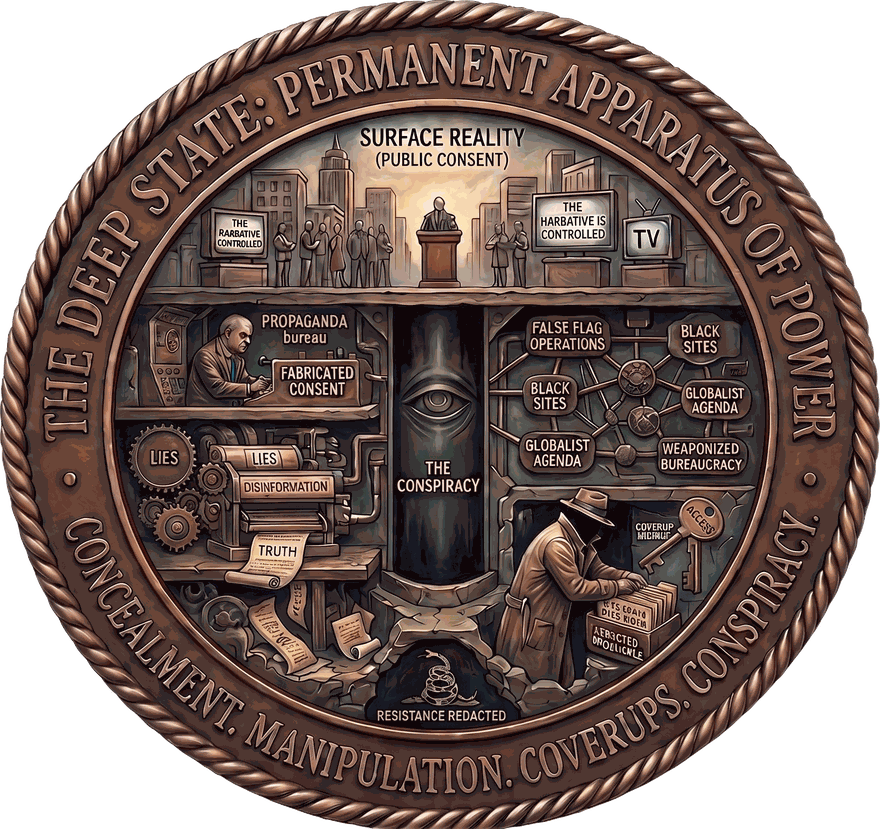
First, the sober definition, because the phrase gets cartooned on purpose. The deep state is not a bunker of lizard men. It is the permanent, unelected part of the government — the agencies, the security organs, the contractors welded to them (War Is a Racket) — whose personnel, budgets, classifications, and operations roll on no matter which wing wins in November. The manifesto’s war-money chain — non-intervention, the racket, the dollar — showed you the incentive structure. This one is the operating history: what that apparatus has actually done, in chronological order, every entry dated and graded. And fifteen entries wear suits instead of uniforms — radium dials to the 737 MAX, tobacco to the mortgage machine — because a regulator captured by the industry it polices is the same disease in a different organ: unelected power that rolls on no matter how you vote.
Three grades, applied without favor. Verified means the government’s own declassified files, inspector-general reports, court records, or sworn testimony confirm it. Suspicious means documented anomalies and unanswered questions — but no proof, and we say so. Doesn’t hold up means the claim fails on the evidence — and it stays on the list anyway, because a track record is only a track record if you grade the misses too. That discipline is what separates a ledger from a grievance collection.
1828“A convicted adulteress” — the Rachel Jackson smear verified — the oldest smear on the page
Rachel Donelson married Andrew Jackson in 1791 believing her first husband, Lewis Robards, had completed their divorce. He hadn’t — he had only secured permission to sue — and when the decree finally came through in 1793 it was granted on grounds of her adultery, since she was by then living as Jackson’s wife. They remarried in January 1794, and the paperwork error sat quietly for thirty-four years — until Jackson ran against the incumbent President. Then the pro-Adams press dug it up and ran it as character: Charles Hammond’s Cincinnati Gazette asked whether “a convicted adulteress and her paramour husband” should “be placed in the highest offices of this free and christian land.” The 1828 campaign remains one of the dirtiest ever run — coffin handbills for his executions, the marriage for hers.
Jackson won in a landslide. Rachel — sixty-one, in failing health, reading her own name in the papers — collapsed and died on December 22, 1828, weeks after the election and weeks before the inauguration. She was buried in the gown bought for the inaugural ball. At the graveside Jackson said: “May God Almighty forgive her murderers, as I know she forgave them. I never can.” This entry opens the ledger on purpose: before the apparatus had agencies, budgets, or classification stamps, it had newspapers — and the manufactured story was already lethal in 1828. Everything below is the same weapon with better funding.
1867–1873Crédit Mobilier verified — the share list was read into the record
The men building the taxpayer-subsidized Union Pacific chartered a construction company, Crédit Mobilier of America, hired it — that is, hired themselves — and billed the railroad roughly double the real cost, skimming the federal loans and land grants Congress kept voting. Insurance for the arrangement was bought in the cheapest market available: Congressman Oakes Ames of Massachusetts placed Crédit Mobilier shares with fellow members at par — far below their real value, dividends payable immediately — explaining in a letter that he had put the stock “where it will produce most good to us.” The New York Sun broke it on September 4, 1872, under the headline “The King of Frauds,” naming the sitting Vice President, the incoming Vice President, and a future President among the shareholders.
The Poland Committee took testimony and read Ames’s share list into the record — and then the discipline arrived: censure for Ames and James Brooks, expulsion for no one, criminal charges for no one, and the skimmed profit — the committees put it somewhere between seven and twenty-three million dollars and couldn’t pin it closer — recovered never. Schuyler Colfax’s career ended; James Garfield’s survived all the way to the White House. Mark the pattern, because it recurs down the whole page: the fraud verified by the conspirators’ own paper, the punishment measured in embarrassment.
1871–1876The Whiskey Ring verified — 110 convictions; the White House walked
Distillers in St. Louis, Milwaukee, and Chicago paid off the federal revenue agents assigned to tax them, reported a fraction of their production, and split the stolen excise — millions a year, a cut of it flowing into campaign funds. Treasury Secretary Benjamin Bristow couldn’t trust his own department to investigate itself, so he hired outside men in secret, mapped shipments against tax stamps, and on May 10, 1875 raided the ring in one coordinated day. The haul: more than three hundred indictments, 110 convictions, over three million dollars recovered. Grant’s instruction went on the record: “Let no guilty man escape.”
Then the trail reached his private secretary. Orville Babcock — who ran the President’s correspondence from a desk outside his door — was indicted on ciphered telegrams to the ring’s St. Louis fixer. Grant, ready to testify in person until his cabinet talked him out of it, gave a sworn deposition for the defense — the only time a sitting President has testified for a criminal defendant — and the jury acquitted. Bristow, the man who broke the ring, was frozen out of the administration within the year. The machinery worked exactly until it touched the White House door — a distance later entries measure again and again.
1874–1877The Black Hills seizure verified — by the Supreme Court itself
The 1868 Treaty of Fort Laramie guaranteed the Black Hills to the Sioux Nation permanently — with a clause requiring the signatures of three-fourths of adult males before one acre could change hands. Six years later Washington sent Custer and a thousand soldiers into that treaty land, nominally to scout a fort site — with geologists and newspaper correspondents riding along on the “survey.” The dispatches announcing gold “from the grass roots down” hit the wires in August 1874, the rush stampeded in, and the Army that was treaty-bound to keep miners out was quietly ordered to stop trying. When the Sioux refused to sell, Congress attached the “sell or starve” rider — suspending the rations the treaty guaranteed until they signed — and the 1877 Act took the Hills with signatures from roughly ten percent of the men the treaty required. The gold was real; the Homestake mine alone gave up some forty million ounces over the next century. The manufactured discovery, the engineered starvation, the paper consent — that was the con.
Then the government graded its own work. In 1980, United States v. Sioux Nation, the Supreme Court affirmed 8–1 that the seizure was an unconstitutional taking, quoting the Court of Claims: “A more ripe and rank case of dishonorable dealings will never, in all probability, be found in our history.” The award has sat in trust ever since, compounding past a billion dollars, unclaimed — because the Sioux position for forty-five years has been that the Black Hills were never for sale. Mark the playbook — manufacture the pretext, break the paper, keep the territory — because every war entry below it runs the same three steps.
1882–1943The Chinese Exclusion Act verified — Congress expressed formal regret, twice
The first federal law in American history to ban immigration by race. Passed in 1882, hardened in 1892 by the Geary Act — which required every Chinese resident to carry a certificate of residence or face arrest and deportation, a papers-please regime the Supreme Court blessed — and made permanent in 1902. It stood for sixty-one years, until 1943, when a wartime Congress needed China as an ally against Japan and repealed it — replacing exclusion with a quota of 105 Chinese immigrants per year, which is repeal the way a cracked window is ventilation.
There is no “suspicious” grade available here and nothing to declassify: the racial ban is the text of the statute, debated openly and passed proudly. The receipts on the other end are just as official — the Senate expressed formal regret in 2011, the House in 2012, each resolution reciting what the law had done in the law’s own words. Mark the shape for the entries below: the government did it in writing, defended it for decades, and apologized only when the harm was beyond remedy. The ledger’s legislation wing opens here — because with a statute, the receipt is the act.
1884“Ma, ma, where’s my pa?” the chant was true · her sworn account was buried
July 21, 1884, eleven days after Grover Cleveland’s nomination, the Buffalo Evening Telegraph ran “A Terrible Tale”: a Buffalo widow named Maria Halpin had borne a son in 1874 — Oscar Folsom Cleveland — and the Democratic nominee had been paying for him ever since. Cleveland’s instruction to his handlers became civics-class legend — “whatever you do, tell the truth” — and the truth they told was tidy: a bachelor among married friends, paternity uncertain, one man decent enough to shoulder it. Republicans chanted “Ma, ma, where’s my pa?” at rallies. Cleveland won anyway, and Democrats answered: “Gone to the White House, ha, ha, ha!”
The half that didn’t make the legend is also on paper. In sworn affidavits that October, Halpin said the encounter was “by use of force and violence and without my consent”; that when she pressed the matter she was seized and committed to the Providence Lunatic Asylum — whose doctors examined her and released her, finding nothing wrong — and that her son was taken from her and placed with another family. None of it was ever tested in a courtroom; the campaign dismissed her as a drunk, the papers moved on, and “honest Grover” hardened into the moral of the story. Grade it with the house pen: the chant was verified by the candidate himself — and the woman’s sworn account was answered with an asylum and a century of silence.
February 15, 1898“Remember the Maine” verified false pretext
The USS Maine explodes in Havana harbor; 266 dead. Hearst’s and Pulitzer’s papers rule it a Spanish mine before any inquiry exists — Remember the Maine, to hell with Spain — and the war is on by April. In 1976, Admiral Rickover’s engineering investigation concluded the likely cause was an internal coal-bunker fire cooking off the magazines. No mine required. Whether anyone lied in the moment or merely wanted it true, nobody waited for evidence — and the war delivered Cuba, Puerto Rico, Guam, and the Philippines. Keep the template: blame first, investigate decades later, keep the territory.
May 7, 1915The Lusitania verified — she carried munitions
Sold for generations as the torpedoing of an innocent passenger liner: 1,198 dead, 128 of them Americans, and a decisive shove toward U.S. entry in 1917. Her own manifest listed more than four thousand cases of rifle cartridges, and divers on the wreck have since found millions of rounds of .303 ammunition in her holds. Germany had taken out newspaper advertisements in New York warning passengers she was sailing into a declared war zone. She was a liner and a munitions carrier at once — and the second half was officially denied for decades while the first half did the recruiting.
1917–1928The Radium Girls verified — the falsified diagnoses and the settlement record
At U.S. Radium in Orange, New Jersey, and Radium Dial in Ottawa, Illinois, young women painted glow-in-the-dark watch faces with radium paint and were taught to point the brush between their lips — lip, dip, paint, hundreds of dials a day. They were told the paint was harmless; some were told it would put roses in their cheeks. In the laboratory upstairs, the company’s own chemists handled the same material behind lead screens, with tongs. Then the dial-painters’ jaws began to abscess and break, and the company’s response is why the entry is on this page: U.S. Radium commissioned a Harvard industrial-hygiene study from Cecil Drinker in 1924, got back a report finding the plant thick with radioactive dust and the workers contaminated — and suppressed it, passing the state labor department a version rewritten to say the opposite. Company-arranged medical exams returned no results to the women examined, and as they died, the deaths were attributed in company-fed whispers to syphilis — a diagnosis chosen to smear as well as to hide. In 1925 pathologist Harrison Martland built the test that proved radium necrosis, and the alibi collapsed.
Grace Fryer spent two years finding a lawyer willing to take the company on — the statute of limitations had been engineered to run out faster than radium poisoning shows — and in 1927 she and four co-workers, the papers’ “five women doomed to die,” sued. Too weak to raise their arms for the oath, they settled in 1928: $10,000 each, an annuity, and their medical bills, days before trial. In Ottawa, Catherine Donohue won her case against Radium Dial in 1938 from her deathbed, the company appealing as she died; it lost every round, including the last one the Supreme Court declined to hear. The kicker outlived them all: their cases helped build occupational-disease law and workers’ compensation as America now knows them, and their bodies — radioactive to this day, fogging photographic film from inside the coffin — became the scientific baseline for radium body-burden standards later used to protect Manhattan Project workers. The women the company swore were healthy calibrated the atomic age.
May 31–June 1, 1921The Tulsa race massacre verified — then erased for seventy-five years
Greenwood was the wealthiest Black district in America — “Black Wall Street,” thirty-five square blocks of banks, hotels, theaters, groceries, and doctors’ offices in segregated Tulsa. Over roughly eighteen hours a white mob thousands strong — many deputized and armed by the city itself — burned it to the ground: more than 1,250 homes, every church, every business. Witnesses and the state’s own later investigation documented private airplanes circling the district dropping incendiaries — arguably the first aerial bombardment of an American city, carried out by Americans. As many as 300 dead, some 6,000 survivors interned under guard, and not one member of the mob ever convicted of anything. Insurers denied every claim under riot-exclusion clauses; the city rewrote its fire code to strangle the rebuild.
Then it disappeared — and the disappearance is why it lives on this ledger. Police and National Guard records went missing. The Tulsa Tribune front page that helped summon the mob was razored out of the bound archive. Oklahoma schoolchildren graduated for generations without hearing it named. The state commission that finally documented the massacre reported in 2001 — eighty years on — and excavations begun in 2020 have been pulling unmarked remains out of Oaklawn Cemetery ever since. In January 2025 the Justice Department’s civil-rights review concluded Greenwood was destroyed in a “coordinated, military-style attack” — and that every statute of limitations had long since run out. The massacre was a crime; the scrubbed archive was policy.
1921–1929Teapot Dome verified — the first cabinet cell
The Navy held emergency oil in the ground — Teapot Dome in Wyoming, Elk Hills in California — banked against the next war. Harding’s Interior Secretary, Albert Fall, had custody of the reserves transferred to his own department, then leased them without competitive bidding: Teapot Dome to Harry Sinclair, Elk Hills to Edward Doheny. What moved him was roughly $400,000 — including $100,000 in cash that Doheny’s son carried to Fall’s apartment in a little black bag, papered afterward as a “loan” on a note with the signature torn off. Senator Thomas Walsh ground through the books for years while respectable papers called the investigation a partisan smear; in 1927 the Supreme Court voided both leases as products of fraud.
In 1929 Fall was convicted of taking the bribe — the first cabinet officer in American history imprisoned for a crime in office. Then a separate jury acquitted Doheny of paying the same $100,000 Fall was convicted of accepting — a verdict pair that should be geometrically impossible and stands anyway. Sinclair served six and a half months, not for the leases but for contempt of the Senate and for hiring detectives to shadow his own jury. The scandal’s lasting gift is procedural: McGrain v. Daugherty (1927) cemented Congress’s subpoena power — the tool half the entries below this one depend on.
1924–1965The Johnson-Reed quotas verified — praised by name in Mein Kampf
The 1924 Immigration Act built national-origin quotas keyed to the 1890 census — a date chosen deliberately, before the great waves of Italian, Polish, and Jewish arrival, so the arithmetic itself would do the excluding. Asian immigration was barred outright. The science behind it was eugenics, and that is not an interpretation: the House committee employed Harry Laughlin of the Eugenics Record Office as its official “expert eugenics agent,” and his testimony is in the committee record. The law drew admiration from a then-obscure German author — Mein Kampf cites American immigration law as the model for a race-based state.
Then came the 1930s, and the quotas did exactly what they were built to do — to people fleeing the admirer. Jewish refugees from Germany were refused against a German quota that went unfilled in most of the Nazi years, because consular officers were instructed to apply the “likely to become a public charge” test hard; the St. Louis steamed close enough to see Miami’s lights in 1939 and was sent back. The law stood until 1965. Verified is almost too weak a word: the quota tables were printed in the statute, and the consequences are in the history books.
1924–1996Leaded gasoline — the loony-gas century verified — the Bayway ward, the captive science, and the ice cores
In 1921 a General Motors engineer named Thomas Midgley Jr. found that tetraethyl lead stopped engine knock. Ethanol did too, but ethanol couldn’t be patented — so GM, Standard Oil, and DuPont built a business on the neurotoxin instead, and named the company and the product “Ethyl,” with lead appearing nowhere on the pump. The warning arrived immediately: in October 1924, workers at Standard Oil’s Bayway plant began hallucinating and dying — five dead, dozens carried out in straitjackets — and the press named the product “loony gas”; at DuPont’s Deepwater works the TEL building was already called the House of Butterflies, for the insects workers swatted that weren’t there. Midgley held a press conference, washed his hands in the stuff and inhaled its vapor to prove it safe — not long after taking a leave to recover from lead poisoning. The Surgeon General convened a conference in 1925, heard Alice Hamilton warn exactly what would happen, and handed the science to the industry to referee.
The referee was Robert Kehoe of the Kettering Laboratory — funded by GM, Ethyl, and DuPont — whose standing rule, cited for decades, was that lead in every human body was natural and harmless until critics could prove otherwise. The proof required measuring the planet. Clair Patterson, the geochemist who had just dated the Earth itself, showed in 1965 from ocean sediments and polar ice that industrial-era lead ran orders of magnitude above the pre-industrial baseline — and Ethyl’s response was pressure on his funding and his panel seats, the tobacco playbook with an octane rating. Herbert Needleman’s studies then tied childhood lead exposure to lost IQ, and the industry answered with scientific-misconduct charges; he was cleared, twice. The unleading of America finally rode in on the catalytic converter in 1975 — lead fouled the catalyst, not the conscience — and the on-road ban completed in 1996. Blood-lead levels in American children fell by roughly three-quarters as the fuel phased out.
The bill, as currently estimated in the peer-reviewed literature: about half of living Americans were exposed to harmful lead levels as children, at a collective cost on the order of 800 million IQ points — with a body of research linking the exposure curve to the late-century crime wave, rising and falling on a twenty-year lag. Grade it verified: the deaths were in the 1924 newspapers, the captive science is documented by name, and the ice cores don’t negotiate. Fifty years of “no proof of harm,” purchased from the profits of the harm — and the same metal came out of the taps in Flint. As for Midgley, he had one more gift in him: he also invented chlorofluorocarbons. One historian’s verdict — more impact on the atmosphere than any other single organism in Earth’s history.
1926–1933The federal alcohol poisoning program verified — the denaturing orders and the morgue ledgers
Prohibition never banned industrial alcohol — the country ran on it — so the law required it “denatured,” dosed with additives to make it undrinkable. Bootleggers hired chemists to strip the additives back out, and by mid-decade renatured industrial alcohol was feeding a large share of the national liquor supply. The government’s answer, ordered by the Treasury Department in 1926, was to change the recipe: new denaturing formulas built to defeat re-distillation, the flagship being up to 10 percent methanol — wood alcohol, which blinds at a swallow and kills at a glass — alongside benzene, kerosene, mercury salts, and pyridine. This was not an industrial-safety measure that went wrong. The additives were chosen because people were drinking the product, in the stated hope that fear of death would succeed where the Eighteenth Amendment had not.
The morgue kept the ledger. Christmas 1926 in New York: sixty-plus dead of alcohol poisoning inside a few days, wards at Bellevue full of the blinded and dying. Charles Norris, the city’s pioneering chief medical examiner, ran the numbers with toxicologist Alexander Gettler, published the methanol counts, and called the policy what it was in public: “our national experiment in extermination” — noting that the government knew the poison would not deter drinking and kept poisoning anyway. The Anti-Saloon League’s Wayne Wheeler answered on the record that anyone who drank the stuff was a deliberate suicide, and the person to blame was the drinker. Estimates run to 10,000 or more dead nationwide before Repeal shut the program down with the Amendment in 1933 — skewed, Norris documented, toward the poor, who couldn’t afford the smuggled Canadian bottles the deterrence theory assumed they’d switch to. No hearing, no prosecution, no apology — the entry survives because the denaturing orders were published policy and the death counts sat in the medical examiner’s files. The federal government spent seven years poisoning its own citizens to win an argument, lost the argument, and never answered for the bodies.
1930–1937Reefer madness — the marihuana panic the campaign verified · the Hearst profit theory doesn’t hold up
Cannabis sat in the American pharmacopeia for nearly a century — tinctures on pharmacy shelves, prescribed by physicians — under the name everyone knew: cannabis. The campaign that criminalized it began by renaming it. Harry Anslinger took over the brand-new Federal Bureau of Narcotics in 1930, and when alcohol Prohibition died in 1933 and took the enforcement mission with it, the bureau needed a new one. Anslinger — who had earlier waved off the claim that the plant made people violent as absurd — reversed himself and assembled what he called the “Gore Files”: two hundred lurid crimes clipped from newspapers and attributed to “marihuana,” the Mexican street word, deployed in place of the pharmacy word precisely so nobody would connect the killer weed to the bottle in the medicine cabinet. Exhibit A was Victor Licata, who axed his family to death in Tampa in 1933 — a man with a diagnosed history of severe mental illness that the file did not mention. The Hearst chain ran the material nationwide with the throttle open, and the racial pitch was not subtext but text, aimed at Mexican laborers and Black jazz musicians by name. Anslinger’s most notorious one-liners survive in varying states of documentation — some in his own files, some secondhand — so grade them individually; but the campaign’s racial targeting needs no disputed quote, because it sits in the bureau’s own correspondence and testimony.
In 1936 a church group financed a cautionary film called Tell Your Children; exploitation producer Dwain Esper bought it, spliced in racier footage, and toured it for years as Reefer Madness — one puff to piano-fueled mania, manslaughter, attempted rape, suicide, permanent insanity. The next year Congress delivered the statute. At the Marihuana Tax Act hearings the American Medical Association’s legislative counsel, Dr. William Woodward, testified against the bill: no credible evidence behind the crime claims, and the AMA had barely realized “marihuana” meant the cannabis its members prescribed, because the drafters used the word that hid it. The committee dismissed him with open hostility. On the House floor the debate ran minutes; asked what the bill concerned, the answer given was that it had “something to do with a thing called marihuana — I believe it is a narcotic of some kind,” and when a member asked whether the AMA agreed, a committee member answered that it did — the opposite of Woodward’s sworn testimony. Prohibition passed on a mislabeled plant and a misquoted doctor. When New York’s La Guardia Committee spent five years studying the drug and reported in 1944 that the violence and addiction claims were false, Anslinger denounced the study and kept enforcing for another quarter century.
Grade the ledger honestly, in both directions. The popular version adds a profit conspiracy — Hearst protecting timber from hemp paper, DuPont protecting nylon from hemp fiber. That theory traces to a 1985 advocacy book, and the paper trail runs the wrong way: Hearst bought newsprint and was squeezed by paper prices, and no document has ever surfaced showing either company lobbying for the Act. It doesn’t hold up — and the racism thesis needs no help, because it is the one in the hearing record. The kicker runs down-page: the Supreme Court struck the Tax Act down unanimously in 1969 (Leary v. United States), Congress answered with Schedule I in 1970 — “temporarily,” pending its own Shafer Commission, which came back in 1972 recommending decriminalization and was buried by the president who ordered it. The signed confession for that chapter is the Ehrlichman entry. And Reefer Madness itself got the last laugh: rediscovered in the Library of Congress in the early 1970s, it toured the midnight-movie circuit as a legalization fundraiser — the propaganda reel, passing the hat against its own cause.
1930s–1982Asbestos and Johns-Manville verified — the Sumner Simpson papers and the bankruptcy
Asbestosis was in the medical literature by 1930, and the industry’s paper trail starts almost immediately after. In 1933 Johns-Manville settled eleven dying workers’ claims on the condition that the plaintiffs’ lawyer never bring another case. The Sumner Simpson papers — the correspondence of Raybestos-Manhattan’s president with Manville’s counsel Vandiver Brown — show the industry managing its own trade journal in the 1930s so that asbestosis stayed out of print: “the less said about asbestos, the better off we are.” In 1949 Manville’s medical director, Kenneth Smith, recommended in writing that workers whose X-rays already showed asbestosis not be told: as long as the man feels well, let him work in peace, and the company benefits from his years of continued service. And in sworn testimony, an executive recalled Brown dismissing a competitor as fools for notifying sick employees — asked whether Manville would really let its men work until they dropped dead, the answer was yes: “We save a lot of money that way.”
The science the industry managed privately went public in 1964, when Irving Selikoff’s Mount Sinai study of insulation workers tied the fiber to asbestosis, lung cancer, and mesothelioma in numbers no journal could sit on. The 1973 Borel decision established failure to warn; the Simpson papers surfaced in discovery in 1977 and turned negligence into knowledge. In August 1982, Johns-Manville — a blue chip, one of the original Dow 30 — became the largest American corporation to that date to file for bankruptcy, doing it explicitly to cap the tort liability, with some 16,500 suits pending and more arriving daily. The trust that emerged has paid claimants cents on the dollar since. Roughly 27 million American workers were exposed between 1940 and 1979; the fiber’s fuse runs decades, and mesothelioma still kills thousands of Americans a year. Grade it verified — and note the chronology: this is the tobacco playbook, written a generation before tobacco needed it.
1932–1972The Tuskegee syphilis study verified — forty years, on the record
The U.S. Public Health Service enrolled 399 Black sharecroppers with syphilis — plus about 200 uninfected controls — in Macon County, Alabama, told them they were being treated for “bad blood,” and then studied the disease destroying them while deliberately withholding treatment. Placebos and aspirin were dressed up as medicine; diagnostic spinal taps were sold as “special free treatment”; local doctors and even the wartime draft board were enlisted to make sure no subject got cured somewhere else. Penicillin became the standard cure by 1947. The study ran twenty-five more years anyway — through the Nuremberg Code, written by American prosecutors to condemn exactly this. It ended only because Peter Buxtun, a PHS employee whose internal complaints went nowhere for six years, took the files to the Associated Press; Jean Heller’s story ran July 25, 1972, and the program was dead within months. By then dozens of the men had died of syphilis or its complications, wives had been infected, children born with congenital syphilis. Senate hearings, a $10 million settlement, and — in 1997, sixty-five years after enrollment — a presidential apology to the eight survivors still alive to hear it.
And the shadow entry, in case anyone files this under “different era, lone lapse”: from 1946 to 1948 the same Public Health Service, including Tuskegee’s own Dr. John Cutler, went to Guatemala and deliberately infected prisoners, soldiers, and mental patients with syphilis and gonorrhea — no consent, no pretense of it. Confirmed by a historian’s dig through Cutler’s papers in 2010; official U.S. apology the same year. The government that demands your trust on medical mandates ran a forty-year experiment on citizens it swore it was treating — and graded itself ethical the entire time.
1934–1968Redlining verified — the government drew the maps itself
The federal government did not merely tolerate housing segregation — it drew the maps. The Home Owners’ Loan Corporation color-graded every sizable American city; the fourth grade, “hazardous,” was inked red, and the area descriptions on the government’s own forms say why in plain type — the race of the residents listed as a defect alongside cracked foundations. The FHA’s Underwriting Manual then made it national policy, warning appraisers against “inharmonious racial groups” and recommending restrictive covenants. A Black family with the same income, the same job, the same down payment could not get the federally insured loan the white family across the line got as routine.
This ran until the Fair Housing Act of 1968 — three decades of federally underwritten wealth transfer, compounding at mortgage scale. The maps are not a metaphor and not a rumor: the National Archives holds them, scanned and public, and researchers overlay them on present-day data to find the same lines predicting wealth, home value, even asthma rates and summer heat, ninety years on. The government’s own hand, in its own ink. Verified was never in question — the only cover-up here was the decades of pretending the market did it.
1935–1950sThe New Deal exclusions and the GI Bill’s fine print verified — the carve-outs are in the section text
The New Deal’s founding statutes carried a carve-out you can read in the section text: the Social Security Act of 1935 excluded agricultural and domestic workers — the two occupations that then employed roughly two-thirds of Black workers — and the labor statutes of the same era repeated the exclusion. The committee record shows why: the votes ran through Southern committee chairmen who priced them precisely. No slur needed to appear in the statute; the job categories did the work.
Then the GI Bill of 1944 — the greatest middle-class-building machine ever legislated — was administered through segregated state offices and the banking system the redlining entry above just described. The result, counted: of some 67,000 mortgages insured under the bill in the New York and northern New Jersey suburbs, fewer than one hundred went to non-white veterans. Same uniform, same war, same signature on the same law — and the wealth it built runs down family lines to this day on one side of the line only. Verified in the statutes, the state administrative records, and the mortgage arithmetic.
1940–41Pearl Harbor foreknowledge provocation verified · foreknowledge unproven
The McCollum memo — October 7, 1940, real, declassified — proposed eight measures designed to provoke Japan into “an overt act of war,” and most of them, including the oil chokehold, were implemented. Washington had broken Japan’s diplomatic codes; fleet-wide war warnings went out November 27. What no document has ever proven is that FDR knew the time and the place. So the honest grade splits: a deliberate provocation policy is documented; letting the fleet burn on purpose is not. December 7 killed 2,403 Americans and converted a public that polled overwhelmingly against the war into a unanimous one before sundown.
1942–1983Korematsu and the internment lie verified — the government lied to the Supreme Court, and a federal court said so
Executive Order 9066 put roughly 120,000 people of Japanese ancestry — two-thirds of them American citizens — behind barbed wire on the strength of a claimed military necessity. The government’s own intelligence said otherwise: the Office of Naval Intelligence’s Ringle report concluded the community posed no mass threat, and the FBI and FCC privately debunked the shore-to-ship radio-signaling claims the Army’s official justification leaned on. When Fred Korematsu’s challenge reached the Supreme Court in 1944, Justice Department lawyers drafted a footnote warning the Court that the Army’s report was contradicted by the government’s own agencies — one internal memo called staying silent “the suppression of evidence.” The footnote was gutted, the Court never told, and Korematsu lost 6–3, Justice Jackson dissenting that the ruling would lie around “like a loaded weapon” for any future government claiming urgent need.
The proof came from the government’s own files: in the early 1980s researcher Peter Irons found the suppressed memos in the National Archives, and in 1983 federal judge Marilyn Hall Patel vacated Korematsu’s conviction on coram nobis — a forty-one-year-old conviction erased because the United States had deceived its highest court. The 1988 Civil Liberties Act delivered a formal apology and $20,000 per surviving internee; in 2011 the Justice Department filed a formal “confession of error,” and in 2018 the Supreme Court took the rare step of declaring Korematsu overruled in the open. Every element — the innocence, the suppression, the lie to the Court — is confirmed by the government that committed it. Jackson’s loaded weapon stays on the table, which is why this entry sits here.
1944–1974The human radiation experiments verified — the government’s own 1995 report
For thirty years, government-funded doctors ran radiation experiments on people who never agreed to be experiments. Eighteen hospital patients were injected with plutonium without their knowledge — some misdiagnosed as terminal, some outliving the “terminal” label by decades with the injection still in their bones. Boys at the Fernald school in Massachusetts — wards of the state, told they were joining a “Science Club” — were fed radioactive tracers in their breakfast oatmeal in studies co-sponsored by MIT and Quaker Oats. Prisoners in Oregon and Washington had their testicles irradiated for pay. When journalist Eileen Welsome traced the plutonium patients by name and won a Pulitzer for it, Energy Secretary Hazel O’Leary opened the department’s files, and President Clinton chartered the Advisory Committee on Human Radiation Experiments — which documented roughly four thousand government-sponsored human radiation experiments from the Department of Energy’s own archives.
Clinton delivered the formal presidential apology on October 3, 1995 — the same afternoon the O.J. Simpson verdict landed, which is why almost nobody remembers a sitting president admitting the government had irradiated its own citizens without consent. The finding stands in the committee’s report either way, in the government’s own words, from the government’s own files. Same lineage as MKULTRA below — the Cold War body-as-instrument era — but this one never needed a whistleblower: the paperwork was filed correctly the whole time.
1946–1948The Guatemala syphilis experiments verified — a formal state apology to a foreign head of state
Tuskegee, entered above, withheld the cure. Guatemala did the infecting. U.S. Public Health Service doctors — led by John Cutler, who would later work the Tuskegee study — deliberately exposed some 1,300 Guatemalan prisoners, soldiers, psychiatric patients, and sex workers to syphilis and gonorrhea without consent, using infected prostitutes and direct inoculation to test whether penicillin could prevent infection. Fewer than seven hundred of the deliberately exposed received documented adequate treatment. The experiments were run with the cooperation of Guatemalan authorities and hidden from the subjects themselves — Cutler’s own papers, unearthed by historian Susan Reverby in 2010, are the record.
The verification could not be more formal: President Obama telephoned Guatemala’s president to apologize on October 1, 2010, Secretary of State Clinton and HHS Secretary Sebelius issued a joint statement calling the work “clearly unethical,” and the Presidential Commission for the Study of Bioethical Issues titled its 2011 report “Ethically Impossible.” Grade the aftermath too: the victims’ lawsuits against the United States were dismissed on sovereign immunity, and no compensation program was ever created. The apology was free. The receipts are complete.
1948–1976The CIA and the press the newsroom relationships verified · the “Mockingbird” legend overclaims
This page keeps cataloguing media lies one at a time; this is the institutional entry underneath them. The Church Committee confirmed under oath that the CIA maintained covert relationships with roughly fifty U.S. journalists and media employees, planted stories in foreign outlets knowing they would blow back into American coverage, and owned or subsidized publishing operations outright. Carl Bernstein’s 1977 investigation put the broader number at more than four hundred journalists who had carried out assignments for the Agency over twenty-five years, with the knowing cooperation of executives at the most respected names in American news. In February 1976, Director George H.W. Bush announced the CIA would no longer enter paid relationships with accredited U.S. journalists — a policy whose own text preserved the unpaid, voluntary kind.
Now the house discipline, on our own side’s favorite version: “Operation Mockingbird” as the name of a grand press-control program is folklore. The only operation actually named Mockingbird in the declassified record is a 1963 wiretap of two syndicated columnists. The practice is real, Senate-documented, and bigger than most skeptics admit; the tidy code name wrapped around it is an internet artifact. Grade both, keep the part with receipts — a 1967 CIA dispatch coaching friendly media appears in the tally below for exactly this reason.
1953–1954Iran and Guatemala — the two coups that worked verified — the CIA confessed to both
The Bay of Pigs, below, is the famous failed coup. These are the two successful ones that made Havana look easy. August 1953: the CIA and MI6 ran Operation TPAJAX against Mohammad Mosaddegh, Iran’s elected prime minister, after he nationalized the Anglo-Iranian Oil Company — bought newspapers, hired mobs, and restored the Shah, whose SAVAK secret police then held the country for a quarter century until the 1979 revolution answered for all of it. Denied for sixty years, then confessed in writing: the Agency’s own declassified internal history, released in 2013, states the coup “was carried out under CIA direction as an act of U.S. foreign policy, conceived and approved at the highest levels of government.”
June 1954: Operation PBSUCCESS overthrew Jacobo Árbenz, Guatemala’s elected president, after his land reform touched United Fruit — a company whose lawyers’ and directors’ orbit included both Dulles brothers, then running State and the CIA. Psychological-warfare radio, a phantom rebel army, and assassination target lists — all in the Agency’s own documents, declassified in 1997. The coup opened onto a thirty-six-year civil war; the UN-backed truth commission counted roughly 200,000 dead and attributed 93 percent of documented atrocities to the U.S.-backed state, and President Clinton, standing in Guatemala City in 1999, said support for those forces “was wrong.” Two elected governments, two confessions, zero prosecutions — and the template Northwoods, below, assumed was already routine.
1953–1973MKULTRA verified — Senate record
The CIA dosed unwitting American citizens with LSD and ran hypnosis, sensory-deprivation, and electroshock experiments through more than eighty universities, hospitals, and prisons. Frank Olson, a government scientist drugged without his knowledge, went out a thirteenth-floor hotel window in 1953. Director Richard Helms ordered the files destroyed in 1973; roughly twenty thousand documents survived in a misfiled financial archive and surfaced through FOIA in 1977 — after the Church Committee had already confirmed the program under oath. This is not a theory. It is a Senate record.
Two names live in its shadow. Ted Kaczynski — verified: as a sixteen-year-old Harvard student, 1959–62, he spent three years as a subject in Henry Murray’s psychological-degradation experiments (Murray had wartime OSS ties; a direct MKULTRA link is suspected, not proven). What those sessions contributed to what he became, no record can say. Charles Manson — suspicious, unproven: Louis “Jolly” West, a documented MKULTRA contractor, ran a research clinic in Haight-Ashbury in 1967, the same neighborhood and months where a freshly paroled Manson recruited his followers while a federal parole officer let violation after violation slide. The anomalies are documented across twenty years of records in Tom O’Neill’s Chaos (2019); the connection has never been proven, and we grade it that way.
1953–1987Camp Lejeune’s water verified — denied for decades, admitted by statute
For thirty-four years, Marines and their families at Camp Lejeune drank, bathed in, and mixed baby formula with water carrying trichloroethylene, perchloroethylene, benzene, and vinyl chloride at concentrations among the worst ever measured in a U.S. public water system — an off-base dry cleaner and leaking fuel tanks feeding the Tarawa Terrace and Hadnot Point wells. Base labs flagged solvent contamination as early as 1980–82; the wells kept pumping until 1985. As many as a million people were exposed. What followed tracks the Agent Orange playbook above almost beat for beat: decades of denial and slow-walked notification, a federal health study hobbled when the Navy failed to disclose benzene data, and a cluster of male breast cancer cases among Lejeune veterans that made the base its own epidemiological signature.
The admission came the way it usually does — by statute, late. The 2012 Janey Ensminger Act, named for a Marine’s daughter who died of leukemia at nine, granted care to exposed families; the Camp Lejeune Justice Act, folded into the same 2022 PACT Act that finally covered the burn pits below, opened the courthouse door the government had held shut for decades. The contamination is government-confirmed, the exposure window is government-mapped, and the compensation began arriving roughly seventy years after the first tainted well came online.
1953–1998Big Tobacco’s cover-up verified — ruled racketeering in federal court
On December 15, 1953, the chief executives of America’s tobacco companies — competitors who did not meet — met at the Plaza Hotel in New York with the PR firm Hill & Knowlton, weeks after mouse-skin studies tied cigarette tar to cancer. Out of that room came the January 1954 “Frank Statement to Cigarette Smokers,” run in more than four hundred newspapers, pledging the public’s health as “a basic responsibility, paramount to every other consideration.” What the public could not see was the industry’s own laboratories spending the next decade confirming everything it publicly denied. Brown & Williamson’s general counsel, 1963, in writing: “We are, then, in the business of selling nicotine, an addictive drug.” And a 1969 B&W planning memo stated the strategy in four words that became the franchise template for every corporate entry on this page: “Doubt is our product.”
The denial ran five decades. In April 1994 seven tobacco CEOs stood before Congress and swore, one after another, that nicotine is not addictive — while their own files said otherwise. Those files surfaced that same year: a paralegal named Merrell Williams walked thousands of pages out of B&W’s law firm, and the University of California published them over the industry’s lawsuits. The 1998 Master Settlement followed — $206 billion over twenty-five years, the largest civil settlement in American history. And in 2006, federal judge Gladys Kessler capped the government’s racketeering case with a 1,683-page ruling: the companies had “marketed and sold their lethal product with zeal, with deception, with a single-minded focus on their financial success, and without regard for the human tragedy” — a fifty-year conspiracy, adjudicated under RICO, the statute written for the Mafia. Cigarettes still kill roughly 480,000 Americans a year. Hold on to the playbook — manufactured doubt, rented scientists, a slow-walked regulator — because two entries below bought it off the shelf.
1956–1971COINTELPRO verified — stolen from the FBI’s own files
Hoover’s FBI ran a formal covert program — the memos use the words “expose, disrupt, misdirect, discredit, or otherwise neutralize” — against Americans whose crime was politics: the civil rights movement, the anti-war movement, socialist parties, the American Indian Movement, the Black Panthers. The Bureau bugged Martin Luther King’s hotel rooms and then mailed him an anonymous package — the tapes plus a letter urging him toward suicide — five weeks before he collected the Nobel Peace Prize. In Chicago, an FBI informant inside the Panthers supplied a floor plan of Fred Hampton’s apartment, marked with where he slept; on December 4, 1969, police fired roughly ninety rounds into it against a single shot from inside, and Hampton, twenty-one years old and likely drugged by that same informant, died in his bed. The federal government eventually paid $1.85 million to the survivors and families rather than keep defending it in court.
None of it was leaked by an insider or pried loose by FOIA. On March 8, 1971, a group of citizens calling themselves the Citizens’ Commission to Investigate the FBI burglarized the Bureau’s field office in Media, Pennsylvania, carried out every file in the building, and mailed them to newspapers. The burglars were never caught; they outed themselves voluntarily in 2014, statute of limitations long expired. The Church Committee’s 1976 verdict on what those files revealed: a “sophisticated vigilante operation” using techniques “intolerable in a democratic society,” aimed overwhelmingly at lawful speech and association — not crimes. Read it next to the manifesto’s surveillance article: the apparatus does not need a new law to target you; it needs only for you to become inconvenient. And the only reason you know this program’s name is that somebody committed a burglary the government never solved.
April 1961The Bay of Pigs verified
The CIA recruited, trained, funded, and landed some 1,400 Cuban exiles on an operation built around the tacit assumption that a young president could be maneuvered into overt air support once the landing faltered. Kennedy refused; it collapsed in three days; the agency’s own declassified inspector-general autopsy described an operation deceiving itself at every level. Kennedy fired Director Allen Dulles and reportedly swore to splinter the agency into a thousand pieces. Hold on to the name Dulles — he reappears two entries down, seated on the commission that judged the death of the man who fired him.
1961–2017DuPont and C8 verified — DuPont’s own studies, pried loose in discovery
C8 — perfluorooctanoic acid, the surfactant behind Teflon — went into use at DuPont’s Washington Works outside Parkersburg, West Virginia, in 1951. In 1961 the company’s own toxicologist reported it enlarged rat livers and should be handled with extreme care; by the 1970s DuPont knew it was accumulating in its workers’ blood. In 1981, after 3M reported birth defects in rat studies, DuPont quietly tracked the pregnancies of seven women on the Teflon line: two of the seven babies were born with facial defects. The company moved the women off the line, told no one what it had found, and later moved them back. In 1984 it confirmed C8 in the local drinking water — and an internal review that year weighed walking away from the chemical and concluded the answer was no; usage went up, and the sludge went into a landfill at the head of a creek called Dry Run.
Dry Run is where the cattle started dying — Wilbur Tennant’s herd, wasting and mad, which is how a corporate-defense lawyer named Rob Bilott ended up suing DuPont in 1999 and extracting a hundred and ten thousand pages of the company’s own files. The resulting class action produced something unprecedented: a court-ordered science panel that drew blood from about 69,000 valley residents — one of the largest human health studies ever conducted — and found probable links from C8 to kidney cancer, testicular cancer, thyroid disease, ulcerative colitis, and preeclampsia. The EPA’s 2005 penalty, $16.45 million, was the largest civil administrative fine in the agency’s history and a rounding error against a single year of Teflon revenue. In 2017 DuPont and its spin-off settled 3,550 personal-injury cases for $670.7 million. The class of compounds C8 belongs to is now called “forever chemicals,” because they do not break down — and they are measurable in the blood of nearly every American, which makes this the rare entry on the page the reader is carrying in their veins. Grade verified: every damning study cited above was DuPont’s.
1962–2014USAID — the second mission verified — the AP wire and the agency’s own inspector general
The aid agency was born in 1961 and grew its second mission almost immediately. From 1962 the Office of Public Safety ran inside USAID — roughly $200 million to train more than a million police officers across 52 countries, and, per the congressional record that killed it, a home the CIA used to place officers and recruit assets under aid cover. The program’s face became Dan Mitrione, the OPS advisor kidnapped and executed by Uruguay’s Tupamaros in 1970 amid allegations — from local officials and Agency defectors — that he taught torture with kidnapped beggars as the demonstration models. The curriculum on paper said riot control and explosives; what Congress could verify was bad enough that it didn’t bother adjudicating the rest: Section 660 of the Foreign Assistance Act abolished the whole operation in 1974 and banned U.S. funding of foreign police training outright. When Congress passes a statute to make an aid program stop, the aid program has earned its ledger entry.
The statute changed the methods, not the mission. In 2014 the Associated Press pulled three programs out of USAID’s Cuba portfolio, all run through the same Washington contractor: ZunZuneo, a “Cuban Twitter” built to 40,000 subscribers through Cayman Islands and Spanish front companies — executives hired unwitting, traffic routed through third countries, the goal in the documents a “Cuban Spring” — none of its users told who owned it; a traveler program that sent Venezuelan, Costa Rican, and Peruvian youth onto Cuban campuses posing as tourists, using an HIV-prevention workshop as what the files called “the perfect excuse”; and an infiltration of Cuba’s underground hip-hop scene that got artists interrogated, a festival seized by the state, and performers driven into exile — also unwitting. The State Department’s defense, verbatim: “discreet does not equal covert.” The agency’s own inspector general confirmed the concealment in 2015. Subcontractor Alan Gross served five years in a Cuban prison for the satellite-gear half of the same portfolio and came home in a spy swap. This is why the entry matters beyond Cuba: every real doctor and famine worker flying the same flag now carries the suspicion the second mission earned — Russia expelled USAID in 2012, Bolivia in 2013, and neither had to invent the reason. Then the coda, which is the whole ledger in one act: when Washington finally destroyed the agency in 2025, it didn’t cite Mitrione or MovilChat or the inspector general’s file. It cited $50 million of condoms for Gaza — a claim that confused the Gaza Strip with Gaza Province, Mozambique, and was walked back by its own author within weeks. The real receipts sat in the public record for a decade, and the demolition crew reached for a fake one.
Then follow the dollar, because the money side needs no conspiracy — the funnel was written into statute. U.S. law required most goods and services USAID financed to be bought from American vendors; per the Congressional Research Service, roughly 41 percent of U.S. food aid came off American farms. The dollar left Washington, orbited the world, and came home. Its biggest single carrier: Chemonics, a for-profit Beltway contractor that collected over $17 billion in USAID awards between 2008 and 2024 — including the largest contract in agency history, $9.5 billion to run the global health supply chain, which by 2017 was delivering exactly 7 percent of its HIV, malaria, and tuberculosis shipments on time and in full. In post-quake Haiti the same firm took the largest share of recovery money, much of it no-bid, and spent 75 percent of program budgets on materials and equipment where the plan said 30; in 2024 it paid $3.1 million to settle fraudulent-billing claims on a USAID contract. Louis Berger, the agency’s marquee Afghanistan builder, did it cruder: a record $69.3 million False Claims Act settlement in 2010 for billing the government internal costs unrelated to the rebuilding work, then a 2015 criminal admission and a $17.1 million penalty for bribing officials in four countries to win the business in the first place. And the ceiling, for scale: fiscal 2023, the agency’s biggest year ever, moved $16 billion to Ukraine — 36.6 percent of everything USAID managed, sent to one country. Now the house discipline, because the demolition-era version of this paragraph overshoots too: the viral claim that USAID “funneled eight million dollars to Politico” counted the entire federal government’s trade-press subscriptions, with the agency’s own share a rounding error — and when Politico ran the audit the other direction, it could verify $1.4 billion of the wrecking crew’s $32.7 billion in claimed contract savings. The funnel was real; it just pointed at the Beltway, not at the bogeymen. Grade verified — and grade the wrecking ball too: it also fails.
1962–1991Agent Orange verified — the makers’ own memos
Operation Ranch Hand sprayed some nineteen million gallons of herbicide over South Vietnam — more than half of it Agent Orange, laced with TCDD dioxin, one of the most toxic synthetic molecules ever made. The contamination was not a later discovery: internal industry documents surfaced in litigation show the manufacturers knew by 1965 that the compound ran hot with dioxin, met privately about it, and kept the government’s spray program supplied. When the veterans came home and started dying — cancers, neuropathies, children with birth defects — the companies settled the class action in 1984 for $180 million while admitting nothing, and the government spent the decade keeping the science inconclusive: the CDC’s exposure study was shut down in 1987 on the claim that exposure couldn’t be measured.
The demolition of that claim came from inside the machine. Admiral Elmo Zumwalt — the commander who ordered the defoliation of the river banks, whose own son patrolled those rivers and died of cancer at forty-two — delivered a report to the VA in 1990 concluding the government’s science had been shaded to hold the compensation bill down, and that the evidence linking the spray to the diseases was already sufficient. The Agent Orange Act followed in 1991: exposure presumed for anyone who set foot in-country, the burden of proof finally flipped after two decades of denial. The sailors who served offshore waited until 2019 for a federal court to force their inclusion. Vietnam’s own estimate runs to three million people affected, with birth defects into a third generation. Grade it by the paper: the makers knew in 1965; the law arrived in 1991; everything between was the cover-up.
March 1962Operation Northwoods verified — declassified 1997
Signed by the Chairman of the Joint Chiefs of Staff: proposals to stage false-flag terrorism against Americans — sink boats of Cuban refugees, run fake attacks in Miami and Washington, destroy a remotely piloted airliner and hang it on Castro — to manufacture public support for an invasion of Cuba. Kennedy’s civilians rejected it. The document’s value is not that it ran. It is that the request existed, in writing, over the signature of the highest military office in the country. Every “they would never even propose such a thing” died in 1997, when it was declassified.
November 22, 1963The Kennedy assassination suspicious — unresolved
The Warren Commission ruled lone gunman in 1964 — with Allen Dulles, the fired spy chief, on the panel weighing his former agency’s candor. The House Select Committee on Assassinations concluded in 1979 that the murder was “probably… the result of a conspiracy” (its acoustic evidence was later disputed). In 2013 the CIA’s own chief historian conceded the agency ran a “benign cover-up” that withheld what it knew about Oswald from the Warren Commission. Sixty years on, files are still released late and redacted past statutory deadlines. Grade it by the government’s own behavior: you do not keep sealing the paperwork on a settled case.
August 4, 1964The Gulf of Tonkin verified — the attack never happened
The August 2 skirmish was real. The August 4 “second attack” — the one that stampeded Congress into the Gulf of Tonkin Resolution inside three days — never happened, and the destroyer’s own captain radioed his doubts that same night. The NSA’s internal history, declassified in 2005, concluded the signals intelligence was mishandled and skewed to fit the attack narrative. On a non-event: eleven more years of war, and 58,220 names on a black granite wall.
February 21, 1965The Malcolm X frame-up verified — convictions vacated, files withheld
Nation of Islam gunmen shot Malcolm X dead at the Audubon Ballroom — that much nobody disputes. The entry is what the state did around the murder. The FBI had him under COINTELPRO-grade surveillance for years; its informants and the NYPD’s undercover Bureau of Special Services were so deep in his orbit that the man giving him mouth-to-mouth on the ballroom stage was an undercover cop. His police protection had been thinned in the days before, despite the firebombing of his home the week prior. And when the shooting was over, both agencies watched New York try, convict, and cage two men — Muhammad Aziz and Khalil Islam — while sitting on evidence that pointed away from them.
It took fifty-five years to come out. The confessed gunman swore at trial and again in 1970s affidavits that Aziz and Islam were innocent, and named the accomplices who did it; no agency followed up, and the men he named were never charged. A reinvestigation by the Manhattan District Attorney concluded in 2021 that the FBI and NYPD had withheld exculpatory evidence from the defense; the convictions were vacated that November — Islam had been dead twelve years by then — and New York City and State paid $36 million for the decades the two men spent in prison. Whether any hand of the state helped aim the shotgun remains unproven, and we grade it that way. What is proven is worse than most theories: the government watched the wrong men convicted for one of the century’s defining assassinations, and kept the proof in a drawer for half a century.
1965–67The sugar papers verified — from the industry’s own archive
In 1965, as studies began linking sucrose to heart disease, the Sugar Research Foundation quietly paid three Harvard scientists the equivalent of roughly $50,000 today for a literature review it designated Project 226. The foundation chose the papers, set the objective, and reviewed the drafts; the result ran in the New England Journal of Medicine in 1967, pinning coronary heart disease on saturated fat and waving sugar through — funding undisclosed, because the journal would not require disclosure for another seventeen years. One of the three, Mark Hegsted, went on to help draft the federal government’s first dietary guidelines. The low-fat era that followed — supermarket aisles of “heart healthy” products stripped of fat and packed with sugar — ran downstream of a purchased review for a generation.
None of it surfaced until 2016, when UCSF researchers published the foundation’s internal correspondence in JAMA Internal Medicine — the industry convicted by its own filing cabinet, exactly the way tobacco was. A year later came Project 259: the foundation’s own 1968 rat study, which began linking sucrose to elevated triglycerides and flagged a possible bladder-cancer signal — defunded weeks from completion, never published. When the industry’s science said the wrong thing, the industry unplugged the science. Grade it honestly: no statute broken, no body count you can total — just the national diet steered for fifty years by a $6,500 invoice.
April 4, 1968The King assassination the war on King verified · the murder unresolved
The verified half sits in the FBI’s own files: years of wiretaps and hotel-room bugs, and in late 1964, weeks before King accepted the Nobel Peace Prize, the Bureau mailed him a package of its surveillance tape with an anonymous letter telling him “there is only one thing left for you to do” — inviting his suicide. The letter sits in the National Archives; the Church Committee confirmed the campaign under oath. That is not a theory about what the apparatus thought of Martin Luther King. It is the apparatus, in its own typescript, trying to talk America’s foremost apostle of nonviolence into killing himself.
Then Memphis. James Earl Ray pled guilty in 1969 — no trial, the state’s case never tested — and recanted within days, asking until his death in 1998 for the trial he never got. The House Select Committee on Assassinations concluded in 1979 that Ray fired the shot but that he likely did not act alone — a probable conspiracy it traced toward a bounty offer, then closed the books on. In 1999 the King family, suing for one hundred dollars because they wanted a verdict and not a payday, put seventy witnesses before a Memphis civil jury — which found that Loyd Jowers and “others, including governmental agencies” were parties to a conspiracy to kill King. A Justice Department review the next year found Jowers uncorroborated and self-contradicting. So the grade splits, the way Pearl Harbor’s does: the federal campaign to break the man is documented past argument; who all stood behind the bullet is a question a jury answered one way and the DOJ another — and the family has believed the jury ever since.
October–November 1968The Chennault affair verified — “treason,” in the President’s own voice, on tape
Days before the 1968 election, with Johnson halting the bombing and the Paris peace talks ready to seat all parties, Nixon’s campaign ran a covert back-channel through Anna Chennault to South Vietnam’s President Thieu: hold out, boycott the talks, you’ll get a better deal from a President Nixon. Thieu boycotted. Johnson knew in real time — NSA intercepts and an FBI wiretap on the South Vietnamese embassy caught the channel working — and on November 2 he said it plainly to Senator Dirksen, on the White House taping system: “This is treason.” Confronted by phone, Nixon denied any involvement. Johnson stayed publicly silent — exposing the sabotage meant exposing the intercepts — and sealed the file. Nixon won by seven-tenths of a point.
The missing piece — Nixon’s personal hand — surfaced in 2016, when biographer John Farrell found it in H.R. Haldeman’s handwritten notes of an October 22, 1968 call: keep Chennault working on the South Vietnamese, and “monkey wrench” the peace initiative. The order, in his own chief of staff’s hand. The war ran seven more years past that election; more than twenty thousand additional Americans died in it. This is the entry that makes Watergate, below, read differently — the man who ordered the cover-up as President had already gotten away with something categorically worse as a candidate.
July 18–19, 1969Chappaquiddick verified — two months, suspended
Late on July 18, Senator Ted Kennedy drove his Oldsmobile off the unlit Dike Bridge on Chappaquiddick Island with Mary Jo Kopechne — twenty-eight, one of the “boiler-room girls” of his brother’s campaign — in the car. He got out; she didn’t. He walked back past houses with working telephones to the party, returned to the bridge with two friends who dove and failed, then swam the channel to Edgartown, went to his hotel, and slept. He reported the accident roughly ten hours later — after fishermen had already spotted the car and a diver had already brought up the body. That diver, John Farrar, testified she was braced in an air pocket and might have lived for some time after the crash; nobody can say how long, because there was no autopsy — the body was flown out of the state before one could be ordered.
On July 25 Kennedy pleaded guilty to leaving the scene of an accident: two months, suspended. The January 1970 inquest was closed to the press and its record impounded; Judge James Boyle found probable cause that Kennedy’s negligent driving contributed to her death — a finding that produced no charge. The grand-jury foreman later said he was blocked from the inquest evidence. Kennedy went on television, invoked the family curse, asked Massachusetts whether he should resign — and served forty more years. Two days after the pond, the ledger’s next entry put men on the Moon, and the story sank beneath the biggest broadcast in human history. Grade what’s verified: the ten hours, the plea, the sentence, the sealed inquest — all on the record.
July 20, 1969The moon landing “hoax” doesn’t hold up — the control entry
The suspicions, stated fairly: the shadows in surface photos don’t run parallel; the Van Allen radiation belts should have cooked the crew; the fuel and the physics feel impossible; and the Cold War space race gave Washington every motive to fake a win over Moscow. The answers hold: non-parallel shadows are what a single low sun does across uneven terrain through a wide lens — photogrammetry of those frames reconstructs one light source, not studio rigs. The trajectory crossed the belts’ thin margins in under two hours, and measured crew doses came back comparable to a few chest X-rays — the belts punish loitering, not passage. The ascent stage that left the Moon weighed about five tons and fought one-sixth gravity with no atmosphere — a different problem from leaving Earth, which is why staging works.
And the scale’s other pan is crushing: the Soviet Union — mid–space race, with its own deep-space tracking network and every incentive on the planet to expose a hoax — tracked the missions and never once cried fake. Independent observatories followed the craft out and back. 382 kilograms of samples went to laboratories worldwide and match nothing formed on Earth. Retroreflectors left at the landing sites return laser pulses today for anyone who aims one. A lunar orbiter photographed the descent stages and boot tracks in 2009. Four hundred thousand workers, five and a half decades, zero deathbed archives. It doesn’t hold up — and it stays on this list because grading your own side’s misses is the price of being believed about the hits. But notice what the belief fed on: everything else on this page. When a state lies at Tonkin scale, it doesn’t just buy a war — it bankrupts public belief in the things it did honestly. The liars ran up that bill, not the doubters.
December 4, 1969The Fred Hampton raid verified — the FBI drew the floor plan
At 4:30 in the morning, fourteen officers attached to Cook County State’s Attorney Edward Hanrahan raided a West Monroe Street apartment and killed Fred Hampton, the 21-year-old chairman of the Illinois Black Panthers, and Mark Clark, 22. Hanrahan announced a fierce gun battle against “vicious” Panthers who had fired first. Then the physical evidence arrived: a federal grand jury put the police shot count near a hundred and the Panthers’ at one — likely a dying reflex from Clark’s hand as the first round hit him. The “bullet holes” Hanrahan’s men showed reporters in the apartment door turned out to be nail heads. Hampton never left his mattress; he was shot twice in the head at point-blank range while lying beside his fiancée, eight and a half months pregnant with his son, and an independent autopsy found barbiturate in his blood that he had no known reason to have taken.
The detail that moves this from police scandal to this ledger: Hampton’s own head of security, William O’Neal, was an FBI informant, and the detailed floor plan he drew — marking the bed Fred slept in — went from the Bureau’s Chicago COINTELPRO desk into the raiders’ hands. The FBI paid O’Neal a bonus afterward. Upstream of the floor plan sat Hoover’s written directive to “prevent the rise of a messiah” who could unify the movement — and Hampton, at 21, was building the original Rainbow Coalition, Panthers and Puerto Rican Young Lords and poor white Appalachian Young Patriots in one bloc, which is precisely the rise the memo meant. No one was ever convicted of anything: Hanrahan and thirteen others were indicted for obstruction and acquitted. It took a thirteen-year civil suit to pry the FBI documents loose, and in 1982 the city, the county, and the federal government split a $1.85 million settlement — Washington paying a third of the bill for a “local” police raid is as close to a signed confession as the form allows. O’Neal killed himself in 1990, hours after his televised confession aired. This is the COINTELPRO entry above with a body count — the program’s paper trail, terminating in a bed.
1970–1978The Ford Pinto memo verified — the arithmetic is real; the legend rounds it up
The Pinto went from approval to showroom in twenty-five months — half the usual cycle — to hit “two thousand pounds, two thousand dollars,” with the fuel tank slung behind the rear axle. In moderate-speed rear impacts the tank could ride onto the differential bolts and tear, and crumpled doors could jam shut over the fire. The document that made it a legend is the Grush–Saunby memo: Ford’s cost-benefit analysis pricing burn deaths at $200,000 apiece and concluding that 180 of them a year, plus the burn injuries and the burned vehicles, cost society less than an eleven-dollar fix per car. Mother Jones published “Pinto Madness” in 1977; NHTSA forced the recall of 1.5 million cars in 1978; a California jury answered the memo’s arithmetic with $125 million in punitive damages in Grimshaw (cut to $3.5 million); and in 1980 Indiana put Ford itself on trial for reckless homicide — the first criminal homicide prosecution of an American corporation — for three teenage sisters burned to death in a Pinto. Ford was acquitted.
Now grade it with the page’s discipline, because this entry cuts both ways. The memo is real, but it was a lobbying submission to NHTSA about proposed rollover rules, using the agency’s own per-death dollar figure — not a secret internal plan to let Pintos burn; and later scholarship puts confirmed Pinto fire deaths in the dozens, not the hundreds of legend. What survives the correction is damning enough without it: the car failed the crash tests, the fixes were known, cheap, and shelved, and the recall came only after the press went in. The kicker is who taught whom the math — the $200,000 valuation of a burned American was the federal government’s number first. The regulator priced the life; the company just ran the equation.
June 1971The Pentagon Papers verified
McNamara’s own classified history of the war, leaked by Daniel Ellsberg: four consecutive administrations, Truman through Johnson, systematically misled the public about Vietnam’s aims, costs, and prospects while their internal assessments called it likely unwinnable. Nixon’s response was not contrition — it was the Plumbers, burglarizing Ellsberg’s psychiatrist for blackmail material, the same crew whose next job address was the Watergate. The state’s answer to being caught lying was a fresh crime with its own cover-up attached.
June 1971 / 1994The Ehrlichman confession verified — published in full; the paper trail agrees
In June 1971 Nixon declared drugs “public enemy number one.” Twenty-three years later his domestic-policy chief, John Ehrlichman — by then a felon via the Watergate entry below — explained the launch to journalist Dan Baum in words published in full in 2016: “We knew we couldn’t make it illegal to be either against the war or black, but by getting the public to associate the hippies with marijuana and blacks with heroin, and then criminalizing both heavily, we could disrupt those communities… Did we know we were lying about the drugs? Of course we did.”
Grade it with the page’s discipline. The quote surfaced after Ehrlichman’s death; his family called it out of character, and Baum stood by his 1994 notes. So mark the quote as sourced journalism rather than sworn record — and then mark what needs no quote at all: COINTELPRO’s files sit above this entry, the Hampton floor plan sits above this entry, and the 100-to-1 sentencing statutes sit below it. The confession merely says aloud what the paper trail on either side of it already proves. That is why it belongs here, dated to the month the war it explains was declared.
June 1972–August 1974Watergate verified — the tapes convicted the President’s own men
The entry above ends with the Plumbers’ next job address, and here it is. June 17, 1972: five men arrested inside the Democratic National Committee’s offices at the Watergate, one of them the security director of Nixon’s re-election committee, carrying cash traceable to its campaign fund. The break-in was small; what followed is why the word became a suffix. Six days later — on tape — Nixon approved having the CIA tell the FBI to drop the money trail on phony national-security grounds: the two flagship organs of the permanent state, deployed as obstruction tools by the elected man they nominally served. Hush money moved to the burglars. When a subpoena finally reached the White House taping system, the version delivered up carried an 18½-minute erasure the White House attributed to a secretary’s stretch. Nixon fired the special prosecutor rather than surrender the tapes — his attorney general and deputy attorney general resigned in a single Saturday night rather than pull the trigger — and in July 1974 the Supreme Court ordered the tapes out, 8–0. The “smoking gun” reel carried his own voice running the cover-up from day six. He resigned within two weeks.
The accounting: sixty-nine officials charged, forty-eight convicted or pleaded — among them the former Attorney General of the United States, the White House chief of staff, and the President’s chief domestic adviser. The one man at the top was never tried: Ford’s pardon arrived a month after the resignation, covering every federal crime Nixon “committed or may have committed” in office — the blanket template graded near the bottom of this page. And run the house discipline on the hero, too: “Deep Throat,” the source who kept the story alive, was Mark Felt — the FBI’s own number two, passed over for Hoover’s chair — and in 1980 Felt was himself convicted of authorizing warrantless break-ins against Americans (Reagan pardoned him). The apparatus that leaked the scandal was running its own. Watergate is this ledger’s proof-of-concept that the system can catch a lying executive — press, courts, and Congress all firing at once — which is exactly why the later entries sting: the machinery demonstrably exists, and it has mostly declined the work since. The template it left behind — the cover-up is the crime — is quoted by half the entries below it.
1978–2000Whitewater fifteen convictions in the orbit · the core charge never proven
In 1978 the Clintons and their partners Jim and Susan McDougal borrowed about $200,000 to buy 230 acres of Ozark riverfront — the Whitewater Development Corporation, a vacation-lot venture that mostly lost money. The scandal came from what grew next to it: McDougal bought a savings and loan, Madison Guaranty, ran it the way half the industry ran S&Ls in the eighties, and when it collapsed in 1989 the taxpayers ate roughly $73 million. Federal regulators traced Madison money moving through Whitewater accounts; a municipal judge named David Hale swore that Bill Clinton had pressured him into an illegal $300,000 federally backed loan to Susan McDougal — Clinton denied it under oath, and no charge ever landed. What is not in dispute: the independent-counsel machine that started here ran seven years and convicted fifteen people in the Clintons’ orbit — Jim McDougal on eighteen felony counts (he died in prison), the sitting governor of Arkansas, who resigned the office, and the associate attorney general of the United States, Webster Hubbell, on fraud from his Rose Law Firm days. Susan McDougal did eighteen months for contempt rather than answer the grand jury’s questions about the Clintons — and on his last day in office, Bill Clinton pardoned her.
The documented anomaly wears the First Lady’s initials. Hillary Clinton’s Rose Law Firm billing records — the paper trail of her legal work for Madison Guaranty, under subpoena since 1994 — were reported lost for two years, then surfaced in January 1996 on a table in the White House residence, steps from her office. No one ever explained where they had been, and she became the first First Lady in history subpoenaed before a federal grand jury. Now grade the misses with the same pen, because this file collects them like barnacles: Vince Foster’s death in July 1993 spawned a murder industry, and five separate investigations — two of them run by the Clintons’ own prosecutorial adversaries, Fiske and Starr — all reached suicide; the claim does not hold up, and we say so. The core charge fails on the record too: in September 2000 the final independent counsel, Robert Ray, closed the file with a finding that the evidence was insufficient to prove the Clintons committed any crime. Fifteen convictions in the blast radius, a witness who chose prison over testimony and was pardoned for the silence, subpoenaed records that vanished and reappeared at the subject’s elbow — and no proof at the center. That is what suspicious looks like when you refuse to round it up to verified. And the $70 million machine this land deal set in motion found its conviction somewhere else entirely — the 1998 entry below, in a blue dress.
1985–87Iran–Contra verified — convictions on the record
The Reagan administration secretly sold missiles to Iran — a government under a U.S. arms embargo that Washington publicly branded terrorist — and steered the proceeds to Nicaragua’s Contras after Congress had expressly outlawed funding them. Confirmed by the Tower Commission and an independent counsel; the national security adviser and his deputy convicted (overturned on immunity technicalities); the sitting defense secretary indicted and then pardoned six days before trial. A foreign policy run out of a basement precisely because a recorded vote of Congress had already said no. Run the follow-the-invoice test on it and watch every line item light up.
1985–1995The S&L collapse and the Keating Five verified — a Senate ethics record and a thousand felony convictions
Deregulation let savings-and-loans gamble federally insured deposits, and Charles Keating’s Lincoln Savings gambled them on junk bonds and raw desert. When Lincoln’s regulators concluded in 1987 that it should be seized, five United States senators — Cranston, DeConcini, Glenn, McCain, and Riegle, holders of $1.3 million in Keating money among them — convened two private meetings to lean on the examiners. Asked later whether his financial support had influenced political figures to take up his cause, Keating handed the ledger one of its cleanest confessions: “I want to say in the most forceful way I can: I certainly hope so.” The regulators backed off, Lincoln survived two more years, and its 1989 failure cost $3.4 billion — the costliest of the crisis — while some 23,000 customers, many of them elderly depositors sold worthless holding-company bonds in Lincoln’s own branch lobbies, lost their savings.
The full crisis killed over a thousand thrifts and cost about $160 billion, most of it taxpayers’ — and the consequences actually arrived, which is precisely why the entry matters. Federal task forces produced over a thousand felony convictions, Keating’s among them (his state and federal convictions were later overturned on technical grounds; he finally pleaded to fraud in 1999 for time served). The Senate Ethics Committee formally reprimanded Cranston and found the rest had shown poor judgment — the scandal that welded five senators’ names to their donor’s forever. Hold the number: a regional banking crisis, prosecuted, produced a thousand-plus felons. Then read the entry below for what a global one produced.
1986–1994The crime bills — 100-to-1 verified — the statutes and both authors’ apologies
Three statutes, one author. The 1986 Anti-Drug Abuse Act — written and driven by Senator Joseph Biden — set the ratio this ledger keeps citing: five grams of crack drew the same five-year mandatory minimum as five hundred grams of powder cocaine, the same drug at different prices, and for two decades more than eighty percent of federal crack defendants were Black, per the Sentencing Commission’s own tables. The 1988 sequel added a mandatory minimum for simple possession — the only drug so treated. Then the 1994 Violent Crime Control and Law Enforcement Act — $9.7 billion for prison construction wired to states that adopted truth-in-sentencing, a federal three-strikes rule, sixty new death-penalty offenses — which its author was still proudly calling “the 1994 Biden Crime Bill” in 2015.
The apologies are receipts too. Clinton, who signed it, to the NAACP in 2015: “I signed a bill that made the problem worse. And I want to admit it.” Congress itself confessed in statute — the 2010 Fair Sentencing Act cut 100-to-1 to 18-to-1, and the 2018 First Step Act made the correction retroactive: a legislature formally acknowledging it had been sentencing one class of defendants to phantom decades. The author of all three laws later signed the pardon spree that closes this ledger. Every receipt in this paragraph is a public law with a number.
1987–93AZT and the plague years the toxic dose and the price verified · “deliberate poisoning” doesn’t hold up
AZT was synthesized in 1964 on a National Cancer Institute grant, as a cancer drug. It failed, and sat on a shelf for twenty years — until Burroughs Wellcome picked it up in the middle of the AIDS emergency, ran it through a single trial that was halted after nineteen weeks, and walked away with FDA approval in twenty months, the fastest in the agency’s history, plus a monopoly price of roughly $8,000 a year — the most expensive drug ever sold at the time, for a molecule the taxpayer had already paid to invent and then paid again to test. The launch ration — 1,500 milligrams a day — turned out to be brutally toxic: bone-marrow suppression severe enough that many patients needed regular blood transfusions to survive their own prescription. The effective dose was later cut to a third. And in 1993 the largest trial yet run — Concorde — delivered the verdict on the original strategy: early high-dose AZT alone, in patients without symptoms, extended nobody’s life. The men who swallowed the full ration in those first years got the poison and, in the end, not the promise.
Now grade the modern claim, because the discipline applies to the suspicious rows hardest of all. The internet version — that Anthony Fauci knowingly pushed a poison to kill AIDS patients — fails on the contemporary record: the loudest activists of the era, ACT UP, Larry Kramer calling Fauci a murderer in an open letter, were attacking him for moving too slowly — for trials that ground on for years while men died — not for pushing AZT too hard. And AZT itself, at sane doses inside combination therapy, went on to help turn HIV from a death sentence into a chronic condition, and to nearly abolish mother-to-child transmission. What stands verified is ugly enough without embroidery: a public invention handed to one company, priced beyond any patient, at a dose that hurt the people it was sold to save, while the agencies vouched for every step — a shape this ledger already catalogued in the OxyContin entry above. Fauci’s name returns near the bottom of this page, in the pardons entry — for a very different reason.
1980s–1998The Contra cocaine pipeline partially verified — by the CIA’s own IG
Gary Webb’s 1996 Dark Alliance series alleged Contra-linked traffickers helped seed the Los Angeles crack trade. The Senate’s Kerry Committee had already found Contra drug ties in 1988, and in 1998 the CIA inspector general’s Hitz Report confirmed the agency worked with Contra-linked traffickers, knew the allegations — and had obtained a 1982 understanding with the Justice Department relieving it of any duty to report drug crimes by its assets. Grade both halves honestly: “the CIA sold crack in California” is an overclaim, unproven. “The CIA knowingly partnered with traffickers and held a written waiver about it” is verified — by the CIA. Webb was professionally destroyed by the major papers, which conceded the substance only after the report came out.
May 1, 1989The Central Park ads verified — the convictions vacated, the ad never retracted
Twelve days after the Central Park jogger attack, a private citizen named Donald Trump spent $85,000 on full-page ads in all four New York dailies: “BRING BACK THE DEATH PENALTY. BRING BACK OUR POLICE!” The five suspects were boys of fourteen to sixteen whose confessions — taken after hours of unrecorded interrogation, contradicting each other and the physical evidence — were the entire case; no DNA matched any of them. In 2002 the serial rapist Matias Reyes confessed, his DNA matched, and the convictions were vacated after the five had served six to thirteen years. The city paid a $41 million settlement in 2014. Asked about it as President in 2019, the man who bought the ads said “you have people on both sides of that.” This entry is the Rachel Jackson smear’s direct descendant — the page opens with a newspaper campaign against one woman in 1828, and here is the same instrument, same city tabloids, aimed at five children. It belongs in the ledger for the same reason: the smear is verified, and the retraction never came.
October 1990The Nayirah testimony verified false pretext — the witness was the ambassador’s daughter
The Maine and Tonkin, above, are this entry’s ancestors. On October 10, 1990, a tearful fifteen-year-old identified only as “Nayirah” told the Congressional Human Rights Caucus she had watched Iraqi soldiers pull Kuwaiti babies from incubators and leave them “on the cold floor to die.” The testimony ran everywhere; President Bush invoked the incubator babies again and again in making the case for war; the Senate authorized force by five votes. It was theater. “Nayirah” was the daughter of Kuwait’s ambassador to the United States, her appearance arranged and coached by Hill & Knowlton, the PR firm running a multimillion-dollar campaign for “Citizens for a Free Kuwait” — facts concealed from Congress and the press at the time, exposed by John MacArthur in 1992. Postwar investigations by human-rights groups and journalists found the incubator atrocity did not happen.
Grade the whole thing honestly: Iraq’s invasion and occupation of Kuwait were real and brutal — the war didn’t need a fabricated atrocity, which is precisely what makes the fabrication instructive. When the truth would have sufficed, the machine reached for the script anyway, because a sobbing teenager tests better than a map. Khamisiyah, below, is what the troops brought home from the war this testimony sold.
1991–96Khamisiyah and Gulf War illness verified — denied five years, then admitted
In March 1991, days after the cease-fire, U.S. engineers blew up the Iraqi ammunition depot at Khamisiyah. Among the stacked crates: rockets filled with sarin and cyclosarin. For five years the Pentagon’s answer to sick veterans was categorical — no evidence any American was exposed to chemical agents in the Gulf. In June 1996 it reversed, and notifications eventually went to roughly 100,000 troops who had stood under the plume’s modeled path. Meanwhile a quarter of the nearly 700,000 who deployed came home with something the government spent a decade filing under stress — until the VA’s own Research Advisory Committee concluded in 2008 that Gulf War illness is a real, physical condition, most consistently linked to the anti-nerve-agent pills the troops were ordered to swallow and the pesticides they were doused in, afflicting as many as one veteran in four.
The third exposure is still an open file: hundreds of tons of depleted-uranium munitions fired in 1991 and again in 2003, tank graveyards left hot, and an official position that the health effects are unproven — a claim that is technically defensible and impossible to independently test, because the government controls the exposure records. Grade the entry on what is admitted: the troops were exposed, the exposure was denied for five years, and the illness was dismissed as psychological until the government’s own scientists said otherwise. The pattern is Agent Orange run at higher speed — deny, delay, concede after the damage compounds.
1992–2008Madoff and the SEC verified — the SEC Inspector General’s own 477 pages
The scandal is not that Bernie Madoff ran the largest Ponzi scheme in history — $65 billion on the statements, roughly $19 billion of real principal in. The scandal is that the referee was handed the proof, in writing, for sixteen years. The SEC first brushed against the operation in 1992 and accepted the explanations. Then Harry Markopolos, a Boston quant asked by his employer to replicate Madoff’s returns, concluded within hours that they were mathematically impossible — and submitted his analysis to the SEC in 2000. And 2001. And 2005, under the title “The World’s Largest Hedge Fund Is a Fraud,” with twenty-nine numbered red flags. And 2007, and 2008. The agency examined Madoff repeatedly, caught him lying about his custody arrangements and options volumes, registered him as an investment adviser in 2006 — and closed the file each time. It did not help the skeptics’ case that Madoff was a former NASDAQ chairman who had helped write the industry’s rules.
The scheme died the only way an un-policed Ponzi can — from the inside, when the 2008 crash triggered redemptions no new money could cover and Madoff’s sons turned him in that December. He took 150 years. The receipt that earns the entry its badge is the SEC Inspector General’s 2009 report: six substantive complaints since 1992, every one botched — examinations run by staff who asked Madoff for answers and accepted them, never once verifying with the clearing depository that his trades, all of them fictional, had ever occurred. One phone call to check a single account would have ended it years and billions earlier. Nobody at the agency was fired for the miss. The bankruptcy trustee’s clawbacks eventually recovered the majority of lost principal — a better hit rate than the regulator ever managed with the fraud sitting documented, in plain sight, on its own desk.
1995–2020OxyContin and the opioid cover-up verified — two federal guilty pleas
In December 1995 the FDA approved OxyContin with a sentence no other narcotic’s label carried: the delayed-absorption coating “is believed to reduce the abuse liability of a drug.” No study supported it — and the FDA examiner who shepherded the approval, Curtis Wright, left the agency and was working for Purdue Pharma within two years. On that sentence Purdue built the most aggressive narcotics campaign in pharmaceutical history: sales reps trained to tell doctors the addiction risk was “less than one percent,” a figure traced not to any trial but to a five-sentence 1980 letter to a journal’s editor; and a coined diagnosis, pseudoaddiction, teaching that a patient showing signs of addiction was actually undertreated — and needed a higher dose.
In 2007 Purdue and three executives pleaded guilty to federal misbranding — $600 million, no prison — and the company kept selling; sales peaked after the conviction. In 2020 it pleaded guilty again: conspiracy to defraud the United States and kickback violations, an $8.3 billion resolution against a company already in bankruptcy. The Sacklers, who drew billions out of the firm as the crisis compounded, settled for roughly $6–7 billion with no admission of wrongdoing and no prison; McKinsey, which advised Purdue on how to “turbocharge” sales after the first guilty plea, paid more than $600 million to the states. The CDC’s cumulative count of American opioid overdose deaths since 1999 has passed 800,000 — more than every American war death since 1945 combined. Tobacco’s playbook, run start to finish — except this time the manufactured doubt was printed on a federal label, and the referee who approved it went to work for the team.
1996Welfare reform and AEDPA verified — the statutes are the receipts
Election year, 1996, two signatures. In April, the Antiterrorism and Effective Death Penalty Act — passed in the emotional wake of Oklahoma City — gutted federal habeas corpus: a one-year filing clock, near-total deference to state-court rulings even when the federal judge believes them wrong, and second petitions barred so tightly that prisoners holding new proof of innocence get refused a hearing on procedure. Federal judges across the spectrum have said so in published opinions for a quarter century. In August, the welfare bill ended six decades of cash assistance as an entitlement, block-granted it, time-limited it, and dared the states to spend the money elsewhere; they did. Two of the administration’s own assistant secretaries resigned over it, one publishing his reasons under the title “The Worst Thing Bill Clinton Has Done.” The researchers who went counting afterward found the thing the entitlement had prevented: households with children living on effectively no cash income — the two-dollar-a-day literature — had multiplied.
No leak was required for this entry and no grader can dispute it: both receipts are statutes, signed in a triangulation sprint toward a November already won. The ledger’s standing observation — the apparatus rolls on no matter which wing wins — has a legislative corollary: sometimes the wings co-sign.
January 1998–February 1999The Lewinsky affair verified — the perjury held in contempt of federal court
January 17, 1998: President Clinton, under oath in the Paula Jones deposition, denied a sexual relationship with a 22-year-old White House intern. Nine days later, on camera, finger wagging: “I did not have sexual relations with that woman, Miss Lewinsky.” Seven months of denial ended in a laboratory — the dress made the DNA question unanswerable — and on August 17 he admitted the relationship to a grand jury and then to the country. The House impeached him for perjury and obstruction; the Senate acquitted on the numbers. But the entry earns its badge downstream of the politics: in April 1999 the federal judge in the Jones case held Clinton in contempt of court — the first sitting president ever — for testimony she ruled “false, misleading and evasive,” fined him over $90,000, and referred him to the bar; he surrendered his Arkansas law license for five years and resigned from the Supreme Court bar rather than fight disbarment. Grade the whole thing with the house pen: the perjury is verified by his own settlement of it. So is the machine that caught him — an independent-counsel operation that began on a decades-old land deal and spent some $70 million to arrive at a dress. And so is the asymmetry the tally below can’t capture: the most powerful man alive lied under oath and kept the office; the intern’s name became the scandal’s. This page’s standard is the Clapper card — what happens when government lies under oath, on camera. It applies to presidents.
August 20, 1998The Al-Shifa strike verified false pretext — the government folded rather than show proof
On August 17, 1998, the President testified to the grand jury in the Lewinsky matter above. On August 20, cruise missiles destroyed the Al-Shifa pharmaceutical plant in Khartoum — the largest medicine factory in Sudan, maker by most estimates of half the country’s human and veterinary drugs — on the stated grounds that it produced a VX nerve-agent precursor and was tied to bin Laden. The evidence was one covertly collected soil sample. The case fell apart in public: no chemical-weapons trace was ever produced from the rubble, the financial link evaporated, and when the plant’s owner sued and pressed for the proof, the Treasury quietly unfroze his assets in 1999 rather than defend the intelligence in a courtroom — the federal government’s version of folding a hand.
Wag the Dog was in the theaters that year, and the White House hated the comparison, but the ledger doesn’t grade motives it can’t prove — it grades pretexts it can. The stated justification failed on the evidence, the government declined every venue that would have tested it, and a poor country lost half its pharmacy by airmail. File beside the Maine and Tonkin: the shape where the claim flies with the ordnance and dissolves in the paperwork.
1999–2004Vioxx verified — the sales training said “DODGE”
Merck’s blockbuster painkiller showed its hand in the company’s own VIGOR trial in 2000: users suffered heart attacks at several times the rate of the comparison group. Merck’s answer was the “naproxen hypothesis” — the theory that the older drug was protecting hearts rather than Vioxx attacking them — and a marketing machine that kept the product moving: internal documents produced in litigation included a sales-training piece on deflecting doctors’ safety questions built around the word DODGE. The FDA’s own safety analyst, David Graham, later told the Senate the agency had tried to muzzle his findings; his published estimate ran to 88,000–139,000 excess heart attacks and strokes in the United States alone.
The drug came off the market on September 30, 2004 — the largest prescription-drug withdrawal in history — only after Merck’s next trial reproduced the cardiac signal so cleanly it couldn’t be theorized away. The accounting: a $4.85 billion civil settlement in 2007 and a criminal guilty plea with $950 million in penalties in 2011. Slot this beside OxyContin and the sugar papers above — same genre, industry science bent around a revenue line — with one distinction: here the regulator’s own analyst did the counting, under oath, while his agency worked to keep him quiet.
January 20, 2001The Marc Rich pardon verified — the pardon and the donations are both public record
Marc Rich was a fugitive — indicted in 1983 on sixty-five counts including tax evasion and trading with Iran during the hostage crisis, fled to Switzerland, a fixture of the FBI’s Most Wanted list for seventeen years. On the final morning of the Clinton presidency, January 20, 2001, he was pardoned — a petition that bypassed the Justice Department’s pardon attorney entirely and went straight to the White House. The donation ledger beside it is public record: Rich’s ex-wife Denise had given roughly $450,000 to the Clinton presidential library, more than a million to Democratic causes, and six figures to the incoming senator’s campaign. Jimmy Carter, asked about a fellow Democrat’s conduct, used the word “disgraceful.”
The aftermath followed the ledger’s standard arc: congressional investigation, a federal criminal probe opened by Mary Jo White and inherited by James Comey, and no charges — the pardon power being absolute, as the pardon-spree entry below rehearses at industrial scale. Note what makes this row verified rather than suspicious: no quid pro quo needs proving for the entry to stand, because the pardon, the fugitive status, and every donation are separately documented in public filings. The ledger simply puts them on one line, dated the same morning the moving trucks were loading.
September 11, 2001“They let it happen” warnings verified · intent unproven
Verified: the August 6, 2001 President’s Daily Brief titled “Bin Ladin Determined To Strike in US”; the Phoenix memo flagging suspicious flight students; FBI headquarters smothering the Moussaoui search warrant; twenty-eight pages on Saudi facilitation networks kept classified until 2016. Unproven: that anyone stood aside on purpose — ordinary bureaucratic failure explains the record without help, and we say so. But grade the aftermath with the same pen: a surveillance apparatus (the manifesto’s Article VIII) enacted in weeks through a bill nearly nobody read, and a second war sold on the next entry’s “evidence.” A government that sealed the Saudi pages for fifteen years spent the benefit of the doubt it keeps demanding back.
1985–2001Enron verified — the tapes, the shredder, and the convictions
For six straight years, 1996 through 2001, Fortune named Enron America’s most innovative company — and the innovation was the accounting. In 1992 the SEC let the company book energy deals mark-to-market: sign a twenty-year contract today, declare two decades of projected profit as income today, and let the future worry about whether any of it arrives. When the projections rotted, CFO Andrew Fastow built the disposal system — partnerships named Chewco, LJM, and the Raptors that existed to buy Enron’s losses off its own balance sheet with Enron’s own stock as collateral, debt hidden in plain sight from every quarterly report. And the regulatory story belongs on this page’s capture shelf next to tobacco and sugar: the CFTC commissioner who exempted energy derivatives from oversight in 1993, Wendy Gramm, left the commission and took a seat on Enron’s board five weeks later, and her husband’s Commodity Futures Modernization Act of 2000 wrote the exemption into statute — the “Enron loophole,” by name, in the trade press.
What the machine did with its exemption is on tape. During the California energy crisis of 2000–01 — rolling blackouts, a state of emergency — Enron’s traders ran scheduling schemes they named themselves: Death Star, Fat Boy, Ricochet, Get Shorty, megawatts exported and re-imported to dodge price caps, congestion relief billed for congestion the traders had created. The recorded calls surfaced in litigation: traders joking about the money stolen from “Grandma Millie,” and a trader asking a plant operator to “get a little creative” and find a reason to shut down — the plant went dark hours later. Then gravity arrived. In August 2001 vice president Sherron Watkins warned Ken Lay in writing that the company would “implode in a wave of accounting scandals”; the stock slid from ninety dollars toward zero while executives unloaded roughly a billion dollars of it — and while rank-and-file employees, their 401(k)s stuffed with company stock, were locked out of selling during an administrative “blackout window” as the price collapsed. On December 2, 2001, Enron filed the largest bankruptcy in American history to that date. Twenty thousand jobs, pensions ashed, $74 billion in shareholder value gone.
The verdicts are the receipts. Arthur Andersen — auditor of record, and shredder of record once staff were reminded of the firm’s “document retention policy” with subpoenas inbound — was convicted of obstruction in 2002 and surrendered its licenses; the Supreme Court reversed 9–0 in 2005 over broken jury instructions, three years after the 28,000-employee firm had already ceased to exist. Fastow flipped and served six years. Jeff Skilling was convicted on nineteen counts in 2006 — twenty-four years, cut to fourteen on appeal. Ken Lay was convicted on every count he faced and died six weeks later, before sentencing — so under the doctrine of abatement his conviction was erased as if the trial never happened. Congress answered with Sarbanes-Oxley in 2002, the disclosure regime every public company lives under since. Grade the whole file verified — and note which chair stayed warm: the commissioner who unlocked the market died a board member, and the loophole outlived the company that bought it.
1999–2002WorldCom verified — an $11 billion restatement and a 25-year sentence
While Enron was collapsing operatically, WorldCom was running a bigger fraud with a dumber trick: booking ordinary network line costs as capital investment, turning everyday expenses into assets and losses into profits — no partnerships, no Raptors, just miscategorized ledger lines by the billion. It unraveled because internal auditor Cynthia Cooper ignored her CFO’s instruction to drop it and had her team dig through the general ledger at night; they surfaced $3.8 billion in bogus entries in June 2002, and the final restatement reached eleven billion — the largest accounting fraud in American history to that point. The July 2002 bankruptcy took Enron’s largest-ever crown seven months after Enron set it. CFO Scott Sullivan flipped for five years; CEO Bernie Ebbers ran an aw-shucks ignorance defense past a jury and drew twenty-five. The kicker is legislative: Sarbanes-Oxley — the reform the Enron entry credits Congress with — was signed nine days after WorldCom’s filing. Enron wrote the bill; WorldCom got it passed.
2001–2014The torture program verified — 6,700 pages of Senate record
Black sites across multiple countries. Abu Zubaydah waterboarded eighty-three times; Khalid Sheikh Mohammed, one hundred eighty-three. A detainee named Gul Rahman froze to death chained half-naked to a concrete floor at the site the Senate report calls COBALT. “Rectal feeding” without medical need. Two contract psychologists paid $81 million to architect it. The Senate Intelligence Committee’s 6,700-page study — built from the CIA’s own cables and emails — found the program produced no intelligence that couldn’t have been had otherwise, and that the Agency systematically misled Congress, the Justice Department, and the White House about both its brutality and its results. Only the 525-page executive summary has ever been released, in December 2014. The rest is still classified.
The cover-up half is just as documented: in November 2005 the CIA’s Jose Rodriguez ordered ninety-two interrogation videotapes destroyed — he wrote later that he was “tired of waiting” for permission — and the special prosecutor closed the case without charges. When Senate staff compiling the report found the Agency’s own damning internal review, the CIA searched the committee’s computers; Director Brennan denied it flatly, the CIA’s own Inspector General confirmed it, and Brennan apologized. Total prosecutions for the torture: zero. The one CIA officer imprisoned in connection with the program was John Kiriakou — for confirming its existence to a reporter. An officer who ran a black site went on to run the Agency.
2001–2022The burn pits verified — the hazard memo is dated 2006
At hundreds of bases across Iraq and Afghanistan, the military and its contractors burned everything in open pits doused with jet fuel — plastics, batteries, medical waste, amputated limbs, entire vehicles — and the troops lived, ate, and slept in the smoke. The pit at Balad covered roughly ten acres and burned on the order of a hundred tons a day. The government did not fail to notice: in December 2006 an Air Force bioenvironmental engineer, Lt. Col. Darrin Curtis, put it in writing — an “acute health hazard,” the worst environmental site he had personally visited. The memo went up the chain, and the pits kept burning for years. When the veterans got sick — rare cancers, constrictive bronchiolitis, lungs scarred by particulate — the VA denied roughly three-quarters of burn-pit claims, and the lawsuits against the contractor that ran the pits were dismissed without any court reaching the merits.
It took until August 2022 — sixteen years after the Curtis memo — for the PACT Act to flip the burden: more than twenty conditions now presumed service-connected, millions of veterans newly eligible for care. The bill was carried in no small part by a president who believes the Balad smoke killed his own son — a Bronze Star major, dead of glioblastoma at forty-six. Read this entry against Agent Orange above: the same fuel-and-poison exposure, the same in-house warning ignored, the same decades of denial, the same late statute named like an apology. The apparatus does learn — it learned exactly how long it can afford to wait.
2002–03Iraq’s weapons of mass destruction verified false — by the U.S. government
The Downing Street memo — minutes of a July 2002 briefing by the head of British intelligence, leaked in 2005, authenticity never disputed — put it plainly: “the intelligence and facts were being fixed around the policy.” The star source on mobile bioweapons labs was a fabricator his own handlers doubted; the secretary of state presented his claims to the United Nations anyway. The U.S. government’s own final accounting, the 2004 Duelfer Report: no stockpiles, no active program. Roughly forty-five hundred American dead, Iraqi dead in the hundreds of thousands, trillions spent. The Maine and Tonkin with better production values — and not one person fired for it.
2002–2016The Wells Fargo fake accounts verified — the bank’s own consent orders and a guilty plea
Under a cross-selling gospel called “eight is great” — eight products per household, chosen because it rhymed — Wells Fargo set branch quotas its customers’ actual needs could not meet, and its employees closed the gap by inventing the customers’ consent: roughly 3.5 million unauthorized accounts and cards, forged signatures, money shuffled between accounts to trigger fees, PINs set to 0000 in bulk. The bank fired some 5,300 employees over the years for the practice its own incentive system demanded — and, as litigation and its own records later showed, it also fired employees who reported the practice to the ethics hotline, on pretexts, which made the compliance line the most dangerous phone number in the company. Customers paid fees on accounts they never opened and took credit-score damage for them.
The receipts are all first-party: the 2016 CFPB and OCC consent orders, a 2018 Federal Reserve growth cap — the first time the Fed ever froze a major bank’s size as punishment — and a 2020 settlement with the DOJ and SEC, $3 billion, in which the bank admitted in writing to a fourteen-year practice of falsifying bank records and harming customers. CEO John Stumpf, who told Congress the problem was rogue employees, was banned from banking for life; community-banking chief Carrie Tolstedt, whose unit ran the machine, pleaded guilty to obstructing a bank examination and received probation. Total prison time served for 3.5 million forged accounts: zero days. The tellers got fired; the executives got clawbacks. Grade verified — the bank signed the confession itself.
2003–2004Jessica Lynch and Pat Tillman verified — the Army admitted scripting both
Two manufactured war stories, bookending the invasion’s first year. Private Jessica Lynch, captured when her convoy was ambushed at Nasiriyah in March 2003, was reported — via unnamed officials — as having gone down “fighting to the death,” emptying her weapon into Iraqi soldiers. Her rifle had jammed; she never fired a shot. The night-vision “rescue” footage the Pentagon released was a raid on a hospital Iraqi forces had already abandoned — whose staff had tried to return her by ambulance. Lynch said it herself, under oath, in 2007: the military had used her for “elaborate tales.” Corporal Pat Tillman — the NFL safety who walked away from a multimillion-dollar contract after 9/11 — was killed by his own platoon’s fire in Afghanistan in April 2004. Officers knew within days. His uniform and body armor were burned. He was awarded a Silver Star on a fabricated narrative, memorialized on national television as killed by enemy fire, and his family was told the truth five weeks later.
The paper trail is Congressional: a general’s April 29 back-channel memo warned the White House — days before the televised memorial — that the President risked embarrassment if he repeated the enemy-fire story, which establishes the fiction was known at the top while it was being sold. Seven investigations followed; at the 2007 House hearing, the Secretary of Defense and a row of generals could not recall who approved it. Pat’s brother Kevin, who served in the same platoon, called it what the record shows: “deliberate and calculated lies.” No one was court-martialed for either story.
2003–presentPalantir and In-Q-Tel verified — the seed money is admitted; the contracts are procurement records
In 1999 the CIA chartered its own venture-capital firm — In-Q-Tel, a nonprofit that invests public money in startups whose products the Agency wants to exist. That is not an allegation; it is the firm’s own charter, on its own website. In 2003 Peter Thiel and a handful of PayPal alumni founded Palantir Technologies to point fraud-detection techniques at intelligence data, and In-Q-Tel put in roughly $2 million — nearly the only outside money willing to touch the company. The check bought more than equity: through In-Q-Tel, Palantir’s engineers sat with working intelligence analysts and built the product to their specifications, and for roughly its first three years the CIA was Palantir’s only customer — the company’s own executives have said so on the record. In-Q-Tel had run the play before: it seeded a mapping startup called Keyhole in 2003; Google bought it a year later and renamed it Google Earth. Say the mechanism plainly, because it is the entry’s entire point: what the state cannot lawfully build against its own citizens, it can seed, wait for, and then buy — and the Fourth Amendment follows the collector, not the data.
Then the customer list grew, and stayed public — which is why this row sits verified. ICE’s case-management backbone is Palantir software; procurement records and 2019 reporting tied it to workplace raids and to targeting the sponsors of unaccompanied children, and a roughly $30 million 2025 contract extends it to tracking deportations in near-real time. New Orleans ran Palantir predictive policing for six years — routed through the mayor’s office as a philanthropic gift so it never faced a council vote; the city council learned the program existed from a 2018 news story, and it died in the daylight it could not survive. Then the consolidation: a March 2025 executive order directed agencies to eliminate “information silos,” and by May the reporting had Palantir’s platform spreading across DHS, HHS, and the IRS — connective tissue for a unified domestic file that no statute ever authorized and no voter was ever asked about. Grade it with discipline. “CIA front company” overclaims: Palantir is a publicly traded contractor, the data belongs to the agencies, and its founders straddle both wings — Thiel bankrolled Trump and Vance while Karp wrote checks to Democrats, which is precisely why neither wing will kill it. But notice what the ledger notices: nothing in this entry leaked. The seed round is admitted, the contracts are in the procurement databases, the executive order is in the Federal Register. The panopticon did not need a conspiracy. It had a term sheet.
2004–2009The 2008 financial crisis verified — everything documented, one banker jailed
Start with the receipt that kills the nobody-could-have-known defense: in September 2004 the FBI publicly warned of an “epidemic” of mortgage fraud that could rival the S&L crisis. The machine ran anyway, by design — income-optional “liar’s loans” originated for immediate resale, packaged into securities, repackaged into CDOs, and stamped AAA by ratings agencies paid by the packagers. The agencies’ own instant messages surfaced in the Senate record: we rate every deal — “it could be structured by cows and we would rate it.” Goldman sold clients instruments its internal e-mails celebrated shorting — one deal immortalized in a hearing transcript as “one shitty deal,” senator quoting salesman — and paid $550 million over Abacus, a security built to fail for the client betting on the failure. Then Lehman died on September 15, 2008, AIG absorbed $182 billion of public support so its counterparties could be paid at par, and Congress passed a $700 billion rescue in a fortnight of panic while the Fed’s emergency lending — trillions, across facilities kept secret — came out only years later through a GAO audit and a Bloomberg court fight.
The damage was national in a way little else on this page matches: roughly nine million jobs and ten million foreclosures — a chunk of the latter executed with robo-signed affidavits sworn by employees signing thousands a month without reading them, industrial-scale perjury resolved for $25 billion, civilly, nobody charged. The government’s own Financial Crisis Inquiry Commission ruled the catastrophe “avoidable,” named the failures, and referred its fraud findings to the Justice Department, which prosecuted approximately none of them. Exactly one Wall Street banker went to prison for the crisis — a Credit Suisse trader who mismarked bonds, thirty months, a rounding error convicted of a rounding error — while the executives who built the machine kept the bonuses, and the sitting Attorney General told Congress in 2013 that some banks were too large to prosecute without harming the economy: too big to jail, straight from the source. Grade the whole file verified in the banks’ own e-mails — then put it next to the S&L entry above, a crisis a tenth the size that produced a thousand felony convictions. The apparatus didn’t lose the ability to prosecute. It declined.
2005–2016Trump University verified — settled; the playbooks are public
It was never a university — New York regulators ordered the name dropped in 2010 because it granted no degrees and held no charter — and the product was $1,495 seminars funneling attendees toward “Gold Elite” packages at $35,000. The receipts are the company’s own unsealed playbooks, which instructed sales staff to rank prospects by liquid assets, to coach attendees into raising their credit-card limits mid-seminar, and to understand the product as “the most important political currency: hope.” Instructors marketed as hand-picked by Trump had, per deposition, in several cases never met him. Two class actions and a New York AG suit ended eleven days after the 2016 election in a $25 million settlement with no admission — the standard corporate close — but the playbooks, the depositions, and the state findings are public record. Graded on this page’s standard: the documents are the defendants’ own.
2009–2011Fast and Furious verified — the Department withdrew its own denial as false
Between 2009 and 2011, ATF’s Phoenix field division ran “gunwalking” at scale: roughly two thousand firearms deliberately allowed to pass to straw buyers for the cartels, on the theory that the guns could be tracked up the chain. They could not; the tracking plan barely existed. On December 14, 2010, Border Patrol agent Brian Terry was shot and killed in Peck Canyon, Arizona — two rifles from the operation were recovered at the scene. When Senator Grassley asked, the Justice Department answered in a formal letter on February 4, 2011 that ATF never knowingly let guns walk. Agent John Dodson then said otherwise on camera, and in December 2011 the Department withdrew its own letter as inaccurate — a written federal denial, formally retracted, which is this ledger’s favorite kind of receipt.
The Inspector General’s 2012 report faulted officials up both chains of command. Congress demanded the internal documents; the President asserted executive privilege over them; and Attorney General Holder became the first sitting cabinet officer in American history held in contempt of Congress. Accountability roll call, in the house style: guns walked, an agent dead, a false letter withdrawn — and the sole historic first was a contempt citation nobody enforced.
2009–2017The whistleblower war verified — the case count is arithmetic
The administration that entered promising the most transparent government in history prosecuted more leakers under the 1917 Espionage Act than every previous administration combined — eight cases against three, and the arithmetic is the entry. Thomas Drake, ruined for disclosing NSA waste before the dragnet entry above vindicated him. John Kiriakou — the only CIA officer imprisoned in connection with the torture program, and what he was imprisoned for was naming it. Manning, for the Collateral Murder tape above. Sterling, Kim, Snowden. Alongside: the seizure of Associated Press phone records across twenty lines, and a search-warrant affidavit naming a television reporter a criminal “co-conspirator” for the act of asking a source questions.
Grade the asymmetry, because that is where the entry lives: the same years produced a steady stream of authorized leaks — cyberweapon details, raid narratives, kill-list process stories — that flattered the government and prosecuted no one. The rule the case list writes is plain: classified information flows freely when it serves the apparatus and criminally when it embarrasses it. The count is public docket record, the AP seizure was confirmed by the Department itself, and the co-conspirator affidavit is filed in court. Every receipt here has a case number.
2009–2016Uranium One and the Foundation the donations documented · the quid pro quo never established
The documented half: between 2009 and 2013 Russia’s state atomic agency acquired Uranium One, a company holding licenses to a meaningful slice of U.S. uranium capacity, in a takeover approved by CFIUS — the multi-agency committee on which the State Department, then run by Hillary Clinton, held one of nine seats. Investors connected to the company’s history had given tens of millions to the Clinton Foundation — sums the Foundation failed to disclose despite a written transparency agreement with the Obama White House — and months after the deal cleared, a Kremlin-linked bank paid Bill Clinton $500,000 for one Moscow speech. All of that is filing-cabinet fact.
The unproven half, stated with the same discipline the page applies to Whitewater and Haiti: no evidence has ever established that the Secretary personally intervened in the approval; the largest donor had sold his stake years before she took office; the committee had nine members and the deal cleared them all; and the uranium itself could not leave the country. A later Justice Department review — run by prosecutors with every incentive to find something — ran quietly for two years and closed with no charges. So the grade is the honest one: a disclosure agreement violated in the presence of a live conflict of interest — documented; the sale of policy — never proven.
January 12, 2010Haiti’s earthquake money the cronyism documented · the “stolen billions” unproven
The quake dropped Port-au-Prince in about thirty-five seconds — a death toll somewhere between 100,000 and the government’s 316,000, because nobody ever managed to count, and roughly $13 billion in relief pledged by a world that watched it live. What makes it a ledger entry is the concentration that formed over the money. Bill Clinton was already the UN Special Envoy for Haiti — appointed after the 2008 season put four hurricanes across the island in a single summer — and after the quake he became co-chair of the Interim Haiti Recovery Commission, the body that approved reconstruction projects. His wife ran the State Department, which steered USAID’s share of the billions. The family foundation and the Clinton–Bush Haiti Fund raised privately for the same disaster. One family simultaneously held the UN portfolio, the U.S. purse strings, and a private charity over the same pool of money — a conflict-of-interest diagram no ethics office would sign, running in the open.
The receipts are specific. State Department procurement emails released years later show staff flagging contractor applications “FOB” — Friends of Bill — and “WJC VIPs.” Hillary Clinton’s brother Tony Rodham landed on the advisory board of a mining company holding one of the first gold permits Haiti had issued in half a century — a connection Rodham himself said was made at a Clinton Global Initiative meeting — and Haiti’s Senate moved against the permits. Meanwhile the delivery collapsed while the friend-flags were being sorted: USAID promised some 15,000 new homes and built on the order of 900; the flagship Caracol industrial park — roughly $300 million, opened with both Clintons on the ribbon — was sited a hundred miles from the quake zone, promised tens of thousands of jobs, delivered a fraction, and cleared hundreds of farming families off the land to do it. The Red Cross, for scale of the whole relief machine: nearly half a billion dollars raised, six permanent homes built. Then the house discipline, because the viral version overshoots: the claim that the Clintons “stole billions in Haiti aid” does not hold up — most relief money never passed anywhere near the foundation, and no investigation ever charged anyone with anything. What is documented is quieter and, in its way, worse: contractors sorted by friendship, a brother’s gold permit, and a reconstruction so thin that Haitians marched on the foundation’s New York office asking where the money went — because they could see the ribbon-cuttings and not the houses. Follow the receipts before you follow the theories; both halves of this entry show why.
2010–2024Collateral Murder and the WikiLeaks prosecutions verified — the crimes were real; only the publishers were punished
On April 5, 2010, WikiLeaks published gun-camera footage the Pentagon had spent years refusing to release: a July 12, 2007 Apache strike in Baghdad that killed roughly a dozen people, including Reuters photographer Namir Noor-Eldeen, 22, and his driver Saeed Chmagh, 40 — the crew laughing on the audio, then opening fire on the van that stopped to carry off the wounded, hitting the two children inside. Reuters had been requesting that tape through official channels since 2007 and been stonewalled; the military’s own investigation had cleared everyone involved. The source was a 22-year-old Army intelligence analyst, Pvt. Bradley Manning — Chelsea Manning since 2013 — who also delivered the Afghan and Iraq war logs and a quarter-million State Department cables. What followed is the receipt. Manning spent eleven months in pre-trial confinement at Quantico, much of it in solitary, some of it stripped naked — treatment the UN special rapporteur on torture formally ruled cruel, inhuman and degrading. At the 2013 court-martial the government’s own witness — the brigadier general who ran the Pentagon’s damage review — testified he could not tie a single death to the disclosures; the court handed down thirty-five years anyway, the longest leak sentence in American history, commuted by Obama in January 2017. Assange’s file runs darker: in 2017 the CIA designated WikiLeaks a “non-state hostile intelligence service,” and a 2021 Yahoo News investigation sourced to some thirty officials reported the agency sketched options for kidnapping — and discussed assassinating — him in London. No one has denied it under oath. The 2019 indictment charged seventeen Espionage Act counts for obtaining and publishing classified material — the first time in the statute’s century on the books that publishing itself was the crime charged — and every major American press-freedom organization objected, because that theory criminalizes the mechanics of national-security journalism. Five years in Belmarsh, then a June 2024 plea to a single count, time served, free. And grade the whole record, per the house rule: Mueller’s indictments state that WikiLeaks’ 2016 election releases arrived through Russian intelligence cutouts — that stain is real, and it lives in the Russiagate entry below. It does not touch the tape. Nobody on the tape was ever charged with anything. The only people who went to prison over the killings on that video are the two who showed it to you.
2010–2013The IRS targeting verified — the government apologized in a consent order
Beginning in 2010, IRS screeners worked from “be on the lookout” lists that flagged tax-exemption applications by name: “Tea Party,” “Patriots,” “9/12.” Flagged groups sat in limbo for years and drew demands no statute required — donor rolls, transcripts of members’ prayers. The story broke by planted question: Lois Lerner, who ran the exempt-organizations division, apologized at a bar-association panel in May 2013, days before the Inspector General’s audit confirmed the criteria were inappropriate. She then took the Fifth before Congress and was held in contempt.
The closing paperwork is what seats this entry’s badge: in October 2017 the government settled the class actions, paid millions, and — in the Linchpins of Liberty consent order — formally apologized in a court filing, the rarest document in the federal repertoire. Grade the counterclaims honestly too: some progressive keywords appeared on later lookout lists, and the Justice Department twice declined to charge Lerner — but the IG’s finding, the contempt citation, the settlements, and the apology all sit on the public docket. A tax agency admitting in writing that it screened citizens by their politics is not a theory. It is a consent order.
2011–2016The drone papers and the Awlakis verified — the kill memo was forced out by court order
On September 30, 2011, a drone strike in Yemen killed Anwar al-Awlaki — an American citizen, charged with no crime, tried in no court, killed on the authority of a secret Justice Department memo his family’s lawyers were never allowed to challenge. Two weeks later, a separate strike killed his son Abdulrahman — sixteen years old, born in Denver, eating at an open-air restaurant; the government never alleged he was anything at all. Asked about the boy, a former White House press secretary answered that he “should have had a more responsible father.” The legal theory stayed classified until the white paper leaked in 2013 and a federal appeals court forced the memo itself out in 2014.
The wider program’s bookkeeping surfaced the same way. The administration’s method for counting civilian deaths, reported in 2012: military-age males in a strike zone were presumed combatants unless posthumously proven otherwise. The Drone Papers leak in 2015 showed campaigns where nearly nine in ten of the dead were not the intended target. The government’s own 2016 disclosure admitted scores of civilian deaths outside war zones — a fraction of every independent count. Verified by the leaked white paper, the compelled court release, and the confirmed quote — a citizen’s execution, graded by the executioner, with the rubric classified.
June 2013The NSA dragnet verified — ruled unlawful in federal court
On March 12, 2013, Senator Wyden asked the Director of National Intelligence, under oath and on camera, whether the NSA collects “any type of data at all on millions or hundreds of millions of Americans.” “No, sir,” James Clapper answered. “Not wittingly.” Eighty-five days later the Guardian published the secret FISA court order compelling Verizon to deliver every customer’s call records to the NSA, daily, in bulk — page one of Edward Snowden’s archive. Then the rest: PRISM, pulling content through the servers of nine American tech companies; upstream splitters on the fiber backbone itself; XKeyscore, whose own training slides bragged an analyst could see “nearly everything a typical user does on the internet.” Clapper later called his testimony the “least untruthful” answer available — and was never charged. In 2015 the Second Circuit ruled the phone dragnet unlawful: Congress never authorized it. In 2020 the Ninth Circuit went further — the program likely violated the Fourth Amendment, and the government’s claims that it had foiled terror plots were “inconsistent with the contents of the classified record.” No one who built the dragnet or lied about it under oath was prosecuted; the man who proved it exists was charged under the Espionage Act and lives in exile. This is the apparatus the manifesto indicts, caught in the act. And read the blockquote that closes this article — Frank Church, 1975, warning about this exact agency. Snowden’s archive is the receipt that nobody listened.
2013“If you like your plan” verified — the Federal Register knew in 2010
“If you like your health care plan, you can keep your health care plan.” On tape, in some form, more than thirty times across the selling of the Affordable Care Act. The receipt that converts a broken promise into a ledger entry is dated June 2010: the administration’s own interim final rule, printed in the Federal Register, estimated that forty to sixty-seven percent of individual-market policies would lose grandfathered status — meaning the government projected the cancellations in writing while the promise was still being repeated on stages. In the fall of 2013 the letters arrived, millions of them, and PolitiFact — no organ of the opposition — named the promise its Lie of the Year.
Small against the wars and the syphilis studies above? Sure — and that is exactly why it earns its row. The ledger keeps entries like this one for calibration: a clean, bounded, fully documented case where the government said the thing, possessed a written internal estimate contradicting the thing, and kept saying it. No national-security veil, no decades of classification — just the Federal Register versus the teleprompter, printed three years before the letters landed. When the big lies get argued, this is the small one that proves the reflex.
2014–2019Flint the poisoning verified · every criminal charge dismissed
April 25, 2014: a state-appointed emergency manager — not anyone Flint elected — switched the city’s drinking water to the Flint River, and the state environmental agency ran the system without corrosion control, telling the EPA it wasn’t required. Lead leached from the pipes into a hundred thousand people. The residents’ brown water was dismissed for over a year while the receipts piled up: General Motors quietly stopped using Flint water in October 2014 because it was corroding engine parts, and in January 2015 the state trucked bottled-water coolers into its own Flint office building while publicly vouching for the taps. An EPA specialist’s June 2015 memo flagging the missing corrosion control leaked instead of acting; one resident’s tap tested at 13,200 parts per billion. When pediatrician Mona Hanna-Attisha published blood-lead data that September, the state accused her of slicing numbers — then conceded she was right. A Legionnaires’ outbreak tracked the switch: a dozen dead, and the public wasn’t told until 2016.
Then the accountability arc collapsed, which is why the badge splits. A former governor was criminally charged in 2021 — but in 2022 the Michigan Supreme Court voided the one-judge grand jury that indicted him and eight others, and by 2023 every charge was gone. Convictions standing for poisoning an American city: zero. What remains is a $626 million civil settlement and the state’s own task-force report calling it a failure of government at every level. The poisoning is proven; the punishment never happened. Both facts belong on this ledger.
2014–2015“Hands up, don’t shoot” both halves verified — by the same DOJ, on the same day
After Michael Brown was killed in Ferguson in August 2014, one account — that he was shot while surrendering, hands raised — became a national slogan, chanted in Congress and mimed on network airtime. On March 4, 2015, Obama’s Justice Department released its investigation: the physical evidence — the blood trail, the wounds, DNA inside the police vehicle — contradicted the surrender account, the witnesses who’d told it recanted or were discredited, and the witnesses deemed credible corroborated the officer. No charges, and the report’s reasoning is public. The media apparatus that had run the slogan for months barely paused. This entry cuts the opposite direction from the laptop letter below, which is exactly why the page needs it — the machine manufactures certainty in every direction, and a ledger that only catches one wing’s fabrications is just the other wing of the bird.
Now the other half, same day, same building: the DOJ’s second March 4 report found Ferguson ran its police force as a municipal revenue engine — ticket quotas driving budgets, court fines stacked on the poorest residents, racist jokes in official email, constitutional violations as routine practice. The specific story was false and the underlying grievance was documented, simultaneously, by the same department. Almost nobody holding either half aloft ever mentions the other. That’s the tell — and the discipline this page exists to enforce.
April 3, 2016The Panama Papers verified — from the firm’s own files
A source calling himself John Doe handed Süddeutsche Zeitung 11.5 million documents — 2.6 terabytes, the complete internal files of the Panamanian law firm Mossack Fonseca — and roughly 370 journalists in 80 countries spent a year reading them before publishing on the same day. Inside: more than 214,000 offshore shell companies and the people they hid, including a dozen current and former heads of state and 140 politicians and public officials. Iceland’s prime minister resigned within days. Pakistan’s was removed by its Supreme Court. A cellist who happened to be Putin’s oldest friend sat at the center of a two-billion-dollar paper trail. The firm announced its own closure within two years, and tax agencies across two dozen countries have clawed back $1.86 billion and counting — money that stayed hidden until one leak the powerful never intended anyone to read. Then the part this ledger exists to notice: Daphne Caruana Galizia, the Maltese journalist who worked the files hardest, was assassinated by car bomb in October 2017. And the American angle is the quietest thing in the archive — remarkably few U.S. names. Not because American elites are cleaner, but because they don’t need Panama: Delaware, Nevada, South Dakota, and Wyoming sell the same anonymity domestically, and Washington — which demands every foreign bank on earth report its American account holders under FATCA — declines to reciprocate, making the United States itself one of the largest tax havens in the world (the manifesto’s case on taxation). The government that lectures the planet on financial transparency runs the racket onshore. Every word of it verified from the conspirators’ own filing cabinets — this ledger’s favorite kind of proof.
2016–19Russiagate and the Steele dossier interference verified · collusion not established · the FISA abuse convicted
Grade the three claims separately, because the record does. The interference was real: Mueller indicted twelve named GRU officers for hacking the DNC, and the Republican-led Senate Intelligence Committee’s five-volume report confirmed a sweeping Russian operation — and documented Trump’s campaign chairman passing internal polling data to a man the committee flatly identified as a Russian intelligence officer, a “grave counterintelligence threat” in its own words. The collusion verdict runs just as flat the other way: after two years and five hundred witnesses, Mueller did not establish that the campaign conspired or coordinated with Russia. Each wing still recites its half of that sentence and swallows the other — which is the bird doing what the bird does.
Then the part this page exists for. The Steele dossier was opposition research bought by the Clinton campaign and the DNC, routed through their law firm and billed as “legal services” — the FEC fined both for the disguise. The FBI carried that document into the secret FISA court four times to wiretap Carter Page, a former adviser to a presidential campaign. The Justice Department’s own Inspector General later counted seventeen significant errors and omissions across those four applications. The Bureau kept renewing after Steele’s own primary source told agents, in January 2017, that the material underneath was rumor and “bar talk.” And an FBI lawyer doctored a CIA email — adding “not a source” to describe a man the agency had called an approved contact — to keep the surveillance alive; he pleaded guilty to a felony, and the government itself later declared two of the four warrants invalid. Two entries up, Snowden proved what the apparatus can do. This entry is what it did — swore a paid, unverified rumor sheet to a secret court, four times, against a political campaign’s orbit. If the target had been anyone you liked less, the lesson would be identical. That is the lesson.
2016–19The Trump Foundation verified — admitted in a signed court filing
The New York Attorney General sued the Donald J. Trump Foundation for “persistent illegality” — and the case ended not with a contested verdict but with the defendant’s signature. In the 2019 settlement dissolving the charity, Trump admitted in a court filing to misusing its funds: a $10,000 portrait of himself bought with charity money and hung at one of his golf resorts, $258,000 in foundation funds used to settle his businesses’ private legal disputes, and a January 2016 “fundraiser for veterans” the filing conceded was run as a campaign event, its disbursements directed by campaign staff. The court ordered $2 million in damages, distributed the remaining assets to unrelated charities, and imposed conditions no ordinary donor ever faces: mandatory independent majorities on any future Trump charity board, and training requirements for his children, who had all sat on a board that had not met in eighteen years. No conspiracy required — the admission is on the docket.
October 2016–May 2024The hush-money conviction verified — the only president with a felony record
Eleven days before the 2016 election, $130,000 moved to Stormy Daniels through a shell company set up by Michael Cohen, buying silence about an affair the candidate denied. Cohen pleaded guilty to federal campaign-finance crimes over that payment in 2018 and went to prison — and federal prosecutors’ own sentencing memo stated he acted “in coordination with and at the direction of Individual-1.” Individual-1 was never federally charged; the reimbursements to Cohen were booked in the Trump Organization’s ledgers as legal fees under a retainer that did not exist. That paper became the Manhattan case: in May 2024 a unanimous jury convicted on all 34 counts of falsifying business records — the first felony conviction of any American president. Grade the whole record, per the house rule: the sentence, imposed days before the second inauguration, was an unconditional discharge — no fine, no probation, nothing — and critics of the legal theory that lifted the misdemeanors to felonies have a real argument the appeal will test. But the jury’s finding stands on the docket, and the man who directed the payment got the office while the man he directed got the cell — a ratio this ledger has seen before.
October–December 2016Pizzagate doesn’t hold up — the receipt trail is a null set
In the fall of 2016 WikiLeaks published John Podesta’s hacked emails — and within weeks, anonymous forum posts announced that the campaign chairman’s dinner plans were coded traffic in children: “cheese pizza,” “pasta,” “sauce,” each assigned its meaning by readers who had chosen the conclusion before opening the mail. The ring was said to operate from the basement of Comet Ping Pong, a Washington pizzeria. Grade it with the house pen. The building has no basement. No victim was ever named, no child ever surfaced, no document, no witness, no charge — in a case “investigated” in public by millions, the receipt trail is a null set. What the theory did produce sits on a court docket: on December 4, 2016, Edgar Maddison Welch drove six hours from North Carolina with an AR-15 to “self-investigate,” walked the dining room pointing the rifle while parents pulled children under tables, fired three rounds into a locked door, and found computer equipment. He pleaded guilty and served four years, and his own words afterward — “the intel on this wasn’t 100 percent” — are the entry’s epitaph. The ledger’s obligation is to say the harder thing too: the Epstein entry two rows down documents a real network that trafficked minors to powerful men while institutions looked away — verified, on the record, largely unpunished. That is exactly why the invented version found believers. When the true thing goes unprosecuted, the fake thing goes unfalsifiable — and part of the bill for the establishment’s real cover-ups was paid by a restaurant full of families staring down a rifle.
October 2017–presentQAnon doesn’t hold up — every dated prophecy failed; the “insider” was the site admin
On October 28, 2017, an anonymous 4chan poster claiming Q-level clearance announced that Hillary Clinton’s “extradition” was already in motion and her arrest would come October 30. Nothing happened — and the opening miss set the pattern for roughly five thousand “drops” over the years that followed: the Storm, the mass arrests, the military tribunals, the sealed indictments, John F. Kennedy Jr. alive and returning. Hundreds of dated, checkable prophecies; the verified count is zero. In November 2021 crowds stood at Dealey Plaza in Dallas waiting for JFK Jr. to appear — that is not an intelligence operation, it is a failed-prophecy movement, and the sociology of those was written in 1956. As for the insider: two independent forensic-linguistics teams — Swiss and French, using different methods — concluded in 2022 that the drops were written first by Paul Furber, a South African forum moderator, and then by Ron Watkins, administrator of the only board Q ever posted to after the move to 8chan; Watkins came within a sentence of admitting it on camera in HBO’s documentary. The “military intelligence insider” posted exclusively on infrastructure controlled by the man the stylometry names as the author. The FBI’s Phoenix field office flagged QAnon by name in a May 2019 memo on conspiracy-driven domestic extremism, and the body count is real: an armored-truck standoff on the Hoover Dam bridge, a Gambino boss murdered by a man who inked a Q on his palm for the cameras in court, and the horned figure on the Senate dais — graded in the January 6th entry below. By the page’s only standard — receipts — QAnon is the moon landing’s opposite twin: there, overwhelming evidence disbelieved; here, zero evidence believed. Both stay on the ledger for the same reason. The machine grades everything, including the audience.
2018–2024The Boeing 737 MAX verified — the DPA record and the clowns-and-monkeys messages
To avoid designing a new plane, Boeing hung bigger engines on a 1960s airframe and patched the resulting pitch-up tendency with software: MCAS, which could repeatedly force the nose down on the word of a single angle-of-attack sensor. Then it concealed the system’s reach from pilots and regulators — scrubbed from manuals and training — to preserve the claim that MAX pilots needed no simulator time, a claim with a price tag: Boeing owed Southwest a rebate of $1 million per plane if sim training turned out to be required. The FAA, which had delegated much of its own certification work back to Boeing’s employees, signed off. Lion Air 610 went into the Java Sea in October 2018, killing 189; Boeing pointed at the pilots and promised a software update. Ethiopian 302 went down five months later, killing 157 — the crew fighting MCAS by Boeing’s own published procedure — and the FAA grounded the plane after most of the rest of the world already had. Three hundred forty-six dead.
The paper is in the DOJ record and the congressional file. A Boeing pilot bragging about the “Jedi mind tricks” he played on regulators; another writing that “this airplane is designed by clowns, who in turn are supervised by monkeys”; another, that he still hadn’t been forgiven by God for the covering up he’d done. The January 2021 deferred-prosecution agreement charged conspiracy to defraud the FAA and priced it at $2.5 billion — of which the actual criminal fine was $243.6 million, roughly the list price of two airplanes; the families weren’t consulted, called it a sweetheart deal, and a federal judge later ruled they were, legally, crime victims. The only human being charged was the Jedi-mind-tricks pilot, and he was acquitted. Then in January 2024 a door plug blew out of a MAX 9 at 16,000 feet — the bolts had never been installed — and the DOJ found Boeing had breached its probation; Boeing agreed in 2024 to plead guilty to the felony, and in 2025 the government traded the plea away for a non-prosecution deal and another check, over the families’ objection. Convictions for 346 deaths: zero. Grade verified — regulatory capture with a body count, the certification desk and the manufacturer sharing one payroll.
2019–25The Epstein file the negligence verified · the death ruled suicide · the files still curated
Jeffrey Epstein was arrested in July 2019 on federal sex-trafficking charges and died in his Manhattan jail cell thirty-three days later. Count the coincidences, because every one is verified: he had been taken off suicide watch six days after an apparent attempt; his cellmate was transferred out the night before and no replacement assigned, against the jail’s own policy; the two guards required to check him every thirty minutes were asleep and browsing the internet, then falsified the logs to say the rounds were made — they were criminally charged, and the charges were later quietly dismissed; and the cameras covering his cell area malfunctioned that night. The medical examiner ruled suicide by hanging. The forensic pathologist his own brother hired observed the autopsy and said the three fractures in the neck were more consistent with homicidal strangulation. The Justice Department’s Inspector General spent four years cataloguing the failures and concluded: negligence, misconduct — and no evidence of foul play. That is where the record honestly sits — a chain of failure too perfect to believe, and no proof of a hand in it. And beneath it, the older file: in 2008, federal prosecutors who had identified thirty-six minor victims let Epstein plead to state charges and serve thirteen months with six-days-a-week work release — and the U.S. Attorney who signed that deal was later reported saying he had been told to back off because Epstein “belonged to intelligence.” Attributed, never confirmed — graded exactly that.
Then the files. In February 2025 the Attorney General said the client list was “sitting on my desk right now.” In July 2025 her own Department issued a memo: there is no client list, no evidence of blackmail, and the death was suicide — and released eleven hours of cell-block video with one minute missing, explained as a nightly system reset. The revolt crossed every tribal line on the map, and in November 2025 Congress did something it almost never does: the House voted 427–1 to force the files out, the Senate passed it without objection, and the President signed. The releases since have arrived in tranches, redacted. What the earlier court unsealings already showed: roughly 170 names in the files, the flight logs, the black book — princes, presidents, professors, financiers. Being named is not guilt; the house discipline holds, and this page will not launder a contact list into a verdict. But hold the other number beside it: in a trafficking network with dozens of identified victims across two decades, the total of people ever criminally charged stands at two — Epstein and Ghislaine Maxwell. The clientele the network existed to serve, whoever they were, has been investigated by no one — and Maxwell herself was moved to a minimum-security prison camp weeks after sitting for interviews with the Deputy Attorney General. The most connected prisoner in America was left alone, unwatched, on camera systems that failed — and the apparatus asks you to call the question closed.
1990–2022NATO expansion and the proxy war assurances verified · “broken treaty” overclaimed
Verified: on February 9, 1990, Secretary of State Baker assured Gorbachev that NATO’s jurisdiction would move “not one inch eastward” — it is in the declassified memoranda, alongside parallel assurances from the West German and British governments. Also verified, against the popular version: no signed treaty ever barred expansion. The assurances were verbal; the treaty paper covered East Germany only. “Broken treaties” is the overclaim — broken assurances is the record. And verified: in 2008, Washington’s own ambassador in Moscow cabled — “Nyet means nyet” — that Ukraine-in-NATO was a red line for the entire Russian political class, not just its strongman, and warned it invited exactly the catastrophe that arrived. The Bucharest summit promised membership anyway. None of this excuses the invasion — the non-aggression principle puts aggression on the aggressor, full stop. But “nobody could have foreseen it” is refuted by the State Department’s own cable, and the resulting proxy war now runs on the racket’s exact terms: no declaration, no recorded vote to enter it, the money moving as “assistance.”
2019–20The Wuhan lab leak origin unresolved · suppression verified
On the origin, honestly: unresolved. The FBI assesses a lab origin at moderate confidence; the Department of Energy and, since January 2025, the CIA lean the same way at low confidence; other intelligence elements lean natural origin, also at low confidence. Nobody holds a high-confidence answer, and anyone who tells you otherwise is selling something. What is verified is the handling: American grant money flowed through an intermediary to coronavirus research at the Wuhan Institute of Virology; the February 2020 Lancet letter branding the lab hypothesis a “conspiracy theory” was organized by the man whose organization funded that lab, conflict undisclosed; and the major platforms banned the claim outright until mid-2021, then quietly unbanned it as the assessments shifted. Whatever the virus’s true origin, the suppression of the question was real, coordinated, and wrong — the cleanest modern proof that “conspiracy theory” is a label, not a grade.
July–December 2019The Ukraine hold verified — the GAO ruled the freeze illegal
The White House released the call memo itself: on July 25, 2019, moments after Ukraine’s president raised the anti-tank missiles his invaded country needed, the President answered, “I would like you to do us a favor though” — the favor being investigations of the Bidens and a debunked server theory. What most retellings drop is that the leverage was real and already applied: $391 million in aid Congress had appropriated was sitting frozen at the Office of Management and Budget on White House orders, and in January 2020 the Government Accountability Office — the government’s own auditor — ruled the freeze violated the Impoundment Control Act. That ruling is the receipt; it does not depend on the impeachment, which ran the tribal script to an acquittal and settled nothing. Faithful to the house discipline, the entry notes the aid ultimately moved — two days after the freeze became public. The pattern to file: a finding of illegality arrived on paper, from a nonpartisan office, and carried no consequence whatsoever — this page’s oldest refrain.
December 2019The Afghanistan Papers verified — the government’s own interviews
The Pentagon Papers, above, needed a leaker. This one just needed a FOIA lawsuit: after a three-year fight, the Washington Post pried loose the Special Inspector General’s “Lessons Learned” interviews — more than four hundred generals, ambassadors, diplomats, and aid officials speaking candidly on the assumption it would stay internal — and they said, in their own words, that the government had spent eighteen years lying about the war. An Army colonel who handled war statistics: “Every data point was altered to present the best picture possible.” The three-star who coordinated Afghan strategy for two presidents: “We were devoid of a fundamental understanding of Afghanistan — we didn’t have the foggiest notion of what we were undertaking.” Rumsfeld’s own 2003 memo: “I have no visibility into who the bad guys are.” Three administrations, both parties, roughly a trillion dollars, more than 2,300 American dead at publication — and the internal assessments called it unwinnable while the podium assessments called it progress.
Measure the distance between the two eras: the Pentagon Papers detonated — injunctions, a Supreme Court case, the Plumbers, a presidency eventually consumed. The Afghanistan Papers ran in December 2019, were confirmed rather than denied, produced no resignations and no hearings of consequence, and the war ended twenty months later with the Kabul government collapsing before the last American plane left. The machinery that once caught the lie now files it. That is this ledger’s thesis, in one before-and-after.
October 14, 2020The Hunter Biden laptop the laptop verified · the “Russian disinfo” letter was the disinformation
The New York Post published emails from a laptop Hunter Biden abandoned at a Delaware repair shop — including one suggesting his father, then running Ukraine policy as Vice President, had been introduced to a Burisma adviser. Twitter’s response: blocked the URL platform-wide — users could not share it even in a private message — and locked the Post out of its own account for two weeks, citing a “hacked materials” policy conjured for the occasion. Facebook throttled the story’s reach “pending fact-check” — a fact-check that never arrived. Five days later, fifty-one former intelligence officials — former CIA directors among them — signed a letter declaring the story had “all the classic earmarks of a Russian information operation.” Read the fine print they buried: the signers admitted they did not know whether the emails were genuine and had no evidence of Russian involvement. The headlines carried the earmarks; the caveats carried nothing. Three weeks before a presidential election, the candidate cited the letter on the debate stage.
Now the receipts. The FBI had held that laptop since December 2019 and knew what it was. The Washington Post and the New York Times authenticated the key material by March 2022. In June 2024 the Justice Department entered the same laptop into evidence in federal court — at Hunter Biden’s own trial, an FBI agent vouching for it under oath. And the letter’s organizer, former acting CIA director Michael Morell, testified to Congress that a call from the Biden campaign’s Antony Blinken prompted it, and that one aim was to hand the candidate a talking point for that debate. On Burisma, apply the house discipline and grade both halves: the board seat itself — up to a million dollars a year for the Vice President’s son, from a Ukrainian gas firm, while the Vice President ran Ukraine policy — is verified, and it stinks on its own terms. But the $5 million bribery allegation that later electrified the impeachment push collapsed: the FBI informant who supplied it was indicted for fabricating it and pleaded guilty. The laptop was real and called fake; the bribery memo was fake and called proof. Each wing kept the half it liked — the bird, again.
December 14, 2020The fake electors the certificates verified · the federal case never tried
On the day the real electors met, alternate slates in seven states Trump lost signed certificates declaring themselves “the duly elected and qualified electors” and mailed them to the National Archives and Congress. The documents are not alleged — they are public records, retrievable today, bearing the signatures. In Georgia, three architects of the scheme — Kenneth Chesebro, Sidney Powell, and Jenna Ellis — pleaded guilty, and the Chesebro memos laying out the plan are likewise public. Then the graded half: the federal indictment built on this record was dismissed after the 2024 election under the Justice Department’s rule against prosecuting a sitting president, and never reached a jury — while the state cases scattered across Michigan, Nevada, and Arizona have moved slowly or collapsed. So the ledger writes it exactly: the false certificates exist under government seal, several authors confessed in court, and the central question — whether it was criminal conspiracy at the top — was extinguished by the calendar, not answered. Unresolved by procedure is still unresolved.
January 2, 2021The Georgia call verified — the recording is the receipt
“I just want to find 11,780 votes, which is one more than we have.” The President said it to Georgia’s Secretary of State on a recorded call, lawyers on both ends of the line, and the recording became public within days — released after the White House characterized the call in terms the tape did not support. The hour of audio runs through fraud claims Raffensperger’s office rebuts in real time, lands on the ask, and adds the nudge that leaving it unaddressed would be “a big risk” to the Secretary and his counsel. Whatever one thinks of the prosecutions that followed — and the Fulton County RICO case self-destructed on its own prosecutor’s conduct, the district attorney disqualified and the case never reaching trial — the tape exists, is undisputed, and says what it says. This ledger’s rule since Tonkin: when the official account and the recording differ, believe the recording. It applies to presidents on either wing.
January 6, 2021January 6th the attack verified · the “false flag” claims fail · the pipe bomber unsolved
The core of it was broadcast live and then proven in court at a scale no other entry on this page approaches: the largest criminal investigation in Justice Department history — more than 1,500 people charged, over a thousand convicted or pleaded, roughly 140 police officers assaulted with flagpoles, bear spray, and their own stolen shields. The organized piece rose to seditious conspiracy: Oath Keepers founder Stewart Rhodes, eighteen years; Proud Boys chairman Enrique Tarrio, twenty-two — convictions on a charge the government had not successfully brought in decades. Then the 187 minutes: between the end of the Ellipse speech and the “go home” video, the President watched it on television, and at 2:24 p.m. — the mob inside the building, his Vice President being evacuated down a back stair — tweeted that Pence “didn’t have the courage to do what should have been done.” The federal indictment that followed was dismissed after the 2024 election under the Department’s sitting-president policy — the page has filed that shape twice already. And then January 20, 2025, hours into the second term: roughly 1,500 pardons and commutations in a single order, Rhodes and Tarrio included. The pardon-spree entry above graded one president for wholesale erasure by signature. The pen does not change parties. The convictions were real; most of them are now gone.
Now the counter-claims, with the same pen. “Antifa in disguise”: the FBI told Congress it found no evidence of antifa involvement, and the defendants buried the theory themselves — they livestreamed the attack under their own names, wore their own insignia, and stood in court one after another saying they came because the President asked; the government’s case files are built overwhelmingly from the rioters’ own footage. “Ray Epps was a federal plant”: the man at the theory’s center was himself criminally charged and pleaded guilty in January 2024 — a strange fate for an asset — the FBI stated in writing he was never an employee or informant, and he sued the network that made him famous for defamation. Neither claim survives contact with the docket. But the honesty cuts the other way too, twice. The pipe bombs planted at both parties’ headquarters the night of January 5 were real, viable devices — and despite years of released footage, geofence data, and a half-million-dollar reward, the bomber has never been identified; on a ledger that keeps the Kennedy file open, this stays open. And the Secret Service’s text messages from January 5 and 6 — requested by the inspector general — were erased in a “device migration” after the request landed; that is not a theory, the DHS inspector general said it in writing. The attack is verified. The false-flag claims fail. And the agency that lost the texts earned every ounce of the suspicion it got.
2021–22The Kushner $2 billion documented · never investigated
Six months after leaving a White House job in which he ran Saudi policy — and shielded the crown prince after U.S. intelligence concluded MBS approved the Khashoggi operation — Jared Kushner’s brand-new investment fund received $2 billion from the Saudi sovereign wealth fund. The fund’s own screening panel objected in writing: management “inexperienced,” fees “in excess of industry standard,” due diligence “unsatisfactory,” the kingdom bearing most of the risk. The full board, chaired by the crown prince himself, overruled the panel days later. Those minutes leaked to reporters and nobody disputes them. A House Oversight inquiry opened, requested documents, and produced nothing; no subpoena was enforced, no investigation concluded, on either party’s watch. File it beside the Epstein entry for the same structural reason: the documents exist, the questions are obvious, and the machinery built to ask them declined to run. Documented and uninvestigated is its own grade on this page — and one of its most crowded.
August–September 2021“Horse dewormer” the smear verified · the miracle-cure claim graded too — it also fails
Ivermectin’s discoverers won the 2015 Nobel Prize in Medicine. It sits on the WHO’s essential-medicines list; billions of human doses have been dispensed against river blindness. When Americans began taking it for COVID — some, foolishly, in veterinary formulations — the FDA’s response was not a dosing advisory but a viral joke: “You are not a horse. You are not a cow. Seriously, y’all. Stop it.” The press took the cue and made “horse dewormer” the standard descriptor for a Nobel-winning human medicine. Then Rolling Stone ran the perfect story: Oklahoma emergency rooms so jammed with ivermectin overdoses that gunshot victims were left waiting. One source, a single doctor, no second phone call. The hospital’s statement demolished it: the doctor hadn’t worked there in months, it had treated no ivermectin-overdose patients — none — and no gunshot victim had been turned away. The story had already circled the globe; the correction was appended as an “update,” not a retraction. And in March 2024, settling a lawsuit brought by physicians, the FDA agreed to delete the horse posts.
The grade cuts both ways, because that is the whole discipline of this page: the large randomized trials — ACTIV-6, TOGETHER — found no meaningful benefit from ivermectin against COVID. The evangelists were wrong about the miracle. The regulator was wrong to mock instead of inform. The magazine was wrong to print a fabrication because it flattered the narrative. Three failures, one lesson: when the authorities and the press reach for ridicule before evidence, they are spending credibility — and the rest of this ledger is the account it drains from.
2021–24The jawboning of the platforms verified — in the founder’s own letter
The government cannot censor Americans directly; the First Amendment is inconvenient that way. But it can lean on the chokepoints. In July 2021 the President declared the platforms were “killing people” by hosting vaccine misinformation. Behind the scenes it was blunter: White House staff emailed Facebook demanding removals and demotions — “Are you guys f***ing serious?” reads one — pressing the company over content its own staff privately noted was often true, and over posts that were plainly jokes. The Twitter Files showed the other channel: a standing FBI intake for takedown requests, and $3.4 million reimbursed to Twitter for processing them. Two entries up, you watched the platforms ban the lab-leak hypothesis outright until mid-2021. This entry is the machinery that did it.
Then the confession. In August 2024 Mark Zuckerberg wrote the House Judiciary Committee that senior Biden administration officials had “repeatedly pressured” his teams “for months” to censor COVID content — “including humor and satire” — that the pressure was wrong, and that demoting the Post’s laptop story had been wrong too. The courts split the difference: the Fifth Circuit found the White House, the Surgeon General’s office, the CDC, and the FBI had likely coerced the platforms in violation of the First Amendment; the Supreme Court reversed in June 2024, 6–3 — on standing, without ever reaching the merits. So there is no precedent, no penalty, and no promise it stopped. Censorship the state outsources to a DM channel is still censorship — it just ships without the government letterhead: the apparatus learning to borrow private hands.
2022–24The Mar-a-Lago documents the documents verified · the case never tried
The government’s own exhibits carry this one: FBI photographs of classified-cover-sheet folders spilled across a storage-room floor, boxes stacked in a bathroom under a chandelier, in a ballroom, on a club stage — more than 100 marked documents recovered in the August 2022 search alone, some at the Top Secret compartmented level, after a June subpoena had been answered with a sworn certification that everything had been returned. The indictment added surveillance footage of boxes being moved before the lawyers searched, and a recorded 2021 meeting in which the former president showed off a “highly confidential” attack plan while acknowledging on tape that he could no longer declassify it. Then the procedural half, graded straight: the case was dismissed in July 2024 on the ground that the special counsel’s appointment was invalid — a ruling against decades of practice — and the appeal was dropped after the election under DOJ policy. So the photographs are real, the certification was false, and no jury will ever say what it amounted to. The page has filed that shape before; it files it again.
2022–25The New York fraud judgment the fraud found · the penalty vacated
After a bench trial on the state’s books-and-records statute, a New York judge found the Trump Organization had engaged in persistent fraud — statements of financial condition that tripled the square footage of the Trump Tower triplex, valued Mar-a-Lago as a sellable private residence in defiance of deed restrictions Trump himself had signed, and carried those inflations into bank loans. The judgment: $454 million with interest. Then the other half, which this page prints at equal weight: in August 2025 the Appellate Division upheld the liability findings but threw out the monetary award entirely as an unconstitutionally excessive fine. Both wings promptly kept the half-sentence they liked — “fraud proven” on one side, “case thrown out” on the other — and each is reciting half of a court record anyone can read. The finding stands; the penalty is gone; and the statute that requires no victim and no intent got a workout the legislature should have to answer for. Grade all of it or grade none of it.
2023–24The Carroll verdicts verified — two juries, two verdicts
Two separate federal juries, empaneled eight months apart, heard the evidence. The first, in May 2023, found Donald Trump liable for sexually abusing E. Jean Carroll in a department-store dressing room in the 1990s and for defaming her when she said so — $5 million — and the trial judge later noted for the record that what the jury found was, in ordinary usage, rape. The second jury, in January 2024, awarded $83.3 million for the defamation he kept committing while the first case was pending, including statements made the same week as the first verdict. Both verdicts survived appeal at the circuit level. He declined to testify in the first trial, testified for under three minutes in the second, and repeated the statements after each judgment. This entry earns its badge the way the page’s strongest entries do — not from an allegation but from adjudication: twelve citizens, then twelve more, unanimous both times.
2021–2024The decline cover-up the decline verified on live television · who governed unresolved
For most of a term, the White House ran a protection operation around the President’s decline: schedules compressed toward midday, aides flanking short walks, cabinet officers and donors describing sharply limited access — while the press office and surrogates repeated “sharp as a tack” and denounced contrary video as deceptive editing. In February 2024 the Hur report threaded the needle in public: prosecution declined, partly on the stated ground that a jury would see “a sympathetic, well-meaning, elderly man with a poor memory.” The White House attacked the description and stood behind the non-prosecution it justified — in the same news cycle. Then June 27, 2024: ninety minutes of live television did what four years of press briefings said could not happen, and within a month the President was off the ticket — the fiction’s half-life, once exposed, measured in weeks.
The suspicious grade is precise. That the decline was real and concealed is verified by the broadcast and by the post-mortem reporting from the same outlets that had deferred. What remains unresolved is the question the ledger actually cares about: who exercised the office while the fiction held — which decisions, signed by autopen per the pardon-spree entry below, were reviewed by the man whose signature they carried. No inspector general has answered it. The apparatus closed ranks, the press mostly waited, and the voters found out from a debate stage.
December 2024–January 2025The pardon spree verified — every signature public
On December 1, 2024, after a year of the President and his press office flatly promising it would not happen, Hunter Biden received a pardon — full, unconditional, and drawn far wider than the gun and tax cases he had actually been convicted in: it covers any federal offense he “has committed or may have committed” from January 1, 2014 through the date of signing. Eleven years. Mark the start date against the laptop entry above: 2014 is the year he joined Burisma’s board. The pardon does not just erase two convictions — it seals the entire documented decade off from any future case before any investigation could reach it. What followed was the largest clemency operation in American history: roughly 1,500 commutations in a single December day, another 2,500 in January, some 4,245 acts of clemency in total — and then, in the final hours of the term, the ones this ledger exists to notice: preemptive pardons, for people charged with nothing — Anthony Fauci, General Mark Milley, every member and staffer of the January 6 committee — and five of the President’s own relatives, signed in the last minutes before the inauguration.
Grade it honestly. The pardon power is absolute; every signature was lawful and public, which is why this row sits verified. And the practice is bipartisan — Trump closed his own first term pardoning Bannon, Stone, Manafort, and his son-in-law’s father, whom he has since made ambassador to France. But a preemptive pardon is a different instrument from a merciful one: it does not forgive a conviction, it forbids the question — conduct sealed off from any court before any charge, any discovery, any testimony under oath. Ford issued one, once, for Nixon, and spent the rest of his life defending it as a national mercy. Now it is a checkout procedure. Add the coda: much of the spree was signed by autopen, and when pressed, the former President said he had approved categories of names orally and let the machine sign. Whether that voids anything is untested — almost certainly it voids nothing — but notice what the ledger notices: the final official acts of an administration were mass-produced immunity for its family, its officials, and its most embattled public servant, whose entry sits just up this page. The apparatus does not fear the next election; it fears discovery. These signatures closed that door in bulk — and both wings have now seen how the door closes.
March 2025Signalgate verified — the White House confirmed the messages
The national security adviser added a journalist — the editor-in-chief of The Atlantic — to a Signal group named “Houthi PC small group,” where the Secretary of Defense posted launch times, aircraft types, and weapons packages for strikes on Yemen hours before the jets flew. No hack, no mole, no whistleblower: a wrong tap on a phone, on a commercial app set to auto-delete, for a conversation the law required to be held on classified systems and preserved. The White House confirmed the thread was authentic while insisting nothing in it was classified — a claim any reader of this ledger’s Espionage Act entries can grade unassisted, since people sit in prison cells elsewhere on this page for less. The accountability roll call: the adviser who added the reporter was moved to a different job, the secretary who typed the strike times stayed, and the Pentagon opened an inquiry into — how the story got out. The ledger files the reflex, not just the leak: the breach was confirmed, and the investigation pointed at the messenger.
March–June 2025The Iran strikes the contradiction is on the record
In March 2025 the Director of National Intelligence told Congress, in the annual worldwide-threats assessment, that the intelligence community “continues to assess that Iran is not building a nuclear weapon,” its weapons program unauthorized since its suspension in 2003. On June 17, asked about that assessment, the President answered: “I don’t care what she said.” Days later the bombers flew against Fordow, Natanz, and Isfahan — and the DNI explained her testimony had been mischaracterized. Take whatever view of the strike you like; the sequence sits in the public record, and its shape is the Maine’s, Tonkin’s, Iraq’s: the assessment says one thing, the ordnance flies anyway, and the story gets fixed around the policy afterward. The ledger above is not a history lesson. It ran again last year.
The tallyWhat the ledger proves
Count the verified rows: the Jackson marriage smear, Crédit Mobilier’s share list, the Whiskey Ring’s skim, the Black Hills theft, the exclusion act that stood sixty-one years, the Maine’s pretext, the Lusitania’s cargo, the dial-painters’ falsified diagnoses, Greenwood’s erasure, Teapot Dome’s black bag, the eugenicists’ quota law, the loony-gas ward at Bayway, the Sumner Simpson letters, Tuskegee’s withheld cure, the government’s own redlining maps, the New Deal carve-outs and the GI Bill’s fine print, the internment lie confessed in coram nobis, the plutonium injections, the Guatemala infections, the Agency’s newsroom payroll, the two confessed coups, MKULTRA, the tobacco files, the Lejeune wells, COINTELPRO, the Bay of Pigs autopsy, DuPont’s C8 pregnancy file, Northwoods, the Ranch Hand memos, Tonkin, the Malcolm X frame-up, the sugar papers, the “treason” on the Johnson tapes, the Chappaquiddick plea, the Hampton raid, the Pinto memo, the Pentagon Papers, the Ehrlichman confession, the Watergate tapes, Iran–Contra, the Keating Five transcripts, the 100-to-1 statutes and their authors’ own apologies, the trafficking waiver, the incubator script, the Khamisiyah admission, the Markopolos submissions the SEC shelved, the OxyContin label, the welfare and habeas statutes signed in one election season, the perjury held in contempt, the Al-Shifa rubble, the Vioxx training deck, the final-morning pardon and its donation ledger, the Grandma Millie tapes, the WorldCom restatement, Iraq’s fixed intelligence, the destroyed interrogation tapes, the scripted rescue and the burned uniform, the In-Q-Tel term sheet, the structured-by-cows ratings e-mails, the burn-pit hazard memo, the Collateral Murder tape, the walked guns at Agent Terry’s murder scene, the Espionage Act arithmetic, the IRS consent-order apology, the kill-list white paper, the cancellation letters, the NSA’s bulk dragnet, the ZunZuneo front companies in the inspector general’s file, the Flint water switch, the Ferguson forensics, the Panama files, the 3.5 million fake accounts in the consent orders, the clowns-and-monkeys messages, the Afghanistan interviews, the laptop the letter called fake, the Oklahoma ER story that never happened, the pressure campaign confessed in writing, the Central Park ads in print, the Trump University playbooks, the foundation’s signed admission, the GAO’s impoundment ruling, the fake electors’ filed certificates, the “find 11,780 votes” recording, the January 6 seditious-conspiracy verdicts, the 34-count verdict, the bathroom-floor exhibit photos, the fraud finding that outlived its own vacated penalty, the Carroll verdicts, the Signal thread the White House confirmed, the pardon spree signed in the open. Ninety-one entries confirmed by the government’s — or the conspirators’ — own paper — nearly every one dismissed as paranoid raving during the years it was both true and classified. Even the sneer has a file: a real, FOIA-released 1967 CIA dispatch coached friendly media on rebutting Warren Commission critics. And the discipline cuts both ways — the popular claim that this memo “invented the term conspiracy theorist” is itself an overclaim; the phrase is decades older. And three entries on this page fail on purpose — the moon landing, Pizzagate, QAnon — the control group, fed through the same machine to prove the machine isn’t rigged. Grade your own side, or you are just the other wing of the bird.
And notice the authorship, because it is the entire point: this list runs a century and a half — Grant to the present — across presidencies of both parties without a seam. The wings alternate; the apparatus compounds — Two Wings, One Bird told you why. That is all deep state has ever needed to mean: the part of the state you cannot vote out. Which is why the demands that follow from this article are not radical — they are hygiene. Declassification deadlines that actually bind. Inspectors general who answer to no director. And a Congress that must put its name on a recorded vote before the bombers fly (Non-Intervention Is Not Isolation) — because every entry above got easier in the dark.
The next time a skeptical question gets answered with “that’s a conspiracy theory,” skip the argument about whether the government would lie. That question is settled above — in its own documents, under its own seal. Only two questions remain: what does the evidence show this time — and who profits if you never ask?
That capability at any time could be turned around on the American people, and no American would have any privacy left… There would be no place to hide. — Senator Frank Church, 1975 — chairman of the committee that confirmed half of this article