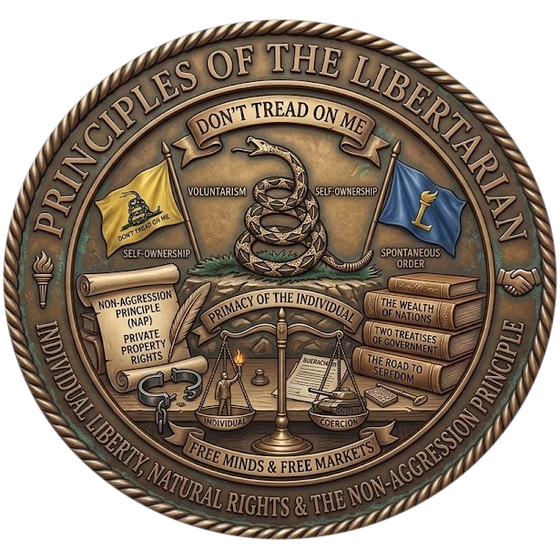


The coin they should have minted in 2008. And 2013. And 2022.
What Is a Libertarian?
The answer is shorter than you think. The implications are bigger than you were told.
A libertarian is someone who believes you own yourself — and takes that belief seriously all the way to the end of the argument. Not “you own yourself unless a majority votes otherwise.” Not “you own yourself except where a bureaucrat has a better idea.” You own your body, your labor, your conscience, and the fruits of your work — and so does everyone else, which is exactly what stops the whole thing from being an excuse for selfishness. Your rights end precisely where the next person’s begin.
Two Axioms. That’s the Whole Foundation.
Every political philosophy has load-bearing walls. Most have dozens, and they contradict each other. Libertarianism has two:
Axiom I — Self-Ownership
You are the sole rightful owner of your body and your life. Nobody else holds a claim on you — not a king, not a party, not 50.1% of your neighbors. Everything else in the philosophy is derived from this single premise.
Axiom II — The Non-Aggression Principle (NAP)
No person or institution may initiate force, fraud, or coercion against another. Defending yourself is legitimate. Starting the violence is not — and it doesn’t become legitimate because the person starting it wears a badge, holds an office, or won an election.
That’s it. Everything a libertarian believes about taxes, war, speech, guns, drugs, marriage, and markets is those two axioms applied consistently. The consistency is the point — and it’s what makes the philosophy uncomfortable for both major parties, each of which loves liberty in the rooms where their donors live and despises it everywhere else.
The Hinge Is Consent
Both axioms turn on one word: consent. Self-ownership means nobody may act on your body without it. The NAP defines aggression as force, fraud, or coercion imposed without it. So before the philosophy does any work at all, consent has to mean something real — and it does. Consent is not a word someone says. It is a capacity someone has, which is why a child cannot give it and why an adult who overrides that fact is committing the most complete violation of the NAP there is.
That argument is made in full — the capacity test, the answer to the smear, where we stand on trans adults, why the child question is a consent question and not a trans question, and the symmetry that condemns forced conversion and rushed medicalization alike — in Article LXIII of the Manifesto: Trustees, Not Owners.
What Follows From the Axioms
- Property rights. If you own yourself, you own your labor; if you own your labor, you own what it produces and what you trade it for. Property isn’t greed — it’s self-ownership extended into the world.
- Free markets. A market is just millions of voluntary trades between consenting adults. Every trade that isn’t coerced makes both sides better off by their own judgment — nobody trades down on purpose.
- Voluntarism. Anything worth doing together — charity, mutual aid, insurance, education, community defense — is more legitimate and usually more effective when people choose it than when they’re conscripted into it.
- Spontaneous order. Language, markets, common law, the internet — the most complex and useful systems humans have were not designed by a central planner. Order emerges from free people cooperating. Planners take credit for it afterward.
- Non-interventionism. The NAP doesn’t stop at the border. A foreign policy of endless intervention is the initiation of force at industrial scale, billed to taxpayers who were never asked and fought by young people who were lied to.
- Skepticism of concentrated power. Not because the people holding it today are villains — but because every power you grant the state outlives the hands you trusted it to. Judge every state power by the worst enemy who will ever inherit it. They always inherit it.
What a Libertarian Is Not
- Not a corporatist. This is the big one. Capitalism is voluntary exchange under competition. Corporatism is corporations capturing the state — subsidies, bailouts, regulatory moats, lobbyist-written law. Libertarians oppose corporatism more fiercely than progressives do, because we oppose the weapon (state power for sale) and not just the current buyer. If a business can only survive by lobbying, it deserves to die.
- Not “no rules.” Libertarianism is a philosophy of rules — starting with the strictest one ever written: you may not aggress against another human being. Ever. What it rejects is rulers, not rules.
- Not left or right. The left wants to control your wallet and free your bedroom; the right wants to free your wallet and control your bedroom. A libertarian notices these are the same claim — that someone else owns part of your life — aimed at different rooms of your house.
- Not utopian. Nobody claims free people produce a perfect world. The claim is narrower and much harder to refute: dispersed power fails smaller, corrects faster, and murders fewer people than concentrated power. The twentieth century ran that experiment at scale. A hundred million dead settled it.
- Not one thing. Libertarianism is a family of schools that argue with each other constantly — which is itself the philosophy working as intended. See the spectrum below.
The Spectrum — One Principle, Many Schools
Ask ten libertarians how small the state should be and you’ll get eleven answers — from classical liberals who want a limited constitutional government, to minarchists who’d keep only courts, cops, and defense, to anarcho-capitalists who’d privatize even those. What unites them is the direction of travel: power flows back to the individual.
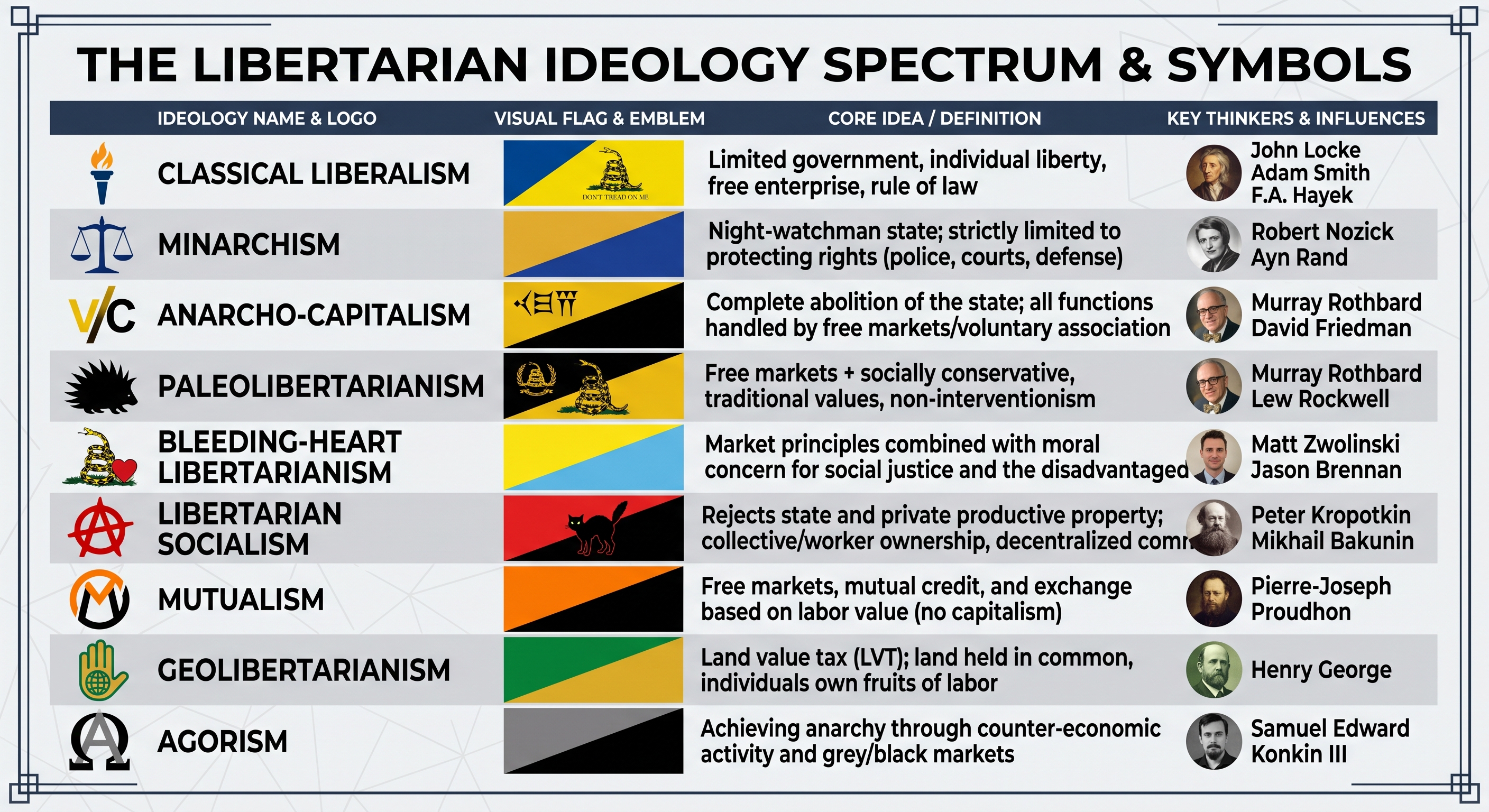
Tap to open full-size. Nine schools, one root: the individual over the state.
The Bookshelf
The coin on this page shows three spines for a reason. If you want the philosophy from the people who built it:
- John Locke — Two Treatises of Government. Natural rights and consent of the governed. The Declaration of Independence is Locke with better handwriting.
- Adam Smith — The Wealth of Nations. Free exchange, division of labor, and the original takedown of state-favored monopolies.
- Frédéric Bastiat — The Law. Ninety pages. Legal plunder, explained so clearly it still stings two centuries later. Start here if you start anywhere.
- F.A. Hayek — The Road to Serfdom. Why central planning drifts toward tyranny even when the planners mean well — especially when they mean well.
- Milton Friedman — Free to Choose. The empirical case, delivered with a smile that infuriated every planner who debated him.
- Murray Rothbard — For a New Liberty. The axioms taken all the way to the end of the road, whether you follow him there or not.
Rapid Fire — The Greatest Hits
“Who will build the roads?”
The same people who build them now — private contractors. The state doesn’t pour asphalt; it takes your money, skims overhead, and hires the low bidder. The question was never who builds roads. It’s whether you need to be threatened to fund them.
“So you just don’t care about the poor?”
Americans gave over half a trillion dollars to charity in a single recent year — voluntarily. Mutual-aid societies had working-class America insured before the welfare state crowded them out. Compassion at gunpoint isn’t compassion; it’s conscription with better branding.
“Show me a libertarian country that works.”
Show me a pure anything country. Every functioning nation is a blend — and its most libertarian parts are usually its working parts. Switzerland’s decentralism, America’s First Amendment, free trade everywhere it’s tried. The manifesto has the full answer.
“Isn’t that just what the corporations want?”
Backwards. Corporations spend billions lobbying for regulation — because compliance costs crush their smaller competitors and moats their market. The Fortune 500 fears a genuinely free market more than any activist does.
Free minds & free markets — individual liberty, natural rights & the non-aggression principle.
The crown can bite me.